







Abstract
This article reports on the findings of a study conducted with 24 women who left violent domestic relationships in Lebanon. The study sought to understand the process of making the decision to leave within the particularities of the Lebanese sociocultural context. Findings elucidate a three-step process by which women make and carry out their decision to leave: 1) focusing on saving the marriage, 2) facing a moment of truth that helps them re-evaluate their experiences within the marriage, and 3) leaving without ‘losing face’. Implications of these findings for research and practice are presented.
Keywords
Introduction
In 1996 Lebanon took a decisive step towards the formal recognition of violence against women with the signing of the Convention on the Elimination of All Forms of Discrimination against Women (CEDAW). Since then, a number of civil society initiatives have attempted to break the silence that surrounds violence against women in general, and domestic violence in particular. Within a context such as Lebanon, where until very recently there have been few support services, the decision to actually leave a violent relationship is one that merits further examination. This article reports on a study conducted by the first author examining the experiences of 24 women who made the decision to leave a heterosexual violent relationship.
A defining element of the Lebanese context that needs to be taken into account in understanding and responding to domestic violence is the religious confessional nature of personal status laws, which, in secular countries, are usually regulated by the state. Despite signing the CEDAW, the Lebanese government has stated its reservation with regards to adopting unified family law (Obeid et al., 2010). There are 18 religious sects that regulate laws concerning matrimonial and family matters across the country. As such, the religious and moral orientations that regulate divorce are not uniform: some communities refuse this practice and shun those who are divorced while others accept and legalize it (Ducruet, 2003). At the heart of the study discussed in this article is an attempt to understand how women within this context come to the decision of leaving a violent relationship and the process that they undertake in doing so.
Situating the study within the scholarship
There is currently an absence of research in Lebanon about women’s decisions to leave violent domestic relationships. The few existing studies have focused on surveying public opinions and perceptions of domestic violence (e.g. Keenan et al., 1998; Khoury and Khoury, 1997; Obeid et al., 2010). In one such survey, conducted with 400 participants in Lebanon, 36 percent of the respondents denied the existence of domestic violence (Khoury and Khoury, 1997). In a more recent study with 206 Lebanese university students, researchers examined attitudes towards ‘wife beating’ (Obeid et al., 2010) and found a positive correlation between these attitudes and traditional patriarchal values, among other factors. In a study of 60 women with a history of domestic violence in their relationships Keenan et al. (1998) sought to understand the cultural context of domestic violence in Lebanon. Findings focused on triggers of the abuse and found them to be related to gender role expectations in the traditional Arab family structure.
Findings of the studies by Khoury and Khoury (1997) and Keenan et al. (1998) describe women in Lebanon as having learned from a very young age how to be dependent and resigned to whatever their marriage holds for them. They are largely presented as silent spouses who would passively accept their violent fate. While these studies further our knowledge of domestic violence in Lebanon, they are problematic because they posit women in the category of ‘victim’. However, as noted in the scholarship from other contexts, wanting and being able to leave a violent relationship is far from being a simple solution to a problem as complex as domestic violence (Barnett, 2001; Belknap, 1999; Griffing et al., 2002; Kim and Gray, 2008).
The scholarship points to a number of barriers that prevent women from leaving violent relationships; these barriers include those of psychological, emotional and cognitive levels (Burman, 2003; Carlson, 1997), as well as external barriers at both cultural and structural levels (Barnett, 2000; Gharaibeh and Oweis, 2009). In this regard, the ‘barrier model’ proposed by Grigsby and Hartman (1997) is illustrative of the internal and external difficulties women face in making the decision to leave a violent relationship. These barriers include familial and social barriers related to role expectations, psychological consequences of the violent relationship, family history of abuse as well as environmental barriers such as the role of informal and formal supports and availability of material resources. Scholars such as Patterson (2009) and Bhuyan (2007) alert us to the need to consider issues such as poverty, immigration status, and lack of affordable housing as important structural barriers that prevent women from leaving violent relationships.
Scholars have also pointed to the salience of sociocultural elements in presenting barriers to women deciding to leave a violent relationship (Acevedo, 2000; Bhuyan, 2008; Gharaibeh and Oweis, 2009; Haj-Yahia, 2000, 2005; Liang et al., 2005; Xu et al., 2001; Yoshihama, 2000, 2002). These authors have noted the sociocultural proscriptions that impact on women’s experiences of staying or leaving a violent relationship, such as keeping family secrets, being submissive and not fighting back. For example, in a study with Japanese women in violent domestic relationships, Yoshihama (2000) notes the importance of not fighting back or being confrontational with their husbands as an important sociocultural strategy. For Chinese women in the study by Xu et al. (2001), not airing ‘dirty laundry’ in public was noted as an important sociocultural value that prevents women from leaving violent relationships. Acevedo’s (2000) study with Mexican women in the United States notes that ‘saving face’, in other words not bringing shame or dishonor to themselves or to their families, is an important value that keeps women in violent relationships.
It is noteworthy that as opposed to the discourse of victimization and passivity present in other studies, the above-noted discussions have emphasized how women perceive strategies of non-defiance of violent spouses and saving face as self-protection, not as weakness. Patterson (2009) notes that women are routinely ‘problematized’ for not leaving a violent relationship and that this is seen as a sign of weakness. Not only is this problematic because it fails to recognize women’s strategies of resistance, but it shifts the focus away from violence as the problem to discourses of women’s passivity. Similarly, in the Lebanese context, we propose shifting from a discourse that espouses the dual poles of victimization to survivorship, and moving to a feminist discourse that privileges women’s stories of their own lives. Considering the diversity of feminist scholarship to understanding violence against women, we find it more useful to discuss two central feminist principles that have informed this study, namely, the importance of intersectionality and strategies of resistance, discussed below.
A principle of direct relevance for this study is the need to centre women’s strategies of resistance (Patterson, 2009; Sabbagh, 1996). As Sabbagh notes, women in Arab contexts are seen as ‘repressed’, downtrodden, and devoid of agency. Indeed, scholars alert us to the impact of colonial and neocolonial discourses on constructing women in the ‘East’ as victims of oppression who need to be rescued (Alloula, 1998; Razack, 2008). The study discussed in this article sought to specifically examine women’s decisions to leave an abusive relationship as an act of agency and resistance. Furthermore, we rely on an intersectional and interlocking feminist analysis that takes into account the impacts of factors such as religion and class as well as the specificities of contexts on women’s experiences (El-Solh and Mabro, 1994; Gharaibeh and Oweis, 2009; Narayan, 1997). As noted earlier in this article, elements of the context have a direct bearing on women’s experiences of violence. Moreover, there is a need to take into consideration the diversity of women’s experiences based on elements such as class and religion, which are of particular relevance in the Lebanese context. By exploring women’s stories of why and how they have chosen to leave a violent relationship, we can glean how they negotiate sociocultural constructions of their roles and how they can be supported in their efforts to do so.
Methodology
The present study adopted grounded theory methodology which aims not to verify theories but to generate theoretical concepts and build theories from empirical data (Glaser and Strauss, 1967; Paille, 1994; Strauss and Corbin, 1990). While this study did not generate formal theory, it sought to illustrate how women’s decision-making processes could be better understood (see Figure 1 in the Findings section of this article). As Charmaz (2004) notes, grounded theory methodology can be used to shed light on research questions concerned with ‘individual processes, inter-personal relations, and the reciprocal effects between individuals and larger social processes’ (pp. 497–8). As such, the study arrived specifically at a theoretical formulation of a three-stage process which the women interviewed undertook to leave a violent relationship. This process expounds on individual processes, interpersonal relations as well as the links between these ‘larger social processes’ (Charmaz, 2004). One of the study’s contributions lies in providing a much needed empirical illustration of the process by which women leave a violent relationship within a specific sociocultural context where this topic has received little if any attention.
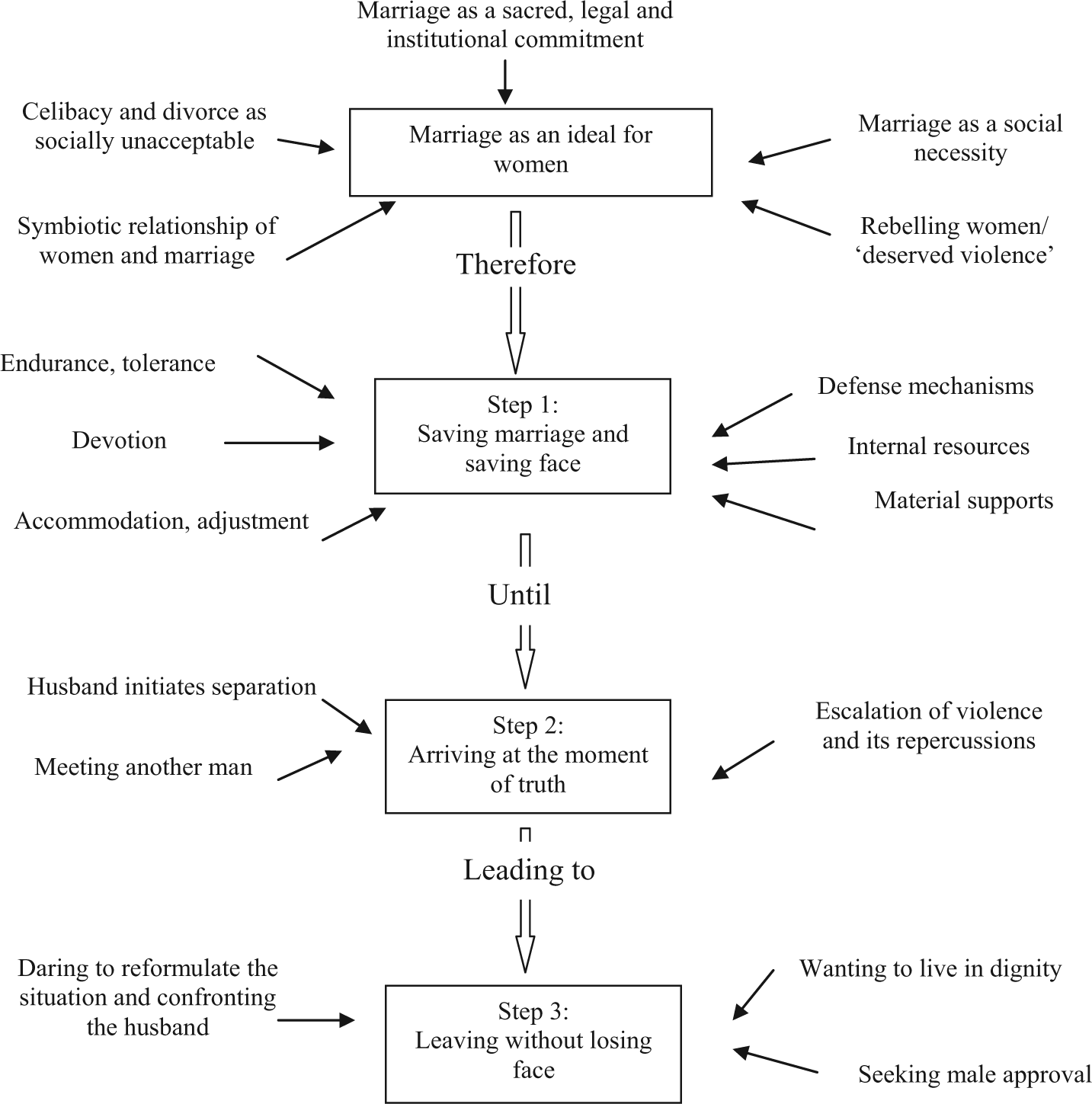
Decision-making process.
Data collection consisted of interviews with 24 women who had left violent relationships in the three years preceding the study, and 14 key informants such as social workers, psychologists, psychiatrists, lawyers, religious clerics and police officers. Findings from key informant interviews are presented in a separate publication. Of the 24 women, all had experienced physical and psychological violence. Their marriages had lasted between two and 27 years, with an average of 12.5 years. Their marital status included being separated or divorced and in some cases having the marriage annulled. In terms of religious background, 60 percent were of various Christian sects while 40 percent were of Muslim sectarian background. The average age was 37 years and the age range was between 23 and 47 years.
In terms of educational background, 4.3 percent of the study participants were illiterate, 7.4 percent had completed primary school, 21.7 percent had completed intermediate school, 26.1 percent had completed secondary school, while 30.4 percent had university degrees, including three women who had completed their degrees after they had separated from their spouses. Two-thirds of the women were employed outside the home, while the rest worked in the home. Participants resided in Beirut (39.1%), and the predominantly rural regions of Mount Lebanon (34.8%) and Bekaa (13%).
Participants were selected relying on a non-probability sampling strategy by ‘network’ (Fortin, 1996) wherein the researcher relies on her contacts to suggest participants. Three such sources were utilized in the present study: socio-medical services in various parts of Lebanon, students in two Lebanese universities (one private and one public) and personal connections, including social work academics. Consistent with grounded theory methodology, purposive sampling continued throughout the study and sought the selection of women with differences in characteristics such as religious background, age, education, years in a marriage, etc. However, it is important to note that the present study is limited in the sense that due to fear of reprisal specifically from their husbands, and due to the sensitive nature of the issues discussed, recruitment was difficult and the study’s sample was limited to women who chose to come forward.
In-depth interviews were conducted in Arabic based on a semi-structured guide focused on the themes of the violence women experienced, their doubts and uncertainties in terms of staying or leaving the relationship, and making a decision to leave. Interviews were transcribed verbatim and subjected to validated translation. Iterative data analysis was conducted following the method of going back and forth between data collection, coding and categorization in sequential steps that led from coding to the development of themes. This process focused on uncovering the relationships between the steps in the decision-making process and the sociocultural context within which this process was undertaken by the participants.
Findings and discussion
Findings indicate three main steps in the process of making a decision to leave and carrying out this decision: focusing on saving the marriage and saving face; confronting a moment of truth; and leaving without losing face. Each of these steps is discussed in detail below and examples are provided from the women’s own narratives; pseudonyms are used to refer to the participants. The decision-making process is summarized in Figure 1.
Step 1: Saving the marriage and saving face
During the first step, women see marriage as highly important and express the need to save it at any expense. This idea was supported by the value of seeing marriage as a ‘social necessity’, as can be seen from these excerpts:
. . . For me, it was finished: him and no one else (. . .). He’s my husband, my family, my place. (35-year-old Christian Catholic woman from a moderate socio-economic and low educational background)
I refuse to be a divorced woman. (. . .) I can’t stand failure. (. . .) Divorce is as much a destruction of the personality as of the home. (48-year-old Muslim Shiite woman of moderate socio-economic and low educational background)
The above excerpts from interviews with women of diverse backgrounds demonstrate the value of importance of marriage and its centrality in women’s lives. The participants almost unanimously consider marriage as a social institution that provides protection for women including from unwanted sexual advances that unmarried or divorced women are seen to be subject to (e.g. ‘our doors are seen as being open to whomever’). Moreover, marriage is seen as a relationship that is entered into permanently, precluding the possibility of divorce, seen as a failure by some women. As noted earlier, such an idea is supported by confessional personal status laws of some sects that make it difficult for women to seek divorce.
In contrast to these ideas, Suzanne presents the value of marriage as a place of women’s rights as a wife. Marriage is seen by her to be the place where she has the right to be respected, valued, and to live in a stable and balanced relationship. Suzanne, a 23-year-old Muslim Druze woman of moderate socioeconomic and educational background, held this belief since the beginning of the relationship:
I always defended myself. I did not accept the bad things he would come up with. I did not play his game: his blackmail with regards to my son, my weak point. He [her husband] wanted to live his life without respecting me, without valuing me, without giving me my rights. (. . .) I wasn’t capable of staying silent and accepting it all.
As such, not all the women interviewed believed in the importance of marriage at all costs. For Suzanne, marriage needs to be a place of respect where good treatment is reciprocal.
Most women interviewed perceived their sense of devotion to be the key to success of ‘competent’ women. In other words, they perceived of themselves as capable of surmounting any obstacle and of having the values and capacities necessary to hold the marriage together. In this sense, they considered themselves responsible for maintaining the relationship. Being centered on saving the marriage and saving face through their devotion, they discussed the need to support their husbands, to help them change and to endure the violence and difficulties of the relationship. Notably, only Suzanne considered working on the marriage to be the equal responsibility of both spouses. The data obtained from the interview with Suzanne presents a ‘negative case’ permitting us to verify the validity of the analysis (Morse et al., 2002). Moreover, Suzanne’s views allow us to render a more nuanced and complex understanding of marriage as a commitment that is negotiated differently by women.
Marriage then is not only a commitment between two people but is also linked to societal expectations about women’s role and how they are perceived in their broader circles. As Mernissi (1996) notes in her discussion of patriarchy within Arab societies, women’s honor and dishonor is closely associated with the value of virginity before marriage and on women’s role as a chaste and committed wife. Kulwicki (2002) further notes that family honor is ensured by the sexual ‘purity’ of women within the confines of a legal marriage. As the findings demonstrate, women understand and negotiate these conceptions by placing a value on the importance of marriage and the need to preserve it at any cost, even if for Suzanne, this is considered to be a shared responsibility. As mentioned earlier, in her critique of Western feminist scholarship on violence against women, Razack (2008) notes that there is a tendency to equate the value placed on family in Muslim and Arab societies as a sign of the repression and passivity of women. However, contrary to these conceptions, the women in the study actually discuss their efforts to preserve their marriages as a sign of competence and strength to surmount any obstacle. Moreover, Suzanne’s example allows us to see the diversity in how women negotiate their understanding of marriage and their roles within it, hence the importance of not assuming cultural homogeneity of women within Arab contexts.
Step 2: Arriving at the moment of truth
Interviewees reported that the belief in their own capacities to save their marriage eventually erodes with the physical and psychological fatigue they experience. This culminates in a moment of truth wherein the women suddenly recognize certain facts that they had long denied or misunderstood. During this step, the women who were categorically against divorce discuss the following triggers that pushed them to think about leaving: the husband initiates separation through infidelity, indifference or polygamy; the violence escalates thereby posing a danger for the children; there is a sense that the losses outweigh the gains and a failure of negotiations; they enter into a positive relationship with another partner.
For many of the participants, feelings of being abandoned by her husband through infidelity, indifference or polygamy present important triggers that allows them to re-evaluate their past experiences and see how after many years of self-sacrifice, they had been neglected or let down by their husbands:
To find oneself relegated to a secondary status after all these sacrifices is incompatible with the self-sacrifice of the loyal, loving spouse. (46-year-old Muslim Sunnite woman of high socio-economic and educational background)
For eight of the participants, the escalation of violence and its potential impact on their children was the trigger that allowed them to consider leaving the relationship. Sensing their inability to protect their children and feeling that they should not be raised in a violent environment, these participants were pushed to think of leaving the relationship. As Oznac, a 50-year-old Christian Armenian woman of low socio-economic and educational background, explains: At the end of all these sacrifices there is certainly death (. . .) for me or for one of my children.
For other participants, the realization that negotiating with their spouses was futile and that the losses outweighed the gains, were important turning points; as Suzanne shares: . . . You’re beaten, ok. If you’re making the most of life, ok. But beaten, humiliated, sequestered (. . .) Living a dog’s life is not worth it.
Two participants made the decision to leave after meeting men who were loving towards them. Both women noted with shame the presence of another man, expressing that this is a transgression of social norms related to marriage, even if they had been suffering. They explain that meeting another man awakened in them their feminine image long shattered by their husbands. For the first time, they begin to recognize the unhappiness in their lives, and were willing to defy the social norms surrounding modesty and propriety for married women. As Marie explains: The fact that he put his hand on my shoulder shook me. (. . .) That day, I decided to leave. I think that this process of reconstruction, (. . .) a man who rediscovered me as a woman, (. . .) intelligence, beauty, a body that could be desired and loved was radical for me.
In sum, these findings demonstrate that in the midst of their ambiguity about whether to stay or leave, women reach the limits of their endurance. They abandon the belief that they had enough power over their spouses to make them change and they articulate several turning points, specific events and moments that lead them to a new orientation in their lives and triggered their decision to leave. The moment of truth is hence an important step in women’s decision-making process.
This step threatens their social acceptability as married women, and as such, the participants tried to justify their decision to leave so as to not lose face, for themselves and their extended families (discussed in more detail below). With the exception of two women who dared to mention the presence of another man, the other participants situated their stories and reasons for deciding to leave within socially acceptable norms, while searching for alternative values (e.g. wanting to live in dignity – discussed below) to implement their decision to leave. Like the women in previously noted studies (e.g. Acevedo, 2000; Xu et al., 2001), the women in the present study noted the predominance of sociocultural proscriptions on their behaviors and the need to save face. However, findings demonstrate women’s ability to surmount not only their own personal feelings and reservations, but also to confront and challenge sociocultural conceptions of their primary role as wife, albeit with the ever-present concern of saving face.
Step 3: Leaving a violent relationship: Dignity, reformulation and saving face
For the participants, leaving a violent relationship is tied to saving face for themselves and their families, which includes their extended family members especially the men in the family – brothers, fathers, etc. This is the final step in the process of deciding on, and carrying out, the decision to leave, and it consists of three stages: wanting to live in dignity, daring to reformulate the situation they are living through, and finally leaving without losing face.
For 22 of the participants, wanting to live in dignity is the substitute value that replaces their unattainable ideal of having their marriage stay intact despite the violence they are experiencing. It is noteworthy that two of the participants had not defined for themselves a value that would replace the importance of marriage. They justified their decision to leave out of fear. They regret their decision to leave in haste and continue to hold on to marriage and its advantages. Despite being out of their relationships for close to two years, they await any glimmer of hope to return to their spouses. These women regret their departure and wait for the opportunity to return to their husbands. Once again, these two women’s interviews present negative cases that allow us to see the complexity inherent in making the decision to leave. Specifically, there is diversity in how women negotiate the steps of the process and what allows them to arrive at the final step of leaving. As will become apparent below, this process involves not only finding alternative values, but also finding family support and being able to save face.
For the majority of the participants, wanting to live in dignity was the end of the journey that pushed them to leave their relationships. As Nadine, a 35-year-old Christian Catholic woman of moderate socioeconomic and high educational background, says: . . . I could no longer help myself or my kids. (. . .) I want to live with dignity. (. . .) I understood life in another way. I was free on a moral level.
In arriving at this decision to want to live in dignity, the participants undertook the process of reformulating their situations; in doing so, they expressed feeling the power and courage to try new responses to old problems, notably challenging their spouses instead of trying to accommodate them. Armed with a new interpretation of their experiences, women dared to challenge their spouses. Discussing the courage that it took her to challenge her husband, Marie-Claude, a 40-year-old Christian Catholic woman of low socio-economic and educational background, tells this story: As usual, he denied everything (. . .). A month before, he had beaten me to death (. . .) I left to complain to the police. (. . .) I hid a flannel shirt covered in blood from when I had started bleeding. (. . .) When my mother came (. . .) and told me that he had called me a liar, I gave her the flannel shirt and told her to tell him that it had been certified by a forensic doctor. At that moment, he began to tremble with fear.
The audacity that women express in choosing to challenge their husbands at once escalates the violence and pushes them forward in their decision to leave. However, to actually leave without risking becoming socially marginalized, they need to do so without losing face. In this regard, they take the final step of leaving usually following an emotionally charged encounter with their husbands, they search for rational justifications and seek out the support of others for their decision to leave.
For 23 of the participants, the actual act of leaving can be described as a departure that occurred in light of an emotionally charged situation such as fear, reaching the end of their endurance, and desperation. During those situations, women believed that their husbands would actually carry out their threats of killing them. As such, women feel like they have to choose between living or dying and they choose the former. Madeleine describes her fear and the choice she made to escape: He had lost at the horse races. He broke stuff, he hit (. . .). I can’t see me repeating his cruelty. The essential thing is that as usual he threw me and my daughter out. I was shaking: he had never been this violent. My daughter almost fainted in my arms. Since then, I have not returned.
Only one of the participants, Suzanne, negotiated her leaving of the relationship in a way that was not emotionally charged; she actually paid her husband a sum of money to allow her to leave, thereby ‘buying her own divorce’. Once again, Suzanne’s case presents us the opportunity to explore the complexity of decision-making and how it is impacted by factors such as socioeconomic status.
In addition, 22 of the participants looked for rational justifications to support their decision to leave. Specifically, they explained that they had long fought to keep their husbands and to keep their marriage intact but that their husbands had refused to negotiate or compromise. Moreover, for many of the participants, it was important to seek support from their social network for their decision to leave. Specifically, they sought positive feedback from the males in their families, notably their fathers or brothers, not as a shoulder to cry on or for advice but as a source of validation for their decision. Marie-Claire discusses the value of the support she received from her brother: I told my father and brothers that a settling of accounts was going to happen when I returned home. (. . .) When he came back two days later ordering me to ‘be back home in two hours or else!’, my brother told him: ‘if you don’t leave of your own will, I will throw you off the balcony; you’re wrong if you think this woman has (. . .) no men behind her’. Since then, his tone during our divorce negotiations has changed.
In the absence of family members such as brothers or fathers, some participants relied on their older children to carry out their decision to leave. For Oznac, even the gender of her child is important: ‘(. . .) even if a girl is 50 years old, she can’t confront her father, whereas my son told his dad ‘‘from now on, I am responsible for my mother and sisters’’’. In contrast, one participant who could not count on her parents or family turned towards the convent and her faith to implement her decision to leave. Mona says: This time I didn’t go to my parents so that they would bring me back [home]. I told myself, I would rather die on the road than to live in his home. (. . .) This is how I knocked on the convent’s door.
The participants noted that when they decided to stop the violence through divorce that they left the realm of social acceptability for women and risked social marginalization. The approval of the father or brother has the potential to help the woman to not be stigmatized in her environment. As Marie says: . . . A father is not going to be in agreement with his daughter if she’s wrong. So, he legitimated my actions and validated my image.
In short, wanting to live in dignity, as a value that replaces the importance of marriage at all costs, constitutes for the participants a legitimate and accessible goal. While this may be a legitimate goal, their decision to leave and the actual act of leaving have to be carried out without losing face; however, there is an emphasis placed not only on the woman’s individual social face but also on family honor. In order to save this collective face, they need to engage in the preventative action of gaining the support and approval of others, notably male family figures.
As these findings indicate, the decision to leave is not simply an individual one conceived and carried out by the women, but is in fact, relational in nature, because it impacts family relationships and honor and is situated within broader proscriptions on women’s personal relationships (e.g. personal status laws concerning divorce). Indeed, Fanslow and Robinson (2010) as well as Wendt and Cheers (2002) note the importance of outreach to family and friends and the broader community to assist women in dealing with violent relationships. Similarly within the Lebanese context, Joseph (1993, 2000) notes the importance of extended family relationships in her discussions of Lebanese families and highlights the emphasis placed on being connected to others in immediate social circles, such as relatives and neighbors. The author links this importance accorded to ‘connectivity’ with the Lebanese sociocultural context where formal social supports are quite sparse; in other words, in the absence of state services and supports, people turn to one another for needed assistance. In addition, considering that preserving the honor of female siblings is the responsibility of male kin (primarily brothers and fathers), gaining their sanction for the decision a woman has already taken to leave a violent relationship is of great importance.
As such, for the women in the study, engaging in preventative measures to avoid losing face is far from being simply a ‘cultural’ value inherent in being Lebanese. As Joseph (1993, 2000) notes, the family’s importance is not merely a cultural value but a sociocultural necessity. Hence, for the women in this study, avoiding losing face is a way of avoiding social marginalization in a sociocultural context where their survival will depend on their relationships to others in their environment. As Brosi and Rolling (2010) note, women’s decision-making process is shaped by their ability to navigate dominant cultural narratives in ways that allow them to re-story their own experiences as being about strength and survival.
Moreover, for women who cannot or choose not to rely on family support, religious institutions provide at times a safe space. However, it should be noted that these faith-based institutions may not always be supportive of women’s decision to leave, especially considering the religious confessional nature of family laws in Lebanon. For one of the participants, the decision to seek help from a faith-based institution was a positive experience; however, this may not be the case for all women in similar situations.
Concluding thoughts: Implications for research and practice
This article has presented the findings of a study conducted with Lebanese women who made the decision to leave violent domestic relationships. As demonstrated in this article, this decision-making process is at once rational and relational. Women became aware of their situation and made a conscious decision based on their understanding of their own actions and the probable consequences. Yet, this decision was also relational in the sense that women sought social supports and aimed to make their decision to leave while preserving their ability to remain socially integrated (e.g. by seeking male support and saving face). In a sense, these women reinvented a form of social adaptation that responds to their own needs as well as the realities of their context.
Findings of this study hold several implications at the interconnected levels of practice and research. First, considering the importance of the context in shaping women’s experiences, more studies are needed that explore the salient elements of the Lebanese context that shape what formal supports are available for women leaving violent relationships. These studies would allow us to find the gaps in services and seek to improve interventions in ways that are consistent with the local context. For example, social work interventions must include advocacy for legislative changes that respond to the specificities in the current systems that do not support women’s decisions to leave or respond to violent relationships. Such contextual specificities include confessional and sectarian civil status laws noted earlier that regulate matters such as marriage and divorce in Lebanon. Moreover, for currently available services, it would be important to evaluate whether they actually take into account the impact of the sociocultural context on women’s experiences of leaving, and thereby negotiate the risk of social marginalization.
Second, further research should explore the types of formal supports that women require to leave violent relationships. For women who do not have the support of family members or choose not to rely on the support of religious institutions, the options are limited and circumscribed to formal supports. Yet, without knowing what the women themselves require in terms of supports, we risk recreating a situation wherein services are imposed, without taking into account preferences or their lived realities within the sociocultural context. It would be equally important to explore the further experiences of women who have left violent relationships and whether these women do in fact experience marginalization, and if so, how it plays out once they have left or become divorced. On a related note, further research may be enriched by garnering the input of family members such as brothers and fathers who emerge as important potential allies and supports for women.
Finally, for services and programs to succeed, there is a need for coalition work to have a solid base of formal support from women’s organizations, human rights organizations, and other civil society organizations concerned with issues of equity and violence. As noted earlier, there is a need to continue to advocate at the level of personal status laws that regulate marriage and divorce and women’s roles. This is especially key considering the great influence of religious and confessional laws, institutions and groups in Lebanon. Specifically, due to pressures from such groups the law for the protection of women against family violence was rejected in 2012 in Parliament after it had been supported by the council of ministers in 2010. Within such a context, the work to end violence against women in all its forms cannot be undertaken solely by groups focusing narrowly on this issue; working together to change societal values, challenge oppressive legislations such as confessional personal status laws and create a just society needs to be a joint commitment of civil society organizations concerned with human rights and equity in all sectors of Lebanese society.
Footnotes
Funding
This research received no specific grant from any funding agency in the public, commercial, or not-for-profit sectors.