







Abstract
The goal of the study was to explore the relationship between personality characteristics and the development of resilience in the context of social work. To do this, combining the transverse and longitudinal approaches, we investigated 479 students and professional social workers. For students, the within-subject analysis shows that this group, while pursuing a university degree, are reaching greater openness, accountability, extraversion and kindness and, by contrast, are reducing their levels of neuroticism, which is the personality trait that acquires smaller presence on the professional stage. The regression results also confirmed the influence and predictive ability of personality traits on the resilience of students and social workers.
Introduction
In the field of social science, resilience has been analysed as a bio-psycho-social process that develops naturally rather than as an extraordinary response to adversity that only develops in exceptional individuals (Baruch and Stutman, 2006). All people, groups and communities are potentially resilient, although the development of resilience is not automatic, absolute or stable; rather, resilience is the result of a complex combination of interacting factors that occur when difficult and adverse situations arise (Buikstra et al., 2010; Cirulnyk, 2001; Grotberg, 1995; Masten, 2001).
Numerous studies have attempted to identify the presence and intensity of resilient personality traits that, together with social and environmental factors, allow individuals to experience a ‘. . . dynamic process encompassing positive adaptation within the context of significant adversity’ (Luthar et al., 2000: 543). Their findings show that certain personality traits help to overcome adversity, such as good humour, being socially responsible, adaptable and tolerant, having good self-esteem, self-discipline and self-control, as well as having planning, problem solving and critical thinking skills (e.g. Garmezy, 1984, 1991; Rutter, 1979, 1985; Werner and Smith, 1992).
These personality traits have been defined as protective factors in the development of resilience, which Grotberg (1995) grouped into personal strengths (I am), personal skills (I can), and social support factors (I have). I am refers to inner strength and the personal attributes presented by the resilient individual that can be predictors of resilience and that may also be associated with classic personality traits (McCrae and Costa, 1986). The dominant model of personality assessment in adults in recent years is the Big Five model. It suggests that there are five main factors of personality: Openness, Conscientiousness, Extraversion, Agreeableness and Neuroticism (OCEAN) (Costa and McCrae, 1992; Goldberg, 1993; Paunonen, 2003; Young and Schinka 2001). The greatest empirical support for this model has been provided by Costa and McCrae (1992). These authors view personality as a group of basic behavioural tendencies that influence thought, emotions and actions, and that are associated with the main mechanisms through which people face adversity. According to the authors, neuroticism positively correlates with hostile reactions to stressful events. Extraversion correlates with tendencies such as planning rational actions, having positive thoughts and defusing stress via humour. Openness correlates with fantasizing and defusing stress via humour. Conscientious individuals are generally more adaptable than others and have an increased learning capacity.
Following this model, recent studies in adult populations found that resilience is negatively associated with neuroticism and positively associated with extraversion, openness and conscientiousness, whereas no significant association was found with agreeableness (e.g. Campbell-Sills et al., 2006; García-Izquierdo et al., 2009).
Like resilience, personality traits are not static over a person’s lifetime but are subject to transformation or gradual changes caused by biological factors, learning, and sociocultural conditions (Gonzalez, 1987). Within the setting of social work, resilience has usually been analyzed as a variable that should be encouraged among the clients (e.g. Gilligan, 2004; Guo and Tsui, 2010; Norman, 2000). Nevertheless, no study has investigated the process of resilience in social work students and social workers and its association with their personality traits.
In Spain, up to the academic year 2011/12, a university degree course in social work takes three years, during which period the students acquire the skills needed to carry out their professional work in managing and mediating situations distressing to individuals, families, groups, organizations and communities (ANECA, 2004). Although these contexts can also become a source of distress to the social workers themselves (e.g. Contreras, 2008; Coyle et al., 2005), they can also be settings in which they can overcome difficulties, increase their capacity for adaptation, and experience positive emotions (Menezes et al., 2006). In addition, different studies have analysed job satisfaction among social workers and the factors that influence it, showing that they learn from their experience and the difficulties encountered, empowering them to respond to new challenges and situations in which they have to intervene (e.g. Arches, 1991; Collins, 2008; Farmer, 2011). These skills and attitudes are synergic with resilience considered as a process that develops throughout professional life (Luthans and Youssef, 2004; Palma-García and Hombrados-Mendieta, 2014).
Thus, studying social work at university and practising it professionally can be seen as contexts in which the students and social workers can develop resilience. This study analysed the personality traits that are positively associated with developing resilience among social work students and social workers and investigated the following hypotheses: 1) social work students and social workers have personality traits that are positively associated with resilience, in particular, extraversion, openness, and conscientiousness; and 2) students develop these traits during their university course.
Method and materials
Analytical framework
This study followed a combined cross-sectional and longitudinal design. The cross-sectional approach was applied to the social workers in order to analyse the relationship between their personality traits and resilience. The longitudinal approach was applied to the social work students to allow personality changes to be analysed in the course of their training over one academic year.
Participants
The study included 479 participants from the province of Malaga (Spain); of these, 304 were social workers and 175 were students who were studying a three-year degree course in social work at Malaga University (Table 1). The students were chosen from the entire group of enrolled students, thus obtaining a representative sample of the three courses of the degree in Social Work. They participated in both the first and second measurements: during the first measurement there were 175 participants; during the second measurement, at the end of an academic year, there were 111 repeat participants. There was 64 percent participant retention in the longitudinal analysis, which, according to Rutter (1993), confirms the validity of the analysis of resilience as a process. Of the students who did not participate in the second measurement, some had left university, others refused to participate, and others were excluded because their identification code could not be verified.
Sample distribution by category and time of measurement.
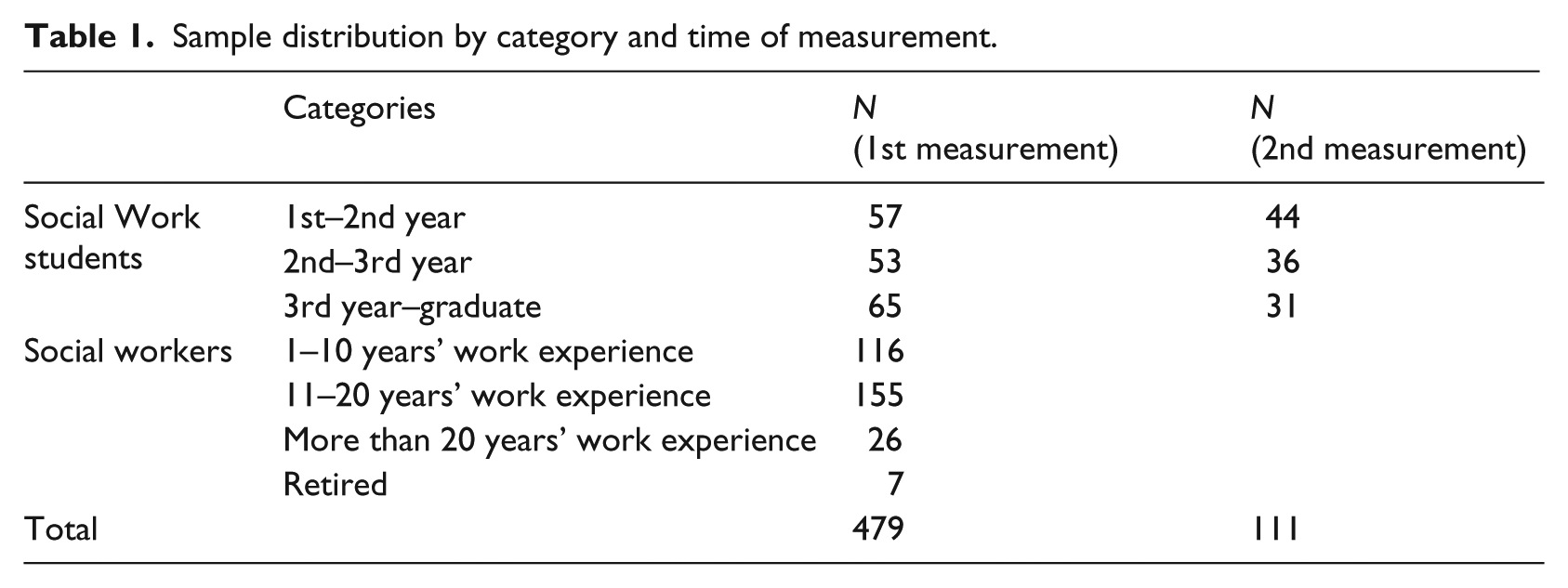
The participating social workers were chosen from the members of the Association of Graduates in Social Work of Malaga (N = 1570) using probability sampling from a finite universe, with a 95 percent confidence level and 5 percent sampling error. They were randomly selected according to representative criteria regarding age, gender, professional field and work experience based on the register of Social Workers in Málaga. Their mean age was 39 years (SD = 9.15); 84 percent were women and 16 percent were men. They mainly worked in social services (52%), followed by social organizations (14%), public health (12%) and other professional settings (22%). The social workers only participated in the first measurement.
Instruments
Personality traits
The Big Five factor model (Costa and McCrae, 1992; John, 1990) obtained from Brody and Ehrlichman (2000: 26–27) was used to evaluate the personality traits of the participants. The following dimensions were analysed on a five-point Likert-type scale of 25 items: Neuroticism (N: negative emotionality); Extraversion (E: sociability and positive emotionality); Openness (O: cultural and intellectual curiosity); Agreeableness (A: interpersonal confidence and friendliness); and Conscientiousness (C: impulse control and organization). The instrument has good internal consistency with a Cronbach alpha of .81 for neuroticism, .73 for extraversion, .76 for openness, .85 for agreeableness; and .88 for conscientiousness.
Resilience
Resilient factors were established according to the model proposed by Grotberg and were assessed using an instrument consisting of three subscales: I Can, I Am, and I Have. The first two subscales were taken from the Spanish version of the Resilience Scale (RS) (Heilemann et al., 2003; Wagnild and Young, 1993). The first subscale assesses acceptance of self and life via eight items referring to I Am, indicating adaptability, balance, flexibility and a stable life view (e.g. ‘I am able to accept things without getting upset’). The second subscale assesses personal competence via 17 items referring to I Can, indicating self-confidence, independence, determination, endurance, empowerment, ingenuity and perseverance (e.g. ‘I can overcome difficulties because I’ve experienced them before’). The third sub-scale assesses social support via five items referring to I have, indicating the external support received and perceived by the individual (e.g. ‘When faced with a problem, I find someone who can help me’). This subscale was taken from an instrument specifically constructed for use in a previous study (Dash et al., 2006). The global instrument consists of 30 items and measures the level of agreement or disagreement with the dimensions described on a seven-point Likert-type scale (1 = strongly disagree; 7 = strongly agree). Cronbach’s alpha was .72, .86, and .85 for the subscales of personal competence, acceptance of self and life, and social support.
Procedure
The instrument was applied twice. In the first measurement, data were collected from all the social work students and social workers participating in the study. The students were enrolled in a three-year course in Social Work at the University of Malaga. They filled in the instrument at the Faculty of Social and Work Studies and were informed they were participating in a longitudinal study. They were assigned an identification code for the second measurement. The social workers only participated in the first measurement. The instrument was administered to them in collaboration with the Colegio Profesional de Diplomados en Trabajo Social de Málaga (College for Registered Social Workers of Malaga) and the managers of the public administrations and social organizations where they worked. In the second measurement, the instrument was again administered to social work students (the repeat participants) after a full academic year had passed.
Results
Personality traits of social work students and social workers
Pearson’s correlation test was conducted to analyse whether age was associated with personality variables. The association was very low in all cases. As age increases, openness (r = −.06, p = .18) and agreeableness (r = −.03, p =.43) decrease, whereas extraversion increases (r = −.08, p =.06). However, these correlations were not statistically significant. The only personality variables that significantly correlated with age were conscientiousness (r = .09, p = .02) and neuroticism (r = −.11, p = .01). That is, as age increases conscientiousness increases and neuroticism decreases in social work students and social workers, although this association remains very low.
Various personality variables were analysed to investigate potential gender differences. A nonparametric Mann-Whitney U test was conducted given the large difference in sample size (men, N = 74; women, N = 405). Significant differences were found in agreeableness alone (z = −2.63, p = .008). Women were slightly more agreeable (M = 4.20, SD = .54) than men (M = 4, SD = .58). No statistically significant differences were found in the remaining variables: openness (z = −1.46, p = .14), conscientiousness (z = −1.48, p = .13), extraversion (z = −.70, p = .50), and neuroticism (z = −1.28, p = .20).
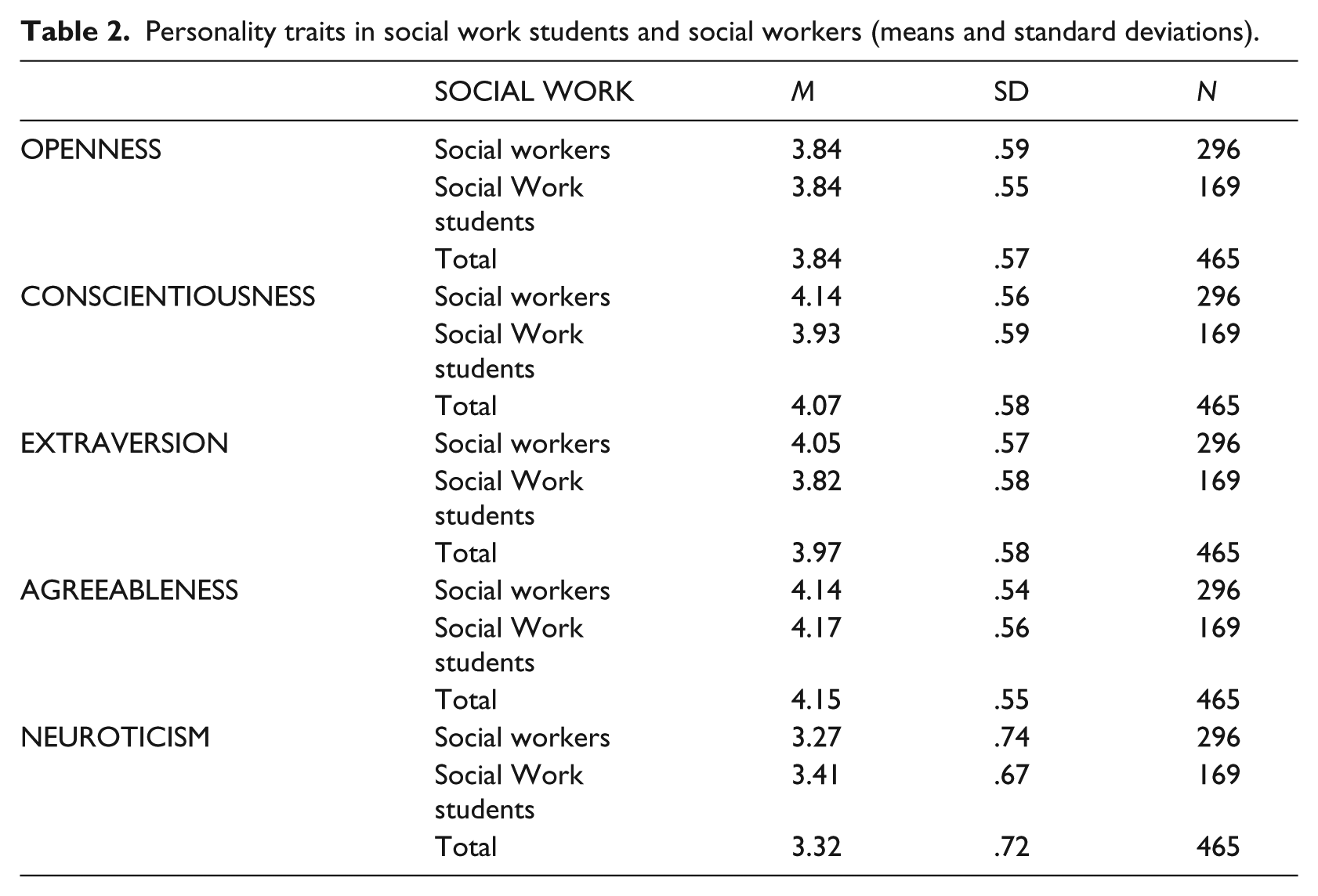
A MANOVA was used to determine differences in personality traits between the social work students and social workers, where the independent variable was being a student or social worker and the dependent variables were the dimensions openness, conscientiousness, extraversion, agreeableness, and neuroticism. Statistically significant differences were found in personality traits between students and social workers (Pillai Trace = .915, F (1,463) = 8. 55, p = .001, η2 = .90).
As shown in Table 2, significant differences were found in the dimensions responsibility F (1,463) = 14.44, p = .001 and extraversion F (1,463) = 17.46, p = .001. The social workers were more conscientious and extroverted than the students. Significant differences were also found between the groups in the dimension neuroticism; the students obtained higher scores than social workers F (1,463) = 4.46, p = .03. However, no significant differences were found between students and social workers in openness F (1,463) = .01, p = .99 and agreeableness F (1,463) = .29, p = .58.
Personality traits in social work students and social workers (means and standard deviations).
Personality traits in social work students
A longitudinal analysis of the students was conducted to analyze how their personality traits developed over time. A repeated measures analysis of variance was performed using the course year (1st, 2nd, 3rd or graduate) as the between-subject factor, and the repeated measure (previous year and current course) as the within-subject factor. This analysis was repeated for each dependent variable (openness, conscientiousness, extraversion, agreeableness and neuroticism).
The results show statistically significant differences in the dimension openness between the means of the two courses analyzed, F (1,104) = 10.70, p = .001. That is, the students presented more openness during the current course (second measurement) than in the previous course. No significant differences were found between courses F (2,104) = .31, p = .73 and no interaction effect was found between this variable and the repeated measurement, F (2,104) = 2, p = .15 (Figure 1).
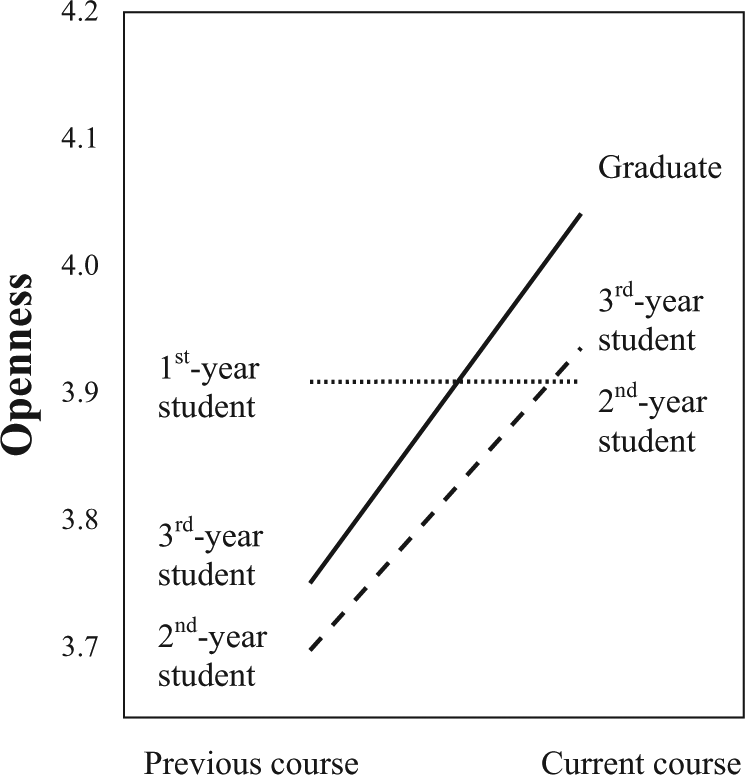
Differences in openness in social work students between the first and second measurement after one academic year.
Regarding the dimension conscientiousness, the repeated measures analysis of variance showed that there were significant differences between the means of the previous course and current course, F (1,105) = 11.29, p = .001. That is, the students presented more conscientiousness after one academic year as shown by the within-subjects analysis. However, no statistically significant differences were found between courses, F (2,105) = 1.15, p = .32, and no interaction effects were found between this variable and the repeated measurement, F (2,105) = 0, 38, p = .67 (Figure 2).
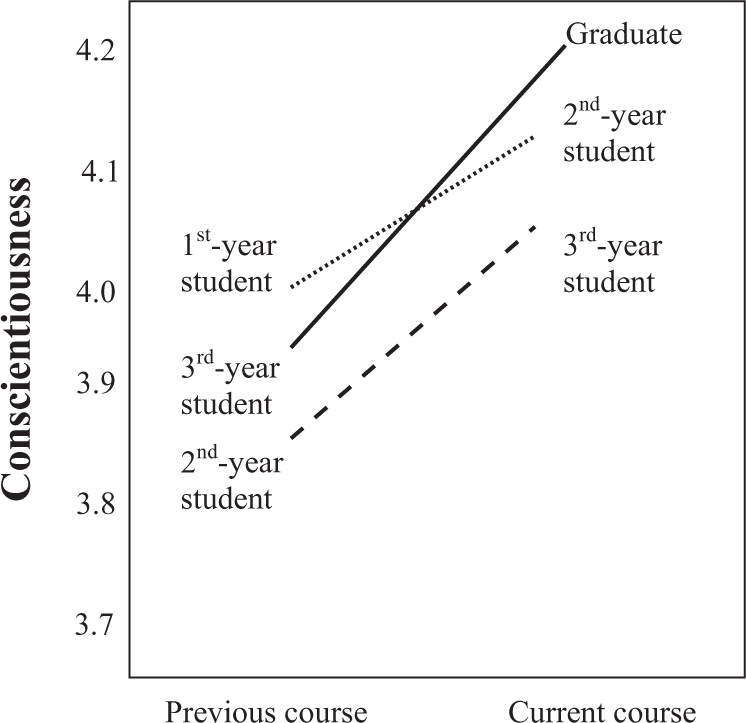
Differences in conscientiousness in social work students between the first and second measurement after one academic year.
The results show statistically significant differences in the dimension extraversion between the means of the previous course and the current course, F (1,103) = 12.54, p = .001. That is, the students were more extroverted after one academic year. The within-subject analysis showed an increase by the time of the second measure, whereas no statistically significant differences were found between courses, F (2,103) = 2.42, p = .09 (Figure 3).
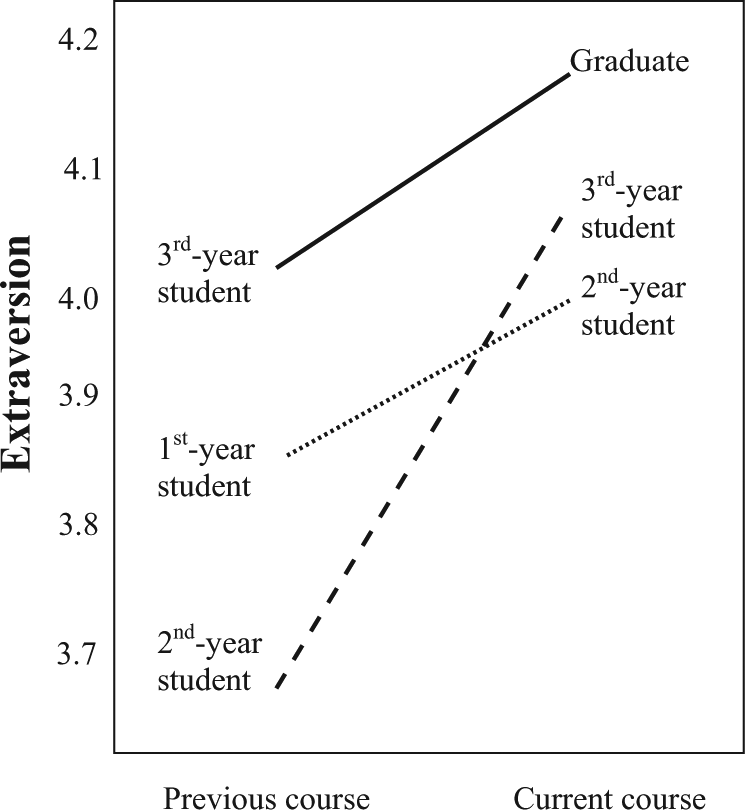
Differences in extraversion in social work students between the first and second measurement after one academic year.
For the dimension agreeableness, statistically significant differences were also found between the means of the two courses F (1,104) = 6.13, p = .015. However, the between-subject analysis showed no significant differences between courses F (2,104) = 2.61, p = .078, and no interaction effects were found between this variable and the repeated measure, F (2,104) = .092, p = .91 (Figure 4).
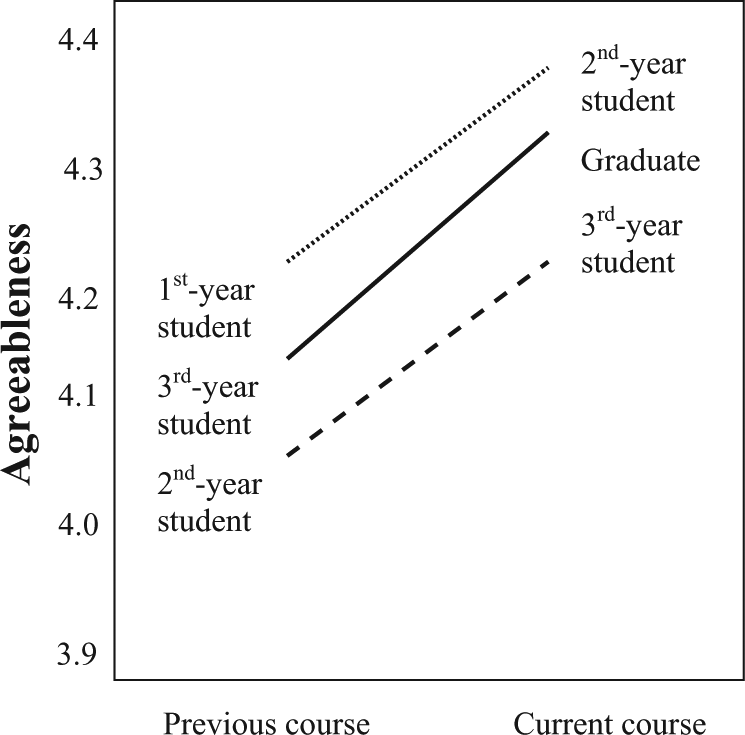
Differences in agreeableness in social work students between the first and second measurement after one academic year.
The results show that there were no statistically significant differences for the dimension neuroticism between the means of the two courses analysed F (1,108) = 1.64, p = .203. There were no significant differences between courses, F (2,108) = 0, 033, p = 0, 967, and there were no interaction effects between this variable and the repeated measurement F (2,108) = .341, p = .712 (Figure 5).
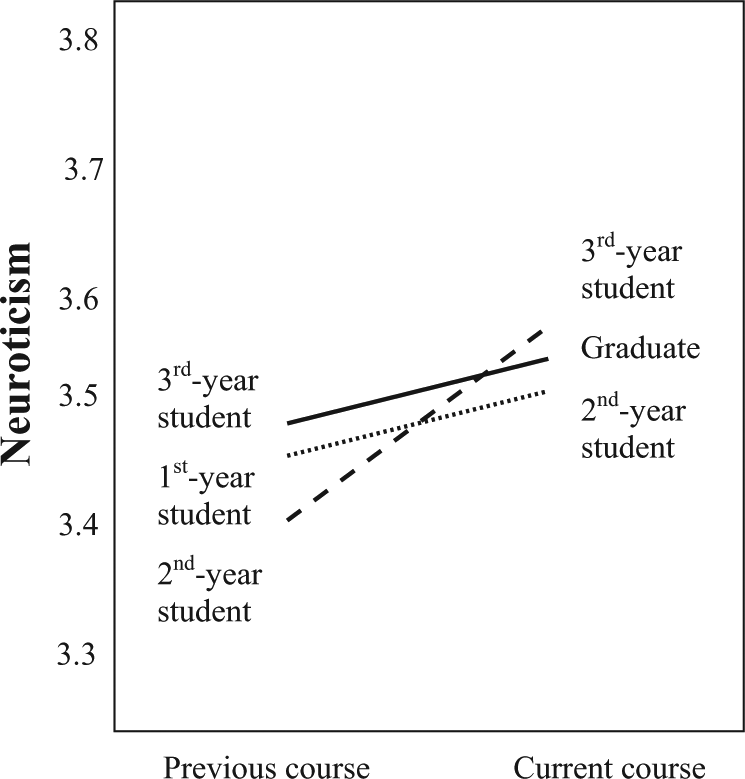
Differences in neuroticism in social work students between the first and second measurement after one academic year.
Overall, the results show that social work students who completed an academic year or graduated significantly increased in openness, conscientiousness, extraversion and agreeableness between the first and second measure. The exception was neuroticism.
Personality and resilience in social work students and social workers
The association between personality and resilience was investigated using a regression analysis in which the independent variables were personality traits (openness, conscientiousness, extraversion, agreeableness and neuroticism) and the dependent variables were the different components of resilience (self-acceptance, personal-competence and social support) (Table 3).
Regression analysis of the dimensions of personality and the components of resilience.
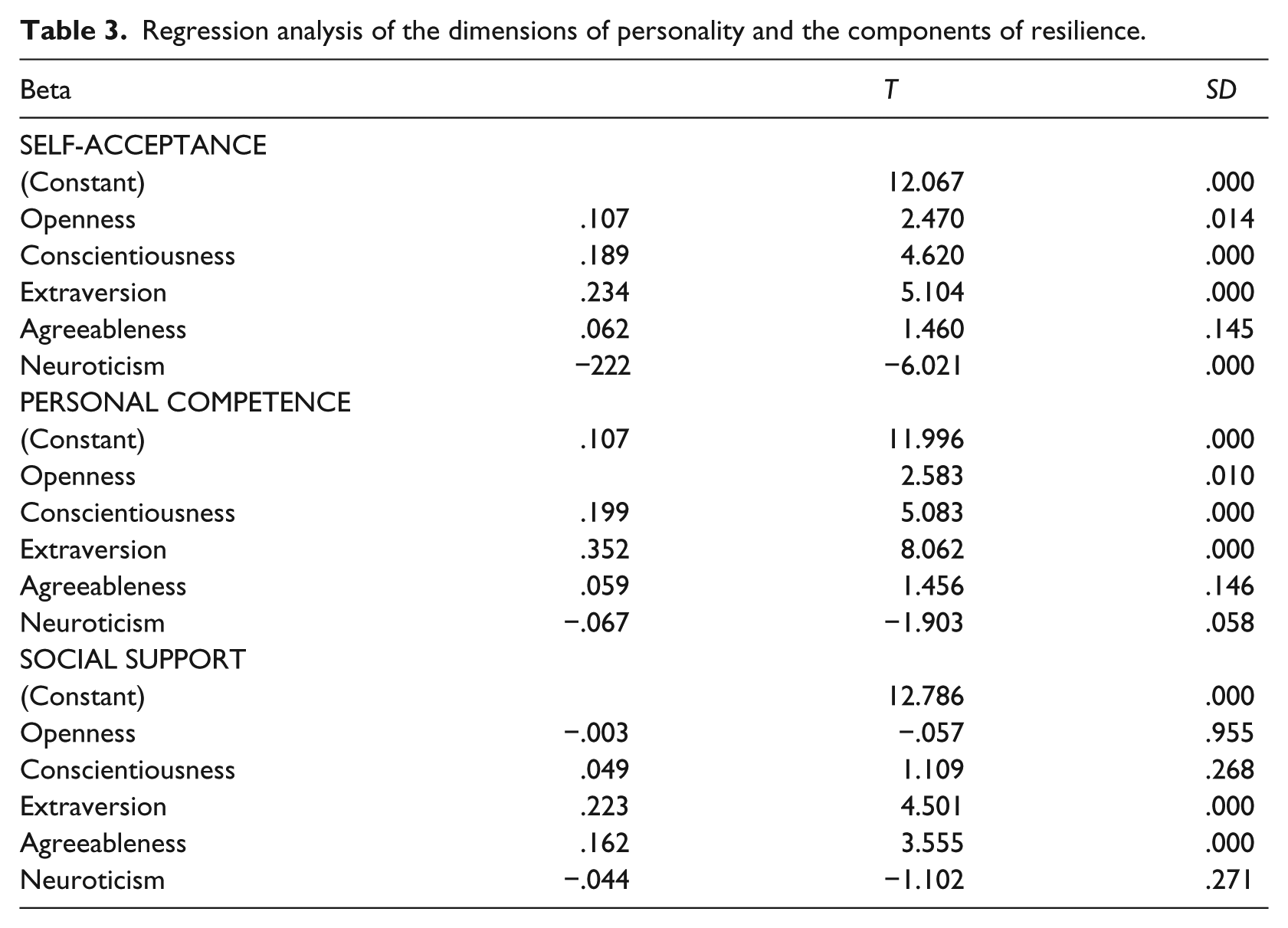
In the first regression analysis the five personality dimensions were used as predictors and acceptance of self and life as the dependent variable. The five personality dimensions explained 25 percent of the variance, F = 38.25, p = .001, showing that they had a significant influence on the self-acceptance component of resilience. Regarding all the dimensions, extraversion had the greatest influence on this component (Beta = .24, p = .001), followed by conscientiousness (Beta = .19, p = .001), openness (Beta = .11, p = .01), and neuroticism (Beta = −.23, p = .001). In summary, low levels of neuroticism and high levels of extraversion, conscientiousness and openness had a positive influence on the self-acceptance component of resilience.
In the second regression analysis the five personality dimensions were again used as predictors and the dimension personal competence as the dependent variable. The five personality dimensions explained 32 percent of the variance, F = 55.62, p = .001, showing that they had a significant influence on the personal competence dimension of resilience. In relation to all the dimensions, extraversion had the greatest influence on personal competence (Beta = .35, p = .001), followed by conscientiousness (Beta = .20, p = .001), openness (Beta = .11, p = .01) and neuroticism (Beta = −.10, p = .05). In summary, to the extent that extraversion, conscientiousness, and openness increase and neuroticism decreases, the personal competence component of resilience increases.
Finally, regarding perceived social support, the third regression analysis shows that the five personality dimensions explained 13 percent of variance, F = 16.31, p = .001. The predictors that had the greatest influence on the social support dimension of resilience were extraversion (Beta = .22, p = .001) and agreeableness (Beta = .16, p = .001), whereas no statistical significant effects were found for the predictors openness, conscientiousness and neuroticism. In summary, as extraversion and agreeableness increase, the social support component of resilience also increases.
Discussion
This study investigated the personality traits of social work students and social workers, the association between their capacity for resilience and these traits, and their influence on this capacity.
In the case of students, the within-subjects analysis confirmed that over the course of their university degree they increased their levels of openness, conscientiousness, extraversion and agreeableness and decreased their level of neuroticism. Of the five components, neuroticism was also the least pronounced personality trait among social workers. However, the between-subjects analysis did not demonstrate these changes, which can be explained by the lack of internal homogeneity in each group of students in relation to their personality traits. In line with previous research that showed resilience to be negatively associated with neuroticism and positively associated with responsibility, extraversion and openness, our results highlight the importance of analysing the influence of university education on the capacity of resilience in students (e.g. Campbell-Sills et al., 2006; García-Izquierdo et al., 2009; González and Valdez, 2011; Villalta and Saavedra, 2012). According to our results, following a university course in social work leads to the development of personality traits (conscientiousness, extraversion, openness) that increase resilience, while decreasing a personality trait (neuroticism) that has a negative influence on resilience. The development of these traits would help these students to increase resilience and face adverse situations encountered in their professional life.
In the professional setting, levels of neuroticism tend to decrease. Social workers are less neurotic than students, while being more conscientious and extrovert. Previous studies have shown that people who score high in neuroticism (i.e. individuals who are more emotionally unstable), are more vulnerable to psychosocial stress and are less resilient (Bakker et al., 2006; Bonanno et al., 2001; Ortiz et al., 2012; Zellars et al., 2000). According to our results, neuroticism decreases among social work students and social workers, thus contributing to the development of their capacity for resilience.
Campbell-Sills et al. (2006) investigated personality traits and resilience. Their study demonstrated a personal profile in which resilience had a negative association with neuroticism, a positive association with extraversion and conscientiousness, a small statistically significant positive association with openness, and no association with agreeableness. Furthermore, several authors have established that the five personality factors are predictive of resilience (e.g. Fayombo, 2010; McCrae and Costa, 1986; Waaktaar and Torgersen, 2010). In the present study, the results of the regression analysis confirmed that personality traits had an influence on and are predictive of resilience in social work students and social workers. Specifically, extraversion, which develops over time, has a positive influence on the development of self-acceptance and acceptance of life (I am), personal competence (I can), and perceived social support (I have). This is the only personality trait that is predictive of all three components of resilience, whereas conscientiousness and openness are predictive of the first two (I am and I can). On the other hand, as shown by Campbell-Sills et al. (2006), agreeableness has a moderate influence on resilience among students and social workers, only having an association with the component social support.
In summary, the results suggest that both studying and practising social work is an activity that promotes a positive association between personality and resilience. This finding is of particular relevance, because this is the first study to analyse, in this setting, the personal factors that have a positive association with the development of positive coping skills, such as resilience. Most studies on the social work setting have analysed the negative consequences of practising this profession, such as stress or burnout. However, studies on burnout in social workers have demonstrated a high level of job satisfaction and a low level of burnout compared to other social workers (e.g. Arches, 1991; Collins, 2008; Hombrados-Mendieta and Cosano, 2011). According to Menezes et al. (2006), the development of resilience among social workers is positively associated with managing adversity, leading to increased competence among these professionals when dealing with the stressful situations they have to confront on a daily basis.
In conclusion, an important contribution of this study has been to show how, during training and the professional practice of social work, personality traits develop that are positively associated with resilience among these students and social workers. Furthermore, it has been shown that among students the personality traits (extraversion, conscientiousness, and openness) most strongly associated with resilience develop over the three academic years, whereas neuroticism, the trait least associated with resilience, decreases over time (Campbell-Sills et al., 2006). It has also been shown that practising social work has an association with the personality traits that make subjects more resilient.
Based on this evidence, the development of activities and actions during university education and in the workplace that foster the development of these personality traits in social work students and social workers will contribute to making the individuals more resilient and will lead to improvements in their quality of life and ability to cope with adversity.
The results of the present study contribute to our understanding of the relationship between personality and resilience. We believe that the current study may be of assistance in designing programs to develop the personality traits associated with resilience in social workers. Throughout their careers social workers face a plethora of difficult situations that continually demand a high level of problem-solving skills. Thus, the development of personal traits associated with resilience (e.g. positive emotionality, cultural and intellectual curiosity, friendliness, interpersonal confidence, organization) should increase their ability to respond to adverse situations. The analysis of the elements that make social workers more resilient would ultimately lead to improvements in their quality of life. Future studies could investigate which components of undergraduate education improve the personality traits most associated with resilience.
Before generalizing these results, it should be noted that this study has some limitations and thus the results should be taken with caution. Although the association between age and personality traits was very low, future work would be needed to address this issue. Such work could also include other variables (e.g. level of income). It would also be of interest to compare changes in personality traits to those of other professionals and students following other degrees. In this way, the possibility of these changes being produced by a maturation effect could be investigated.
The data were collected using self-report surveys. In self-report surveys, the researcher makes the assumption that the participants’ responses accurately reflect their feelings (Heppner et al., 1992). In addition, these results may not adequately reflect the association between personality and resilience among social workers in other countries and thus it would be of interest to replicate these results in other countries.
Footnotes
Funding
This research received no specific grant from any funding agency in the public, commercial, or not-for-profit sectors.