







Abstract
The misalignment between economic strengthening opportunities and women’s agency is especially salient given the connection between women’s economic empowerment and household well-being. Using Kenya Demographic Health Survey 2014 data, we examine married women’s agency in household economic decision making. Women who are less likely to characterize abusive patterns of behavior as problematic and women reporting emotional abuse are less likely to report economic autonomy in the household. Furthermore, data indicate little congruence in perceptions of wife’s household economic autonomy between couples. These findings point to the need to understand the interplay among structural factors, gender, marital status, and the financial well-being of married persons.
Introduction
Women are central in global development initiatives, with a significant number of household economic strengthening efforts designed and delivered through female household members. These economic empowerment interventions (EEIs) have become an effective development strategy (Buvinić et al., 2013) with an end goal of enhancing households’ economic potential. The resources they provide – be it credit facilities, cash grants, or income-generating opportunities – empower women by expanding their ability to make choices and exercise control over their lives. Empowerment is closely connected to the ability to exercise control over one’s environment – social, economic, and political – meaning that women with stronger agency are more likely to fully exploit the ever-expanding opportunities available to them. Agency is defined as a woman’s autonomy in deciding how household economic resources are expended. Agency as a component of empowerment gives actors the ability to translate choice into a desired outcome. A woman who exercises agency is one who has the ability to be a significant actor in her own change process (Sen, 1999). Agency depends not only on individual characteristics and opportunities, but also on one’s institutional (read structural) context. However, even with the tremendous strides made in placing women at the center of the economic development agenda, their agency remains inhibited as a result of both formal and informal institutional constraints. From the perspective of EEIs, the misalignment between economic strengthening opportunities and agency should be especially salient given the amount of resources directed toward female-specific interventions (Brush et al., 2011). Furthermore, given that control and autonomy over economic resources are further complicated by the socio-cultural and interpersonal constraints faced by women all over the world, the overarching goal of EEIs should include providing household supports to address the barriers that stymie their continued economic and overall well-being. This is especially salient given that women’s responsibilities in the home remain static even as their economic contributions are on the rise (Chant, 2008; Chant and Sweetman, 2012).
Using the Kenya Demographic Health Survey (KDHS) 2014 (Kenya National Bureau of Statistics and ICF Macro, 2014), this article seeks to examine married women’s agency in household economic decision making in Kenya. Controlling for individual- and household-level factors, we explore the associations between autonomy in economic decisions and other dimensions of autonomy. Finally, we test for homogeneity in perceptions of economic agency between married or cohabiting couples.
Economic empowerment interventions
The focus of EEIs that target low-income groups is the expansion of participants’ capabilities to make favorable economic choices. Women enrolled in these EEIs are in turn better equipped and more likely to challenge the social status quo (Swain and Wallentin, 2009). Kenya has for a long time recognized the centrality of EEIs in helping women make choices and enact those choices into desired economic outcomes. Even in pre-independent Kenya, women were actively engaged in identifying and pursuing an economic empowerment agenda. As early as the 1950s, Maendeleo ya Wanawake, a government-sponsored grassroots organization, worked to provide economic supports to women across the country (Maendeleo ya Wanawake, 2011). More recently, private–public partnerships have furthered these efforts by designing targeted supports to diverse groups of women. These include initiatives targeting youth such as the Adolescent Girls Initiative (Austrian et al., 2015), those geared toward women in agriculture such as the Feed the Future Initiative (United States Agency for international Development [USAID], 2015), and those targeting women living with chronic illness including HIV (Kenya Network of Women with AIDS [KENWA], n.d.; Living Positive Kenya, n.d.). In addition to providing economic supports, some of these offer in tandem health, mental health, and legal supports. While exact figures on the number of Kenyan women who have in the past accessed or continue to access the support services of EEIs may be difficult to quantify, they remain a popular empowerment strategy. We should also note that the relationship between economic empowerment and a woman’s well-being is mixed at best. Indeed, women’s economic empowerment is not always beneficial, and studies have found them to have a negative impact on women’s physical, emotional, and – in contradiction to the goals of EEIs – material well-being.
A woman’s access to economic assets such as earned income, education, and fixed property increases her bargaining power both within and outside the household; this in turn impacts her ability to exercise autonomy in decision making in all spheres of her life, that is, at the household, social, and political levels. Studies have found that in instances where women are active participants in economic decision making, household inequality is less pronounced (Vogler and Pahl, 1994). At the familial level, therefore, women who are able to exercise control over household economic resources alongside other income earners are more likely to enjoy wealth accumulation opportunities similar to those accorded to male household members. For instance, in their study of young married women in Kenya (15–19 years), Muthengi et al. (2016) found that girls reporting cash savings were less likely to report intimate partner violence (IPV). These findings do support the hypothesis that women who have greater control over their finances (read savings) may have greater autonomy over their well-being.
Conversely, in the very same study, women earning an income reported an associated increased risk of IPV (Muthengi et al., 2016). Given that the World Health Organization (WHO) (2013) estimates that 36.6 percent of married women in Africa experience IPV in their lifetime, findings such as these should remain of central concern to interventionists.
The issue of control and autonomy over economic resources is further complicated by complex family relationships in societies where decisions may very well be made outside the marital unit. Therefore, a woman living within an extended family unit where decisions are out of her control, or those part of a polygamous marital unit, or living in rigidly male-dominated societies may have attenuated autonomy over economic resources. When individuals do not believe that engaging in economic strengthening activities such as savings will yield optimal results, they are less likely to engage in such behavior (Beverly et al., 2008: 18). In non-egalitarian households, therefore, where economic decision making is subject solely to a spouse or a third party, a woman’s investments into household coffers may be compromised.
Within the social sphere, cultural practices and social connections define a woman’s ability to make economic decisions for herself and her family. In Kenya, as in many societies in sub-Saharan Africa, socio-cultural values and norms dictate women’s ownership of capital intensive assets, limit their property rights, and determine the returns women enjoy on investments (Deere and Doss, 2006; Doss et al., 2012; Kagotho, 2014). Despite a tempering of customary laws by the more progressive and gender-neutral set of national laws and regulations in the country, statutory laws that govern wealth adjudication recognize customary laws (Musyoka, 2006). Given the fact that customary law remains the most accessible point of recourse for many, a woman’s ability to exercise control over economic resources becomes highly dependent on ethnic belonging and regional residence (Ellis et al., 2007). Although skewed in favor of men (Musyoka, 2006), ethnic groups across the country do proffer their own unique norms and rules pertaining to women’s rights over household wealth. For instance, women from the Kikuyu (central Kenya) and Taita (eastern coast of Kenya) ethnic groups are permitted on the dissolution of a marriage to leave with their personal effects and a share of the household wealth, whereas women from the Kisii (western Kenya) and Tugen (the Kenyan Rift Valley region) communities leave with virtually none of their possessions after a divorce (Ellis et al., 2007). As stated previously, when individuals have only tenuous control over household economic strengthening activities, they are less likely to engage in wealth generation. In addition, when socio-cultural norms and practices impede a woman’s control over economic resources such as land, her bargaining power within other spheres of her life is also curtailed (Meinzen-Dick et al., 2007). It is, however, important to highlight that while regressive cultural practices and expectations that disenfranchise women in economic development still exist, targeted gender-neutral laws and affirmative action tools have attempted to level out the playing field. While these have to some extent begun to redress the historical injustices attributable to economic disenfranchisement, women are still for the most part unable to access the legal protections due them. Moreover, in 2010 the country devolved power to County governments, replacing the previous fully centralized system of government wherein the intersection of ethnicity and political machinery impacted national redistribution of resources (Githongo, 2006; Hassan, n.d.; Miguel, 2004). Previous studies have found regional disparities in the well-being of Kenyan women (Kenya National Bureau of Statistics and ICF Macro, 2010; Obago, 2013). It is hoped that the new decentralized system of government will reduce regional marginalization and bring resources closer to local communities.
The complexity of gendered decision making is explained by markets, social connections, psychological factors, and cultural and statutory laws (Agarwal, 1997; Malhotra et al., 2002), and this article investigates this context using data from married and cohabiting women in Kenya. Although this article examines women’s decision making at the household level by analyzing individual and household characteristics, we do acknowledge that the reality of economic behavior is informed by more than individual constructs and extends to include institutional constructs which are beyond the purview of the current study.
Theoretical foundation
The theoretical underpinning of this study is the Capability Approach, which posits that the goal of development should be the expansion of capabilities – what people are able to achieve and to be (Sen, 1999). This approach, therefore, seeks to identify and address the constraints that limit choice and agency. The Capability Approach deconstructs women’s well-being by focusing on autonomous decision making (Fukuda-Parr, 2003). Capabilities are the freedoms we have in order to achieve what is important to us. Put another way, capabilities are the freedoms women have to determine and live their best kind of life. These functionings, as Sen (1999) refers to them, are subjective and context specific, meaning that what one woman considers ‘her best life’ may differ from what another with different group membership holds to be important. Although extremely diverse and heterogeneous, there are a set of national priorities that detail the basic rights that all Kenyan women should enjoy. These include opportunities that allow women to exercise agency in matters pertaining to their social, economic, and political empowerment (Maendeleo ya Wanawake, 2011). Priorities set by institutions are also important in determining how individual women are able to exercise agency over their lives. Rules such as those that determine women’s property rights, access to credit, and financial facilities determine what women are able to aspire to and achieve. This study therefore controls for factors that could determine an individual’s ability to engage in economic decision making at the household level. The structure of the KDHS, however, does not allow us to measure the opportunities (capabilities) available to women, but instead offers an array of variables that capture what women have actually achieved. These functionings will be treated as indicators of empowerment (Robeyns, 2003: 85).
Methods
Using the KDHS 2014 (Kenya National Bureau of Statistics and ICF Macro, 2014), this study seeks to examine women’s autonomy in economic decision making. Using married dyads and individual-level data, the analysis focuses on three domains of autonomy to denote economic empowerment: control over large household purchases, husband’s income, and respondent’s earned income. This study answers three questions: (1) What individual-level factors are associated with women’s autonomous economic decision making? (2) What other empowerment domains are associated with women’s autonomous economic decision making? (3) Is there congruity in perceptions of women’s autonomy in autonomous economic decision making between couples?
The KDHS is a nationally representative dataset that surveys Kenyan households and focuses on population, nutrition, and health outcomes. It utilizes a two-stage stratified sampling design. In addition to English, 16 other Kenyan languages were used in the interviewing process. To account for the sampling design of the KDHS, survey estimation methods including sampling weights were applied to the analysis (Rutstein and Rojas, 2006). A subset of the couples dataset was used.
Variables
All variables are drawn from the KDHS 2014. The outcome variables consisting of three categorical economic empowerment variables were created. Women who made large household purchase decisions by themselves or jointly with their spouse were coded as 1, while those whose decisions were made by a spouse only or another person were coded as 0. The second economic empowerment variable final say on how husband’s income is used was also collapsed into a dichotomous variable again, with women who made the decisions alone or jointly with their spouse coded as 1. Finally, say on how wife’s income is used was asked only of women earning cash for their paid work. The variable was dichotomized, with women making the decision alone or jointly with a spouse coded as 1 (Table 1).
Weighted univariate analysis: Married and cohabiting women
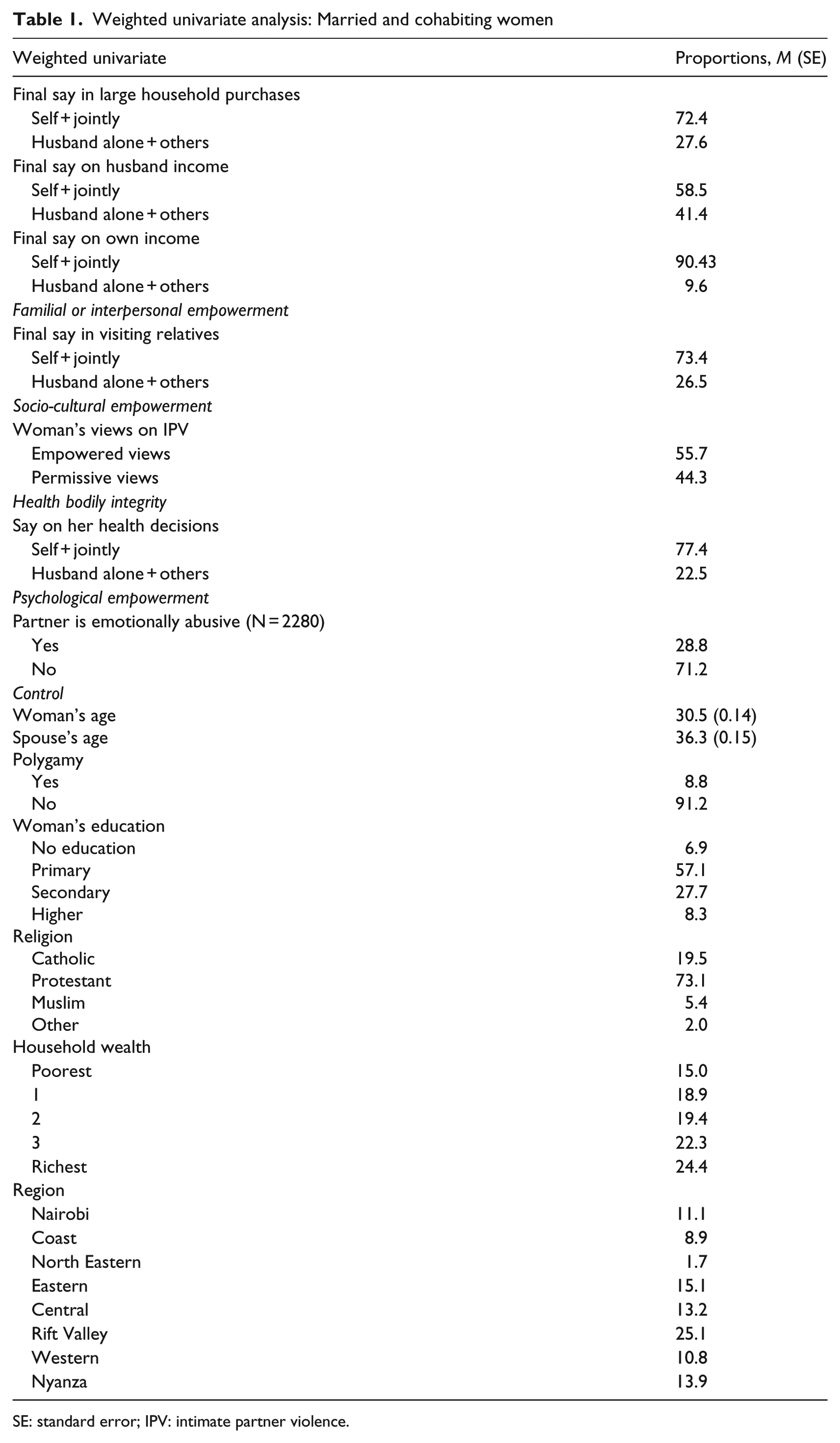
SE: standard error; IPV: intimate partner violence.
To determine the association between women’s economic empowerment and other empowerment domains, four independent variables are re-coded and analyzed. These empowerment dimensions – determined by the current literature – include control over household economic resources, interpersonal decision making, views on domestic violence, autonomy in health decision making, and self-esteem (Malhotra et al., 2002). Familial/interpersonal empowerment is denoted as final say on visiting relatives, and socio-cultural empowerment, a count variable, measured as a woman’s attitudes toward domestic violence (Is wife beating justified if she goes out, neglects children, argues with husband, refuses him sex, and/or burns the food?). Psychological empowerment is measured as ever experienced emotional abuse. Finally, a categorical variable final say on own health care is used to capture bodily integrity. The study controls for variables associated with empowerment including age, education, household wealth, religion, and region of residence.
Data analysis
A subset of the couples dataset with women in the domestic violence subset (N = 2283) was used. A further sub-sample of employed women (N = 1212) and a parsimonious model were used to answer the third question. Bivariate cross-tabulations and logistic regression models were constructed to answer the aforementioned research questions. To account and correct for design effects, weights were used across all levels of analysis. Using survey-adjusted commands takes into the complex nature of the data including clustering. Given its superior handling of survey data methods, analysis was conducted using Stata14 statistical software release. Given the randomness and small number of observations without data, missing data were handled through listwise deletion.
Results
A significant number of women report being key decision makers in household economic decisions. More than 72 percent of the female respondents see themselves as autonomous decision makers at the household level. Working women reported high rates of autonomy over their earned income, while approximately 59 percent reported being involved in decisions on how a husband’s/partner’s income is utilized. Investigation into the other four empowerment domains shows that women are actively engaged in making decisions around family relationships (73%) and their personal health (77%). Approximately 55.6 percent of sampled women perceive domestic violence of any kind as problematic, and on average, women reported a mean score of 1.1 of how tolerant they were on IPV. At the bivariate level, more tolerant views of IPV were associated with lower odds of autonomy over large household purchases and husband’s income. In addition, approximately 29 percent of sampled women indicated emotional abuse by a partner in the household. These women were also more likely to report lower rates of autonomy over a partner’s wages.
The control variables help paint a picture of the respondents. Of the 8.8 percent who report being part of a polygamous union, 29 percent identified as first wives, while 45 percent identified as second wives. While 36 percent of female respondents have a high school education and higher, 43 percent of their partners had achieved comparable levels of education. The average age of the women in this sample was 30 years old. The bivariate analysis indicates that while older women were more likely to report autonomy over large household purchases and their own earned income, this relationship did not, however, hold true for decision making around a partner’s income.
Results from logistic regression
Logistic regression models were constructed to answer the study’s first two questions: What empowerment domains are associated with women’s autonomous economic decision making and which individual-level factors are associated with women’s autonomous economic decision making? At the bivariate level, familial/interpersonal empowerment, socio-cultural empowerment, and bodily integrity were associated with autonomy over large household purchases, husband’s income, and the woman’s earned income. Psychological empowerment measured as emotional abuse was significantly associated with autonomy over husband’s income only (Tables 2 to 4).
Logistic regression: Decision making over large household purchases
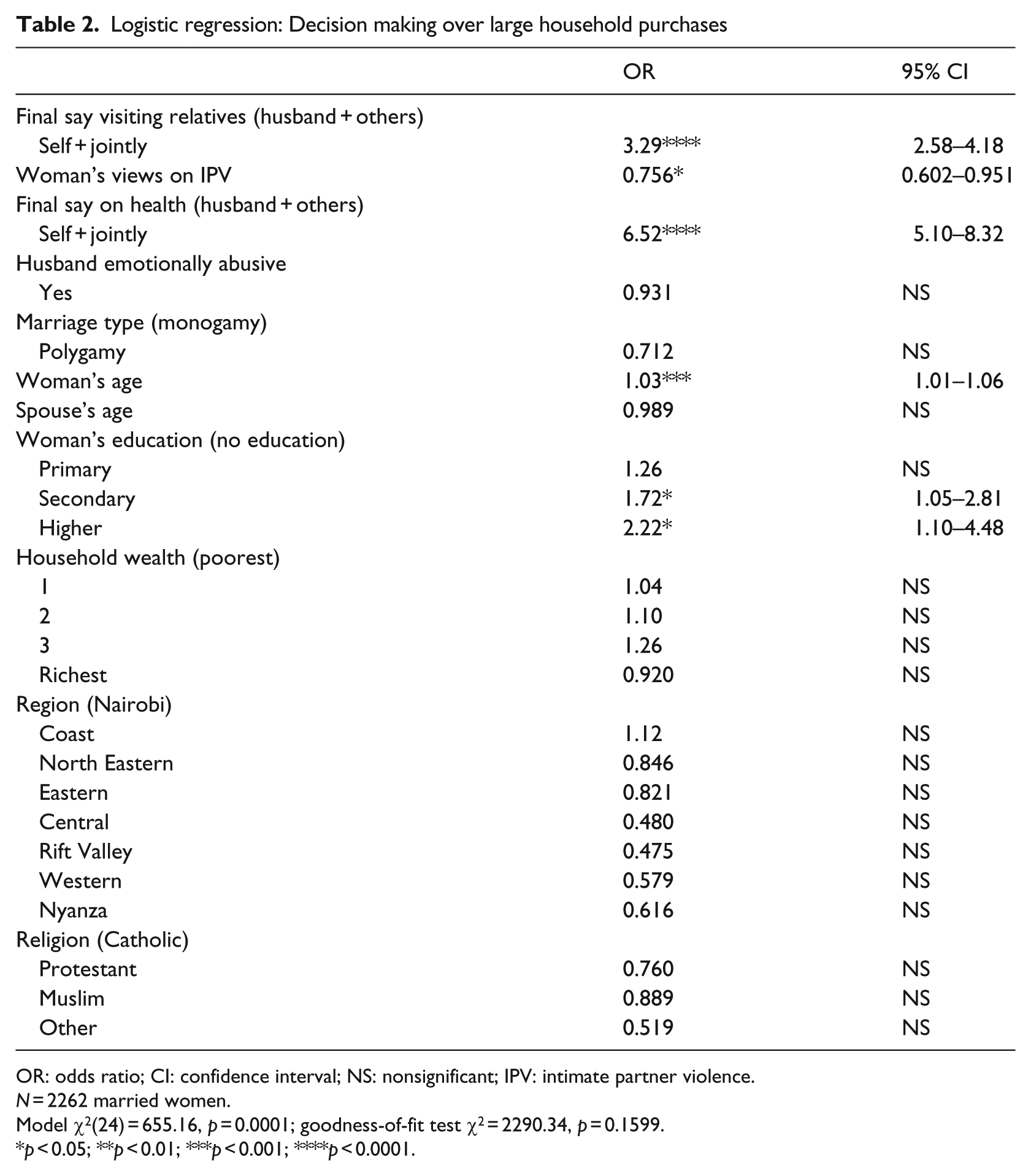
OR: odds ratio; CI: confidence interval; NS: nonsignificant; IPV: intimate partner violence.
N = 2262 married women.
Model χ2(24) = 655.16, p = 0.0001; goodness-of-fit test χ2 = 2290.34, p = 0.1599.
p < 0.05; **p < 0.01; ***p < 0.001; ****p < 0.0001.
Logistic regression: Decision making over husband’s money
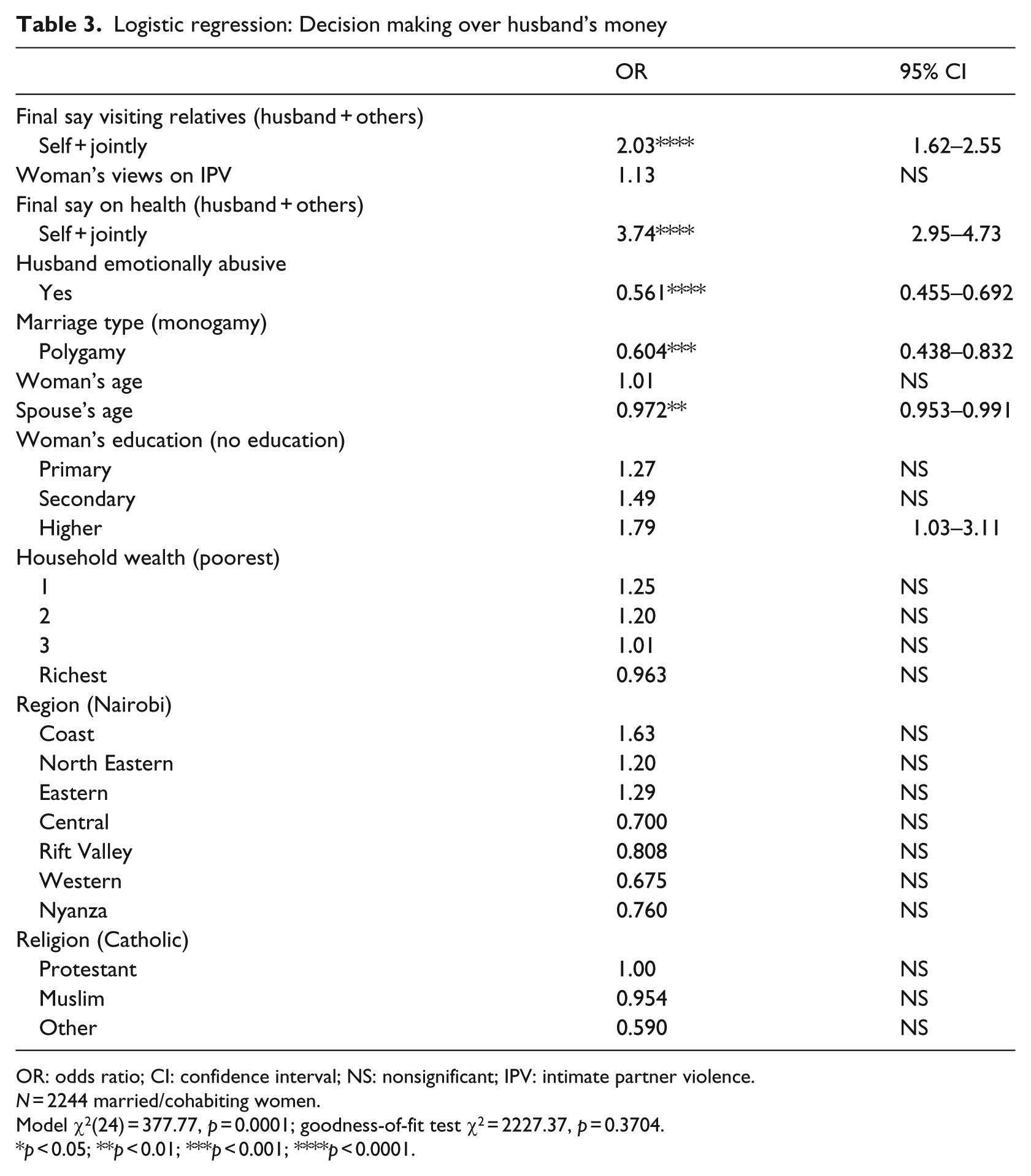
OR: odds ratio; CI: confidence interval; NS: nonsignificant; IPV: intimate partner violence.
N = 2244 married/cohabiting women.
Model χ2(24) = 377.77, p = 0.0001; goodness-of-fit test χ2 = 2227.37, p = 0.3704.
p < 0.05; **p < 0.01; ***p < 0.001; ****p < 0.0001.
Logistic regression: Decision making over wife’s own income
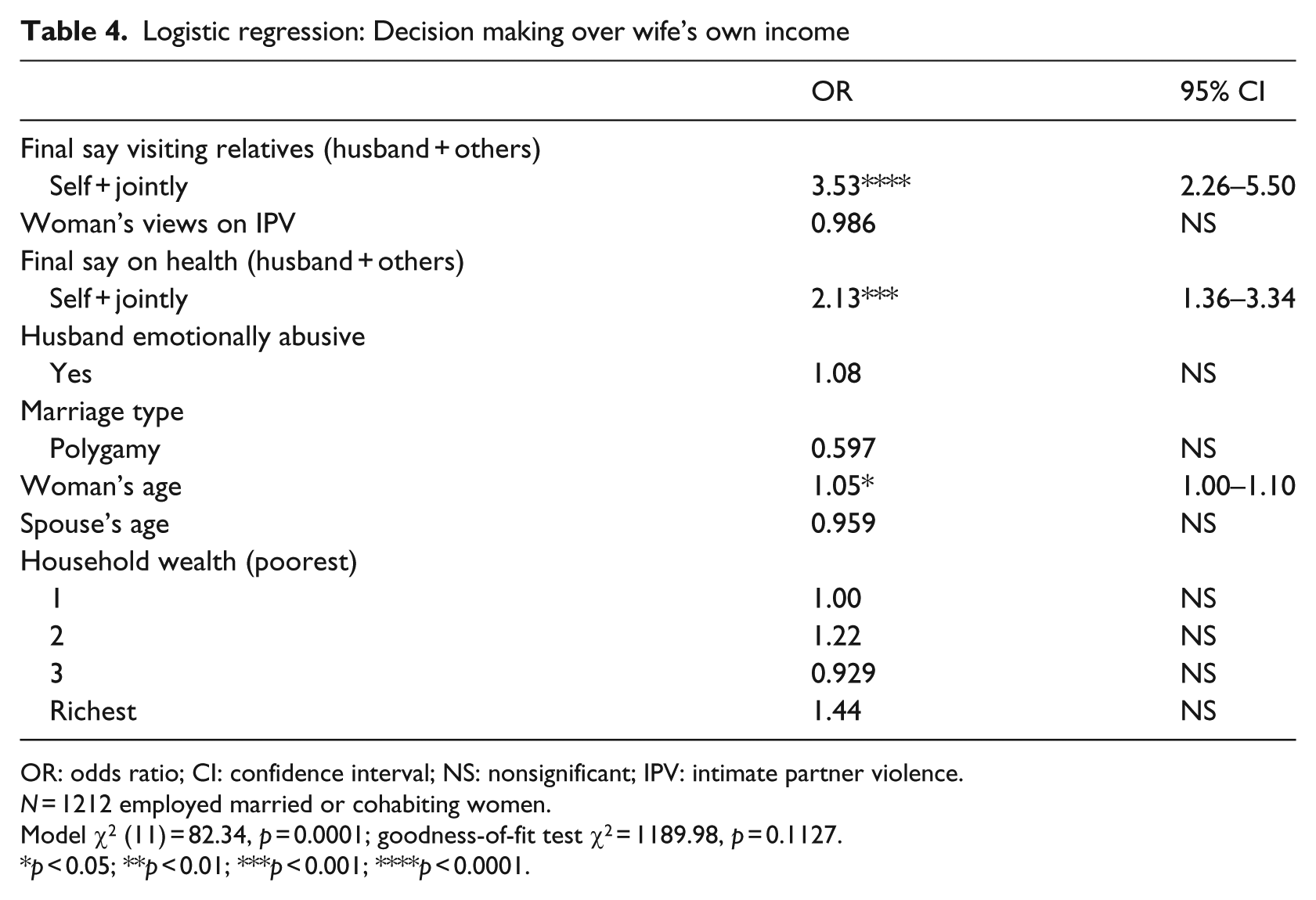
OR: odds ratio; CI: confidence interval; NS: nonsignificant; IPV: intimate partner violence.
N = 1212 employed married or cohabiting women.
Model χ2 (11) = 82.34, p = 0.0001; goodness-of-fit test χ2 = 1189.98, p = 0.1127.
p < 0.05; **p < 0.01; ***p < 0.001; ****p < 0.0001.
Logistic models indicate that women were more likely to report participation in decisions revolving around large household purchases if they were also empowered in decision making at the interpersonal level (odds ratio (OR) = 3.29, 95% confidence interval (CI) = 2.58−4.18) and also those who reported control over their own health care (OR = 6.52, 95% CI = 5.10−8.32). In addition, women with permissive views of domestic violence were less likely to engage in large household purchases (OR = 0.75, 95% CI = 0.6−0.95). A woman’s ability to make decisions regarding a partner’s earnings was determined by interpersonal empowerment (OR = 2.03, 95% CI = 1.62−2.55) and control over one’s health (OR = 3.74, 95% CI = 2.95−4.73). In addition, women who reported experiencing emotional abuse were less likely to report autonomy in deciding how a partner’s income was used in the household. Holding all variables constant, the odds of making autonomous decisions over a partner’s income were 0.56 for women who reported an emotionally abusive partner (OR = 0.56, 95% CI = 0.45−0.69). As in the preceding models, women who reported higher autonomy in family relationships (OR = 3.53, 95% CI = 2.26−5.50) and with autonomy over their health decisions (OR = 2.13, 95% CI = 1.36−3.34) were also more likely to exercise control over their earned income.
Other control variables significantly associated with autonomous decision making were polygamy, age, and women’s education. Women in polygamous relationships were less likely to engage in decision making around a spouse’s income. Holding all variables constant, the odds of women in polygamous unions making decisions over a husband’s income were 0.60 when compared to women in monogamous relationships (OR = 0.60, 95% CI = 0.43–0.83). Older women were more likely to have autonomy in large household purchases and individual earned income. The odds of autonomy in both categories were increased by 1.0 for each unit increase in age. Higher education among women was associated with higher rates of autonomy over large household purchases and a spouse’s income. The odds of autonomy over large household purchases and partner’s income were 2.23 and 1.79 times those of women who reported the highest education level when compared to their peers who reported no education at all.
Results on couple congruity
Data indicate that there is a statistically significant difference in perceptions of wife’s autonomy between couples. ORs are interpreted to determine congruence between couples around issues of economic empowerment. As final say on wife’s income is not asked of men in the dataset, only two models were constructed: final say on large household items and final say on husband’s income. Data indicates a statistically significant association between couples in both models. Indeed, McNemar’s test indicates significant difference in the proportions of men and women who agree on economic decision making. Of all the women reporting that decisions on a husband’s income are made jointly, only 36 percent have spouses who concur. The odds of a woman having a spouse who agrees that they make income decisions jointly are only 0.67 times those of a peer who reports less autonomy over a husband’s income. Approximately 68 percent of all women who reported making joint decisions on large household purchase live in a household where the husband concurs. The odds of having a spouse who agrees that household purchases are made jointly are 1.6 times those of a woman who reports little autonomy in large household purchases. It would seem, therefore, that couples are more likely to agree on how large household purchases are made, but not on how a husband’s income is spent.
Discussion
Questions such as how much control women retain over economic resources during and after completion of EEIs and how these expanded economic roles may add to their responsibilities at the household and community levels are a lively area of study. These questions remain focal in the area of economic development given issues that women face in exercising control over economic resources globally.
Economically empowering women by providing them with income and asset-building opportunities has undeniably been an effective poverty elimination strategy. Studies have found that financial independence gives women the ability to leave an abusive relationship (Muthengi et al., 2016). In this study, women who are less likely to characterize abusive patterns of behavior as problematic and women reporting emotional abuse are less likely to report economic autonomy in the household. Controlling for all other variables in the logistic model, emotional abuse is an indicator of weak autonomy in decision making over a spouse’s income. In addition, women who report more tolerant views of IPV are also less likely to exercise autonomy in large household purchases. These findings are supported by other studies which have shown that abuse tactics not only diminish a woman’s control over household economic resources, but that they further impede her ability to engage in income-generating activities outside the household. In a study of immigrant Mexican women, Kyriakakis (2010) found that women experiencing IPV reported various barriers to work including social isolation, lack of transportation, and inability to engage in employment.
EEIs have to take into account the possibility of abuse not only in the context that enrolled women might be experiencing IPV, but also that the intervention might heighten risk. If a woman seems to be gaining self-sufficiency or power, it might cause a partner to escalate abuse tactics, for instance moving from emotional abuse tactics to physical abuse. Therefore, EEIs have to constantly assess for the possibility of abuse and have expertise on hand to consult with or to refer the women to. Although not a significant risk in the logistic models as a gateway to address IPV, these EEIs would be beneficial more so for women who characterize abuse tactics as normative. Emotional abuse mirrors gender-based expectations, meaning that partners target elements most associated with a woman’s identity, such as her ability to provide for her family. In instances where it is safe to do so, EEIs working with women in intimate relationships should consider integrating intervention components that address decision making between couples. Finally, even as EEIs continue to focus on wealth generation, these findings support the need for more nuanced programming that integrates social and legal components. EEIs that incorporate components that help women understand and address abuse tactics while encouraging and supporting men’s participation have shown encouraging results in South Africa (Kim et al., 2007).
At the bivariate level, this study finds that women in polygamous unions report less autonomy over household economic decision making. At the multivariate level, women in polygamous unions are less likely to exercise autonomy over a spouse’s income; these findings are especially significant given that approximately 9 percent of women in this nationally representative sub-sample report a polygamous union. All cultural marriages are presumed to be polygamous from the onset, and polygamy is recognized under Kenyan law. Given that the law implicitly denies women the right to veto or acquiesce to the addition of a co-wife in an already existing union, these household structures should be taken into account.
An encouraging finding was the lack of disparities among women from different geographic regions – which are generally understood to be proxies for ethnicity. Clearly, cultural practices determine how women engage in economic decision making in the household. Socio-cultural values and norms direct women’s ownership and control over assets. As previously mentioned, past studies have shown disparities in well-being outcomes for women residing in different provinces. This was attributed to the intersection of regional economic deprivation, ethnicity, and political will. As was hoped when the country devolved into a County system of government, it would seem that these disparities are being altered by these changing institutions.
These results further point toward a need for the continued examination of institutional factors that diminish women’s agency. Women continue to grapple with larger structural factors that limit their agency. Indeed, studies from across sub-Saharan Africa have found that laws, both statutory and cultural, disadvantage women in the economic arena. Chant and Sweetman (2012) argue that these larger factors must remain at the forefront of women’s economic empowerment agenda. EEIs should ensure that women have clear and protected access by engaging both statutory and cultural mechanisms. Current examples from across the continent of interventions that target larger structural factors would be those that are working to protect women’s right to property (GROOTS, 2013; Izumi, 2007).
Limitations and strengths
Findings from this study add to our knowledge of women’s autonomy in economic decision making within the household. This theory-based exploration allows for practice implications. The use of survey analysis corrects for the KDHS design effects. These methods thereby increase the generalizability of these findings. In addition, as one of the few Kenyan datasets that interviews couples, these data allow us to investigate both men’s and women’s perceptions within the household. The structure of the dataset also allows us to investigate cultural variations in women’s autonomy. The study, however, suffers from several limitations. Because the data are not longitudinal, this study cannot construct models that establish causality. In this instance, longitudinal data would enable us to determine whether one empowerment domain is a precursor to other domains. Furthermore, as not all questions are asked in every iteration of the KDHS, the scope of some of the models presented here is narrowed. For instance, variables in the dataset do not capture the freedom accorded to women to exercise/determine control over household economic resources.
Conclusion
This study has focused on the individual-level factors associated with women’s autonomous economic decision making, explored what empowerment domains are associated with women’s autonomous economic decision making, and finally assessed the congruity in perceptions of women’s autonomy in autonomous economic decision making between couples. Our findings suggest that individuals who lack autonomy in economic decision making are also less likely to be motivated toward making resource investments due to the inability to exercise control over their returns. Household wealth gives individuals the means to circumvent structural barriers that could otherwise impede their ability to dream about their future. Ensuring that women are able to retain full access to these resources is, therefore, critical in household economic stability. There continues to be a need to understand the interplay among structural factors, ethnicity, gender, socioeconomic status, marital status, and the financial well-being of married persons.
Footnotes
Funding
The author(s) received no financial support for the research, authorship, and/or publication of this article.