







Abstract
Prompted by an experience while on a student placement in the United States, where sexual harassment was not responded to appropriately in professional supervision, the article focuses on female practitioners’ accounts of such harassment. Initially, the wider context for sexual harassment is furnished by a brief overview of the definition of sexual harassment, the legal context and responses in the Republic of Ireland. The focus then shifts to a small-scale empirical project garnering perceptions. The study is clearly preliminary and tentative, yet it illuminates important findings relating to the sexual harassment of female social workers across professional workspaces.
Introduction
Our interest in this topic was sparked by the experience of one of the authors, Aisling, when on a student placement with an organisation providing support services to vulnerable older people in the United States. The organisation received a referral for a man, aged 72, from a neighbour who was concerned about the housing conditions and, ultimately, his health and safety. A male social worker and Aisling went on a home visit to the client’s house. He lived in an old townhouse which appeared in good condition from the outside. However, upon entering, Aisling was taken aback by the stale heat inside which was in stark contrast to the below-freezing temperatures of the urban winter. The client was bare-chested and wore trousers that appeared dirty. The house, stale-smelling, was quite cluttered, but overall the conditions seemed satisfactory.
The client sat on the only chair at the dining table and Aisling and the male social worker stood next to the sink on the other side of the room. Throughout the conversation, it was somewhat difficult to maintain focus on his well-being and aspirations as he repeatedly diverged onto stories that he found amusing. As he spoke, he would frequently scratch his bare chest. It became apparent that this individual had an eccentric personality. Preparing to leave, Aisling asked ‘Is there anything else you need?’ He then looked to the other social worker and said in a suggestive tone, ‘Can she stick around for a while after?’ Aisling replied with a light-hearted ‘We’ve gotta go’. Shortly after, they left the house.
Noting the man’s expression and interpreting his somewhat ambiguous remarks as containing a sexual connotation, Aisling felt awkward and uncomfortable. Despite knowing that her safety was never at risk, she still felt his comments were left ‘hanging in the air’ and hard to dispel. Part of her felt very frustrated. Sexualised comments such as this undermined her professional practice and the value of her gender. In that moment, she felt she had two choices: either ‘laugh it off’ for the sake of developing a good rapport with the client or to tell him that it was inappropriate and unacceptable behaviour. Aisling knew that developing a relationship with the client was crucial for her intervention, so she chose the former approach.
Still needing to investigate her feelings further in supervision, Aisling discussed these frustrations with her US-based practice teacher, a female social worker with experience, over many years, as a gerontology social worker. She offered reassurance with the comment, ‘Don’t take it personally. This is the world we live in; women have to play the game’. The ‘game’, it seemed, involved being complicit in dominant social constructions of gender and the sexualisation of women.
The social work profession is based on respect for the inherent worth and dignity of all people. The International Federation of Social Workers (IFSW, 2012) recognises that women of all ages and at all stages of the life cycle ‘deserve protection from discrimination in all forms, including the elimination of all forms of gender-specific discrimination and violence’. Aisling was, therefore, immensely disappointed and perturbed by the lack of support from her practice teacher and what appeared to be a bleak, and arguably trivialising, perspective on attitudes towards women. When home in Ireland, she discussed what had occurred with, the second author, her then college tutor. Having listened to his reflection of her practice teacher’s perspective, she began to consider whether other women in social work had experiences of sexual harassment and how they have responded. Does everyone ‘play the game’? This article is a product of an ensuing project investigating female practitioners’ experience of sexual harassment experienced in the office or in other environments that constitute practitioner workspaces, such as clients’ homes.
We begin with by articulating the context for the study by briefly dwelling on the definition of ‘sexual harassment’. We also examine the legal context and map the responses of the social work profession in Ireland. The next component of the article focuses on the theoretical framing of the study and methodological questions relating to our empirical work. This is followed by a report on the findings which, although derived from a manifestly small study, are still significant. This is partly because in certain fields where a disproportionately high number of staff are female (such as nursing), there is a literature exploring sexual harassment in the professional workspace (Valente and Buttough, 2004), but within contemporary social work this remains a neglected and muted facet of academic inquiry with only a few contributions emerging, largely from the US (Didham et al., 2011; Fogel, 2001; Maypole, 1986; Moylan and Wood, 2016; Risley-Curtiss and Hudson, 1998; Singer, 1989). The fourth part of the article discusses issues arising from the research respondents’ comments and perceptions.
What do we mean by ‘sexual harassment’?
In Irish law, sexual harassment is defined as any form of unwanted verbal, non-verbal or physical conduct of a sexual nature which has the purpose or effect of violating a person’s dignity and creating an intimidating, hostile, degrading, humiliating or offensive environment for the person … such unwanted conduct may consist of acts, requests, spoken words, gestures or the production, display or circulation of written words, pictures or other material. (Irish Statute Book, 2004: 51)
In a summary of two studies of sexual harassment in 1998, covering 16 Western European countries, the European Union (EU) concluded that an estimated 40–50 percent of female employees have experienced some forms of sexual harassment, with verbal forms of sexual harassment being most common (The Advocates for Human Rights, 2010). Kaplan (in Gould, 2000) states the damaging effect that sexual harassment can have on women: Women in sexual harassment situations dealt with the problem by behaving passively, avoiding the harasser, and ignoring the behaviour (resulting in continued harassment), or if they filed formal complaints, they experienced retaliation. Personally, they experienced changes in affect, physical and emotional problems, deterioration in work performance, which many dealt with by absenteeism or quitting jobs because of fear and frustration.
Most sexual harassment research identifies male superiors harassing female subordinates. This may be accurate, but it is important to remember that sexual harassment can serve as an ‘equaliser’ against women in power, motivated more by control and domination than by sexual desire (McLoughlin et al., 2012). Furthermore, research suggests that sexual harassment is primarily targeted at women who violate gender roles by having what are perceived as masculine characteristics (assertive, dominant, independent) or being ‘uppity’ (Berdahl, 2007).
Low reporting rates are a result of fear of retaliation from employers, concern for the harasser, shame, belief in the futility of the complaint mechanism and/or fear of being blamed for the harassment (The Advocates for Human Rights, 2010). Hester (in Brockman, 2002) argues that failure to report incidents may be due to women undervaluing or denying such experiences. A qualitative study of students’ experiences found that they ‘rarely labelled their experience as sexual harassment, although certain behaviour was described as unpleasant, unwanted, or degrading to them’ (Vohlidalova, 2011: 1131). Low reporting rates of sexual harassment and the ambiguity of sexual harassment behaviours can be theoretically linked, as we will argue later, to what the sociologist Pierre Bourdieu (2000: Chapter 5) terms ‘symbolic violence’ and misrecognised forms of domination.
Sexual harassment in the Republic of Ireland
The Irish Association of Social Workers (IASW), a member of the IFSW, is a national organisation representing the social work profession in the Republic of Ireland. Within the IASW (2009) Code of Practice, it is made clear that social workers should, under no circumstances, form inappropriate personal and intimate relationships with people who use social work services. However, there is little guidance on appropriate actions when the practitioner is a victim of sexual harassment while at work. It is outlined that members of the IASW should report colleagues whose behaviour is abusive, discriminatory or unsafe (IASW, 2007). This would include colleagues who sexually harass other practitioners, but does not extend to other individuals that practitioners come in contact with, for example, clients and their families.
Social workers in Ireland are also guided by CORU, the social workers’ registration board, set up under the Health and Social Care Professional Act 2005 to promote high standards of professional conduct. In maintaining high standards of personal conduct, and as outlined in CORU’s Code of Professional Conduct and Ethics for Social Workers, practitioners must not ‘exploit or discriminate unlawfully or unjustifiably against clients, carers or colleagues’ or ‘form inappropriate personal relationships with service users’ (CORU, 2010: 9). However, there is a lacuna in terms of what should be the response if the practitioner is the victim of sexual harassment.
Harassment and sexual harassment are prohibited in the workplace with the Employment Equality Acts 1998–2011 placing an obligation on employers to prevent such harassment in the workplace. This Act places further responsibility on the employer to prevent and respond to instances of sexual harassment (Irish Statute Book, 2004: Section 14A). The actual intention of the perpetrator of the sexual harassment is irrelevant. The fact that the perpetrator has no intention of sexually harassing or harassing the employee is no defence. The effect of the behaviour on the employee is what is relevant (Irish Statute Book, 2012).
Despite this legislation, sexual harassment remains a problem in Ireland. The number of people contacting the Dublin Rape Crisis Centre (DRCC, 2015) helpline increased from 76 in 1979 to 11,618 in 2010. This has continued to rise, where ‘52% of clients received therapy in 2013 for issues of rape, sexual assault or sexual harassment, compared to 46% in 2012’ (DRCC, 2013: 8). In 2013, 78 percent of callers to the helpline were female, 21.6 percent were male and 0.4 percent identified as transgender (DRCC, 2013: 7). This gender difference in experiences of sexual violence, including sexual harassment, is consistent with the Sexual Abuse and Violence in Ireland (SAVI) Report which surveyed the prevalence of sexual abuse and violence in Ireland. In the findings, 16.2 percent of women and 12.6 percent of men experienced some form of sexual harassment in the past 12 months (McGee et al., 2002: 162).
Sexual harassment, specifically in the workplace, was examined in an Irish study in 2007. It found that 2.6 percent of males, 6.1 percent of females and 4.7 percent of all persons experienced sexual harassment in the workplace (O’Connell et al., 2007). ‘Women report substantially higher rates of bullying victimisation than men: less than 6% of men report bullying in 2007, compared to almost 11% among women. We found a similar gender pattern in 2001’ (O’Connell et al., 2007: 35).
If sexual harassment is a prevalent issue in Irish society, and in the workplace, the social work profession is unlikely to be an exception.
The theoretical and methodological approach
A ‘theory of sexuality becomes feminist to the extent it treats sexuality as a social construct of male power: defined by men, forced on women, and constitutive in the meaning of gender’ (Kolmar and Bartkowski, 2005: 476). Feminists argue the personal is political; thus, power relations operate in personal as well as in public life (Byrne and Leonard, 1997). Considering this, sexual politics cannot be ignored within the social work profession, and in this sense, aspects of Bourdieu’s contribution to sociological theory are helpful.
Bourdieu considers the issue of female oppression as a mode of domination that ‘presupposes a doxic order shared by the dominated and the dominants’ (Krais, 1993: 169). For him, gender domination is incorporated as part of an agent’s ‘habitus’. Loic Wacquant (2013), Bourdieu’s close colleague, describes ‘habitus’ as the articulation of the way we internally experience and actively construct the lived world. In this sense, culture cements individuals and groups into patterns of domination. However, Bourdieu outlines that we ‘are not automatons or mindless vehicles of our governing habitus. Rather, our habitus acts as a very loose set of guidelines permitting us to strategize, adapt, improvise or innovate in response to situations as they arise’ (Houston, 2002: 157). Building on this body of theorisation, it is crucial for social workers to deconstruct and analyse the personal and collective habitus in order to challenge discrimination, sexism and sexualised harassment.
For Bourdieu, male domination offered ‘the example par excellence of this paradoxical submission’ to an unjust social order, a submission achieved through ‘symbolic violence, a gentle violence, imperceptible, invisible to its very victims’ (Bourdieu in Lane, 2000: 130). Indeed, this concept may be particularly useful when looking at the issue of sexual harassment. Social workers operate in a world where male bias and power are reflected in institutions, structures and theoretical models (National Association of Social Workers (NASW), 2005). Traditional values derive from a patriarchal society that many argue implicitly underpin conceptualisations of gender roles today. Borrowing from Bourdieu’s ‘habitus’ concept, gender can be understood as the social construction of domination relationships that determines body image, body experience, even the form of the body, feelings and expressing joy or pain (Krais and William, 2000). By employing the habitus concept, it clarifies the distinction between sex (biological) and gender (a sociological construct). Understandings of gender and gender norms vary depending on personal and cultural values. Gender dynamics are intrinsically complex and important in all interactions. In social work, gender dynamics impact three key relationships: ‘between workers and “clients”; working colleagues; and employees and their employers’ (Dominelli, 2006: 98). These can also be sites of sexual harassment.
Turning to our study, a qualitative approach was selected as it provides an opportunity to capture the meanings and relationships involved and the complexities of this issue (Becker et al., 2012). A non-probability sampling method was employed in this project. With this approach, ‘each population does not have an equal chance of selection, it does not claim to be representative, and it does not necessarily allow the researcher to generalise results’ (D’Cruz and Jones, 2004: 99). Despite this, our findings are still illuminating and highlight areas for further research within the domain of social work education and practice. The sample consisted of four female practitioners from different disciplines of social work and two MA in Social Work students (see Table 1).
Profile of respondents.
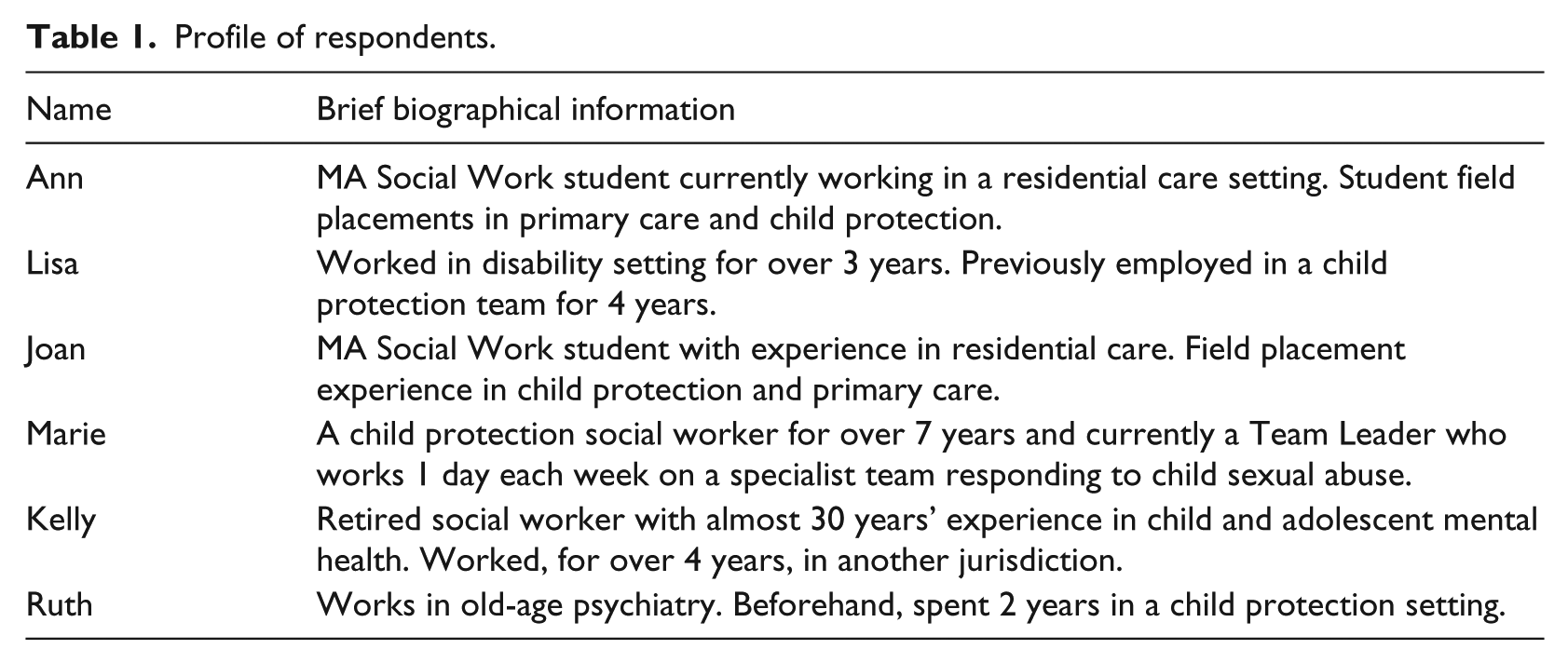
The students were selected as they both had experience in residential care settings as social care workers where they undertook overnight duties. This potentially added a new aspect in terms of risk and safety. Also, both students had completed two field placements as part of their social work programme. Considering that Aisling had experienced sexual harassment on placement, we thought it would be interesting to examine whether other students considered sexual harassment to be an issue needing to be addressed.
The sample was assembled using a ‘snowball’ sampling method whereby contact is made with a small group of people and these connections are used to establish contact with others (Bryman, 2008). The individuals who participated in the research were all based in the same Irish city. Although they shared the same current geographical location, none of them were originally from the area. Two of the six participants were from other countries in Europe and completed their social work education in their home countries.
Clearly, the sample will not reflect a representational account of female social workers in Ireland. Despite not being able to make generalisations, the in-depth interviews can potentially generate interesting data to provoke further research in this subject area. Semi-structured interviews took place and an interview schedule was designed beforehand consisting of a set of pre-determined questions. This approach also furnished an opportunity for the respondents to relate their experiences, attitudes, feelings and perceptions throughout the interview process (Moore, 2000: 121). The Interviews were conducted in an appropriately quiet setting, on a one-to-one basis, by Aisling. Each lasted between 30 and 45 minutes and was recorded on a dictation device. The data was transcribed following the interview and pseudonyms were used so that no individual participant was identifiable. The respondents were invited to share their experiences of sexual harassment behaviours relating to any person they have, or have had, contact with in a professional context (i.e. client/client’s family/colleague/supervisor). This was succeeded by questions exploring whether they considered sexual harassment to be an issue for women in social work. If the respondents had experienced sexual harassment, they were asked about their responses and feelings in relation to these incidents. In line with the objectives of the research, the interviews also incorporated wider themes related to sexual harassment, safety, risk and employer’s response.
Speaking about ‘it’: Findings
Respondents were provided with a list of behaviourally specific indicators of sexual harassment, and their responses illustrated a range in the severity in terms of their own experiences. We are aware in what follows that some of the language used by our respondents in the lengthy extracts is quite explicit, but it is vital to incorporate this dimension so as to retain the vibrant authenticity and tonality of the interview exchanges.
Experiences of sexual harassment
A stark finding was that all of the respondents, apart from Lisa, considered sexual harassment as ‘an issue’ for women in social work: I definitely think it’s an issue working with clients. With colleagues? Not as much. Maybe that’s because social work is predominantly female? But I know it is an issue in my workplace. I think it’s an issue for every woman in any workplace. (Marie)
Two participants who considered sexual harassment an issue for women implied that it was not addressed in social work: I think it is and I think it’s one that’s not clear because nobody talks about it. It’s accepted in that kind of way, you just go along, it’s laughed off. (Joan) Well, it’s not talked about. I don’t think it’s really reported. And because of that, no one knows how to respond. So it’s just swept under the carpet really. (Ruth)
Joan and Ann, the two participants with experience in residential centres, referred to incidents of sexual harassment where clients exposed their genitals and/or masturbated in their presence. The former alluded to a client, in a residential centre, making oral sex gestures towards her and masturbating: There was a boy there and he was about sixteen and I was about twenty one or twenty. It was very uncomfortable, he used to make licking gestures behind my back and behind the backs of other staff. He used to – one incident actually – I know it’s disgusting, but he took out his genitals in the kitchen. There was two male staff and me and he just started masturbating, groaning my name, and he was observed in his bedroom masturbating calling my name as well … There was no support for me nothing done with me and him to make the [professional] relationship work; just me saying ‘stop it’. (Joan)
Ann described sexual harassment incidents connected to adult clients in a disability setting. Other staff had failed to warn her about a particular service client’s inappropriate, sexualised behaviours; they also tended to excuse his actions: I had a service user who would intentionally masturbate at a time when he’d know you’d be coming in. So in that case I’d leave and tell my supervisor or manager. Then the manager or a male staff member would go in instead or check on him … He had Down’s syndrome and a long history of sexual harassment. He’d always be touching women and just grab you, your bum or your breasts. When I started, I had been in the job a couple of weeks before staff told me what he did. He’s short in height, and he hugs taller women. So he sticks his face into your breasts. And the staff would be like ‘Ah god love him, ah isn’t he cute’. But management took it more seriously. When I started I was twenty/twenty one. He took a liking to me, probably because I was younger than most staff. His brother told management about the fascination that he had with me and to be sure I was not carrying out intimate care with him or have him in car on my own. Management tried, therefore, to cut contact so it wouldn’t be adding to his behaviours and fascination.
One respondent stated that she experienced verbal forms of sexual harassment from a male colleague who frequently remarked on female workers’ bodies and appearances: He’d say things like ‘such and such is coming to a meeting; let’s hope she brings the girls with her’. And the girls he’s referring to are her breasts. (Marie)
Marie described this individual as more senior than her, older and generally perceived as a ‘nice guy’ in the workplace. She stated that these attributes – what Bourdieu (2000) terms ‘symbolic capital’ – enabled him to ‘get away’ with inappropriate comments and making women feel uncomfortable.
Ruth also described sexist attitudes in her previous workplace where women were accorded less respect than men: One of the women that I worked with in child protection, she was pregnant and she said that when she told a male colleague about her maternity leave, he said ‘oh sure isn’t it well for ya, wouldn’t we all be having babies if we could get that time off’. Also, in that office there was large number of female workers, one male social worker and the principal social worker was male. The principal would nearly seem to have more respect for the male. He thought that women tended to be ‘dramatic’. So like, there was several complaints made by women about a team leader and nothing was done about it, but when he [the male social worker] made a complaint, something was done. (Ruth)
Responses towards sexual harassment
All the respondents indicated that sexual harassment was not taken seriously in social work practice. For example, Lisa stated, I do not think it’s taken as seriously as if you were physically assaulted on the job or if you were being bullied. It can be subtle. Like, one person’s experience of it might be different, like ‘it’s just a joke’. I could imagine how that might play out. It can leave you feel utterly isolated.
Ann talked about an incident while on a primary care home visit to a father and son. On her last home visit to the family, at the end of her intervention, the father made a comment to his son in front of her saying ‘maybe we’ll bring her back as a mammy for you’. She stated that this comment was relayed to her senior social worker, but he failed to formally report it. Ann maintained, ‘it was laughed off’ by management. ‘Unless it’s something major I don’t think you’d be given the time of day’. Marie indicated that she would not report verbal harassment: I don’t think it would be taken seriously. I think management would go through the procedures to cover themselves but I think in the workplace you wouldn’t get much respect. Despite the fact that my managers are all female, they are listening to the same stuff, so they wouldn’t see it as a problem. So I wouldn’t. And I think people don’t complain about colleagues and teams get quite close and you’d be seen as being the ‘traitor’ within the team … I suppose nobody in the Health Services Executive (HSE) or the Irish Child and Family Agency (TUSLA) gets fired, ever. So you’re going to have to work with this person afterwards … they would know you reported them. Everybody in the office would know you reported them. And you’re still stuck working there and there would be repercussions I think. Even though there’s a policy in place I wouldn’t trust that it would be followed to the letter of the law in terms of confidentiality and everything else.
Joan stated that she did report incidents of sexual harassment to her managers, but, she implied, she is disappointed with the outcome: It’s mostly the team that would support each other … all these things are overlooked, there’s absolutely no consequences, you could send 100 incident reports to the top and what would be done with it, they’d sign it off and put it in a file. That’s it.
When asked whether she would have reported an incident of sexual harassment, Kelly responded, I’ve never done it. I don’t know what they [management] could do. If I was really scared for my safety I would like someone to take over the case. I would hope to be believed and for it to be taken seriously.
Sexual harassment as a form of ‘challenging behaviour’
Four of the respondents stated that handling various sorts of ‘challenging behaviour’ was viewed as a core social work competency, and so this would influence their willingness to report incidents of sexual harassment: Sometimes Child Protection can be quite macho and you’re expected to deal with any stress that happens, any difficult clients, any threats that are made, and you’re meant to ‘take it on the chin’. If you’re seen as not able to take it or seen as a ‘complainer’, you’re put down. So I think that would be part of my reason for not reporting it. As well as that I would not like to give the person [those responsible for the sexual harassment] the satisfaction of thinking they had any power over me; that they were unnerving me or they were making me uncomfortable. I wouldn’t want to give them that power over me. I’d rather just ‘blank’ them.
Ann also described feeling that it was part of her role: Sometimes to a certain extent it can be viewed as part of the job, same as ‘resistant’ clients … people are going to shout, scream at you. Sexual harassment might be viewed as a part of this. Like, just ‘grow a thick skin and get over it’.
Colleagues and clients exerting male power
Three of the respondents felt that sexual harassment was used as a tactic by men to exert power over them. Marie talked about ‘sexual harassment’ being strategically deployed to undermine her: I was attending a meeting and this colleague made a comment on length of skirt, he said something like thanking me for bringing my legs to the meeting and for him having something to look at. At the time I was a lot younger. On reflection I think the comment itself was harmless, but it still undermined me. Everyone else was going into the meeting as a ‘professional’, but he made it about my legs. It’s done with the intention of undermining me, unnerving me for the meeting and in hindsight it did. But because he was not perceived to be an ‘aggressive’ or ‘difficult’ colleague he got away with it.
Kelly considered that sexual harassment was frequently used as a ‘defence mechanism’, especially by involuntary clients: It’s a bit of bravado really. They use sexist or patronising behaviour and they would hide behind that and you would think they’re a bit of an idiot. But you would know where they’re coming from and that they’re feeling insecure … because it’s one way, particularly men, would have of trying to feel better in a situation where they feel ‘one down’ when the social worker is ‘one up’ and they try to feel better in the situation.
Ruth spoke of an incident when she felt that a male client was trying to intimidate her: I once went on a home visit, and it had been arranged beforehand. It was a morning, maybe 10 o’clock. The father answered the door in his boxer-shorts. He said that he forgot about the appointment but, I don’t actually think he forgot at all. It was like he did it to make me feel awkward. Actually, as well, he’d always have the curtains pulled and the lights off. I’d have to ask him if I could turn the lights on. I think he wanted me to find him intimidating.
Vulnerability
Four of the participants mentioned that they consider social workers to be quite vulnerable. Following the incident where a service user sexually harassed Joan, she described feeling vulnerable doing a ‘sleepover’ on her own with him in the residential centre: I was afraid of him. It was the next time I worked with him I was on my own, which is completely vulnerable like and at that time I actually locked myself in the upper half of the house. What else could I do? I was afraid of him, I just didn’t know what he was going to do, what his understanding of it was, what if he had dragged me to his room. I was afraid of him, yes.
Ann mentioned similar concerns regarding conducting home visits and highlighted vulnerability when home visiting in rural parts of Ireland: I think going in you’re more vulnerable. For example, in primary care a lot of your clients are older men, and you’re vulnerable because you’re going into their home. A lot of times, you could be going out to a house in rural Ireland. And you’re told to park the car facing direction of the road, and sit by the door, but at the same time … Whether my car is parked in the right direction or whether I’m sitting by the door, it’s not going to stop them from doing something … It’s got to a stage where you just brush it off, if it’s not extreme, not actually physical. Female social workers are expected to brush it off. I don’t think that would be enough to warrant handing your caseload over. If you’re saying you don’t feel comfortable that should be enough. No one tells you how vulnerable you really are. Like, it’s their home, their safe environment, but it isn’t safe for us.
Dressing ‘appropriately’
Three of the participants spoke about how they considered what they wore before working with certain clients; they always endeavoured to dress ‘professionally’ and ‘appropriately’. They also alluded to dress and attire being used as a way to reinforce ‘boundaries’ with certain clients.
Lisa referred to considering her clothing as a ‘precautionary’ measure forestalling particular reactions from clients: Some individuals that I would know as a worker, certain houses or places I am going to I wouldn’t wear certain clothes, I might not wear tights, skirt, skinny jeans because it will possibly provoke a reaction … You would be conscious of not creating a ‘situation’.
Joan reported an incident in which an adolescent service user in a residential setting tried to ‘put his hand down her trousers’. She stated that she moved his hands away and he grabbed her wrists and attempted to drag her to his room. However, her manager’s response was to dwell on her clothing: The next time I was working with him I was told to dress ‘asexual’ … All women staff were to look ‘asexual’ because ‘you don’t want to be influencing the boys’. It’s like even if you wear makeup or anything … it would be like ‘sure you’re only asking for it’.
Discussion
Sexual harassment can take many forms ranging from gender-related insults, sexualised gestures and comments to touching and physical assault (Ramsaroop and Parumasur, 2007). In this sense, it seems to constitute part of the professional ‘habitus’ for female staff (Bourdieu, 2002). A majority of respondents (five out of six) stated that they experienced some form of sexual harassment in social work practice. This figure is especially high when compared to figures in quantitative research exploring the theme in, and beyond, social work (McGee et al., 2002; Maypole, 1986; O’Connell et al., 2007; The Advocates for Human Rights, 2010).
The respondents discussed their experiences by referring to a range of behavioural indicators of sexual harassment with a majority identifying verbal forms of harassment as more frequent. Indeed, this is consistent with the findings of an EU study whereby participants stated verbal forms of sexual harassment as being most common (The Advocates for Human Rights, 2010). Our female respondents also identified a range of perpetrators. Although none specifically mentioned placement practice teachers, this was revealed as a prevalent facet of sexual harassment in US research: Moylan and Wood’s (2016: 414) survey of over 500 students revealed, in fact, that ‘field supervisors’ were the reported perpetrators in 12 percent of incidences.
Humour was noted as a mechanism which often served to mask offensive and degrading behaviour, and this is consistent with studies of sexualised interactions examining perpetrators’ efforts to embarrass or humiliate. Here, humour is deployed to maintain or enhance male status (Skeggs, 2002). Perhaps the most distressing of the respondents’ experiences of sexual harassment are derived from the accounts of Ann and Joan, the two MA in Social Work students with experience of working in residential settings. Clearly, further research in this area is vital in order to ascertain whether this type of harassment is a widespread issue for social care workers/social workers in residential settings. Procedures need, it would seem, to be implemented in Ireland to make this working environment safer for female staff.
Research indicates that underreporting of violence towards social workers is due to a variety of factors, including practitioners’ perception that violent incidents are an inevitable part of their work and social workers should be able to take care of themselves (Spencer and Munch, 2003: 535). Perhaps in line with this perception, our respondents pointed towards an unsupportive attitude towards sexual harassment within the workplace. For example, Ann described – as we have seen – the dominant perspective as one stressing the need to ‘grow a thick skin and get over it’. This gels with Dominelli and McLeod’s (1989: 135) theory that women experience subtle forms of sexual harassment daily, but have to handle it on their own.
Social workers operate in professional workspaces reflecting the power of male domination within the wide world (NASW, 2005). The perception that sexual harassment behaviours are ‘part of the role’ for female social workers is a worrying thought. Pressing this further, perhaps this stems from notions that sexual harassment may be considered as integral to what Aisling’s US-based practice teacher viewed as the gendered ‘game’.
It is understandable that women in sexual harassment situations respond by behaving passively, avoiding the harasser and ignoring the behaviour (Kaplan in Gould, 2000). The findings in this small-scale project support other research reflecting this, given that the majority of our respondents stated that, in most instances, they did not challenge sexual harassment. By not challenging inappropriate behaviour, practitioners may, however, risk being perceived as condoning such behaviour (Cooper, 2012). Key factors in not objecting to such conduct include fear of retaliation from employers, ineffective complaints procedures, and a fear of being blamed for the harassment (The Advocates for Human Rights, 2010); indeed, all these factors are present in the comments of our respondents. All stated that they would like to be believed, supported and informed throughout a complaints’ process. However, they lacked faith in the guidance and protocols set by management.Half stated that they relied on peer support to help them deal with their experiences. It is still, however, vitally important that management are informed of these issues, otherwise they operate in a world of ignorance while their employees are at risk (Spencer and Munch, 2003). Here, of course, trade unions have a significant role to play as advocates and protectors of workers, but in our study, reference to unions was strikingly absent. This may, in part, be attributable to the relative quietude of unions during a period of ‘austerity’; alternatively, it may suggest that these workplace organisations are being insufficiently attentive to the sexual harassment of female workers.
Power issues were identified by half of the respondents with sexual harassment behaviours deployed by male colleagues and clients or to create gendered leverage within micro interactions across professional workspaces. This dimension was reflected in Marie’s comments on the male colleague remarking on her appearance in an attempt to unnerve her and undermine her professional status. Kelly also focused on her experiences of how certain clients would utilise sexual harassment as a tactic to try and shift the power relations within encounters. In all of these instances, the social power of the female respondents was tactically diluted with, oftentimes, female workers being merely viewed, by men, as sexual objects. This may also reflect what Lee (2000) describes as men’s understanding of sexual harassment as an ‘acceptable masculinity’. For many, it is entrenched in their gendered habitus amplifying and serving to reproduce wider ideologies of domination (Bourdieu, 2000, 2002).
CORU (2010) advises social workers to take the necessary steps to minimise risk in line with the organisation’s policies. However, the majority of our respondents conceded that at times, as women, they felt vulnerable in their role. In social work, the workspaces encompass offices, cars, clients’ homes and other related locations (Lyter and Abbott, 2007). In this context, half of the respondents emphasised the ‘home visit’ as a highly vulnerable situation for practitioners. Lisa stated that she felt vulnerable during home visits in certain urban areas, while Ann stressed that conducting home visits in rural parts of Ireland often left her feeling ‘helpless’.
The Health Service Executive (HSE) (2011) produced safety procedures for child protection social workers conducting home visits to ‘hostile’ clients with ‘joint visits’ being recommended in such situations. However, none of our respondents mentioned doing ‘joint’ home visits. Despite ‘safety tips’ for practitioners conducting home visits and CORU’s recommendation to minimise, reduce or eliminate risk where possible, they can still, as we have seen, be problematic for social workers. This is an area that should be researched further with existing policies revised to assess whether they are realistic and effective. Even during times of so-called ‘austerity’, budget cuts and unfilled vacancies, ‘joint’ visits are clearly essential on an initial home visit and when visiting clients with a history of violent or ‘inappropriate’ behaviour.
The social work literature outlines that professional boundaries should be implemented to work safely and ethically with clients. O’Leary et al. (2013) describe this as the maintenance of ‘professional distance’. The responsibility of setting boundaries lies with the social worker while little guidance is offered in the event of uncertain situations. Half of our respondents mentioned dressing ‘appropriately’ and how incidents of sexual harassment have altered their work with clients.
In maintaining professional boundaries, it is advised that appropriate clothing should be worn by practitioners and clients (Cooper, 2012). However, the notion of practitioners giving further consideration to the appropriateness of their clothing, in maintaining a boundary, is absent from current literature. As previously discussed, sexual harassment can be used as a mechanism of power and domination. Perhaps this responsibility of female social workers to prevent reactions from men is also a cultural by-product, even another mode of domination.
Conclusion
This article does not seek to provide a representative account of all female social workers in Ireland. Clearly, it is a small, qualitative study undertaken with four social workers and two final year MA in Social Work students. However, their perceptions and opinions are thought-provoking, insightful and challenge assumptions about sexual harassment, women and social work practice.
We have endeavoured, therefore, to make visible an array of issues previously insufficiently explored within the professional literature. More emphatically, it is vital that we should expose discrimination and challenge prejudices or we run the risk of living behind a screen of ‘symbolic violence’. Our most practical and immediate recommendation is to further the scope of research in this area. It may also be interesting to examine other factors such as age, ‘race’/ethnicity, class and disability alongside the theme of sexual harassment.
We have often referred to the need for incidents of sexual harassment to be ‘reported’ and adequately investigated. However, we realise that, in terms of clients, the situation is highly complex. Some of those reportedly responsible for abuse – such as young clients with learning difficulties – clearly did not have the capacity, because of cognitive impairments, to act in a deliberative, fully informed and reflexive manner. What is more, we are not implying that a punitive response to such behaviour is warranted. Here, the emphasis should be more tilted towards education, awareness-raising and adequate staffing levels, especially in day-care and residential facilities. However, it is clear that sexual harassment is also attributable to male co-workers. In this context, the organisational responses need to be much clearer, better attuned to and much more protective of women workers.
Training should also address power relations in the workplace and ethical uses of power. This may assist women workers in talking more openly about their experiences and gaining a sense of validation. More generally, it is vital that female social workers are supported in their role and understand that sexual harassment should not be considered part of the ‘game’ across our workspaces.
Footnotes
Funding
The author(s) received no financial support for the research, authorship and/or publication of this article.
Author biography
For several years,