







Abstract
While rural residents still comprise nearly 60 percent of the total population in China, little is known about the evolution of rural welfare. This article explores welfare services in rural China using a broad definition of social welfare: efforts by the entire country and society to promote personal or societal well-being. Diverse approaches have been implemented to provide social services for rural residents with complicated dynamics among different providers, which follows a path different from that in the West. Findings of this study have important policy and research implications for understanding and further developing social welfare services in rural China.
Introduction
Despite the rapid economic growth and industrialisation of the past several decades, 58.8 percent of the Chinese population still lives with a rural identity, based upon the hukou system of household registration (National Bureau of Statistics of China, 2017). A high proportion of the rural population in China was associated with the fact that, historically, agriculture was valued as more important than commerce. This economic and demographic structure also played an important role in the success of the Chinese Revolution of 1949, which motivated rural residents’ support by addressing their concern over the ‘land ownership’ at that time. However, Chinese modernisation after the Revolution had further exacerbated the urban/rural disparity and inequality. While the modernisation of agriculture is regarded as one core goal of Chinese modernisation, it is known that China’s recent growth has occurred at least partially at the expense of sacrificing the development of rural residents and has resulted in their economic and social welfare 1 disadvantages.
Few studies, however, have examined the development of the social welfare policy in rural China from a historical view. Little is known about the dynamics of welfare governance in rural societies, particularly from a historical perspective, which could greatly contribute to the new development of social welfare policies in rural China. Among the limited literature on social welfare in rural areas, most has explored this topic from a narrow perspective of social security such as the Western view. While significant, this narrow perspective emphasises social insurance programmes over a broad spectrum of social welfare services. Taking this narrow perspective may underrate the depth and cohesion of Chinese rural welfare developed throughout China’s long history. It not only restricts the possible theoretical contributions of Chinese experience to the development of social welfare policy in the global context, but also intensifies the improper superiority of Occidentalism in Chinese welfare studies (Zhou, 2007). From a Western view, transitional China has provided an intriguing image of welfare state development since the early 1980s, whose consecutive decades of astounding economic growth has been accompanied by low welfare expenditure and a high level of social stability (White and Goodman, 1998). However, Chinese experiences of the social welfare regime, in particular those generated from the development of social welfare services in rural areas, could not be well explained by the classic typology of welfare state. In addition, without an inclusive perspective on social welfare in a broad sense, various needs of rural residents for social services may have been overlooked by policymakers, researchers and service providers.
Therefore, this study takes a broad view of social welfare, with a particular interest in depicting the dynamics of welfare governance for rural residents and identifying the key factors contributing to the development of social welfare in rural areas. In the study, ‘rural residents’ refers to those identified by the household registration system (hukou) as having rural residency status or those living in rural areas. In exploring the development of social welfare in rural China, the study uses the term ‘social welfare’ to indicate efforts by the entire country and society to promote personal or societal well-being, and it emphasises the roles that different service providers have played (Shang, 2001; Yang, 2008). It involves the formal or informal support provided by the state, governments, civil society, and so on, through cash, goods, in-kind services, transfers of payments and benefits, and other means (Hebel, 2003; Midgley, 1999; Yang, 2008). Accordingly, in a broad sense, ‘social welfare in rural areas’ is the welfare system established for the rural population and promoted by different welfare providers. It refers to the aggregate welfare that different welfare providers offer, along with relevant actions, measures, policies and institutions; these provisions can be divided into the categories of social security, 2 social insurance, social service and cultural welfare.
This article explores social welfare in rural China from the period of traditional society 3 through the present. Apart from the traditional explanations of the welfare state by economic or political hypotheses, this article forms an economic-political-cultural analytical framework to investigate the transitions of social welfare in Chinese rural areas, and to illustrate the dynamics of welfare governance from a historical perspective. Of note, social welfare through culture reproduction was taken into account in this study to echoe current misunderstandings of welfare supply (Zhang, 2017). Closer inspection and historical analysis will be applied for different stages to describe social welfare circumstances and approaches for rural residents. The secondary objective of the article is to reveal the dynamics among different welfare providers, including the state, governments, market, civil society, families, and even the invisible cultural pillar. It defines the development of social welfare as the product of interactions among the economic and political institutions, and the cultural, social and political resources. A focus on the dynamics of welfare governance for the Chinese rural population may better summarise the lessons from Chinese experiences on social welfare development in rural areas, contribute to the theorising of welfare development from the practice of a big agricultural country, and provide rich insights into future cross-country discussions on global social welfare development.
Fragmented welfare in the traditional society
In imperial China, the power of the emperor was paramount. No other power surpassed the emperor’s in the governmentality of the state. Even if a rival power had existed, it played merely a limited role that was conditional on its obedience to the emperor (Zhou, 2005). Comparatively, in traditional Western society the power of the church surpassed that of the monarchy, especially in matters of social relief and other welfare affairs; churches were the greatest welfare providers, and they provided welfare long before governments assumed that role (Wang and Huang, 2005). Traditional China did not gradually develop social welfare for rural residents along a systematic path as Western countries did.
As the country transitioned from one centralised dynasty to another, the ‘family’ or ‘household’ was shaped as an important unit for informal welfare provision. Traditional Confucian values, including ‘filial piety’ and ‘being faithful to one’s husband unto death’, defined and supported the family’s role in welfare provision. Research also shows that rural residents received welfare support from other sources beyond families in traditional society. During this period, the local government served as an indispensable provider of social welfare by means of social protection, and performed scattered, non-institutional welfare functions (Zhou, 2005). Furthermore, supplies from the society such as patriarchal clans, mutual assistance associations and collaborations among communities also grew gradually and complemented the social welfare functions supported by families and local government.
At this stage, social relief was offered as the main category of social welfare in rural China, including disaster relief services and social assistance for the vulnerable. Although the relief services and assistance fluctuated or varied partially by governmentality of local governments, these programmes did play an irreplaceable role in supporting agricultural production, reducing losses from disaster and assisting people in need. Older adults and those experiencing sickness, injury or disability could obtain some support and relief from the government, such as material assistance or spiritual awards for the elderly (Wang et al., 2003). Specific assistance and medical aids were offered for the poor, disabled or sick (Wang and Huang, 2005), and nurturing care was provided for abandoned infants or toddlers from impoverished families (Zeng and Zhou, 2006). The emperor was informed that the state should take on the least level of welfare responsibility to keep the country stable. In fact, there has been a long history of the state and government providing welfare services, although the provision was very limited and fragmented. Moreover, charity from clans and from religious and charitable nongovernmental organisations not only provided an organisational infrastructure for delivering social welfare services in rural societies, but also helped maintain the rural families and communities in solidarity (Wang, 1992).
Additionally, public goods of traditional rural society were mainly self-sufficient within the rural community itself, including military defence, flood governance and social order maintenance (He and Chen, 2008). For example, being an extremely scarce resource at the time, education for the rural population was relatively improved through the Mass Education Movement and the Rural Education and Rural Reconstruction Movement during the 1920s and 1940s (Liang, 2006; Yen, 1926). About 700 distinct organisations were devoted to various rural tasks in response to the reform of ‘rural revival’ at the time (Alitto, 1976; Ho, 1936). These civil forces broadened the rural population’s limited welfare, while the scope of these services was constrained in local communities or certain areas.
The welfare providers in traditional society, mainly composed of local societies and the extended family, gradually developed the premature fragmented welfare programmes for rural residents. Mainly consisting of social relief, veterans’ benefits and public goods, social welfare in rural China at this period was established in an extremely loose and unorganised manner through social organizations such as the local gentry, clan organisations, land-sharing groups, clan estates and others, a system that was loose but irreplaceable in delivering welfare to the rural areas. Informal welfare resources based on marriage were considered the ‘bottom line’ for the rural population. This invisible welfare provider built on traditional ethics and habitus, law and codes, including benevolence, bliss, fate and revenge, promoted welfare reproduction in rural areas to some extent (Zhang, 2017; Zhou, 2005). However, as there was no top-down supervision over the intrinsic power of families and clans, rural community solidarity was weak and self-reliant (Fang, 2000), which resulted in the non-institutional nature of rural welfare.
Collective welfare during the people’s commune period
Following the independence of New China (1949), the China Communist Party (CCP) and the central government gradually built state capacity, including fiscal strength, regulation and control over macro-economics, legitimation and social control (Wang and Hu, 2001). Farmers got rid of the oppression that had lasted for thousands of years and became participants in the New Agricultural Cooperation Movement. The transformation of the social welfare model in rural China transitioned in this period from one that had been mainly managed within family, household and clan to one that relied on the collective land cultivation of the people’s commune system. However, neither of these two was guaranteed by the fiscal system. 4
In fact, the commune system encountered resistance from rural societies at the beginning (Li, 2006). 5 It was not until the implementation of trials of mutual-aid teams and elementary cooperatives that the commune system consolidated the foundation of public accumulation extraction. In the ‘Model Regulations for Advanced Agricultural Producers’ Cooperatives’ (CPC Central Literature Research Center, 1994: 422–3), specific welfare programmes were clearly embodied and outlined. The Five Guarantees System set a prototype and principles on how to redistribute the limited resources to rural vulnerable groups: under the direction of the state, collective relief and food stocks initiated the institutional welfare for rural residents; specific labour protection measures settled the classified social welfare; and most importantly, cultural welfare and public social participation, which were taken into the framework of the collective’s routine, greatly expanded the connotation of rural welfare towards the concept of comprehensive welfare for rural residents. However, the government merely served as a regulator and residual supporter for rural emergencies.
As the collective public welfare expanded within the rural community along with the collective’s militarised management and highly unified life, the importance and responsibility of family in welfare provision diminished. Public mess halls, kindergartens, nurseries, sewing teams, barbershops, public bath halls, agricultural schools, political schools and child welfare provided farmers with some modern welfare (CPC CLRC, 1995; Pan, 2014). Among these efforts, the institutionalisation of health services was a benchmark of collective welfare, with the Cooperative Medical Service as the main component of health services (Gao, 1999).
After the catastrophic drought and the Great Leap Forward from 1959 to 1961, agricultural cooperation was adjusted to a joint model in which the land ownership was shared by the commune, the production brigade and the production team, while the production team served as the basic unit. This model continued until the 1970s, when the production team took on the full responsibility of administrating the commune’s social welfare (Dixon, 1982). Rural welfare services, including public facilities, social services and social security, were regulated at a higher level using public funds set aside for production activities and specific welfare affairs. Production funds were collected mainly for rural infrastructure construction, whereas welfare funds were used for members’ common welfare to assist the vulnerable or their families. Four ways to support the rural vulnerability are outlined: first, the disabled, the childless, old widowers and widows, orphans and those who faced livelihood difficulties for various reasons could receive aid with the team’s consent after discussion; second, families of ‘revolutionary martyrs’ and veterans with disabilities were privileged with financial and political welfare; third, for large families with few labourers, the production team would adjust their workloads in accordance with their capabilities and help them increase their family incomes with the necessary support; fourth, compensation for wounded or dead family members could be provided by the welfare fund (CPC CLRC, 1996). It should be noted that the collective welfare of this period emphasised the role and responsibility of family again after the efficiency of the commune system decreased (Dixon, 1982).
Dialectically, the commune system laid a solid foundation for China’s primitive industrialisation and also for the collective rural welfare. In a society highly regulated by the state, social welfare in rural China was financed via a relatively sustainable institution in which the production team served as the basic unit of public accumulation. According to the 1965 data, the collective accumulation for social welfare in rural areas accounted for 42.36 percent of the annual yield (Yu, 2000), which demonstrated the solid foundation of this welfare system.
Under the ideologies of ‘people being the masters’ and ‘egalitarianism’, rural residents began to enjoy modern welfare rights based on the institutional and normalised foundation of public accumulation. Although this approach of rural social welfare complied with their needs of modernisation to some extent, it was not equal to their contributions to Chinese modernisation. The gap of social welfare between rural and urban societies has evolved into even larger and entrenched inequalities since the early 1980s (Dillon, 2015; Hannum, 1999; Zhang and Kanbur, 2005). The evolving pattern of welfare governance for rural residents at this specific period was rooted in an imbalance between the commune and state. It is known that, after a series of cell-processing events in the 1950s, the state’s power penetrated into the rural areas even more deeply and closely than it had in late traditional society (Huang, 2000). The state played the very role of social controller and resource extractor in rural societies in pursuit of industrialisation and political legitimacy as a whole, but with an extremely limited role in social welfare governance. The government paid much more attention to rural residents’ political (political participation), economic (development of agricultural production) and cultural welfare (political education) than to their needs for social welfare services (Liu, 2002). Meanwhile, rural civil society was largely adsorbed into the state socialisation through the communes. As a result, the commune became the genuine provider of social welfare, mainly depending on residents’ own labour accumulation (Ye, 1997) and mutual aids among team members.
Under the circumstances of a big state-weak society system, the collectivisation of rural non-institutional welfare merely played a ‘handmaiden’ role in relation to a programme of rapid industrialisation organised by a communist developmental state that was unwilling to spend a certain amount of funds on social welfare in rural areas (White and Goodman, 1998). Undoubtedly, the collective social welfare in rural China ended in failure despite its ideal design (Dixon, 1982). First, the welfare system for rural residents was deeply embedded in the framework of the ‘agriculture feeding industry’, and hence, the needs for social welfare of rural residents were far from the vision of state and local governments. Second, under the ideology of socialism, such as collectivism and egalitarianism, free-riding behaviours of rural residents to take advantage of collective welfare provision was too difficult to be completely solved, especially during the late commune period. On the basis of primary cooperation among rural households without effective top-down supervisory mechanisms in the framework of strong state/weak society, agricultural cooperation actually resembled a social movement controlled by the state and resulted in futility (Wu and Wu, 2011). Naturally, the responsibility of rural welfare provision mainly fallen back into family domain again.
Involution welfare from the 1980s to the early 21st century
Social welfare programmes are considered as a type of social protection to counteract the commercialisation of labour in the process of marketisation wherein the necessity of social welfare for rural residents is self-evident. Unfortunately, social welfare in rural China has inevitably fallen into a trap of ‘involution’ in the last two decades of the 20th century.
‘Involution’ is a concept derived from Alexander Goldenweiser’s ‘practical analysis of cultural patterns’ (Liu and Qiu, 2004). The concept was further developed by Clifford Geertz (1963) to describe the phenomenon that occurs when a social or cultural pattern is stagnant or cannot lead to a higher stage after it develops into a certain type. The involution of rural social welfare means that, due to the non-institutionalised and non-standardised system of collecting taxes from rural residents, the sluggish growth of rural incomes and the inefficient utilisation or illegal occupation of welfare resources in the context of the persistent absence of the state, the mobilisation of resources for rural welfare depending on collective ‘public accumulation’ and ‘labour amounts’ could not be sustained. The financial burdens to support the social welfare system over rural residents finally reached an unbearable level in spite of their extremely limited obtainment of social welfare.
Regarding resource mobilisation during this period, rural social welfare copied the previous collective model, while accumulated funds were held by the village committee 6 rather than the production team. The town and village also assigned rural residents compulsory work mainly for flood relief services and road construction, and allocated accumulative labour tasks mostly for agricultural irrigation and water conservation projects (Ye, 1997). Furthermore, rural residents had to pay for primary education, family planning, militia training and transportation services, which were still not within the fiscal budget as before but were coordinated by township governments. While it was not considered an issue during the commune period, the ‘General Accumulation and Apportioned cost share among village households’ became a critical burden for rural residents after the early 1980s, attributed to the new calculation unit and the unequal exchange between agricultural and industrial products. Great changes in resource mobilisation took place after the collapse of the commune system: first, all public welfare costs were directly shouldered by each rural household, which had an economic and psychological impact on recipients. Second, as rural residents gained control over their own labour, the ‘labour’ that was previously part of the welfare payment could not be dispatched as flexibly as it was in the commune period. Instead, it was paid to rural residents to some extent in cash, resulting in greatly increased costs for the rural social welfare system (Ye, 1997). 7
To sum up, with the process of major economic reforms, it became an impossible task to maintain even a low level non-institutional welfare in the non-equivalent rural political and social system. With the 1998 tax reform, the rural tax settlement unit evolved according to the path of ‘team-village-household’ (Shen, 2008), and further increased the transaction cost in collecting taxes from the rural population. Meanwhile, the inverted-pyramid fiscal structure after the tax-sharing system reform in 1994 intensified the fiscal burdens of the county and township governments (Lv and Zhao, 2009), which was eventually shifted to rural residents and created social problems such as hostility between rural residents and local governments with unconventional violence during the process of tax collection. Moreover, the ‘Three Public Accumulation Methods and Arrangement of Five Public Services’ (Santiwutong) and other apportions of charges for the provision of rural social welfare, being typically non-budgetary funds, were illegally usurped or inefficiently spent, resulting from asymmetric exchanges of communication between fundraisers and rural residents, a lack of social supervision and other factors (Ye, 1997). Meanwhile, to pursue rapid economic development after 1980s, the government launched a series of campaigns such as township enterprise initiatives and the construction of satellite towns. These actions not only increased the tax burden across the rural population, but were accompanied by neglect and inaction of governments on social development, specifically in the provision of social welfare for rural residents. Despite the stratification among the rural population, the original equally apportioned system of rural taxes and fees continued to charge every household the same amount, regardless of their income and wealth, and finally resulted in a distinct regressive effect over the rural households (Ye, 1997; Zhou, 2003). Entrenched gaps in resource mobilisation have resulted from disequilibrium in industrialisation among the eastern, middle and western rural regions, which manifests as multiple sources of fundraising in the eastern regions versus shortages in the middle and western regions (Liu, 2002). In the absence of tight state control over the rural areas during the collective welfare period, the purely top-down model of taxation and resource allocation mismatched the rural economic and political system, and resulted in social welfare involution. This plight was not simply rooted in the collapse of the collective economy; it mainly lay in the increasingly unbearable burden for rural residents despite the large disproportion between their responsibilities and welfare obtainments from the welfare system.
In the era of social transformation, land as one of the four elements of production became a quasi-provider for rural social welfare. On the one hand, rural residents with tiny land plots were unable to resist risks that arose due to marketisation as the function of land’s marginal efficiency in welfare provision diminished. On the other hand, the former policy approach of ‘agriculture feeding industry’ was replaced by ‘GDP as the overarching priority’; hence, resource allocation further tilted towards urban areas and rural social welfare was more neglected. Under the context of increasingly interplayed globalisation, the function of the land in sustaining rural social welfare tends to be weakened; to satisfy the needs of rural residents on social welfare requires a more demanding role of the family in welfare provision.
However, being the key pillar of welfare provision, the rural family has also unquestionably experienced a transition. The restricted role of family in welfare provision has resulted from the weakened economic rewards of agriculture, the shrinking family size (Wang, 2009), and the structural shift of family power from ‘father–son’ to ‘husband–wife’ 8 (Yan, 2006). Furthermore, the absence of integrated welfare provision mechanisms forced the family to take on a greater responsibility despite the erosion of conventional values and ethics among family members and neighbourhoods since the 1980s, where individualisation is portrayed by the changing relationship between the individual and the party-state (Murphy, 2002; Yan, 2010).
Due to the absence of government and excessive intervention of the market, the rural welfare system which aimed to guarantee basic security (such as the ‘five guarantees’, cooperative medical services and rural old-age insurance) nearly collapsed during the 1980s and 1990s (Hong et al., 2004; Liu, 2006; Qiao, 1998). Thus, rural residents had to spend the majority of their savings for market-oriented ‘paid’ social welfare, including a certain amount of medical care and education. Regarding education, rural compulsory education became purely the ‘rural residents’ obligation’, which should have been completely supported by public funding (Wang, 2005). Poverty, as a consequence of the unbearable cost of illness or education, evolved into the realms of the normality in rural societies.
The involution of rural welfare shows the collapse of welfare provision mechanisms in rural China and reflects the large imbalance between obligations and rights of rural residents and indicates the incompatible relationship between state and society. Since the 1980s, the structure of ‘strong state and weak society’ has evolved considerably. Without communes, the state’s capacity to control rural society decreased a great deal; hence, the state could no longer act as a ‘visible hand’ in welfare provision via regulation and control over communes, as it did during the commune period. That is to say, the state allocated the assignments of modernisation to rural residents via top-down strategies in a pressurised system that greatly increased the transaction costs between the state and rural residents (He, 2007). Accordingly the state’s irresponsibility of welfare provision contributes to the ephemeral welfare rights of rural residents in the dual urban–rural welfare system when the society is not strong enough to implement its role. All of the above-mentioned factors have cultivated favourable conditions for the intervention of the market into rural social welfare. That is, with the absence of the state, the previously forbidden market has gradually stepped into much of rural society, especially into the fields of education and health services, which has eventually resulted in a further intensified welfare gap between urban and rural residents. According to Zhu and Wu (2001), rural residents, accounting for 75 percent of the whole population, only enjoyed about 6 percent of the total national welfare expenditure in 1996. The mean ratio of social welfare expenditure per capita between urban and rural from 1991 to 1998 even reached up to 141.7:1 (Yang, 2003).
Meanwhile, the demands of rural residents for social welfare services have also naturally increased with the overlapping influence of industrialisation, modernisation and globalisation, which greatly differ from those of the previous stage of single-unitary agricultural operations. This unresisting trend predicts the rural population’s demands not only for public services, as characterised by quasi-public goods, but also for culture, community, solidarity and similar benefits supporting their modernisation. Nevertheless, the key welfare providers are either absent or have been squeezed out by the market or the state, due to which the rural residents have been compelled to lead lives without appropriate or sufficient welfare services.
The evolving path of rural welfare governance and the existing plights for rural residents
The evolution of social welfare from the traditional society to the early 21st century implies that the dynamics of welfare governance for the rural population are deeply embedded in different stages of the state–society framework (Table 1). Three main factors, comprising the nature of welfare rights, the boundaries of the state and the role of society (particularly the family in rural China), are identified as the key factors explaining the development of rural social welfare. First, in general, the welfare rights of Chinese rural residents were considered non-essential without the state’s direct and stable involvement. In traditional society, the rights of social welfare developed as a type of moral relief. With industrialisation and the overarching ideology of socialism after 1949, this right evolved into a modern one, to some extent. However, the welfare rights of rural residents have gradually dissolved in favour of economic growth-oriented strategies since the early 1980s. Whether welfare rights pertain to moral welfare in a narrow sense or modern social welfare in a broad sense, the path of rural welfare governance illuminates the divergence of ‘social welfare’ in a different context of the state–society framework, and demonstrates the low quality of and appendant status of rural social welfare constrained by the economic, political and social contexts.
The provision of rural welfare and welfare governance in different stages.
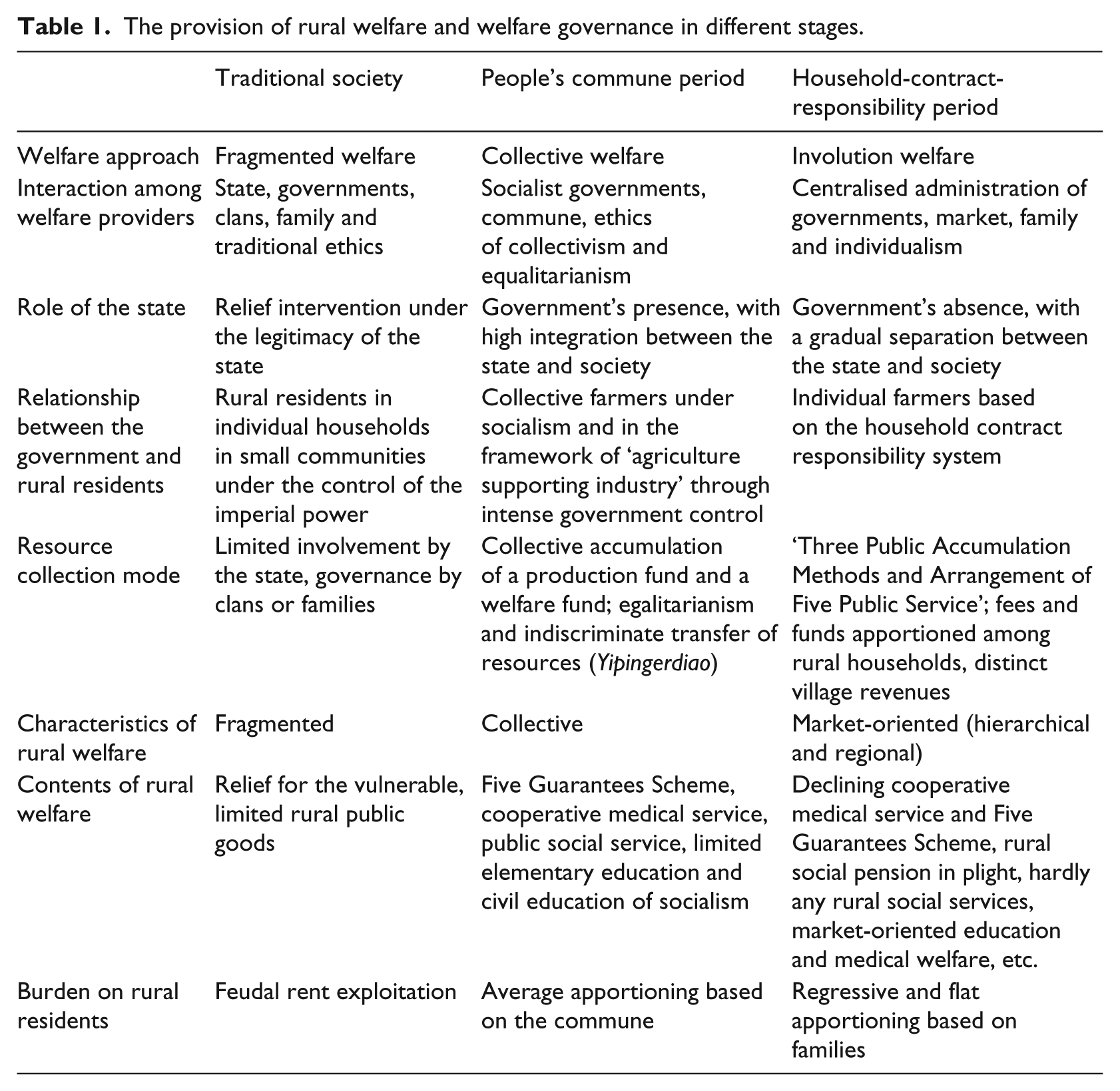
The overwhelming influence of the state on all other providers is well confirmed, with a path in which the state was unconsciously involved at the beginning, was a controller in resource mobilisation during the socialist period, and was absent during the first 20 years since the early 1980s. Comparatively, China and the West diverge in the state’s role of welfare governance. Although the Chinese government stepped into social welfare earlier than Western governments did, it has followed a much more tortuous and sluggish path than that of the West. It was not until the well-being of poor rural strata and localities and the continuity of Chinese modernisation were under threat (Selden, 1999) that the state realised the severity of its inaction in rural welfare governance. On the contrary, Western countries gradually combined rural welfare into modernisation of the welfare state in tune with the industrialisation and modernisation of the whole population.
In the path of Chinese rural welfare evolution, the society is greatly constrained by the patriarchal state and eventually remedied by a changing but ever lasting role of family, by which family-based welfare has been demonstrated as a realistic familialism approach in China (Huang, 1995). However, as an inborn welfare provider, the role of family in rural welfare provision also largely depends on support from the state and society, otherwise the welfare governance is unsustainable.
As stated, apart from the social-political and institutional determinants, cultural factors are considered another important determinant of the development of the welfare state (Aspalter, 2008). Economic growth relies not only on conventional economic inputs, but on the wider social development including that of social welfare. The overlapping influence of institutional, political, economic and cultural factors explains the course of welfare state development for the Chinese rural population. The neglect of rural social welfare in favour of economic growth-oriented strategies since the foundation of New China and the failure to gradually frame sustainable welfare policies for the rapid modernisation of rural population, given the diminishing role of culture in rural welfare provision, not only threaten the well-being of rural population, but also jeopardise the continuity of Chinese development.
In fact, multiple initiatives have been launched in the last decade to promote welfare governance in rural China, including almost full coverage of the minimum living allowances, the new cooperative medical system and the consensus of legal entitlement to social welfare for the rural population. However, a wide variety of concerns, such as the reduced 9 rural old-age pension, the materialisation approach of social welfare and the inefficiency of welfare providers, remain unresolved (Xue and Xian, 2014; Zheng, 2009). Being the core system of the welfare regime for rural residents, the new rural pension only covers a small portion of the target population, and offers only 8 percent of the recipient’s average income (Mu, 2013). For rural residents, they remain reluctant to transfer their land rights partly because their entitled welfare was infringed by the alliance of local governments and enterprises (Guo, 2014). Furthermore, the vast and rapid rural-to-urban migration of rural labourers has triggered other urgent issues, such as the vulnerability of the ‘left-behind’ children and elderly versus the shortage of appropriate and timely welfare services for target groups (Huang et al., 2015; Robinson, 2016), the reluctance of migrant labourers from rural areas to participate in welfare programmes versus the demands for social welfare within breakable floating families including members at different stages of life (Xu et al., 2011), et cetera. This clearly indicates that the development of rural welfare is still lagging behind.
China is undoubtedly a country with one of the biggest rural populations on the globe. The aforementioned concerns also echo certain issues confronting different countries under different social and economic conditions and resources. Hence, what can we learn from the experience of developed or developing countries? To date, the development of welfare governance of Northern or Southern countries demonstrates that social welfare could also enhance economic participation and make a positive contribution to development, and the evolving demands for social welfare of rural populations should also be taken into account for the pursuit of a sustainable harmonious society (Ahn and Kim, 2015; Midgley, 1999).
The government-enabled provision of developmental social welfare for rural residents is an alternative. Developmental social welfare is considered one of the mechanisms to promote social development, social justice and the social functioning of the people (Midgley, 1995). This perspective on social welfare has been widely put into practice, especially in the developing countries since 1970s, and was given international recognition in 1995, which offers an opportunity to harmonise economic and social development (Bak, 2004). Removing barriers to economic participation, investing in cost-effective social programmes and funding asset development, et cetera, are considered the essential initiatives (Midgley and Tang, 2001).
Given the inherent law of social welfare, the developmental approach illuminates the government’s full understanding of, certain support of and reparation of debts to rural residents. More substantially, this model would confirm the rights of rural residents to social welfare by satisfying both their basic and developmental needs; such support is considered necessary for cultivating rural residents’ independence and autonomy in transitional society. More active state involvement is required to help gradually facilitate awareness of economic participation and social inclusion of rural residents by means of innovative social programmes that lie in market, civil society and cultural reproduction.
Conclusion and discussion
This article explores the different forms of rural social welfare in China in a historical analysis (Table 1), and offers an economic-political-cultural logic for the observed variation in non-institutions of rural social welfare established by the nondemocratic regimes, filling gaps and adding additional explanatory content for welfare development of the rural population. Regarding traditional society, beyond the initiatives promoted by state legitimacy, the rural population received the least distributed welfare for their family, household and clan in communities that were integrated by common ethics, traditional culture and other norms. However, rural welfare in traditional society could not have been guaranteed because of the absence of efficient agents communicating with the state. Following the independence of New China, rural social welfare received consistent support from the out-of-institutional public accumulation by the commune that was controlled remotely by the state at the beginning of industrialisation, forming a relatively supportive welfare system. Although this system was characterised by many limitations, especially the increasing dual gap between urban and rural populations, it did initiate the path of institutional welfare provision for rural residents for a short duration. Nevertheless, during the market-oriented welfare stage, the market has overly irrupted the sphere of social welfare, due to the absence of governments and the sharp decline in the capacities of the collective for welfare provision. This system has further intensified the welfare gap between urban and rural populations, limited the de-stratification role of social welfare, and jeopardised continued Chinese development in the long run. More recently, the state and governments have been brought back to remedy the unbalance between economic growth and social development in the early 21st century, in which great changes have taken place in social welfare development along with a wide range of challenges in rural China.
A developmental approach of social welfare as the solution to rural welfare in developing countries is not solely an issue of resources inputs, but one of feasible and sustainable strategies to solve the entrenched urban–rural disparity in China and to respond to unmet demands for social welfare for rural residents in an accelerated trend of globalisation and individualisation. Most importantly, the leading role of the state and governments is to be clearly clarified, in which the state should solidify the basis of the rural welfare system for other providers in welfare provision and prioritise creating favourable conditions to facilitate the role of the market and society in welfare provision. Further, efficient collaboration of the market, society and other informal welfare providers is the core of welfare governance in rural China within the framework of the Chinese centralised administration system. Meanwhile, it is critical to manipulate the mechanism of the market as well as to stimulate the autonomy of village committees and foster a network of social capital in local communities, on the condition that the role of family and the evolving culture and ethical system is well rebuilt and integrated into welfare governance.
Footnotes
Declaration of conflicting interests
The author(s) declared no potential conflicts of interest with respect to the research, authorship and/or publication of this article.
Funding
We gratefully acknowledge the support from The Research Fund of the School of Social Development and Public Policy at Fudan University.