







Abstract
This article maps the field of international comparative research in school social work. For this purpose, a systematic literature review was conducted and subjected to a narrative synthesis. The review reveals 11 publications that are predominantly non-empirical, take mainly Asian, European, North American countries and Australia and New Zealand into account, and are focused on profession-related and sociopolitical aspects of school social work. A synthesis of school social work practice themes transcending national boundaries emerged from the findings, covering child-, family-, school-, and community-related issues. Accordingly, children are predominantly confronted with similar issues, irrespective of the place where they live, such as violence toward themselves, at home, in school, and in their community. Bearing in mind methodological challenges when carrying out comparative studies, recommendations include the conduct of practice-focused studies that generate new stimuli to improve already well-developed practices in a culturally appropriate way and enable mutual learning among school social workers.
Keywords
Introduction
Despite an increase of publications in international comparative research (ICR) in social work (SW) in recent years, many authors state that, to the present day, comparative views are not a self-evident part of SW theory building and research (Friesenhahn and Kniephoff-Knebel, 2011; Göppner and Hämäläinen, 2004; Hämäläinen, 2014). Nevertheless, several reasons are discussed concerning why ICR in SW appears valuable. Accordingly, ICR can lead to a deeper knowledge and understanding of SW (Göppner and Hämäläinen, 2004; Hämäläinen, 2014; Hantrais, 1995; Ornellas et al., 2019; Schweppe and Hirschler, 2007). In addition, alternative SW practices can be recognized and lead to improvements (Friesenhahn and Kniephoff-Knebel, 2011). Thus, SW can function as a role model for other countries (Schweppe and Hirschler, 2007) and help to question a country’s ‘own taken for granted practice’ (Williams and Simpson, 2009: 3).
There has been a greater emphasis on international SW in recent years and, associated therewith, on school social work (SSW), a specialized area within the SW profession (Villarreal Sosa et al., 2017). The traditional role of SSW was to support children and young people to enroll in and successfully complete school (Huxtable and Blyth, 2002: 3–4). However, several other tasks have been added over time (see e.g. Villarreal Sosa et al., 2017). While roles and methods have been developed based on ‘national cultures and educational traditions’, they were shared between different countries (Huxtable et al., 2012: 236). Thus, SSW is an internationally informed profession based on national cultures and traditions.
There are many single-country studies and much nation-specific literature focused on specific SSW aspects. For example, a Swedish study, consisting of 12 semi-structured interviews with school social workers, investigated the use of SW in SSW, considering that SSW in Sweden is a minor profession within the school institution and subject to ‘educational logic’ (Isaksson and Sjöström, 2017: 192). Results show Swedish SSW is led by discipline-specific knowledge rather than the organizational context. Furthermore, professionals act quite pragmatically, rather than applying evidence-based methods, and their practice is consistent with four approaches: task-centered, systems theory, strengths, and anti-oppressive (Isaksson and Sjöström, 2017: 200, 194; referring to Healy, 2005). Also, a systematic review investigating SSW in Germany revealed 31 terms that are used beneath the most common term, Schulsozialarbeit (school social work), and partly different underlying conceptual ideas which are seen as a hindrance to further professionalization (Beck, 2017). Considering that SSW is not implemented in Sierra Leone yet, and the first cohort of SW students graduated from university in 2016, a study investigated the possible role of SSW in Sierra Leone (Bulanda and Jalloh, 2017). The study used a mixed-method approach, consisting of interviews and surveys with 105 teachers and 30 school principals. Four recommendations are deduced, namely, to (1) enable individual education planning, (2) counsel pupils and (3) school staff, (4) engage parents in their children’s education, and (5) act as a liaison with community stakeholders. The importance to combine international standards with specific local cultural knowledge is highlighted.
Beneath single-country studies, only few publications compare SSW in two or more countries or provide separate country descriptions based on comparable criteria. The present article’s aim is threefold, namely, (1) to identify the main focus areas in previous publications, (2) to explore SSW practice themes, and (3) to develop recommendations for future research. Therefore, a systematic literature review was conducted and subjected to a narrative synthesis.
The article’s structure is as follows. First, the central questions in ICR, namely, why, how, and what should be compared, will be summarily outlined. Second, different attempts to classify comparative studies in SW are briefly shown. Third, methodological challenges in ICR in SW are presented. Fourth, the method, including the search strategy, study eligibility criteria, publication selection, data synthesis, and limitations, will be outlined. Fifth, the results will be shown, including the lack of practice-focused research in SSW, as well as a synthesis of SSW practice themes transcending national boundaries; and sixth, a conclusion will be drawn and implications deduced.
Why, how, and what to compare?
When dealing with ICR in SW, questions arise about why a comparison should be done, what should be investigated, and how. Concerning why comparison is valuable, one can say that it is possible to gain practical and theoretical knowledge. First, it is possible to learn from others and to expand one’s own repertoire of explanations, interpretations, assessments, as well as institutional approaches and practice methods (Walther, 2002: 1147). Second, it enables theory formation as it allows us to include constituent attributes that may be obscured by what we would unquestioningly take as a matter of course (Schnurr, 2005: 153). Concerning the second question, comparative research aims at identifying similarities and differences by confronting two or more objects with each other. However, to be comparable, the objects under consideration must have a similar structure, common function, or commutated sense (Seidenfaden, 1966: 13); thus, the central element of a comparison is its comparison object, the so-called Tertium Comparationis (see, for example, the comparison cube, differentiating between a micro-, meso-, and macro-level, developed by Treptow, 2006). Concerning the question of how the comparative process can be schematized, different approaches are discussed in the literature (see, for example, the multi-stage model of comparison developed by Friesenhahn and Kniephoff-Knebel, 2011).
Categorizing comparative studies in SW
There are some attempts to categorize comparative studies in SW. A bibliography organizes publications by two sections, namely, single-country and comparative studies and therein by different client groups, in particular, (1) children and families, (2) disability (physical and learning), (3) mental health, (4) offenders, (5) older people, as well as (6) SW education, and (7) general issues in SW (Shardlow and Cooper, 2000; Shardlow and Hämäläinen, 2015). Another distinction is made between three publication types, namely, (1) policy and statistical literature, (2) theoretical and descriptive accounts, and (3) empirical research projects (Shardlow and Walliss, 2003, drawing upon the bibliography published by Shardlow and Cooper, 2000). In another review, three approaches to conduct comparisons are revealed, namely, (1) comparisons based on social policy models, (2) profession-oriented comparisons, and (3) practice-oriented comparisons (Meeuwisse and Swärd, 2007).
Methodological challenges in comparative research in SW
A lack of comparison
Many authors (Friesenhahn and Kniephoff-Knebel, 2011; Göppner and Hämäläinen, 2004; Hämäläinen, 2014; Homfeldt and Walser, 2003) share the idea that comparative views are, up to this day, not self-evident in SW theory building and research. In addition, a methodology for ICR in SW is hardly developed, and previous efforts to compare SW are mainly unsystematic and descriptive with at least some comparative elements (Göppner and Hämäläinen, 2004). Also, many studies describe a phenomenon in different countries without an interest in comparative perspectives (Homfeldt and Walser, 2003: 15, referring to Konrad, 1996: 26).
When reviewing the literature about SSW in two or more countries, one can observe mainly separate country descriptions without a juxtaposition and comparison (e.g. Chui, 2013). However, several publications provide information about SSW in single countries based on comparable criteria (International Network for School Social Work [INSSW], 2003, 2006, 2012, 2016).
Equivalence
In education, terminologies, aims, institutions, and organizations are seen as products of their own culture (see Homfeldt and Walser, 2003: 15; referring to Schäfer, 1986: 81). Also, SW is constructed and shaped by its country-specific context (see e.g. Friesenhahn and Kniephoff-Knebel, 2011; Hämäläinen, 2014). A common mistake is to assume that units having the same name also have the same function, though they can differ substantially (Homfeldt and Walser, 2003, referring to Grant, 2000: 312; Sjoberg, 1969: 56f.; see also Meeuwisse and Swärd, 2007). Also, even if believing that terms in another language were understood, unfamiliar words might be interpreted differently (Froslund et al., 2002).
Concerning SSW, a great variety of terminologies and concepts exist. In Sweden, the title Skolkuratorer is used (Isaksson and Sjöström, 2017), in Finland Kuraattori (Oppilas-ja opiskelijahuoltolaki, 2013), both standing for school curator. In the United Kingdom, two different titles exist, namely, education welfare officer and education social worker. In the United States and Canada, the title school social worker is mainly used; nevertheless, another title exists in Canada, namely, school social worker/attendance counselor, that gives information about the position’s primary work focus. In the Czech Republic, professionals are called Sociální pracovník (social workers), in Hungary Iskolai szociális munkás, in Iceland Skólafélagsrádgjafi, in Mongolia Cургуулийн нийгмийн ажилтан, and in Sri Lanka Pasal Samaja Wedakaru (Huxtable and Blyth, 2002). In Germany, the title Schulsozialarbeiter is mainly used; however, 31 alternative terminologies exist (see Beck, 2017). Thus, SSW differs between and within certain countries.
Ethnocentrism
Several scholars are aware of the challenge to overcome ethnocentrism in ICR (see e.g. Askeland and Payne, 2006; Healy et al., 2014; Homfeldt and Walser, 2003; Payne, 2006). Thus, despite the fact that all researchers are embedded in their own society, these cultural models and practices should not serve as a yardstick against which others are measured (Baistow, 2000; Homfeldt and Walser, 2003). However, comparative studies often derive from Western cultures (Askeland and Payne, 2006; Payne, 2006). Instead, one’s own cultural identity must be recovered, while the identity of others must be valued (Askeland and Payne, 2006).
Concerning comparative studies in SSW, few scholars mention their awareness of ethnocentrism; accordingly, ICR enables researchers to mutually learn from each other (Huxtable and Blyth, 2002; Kayama, 2010). Also, while it is useful to use the English language to share information between different nations, practices should not be shaped into ‘culturally appropriate models’ (Huxtable, 2013: 10), but rather should consider specific local knowledge (Bulanda and Jalloh, 2017).
Language and translation challenges
Conducting ICR poses several language- and translation-related challenges. Not all literature can be found when limiting the literature search to publications in the English language. Furthermore, when conducting qualitative interviewing in a cross-national context, several language-related challenges arise. Accordingly, the project, access, interview, and post-interview language must be selected, which has effects on the accuracy and authenticity of statements as well as on the rapport-building with the interview partners and construction of shared understanding (Welch and Piekkari, 2006). A cross-national study investigating SW’s structure, intervention, identity, and challenges in 10 countries describes the use of English as a ‘necessary limitation’ to enable research at the expense of a reduced ‘richness of data’ (Ornellas et al., 2019: 4). Another study investigating the identity, motivation, and professional development of SW students in Finland, Germany, Slovenia, and the United Kingdom considers challenges arising through translation and retranslation (Hackett et al., 2003).
Complexity of reality
A phenomenon of interest in ICR cannot be examined though linear assumptions because one cause can lead to different effects, different causes can lead to same effects, and important causes can lead to unimportant effects, wherefore ICR must consider a phenomenon with its ambivalences and interdependences (Homfeldt and Walser, 2003: 19).
When comparing SSW (SW in schools), unique methodological issues appear. Thus, not only SW is of interest, also national educational systems and policies are important contextual factors when reviewing SSW in single countries and making comparisons among different countries. For example, in Germany, the federal states are primarily responsible for the legislation and administration in education due to their cultural sovereignty (Lohmar and Eckhardt, 2014). Thus, there is a great diversity of educational systems and policies between and even within certain countries.
Fictitious cases and real acting
The vignette technique is widely used to research SW practice (see e.g. Froslund et al., 2002; Nybom, 2005). While a case vignette provides a ‘shared point of departure’ (Eskelinen and Caswell, 2006: 494), a ‘common frame of reference’ (Nybom, 2005: 316), and insight into ‘what actually happens’ in SW practices (Meeuwisse and Swärd, 2007: 491), the method is criticized for using fictitious cases. Thus, ‘we don’t know how the social workers would have acted in reality. The only thing we really can say is how the social workers wish to portray themselves’ (Meeuwisse, 2009: 15). However, this situation might pertain ‘to most methods’ as actions of professionals are always context-dependent (Østby and Bjørkly, 2011: 292; see Østby and Bjørkly for possibilities to secure the internal validity of case vignettes). The review did not identify previous publications using the vignette technique to compare school social workers’ responses to certain phenomena.
Method
Search strategy
Several sources were used to identify suitable publications. Publications were primarily identified through a systematic electronic search of databases, namely, EBSCOhost, Academic Search Premier, FIS Bildung – which combines FIS Bildung, Library of Congress, Casalini Libri, and ERIC (Institute of Education Sciences) – GESIS Bibliothek, Social Science Open Access Repository (SSOAR), USB Köln, FES-Katalog: Friedrich-Ebert-Stiftung Katalog, and SocINDEX with Full Text (EBSCO) until September 2018. Keywords used for the search were ‘school social work’, ‘comparison’, AND ‘worldwide’ OR ‘globally’ OR ‘internationally’, partly stand-alone or in combination. Secondary methods included a manual search of key SW journals (such as International Social Work and European Journal of Social Work), reference lists of the included publications, and data provided by the INSSW.
Study eligibility criteria
Publications were identified and included in two stages. First, results were screened according to whether or not they seemed appropriate due to their title or abstracts or if they were duplicates. Second, further assessment was conducted regarding the inclusion criteria. The inclusion criteria applied were as follows: the publication (1) is focused on the specific field known as SSW, (2) provides an international comparison of SSW in two or more countries, or a separate description of SSW in two or more countries based on comparable criteria, and (3) is written in English. To be eligible, (4) the publication does not have to present primarily an empirical study; also, non-empirical publications were included.
Publication selection
In total, 245 results could be identified as potentially relevant (see Figure 1); 160 results were excluded as they appeared inappropriate due to their title or abstracts or were duplicates. Further assessment was conducted regarding the inclusion criteria. Of 85 publications screened, 74 publications were excluded as they did not meet the inclusion criteria. Finally, 11 publications were included in the review.
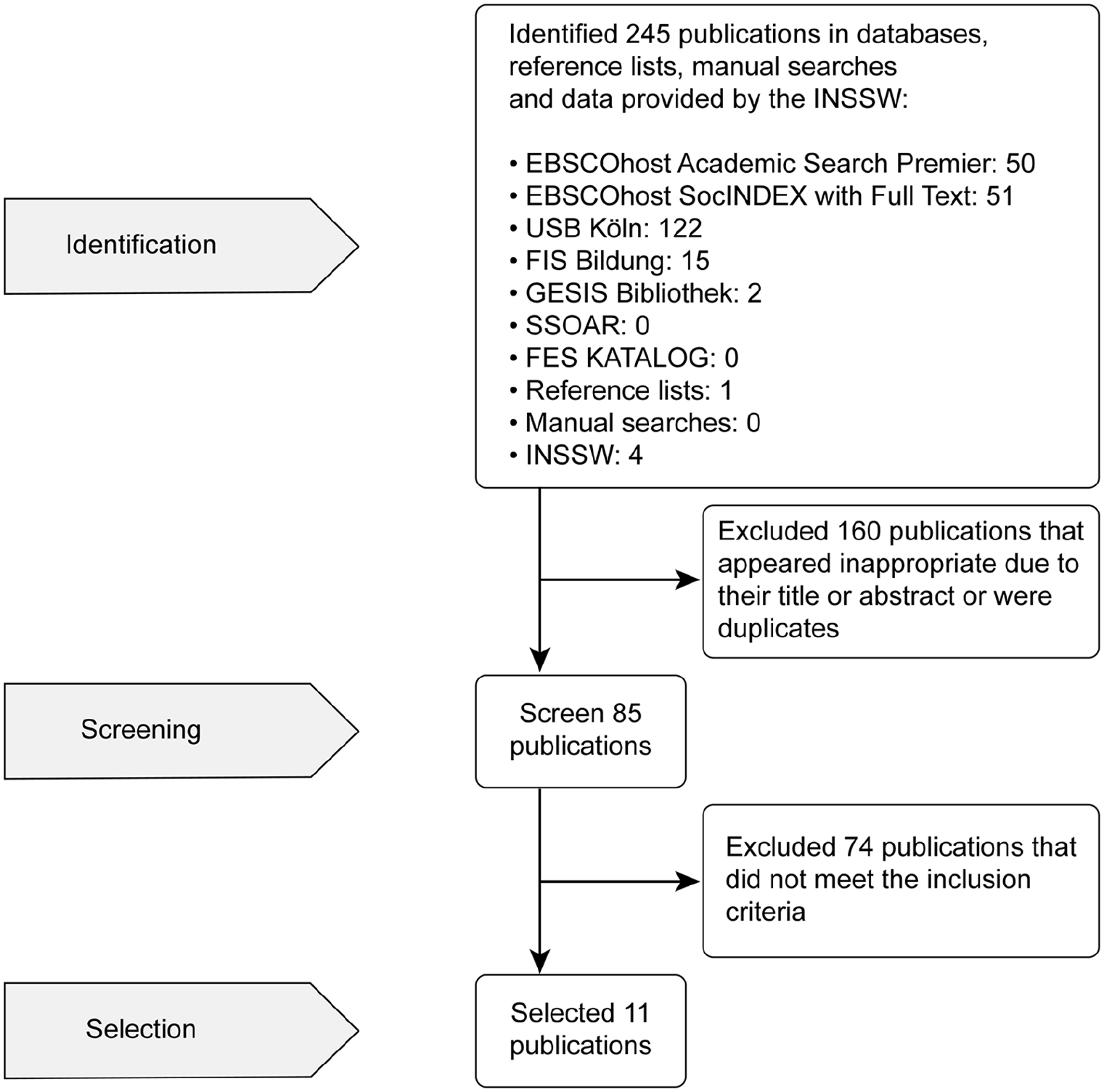
Publication screening and selection process.
Of the included publications, most examine SSW in different countries separately; thus, these publications do not provide – to use the words of Shardlow and Cooper (2000: 5) – a ‘significant juxtaposition of two or more countries’ and have left the actual comparison to the reader. The review did not identify previous approaches to reviewing the scope of international comparisons in SSW.
Data extraction and synthesis
The findings were subjected to a narrative synthesis that ‘relies primarily on the use of words and text to summarize and explain the findings of the synthesis’ and adopts thereby a textual approach (Popay et al., 2006: 5). First, results were preliminarily synthesized by generating tables and organizing certain aspects in groupings. Thereby, publications were analyzed regarding the following characteristics: publication year, type, source of knowledge, and number of comparative countries. Also, the comparative criteria, countries and results were organized in a table. To illustrate differences concerning countries and continents under comparison between all publications with and without the surveys conducted by the INSSW, a Two-Cases Model was generated with the software MAXQDA. For presenting the main focus areas, a preexisting classification system developed by Meeuwisse and Swärd (2007), differentiating between comparisons based on social policy, profession, and practice, was used. To illustrate the existence of these main focus areas, vote counting, in the form of ticks, was used as a descriptive tool.
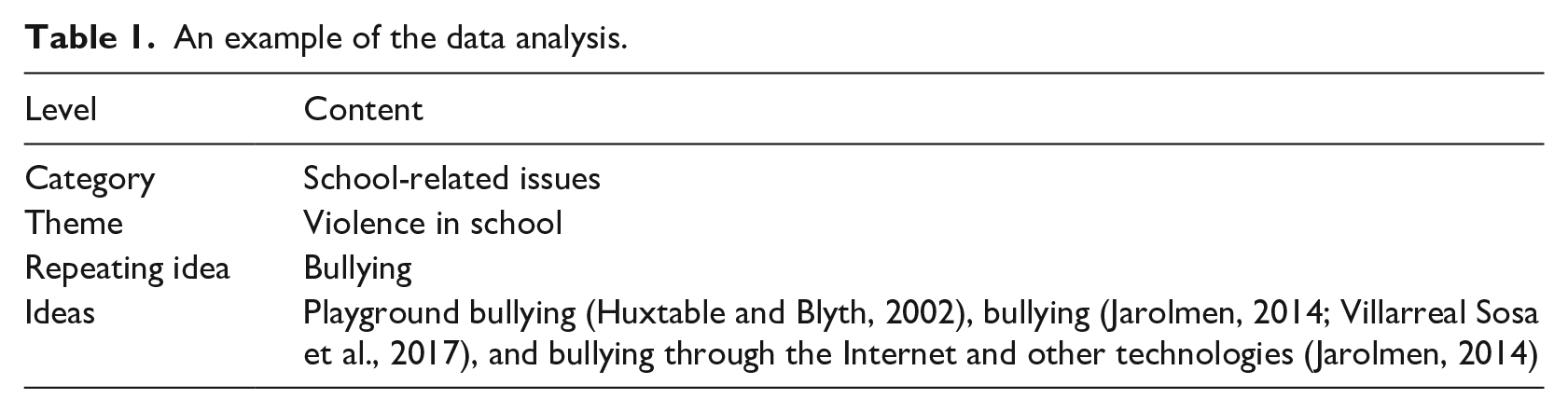
Second, after ‘identifying, listing, tabulating and/or counting results’, relationships between and within publications were explored (Rodgers et al., 2009: 58) concerning SSW practice themes. For this purpose, a coding process took place, starting with the selection of relevant text, followed by the identification of repeating ideas and the development of themes that organize groups of repeating ideas (Auerbach and Silverstein, 2003: 38). The process resulted in four categories, namely, child-, family-, school-, and community-related issues. Table 1 shows an example of the data analysis. One can see the category ‘school-related issues’, accompanied with one included theme, repeating idea and ideas. To assess the robustness of the synthesis, the synthesis methods and assumptions were critically reflected on by the authors.
An example of the data analysis.
Limitations
Before turning to the results, study limitations will be presented. The review revealed a lack of publications considering African and South American countries, which might be traced back to the inclusion criteria: only publications in English were included, which is a common methodological challenge in ICR (Ornellas et al., 2019; Shardlow and Walliss, 2003). Also, publications were removed if their title or abstract was deemed inappropriate. Thus, there is a risk that appropriate literature was excluded. Also, most publications do not provide a comparison, and comparable criteria were often not directly mentioned. Thus, there is the risk that comparable criteria were misinterpreted. In addition, it might be the case that providing a comparison was not the intention of many authors, rather that separate country information was presented (see e.g. Chui, 2013).
Results
Characteristics of the included studies
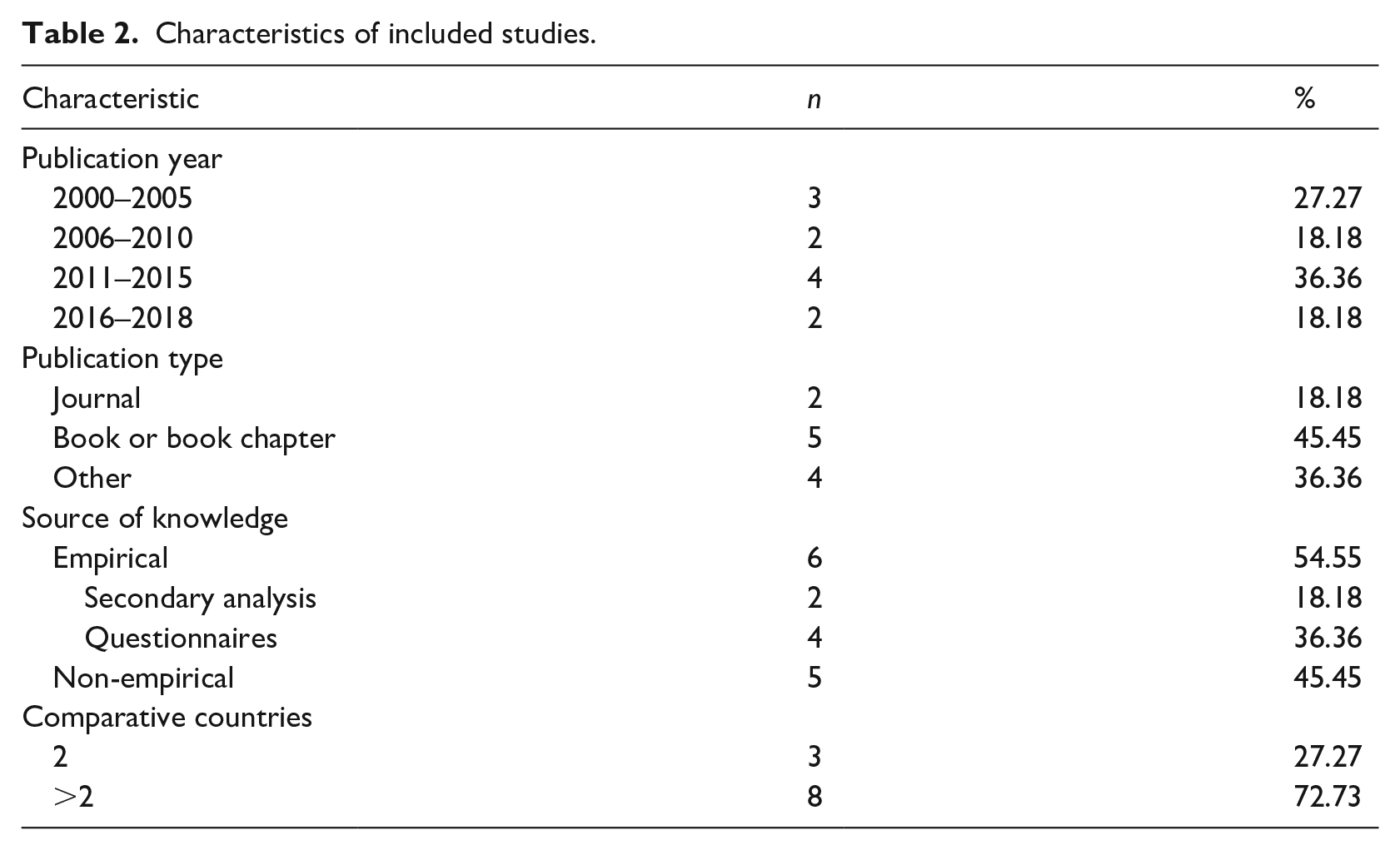
The literature review revealed 11 publications. Table 2 summarizes the characteristics, including publication year and type, source of knowledge, and number of comparative countries.
Characteristics of included studies.
Publication year
The publication year of the included studies varies from 2002 to 2017. Between 2000 and 2005, three publications exist (Huxtable and Blyth, 2002; INSSW, 2003; Saralioti, 2002), followed by two publications between 2006 and 2010 (INSSW, 2006; Kayama, 2010). Another four publications followed between 2011 and 2015 (Chui, 2013; INSSW, 2012; Jarolmen, 2014; Matulayová et al., 2013) before two further publications were published between 2016 and 2017 (INSSW, 2016; Villarreal Sosa et al., 2017).
Publication type
With the exception of two studies that were published as a journal article (Kayama, 2010; Matulayová et al., 2013), the majority of publications were published in book form (Chui, 2013; Huxtable and Blyth, 2002), as a book chapter (Jarolmen, 2014; Saralioti, 2002; Villarreal Sosa et al., 2017), or through an online network (INSSW, 2003, 2006, 2012, 2016).
Source of knowledge
Five publications included in the review are non-empirical (Chui, 2013; Huxtable and Blyth, 2002; Jarolmen, 2014; Saralioti, 2002; Villarreal Sosa et al., 2017). In contrast, six publications are empirical, using either secondary analysis (Kayama, 2010; Matulayová et al., 2013) or questionnaires (INSSW, 2003, 2006, 2012, 2016).
Comparative countries
Three publications deal with two countries (Kayama, 2010; Matulayová et al., 2013; Saralioti, 2002); conversely, the majority of publications focus on more than two countries (Chui, 2013; Huxtable and Blyth, 2002; INSSW, 2003, 2006, 2012, 2016; Jarolmen, 2014; Villarreal Sosa et al., 2017).
Number of publications per country and continent
In total, 48 countries are investigated in the publications. However, without considering the four surveys conducted by the INSSW, only 22 countries are investigated, corresponding to less than half of all countries investigated (see Table 3).
Number of publications per country.
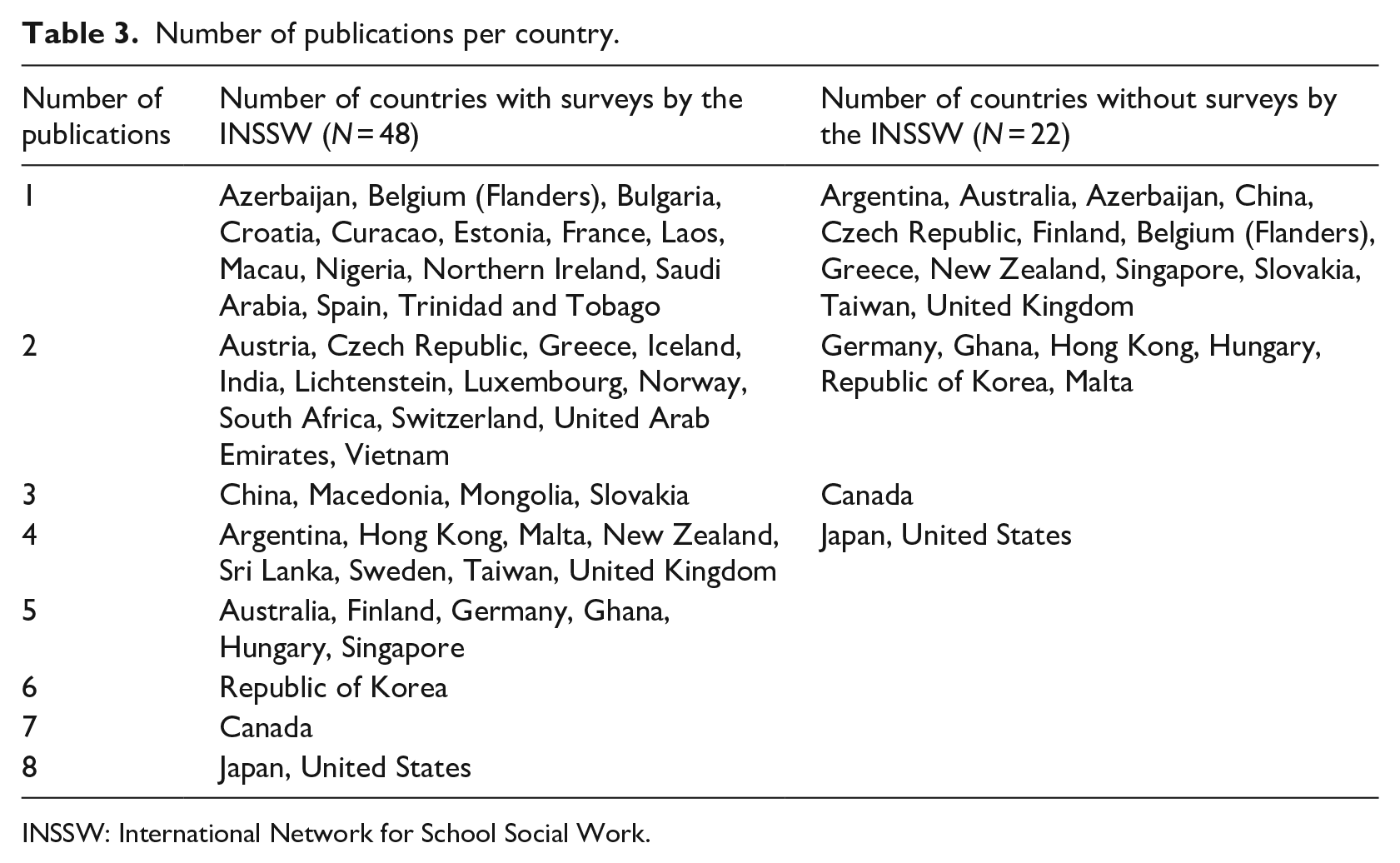
INSSW: International Network for School Social Work.
When considering all publications, countries such as Japan and the United States (n = 8), Canada (n = 7), and the Republic of Korea (n = 6) are investigated several times compared to countries such as Azerbaijan, Saudi Arabia, and Trinidad and Tobago (n = 1). Also, when viewing all publications without the surveys, countries like Japan and the United States (n = 4) and Canada (n = 3) are still investigated several times compared to countries such as Argentina, Greece, and Singapore (n = 1). Interestingly, several countries are only investigated in the four surveys, such as Bulgaria and India, or are considerably less investigated than initially assumed, like Singapore (n = 5 with surveys; n = 1 without surveys).
Figure 2 shows a Two-Cases Model that visualizes the extent to which codes occur in two cases, here all publications and all publications without the surveys conducted by the INSSW. Therefore, each country name was coded to its respective continent.
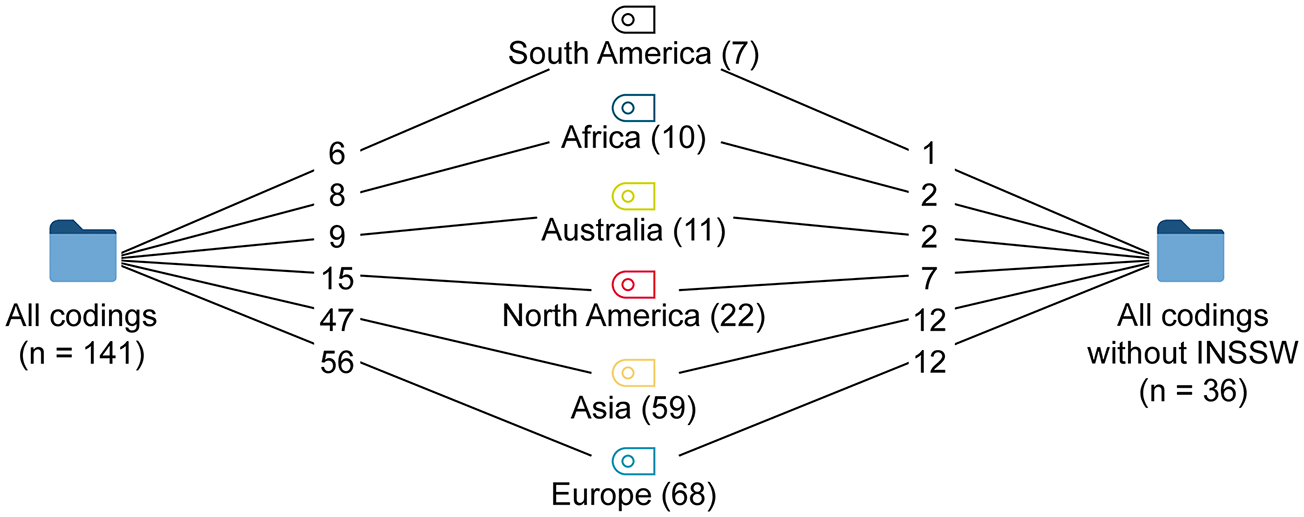
Two-Cases Model generated with MAXQDA.
When viewing the Two-Cases Model, one can see that, when recognizing all publications, 141 codings in total were done compared to 36 codings without publications by the INSSW. Upon further analysis of the coding including all publications, the following number of codings can be noticed: Europe (n = 56), Asia (n = 47), North America (n = 15), Australia (n = 9), Africa (n = 8), and South America (n = 6). Although there is a much lower number of overall codings when not recognizing the four studies conducted by the INSSW, one can see a similar order: Europe (n = 12), Asia (n = 12), North America (n = 7), Australia (n = 2), Africa (n = 2), and South America (n = 1). To summarize, continents such as Asia, Europe, North America, and Australia are investigated in different publications, while Africa and South America are rarely investigated.
Comparative criteria, and countries and results
All publications provide information about SSW in two or more countries. However, most of them do not provide a juxtaposition and comparison of the single-country information. However, it is not always certain whether a significant comparison was the intention. Table 4 shows the criteria upon which SSW was investigated, the countries under investigation, as well as whether or not a results section was included.
Comparative criteria and countries in the included publications as well as results.
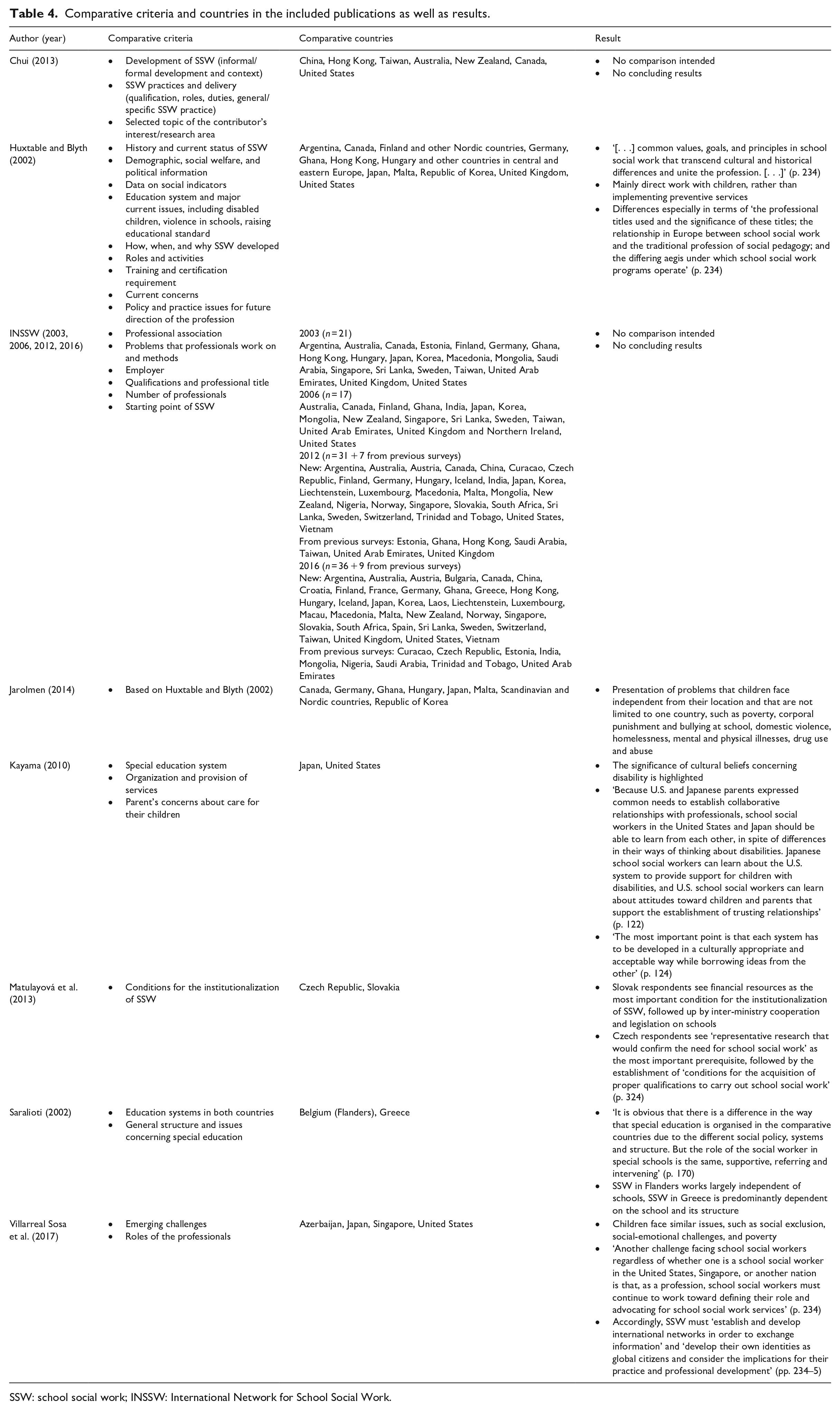
SSW: school social work; INSSW: International Network for School Social Work.
Main focus areas
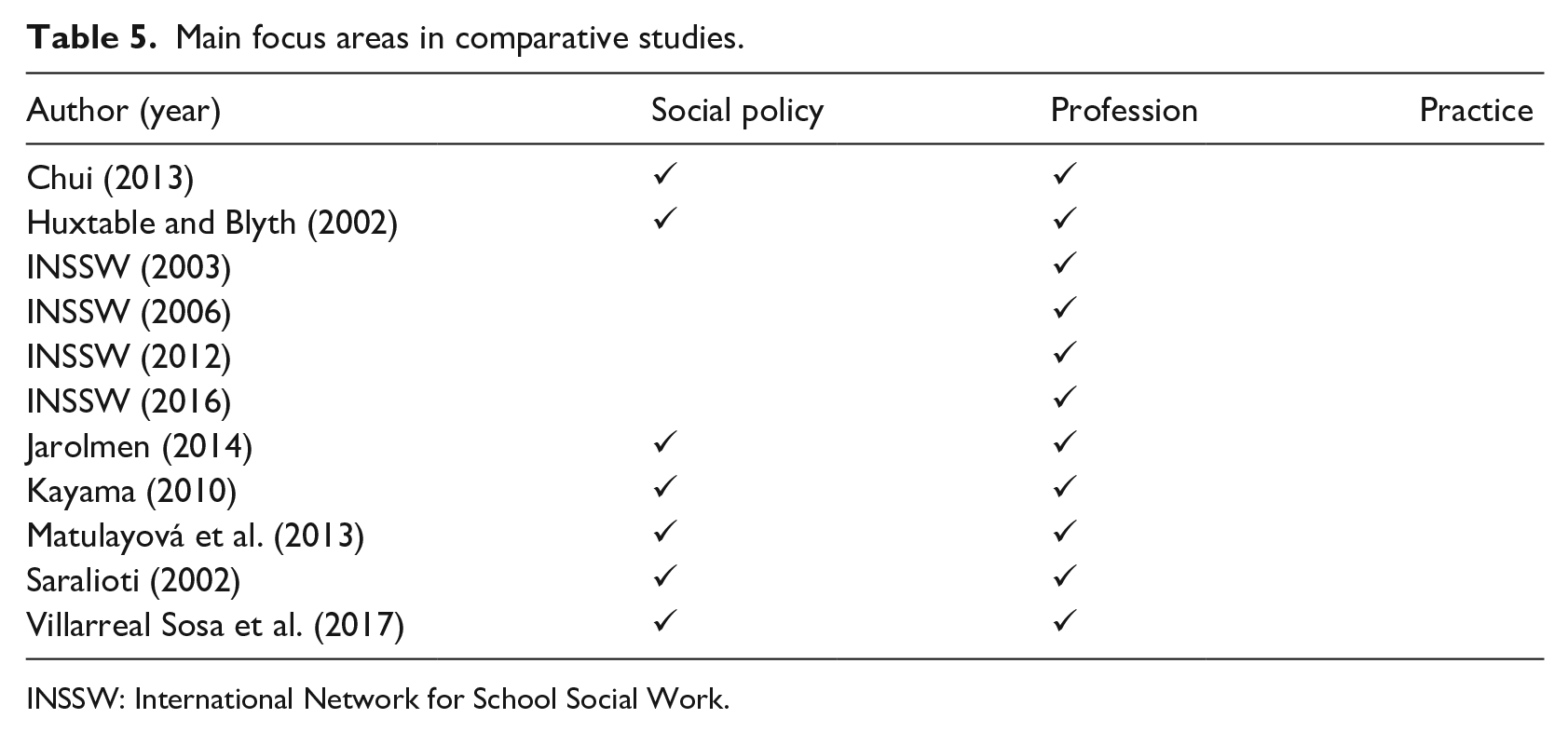
Table 5 compares the main focus areas in the publications. One can see that most publications do not have explicitly one focus but include different aspects concerning SSW.
Main focus areas in comparative studies.
INSSW: International Network for School Social Work.
Table 5 shows several results. Many publications include sociopolitical aspects (Chui, 2013; Huxtable and Blyth, 2002; Jarolmen, 2014; Kayama, 2010; Matulayová et al., 2013; Saralioti, 2002; Villarreal Sosa et al., 2017) and/or profession-related aspects (Chui, 2013; Huxtable and Blyth, 2002; INSSW, 2003, 2006, 2012, 2016; Jarolmen, 2014; Kayama, 2010; Matulayová et al., 2013; Saralioti, 2002; Villarreal Sosa et al., 2017). No publication provides SSW practice-focused research in two or more countries, although some describe specific areas of SSW practices in certain countries (e.g. Chui, 2013).
What is missing: Practice-focused research
The review revealed a lack of comparative studies dealing with SSW practices and complies therefore with the results of scholars focusing on ICR in other SW areas and working fields (e.g. Healy et al., 2014; Payne, 2006). Accordingly, ICR in SW regarding health inequalities is primarily focused on the analysis of systems and structures, rather than SW practices and interventions relevant to the health inequalities themselves, which might contribute to the development of practices (Payne, 2006). Likewise, ICR in SW regarding vulnerable young people is primarily limited to macro-level analyses, rather than recognizing multiple levels focusing on vulnerable young people and SW practices responding to them, which might offer alternative ways of practicing (Healy et al., 2014).
SW practice, likewise SSW, is ‘essentially a local activity’ that provides a ‘culturally specific response to culturally defined social problems’ (Williams and Simpson, 2009: 3) and is shaped and constructed by its country-specific context, wherefore it is necessary to consider social, economic, cultural, and political factors in order to understand similarities and differences (Hämäläinen, 2014: 193–4). For example, Kayama (2010: 117) discusses the influence of cultural beliefs about disability on special education systems and policies as well as parental expectations concerning their relationships with professionals in Japan and the United States, showing clear differences between the two countries. Accordingly, Japanese parents see empathy as the most important factor to build up a trusting relationship with professionals – a belief due to socialization emphasizing sensitivity (Kayama, 2010: 121; referring to Shimizu, 2001). In Azerbaijan, disabled children and youth mostly receive an education in separate institutions or at home due to current policies driven by stigma and discrimination against disabled children (Villarreal Sosa et al., 2017: 223).
However, children face several, often similar, problems across countries and cultures. After identifying and grouping the repeating ideas, 16 themes organized in four categories emerged, namely, child-, family-, school-, and community-related issues that hinder children’s ability to reach their full potential (see Figure 3).
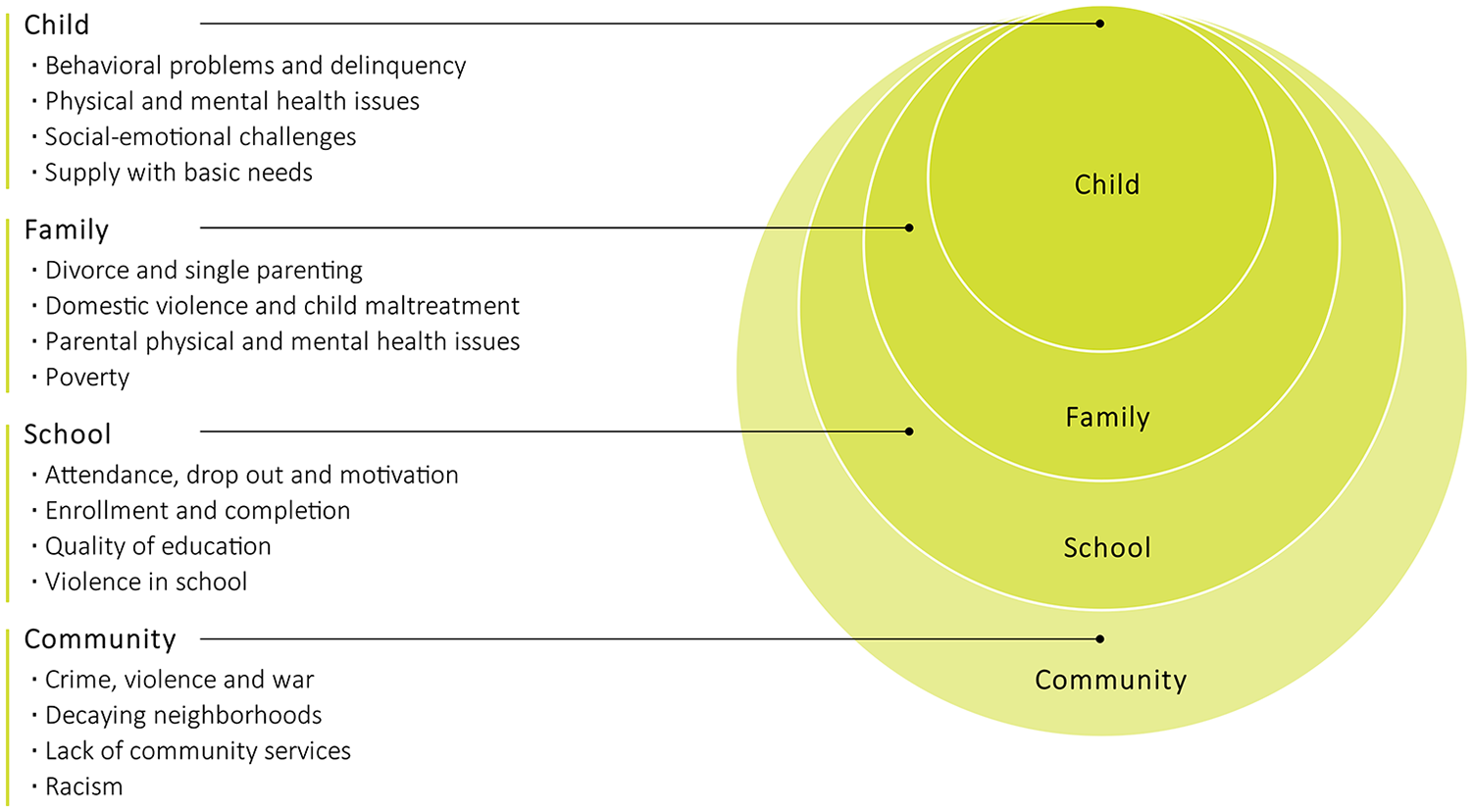
Synthesis of school social work practice themes.
When focusing on Figure 3, one can see several results. First, child-related issues include the supply of basic needs (INSSW, 2003, 2006, 2012, 2016), behavioral problems and delinquency (INSSW, 2003, 2006, 2012, 2016; Villarreal Sosa et al., 2017), physical and mental health issues (Huxtable and Blyth, 2002; Jarolmen, 2014; Kayama, 2010; Villarreal Sosa et al., 2017), as well as social-emotional challenges (Huxtable and Blyth, 2002; INSSW, 2003, 2006, 2012, 2016; Villarreal Sosa et al., 2017). Most authors addressing child-related issues refer to physical and mental health issues, including mental problems and illnesses (Huxtable and Blyth, 2002; Villarreal Sosa et al., 2017); physical illnesses such as tuberculosis, AIDS, malaria, and Vitamin A deficiency (Jarolmen, 2014); attention deficit/hyperactivity disorder and autism (Villarreal Sosa et al., 2017); as well as disabilities (Huxtable and Blyth, 2002; Kayama, 2010; Villarreal Sosa et al., 2017).
Second, family-related issues comprise divorce and single parenting (Huxtable and Blyth, 2002), domestic violence and child maltreatment (Chui, 2013; Huxtable and Blyth, 2002; Jarolmen, 2014; Villarreal Sosa et al., 2017), parental physical and mental health issues (Huxtable and Blyth, 2002; Villarreal Sosa et al., 2017), as well as poverty (Chui, 2013; Huxtable and Blyth, 2002; Jarolmen, 2014; Villarreal Sosa et al., 2017). Most authors addressing family-related issues refer to domestic violence and child maltreatment, such as domestic violence (Chui, 2013; Huxtable and Blyth, 2002; Jarolmen, 2014), and child abuse in the family (Chui, 2013; Huxtable and Blyth, 2002; INSSW, 2003, 2006, 2012, 2016; Jarolmen, 2014; Villarreal Sosa et al., 2017). Also, several authors refer to poverty and its consequences. Thus, due to poverty, children must enter work too soon (Huxtable and Blyth, 2002) and do not receive basic education, which limits their ability to succeed in life (Jarolmen, 2014). Furthermore, poverty leads to illiteracy, malnutrition, disease, famine, and death (Jarolmen, 2014), as well as homelessness (Huxtable and Blyth, 2002; Jarolmen, 2014), which in turn leads to violence, rape, prostitution, drug use, and illnesses such as AIDS (Jarolmen, 2014).
Third, school-related issues include the enrollment into and completion of school (Huxtable and Blyth, 2002; Villarreal Sosa et al., 2017); attendance, motivation, and dropout (Chui, 2013; Huxtable and Blyth, 2002; INSSW, 2003, 2006, 2012, 2016; Villarreal Sosa et al., 2017); violence in school (Chui, 2013; Huxtable and Blyth, 2002; Jarolmen, 2014; Villarreal Sosa et al., 2017); as well as quality of education (Huxtable and Blyth, 2002; INSSW, 2003, 2006, 2012, 2016). Most authors addressing school-related issues referred to attendance, motivation, and dropout as well as violence in school. The interrelatedness between dropout and a family’s socioeconomic status, the region where they live, and whether or not they are among the internally displacement population due to war is shown (Villarreal Sosa et al., 2017). Concerning school violence and its consequences, it is shown that bullying leads to poor academic performance, school absenteeism, dropout, as well as suicide (Jarolmen, 2014).
Fourth, community-related issues include crime, violence, and war (Huxtable and Blyth, 2002; Jarolmen, 2014), lack of community services (Huxtable and Blyth, 2002; Villarreal Sosa et al., 2017), decaying neighborhoods (Huxtable and Blyth, 2002), and racism (Chui, 2013; Huxtable and Blyth, 2002). Most authors addressing community-related issues focus on the lack of community- and child-centered services (Huxtable and Blyth, 2002; Villarreal Sosa et al., 2017), including also a structural inequality as well as social and economic injustice (Villarreal Sosa et al., 2017), and on racism (Chui, 2013; Huxtable and Blyth, 2002).
To summarize, children face these interrelated problems, irrespective of their place of residence, although there are issues that occur in certain countries more often than in others and the appraisal of these issues might vary between countries and cultures. Accordingly, it appears valuable to investigate the school social workers’ responses to certain issues to reflect their professional and institutional answers and to improve their own practices in a culturally appropriate way. Otherwise, systems and approaches transferred to other countries may not be accepted (see e.g. Kayama, 2010: 123).
Discussion and implications
The aim of this article was threefold, namely, to identify the main focus areas in publications dealing with an international comparison in SSW, to explore SSW practice themes, and to develop recommendations for future research. Therefore, a systematic literature review was conducted, considering publications that compare SSW in two or more countries or provide a separate description of SSW based on comparable criteria, and was afterward subjected to a narrative synthesis.
Conducting ICR enables us to learn about others, from others, about ourselves, and with others (Baistow, 2000); however, it poses several methodological challenges that are shared within several disciplines and include, but are not limited to, the complexity of reality, language- and translation-related issues, risk of ethnocentrism, lack of comparison and equivalence, as well as the use of fictitious cases in empirical studies based on case vignettes. When conducting ICR in SSW, unique methodological challenges appear because two different professions are investigated, namely, SW and education. Thus, national educational systems and policies are important contextual factors. Three main implications can be drawn from the study.
First, a synthesis of SSW practice themes emerged from the findings, covering child-, family-, school-, and community-related issues. Accordingly, children are predominantly confronted with similar issues, irrespective of where they live. These issues are interrelated, wherefore it is necessary to treat each child as a whole and to consider all areas and aspects that influence their situation, including community-related issues as well as cultural beliefs (see e.g. Kayama, 2010). SW is essentially a local activity (Lyons, 2018), and the same situation applies to SSW (see e.g. Bulanda and Jalloh, 2017). However, despite the fact that it appears valuable to investigate SSW’s professional response to certain issues in order to generate new stimuli to improve already well-developed practices, a lack of comparative studies dealing with SSW practices was revealed. This result complies with those of scholars who arrive at the same result for ICR dealing with SW and vulnerable youth (Healy et al., 2014) as well as SW and health inequalities (Payne, 2006). Therefore, it is recommended to conduct practice-focused comparisons to learn about others’ practices and to improve their own practices in a culturally appropriate way.
Second, the review revealed a lack of publications dealing with countries from Africa and South America. Also, large parts of Asia are not investigated. Even when considering that only English literature was included, there is not a major improvement compared to the situation described by Marion Huxtable and Eric Blyth in 2002, whereby comparative studies in SSW are only rarely focused on Mediterranean countries, large parts of Africa, Asia, and Central and South America. Findings comply with results of other scholars in ICR in SW, that predominantly Western countries are investigated (see e.g. Meeuwisse and Swärd, 2007). It is recommended to conduct comparative studies, including Africa, Asia and Central and South America, against the background of the idea that newly developed SSW practices contribute to an improvement of SSW in countries where it is already well developed.
Third, most publications are, beneath the four studies conducted by the INSSW, non-empirical and deal with several countries, rather than focusing on fewer countries in depth. Thus, it is recommended to conduct empirical studies focused on SSW in a few countries to obtain a deeper understanding of it.
Despite the fact that professionals deal with similar issues, there is up to this day a lack of international comparative studies in SSW. However, comparative studies enable insight into SSW’s responses to certain issues and generate new stimuli to improve already well-developed practices.
Footnotes
Declaration of conflicting interests
The author(s) declared no potential conflicts of interest with respect to the research, authorship, and/or publication of this article.
Funding
The author(s) received no financial support for the research, authorship, and/or publication of this article.
