







Abstract
This study examines the extent to which poverty is passed from parents to children in Hong Kong based on the social investment thesis. Through tracking the educational and career trajectories of the second generation (aged 23–25) of 77 families, this study suggests that adolescents with poor parents have a 202 percent higher chance of being poor in young adulthood. This poverty-continuation probability increases dramatically to 681 percent if parental poverty is defined in terms of homeownership rather than income. Another important factor that also affects intergenerational poverty is the mother’s educational level. Implications for social workers and policy makers are discussed.
Introduction
Poverty is a perennial problem of modern society, and Hong Kong is no exception. While Hong Kong is the fifth wealthiest entity in terms of foreign exchange reserves in 2019 globally, it is indisputably a city of wealth disparity with – based on 2018 Hong Kong government statistics – one person in every 6.7 considered poor (HKSAR Government, 2018: 23). The Gini-coefficient of Hong Kong rose by 0.002 from 0.537 in 2011 to a record high of 0.539 in 2016, and was ranked second in the world (New York topped the list at 0.551 and Washington came in the third at 0.535). Undoubtedly, the problem of poverty, in particular, the intergenerational transmission of poverty, through which poverty is bequeathed to a person because of the socially or economically challenged background of his or her parents has aroused the concern of many social workers, policy makers and scholars. Since the life cycle development of a family is cumulative, early interventions for poor children with an emphasis on parental involvement in children’s education are usually called for in policies and scholarly studies (e.g. Commission on Poverty, 2005; Figueira-McDonough, 2007). This study also follows this direction.
Decades of scholarly efforts have distilled five dominant models to explain intergenerational poverty, that is, (1) the economic resources model, (2) the social isolation model, (3) the correlated disadvantages model, (4) the family structure model and (5) the welfare culture model (Bird, 2007; Boggess et al., 1999; Corcoran, 1995; Papanastasiou et al., 2016). The economic resources model suggests that poor parents are in a constant state of economic crisis and have limited resources to invest in their children’s human capital or future earning potential (e.g. Becker and Tomes, 1986). For example, in the United Kingdom, there is a strong association between children’s earnings and those of their parents. Only a third of children whose fathers were in the bottom quarter of the earnings distribution made it to the top half when they became adults (Piachaud and Sutherland, 2001).
The social isolation model presents the idea of an underclass which exists in habitats categorized as ‘underclass neighbourhoods’ where a substantial proportion of residents are poverty-stricken with high rates of unemployment and where there are poor schools (Corcoran and Chaudry, 1997: 47; McEwen and McEwen, 2017). Evidence suggests that residents of high-poverty areas face difficulties in finding and maintaining formal employment (Stal and Zuberi, 2010), and are likely to live alongside the welfare poor; hence, they possess fewer resources to break free from intergenerational poverty (Newman, 2006).
The correlated disadvantages model suggests that non-economic parental resources, such as educational level, values and expectations of the future, constitute critical determinants of the socio-economic outcomes of children when they grow up. Studies show that poor parents tend to have lower educational levels and are therefore less motivated to develop their children’s human capital (Corcoran and Adams, 1997; Mayer, 1997).
The family structure model is based on consistent findings that high rates of poverty are registered among teenage mothers, unwed mothers and single mothers (Boggess et al., 1999: 34; Van Ryzin et al., 2018). In the United States, for example, Murray (1995) suggests that teenage women are less likely to graduate from high school, have lower future earnings, and are more likely to be poor and receive welfare than women who do not begin their family until the age of 20 or above (see also, Boggess et al., 1999: 57).
The welfare culture model focuses on the idea that receiving welfare traps people in poverty through the proliferation of the culture-of-poverty attitude that generates disincentives for the younger generation to engage in productive jobs (Gottschalk et al., 1994). For example, Murray (2008) criticizes welfare programmes in the United States which have unwittingly produced incentives among social security recipients to remain unemployed.
While the general mechanisms for intergenerational poverty highlighted by the above five models remain prominent in today’s societies in different ways, recent scholarship has begun to explore the context-specific factors and processes where intergenerational transfers of values and practices either proliferate or change the ‘poverty trajectory’ (e.g. Homan et al., 2017; Smith et al., 2015; Wright, 2016). This development can be considered a consequence originating partly from the criticism over the heavy reliance on income level as the defining nature of poverty for both parents and their children (e.g. Spicker et al., 2007), and partly from the emerging constructionist view of family (rather ‘the family’) which emphasizes the actor’s (re-)articulations of the meaning of poverty (e.g. Holstein and Gubrium, 2008). The latest scholarship on intergenerational poverty thus increasingly considers the concept of poverty as context-specific and by association, multidimensional, which involves not just salary but other factors ranging from educational attainment, to career aspirations, or even to values on life (Spicker et al., 2007). Factors that cause cross-generational poverty in households identified in specific contexts may include individuals’ perception of the meaning of ‘well being’ (Wright, 2016); ‘career aspirations’ (Dudovitz et al., 2017); cultural schemas that shape ‘poverty beliefs’ (Homan et al., 2017); and the attitude towards the ‘play’ of children (Smith et al., 2015). Echoing this recent scholarly trend, this study also endeavours to identify the context-specific (or even cultural-specific) factors and processes that predict a family’s path-dependent or path-breaking potentiality in face of intergenerational poverty; and along this line, scrutinize the validity of the five dominant models in explaining the intergenerational poverty of Hong Kong in the 2010s.
Empirically, this study benefits from the availability of the ‘In Search of Family-friendly Policies’ (SFP) database developed by the first author. The SFP database contains survey data collected between October 2007 and April 2008, with an original sample of 1523 mothers who had children aged 11–13. A follow-up study was conducted during October 2020 – April 2021 based on a sample of 256 cases from the SFP database. Among the 77 families we successfully interviewed through telephone, we endeavoured to track the educational and career trajectories of the second-generation in early adulthood (aged 23–25), and determine to what extent one’s vulnerability to the intergenerational transmission of poverty is different among those with poor and non-poor family backgrounds in a period of 13 years (2007/2008–2020/2021). This study indeed represents a pioneering attempt – by adopting a longitudinal approach – to determine whether one’s vulnerability to the intergenerational transmission of poverty is different among those with poor or non-poor family backgrounds. But why do we consider the educational and career trajectories of the second-generation members as the key to measure the poverty-level of the second-generation of a family? Here, we draw insights from the ‘social investment’ thesis in understanding poverty because of its conceptual rigour and empirical validity.
The social investment thesis and its empirical validity in Hong Kong
The ‘social investment’ theory emphasizes the importance of investment in human capital, essentially, in the education and future employability of children, as effective means to tackle intergenerational poverty. It means that the poverty-continuing, or -breaking potentialities of a family are best estimated by the level of educational attainment and career prospects of its second generation. In the literature, the links between educational deficit, low employability and poverty are generally clear. In many countries, schooling correlates strongly with adult income and other markers of socio-economic status (Bird, 2007). Educational returns for each additional year of schooling are positive and range somewhere from 5 percent in developed regions to as high as 29 percent in developing regions (Fiszbein and Psacharopoulos, 1993; Muyanga et al., 2007). However, in some modern capitalist countries, the associations among educational attainment, employability and poverty are complicated as it usually depends both on labour market opportunities and the extent to which individuals are able to access those (Harper et al., 2003). In the European Union, for example, completing a recognized university degree is highly rewarded in the United Kingdom, France, Belgium, Ireland, Luxembourg, Spain and Portugal though the educational returns are relatively lower in the Nordic countries (Denmark, Finland and Sweden), Greece and the Netherlands (Heinrich and Hildebrand, 2005). Some scholars even question the validity of the ‘social investment’ thesis, and argue, for example, that the increasing casualization of the workforce and major cost of living pressures in Australia have rendered doubtful the claims that highly educated people must be employed and poverty-free (Institute for Higher Education Policy [IHEP], 2010; Smith et al., 2015). Cantillon and Lancker (2013) also criticize that the ‘social investment’ perspective, which emphasizes the long-term investment in human capital as the sole channel to empower people to integrate into the market, has ignored the social protection of vulnerable groups in class-based societies.
Despite the discrepant views, we deem the ‘social investment’ thesis an appropriate one to define and measure poverty in this study mainly for two reasons. First, substantial research has confirmed that returns to education are very positively associated with a higher level of education. Even those studies which suggest that education has no effect on relative upwards mobility have reaffirmed that higher educational achievement does lower the chances of downwards mobility (e.g. Baulch and McCulloch, 1998; Yaqub, 2000). Second, the ‘social investment’ thesis possesses a high level of empirical validity in the context of Hong Kong. Official statistics show that children’s educational attainment and career-related attributes are important determinants of poverty or wealth of their family in Hong Kong during 2009–2019. The median monthly wage of persons who completed a university degree, for example, is about double that of those with just an upper secondary educational qualification and about triple that of those with only primary education or below. Besides, persons who possess a postsecondary qualification are found to be more resilient against downwards mobility as they have a significantly lower underemployment rate than those with only primary school qualifications or below (HKSAR Government, 2020; HKUGC, 2020).
Taking further the family structure of Hong Kong into account, we consider that university qualifications constitute a further buffer against a child remaining in poverty from a poor Hong Kong household. For example, in 2018, fresh university graduates on average earned HK$24,542 per month (HKUGC, 2020) (1US$ ≅ 7.78HK$). Taking into account that average household size in Hong Kong was 2.8 and that the median monthly income was HK$18,805, we acknowledge that any household which has a total monthly income over HK$26,421 can be considered non-poor (HKSAR Government, 2018). In this light, for a typical nuclear household with three members – that is, father, mother and child–if the youngest member of the household attains a university qualification and earns the average monthly salary of HK$24,542, the family as a whole is very likely to escape poverty as the salary has already covered 92.9 percent of the poverty line income. In line with the ‘social investment’ thesis, this study presumes that if children in low-income families obtain a recognized university degree, they are likely to find a job with good prospects, and they are likely to lift the whole family from below to above the income poverty threshold in Hong Kong.
The Hong Kong government is concerned with the problem of intergenerational transmission of poverty, and has taken several measures to help children from low-income families to break out of the poverty cycle. For example, a saving plan for low-income families with children has been implemented by the Commission on Poverty and Child Development Fund since 2009. The plan adopts an asset-building approach, emphasizing long-term investment in children. The goal is not simply to alleviate children’s poverty, but also to provide a route out of poverty by strengthening children’s capacities and giving them ‘hope’ through a mentoring scheme (Commission on Poverty, 2007). An evaluative study conducted by Chan and Ho (2013), however, suggests that the plan ‘offered some “hope” [for poor children] . . . [but not] a means of avoiding the trap of intergenerational poverty’ (p. 138). Two other policy schemes have also been formulated to deal with breaking the poverty cycle for families in low-income communities, namely, the Work Incentive Transport Subsidy Scheme and Enhancing Self-Reliance through District Partnership Programme. While the former scheme helps low-income earners who live in remote communities reduce their cost of travelling to and from work, the latter constitutes the initiative of the Commission on Poverty to alleviate poverty through a district-based approach. However, once again, the effectiveness of these programmes to reduce intergenerational transfer of poverty has been called into question (Audit Commission, 2014: 42, 50). Evidence thus shows that the government’s efforts to tackle intergenerational poverty have not been effective. One reason – from our point of view – is that no longitudinal study was conducted to measure the seriousness of intergenerational poverty and identify the critical factors involved in the phenomenon. The findings of our study therefore possess important policy implications.
Data
Funded by Public Policy Research of Hong Kong Research Grants Council/Central Planning Unit in 2007, the SFP database was constructed to examine how mothers whose family had at least one child aged below 13 and who lived in low-income communities face the work–family conflict. A survey was conducted of 1523 mothers in three low-income communities (Sham Shui Po [SSP], Tin Shui Wai [TSW], and Kwai Tsing [KT], N = 1213) and two non-low-income communities (Tsang Kwan O [TKO] and Yau Ma Tai Mongkok [YM], N = 310; for comparison purposes) in Hong Kong during October 2007 and April 2008. Each of these communities belongs to a different geographical district of Hong Kong. There are 18 districts in Hong Kong each of which has an individual district board and is governed by a specific home affairs department. A multistage sampling procedure was used, and it successively identified community, schools and school classes. Accordingly, the first stage of sample recruitment involved locating three communities where low-income neighbourhoods were present; and two non-low-income communities where the first author had substantial professional networks to support the survey. Seven publicly-funded secondary schools were identified in these communities. At that time, more than 90 percent of the schools depended on public funding. These schools helped to identify mothers who had children in the schools below the age of 13 (i.e. secondary one and two students). These mothers were selected because it was felt that they were responsible for the care of their children, according to the social welfare policy of Hong Kong. Once identified for potential participation, the mothers were sent an invitation and information about the study through their children in school. If interested, the consent process involved completing and returning the self-administered anonymous survey to the school; the response rate was 80.7 percent. No names were used, and when the researchers received the data, they could not tell who completed it. The mothers, however, had the option to indicate the class and class number of their children.
Among the mothers who responded to the survey, 73.0 percent lived in a state of poverty, defined as either having personal income below half the median income of the population or receiving public assistance called Comprehensive Social Security Assistance (CSSA) – a monetary welfare benefit provided by the Hong Kong government to support people who are in financial need. The mothers’ median family income was HK$10,000 per month, which was substantially less than the territory-wide median of HK$17,250 at that time. In addition, half (50.4%) of the mothers resided in rental public housing, and 11.0 percent resided in purchased public housing, both of which represented government subsidies to low-income people. Although the mothers had an average age of 42.0 years, their average duration of residence in Hong Kong was only 22.2 years. As such, many (52.9%) of the mothers were mainland Chinese migrants to Hong Kong, who were typically economically disadvantaged (Chiu and Lui, 2004). Their social class was relatively low as 44.9 percent were not working and 33.2 percent were manual workers. The social class of their husbands was also relatively low as 9.9 percent were unemployed and 58.9 percent were manual workers.
For the purpose of this study, we re-connected with the seven schools in mid-2020, and six (from three low-income communities [SSP, TSW, KT] and one non-low-income community [TKO]) agreed to collaborate with us to contact their student alumni who might have participated in our survey in 2007/2008. Among 256 cases referred from these schools, we managed to conduct telephone interviews during October 2020 to April 2021 with 77 mothers (and also with their children in 15 out of these 77 cases) who could (1) tell the class and/or class number of their child and (2) answer correctly at least three questions regarding the demographic information the respondent indicated in the 2007/2008 survey (such as, length of stay in the community, monthly income and type of accommodation). Once the respondent’s identity was confirmed, we asked three questions about their child: (1) what is his or her highest educational attainment? (2) what is his or her current monthly salary (to check if it is above or below the latest median wage reported by the Government)? and (3) what kind of job does she or he have currently (to check if it is professional/semi-professional/managerial/civil service)? Table 1 summarizes the key descriptive statistics of the respondents.
Descriptive statistics of the second-generation members (N = 77).
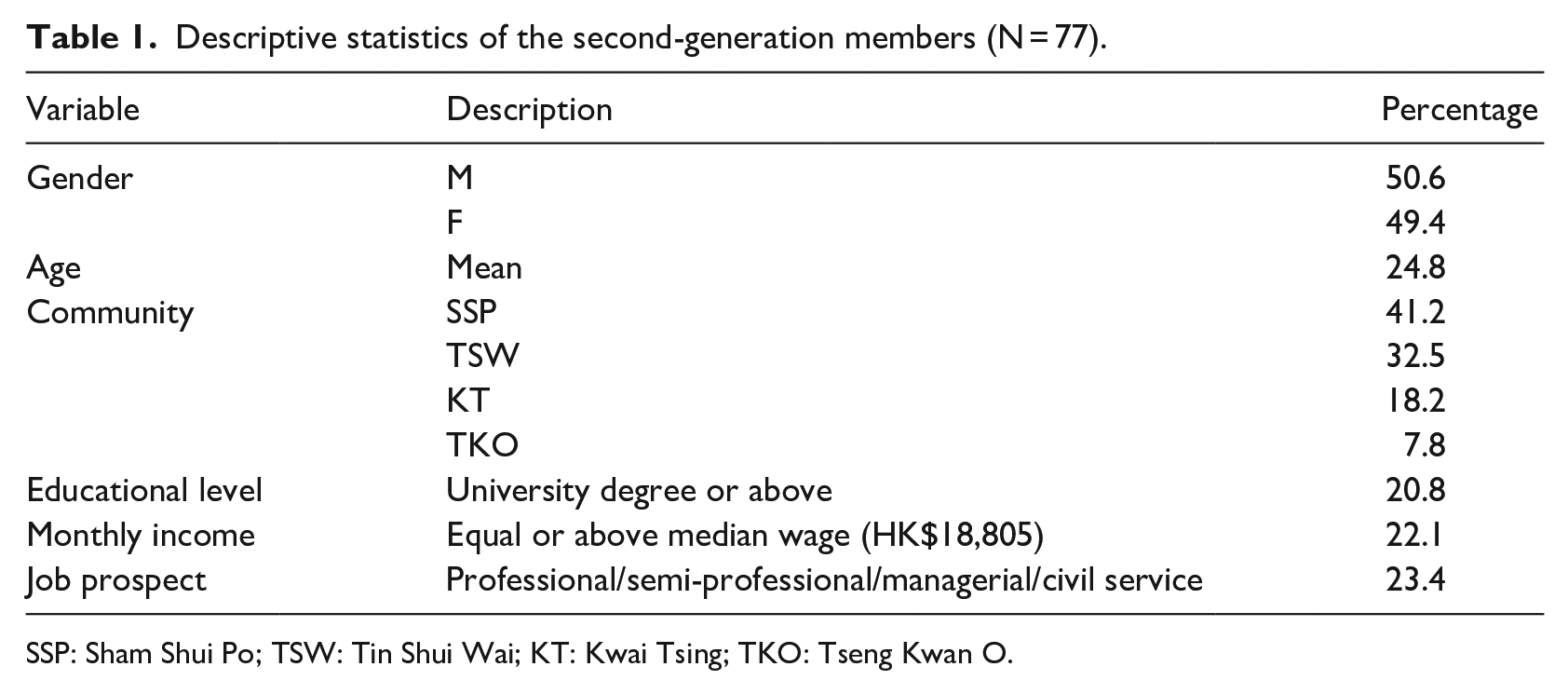
SSP: Sham Shui Po; TSW: Tin Shui Wai; KT: Kwai Tsing; TKO: Tseng Kwan O.
Variables and methods of analysis
Dependent variable
Based on the ‘social investment’ thesis, the dependent variable, which we will call ‘life chances’ is determined by the following three factors: educational attainment, monthly income, and job prospects of the second-generation family member. ‘Life chances’ is a concept coined by Max Weber which does not refer directly to the wealth one possesses at a specific time, but the labour opportunities that ‘causally influence the material standards of . . . [his/her] existence’ in a specific ‘market situation’ (Weber 1968: 927; Wilson 1997: 607). In their study of social stratification in Russia, Anikin et al. (2017: 2) take ‘life chances’ as the conceptual key to capture one’s opportunities (and risks) of experiencing ‘economic conditions, work situation, human capital accumulation, and consumption and leisure activities’ in a specific market situation. Concurring with Anikin et al. (2017), we consider that the three factors involved – that is, educational attainment, monthly income, and job prospects – constitute a fairly accurate approximation of the ‘life chances’ of the second-generational members of the families in this study.
In subsequent analyses, ‘life chances’ is a binary variable. For those who reported having a postsecondary educational qualification, or a monthly salary equal to or higher than the medium income of HK$18,805, or a job with good prospects for income level and stability in Hong Kong society (e.g. professional/semi-professional/managerial/civil service rather than manual workers such as construction workers or restaurant attendants), they were considered as having high life chances of escaping poverty (score = 1). All others were considered as having low life chances (score = 0) with a view to adopting a binary coding format in all our variables.
Independent variables
The SFP database contains dozens of variables which captured the initial family conditions of the second-generation 13 years ago as reported by their mothers. In determining what household factors predict the future life chances of the children, we arranged the independent variables available in the SFP database in accordance with the five dominant models of intergenerational transmission of poverty as follows:
Economic resources model
In assessing income, respondents who reported a median household income of less than half of the Hong Kong median (i.e. less than HK$5000 in year 2008) or whose family included at least one member receiving public assistance were coded as ‘poverty’ (1 = yes; 0 = no).
Homeownership was used as a proxy for people’s wealth. Respondents were asked whether the residence they were living in was ‘self-owned’ or ‘rented’ or ‘belonging to friends/relatives’. For those claiming ownership of a residence, their answers were coded as ‘1’. Other answers were coded as ‘0’.
One’s income was also believed to relate to the prospects for employment, which was assessed by the construct of ‘job readiness’ (Garcia-Ramirez et al., 2005). Respondents who reported being ‘employed’, unemployed but ‘actively/very actively’ seeking jobs, and unemployed without ‘actively/very actively’ seeking jobs were coded as 2, 1 and 0, respectively.
Social isolation model
The community characteristics are assessed in terms of the following four concepts: community location, social support, social capital and walkability.
The location of a community was composed of four dummy variables: SSP, TSW, KT and TKO. All were coded: 1 = yes and 0 = no.
The measure for social support networks was composed of three questions asking respondents to indicate the number of friends, neighbours or relatives expected to help in case of the need for (1) sharing feelings (emotional support), (2) taking care of children temporarily (instrumental support) and (3) a loan due to economic difficulty (financial support). The answers go from 0 for none, 1 for one, 2 for two, 3 for three, and 4 for more than three.
Social capital is defined as social cohesion, which refers to the attitudes of the respondents towards interpersonal relationships in the community. Composed of three questions, the construct was used extensively to measure bonding social capital by Brisson and Usher (2007). The respondents were asked: ‘Please say how much you agree or disagree with each of the following statements’: (1) ‘I live in a close-knit neighbourhood’; (2) ‘People in my neighbourhood are willing to help neighbours’ and (3) ‘People in my neighbourhood generally don’t get along with each other’. For each question, the responses ranged from ‘agree strongly’ (score = 1) to ‘disagree strongly’ (score = 5).
The measure of community walkability was inspired by Leyden (2003). The respondents had to answer a question: ‘If you or another family member(s) want to go to one of the following places, could you walk to this place without too much trouble? Check all the places you could walk to without too much trouble’. The measure included the following four items: the community organization, respite service centre for childcare, current workplace and earlier workplace (1 = yes; 0 = no). The first two items identified social service walkability and the next two items identified workplace walkability of their community.
Correlated disadvantages model
Parental factors were determined by the educational level, civic engagement and status of new migrants.
The measure of education had five levels, below primary school, junior secondary school, senior secondary school, technical or vocational college and university or above (score from 1 to 5, respectively).
The measure for civic engagement of the respondents was composed of three questions. The respondents indicated whether they had (1) served as a committee worker, (2) volunteered or (3) attended a community festival or a community group in the past 12 months. Respondents who responded affirmatively to any one of these three questions were coded as ‘yes’ (score = 1) for ‘civic engagement’; those who did not were coded as ‘no’ (score = 0; Brisson and Usher, 2007).
The new migrant status was determined by whether the respondents had resided in Hong Kong for less than 7 years (1 = yes; 0 = no).
Family structure model
This model is mainly tested by two variables: marital status and marital contentment.
The marital status had a score of ‘1’ if the respondents reported ‘married’; and a score of ‘0’ if the respondents reported otherwise.
Rather than directly asking the respondents to rate their marital contentment, we adopted a lexical approach and asked them to rate four Chinese statements that are commonly used to describe a marital relationship (Chan and Ho, 2008). Respondents were asked to rate the accuracy of the following four statements: (1) ‘You and your husband talk to each other about everything’, (2) ‘Your personality and your husband’s personality do not match’, (3) ‘You and your husband understand each other’s needs and help each other’ and (4) ‘You and your husband communicate adequately’. The scores range from ‘disagree strongly’ (score = 1) to ‘agree strongly’ (score = 5). The scores of items (2) and (4) were reversed in analysis.
Welfare culture model
One should be aware that Hong Kong society considers CSSA highly stigmatizing. It is believed – widely and stereotypically – that the public assistance scheme will only proliferate a welfare-dependence culture among recipients (Ho and Cheung, 2012). To see whether welfare culture really leads to lower ‘life chances’ of the second-generation members, we used the answers provided by the mother respondents on whether their family included at least one member receiving CSSA (1 = yes; 0 = no).
Results
In order to identify factors which are significantly predictive of the life chances of the second-generation, a series of logistic regression analyses were conducted. Table 2 shows how the independent variables are associated with the binary dependent variable of life chances.
Logistic regression analysis of the life chance of the second-generation member.
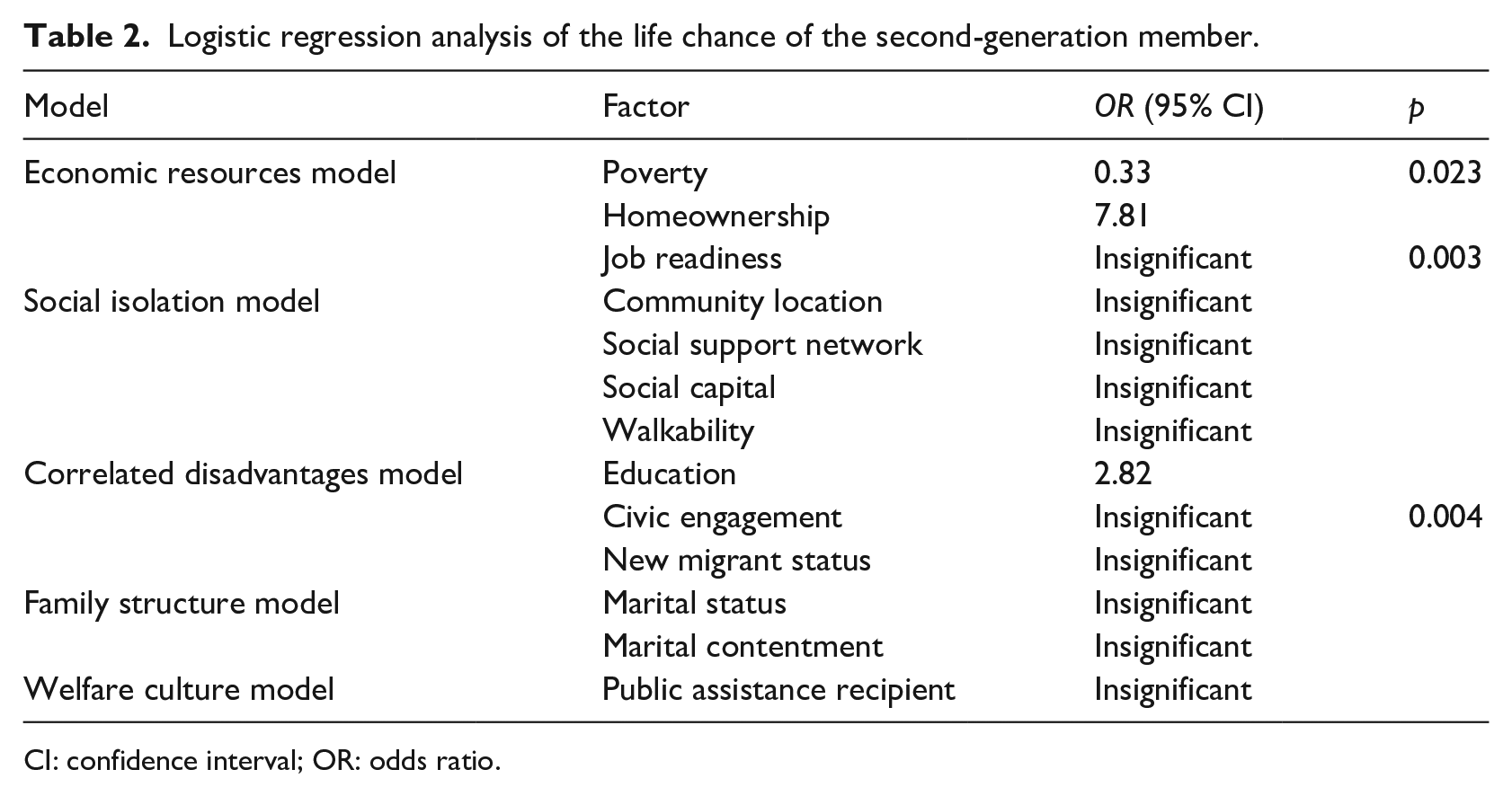
CI: confidence interval; OR: odds ratio.
To what extent poverty is passed from parents to children?
To answer this question is to test the economic resource model of intergenerational transfer of poverty. Table 2 shows that family income and homeownership significantly predict the life chances of the children. In concrete terms, adolescents of poor parents have a 67 percent lower chance of having high life chances in young adulthood. Put it in another way, adolescents of poor parents have a 202 percent higher chance of being poor in young adulthood. This poverty-continuation probability increases drastically to 681 percent if parental poverty is defined in terms of homeownership rather than income. In this light, we can see that the path-dependent pattern of ‘the-poor-begets-the-poor; the-rich-begets-the-rich’ in Hong Kong is highly valid. The reason is that 62.4 percent of our sample were found to fit this path-dependency pattern when comparing the level of family income 13 years ago with the life chances of the second-generation today. This path-dependency proportion was further increased to 68.8 percent if a family’s initial wealth was defined by homeownership rather than income.
What factors predict the likelihood of being trapped in poverty?
Table 2 shows that apart from the economic resources model, only the correlated disadvantage model received empirical support. It is found that the level of educational attainment of the mothers was predictive of the life chances of their children. More specifically, mothers with a higher educational level are more likely (182% higher chance) to keep their children out of poverty in young adulthood than mothers with a low educational level.
Table 3 shows the steps taken to construct a logistic regression model that best explains the life chances of second-generation members. Model 1 used all three independent variables identified above: ‘poverty’, ‘homeownership’ and ‘education’ as repressors. Among these variables, only homeownership significantly predicted life chances. When ‘poverty’ was taken out in Model 2, both ‘homeownership’ and ‘education’ became significant. This indicates that homeownership and mother’s education are two key initial determinants that predict a family’s ability to allow its second-generation members to break the poverty cycle in the future. Initial levels of ‘poverty’ of the family – and quite surprisingly – is relatively speaking a less important determinant.
Logistic regression models.
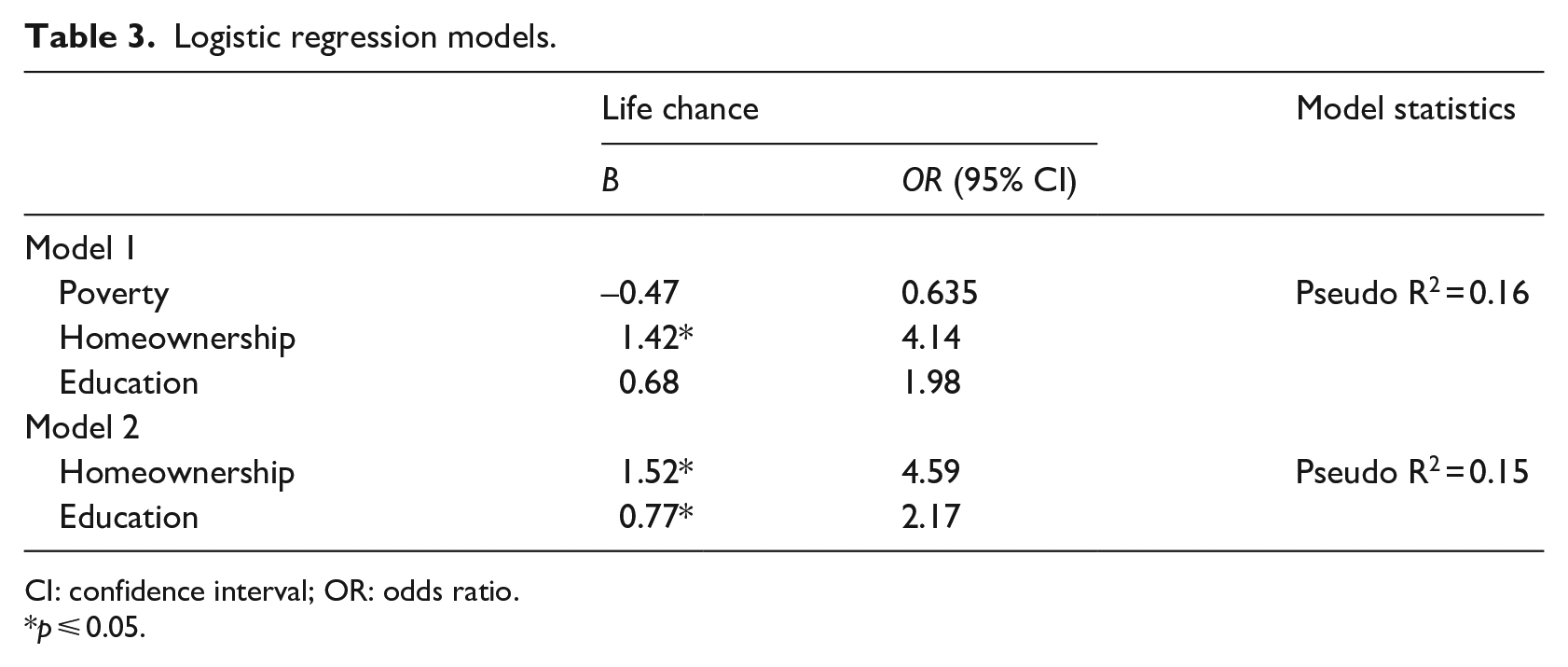
CI: confidence interval; OR: odds ratio.
p ⩽ 0.05.
Based on the above, it is found that a combined economic resources and correlated disadvantages model constitutes the best model to explain the intergenerational transfer of poverty in Hong Kong, whereas the other three models were not found empirically applicable. Guided by the economic resources model, we found that homeownership is be a better indicator than income level to predict poverty transfer. The correlated disadvantages model is valid in a sense that the mother’s level of educational attainment and civic engagement – what we call ‘mother’s self-efficacy’ – constitutes a key determinant to reduce the likelihood that poverty is passed from parents to children.
Context-specific factors and processes predicting intergenerational poverty and their implications
To see that the problem of intergenerational transmission of poverty still exists in Hong Kong has constituted a challenge to social worker practitioners and policy makers; and to know that homeownership is a more significant predictor of intergenerational poverty than income adds more complexity to the challenge of solving the problem. One should note that the valuation and rental index of Hong Kong’s residential properties had risen by 122 percent (from HK$79,154/m2 to HK$175,435/m2) and 62 percent (from 119.7 to 194.4) from 2009 to 2019 respectively, whereas the inflation rate has increased only mildly with an annual average of 3 percent during the same period (HKSAR Government, 2020). This makes Hong Kong’s housing the least affordable in the world. According to the ‘Demographic International Housing Affordability Survey’ (available at: www.demographia.com/dhi.pdf), Hong Kong people are only able to buy a house if they do not spend any money at all (not even basic needs) for 20.8 years as of 2020. Scholars, mostly in the field of health studies, have argued that homeownership is a better indicator for socio-economic status than income for examining associations with self-rated health (Airio et al., 2005; Dunn, 2002), mortality (Laaksonen et al., 2008) and leisure-time physical activity (Cleland et al., 2012). These studies suggest that homeownership reflects long-term accumulation of material wealth which may not be easily affected by increasing rents, current employment status and income. This study brings this argument afresh to the domains of social work and social policy studies regarding the intergenerational transfer of poverty. The underlying familial process seems to be that families with homeownership experience less economic crisis, and hence can invest more in their children’s human capital and promote their future earning potential.
Apart from the argument that homeownership is a plausible marker of wealth and affluence, homeownership which offers a more stable, and probably better, home environment for children’s studies may constitute another micro process that homeownership contributes to the higher life chances of the second-generation members. Using this logic, studies in the United States and the United Kingdom have discovered that children of homeowners have higher cognitive test scores, fewer behaviour problems and higher academic attainment than do children of renters (Bramley and Karley, 2007; Haurin et al., 2001). This study suggests similar processes are at work in Hong Kong. Moreover, it is further found that such stable home environments are not affected by the community environment – such as social support network, social capital and walkability – in predicting the life chances of children.
The factor of educational attainment reveals another set of familial processes which increase the likelihood of upwards mobility of the second-generation. Previous studies have already highlighted that parental education plays a role of indirect transmission of resources and assets that facilitate upwards intergenerational mobility of a family (Buis, 2013). Subscribing to Bourdieu’s concept of ‘cultural capital’, scholars argue that better educated parents spend more quality time with their children, cultivating their reading and language skills, nurturing their social skills to address teachers and other authoritative figures, and holding high aspirations for their children (e.g. Lareau and Weininger, 2003).
A number of studies have underscored specifically the importance of mothers in transferring resources to the children and improving their educational achievement. For example, Korupp et al. (2002), using data from the Netherlands, West Germany and the United States, show that resources from the lower status parent matter for children’s educational attainment – this parent usually being the mother. Buis (2013), using 11 Dutch surveys that covered birth cohorts born between 1931 and 1991, found that the mother’s education mattered more in children’s attainment than that of the father, especially when the mother was not employed. Willekens et al. (2014) argue that mothers’ greater influence on children’s educational attainment can be explained by the fact that mothers usually spend more time with their children than their father such that the mother is usually taken as the role model for children in adopting learning strategies and making educational choices. The above-mentioned processes that involve how mother’s cultural capital can improve her children’s educational attainment thus offer possible mechanisms that explain why mother’s higher educational attainment can increase the life chances of her children in Hong Kong.
Based on the context-specific factors and processes discussed earlier, several key implications for social work practitioners and policy makers who aim to eliminate intergenerational transfer of poverty in Hong Kong become highly relevant. First, apart from those measures which mean to increase the salary of low-income people, social work practitioners and policy makers should advocate for policies and initiatives which can offer affordable housing to poor people. Second, territory-wide programmes to allow well-educated mothers from low-income families to share their successful parenting experiences with less-educated mothers should be encouraged. Third, since our findings have confirmed that intergenerational transfer of poverty in Hong Kong is determined more by micro-familial processes of resource or knowledge or values transfer between mothers and their children than the meso family structure (e.g. marital status, migrant background) and macro community structure (e.g. social support, social capital), future public resources to tackle intergenerational poverty should be channelled in accordance with this priority. Last, but not least, social workers and policy makers should take action to rectify the stereotypical perception of Hong Kong people that CSSA recipients are likely to depend continuously on public welfare without having the motivation to break the poverty cycle. Our findings suggest that being a CSSA recipient exerts no significant impact on the poverty trajectory of one’s children.
Our analyses insofar carry the following three key limitations. First, this study was based on convenience sampling rather than random samples. Second, some degree of inaccuracy in determining the salaries of second-generation family members inevitably incurred based on the self-reported data from their parents. Third, constrained by the initial purpose of the SFP database, only the data from mothers (not fathers) were analysed.
Footnotes
Declaration of conflicting interests
The authors declared no potential conflicts of interest with respect to the research, authorship and/or publication of this article.
Funding
This research project (Project Number: 2021.A1.112.21A) is funded by the Public Policy Research Funding Scheme from the Policy Innovation and Co-ordination Office of the Government of the Hong Kong Special Administrative Region.
