







Abstract
Using qualitative methods, this study explores the roles of social workers in a healthcare team in the context of China. It reveals that, like their international counterparts, Chinese social workers also adopt a client-centered approach. However, they usually utilize such an approach at the family level rather than the individual level. In order to fulfill professional responsibilities, Chinese social workers need to adjust their roles to take on some nonprofessional tasks within the bureaucratic systems, which would help them further embed their roles into the teams. Strategies for maximizing the professional roles of social work in multi-professional teams are also discussed.
Keywords
Introduction
Health is crucial for the well-being of individuals and the socio-economic development of nations (World Health Organization [WHO], 2013). In China, due to rapid population aging, the increase in chronically ill patients, the deteriorating doctor–patient relationship, and improved approaches to healthcare, social work is now an integral part of China’s modern healthcare systems (Liu, 2022). More and more social workers have been included in the multi-professional healthcare teams (Liu et al., 2022), collaborating with doctors, nurses, and other professionals in various settings such as hospitals, public health facilities, and community health service centers. Their primary goals are to enhance the client’s quality of life and pursue health equity for all (Cheng and Schatz, 2015). Some specific roles that social workers can play have been discussed such as the provision of social support for clients and their families (Chen, 2017) and the alleviation of clients’ negative illness experiences (Tong and Liu, 2018).
Unfortunately, given that social work is still an emerging profession in China, the importance of social workers in healthcare teams has not been fully recognized (Niu and Haugen, 2019). Social workers are often equated with volunteers (Wang and Ma, 2021). Even when some team members do recognize the value of social work, collaborations between social workers and other healthcare professionals are often limited by frictions and controversies among different professions, which further hinder them from working as a team to effectively address the clients’ needs (Sun et al., 2023). Therefore, it is crucial to explore the roles of healthcare social workers in multi-professional teams in the context of China, especially given the extensive professional experiences of social work in the health sector spanning over a century in numerous countries (Cullen, 2013).
Literature review
Healthcare is referred to as the comprehensive provisions of services and interventions that aim at promoting individuals’ health through diagnosis, treatment, preventive measures, and monitoring of physical and mental ailments, injuries, diseases, and traumas (Edelman and Kudzma, 2021). With the decline in the biomedical model of medicine and the rise of theories such as medical anthropology and second-generation feminism, our understanding of health has become increasingly comprehensive (Thomas, 1999). For instance, health can be defined by the patients’ experiences of coping with illnesses at both the individual and the family levels (Kleinman and Kleinman, 1996). It is important to explore how the patients manage their health in the context of interpersonal dynamics as well as how social factors affect the individuals’ health (Shilling, 2012). It is evident that healthcare represents an ongoing, dynamic, and intricate process (Lee et al., 2015). It not only encompasses the patients’ self-management of their illnesses and conditions but also involves the invaluable support and assistance provided by caregivers. Moreover, formal healthcare providers offer professional guidance while informal social networks such as family members and friends also contribute significantly, providing physical help, financial assistance, emotional support and advice (O’Leary and Tsui, 2023). These formal and informal services are intertwined and together determine the quality of healthcare (Ruth and Marshall, 2017).
In response to the intricate healthcare landscape, the multi-professional collaboration has emerged as a pivotal component of the Western healthcare system since the early 20th century (Bronstein, 2003). It serves as an efficacious approach to address the service overlap and resource inefficiency within the realm of healthcare. In 2010, the WHO advocated interprofessional education and collaboration among different professions in healthcare practice (WHO, 2010). This approach pays special attention to the social determinants of health and considers health and illness as a result of interactions between the environment and physical, behavioral, psychological, and social factors (Beddoe, 2013). The existing research on healthcare social work in multi-professional collaboration has encompassed a wide range of areas, including the composition of professional teams (Crawford, 2012), collaborative competencies (Horevitz and Manoleas, 2013), education and training (Addy et al., 2015), role positioning (Craig and Muskat, 2013), and knowledge generation (Nicholas et al., 2019). When it comes to the barriers to team-based healthcare, the primary challenge faced by social work is the lack of clarity and visibility in role positioning, leading to the knowledge it produces often being marginalized or excluded (Cootes et al., 2022).
The origins of professional social work in healthcare are often traced back to the services provided by the Charity Organization Societies in England in the 1890s. Initially known as almoners, social workers addressed the patients’ social issues affecting their medical treatment and maintained the institutional records. Over time, they transitioned into ‘friendly visitors’, focusing on prevention and community care (Auslander, 2001). Healthcare social work has a historical legacy focused on protecting and promoting the health of individuals, populations, and communities, as well as social justice (Bachman et al., 2017). However, in contemporary team-based healthcare practices, social workers face challenges in clearly articulating their roles (Morriss, 2017). In the United Kingdom, social workers play a key role in case management by promoting healthcare tasks such as short-term assessments, resource connections, and service plan development and implementation (Postle, 2002). However, it seems that social workers’ unique and valuable contributions could be replaced by experienced nurses, occupational therapists, counselors, and other healthcare professionals (Roland et al., 2012). Studies in Sweden indicate that social work plays a ‘fairly important’ role in healthcare teams, although it is still portrayed as a ‘blurred profession’ (Melin Emilsson, 2013). Social workers in team-based healthcare are identified as boundary spanners in Norway, who aim to strengthen the relationships among patients, families, healthcare professionals, and communities (Mannsåker and Vågan, 2024). Similar findings have also been documented in Canada (Oliver, 2013), America (Moore et al., 2017), and Hong Kong (Leung et al., 2009). But the current literature has been limited in specifying which competencies are prominent in fulfilling these roles or functions (Nicholas et al., 2019), which may lead to ethical conflicts in their dual roles of supporting clients and teams as studied in Australia (Delany et al., 2017). Compared with those countries that have well-established social work practices in healthcare settings, some countries in the nascent stage of social work development encounter more problems of role ambiguity among healthcare social workers (Abri and Zahedi asl, 2018).
In addition, the term ‘role’ is described as ‘a set of related functions or tasks that require both knowledge and skill’ (Delany et al., 2017: 508). Role theory posits that roles are constructed through interactions and relationships among individuals, encompassing the emergence of roles, the interactive framework they create, their relationship to interactors, and the establishment of organizational roles in relation to propositions made between roles and people (Biddle, 1986). In other words, roles entail a set of expectations or behaviors associated with a specific position, and their significance can only be unveiled and determined within the context of interactive relationships (Payne, 2014). Especially, due to socio-economic changes and the professional advancement of healthcare social work, the scope and intensity of each individual’s expectations regarding the roles of healthcare social work may evolve (Peterson et al., 2018). Previous research also indicates that members of healthcare teams exert significant influence on the perceptions and expectations held by social workers themselves. Within the same workplace, individuals can mutually influence each other during the long-term collaborations and interactions, leading to alterations in their cognitive levels and substantive interactions (Saxe Zerden et al., 2019).
In summary, previous research suggests that social workers, who are aware of their unique roles, can assert a distinct social work perspective within the healthcare teams and organizations while also addressing the misunderstandings between profession and social workers’ sense of powerlessness (Moore et al., 2017). However, the majority of the researchers have focused their efforts on exploring the roles of social workers within the confines of the profession per se. This has led to an oversight in examining how social workers practice their roles throughout the comprehensive, continuous, and dynamic process of healthcare collaborations. Furthermore, there are very few empirical studies that explored the roles of social workers from a longitudinal perspective, making it challenging to present the development of professional roles through this intricate process.
To address the aforementioned research gaps, this study examined how social workers in a healthcare multi-professional team perceived and defined their professional roles. It also investigated the professional orientations and expectations of the clients and their families as well as other healthcare professionals toward social work. From a longitudinal perspective, the study further illustrated the gradual process through which social workers gained recognition and acceptance within and outside the healthcare team and thus were able to perform their professional roles. To be specific, this article addressed the following questions: What are the specific roles of social workers in a healthcare multi-professional team in the context of China? How have these roles evolved over time? Are these roles consistent with the general characteristics of healthcare social work roles within multi-professional teams in other countries?
Method
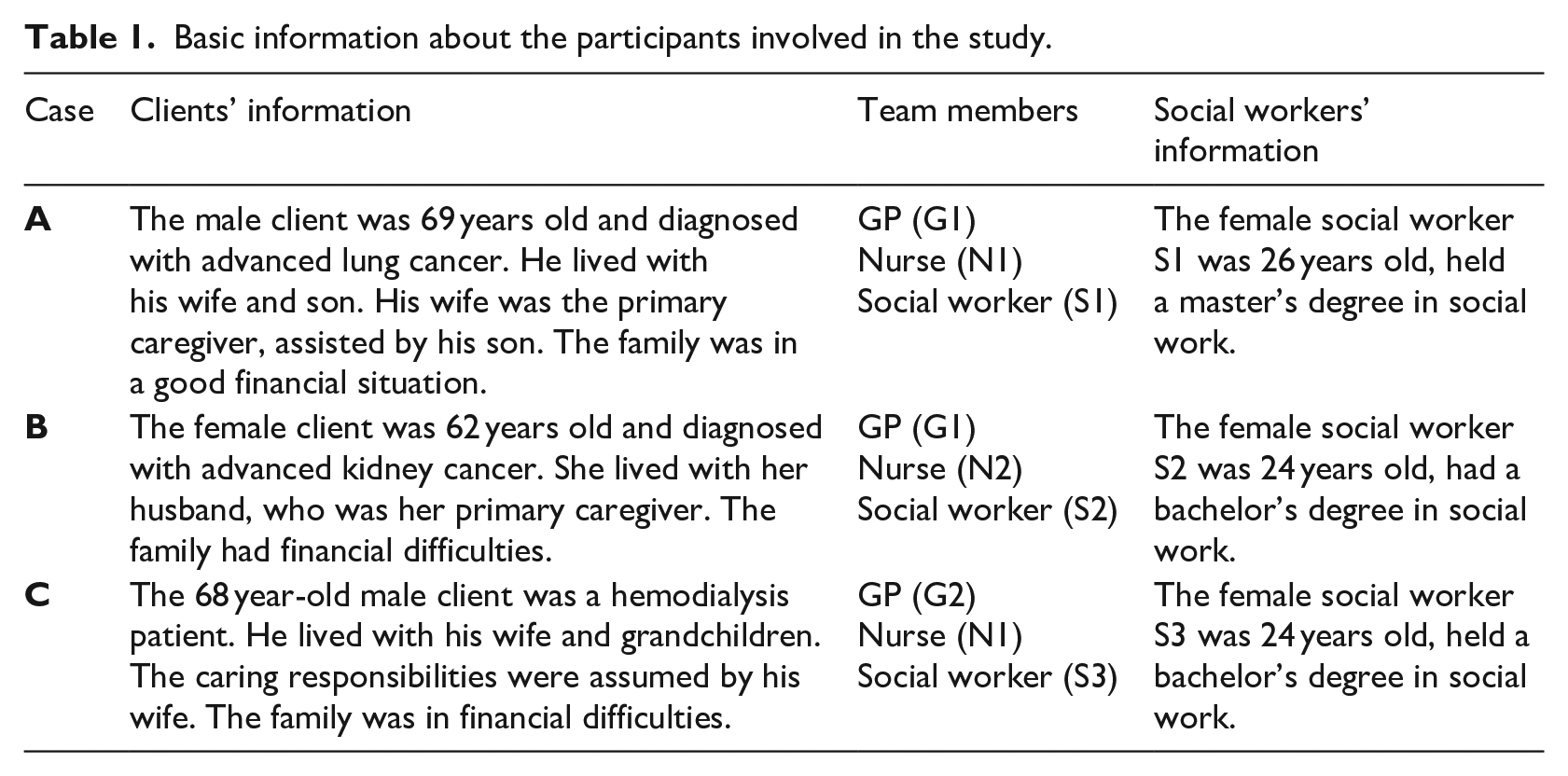
Using qualitative methods, this study collected pertinent data from a multi-professional healthcare team at the Institution M in Xiamen, China. The team consisted of general practitioners (GPs), nurses, and social workers who worked together to provide comprehensive services for older adults living in the community. The State Council’s 2019 Opinions on Implementing Healthy China Actions emphasized the importance of collaborations among different sectors and professionals in the healthcare system. According to this policy, the multi-professional team at the Institution M adopted a community work approach to promote holistic health by regularly visiting older adults in their homes from 2018 to 2023. In order to understand the routine work of social workers in the multi-professional team and the development of their professional roles between 2019 and 2023, two GPs, two nurses, and three social workers in the team were invited to participate in the study. They were selected based on three main criteria: (1) the GPs and nurses had not heard of social work before working with social workers; (2) the social workers had a bachelor’s or master’s degree in social work and had no previous experience of multi-professional teamwork; and (3) they allowed the authors to follow up with them on full service cases, which was also supported by the clients and their families. The main characteristics of participants are shown in Table 1.
Basic information about the participants involved in the study.
Three methods were used to collect data from a longitudinal perspective.
Participatory observations
With consent of participants, the authors conducted participatory observations during 10 multi-professional service interventions in three households as well as three healthcare team meetings. Team-based meetings were convened to effectively discuss and address the issues related to the implementation of the team’s work such as assessment of clients’ needs, confirmation of service plans, and arrangements for subsequent phases.
In-depth interviews
Two in-depth interviews were conducted to understand the participants’ collaborative experiences and subjective evaluations of social work. One interview was conducted within the first month after the team was established, which focused on the participants’ views about the multi-professional collaboration and the roles of social work, the challenges they encountered, and the factors affecting the teamwork. The other interview was done after the team had worked together for at least half a year. It examined how the participants addressed the challenges in their work, developed effective team collaboration, and understood the roles of social workers over time, and whether there had been any changes in their understanding of the collaboration since the first interview.
Documentary
The team’s service documents such as assessment information, service plans, and service delivery process reports were collected. This documentation detailed the multi-professional team’s intervention process along with the specific roles played by social workers within it.
Analysis
The study used thematic analysis to analyze the data (Braun and Clarke, 2006). These phases are as follows: (1) the authors transcribed the interviews into a written form, and repeatedly read the data to become familiar with it; (2) the initial codes were generated using NVivo 12 with all actual data extracts being coded; (3) based on the contrast, induction, and integration of the data, the main themes were developed; (4) themes were reviewed and identified by reading all the themes multiple times, discussing, breaking down into separate themes, and discarding irrelevant themes; (5) defining and naming themes involved considering the relationship between the themes and clearly defining what they were and what they were not; and (6) the data-driven story was produced within and across themes.
Ethical considerations
This study received ethical approval from the authors’ primary institution and supported by the Institution M. Written informed consent was obtained from all participants.
Results
According to the data analysis, the process of role construction for social workers in a multi-professional healthcare team was not a quick undertaking. It unfolded gradually through three distinct stages: (1) initial role ambiguity; (2) subsequent recognition of multiple roles; and (3) finally culminating in flexible role transition.
Stage 1: Role ambiguity
Uncertainty about social workers’ responsibilities
As social workers began to engage in the multi-professional collaboration, they did not know how to define their work, what specific goals needed to be achieved, and how to effectively participate in team collaboration. Because social work is still a developing profession in China, they also faced misunderstandings about their roles from both patients and their families as well as other healthcare professionals (Yeung et al., 2024). Some healthcare professionals viewed them as ‘outsiders’ and even feared that working with social workers would negatively affect the work efficiency and the quality of healthcare.
People don’t really know what I can do. Even when I told them I was a social worker, they only knew there were social workers in the team and didn’t expect much from us. (I-S3)
Lack of knowledge and skills
The knowledge systems of social work in China have been largely influenced by the West. Consequently, many of the theories, skills, and competencies that social workers acquired through their education may have limited applicability to the real-life situations in Chinese healthcare settings. Social workers in this study expressed a lack of essential knowledge. Social work knowledge is crucial for assessing clients’ specific needs and situations and providing them with tailored psycho-social services, while social policy knowledge enables social workers to quickly identify and secure the necessary community resources and financial aid for the clients and their families. In addition, basic health knowledge enables social workers to understand clients’ health problems and the course of nursing care. Unfortunately, there are insufficient social work curricula and training in these areas in China.
I’m a bit embarrassed to admit this, even [though] I have a master’s degree in social work, I still feel my knowledge and skills are not up to par. (I-S1)
Stage 2: Recognition of multiple roles
As the collaboration progressed, social workers pursued several strategies to overcome the role ambiguity, which included participating in training programs on integrated healthcare services, receiving supervision from social work educators, engaging in regular team discussions, and interacting with various stakeholders for the sake of clients. Such efforts helped social workers recognize multiple roles they could assume in the multi-professional healthcare team.
Roles relating to clients and their families
In this study, social workers could serve as assessors for clients and their families. During the comprehensive assessment, the other healthcare professionals were primarily responsible for the assessment of the clients’ physical needs and pertinent factors contributing to their physical status such as older adults’ physical functioning, medical history, medications, and overall care requirements. Social workers mainly identified and addressed the psychosocial needs of clients and their families regarding the clients’ cognitions, emotions, beliefs and aspirations, the caregivers’ abilities and challenges, the overall family functioning, and the existing social support. Unlike other healthcare professionals, social workers not only assess the clients’ problems and needs, but also prioritize the abilities and resources they possess, understand their lived experiences within healthcare systems, and continuously reassess new needs or change goals during the collaborative service delivery process. These are typical tasks of health social work in international settings (Green and Ellis, 2017).
We conducted an assessment of B’s home care situation. G1 found her husband’s lack of skills in medication changes, dietary adjustments . . . and I found he was under a lot of pressure . . . tired of caring, fear of B’s impending death. Additionally, their family faced serious financial difficulties . . . (I-S2)
As intervention planners, social workers collaborated with other healthcare professionals to develop a comprehensive plan, which involved setting clear goals, organizing services, and maintaining constant communication with clients and their families. The aim was to take responsibility for client-centeredness under the Healthy China strategy by providing efficient and well-structured multi-professional services.
Many Chinese people, especially older adults, lack healthcare knowledge and have poor health behaviors (He et al., 2016). Social workers could serve as educators to assist older people and their families in acquiring health-related knowledge and caregiving skills to improve the quality of healthcare in daily life. This encompassed the use of medication, exercise routines, nutritional management, pain management, sleep regulation, prevention of bedsores, and so on. Music therapy and exercise therapy were also employed by social workers in their treatment and care services. For those who were at an advanced age and diagnosed with dementia, a collaborative education was carried out with caregivers and families on prevention of wandering and falls.
We helped C maintain an adequate intake of water and engage in physical activity, instead of just sitting around at home all day. (I-S3)
Participants described that older adults with chronic illnesses or who were bedridden had high psycho-emotional needs. Social workers identified such needs for them and acted as counselors throughout the whole collaborative process. This included helping clients and families understand their physical conditions, promoting accurate recognition of their illnesses, empowering clients and families, making sure they were understood, providing emotional support, promptly alleviating negative moods, and creating a supportive healthcare environment. However, some social workers found it challenging to provide emotional support due to lacking counseling knowledge and training.
In China, the relationship between healthcare professionals and patients is an authority-obedience relationship. Although social workers may not have authority within the team (He et al., 2022), they try to position themselves between other healthcare professionals and clients, functioning as mediators, to reduce the misalignment of expectations and perceptions between them. For example, social workers assist other healthcare professionals in assessing clients’ needs and their family care situations. They help clients and their families understand the medical instructions regarding medication, diet, rehabilitation training, and identify potential challenges. They also provide timely feedback to healthcare professionals and collaborate on adjusting treatment plans if necessary. It is crucial for social workers to understand the medical terminology and convey the complex information clearly and concisely. Their advice should be tailored to the specific needs of clients and their families, neither excessive nor insufficient. The mediation between clients and their families includes facilitating connections and communications between the two parties, improving care arrangements, promoting inter-family exchanges, and avoiding misunderstandings or neglect in care.
The GP gives a lot of advice, but not all of it might be helpful. So, I try to connect the GP and customize her advice to fit C’s family care situation, and then meeting C’s needs . . . (I-S3)
Furthermore, social workers served as intermediaries to establish the links among different social support systems for older adults and their families. They ensured that these systems were interconnected and provided sufficient support for clients and their families. Specific strategies included the development of support groups among older adults and their caregivers, the promotion of community volunteer programs for older adults, the strengthening of links between older adults and their communities, the integration of available material and financial resources, and the moderate provision of information and resources especially during the COVID-19 pandemic.
We recruited 25 volunteers in the community, trained them and involved them in providing support services for old people and creating an age-friendly community. (I-S1)
Social workers served as advocates, by coordinating healthcare professionals, providing community residents with essential health knowledge, and promoting healthy lifestyles to effectively manage people’s health. Meanwhile, social workers collaborated with other healthcare professionals, community members, and volunteers to provide respite services to help relieve caregivers of their burdens, guarding and protecting the rights of older adults and their caregivers. They also stressed the important of fostering a community ethos for caring for older adults within the community.
Roles relating to healthcare professionals
The study found that social workers could help maintain positive teamwork. With the deepening of collaboration, social workers frequently assumed the role of organizers within the multi-professional healthcare team. The organizational tasks encompassed various stages of collaboration, including establishing professional relationships between clients and the team, compiling comprehensive case files for clients, scheduling home visits by healthcare professionals based on clients’ physical condition and care needs, facilitating regular meetings among healthcare professionals to discuss the service needs of clients and their families, developing service plans, facilitating knowledge sharing, evaluating service effectiveness, and formulating response strategies. To excel in this role, social workers found it necessary to possess the basic health and behavioral knowledge and understand the impact of psychosocial factors on people’s engagement with health services and healthcare preferences, nursing skills, and team organizing skills.
Working together doesn’t have to be all perfect and smooth. It’s more about how we organize these services. Once we know enough about health and care, we can figure out what might happen in those situations and spot any hidden dangers. Then we can team up with doctors and nurses to step in when needed, so we can effectively organize services. (I-S2)
As mentioned earlier, the diverse professional backgrounds of healthcare team members could lead to some conflicts and disputes, which resulted in communication barriers and negative emotions. In such situations, social workers played a crucial role in resolving group tensions through conflict resolution, as suggested by other literature (Sims-Gould et al., 2015). Specific support measures included, but were not limited to, promoting mutual understanding between different professions by organizing basic training, providing the emotional support to the multi-professional team, and educating health professionals about the strengths-based practice. N2 described how her clinical work was influenced by social workers.
Before the multi-professional collaboration, I only focused on one aspect of physical fitness, instead of first listening to the clients and understanding their current difficulties or needs, as social workers do. So, when we went to B’s home for the first time, I thought it was unnecessary and even got a little angry, thinking it was a waste of time, when S2 addressed the issues such as financial struggles or family relationships. However, after the training, I realized how important these aspects were, and how they could help us better understand and support B’s recovery. (I-N2)
Stage 3: Culminating in flexible role transition
Social workers made progress in defining their roles within the multi-professional healthcare team and were strongly committed to providing professional services as part of such a team. However, successfully performing multiple roles simultaneously could be challenging. These challenges emerge not only from the diverse needs of clients and their families, but also from the hierarchical power structure within the Chinese healthcare system. The limited and unequal distribution of medical resources gives health professionals a certain degree of authority and power over social workers within the biomedical model in China as well as in many other countries (Delany et al., 2017). In this context, there is a demand from institutional leaders or health professionals for social workers to engage in services that extend beyond the boundaries of their professional remit, as illustrated by S1 in the interview.
Our leader assigned a lot of administrative work to us, and it seems that apart from filling out forms and writing reports, we have nothing else to do . . . Nurses also make us do a lot of non-social work tasks, like taking clients’ weight and blood pressure. (I-S1)
Faced with these challenges, social workers not only recognize their sense of powerlessness and engage in self-care but also gradually explore a set of coping strategies that are in line with the current context. In the process of taking on nonprofessional tasks, they perceive an opportunity to communicate their administrative worth and professional values to the institutions and other health professionals.
Initially, I felt pretty powerless, but I didn’t dwell on the negative feelings. Instead, I took the opportunity to introduce social work during administrative meetings. For example, following the discovery that many elderly people [had] elevated blood pressure levels, I put forth the suggestion of implementing community-based health education initiatives. (I-S1)
In the Western context, healthcare social work initially focused on hospitals before expanding to families and communities. In contrast, the development of healthcare social work in China does not follow a similar path. Instead, it simultaneously evolves within hospitals, families, and community (Wong, 2016). Social workers have identified that it is impossible to implement a universal strategy. They must engage in informed reflection on practice issues, build professional partnerships, and foster relationships with the community and other systems that emerge during the service delivery process. What is more, if necessary, they should conduct further research to identify strategies for effectively addressing the challenges faced by them. Ultimately, social workers gained a comprehensive understanding of how to flexibly adapt their professional roles based on the specific service contexts, enabling them to enhance the multi-professional collaboration and ongoing commitment to promoting client-centered healthcare.
In the beginning, I was always trying to figure out what my role was in the team. But after a year of working together, I realize that we don’t always need everything spelled out. What we really need is to be able to adapt to whatever comes our way. Sometimes I’m giving advice, other times I’m making connections or organizing things. Switching roles facilitates smoother teamwork. (I-S2)
Discussion and implications
Similar to previous international studies, Chinese healthcare social workers aim to provide psychosocial support in order to enhance the quality of clients’ healthcare and pursue social justice. However, as healthcare social work in China is still in the early stages of professionalization, social workers face the dual task of promoting their professionalism and integrating their roles into multi-professional teams. They are required to assume multiple roles in specific contexts and adapt their roles as necessary.
Client-centered approach
The study demonstrates that the centuries-old tradition of healthcare social work, which is centered on clients (Bryson and Bosma, 2018), also applies to China. However, in China, this approach is typically utilized at the family level rather than the individual level. The Chinese family-centered Confucian culture, which emphasizes the strong moral obligations among family members, contradicts the notion that a family is merely an extension of the client (Cong, 2004). Chinese families play a significant role in influencing individual health behavior, healthcare decision-making, and the development of clients’ care plans in the home- and community-based care setting (Tu and Liao, 2021). Like previous research (Holroyd, 2003), we have found that families, despite being an invaluable source of informal care, may still face barriers in accessing healthcare due to their poor health literacy, inadequate financial resources, and the heavy burden of caregiving. Furthermore, misunderstandings between families and healthcare professionals can also impede access to necessary healthcare services. It is essential for social workers to not only assess the health issues of clients, but also to pay attention to their families’ daily experiences in managing healthcare and their requirements for social support within the home- and community-based care setting. The present study encourages healthcare social workers in various countries to adapt the client-centered approach for practice and research in their own cultural settings. Research in Indonesia revealed that many clients sought healthcare assistance and counsel from their communities, within the context of cultural values and the principle of mutual cooperation (gotong royong) (Husein et al., 2021). Family-centered health interventions and collectivism preference have also been identified in Middle Eastern literature (Elshamy et al., 2023).
Enhancing collaboration and expanding services at different stages
Our observations and the existing research both indicate that the best healthcare practice involves complex and dynamic team-based practices (Muskat et al., 2017). Within this integrated context, building a professional identity for social workers is ‘harder than we think’ (Gustafsson et al., 2019). We found that Chinese social workers initially take on some nonprofessional bureaucratic tasks, such as filling out administrative paperwork. This helps to reduce the workload of other healthcare professionals and promotes communication between clients and healthcare professionals. By embedding their roles into the teams, rather than rushing to prove what social work is, they actively attempt to make changes for clients and their families. Gradually, this approach makes other healthcare professionals realize the potential impact of social work. This process is related to their focus on the social determinants of health during collaboration (Muskat et al., 2017), such as patient emotions, family caregiving function, household economics, and community services. As they develop their own understanding of what needs to be done, social workers try to effectively expand the transformation of services at different levels and stages within dynamic and continuous healthcare. It is clear that the process of professionalizing healthcare social work in China is a gradual one from nonspecialization to specialization. However, there are new challenges such as scarcity of resources and inadequate legal, policy, and institutional safeguards for healthcare social workers in China. Similar findings were also observed in previous research in Vietnam (Nam et al., 2021).
Commencing with teamwork
This study identifies the significant ‘backstage’ contributions social workers make to the overall functioning of healthcare teams (Cowles, 2012). The essence of their collaboration is not in surpassing others or eliminating differences; rather, it is in fostering effective cooperation to address clients’ health promotion needs (Whittington, 2023). Nevertheless, the lack of state guidelines for healthcare social work, coupled with highly bureaucratic healthcare environments in China, means the challenges and strategies for initiating teamwork in China are markedly distinct, as the findings indicate. This is particularly evident when social work services are delivered in community-based settings rather than in hospitals. For example, temples are vital traditional institutions that support healthcare services in Thailand (Mongkolnchaiarunya and Nuanyai, 2013). In this regard, it is of the utmost importance to prioritize the manner in which services are provided and the changes that occur for clients. As well as actively learning about the knowledge from different professionals, conducting debriefings to clearly articulate their epistemic contribution to clients, recognizing one’s feelings and emotions, and developing strategies to handle them, are all very effective measures.
Conclusion
The study demonstrates that social workers in a Chinese healthcare multi-professional team, like the international core functions, adopt a client-centered approach with a variety of roles. However, in contrast to the existing international research that has concentrated on defining the roles of healthcare social work, this study posits that social workers must be adaptable in aligning their roles with the specific demands of service contexts. Unfortunately, Chinese social work will confront obstacles such as inadequate knowledge, insufficient skills, limited authority, and inadequate resources when engaging in the multi-professional collaboration. This necessitates that Chinese social work education respond to the demand for knowledge and skills in the field of healthcare while simultaneously prioritizing the generation of knowledge within Chinese contexts. Moreover, the Chinese departments responsible for social work and healthcare should provide legitimacy and resource support for healthcare social workers at the policy level.
As an exploratory study, this article still has some weaknesses that would need to be addressed in future research. First, the scope of the study sample is limited, and subsequent studies may consider expanding the scope of the sample. Second, this study did not design variables for causal mechanisms, and subsequent research could explore the causal pathways of healthcare social work practice in multi-professional collaboration in a more systematic manner.
Supplemental Material
sj-docx-1-isw-10.1177_00208728241309482 – Supplemental material for Roles of health care social workers in a multi-professional team: A qualitative study in the context of China
Supplemental material, sj-docx-1-isw-10.1177_00208728241309482 for Roles of health care social workers in a multi-professional team: A qualitative study in the context of China by Minmin Luo and Haiping Chen in International Social Work
Supplemental Material
sj-docx-2-isw-10.1177_00208728241309482 – Supplemental material for Roles of health care social workers in a multi-professional team: A qualitative study in the context of China
Supplemental material, sj-docx-2-isw-10.1177_00208728241309482 for Roles of health care social workers in a multi-professional team: A qualitative study in the context of China by Minmin Luo and Haiping Chen in International Social Work
Footnotes
Acknowledgements
This work would have not been possible without the contribution and support of all the participants in this study.
Author contributions
All authors contributed to the study design. Luo conducted data collection and analysis, and drafted the initial version of the manuscript. Chen provided critical review and editing.
Declaration of conflicting interests
The authors declared no potential conflicts of interest with respect to the research, authorship, and/or publication of this article.
Funding
The author(s) disclosed receipt of the following financial support for the research, authorship, and/or publication of this article: This work was supported by the National Social Science Foundation of China, grant number22CSH042.
Ethical approval
This research has been approved by Institutional Review Board of College of State Governance, Southwest University (IRBGZL20014). Date of ethical approval is 4 January 2020, and the date the participants were recruited is 13 January 2020.

Data availability statement
The data that support the findings of this study are available from the corresponding author upon reasonable request.
Supplemental material
Supplemental material for this article is available online.