







Abstract
Social workers are standing on the front line in preventing, disclosing and intervening in intimate partner violence cases and in promoting survivors’ safety and well-being. However, for survivors with strong religious affiliations, social workers are not the only actors involved. This study aimed to retrospectively explore the help-seeking experience of Ultraorthodox survivors of intimate partner violence who received help from social workers and rabbis. Findings suggest that social workers should acknowledge the care barriers connected to child outcomes and that rabbis may not be the preferred source of care unless they possess a good background in family matters.
Introduction
Social workers are the most meaningful front-line professionals who play a crucial role in preventing, disclosing and intervening in intimate partner violence (IPV) cases, and in promoting survivors’ safety and well-being (Olsson et al., 2024; Pelkowitz et al., 2023; Tam et al., 2016). Social workers working with survivors from the general population operate under an established body of knowledge and possess the professional capacity to intervene and build trust with clients. Although they may face challenges in maintaining a long-term therapeutic relationship with IPV survivors (e.g. mostly due to their clients’ rejection and trust issues), social workers generally possess the abilities standing at the core of the profession – a non-judgmental viewpoint, acceptance and empathy toward their client’s life story.
Clients with strong religious affiliations sometimes face challenges in building trust with social work practitioners, and in processing decision-making, when they hold a different set of values and world views. Interventions with survivors with strong religious affiliations sometimes involve religious figures (e.g. rabbis, religious leaders and more), who might be meaningful actors in the lives of survivors. Since the central role of social workers in detecting and ameliorating IPV involves great responsibility, survivors’ perspectives regarding help-seeking are of main interest to social work practitioners. However, the help-seeking experience of IPV survivors with strong religious affiliations such as Ultraorthodox has been largely overlooked. This study aims to examine the help-seeking experience of Israeli Ultraorthodox IPV survivors, particularly the help offered by two primary sources: social workers and rabbis. In the following sections, we address the concept of ‘help-seeking’ in general and among IPV survivors. Next, we highlight prior research on the Ultraorthodox community, its main characteristics, and help-seeking behaviors within the community. We conclude by highlighting disparities and research gaps in the field and addressing the rationale for conducting this study.
Help-seeking behaviors of IPV survivors
Help-seeking behaviors in response to IPV are well documented and explored. IPV widely occurs among couples without any differences in their ethnic origin, culture, socioeconomic status, or religious affiliation (Bent-Goodley, 2021; Both et al., 2019; Lannon et al., 2021; McDonald et al., 2006). Worldwide statistics reveal that one in three women has experienced at least one incident of IPV during her life course (Both et al., 2019). It is defined by the Centers for Disease Control and Prevention as ‘physical violence, sexual violence, stalking, and psychological aggression (including coercive acts) by a current or former intimate partner’ (p. 1). Social workers and social welfare practitioners are directed to intervene in family violence cases, to promote the safety and well-being of survivors, and to help them move to the other side of abuse. In many cases, when survivors acknowledge that they are living under abuse (physical, emotional, sexual, or any combination in between), they are seeking assistance and advice to cope with their situation. Help-seeking is defined as the process that survivors utilize to disclose, reach support and secure formal services (Goodson and Hayes, 2021; Stork, 2008). Help-seeking behaviors include searching for and using formal and/or informal assistance in addressing concerns, seeking advice from others to understand the problem, receiving information, and/or intervention, and reaching out for general support (Rickwood and Thomas, 2012).
Studies have shown that the help-seeking behaviors of IPV survivors are multifaceted and influenced by sociocultural, interpersonal, and individual factors, such as trauma histories, cultural and religious beliefs, and economic resources (Ansara and Hindin, 2011; Liang et al., 2005). The research examining tendencies of help-seeking among IPV survivors usually focuses on specific services offering help, and the experience of survivors receiving help from different sources. IPV survivors typically seek care such as legal advice, financial support, personal assistance in decision-making, care for the children, and also informal support from friends and family members. Beyond the formal help and support offered by the social welfare services and private organizations of women’s rights, the invaluable need for informal support for IPV survivors in promoting their mental well-being is well established (Ansara and Hindin, 2011; Goodson and Hayes, 2021; Liang et al., 2005; Stork, 2008).
Help-seeking perspectives of IPV survivors from religious minorities
Help-seeking perspectives of IPV survivors affiliated with religious minorities are a relatively understudied topic. Although many IPV survivors experience barriers to help-seeking, some factors have been found to particularly influence help-seeking among religious minorities (Damron and Johnson, 2015; Martin and Garcia, 2011). The assistance offered in faith-based communities is typically provided through three main resources: personal consultation, social support and spiritually-oriented support. Personal consultation is usually provided through personal contact with a religious authority (e.g. rabbis and clergy), social support is offered through interaction with leading members of the local congregation, and spiritually-oriented ideologies provide a framework for coping with family crises (Liang et al., 2005).
In the last two decades, the concept of IPV in religious and faith-based communities has been gaining attention (Dehan and Levi, 2009; Gass et al., 2011; Grodner and Sweifach, 2004). Researchers address the specific needs of IPV survivors from religious affiliations, and the relevance of cultural aspects in addressing such needs (Damron and Johnson, 2015; Martin and Garcia, 2011). Studies show that women from faith-based communities may be reluctant to expose IPV to public and social services due to a lack of familiarity with the law system and the intervention strategies commonly used in their country (Menjívar and Salcido, 2002; Simonič, 2021). In general, help-seeking behaviors and perspectives have been studied through conceptual frameworks that are prevalent in Western culture. To the best of our knowledge, limited research addresses the cultural contexts in which help-seeking strategies in response to IPV are taken.
The Ultraorthodox community and help-seeking behaviors
In Israel, the Ultraorthodox community represents 12 per cent of the Israeli population (Israeli Central Bureau of Statistics, 2019), is considered a minority sector of the Jewish community, and is characterized by cultural conservatism and loyalty to the community and its leaders (Hakak, 2009; Ringel and Bina, 2007). In general, families and individuals within the community live in segregated neighborhoods or areas of living and attend separate educational systems. Different aspects of daily living for families and individuals are mandated and directed by the Jewish Halacha (Jewish law). Even though most rabbinic leaders over the generations have condemned all forms of IPV, supported by Halacha, this problem is present in this community (Horowitz and Milevsky, 2020). Considering the centrality of marriage, parenting and family, IPV is followed by particular challenges and is often experienced as damaging the Jewish home to the core (Grodner and Sweifach, 2004; Shechory-Bitton and Ronel, 2015). Beyond the common forms of IPV (physical, emotional, sexual), researchers uncovered a spiritual form of abuse in intimate relationships. Spiritual abuse involves intentional harm to a woman’s spiritual life or well-being, such as forcing a woman to pray against her will, and/or preventing her from maintaining religious practices (Dehan and Levi, 2009).
Help-seeking preferences of Ultraorthodox women are still very much an understudied topic in Israel and Jewish congregations worldwide. One study that examined barriers for Ultraorthodox women coping with IPV, indicated that women often use religious terminology to explain why they are willing to stay in marriage despite IPV for example, by forgiving the husband and avoiding family breakups (Grodner and Sweifach, 2004). Individuals and families within the community perceive family issues as private; thus there is a tendency to seek informal help from within the community instead of formal help (e.g. referring to public social services). However, despite the efforts to deal with family problems from within, this community is more willing to cooperate with professionals to better deal with such problems (Tuito and Band-Winterstein, 2021). Due to some religious beliefs, it is common for survivors to reach assistance via their congregations, rabbis, informal resources and private organizations. However, attitudes toward modern values and practices (e.g. exposure to the Internet and digital networks) are varied among individuals within the community (Horowitz and Milevsky, 2020). Some subgroups within the Ultraorthodox community lead a lifestyle apart from general society and lack the knowledge of how to promote social rights and seek help from available resources outside the community. Concerning help-seeking, strongly religious observance may face barriers to seeking formal help from public services, as social welfare practitioners might subscribe to a different set of values (Buchbinder et al., 2015). Therefore, when faced with personal challenges, individuals from the community may turn to their congregation and/or rabbi for support prior to seeking help from practitioners. The rabbi plays a central role in advising and guiding people through various kinds of decisions and is positioned to work with couples and offer support during a marital crisis. In many cases, a rabbi is a teacher, but, in essence, his role extends far beyond educator and frequently reaches the position of personal advisor (Coleman-Brueckheimer et al., 2009; Vass, 2023). However, the attitudes and preferences of consulting with a rabbi are varied across families and subgroups within the community.
The study context
This study was conducted as part of a larger research project consisting of over 80 in-depth interviews and focus group protocols with IPV women-survivors from two central Jewish congregations. The women who participated in the large study came from diverse religious affiliations (secular and traditional Jewish, modern orthodox and Ultraorthodox subgroups). The purpose of the research project was to create a contextually-based framework for understanding the coping experiences of IPV survivors. This study focused on the experiences of Ultraorthodox Israeli Jewish women. The experiences of the other subgroups included in the research project are addressed in the authors’ forthcoming publications.
Exploring the perspectives of these minority women could be a starting point for social workers and social care practitioners before evaluating proper interventions in response to IPV. As social workers are standing on the front line in preventing, disclosing and intervening in IPV cases, it is crucial to address disparities in care and to examine in depth how survivors coming from unique religious affiliations perceive the care provided by social workers. Since in the case of Ultraorthodox, more meaningful actors are involved, we intended to explore how the care provided by rabbis is perceived. The following research questions guided the study:
Research Question 1 (RQ1). How do Ultraorthodox IPV survivors describe their help-seeking experience?
Research Question 2 (RQ2). What are their specific perspectives on the help provided by social workers and rabbis?
Method
This study represents data derived from 20 in-depth semi-structured face-to-face interviews and relies on the interpretative phenomenological approach (IPA), which aims to understand human behaviors and experiences through in-depth interviews and is preferable to exploring understudied topics (Frechette et al., 2020). A phenomenological inquiry aims to describe the lived experience of a phenomenon without the researchers’ prior assumptions. Entrenched in the method is a set of existential assumptions by which women are viewed as active meaning-makers (Buchbinder and Eisikovits, 2003). All of the study methods and procedures were approved by the institutional ethics committee board of the first and second authors.
Participants and procedures
The first author and a research assistant approached three women who were familiar with a non-profit organization that provides care for IPV survivors from the Ultraorthodox community. The three survivors targeted other participants through personal connections and social media. Participants comprised 20 women, IPV survivors from the Ultraorthodox community in Israel. All potential participants were approached by email, text messages and phone. The objectives and procedures of the study were explained in detail, and the women signed an informed consent. The interviews were conducted at the woman’s home and varied between 60 minutes and 2 hours. All interviews were recorded and transcribed verbatim. To maximize confidentiality and privacy, all participants’ names have been changed, and all identifiable details were removed from the transcribed interviews. All women were aged 26–55 (M = 40.5) and were mothers of children (between 1 and 10 children). Inclusion criteria for participating in the interviews were (1) being 20 years old or older; (2) had experienced any kind of violence in their intimate relationships; and (3) having sufficient Hebrew or English language skills. The semi-structured interview guide covered issues on the experience of seeking help in response to IPV (e.g. ‘What do you think about help-seeking in response to IPV?’; ‘Where did you go to find help to cope with your situation?’; ‘What do you think about seeking help from that source?’; and ‘tell me more about your experience’). Although the questions were directive, the interview guide was semi-structured and flexible, allowing the researcher to listen, change the subject, add follow-up questions, and capture the unique knowledge related to the research questions. The authors decided to finalize data collection (i.e. targeting more interviewees) after discussing and obtaining agreement concerning data saturation.
Data analysis
All interviews were recorded by the first author on audio files with the participants’ permission and subsequently transcribed. Two of the women refused to be recorded; however, they expressed their will to participate and talk about their experience. After close consultation with the ethics committee members, the researchers decided to take notes during and after those two interviews. Reflective thematic analysis (RTA) was conducted by the first and second authors with adherence to the six phases of thematic analysis previously suggested by Braun and Clarke (2006, 2021): (1) In the first step, the first and second authors read and reread all the interviews to become familiar with the data set; (2) the first author conducted an open coding and imported the codes into NVivo12; (3) next, they gathered quotations around the same topics and organized them into optional patterns across interviews; (4) the recognized patterns were defined and named as themes; (5) the authors examined the themes in depth using an inductive strategy, in a way the identified themes were assumed to represent the women’s experience; (6) in order to maximize credibility, the researchers examined the thematic map comparatively and discussed issues concerning the contents and interpretation of meaning.
Shenton’s four stages (Shenton, 2004) were assessed to promote this study’s rigor and trustworthiness. Credibility was achieved by assessing how our findings correspond with classic and updated empirical literature in the IPV field, specifically regarding coping strategies. Disparities and similarities were discussed between the authors to promote dependability. Transferability was achieved by providing exact quotations to demonstrate the women’s experience. Finally, the researchers read the findings sections separately to ensure that the analyses represent the survivors’ experiences. In addition, the coding lists and themes were presented to three study participants. They were asked to share their viewpoints and thoughts about the themes, to comment, and to suggest recommendations. This member-checking process further promoted the confirmability of the analyses.
The authors have been addressing positionality matters throughout the duration of the study. The first author, a researcher of IPV and violence prevention, is affiliated with the Ultraorthodox community. The second author, a secular Jewish scholar, has teaching, and research expertise in phenomenological approaches to violence against women. The authors drew on their distinct experiences to understand the dearth of research and the complexities, evaluating the state of the knowledge before forming the themes, and contributing to the findings’ conceptualization. The third author a Canadian Jewish scholar, with an outsider perspective, engaged in reflexive thinking and debriefings, through peer discussions in different stages of the analysis. The authors engaged in the ‘bracketing’ process to avoid predetermined conceptions centering on the participants’ lived experiences.
Ethical considerations
The women were informed that their participation was voluntary and they had the possibility to withdraw at any stage. The interviewer sought to recognize any inconvenience caused and referred the women to the preferred services (e.g. private/public) in their surroundings. Another ethical concern was associated with reporting to authorities. As mandated in Israeli law, there is an obligation to report child maltreatment, abuse and neglect to authorities in cases where this is revealed by participants. This issue was discussed with the women prior to each interview. All of them were already familiar with the law and agreed to participate.
Findings
The women that were targeted for this study reported they experienced a range of emotional violence and financial and verbal abuse from their husbands. The types of emotional violence described were mostly coercive control and stalking behaviors, gaslighting, name-calling, devaluation of their self-esteem, blaming or shift-blaming (accusing them of destroying the marriage) and more. The interviews were centered around the help-seeking experience when they sought help to cope with their situation. The types of assistance they sought were associated with navigating their situation in many ways. Most of the women shared that they had reached out to meet with a social worker to ask for financial help, help with the children and administrative help associated with securing their social rights. The communication with the social worker moved beyond the initial reason the women came in the first place. The women reflected they were asked questions about the situation at home, about their children’s exposure to conflicts, and similar issues connected to their sense of safety at their home.
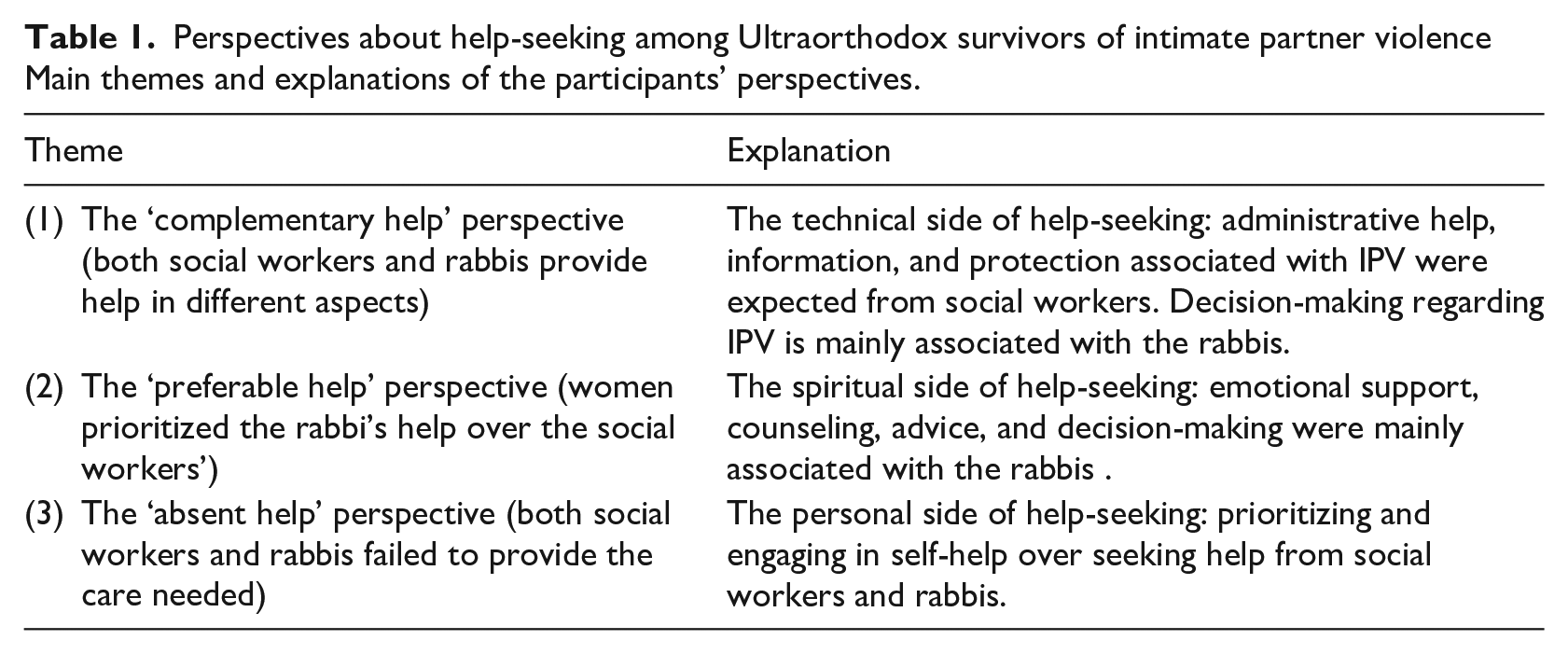
Our findings address two main sources the women turned to for help: rabbis and social workers from the social welfare services. Three core interrelated themes (see Table 1) representing the participants’ main perspectives were revealed: (1) the ‘complementary help’ perspective (both social workers and rabbis provide help in different aspects), (2) the ‘preferable help’ perspective (women tend to prioritize rabbis’ help) and (3) the ‘absent help’ perspective (both social workers and rabbis did not provide the care needed). These themes demonstrate three key categories: (1) the technical side of help-seeking: administrative help, information and protection associated with IPV were expected from social workers; (2) the spiritual side of help-seeking: emotional support and decision-making were associated with rabbis and included religious orientation; and (3) the personal side of help-seeking: prioritizing and engaging in self-help.
Perspectives about help-seeking among Ultraorthodox survivors of intimate partner violence Main themes and explanations of the participants’ perspectives.
The ‘complementary help’ perspective
This theme demonstrates how the assistance offered by social workers and rabbis is different but also complementary, thus enabling women to better deal with their situation. Both social workers and rabbis are viewed as meaningful actors in providing care and advice. The following quotations reflect two professional key roles of the social worker, in such circumstances: providing practical help and directing women in the coping journey with IPV. The social worker is experienced as an expert, a safeguard that the violent husband is threatened by (and thus contributes to the woman’s sense of safety): The social worker really helped me with the kids, with daycare payments, I am thankful for that . . . she was very helpful; she talked to him [the husband] several times and threatened him that if he didn’t come there to talk with her, she would report him to the police, and he only listens when it comes to the police . . . I do think she has that big role, to protect us, to stand tall for women like me . . . (Yael, 28, divorced and mother of four). They have financial help and daycare payments for children. She also helped me with a cleaning woman who came to my house and helped me with the kids and everything . . . it sounds like simple things but this was a huge help. I was alone and it was a huge help. They [social workers] are also listening, they listen and help you understand your situation . . . I liked them (Yischa, 36, separated from her husband, mother of seven).
The next quotations reflect the perception of the rabbi’s position. As previously mentioned, Ultraorthodox women live in a community where rabbis take an important role in directing and providing counseling on family issues, specifically before and during family breakups. The women reflected they could feel confident sharing their life stories with the rabbi, and could count on his advice: There is something in the fact that you are not alone, that you have good advice. You can look for the right thing to do with people who understand your point of view because they are doing it for god’s sake. That’s exactly the point, the rabbi who fears from god has a chance to seek the truth (Yael, 28, divorced and mother of four). First of all, when I reached out to the rabbi I knew I had his back, it’s a direct channel to God. Look, some rabbis aren’t really rabbis . . . I am not talking about them, I mean rabbis who are considered rabbis, they direct you in the right way (Yischa, 36, separated from her husband, mother of seven).
The ‘preferable help’ perspective
The second theme demonstrates a kind of contrast concerning the help-seeking experience. According to the women’s descriptions, the social worker, despite a sincere willingness to help, did not fully provide the help needed. The central motive in this theme is trust. The women reported they could trust the rabbi’s advice while doubting the social workers’. This concern is mainly rooted in the fear of what might happen to their children (e.g. children might be taken to boarding schools or foster care due to exposure to severe IPV). The following quotations reflect a kind of dichotomy between positive and negative perceptions of seeking help from rabbis and social workers: It is like the social worker stuck a knife in my heart because they told me I should think about taking my little kids to a boarding school . . . To this day, I’m afraid of the social welfare services. I don’t want them to take my children away, absolutely not . . . that is true that I wasn’t the best mother in the world, but that doesn’t mean one should break me down even more by taking my kids . . . I took the courage to open up myself and tell what was happening with my husband. And I was asked lots of questions about the kids, I felt the kids were more important than me. By the way, he [the rabbi] was also a Dayan (an expert in the Jewish law), he understands everything about divorce, but he is also a scholar, he is the man to turn to, it’s a win-win situation. He suggested that I should agree to shalom bait (marital reunion), but only under my terms, and my conditions! and he made it clear that it should be under my terms. I believe that he can see things ahead. (Odelia, 28, divorced and mother of four).
Another idea that posits the rabbi as the preferable figure to consult with is his life experience (e.g. compared with the relatively short life experiences of some of the social workers they met). The women described meeting with young social workers (e.g. single or married) without sufficient experience with marital relationships. The professional experience that social workers surely possess, stands in the shadow of a lack of life experience. This created difficulty in accepting advice from social workers: I went to the social welfare services a few times . . . there was a young lady there, for sure younger than me. I asked myself, can she truly understand what I am going through? could she really help? Look, I’m not saying she is not a professional, she has a degree and everything, but I am not sure she can help if she had never been married or experienced emotional abuse like I did. No one is wise enough to give advice, as someone who knows what a successful marriage is . . . no matter how professional a person is and if he has a PhD., it will never be like a person with a life experience. There is a saying that goes like this: don’t ask the doctor, ask the one who has been through it. (Racheli, 28, separated and mother of two).
The ‘absent help’ perspective
Although less prevalent in the data set, three of the participating women described clear dissatisfaction with both rabbis and social workers concerning their past experiences of seeking help. This theme represents a negative case whereas the women reflected a negative experience of care provided from both sources. Neither the social workers nor the rabbis were contributing to the women’s well-being and ending the cycle of abuse. The following quotation exemplifies how contacting the rabbis and the social workers resulted in the same feeling of distrust. One participant said she was unsure the social workers were acting in her best interest. Similarly, she shared her disappointment in connecting with the rabbi: I’m not into this so much . . . involving a rabbi in my private life. I know some women are more into it. I’m quite disappointed about asking them for help. What I met is a rabbi who thinks women should always give up and obey their husbands. I don’t think that if he is a rabbi he can necessarily understand me . . . it was better for me to do it by myself and move on, I mean to leave my husband and leave the abuse behind me. They should change their name, they are not taking care of people’s welfare. If they cared much about me, they wouldn’t have threatened to take my kids . . . this will not promise them a better future. I think they (social workers) are pretty sure they know better what will work for my kids . . . (Osherat, 41, married, mother of five).
The following quotations further describe the feeling of mistrust toward the rabbi and the welfare system in general, leaving the woman to navigate the situation on her own.
I think I lost my trust. For years I had a Rabbi to turn to for everything. I trusted him. He kept telling me: go on with your life, accept the situation with your husband, it is a test from god, in the next world you’ll be on top . . . A decent rabbi would never give this kind of advice. I can hardly go for help from a social worker. My oldest son was taken to a boarding school from the age of 13. I begged them to not take him. My oldest son could be already married today, I could have had grandchildren. Today my kids are living in the south, no yeshiva, no college, not sure what they are doing for a living . . . today I think it is much different, they are not taking children out of home that easily, but ten years ago it was much more prevalent. (Sigalit, 47, divorced mother of five children).
Discussion
This study aimed to retrospectively explore the help-seeking experience of Ultraorthodox IPV survivors. Our findings show how reaching for help in response to IPV might be a different experience for women affiliated with the same religious community, that are sharing similar values, beliefs and world views. An in-depth glance at the themes reveals three key categories that speak to the help-seeking experience ascribed to social workers and rabbis: (1) the technical side of help-seeking: concrete and administrative help and information and protection associated with IPV were expected from social workers; (2) the spiritual side of help-seeking: emotional support and decision-making were expected from rabbis; and (3) the personal side of help-seeking: prioritizing and engaging in self-help over seeking help from both sources. Supported by prior scientific evidence, we argue that help-seeking in response to IPV does not have a singular impact on all survivors (Josephson, 2002; Kelly, 2011; Waller et al., 2022), although affiliated with the same religious minority. Our findings correspond with prior research which underscores that IPV help-seeking is far from being a monolithic phenomenon that can be described through a specific context (Tajima, 2021). IPV survivors who are Ultraorthodox are facing unique challenges and are influenced by several aspects of their identity. We therefore highlight the importance of taking into consideration the varied dimensions, wherein one dimension of identity (being an Ultraorthodox woman), intersects with more dimensions (e.g. attitudes toward social welfare policies, and personal and religious preferences).
The women described referring to social workers who were affiliated with the Israeli social welfare system, typically working with families in distress, at-risk children and youth, and domestic violence cases. In general, the Israeli court system is typically involved in the decision-making process of removing children to an out-of-home care placement. Usually, this decision is taken under a court order. However, the rabbis (that the women in this study had turned to) were not affiliated with or represented any authority source. In the following sections, we will delve into a detailed discussion of our findings.
The first theme, the ‘complementary help’ perspective, represents the concept according to which social workers are entrusted with providing concrete and instrumental care, and a sense of safety while at the same time, they have the power to leverage the law system and the police to secure women’s safety. The rabbis, however, provide help regarding family and private issues and are involved in the decision-making process. The second theme, the ‘preferable help’ perspective, reflects a perception of women prioritizing the rabbis’ help over the social workers’. In this regard, the social workers are perceived as threatening, mostly due to their role of detecting and assessing risk, and taking children to out-of-home care. The third theme (although less prevalent in the findings), the ‘absent help’ perspective, originated from the experience of generalized dissatisfaction both from rabbis and social workers and reflects a critical perception that both failed to provide the care needed.
When synthesizing the three themes, findings show how different needs led the women to reach out to both formal (social workers) and informal support (rabbis). Women from the same community, who share common values, beliefs and religious practices, actually demonstrated a range of perspectives concerning help-seeking. Ranging from solely prioritizing the rabbi’s advice over the social workers’, to rejecting both, the findings demonstrate how the lived experience of seeking help differs across participants with the same religious affiliation. This finding corresponds with prior research that rejects the assumption that all members of a particular community are the same. When women seek help in response to IPV, their experience might be shaped by additional aspects of their identity (Josephson, 2002. Such identity goes beyond being a ‘strongly religious observant’. For instance, the fact that women have attended social services for help underscores they wanted to secure their social rights. Further, some of the women in this study described how social workers managed to become a source of protection (their cooperation with the police promised a sense of safety). However, in other cases, women shared a feeling of distrust toward the social welfare system, rooted in their role of removing children to out-of-home care. As mentioned above, in the Israeli context, the removal of children from home is an intervention made under a court order and is mandated when the decision is made. In most cases, children are moved from home due to child maltreatment assessments (i.e. physical abuse and sexual abuse), but this rarely happens in cases of emotional abuse and/or neglect. Adding to this complexity, in cases of exposure to IPV between caregivers the chances of moving children from home become even more rare. However, this fundamental intervention means social workers in Israel have a critical role and responsibility, while they do face challenges in achieving cooperation with parents in this regard. Our findings show that when contending with children exposed to IPV within the Ultraorthodox community, the critical decision of removing them from home might be a source of distress and fear for mothers, potentially preventing them from seeking care and support. This complexity could make Ultraorthodox IPV survivors trapped in the abuse cycle.
Under such circumstances, a woman who is already coping with IPV has to cope with the potential consequences for her children. To add another challenge to this position, this might not be the whole story for the Ultraorthodox IPV survivor. Living in a segregated community, with a unique worldview, this woman may be having to cope with additional stressors. When facing a decision of children’s removal to out-of-home care, parents prioritize educational placements that follow religious codes, norms and restrictions. However, it is not always feasible to place children in such places, specifically in emergency times. These potential stressors may generate frustration and worry for IPV survivors from within this community. Under those circumstances, Ultraorthodox IPV survivors could potentially articulate their expectations of care negatively.
Strengths, limitations and future research directions
This study contributes to the IPV theoretical background in three important aspects. First, by utilizing an interpretive phenomenological approach, we could present the multifaceted perspectives of survivors coming from the same religious minority and address a basic typology of perspectives. Second, although our sample represents a minority with specific characteristics (e.g. outlined in the literature review), findings show how a ‘one-size-fits-it-all’ approach has been deemed inadequate in describing the experiences and needs of IPV survivors from this minority (Vass and Krane, 2024). As mentioned above, although affiliated with the same religion-cultural society, participants differ in their perspective of optimal care. Third, although this study deals with a specific minority, it may provide the basis of a theoretical understanding to replicate similar studies with more religious minorities (Warner and Brown, 2011) to inform IPV survivors’ needs. The abovementioned strengths must be viewed in light of the limitations of this study. First, the Ultraorthodox community is composed of multiple subgroups that differ in nuances, attitudes and practices. Women who participated in this study were not recruited from a specific subgroup within the community and most of them defined themselves as ‘modern-orthodox’. The findings do not describe a specific subgroup within the community (e.g. highly observant Ultraorthodox, Litvak and Chasidic). This only points to the importance of future research, which needs to address in further depth the specific help-seeking perspectives of each subgroup (Buchbinder et al., 2015). Second, as this study deals with a highly sensitive topic, we were not been able to recruit a bigger sample; however, we made efforts to delve into the interviews, allowing the participants to elaborate, and engage in reflexive thinking of their storyline. These efforts have been made to capture the lived experience and to authentically document their perceptions. However, future studies with broader samples and maybe focus groups may contribute to a greater understanding of the IPV help-seeking experience among this minority.
Implications for social work practice
Our study provides a framework to promote social workers’ awareness of the help-seeking complexity of IPV survivors from the Ultraorthodox community. Generally, we recommend that practitioners adopt an open-minded attitude and reflexive thinking. Nixon and Humphreys (2010) previously argued that no single perception or explanation can adequately explain in essence the help-seeking experience of individuals who experienced IPV, as survivors are not a homogeneous group. From this point of view, we conclude that multiple and intersecting perspectives of help-seeking facilitate a better understanding of survivors’ experiences (Etherington and Baker, 2018; McCall, 2005). These study findings demonstrate cases in which women could see themselves benefiting from both sources and take what is relevant from each; the second theme reflects a dichotomy between a negative and a positive perspective toward these two sources; and the third theme presents a negative case where women preferred not to engage in help-seeking at all, despite the available sources around them. Practitioners and social work educators should reject the assumption that all members of a particular community will prioritize the same values and life perspectives (Krane et al., 2000). Social workers should be aware of the option of internal differences, between and across IPV survivors within this community. Moreover, social workers and social work educators working with the Ultraortodox community might benefit from gaining and regaining new understandings of this community’s specific codes and social norms to leverage better cooperation with their clients. They may also benefit from making decisions, and promoting interventions that reflect ‘the multiplicity of lived realities’ in how IPV is identified, experienced, understood and addressed (Krane et al., 2000: 14).
In the Israeli context, Buchbinder et al. (2015) indicated that the Israeli welfare services are becoming irrelevant for members within the Ultraorthodox community, as they are becoming a source of threat and stigma. They highlighted the need to develop social welfare services within the community, to better fulfil its members’ interests. They argued how the dominant Western values are likely to be irrelevant in the development of intervention programs within this community (Buchbinder et al., 2015). In this regard, we highly recommend that social workers look beyond the religious affiliation of IPV survivors, as they are part of the large Israeli welfare context and are influenced by its ideology, law, policies and constructions.
In their current form, policies and state guidelines for Israeli social workers contending with IPV cases are tailored to Western culture and the general (secular) Israeli population. As agents of change promoting women’s rights, front-line social workers and social work students must be provided with adequate and culture-based training on IPV intervention within the Ultraorthodox community. This study’s findings suggest that social workers and social work educators should be aware of potential barriers to Ultraorthodox clients seeking social care, specifically when it comes to child outcomes.
An additional message for social workers (i.e. reflected by some women in this study) is that despite prior assumptions of the central role of rabbis in advising and determining family issues, rabbis are not always the preferred source of care in response to IPV, unless they are familiar with, are educated and have a good background contending with family matters within their community. Therefore, social workers should look beyond prior assumptions (Wang and Perlman, 2021), they should investigate each IPV case sensitively, and assess if they can benefit from involving rabbis or not. Finally, in some cases, social workers are encouraged to assess if the survivor potentially possesses the internal strengths to do the inner work herself, engage in self-help practices, and break the cycle of abuse.
Footnotes
Funding
The author(s) disclosed receipt of the following financial support for the research, authorship and/or publication of this article: Grant Agreement number: 899037 – IPUOIPV – Horizon2020-Marie Skłodowska-Curie Actions-Individual Fellowship-2020.
Ethical approval
All methods and procedures of this study were approved by the Ethics Committee of the Faculty of Social Welfare and Health Sciences (Approval no. 322/21)
