






Abstract
This study proposes policy measures to address social isolation among middle-aged individuals through ecological systems theory. In-depth interviews with eight high-risk participants were analyzed using framework analysis, a structured form of thematic analysis, in which inductively and deductively generated themes were organized into a systematic framework to integrate detailed data description with higher-level abstraction. The findings move beyond previous research that primarily emphasized individuals’ feelings of loneliness and psychosocial support, by applying an ecological systems perspective to address social isolation among middle-aged adults in a comprehensive and structural manner. The findings yield theoretical, practice, and research implications, informing multi-level interventions.
Keywords
Introduction
The issues of solitary death and social isolation are no longer confined to older adults living alone. Recent trends indicate that these risks now span multiple age groups. A news report from The Hankyoreh (October 17, 2024) noted solitary deaths on the increase with 3661 cases in the previous year with half being men in their 50s and 60s, highlighting the growing prevalence of solitary deaths among middle-aged individuals. This shift is further substantiated by the Ministry of Health and Welfare’s 2024 national survey, which reveals a continued increase in solitary deaths over the past 2 years, particularly among socioeconomically marginalized men in their 50s and 60s (Ministry of Health and Welfare, 2024, October 18).
Social isolation has emerged as a global concern, with the United Nations identifying the rise of single-person households as a key driver (UN, 2017). Policy responses in the United Kingdom, Europe, Japan, and South Korea have emphasized community engagement and relationship-based support, including South Korea’s 2021 Act on the Prevention and Management of Solitary Deaths. Despite these efforts, solitary deaths remain prevalent, indicating limited policy effectiveness. Across contexts, policies tend to frame the issue primarily as solitary death or subjective loneliness, often overlooking objective social disconnection and its structural determinants (Park et al., 2019). Situating individual experiences within broader systemic contexts highlights the need for interventions that extend beyond psychosocial support to encompass comprehensive policy and structural reforms addressing social isolation and its consequences (Ungar, 2012).
Accordingly, this study applies ecological systems theory to conceptualize midlife social isolation as the product of interactions among individual psychological characteristics, family relationships, occupational structures, community contexts, and broader policy and institutional environments. Moving beyond dominant perspectives that frame social isolation primarily as an individual emotional deficit or maladjustment, this approach reconceptualizes isolation as an outcome of person–environment dynamics. In doing so, the study challenges individualizing accounts of loneliness and theoretically underscores the importance of structural and institutional contexts, providing a foundation for diverse social work practice and policy approaches to preventing and alleviating social isolation in midlife. Accordingly, the study poses the following questions:
Within the framework of ecological systems theory, what factors at each level exacerbate social isolation among middle-aged adults?
Within the same framework, what factors at each level contribute positively to its mitigation?
Building on ecological framing, the present study addresses limitations of prior research that has narrowly focused on individual psychological or health-related determinants of social isolation by situating isolation within its broader social and contextual conditions. By employing a qualitative approach, the study illuminates lived experiences and meanings of social isolation that have remained insufficiently captured in predominantly quantitative scholarship. This contextual and experiential focus offers an empirical basis for informing more responsive and effective practice and policy interventions aimed at alleviating social isolation in midlife.
Literature review
Concept of ecological systems theory
Ecological systems theory posits that individuals are continuously interacting with their environments, and that development occurs not along fixed pathways but within the influence of multiple environmental layers. According to this theory, human development, well-being, and health are shaped not merely by personal choice but through complex interactions within environmental structures (Bronfenbrenner, 1979). The theory categorizes the surrounding environment into five interconnected systems: the microsystem, mesosystem, exosystem, macrosystem, and chronosystem. These systems interact in overlapping ways to collectively influence an individual’s well-being and growth. This theory highlights the importance of understanding humans and their environments from an integrated and relational perspective.
The microsystem comprises immediate settings—such as family, peers, school, and the workplace—where direct interactions shape emotional well-being and social functioning, alongside physical conditions including housing quality and access to green space. The mesosystem refers to linkages among these settings, including family–school coordination, caregiving and welfare networks, community spaces, and transportation systems that facilitate or constrain daily functioning (Epstein, 2018). The exosystem includes contexts not directly experienced by individuals but that exert indirect influence, such as urban planning, transportation policies, and environmental design (Bronfenbrenner, 1986). The macrosystem encompasses broader legal, cultural, ideological, and economic structures that shape social norms and welfare expectations (Bronfenbrenner, 1986; Canda and Furman, 2010; Garbarino, 1982). Finally, the chronosystem captures temporal dynamics across the life course and historical context, including major social disruptions and personal transitions such as divorce, bereavement, or housing change (World Health Organization [WHO], 2020).
Ecological systems theory offers a valuable lens through which to understand the complex and multidimensional nature of human life. Particularly in the context of social welfare, the theory highlights the importance of focusing not solely on the individual but on the dynamic interplay between the person and their environment, thereby supporting an integrated approach to intervention (Ungar, 2012). Guided by this perspective, the present study critically engages with the lives of middle-aged individuals at risk of social isolation, viewing their struggles not as isolated personal issues but as phenomena shaped by broader structural conditions. In doing so, the study emphasizes the need to expand systemic and policy-level responses aimed at alleviating social isolation among this vulnerable population.
Conceptualization and causes of social isolation
Earlier research on social isolation often failed to clearly differentiate it from loneliness, with the two terms used interchangeably. However, Townsend (1974) clarified this by defining social isolation as limited interaction with family or community members, while loneliness refers to a distressing emotional state caused by neglect, disconnection, or exclusion. Loneliness is therefore subjective, whereas isolation is a neutral, factual descriptor of absent social ties without necessarily implying emotional suffering.
A range of factors contribute to social isolation among middle-aged individuals, with job loss standing out as a particularly salient micro-level risk factor. The involuntary termination of employment often triggers psychological distress, stemming from feelings of personal failure and uncertainty about the future, which can in turn increase the likelihood of social withdrawal (Kim et al., 2018; Shin and Choi, 2019). Middle-aged men may be particularly vulnerable due to persistent gender norms linking masculine identity to the breadwinner role (Moon and Lim, 2017). Demographic shifts, such as older parental ages at childbirth, have prolonged childrearing responsibilities into midlife, extending isolation linked to parenting. Compounding this, midlife transitions such as children leaving home—often referred to as “empty nest syndrome”—can further diminish family-based interactions and exacerbate the risk of social disconnection (Lee, 2018; Shin and Choi, 2019). Previous studies have also demonstrated the protective role of close family ties and supportive neighbors, as well as the heightened risk associated with strained intergenerational relationships. At the community and environmental levels, social isolation among middle-aged adults has been linked to institutional contexts such as housing stigma, welfare receipt, and limited transport accessibility, particularly in large-scale or high-rise housing estates (Kim, 2005; Song and Kim, 2016; Madhurima, 2021; WHO, 2021).
Despite these findings, prior research has largely examined factors associated with midlife social isolation as discrete predictors, often within a single ecological level or time point. Applying Bronfenbrenner’s ecological systems theory to qualitative data, this study aims to move beyond individual or relational explanations to show how social isolation in midlife emerges as a cumulative, multi-layered process shaped by interactions across personal, familial, community, and institutional contexts. By reconceptualizing social isolation as a multidimensional social process, the study attempts to highlight how structural inequalities and institutional exclusions are actively experienced and negotiated in everyday life, pointing to the need for multi-level practice and policy responses.
Methodology
This study adopted a qualitative research methodology to investigate the experiences of middle-aged individuals vulnerable to loneliness and social isolation, with the objective of conducting a nuanced analysis of the meanings embedded in these experiences. Among the various qualitative methods, in-depth interviews were selected for their methodological appropriateness in exploring emotionally sensitive subjects and eliciting rich, first-person accounts of lived experiences. This approach enables participants to articulate their perceptions and emotions in a manner that fosters depth and complexity, while allowing the researcher to engage interpretively with the narratives. Given the multifaceted and often intimate nature of loneliness and isolation, in-depth interviewing was deemed particularly well suited to capturing the subjective realities of participants.
This study conceptualizes midlife social isolation as a relational and contextual experience shaped by life trajectories, social relationships, and institutional encounters. Grounded in an interpretivist epistemology, knowledge was treated as co-constructed through researcher–participant interactions. In-depth interviews captured participants’ accounts of social isolation, which were analyzed using an ecological systems lens. Framework analysis organized interpretations across micro-, meso-, and macro-level systems, while thematic analysis identified recurring meanings across system interactions, allowing simultaneous attention to subjective experience and its structural production.
Sampling
In qualitative research, participant selection prioritizes individuals capable of providing rich, contextually grounded insights (Denzin, 1989). Accordingly, this study focused on middle-aged adults (40–64 years) living alone and experiencing loneliness or social isolation, consistent with South Korea’s definition of middle adulthood. Given evidence that single-person households—particularly low-income residents of public rental housing—are at heightened risk of social isolation and solitary death, the sample was purposively limited to this group. Participants were recruited between July and August 2024 through referrals from community welfare center caseworkers and public housing staff, supplemented by snowball sampling.
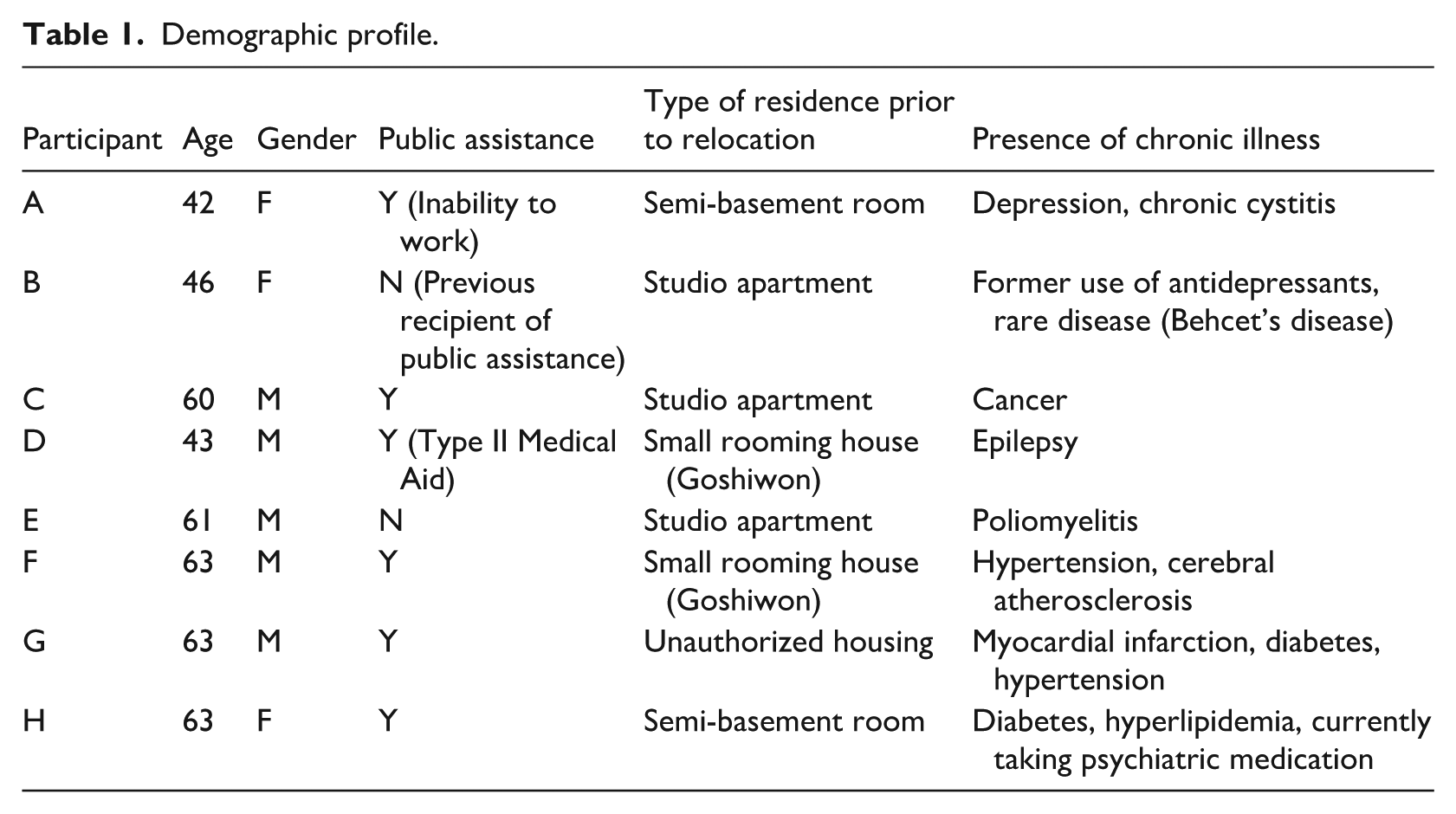
Recruitment continued until data saturation was achieved. Data saturation occurs when additional data no longer yield new concepts or insights; interviews concluded once content recurred without novel findings (Bryant and Charmaz, 2007). The demographic characteristics of the participants are presented in Table 1.
Demographic profile.
Data collection and analysis
This study aimed to highlight the challenges faced by middle-aged individuals at risk of loneliness and social isolation who are marginalized within the social welfare system, and to propose policy interventions. Interviews took place from July to August 2024 at participant-chosen locations, lasting 60–90 minutes. A semi-structured interview guide ensured consistency while allowing in-depth exploration of individual experiences. The study analyzed transcripts of consented audio-recorded interviews. The first author performed transcription, and both researchers cross-checked transcripts against the audio to ensure accuracy and completeness of the analytical data.
This study employed framework analysis, a structured form of qualitative thematic analysis (Gale et al., 2013; Kim, 2016), guided by ecological systems theory. An initial inductive thematic analysis generated participant-led meanings without predetermined categories, capturing how social isolation was experienced and understood. These were then organized using framework analysis across micro-, meso-, and macro-level systems, defined by relational and institutional contexts rather than physical settings. Individual emotions and daily experiences were examined at the micro-level; interactions with family, workplaces, and community organizations at the meso-level; and labor market structures, welfare systems, and sociocultural norms at the macro-level. Experiences spanning multiple levels were interpreted as cross-system interactions—for example, neighborhood disconnection was coded at the micro-level while interpreted in relation to meso-level access to community resources. This combined approach balanced inductive insight with theory-informed structure, enhancing analytic transparency and credibility.
Ethical consideration
All ethical protocols were strictly followed to minimize risk and ensure confidentiality. Participation was voluntary, and prior to data collection, participants received a Participant Information Sheet detailing the study’s objectives, procedures, methodological approach, and ethical considerations, including assurances of confidentiality. Informed consent was obtained for audio-recorded interviews, with participants free to withdraw at any time.
Researchers with 10 years’ qualitative experience, including a qualitative-methods PhD, conducted the analysis. Given the potential for discussions of social isolation to evoke emotional distress, participants’ well-being was closely monitored throughout the interviews. When discomfort arose, interviews were paused, rest periods were offered, and neutral questions were used to support stabilization, with sensitive topics resumed only with participants’ consent. These procedures prioritized participant safety and dignity, thereby enhancing the study’s ethical rigor and trustworthiness.
Findings
Supportive and risk factors at the microsystem level
Emotional bonds with children and siblings as protective factors against social isolation
Even among those currently experiencing social isolation, emotional bonds with children and siblings can serve as powerful motivators for living. For Participant A, who has been raising her daughter alone after a divorce, her daughter is the reason she continues to live. Similarly, Participant C, who can only see his granddaughter through video clips, described these moments as a small joy that helps ease his loneliness. Participant G, who meets his siblings once or twice a year, expressed gratitude for the care he receives from his siblings, who make a point to call him and show concern: If it weren’t for my daughter, I wouldn’t want to live right now. (Participant A) My eldest son got married overseas and has a daughter. But when he sends me a few video clips, I watch them to soothe my loneliness. (Participant C) I’m struggling just to get by, so we only talk and meet once or twice a year out of obligation. My older and younger brothers always call me on my birthday and check in on me. (Participant G)
The presence of a neighbor to talk to during moments of loneliness as a deterrent to suicide
Feelings of loneliness and isolation can lead to suicide as a form of extreme action (Lapane et al., 2022). Therefore, forming relationships with others and alleviating loneliness through social connection may serve as a preventive measure against suicide resulting from isolation. Participant D emphasized that having time to “smoke with a neighbor” has been the reason he has not attempted suicide by taking an overdose or jumping. This highlights the importance of building emotional support systems within the local community: When I feel lonely, I smoke with a guy in the neighborhood and we talk a lot about life. If no one had been there, I would have either quietly overdosed or jumped, and I would have died. (Participant D)
Distant family relationships as a factor that intensifies loneliness
Participants E and F both expressed a deep sense of loneliness stemming from their inability to maintain contact with their children. In particular, given the participants’ economically vulnerable circumstances, expectations such as Participant E’s belief that “if I had assets, my children would have called” appeared to intensify feelings of loss. These strained family relationships contributed to a sense of “solitude (Participant F),” which, in some cases, extended to a broader sense of meaninglessness in life, as reflected in Participant H’s statement.
If I had assets, my children would definitely have called to ask, ‘Dad, how are you? Are you doing okay’, But since I have nothing, they don’t. (Participant E) What makes me feel the loneliest is the kids. I haven’t been in touch with them for a long time. When I miss my children, that’s when the loneliness really hits. (Participant F)
Disconnected relationships with neighbors
According to social network theory, individuals who are not connected to their communities are likely to be isolated without access to essential resources and information. Moreover, individuals who lose solidarity with others may become more vulnerable to adverse circumstances (Granovetter, 1985). In fact, participants in the present study who had become disconnected from their neighbors commonly reported feelings of being “like a loner” (Participant B), “withdrawn and alone” (Participant C), and “lonely” (Participant H). The concern is that this disconnection does not merely result in emotional isolation, but may also escalate into thoughts of suicide: No one around me really pays attention, and that made me withdraw and stop reaching out to friends or neighbors. Eventually, I started feeling like I was all alone. (Participant C) Moving into the apartment was nice at first, but after a while, I started feeling incredibly lonely. (Participant H)
Supportive and risk factors at the mesosystem level
Community welfare centers as agents for positive change through emotional support and program participation
In South Korea, it is mandatory to establish community welfare centers within public rental housing complexes, with the goal of providing not only economic assistance, but also strengthening emotional support for vulnerable populations. Participant A, who visits the center because it is a place where she can “talk about difficult things,” and Participant B, whose symptoms improved through participation in a depression program, both illustrate the positive impact of counseling and practice-based programs at welfare centers for middle-aged individuals facing social isolation: When I go to the welfare center and talk about what I’m going through, the social workers there ask if I’m okay and help me. Honestly, it’s much easier to open up to them than to my family. (Participant A) I started to gradually get better after joining the depression program at the welfare center. (Participant B)
Witnessing a neighbor’s solitary death as a reflection of one’s own isolated life
A significant number of public rental housing residents are single-person households with minimal social relationships, making solitary deaths within these communities both frequent and ongoing. This study highlights the need for policy and practice-level interventions addressing the shock and fear experienced by those who witness such events. Participants reported projecting these deaths onto themselves, with one noting that witnessing a neighbor’s solitary death triggered depression and suicidal thoughts. Findings indicate responses must extend beyond the incidents to consider broader risks and psychological impacts among residents, emphasizing preventive and supportive measures: When I hear about someone dying alone, I just think—how bad must it have been? And I feel the same way. I think that when I get old, and I’m sick, and have no children, maybe that’s how I’ll go too. (Participant D) There was a solitary death nearby . . . After seeing that, I thought, “That could be me,” That’s when the depression began. If I could die without pain, I would. It would be a lie to say I never felt suicidal. (Participant E)
Negative perceptions of neighbors in public rental housing: A rejection of being identified as “one of the.”
Participant E avoided interacting with neighbors, and Participant H deliberately distanced themselves to avoid “becoming like them.” Such avoidance reflects a defensive response to perceived social discrepancies: while isolation often stems from lacking social bonds, it can also arise when one’s desired social connections differ from reality (Peplau and Perlman, 1979). In this sense, the act of avoiding other residents may be interpreted as a form of defensive response—a fear of social exclusion driven by the anticipation that their sense of being “different from them” will not be socially accepted, despite sharing the same residential environment: I don’t like running into people in the neighborhood. When I see them, I instinctively turn away. I just avoid them. (Participant E) After talking with someone for a while, the conversation always turns negative—just gossiping about others. If I join them, I’ll become just like them. So I’ve never gone over to that side of the complex. (Participant H)
Supportive and risk factors at the exosystem level
High satisfaction with improved housing conditions following relocation to public rental apartments
The participants in this study had relocated to public rental apartments built in the area to ensure residential stability for individuals previously living in insecure, nonstandard housing such as vinyl greenhouses, semi-basement units, or small dormitory-style rooms (goshiwons). Compared to their former living environments, they reported experiencing significant improvements in daily life, particularly due to the clean and comfortable conditions of their new homes. Participants A and C expressed high levels of satisfaction with their current residences, contrasting their past experiences in “miserable” and “undignified” spaces with their new apartments, which offer “open views” and “well-maintained” communal areas: After always living in basement rooms, I moved up to the 20th floor for the first time. The view is nice, and at first I even started going outside again. I guess it’s because I used to live in such miserable places—I’m pretty satisfied here. (Participant A) The apartment has nice landscaping, and you can hear kids running around—those things are really nice. When I lived alone in a house before, I felt a deep sense of self-contempt, but now that I’m in a more open space, I feel like my mind has opened up too. (Participant C)
Disconnected relationships due to the enclosed nature of apartments
Although public rental apartments offer high levels of resident satisfaction in terms of clean-living spaces and well-designed communal areas, their inherent structural enclosure of apartment complexes may contribute to the weakening of neighborly relationships, potentially leading to or increasing the risk of social isolation. Both Participants B and H expressed a sense of loneliness due to the lack of connection with neighbors, despite being satisfied with their new housing itself. Notably, Participant H reported that the intensified loneliness eventually led to a suicide attempt. These findings highlight the urgent need for preventive support measures to address the isolation and loneliness experienced by residents of public rental housing: Back where I used to be, there were people around, so I didn’t feel lonely. But here, even though it’s a new house and an apartment, there is no one around, and I felt very lonely. (Participant B) Even after moving in, I was happy—but after living here for about a year, the loneliness started to hit. I was stuck in my room all the time, and I ended up doing something bad. (Participant H)
Inadequate transportation infrastructure as a barrier to mobility
Transportation infrastructure is closely linked to mobility rights. For residents of public rental housing—many of whom are physically limited or from low-income backgrounds—well-developed public transportation and special mobility services such as paratransit for people with disabilities are essential. However, reality often falls short. Due to physical limitations and the financial burden of transport fares, Participant C was unable to visit the welfare center, while Participant H experienced difficulty accessing even basic services such as hospitals and pharmacies. These cases reveal the structural barriers that persist despite individuals’ willingness to overcome social isolation: I can’t move like other people. So even if the center is there, I can’t make use of it. (Participant C) When I go to pick up my medication, I have to use a cane. I’ve even fallen on the bus. So I use taxis, but they’re too expensive—I just can’t afford it. (Participant H)
Supportive and risk factors at the macrosystem level
Public assistance benefits that support basic livelihoods
Most participants in this study were beneficiaries of Korea’s National Basic Livelihood Security System. Depending on their circumstances, beneficiaries may receive full or partial support for living expenses, medical care, education, and housing. For socially isolated middle-aged individuals who are cut off from private support systems such as family or friends and are unable to work due to health issues despite being of working age, these public benefits play a critical role in maintaining their livelihoods. Participants A, B, and F commonly expressed a sense of “relief” and appreciation for being able to receive this governmental support. Given their isolation and inability to work, it is evident that without such assistance, their circumstances could easily lead to solitary death: The living allowance is a bit insufficient, but I can still manage. That’s how I’m surviving now. (Participant A) I think the country’s welfare system is really well developed. That gives me a great sense of relief. (Participant B) When it comes to living or medical benefits, I think Korea has improved a lot. I really appreciate that. (Participant F)
Social stigma toward public rental housing residents and welfare recipients
Controversies surrounding urban development plans that incorporate public rental housing into general residential areas often stem from concerns about residential stigmatization (Kim, 2005). Statements by Participant C—who associated public rental housing with a “beggar-like life”—and Participant D—who reported feeling marginalized due to negative perceptions toward welfare recipients—reveal that such stigma is not merely theoretical but a lived reality. This societal stigma surrounding public rental housing may also compel residents to hide their living circumstances, potentially increasing their risk of social isolation: Just because I live in public rental housing doesn’t mean I should live like a beggar. I may not be able to work now, but I’ve lived my life with pride, and I’ve never lived in a filthy way. (Participant C) People in the general public tend to hold unfavorable views toward welfare recipients. They assume we might avoid paying or try to take advantage of the system. It’s those kinds of judgments that make you feel excluded. (Participant D)
Risk factors at the chronosystem level
Experiences of divorce as a life transition
For many participants, marriage—and its subsequent breakdown—marked a major turning point in their lives. Divorce often shifted them from a life shared with family to one of solitude. Participants A, B, and F all described experiencing significant emotional and psychological challenges following divorce, including prolonged depression (Participant A), stress-induced illness (Participant B), and suicidal ideation tied to feelings of shame and worthlessness (Participant F): Things didn’t work out with my child’s father, so we got divorced. I ended up taking antidepressants for nearly ten years. (Participant A) I felt incredibly hopeless. After spending my whole life with my spouse and children, I suddenly found myself alone. I kept thinking, “Why did I live my life this way,” That sense of shame would consume me when I was alone. I kept hearing a voice in my head saying, “You should die.” (Participant F)
A life trapped in a self-imposed cage to conceal perceived failure
According to Self-Discrepancy Theory, emotional vulnerability arises from a misalignment between one’s actual self and self-guides. The greater the discrepancy between the ideal self—a reflection of personal aspirations—and the ought self—internalized social expectations and moral obligations—the more likely individuals are to experience negative emotions such as guilt, self-blame, and diminished self-worth (Higgins, 1987). Participants in this study had previously experienced a sense of success in their personal or professional lives before becoming public assistance recipients. This made it particularly difficult for them to reconcile their current status with their past identities. As a result, they reported behaviors reflecting social withdrawal, including “feeling ashamed and losing pride” (Participant C), and “not asking for help” (Participant F). As Participant F noted, they came to live “trapped in a cage of their own making”: I used to work in finance and ran my own business. Now, everything is so different—it’s really hard to accept. I guess it’s a kind of inferiority complex. I can’t help but think, ‘I used to be better off than you’, and that really hurts my pride. (Participant C) I’ve cut everyone off, and that only makes me feel lonelier. It’s embarrassing to contact people I used to know, and I can’t bring myself to ask them for help. I guess I’ve trapped myself in my own cage. (Participant F)
Conclusion and discussion
This study confirms previous findings that loneliness and isolation can lead to suicidal behavior (Granovetter, 1985; Lapane et al., 2022) and highlights residential stigmatization (Kim, 2005). It also confirms that social isolation is closely tied to the presence or absence of social support (Kakiuchi et al., 2019) with middle-aged adults showing depression and withdrawal post-family dissolution or job loss (Park and Choi, 2020). Furthermore, this study builds on and extends previous research that primarily focused on individuals’ feelings of loneliness and emphasized psychosocial support, by adopting an ecological systems perspective to provide a comprehensive and structural approach to social isolation among middle-aged adults. Notably, the newly identified need for multidimensional strategies highlights the importance of interventions that extend beyond individual-level psychosocial support to include policy and practice measures.
The findings indicate that midlife social isolation is not attributable to individual psychological vulnerability alone but emerges as a cumulative, multi-level process involving family disruption, community disconnection, living conditions, structural features of welfare systems, and life-course transitions. While consistent with prior studies linking social isolation to depression and suicide (Lapane et al., 2022), participants’ accounts suggest that these risks are exacerbated by the accumulation of relational absence and institutional and environmental exclusion rather than by individual-level factors alone.
Theoretical implications
This study offers several theoretical implications. First, the findings reaffirm prior research linking social isolation to increased risks of depression and suicide (Granovetter, 1985; Lapane et al., 2022). Participants’ accounts show that the absence of social ties heightens vulnerability to suicidal ideation, while emotional bonds with family serve as protective factors sustaining the will to live.
The study further identifies residential stigma as a mechanism that sustains and intensifies social isolation. References to living a “beggar-like life” and fear of others’ judgment reveal how residence in public rental housing becomes a basis for social evaluation, triggering shame and avoidant behavior. This internalization of stigma extends beyond external discrimination, leading individuals to withdraw from relationships and social contact, thereby supporting Kim’s (2005) findings on the enduring effects of residential stigma.
Consistent with previous studies linking social support to family disruption, job loss, and major life events (Kakiuchi et al., 2019; Park and Choi, 2020), participants described heightened loneliness following divorce and during the transition from past occupational success to reliance on public assistance. These experiences demonstrate how relational loss and self-discrepancy intersect to deepen social isolation.
Beyond confirming these relationships, this study extends previous research—largely focused on subjective loneliness and psychosocial coping—by adopting Bronfenbrenner’s ecological systems theory as an integrative analytic framework. By conceptualizing social isolation as a multidimensional social process encompassing disruptions across family, community, residential, and welfare systems over the life course, this study advances a shift from viewing isolation as an individual emotional state to understanding it as a socially produced process. This theoretical reframing expands the scope for practice and policy interventions addressing social isolation in midlife.
Practical and policy implications
Based on the analysis, the following practical, policy recommendations aim to reduce social isolation among middle-aged individuals.
Micro-level: Individual economic and psychological stabilization
At the micro-level, interventions aimed at enhancing individuals’ economic and psychological stability are required. Prompt and targeted support is crucial for unemployed middle-aged men living alone who face economic hardship. The findings show that employment loss and financial instability both trigger and intensify social isolation among middle-aged single-person households, with cascading effects on self-esteem, social withdrawal, and suicidal ideation. Participants’ accounts—such as feeling that “life completely collapsed” after divorce and job loss or believing one “should die” when left alone—emphasize the depth of emotional disintegration accompanying prolonged isolation. The findings indicate that counseling and support services provided by community welfare centers can reduce social isolation among middle-aged adults; however, those at the highest risk of isolation often face substantial barriers to accessing these services. This is evidenced by participants’ accounts describing their initial contact with social workers as a critical turning point that facilitated immediate crisis support and a clearer recognition of their personal circumstances in the process of recovery. Accordingly, interventions that disrupt the pathways through which economic instability leads to social isolation and heightened suicide risk are essential.
Furthermore, policy measures such as greater flexibility in the duration of basic livelihood benefits, adequacy adjustments to benefit levels, and integrated interventions linking medical care with income support for individuals facing employment barriers due to chronic illness or mental health conditions are required. In South Korea, the Emergency Welfare Support Program provides temporary assistance to low-income households experiencing sudden crises that threaten their livelihood. However, limitations in the number of times this support can be received restrict its effectiveness in addressing the chronic instability experienced by many in this group.
Meso-level: Community-based relationship restoration
At the meso-level, community-based practices that facilitate the restoration of social relationships are required. Middle-aged individuals at risk often face psychological vulnerabilities, such as depression and social withdrawal, especially after family disruptions, leading to avoidant behaviors that hinder forming new ties (Park and Choi, 2020). Participants’ statements such as “I instinctively avoid people” or avoiding others to prevent “becoming like them” illustrate how midlife individuals experience depression and social withdrawal after divorce, family disconnection, and job loss, leading them to avoid forming new relationships altogether. The analysis suggests that policy interventions aimed at restoring community ties should adopt a staged approach.
Participants perceived social workers as individuals they could “open up to more easily than family,” indicating that social workers can serve as an initial point of reconnection for socially isolated middle-aged adults. Accordingly, early interventions should prioritize stable, trust-based relationships through regular one-to-one counseling or small-scale emotional support programs within community welfare centers. Building on this foundation, individuals may be gradually linked to voluntary small-group or peer-based activities. Participants’ accounts further caution that premature exposure to broader social networks may intensify avoidance, highlighting the need for medium- to long-term, relationship-centered interventions. In addition, to mitigate isolation arising from limited access to information—as identified in this study—it is necessary to improve information accessibility through a range of strategies that combine traditional outreach methods with digital platforms such as social media. Such efforts are expected to enhance awareness of available services, including psychological counseling, financial assistance, and, where necessary, transportation support.
Macro-level: Structural accessibility and stigma reduction
Finally, at the macro-level, there is a need to emphasize practices and policy initiatives that strengthen accessibility to support systems and reduce stigma. Institutional measures to improve physical accessibility—such as transportation support and the provision of counseling spaces near residential areas—should be implemented for individuals with mobility or transportation barriers. These efforts can enhance physical accessibility, ensuring that social work services are more effectively available to those most at risk of isolation.
Finally, efforts must focus on reducing the stigma surrounding public rental housing and poverty. The analysis indicates that identification as public rental housing residents and public assistance recipients elicited shame, social withdrawal, and sustained psychological strain, contributing to reduced self-esteem and heightened depression. Fear of negative judgment led some participants to avoid social relationships or delay help-seeking, thereby deepening social isolation. These findings support prior research conceptualizing stigma not merely as an internalized response but as a structural mechanism that reinforces social exclusion and inequality (Bane and Elwood, 1994; Link and Phelan, 2001; McCormack, 2004).
Notably, midlife emerged as a critical stage intensifying stigma, as participants described heightened scrutiny associated with “not working at this age” while living in public housing. This reflects normative expectations linking economic self-sufficiency to moral worth in midlife, thereby deepening social isolation and vulnerability. Grounded in principles of social justice and human dignity, such efforts are essential for reducing stigma and fostering inclusive community environments that support agency, social participation, and meaningful relationships.
Research implications
From a research perspective, this study contributes to the advancement of social isolation scholarship by addressing the methodological bias of prior research dominated by quantitative approaches and by expanding the conceptual precision with which social isolation is understood. By integrating Bronfenbrenner’s ecological systems theory with qualitative thematic and framework analysis, inductively derived themes were interpreted within an ecological analytic structure, allowing for a more comprehensive understanding of social isolation. Conceptually, the study distinguishes social isolation from loneliness and conceptualizes it as a multidimensional and temporally dynamic phenomenon shaped by the interaction of relational, institutional, environmental, and policy-level factors.
Although focused on Korean middle-aged adults, this study addresses social isolation as a globally relevant issue requiring community-, institutional-, and structural-level interventions beyond individual-focused approaches. The findings conceptualize social isolation not as individual maladaptation but as a socially produced outcome of accumulated structural inequality and institutional exclusion. This perspective aligns with the principles of the International Federation of Social Workers and the United Nations Sustainable Development Goals on poverty reduction, inequality, and inclusive communities (SDGs 1, 10, and 11). Accordingly, addressing midlife social isolation requires strengthening community infrastructures, reducing stigmatizing environments, and improving welfare system accessibility, reflecting a shared challenge across national contexts.
This study has several limitations and directions for future research. Participants were middle-aged adults at high risk of social isolation living in public rental housing, who typically receive public assistance and engage with social workers during crises. Consequently, the study did not include individuals who neither seek nor accept support despite facing isolation and solitary death risks. Identifying and recruiting such individuals presents practical challenges, yet understanding their experiences is essential for advancing research on social isolation. Future studies should specifically target this population to capture a more comprehensive understanding of social isolation dynamics.
Footnotes

Ethical considerations
Ethical approval was given by the Changwon National University Human Participants Ethics Committee (reference number: 7001066-202405-HR-035) on 10 July 2024. The participants were recruited between July and August 2024.
Funding
The authors received no financial support for the research, authorship, and/or publication of this article.
Declaration of conflicting interests
The authors declared no potential conflicts of interest with respect to the research, authorship, and/or publication of this article.
Data availability statement
The data cannot be shared while adhering to ethical obligations to protect privacy and maintain confidentiality.
Statement on AI
OpenAI’s ChatGPT (version GPT-4, accessed via ChatGPT as of July 2025) was used during the final stage of writing for translation and general language refinement, in order to improve clarity and readability. Everything produced by AI was validated by the authors.