






Abstract
This study re-examines professional autonomy within China’s anti-drug social work by highlighting the role of relational work. Using qualitative case studies of four rehabilitation organisations in two cities, it explores how social workers build trust, networks, and reputation to sustain practice under structural constraints. Findings reveal contrasting paths: a professionalised organisation losing projects due to weak political ties, and a bureaucratic one gaining stability through administrative trust. Relational work thus functions as a key mechanism for negotiating survival, opportunity, and ethics within restrictive party-state-led, penal-welfarist systems. The study contributes to global social work by showing that autonomy in the Global South is not a fixed condition but a dynamic, relational practice enabling limited yet vital professional agency.
Introduction
Over the past two decades, the role of social work within China’s national governance system has undergone a profound transformation. With the advancement of the state’s ‘modernisation of social governance (Shehuizhili Xiandaihua)’ strategy, social work has been progressively institutionalised through mechanisms of government procurement, project-based management, and performance evaluation (Spolander and Martin, 2012). These dynamics, particularly the growing reliance on commissioning, contractualism, and performance regimes of civil servant bureaucrats, have also been widely documented in Western welfare systems (Solvang and Juritzen, 2020). Within this context, anti-drug social workers occupy a particularly complex and ambivalent professional position. As a widely recognised occupational group, they are entrusted with assisting public security, and judicial, and community organisations in simultaneously pursuing the dual and often tension-laden goals of ‘security maintenance’ (weiwen) and ‘social reintegration’ (Huiguishehui) (Song, 2024).
Yet this position embeds them in a web of institutional contradictions – they function both as professional service providers and as extensions of state authority (Song et al., 2025). They are expected to uphold professional autonomy while operating under rigid administrative oversight and performance appraisal. This tension epitomises the structural dilemma of the professional autonomy of anti-drug work, within what Jiang and Liu (2022) have termed a ‘welfare-based punishment regime’.
International social work scholarship generally conceptualises professional autonomy as the independence of social workers in value judgements, practical decisions, and ethical orientations (Banks, 2004). It is viewed as a cornerstone for resisting bureaucratic control, upholding professional ethics, and advocating for clients’ rights. However, within a governance system that is party-state-led, project-based, and persistently committed to drug prohibition (Jiang and Song, 2025), this ‘independence-based’ understanding proves inadequate. This inadequacy is widespread due to the organisational relationships between social work and the state. The field has historically been subject to direct state administration, lacking an independent professional association for social work in China. Professional autonomy thus has been continually shaped by the relational dynamics between the state, society, and the profession, rather than self-regulation (Zheng, 2024). Specifically, the incorporation of Chinese anti-drug social workers into the judicially led field of drug rehabilitation reflects not the expansion of welfare per se, but the judicial upgrading of governance power where welfare operates as a citation within the logic of punishment (Zumbansen, 2008). Consequently, their professional autonomy entails continuous negotiations among government contracting, policy guidance, and organisational survival. Rather than a form of freedom detached from structural constraints, it manifests as a competency for adaptation and reproduction within institutional boundaries. This ‘agency within constraint’ exemplifies the situated and negotiated character of social work practice in the Global South (Healy, 2008; Malhotra and Ling, 2020), offering an important empirical basis for rethinking the conceptual and practical dimensions of professional autonomy.
Scholars have increasingly examined how social workers preserve their professional space through ‘relational (guanxi) practice’ (Cheung, 2017). In the Chinese context, the implementation of social work is deeply embedded in relationships among local governments, funders (both governmental and non-governmental), and community networks. Organisational reputation, political trust, and informal interactions frequently shape the allocation of resources, career trajectories, and project renewals (Wang, 2024). This dynamic suggests that the survival and operational space of social workers depend not only on professional standards but also on the structuring effects of social relationships. Relational work, developed by sociologist Viviana Zelizer (2000, 2005), highlights how individuals continually define, negotiate, and adjust the boundaries of interpersonal relationships in economic and social life, thereby imbuing actions with economic value and social meaning. Introducing this framework into the field of anti-drug social work in China helps illuminate how social workers operate within institutional constraints, redefining their professional identities and boundaries of action through the active production and maintenance of relationships, effectively engaging in doing business (or, colloquially, Dui fanwanlaiyuan fuze).
This article thus re-examines the concept of professional autonomy in party-state-led penal-welfarist systems (Zeng, 2013). It explores how anti-drug social workers negotiate structural constraints, secure policy benefits, and navigate project priorities through relational work. Drawing on a comparative case study of four drug rehabilitation social work organisations, the analysis identifies two analytically distinct pathways through which professional autonomy is enacted in practice. The first pathway, exemplified most clearly by Organisations A and Y, prioritises professionalisation, standardisation, and values. The second pathway, more characteristic of Organisations B and Z, involves cultivating administrative trust and relational embeddedness within local governance structures. This comparison highlights the multifaceted nature of professional autonomy within a party-state-led governance system: autonomy is neither a fully suppressed ideal nor a freely exercised entitlement, but rather a dynamic process and outcome produced through relational negotiation.
The academic and practical purpose of this study has three dimensions. First, theoretically, it introduces relational work as an analytical framework for understanding professional autonomy, moving beyond the binary opposition between autonomy and structural constraint. Second, empirically, it demonstrates how social workers within institutional confines use relational networks to maintain, and sometimes expand, their practical agency. Third, from an international and comparative perspective, the study contributes empirical evidence and theoretical insight into the survival logics of social work in the Global South under national, project-based governance regimes. By conceptualising relational autonomy, this article urges the scholarly community to attend more closely to social workers who continue to practise, negotiate, and innovate within systems that are neither fully open nor entirely closed.
Background and literature review
Professional autonomy in social work
Professional autonomy has long been a central concern in international scholarship on the professionalisation of social work. Extensive scholarship has noted that social workers’ roles have expanded from those of primarily ‘value-oriented caregivers’ to institutional actors responsible for implementing policy objectives, managing risks, and delivering measurable outcomes (Dominelli, 2004). Consequently, professional autonomy is no longer understood as complete independence from organisational or state authority, but as a form of discretion exercised within increasingly dense governance frameworks.
Professional autonomy is commonly examined through the lenses of de-bureaucratisation, marketisation, professionalisation, and ethical independence. Banks (2004) argues that autonomy is reflected not only in practitioners’ value commitments to service users but also in their capacity to exercise judgement and act in accordance with ethical principles when confronted with organisational and policy pressures. These dynamics indicate that, even in liberal democratic welfare regimes, social workers routinely function as agents of the state. Studies of street-level bureaucracy and welfare governance have long shown that social workers’ discretion is embedded within systems of accountability, managerial oversight, and policy conditionality, rendering professional autonomy contingent, negotiated, and situational rather than absolute (Evans, 2010; Lipsky, 2010).
From this perspective, the tension between care and control is not unique to state-led or non-liberal systems, but constitutes a structural feature of social work across global jurisdictions. Social workers’ ethical commitments routinely coexist with responsibilities to implement state priorities, monitor compliance, and regulate behaviour. What varies across political and welfare regimes is therefore not whether social workers ‘do the state’s bidding’, but how discretion, negotiation, and moral justification are organised and enacted in everyday practice (Banks, 2020). This distinction is particularly salient in authoritarian governance contexts, where professional autonomy rarely takes the form of overt resistance or principled confrontation. Instead, autonomy is more commonly exercised through negotiation, strategic adjustment, and relational positioning (Song, 2024). As Gray and Webb (2013) note, social work in non-liberal systems is characterised less by open opposition to policy mandates than by a form of ‘strategic balancing’ between institutional demands and ethical commitments.
Accordingly, professional autonomy should not be understood simply as the capacity to resist power, nor as a binary condition that social workers either possess or lack. Instead, it is more productively conceptualised as a mode of situated agency produced within power relations, in which dependence and autonomy coexist. In this sense, the Chinese context examined in this study does not represent a categorical exception to international debates on social work autonomy.
Chinese anti-drug social work: Professional autonomy and institutional constraints
Chinese anti-drug social work has emerged as a distinct professional field, operating in close cooperation with police officers and primarily within community-based drug rehabilitation programmes shaped by state-led approaches to drug governance (Song et al., 2026). Similar to many Western jurisdictions, drug use interventions are commonly framed through public health or criminal justice agendas rather than a sole care concern (Fraser and Valentine, 2008). In countries such as the United Kingdom, the United States, and Australia, drug or alcohol social workers frequently operate within multi-institutional systems, including drug treatment, criminal justice supervision, and welfare provision (Berridge, 2013; McNeill and Weaver, 2010). Within these settings, social work practice has often been associated with ‘punitive reward’ regimes, such as conditional access to opioid substitution therapy or risk management affected by drug use.
The distinctiveness of Chinese anti-drug social work does not lie simply in the coexistence of care and control, which is a globally recognisable feature of drug-related social work. Rather, it lies in the degree of institutional embedding and functional integration of social workers within a party-state-led penal-welfare apparatus (Jiang and Song, 2025). Since the promulgation of the Anti-Drug Law (2008) and the expansion of community-based rehabilitation and correctional programmes, Chinese anti-drug social workers have been formally positioned as ‘assistants to governance’ (Zhili xiezhuyuan), tasked simultaneously with abstinence monitoring, psychosocial intervention, and coordination with public security and justice authorities.
This embeddedness produces a distinctive mode of practice characterised by close, routine collaboration with law enforcement, project-based procurement mechanisms, and stringent performance evaluation regimes. Unlike many Western contexts, where social workers’ involvement in drug governance is mediated through relatively segmented systems, Chinese anti-drug social workers operate within an integrated framework in which welfare provision, surveillance, and risk control are institutionally fused, under party-state governance. As a result, professional autonomy cannot be adequately conceptualised in terms of independence or discretionary authority; instead, it takes a relational and negotiated form.
Structural constraints in party-state-led welfare
In the Chinese context, the development of social work has been deeply shaped by national institutions and policy logics. Since the 2000s, the state has promoted the institutionalisation of social work through mechanisms such as service procurement, project-based management, and performance evaluation (He, 2017). This state-led welfare regime emphasises policy goal orientation and organisational compliance, positioning social workers in a dual role situated between ‘service’ and ‘governance’. On one hand, practitioners are expected to mobilise professional knowledge to intervene in and support vulnerable groups; on the other, they are required to assist the state in fulfilling social management objectives and maintaining social stability (Yan, 2020). Through this dual positioning, social work functions simultaneously as a ‘provider of social services’ and an ‘extension of political order’. Such an arrangement not only constrains social workers’ professional autonomy but also compels them to develop complex strategies of negotiation and survival to sustain meaningful practice within institutional boundaries.
In recent years, new political dynamics have reshaped social workers’ position. The establishment of the Central Department of Social Work in 2023 formally integrated social work into the Party Central Committee’s organisational structure, positioning it as a key component of ‘Party-building-led governance’ (Mao and Yu, 2025). This institutional update reinforced the political attributes of social work, requiring practitioners not only to serve communities and local populations but also to ‘serve the central work of the government, and the Party’. This emerging configuration, which can be termed a party-state-led welfare regime, further strengthens party ideology and political integration from the existing state-led framework. Under this regime, local social organisations are required to establish Party branches and operate through a dual mechanism of ‘Party-building leadership + professional services’, with Party-building indicators incorporated into project design, funding allocation, and performance evaluation. These reforms have deepened social work’s dependence on party-state institutions, rendering professional practice increasingly institutionalised and politicised (Guo, 2025). ‘Political performance’ thus became a crucial dimension of organisational survival and resource competition.
The financial and human-resource stability of social work organisations remains heavily dependent on government funding and project-based contracts. The dominance of project-based funding has produced a ‘short-term’ and ‘performance-oriented’ professional logic, placing social workers in a condition of ‘passive dependence’ (He, 2017). Simultaneously, new requirements related to Party-building assessments and political loyalty further intensify the administrative and hierarchical tendencies of social work. Practitioners must not only meet quantitative performance indicators but also cultivate and maintain trust relationships with government departments and party organisations to secure project renewals, policy endorsement, and funding flows. These structural pressures further weaken professional autonomy. Yet they also contribute to what Wang (2024) describes as a ‘combined construction’ of professionalisation: within institutional constraints, social workers carve out limited but sustainable practical initiative through strategies such as flexible adaptation, symbolic compliance, relational coordination, and political signalling. In this way, autonomy is reconfigured as a negotiated and relational process rather than an independent professional entitlement.
This professional ‘combination’ in the Chinese language reflects the new normal of social work under the party-state-led welfare regime, specifically, political loyalty operates alongside professional service, and performance evaluation coexists with client-centred practice. It captures the inherently tense position of social work within this governance structure, functioning simultaneously as the ‘front-end tentacles’ of policy implementation and as a mechanism of ‘soft governance’ tasked with maintaining community stability. This forms professional autonomy boundaries of anti-drug social work.
Theoretical framework: Relational work in professional autonomy
To examine how anti-drug social workers negotiate professional autonomy under structural constraints, we draw on Zelizer’s (2000, 2005) theory of relational work. Zelizer challenges the conventional dichotomy between ‘economic rationality’ and ‘emotional relationships’ in social science, arguing that social relations are themselves active sites where value is produced, boundaries are stabilised, and moral meanings are continuously negotiated. Rather than treating relationships as residual or informal aspects of social action, relational work conceptualises them as significant practical labour, working for appropriate forms of exchange. Subsequent scholarship has extended Zelizer’s framework to contexts marked by hierarchy, institutional constraint, and governance, demonstrating how relational work functions as a situated strategy within unequal organisational and political settings (Bandelj, 2012; Stout and Love, 2015). Relational work, thus, is not merely a lens for understanding the action of anti-drug social workers, but the very medium through which their agency becomes possible under constraint.
In the Chinese anti-drug social work context, relational work constitutes a core strategy through which organisations secure institutional survival and practitioners exercise influence. Although social workers do not pursue economic profit, their practice is deeply embedded in dense relational networks involving local governments, subdistrict offices, public security agencies, civil affairs departments, and neighbourhood or community committees (Jiang and Song, 2025; Zeng, 2013). Project approvals, contract renewals, and funding allocations are frequently contingent upon perceived trustworthiness, political reliability, and administrative cooperation rather than technical performance alone. Under such conditions, social workers’ agency derives not only from professional expertise but also from their capacity to cultivate and sustain trust, reputation, and organisational visibility within local governance ecologies. Social work thus operates not merely as technical labour, but as relational labour, in which emotional attunement, political sensitivity, and symbolic compliance together constitute the conditions for organisational continuity (Song, 2024).
Comparable dynamics have been documented in other Global South and South Asian contexts, where social work services are also closely entwined with state authority, political patronage, and moral regulation, highlighting that practitioners rely on relational brokerage and informal negotiation to access and maintain resources (Nikku and Rafique, 2019). What distinguishes the Chinese case, however, is the intensification of these relational dynamics through the institutional expansion of Party-building requirements. As social work has been formally incorporated into the party-state governance apparatus, relational work has shifted from securing administrative trust to demonstrating political performance, organisational identification, and Party-building alignment and loyalty (Mao and Yu, 2025). Within this politicised and hierarchical environment, relational work operates as a flexible strategy for navigating and subtly reorganising power in China’s distinctive party-state governance.
Building on the aforementioned literature and contextual analysis, we employ relational work as a framework to re-examine the dynamic interplay between anti-drug social workers’ professional autonomy and structural constraints. The analysis unfolds across three interrelated dimensions. First, professional autonomy is relationally produced. Rather than a fixed attribute, autonomy emerges through the carving out of meaningful spaces via relational work, enacted through emotionally grounded, trust-based, and reciprocal relationships. Second, the permeability of structural constraints. The party-state governance exerts strong directive control; implementation within a project-based regime depends on political trust, reputation management, and competition for resources. Third, navigation through relational autonomy. Employing relational work, anti-drug social workers sustain organisational legitimacy and ensure programme continuity amid shifting institutional demands.
Method and data analysis
Research design
This study adopts a qualitative method to develop an in-depth understanding of social workers’ relational professional autonomy. The research focuses on two prominent anti-drug social work organisations, A and B, in western China, and two competing agencies, Y and Z, in eastern coastal cities, analysing their organisational trajectories, relational strategies, and project development paths.
These four organisations were selected because they represent two ideal-typical models of anti-drug social work: (1) ‘Professional organisations’, such as A and Y characterised by strong professional identity, adherence to social work standards, and an emphasis on service ethics; and (2) ‘Bureaucratic projects’, such as B and Z whose operations rely heavily on government trust, administrative networks, and project-based resource allocation. Contrasting these two models allows us to illuminate how social workers cultivate and sustain relationships, secure organisational resources, and enact daily practice under the same party-state-led governance.
Data collection
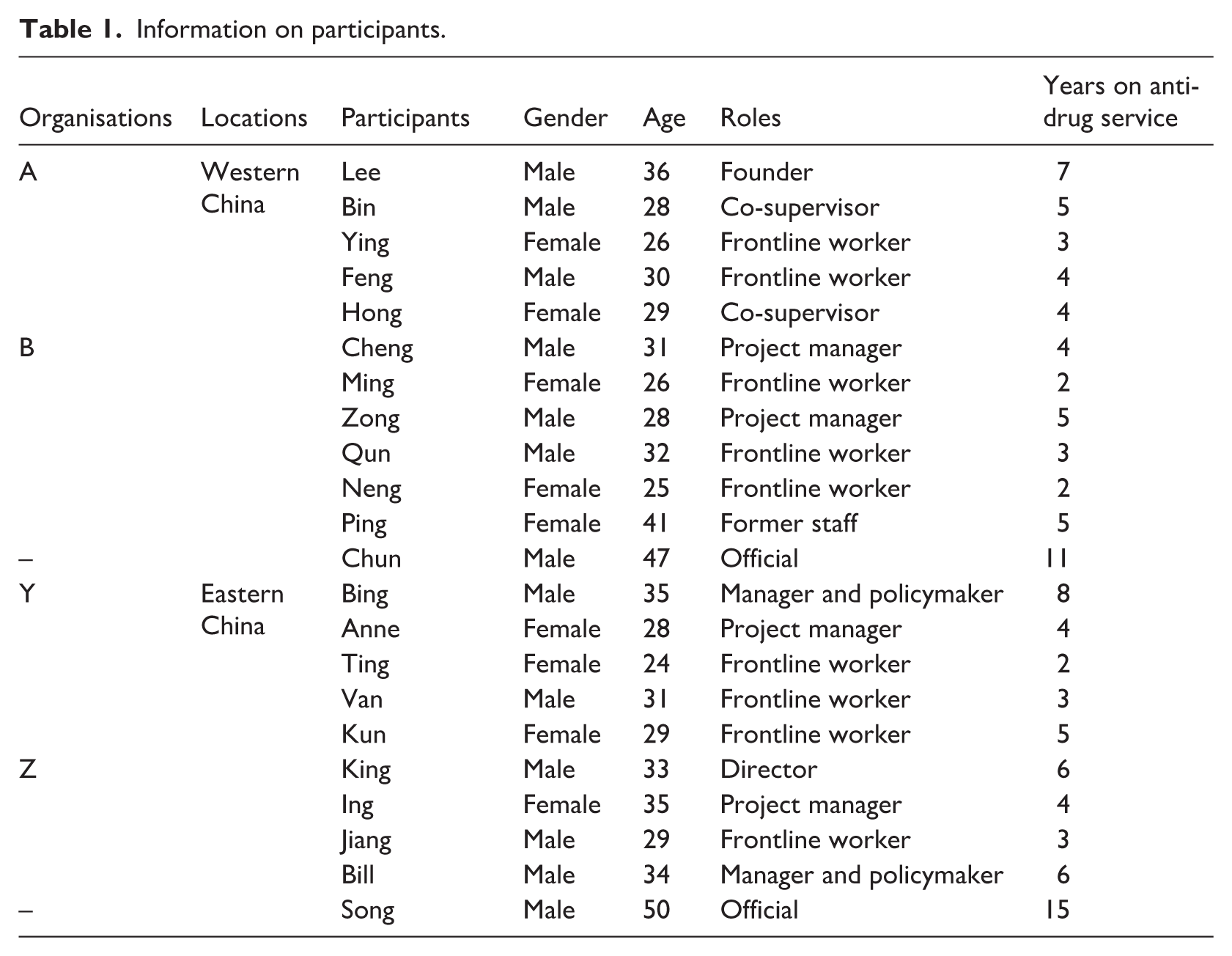
Data collection drew on multiple qualitative sources to ensure depth, breadth, and triangulation. We conducted semi-structured interviews with 22 participants, including 16 social workers across the four organisations, 4 project managers, and 2 local government officials. The interviews explored career trajectories, project operation logics, relational maintenance strategies, and forms of work stress (see Table 1). Each interview lasted between 60 and 120 minutes. To protect confidentiality, all names, locations, and organisational identifiers are pseudonyms.
Information on participants.
Researchers conducted 10 months of participant observation at drug-control service sites in two localities and all four organisations. Observational settings included organisational meetings, outreach activities, community visits, and inter-departmental collaborations. These observations focused on everyday organisational atmospheres, relationship dynamics, and the enactment of emotional labour in routine interactions. Field notes totalling approximately 130,000 words document multi-layered organisational processes and practices. To supplement primary data, we analysed relevant policy documents, government procurement contracts, service delivery guidelines, project evaluation reports, and publicly available organisational materials. These documents provided contextual grounding, supported triangulation, and helped trace the institutionalisation of organisational–government relationships.
Analytical processes
The analysis employed a reflexive thematic approach (Braun and Clarke, 2019), informed by the conceptual lens of relational work. All interview transcripts and fieldnotes were analysed manually. The first and second authors conducted multiple rounds of close reading to familiarise themselves with the data and to generate initial codes inductively. Coding was iterative rather than blind, allowing continuous movement between data, theory, and emerging interpretations. This reflexive engagement enabled the analysis to remain sensitive to contextual meanings while progressively refining analytical categories.
In a second stage, related codes were clustered into provisional themes and examined comparatively across organisational and institutional contexts. These themes were then interpreted through a relational work framework to explore how boundaries were negotiated, how emotions and power intersected in everyday practice, and how relational strategies were mobilised under structural constraint. Throughout the analytic process, regular discussions were held among the research team to keep a reflexive approach, review coding decisions, refine theme definitions, and challenge emerging interpretations. Furthermore, this study was approved by the Ethics Committee of University of New South Wales. All participants provided informed consent, and strict anonymity and organisational confidentiality were upheld throughout the research process.
Findings
Four anti-drug social work organisations illustrate how relational professional autonomy is expressed within a party-state-led community-based rehabilitation, revealing depoliticised professionalism and relational adaptation as contrasting pathways of situated, relational professional agency.
‘Professionalism as isolation’: The fragility of depoliticised autonomy
Organisation A is a drug rehabilitation social work agency widely recognised for its ‘professionalism’, which was established in 2012 by a group of young, social work-educated practitioners. Its founding vision was to promote a rehabilitation model grounded in humanistic care and social integration. As stated in its mission, ‘We are not the ones managing individuals; we are the ones accompanying them’. In a policy environment dominated by control-oriented and performance-driven logics, this positioning was distinctive, reflecting an idealistic professional ethos that viewed service recipients as subjects rather than mere objects of governance.
In its early years, Organisation A gained significant government recognition for its standardised procedures and high degree of professionalisation, becoming a local exemplar. It was emblematic of the ‘winner’ at the early phase of the state service-procurement system, securing legitimacy through adherence to professional standards rather than through administrative compliance. As the organisation’s founder recalled, In those years, we were practically a model; many places came to visit. We believed that as long as we did a good job professionally, the state would naturally see it. (Lee, male, 2024)
However, this professional belief system became increasingly fragile as the broader political climate shifted. With the rise of ‘party-building-led’ and ‘penal-welfare’ paradigms, trust based solely on professional competence became insufficient. Organisation A did not establish stable political relationships promptly. In this evolving political ecosystem, absence effectively translates into marginalisation. As co-supervisor Bin candidly reflected, We worked on this for ten years, and now the project is suddenly gone. We know it’s not because we did a bad job, but because they were ‘closer’ to the government. (Bin, male, 2024)
Within Organisation A, there is a pervasive sense of loss and powerlessness. During a team meeting, a young social worker quietly remarked, Sometimes we feel like we’ve been forgotten by policy. We’re still talking about professional ethics, and they’re already talking about political performance. Professionalism used to make us proud, but now it’s become a burden. The government thinks we’re too ‘idealistic’ and not ‘pragmatic’ enough. (Ying, female, 2024)
As the political climate shifted, ‘professionalism’ became a marker of organisational isolation. Organisation A continued strict routines, such as archived interviews, standardised assessments, and supervised plans, reinforcing internal identity but deepening external ‘closedness’. This surfaced when officials invited the agency to a Party-building session. The manager recalled, ‘We’d rather focus our time on case work. We have our own schedule and professional standards to maintain, and these activities don’t directly relate to our service outcomes. If we step away from our cases, it affects the continuity of care for our clients’. The officials responded curtly, ‘Then you probably don’t understand the current priorities. These arrangements are not optional, and participation reflects your organisation’s stance’. (Fieldnotes, 052024)
What appeared to be an ordinary exchange in fact revealed a deeper fissure between the organisation’s professional ethos and the political logic of contemporary governance. As one staff member later reflected, At first, we thought professionalism was all about relationships. But now we realise that relationships are the prerequisite for professionalism to exist. (Feng, male, 2024)
Organisation A’s internal resistance appeared ‘incongruous’. While most agencies embraced Party-building and political signalling to secure projects, it maintained ‘professional neutrality’, avoiding politicised expression. Although echoing Western ideals of ethical independence, this stance had limited traction in China’s party-state environment. As one participant reflected, We always thought we were upholding professionalism, focusing only on service delivery and ethical boundaries. But looking back, we were actually avoiding engagement with the system and its people. In this environment, relationships are part of how work gets done. What we saw as professionalism was, in practice, a form of resistance to relationships. (Hong, female, 2024)
Field observations suggest that this resistance is not a silent protest but an emotionally charged commitment. In internal trainings, social workers repeatedly invoked principles such as ‘professional ethics’ and ‘people-centredness’, reinforcing a collective identity anchored in the moral significance of professional practice. At a debriefing meeting, a project manager declared, We cannot abandon our professional identity, even if it means being marginalised within the system. If we start adjusting everything to fit external expectations, then what we do loses its meaning. We are trained to uphold certain values, and those values should guide our decisions. We do . . . social work, not just tasks assigned by others. (Fieldnotes, 092025)
This commitment carries a tragic undertone: it is simultaneously a self-protective ethical defence and a soft symbol of rupture from the prevailing order.
From a relational work perspective, Organisation A’s predicament stemmed not from inadequate competence but from its refusal to cultivate and maintain strategic relationships. This stance limited opportunities to rebuild trust or visibility within the governance system. Professionalism was recoded as a moral boundary – purity, rationality, neutrality – yet it deprived the organisation of flexibility in an increasingly politicised environment. Over time, this voiceless professionalism produced detachment from key administrative networks, reflected in project losses, staff turnover, and declining policy support. The result is a structural paradox: once professionalism is read as rejecting politics, it loses legitimacy and becomes a dissenting voice, rendering the organisation simultaneously ‘more professional’ yet ‘more vulnerable’.
‘Being trusted to obey’: Relational work in bureaucratic survival
Organisation B operates with an almost opposite logic. Founded in 2016 under the civil affairs department, it is led by a director deeply familiar with government procedures and evaluation systems. The organisation openly defines itself as a ‘Party-led social work entity’, with office slogans such as ‘Party-building leads livelihood services’ and ‘Obedience is the greatest professionalism’. At internal meetings, the director repeatedly stresses that ‘administrative trust matters more than professional ability’, a principle that anchors the organisation’s daily operations: We must respond to the district’s instructions immediately, without delay. Remember, ‘professionalism’ here means the ability to implement requirements, not your own ideals. (Fieldnotes, 042024)
What may appear as casual guidance succinctly captures the organisation’s cultural logic: administrative loyalty supersedes professional judgement, and political performance is exchanged for institutional security. Within this organisational culture, cooperation is elevated as the highest value. As one project manager explained, We may not be the most professional, but we are the most ‘cooperative’. The government needs trust, not questioning. (Cheng, male, 2024)
Another social worker echoed this: As long as the leadership is satisfied, the project is stable. We don’t have to worry about funding running out. (Ming, female, 2024)
Here, ‘trust’ stems not from professional merit but from mutually beneficial political ties. This cooperative relationship has ensured repeated contract renewals and expanded assignments, demonstrating that political embeddedness, rather than expertise, drives organisational stability and resource growth in the current governance landscape.
In addition, social workers in Organisation B proactively visit community officials, attend meetings, organise group photos, and send images of their activities to demonstrate ‘effective execution’. These symbolic practices have become embedded in performance evaluation. As the manager, Zong frequently reminded staff, Send the photos to the district as soon as possible; they like to see us ‘following up’. Make sure the pictures are clear and show interaction, not just attendance. It’s not only about what we do, but how it can be seen and reported. Otherwise, they won’t count it as real progress. (Fieldnotes, 082024)
Such visual reporting has replaced earlier forms of professional reflection and supervision; ‘evidence of compliance’ communicated through images now functions as the most effective organisational signal.
Yet this deep administrative embedding does not fully suppress practitioner initiative. A ‘grey zone’ persists within Organisation B. When oversight from superiors is relaxed, social workers employ flexible strategies to adjust their work. As one participant explained, What the higher-ups value is the quantity of activities; we can arrange the details ourselves. For example, in case of counselling, we can secretly have a few more sessions, as long as the report is well written. (Qun, male, 2024)
This form of ‘tolerated flexibility’ exemplifies relational autonomy in practice rather than openly resisting the system; social workers carve out space for discretion within the boundaries of administrative trust. The director tacitly endorsed this arrangement: As long as nothing goes wrong, I don’t care how it’s done. You can adjust your approach depending on the situation, just make sure the outcomes are acceptable. We need to keep things running smoothly and avoid drawing unnecessary attention. If the work is delivered and no problems arise, that’s what matters. (Fieldnotes, 082024)
However, this grey-zone autonomy is fragile. The organisation lacks systematic training and mechanisms for professional reflection, leading to widespread burnout. A young social worker commented, We do a lot of activities every day, but we don’t know what the meaning of these activities is. Reports are written, and performance reviews are passed, but nobody cares about the service recipients. (Neng, female, 2024)
Within this pragmatic organisational culture, ‘professionalism’ becomes redefined as the ability to comply with instructions and avoid risks, rather than as an ongoing process of reflection, improvement, and ethical engagement.
Through ongoing administrative engagement, Organisation B’s staff internalised a notion of ‘autonomy through trust’. As one put it, ‘Our autonomy is growing from being trusted’. This reflects a dependent, system-granted agency permitted only within sanctioned institutional boundaries. As a former staff member summarised, Success here isn’t about how professional you are, but about how well you know how to get along with people. You need to understand what officials expect and how to respond without creating friction. Professional skills still matter, but they come after relationships. If you can build trust, then you are given more space to act. (Ping, female, 2024)
Organisation B exchanges political loyalty and administrative closeness for operational space within the system. Its ‘relational autonomy’ is not confrontational, but a constrained agency generated through deep political embedding. This creates limited grey zones of practice, yet such breathing room remains contingent on shifting political climates and bureaucratic preferences. In effect, Organisation B survives by trading compliance for existence: its autonomy is relationally produced, power-shaped, and bounded by governance logics of trust – an everyday oscillation emblematic of social work in China’s party-state-led, judicially driven drug control system.
‘Knowing the language of power’: Navigating competition through relational autonomy
In Western cities, anti-drug social work operates within a competitive yet coexisting landscape of professionalism and relationship-based practice. Organisations must demonstrate both technical compliance and political reliability in bidding, evaluation, and assessment (Wang, 2024). This institutional configuration intensifies the tension between professional practice and political embeddedness. As one policymaker observed, One needs expertise, and one needs connections. What we need now, in fact, is both. (Bing, male, 2024)
Organisation Y first gained prominence as a ‘model of professional drug-control social work’, but as Party-building and governance indicators grew central to evaluation, its professionalism was reinterpreted as political indifference. During a municipal anti-drug project presentation in 2023, the director delivered a meticulously prepared report detailing service outputs and case achievements, yet the recipient remarked, The report is good, but it seems to lack political warmth. It focuses too much on technical details and not enough on alignment with current priorities. We need to see how your work connects with the broader agenda and reflects the right stance. Professional results are important, but they should also be expressed in a way that resonates politically. (Fieldnotes, 102024)
Since then, Y has repeatedly lost competitive anti-drug bids, and its professional stance has been labelled ‘idealistic’, ‘detached’, and even ‘too academic’. As participant Anne recalled, Our drug service proposals have always been logically clear, but now reviewers keep saying, ‘It lacks political orientation’. (Anne, female, 2024)
Y’s predicament illustrates a structural reality that under a bureaucratised and politically inflected project-review regime, ‘professional competence’ is no longer a decisive asset. Anti-drug government officials prioritise organisations’ responsiveness to Party-building requirements, participation in political activities, and ability to demonstrate political reliability within the broader discourse of ‘social security’. As one frontline worker privately reflected, We thought that as long as we delivered good services and solid data, we could win. But now, ‘who understands the political language’ matters more than ‘who understands the drug users’. (Ting, female, 2024)
In stark contrast to Organisation Y, Organisation Z achieved rapid and sustained expansion through a flexible strategy of relational adaptation. The organisation cultivated close ties with local party bodies and the municipal anti-drug committee, while also embedding itself in a broad range of cross-departmental activities. As its director remarked, We don’t just do anti-drug work; we also do party-building activities, mental health services, and community patrols. The logic is simple . . . whoever has a stable relationship has a larger scope. (King, male, 2025)
Field observations reveal that Organisation Z strategically replaced professional expression with political responsiveness: At reporting meetings, project achievements were framed within narratives of ‘serving the masses’ and ‘spreading positive energy’, rather than standardised professional indicators . . . This discursive alignment secured Z’s recognition as a key municipal project in early 2024. (Fieldnote, 092025)
Compared with Organisation Y, Z’s organisational ‘success’ is rooted less in its professional capacity than in its acute reading of institutional logic and its fluency in power language. Social workers in Z adeptly weave political terminology, such as ‘party-building leadership’ and ‘supporting the modernisation of grassroots governance’, into their reports to secure governmental approval. As one participant noted, We all understand these words are a ‘password’. Speaking their language allows you to breathe a little more air. (Ing, female, 2025)
This practice of discursive language translation is not mere conformity but embodies a form of relational autonomy. A strategic negotiation in which symbolic expressions of loyalty are exchanged for greater flexibility in practice. One employee was explicit: We write ‘Party building activities’ in our reports, but the actual activities are mostly psychological counselling. The higher-ups want a political flavour, so we add a little. That way, everyone is comfortable. (Jiang, male, 2024)
Through such calibrated symbolic compliance, Organisation Z maintains operational leeway and sustains its project survival even under tightening administrative oversight.
This competitive ecosystem in coastal anti-drug work reveals the logic of China’s project-based governance: professional ethics, administrative trust, and political loyalty are collapsed into a single evaluative regime. ‘High-quality’ institutions are defined less by service outcomes than by political visibility and recognisability. Institution Y, keeping ‘professional distance’, lost political oxygen, whereas Organisation Z sustained support through relational embeddedness. As one policy maker succinctly put it, What we need is not who understands social work best, but who understands our language best. You have to know how to translate your work into terms that fit our priorities and reporting logic. It’s not just about doing things well, but about making them legible to the system. If we can’t recognise it, it’s hard for us to support it. (Bill, male, 2025)
Crucially, this ecosystem is not zero-sum but structurally symbiotic. Professionalised institutions provide the system with technical legitimacy, while relationally adaptive organisations translate and stabilise policy implementation. Together, they enact the dual logic of Chinese social governance, technocratic rationality alongside political loyalty, within which relational autonomy is continually practised and reproduced.
Discussion
Our findings demonstrate that within a party-state-led welfare system, the professional autonomy of anti-drug social workers emerges through ongoing relational negotiation. This resonates with, yet also extends, international scholarship that has long challenged the assumption that professional autonomy is secured through formal institutional insulation or independence from the state (Lipsky, 2010; Maynard-Moody and Musheno, 2012). Across the four organisations studied, different organisational strategies – ranging from Organisation A and Y’s attempts to uphold professional ideals and moral boundaries, to Organisations B and Z’s pursuit of administrative embedding through political trust and institutional dependence – illustrate a contextualised, relational mode of autonomy.
Building on Zelizer’s (2005) concept of relational work, this study conceptualises relational autonomy as a situated accomplishment through which social workers actively reshape the boundaries of professional practice in environments where resources, legitimacy, and power are deeply entangled. Similar dynamics have been identified in welfare systems beyond China, where frontline professionals navigate competing logics of care, control, and accountability (Burton and Van den Broek, 2009). However, the Chinese case highlights a particularly intensified configuration of these dynamics under a project-based, party-state governance system, in which professional autonomy is not a codified right but a fragile outcome generated through sustained relational engagement with political and administrative actors.
Our findings show that the development of anti-drug social work organisations is closely tied to their connections with the party-state-led systems (Wang, 2024). In this context, relationships function not merely as social capital, but as preconditions for professional practice itself. Through strategic networking, reputation cultivation, and symbolic alignment with political priorities, organisations secure access to projects, policy opportunities, and institutional recognition. Relational work thus operates simultaneously as an adaptive mechanism and a strategic mode of action, enabling organisations to maintain a precarious balance between administrative imperatives and professional ethics.
Importantly, even under conditions of heightened political oversight and performance-based evaluation, like our study, the governance structure retains strategically exploitable flexibility. Practices such as eliciting verbal endorsements from judicial officials, participating in Party-building activities, or cultivating visibility through collaboration with schools and local media should not be interpreted as simple capitulation. Rather, they constitute situated forms of institutional negotiation, comparable to what scholars elsewhere have described as symbolic compliance or performative accountability in welfare bureaucracies (Jann and Lægreid, 2015). In this sense, symbolic compliance becomes a means of relational autonomy.
The findings highlight how political loyalty is heavy now in the social work area. This forces social workers to navigate the tension between doing the right thing and being seen to do the right thing, a common dilemma in other countries’ welfare systems (Banks, 2014; Solvang and Juritzen, 2020). Organisation A’s insistence on ethical and professional purity resulted in forms of ‘silent punishment’, including reduced political visibility and eventual marginalisation. By contrast, Organisations B and Z re-encode professional values into politically legible language, getting prioritised. This does not signal the erosion of professional ethics, but rather their reconfiguration under political constraint, where autonomy increasingly reorients to institutional adaptation rather than independent ethical judgement.
These findings speak to broader debates on whether social workers should be understood as agents of the state. While critical scholarship has long highlighted the state-embedded nature of social work (Gill, 2003), this study suggests that agency is neither fully absorbed by the state nor exercised outside it. Instead, anti-drug social workers in China operate as relational intermediaries, whose autonomy is produced through continuous negotiation within state-dominated governance arrangements. Although the intensity of party-state involvement distinguishes China from many liberal welfare regimes, similar patterns of negotiated autonomy have been observed in other contexts characterised by strong state control, including Russia and parts of Eastern Europe (Iarskaia-Smirnova, 2004).
Finally, while this study focuses on the field of drug prevention and rehabilitation, the dynamics identified are unlikely to be unique to this sector. The combination of moralised targets, heightened surveillance, and performance-based governance suggests broader trends in Chinese social work. Similar tensions have been documented in fields such as community corrections, mental health, and poverty governance (Jiang and Liu, 2022; Mao and Yu, 2025). The ‘drug’ element thus magnifies, rather than fundamentally alters, the structural conditions under which relational professional autonomy happens.
Implications for social policy and practice
In a party-state-led governance system, the sustainability of social work practice depends on balancing administrative logic with professional ethics. At the policy level, it is important to recognise that relational work is neither a ‘grey zone’ that weakens professionalisation nor a ‘Pandora’s box’ that threatens public interest. Instead, it is a central mechanism through which social workers maintain service continuity, negotiate institutional constraints, and uphold ethical commitments in politically structured environments. Policies should therefore treat relational work as a legitimate, and often necessary, dimension of practice rather than dismissing it as informal networking. For practitioners, the goal is not to eliminate political dependence, an impossibility, but to cultivate strategic distance within relational networks. This requires navigating between compliance and principled persistence, creating small yet meaningful pockets of autonomy within rigid governance frameworks.
Limitations
This study has several limitations. First, empirical evidence is drawn from a small number of anti-drug social work organisations in economically developed urban areas. These contexts, while illustrative of dynamics in China’s project-based welfare regime, may not reflect the experiences of practitioners in less developed or ethnically diverse regions, where governance arrangements and political relationships differ substantially. Second, the qualitative and cross-sectional nature of the data provides only a partial snapshot of relational strategies. Future longitudinal or cross-regional studies could investigate how relational autonomy evolves in response to shifting policy agendas and political climates across the Global South.
Footnotes
Acknowledgements
The authors extend their deepest gratitude to all the participants for entrusting them with their stories.

Ethical considerations
This study forms part of a broader project focused on the recovery of people who inject drugs, which was approved by the UNSW ethical committee (Ethics Number: iRECS4340; approved date: 04/02/2024; Approval Period: 05/02/2024 to 04/02/2029). The participants were recruited from February 2024 to August 2024, and from September 2025 to December 2025.
Funding
The authors received no financial support for the research, authorship, and/or publication of this article.
Declaration of conflicting interests
The authors declared no potential conflicts of interest with respect to the research, authorship, and/or publication of this article.
Data availability statement
Statement on AI
The purpose of using AI was limited to improving linguistic accuracy and readability. The intellectual content, theoretical framing, data analysis, interpretation of findings, and argument development were entirely produced by the authors. Typical prompts entered by the researcher included instructions, such as: ‘Please revise this paragraph for grammatical clarity while preserving the original meaning’. It was only used in the literature review section for language-editing. The authors take full responsibility for the content of the manuscript.