






Abstract
This reflective article examines the use of the Model United Nations (MUN) pedagogy in an international social work subject at an Australian university. We used MUN simulations to develop students’ critical thinking and decision-making skills while engaging with global issues including power, justice and decoloniality. Acknowledging that both the UN and MUN were built on colonial foundations, we adopted a third-space methodology incorporating decolonising pedagogy. This approach enabled students to critique the UN and social work profession, challenge Eurocentric frameworks and broaden their understanding of global social work practice. We conclude with practical tips for replicating this approach.
This article shares the design and process of using the Model United Nations (MUN) as a simulation tool in teaching an international social work subject. The article begins with background information on the MUN and then moves on to discuss decolonisation in teaching and learning and international social work. Detailed information is then provided about the subject and how the MUN was used. A method section is presented followed by results and discussion of our reflective process. Limitations of and barriers to the MUN approach and recommendations are provided at the end.
Background
Understanding the MUN approach
An MUN is an educational activity where students simulate the work of UN committees. At a MUN committee, students work as the representatives of a country or organisation to resolve or solve a selected social issue. MUN has been adapted as an experiential learning tool to support students’ learning in tertiary education across disciplines globally such as climate or environment (Matzner and Herrenbrück, 2017), international relations (Calossi and Coticchia, 2018) and business (Phillips and Muldoon, 1996). MUN supports students to develop knowledge of social, cultural and political perspectives from the countries they represent, and students can develop a broad global perspective and build the competency of global citizenship (Phillips and Muldoon, 1996). However, the discussion of the use of MUN in social work education is limited. While social work educators can draw on the implications of MUN simulations from other disciplines, there is a need to adapt the implementation to ensure that the design of MUN incorporates core social work values.
Both social work and the UN have human rights and justice as core values. Social workers engage in a wide range of contexts, such as ‘working with individuals, families, groups and communities; conducting research and evaluation; providing education and training for future and current social workers; leading and managing public and private organisations; and contributing to policy development and implementation’ (Australian Association of Social Workers [AASW], 2023). The UN promotes social justice through passing international policies and implementing programmes with a global focus. Therefore, employing MUN as a simulation tool provides social work students with opportunities to understand and critically analyse international social work issues.
There is criticism of the UN for its Eurocentricity, including the promotion of values that do not necessarily reflect diverse world views (Zembylas, 2020). In addition, the UN has been critiqued as an agent of colonialism and neo-colonialism, especially for the so-called developing countries (Okafor, 2022). These countries have limited influence at the UN compared to Western countries, for example, the United States, France and Britain (together with Russia and China) have veto power which they have used to extend their influence and support their allies. From a community development perspective, Ife (2016) argues that community development programmes sponsored by the UN maintain neo-colonialism through development aid, pseudo-participation in development, and displacing pre-existing systems of local health and community care, education, justice and land tenure that have been established for centuries within local geographical and cultural contexts. These criticisms highlight the need for the UN and MUN users to decolonise approaches to ensure they reflect and respect the diverse cultural and historical contexts of the local communities. We decided to stick with the UN and MUN despite these shortcomings, because we think this approach is important in educating and developing contemporary graduates.
Decolonisation in teaching and learning
Decolonisation improves student learning, makes teachers more confident, values all knowledges and reverses or repairs the harm of colonisation (Adam, 2020). A decolonised curriculum therefore contributes to a better society. There are multiple ways of looking at decolonisation in higher education. Chilisa (2012) provides a model that unpacks what decolonisation entails, even though her model is more focused on research. Chilisa et al. (2017) see decolonisation as existing at four levels, as follows:
Level 1 – Least indigenised approach which involves paternalistic, false or pretentious recognition of decolonising approaches.
Level 2 – Integrative approach which uses both indigenous and Eurocentric approaches but there is a less conscious decision about the role of Indigenous approaches.
Level 3 – Predominantly Indigenous approach.
Level 4 – Third-space methodologies that mix Indigenous and non-indigenous approaches.
Chilisa uses a global definition of Indigenous, which focuses on all Indigenous people of the world. In this article, authors aligned with the fourth level of decolonisation, where the MUN is viewed as a colonial pedagogical approach that can be adapted by incorporating decolonising content to improve students’ learning of international social work. Social work education is still presently dominated by Eurocentric knowledge, including philosophies, ways of learning and curricula (Sung-Chan and Yuen-Tsang, 2008), although this is changing. The call for decolonising social work curricula has drawn increasing attention from social work scholars (Bennett et al., 2017; Choate, 2019; Mugumbate et al., 2023). The recognition and promotion of localised knowledge are presently central in education in many countries. In the Australian context, Aboriginal and Torres Strait Islander ways of knowing, being and doing have long been advocated to be a core part of the social work curriculum (Bennett et al., 2017). In the global context, recognising the importance of the local Indigenous philosophies is part of decolonising social work education, for example, Ubuntu in Africa (Mugumbate, 2020) and buen vivir in South America (Godden, 2021). While there is no agreement on how to decolonise social work curricula, Muller (2023) believes decolonisation includes enabling a safe space for discussion, while Mahabeer (2018) thinks it is openess to both learn and unlearn and a commitment to put new learning into action. As international social workers, educators and researchers, we agree with Muller’s (2023) and Mahabeer’s (2020) views on decolonisation and add that decolonising social work curricula is a collective effort which involves both the colonised and the colonising people working in ways that promote Chilisa’s third-space methodology (Chilisa, 2012).
These ideas are reinforced by other authors on epistemological justice, including Adam (2020), who proposed the three-tiered framework which explains decolonisation as a systemic restructuring of knowledge, power and pedagogy. Justice-as-content requires revising curricula to eliminate deficit narratives, correct misrepresentation of Global South communities and centre Indigenous and non-Western epistemologies, thereby addressing epistemic injustice in what is taught. Justice-as-process focuses on how education operates, challenging inequitable placement systems, hierarchical knowledge validation and Western-dominant academic norms, while embedding critical perspectives and co-creating learning to disrupt structural power imbalances. Justice-as-pedagogy develops students’ capacity for critical self-reflexivity by designing assessments that explicitly interrogate colonial histories, socio-cultural injustice and the dominance of Eurocentric intervention models, equipping students to question whose knowledge counts and to reconstruct practice frameworks accordingly. Together, these tiers move decolonisation beyond symbolic inclusion towards a substantive redistribution of epistemic authority, institutional power and professional formation within education. Adam (2020) supports earlier views on this topic; for example, Razack (2009) stressed that critical attention is needed to understand how we teach global issues, how we introduce content on particular topics, how students interpret and integrate the knowledge, whose voices are silenced and, more importantly, what gets discussed and what is erased’ (p. 19).
International social work
As a result of globalisation, international social work has drawn increased attention from researchers, practitioners and educators (Healy, 2014; Lyons, 1999; Lyons et al., 2012). The need for social work educators to provide international knowledge to facilitate students’ understanding of the context of working with international service users, communities and organisations within and outside Australia is paramount. In response to this need, the International Social Work subject was developed in 2017 for third- and fourth-year Bachelor of Social Work students at an Australian university. However, international social work, just like other methods of social work, has been criticised for being colonial in orientation and objectives, hence decolonisation has been called for (International Federation of Social Work, 2023; Jones et al., 2025).
Embracing experiential learning theory (Kolb, 2014), critical pedagogy (Freire and Ramos, 2017) and decolonising pedagogy (Adam, 2020; Bennett et al., 2017; Chilisa, 2012), the International Social Work subject considers the social work profession, social services and social policies within an international context. The subject discusses the nature and historical evolution of professional social work and characteristics of social work in different world regions, particularly in Asia/Pacific; variations in national resources and development and the impact of poverty and inequality; the role of major international organisations and international agreements in promoting social welfare; transnational social issues, such as environmental related disasters and human trafficking; and the impact of international politics and current affairs on social work.
Pedagogically, simulation sits with experiential learning theory (Kourgiantakis et al., 2020). In social work, simulation is an effective pedagogical approach for developing students’ practice competence (Bogo and Bogo, 2014; Olcon et al., 2023), supporting student understanding of theory in practice and providing a safe place for students to experience failure in a hypothetical environment (Meredith et al., 2023). Teaching with simulations has been found to improve students’ communication competency (Barker et al., 2018), build students’ knowledge of and approach to social justice issues (Lee et al., 2022) and connect universities with communities (Olcon et al., 2023). Although simulation has been used as an effective tool in social work education in field education, working with individuals, families and community, there is limited evidence regarding the use of simulation in international social work education and decolonisation.
Our international social work subject and the MUN pedagogical approach
Our subject was developed in 2017 and taught by the three of us. We are all international social work academics. Enrolments in the International Social Work subject mainly consist of domestic students (average 95%), with a few international students in their third or fourth years of a Bachelor of Social Work programme. Prior to the International Social Work subject, students study Indigenous Australia, social policy and advocacy. The international social work subject is usually timetabled in a 4-hour teaching block fortnightly over a period of 13 weeks, on campus. The first 2 hours cover international social work content in form of a lecture and a guest lecture sharing international social work practice and research with all students, followed by a tutorial for 2 hours. The guest lectures provide students with an opportunity to understand social work at the international level and the practicalities of decolonising practice. We provide multiple ways of understanding social work practice rather than only relying on Eurocentric knowledge. The lectures and tutorials provide students with a diverse understanding of international social work by focusing on the different meanings of international social work as working with service users in or from another country; colloborating with organisations, institutions or people from another country; working with or within multilateral institutions; creating, using or applying international policy; working with global social work organisations; or engaging in international learning exchanges. We cover a diverse range of topics and examples for students to understand local and global issues. These topics include international social work organisations, globalisation, Sustainable Development Goals (SDGs), poverty and inequalities, environmental crisis, migration, global indigenous knowledge, decolonisation and international social policies and agreements. The topics connect knowledge from local contexts to the global context and provides a decolonsing lens. For example, we introduce the UN Declaration on the Rights of Indigenous Peoples while focusing on Australia’s history of colonisation.
After covering the content, we use the MUN activity for more learning and assessment. The MUN as a group assessment requires students working in groups of three to six to identify an international social issue to be addressed by the organisation. In the scenario the students follow, the UN has up to US$10 billion to use to address the world’s most pressing international social issues (linked to the SDGs/2030 Agenda) and the multilateral institution has called for a session to discuss and select the most pressing issues and allocate funding. During the session, each group will suggest a pressing issue and justify why it should be funded. The group will make an appeal to the UN Secretary General and other organisations in the form of an oral presentation (10 minutes), supported by slides, a written statement of two pages and any other forms of support. Groups will articulate the need, and support with evidence and a budget.
Although the MUN simulation is in the final workshop, students’ preparation starts in the first workshop. There are six major steps of our MUN approach, as follows:
Researching and learning about the UN, covering its history, structure, aims and shortcomings, including but not limited to colonising tendencies seen in having a few countries with veto power in the Security Council and dominance of Western values. Students are also introduced to decolonising international social work, including social work organisations such as those owned by the UN.
Students are put in groups of three to six and asked to identify an international non-government organisation to represent and nominate an international social issue to appeal to the UN to fund. Traditionally, the MUN invites students to represent different countries to debate global issues and negotiate solutions. Our approach moves away from emphasising power relations between countries and instead focuses on the significance of the social issues.
The tutor checks group progress and provides oral feedback in each tutorial and ensures that each group has selected a unique organisation and social issue.
The MUN simulation is held in the last tutorial. The subject coordinator or tutor plays the role of the President of the General Assembly to open and close the simulation and oversees the process, while students will be delegates in their groups.
Delegates negotiate the UN funding allocation based on consensus. However, if consensus is not reached, delegates vote as groups for the final allocation using a ballot system.
The tutor debriefs and provides feedback to each group, followed by a class discussion. Written feedback and grades are provided in later weeks.
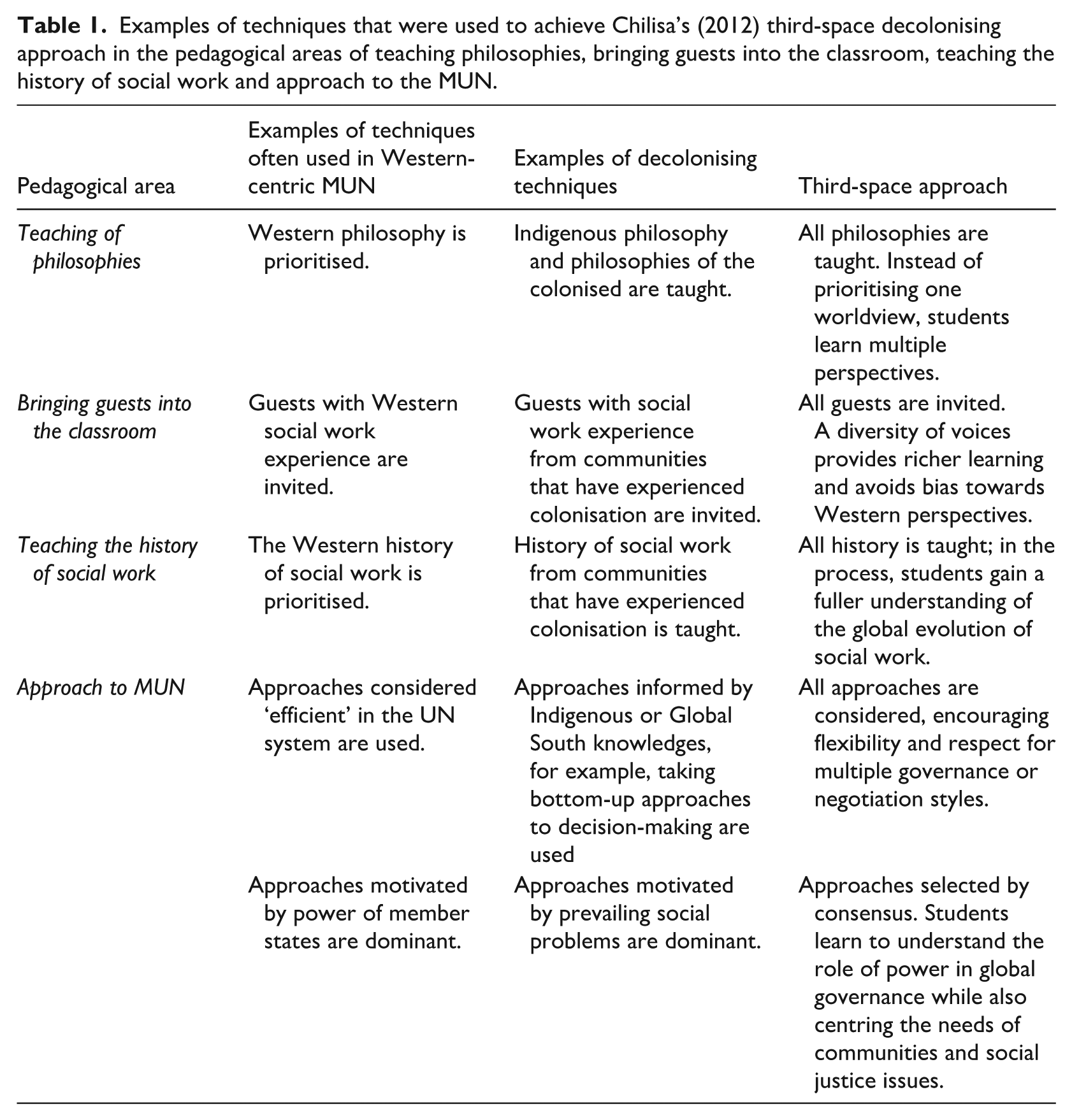
As noted already, our MUN approach utilises Chilisa’s (2012) third-space methodology of decolonisation. In our decolonisation approach, we focus on strategies used more frequently in colonising pedagogies and those favoured in decolonising pedagogies. Some examples are given in Table 1.
Examples of techniques that were used to achieve Chilisa’s (2012) third-space decolonising approach in the pedagogical areas of teaching philosophies, bringing guests into the classroom, teaching the history of social work and approach to the MUN.
Other approaches include having international academics developing and introducing students to knowledge and literature on decolonisation, including their own experiences. By seeing these academics being given these roles, this reinforces the importance the social work programme places on decolonisation. At the end, students see decolonisation in practice, not only in theory, and the academics see their experiences of colonisation being validated. The approach is supported by the social work programme philosophy which values decolonisation, at the local and global level.
Our third-space approach is not about replacing Western methods with decolonial ones but is about integrating multiple ways of knowing, doing and teaching. This creates a space where students can critically engage with different perspectives, learn from diverse experiences and reflect on power, coloniality and inclusion. Traditional the MUN emphasises geopolitical power, decolonising approaches emphasise social needs and the third-space approach integrates both so students can critically analyse the tension between power and justice.
Methodology
The questions for this research were as follows: What ways were decolonising in our use of the MUN in the International Social Work subject? What lessons can we derive from our MUN approach that could benefit other academics globally? To answer these questions, a collaborative reflective analytical approach was considered the most suitable methodology because it allowed the authors to share their experience of teaching in the subject. This autoethnographic approach helped us demonstrate our standpoint as insiders with experiential knowledge in international social work. This method also worked well because we did not have resources to collect data from students or academics (Ellis and Bochner, 2000). However, we acknowledge that autoethnography has loopholes, for example, the potential for personal bias is high as noted by Holman (2005). We have addressed this shortcoming by searching and reviewing relevant literature and by continuously reflecting on our positionality, as detailed later in this section.
In this study, we employed a blended approach combining analytical and collaborative personal narratives of teaching the International Social Work subject using the MUN approach, reflecting critically on our experiences, observations of student engagement and the challenges of decolonising practice. The analytical component allowed us to systematically examine how our pedagogical decisions, feedback and interactions with students were shaped by broader cultural, institutional and epistemic structures, linking our personal experiences to existing theory on decolonisation, experiential learning and global social work education. The collaborative aspect facilitated shared reflection and dialogue among us as educators, enabling us to compare perspectives, challenge assumptions and co-construct interpretations of the successes and tensions encountered in the classroom. This combined approach not only foregrounded our reflexivity as teachers but also provided richer insights into how students navigate Eurocentric frameworks, engage with community-led approaches and develop critical professional judgement in simulated global policy contexts.
We held four discussions about the use of the MUN approach in the subject and further communicated via email. The initial discussion focused on what we did and why and what other academics have said or found in their research. After the first discussion, we created a list of discussion points that acted as categories of analysis. The second and third discussions focused on simulations in the context of decolonisation, the gaps in our simulation and what could be improved. We then refined our initial points. The fourth discussion involved refining the points.
We had access to student and peer feedback for our International Social Work subject but this was not a lot. We used the available feedback as a secondary approach to aid our reflections and reduce bias but did not include the feedback received in this report. Further to this, we used the literature to identify and reflect on the work of others on the MUN and decolonisation. Of significance was Chilisa’s (2012) approaches to decolonisation, particularly the third-space approach.
Throughout the process of reflection, analysis and writing, we remained cognisant of the risk of bias which could emanate from us being the teachers in the subject but also from us being international social workers trained outside Australia and coming from colonised backgrounds. We addressed this potential shortfall by adding time to our meeting agenda to reflect on our positionality. In engaging in this autoethnographic process, we were motivated by decolonisation, which we experienced, and the experiences of Indigenous people in Australia where we worked. Furthermore, decolonisation features prominently in the philosophy of the programme in which we teach, and across the Australian national landscape, where it remains a central priority for Aboriginal and Torres Strait Islander communities. The prevalence of this theme encouraged us to embrace decolonisation more deeply; it validated our personal experiences of colonisation and helped us realise that the local and the global walk together, constantly enriching one another. Put together, a critical decolonisation arose in us as a result of our own experiences, local history of colonisation and the philosophy of our teaching programme.
Findings and discussion
Key lessons
An important contribution our MUN makes is exposing students to the policy-making process at the global level, although it can be argued that these simulations risk reproducing UN-centric and Western diplomatic frameworks as default sites of authority. The learning of the policy-making process is experiential and includes learning to debate policies and factors influencing the policy-making process. An important contribution of our simulation is providing students with multiple perspectives through debate, observation and peer feedback which enhances situated learning and transfer (Dede, 2009). The feedback students receive in simulation, observation of continuous practice and guided reflections enhances knowledge, improves skills, develops professional judgement and increases self-reflection (Kourgiantakis et al., 2019). Yet another contribution is providing safe spaces to receive critical feedback, especially on the topic of decolonisation that students often find difficult. Three examples will be used to illustrate these lessons.
By the time they engage with the MUN, students would have expanded their learning context from local to global, which helps them engage in discussions and receiving critical feedback. For example, one group of students from the Spring 2023 session represented an organisation called Sista from Vanuatu addressing gender-based violence issues in the South Pacific. Embracing a community-led approach, students proposed to maintain and expand current programmes run by Sista. Working with the community and identifying the current gaps by consulting with community members, students proposed using UN funding to provide trauma-informed care training for Sista staff. Informed by Adam’s (2020) idea about restructuring of knowledge, the feedback from the teacher was that the students’ proposed solution of trauma-informed training was a validated Eurocentric approach common to the global North but is foreign to relational and collective approaches in Vanuatu, and therefore poses barriers to practice (Gair, 2016; Mugumbate, 2024). In their approach to a problem in the South Pacific, students validated a foreign approach, making local approaches such as invisible. Their solution illustrated how hegemonic Western epistemologies that are embedded in mainstream social work curricula shape problem framing and solution design, even when students intend to work in culturally grounded ways. We suggested grounding solutions more in the community, for example, including the community in decision-making about identifying needs and approaches. To the rest of the students, we tasked them to interrogate whose knowledge was privileged. Our reflection concluded that the Eurocentric approach was the most dominant starting point for students when planning for social work intervention with global service users. We further concluded that prior learning from other social work subjects contributed to this because there is an emphasis on Eurocentric philosophy and theories. As teachers, we supported students through feedback to gain the knowledge, skills and confidence when they decolonise their practice, disrupting unexamined epistemic assumptions. In this case study, our students’ intervention design reproduced hegemonic Western epistemologies embedded in global social work education. The approach we employed supports Carrick-Hagenbarth and Maton’s (2023) educational decolonising idea, which holds that education should equip students to be informed members of both their local and global communities and Adam’s (2020) framework to decolonise curricula as mentioned earlier. Such approaches can help students to consider their assumptions and ignorance of societal issues pertaining to different countries. It aided in achieving the educational objective of encouraging students’ self-reflexivity on these assumptions about global societal issues (Carrick-Hagenbarth and Maton, 2023).
More broadly, the Sista session revealed structural issues of our teaching environment, not just deficits of the students. The intervention suggested by the students demonstrated that their default to Eurocentric intervention models is not an individual deficit but a systemic outcome of how social work knowledge is historically constructed, validated and circulated globally. Decolonising practice cannot rely solely on reflexivity by students within isolated assignments or classroom activities when curricula, assessment regimes and core texts remain predominantly Western. In our reflection, we noted that, as educators, we are implicated in these structures and must continually examine how our own teaching materials and evaluation criteria may reproduce epistemic hierarchies.
In our MUN, students are engaged in repeated trials that involve prioritising global social problems and solutions, budgeting and preparing persuasive statements. According to Dieker et al. (2014), such trials protect students from risking the loss of valuable resources in real-life situations, providing students the platform for a sense of personal responsibility for improvement grounded in critical self-reflection. By role playing making decisions about social issues and creating social solutions, students are developing professional judgement skills at the same time as learning about social justice from multiple perspectives, including non-Western perspectives. These goals are amplified when students observe their peers do the same (Ellen et al., 2014).
In one session, a group of eight students were resolving low levels of education of girls in the Middle Eastern region and what the UN funding they had access to could be used for. In their first session, they focused more on buying more books and building more schools. When the educator introduced the work of Malala Yousafzai, a Pakistani education activist and Nobel Peace Prize laureate who campaigns for girls’ right to education, the discussion shifted towards rights-based advocacy, highlighting tensions around whose voices are amplified and the risks local actors face under repressive regimes. Further feedback was on the dangers of social action in a region that dissuades dissenting voices, especially female voices. The group reframed their proposal to strengthen social workers’ capacity for context-sensitive policy engagement, recognising the importance of navigating power, risk and political constraints. In our reflection, we agreed that universalised rights frameworks can risk imposing solutions misaligned with local realities. This progression demonstrates that decolonising international social work requires interrogating how global governance, funding structures and rights discourses shape assumptions about change.
In another session, a group examined farmers’ problems in Australia, including droughts, and initially proposed using allocated UN funding to kill pests. This sparked a debate, led by another student, over what constitutes a pest – native animals or introduced species brought by colonial settlers. The discussion highlighted that environmental solutions cannot be separated from histories of colonisation, revealing how ecological management is entangled with power, land and knowledge systems. Ultimately, the group adopted a third-space approach, as suggested by Chilisa (2012), emphasising support for farmers in ways that protect country while respecting Indigenous knowledge. This example demonstrates that decolonising social work and development practice require critically engaging with historical, political and ecological contexts rather than applying technical fixes in isolation.
Tips for replicability
Educators seeking to adopt a decolonising MUN approach can support students by combining experiential learning with structured reflection, allowing them to debate, budget and make decisions while interrogating assumptions, risks and broader historical and political contexts. It is important to expose students to multiple perspectives through peer observation, guided discussion and critical feedback, prompting them to examine whose knowledge is privileged and how Eurocentric epistemologies shape problem framing and solution design, even when resources are provided and intentions are culturally grounded. Encouraging community-led and locally grounded solutions helps students co-create interventions that respect relational practices, histories and values, while critical engagement with rights-based and universalised frameworks highlights tensions between global norms and local realities. Decolonisation can be a difficult topic, so students should be prepared with introductory guidance and support. Educators should consult the UN website for MUN resources (e.g. https://www.un.org/en/mun) and explore videos available on social media to enrich simulations. They must also reflect on their own curricula and assessment strategies to avoid reproducing epistemic hierarchies, linking practice to decolonial theory, such as Adam (2020) or Chilisa (2012), to strengthen professional judgement and transformative learning.
Limitations, barriers and recommendations
The MUN simulation in the International Social Work subject has been adapted to incorporate decolonising practices, allowing students to represent non-governmental international organisations from any country and ensuring each delegate’s voice is heard. However, this practice does not truly reflect the UN operations; for example, five countries have permanent status in the UN Security Council, and they may veto the decisions made by others. In our MUN, we use one language, English, whereas at the UN, they use multiple languages. Adjustments may include having more languages and having governmental or intergovernmental institutions as opposed to non-governmental organisations, in line with membership of the UN.
No First Nations person in Australia where the teaching reported in this article took place was involved in the design of the subject or the MUN and its delivery. This is a limitation; however, it reinforces the need to adopt our approach. Furthermore, authors have focused more on global decolonisation, that is, decolonisation as it pertains to all people of the world who were colonised. Furthermore, as noted earlier, all authors are from countries whose social work has been colonised, and decolonisation is an ongoing process in those countries.
Some barriers to implementation of the MUN are smaller enrolments at a second campus where the subject is taught, lack of video recording and limited opportunity to evaluate the teaching approach to get feedback about the MUN approach. For smaller classes, we recommend combining classes online for the MUN session, where technological resources are available. This will also provide an opportunity to record the sessions, thereby providing students with greater flexibility to watch and reflect on their performance later. The MUN can be expanded to be inter-subject or interdisciplinary, allowing for more participants, and more ways of interpreting international social issues and the role of governments, the non-government sector and the UN in addressing international social issues.
Despite the limitations and barriers summarised above, the MUN simulation promises to be a valuable pedagogical tool in international social work education and could be applied globally. The third-space MUN approach enables educators to use both Western and non-Western approaches to teaching and learning and sensitise students on the colonising nature of international organisations, including the UN, and develop critical understanding of international social issues. The approach can be implemented in other educational programmes as it is or with adjustments, in any part of the world. The major resource required to implement this approach is time to plan activities and do a MUN, meaning this approach fits resource constrained settings as well.
Footnotes

Ethical considerations
No ethics approval was required for this work.
Funding
The authors received no financial support for the research, authorship and/or publication of this article.
Declaration of conflicting interests
The authors declared no potential conflicts of interest with respect to the research, authorship and/or publication of this article.
Data availability statement
Authors have not shared underlying research data in a relevant public data repository.
There is no data available for sharing publicly.
Statement on AI
Some text in the abstract and table was synthesised using an AI tool. No other content in the article was searched, summarised, generated or translated with the assistance of AI.