






Abstract
As artificial intelligence (AI) is fast influencing social work practice around the world, this study examines social workers’ attitudes, perception, concerns, and readiness for AI adoption. A survey of 211 practitioners revealed cautious optimism. While AI was perceived as beneficial for administrative tasks, respondents expressed ethical concerns and deemed it less suitable for direct practice. Despite positive attitudes, readiness for adoption was low. The findings highlight the need for enhanced digital literacy, ethical guidelines, and inclusive strategies to ensure AI integration aligns with core social work values.
Introduction
Since its inception, artificial intelligence (AI) has significantly transformed the way work is performed across a wide range of industries, from manufacturing and finance to healthcare and education. By automating routine tasks, enhancing data analysis, and enabling predictive decision-making, AI has reshaped operational processes, workforce demands, and service delivery models (Gillingham, 2019; Raj and Kos, 2023). In the field of social work, AI is increasingly being explored for its potential to augment professional judgement, improve administrative efficiency, and support evidence-based practice through tools such as natural language processing, machine learning, and automated case-management systems (Ofori-Boateng et al., 2024). While these technological advancements offer promising opportunities, they also raise important ethical, relational, and practical questions about how best to integrate AI within a profession grounded in human values and empathy (Reamer, 2023).
AI has been increasingly adopted in social work practice around the world, albeit with more caution and complexity due to the profession’s deeply humanistic and relational foundations. Globally, social work practitioners and scholars are exploring AI’s potential to enhance practice through predictive risk modelling, chatbots for service triage, and intelligent case-management systems (Fahad, 2024; Nuwasiima et al., 2024). For example, in the United States, jurisdictions have trialled algorithmic tools to support child welfare assessments (McNellan et al., 2022), while in Australia and the United Kingdom, AI is being used to support administrative tasks and enhance client data analysis (Isbanner et al., 2022; Vogl et al., 2020).
Despite these advances, the integration of AI into social work practice raises significant ethical, practical, and professional questions. These include concerns around data privacy, algorithmic bias, the erosion of professional judgement, and the risk of dehumanising care (Reamer, 2023). AI’s potential to both augment and undermine social work values necessitates a critical exploration of how practitioners perceive and prepare for its integration. There is growing scholarly interest in understanding the attitudes, competencies, and readiness of social workers to engage with emerging technologies (Barrera-Algarín et al., 2023; Jackson and Malone, 2024).
In Singapore, where digitalisation is a national priority, the government has actively promoted the integration of AI across public service sectors, including healthcare, eldercare, and social services (Smart Nation and Digital Government Office, 2021). Efforts such as the development of the Social Service Navigator and digital case-management systems in social services in Singapore reflect a commitment to leveraging technology to enhance social work practice. However, there remains a paucity of empirical research examining how frontline social workers in Singapore perceive these developments and how prepared they feel to adopt AI-related tools in their day-to-day practice.
This study seeks to address this gap by exploring the attitudes and readiness of social workers in Singapore towards the use of AI in social work. It aims to examine the perceived benefits of AI adoption, perception of the usefulness of AI into different social work tasks, and domains of practice. By doing so, this paper contributes to an emerging body of knowledge that seeks to navigate the interface between technological innovation and the ethical and relational core of social work practice.
Literature review
AI refers to the simulation of human intelligence processes by machines, particularly computer systems. These processes include learning, reasoning, and self-correction (Russell and Norvig, 2021). AI systems can range from narrow AI, designed for specific tasks, to general AI, which aims to replicate human-level intelligence across various functions. The construct of AI is multidisciplinary, drawing from computer science, mathematics, cognitive psychology, and neuroscience, and incorporates machine learning, natural language processing, robotics, and computer vision (Ertel, 2024).
Impact of AI on the world and social work
AI is transforming industries and reshaping global interactions by improving efficiency, enhancing data analysis, and enabling new technological solutions. In social work, AI offers tools like predictive analytics to identify at-risk individuals, chatbots for crisis intervention, and automated systems for case management (Kassar et al., 2024). Despite these benefits, concerns about ethical implications, such as data privacy, bias, and the reduction of human interaction in care, are significant. Social workers must engage critically with AI technologies to ensure their use promotes social justice, equity, and culturally competent practice (Reamer, 2023).
The adoption of AI in social work is increasingly attracting scholarly attention, as the profession navigates rapid technological advancement while remaining grounded in human-centred values. While AI has been adopted in various adjacent disciplines such as healthcare, law, and education, social work’s relationship with AI remains nascent, with research suggesting both cautious optimism and significant concerns among practitioners (Goldkind et al., 2024; Hodgson et al., 2022).
Awareness and understanding of AI in social work
There is a lack of studies that examine social workers’ understanding and awareness of what AI entails and how it could be integrated into their practice. A study from the United Kingdom found that social workers lack exposure to AI in their daily roles and hence are unaware of how it can be suitably adopted into their work (Wassal et al., 2024). The study also found that the lack of trust and positive experience of technology adoption also poses a barrier to AI adoption. In another study conducted across India, Dey (2023) found that social workers were broadly aware of digital innovations, but many lack awareness of the advantages and disadvantages of using information technology (IT) and AI in their practice, which hinders their ability to adopt AI in their work. This causes concern with regard to the extent of knowledge and awareness of the potential benefits, risks, and implications of the use of AI in social work practice.
Attitudes towards AI: Opportunities and benefits
Despite knowledge gaps, social workers generally acknowledge the potential of AI to improve practice. Benefits frequently cited in the literature include AI’s capacity to streamline administrative tasks, enhance predictive risk assessments, support decision-making, and improve service-delivery efficiency (Nuwasiima et al., 2024; Tveita and Hustad, 2025). For example, AI-powered case-management systems have been implemented in some parts of the United States and Australia to assist with triaging clients and identifying high-risk cases, freeing up practitioners to focus on more complex relational work (Isbanner et al., 2022; Mimmo, 2025).
Furthermore, AI tools such as chatbots and natural language-processing systems have been explored as supplemental resources in client engagement and crisis response, particularly in under-resourced regions such as Pakistan and Mexico (Kassar et al., 2024; Sharmin, 2025). These developments have prompted discussions around the possibility of AI augmenting, not replacing, professional judgement in social work.
Concerns: Ethics, bias, and the risk to core values
Alongside optimism, the literature consistently reflects concerns about AI’s compatibility with social work values and ethics. Issues such as algorithmic bias, lack of transparency, data privacy, and potential dehumanisation of care are key themes (Grant, 2018; Reamer, 2023). Social workers have expressed worry that reliance on predictive algorithms, particularly in areas like child protection or welfare eligibility, could reinforce systemic inequalities, especially when trained on historically biased data sets (Redden, 2020).
Reamer (2023) emphasises that ethical social work practice must adapt to technological disruption by incorporating new standards of accountability and digital literacy. The fear of professional deskilling and loss of relational aspects of social work are also commonly cited barriers to adoption, particularly among experienced practitioners (Hassan et al., 2024).
Suitability of AI in social work practice
AI is increasingly being explored for its potential to support various domains of social work practice, although its perceived suitability varies depending on the nature of the task. Administrative and analytical domains such as programme evaluation, data management, and needs assessment have been identified as particularly well suited to AI integration due to their reliance on structured data and routine procedures (Meilvang, 2023). AI-powered tools can assist with identifying service gaps, monitoring outcomes, and streamlining case documentation, thereby enabling social workers to allocate more time to relational engagement (Hodgson et al., 2022). For instance, predictive analytics have been used in child welfare to identify high-risk cases, while natural language processing has been applied to automate documentation processes in healthcare social work settings (Koleck et al., 2019).
However, the suitability of AI for relational domains–such as casework, groupwork, community development, and therapeutic interventions–remains contested. These areas require empathy, cultural competence, and nuanced human judgement, which AI systems currently lack (Reamer, 2023). Social workers have voiced concerns about the potential erosion of client–practitioner relationships and the risk of ethical dilemmas arising from algorithmic decision-making in sensitive contexts (Diez, 2023). While AI may serve as a supplementary tool for information gathering or triage in these domains, its role must be carefully managed to avoid undermining the humanistic foundations of social work. Overall, AI shows promise in augmenting certain technical and administrative functions, but its use in core relational aspects of practice should be approached with caution and guided by robust ethical frameworks.
Readiness for AI adoption
Organisational support, digital infrastructure, and training opportunities play a significant role in shaping social workers’ readiness to adopt AI. Wassal et al. (2024) found that social workers lacked formal training in digital competencies, which limited their ability to critically assess or confidently use AI tools. Moreover, the adoption of AI is often influenced by managerial priorities, funding availability, and broader political will that can either enable or hinder frontline practitioners’ engagement with innovation (Hassan et al., 2024).
In a study conducted in Australia, James and Whelan (2022) argue that social workers’ attitudes towards AI are shaped not only by the technology itself but also by broader concerns about neoliberalism and the marketisation of social care. As such, the introduction of AI is sometimes viewed with suspicion, as part of a trend towards reducing human discretion in favour of quantifiable outcomes (Lehtiniemi, 2024).
Emerging research in Asian contexts
Chan and Nurrosyidah (2025) systematically reviewed social science literature across Asia, identifying a growing but unevenly distributed body of work on AI for social good. They underscored a lack of practitioner-centred design and ethical frameworks within current AI deployments in social sectors. In Hong Kong, Tsang et al. (2022) found that social workers were open to digital tools but stressed the need for culturally sensitive and ethically aligned AI systems. In South Korea, social workers identified biasness in big data care services and are concerned about potential infringement of privacy for their clients (Kim et al., 2024). Qi et al. (2024) investigated how large language models (LLMs) perform on the Chinese National Social Work Examination, revealing that even advanced LLMs struggle with culturally nuanced practice scenarios despite scoring well on regulatory knowledge, highlighting limitations in AI’s cultural competence.
Singapore has seen early but meaningful steps towards integrating AI within social work and social service delivery. A community senior service agency, Lions Befrienders, adopted AI-powered tools to screen elderly clients for emotional distress such as sadness or anger with about 90% accuracy, enabling social workers to monitor up to six times more clients and improve follow-up care (Zaidi and Yang, 2024). In addition, social service agencies such as Care Corner Singapore and Thye Hua Kwan Moral Charities are piloting tools like Scribe, an AI-powered transcription and case-note assistant that helps streamline documentation, freeing caseworkers to focus more closely on client interaction (Tiah, 2024; Zaidi and Yang, 2024).These initiatives are supported by regulatory frameworks and strong data governance, demonstrating a cautious yet proactive stride towards ethically aligned AI deployment (Zaidi and Yang, 2024).
An exploratory study from the National University of Singapore examined practitioners’ perceptions of AI, technology adoption, and value tensions, revealing both optimism about AI automating administrative workload and concerns over preserving professional identity (Chung and Goh, 2024). Chung and Goh (2024) cautioned that social workers need to study the use of AI carefully to preserve the mission and value of the profession and safeguard the confidentiality of its clients. A participatory design study led by Tan et al. (2025) co-designed generative AI prototypes with social service practitioners, highlighting AI’s promise in documentation, assessments, and supervision while raising alerts on risks such as algorithmic bias and deskilling.
Little is currently known about social workers’ attitudes, concerns, and readiness to adopt AI into social work practice in Singapore. Understanding social workers’ attitudes, concerns, and readiness towards AI adoption is crucial to ensure ethical alignment, practitioner engagement, and effective service delivery (Wassal et al., 2024). Without practitioner buy-in and adequate digital preparedness, AI risks undermining core social work values such as empathy and client-centredness (Reamer, 2023). This understanding helps ensure that technological integration aligns with the profession’s values and service-delivery realities.
As Singapore advances its Smart Nation agenda and introduces AI-driven tools across public sectors, including social services (Smart Nation and Digital Government Office, 2021), it is critical to understand how social workers perceive these changes. The profession’s openness or resistance can significantly influence the successful implementation of AI, particularly in a field grounded in empathy, relational practice, and ethical accountability. Insights into their concerns such as data privacy, job displacement, and the impact on client relationships can guide the development of supportive policies, ethical safeguards, and training frameworks. Furthermore, assessing readiness helps identify gaps in digital literacy and infrastructure, allowing social service agencies to tailor interventions that enhance AI adoption while preserving the integrity of social work practice.
Methodology
This study employed a quantitative survey research design to examine the attitudes and readiness of social workers in Singapore towards the adoption of AI in social work practice. A structured, anonymous online questionnaire was developed using Google Forms, enabling broad reach and ensuring the confidentiality of responses.
The study sought to answer the following six research questions.
To what extent do social workers in Singapore possess positive attitudes towards the use of AI in social work practice?
To what extent do social workers in Singapore perceive AI as beneficial to social work practice?
To what extent are social workers concerned about the use of AI in social work practice?
To what extent do social workers see AI as suitable for different domains of social work practice?
To what extent are social workers ready to adopt AI in different social work tasks?
How do social workers with different demographic characteristics differ in their attitudes, perceived benefits, concerns, perceived suitability, and readiness to adopt AI in social work practice?
An online anonymous survey was administered from September to December 2024, disseminated with the support of the Singapore Association of Social Workers to its members through their mailing list. The study was also publicised through the researchers’ network of social service agencies, who publicised the study to their staff. The study was also shared on social media platforms such as Facebook and circulated through social work-related WhatsApp groups.
Participants
A total of 211 social workers responded to the study through convenience sampling. Inclusion criteria required participants to possess a social work qualification and to be employed as a social worker or in a related role in a social service or healthcare agency.
Instruments design
The survey instrument was developed and adapted from existing literature regarding technology adoption and digital readiness in human service professions (e.g. Barrera-Algarín et al., 2023; Chan and Nurrosyidah, 2025). The questionnaire required participants to provide their demographic information, as well as responses to five key domains, each aimed at capturing a distinct aspect of the participants’ relationship with AI in social work practice.
Demographic information
Demographic information such as ‘gender’, ‘age group’, ‘education level’, ‘years of experience’, if they ‘work directly with clients’, “experience in using AI’, as well as the ‘field of social work they are currently working in’. This allowed the research team to analyse if there were any significant differences in the responses between participants with different demographics.
Domain instruments
Attitudes towards AI: This section included 17 items that assessed overall sentiment and openness to AI integration, using a 5-point Likert-type scale ranging from (1) strongly disagree, (2) disagree, (3) neutral, to (4) agree, (5) strongly agree. Example items were: ‘There are many beneficial applications of AI in Social Work’, ‘My clients are open to interact with an AI’, and ‘AI can make me a more effective Social Worker’.
Perceived benefits of AI: There are eight items in this section which explored the extent to which participants believed AI could enhance efficiency, decision-making, and outcomes in social services. These were measured on a 5-point Likert-type scale ranging from (1) strongly non-beneficial to (5) strongly beneficial, participants rated whether they perceive AI will ‘improve efficiency and productivity’, ‘enhance accuracy and precision’, or ‘support complex decision-making’.
Concerns about AI: This domain, consisting of seven items, examined ethical and practical concerns on a 5-point Likert-type scale, from (1) strongly unconcerned to (5) strongly concerned, where participants were asked about their concerns such as ‘confidentiality & privacy’, ‘impact on client–worker relationship’, and ‘autonomy in decision making’.
Perceived suitability of AI across practice areas: Participants were asked to rate the appropriateness of AI application in seven areas of social work practice, such as ‘casework’, ‘groupwork’, and ‘programme development’, using a 5-point Likert-type scale, from (1) very unsuitable to (5) very suitable.
Readiness to adopt AI: This section measured self-reported preparedness to adopt AI in six different social-work related tasks such as ‘case recording’, ‘needs & risk assessment’, ‘data analysis’, ‘research’. ‘literature review’ and ‘psychoeducation’ on a 5-point Likert-type scale, from (1) very unready to (5) very ready.
Ethical considerations
Ethical approval was obtained from the Singapore University of Social Sciences’ Institutional Review Board prior to data collection to ensure that the study design would be conducted in accordance with ethical guidelines. A participant information sheet was provided to all participants to provide details about the study and inform them of their rights prior to the commencement of the study. Participants were considered to have provided implicit consent when they proceeded to complete the questionnaire after reading the participant information sheet. Participation was entirely voluntary. No personal identifiers were collected, ensuring anonymity in accordance with ethical research practices. Participants were informed that they could end the survey at any time without consequences.
Data analysis
Responses were automatically recorded through the Google Form platform and exported by the primary investigator into Microsoft Excel and SPSS Version 29 for analysis. Descriptive statistics (frequencies, means, and standard deviations) were used to summarise demographic information and responses for each domain. Inferential statistics, including t-tests and analysis of variance (ANOVA), were planned to examine variations in responses across demographic variables such as years of experience, sector (e.g. healthcare, family services), and level of digital exposure.
Descriptive statistics, including means, standard deviations, frequencies, and percentages, were used to summarise responses across the five domains: general attitudes towards AI, perceived benefits, concerns, perceived suitability across practice areas, and readiness to adopt AI. To explore differences across demographic variables (e.g. age, years of experience, sector of practice), independent-samples t-tests and one-way ANOVA were conducted. To be adopted for the study, all analyses were conducted with a significance level set at p < 0.05.
Findings
This section presents the findings based on responses from the 211 social workers who participated in the study regarding their attitudes, perceived benefits, concerns, perceived suitability, and readiness to adopt AI in social work practice. Internal consistency for each domain instrument was assessed using Cronbach’s alpha, with values above 0.70 considered acceptable. All items were rated on a 5-point Likert-type scale, with scores above 3.5 interpreted as favourable.
Demographic information
Among the 211 participants, 100 (47.4%) were male, 105 (49.8%) were female, and 6 (2.8%) preferred not to say. Thirty-two (15.7%) of the participants were aged 21–29, 77 (36.5%) aged 30–39, 64 (30.3%) were aged 40–49, 30 (14.2%) were aged 50–59, and the remaining 8 (3.8%) were aged 60 and above.
Eighty-eight (41.7%) of the participants possessed a degree qualification, 38 (18%) had a post-graduate diploma, 83 (39.3%) had master’s qualification, and 2 (0.9%) possessed a PhD. Twelve (5.7%) had less than 1 year’s work experience, 50 (23.7%) had 1–5 years’ experience, 46 (21.8%) had 5–10 years’ experience, 41 (19.4%) had 10–15 years’ experience, 40 (19%) had 15–20 years’ experience, while 22 (10.4%) had more than 20 years of social work experience. One-hundred-and-eighty-five (87.7%) had direct work with clients, while 26 (12.3%) did not work directly with clients. Seventy-two (34.1%) worked in the family service subsector, 33 (15.9%) in medical social work, 26 (12.3%) in senior service, 26 (12.3%) in leadership and management roles, 20 (9.5%) in the child and youth sector, and the remaining 34 (15.9%) were in other subsectors such as special needs, mental health, and correctional settings. Four (1.9%) of the participants claimed to have never used AI, 36 (17.1%) claimed to have used AI fewer than five times, 166 (78.2%) used AI selectively in areas which they assessed AI to be more suitable for, while 6 (2.8%) chose to use AI as their preference for all tasks. A summary of the demographic information is in Table 1 in Appendix1.
Domain instruments
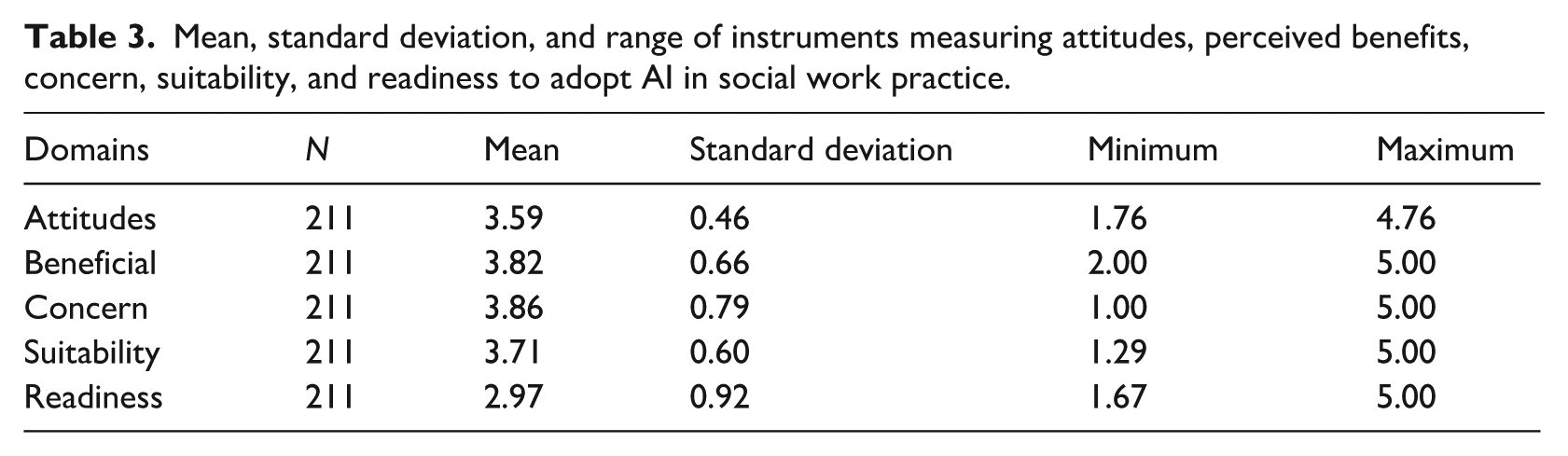
To test the internal validity of the constructed instruments used to measure the five sub-domains, the Cronbach’s alpha of the different domains was tested, and all of them have a good score of more than 0.8. As all the instruments across the five domains have an internal validity of more than 0.7, they were accepted for the study. A summary of the internal validity of the five domain instruments is given in Table 2 in Appendix 1. Table 3 provided a summary of the Mean and standard deviation of the five domain instruments instruments measuring attitudes, perceived benefits, concern, suitability, and readiness to adopt AI in social work practice.
Attitudes towards AI in social work
Overall, social workers demonstrated a generally positive attitude towards AI with a score of 3.59 over 5 in this subscale, with a majority of the attitude-related items scoring above 3.5. The highest agreement was found with the statements indicating that participants believed ‘AI can provide new opportunities for the social work profession’ (m = 4.18), perceived ‘AI as a suitable tool for routine task’ (m = 4.13), and saw ‘many beneficial applications of AI in social work’. This displays recognition that AI might perform better than humans in selected tasks, reflecting a nuanced appreciation of AI’s strengths. These findings aligned with literature that highlighted the growing optimism within human services professions regarding AI-enhanced practice (Dey, 2023; Jackson and Malone, 2024). On the other hand, some ambivalence was noted in statements regarding client receptivity to AI and job security participants. These participants scored the lowest on ‘I am not worried that my job will be taken away by AI in the future’ (m = 2.66) and ‘my client is open to interact with an AI’ (m = 2.91), indicating some fear associated with job security and displacement of some social work roles. This tension reflected that professionals remain cautiously optimistic amid growing automation (Tveita and Hustad, 2025).
Perceived benefits of AI integration
Social workers perceived AI integration in social work as beneficial, with a score of 3.75 over 5 on this eight-item subscale. All items in this domain received favourable mean scores (m > 3.5), particularly, participants perceiving that AI can ‘improve efficiency and productivity’ (m = 4.36) and ‘increase accessibility of information’ (m = 4.2), but there were mixed responses about AI’s ability to ‘personalize & customize services’ (m = 3.45) and about ‘provision of data informed assessment and decision-making’ (m = 3.66). These responses echoed broader discourses in the field regarding AI’s promise to optimise social service delivery while improving outcomes for both clients and practitioners (Dey, 2023; Nuwasiima et al., 2024).
Ethical and practice concerns
Participants had a mean of 3.83 over 5 on this seven-item subscale, indicating ethical concerns on the use of AI in social work practice. Items such as ‘confidentiality and privacy’ (m = 4.19), ‘plagiarism and originality of information’ (m = 4.09), and ‘accountability issues’ (m = 4.02) were the greatest concerns raised, indicating the presence of caution and ethical hesitations. Participants were least concerned about ‘AI equity and access’ (m = 3.4), ‘impact on client–worker relationship’ (m = 3.62), and ‘autonomy in decision-making’ (m = 3.8), signifying confidence that AI would serve as a tool rather than replace social workers’ assessment and working relationships with their clients. This highlighted a critical challenge for how the profession can integrate AI in a way that preserves core social work values, particularly client-centredness and ethical accountability (Naslund et al., 2020).
Suitability of AI in practice domains
AI was perceived as suitable for a wide range of social work tasks, with programme evaluation (m = 4.18), programme development (m = 4.1), and information and referral (m = 3.9) being the most suitable ones, while groupwork (m = 3.39), community work (m = 3.51), and casework (m = 3.52) were perceived as least suitable. This reflected practitioners’ caution with regard to using AI in more relationally intensive functions such as casework, groupwork, and community work. This suggests that while AI is embraced for technical and analytical functions, its role in interpersonal domains remains contested.
Readiness to adopt AI
Interestingly, participants scored a low level of readiness (m = 2.97) to adopt AI, with scores below 3.5 across all the six social work tasks in the subscale. Participants indicate least readiness to adopt AI in ‘needs and risk assessment’ (m = 2.42), ‘psychoeducation’ (m = 2.86), and ‘research’ (m = 3.08). The low readiness to adopt AI despite their positive attitude signals a need to help social workers increase their readiness through training, policies, and infrastructure.
Comparative and inferential statistics
Independent-samples t-test and ANOVA analysis was conducted to examine differences in the mean of attitudes, perceived benefits, suitability, concerns, and readiness among respondents with different demographic characteristics. Using independent-samples t-test, no significant results were obtained when comparing between gender or between workers who work/do not work directly with clients. Using one-way ANOVA to compare across age, younger participants perceived AI as more beneficial (F(4, 206) = 2.85, p = 0.025). When compared across years of social work experience, participants with less work experience had higher positive attitudes (F(5, 205) = 6.89, p < 0.001), appraised AI to be more beneficial (F(5, 205) = 3.85, p = 0.002), and perceived AI to be more suitable for different domains of social work practice (F(5, 205) = 4.34, p = 0.001). There were no observed differences when compared across participant’s age, education level, and participant’s subsectors.
In summary, the findings suggest that social workers were cautiously optimistic about the integration of AI into their professional practice. While they recognised substantial benefits and expressed readiness for adoption, their concerns, particularly around ethics and the relational aspects of practice, underscored the need for thoughtful, values-driven implementation strategies.
Discussion
This study contributes to the growing discourse on the implications of AI in social work by offering empirical insights into the attitudes, concerns, and readiness among Singapore social workers. The findings revealed a picture of cautious optimism among the participants towards AI adoption in practice.
The positive orientation towards AI, evident in the high scores for attitudes, as well as perceived benefits and suitability in administrative domains, aligns with global research highlighting the potential of AI to enhance efficiency, streamline workflows, and improve access to information (Jackson and Malone, 2024; Kassar et al., 2024). Social workers in this study recognised AI’s utility in programme evaluation and referral systems, which require analytical rigour more than relational depth. This finding mirrored studies in other developed contexts, such as Australia and the United Kingdom, where AI has been utilised to support back-end functions (Barrera-Algarín et al., 2023; Isbanner et al., 2022).
However, participants were remarkedly more hesitant about AI’s use in relational aspects of social work such as casework, groupwork, and community practice. This scepticism reinforced the argument that AI’s role must be carefully delimited, particularly in contexts requiring empathy, moral reasoning, and cultural sensitivity, in line with social work identity (Qi et al., 2024; Reamer, 2023). The low readiness scores despite favourable attitudes and perceived benefits suggest that enthusiasm alone does not translate into implementation. This underscores a pressing need to strengthen digital competency among social workers in Singapore, particularly through structured training, supervision, and continuing professional education. Similar findings have been reported elsewhere: without targeted training and institutional support, frontline social workers may lack the confidence and capacity to use AI tools responsibly and effectively (Hodgson et al., 2022; Wassal et al., 2024).
While participants demonstrated generally positive attitudes and saw potential benefits in AI integration, especially for administrative and analytical tasks, the low readiness scores highlight a significant implementation gap. This gap is particularly pronounced among more experienced and older practitioners, suggesting that digital literacy initiatives must be targeted and inclusive. Integrating AI-related modules into professional development programmes and social work curricula can empower practitioners to critically assess, ethically deploy, and collaboratively design AI systems. Such training would not only enhance confidence and reduce resistance but also safeguard the relational, ethical core of social work in an increasingly data-driven context (Dey, 2023; Reamer, 2023).
The general ethical concerns expressed by most participants, particularly around data privacy, accountability, and originality, are consistent with literature calling for robust regulatory frameworks and practice standards (Grant, 2018; Reamer, 2023). The tension between innovation and social work’s commitment to human dignity is not easily resolved. Rather, it requires a participatory approach to AI development where social workers are actively involved in designing, piloting, and evaluating tools to ensure that they align with professional values and service user rights (Barrera-Algarín et al., 2023).
From an inferential perspective, no significant differences emerged between gender and client-facing roles with respect to attitudes, perceived benefits, suitability, concerns, or readiness. This underscores that professional alignment and shared social work values may play a stronger role than personal characteristics in shaping perspectives towards emerging technologies.
Age, however, was a differentiating factor. Younger participants perceived AI as more beneficial (F(4, 206) = 2.85, p = 0.025). This may be attributed to greater digital familiarity and openness to technological change among younger cohorts, who are often more adept at integrating new tools into practice. Conversely, older social workers may have more established practice routines and could be more cautious in appraising novel interventions, particularly those involving complex technologies like AI.
Years of social work experience also significantly influenced responses. Social workers with fewer years of experience showed more positive attitudes (F(5, 205) = 6.89, p < 0.001), perceived AI as more beneficial (F(5, 205) = 3.85, p = 0.002), and found AI more suitable across practice domains (F(5, 205) = 4.34, p = 0.001). These outcomes sustain the generational and professional trajectory argument that newer entrants, potentially digital natives, are more receptive to AI. Existing studies similarly note that digital self-efficacy and technical knowledge are key predictors of favourable AI attitudes (Mimmo, 2025; Nuwasiima et al., 2024). In line with diffusion of the innovation theory, such practitioners can be categorised as early adopters with greater openness to change.
Surprisingly, no significant differences were observed across educational level or the subsector of employment (e.g. family services, healthcare, community development). This suggests that receptivity to AI in social work is not shaped by academic credentials or domain-specific practice contexts. Instead, attitudes appear to be more strongly linked to experiential and generational factors. This has important implications for workforce development: rather than focusing solely on educational interventions, strategies to foster readiness may need to target senior and more experienced practitioners, addressing concerns related to professional identity, practice suitability, and ethical implications.
Taken together, these findings indicate that while the social work profession in Singapore demonstrates an overall openness to AI, attitudes are stratified by age and professional experience. Younger and less-experienced practitioners are more optimistic about the potential of AI, whereas seasoned practitioners may require more engagement, dialogue, and tailored capacity-building efforts to ensure inclusive adoption. These patterns highlight the importance of a nuanced, multi-pronged approach in introducing AI to social work practice–one that balances enthusiasm with critical reflection, and innovation with regard to the profession’s deeply rooted humanistic values.
Conclusion
As AI continues to evolve, its integration into social work practice appears both inevitable and contested. This study underscores a dual reality: social workers in Singapore are broadly optimistic about AI’s potential benefits but remain wary of its ethical and relational implications. The discrepancy between positive attitudes and low readiness reveals a critical gap that institutions and leaders will have to consider when rolling out training and engagement to help social workers with their readiness towards AI adoption. More importantly, the implementation of AI in social work must be guided by core values of the profession such as respect for human dignity, cultural competence, social justice, and relational accountability (Reamer, 2023) Only then can AI be leveraged not merely as a tool for efficiency but as a partner in enhancing the reach, quality, and impact of social work practice.
Recommendations
To bridge this gap, social work educators, agency leaders, and policymakers must work collaboratively to embed digital competencies within professional development frameworks.
Social workers should proactively engage with the evolving adoption of AI by staying informed, critically assessing its ethical implications, and advocating for its responsible use in practice. They must also develop digital competencies and collaborate across disciplines to ensure that AI supports, rather than replaces, human-centred and values-driven social work (Tan and Shajahan, 2022).
Future research should explore longitudinal outcomes of AI integration, focusing on both client experiences and practitioner wellbeing. Comparative studies across different Asian contexts may also yield culturally specific insights into how AI can be ethically adapted to local needs. A study to understand the attitude and readiness to adopt AI among social work students may also inform social work academics on how they can better prepare students for ethical AI adoption in social work practice. Ultimately, an inclusive, critically reflective, and values-driven approach to AI adoption is essential to safeguard the heart of social work in a digital age.
Supplemental Material
sj-pdf-1-isw-10.1177_00208728261453261 – Supplemental material for Tools or threat: Social workers’ attitudes, concerns, and readiness for artificial intelligence in Singapore
Supplemental material, sj-pdf-1-isw-10.1177_00208728261453261 for Tools or threat: Social workers’ attitudes, concerns, and readiness for artificial intelligence in Singapore by Terence Tuck Sheng Yow, Grace Jia Hui Chee, Nicholas Raphael Netto and Satvinder Singh Dhaliwal in International Social Work
Supplemental Material
sj-pdf-2-isw-10.1177_00208728261453261 – Supplemental material for Tools or threat: Social workers’ attitudes, concerns, and readiness for artificial intelligence in Singapore
Supplemental material, sj-pdf-2-isw-10.1177_00208728261453261 for Tools or threat: Social workers’ attitudes, concerns, and readiness for artificial intelligence in Singapore by Terence Tuck Sheng Yow, Grace Jia Hui Chee, Nicholas Raphael Netto and Satvinder Singh Dhaliwal in International Social Work
Supplemental Material
sj-pdf-3-isw-10.1177_00208728261453261 – Supplemental material for Tools or threat: Social workers’ attitudes, concerns, and readiness for artificial intelligence in Singapore
Supplemental material, sj-pdf-3-isw-10.1177_00208728261453261 for Tools or threat: Social workers’ attitudes, concerns, and readiness for artificial intelligence in Singapore by Terence Tuck Sheng Yow, Grace Jia Hui Chee, Nicholas Raphael Netto and Satvinder Singh Dhaliwal in International Social Work
Footnotes
Appendix 1
Mean, standard deviation, and range of instruments measuring attitudes, perceived benefits, concern, suitability, and readiness to adopt AI in social work practice.
| Domains | N | Mean | Standard deviation | Minimum | Maximum |
|---|---|---|---|---|---|
| Attitudes | 211 | 3.59 | 0.46 | 1.76 | 4.76 |
| Beneficial | 211 | 3.82 | 0.66 | 2.00 | 5.00 |
| Concern | 211 | 3.86 | 0.79 | 1.00 | 5.00 |
| Suitability | 211 | 3.71 | 0.60 | 1.29 | 5.00 |
| Readiness | 211 | 2.97 | 0.92 | 1.67 | 5.00 |

Ethical considerations
Ethics approval was provided by Singapore University of Social Sciences Institutional Review Board. Ethics approval number: APL-0300-2024-EXE-01. Date of approval: 22 October 2024. Date of recruitment: 23 October 2024.
Funding
The authors received no financial support for the research, authorship, and/or publication of this article.
Declaration of conflicting interests
The authors declared no potential conflicts of interest with respect to the research, authorship, and/or publication of this article.
Data availability statement
The anonymised raw data of this research study is uploaded as part of the submission to this journal.
Supplemental material
Supplemental material for this article is available online.
Declaration of use of AI
In the preparation of this manuscript submitted to International Social Work, AI tools (such as ChatGPT and Co-Pilot) were employed solely to assist with literature scanning and language proofreading. These tools did not generate any original content, data, or analysis. All outputs produced with AI support were carefully reviewed, verified, and edited by the authors to ensure academic rigour and alignment with the study’s objectives. The research design, data collection, analysis, and all substantive writing are entirely the original work of the authors.
Author biographies
References
Supplementary Material
Please find the following supplemental material available below.
For Open Access articles published under a Creative Commons License, all supplemental material carries the same license as the article it is associated with.
For non-Open Access articles published, all supplemental material carries a non-exclusive license, and permission requests for re-use of supplemental material or any part of supplemental material shall be sent directly to the copyright owner as specified in the copyright notice associated with the article.
