






Abstract
This review synthesised recent evidence on social workers’ roles in disasters and pandemics. Major health and social science databases were searched for English-language empirical studies published between 2020 and 2025. Twenty studies were included and critically appraised. The synthesis identified six recurring practice functions: psychosocial assessment and triage, case management and resource navigation, safeguarding, interagency coordination and advocacy, community engagement and culturally responsive communication, and workforce support with ethical decision-making. Findings suggest that social work plays an important integrative role across disaster contexts, while role clarity, training, supervision and organisational readiness remain key implementation challenges.
Keywords
Introduction
Crises and disasters have become persistent, system-shaping realities for social welfare, health and humanitarian services. While “crisis” is often used broadly, it is commonly defined as a disruptive event or condition that creates instability and overwhelms existing coping resources, producing heightened vulnerability but also a time-limited window for effective intervention (Caplan, 1964; Garayev, 2013; Roberts, 2005). In disaster research, hazards are understood as potentially damaging events or processes, while disasters occur when such hazards interact with social vulnerability and exceed the capacity of a community or society to cope using available resources (UNDRR, 2017).
This understanding directs attention beyond hazards themselves to the social, economic and institutional conditions that determine who is exposed, who is protected and whose needs remain unmet. In disaster scholarship and practice, vulnerability is therefore treated as socially produced and unevenly distributed, with disasters frequently amplifying pre-existing inequalities (Wisner et al., 2004; Zakour and Gillespie, 2013). This perspective is particularly relevant for social work, whose practice focuses on the interaction between structural disadvantage, service systems and community resilience.
Contemporary crisis governance increasingly adopts an “all-hazards” framing that spans four interlinked phases—mitigation, preparedness, response and recovery—supported by coordinated strategies, institutions and mechanisms commonly discussed under Disaster Risk Management (DRM) and Disaster Risk Reduction (DRR) (IFRC, 2020; UNDRR, 2015). The Sendai Framework for Disaster Risk Reduction (2015–2030) reinforces this orientation by emphasising prevention, preparedness and resilience-building, while highlighting the need for multi-sectoral coordination and locally grounded capacity (UNDRR, 2015).
For social work, this policy architecture matters because it shapes whether social workers are recognised as core actors across the disaster cycle or are mobilised late and inconsistently, often without clear mandates, interoperable information systems or sustained organisational support. Where such integration is weak, social workers may be positioned primarily in downstream response roles rather than being involved in preparedness planning, risk reduction and recovery governance.
Social work’s relevance to disasters has historical roots, but the field of “disaster social work” has become more explicit and theoretically consolidated since the 2000s, drawing on concepts such as resilience, capacity building, community empowerment and trauma-informed practice (Dominelli, 2014; Drolet et al., 2019; Iravani and Parast, 2014; Zakour and Gillespie, 2013). Across this literature, social work practice in disasters is commonly associated with psychosocial support, safeguarding, advocacy, community engagement and recovery-oriented interventions.
This consolidation aligns with broader developments in international social work, which emphasises professional action in an interdependent world, attention to transnational risk and ethical responsibilities shaped by global inequalities (Healy, 2008). The Global Definition of Social Work further anchors the profession in principles of social justice, human rights, collective responsibility and respect for diversities—principles that become especially salient when disasters expose systemic exclusion and differential access to protection and recovery resources (IFSW, 2014).
The COVID-19 pandemic, alongside climate-related and compound emergencies, has intensified interest in how social work practice adapts under prolonged uncertainty and constrained resources. Empirical work during COVID-19 highlights the profession’s contributions to psychosocial support, service navigation, safeguarding and advocacy, and the rapid reconfiguration of service delivery models (Hay and Pascoe, 2021a; Hussein, 2021). At the same time, this body of work has foregrounded ethical challenges, including the tension between duty of care and institutional constraints, the need to prioritise high-risk groups under scarcity and the moral strain associated with role ambiguity and safety risks—issues discussed explicitly in international social work ethics debates during the pandemic (Banks et al., 2020). These pressures are not unique to pandemics; they recur across disaster contexts when service systems face surge demands, organisational fragmentation and unstable interagency boundaries.
Within emergency preparedness and response systems, role clarity and interprofessional coordination are central determinants of effectiveness. Social workers frequently operate at the interface of statutory services, community-based organisations, and humanitarian or emergency management structures, making their effectiveness dependent on how well social work is integrated into multi-agency arrangements and leadership pathways. Recent scholarship points to an expanding, yet often inconsistently formalised, role for social work within emergency preparedness—raising questions about competencies, organisational readiness and the profession’s positioning within incident governance (Kim and Keum, 2021; Zapf and Dean, 2023). Disaster-specific education, supervision and workforce development have similarly been highlighted as prerequisites for sustainable practice, particularly where practitioners face repeated exposures to trauma, uncertainty and ethical dilemmas.
Despite the growing volume of publications on social work in disasters, the evidence base remains fragmented across event types (e.g. pandemics, wildfires, floods), sectors (e.g. health, child protection, community services) and national systems. This fragmentation can obscure cross-cutting role functions and make it difficult to translate insights into generalisable practice and preparedness recommendations. It also limits understanding of which elements of social work practice are context-specific and which may be transferable across disaster settings. Qualitative and mixed-methods studies are particularly important in this area because they illuminate the processes of practice—how social workers assess needs under pressure, negotiate interagency boundaries, mobilise resources and interpret ethical obligations within real-world constraints. Quantitative descriptive cross-sectional studies also contribute by documenting patterns in workforce preparedness, organisational support and psychosocial outcomes, complementing qualitative insights and supporting triangulation across study designs. Methodologically, systematic approaches to qualitative evidence synthesis are well suited to identifying patterns and transferable insights across diverse sociocultural contexts while maintaining transparency and rigour (Booth et al., 2016; Thomas and Harden, 2008). Such approaches are particularly valuable in fields where practice varies across welfare systems, service infrastructures and sociocultural contexts.
Aim and review questions
Against this background, the present systematic review synthesises evidence from primary qualitative, mixed-methods and quantitative descriptive cross-sectional studies on social workers’ roles in disasters and pandemics, with a focus on practice implications relevant to international social work. By synthesising recent empirical studies across diverse crisis contexts, the review seeks to identify recurring practice functions that may inform preparedness, response and recovery within international social work systems. The review addresses four questions: (1) how social workers’ roles and contributions are described across crisis and disaster settings; (2) which cross-cutting practice functions recur across contexts and systems; (3) what constraints and enabling conditions are reported (including role clarity, coordination, information systems, training and organisational support); and (4) what implications follow for social work practice, preparedness and workforce development in international contexts.
Methods
Design and reporting framework
This study is a systematic review of primary qualitative, mixed-methods and quantitative descriptive cross-sectional studies on social workers’ roles in crises and disasters. The methodological approach followed guidance for systematic reviews of qualitative studies and was reported in alignment with PRISMA, with the study selection process documented through a PRISMA flow diagram. In contrast to scoping reviews that primarily map available evidence, the present review also included methodological quality appraisal of all included studies using Joanna Briggs Institute critical appraisal tools.
Search strategy
The literature search was conducted in PubMed, Scopus and EBSCOhost. Within EBSCOhost, the following databases were searched: CINAHL, PsycINFO and SocINDEX.
Keywords were selected based on the thematic axes of the review and combined using Boolean operators (AND, OR). The core search string was: (“social work” OR “social worker”) AND (“role”) AND (“disaster” OR “crisis”) AND (“intervention” OR “response”). Searches were limited to English-language studies with full text available and restricted to the publication years 2020–2025. The final search was run on 30 June 2025.
Eligibility criteria
We included English-language primary qualitative, mixed-methods and quantitative descriptive cross-sectional studies published between 2020 and 2025 that examined social work involvement in disasters and pandemics. Studies were excluded if they were (a) systematic reviews or theoretical papers; (b) focused on other professional groups without involvement of social workers, or addressed topics not aligned with the review question; and (c) did not meet quality appraisal prerequisites.
Study selection
Study selection was completed in sequential stages. Initially, 146 records were identified across the databases (PubMed n = 45; Scopus n = 62; EBSCOhost n = 39). Title and abstract screening led to the exclusion of 101 records (other professions without social worker involvement n = 37; topic not aligned with the research questions n = 37; incompatible study design n = 24; not available n = 3). Forty-five full-text articles were assessed for eligibility. Following duplicate checking, 20 records were removed and 25 articles remained for full assessment by the primary reviewer. The remaining material was then re-evaluated by a second reviewer, who made final additions and removals to ensure comprehensive coverage of the research question. After this second review, 5 articles were excluded, and 20 studies were included by agreement between the 2 reviewers. The study selection process is summarised in Figure 1.
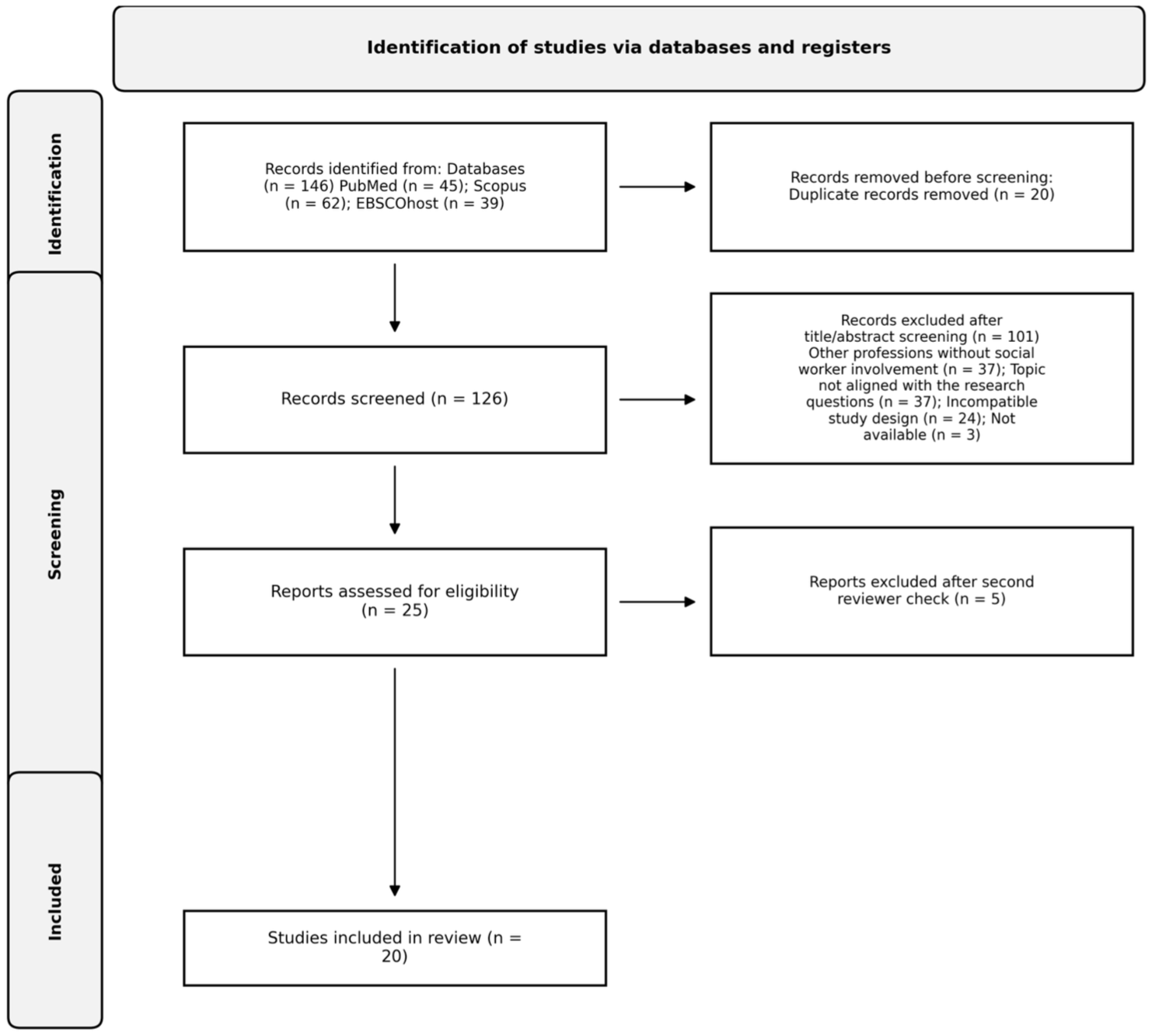
Study identification, screening and inclusion flow diagram for the review of social work roles in disasters and pandemics. Records were retrieved from PubMed, Scopus and EBSCOhost (search period: January 2020–June 2025); duplicates removed (n = 20); records screened (n = 126); reports assessed for eligibility (n = 25); and studies included (n = 20).
Quality appraisal
Methodological quality appraisal was undertaken using Joanna Briggs Institute (JBI) critical appraisal tools (Aromataris and Munn, 2020). The JBI Critical Appraisal Checklist for Qualitative Research was used for qualitative studies, and the JBI Critical Appraisal Checklist for Analytical Cross-Sectional Studies was used for the two mixed-methods studies that included quantitative components. Appraisal focused on study validity and transparency, including clarity of aims, appropriateness of methods, data collection and analysis procedures, and other established indicators of quality.
Data extraction
Key information was extracted from each included study and organised in Microsoft Excel to support systematic comparison across studies. The use of structured tables facilitated cross-checking of findings by study and supported identification of recurring patterns and differences across settings.
Data synthesis
Qualitative findings including qualitative components of mixed-methods studies were synthesised using an inductive thematic synthesis. Quantitative-only studies were summarised descriptively and used to triangulate themes and constraints. The synthesis followed the staged process described by Nowell et al. (2017): familiarisation through repeated reading, initial coding, theme generation, theme review for coherence and representativeness, defining and naming themes, and final synthesis and presentation in relation to the review question. Theme development followed an iterative process of constant comparison and reflexive review. The final thematic structure was validated by a second reviewer to strengthen credibility and reproducibility of the thematic synthesis. The aim of the synthesis was to identify cross-cutting practice functions recurring across different disaster types, service sectors and national contexts.
Results
A total of 20 studies were included and synthesised (Figure 1). Results are presented in two parts: (a) an overview of study characteristics and (b) a thematic synthesis organised around six cross-cutting functions of social work in crisis and disaster settings. Table 1 summarises the characteristics of the included studies, and Table 2 summarises methodological appraisal and reported limitations.
Characteristics of included studies examining social work practice in disasters and pandemics (N = 20).
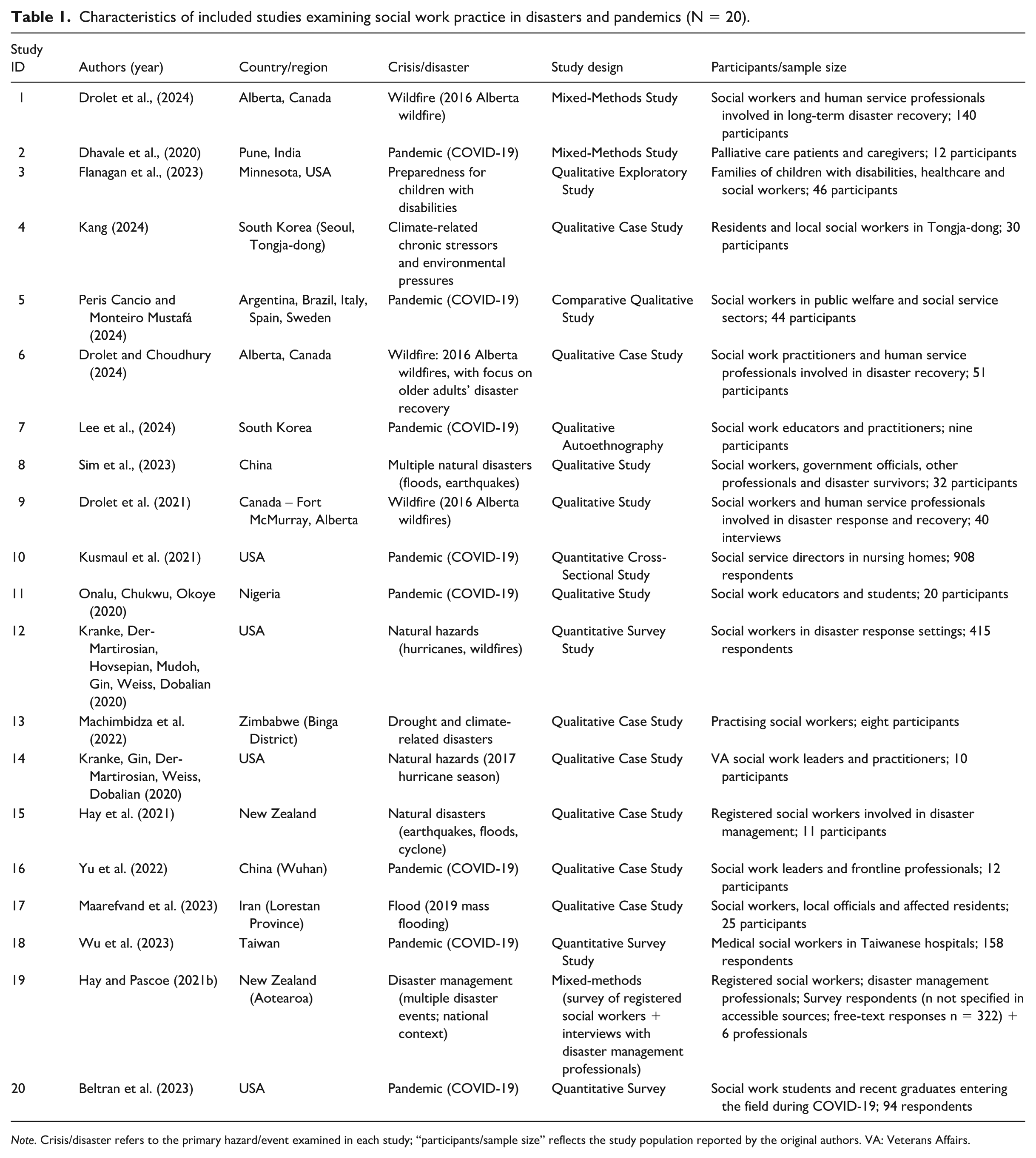
Note. Crisis/disaster refers to the primary hazard/event examined in each study; “participants/sample size” reflects the study population reported by the original authors. VA: Veterans Affairs.
Methodological quality appraisal (JBI critical appraisal checklists) and author-reported limitations of included studies on social work practice in disasters and pandemics (N = 20).
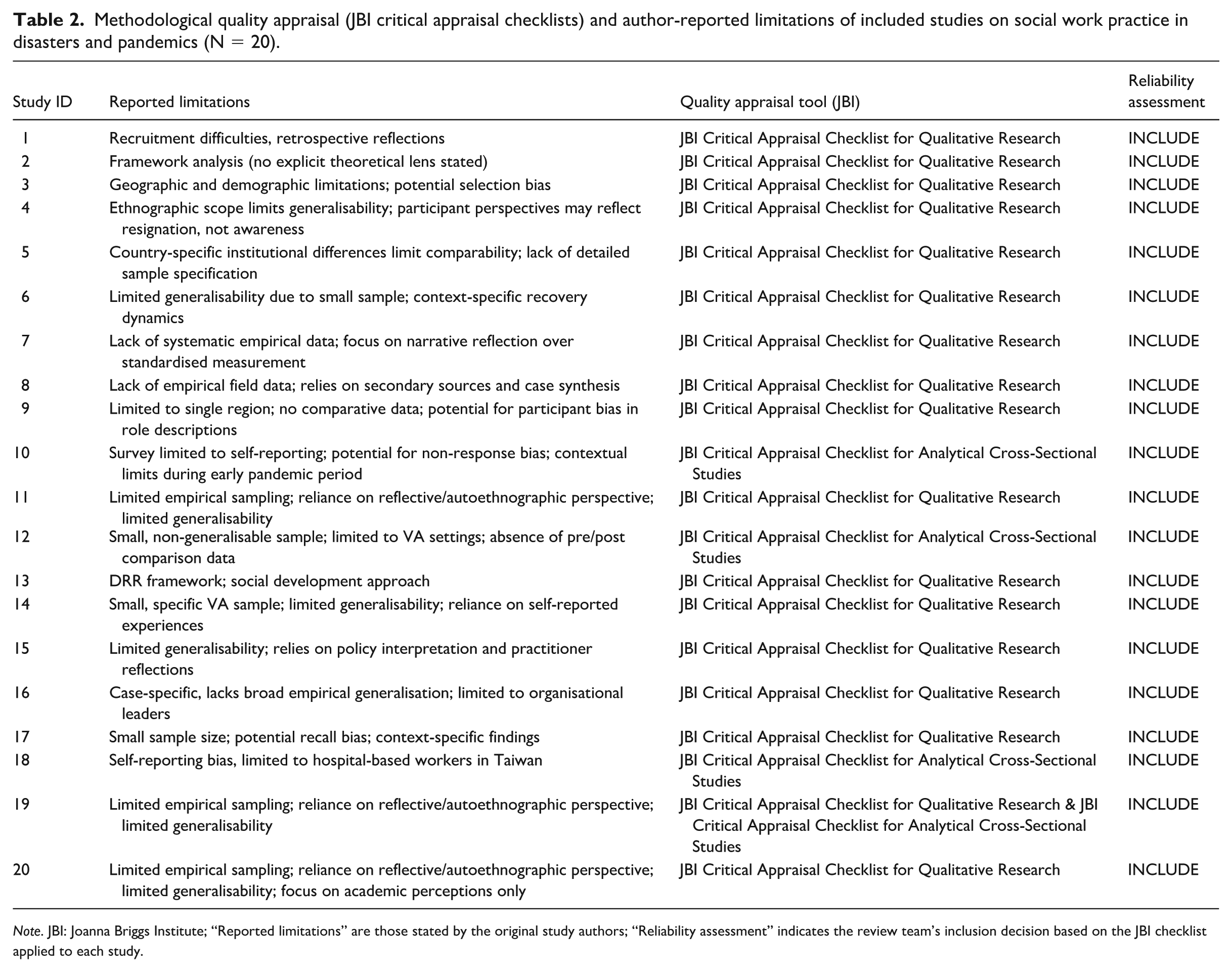
Note. JBI: Joanna Briggs Institute; “Reported limitations” are those stated by the original study authors; “Reliability assessment” indicates the review team’s inclusion decision based on the JBI checklist applied to each study.
Study characteristics
The included evidence base was predominantly qualitative, reflecting an emphasis on understanding social work practice, professional judgement and role negotiation under crisis conditions. Most studies applied qualitative case study or exploratory designs, drawing on in-depth interviews, focus groups and document analyses to capture lived experiences of practitioners and communities (Drolet et al., 2021; Hay and Pascoe, 2023). Several studies also used participatory or reflexive qualitative approaches to situate social work practice within specific crisis contexts (Kang, 2024; Peris Cancio and Monteiro Mustafá, 2024). Quantitative methods were less common but included cross-sectional surveys assessing workforce preparedness, psychosocial outcomes and perceived organisational support (Beltran et al., 2023; Kusmaul et al., 2021; Wu et al., 2022). The diversity of methodologies underscores the multidimensional nature of social work during emergencies, spanning psychosocial care, policy advocacy and systems coordination.
Geographically, the studies represented five continents—North America, Europe, Asia, Oceania and Africa—illustrating the profession’s global reach. Research in high-income countries such as Canada, the United States and New Zealand emphasised system coordination, disaster governance and workforce roles and challenges (Drolet et al., 2021; Hay et al., 2021; Kranke et al., 2020). Studies from Asia and Africa focused on resource constraints, context-specific service barriers and community-based interventions (Yu et al., 2022; Machimbidza et al., 2022; Maarefvand et al., 2023). Overall, the included studies suggest that while crisis contexts differ, social work practice adapts to institutional and cultural settings in ways that shape how core functions are enacted in response and recovery.
Crisis and disaster types
Natural hazards such as wildfires, floods, earthquakes, hurricanes, cyclones and droughts were the most frequently examined (n = 10). This count includes studies focused on natural disaster events or disaster management contexts and excludes pandemic-focused studies and general all-hazards education studies. For instance, Drolet et al. (2021, 2024) and Drolet and Choudhury (2024) explored the role of Canadian social workers during the Alberta wildfires, highlighting their engagement in emergency relief and post-disaster community rebuilding. Hay and Pascoe (2021b) examined disaster management in Aotearoa New Zealand, demonstrating how culturally grounded approaches informed social work responses. Maarefvand et al. (2023) described social work roles in the context of flooding in Iran, while Machimbidza et al. (2022) examined social work practice in drought- and climate-related crises in Zimbabwe. Additional studies addressed natural hazard contexts in the United States, including hurricanes and wildfires, and the 2017 hurricane season (Kranke et al., 2020).
Public health emergencies, particularly the COVID-19 pandemic, accounted for seven studies. These highlighted the shift to remote practice, ethical dilemmas in balancing self-care and professional duty, and social protection for vulnerable groups such as older adults, migrants and persons with disabilities (Kusmaul et al., 2021; Yu et al., 2022; Peris Cancio and Monteiro Mustafá, 2024; Wu et al., 2023). Several studies also addressed climate-related stressors and environmental pressures as chronic crisis conditions (Kang, 2024) and examined disaster preparedness within social service organisations and professional education settings (Beltran et al., 2023; Flanagan et al., 2023). One study explored all-hazards preparedness within social service agencies, noting that few organisations had structured contingency plans before 2020 (Lee et al., 2024).
Collectively, the 20 studies portray social work as operating across multiple hazard types and time frames, from immediate response to long-term recovery. Across these contexts, the evidence highlights recurring social work contributions in psychosocial support, service navigation, safeguarding and coordination, while also reflecting variation in how practice is shaped by local systems, resources and cultural settings.
Quality appraisal
All studies were critically appraised using Joanna Briggs Institute (JBI) tools. Overall, appraisal indicated that the included studies were of generally acceptable methodological quality for inclusion in the synthesis. Common methodological limitations included limited transparency regarding reflexivity, small sample sizes and descriptive rather than analytical reporting. Several qualitative studies provided rich, contextual insights but lacked explicit theoretical framing. Others were constrained by single-site designs or by focusing on practitioner perspectives without triangulating client or policy data. These limitations were considered when interpreting the thematic findings, and confidence in context-specific interpretations was treated cautiously where reporting was limited. The overall strength of the evidence supports meaningful synthesis of professional roles, competencies and organisational challenges in disaster settings.
Thematic synthesis: Six cross-cutting functions of social work
Across contexts and hazard types, the synthesis identified six interrelated and often overlapping functions of social work in crisis and disaster situations. These functions reflect practice spanning micro-, meso- and macro-level interventions and are presented below.
Rapid psychosocial assessment and triage
Across disaster and pandemic contexts, social workers described rapid assessment of psychosocial needs and risk, particularly during acute response and early recovery. Assessment frequently included identifying immediate safety, basic needs, housing stability and psychosocial distress, alongside prioritisation under resource constraints (Drolet et al., 2021; Yu et al., 2022; Maarefvand et al., 2023). In pandemic settings, assessment and triage were often complicated by reduced face-to-face contact and disruptions in service access, requiring adaptation of assessment and follow-up processes (Kusmaul et al., 2021; Wu et al., 2023). Several studies highlighted the importance of local system knowledge and community proximity for timely identification of emerging risks and linking people to support (Hay et al., 2021; Sim et al., 2023).
Case management, resource navigation and access to services
A second recurring function involved coordinating access to services when routine pathways were disrupted. Social workers described acting as brokers across organisations and sectors, supporting access to emergency relief, housing, health and social care, and income-related supports (Drolet et al., 2021; Yu et al., 2022; Maarefvand et al., 2023). During the pandemic, studies reported rapid shifts to remote support and increased administrative coordination demands, including maintaining continuity of support in institutional and community care settings (Kusmaul et al., 2021; Wu et al., 2023). Cross-national accounts described how navigation work was shaped by variable eligibility rules and service capacity constraints across welfare systems (Peris Cancio and Monteiro Mustafá, 2024).
Safeguarding and protection of at-risk groups
Safeguarding and protection were reported as core responsibilities across crisis contexts, particularly when services were disrupted and protective systems were strained. Included studies described safeguarding concerns across a range of populations, including older adults and groups facing exclusion from services during crisis response (Kusmaul et al., 2021; Yu et al., 2022). In COVID-19 contexts, reduced visibility of households and limited in-person contact increased the complexity of risk identification and follow-up, prompting adapted monitoring strategies and intensified interagency communication (Kusmaul et al., 2021; Wu et al., 2023). In disaster settings, safeguarding was frequently linked to advocacy and resource navigation to reduce access barriers for those facing heightened risk (Drolet et al., 2021; Machimbidza et al., 2022).
Interprofessional and interagency coordination and advocacy
Interprofessional and interagency coordination emerged as a key function enabling effective response and recovery. Studies described social workers operating as boundary-spanners between health, welfare and community services, contributing to information exchange, shared problem-solving and linking service users to relevant agencies (Drolet et al., 2021; Hay and Pascoe, 2021b; Sim et al., 2023). Coordination frequently involved advocacy to address unmet needs, exclusions from support and service gaps, particularly where crisis response systems prioritised operational or clinical demands (Machimbidza et al., 2022; Peris Cancio and Monteiro Mustafá, 2024). Several studies also reported coordination challenges associated with fragmented governance arrangements, inconsistent role definitions and limited surge capacity (Kranke et al., 2020; Kusmaul et al., 2021).
Community engagement, risk communication and culturally responsive practice
Community engagement was repeatedly described as supporting trust, accessibility and legitimacy of crisis response. Studies emphasised engagement with local networks and culturally grounded approaches, particularly in disaster management contexts where social cohesion and community leadership were central to recovery (Drolet et al., 2021; Hay et al., 2021). Risk communication and information-sharing were also highlighted in pandemic contexts, including translating guidance into accessible forms and supporting uptake of protective behaviours under uncertainty (Yu et al., 2022; Wu et al., 2023). Cross-national accounts indicated that culturally responsive practice and community connection were shaped by welfare system capacity, digital access and local organisational arrangements (Peris Cancio and Monteiro Mustafá, 2024).
Workforce support, ethical challenges and reflective practice under moral strain
A final recurring function concerned workforce support and ethical challenges under sustained stress and uncertainty. Across pandemic and disaster contexts, studies described moral strain, role pressure and the cumulative burden of prolonged crisis conditions, particularly where resources were constrained and organisational expectations were ambiguous (Kusmaul et al., 2021; Onalu et al., 2020; Wu et al., 2023). Several studies noted the importance of supervision, peer support and structured reflection to sustain practice and reduce distress, alongside organisational supports that enabled safe and sustainable service delivery (Kranke et al., 2020; Peris Cancio and Monteiro Mustafá, 2024). Workforce preparedness and training were also discussed as determinants of confidence and practice sustainability, particularly in organisational and educational settings where crisis roles expanded rapidly (Beltran et al., 2023; Kranke et al., 2020).
Cross-cutting constraints and implementation gaps
Across the included studies, several recurring constraints were reported. These constraints were often experienced as operational “friction” during response and early recovery: unclear lines of authority and rapidly shifting responsibilities between agencies; inconsistent thresholds for eligibility and access to relief or social protection; duplication or gaps in referrals when organisations relied on parallel record systems; and delays in follow-up when information flow depended on informal personal contacts rather than shared protocols. Such organisational volatility can amplify moral strain for social workers, who must reconcile urgent needs with limited resources and procedural uncertainty. These conditions underscore that effective crisis social work depends not only on individual competence but also on pre-established coordination routes, interoperable referral pathways and stable supervision arrangements that remain functional under surge conditions. Role ambiguity and inconsistent integration within emergency and organisational decision-making structures were described as limiting participation in planning and coordination, particularly under surge conditions (Hay and Pascoe, 2021b; Kranke et al., 2020). Limited surge capacity and resource constraints were reported as constraining continuity of psychosocial and safeguarding functions and delaying timely service access (Kusmaul et al., 2021; Machimbidza et al., 2022; Maarefvand et al., 2023). Fragmented information systems and variable interagency communication were also identified as barriers to effective coordination and follow-up (Sim et al., 2023; Wu et al., 2023). Gaps in disaster-specific training and preparedness were noted across contexts, including limited formal preparation for crisis roles in organisational and early-career professional settings (Beltran et al., 2023; Kranke et al., 2020). Taken together, these constraints suggest that the effectiveness of social work functions in crises depends not only on individual competence but also on organisational readiness, coordination infrastructures and workforce supports that can be mobilised under disruption.
Discussion
Building on the six cross-cutting functions identified in this review, this discussion interprets their implications for international social work practice, disaster governance and workforce development. Rather than presenting the functions as entirely new roles, the synthesis consolidates fragmented recent empirical evidence into an integrative framework that can support preparedness, response and recovery planning across settings, while remaining sensitive to context and culture.
Contribution relative to existing disaster social work and DRR frameworks
The six functions recur across different crisis types in ways that align with established disaster social work scholarship and disaster risk reduction frameworks. Disaster risk reduction approaches emphasise governance, preparedness investment and multi-sectoral coordination, including the Sendai Framework’s emphasis on risk-informed systems (UNDRR, 2015). The present synthesis complements that orientation by showing how social work contributions cluster into recurring practice functions (assessment/triage; navigation; safeguarding; coordination/advocacy; community engagement and risk communication; workforce support) that can be operationalised across phases of the disaster cycle, while recognising that implementation depends on organisational capacity and system readiness. The functions are best interpreted as a functional framework: the same domains recur, but enactment varies by welfare regime, institutional capacity, professional authority and emergency context. This clarifies the manuscript’s contribution as integrative synthesis rather than a claim of novelty in role definitions (Dominelli, 2014; Drolet et al., 2019).
Culture, context and transferability
International social work practice is shaped by culture and context, including community leadership, trust in institutions and the availability of formal social protection. Across the evidence base, practice differences were linked to service infrastructures, resource constraints and the extent to which social work roles were formalised within incident governance. These patterns support “same function, different enactment”: functions such as community engagement, culturally responsive communication and safeguarding require adaptation to local histories, language and governance arrangements, particularly where institutional trust is fragile (Denov and Shevell, 2019). For preparedness, this implies specifying transferable competencies (e.g. crisis assessment, referral navigation, safeguarding pathways, interagency coordination, culturally responsive risk communication) while tailoring delivery to local systems.
Implications for international social work debates: Equity, climate-related hazards and decolonising disaster governance
Beyond role clarity, the six functions intersect with debates on equity, climate-related hazards and the legitimacy of disaster governance in contexts shaped by structural inequality. Social work’s interface role—linking people facing heightened risk to service systems, safeguarding and advocating for access—becomes especially salient when crisis systems reproduce differential access to protection and recovery resources (IFSW, 2014). Community engagement and culturally grounded risk communication also highlight that crisis governance depends on legitimacy and local knowledge; where decision-making marginalises community voices, social work is positioned to bridge institutional systems and lived realities. These issues are amplified in climate-related and slow-onset crises, where emergencies may be prolonged and cumulative, requiring sustained social protection and workforce support.
Linking the findings to global guidelines and tools
Several functions align with widely used global guidance on mental health and psychosocial support and inclusion in emergencies. Interagency coordination, referral pathways, workforce support and supervision, safeguarding and inclusive approaches are emphasised in the IASC Mental Health and Psychosocial Support Minimum Service Package (IASC, 2022) and disability/inclusion guidance (IASC, 2024). Linking social work functions to such guidance can strengthen interoperability with humanitarian response systems by using shared operational language (coordination mechanisms, referral pathways, supervision structures and inclusion standards). Notably, global MHPSS standards place early emphasis on community-level mapping and needs/resources assessment to inform priorities and build on existing supports (IASC, 2022). This component was not prominent in the included social work studies and represents a practical gap for training and implementation, particularly for strengthening locally grounded planning and inclusive response design (MHPSS Minimum Service Package (IASC, 2022). Work linking disaster risk reduction and MHPSS also supports positioning these functions within upstream preparedness and systems-building (Gray et al., 2020, 2021; IASC, 2021).
Disaster governance, organisational readiness and the profession’s positioning
The effectiveness of the six functions depends on organisational readiness and how social work is positioned within emergency governance. Where roles are ambiguously defined and social work is not embedded within planning and coordination structures, engagement tends to be delayed or limited. Preparedness therefore requires role definitions, decision-making representation within coordination structures, shared protocols/referral pathways and information systems that support continuity of care under disruption (IFRC, 2020; UNDRR, 2015).
Workforce development and ethical infrastructure
Workforce support conditions the sustainability of all other functions. Ethical challenges under scarcity, ambiguous mandates and prolonged crisis exposure point to the need for “ethical infrastructure” in preparedness: structured supervision and peer support, debriefing mechanisms, clear decision protocols and organisational supports that protect workforce wellbeing (IASC, 2022). From a workforce development perspective, training should move beyond awareness towards competencies aligned with crisis assessment, interagency coordination, safeguarding under disrupted systems, culturally responsive risk communication and remote practice adaptations.
Cross-cutting constraints and implementation priorities
Consistent with the constraints identified in the Results, the synthesis supports four implementation priorities: (1) formalise social work roles within emergency governance and coordination structures; (2) strengthen surge capacity and continuity planning for psychosocial and safeguarding functions; (3) improve information systems and cross-sector communication infrastructure to support navigation and follow-up; and (4) invest in competency-based training and sustained supervision/support structures to ensure preparedness and workforce sustainability. These priorities align with DRR governance emphases and MHPSS guidance foregrounding coordination, referral pathways, inclusion and workforce support (IASC, 2022, 2024; UNDRR, 2015).
Future research should address the limited and uneven evidence base by expanding empirical work in under-represented regions and crisis contexts, including comparative studies across welfare and governance regimes. Priority areas include evaluation of interagency coordination and referral pathway interventions, the effectiveness of supervision and workforce support models under surge conditions, and the integration of community-level mapping/assessment into social work-led crisis practice. More consistent reporting of context, organisational arrangements and implementation processes would also strengthen transferability and practice guidance.
Limitations of this review
Several limitations should be noted. The review was restricted to English-language studies published between 2020 and 2025, which may have excluded relevant evidence from non-English settings and earlier disaster events. A further limitation concerns uneven global knowledge production in disaster social work, as publishing and indexing practices are disproportionately shaped by Global North research capacity, which may influence what is represented as “evidence” and whose practices are most visible in the literature. The heterogeneity of hazard types, sectors and national systems limits direct comparability across studies and precludes meta-analysis; findings should therefore be interpreted as an interpretive synthesis rather than an estimate of effect. Although quality appraisal was undertaken using Joanna Briggs Institute tools (Aromataris and Munn, 2020), primary studies varied in reporting depth, particularly regarding reflexivity and analytic transparency, which may constrain confidence in some context-specific interpretations. Finally, publication and reporting biases remain possible, and some roles or outcomes may be under-represented in the published literature despite practical salience (Page et al., 2021).
Conclusion
This systematic review identified six recurring functions that characterise social work involvement in disasters and pandemics: rapid psychosocial assessment and triage; case management and resource navigation; safeguarding and protection; interprofessional coordination and advocacy; community engagement and culturally responsive risk communication; and workforce support with ethically grounded decision-making under moral strain. Across settings, these functions suggest that social work can play an integrative role in connecting social risk, rights-oriented practice and service systems across crisis contexts, although enactment varies by institutional capacity and sociocultural setting. At the same time, persistent constraints—role ambiguity, limited surge capacity, fragmented information pathways and gaps in training and supervision—continue to limit effectiveness and sustainability. Strengthening disaster social work therefore requires explicit integration into all-hazards preparedness and governance, supported by interoperable coordination mechanisms, funded organisational supports and competency-based education. In the context of compounding climate-related events and public health emergencies, these measures are likely to be important to reduce disproportionate impacts on marginalised populations and to support resilient, inclusive recovery.
Footnotes

Funding
The authors received no financial support for the research, authorship and/or publication of this article.
Declaration of conflicting interests
The authors declared no potential conflicts of interest with respect to the research, authorship and/or publication of this article.
Data availability statement
No new data were created or analysed in this study. Data sharing is not applicable to this article.
Statement on AI
No generative artificial intelligence tools were used to search, summarise, draft, generate or edit any part of this manuscript. The authors take full responsibility for the content, accuracy, and integrity of the work.