







Abstract
Indian Knowledge Systems (IKS) have emerged as a central theme in contemporary discourses, cutting across various fields and disciplines, including education, history, science and technology, politics, and sociology. There remains, however, a striking absence of a structured, meaningful dialogue around IKS. The lack of clear boundaries and definitions opens IKS to the criticism of being an abstract concept rather than a coherent framework for understanding India’s glorious past and its achievements across history, strategy, politics, science, technology, and philosophy. In reality, IKS is a bridge between the rich traditions of India and the demands of modernity, serving as a pathway for India to reclaim its history and adapt the best practices of its past to meet contemporary challenges. IKS has the potential to function as a vital reference for contemporary Indian diplomacy, integrating cultural, philosophical, and strategic elements to define India’s role in its international relations and to foster a distinctive approach to global governance. This article aims to contribute to the creation of a foundational discourse on IKS, situating it within a modern context and underscoring its alignment with the larger vision of ‘Viksit Bharat 2047’. It critically examines the reservations about IKS, arguing that by fostering a debate around it, a more nuanced and informed discussion of India’s past, present, and future can be achieved. At a time when the School of International Studies (SIS), JNU is celebrating 70 years, the need to build interdisciplinary narratives based on IKS, as mandated in the National Education Policy (NEP), is more imperative than ever.
Introduction
The resurgence of interest in India’s civilizational knowledge is not merely an academic trend; it reflects a more profound cultural, intellectual, and strategic shift in how the nation perceives its past and reimagines its future. In an era shaped by rapid globalisation, ecological crises, and the search for sustainable development models, the Indian Knowledge Systems (IKS) framework emerges as a timely and necessary response. It offers not a backward-looking romanticism but a forward-facing, integrative approach that draws on India’s intellectual traditions to inform contemporary thinking. Recognising the historical marginalisation of indigenous knowledge, the current discourse on IKS seeks to reclaim intellectual sovereignty while contributing constructively to global conversations on innovation, equity, and resilience (Visvanathan, 2016).
The conceptual foundation of IKS lies in recognising that knowledge is not culture neutral. India’s intellectual heritage evolved through diverse epistemic traditions rooted in its philosophical, linguistic, scientific, and ethical worldviews. These traditions emphasise interconnectedness, moral reasoning, sustainability, and holistic inquiry—principles that resonate with modern concerns but are often absent from dominant knowledge paradigms. By foregrounding these values, IKS can offer an alternative imagination of progress not divorced from ecological, cultural, and spiritual realities. However, for this vision to gain legitimacy, it must be situated in rigorous scholarship, critical engagement, and inclusive education, an effort that this article undertakes with humility and intent. The IKS Division, officially known in Hindi as the Bharatiya Jnana Parampara Vibhaga, under the Ministry of Education, has taken the Vedic quote, ‘भद्रायां सुमतौ यतेम’ (Ṛig Veda: 6.1.10), meaning ‘Let us strive for the wisdom that leads to the welfare of all’, as its inspiration (Indian Knowledge Systems Division, 2025). This invocation reflects the philosophical ethos that drives the broader vision of IKS, not only as a cultural inheritance but as a living, inclusive, and globally meaningful enterprise.
Accordingly, this article aims to contribute to creating a foundational discourse on IKS, positioning it within a modern context. It critically examines and dispels the myths and reservations that have hindered its acceptance and understanding. Many intellectuals either face or, at times, deliberately propagate these doubts and misconceptions about IKS. However, by fostering a debate around these ideas, the article seeks to encourage a more nuanced and informed discussion of India’s past, present, and future. The goal is not to isolate the future from the past but to view the past as a continuous and transformative process that can inform and shape the future. In doing so, IKS becomes not just a reflection of history but a living, evolving framework that offers innovative solutions for today’s challenges while staying true to India’s civilizational heritage.
At its core, IKS is not about creating a parallel system that rejects modernity; instead, it invites a reconfiguration of how we understand relevance, evidence, and expertise. It challenges the deep-seated notion that modern knowledge is inherently superior by demonstrating the empirical and rational foundations of India’s own intellectual traditions. In doing so, it not only reclaims indigenous contributions in fields such as mathematics, medicine, logic, and linguistics but also repositions them as part of a global heritage (Meulenbeld, 1999; Plofker, 2009). This article avoids the temptation to treat IKS as a homogenous or uncritical archive. Instead, it presents it as a dynamic, evolving body of knowledge that has always adapted to changing contexts and continues to hold transformative potential.
This orientation also calls for pedagogical courage. Engaging IKS meaningfully requires a willingness to transcend disciplinary silos and academic gatekeeping. It demands not only curriculum reform but also epistemic humility—the ability to acknowledge that wisdom traditions may offer insights into domains that we have come to think of as exclusively modern. More importantly, it requires an ethic of inclusivity; many of India’s knowledge traditions have thrived outside elite institutions, preserved by communities, women, and oral cultures. Any revival of IKS must, therefore, attend to the question of whose knowledge counts, who preserves it, and how it is made accessible. As emphasized in the National Education Policy 2020 and the recent curriculum guidelines of the University Grants Commission (UGC), such integration must be interdisciplinary, context-sensitive, and rooted in the Indian ethos (Ministry of Education, 2020; UGC, 2023).
This article is structured to develop this argument in a layered and critical manner. It begins by establishing the historical and institutional context in which IKS has re-emerged as a policy and academic concern. The following section reflects on how restoring civilizational confidence requires a shift from external validation to internal affirmation of India’s intellectual capacities. Following this, the article explores the scientific, logical, and philosophical foundations of IKS, demonstrating its compatibility with and contributions to modern epistemologies. A dedicated section then addresses contemporary adaptations of IKS in fields such as technology, ecology, and health. The penultimate section focuses on the intersection of IKS and education, with particular attention to inclusion, gender, and pedagogy. Finally, the article closes by outlining key challenges and practical pathways for integrating IKS into India’s future knowledge systems, both nationally and globally.
Restoring Civilizational Confidence
Indian Knowledge Systems (IKS), also known as Bharatiya Jnana Parampara, encompass the rich and diverse intellectual traditions that have developed over millennia in the Indian subcontinent. These systems are founded on experiential learning, observation, experimentation, and rigorous analysis, covering fields such as philosophy, science, mathematics, medicine, arts, and governance. The Ministry of Education recognises IKS as comprising Jnana (knowledge), Vijnana (science), and Jivana Darsana (philosophy of life), reflecting a holistic approach to understanding and engaging with the world (Ministry of Education, 2020). Historically, India was home to renowned centres of learning like Takshashila, Nalanda, and Vikramashila, which attracted scholars from across Asia and beyond (Sengupta, 2017, p. 84). These institutions fostered an environment in which diverse streams of thought coexisted and thrived, making significant contributions to global knowledge. However, the arrival of colonial rule disrupted this intellectual ecosystem. The British colonial administration systematically devalued indigenous knowledge systems, replacing them with Eurocentric models, which consequently marginalised local traditions.
A pivotal moment in this shift was Thomas Babington Macaulay’s 1835 ‘Minute on Indian Education’, which advocated for promoting English education to create a class of intermediaries who were ‘Indian in blood and colour, but English in taste, in opinions, in morals, and in intellect’ (Macaulay, 1835). This policy led to the erosion of indigenous educational institutions and the marginalisation of traditional knowledge. The imposition of English as the medium of instruction further alienated learners from their cultural and intellectual heritage. The colonial education system’s emphasis on Western paradigms not only displaced indigenous knowledge but also instilled a sense of inferiority regarding local traditions. This phenomenon, often called ‘Macaulayism’, resulted in generations of Indians being educated in a way that disconnected them from their cultural roots and fostered a reliance on Western validation. As a consequence, traditional practices and knowledge systems were often dismissed as archaic or unscientific, despite their empirical basis and practical applications (Visvanathan, 2016, p. 108).
In the post-independence era, efforts to reclaim and revitalize IKS have gained momentum. The NEP 2020 marks a significant step in this direction, emphasizing the integration of IKS into the educational framework at all levels. The policy envisions an education system rooted in Indian ethos, aiming to transform India into an equitable and vibrant knowledge society (Ministry of Education, 2020). It underscores the importance of incorporating traditional knowledge systems to foster a sense of pride and connection to India’s cultural heritage among learners. The NEP’s emphasis on IKS is not merely about preserving the past but about leveraging indigenous knowledge to address contemporary challenges. For instance, traditional agricultural practices offer insights into sustainable farming, while Ayurvedic medicine provides alternative approaches to health and wellness. Integrating such knowledge into modern curricula can foster innovation and resilience, particularly in the face of global issues like climate change and public health crises (Ministry of Education, 2020).
However, the process of integrating IKS into mainstream education is not without challenges. One significant hurdle is the lack of standardized curricula and trained educators proficient in these knowledge systems. Moreover, prevailing biases and misconceptions continue to hinder the acceptance of IKS as legitimate and valuable. Critics often dismiss traditional knowledge as outdated or irrelevant, failing to recognize its empirical basis and potential contributions to contemporary discourse (Visvanathan, 2016, p. 112). To counter these myths and restore confidence in IKS, it is essential to adopt a decolonial approach that recognizes the value of diverse epistemologies. The concept of ‘cognitive justice’ advocates for the coexistence of multiple knowledge systems and challenges the dominance of Western paradigms (Ibid., 118). By embracing cognitive justice, educational institutions can create inclusive spaces that honour and integrate indigenous knowledge alongside global perspectives.
This is also apparent in the framework of IKS as outlined by the government on the IKS Division website, wherein IKS encapsulates a unique yet inclusive framework that balances specificity and universality. Centred around Laukika Prayojana (practical relevance), Parampara (continuity of tradition), and Dristi (distinctive worldview), IKS embraces India’s civilizational ethos while addressing global challenges. This layered model ensures that IKS is grounded in indigenous traditions, offers contemporary utility, and contributes original perspectives to global knowledge (Figure 1). Thus, it is broad enough to be globally relevant and specific enough to retain its Indian identity, making it an inclusive and dynamic knowledge system for both India and the world.
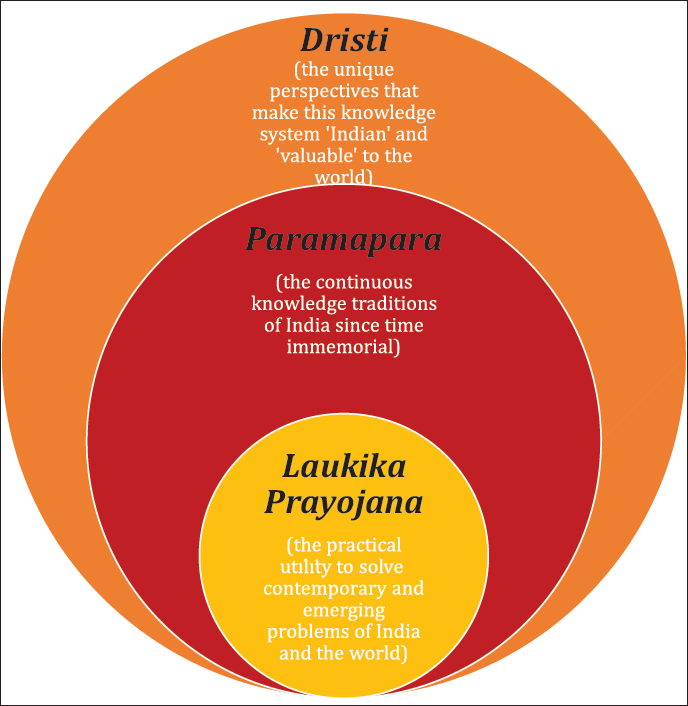
Source: Re-created by author based on similar figure on the IKS Website, Ministry of Education, Government of India (
Incorporating IKS into education presents an opportunity to address issues of inclusivity and representation. Historically, women and marginalised communities have played crucial roles in the development and preservation of indigenous knowledge. Highlighting these contributions within educational curricula can promote gender inclusivity and inspire future generations of scholars from diverse backgrounds (Ministry of Education, 2020). In short, redefining and reintegrating IKS into the educational landscape is a crucial step toward decolonising the mind and restoring civilizational confidence. By acknowledging the value of indigenous knowledge and challenging entrenched biases, India can cultivate an education system that is both rooted in its rich heritage and responsive to contemporary global challenges. In the domain of international studies, incorporating IKS can potentially constitute a step in the direction of global dissemination of the Indian approaches to diplomacy, global governance, and sustainable development.
Reclaiming Scientific Temper: Reason, Inquiry and Innovation in Indian Traditions
The idea of scientific temper is often understood as a modern concept rooted in reason, empirical evidence, and systematic inquiry. However, India’s intellectual traditions, encapsulated in IKS, have long embodied these values, contributing to the global repository of scientific knowledge. The scientific innovations within these traditions were not only empirical but also deeply embedded in an understanding of the natural world, showing a profound connection between reason, inquiry, and the environment. To understand the role of IKS in modern science, we must first acknowledge that these traditions represent not a rival but a complementary partner to contemporary scientific approaches.
Logical Traditions: Nyaya and Mimamsa
The Nyaya school of Indian philosophy established a comprehensive system of logic and epistemology that mirrors many principles of the modern scientific method. Founded on the Nyaya Sutras of Aksapada Gautama (circa 6th century BCE to 2nd century CE), the tradition emphasizes the means of acquisition of valid knowledge (pramana) through perception (pratyaksa), inference (anumana), comparison (upamana), and verbal testimony (sabda) (Chatterjee & Datta, 1984). The school’s rigorous categorisation of knowledge, logic, and fallacies laid a foundation for critical debate and rational argumentation, functioning as a form of philosophical peer review. Nyaya’s focus on anumana, or logical inference, parallels hypothesis-driven inquiry in scientific practices (Potter, 1977). Later, Nyaya scholars, such as Udayana and Gangesa, expanded the tradition into what became known as Navya-Nyaya (New Logic), introducing a more technical and analytical language of epistemology that focused on truth conditions, cognitive states, and fallacious reasoning (Bhattacharyya, 1961). This movement, which thrived from the 12th to the 18th centuries, led to the creation of logic manuals used in scholastic education across Indian philosophical schools. Gangesa’s Tattvachintamani (Jewel of Reflection on the Truth) remains one of the most profound and dense contributions to logic ever produced, rivalling in complexity the works of Aristotle or medieval scholastics (Matilal, 1998).
Mimamsa, though often associated with Vedic ritual interpretation, developed its own form of rigorous logic to interpret sacred texts. Founded by Jaimini and later systematised by Sabara and Kumarila Bhatta, the school emphasised the authority of Vedic testimony while devising detailed hermeneutic tools to resolve textual ambiguities. Kumarila Bhatta’s theories of sentence meaning (abhihitanvaya) and knowledge justification (svatah pramanya) involved layers of reasoning that closely resemble textual analysis and consistency checks in legal or scriptural exegesis (Bilimoria, 1988). While Nyaya stressed empirical reasoning, Mimamsa ensured intellectual discipline in interpreting evidence, making the two traditions complementary. Both traditions underscore a central tenet of the scientific method: that knowledge must be logically derived, justified, and communicable. In fact, Matilal (1990) argues that these traditions provided India with a robust culture of debate, rationality, and truth-seeking that predates and, in some cases, anticipates Western Enlightenment rationalism.
Ayurveda and Medicine
Ayurveda, one of the world’s oldest medical systems, presents a holistic framework grounded in the belief that health arises from the balance between body, mind, spirit, and environment. Unlike reductionist models of modern biomedicine, Ayurveda emphasizes the interconnectedness of bodily systems and incorporates elements of philosophy, botany, and empirical observation. The Charaka Samhita, one of the foundational texts of Ayurveda, outlines detailed principles of diagnosis, treatment, and health maintenance that are remarkably systematic and evidence-driven (Sharma, 1981). It introduces the concept of tridosa—vata, pitta, and kapha—which regulates physiological functions and underpins its theory of pathology and healing. The Sushruta Samhita, another classical Ayurvedic text, exemplifies the empirical nature of ancient Indian medicine through its precise and extensive discussion of surgical techniques, including plastic surgery, cauterization, and lithotomy (Sushruta, 1907–1916). It contains over 300 surgical procedures and 120 surgical instruments, indicating not only theoretical sophistication but also hands-on surgical practice. Sushruta’s methods were grounded in anatomical dissection and surgical simulation using organic materials like gourds and leather, a practice unparalleled in many other ancient cultures of the time.
In contrast to claims that Ayurveda is purely metaphysical or mystical, modern scholars have shown that it was grounded in observation, diagnosis, and experimentation. G. J. Meulenbeld (1999), in his exhaustive historical analysis, argues that Indian medical literature developed through successive refinements, annotations, and clinical experiences over centuries. Dominik Wujastyk (1998) reinforces this view by emphasizing Ayurveda’s openness to pharmacological innovations, botanical classifications, and standardization of medical procedures. Contemporary interpretations of Ayurveda continue to reflect its deep empirical roots while integrating it with modern scientific understandings. Furthermore, various other studies have demonstrated how Ayurvedic principles of diet, detoxification, and daily routine are adaptable to modern lifestyles and diseases. Far from being obsolete, Ayurveda’s framework encourages preventive care and personalized treatment, an area modern medicine increasingly acknowledges as necessary for sustainable healthcare.
Metallurgy, Water Management, and Town Planning
India’s contributions to metallurgy are both ancient and pioneering. The Iron Pillar of Delhi, dating back to the Gupta period (circa 4th–5th century CE), stands as a marvel of metallurgical engineering, notable for its rust-resistant composition despite being exposed to the elements for over 1,600 years (Balasubramaniam, 2002). This feat suggests sophisticated knowledge of alloy composition and surface treatment, far ahead of its time. Archaeometallurgical studies of the Iron Pillar have revealed high phosphorus content and forging techniques that facilitated passive rust protection, aligning with modern corrosion-resistant technologies (Raghavan, 1993). Such examples challenge the narrative that traditional technologies lacked empirical sophistication. Water management in ancient India reflected an advanced understanding of hydrology, geology, and community-based resource governance. The stepwells (baolis or vavs) of Gujarat and Rajasthan, some dating back to the 6th century CE, exemplify architectural ingenuity combined with functional excellence (Livingston & Beach, 2002). The Harappan civilization had already demonstrated remarkable hydraulic engineering through their grid-based drainage systems, standardized water storage tanks, and wastewater disposal methods. The Great Bath at Mohenjo-Daro, possibly used for ritual and hygienic purposes, shows early urban planning centred around water conservation and public sanitation (Kenoyer, 1998).
Traditional Indian water harvesting systems, such as tanka, khadin, johad, and aahar-pyne, emerged from detailed local knowledge of soil, rainfall patterns, and topography (Agarwal & Narain, 1997). These decentralized methods enabled sustainable irrigation and groundwater recharge in semi-arid zones centuries before the advent of modern hydrological science. In South India, temple tanks and interconnected canal systems were used not only for religious rituals but also to stabilize microclimates and support agriculture during dry seasons (Mosse, 2003). The integration of spiritual, social, and ecological dimensions in these systems reflects a civilizational ethos that prioritizes long-term sustainability. Urban planning in ancient India, especially during the Harappan period, was strikingly rational and standardized. The cities of Mohenjo-Daro and Harappa had grid-based street layouts, uniform brick sizes, and segregated residential and administrative zones (Wright, 2010). The widespread use of fired bricks, multi-roomed houses, and public granaries implies centralized regulation and quality control in construction. Some scholars argue that this reflects proto-bureaucratic planning, suggesting a governance model informed by both empirical observation and civic rationality (McIntosh, 2008).
Mathematics
Indian mathematical traditions have significantly shaped the global development of science, beginning with the revolutionary introduction of zero and the decimal system. The earliest recorded use of zero as both a placeholder and a numeral can be found in the Bakhshali Manuscript (major parts are dated between 3rd–4th century CE), which predated similar uses in other civilizations by centuries (Joseph, 2000; Kaplan, 2000). The decimal place value system, foundational to modern arithmetic, was codified in Indian texts such as the Aryabhatiya (circa 499 CE), where Aryabhata laid out a systematic approach to numerical notation and operations (Hayashi, 2003; Plofker, 2009). These developments were not isolated intellectual feats but had significant real-world applications in astronomy, trade, construction, and calendrical sciences (Pingree, 1978). The Sulba Sutras, associated with the Vedic period (circa 800–500 BCE), provide evidence of advanced geometric principles used for constructing fire altars and sacred spaces (Sen & Bag, 1983). These sutras contain methods for calculating square roots, approximating π, and understanding the Pythagorean theorem long before it appeared in Greek sources (Datta & Singh, 1962). These mathematical techniques, although derived for ritualistic purposes, revealed a rational, rule-based structure of thinking that aligns with modern scientific reasoning.
In astronomy, the contributions of Aryabhata, Brahmagupta, and Bhaskara were both theoretically profound and empirically grounded. Aryabhata’s heliocentric model, his calculation of the Earth’s circumference, and his formulation of the sine function (jya) mark a significant departure from mythological cosmologies (Clark, 1930; Plofker, 2009). Brahmagupta’s work in the Brahmasphutasiddhanta introduced rules for operations involving zero and negative numbers, and Bhaskara II’s Lilavati offered a wide range of algebraic and arithmetic techniques (Joseph, 2000; Katz, 2007). These mathematicians employed methods of observation, interpolation, and logical derivation, making Indian mathematics a cornerstone of empirical science. Today, these foundational contributions are widely recognized. The global transmission of Indian numerals and algorithms through Arab intermediaries to Europe catalysed the mathematical revolution in the West (Ifrah, 2000). Moreover, Indian mathematics continues to inspire contemporary scholars and practitioners in fields such as number theory, computer science, and engineering, validating the historical legacy of IKS in the evolution of global scientific thought.
Linguistics and Scientific Grammar
India’s contribution to linguistics is among its most enduring scientific legacies, with the grammar of Sanskrit codified by Panini in his seminal work, the Ashtadhyayi (circa 6th–4th century BCE). This text is considered to be the first known attempt at formulating a comprehensive, rule-based system for any language, consisting of nearly 4,000 succinct sutras that describe phonetics, morphology, and syntax with algorithmic precision (Cardona, 1997; Staal, 1988). Panini’s linguistic model has structural parallels with modern computational linguistics and generative grammar. Scholars such as Kiparsky and Staal have drawn parallels between Panini’s grammar and Chomskyan models of generative grammar (Kiparsky, 1995; Staal, 1965). Thus, Panini’s work remains not only a cornerstone of Indian linguistic tradition but also a precursor to modern theories in logic, computation, and information science.
The meta-linguistic sophistication of Indian grammatical traditions extended beyond Sanskrit. Scholars in the Mimamsa and Nyaya schools also developed theories of language philosophy (shabda as pramana or valid testimony), emphasizing meaning, context, and epistemological integrity (Matilal, 1990). Bhartrihari, in his Vakyapadiya (circa 5th century CE), advanced a theory of sphota, which conceived meaning as an indivisible whole, an idea that prefigures certain strands of modern semantics and phenomenology (Coward & Raja, 1990). These philosophical inquiries highlight how language was treated as both a scientific and ontological category within IKS, demonstrating an intellectual culture deeply engaged in systematizing human expression, cognition, and communication. The pedagogical implications of India’s linguistic heritage are profound. The oral transmission of vast texts such as the Vedas was facilitated by rigorous phonetic precision, mnemonic devices, and metrical regularity, techniques rooted in scientific awareness of sound, rhythm, and articulation (Deshpande, 1993). These oral techniques ensured both the accuracy and longevity of knowledge in a pre-print world by encoding information through structured redundancy and linguistic economy. Some scholars have begun to explore indigenous oral pedagogical methods for their potential benefits in memory and learning (Schaffer, 2003).
Modern applications of India’s linguistic insights are already visible. For instance, Paninian grammar has been employed in natural language processing (NLP) and machine translation projects in India, especially in the development of rule-based systems for Sanskrit and other Indian languages. The structure of Indian linguistic analysis, deeply rule-based yet context-sensitive, provides a powerful model for AI-driven language technologies. Moreover, the Indian emphasis on multilingualism and semantic nuance supports cultural pluralism and is increasingly relevant in global discourses on language preservation and inclusive education. Together, these traditions reveal that Indian linguistics was never confined to the domain of abstract philology. Rather, it was rooted in rigorous epistemology, semiotics, and pedagogy, intertwining the sciences of logic, cognition, and communication. By recovering and adapting these traditions, India not only honours its past but also contributes constructively to contemporary global knowledge ecosystems.
Statecraft and Ethics
Ancient India had a deep and dense philosophical and practical tradition of statecraft. The Mahabharata is the ultimate text on war and peace, replete with lessons on foreign policy, diplomacy, alliances, bargaining and negotiations etc. (Narlikar et al., 2023). India’s pluralistic and consultative traditions go back deep in history, with the Upanishadic ideal of Vasudhaiva Kutumbakam (‘the world is one family’) conveying a commitment to international cooperation (Jaishankar, 2024). The masterpiece on statecraft, Kautilya’s Arthashastra, outlines in great detail, a wholistic understanding of matters of the state. Along with the larger questions pertaining to the duties and responsibilities of the ruler, it deals with matters such as the training of kings, judges and other functionaries of the state. For scholars of international relations, discussions around the concepts of war, foreign policy, diplomacy, espionage, etc. enumerated in the Arthashastra help provide insights into the external behaviour and policies of states. The mandala siddhanta is, in essence, a theory of balance of power among states (Gautam et al., 2016). While there is considerable scholarship on Kautilya’s Arthashastra and successor texts such as the Nitishastra by Kamandaka, not enough research has been done on regional literary traditions of statecraft. The Tamil text Thirukkural (or Kural) by Thiruvalluvar holds a rich promise of providing lessons on statecraft, governance and ethics, and deserves more rigorous attention (Gautam, 2021).
IKS in the Contemporary Period
Today, when we discuss innovation and scientific progress, it is vital to position IKS not as a competitor to modern science but as an essential collaborator. Modern science has achieved remarkable advances, especially in physics, medicine, and technology, but it can greatly benefit from a dialogue with IKS, which often prioritises sustainability, ecological harmony, and holistic health. IKS offers a wealth of knowledge that can complement and enrich modern scientific approaches, providing alternative viewpoints on topics such as environmental protection, public health, and sustainable development. Indian innovations, exemplified in mathematics, metallurgy, and water management, can offer valuable insights into current challenges. The ancient Indian focus on empirical knowledge and environmental awareness offers a way to incorporate sustainability into modern scientific practices.
As India steps into the future, traditional knowledge systems are being recontextualised and adapted for contemporary use. The integration of Sanskrit with computing, a growing field in which the ancient language’s precise and systematic nature is being utilised to improve coding and artificial intelligence, is a striking example of how IKS can partner with modern science. Ecological planning based on traditional water wisdom is also experiencing a resurgence, with modern engineers and urban planners rediscovering ancient methods of sustainable water management to address current water crises. For instance, the rejuvenation of traditional kunds (stepwells) and tank irrigation systems is proving invaluable in water-scarce regions. These solutions, grounded in IKS, offer innovative responses to contemporary environmental challenges.
The convergence of AI and IKS is another example of a promising future. Research is underway on how AI can be used to model and preserve traditional knowledge, allowing these age-old practices to inform future technological developments and contribute to global scientific discourse. The reclamation of scientific temper in India through IKS provides a robust framework for rethinking our approach to science, innovation, and sustainable development. Indian traditions, from logic to Ayurveda, metallurgy to mathematics, offer empirical insights that can serve as a foundation for modern scientific practice. By acknowledging IKS as a partner to, rather than a rival of, modern science, we open the door to a richer, more holistic understanding of the world. This partnership holds the potential to bring about a new era of innovation grounded in a deep respect for the environment, human well-being, and empirical inquiry.
Education and IKS: Pedagogy and Public Philosophy
The integration of IKS into the educational framework represents a pivotal opportunity for India to reconnect with its intellectual heritage, not as a nostalgic reflection of the past but as a living, evolving framework for addressing contemporary challenges. This section delves into the institutional shifts, the challenges in making tradition intelligible, and the role of inclusivity, especially concerning women, in shaping an educational ethos that resonates with the principles of equity, sustainability, and social progress.
Institutional Shifts: From NEP to National Consciousness
The NEP 2020 marks a significant turning point in India’s approach to education, recognizing IKS as a critical element in redefining the country’s educational landscape. The policy outlines a vision for an education system that is rooted in India’s ancient ethos while preparing students for the globalized world. As the NEP emphasizes, ‘the policy envisions an education system that leverages the richness of India’s knowledge traditions, in alignment with modern developments’ (Ministry of Education, 2020). One of the central tenets of the NEP is the encouragement of interdisciplinary learning and the promotion of indigenous knowledge systems, recognising the need for students to draw upon both traditional wisdom and modern scientific thinking. In line with this vision, the Indian government took a decisive step by establishing the IKS Division within the Ministry of Education in 2020. This division’s primary goal is to promote research, preserve indigenous knowledge, and integrate it into educational curricula (Ministry of Education, 2020).
To operationalise these objectives, the All India Council for Technical Education (AICTE) has developed model curricula that incorporate IKS components into the engineering and technology sectors. Initiatives such as ‘Sanskrit in STEM courses’ and IKS-based research fellowships aim to bridge the gap between ancient knowledge and modern scientific disciplines. These efforts are significant but not without challenges. For instance, while such initiatives can be seen as a step in the right direction, their success depends on how effectively they navigate the complexities of curriculum development and integration. Moreover, the UGC has introduced guidelines encouraging universities to include IKS in undergraduate and postgraduate programs (UGC, 2023). Students are encouraged to undertake IKS credit courses that form at least five per cent of their total required credits. While these initiatives offer a positive outlook, the full integration of IKS into mainstream education requires not just structural changes but a paradigm shift in how knowledge is viewed. While these initiatives are commendable, their actual impact will depend on the level of engagement and acceptance they receive from both academic institutions and students.
Women, Inclusivity, and IKS
The role of women in IKS is often overlooked despite historical examples of women scholars and intellectuals who made significant contributions to the preservation and development of knowledge systems. Women such as Gargi and Maitreyi, who were renowned scholars in the Vedic period, exemplify the prominence of women in ancient Indian intellectual traditions. In modern times, women like Savitribai Phule, who was a pioneering educator, continue to invoke and inspire. Integrating IKS into education offers a unique opportunity to highlight these contributions and encourage future generations of women scholars. This can foster a more inclusive understanding of IKS that is sensitive to gender and social justice concerns. It is also crucial to highlight that many aspects of IKS were not inherently patriarchal. For example, the reverence for Shakti in many Indian traditions underscores the power of the feminine as central to both cosmic order and societal balance.
A feminist reading of IKS can contribute to a more nuanced understanding of how traditional knowledge systems can support India’s developmental and ecological visions, particularly in the context of sustainable development and gender equality. Moreover, an inclusive approach to IKS, which values both women’s contributions and indigenous knowledge systems, can play a key role in bridging divides and promoting social harmony. It is not just about preserving traditions; it is about reimagining them to serve the needs of a contemporary, diverse, and globally engaged India.
Cultural Diplomacy
One of the most exciting prospects of integrating IKS into education is its potential for cultural diplomacy. By sharing India’s rich intellectual heritage globally, IKS can enhance India’s soft power and foster international collaborations in education, research, and development. Cultural diplomacy, however, must be distinguished from ideological imposition. The goal should not be to impose IKS on the world but to present it as a valuable resource for global learning. As India positions itself as a global leader in sustainability, education, and innovation, IKS can serve as a model for holistic, ethical, and sustainable approaches to modern challenges. Rather than simply exporting knowledge, India can showcase its traditions as part of a broader dialogue that values diverse knowledge systems and fosters mutual understanding. This approach could position India as a thought leader in the global conversation on the future of education and knowledge-sharing.
The School of International Studies (SIS), JNU, has been a pioneer in the field of international studies in India, widely renowned for forging new areas of research in politics, diplomacy, law, economics, theory and area studies. New initiatives within SIS, such as the establishment of the Chhatrapati Shivaji Maharaj Special Centre for Security and Strategic Studies, which has been set up with a view to strengthening scholarly pursuits from an IKS orientation, are efforts towards contributing to scholarship embedded in IKS.
Future of IKS: Challenges and Solutions
To effectively indigenise and achieve the goals of integrating IKS into modern education, it is crucial to address several challenges. These challenges, when approached thoughtfully, will help revive the rich traditions of Indian wisdom and incorporate them meaningfully into contemporary educational frameworks. Here are eight key challenges that must be addressed, along with potential solutions and practical applications.
Decolonising the mindset: A significant hurdle in integrating IKS is overcoming the entrenched dominance of Western educational paradigms, which have marginalised indigenous knowledge systems for centuries. The integration of IKS requires a societal mindset shift, one that moves away from the pervasive notion that Western knowledge is the benchmark for academic and intellectual excellence. To decolonise education, we must instigate public awareness campaigns that highlight the value of IKS. These can be initiated by government bodies like the Ministry of Education and the Ministry of Skill Development through media outreach and educational reforms that emphasise the utility of IKS in addressing modern-day challenges. For example, introducing awareness programs about the historical contributions of Indian scholars, such as Aryabhata in mathematics and Kautilya in governance, could help shift perceptions. Universities and schools should encourage projects that analyse IKS contributions to fields like astronomy, medicine, and architecture, validating their relevance in today’s context. Authenticity and relevance of ancient knowledge: One of the primary challenges of integrating IKS into contemporary curricula is ensuring that ancient knowledge remains authentic and relevant in the face of modern scientific advancements. There is a risk of distorting traditional knowledge systems, which could undermine their value. A solution lies in the careful curation and translation of ancient texts, with experts in both traditional and modern knowledge systems collaborating. As suggested by many research bodies, the Indian Council of Historical Research (ICHR) should be tasked with reviewing and preserving the integrity of ancient texts, ensuring that their translation and contextualization are accurate. Practical application can be seen in the revitalisation of ancient Indian agricultural practices, such as organic farming methods rooted in Ayurveda, which can be integrated into modern environmental sciences and sustainable farming practices. Incorporation into the education curriculum: While the NEP 2020 advocates for integrating IKS, the practical integration of these systems into existing school and university curricula remains a challenge. This includes both conceptual integration and the development of appropriate educational materials. Without bringing IKS to schools, no matter how much the country does to promote it in higher education, the net results are unlikely to be optimal. To address this challenge, an extensive curriculum overhaul is necessary, with the inclusion of IKS as a standalone subject or as part of interdisciplinary courses. For example, schools could introduce courses on ancient Indian mathematics or philosophy, teaching students the methods of thought that led to significant breakthroughs in these fields. Higher education institutions could offer specialised programs in areas like Vedic astronomy or Indian medicinal systems, focusing on their modern applications in fields such as biotechnology and alternative medicine. Teacher training and preparedness: The lack of adequately trained teachers who understand both the theoretical and practical aspects of IKS poses a significant barrier. Teachers must not only be well-versed in IKS but also skilled in using modern pedagogical tools to impart this knowledge effectively. To address this, specialized teacher training programs must be developed. These programs could include workshops, online courses, and certifications that focus on integrating IKS into existing subject areas. Collaboration with organisations like IITs and universities with established IKS research could help create teacher development programs that incorporate experiential learning. For example, programs focusing on practical applications of IKS, such as using yoga for health education or employing ancient architectural principles in modern urban planning, would be valuable. At the school level, training would be sufficient for teachers, but at the higher education level, there is a greater scope as faculty can work to develop and research IKS, thereby contributing to a larger discourse and discussion. Funding and institutional support: The effective integration of IKS requires substantial investment in research, curriculum development, and teacher training. However, there is often insufficient funding allocated to initiatives that promote IKS. Governments have undertaken various measures in this regard, but the private sector must be encouraged to provide dedicated funding for IKS-based projects. This can include grants for research in traditional knowledge systems and the development of specialised educational resources. Additionally, partnerships with international institutions should be fostered to gain global support and recognition for IKS initiatives. As an example, a dedicated fund for creating interdisciplinary research opportunities in areas such as sustainability, natural farming, and Ayurvedic medicine could help bridge the gap between ancient knowledge and contemporary issues like climate change and healthcare. Public perception and awareness: Despite the growing interest in indigenous knowledge systems, there remains a general lack of public awareness regarding the richness and diversity of IKS. The negative perceptions stemming from colonial history and the global dominance of Western education systems further complicate efforts to promote IKS. Public awareness campaigns, alongside educational outreach programs, must be prioritised to elevate the value of IKS in public discourse. This can involve using digital platforms and media, as well as community engagement programs that highlight the practical applications of IKS in daily life. For example, showcasing the success stories of traditional Indian farming techniques that have helped communities fight climate change can be a powerful tool for changing public perceptions. Inclusion of tribal and indigenous knowledge: While IKS covers a wide array of traditional knowledge, tribal knowledge systems, which are deeply rooted in local cultures, are often overlooked or sidelined. These systems, including ethno-medical practices and forest management techniques, represent an important aspect of India’s knowledge heritage. Specific efforts need to be made to document and integrate tribal knowledge into the mainstream curriculum. Collaboration with indigenous communities to create content that accurately reflects their knowledge is crucial. For instance, the knowledge of indigenous healing practices should be included in medical education and integrated into discussions on alternative healthcare. Moreover, incorporating tribal understanding of sustainable forest management and ecological practices could be part of environmental studies curricula in schools and universities. Global engagement and knowledge sharing: In today’s globalised world, integrating IKS into the education system not only requires national efforts but also demands global engagement. The integration of IKS needs to be understood as a bridge between India’s rich past and the global knowledge economy. To fulfil this vision, India must foster global collaborations that focus on IKS research, knowledge sharing, and exchange programs. This can include partnerships with institutions and countries across the world, where IKS can be showcased through international seminars, workshops, and scholarly publications. For example, IKS-based workshops that demonstrate the application of traditional agricultural techniques could be conducted in collaboration with international universities, positioning India as a leader in sustainable agriculture. Another example is developing curricula in international studies by incorporating the ancient wisdom that IKS offers in creating innovative solutions to modern challenges such as climate change and sustainable development, which are fundamental for global stability. The emphasis on traditional ecological knowledge exemplifies how IKS can be utilised in the international discourse to support sustainable practices. Similarly, the concept of human security can be reinterpreted in light of the ancient Indian ideas of Vasudhaiva Kutumbakam and Panchabhuta (Pandit, 2024).
By addressing these eight challenges, India can create a robust framework for integrating IKS into contemporary education. The proposed solutions are not merely theoretical but can be practically implemented to create a more inclusive, sustainable, and globally recognised educational system that respects and upholds India’s knowledge traditions while addressing the challenges of the modern world. Through deliberate action, IKS can be reintegrated into India’s educational ecosystem, not only enriching the academic landscape but also helping to position India as a global leader in knowledge and innovation.
Towards a Civilizational Renaissance
In conclusion, integrating IKS into modern education and intellectual discourse is a pivotal step toward shaping a future deeply rooted in India’s civilisational strengths while being responsive to contemporary realities. It is neither an act of glorifying antiquity nor rejecting modernity but a strategic effort to create a balanced, contextual, and inclusive knowledge ecosystem. IKS offers holistic, ethical frameworks and is deeply attuned to the interconnectedness of life—qualities that are indispensable to addressing the complex global challenges of the 21st century. By drawing on its vast reservoir of insights spanning governance, sustainability, medicine, mathematics, and beyond, IKS has the potential to enrich modern disciplines with time-tested and forward-looking perspectives. Yet, realising this vision demands a decisive departure from tokenism and marginalisation. The article has underlined the importance of dismantling academic silos and institutional barriers that confine IKS to limited domains. A shift toward interdisciplinary research, curriculum innovation, and policy engagement is essential to unlock its transformative potential. Equally critical is the need to democratize IKS by making it accessible in regional languages, incorporating oral traditions, and foregrounding contributions from historically marginalised voices, particularly women. Doing so would ensure that IKS reflects the plurality of India’s lived realities, not just its elite textual traditions.
Importantly, for IKS to resonate with younger generations and global audiences alike, it must be articulated through contemporary language and supported by rigorous, evidence-based inquiry. Relevance, not reverence, must guide the effort. By embracing innovation and critical scholarship, IKS can move from the margins to the mainstream, not just in India’s academic landscape but also in its global engagements. This would not only reclaim intellectual sovereignty but also amplify India’s role in shaping a more inclusive, sustainable, and pluralistic world order. The integration of IKS is thus not an end in itself but a means to co-create knowledge systems that are future-ready, globally connected, and locally anchored. As India advances toward its vision of becoming a developed nation by 2047, embedding IKS into the foundation of its educational and intellectual life is both a civilisational responsibility and a strategic imperative.
In its 70th year, SIS must find its role in taking forward this imperative. The incorporation of IKS in its teaching and research and the inclusion of diverse perspectives from the Indian traditions will allow a broader appreciation of India’s historical and contemporary significance in global affairs and enable crucial transcultural dialogues to address global challenges in an increasingly interconnected world.
Footnotes
Declaration of Conflicting Interests
The author declared no potential conflicts of interest with respect to the research, authorship and/or publication of this article.
Funding
The author received no financial support for the research, authorship and/or publication of this article.