






Abstract
West Asian (Middle Eastern) Studies in India began in the 1950s as part of the broader international relations and area studies at the Indian School of International Studies. It evolved at the School of International Studies of Jawaharlal Nehru University after the 1960s, first at the Centre for West Asian and African Studies and later at the Centre for West Asian Studies (CWAS). The discipline gradually expanded to other universities and institutions, such as Aligarh Muslim University, Jamia Millia Islamia, University of Mysore and University of Kerala. Despite these developments, the study of the West Asia and North Africa region has long remained confined to New Delhi and Kerala; in the latter, it has been broadly grouped with Islamic Studies or International Studies. The expansion of the discipline has not been commensurate with the region’s significance to India’s foreign policy and relations. Overall, the discipline has faced pedagogical and structural challenges, including a lack of language proficiency, an excessive focus on semantics, an inability to attract younger talent and the non-recognition of its pioneers and stalwarts. CWAS—and West Asian Studies, more broadly—needs to find ways to overcome these challenges and capitalize on India’s growing relations with the Gulf and West Asia, contributing to an informed debate on the region in India and internationally, and making the study of the region attractive to the younger generation.
Keywords
Introduction
The systematic study of West Asia (or ‘the Middle East’ in international parlance) in India began in the early years after independence, when the international relations (IR) and area studies programmes were established as part of the Indian School of International Studies (ISIS). Founded in 1955, ISIS was located at the Indian Council of World Affairs (ICWA) in the capital. Oral accounts suggest that the Centre for West Asian Studies (CWAS) at ISIS began with the induction of Professor Mohammed Shafi Agwani into the School in 1957. Professor Agwani moved to Jawaharlal Nehru University (JNU) when it was established by an Act of Parliament in 1969, and he was thus one of the founding members of the School of International Studies (SIS) and the founder of the Centre for West Asian and African Studies (CWAAS), which later bifurcated into CWAS 1 and the Centre for African Studies (CAS). Although several new centres for the study of West Asia subsequently emerged in India, CWAS remains the premier institution contributing to the development and expansion of the study of West Asia and North Africa (WANA) in India. By all accounts, an overwhelming majority of Indian scholars and experts on the region have been directly or indirectly mentored by Professor Agwani.
Notwithstanding the Centre’s pioneering role in promoting West Asian Studies in the country, its standing among global Middle East Studies centres remains relatively low. In its early years, the Centre was considered one of the major locations for the study of Arab and Middle Eastern affairs in Asia. But its influence soon began to wane as it struggled to keep pace with the changing times. The discipline’s inability to attract younger minds through Master of Arts (MA) and PhD programmes also limited the growth of West Asian Studies. For example, CWAS did not envision or plan a Master’s programme until 2022, and it took over three years of arduous and persistent labour to finally implement the idea in August 2025. Another significant challenge that has limited West Asian Studies (and perhaps other area studies programmes as well) in SIS is the lack of linguistic expertise. Above all, the nomenclature ‘West Asia’, as opposed to the internationally recognized (also by regional countries) ‘Middle East’, made the discipline insular and even local.
Keeping these limitations in mind, it is important to locate the region’s historic, cultural, economic, commercial, political, diplomatic, strategic and security importance to India in order to better appreciate the origin and growth of West Asian Studies in the country. Often, the region is hailed as an ‘extended neighbourhood’ of India; yet for a long time, it did not receive adequate attention in political and diplomatic circles. This is not to suggest that no efforts were taken in terms of political and diplomatic ties with the region, but they were not commensurate with the region’s geopolitical, economic and strategic importance (Kumaraswamy, 2014; Mudiam, 1994). One likely reason for the inadequate attention to West Asia was the skewed perception that the region is a ‘Muslim issue’, and hence sensitive (Kumaraswamy, 2010; Mudiam, 1994). Moreover, the traditional Indian position on the Arab–Israeli conflict meant that New Delhi shied away from understanding Israel and giving it due importance in the regional dynamics (Kumaraswamy, 2010).
India and West Asia
India’s connections with the western parts of Asia extend beyond their contemporary strategic and geoeconomic significance. For centuries, the northwestern part of the Indian subcontinent shared land borders with West Asia, and together they formed the heart of the trade routes connecting the broader Eurasian landmass (Heptullah, 1991, pp. 1–2). Located at the intersection of the northeastern and southwestern parts of Asia, the northwestern parts of the Indian subcontinent not only became a bridge, acquiring a distinct cultural flavour reflecting a blend of East and West Asia, but also often became a battleground for the ambitious political powers emerging in these two regions. These bittersweet memories collectively shaped social psychology, informing the Indian view and attitude towards the region. Although after independence, land connectivity to the West Asian region was lost due to partition and the creation of Pakistan, the historic memories of both friendly and hostile interactions continue to inform public discourse on the region in India (Ahmad, 1978; Heptullah, 1991; Mudiam, 1994).
While the connections between the northwestern Indian mountains and plains and the southwest Asian plateaus and deserts were severed after 1947, the maritime links between peninsular India and Arabia endured. The western coastal regions of India, especially Konkan, Malabar and Kerala, have long maintained direct contact with the eastern and southern coastal regions of the Arabian Peninsula (Ahmad, 1978; Chopra, 1992). Records of interactions between Indian agriculturists, artisans and trading communities and Arab merchants date back to the ancient and pre-Islamic eras, and these accounts have been confirmed by archaeological findings (Ahmad, 1978). These connections meant that the Abrahamic faiths—Judaism, Christianity and Islam—reached the western coasts of India much earlier than other parts of the subcontinent. Even after the advent of Islam, interactions remained largely commercial and cultural, with little political or military contestation, owing to the Arabian Sea serving as a natural divide (Chopra, 1992; Heptullah, 1991). During the British Raj, the colonial interest in the Persian Gulf made Bombay (now Mumbai) the link between the Gulf and London, with intricate social, political and economic interactions between India and the Arab areas in the Gulf (Kéchichian, 1995, pp. 213–214; Onley, 2007). 2 In both the world wars, Indian soldiers played a pivotal role in British military campaigns in West Asia, especially in North Africa, Gallipoli, Mesopotamia and Palestine (Roy, 2012).
Notwithstanding the historic cultural, civilizational and commercial connections, independent India’s relations with the West Asia were defined by Cold War politics and India’s idealist foreign policy (Mudiam, 1994). India’s experience of the freedom struggle against the British shaped its post-1947 foreign policy, which, in the context of the West Asian region, meant two things: not capitalizing on the engagements, connections and presence cultivated and established during the British Raj, and a close association with the anti-imperialist forces led by Cairo and Baghdad (Kumaraswamy, 2010; Mudiam, 1994). India lost its direct land connection with Iran due to the formation of Pakistan. The Cold War-centric Iranian inclination and association with the United States until 1979 meant that, despite the establishment of diplomatic relations in 1950, political ties between New Delhi and Tehran remained subdued (Hussain, 2012; Naaz, 2001). In the wake of the Islamic revolution of 1979, religion assumed greater importance, leading to the development of close religious–cultural links between the seminaries and learning centres in both countries (Hussain, 2012; Naaz, 2001). A similar situation was observed with Saudi Arabia, particularly after the June 1967 war, leading to Indo–Saudi relations revolving around the Hajj pilgrimage and linkages between religious and charitable organizations based in both countries (Kumaraswamy & Quamar, 2019). These developments left India with little room for secular space in bilateral relations.
Another aspect that has preoccupied Indian policymakers and diplomats has been the close association between Pakistan and the Islamic world (Agwani, 1966; Mudiam, 1994). India, to a great extent, fell victim to religious framing and found itself in a diplomatic competition to limit and counter the support of Arab-Islamic countries for Pakistan over Kashmir (Quamar, 2018). The diplomatic fiasco India faced over the 1969 Islamic summit in Rabat stemmed from the Indo-Pakistan political competition in the Islamic world (Singh, 2006). The incident marked India’s attitude towards the Islamic world for a long time. Hence, during the Cold War, India’s imagination and policy towards the West Asian region were informed by its anti-imperialist ideals and the Islamic prism (Kumaraswamy, 2010; Mudiam, 1994). Only after the end of the Cold War and its subsequent economic ascendance did India gradually acquire newer means to improve relations with West Asian countries (Mohan, 2004). During the 1990s, India gradually increased diplomatic engagements with important regional countries, including Iran, Saudi Arabia, Oman and the United Arab Emirates (Kumaraswamy, 2014; Quamar, 2023), while it also established diplomatic relations with Israel in 1992 (Kumaraswamy, 2010).
The early development of ties focused on oil imports and labour migration to the Gulf, providing the backdrop for India’s Look West policy in the 1990s (Kumaraswamy, 2014; Quamar, 2023). The engagement began to expand to other areas, including trade, investments, defence and maritime security, in the early 2000s. A gradual de-hyphenation of Pakistan and a focus on bilateral ties without getting involved in regional conflicts helped India expand its engagement with the region in the 2010s. In the post-Cold War period, notable progress was made during the tenures of Prime Ministers P. V. Narasimha Rao (1991–1996), Atal Bihari Vajpayee (1998–2004) and Manmohan Singh (2004–2014). The situation improved swiftly under Prime Minister Narendra Modi, who has devoted substantial political and diplomatic energy to improving relations with West Asian countries (Blarel, 2022; Burton, 2019).
Centre for West Asian Studies at the Jawaharlal Nehru University
The origins of the study of the WANA region in India, as noted earlier, are linked to the emergence of IR and area studies as a distinct discipline during World War II, at a time when the Indian freedom struggle had reached its pinnacle and the country was seeking independence from the British Raj (Rajan, 1979, 1994). Formally, the beginning of a systematic study of international affairs and politics in India can be traced to the establishment of ICWA in 1943 at Sapru House, New Delhi (ICWA, n.d.). Seven years after independence, the idea of developing a systematic study of IR and area studies took shape with the founding of ISIS in 1955, which later became SIS within JNU when the latter was founded in 1969 (Rajan, 1994). The pioneers of the School—Pandit Hriday Nath Kunzru and Professor A. Appadorai—were also the pioneers of the discipline of IR and area studies in the country.
CWAS is the oldest West Asian Studies centre in India, with roots dating back to the 1950s. Professor M. S. Agwani, who later served as Vice-Chancellor of JNU (1987–1992), joined the newly founded ISIS in 1957 and sowed the seeds of West Asian Studies as one of India’s earliest area studies programmes (JNU, 2025). CWAS, which was part of CWAAS until 2009, was among the founding centres of SIS when the erstwhile ISIS merged with JNU. Although a separate CAS was established after the 2009 bifurcation, CWAS continued to focus on the North African region as well. Through the scholarship and mentorship of Professor Agwani, the study of the region took its early strides in India and developed into a notable area studies programme. His rich understanding of the region, especially Arab affairs, contributed not only to the creation of a new pool of West Asian Studies scholars but also to shaping India’s political and diplomatic understanding of, and attitude towards, the region.
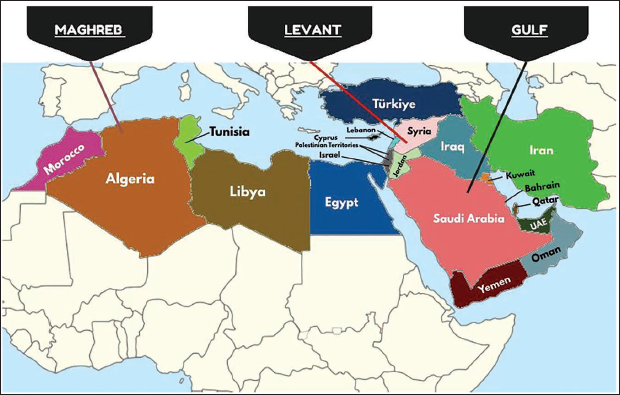
The work focus of CWAS extends to the WANA region, internationally known as the Middle East and North Africa (MENA), or simply the Middle East. In terms of sub-regions, the Centre focuses on the Gulf (also referred to as the Persian or Arabian Gulf), the Levant and the Maghreb (JNU, 2025) (Figure 1). True to the nature of an area studies programme, CWAS takes a multidisciplinary and interdisciplinary approach that intersects history, economics, geography, political science and IR. In terms of its thrust areas, CWAS has focused on ‘government and politics, foreign policy and international relations, economics and political economy, energy security, geopolitics and security, peace and conflict, society and culture and India’s engagements with the region’ (JNU, 2025). Among other issues, numerous studies on the condition and status of Indian expatriates in the Gulf region have been conducted at the Centre (Jain, 2010, 2025).
CWAS has been nurtured by a remarkable group of teachers and mentors since the 1950s. In addition to Professor Agwani, who pioneered West Asian Studies in India, many notable social scientists and academics have been associated with CWAS, including Professors A. H. H. Abidi, K. R. Singh, Mohammed Sadiq, Gulshan Dietl, Girijesh Pant, Prakash C. Jain, A. K. Pasha, A. K. Ramakrishnan and Bansidhar Pradhan. In addition, many luminaries have been part of the Centre as Visiting Faculty; former diplomat Hamid Ansari—who went on to become India’s Vice-President—was associated with the Centre from 1999 to 2000. Additionally, K. P. Fabian (2004–2005), Qamar Agha (2004–2005) and Ishrat Aziz (2008–2009), among others, were associated with CWAS in a visiting capacity. Although the quality and impact of the works produced by different scholars vary, some stand out for their significant contributions.
As noted earlier, Professor Agwani was the pioneer of West Asian Studies in India and has made a yeoman intellectual contribution to the discipline. In research, his understanding of Arab politics and power dynamics significantly shaped the broader Indian understanding of the region (Agwani, 1955, 1965, 1969, 1974, 1978a, 1978b, 1992, 2013). His writings on India–West Asia relations, in general, and the Pakistan factor in those relations have also been notable (Agwani, 1963, 1966). Several of his works became foundational in developing an Indian understanding of the region and its affairs. Professor Agwani nurtured the next generation of West Asian scholars at ISIS and later at CWAAS, from 1957 until his retirement in 1992. He was not only a notable academic but also an excellent administrator who, before his tenure as the Vice-Chancellor at JNU, had served as Rector of JNU (1982–1987), Dean, SIS (1980–1982), Chairperson, CWAAS, SIS (1976–1978) and Director, Gulf Studies Programme (GSP), CWAAS, SIS (1978–1988). His expertise on the region was recognized in his appointments as Visiting Professor at Columbia University, Advisor to the President of Bahrain University and founding head of the Centre for International Politics at Bahrain University (GSP, JNU, 2010). When Professor Agwani passed away on 20 July 2018 at the age of 90, he left behind an army of scholars trained by him, who obtained their doctorates under him and went on to serve in the field, including Professors A. H. H. Abidi, K. R. Singh, Gulshan Dietl, A. K. Pasha and P. R. Kumaraswamy.
Besides Professor Agwani, the study of various other aspects of the region has been advanced by scholars who taught at CWAS. Professor K. R. Singh served at the Centre from 1971 to 1997, focusing his scholarship on North Africa and mentoring numerous young scholars with his friendly approach. A committed researcher and prolific author, Professor Singh continued his scholarly work after retiring from JNU, focusing on security studies, including pioneering work on forts of India and maritime security (Singh, 1971, 1980, 1982, 1991, 1993, 2006a, 2006b, 2006c, 2008). In addition to his work at CWAS, Professor Singh achieved notable milestones, including serving as a Visiting Professor at the Australian National University, Canberra, and as the Chair of Maritime Studies at the University of Calicut (2005–2007).
Professor A. H. H. Abidi, a historian by training, devoted his academic life to the study of Iran. He was among the first to earn a doctorate in West Asian Studies at ISIS. He joined CWAAS in 1977, after teaching elsewhere and serving in several agencies of the Government of India, and remained at the Centre until his superannuation in 1991. Professor Abidi distinguished himself by focusing on Iranian studies and produced numerous works on the subject (Abidi, 1965, 1988, 1989a, 1989b, 1989c, 1991).
Professor Mohammed Sadiq is another important scholar who joined the Centre in 1973 and served until his superannuation in 2000. He pioneered Turkish studies at CWAS, having earned a PhD from Ankara University, Türkiye, in 1964 (Ataöv, 1998) and having conducted primary research on Ottoman and Turkish history and politics, facilitated by his proficiency in Turkish language. He authored numerous works during his academic career (Sadiq, 1964, 1983, 1997).
The above four pioneering scholars nurtured the second generation of scholars and academics on West Asia in India, who devoted their lives to studying the region for decades to come. Among those who served in CWAS is Professor Gulshan Dietl, who focused her attention on Iran and Saudi Arabia, the wars in the Gulf and energy security issues (Dietl, 1985, 1991, 2006, 2007, 2010, 2017, 2022, 2025). She mentored numerous next-generation scholars at the Centre, who went on to teach and research West Asia. Professor Dietl’s association with the Centre as a faculty spanned over three decades—from 1979 to 2012.
Other scholars at CWAS included Professor Girijesh Pant, who joined the Centre in 1979 and served until 2016. An economist by training, he contributed to the study of the region’s economic and energy issues, especially in the Gulf. He was instrumental in creating the Energy Studies Programme (2014–2025), which merged with the renamed Centre for the Study of the World Economy (CSWE) in SIS in 2025. He mentored numerous scholars at the Centre, and his published work on the regional economy and Indo–Gulf relations is extensive (Muni & Pant, 2005; Pant, 1996, 2008). Professor P. C. Jain is another notable academic who enriched West Asian and Gulf Studies as a sociologist, serving at the Centre from 1986 to 2012. His research and writing on sociological issues, including Indian migration to the Gulf, are notable (Jain, 1990, 1999, 2001, 2010, 2025).
Additionally, Professors A. K. Pasha (1988–2021), A. K. Ramakrishnan (2006–2024) and Bansidhar Pradhan (2005–2024) served at CWAS, making notable contributions to various aspects of the study of the region and mentoring a new generation of scholars who have gone on to serve in various colleges, universities and research institutions across India. Professor Pasha’s understanding of the region’s history and politics, Professor Ramakrishnan’s theoretical grounding and Professor Pradhan’s commitment to Palestinian studies served CWAS well. Among the current faculty members at the Centre, there is considerable expertise in Saudi, Israeli, Turkish, Iranian, North African and Gulf Studies, as well as in economic and energy studies. Incidently, a majority of the current faculty at the Centre are also graduates of the Centre.
CWAS hosted GSP, an autonomous area studies programme supported by the University Grants Commission (UGC) (GSP, JNU, 2010), from 1978 to 2019. Notably, it was the only area studies programme in the country that focused on the Gulf region. GSP focused on the six Gulf Cooperation Council (GCC) countries—Bahrain, Kuwait, Oman, Qatar, Saudi Arabia and the United Arab Emirates—as well as Iran, Iraq and Yemen. GSP was the brainchild of Professor Agwani, who served as its founding director from 1978 to 1988. In 2019, GSP ceased to exist due to a change in UGC policy regarding area studies programmes.
Following the normalization of Indo–Israeli relations, JNU recognized the need to initiate and develop expertise on Israel. The absence of relations until 1992 partly facilitated the traditional Islam-centric understanding of Jewish history, national aspirations and demands for a homeland. The end of the Cold War and the burgeoning relations with Israel necessitated a new, different and dedicated understanding of Israel, its regional importance, and its significance for India. With this in mind, CWAS recruited a full-time faculty devoted to studying Israel in September 1999, and this move proved providential. Over the course of a quarter of a century, CWAS emerged as pivotal for understanding Israel, not only within the country but also globally.
Since its founding, ‘CWAS has nurtured numerous scholars, and many of its graduates have flourished in academia, media, think tanks and government services, both within and outside India’ (JNU, 2025). As of 2025, over 600 scholars have been awarded the PhD (267) and MPhil (368) degrees by the Centre. From 2020–2021, admission to the MPhil programme at JNU was discontinued in line with the National Education Policy, 2020 (NEP, 2020) and UGC regulations (UGC, 2022). In implementing NEP 2020, CWAS began a two-year MA in International Relations–West Asian Studies (IRWM) in 2025–2026. The PhD programme at the Centre has continued and, over time, adapted to new demands. In addition to the full-time MA and PhD, CWAS currently offers two optional courses, namely ‘Introduction to the Gulf’ and ‘Introduction to Arab-Israeli Conflict’, for BA students of the School of Language, Literature and Cultural Studies (SLL&CS) of JNU, as well as several optional Master’s courses at SIS, including peace and conflict, political system, foreign policy of Israel and minorities in world politics.
CWAS has contributed to the origin, expansion and growth of West Asian Studies in India. A majority of academics, researchers and scholars currently working in India on West Asia have either been trained at the Centre or have been trained by individuals who were trained there. Hence, one will find JNU doctorates serving as faculty members in the departments and centres offering West Asian Studies, and working in leading research institutions studying West Asia across India. Many have gone on to serve in political science, IR and other departments in various colleges and universities. Others have made a name for themselves in media and government services, both within and outside the country. Among the notable scholars, analysts and journalists who were trained in CWAS but served outside JNU are Faisal Al-Rfouh, who served as Professor of Political Science at the University of Jordan, Amman; Shamir Hassan, who retired as a professor from AMU; Mohammed Azhar and Javed Iqbal (both currently serving at AMU); Noor Ahmad Baba, who retired as a professor of political science at the University of Kashmir; noted journalists Qamar Agha, Atul Aneja, Kallol Bhattacherjee and Stanly Johny; M. H. Ilias (who has served at JMI and is currently teaching at Mahatma Gandhi University (MGU)); and N. Janardhan (Anwar Gargash Diplomatic Academy, formerly known as Emirates Diplomatic Academy).
Expansion of West Asian Studies in India
It is abundantly clear that the number of centres for studying and teaching West Asia is not commensurate with the region’s significance in India’s foreign policy interests, calculations and engagements. Indeed, despite the region’s historical and cultural ties with India, its geographic proximity to India, and its geopolitical, geoeconomic and strategic importance, the growth of centres dedicated to the study of West Asia in India has been slow, even though steps were taken to initiate a systematic study of the region soon after independence. After almost eight decades of India’s independence, only a handful of universities, colleges and research institutions—most of which are located in New Delhi—have dedicated units for West Asian Studies. Ironically, this is not due to a lack of interest, talent or opportunities to expand West Asian Studies, nor due to a lack of expansion of area studies in India. The limited expansion of West Asian Studies in the country has occurred despite the proliferation of IR and strategic studies and the emergence of several think tanks and research institutions. Nevertheless, despite their limited number, these centres have contributed to enhancing the understanding of the West Asian region in India.
CWAS at SIS in JNU has been a pioneer in the field in India. For a long time, apart from CWAS, no other major centres for West Asian Studies existed—until the UGC began funding area studies centres at various universities (Rajan, 1979, 1994). Besides JNU, only AMU (Aligarh, Uttar Pradesh), JMI (New Delhi), UoM (Mysore, Karnataka), UoK (Thiruvananthapuram, Kerala) and MGU (Kottayam, Kerala) have dedicated West Asian Studies centres or programmes.
The first centre on West Asia established outside JNU was at AMU. Since its founding in 1875 as Muhammadan Anglo-Oriental College and its transformation into AMU in 1920, the university has maintained a legacy of studying West Asian issues within its Islamic Studies and History departments. A Centre for West Asian Studies was established at AMU in 1967 and converted into a Department of West Asian Studies in 1996 (AMU, 2025). It underwent another change of nomenclature and is now called the Department of West Asian Studies and North African Studies (AMU, 2025). Over the years, the Department has emerged as one of the major centres for the study of the WANA region in India and has contributed to the expansion of West Asian Studies in India through its MA, MPhil (now discontinued) and PhD programmes.
Gradually, other universities also began offering West Asian programs. The Department of History at UoM in Karnataka established a Middle East Studies programme (notably, the only place where the programme was called by its globally recognized nomenclature) in 1970 and became the first centre in Southern India to offer a West Asian Studies programme. Soon thereafter, the department began offering an MA programme in Middle East Studies, notably the first such postgraduate programme in India (UoM, 2021). Later, AMU, UoK and JMI also started MA programmes. Surprisingly, Kerala, with its geographic proximity, historic associations, cultural linkages and expatriate connections with the region, has been a late entrant—its universities did not establish a dedicated West Asian Studies centre/department until well into the 2000s. Until then, the study of the region was located within either the Islamic Studies or History departments.
In 1985, when the Department of Islamic Studies and Culture emerged from the Department of History at UoK, Thiruvananthapuram, it began offering courses on the West Asian region. In 2019, the Department started offering an MA in West Asian Studies, and in 2021, the department was rechristened as the Department of Islamic and West Asian Studies (UoK, n.d.). In 2023, it began offering elective courses for undergraduate programmes. Another dedicated department for West Asian Studies in Kerala had to wait until 2000, when the EMEA College of Arts and Sciences in Malappuram took the initiative. The College, affiliated with the University of Calicut, established the Department of History and West Asian Studies in 2000 and began offering a BA in West Asian Studies as one of its first academic programmes (EMEA, 2025). Notably, the BA programme at the EMEA College is the only undergraduate programme in West Asian Studies in India. MGU in Kottayam is the third institution in Kerala to establish a West Asia centre. The Centre currently offers courses for various MA and PhD programmes at the School of International Relations and Politics (SIRP), where it is situated.
JMI, founded in 1920 in Aligarh, was relocated to Delhi in 1925. It moved to its current location in Jamia Nagar on the banks of the Yamuna in 1935 and became a Central University in 1988. JMI established a Centre for West Asian Studies in January 2005, inaugurated by the then Prime Minister Manmohan Singh (GoI, MEA, 2005). However, the programme took time to gain traction and, since the late 2000s, has emerged as an important centre for West Asian Studies in the capital. West Asian studies at JMI has been complemented by the establishment of the India–Arab Cultural Centre (IACC), which subsequently began offering MA and PhD programmes in International Studies—Arab Islamic Culture (JMI, 2023). The only other publicly funded university with a West Asia programme is the University of Calcutta (UoC, Kolkata) in West Bengal, where the Centre for Pakistan and West Asian Studies (CPWAS) began operating in 2005 as a UGC Area Studies programme (UoC, 2017). This was the only programme in eastern India on West Asia until it ceased functioning in 2019, when the UGC abandoned funding for autonomous area studies programmes.
Private universities have largely ignored West Asia, with the O. P. Jindal Global University (OPJGU) in Sonipat, Haryana, being the only exception; it established a Centre for Israel Studies in 2012 (OPJGU, 2016) and a Centre for Middle Eastern Studies in 2016 (OPJGU, 2025). Despite the proliferation of private universities, many of which have centres or departments of IR, area studies have not yet captured their attention, largely because of limited demand for such courses among prospective students.
Among think tanks, only the Manohar Parrikar Institute for Defence Studies and Analyses (MP-IDSA), located in New Delhi, has a dedicated West Asia centre (MP-IDSA, 2025) and has made notable contributions to understanding the region within strategic circles. Some other government think tanks, such as ICWA, do focus on area studies, including West Asia, but they have refrained from developing these into dedicated clusters or centres (ICWA, n.d.). Many defence think tanks, such as the Centre for Air Power Studies (CAPS), National Maritime Foundation (NMF), Centre for Land Warfare Studies (CLAWS), and Centre for Joint Warfare Studies (CENJOWS), have emerged in the capital in recent years, but none have taken West Asia as a focus area of research and study. The same is true for many of the privately funded think tanks that have proliferated across India, such as the Observer Research Foundation (ORF), Vivekananda International Foundation (VIF), and India Foundation (IF), all located in New Delhi, as well as Gateway House (GH, Mumbai) and Takshashila Institution (TI, Bengaluru), among many others. None of them has displayed any abiding commitment to West Asian Studies, largely preferring to react to immediate developments.
In 2009, the virtual Middle East Institute (MEI@ND) was founded under the Forum for Middle Eastern Studies (FMES). It is led and supported by a group of like-minded scholars and practitioners (including the authors of this article) and has been funded entirely through personal funding (MEI, 2025). The MEI@ND has focused on nurturing talent and promoting the study of the region, and despite several challenges, it remains the only academic-led initiative in India that focuses on West Asia. The institution emphasizes publications and the nurturing of young talent and has made notable progress in a short time since its establishment. Above all, the pioneering contribution of MEI to the promotion of West Asian Studies in the country centres on the annual Persian Gulf Series (since 2012), which chronicles India’s bilateral relations with the region (Kumaraswamy, 2019–2025; Kumaraswamy et al., 2019, pp. 33–34), and the refereed, Scopus-indexed quarterly devoted to the region, Contemporary Review of the Middle East (Sage Publications, 2025).
Challenges Ahead
The challenges faced by West Asian Studies in India in the early stages of its evolution were part of the broader issues encountered by the IR discipline in the country. In the words of Professor M. S. Rajan (1979, p. 75), just as History and Political Science shared a ‘mother-in-law and daughter-in-law’ relationship in the past, Political Science and IR also followed a similar trajectory. In the initial years, when IR began to be seen as a distinct discipline within the broader social sciences, it faced the challenges of limited funding and the Government of India’s policy of not declassifying diplomatic documents. But the situation for area studies was one of double marginalization as all area studies programmes were clubbed with IR and received little or no attention when it came to funding and the promotion of scholarship and specialization (Rajan, 1979). Therefore, except for South Asian Studies—the study of the immediate neighbourhood—and the ideologically favoured Soviet Studies, especially during the Cold War period, the majority of area studies programmes, including West Asia, received little or no attention in the early stages (Rajan, 1979).
However, once the UGC began supporting autonomous area studies programmes at various universities, many such programmes emerged, including those focused on the West Asian region (Appadorai, 1987; Rajan, 1994). Beyond funding, West Asian Studies in India has faced significant structural challenges in its expansion and evolution, encompassing both interconnected and independent problems. One key problem that has persisted since the beginning is the conflation of the study of the region with Islamic studies or the treatment of it as a ‘Muslim issue’ (Kumaraswamy, 2010, 2014). This has occurred because of political understandings and structural challenges. Given that the majority of the population in the region is Muslim and that most of the regional states declare themselves Islamic, Indian perceptions and understanding of the region have been framed through an Islamic prism. The Pakistan factor has also contributed to the continued viewing of the region through Islamic prism (Agwani, 1966).
Besides, the pool of scholars who had some understanding or abiding interest in the region and were equipped with the language skills to study it belonged to the Muslim community; hence, for a long time, West Asian studies in India became synonymous with a Muslim subject. There have been instances in which scholars have openly argued that it would be preferable if only Muslims studied the region and served as diplomats there, as it would give India leverage over Pakistan in the Islamic world. The problem is not whether more or fewer Muslim students and scholars are attracted to the study of the region, but rather the identification and framing of the discipline as a Muslim subject. In the wake of the communal partition of the Indian subcontinent, there was a challenge to preserve the overt identification of the region with Islam. Moreover, in the early days of independence, India had only a few social science scholars equipped with Arabic, Persian or Turkish language skills, and the majority of them, if not all, were Muslims. Ironically, while advocating for the delinking of the study of the area from a specific community, no serious effort has been made to develop language expertise among scholars initiated into West Asian Studies. A major structural problem is that language skills require considerable time and energy. By the time students join MPhil and PhD programmes in West Asia, they are well past their formative years, and the inclination to learn a new language from scratch has, to some extent, diminished.
Moreover, the tendency among a group of scholars to overtly link area studies programmes with the IR and Political Science disciplines to secure ‘brighter’ job prospects in academia and think tanks meant that the dedicated effort required to impart language skills became secondary and was ignored. The hesitation to offer West Asia-related courses at the undergraduate level and the resistance to starting an MA programme in the discipline did not help the matter either. Moreover, the inability to work closely with the Arabic and Persian language programmes meant that few people with language skills joined the West Asian centres at the PhD level. Those who joined were largely unable to cope with the demands of an interdisciplinary area studies programme due to insufficient training in the social sciences at the Bachelor’s and Master’s levels. Inadequate language expertise has been one of the most glaring limitations of West Asian Studies in India and remains a considerable challenge.
Among the fundamental problems that have afflicted West Asian Studies in India and at JNU is an extraordinary focus on semantics rather than substance. In the early years, this focus on semantics began with the trend of demanding decolonization of the social sciences and higher education (Elder, 1971). This was certainly worth the time, given that psychological colonization persisted even after formal colonial control ended. However, after spending considerable time on the issue, rather than moving forward and leaving the choice of semantics to individual understanding, the need to decolonize semantics became an obsession. Hence, for a long time, any discussion or debate on issues facing the region was incomplete without insistence on calling the region West Asia and criticizing those who preferred the internationally accepted expression Middle East. The debate, at times heated, reached hilarious proportions, with scholars from the region insisting on calling it the Middle East rather than the unfamiliar term West Asia. Ironically, a lack of knowledge of the region’s languages and unfamiliarity with domestic debates in the regional countries contributed to many Indian scholars referring to the region as West Asia, even though regionally it has been referred to as the Middle East. The most glaring example has been the official and academic discussions in India on the India–Europe economic corridor, officially known as India–Middle East-Europe Economic Corridor (IMEEC).
Beyond the ‘Middle East–West Asia’ debate, there was a division over whether to use the term ‘Persian Gulf’—the historic and UN-recognized name for the water body between Iran and the Arabian Peninsula—or ‘Arabian Gulf’—a term used by the region’s Arab states. The divide between the Persian Gulf and the Arabian Gulf intensified after the 1979 Islamic Revolution and the formation of the GCC in 1981. In India, and at JNU, this division manifested as a need to balance contested Persian and Arab claims. Hence, the Indian government adopted the neutral but vague term ‘the Gulf’. It made diplomatic sense, but for many in academia, any deviation from the standard term is seen as blasphemous. A similar division emerged after the Arab uprisings that swept the region, beginning in Tunisia in December 2010. The majority of discourse on the uprisings referred to it as ‘Arab Spring’, which might have been a misnomer given how the situation unfolded, but it captured the phenomenon and its spirit, at least in its early stages. However, West Asian scholars in India and at JNU preferred to debate the semantics of the term rather than the more substantive aspects of its causes, course and consequences.
Another serious problem with the study of West Asia in India has been its equation with the study of Arab–Israeli and Israeli–Palestinian conflicts. This is not to suggest that the conflict per se was and is unimportant. The conflict has been an integral part of regional politics, affecting the region’s security, economy and society, and is therefore critical. However, instead of treating it as one of the issues affecting West Asia, Indian academia and scholarship treated it as the only issue, thus ignoring other serious issues, developments and conflicts. Another problem, related to the previously discussed issue of conflating the region as a Muslim subject, meant that the Arab–Israeli conflict was primarily viewed through an Arab–Islamic lens. This suited the fact that India supported the Palestinian right to self-determination and sympathized with the Arab cause, and maintained prolonged non-relations with Israel. However, as the situation began to change in the 1990s, regional dynamics took new forms, and India’s interests in the region expanded to encompass new areas. The obsession with the Arab–Israeli conflict became stale and repetitive. This traditional framing partly contributed to Indian marginalization in international debates on the conflict.
Another challenge is the significant disconnect between academia and the practice of IR and diplomacy. Notably, in the early stages, the seamless integration of policy and academia contributed to the success of area studies programmes. However, the growing distance between academia and policymaking and implementation has seriously affected the study of world areas. Today, this is one of the most pressing problems that needs to be rectified if the field is to move ahead. A related problem in area studies research is the lack of theoretically informed empirical work. This is largely a by-product of a collective failure, in which people trained in theoretical and philosophical discourses are often unaware of the real issues in the region, its cultural and political ethos, and are not equipped to communicate in the region’s language. On the other hand, those who possess linguistic skills often lack a theoretical and philosophical foundation.
A serious drawback that compounds other challenges is people insisting on sticking to disciplinary silos instead of adopting a more interdisciplinary approach at the undergraduate level and allowing students the freedom to pursue their interests, rather than nudging them to focus on discipline-specific problems. Although this is a more general problem for area studies programmes, including those in West Asia, it takes a particularly serious form because of the near absence of undergraduate and graduate programmes in the discipline and its inherently interdisciplinary nature. As noted earlier, this means that students entering West Asian Studies at the doctoral level face extraordinary challenges in developing new skills, which limits their long-term interest. In the future, West Asian Studies will need to break these barriers to flourish and attract new talent.
Conclusion
West Asian Studies in India has come a long way since the early efforts to develop it as a systematic area of study at ISIS in Sapru House and at SIS in JNU. Initially taught only at JNU, it gradually expanded to other universities, especially AMU, UoM, UoK and JMI. Given the pioneering role of CWAS, JNU, in developing West Asian Studies in India, it is not surprising that a majority of scholars in the discipline in India are products of CWAS. However, rather than resting on its laurels, the Centre will need to adapt to changing times and new imperatives by reviewing many of its established perceptions and practices. While the launch of the new MA programme, the only postgraduate area studies programme in JNU, is a step in the right direction, substantive efforts and commitments are required to make it a success.
Moreover, the Centre will need to keep pace with changing times by offering courses and degrees that are more market-oriented and tailored to the ever-changing demands in area studies. Of particular benefit would be adopting a more niche-driven approach, focusing on specific needs by developing stronger connections across different centres in SIS and at JNU, as well as other West Asian Studies centres in India and abroad. Greater interactions with colleges, universities, think tanks, and public and private agencies interested in the region will be useful in going forward. Overcoming structural challenges will be necessary, especially the language barrier and the difficulty of finding fieldwork opportunities. As CWAS looks to the future and adapts to changing demands, the goal should be to break down barriers of the past and present and evolve into a leading centre for the study of West Asia (Middle East) globally. Duly acknowledging and recognizing the foundational contribution of Professor M. S. Agwani to the study of West Asian Studies in India is a first step towards building a vision for the discipline—and for CWAS in particular—in the years to come.
Footnotes
Declaration of Conflicting Interests
The authors declared no potential conflicts of interest with respect to the research, authorship and/or publication of this article.
Funding
The authors received no financial support for the research, authorship and/or publication of this article.
