







Abstract
This article explores several visual depictions of the event of Pentecost and the doctrine of the Trinity from the history of Christian art. These images can aid contemporary faith communities seeking to reflect in liturgy and worship on the theological significance of these mysteries of the Christian faith.
Keywords
Introduction
Over the history of the church, a rich visual tradition has developed around the Feast of Pentecost and Trinity Sunday. These visual materials of the Christian tradition, however, remain a virtually untapped resource for contemporary Christian liturgy and worship. In this article, we explore a few of the visual sources that might be used to deepen and enrich our understanding of the event of Pentecost and the doctrine of the Triune God.
Pentecost
The account of the first Pentecost is recorded in Acts 2. 1 The Lukan writings are an especially useful source for visualizing Christian liturgy since Luke’s “vision was one that lent itself to liturgical performance: it became embedded in the daily and yearly cycles of Catholic and Orthodox devotion. And these cycles in turn form the underwater reef that gives their distinctive shape to the iconographic traditions of Eastern and Western religious art.” 2 This is certainly true in the case of the Pentecost episode.
Perhaps the earliest visual depiction of Pentecost is found in the Rabbula Gospels (Figure 1). A colophon near the end of this Syriac codex dates the completion of the book by a monk named Rabbula to 586 c.e., and although there is disagreement on whether the 26 pages of illustrations preceding the Gospel text were part of the original manuscript or inserted at the time of the colophon’s composition, there is general agreement that the illustrations date no later than the completion of the manuscript late in the sixth century c.e. 3 The beginning of the manuscript includes 19 pages of canon tables, with illustrations of the life of Christ (fols. 3v–12v). Full-page illustrations include the rarely depicted election of Matthias (fol. 1r, depicting Acts 1:15–26) and Virgin and Child (fol. 1v). The last two pages depict the crucifixion and empty tomb (fol. 13r), the ascension (fol. 13v), Christ enthroned (fol. 14r), and Pentecost (fol. 14v). David Wright has argued that the original arrangement of illustrations (found in the canon tables) was a “full Christological cycle in logical order.” 4 If this is the case, then it is striking that this life of Christ cycle concludes, not with the ascension of Jesus, but rather with the scene of Pentecost and the birth of the church. The image visually anticipates C. K. Barrett’s discernment, “In Luke’s thought, the end of the story of Jesus is the Church . . . .” 5
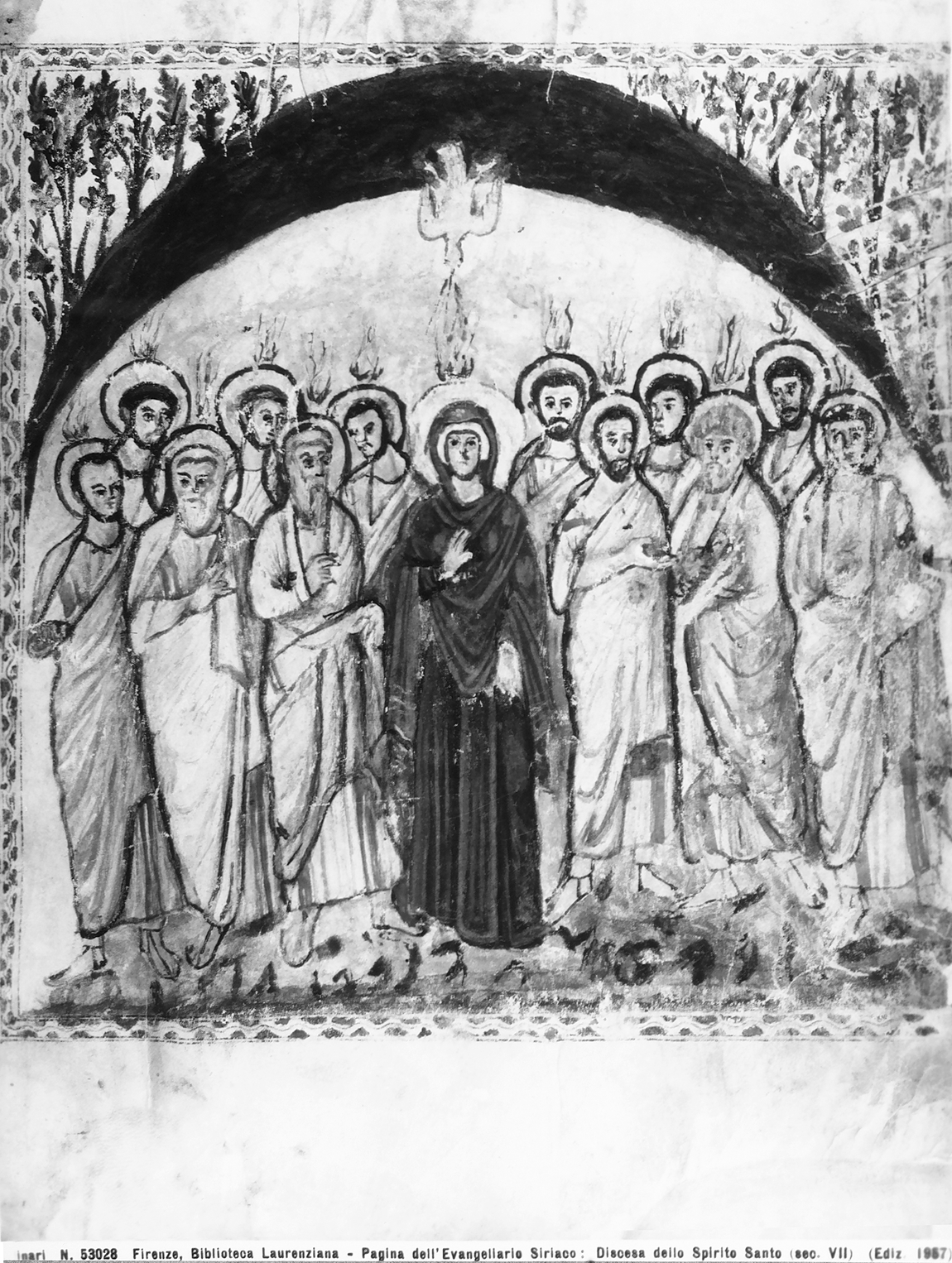
Pentecost. c. 586. Illumination from the Syriac Evangeliary of Rabbula. Biblioteca Laurenziana, Florence, Italy. Photo Credit: Alinari/Art Resource, NY.
The other striking feature of the Rabbula depiction of Pentecost is the prominent place that Mary holds in the scene. While the text of Acts does not explicitly state that Mary (and other women and disciples) were present at Pentecost, neither does it preclude such an interpretation. 6 The reading that “all those gathered” included the 120 mentioned in Acts 1:15 goes back at least to Chrysostom (Homily IV on the Acts of the Apostles) and has gained traction among recent commentators: “Luke uses several words to stress the togetherness of Jesus’ followers on this occasion (v. 1), which makes it look as if he means to include all the 120 believers of 1:14–15 (including Jesus’ family and the women) not just the Twelve.” 7
The illustrator of the Rabbula Gospels, however, does not intend to stress Lukan inclusivity, but rather to highlight the prominence and significance of the Virgin Mary at Pentecost. Mary is in the center of the illustration; her dark blue robe stands in contrast to the paler blue of the apostles, and her halo is golden in comparison with the understated violet of the apostles. Why does she hold such an important position? Herbert Kessler argues that it is the result of an ecclesiological focus that runs parallel to the christological emphasis of the Rabbula cycle (and is found in both the Ascension and Pentecost scenes):
Mary’s dominant presence is even more important; not mentioned in scriptural accounts of the Ascension, she stands for the Church, left behind as the custodian of Christ’s law until the Second Coming. The last folio in the codex depicts Pentecost, the foundational moment of the Church; the Virgin is pictured again amid the apostles, there inspired by the Holy Spirit.
8
Both aspects of the Rabbula Gospels’ illustration of Pentecost (that Pentecost is the logical end to the life of Christ and the importance of Mary’s representative role in symbolizing the church) are brought together by the Holy Spirit in the form of a dove, hovering just above Mary in the Rabbula Pentecost. The dove echoes Jesus’ baptism, illustrated earlier in the canon tables (fol. 4v).
Both themes are also found in later art; we explore one of those examples, Giotto’s Pentecost, in some detail. The first point illustrated by the Rabbula Gospels’ Pentecost (that Pentecost is viewed as a logical conclusion to the life of Christ) is seen again in the 1304–1306 work of Giotto di Bondone in the Scrovegni Chapel at Padua (Figure 2). This series of frescoes is considered to be the most complete series by Giotto done in his mature style. The chapel in Padua, a university town not far from Venice, is usually called the “Arena Chapel” because it is constructed above an ancient Roman arena. A wealthy merchant and influential Paduan citizen, Enrico Scrovegni, acquired the original chapel, dedicated to the Virgin Annunciate, in 1300. He rebuilt it with the likely intention of atoning for his sins, and those of his father, Riginaldo, for usury. (In The Divine Comedy, Dante banishes Riginaldo Scrovegni to the seventh circle of hell, the part reserved for usurers.) The church was dedicated on March 16, 1305, to Saint Mary of Charity.

Giotto di Bondone. Pentecost. 1304–1306. Scrovegni Chapel, Padua, Italy. Photo credit: Cameraphoto Arte, Venice/Art Resource, NY.
The chapel is very simple architecturally. It has a rectangular form with a starry sky in the barrel vault, a gothic triple lancet window on the façade, and narrow windows on the southern wall. The apse is in the east, and the main entrance in the west. The iconographic program is intellectually complex. Theological advisers, who were in consultation with the patron, directed Giotto. The frescoes follow three main themes: scenes in the lives of Mary’s parents, Joachim and Anna; scenes from the life of the Virgin; and scenes from the life and death of Christ. A large number of the representations are from the Legenda Aurea, or Golden Legend, by Jacobus da Voragine in 1264.
The magnitude of the project required Giotto to obtain assistance from his workshop, although he executed the principal figures in each scene and devised each spatial composition. Giotto and his assistants painted from top to bottom. Moist plaster had to be applied only to as much surface as could be painted in a day. This area, known as a giornata, prevented a premature drying of the wall and assured a true fresco composition. Calculated by the giornate seams, scholars have determined the frescoes were painted in 852 days. 9
Giotto was probably commissioned to decorate this chapel by Enrico Scrovegni because of the artist’s contemporary reputation. The Chronicle of Giovanni Villani, written just a few years after Giotto’s death, described the artist as among the great personalities of the day. The Trecento humanist, Boccaccio, claimed that Giotto had “brought back to light” the art of painting “that for many centuries had been buried under the errors of some who painted more to delight the eyes of the ignorant than to please the intellect of the wise” (Decameron, VI, 5). Dante also predicted Giotto’s fame and influence on contemporary culture in the Divine Comedy (Purgatorio 11.94). The Byzantine style of Giotto’s teacher, Cimabue, would soon be discarded by Tuscan artists in favor of the style derived from nature painted by Giotto.
Pentecost is the final scene of the life of Christ cycle and is located on the lowest level of the three bands of narratives on the northern wall. It is also the scene closest to the eastern altar. The arrangement around a table is organized similarly to the Last Supper that is directly opposite it on the south wall. This balance is typical of Giotto. The artist placed the figures inside an architectural space that is clearly defined by a succession of four pointed arches (that create the illusion of a vaulted ceiling under which the apostles are seated) and a right side that is half the length of the front with a two-arch colonnade. This created the illusion that the event occurred within a small church. Basil De Selincourt suggested that the Gothic arch is used for the first time to symbolize the Christian church. 10
Visual sources that came before Giotto are rare, but it can be argued that this is the first time a visual depiction of Pentecost was painted in a prominent location. Giotto will repeat the subject in the Florentine church of Santa Croce in 1306–1312. He extended the visual depiction of the story to include verses up to Acts 2:1–13, rather than stopping at Acts 2:1–4. This allowed him to include three figures outside the house. The Santa Croce cycle also included the tongues of fire over the apostles’ heads, and the Holy Spirit is represented as a dove. In the Scrovegni chapel, speech is portrayed through “the speaking hand.” 11 This allows the critical message of the biblical story, that the Twelve all start speaking in different languages, to be conveyed in a silent picture. Giotto chooses the hand because it is able to communicate so many different meanings and emotions. Precedents of this speaking hand are the orators of Greek and Roman art. The Holy Spirit is represented through rays of light emanating from outside the room and above the painted ceiling. Giotto does not depict Mary among the Twelve. Instead, the church itself is inscribed in the architecture, in the “church-like structure” encompassing, containing and protecting the event from the world outside.
Both these images, the manuscript illumination in the Rabbula Gospels and Giotto’s fresco, highlight aspects of the Pentecost narrative. With the assistance of such visual resources, the contemporary worshipper is reminded that the church, empowered by God’s Spirit, continues Christ’s redemptive ministry of reconciliation.
Trinity Sunday
Trinity Sunday celebrates one of the great doctrines of the Christian church. The mystery of the Triune God has not only been the topic of countless theological treatises but also the topic of artistic depiction and reflection. One of the best-known examples is the Trinity by Tommaso Masaccio (Figure 3). Masaccio’s Trinity was executed around 1427 and is located in the Dominican church of Santa Maria Novella in Florence. 12 This fresco is widely regarded as one of the great masterpieces of Western art, but we should note that it is specifically a work of sacred art in the Christian tradition and was intended to aid its viewers in the worship of the Christian God; as such, it has a particular liturgical function.
The fresco was commissioned as a funerary monument by the Lenzi family, who are depicted life-size and kneeling in prayer on either side of the cross, below Mary and the Beloved Disciple. 13 The upper part of the fresco depicts God the Father supporting the arms of the crucified Son. Between the Father’s beard and Jesus’ head is the white, dovelike form of the Holy Spirit, uniting Father and Son; hence its title.
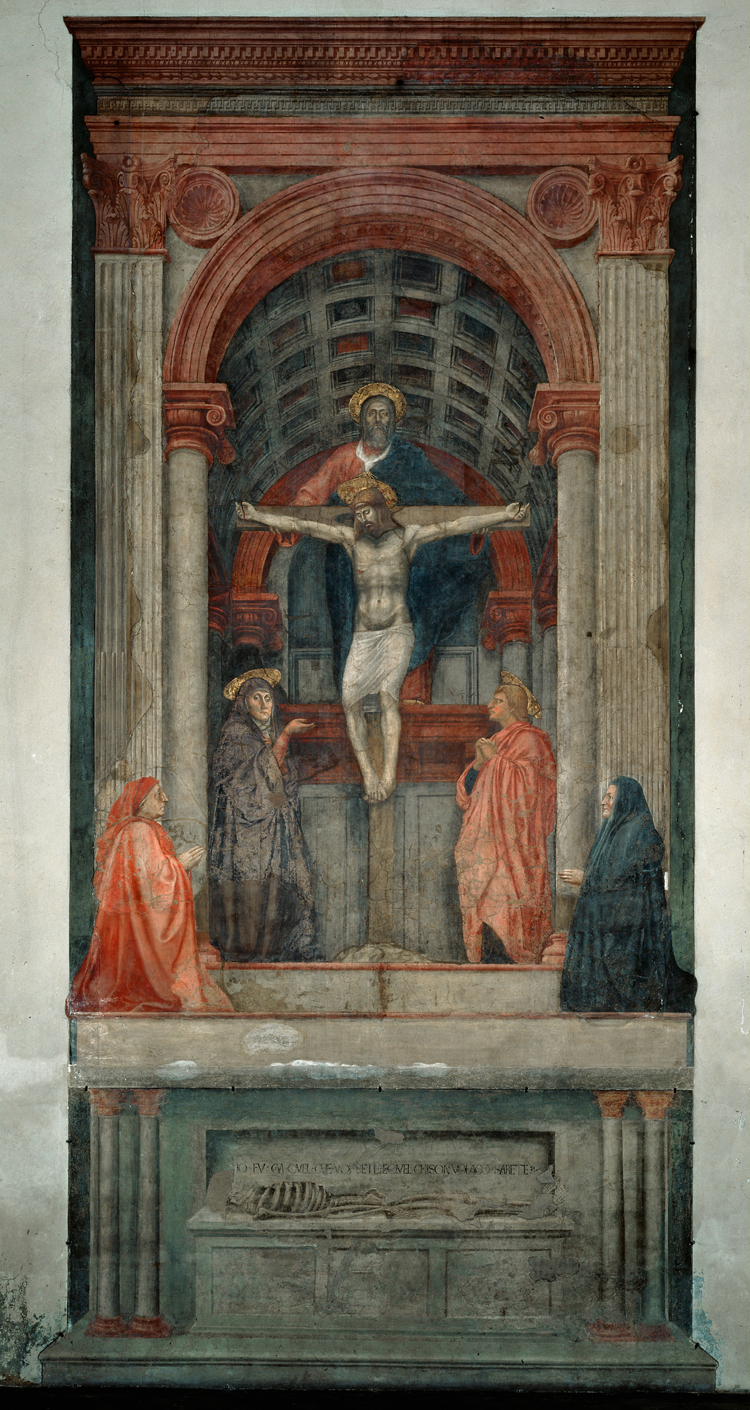
Masaccio. Trinity. 1427. Santa Maria Novella, Florence. Photo Credit: Alinari/Art Resource, NY.
At the base of the fresco is the figure of a skeleton lying on a sarcophagus. Until its rediscovery in 1952, the skeleton was hidden by an altar for over 400 years. This figure is hailed (perhaps incorrectly) as the “first known scientifically exact representation of a human skeleton” since antiquity. 14 Above the skeleton in vernacular Italian is inscribed a haunting epithet, which roughly translated reads, “What you are, I once was; what I am you will become.” 15 The first part of the saying, “What you are, I once was,” highlights what its first audience already knew—there is a common thread in our existence that allows us to connect with our fellow human beings.
The second part of our epithet is a bit more complex. “What I am, you will become.” The skeleton, as Everyman or perhaps even Death personified, speaks from beyond the grave to point out what is, in one sense at least, true. All of humanity, regardless of race, gender, socio-economic standing, or creed, as finite creatures of flesh and blood, will sooner or later die. This reminder of the transitory nature of human existence was especially poignant for a late medieval community that had been repeatedly ravaged by plagues. Masaccio himself, after completing this, his last painting, would die the next year at the young age of 26. 16 But this view, on its own, can lead to a rather pessimistic determinism or fatalism that Masaccio seeks to undermine. There is another dimension to the saying for us beyond this primary reference to the transience of life. “What I am, you will become” has a ring of presumption about it, because it claims what it cannot possibly know.
Left in isolation, this part of the proverb—whether in reference to human transience or human hubris—is depressing, even tragic news. But the story, according to the Christian Gospel, does not end here. And Masaccio and his patrons knew this. The beholder is invited to reflect upon the upper register of the fresco, where God the Father supports the crucified Son. Art historians generally agree that Masaccio is here following a well-known artistic convention of associating the “Throne of Grace”—derived from Heb 4:16 (“Let us therefore approach the throne of grace with boldness, so that we may receive mercy and find grace to help in time of need”)—with a crucifixion scene as a way of reflecting the profound mystery of the Trinity. 17 Thus, the viewer is encouraged to come to the throne of Grace to experience God’s redeeming mercy. 18
In this reading, the skeleton is not only Everyman or Death personified, but also a representation of the first Adam. The tradition that Christ was crucified at the very place that Adam was buried was well known and frequently depicted in art. The death of Christ, the Second Adam, expiated the sin of the first, and as such, the fresco was a visualization of St. Paul’s argument that Christ as the Second Adam came to “undo” what the first Adam had done, the one through whom sin had entered the world (Rom 5:12–19). The first Adam was himself also the first man to be saved by Christ’s blood that seeps down from the upper portion of the fresco toward Adam. 19 As the words of Adam, and not Death or Everyman, the epithet takes on another meaning. Adam says, “What you are—human beings with a stubborn and willful inclination to sin—I once was; what I am—a sinner redeemed by the triune God’s grace and the sacrificial death of his son—you will become.”
In contemplating this painting, we should take note also of the Father who lovingly supports his Son in his suffering and at the same time fixes the viewer/worshipper with a gaze no less penetrating than the mother’s. Whereas many detractors of Christianity would point to the crucifixion as evidence of the absurdity of the Trinity, Masaccio claims it is in this very moment that the essential unity of Father, Son, and Holy Spirit is most clearly revealed. Here, there is no depiction of God turning his back on his Son, disgusted at the sight of one who at that moment bore all the sins of the world. No, here is a loving Father, who in the mystery of the Trinity is at one with the Son and the Spirit, and suffers in our behalf. 20
The visual tradition of depicting the triune God is continued in Andrea del Castagno’s fresco, St. Jerome’s Vision of the Trinity, c.1454–1455 (Figure 4). The fresco was executed above an altar at the Church of Santissima Annunziata, Florence. 21 Jerome, born in Dalmatia in 342, was one of the four doctors of the Church with Ambrose, Augustine, and Gregory the Great. He is best known for making the first translation of the Bible into Latin, the Vulgate, and is usually seen wearing cardinal’s robes. Castagno does not employ the traditional iconography of St. Jerome that depicts him seated at a desk, as a theologian translating Scripture. Instead, the artist portrays Jerome as the hermit who spent four years in the desert. The setting is meant to recall the Egyptian desert but looks like a typical barren hill north of Florence. Jerome is in his undergarments holding a rock (an attribute associated with the saint) in his right hand to continue beating his breast. Jerome’s other attribute, the cardinal’s red hat (although there was no office at the time Jerome lived in the fourth century), is placed in the center foreground of the painting. Just behind Jerome is a lion that legend has it, he befriended by taking a thorn out of its paw. Flanking Jerome are St. Paola and St. Eustochium, two of his close followers.
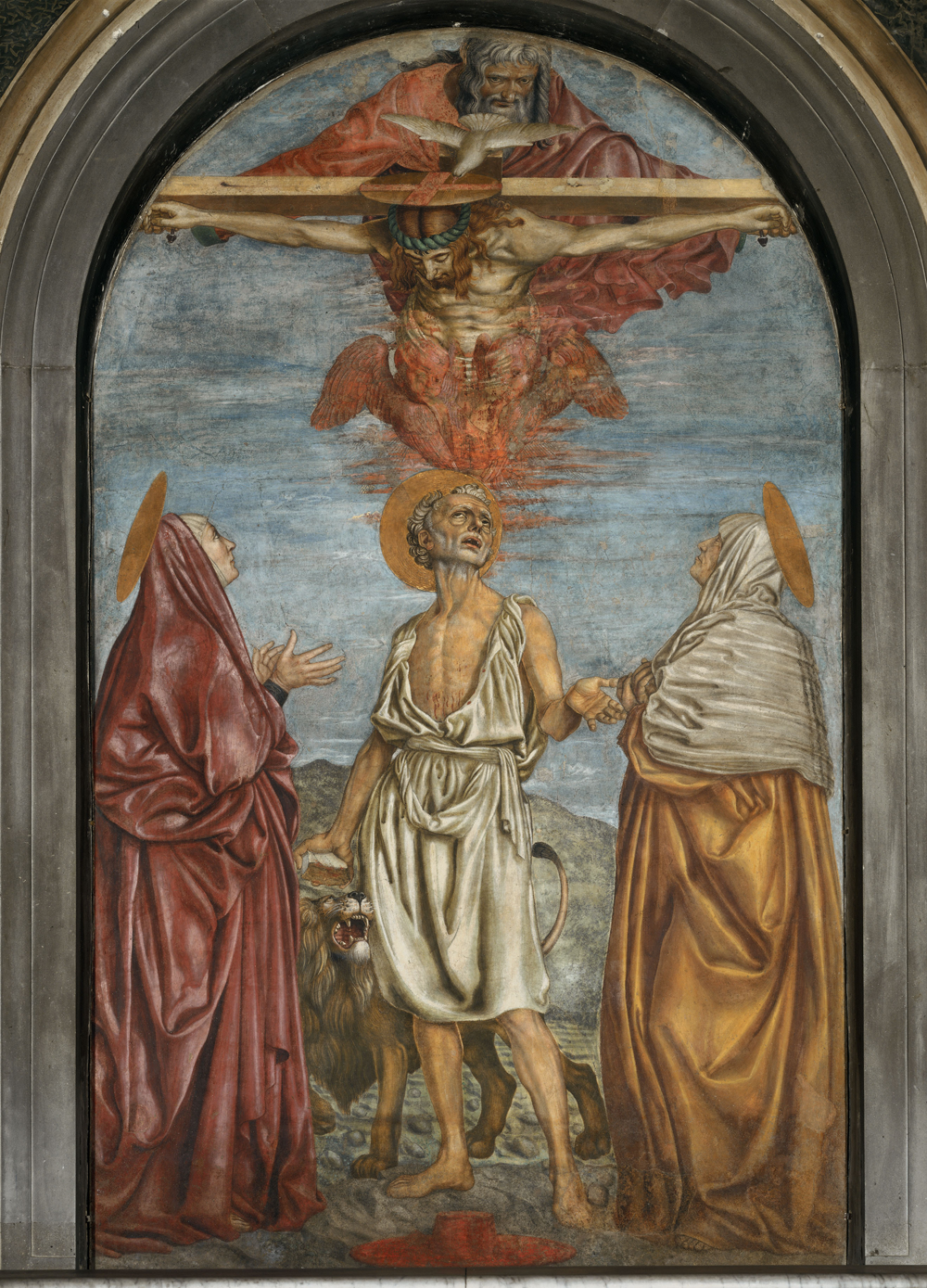
Andrea del Castagno. The Vision of St. Jerome. c. 1454–1455. Santissima Annunziata, Florence. Photo Credit: Scala/Art Resource, NY.
Castagno’s depiction of the Trinity utilizes the new technique of foreshortening that could only be devised after a thorough understanding of one-point linear perspective. Masaccio’s Trinity is commended not only for its complex iconography as discussed above but also for its use of the newly realized rational system of one-point linear perspective. Brunelleschi, the Florentine architect responsible for placing the cupola on the Duomo in Florence, together with Masaccio and humanist-architect Leon Battista Alberti, devised a system to portray correctly (through geometry and ratio and proportion) a perspectival illusion of a third dimension receding into a two-dimensional wall surface. This was accomplished with a single vanishing point. The Masaccio Trinity is the first work to perspect correctly a painted composition. When a person 5’10” in height stands in the nave of the church and views the frescoed wall, the vaulted space behind the Trinity gives the illusion of a physical, coffered area.
Castagno, painting the Vision of St. Jerome almost 30 years after Masaccio’s work, was familiar with the practice and theory of one-point linear perspective. Castagno expands the realistic illusion of perspective by using the concept of foreshortening in the Vision of St. Jerome. God the Father holds Christ on the cross, while the Holy Spirit, in the form of a dove, draws our attention to the down-turned halo, a nimbus reserved for Christ. The entire Trinity appears to be gliding out of the painting and into the viewer’s space. Castagno is also one of the first artists interested in capturing movement.
The subject of St. Jerome’s vision is extremely rare, yet Castagno’s work is usually discussed in every Italian Renaissance college course and textbook. The vision is most likely a passage from an authentic letter by Jerome to Eustochium (where he “seemed” to be among angels), embellished with legendary sources. 22 In Epistle 22 written to Eustochium, Jerome describes his years as a penitent in the desert. The historical Jerome called on the Lord to witness his angelic vision (ut mihi ipse testis est Dominus). Eugene Rice observed that an anonymous author of a late thirteenth- or fourteenth-century pseudograph known as the Regula monacharum states that he had actually seen the Trinity (testis est ipsa Trinitas quam cernebam, nescio quo intuitu). 23 Castagno depicts the version of Pseudo Jerome.
The image of the penitent Jerome was invented by the Hieronymites in Tuscany around 1400. Jerome was seen as a model for the flagellants who beat themselves “per la memoria della passione de Cristo” (“for the memory of the passion of Christ”). An eremitical congregation dedicated to St. Jerome, the Congregazione degli eremiti di S. Girolamo, was founded in nearby Fiesole. Jacobus de Voragine described Jerome in the Golden Legend as “dipped in blood by his contemplation of the passion of our Lord.”24 Artists pictured him before a crucifixion. Now, a generation later, Castagno was probably asked to illustrate Jerome’s reward, a vision of the Trinity, for that period of penitent mortification and meditation on the Passion. 25 Also, Christ is crowned with the rope of flagellation, rather than with thorns. This was probably a request from his patron, Girolamo (Jerome) dei Corboli, who belonged to a community of flagellants.
Our last example, the “Shield of the Trinity” (Figure 5) combines the verbal and visual. The earliest extant examples of this image (known then as Scutum Fidei, “Shield of Faith,” based on Eph 6:16) are found in illuminated manuscripts dating to the thirteenth century. 26 The image’s use experienced a revival in the nineteenth century, being especially popular in stained glass restorations in churches in the UK. Figure 5 comes from a Victorian stained glass in the north aisle above the baptismal font in Holy Cross Church, Gilling East in Yorkshire. It was installed in 1886 in memory of Lavinia Barnes. Like other examples of the Shield of the Trinity, the Gilling example has the word, “Deus,” inscribed in the center with vertices leading out to three nodes, labeled Pater (“Father”), Filius (“Son”), and Sanctus Spiritus (“Holy Spirit”). 27 On each connecting vertex is written the word est (“is”), which is intended to be non-directional. 28 The results are six theological assertions:
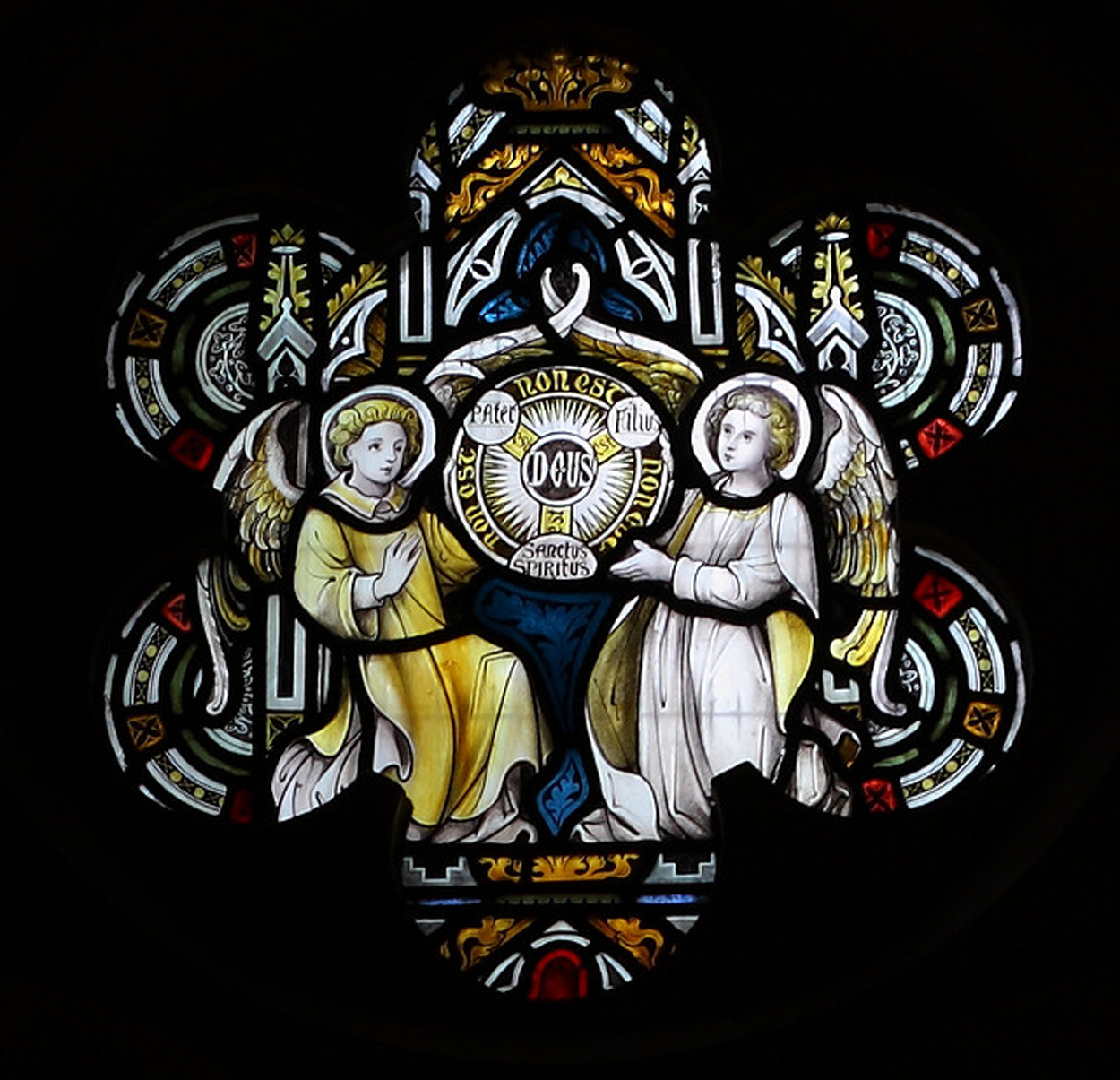
Shield of the Trinity. 1868. Holy Cross Church, Gilling East, Yorkshire, England. Photo Credit: Used with permission of the church.
The three links connecting the outer nodes are labeled non est (“is not”) and are also intended to be non-directional, producing six more theological propositions:
The Shield of the Trinity becomes a visual and logical representation of the doctrine of the Trinity as expressed in the Athanasian Creed, emphasizing the unity of the Godhead, without confusing the divine attributes. Its public accessibility in the stained glass makes it a valuable aid in the teaching and worshiping ministries of the church.
Conclusion
The liturgy associated with the Feast of Pentecost and Trinity Sunday is particularly enriched by appeal to and usage of the relevant Christian visual tradition. Reclaiming and re-casting that visual tradition may prove essential to contemporary churches as they seek to nurture and challenge congregations who have been formed in a largely post-literate, visual culture. Margaret Miles has asked: “Do twenty-first century Christians have images that suggest, inspire, attract? Churches are no longer major patrons of art. The very word ‘art’ conjures in our minds museums and galleries that remove religious images from the life of religious communities.” 29 Our brief survey of visual depictions of the event of Pentecost and the doctrine of the Trinity suggests that resources do, in fact, exist that worship leaders and liturgists can employ to inspire their congregants to deeper theological reflection upon the mysteries of the Christian faith.
Footnotes
1
On this section, see Heidi J. Hornik and Mikeal C. Parsons, “Philological and Performative Perspectives on Pentecost,” in Reading Acts Today (ed. Steve Walton, Lloyd Keith Pietersen, F. Scott Spencer, and Thomas E. Phillips; New York: Continuum/T & T Clark, 2011). This material is used here by kind permission of Continuum International Publishing Group.
2
Loveday Alexander, “What If Luke Had Never Met Theophilus?” BibInt 8 (2000): 161–70 (170).
3
See especially David H. Wright, “The Date and Arrangement of the Illustrations in the Rabbula Gospels,” Dumbarton Oaks Papers, 27 (1973): 197–208.
4
Wright, “Date and Arrangement,” 204.
5
C.K. Barrett, Luke the Historian in Recent Study (London: Epworth, 1961), 57.
6
The fact that several mss (e.g., 326, 2495) insert “the apostles” after “all” is indirect evidence that such an interpretation was acknowledged, and rejected, from early on.
7
Loveday Alexander, Acts: A Bible Commentary for Every Day (The People’s Bible Commentary; Oxford: The Bible Reading Fellowship, 2006), 28.
8
Herbert Kessler, “The Word Made Flesh in Early Decorated Bibles,” Picturing the Bible: The Earliest Christian Art (Jeffrey Spier, ed.; New Haven: Yale University Press, 2007), 166.
9

10
B. De Selincout, Giotto (London: Duckworth and Co., 1905), 149.
11
M. Barasch, Giotto and the Language of Gesture (New York: Cambridge University Press, 1987), 15–17.
12
The fresco measures 21′7″ x 11′. For an introduction to the life and work of Masaccio (1401–1428), see Helmut Wohl, “Masaccio,” in Grove Dictionary of Art (ed. Jane Turner; London: Macmillan, 1996), 20:529–539. For introductory issues related to this specific fresco, see Rona Goffen, “Introduction,” in Masaccio’s Trinity (ed. Rona Goffen; Cambridge: Cambridge University Press, 1998), 1–32.
13
Many assume the patrons were probably Domenico di Lenzo and his wife. On the debate regarding the identity of the donors, see Paul Joannides, Masaccio and Masolino: A Complete Catalogue (London: Phaidon, 1993), 356–68.
14
Charles de Tolnay, “Renaissance d’une fresque,” L’Oeil 37(1958): 38. For a more sober view of the accuracy of Masaccio’s skeleton, see Katherine Park, “Masaccio’s Skeleton: Art and Anatomy in Early Renaissance Italy” in Masaccio’s Trinity (ed. Rona Goffen; Cambridge: Cambridge University Press, 1998), 119–40.
15
The Italian inscription reads: IO FU GA QUEL CHE VOI SETE/E QUEL CHI SON VOI ACO SARETE.
16
Documents related to Masaccio’s life and work are scarce. For what we do have, see James Beck, Masaccio: The Documents (Locust Valley, N.Y.: J.J. Augustin, 1978). For the evidence that places Masaccio’s death in Rome in 1428, see Document XXIX in Beck, Masaccio, 29–30. Two early manuscripts (ibid.) also have the ambiguous note that he died “of poison.”
17
See, for example, Mariotto di Nardo, The Holy Trinity with the Virgin and St. Mary Magdalen, 1400, tempera and gold leaf on panel. This compositional type is known as Gnadenstuhl in art historical scholarship.
18
Ursula Schlegel, “Observations on Masaccio’s Trinity Fresco in Santa Maria Novella,” Art Bulletin 45 (1963): 25.
19
On the redemption of Adam by the blood of the crucified Christ, see G. Bandmann, “Zur Deutung des Mainzer Kopfes mit der Binde,” Zeitschrift fur Kunstwissenschaft 10 (1956): 179 n. 89.
20
Timothy Verdon, “Christianity, The Renaissance, and the Study of History: Environments of Experience and Imagination,” in Christianity and the Renaissance: Image and Religious Imagination in the Quattrocento (ed. Timothy Verdon and John Henderson; Syracuse: Syracuse University Press, 1990), 24–27.
21
The fresco measures 9’9” x 5’10”. For additional Castagno bibliographies that include a discussion of this painting, see Marita Horster, Andrea del Castagno: Complete Edition with a Critical Catalogue (Oxford: Phaidon, 1980); John R. Spencer, Andrea del Castagno and His Patrons (Durham, N.C.: Duke University Press, 1991).
22
Eugene Rice, “St. Jerome’s ‘Vision of the Trinity’: an iconographical note,” Burlington Magazine 125, N. 960 (March, 1983): 151–153, 155.
23
Ibid., 152.
24
Jacobus de Voragine, Legenda Aurea (ed. Theodor Graesse; Bratislava: n.p., 1890), col. 653; cited by Rice, “St. Jerome’s ‘Vision of the Trinity,’” 155.
25
Ibid., 155.
26
See Michael Evans, “An Illustrated Fragment of Peraldus’s Summa of Vice: Harleian MS 3244,” Journal of the Warburg and Courtauld Institutes, 45 (1982): 14–68, esp. 22–23, for a brief history of the image.
27
See Frederick Roth Webber, Church Symbolism: An Explanation of the More Important Symbols of the Old and New Testament, the Primitive, the Mediaeval, and the Modern Church (Detroit: Gale Research, 1971).
28
Rodney Dennys, The Heraldic Imagination (New York: Clarkson N. Potter, 1975). Occasionally, the non- or bi-directionality of the links is emphasized by writing est and/or non est going in both directions.
29
Margaret Miles, “Achieving the Christian Body: Visual Incentives to Imitation of Christ in the Christian West,” in Interpreting Christian Art (ed. Heidi J. Hornik and Mikeal C. Parsons; Macon, Ga.: Mercer University Press, 2004), 22.