







Abstract
While we may use the Gospels and Paul’s letters to justify eating with wild abandon and enjoying every bite, we should revisit the greater principle in the New Testament: to feed others to the point of self-sacrifice in order to honor the integrity of the community.
Introduction
If a brother or sister is naked and lacks daily food, and one of you says to them, “Go in peace; keep warm and eat your fill,” and yet you do not supply their bodily needs, what is the good of that? So faith by itself, if it has no works, is dead. (James 2:15–17) When you come together, it is not really to eat the Lord’s Supper. For when the time comes to eat, each of you goes ahead with your own supper, and one goes hungry and another becomes drunk. (1 Cor 11:20–21) Do not let what you eat cause the ruin of one for whom Christ died. (Rom 14:15) Therefore, if food is a cause of their falling, I will never eat meat, so that I may not cause one of them to fall. (1 Cor 8:13)
Recently, a student in my New Testament class stumbled over the words of Jesus that we will be judged if we do not feed the hungry. He said, “I have never heard that! Jesus loves us! He gives us everything we need in abundance! When we prosper, it means we are being blessed! We should be grateful!” The rest of the students gave their collective assent. I asked them, “Then what do we do with these words of Jesus? What is the appropriate Christian response?” This type of scene occurs more often than I would like. It speaks to a growing assertion in our culture—and I speak from my own particular context in rural North Carolina—that the teachings of Jesus no longer serve as stumbling blocks for ethical decisions. And although the ax is at our roots and will chop us up and throw us into the fire, we do not want to hear these words (Luke 3:9).
This essay is as hard for me to write as it may be, perhaps, for you to read. It is directed to people like me, the “haves” of this world who have enough on their plates on a daily basis. I know what it means to overindulge and to fall into a tryptophan slumber. I have been among the 66% of American adults who are overweight and the 35.7% who are obese. 1 I contribute to the 20 billion-dollar weight-loss industry so that I can learn to manage my portion size. With even more embarrassment, I admit that I think twice about the expense of inviting people in for a meal, spend money first on my grocery budget and second on my tax-deductible charitable donations, and use food drives as a way to make more room in my pantry. I expect food to be served at every gathering. In the past few months as I have been writing this essay, I have developed a growing conviction that I need to reconsider my relationship with food. I ask myself, “Is this what Jesus had in mind when he called us to abundant life?” (John 10:10).
What is it about our culture, especially North American Christian culture, that tolerates such excess and, shall I use that ugly word, “gluttony”? Unlike abortion and gay marriage, gluttony gets little attention in sermons. Some churches seem to promote gluttony by serving sweets between services and by hosting lavish potlucks. Indeed, studies show that evangelical churches have the highest levels of gluttony, manifested in obesity. A 2006 Purdue study, for example, found that fundamentalist Christians are by far the heaviest of all religious groups, led by the Baptists with a 30% obesity rate (compare Jews at 1% and Buddhists and Hindus at 0.7%). 2 In another study of 2,500 clergy, 76% were overweight or obese compared to 61% of the general population in the same time period. 3 In spite of these figures, evangelicals lead the way in opposing anti-obesity efforts by Michelle Obama because they do not want “to damage anyone’s self-esteem.” 4 In response to the growing problem of obesity, some churches and organizations have developed weight-loss projects with good results, although they are often motivated for legitimate health and fitness reasons rather than theological reflection. 5
While many in this country enjoy abundance, perhaps celebrating the “prosperity gospel,” many in this country experience hunger. The U.S. Census Bureau reports that, in 2010, 15.1% of the population lives below the poverty line, more than ever before. 6 The issue is even more frustrating when we turn our eyes to global hunger. The World Hunger Organization estimates that in 2010, 925 million people in the world were hungry. 7 Their figures show that enough food is produced to feed the world, but 30-50% is wasted. 8 In the global arena, many Christians have taken the lead to feed the hungry; organizations abound. And still, obesity and its strange companion—hunger—are both national and global concerns.
In some respects, the New Testament contributes to this profound injustice in which some people battle obesity and others battle hunger. In this essay, I will consider the Christian rationale for feeding our own bellies and for ignoring the hungry. Then I will examine the larger New Testament principles about eating and feeding the hungry, first according to the Gospel traditions and then according to Paul. In the end, I hope that we might all be more aware of our attitudes to food, to our bodies, and to each other, and that we might consider ways to move forward.
The New Testament Rationale to “Eat Enthusiastically and Enjoy Every Bite!”
The New Testament provides a rationale for filling our bellies: God “blesses” us with food. We ask God to feed us when we pray, “Give us this day our daily bread” (Matt 6:11). We should not worry about what we will eat because God feeds the birds of the air and we are more valuable (Matt 6:26); we know that “all things come from God” (1 Cor 11:12). And thus, we credit God with the food before us. The danger of this biblical rationale for enjoying food lies in three areas. First, when we believe that God has provided our food, we think of ourselves as worthy of it. We might be “more worthy than the birds of the air,” but are we more worthy than other people? Second, when we believe that we are “blessed” by God with the food before us, we might want to keep more of it for ourselves. Third, when we concentrate on thanking God, we might forget that others have had a role in feeding us. Should we not thank them also?
The New Testament provides a second rationale to fill our bellies: we have worked hard for it. When Jesus sends the seventy out to spread the good news, he instructs them to eat what they are given, for “the laborer deserves to be paid” (Luke 10:7). They deserve to eat. In the same way, we work hard for our food and we deserve to eat. But do we fairly pay those who have worked hard to put the food on our table?
A third rationale it that we want to receive all that God has to give us, to experience “abundant life.” As we take in the word of the Lord, we take in fried chicken. But sometimes we seek food to fill a void in our lives; we eat comfort food to feed the hunger in our hearts. We receive food as we (hope to) receive love. Are we spiritually hungry? Is there a better way to feed our souls?
Fourth, we use the New Testament to justify not fasting. Unlike the disciples of John the Baptist who fast and pray, we join the sinners and tax collectors who surround Jesus and eat and drink “while the bridegroom is with them.” And because the bridegroom was never really taken away—because Jesus lives!—we never really need to fast now (Matt 9:15; Mark 2:18–20; Luke 5:33–35). We abhor the accusation that we might “look dismal when we fast” (Matt 6:16; Mark 4:2), so we do not fast at all. We prefer to identify ourselves with the honest tax collector who humbled himself before God, than with the hypocritical Pharisee who fasted twice a week and tithed (Luke 18:10–14). Only a few verses suggest that fasting might be a good thing to do (Matt 6:17–18; Matt 17:21 variant; Acts 13:2–3). Fasting is not a popular Christian discipline and receives little New Testament support. But should we revisit this discipline?
Finally, we often tolerate the poor among us using the dangerous words of Jesus: “For you always have the poor with you” (Matt 26:7; Mark 14:7). But we take these words out of context. Jesus says, “For you always have the poor with you, and you can show kindness to them whenever you wish; but you will not always have me” (Mark 14:7). While we might rationalize that we are celebrating the “presence of Jesus” in our midst, we forget that the poor are also always with us, and that we need to attend to them.
Based on New Testament passages, then, we rationalize eating with enthusiasm and enjoying every bite. We express our gratitude and celebrate God’s goodness. We rationalize ways to avoid feeding others, or to deny ourselves our “daily bread” by fasting. We see our expanding waistbands as a sign of God’s provenance and thus, perhaps, our own righteousness. However, when we compare this rationale to eat with enthusiasm to the larger principles of the New Testament, we must reconsider.
The Gospel Traditions Support Feeding the Poor to the Point of Sacrifice
Although we might take the words of Jesus out of context from the Gospels to suit our own purposes, as I have attempted to show above, when we carefully consider the larger principles, we see that the Gospel traditions support, both literally and metaphorically, feeding the hungry to the point of self-sacrifice. These principles arise out of the explicit teachings and actions of Jesus and find support in the actions of the early church: Jesus feeds the hungry; he instructs his disciples to feed the hungry; and he judges those who do not.
The Gospels promote feeding the hungry most pointedly by recounting Jesus’ feeding miracle six times. 9 The basic narrative goes like this: Jesus and the disciples go into a deserted place; a crowd follows them; they become hungry. Jesus says, “You give them something to eat” (Matt 14:16). All they have are a few loaves and fishes. They give the food to Jesus, who blesses it, then they feed five (or four) thousand people, and gather the remnants. Jesus does not take the excess of what they have and distribute it; he requires them to surrender all they have for others. By repeating this story, the Gospels emphasize the importance of feeding the hungry.
Other gospel stories extend the idea that Jesus teaches people to feed the hungry, especially if we see that there is little distinction between those who hunger and those who are poor: to be poor in 1st-century Judea meant to be hungry. Indeed, Jesus consistently teaches excessive generosity to the poor. When a rich and righteous young man asks how he might be saved, Jesus tells him, “If you wish to be perfect, go, sell your possessions, and give the money to the poor, and you will have treasure in heaven; then come, follow me.” But the young man “went away grieving because he had many possessions” (Matt 19:16–24; cf. Mark 10:17–23; Luke 18:18–25). When a poor widow puts her last few coins into the temple treasury, Jesus holds her up as an example: “Truly I tell you, this poor widow has put in more than all those who are contributing to the treasury. For all of them have contributed out of their abundance; but she out of her poverty has put in everything she had, all she had to live on” (Mark 12:43–44). Likewise, after meeting Jesus, Zacchaeus gives half of his money to the poor and pays back four times what he defrauded; Jesus says “Today, salvation has come to his house” (Luke 19:1–10). The Gospels link salvation with feeding the poor sacrificially.
The Gospels also promote feeding the hungry through eschatological parables, warning people that they will be judged if they do not feed the hungry. For example, Jesus describes a rich man “who was dressed in purple and fine linen and who feasted sumptuously every day” (Luke 16:16–31). Outside his gate lay poor Lazarus, who ate the crumbs from the rich man’s table—his excess. Both men die. The rich man in Hades first unsuccessfully begs Abraham to send Lazarus from heaven to give him a drink, then he asks Abraham to “warn his brothers.” But Abraham replies that they have already been warned, and did not listen. Similarly, Matthew 25 claims that when the Son of Man comes in his glory, he will separate the sheep from the goats. The sheep are the ones who fed the hungry (listed first), gave a drink to the thirsty, welcomed the stranger, clothed the naked, cared for the sick and visited the prisoner, and in so doing served the Lord. “Truly I tell you,” he says, “just as you did it to one of the least of these who are members of my family, you did it to me.” They will go into eternal life (25:46). In contrast, the goats are those who did not feed the hungry (again listed first), and so forth. They will be “accursed and sent to the eternal fire” (25:41). Neither the goats nor the rich man seemed to be aware that they would be judged for their treatment of the poor and hungry. Do we have a better excuse than that no one warned us?
Even when it appears that the Gospels “spiritualize” feeding language, they balance it with concrete feeding language. Luke has Jesus say, for example, “Blessed are you who are poor, for yours is the kingdom of God. Blessed are you who are hungry now, for you will be filled. . . . Woe to you who are full now, for you will be hungry” (Luke 6:20–21, 25). In a similar context, Matthew spiritualizes the notion of poverty and hunger, stepping back from the real physical hunger of Luke: Matthew’s Jesus says, “Blessed are the poor in spirit, for theirs is the kingdom of heaven. . . . Blessed are those who hunger and thirst for righteousness, for they will be filled” (Matt 5:3, 6). However, Matthew offsets this spiritualization in the very concrete feeding described in the last judgment (25:31–46). Feeding the hungry, for Matthew, is both physical and spiritual.
Similarly, the Gospel of John preserves the concrete imperative to feed the hungry through Jesus’ example and teaching, and metaphorically links feeding others with dying. Jesus turns water into wine (2:1–11), feeds the 5,000 (6:1–15), and serves the disciples breakfast (21:13). But metaphorically, Jesus must die in order to provide saving food for others. 10 For example, John the Baptist calls Jesus “the lamb of God who takes away the sin of the world” (1:29, 36); when Jesus dies at the hour when the Passover lambs were slaughtered (19:14) and has “no broken bones” (19:33), he becomes, in a sense, the Passover meal. Jesus offers himself as “the bread that comes down from heaven”—“The bread that I will give for the life of the world is my flesh… for my flesh is true food and my blood is true drink” (John 6:51, 54; cf. 19:34). He is the source of living water made visible at his death (4:10–15; cf. 19:34). Meals with Jesus are opportunities for conversations about death: for example, at the meal in Bethany, Mary anoints Jesus for his death (12:1–8); at the Last Supper, Jesus “knows his hour had come to depart” (13:1–3); at the resurrection breakfast, Jesus foretells Peter’s death (21:18). According to the Gospel of John, Jesus must die in order to feed others.
Finally, the Gospel of John encourages believers to feed others, even to the point of death. Although the feeding role of the disciples grows throughout the Gospel narrative from those who observe (2:11), to those who question (4:31), to those who participate marginally (6:13), to those who are active agents in feeding others (21:8), the Gospel does not unfold the full imperative until the last chapter. In chapter 21, Jesus asks Peter three times, “Do you love me?…. Feed my sheep/lambs,” equating feeding with loving (21:15–17). Not only does the Gospel evoke the image of the “good shepherd who lays down his life for his friend” (10:1; cf. 15:12–13), but it reinforces the connection between feeding to the point of self-sacrifice by describing Peter’s death immediately thereafter (21:18–19). The Gospel of John thus promotes feeding others to the point of self-sacrifice.
The Gospel traditions, therefore, unequivocally state that we need to take care of the poor and give them food. Jesus not only serves as an example of one who feeds the hungry, but he instructs his disciples to do so also, for their very salvation. When we focus only on the spiritualized aspect of feeding others by drawing on such New Testament texts as Matt 5:3–6 and the Gospel of John, we must not forget that these Gospels provide a powerful counterpoint to feed others—in concrete terms—even to the point of death.
Food Defines Community
Although the New Testament traditions report that Jesus taught often through word and deed the powerful and important principle of feeding others, and that we cannot dismiss this teaching as merely spiritual, the Gospels also suggest that sharing food with others defines community.
According to the Gospels, Jesus and his disciples redefine the traditional understanding of community. Jesus turns away his mother, sisters, and brothers in favor of his new family (Matt 13:46–50; Mark 3:31–35). This new community is infamous because they “eat with tax payers and sinners” (Matt 9:11; Mark 2:16; Luke 5:29; 15:12) and Pharisees (Luke 7:36; 14:11). Several of Jesus’ parables describe a banquet, where a host invites the poor, the crippled, the lame, and the blind (Luke 14:13; Matt 22:1–13). Jesus teaches the people to feed those who will not be able to repay (Luke 14:12–14). According to the Gospels, this new community does not just include the family, as we usually define it, but extends to the wider community of those who are unable to contribute to it.
The Book of Acts describes this new community of people who eat together in some detail, and connects it to the exponential growth of the early church in Jerusalem. After the initial outpouring of the Holy Spirit, All who believed were together and had all things in common; they would sell their possessions and goods and distribute the proceeds to all, as any had need. Day by day . . . they broke bread at home and ate their food with glad and generous hearts, praising God and having the goodwill of all people. (Acts 2:44–47a)
As a result, “the Lord added to their number those who were being saved” (Acts 2:47; see also 4:32–35). In fact, an early dispute centers on the unequal distribution of food to the community: “the Hellenists complained against the Hebrews because their widows were being neglected in the daily distribution of food” (Acts 6:1). As a result, the people appointed “seven men of good standing, full of the Spirit and of wisdom” to wait on the tables so that the apostles could devote themselves “to prayer and to serving the word” (6:4). This generous and equitable distribution of food demonstrates the recreation of the new community.
The Acts of the Apostles also suggests that the early church needed to remove obstacles to sharing food with “others.” One obstacle was the fact that Jews and Gentiles did not eat together; Jews observed dietary laws by eating only some types of animals, while Gentiles seemed not to have these restrictions. Acts 10–11 recounts the story of this tension in the early community: Peter has three visions in which he is instructed to “kill and eat … all kinds of four-footed creatures and reptiles and birds of the air”; when he protests, a voice says, “What God has called clean, you must not call profane” (10:9–16). Shortly thereafter, Peter visits and eats with a Gentile, Cornelius. When he is challenged by the “circumcised believers” for eating with Gentiles (11:3), Peter describes how they, too, received the Holy Spirit (11:15; cf. Gal 2:11–13). Although the story more pointedly reconfigures the boundaries of the nature of “church” by including Gentiles, it connects this growth in the church with the sharing of food with “Others.”
Paul Teaches to Eat with Care and to Share
In the same way that we use the Gospel traditions inappropriately to justify accumulating “blessings” at the expense of the hungry, we also misuse the words of Paul. On the one hand, Paul says that we are saved by faith through the grace of God and not by works of the law (Rom 3:28). Those who are saved are “in the spirit” (Rom 8:4, 9; cf. 1 Cor 15:44): “those who live according to the flesh set their minds on the things of the flesh, but those who live according to the Spirit set their minds on the things of the Spirit … [and] to set the mind on the flesh is death, but to set the mind on the Spirit is life and peace” (Rom 8:6, 9). With his emphasis on the spiritual, according to some interpreters, Paul maligns the flesh and associates it with death. As a result, we might think that any attention to the flesh of a person’s body (health, welfare, safety, etc.) is “ungodly.” That includes, of course, the health and welfare of the bodies of others, and by extension, the very earth itself.
However, careful readings of Paul suggest that “spurning the flesh in favor of the spirit” is a misrepresentation of his argument. Paul does affirm the flesh; he speaks of the body as “a temple of the Holy Spirit” that should “glorify God” (1 Cor 6:15–20), both as a concrete physical body and as the metaphorical body of the church. In an extended exhortation in 1 Corinthians 5–7, Paul argues that the “body of believers,” the church, has been defiled by various practices: they arrogantly tolerate sexually-immoral members (1 Cor 5:1–2) and take each other to court before “the unrighteous instead of the saints” (1 Cor 6:1–6). Paul urges them not to associate with those who are immoral among them for their “yeast will leaven the whole batch of dough” (1 Cor 5:6): “Do not even eat with such a one,” he says (1 Cor 5:1). Paul continues: “Do you not know that wrongdoers will not inherit the kingdom of God? Do not be deceived! Fornicators, idolaters, adulterers, male prostitutes, sodomites, thieves, the greedy, drunkards, revilers, robbers—none of these will inherit the kingdom of God” (1 Cor 6:9–10). While Paul’s concern here centers on the issue of sexual immorality, he includes in this list the greedy and the drunkards, or those who indulge in excess. He argues that “the body is meant for the Lord, and the Lord for the body” (6:13), connecting individuals’ physical bodies and the corporate “body of Christ” (6:15–17; see also Rom 12:1–8; 1 Cor 10:17; 12:12–31). He concludes his argument with the words: “Glorify God in your body” (1 Cor 6:20). So while some mistakenly think that Paul dismisses care for the body in favor of the spirit, he actually promotes care for the body, and by extension, care for the wider community. 11
In another section of the same letter, Paul takes the Corinthians to task directly over the issue of eating practices: when they come together, they do not really “eat the Lord’s supper” (11:23–26); if they eat it “in an unworthy manner,” they “will be answerable to the body and blood of Jesus” (11:27). In other words, Paul asserts that the Corinthians miss the point of Jesus’ death when they eat in a way that dishonors the community.
Although the context of his words to the Corinthians specifically addresses the ritual remembrance of Lord’s Supper, Paul alludes to other problems that divide the community. Some people have food that they could eat at home so that there will be enough for the communal gathering (11:22), but instead, they start to eat before everyone is present and eat and drink to excess (11:21; cf. 5:11; 6:10). Other people receive nothing and are humiliated. He urges them, “Wait for one another. If you are hungry, eat at home, so that when you come together, it will not be for your condemnation” (11:34). In other words, those who have in abundance should satisfy their own needs but not at the expense of those who have nothing. This, according to Paul, is a test to see if they are “genuine” (hoi dokimoi). Paul urges them “to examine themselves” (dokimazeto ō; 11:28), “for all who eat and drink without discerning the body, eat and drink judgment against themselves” (11:29; see also 6:3). Given that Paul refers to the “body” as the community (see 1 Cor 12:13–14, 24), these words suggest that the Corinthians are not continuing to be “critically aware” (diakrinō) 12 of those who hunger in their midst. As a result, many of them “are weak and ill, and some have died” (11:30). Paul urges them therefore to judge themselves and eat in a worthy manner (11:31–32).
Paul also requests that the community consider the provenance of their food as it may cause others to stumble. Some uninformed Corinthians, he states, think that they “defile themselves” if they eat food that has been “offered to an idol” (1 Cor 8:7). Those who know better—that there is but one God, the Father, and that the idols do not “really exist”—should not take the liberty to eat the food offered to idols because they might cause their “weaker brothers and sisters” to fall (8:13; see also 10:23–11:1). What we eat or do not eat does not matter, says Paul, but if our eating causes another to stumble, we should abstain in order to preserve unity. 13 Today, we might easily dismiss this injunction as irrelevant—our meat comes from a slaughter house, not an idol’s temple 14 —but we may need to reconsider the principle to pay attention to how our actions affect those who are weak.
Furthermore, Paul describes his concern for the poor. Again rarely mentioned in sermons, Paul urges the churches in Achaia and Macedonia to give generously to the needy in Jerusalem (Rom 15:25–28; 1 Cor 16:1–3). He praises the Macedonians who had already given generously “beyond their means” and encourages the Corinthians to give in like manner, again “as a test” (dokimazō) of their love, comparing their life-giving generosity to that of Jesus (2 Cor 8:1–9:15). Paul will pick up their collection and deliver it when he goes Jerusalem, even at the risk of his own life (Rom 15:26–32; 1 Cor 16:1).
Paul rebukes the Corinthians for humiliating the poor by not distributing food fairly (1 Cor 11:20–34). He expects to receive food and drink for his work among them (1 Cor 9:4). In spite of his teaching that the things of the flesh are to be set aside (Rom 8:6), Paul promotes the just distribution of food for the sake of the larger body of the church of Christ.
Conclusion
When faced with the incredible disparity of the haves and have-nots of the world, the obese and the hungry, the rich and the poor, we might turn to the New Testament to engage in a dialogue about what we might be called to do. The New Testament is quite clear, I believe, that we are called to give generously, to share our food and our wealth. And although the New Testament claims we are saved by grace, it also warns that we will be judged if we fail to feed the hungry. Indeed, feeding the hungry builds community, whereas eating without awareness divides community. So how do we transfer these culturally-embedded exhortations from the New Testament into the 21st century?
In a culture where obesity affects the health, happiness, and social currency of our age, where church functions gather around a groaning table, where we “take this daily bread” without sharing it, where our bread is cake far too often, we could exercise restraint. We could say, “Enough.” We could use smaller plates and write bigger checks to organizations that feed the hungry. We could fast occasionally, either completely or selectively (e.g., no meat for a month). We could limit our food budget to $1.50 a day, to live “below the line” like so many others. We could moderate our communal meals.
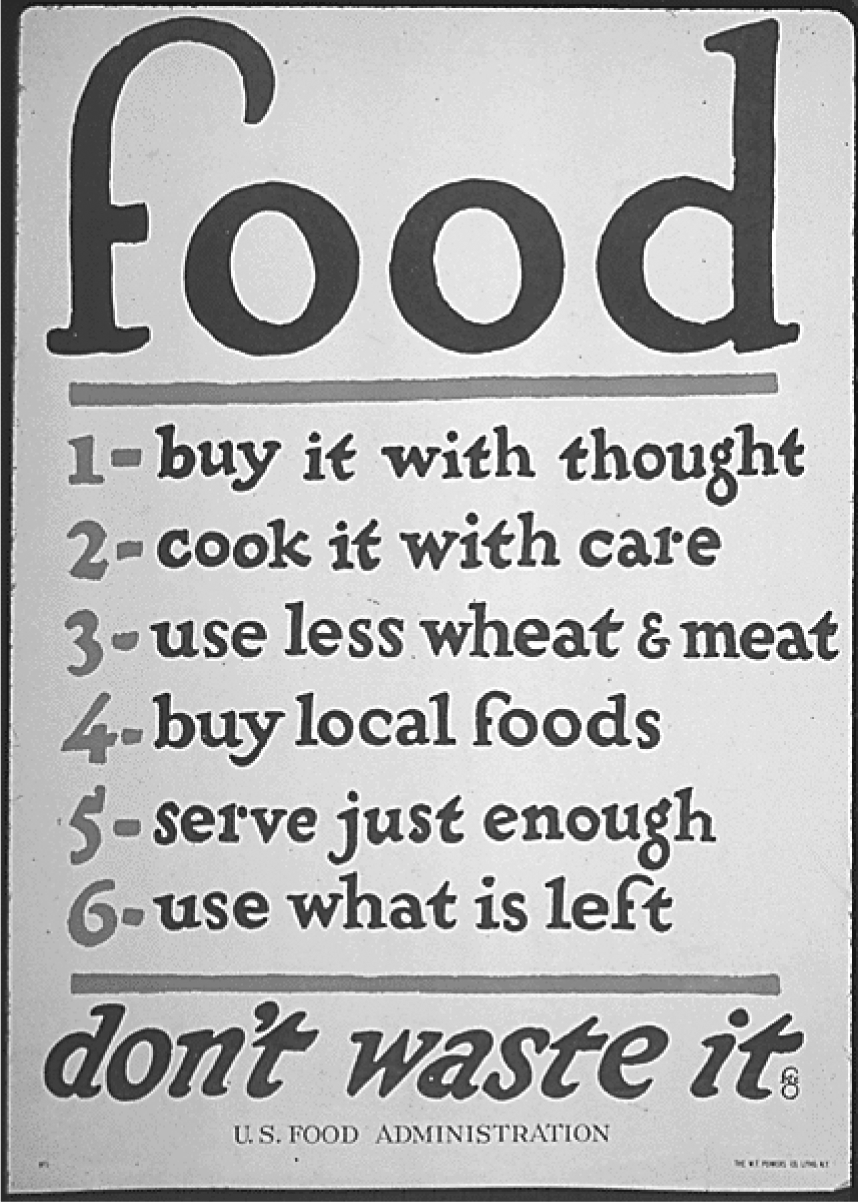
A 1918–1919 poster from the U.S. Food Administrationsays it all. Source: http://research.archives.gov/description/512592. Accessed March 29, 2013.
In a culture where we are so far removed from the production of our food that our children do not know that eggs come from chickens, we could become more mindful of the origins of our food. We could raise food in our windowsills, backyards, or community gardens. We could buy produce and meat from farmers. We could ask our grocery stores for locally-grown food, and buy fruits and vegetables that are native to our own region. We could make our own soup, pack a lunch, and carry a thermos. We could e-a-t m-o-r-e s-l-o-w-l-y. We could become more mindful of the sources of our food.
Where we have so far separated ourselves from the hands that have dug the soil, planted the seed, watered, cultivated, pruned, and harvested our food, we need to insist that the “laborers deserve to be paid” (Luke 10:7) at least a living wage. We could promote fair labor practices both politically and in our consumer preferences. We could build just communities.
In a culture where 30–40% of our food is wasted after it has been harvested, we could make better use of the food we have. 15 We could take smaller portions, eat “everything on our plates,” and dine on leftovers. We could recycle scraps in soups, stews, or compost. We could seek less perfection in our food and eat the outside leaves of the lettuce, the bruised apple, and the celery leaves. We could limit our food waste and save on landfill. We can work to reduce the amount we waste and think more consciously about the effect of our actions on a global level. 16
In a culture where we might only encounter the hungry on a television screen that we can quickly change, or where these images are so grotesque that we resist their attempts to move us, or where we decide not to give because we hear of allegations of fraudulent use of funds, we stop seeing the hungry among us. If we have the opportunity to see the lives of the poor up-close-and-personal, and perhaps participate in a mission trip (across the ocean or across town), we might be more aware of what hungry people look like. 17 If we are unable to go ourselves, we might send others in our stead, inviting them to share their experiences. We could give from our excess what we can spare so that others might be filled. We could also consider ways to give away what we think we deserve to keep, what we have earned, what we have worked hard to acquire, so that we, like Jesus, might give our life for the sake of others.
In Desiring the Kingdom, James Smith argues that our worldview or beliefs arise out of our body practices. 18 For example, when we go to the city mall, we participate in the act of comparing ourselves to others, find ourselves wanting, purchase with the intent of consumption, use up that which is available and/or throw it away when we no longer need or want it; in this way, we feed our souls. If we are not aware of the way that our beliefs follow our actions, we might be easily manipulated. But if we are aware that all action is a type of “liturgy” that moves us towards that which we love, we can make conscious choices to act in ways that move us towards what we do set as priorities. And if we set as a priority, as it seems the New Testament urges, that we extend sacrificial love to others in concrete ways such as feeding the hungry, then as we begin to act in this way, our hearts will follow. If we start to give with abundance, then we will begin to love giving with abundance. In this way, we might “not be conformed to this world, but transformed by the renewing of [our] minds, so that [we] might discern what is the will of God—what is good and acceptable and perfect” (Rom 12:2). We start with our actions and transform our minds: “So, whether you eat or drink, or whatever you do, do everything for the glory of God” (1 Cor 10:31).
Footnotes
1.
Cynthia L. Ogden, Margaret D. Carroll, Brian K. Kit, and Katherine M. Flegal, “Prevalence of Obesity in the United States, 2009–2010,” NCHS Data Brief No. 82 (January 2012): www.cdc.gov/nchs/data/databriefs/db82.pdf. Accessed March 29, 2013. See also  . Accessed March 29, 2013.
2.
www.ncbi.nlm.nih.gov/pmc/articles/PMC3358928. Accessed March29, 2013. See also . Accessed March 29, 2013.
4.
See www.huffingtonpost.com/2011/0March22/evangelicals-resist-obama_n_839267.html. and . Accessed March 29, 2013.
5.
A quick review of the web indicates that these programs are linked, not to “feed the hungry” but to creating healthier congregations and developing self-esteem, claiming “Jesus wants you thin,” or “Jesus loves you fat or thin.”
8.
9.
See Mark 6:34–44; 8:1–9; Matt 14:15–21; 15:32–38; Luke 9:11–17; John 6:1–15.
10.
For a full exploration of the ingesting motif in the Gospel of John, see Jane S. Webster, Ingesting Jesus: Eating and Drinking in the Gospel of John (Atlanta: Society of Biblical Literature, 2003).
11.
Indeed, Paul insists that God raised Jesus’ body from the dead (1 Cor 15:12–19). For discussion of this passage in 1 Corinthians, see Craig S. Keener, 1 Corinthians (New Cambridge Bible Commentary; Cambridge: Cambridge University Press, 2005), esp. 135. See also 2 Cor 5:10.
12.
The present participle here, diakrinōn, emphasizes the continuous action of discerning and judging the needs of the body.
13.
In a similar context, Paul says that “those who eat, eat in honor of the Lord, since they give thanks to God; while those who abstain, abstain in honor of the Lord and give thanks to God” (Rom 13:6–7). The injunction here is to refrain from judging each other.
14.
Although a case may certainly be made that contemporary slaughterhouses are dedicated to the “idol” of making money!
15.
Institution of Mechanical Engineers, “Global Food: Waste Not, Want Not.” See . Accessed March 29, 2013. For an excellent resource of practical ideas, see Doris Janzen Longacre, More-with-Less Cookbook: Suggestions by Mennonites on How to Eat Better and Consume Less of the World’s Limited Food Resources (trans. Mary Emma Showalter Eby; Scottdale, PA and Kitchener, ON: Herald, 1976, 2000).
16.
See http://www.thinkeatsave.org and . Accessed March 29, 2013.
17.
18.
James K. A. Smith, Desiring the Kingdom: Worship, Worldview, and Cultural Formation (Grand Rapids: Baker, 2009).