






Abstract

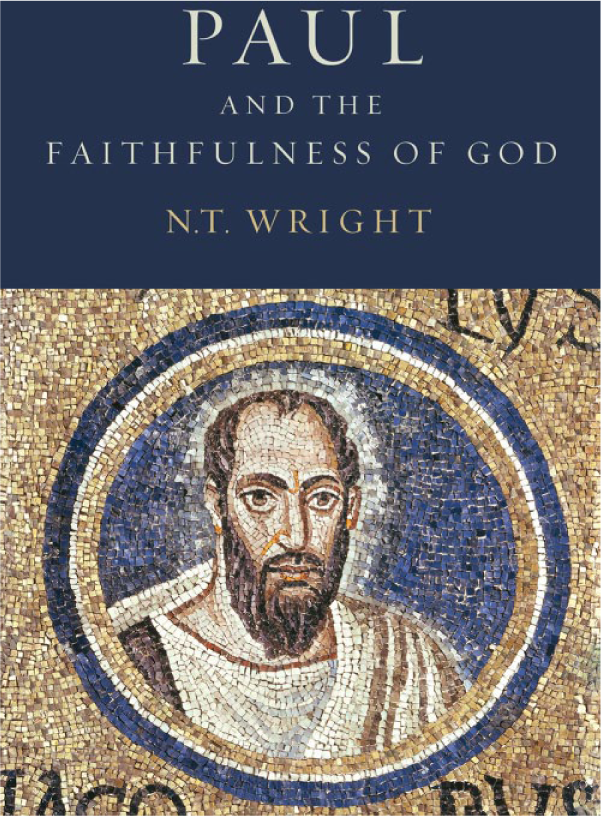
Paul and the Faithfulness of God is ordered in four parts: “Paul and His World” (chs. 1–5), “The Mindset of the Apostle” (chs. 6–8), “Paul’s Theology” (chs. 9–11), and “Paul in History” (chs. 12–16). The first part focuses on the first-century context, looking at the Jewish environment, Greek philosophy, Greek religion, and the Roman Empire. Wright dealt quite extensively with early Judaism in the first volume in this series (The New Testament and the People of God [NTPG], Fortress, 1992), and in the last decade he has written on the Roman Empire. There is notable expansion on his thought in the current volume’s chapters on Greek philosophy and religion, and both of these chapters are engaging and insightful. Wright makes a strong case that in Paul’s world, what we think of as “religion” and “politics” were inseparable.
Part two deals with the Pauline worldview and reflects the unique approach Wright has developed for the study of Pauline theology (going back to NTPG, but further worked out in PFG). Wright uses a set of six questions to get at Paul’s worldview: Who are we? Where are we? What’s wrong? What’s the solution? What time is it? Why? The last question is a major concern of the third and fourth parts of this volume. While the Pauline narrative of redemption, for Wright, comes to a climax with Jesus the Messiah, Wright also contends that “Paul’s worldview had as its central symbol the unity and holiness of the ekklēsia itself” (p. 563). Thus, Wright sustains a robust theology of the church in PFG, one of the major contributions of this work.
Part three, Paul’s “theology,” is clearly the heart of PFG. In keeping with the perspective of his earlier work, Paul: In Fresh Perspective (Minneapolis: Fortress, 2009), Wright resists dividing up Paul’s theology according to traditional systematic categories (soteriology, Christology, pneumatology, etc.). Rather, he follows what he considers a more Jewish approach: monotheism (one God), election (one people of God), and eschatology (one future for God’s people). Throughout the six hundred-page discussion of this theological triad, Wright argues that in each case Paul did not reject his earlier Jewish perspectives, but rather “redefined” and “reworked” them around Jesus and the Spirit.
The last part of the book, “Paul in History,” sets the apostle Paul (with his unique worldview and theology) back into his historical context. While many readers will be inclined to turn directly to part three (“Paul’s Theology”), I think this final part offers the most to the reader, especially in chapter twelve where Wright revisits the matter of Paul and the Roman Empire. In his earlier work, Wright argued that Paul’s letters contain anti-imperial rhetoric, or at least challenged the ideology and authority of Caesar in view of the lordship of Jesus the Messiah—an argument that has been heavily critiqued. John M.G. Barclay, for example, while responding to Wright several years ago at a conference, went as far as to say that Caesar was “insignificant” to Paul. Barclay discerns no trace of anti-imperial critique in Paul’s letters. He is no doubt one of Wright’s major conversation partners in chapter twelve, and while Wright still views Paul as a critic of the Roman Empire, he has arrived at a more nuanced approach. The volume concludes with a broader look at Paul’s own ministry concerns (ch. 16).
It is almost impossible to summarize all the major concerns and emphases of this comprehensive volume, given its scope and size, but four key ideas can be noted. First, a hallmark of Wright’s scholarship has been his contention that Paul was a thoroughly Jewish thinker. Again, emphasis on monotheism, election, and eschatology permeates PFG and lies at its theological heart (because, according to Wright, it was central in Paul’s thinking). Second, Wright refuses to accept the scholarly tendency to make Paul out to be either a “salvation-history” thinker (emphasizing continuity) or an “apocalyptic” thinker (recognizing discontinuity). If Wright were forced to choose sides, as it were, he would probably be categorized with the former, but he repeatedly insists that Paul should not be pressed into one of these options as if they were mutually exclusive. Rather, Wright persuasively makes the case that Paul’s thought leaves room for both continuity and discontinuity. Third, as noted above, Wright sets the people of God (the church) at the center of Paul’s worldview—a people that is actively a part of the divine solution to the world’s plight. Finally, Wright attempts to argue that Paul was Christianity’s first proper “theologian.” What he means by this is that the early Gentile followers of Jesus did not have the symbolic tent-poles of Judaism (circumcision, food laws, Sabbath, endogamy, etc.) and thus lacked the cultural infrastructure that sustained Jewish life. Thus, “theology,” for these early Christians, played a critical role in shaping communal identity: “In Paul’s hands, ‘theology’ was born as a new discipline to meet a new challenge” (p. 1260). Wright’s proposal on this last point is intriguing, but the case is extremely hard to make. It is an interesting idea, but seems more suggestive than demonstrable.
Alongside these four key ideas, three less-central arguments should also be noted, as they will be the subject of ongoing debate. First, Wright makes clear in the introduction that he does not follow a seven-letter “authentic” Pauline canon. While Wright is cautious about the use of the Pastoral Epistles, he includes Colossians, Ephesians and 2 Thessalonians in his study of Paul. This revisiting of the so-called authentic/undisputed letters may open new conversations and vistas in Pauline studies. Second, Wright refreshes his argument that Jesus’ messiahship was not only apparent to Paul, but central to his Christology. Wright has had more than a few critics on this point, but now that the supportive work of Matthew Novenson has appeared (Christ Among the Messiahs: Christ Language in Paul and Messianic Language in Ancient Judaism; Oxford: Oxford University Press, 2012), I would not be surprised to see more openness to this idea. Third, Wright maintains and defends his unique understanding of Paul’s justification/righteousness language as related to covenant membership. For my part, I remain unconvinced, but this will inevitably become a major point of discussion as PFG is closely examined by scholars.
Despite the length of PFG, I was slightly disappointed that Wright did not devote much space to developing a theological perspective on Paul’s view of sin. The problem of evil is the focus of much discussion, but very little attention is given to the nature of sin itself. Wright tends to connect “Sin” to “Death” as two evil powers that have oppressed and corrupted humanity, even Israel. Thus, if Israel is in need of a “rescue mission,” “Sin” tends to be viewed as a terrorizing enemy and Israel is characterized as victim. Wright gives far less attention to Israel as willful perpetrator and covenantal rebel. Certainly Paul’s Jewish perspective would embrace both views, though scholars may disagree on the proper balance. Another quibble is Wright’s habit of translating pistis as “faith/faithfulness.” Because “faith” and “faithfulness” are two different concepts, the subject merits more explanation than Wright offers, especially given the centrality of pistis in Paul’s thought.
In conclusion, readers will not fail to appreciate what Wright has achieved in this magisterial volume. Its length can be daunting, but those who persevere will be rewarded by engagement with a fine writer and expert Paulinist.