







Abstract
Mark 4:35–41 provides an interpretive lens for Jesus as Teacher in the earliest Gospel. It is a lens of inclusive politics. Jesus teaches the Reign of God by how he lives his ministry. That teaching focuses on breaking down the boundaries that separate humans from each other.
Introduction
Though characters in Mark’s Gospel favor the title “Teacher” when referring to Jesus, no one actually calls Jesus “Teacher” until 4:38, 1 which is part of the first of two episodes where the disciples are in a boat and a storm arises and threatens to topple them into the sea (4:35–41; 6:45–52). This story, by initiating the vocabulary, establishes the interpretive lens through which Mark’s understanding of Jesus as a teacher should be viewed. It is a lens of inclusive politics. By studying this teacher of the past we may get a glimpse of how we can do a better job of teaching the faith that Jesus’s life, death, and resurrection inspire in the present and future.
Jesus Teaches by Enacting the Reign of God
Though the Markan Jesus is clearly understood to be a teacher, he is rarely seen teaching any particular content. Rather, he teaches performatively. His actions and words intend more than the conveyance of information. They anticipate responsive activity; they anticipate that his hearers and readers will do something in light of the teaching. How does Jesus teach faith? By falling asleep on a sinking boat. That curricular effort does something. It not only informs; it instigates.
Consider the figurative and powerful text language of the parables. More than information is being conveyed in these Jesus stories. Every one of Jesus’s parables is also, and perhaps primarily, a call to decision that comes out of the repetition and tension in the text’s language. The reader/hearer is not only being told something, she is being told to do something. That “doing” will push her into the center of spiritual and political confrontation with the institutional forces of her time and place.
As a teacher, then, Jesus confronts, engages, and challenges. He provokes his readers/hearers to move from where they are to where his teaching pushes them. His teaching instructs by enacting a way to be emulated. He teaches how to heal by transforming physical and social brokenness into wholeness (2:1–12). He teaches about God’s love, not by defining love as a concept or a theory, but by touching lepers (1:40–45), by allowing diseased people to touch him (5:25–34), by engaging women as equals (7:24–30), by breaking laws and traditions that hinder rather than promote human wholeness (2:23–3:6; 7:1–23), and by associating with the wrong kinds of people (2:13–17). He teaches not by talking, but by doing. To “learn” his lessons one must follow his lead. One must transform destructive physical and social circumstances into constructive ones. One must advance beyond knowing something new into doing something new: something like the touch of a leper.
To be sure, there are times, a very few in Mark’s Gospel, where Jesus actually teaches content. There is the famous apocalyptic speech that is Mark 13, where he launches into a lecture with the disturbing declaration that by the time God is finished, not one single stone of the temple infrastructure will be left standing atop another. Then he ratchets up the alarm by proclaiming that nations and kingdoms will rise up against each other and that an infuriated earth will turn on the people who call it home with earthquakes and famines. Families will destroy each other, false prophets will lead survivors astray, and the end of time will rupture the horizon and detonate a reality so fierce that if God doesn’t shorten the time, no one, not even believers, will survive it. Perhaps the content of this lecture is why Jesus does not lecture very often. Who would keep coming to hear him talk?
There is a single other place in Mark’s Gospel where Jesus comes across as a teacher of consistent content: in chapter four. This is the famous parable chapter, where Jesus offers the parable of the sower, the parable of the lamp under a bushel basket, the parable of a growing seed, and the parable of a mustard seed. These are the parables that explain what the Reign of God is like. He shares the parables so that people will know how to position themselves rightly with God’s Reign, so that when that terrifying moment he will teach about in chapter thirteen blossoms into reality like a mushroom cloud, it will be a moment of salvation, not destruction.
Here, Jesus teaches content because he knows something about the Reign that his hearers do not. Oddly, he appears determined not to clue his students in. He confesses that he teaches with parables rather than with clear images and easily understood metaphors because he wants people to flunk the test of understanding. He lectures in parables so they will not be able to understand, lest they, having understood, realize that it is time to repent so they can be saved. The Teacher not only teaches destruction; when he teaches a lesson on how to avoid the destruction, he intentionally does so obscurely.
How many teachers teach so that people will not understand? What kind of teacher is this? Re-read Mark 4:10–13. There, Jesus explains that outsiders are left with only the parables, but not the key to understanding the parables. For insiders, Jesus explains everything. Insiders. Us. We think. The church. Christians. We get it. Or at least we will get it. Because we get the special teaching that no one else receives.
But, then, just after he has told the insiders that they know the secret of the Reign of God, in looking at the blank expressions on their faces, Jesus realizes that they, too, are clueless. It is clear that they are clueless, because Jesus asks them, “Do you not understand this parable? Well, how are you going to understand any of the parables?” You have the secret, the mystery, the clue to unlocking the parables. And yet, do you not see it?
The insiders have been following the Teacher, but they have not learned the proper lesson because they have not yet understood what kind of teacher he is. They have assumed that it is all a “head trip,” that the key to understanding the parables is somewhere in the words he has just shared in the sower parable. But the answer to the mystery of the parables that puts one in the right relationship with the explosive power and reality of the Reign of God is not found in words, not even in the important words of this parable, but in comprehending and emulating the way this teacher lives his life. The parables elucidate that teaching; they are not the teaching itself.
Church teaching, too, is important, not in and of itself, but because of the person from whom it points. “From whom it points” is the key to the mystery, in the past, and in the future. What is the Reign of God? By themselves, neither the parables nor a fully vested study of the parables can answer that question. The parables are pointers. They do not point to Jesus as much as they point from Jesus, from his life to the Reign of God he lives. One should not as much study the parables as follow from Jesus and how he lives his life to the parables and how they elucidate that living. By themselves, the parables are insufficient to the teaching task. In the end, the Reign of God is not a theory. It is not a time. It is not a place. It is not content, even parabolic content, to be analyzed and learned. It is a person. In the life of that person is thus the answer to the mystery of the Reign. That is the lesson to be learned for the “insider” disciples. For us. If we want to teach the Reign of God, we start by finding a way to live the Reign of God, as Jesus lived it, by crafting a curriculum that not only conveys information about the Reign, but, more importantly, shapes the very reality the Reign intends to convey. In the end, every act of Christian teaching, of Christian education, is an act of enacting the Reign of God. If Jesus is our exemplar, we effectively teach the Reign of God by living the Reign of God. What we say then points provocatively from what we do.
What does Jesus do? He enacts a world where lepers and women, the broken and disfigured, the unholy and impure all belong together as God’s people. How, for example, do we live that inclusive reality in a world where most Christ believers still separate themselves along lines of ethnicity and race when we worship? How can we teach by our living a future Reign where God’s house is a house of prayer for all the people (11:17) if we live a segregated worship reality in the here and now? To us has been given the key to the mystery. Do we not understand?
What has Jesus’s life been teaching? It has been teaching a certain way of being, a way of breaking down the divisive barriers and boundaries that put some on the outside and some on the inside. What does his Reign look like? When he finds himself near a leper, someone who is ritually unclean, broken, worthy of being consigned to places outside of the community of the faithful, a person who should not be in the presence of those who are unbroken and whole, what does he do?
In this ancient world, brokenness/impurity/unholiness was contagious. It leapt from person to person. At times, like a virulent disease, it even went airborne, spreading to others who were in the same airspace. 2 Leprosy was one of the most contagious and virulent forms of disease and impurity (Lev 13:43–46; 22:4; Num 5:2–4). The touch of a leper ravaged a person’s state of holiness and purity. That is why one steered as clear of a leper as possible. But Jesus doesn’t dismiss the leper; he reaches out and touches him (1:40–45). Then he tells the leper: Go out and tell everybody that I touched you. Tell them that I changed the math. Because in their world, when uncleanliness touches cleanliness, the clean thing becomes dirty. But in this new kingdom calculus, when uncleanliness comes into contact with cleanliness, the clean doesn’t become dirty; the dirty washes clean.
Immediately afterwards, Jesus goes into Capernaum and declares that he has the ability and the right not only to make lepers clean, but also to make sinners clean. And this cleansing happens not by touch, but by word (2:1–12). To illustrate, he uses his word to call tax collectors and sinners, thereby cleansing them with his company and his calling (2:13–17). And what does he call them to do? He calls them to break one of the most sacred of codes, the Sabbath code, if it appears that the interpretation and implementation of the Sabbath has become an obstruction to healing and wholeness rather than a promoter of human healing and wholeness. To make the point clear, when a man with a withered arm is brought to him, he doesn’t allow legal traditions that forbid healing on the Sabbath to stop him from working a miracle, because human need is always above ritual need or legal requirement (3:1–6).
This is what Jesus is teaching, by his living. He lives in a way that teaches a particular message: the Reign of God is a reality that does not designate some people as more pure than others, as more holy than others, and then separate them from one other. Where such boundaries exist, the Reign of God ruptures, disfigures, decimates, and destroys those boundaries. Understand that teaching, that mystery, through that living, and then hear the parable of the sower, then hear the parable of the light hidden under a bushel, then hear the seed growing parable, then hear the mustard seed parable. They are to be understood in this boundary breaking light or they will not be understood at all.
The future of Christian teaching must be more like the past of Christian teaching. It must not tell people about the Reign of God, it must find a way to perform the Reign of God in the midst of the people who seek to learn about it. How does one perform the Reign of God? By touching, by breaking, by cavorting, by trespassing one’s way across the human landscape onto God’s shoreline. We know where the boundaries are in our world—the boundaries that reflect human reign more than God’s Reign. Jesus’s teaching via Jesus’s living demands that we ask the question: What will I do about those boundaries?
Jesus Teaches by Engaging Hopelessness
There is something else instructive about the title “Teacher” as applied to Jesus in Mark’s Gospel. Each context in which someone addresses Jesus as “Teacher” is presumably one of hopelessness. Twice, the disciples are in a hopeless situation in a storm-tossed boat and call out to their Teacher (4:38; 5:35). A man seeks the Teacher because his child has been hopelessly possessed by a demon since the child’s birth (9:17). The disciples try desperately and hopelessly to stop a man from performing miracles in Jesus’s name (9:38). A man seeks the Teacher to learn what he must do to inherit eternal life (10:17, 20). Though seeking eternal life is not a hopeless goal, after hearing what Jesus has to say the man walks away depressed, thinking it so. When James and John ask the Teacher to let them sit at his right and left hand, the narrative sighs with a hopelessness that the disciples will ever understand him (10:35). The Herodians, Sadducees, and scribes try with desperation to trap Jesus the Teacher with complex rhetorical arguments and find that their efforts are continually hopeless (12:14, 19, 32). When the disciples marvel before their Teacher at the great stones that make up the great Jerusalem temple, Jesus tells them that it has a hopeless destiny (13:1). And when a man is to be told that the Teacher needs an upper room to share the Passover meal with his disciples (14:14), we can sense the foreboding hopelessness of death, a hopelessness so grave that it will cause the disciples to flee and scatter.
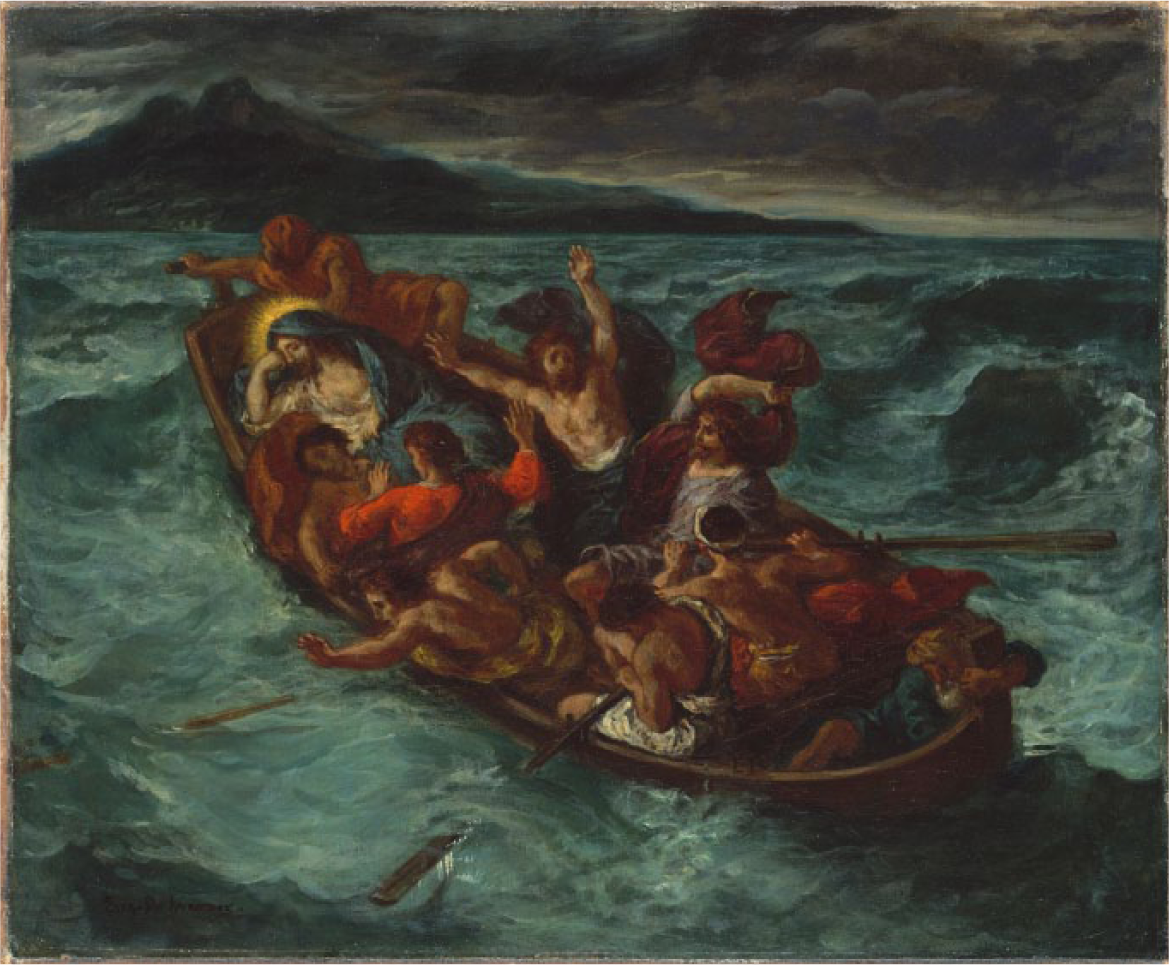
Teaching, as lived in Jesus’s ministry, is about engaging hopelessness. Consider the storm on the sea (4:35–41). To appreciate how hopelessly desperate this situation is, one must read the story in the Greek: “There became . . . suddenly, there just was . . . a magnificent squall of wind, a howling of nature . . . waves threw themselves like possessed phantoms against the boat” (4:35, author’s trans.). Most English translations smooth out the rough edges and temper its shocking start, but Mark’s original language makes it clear that nature had come alive. It was personified. Like evil. Like God.
Contemporary hopelessness arrives just as suddenly. The economic meltdown that rose up like a squall and lashed boats of personal, communal, and spiritual well-being in 2008 brought sudden hopelessness to many American lives. Hopelessness, of course, takes many forms. There is the particular hopelessness of social and political divisions that preoccupy and threaten to destroy. Republican/Democrat. Conservative/Liberal. Classical/Practical. Gay/Straight. Pastor/Educator. Teacher, is there a boundary-breaking, healing word in your lived, curricular effort?
Eugene Delacroix (1998–1863). Christ Asleep During the Tempest. Oil on canvas. H. O. Havemeyer Collection. Photo credit: © The Metropolitan Museum of Art. Art Resource, NY.
Jesus Teaches by Crossing Boundaries
Watch what the Teacher does. When evening has come, he intends to teach by directing his disciples to cross over to the other side (4:35). Two Greek terms are instructive: dierchomai (“cross over”) and peran (“other side”).
“Cross over” is instructive. It suggests difficulty. Mark uses it here (4:35) and only one other time in his Gospel, at 10:25, when Jesus says that it is easier for a camel to cross over the eye of a needle than it is for a wealthy person to enter the Reign of God. A camel is not going through the eye of a needle without some effort. The physics of nature is not agreeable. Likewise, a wealthy person, apparently, will not enter the Reign without some effort. The physics of social and, evidently, spiritual relations is not agreeable. Equally so, a Jewish teacher who claims to be a prophet to his own people is not going to cross over to the Gentile side of the sea of Galilee without some effort. The physics of religious segregation, holiness and purity codes is not agreeable. That is why there is a storm figuratively on the horizon and literally on the boat. The attempt to make God’s physics operational in the arena of human, physical, social, and religious reality triggers conflict. Storms jump up like creatures in the night to confront, contain, and, if necessary, crush.
“Other side” is just as instructive. “Side” is a positional term. By itself, it is neutral. It is: “either of the two broad surfaces of a thin, flat object, as a door, a piece of paper, etc.” It is: “one of the lateral surfaces of an object, as opposed to the front, back, top, and bottom.” It is also: “region, direction, or position with reference to a central line, space, or point: the east side of a city.” It could just as well be: “one of two or more contesting teams, groups, parties, etc.: Our side won the baseball game.” More often than not it is: “the position, course, or part of a person or group opposing another: I am on your side in this issue.” Which brings us to what it almost always seems to be: “one of the surfaces forming the outside of or bounding a thing.” 3 A side is a place to stand on, a place that distinguishes some from others who stand or live or speak or think on a different side. A side is the boundary that keeps those who stand, live, speak, and think over there from bringing their stance, living their lives, speaking their speech, and thinking their thoughts over here.
This is where the marker that Mark places beside “side” comes in: the Other side. Sides often separate us from the Other. The Other lives on that side as opposed to our side. And if the Other knows what is good for him, he stays on his side. And because I who live on the right side have been properly taught by loved ones, mentors, friends, and scholars for years and years, I know better than to think about crossing over to that Other side. I know that if I do cross over I am going to get sideswiped on the way in or on the way back out.
So, what is on the Other side of the sea of Galilee that Jesus is looking out over on the evening of this particular day? Chapter five clarifies that the Other side (peran) is the land of the Gerasenes (5:1). Jesus, a Jew, is on his side when he looks across the sea and makes plans to cross over to the Gentile side. In the purity and holiness codes of his time, Gentiles were unclean sinners, not to be associated with unless under some social or physical duress. In addition, in the purity and holiness codes of his side, death is an impure reality. One avoided graveyards because entombed in them was the carcass of contagious uncleanness. In the purity and holiness codes of his side, pork was an unclean and unholy meat. One avoided areas that hosted swine. In such a dubious, bounded context, God’s Reign is clarified by Jesus’ disturbing act of crossing over to this Other side.
Jesus earns what he receives on the Other side. No sooner than he steps off the boat, he is confronted by what must surely be a Gentile man, naked, diseased of mind and spirit, living in the tombs, on land infested with corpses and swine, frothing at the mouth (5:2). That is what you get, Jesus, for living the way you teach. How many who followed Jesus to the Other side were taught that lesson?
Another lesson plan also unfolds. As with the leper who confronted Jesus on Jewish soil, so with this apparently Gentile mad man, the unclean did not dirty the clean; the clean washed away the dirt. When Jesus gets back into the boat and crosses back over to his side, he leaves on the Other side a man clothed and in his right mind (5:15, 18).
What does this story teach about being a teacher? Prior to the first crossing, Mark narrates, quite oddly, that the disciples take Jesus into the boat “just as he was” (4:36). That puzzling phrase begs a pertinent question: what was he? Mark’s grammar leaves a lot to be desired. He is not clear. Eugene Boring says that “just as he was” is an extremely awkward phrase. Then he tries to explain it with just as awkward an explanation. “It may simply signal that Jesus had been teaching from the boat (4:1), and they took him with them without disembarking.” 4 Joel Marcus’s explanation is equally awkward: “the meaning is that Jesus has returned to the ship after disembarking from it in 4:11.” 5
The Greek can be translated in any number of ways. For example: “they took him, as he was already in the boat.” With this option, Jesus is the one who initiates the action. He said, “Let us go.” Then, he got into the boat and the disciples had no choice but to follow. After all, he was already on the boat! This reading takes away any energy and initiative on the part of the disciples. They are just blindly following. And yet the surrounding narrative implies some agency on their part. They are struggling to become something. Indeed, Jesus directs the action when he says, “Let us cross over to the Other side” (4:35, author’s trans.). Initial agency is his. But the disciples choose to leave the crowd as though they know they cannot remain any longer (4:36). Responding, they take Jesus. Mark thus establishes their agency as following the lead of Jesus’s agency. Because the translation “they took him, as he was already in the boat” downplays their agency, I would press for a focus on the nuances of the interacting verb tenses Mark uses. “They take Jesus in the boat, just as he was.” The word “take” is in the present tense, and the imperfect tense of “he was” (ēn) implies an ongoing state that operates out of the past and continues to be operative in the present. What was Jesus that he yet is?
It does not take much reading backwards to find out that Jesus was touching lepers. He was calling tax collectors and sinners to follow him. He was breaking traditions and laws when interpretation of those traditions and laws harmed rather than helped people. And, in doing all of this, he was teaching—that is, acting, living with an authority and power that no teacher any of them had known had ever displayed before. That is how he was, that is who he was being, the moment he stepped onto the boat. They took him on the boat, just as he was. He goes over to the Gentile side just as he was, a boundary breaker. Only, in this case, the boundary that shatters is an ethnic/racial one. In so doing, he teaches, he lives, he reveals the mystery of the Reign of God.
Jesus’s Teaching Meets Resistance
Jesus’s attempt to live that Reign was resisted by nature, of all things! Nature sees that God wants to break down one of the most cherished boundaries in the world—the one that separated Jew from Gentile. So nature does what people often do when they want to stop that kind of boundary-breaking change—it storms up wave after wave of resistance. By sending Jesus to the Other side, God is saying, “I am shattering this boundary between Jew and Gentile.” By rising up in a storm, nature is saying, “No, you are not!” The implication: The Reign of God is not natural. It is not obedient to natural boundary expectations. Jesus demonstrates the freedom of God’s Reign to break natural boundaries by the way he continues to live. As he used his word to heal a withered arm, so now he uses his word to tell a stormy sea: “Peace. Be still” (4:39). That is the way the NRSV translates his command. In the Greek it is more like: “Silence! SHUT UP!!” That last Greek command (pephimōso) is the same word that Jesus used (in a different form, phimōthēti) when he told an unclean spirit to SHUT UP and vacate its human host (1:25).
The connection between the sea and the unclean spirit is instructive. Jesus shuts up demonic forces that protest against his presentation and understanding of God’s Reign. This is because the demonic forces know Jesus and know what he is up to. They realize what his teaching is all about. They recognize the boundary-breaking nature of his life and ministry. Jesus is about breaking the demonic hold over humankind. Demonic forces know this, and they want to stop it. So, apparently, does nature. As Jesus tries to cross over to the Other side, nature itself rears up in opposition. Like the demon, it shouts furious resistance to his intention to cross the boundary that separates his side from the Other side.
There is something else important to note here. Nature, like the demons in Mark’s Gospel, listens when the Teacher speaks. Unlike the disciples who continually miss the point (see 4:10–13), nature gets it. Nature responds. Nature pays attention to how God is operating in the world, and, though nature initially resists, in the end, nature obeys (4:41).
There are two competing messages here for contemporary Christian teachers. First, teaching in a transformational way that enacts the very Reign it teaches will bring resistance. Humans, like nature in this story, do not like crossing over to Other sides. Second, the teaching, provocative as it is, will “take.” The person who lives the message taught about the Reign of God will be heard. This supposition raises a third, complementary point. Those for whom the teaching is transformative may not be those who have been the intended students. In Mark’s narrative world, it is people like Simon of Cyrene, who carries Jesus’ cross (15:21); or the woman with the twelve-year issue of blood, who demonstrates a faith the disciples cannot seem to muster (5:25–34); or Bartimaeus, who calls out to Jesus even when others tell him to stop (10:46–52); or the Syrophoenician woman, who battles with Jesus until he heals her daughter (7:24–30)—these are people who are not disciples of Jesus, yet somehow live what he teaches.
This conclusion is an indication that there must be trust in the teaching endeavor. We must prepare. We must study. We must research. We must be ready. But we must also be willing to let God work. We must keep teaching, even when there is resistance, with the assurance that if we are teaching the Reign of God by living the Reign of God, the lesson will be learned, sometimes by a person, sometimes by a storm.
At the end of the story, the disciples clearly have not comprehended Jesus’s teaching. They are, therefore, afraid. They are afraid to make the transition to the Other side. They are afraid that they will be destroyed because they have gotten on the boat and tried. Jesus asks: “Why are you afraid?” We know why. Who is not afraid of crossing over when there is so much to be afraid of on the Other side? We live our lives on this side. We become persons of this side. The rules and realities of this side, our side, seep into our being, and we see and understand life from the perspective of our side.
This is precisely the situation in Mark’s community. In his commentary on the Gospel, Ched Myers makes the point quite nicely. He writes, “These harrowing sea stories intend to dramatize the difficulties facing the Kingdom community as it tries to overcome the institutionalized social divisions between Jew and gentile. Through this metaphorical action the community struggles to make the ‘passage’ to integration . . . . all the power of the established ‘symbolic universe’ of segregation opposes this journey.” 6 Myers concludes: “And no doubt the real-life hostility to such a project of integration threatened to ‘drown’ the community. But Mark insists that Jesus will rescue this project and silence the winds of opposition.” 7
In the end, that is why I think Jesus poses his question as he does. He does not ask, “Why were you afraid [of the storm]?” He asks, after the storm has been silenced, “Why are you afraid?”—presumably of the calm that he has imposed on the storm, the calm that allows their passage to the Other side. The disciples are afraid of what the calm means. It means the storm and what it represents are not God’s will. Staying on our own side and minding our own business is apparently not the intent of God’s Reign. Jesus’s way represents God’s will, and Jesus’s way is the crossing-over-to-the-Other-side way. If Mark is writing to a community that includes both Jewish and Gentile believers, the presence of multiethnic tensions would be understandable, especially in a time when Jews and Gentiles were at odds with each other, when Roman and Greek occupation of Jewish lands led to both desperation and the hope that God was about to expel the Gentiles from their holy land. 8 Mark counters: not only did God not desire the expulsion of Gentiles from Israelite land, God intended that Gentiles would become full participants in God’s expansive, coming Reign. The fear comes when Jesus answers the storm with his actions, when he exorcises its power of ethnic separation by embodying in his ministry a seeking out of, a crossing over into, Gentile land. This is what the Teacher teaches by the way the Teacher lives.
Conclusion
What does this teaching in the past mean for our teaching in the future? Our teaching, no matter what the content, must be mission-oriented teaching. Its key mission objective must be the Reign of God. And if the Reign of God is about trespassing the boundaries we have set up in our world to distinguish those who are whole from those who are broken, those who are better from those who are worse, those who are insiders from those who are outsiders, those who are good from those who are bad, then such trespass is what we must be teaching. Such trespass is what we must be living.
Such trespass is the objective of Christian teaching. Why . . . are you afraid?
Footnotes
1.
The term didaskalos (teacher) occurs twelve times: Mark 4:38; 5:35; 9:17, 38; 10:17, 20, 35; 12:14, 19, 32; 13:1; 14:14. The term rhabbouni (rabbi) occurs once, at 10:51.
2.
For example, in Mark 5:1–20 Jesus encounters the uncleanness of Gentile territory, the uncleanness of being in the airspace of tombs, and the uncleanness of being in the proximity of swine.

4.
M. Eugene Boring, Mark: A Commentary, NTL (Louisville: Westminster John Knox, 2006), 144.
5.
Joel Marcus, Mark 1–8: A New Translation with Introduction and Commentary, AB 27 (New York: Doubleday, 1999), 332.
6.
Ched Myers, Binding The Strong Man: A Political Reading of Mark’s Story of Jesus (Maryknoll, NY: Orbis, 1988), 197.
7.
Ibid.
8.
Joel Marcus, “The Jewish War and the Sitz im Leben of Mark,” JBL 111 (1992): 441–62.