







Abstract
After general considerations of what constitutes a “monster,” this essay examines the examples of “monsters” in the Bible, showing that the Bible does not as frequently depict such beings as do other mythologies. The implications of this for understanding the biblical outlook on creation in general are considered, leading to the conclusion that in fact, in the Bible, it is God who is a monster, or at least, on the side of monsters, and is not to be relied on to eradicate them.
Keywords
Introduction
When presented with the idea of monsters in the Bible, I found myself going through a dialectic process of considering the concept, enthusiastically embracing its examples and implications, denying its possibility, changing how I was thinking of it, and considering it again. I was recreating in my thought the typical thesis, antithesis, and synthesis that is used to summarize Hegel’s pattern of thought. My thoughts unfolded over time in the phases I will try to present in what follows (and which hopefully are not too dissimilar from the readers’ reactions): monsters in the Bible resemble those in other mythologies, but there are just fewer of them; there are so few of them that the category of “monster” is too un-biblical to be of much use in understanding the Bible; the relative absence of monsters in the Bible alerts us (as do many other points) to fundamental differences in the biblical outlook and its ideas of God, nature, and humanity. This makes for a radically different idea and experience of “monster” that God Godself is monstrous and/or is the king or parent of monsters, not the vanquisher of such.
Biblical Monsters as “Regular” Monsters
First, what are “monsters”? I suppose one has to acknowledge the difficulty of definition by starting with the old quotation from Justice Stewart, when speaking in 1964 of the equally perennial, popular, and hard to define category of the “obscene”: “I shall not today attempt further to define the kinds of material I understand to be embraced… [b]ut I know it when I see it.” 1 On the one hand, we all seem to have some working definition of “monster,” the way Justice Stewart thought he had one of “obscene.” We probably also think, with Justice Stewart, that our definition is sufficiently based on shared, common “reason” that it overlaps enough with other people’s definitions that we can agree (more or less) on who/what is a “monster.”
Boris Karloff in Frankenstein, 1931, directed by James Whale, based on Mary Shelley’s novel. Adoc-photos/Art Resource, NY.
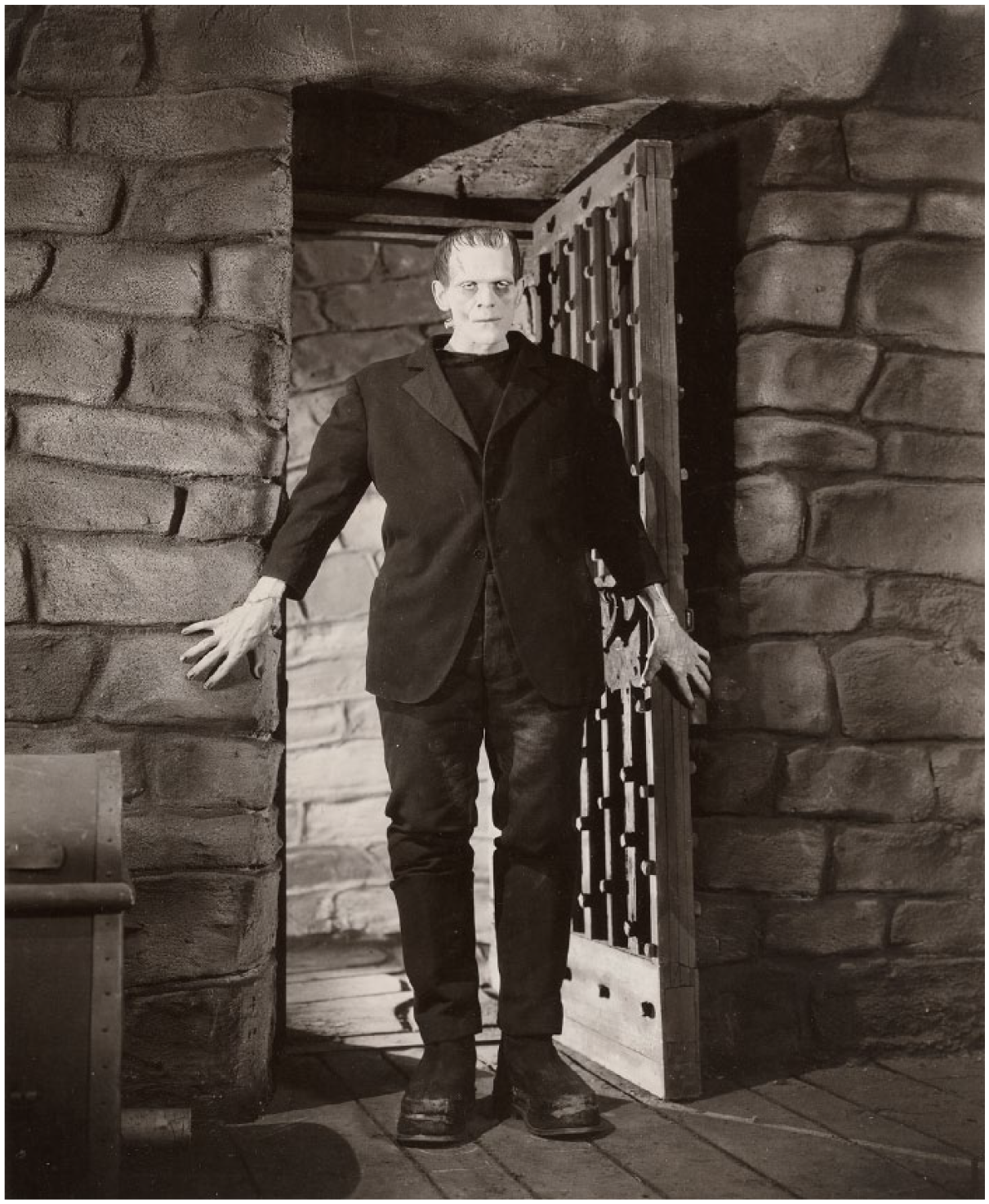
But perhaps even more than the category of “obscene,” I think we sense our working definition breaks down quickly if we consider the purported “monster” more closely. This is vivid in any sensitive reader’s analysis of Mary Shelley’s Frankenstein, in which Victor creates what he himself constantly labels a “monster,” but the narrative challenges the readers to consider to what extent Victor is more monstrous in what he has done. And I do not think this difficulty is a modern problematization: it would seem implicit in the Oedipus story, wherein Oedipus is rightly praised for his killing of the monster, the sphinx, but painfully discovers he himself is a monster, a pollution, a horror. (And then, for the handful of people who still read Oedipus at Colonus, we follow him as he finds there is nobility and beauty, even in that, so that to accept and embrace oneself as monster is not the final or most important evaluation of one’s worth.)
But the modern worldview does perhaps tend to overstate the idea that we are all monsters, sometimes, and therefore no one and nothing is really a monster, as though monstrosity was fully and only in the eye of the beholder, or completely contextual and temporary, and therefore the category is worthless and meaningless. Flannery O’Connor captures some of the pre-modern disdain for this view, in her usual pithy and morbid way, when she opines, “Whenever I’m asked why Southern writers particularly have a penchant for writing about freaks, I say it is because we are still able to recognize one.” 2
The modern worldview is, in a word, disenchanted. It lacks a sense of enchantment, of wonder or horror or awe, and is left only with more pedestrian (and far less revealing) feelings and intuitions of fear or surprise. People my age have seen the loss of such wonder in simple, concrete evolutions in our own lifetimes. I realized when my children were growing up that “carnival” simply meant a travelling collection of rides and games. Even so, it retains a tiny whiff of the dangerous and secretive: the experience is still not nearly as antiseptic and safe as a theme park. But when I was young, that hidden world of something unknown and unspeakable was much more explicit and accessible, for you could still go to a tent and pay fifty cents and see what purported to be dead babies in Mason jars—babies with two heads, tails, four arms, horns, wings, etc. Even at that age, I was probably fifty percent sure they were just crudely constructed rubber things immersed in some unidentified, murky fluid. But even now, all these years later, with something I may call wisdom or at least cynicism and experience, am I one hundred percent sure what they were, really? The labels on the jars proclaimed them “Cursed! Devils! Mutants!” and declared they had been found in faraway or unspecified lands. Can I say now they were most definitely not that? I do not think I can, and I’m absolutely certain nine-year-old me could not make that discernment. And that’s the point: to go into such a place was to experience, palpably, that there were things you were not sure of, things that did not fit and could not be explained in your normal world. You could scoff, or you could abdicate reason and just believe what was claimed, but you’d never really know what those awful things were: this was the visceral, direct, wide-eyed, experiential knowledge of the “… more things in heaven and earth, Horatio, Than are dreamt of in your philosophy,” 3 and it was available much less frequently but much more immediately and personally than seeing it depicted on American Horror Story (which is the only place I think my students believe such horror and confusion reside, completely fictional and only to be summoned up on Netflix conveniently and safely, and then dismissed with equal ease).
What O’Connor captures in her own way, and what nine-year-old me sensed in a stinking, humid haze of sawdust, is what others have tried to articulate about monsters or horror in general, such as H. P. Lovecraft: “The one test of the really weird is simply this—whether or not there be excited in the reader a profound sense of dread, and of contact with unknown spheres and powers.” 4 For all of us who have experienced it, the essence of monsters, and the point of telling horrific stories, is to elicit a certain “sense” or to put (or reveal) in the readers’ minds, a fundamental insight into the world. For Lovecraft, this may be sufficiently expressed as the world being bigger and weirder and more incomprehensible than anyone had previously imagined, and in the early twentieth century, with new technology promising and threatening so much to humans, such an insight is particularly understandable, and it will be a large part of my analysis of biblical monsters as we go. But to anticipate my final conclusions, we may expand O’Connor’s comments, when she cleverly and a little paradoxically unpacks what is at stake in her idea of the “freak”: “To be able to recognize a freak, you have to have some conception of the whole man, and in the South the general conception of man is still, in the main, theological…. I think it is safe to say that while the South is hardly Christ-centered, it is most certainly Christ-haunted.” 5 Indeed. Perhaps the most basic insight into monstrosity is that it is only known to someone who is haunted and de-centered by higher powers for which s/he both yearns and is even built to know and have communion with, but is also incapable of grasping in their totality; the sight—or more fully, the experience of the monster—partly satisfies and mostly frustrates these urges to know more.
So my label of “regular” monsters is itself oxymoronic: monsters are, by definition, the irregular, the abnormal. But as O’Connor always depicted them, not just in the sense of deformed or disabled. Time after time in her stories, those who are different in some way—club footed, bespectacled, obese, covered in acne—have some special insight into the world that its normal, respectable citizens do not. Abnormality entails rejection and alienation from the normal, but also seems to enable those so labelled to see beyond the normal into worlds that are more real and true (and may also be more destructive, dangerous, fatal). So by my label of “regular” monsters, I mean to designate what are the typical ways monsters were depicted in the Bible and many other ancient mythologies. All monsters are irregular, but not all irregularities are therefore monstrous. The genus has to be given more specifics, with more general points of similarity across cultures.
An oft-observed quality of monsters is they are unnatural, as well as abnormal. So an especially large or fierce bear or shark really isn’t a monster, because its natural qualities are just greater than are usually encountered. (Obviously, a big enough difference in quantity, such as a gorilla as big as King Kong, might be enough to be categorized as a difference in quality.) And a particularly common way to show that something is unnatural is to have it straddle categories, or break “natural” boundaries: “The werewolf is both human and animal. The zombie is both alive and dead…. the monster causes anxiety not just because they present a threat to our physical bodies, but because they present a threat to the way we understand the world to be organized.” 6 The two examples given in this quotation are good choices, because they represent two of the most common ways to elicit this anxiety—the unnatural combination of species (especially if one of those species is human), or the unnatural participation in different states (especially living and dead). The examples of the former are numerous from either Greco-Roman or Near Eastern or other mythologies: centaurs, cyclopes, harpies, mermaids, sphinxes, minotaurs, gorgons, cherubim, the various monsters of Gilgamesh (e.g. Humbaba and the scorpion-man). Those from the latter division are probably even more numerous and widespread worldwide across cultures: ghosts, vampires, zombies, wights, wraiths, mummies, liches. 7 Such beings engage in “classificatory obfuscation” that is more disorienting and frightening than physical harm. 8 The threat is not just that one of these things might stalk, kill, and eat you, like a bear or shark (though they are often depicted as doing just that): the threat is that such things exist at all, that the rules of the universe and the boundaries we have in place for comprehending (and using and manipulating) it, might in fact be porous or even non-existent, as may be our illusion of either control or comprehension. Their threat is not (just) about physical safety, but about our ability (and therefore need) to understand ourselves and our world. If such things exist, the world is not only more dangerous, it is more incomprehensible. If they exist, the world is not just surprising and unpredictable, it is unstable, and physical and biological laws are mere suggestions or generally true observations.
Besides (or because of) this, monsters are outsiders, horrific embodiments of the Other, or Otherness. They already exhibit this in their being not-categorizable (since we believe ourselves to be both categorizable, and the source of all categorization), but it is also frequently shown spatially or geographically: they exist outside human society, in wastes or swamps or underground, where humans (and even “normal” animals) cannot survive. The sphinx is outside of Thebes, threatening it constantly. Most of the various kinds of undead occupy tombs or graveyards, where the fully alive can only go occasionally and fearfully. This physical separation is cleverly expanded in the case of the cyclopes, who are very nearly human (being large and having only one eye would barely seem to exclude them from humanity, physically), but do not live like humans (i.e. like Greeks): “And we came to the land of the Cyclopes, lawless savages…. These people neither plow nor plant… They have no assemblies or laws.” 9 And even by cyclopean standards, Polyphemus is especially anti-social and therefore monstrously inhuman, as he “lived apart from others and knew no law. He was a freak of nature, not like men who eat bread.” 10 For a Greek, to journey across the sea and find other humans with agriculture, who baked or fermented the fruits of their farming, and who had laws, would be to find another tribe of humans, as different as their other customs or skin color might be; 11 to find “people” who do not act “human,” would be to find a race of monsters. Centuries later, this is shown poignantly with Grendel, whose exact physical description in Beowulf is vague, who exists just outside the light and drinking and music of the mead halls, but who seems both frightened and murderously envious of those within (again, displaying both human and animal traits): his monstrousness seems mostly to consist in his violently insisting on being allowed to enter human society, or else destroy it (cf. similarly the creature in Frankenstein).
With these typical characteristics—mixing of species or categories, otherness, existence outside human society or territory—exhibited across many cultures and centuries, one would expect similar monsters in the Bible. And one would not be totally disappointed in that expectation, but perhaps also not fully satisfied. The parallels between other ancient Near Eastern creation myths and that in Genesis 1 are known to any student of the Bible, and especially the points of contact related to the Chaoskampf, the battle between the god(s) and primordial chaos (represented by monstrous beings) that threatens the creation and maintenance of any life and order, and especially human life and civilization. 12 In Genesis 1, the monsters have been hidden under a very staid, controlled narrative, but not expunged, while elsewhere (e.g. Ezekiel and Psalms) such forces of chaos and destruction retain their explicit description as monsters. 13
Athanasius Kircher, Antediluvian giants, 1678. A print from Mudus subterraneus, Amsterdam, 1678. Collection of Jean Claude Carriere. HIP/Art Resource, NY.
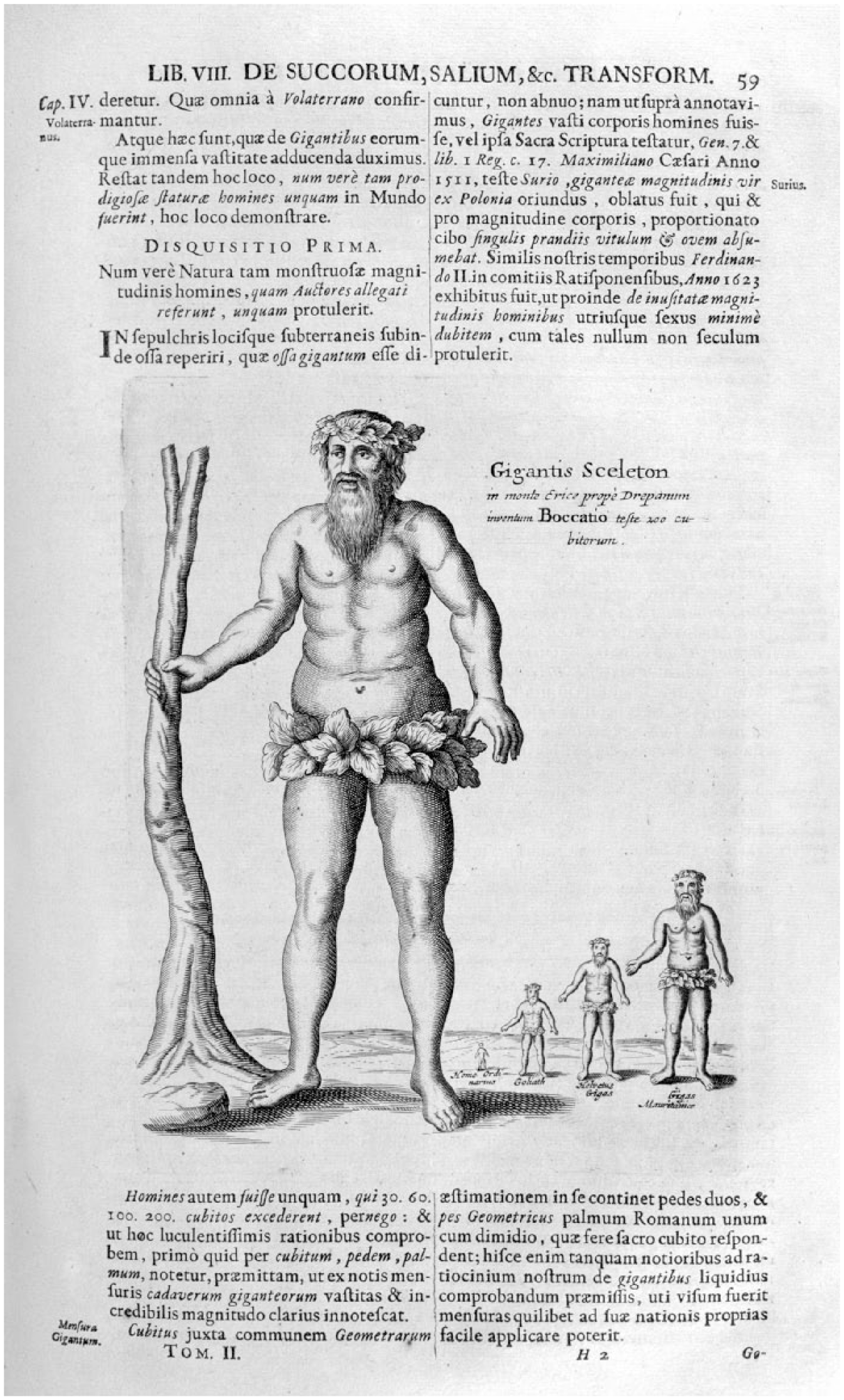
A few chapters later in Genesis, we have what is perhaps the closest parallel between biblical monsters and those of other cultures, when we are told that “The Nephilim were on the earth in those days—and also afterward—when the sons of God went in to the daughters of humans, who bore children to them. These were the heroes that were of old, warriors of renown” (Gen 6:4). On the one hand, this would seem the “smoking gun” that shows how similar is the Bible to other mythologies, in that it has the basic elements that resulted in the creation of monsters in so many Greek myths—heavenly beings mating with human women and the offspring being some powerful, dangerous combination that is unwelcome by both gods and mortals. The story was evocative enough, and its parallels to Greek myth so tempting, that it was conflated with the gigantomachy or titanomachy (themselves often conflated with each other) by apocryphal works (1 Enoch); 14 such conflation is now built into the very architecture of Dante’s Inferno, with the giant Antaeus placing Dante and Virgil in the ninth and final circle of Hell.
But as powerful and compelling as the embellished versions would be, the single biblical verse is rather more disappointing. These beings are barely “monstrous”; “warriors of renown” is not very frightening or grotesque. And while the flood story that follows would seem to indicate God is disgusted and even threatened by these beings (though only as part of a general revulsion at creation), they are obliterated without comment along with most all of antediluvian existence. They do not require a protracted war like the titans or giants, and their destruction is not even singled out for description. Later Hebrew heroes will not have to fight their offspring, the way Odysseus or Perseus have to prove their strength and faith by defeating monsters that are the result of illicit contact between the gods and earthly beings. If this is the closest parallel between biblical monsters and those of other cultures, the specific differences stand out as more significant than the general similarity: the Hebrew world—other than the cataclysmic clash between God and evil/chaos at the beginning and end of the cosmos—is not one where monsters regularly roam.
This very partial overlap between the Bible and other ancient mythologies on the idea of monsters is another confirmation (if any more were needed at this point) that it is willful folly to adhere to either extreme of describing how the Bible relates to other theologies or belief systems. To say either, “The Bible is just like every other ancient myth,” or, “The Bible is uniquely inspired and totally dissimilar to every other ancient myth,” requires one to ignore or deny extensive, clear, well-documented similarities and differences. (Though scrolling through my Facebook feed, and seeing the various posts and memes from an eclectic mix of atheist and Christian friends I have accumulated over a half century, one might think those are the only two options available.) But in this case, the differences seem to outweigh the similarities, so in our next section, we should address what deeper differences of thought, belief, and understanding underlie this difference in what is the fairly narrow topic of monsters. Why are “regular” (i.e. unnatural hybrid) monsters typical all over the world, but relatively rare within the Bible?
Biblical Monsters: A Different Kind
If Genesis 1 includes hints of an underlying Chaoskampf story in which god(s) battled a primordial sea-monster, on its explicit and literal level, it contains a refrain that makes the kinds of monsters considered above virtually impossible. At each step or stage of creation, “God saw that ______ was good” (Gen 1:4, 10, 12, 18, 21, 25), and concludes, once everything has been fitted into its place, given its right relation to everything else, that the whole “was very good” (Gen 1:31). If there is some hint that chaos lurks, imprisoned somewhere at the edge of creation, there is a constant reassurance that within creation, everything is smoothly functioning, working together and with God (especially in the case of humans, who are told to tend the rest of creation as God’s regents, Gen 1:28), to maintain everything in a static, continuing state of goodness. This goodness will be expressed especially as fecundity of the species as established (Gen 1:22, 25, 28): God made them, but they are now empowered and responsible to make more of themselves, thereby expanding the arena of goodness. And when God later sees some problem in creation (Gen 6:5-6), he does not tinker with it, the way other deities might: his only recourse seems to be destruction. So if the species are fixed, and they are individually and all together “good,” and if God is not going to enter into the system to try to “fix” or change or impregnate any of his creatures (though he may kill them outright), then there is no room for monsters, really, just as there is no room, ultimately, for evil, as some separate, competing force against God. The shenanigans of the gods of the Greeks and other ancient cultures created monsters, because those deities meddled more frequently and physically in their world. The God of the Hebrews is more aloof and distant, but at least this Deity does not come down to earth and create hideous monsters because of some divine weaknesses or uncontrolled desires.
But neither the ancient Israelites nor Christian thinkers such as Augustine reflecting on their stories, were naïve or Panglossian: to say God created nothing bad or evil had to be immediately followed by the admission that the world as we now have it (and have had it as far back as any record goes), has been full of evil. But both the biblical text and later interpreters placed this squarely in a different location than either a primordial sea monster, or an opposing, eternal force of evil (as suggested by Augustine’s sometimes co-religionists, sometimes implacable foes, the Manichees): they claimed real evil exists, but only as evil acts, not evil objects. So there are no monsters, really, but there are monstrous acts all the time. And for the Bible, this begins just a couple pages into the text, just a few chapters after God has created, observed, and proclaimed that everything is good, when Cain murders his brother, Abel (Gen 4:1–16). Interestingly, God at least describes such a turn to evil with Cain being stalked and then attacked or infected by some monster (sin) lurking at his door (Gen 4:7). But neither sin nor the serpent in the earlier story of temptation (Gen 3:1–7) can really take the role of an evil monster, or remove the location of real evil from human will and choice: again, there are evil actions, not evil animals or things, and Cain is the epitome and progenitor of all such evil.
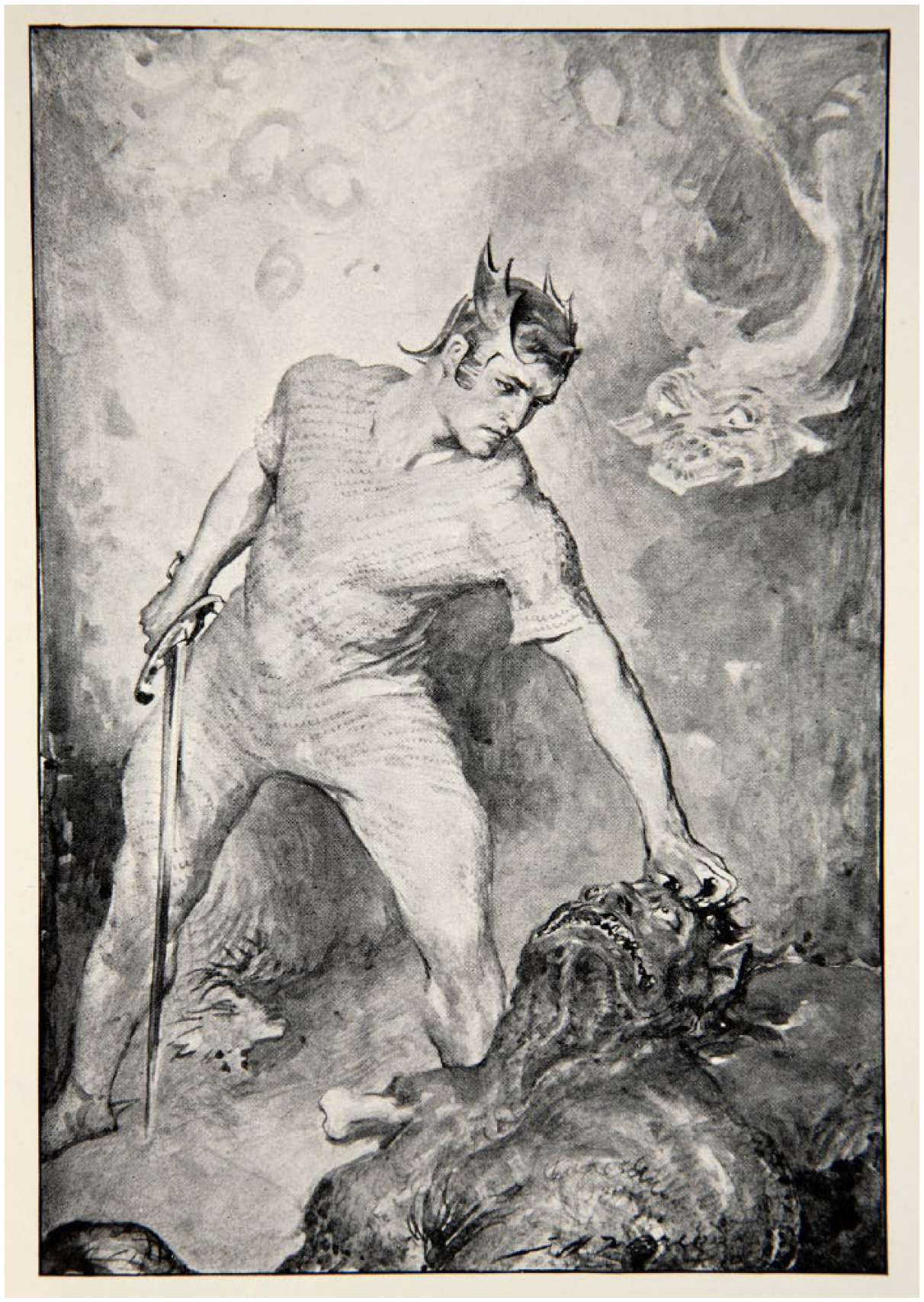
Within the sequel to the Cain and Abel story, however, it is revealing how the biblical authors want subtly to associate Cain with other qualities of monstrousness, most especially with otherness, with being the supposed source of non-Israelite culture (Gen 4:17). According to this genealogy, ancient city-dwellers (i.e. non-Israelites) are the descendants of the first murderer. (A similar genealogy is given in Gen 19:30–38, in which the non-Israelite tribes of Moab and Ammon are slandered as descendants of incestuous relations.) The comparison with Greek myths is again revealing: when a Greek hero like Odysseus journeys and is challenged by monsters, they are often the product (or the descendants of the product) of illicit, unnatural contact between humans and gods, while the Israelites believed their neighbors were the sinful descendants of the first sinner. One culture conceives itself locked in conflict with both nature and the gods (and when they do clash with other cultures, at least some of the pantheon will probably be fighting for the other side!); the other believes itself as allied with God against sinners who rebel against God. Also revealing is how later expansion of Cain’s story partly reverts to the rival idea of a world full of monsters rather than just sinners. In Beowulf, the monster Grendel is vividly but vaguely described as a descendant of Cain, even though Grendel seems to have powers beyond human (e.g. impervious to weapons, possessed of superhuman strength). The lack of monsters in the biblical account is dissatisfying in some ways and needs to be supplemented.
Dissatisfying in a wholly different way, is another corollary of having evil be “only” a matter of evil choices: What to say about all the evils humans experience (disease, famine, drought, deformity, etc.) that cannot be traced to poor human choices? If we are trapped in a universe that we cannot leave, whose rules and confines we must obey, and that universe is constantly full of mental, emotional, and physical pain inflicted on us just for existing, not because of anything we did to deserve it—isn’t that exactly the scenario envisaged by many modern horror movies, except those envision our torturers as insane, monstrous human beings? To expand the scope to the entire universe is just to enlarge the scenario, not necessarily to change our evaluation of it, or of the Being who runs the torture chamber, except that he be much bigger and more powerful than a Jigsaw or Leatherface.
In the Bible, the book of Job is the justly famous response to that anguished question, and its response includes descriptions of the monsters, Behemoth and Leviathan. Those descriptions confusingly combine “different elements that are categorically exclusive of one another, and thereby jams the imagination’s ability to form a complete picture of the monster.”
15
As we observed above more generally about monsters, the greater threat of Behemoth and Leviathan is their mysterious nature rather than their physical menace. And with these two monsters, their inaccessibility seems especially pronounced, given their placement after chapter 39, a beautiful but convoluted poem praising the incomprehensibility of real animals, such as the ostrich: The ostrich’s wings flap wildly, though its pinions lack plumage. For it leaves its eggs to the earth, and lets them be warmed on the ground, forgetting that a foot may crush them, and that a wild animal may trample them. It deals cruelly with its young, as if they were not its own; though its labor should be in vain, yet it has no fear; because God has made it forget wisdom, and given it no share in understanding. When it spreads its plumes aloft, it laughs at the horse and its rider. (Job 39:13-18)
J.H.F. Bacon (1865–1914). Beowulf shears off the head of Grendel in the Old English epic poem. Lithograph, 1910. The Stapleton Collection/Art Resource, NY.
The animals listed in ch. 39 are those outside of human control and use, living in wastes beyond human habitation, as monsters do. But they are not especially powerful or destructive animals: they are merely weird. So to append the description of Behemoth and Leviathan to this is to continue and compound this theme of incomprehensibility or absurdity, even if these two monsters are larger and more powerful than the ass, goat, and ostrich.
God clearly is more powerful than Behemoth and Leviathan, but is God’s greater power really what is offered as consolation or explanation? 16 It would not seem so. The monsters’ incomprehensibility is just as small, compared to God’s, as their strength is minuscule, compared to God’s. They are presented as a learning tool, a horrible visual aid, to help Job and the reader appreciate what they can never understand: an omnipotent, omni-benevolent God who creates and even frolics or plays (cf. Psalm 104) with things that cause unbearable and unavoidable pain to humans. These are not monsters accidentally created by divine sexual hijinks; they are not eternal, pre-existing monsters outside God’s control and plan. That God is more powerful than they are increases their terror, because it means they exist at the Deity’s behest and with divine permission. In a final step of analysis and acceptance, they may be expressions of God’s monstrous chaos, if not evil. 17 Put even more strongly, to encounter such incomprehensible monsters may be the only way fully to encounter God: “[Rudolph] Otto characterizes religious experience as a non-rational encounter with a wholly other mysterium tremendum that is beyond reason and imagination.” 18
One may encounter the divine or the holy by coming face to face with such horrors, but would not necessarily worship or love such a Being, or even survive such an encounter. Indeed, Job barely survives his ordeal, and in Moby Dick, Herman Melville’s modern rendering of Job and Leviathan (among many other things), all who engage in the quest are killed, save one. But it is absolutely clear that Melville very much anticipated Otto’s description of the holy as not reducible to the good and moral, and the right or heroic or humane reaction to it as “an oscillation between terror and fascination, fear and desire.” 19 His Captain Ahab embraces the non-rational and chases after the mystery, not to worship or submit to it, but to hate it and fight it, because it is a mystery: “That inscrutable thing is chiefly what I hate; and be the white whale agent, or be the white whale principal, I will wreak that hate upon him.” 20
These biblical monsters therefore raise problems of survivability, or what, finally, will be the human reaction to them (if the humans even survive). These practical problems are probably connected to the more fundamentally and conceptually deeper problem our discussion has revealed: If evil originates with Cain, but monsters such as Leviathan are ultimately prior to and separate from that origin, what is the relation between monsters and evil, or even between God and evil?
That so much of my analysis keeps returning to fiction writers (O’Connor and Melville framing the discussion, and my atheist friends would not miss the opportunity to quip that the Bible itself is fiction—let us at least admit and celebrate that it is a story) should probably be some warning that the answer will be one that cannot be explained but can be experienced in a story. An inveterate fan of both O’Connor and Melville, I had some ideas of how to bring it back to one of their stories and insights. But as I was working on this, I think I found one that works better. It comes to us from Stephen King, himself a master of creating monsters who are intimate and inseparable from ourselves: a car, a beloved pet, a parent, an adoring fan—any can be a monstrous, lethal threat in his imagination. And his tales, like the Bible, are seldom cynical or pessimistic: there is often a sense of things being finally fixed, as horrific as the journey to wholeness has been. (And this frequent optimism is a rarity in modern horror.)
In a playful, wide-ranging essay, Reinier Sonneveld suggests (among many examples) that the prison itself in the film The Shawshank Redemption (based on a Stephen King novella) 21 is a kind of Leviathan. 22 One needn’t press the analysis too hard, but one can see the essential truth and insight of it. The human, chosen, Cain-like evil is pervasive throughout the story: inmates, guards, and the warden daily commit acts of violence, greed, and deceit. That seems the overwhelming experience of monstrousness throughout the film, but there is ultimately something to the suggestion that the prison itself exerts some crushing force of evil. As Red, one of the primary characters in The Shawshank Redemption and a man serving decades in prison, states, to survive in prison one must give up hope—because hope is dangerous. One must be ruthless, not sadistic, necessarily, but at least detached and uncaring. None of Andy’s (the other protagonist, a man unjustly convicted for murdering his wife) “friends” ever seem to try to stop the repeated gang rapes of him, it should be noted, and he doesn’t seem to blame them or expect them to help; both they and he have acclimated to this hellish eco-system. Most poignantly, Brooks, an elderly inmate who has served most of his life behind bars, hangs himself shortly after being released, because he has no hope, no skills, no connection to a world that’s not the predatory, circumscribed, un-dead existence inside the prison.
But far more interesting is that Shawshank makes the defeat of both moral and existential evil a possibility and gives several tactics for it. In the first example Sonneveld focuses on—the scene fairly early in the film when Andy plays Mozart (from The Marriage of Figaro) over the public address system—the inmates are transfixed by the aria’s beauty. If Leviathan and evil are incomprehensible, so is the beauty the men heard that day; if one greets the mysterium tremendum in a monster with speechless awe, one can also stand agape before it in a shockingly, unbelievably, unspeakably beautiful thing, person, or moment. More subtle and gradual is Andy’s repentance, even if he is not guilty of the specific crime for which he is being punished. He can both accept his responsibility, and proclaim that the suffering he is undergoing is not just, and he will do everything he can to end it. Indeed, he is motivated and empowered to do so by embracing his guilt.
And these two elements together—that beauty is as powerful and incomprehensible as evil is, and that the defeat of evil involves some confession, forgiveness, and atonement for sins —point to Christ as a powerful response to monsters and evil in the Bible. Shawshank is only blatant about this in the storm scene when Andy escapes and he assumes a crucifixion pose, but it pervades the film, with several innocent deaths, Andy’s patient teaching of his fellow prisoners, and long suffering for the inmates. It is explicit in the character of the warden, Andy’s implacable opponent, who is evil throughout—eager to quote Scripture to prove his points, diabolically intelligent, totally lacking in empathy, coldly sadistic (unlike the guards, who are gleefully so), and with a particular hatred of the prisoners’ library—the Word making them free more than his empty, hypocritical quoting of the Bible.
Lesser deities all over the ancient world either inadvertently created monsters, and/or had no way to eradicate them. The good news was they could help their followers fight them, and they were often willing and eager to do so. But the biblical God, who made everything “good,” but whose followers live in a world of frightful monsters and unavoidable evil, has a different problem: he has the power to get rid of evil and monsters, but for reasons wholly incomprehensible to humans, does not. The good news for his followers is that God has filled the world with beauty every bit as powerful, ineradicable, and inscrutable, as the evil. And for Christians, this beauty and power are augmented by God’s own dwelling in the world of evil and monsters, providing hope and example and sacrifice for his followers to continue not just to struggle or merely survive, but joyously to thrive, to “Get busy living.” 23
Footnotes

2.
From her essay, “Some Aspects of the Grotesque in Southern Fiction,” gathered in Flannery O’Connor, Mystery and Manners: Selected Prose, ed. Sally Fitzgerald and Robert Fitzgerald (New York: Farrar, Straus, and Giroux, 1962), 44.
3.
Shakespeare, Hamlet 1.5.167–68.
4.
5.
O’Connor, Mystery and Manners, 44
6.
Grafius, “Text and Terror,” alluding to the work of N. Carroll, The Philosophy of Horror, or, Paradoxes of the Heart (New York: Routledge, 1990).
7.
Many of these creatures are popular foes in the fantasy game, Dungeons and Dragons.
8.
The term is from Noël Carroll, The Philosophy of Horror or Paradoxes of the Heart (New York and London: Routledge, 1990) 195, quoted in T. K. Beal, Religion and Its Monsters (New York and London: Routledge, 2002), 52.
9.
Homer, The Odyssey, trans. Stanley Lombardo (Indianapolis: Hackett, 2000), Book 9, lines 103–104, 105, 110.
10.
Homer, Odyssey, Book 9, lines 183–184.
11.
Such people would be labelled “barbarians,” of course, as they are not Greek.
12.
Cf. Grafius, “Text and Terror”: “Perhaps the most obvious use of monster theory involves the Chaoskampf motif, as frequently it is in the biblical texts employing this motif where monsters are most directly invoked.”
13.
Cf. Gregory Mobley, The Return of the Chaos Monsters—and Other Backstories of the Bible (Grand Rapids: Eerdmans, 2012), 16, (quoted in Grafius, “Text and Terror”): “The Priestly authors ‘buried this story of creation through a competition between the Lord and the dragon of chaos below the surface of their measured prose in Genesis 1, but in the less-constrained discourse of biblical poetry the dragon breaks free’.” Also cf. the much earlier work of Jon D. Levenson, Creation and the Persistence of Evil: The Jewish Drama of Divine Omnipotence (New York: Harper & Row, 1988).
14.
See the analysis of Anathea E. Portier-Young, Apocalypse Against Empire: Theologies of Resistance in Early Judaism (Grand Rapids: Eerdmans, 2011), referred to in Grafius, “Text and Terror.”
15.
Beal, Religion and Its Monsters, 52.
16.
On God’s power over Leviathan, see the discussion of G. Kwakkel, “The Monster as a Toy: Leviathan in Psalm 104:26,” in Playing with Leviathan, ed. Koert van Bekkum et al. (Leiden and Boston: Brill, 2017), 55–76.
17.
Beal, Religion and Its Monsters, 49–50, “… the chaos monster Yam is not completely eradicated from the world, nor is it completely dissociated from the creator God. It is a personification of primordial chaos within cosmos, intimately related to the divine…. Behemoth is not exactly an image of the order and harmony of the world ecology. It is not outside creation, but like Yam it represents a kind of dangerous otherness within creation.”
18.
Beal, Religion and Its Monsters, 53. See Rudolph Otto, The Idea of the Holy: An Inquiry into the Non-Rational Factor in the Idea of the Divine and Its Relation to the Rational, trans. J. W. Harvey, 2nd ed. (New York: Oxford University Press 1950), 40.
19.
Beal, Religion and Its Monsters, 53.
20.
Herman Melville, Moby-Dick (New York and London: Norton, 1967), “The Quarter-deck,” 144.
21.
The Shawshank Redemption, dir. Frank Darabond (Castle Rock Entertainment, 1994).
22.
Reinier Sonneveld, “Incarnations of Death: Leviathan in the Movies,” in Playing with Leviathan, ed. Koert van Bekkum et al. (Leiden and Boston: Brill, 2017), 280–95.
23.
The first half of a refrain in The Shawshank Redemption: “Get busy living, or get busy dying.”