







Abstract
While the natural world may scare us, more frightening beasts arise when we neglect our calling to care for creation and “play god” via technology. From King Kong, Frankenstein, and Godzilla to recent films like The Babadook, The Shape of Water and Us, the most enduring monsters provoke humility, evoke empathy, and prompt us to love rather than fear. These holy terrors can offer an encounter with what Rudolf Otto famously called the mysterium tremendum.
A monster forged from spare body parts is brought to life. The criminal’s brain implanted in a reanimated corpse does not bode well for Dr. Frankenstein’s experiment. When the monster breaks free from the lab, he discovers a young girl by a lake. Little Maria responds to him with flowers rather than fear. Her playfulness makes the monster smile. After they delight in tossing buds in the water, the creature picks up Maria to extend the game. But her tragic and unintentional drowning turns the villagers into a lynch mob. The monster must be found and destroyed.
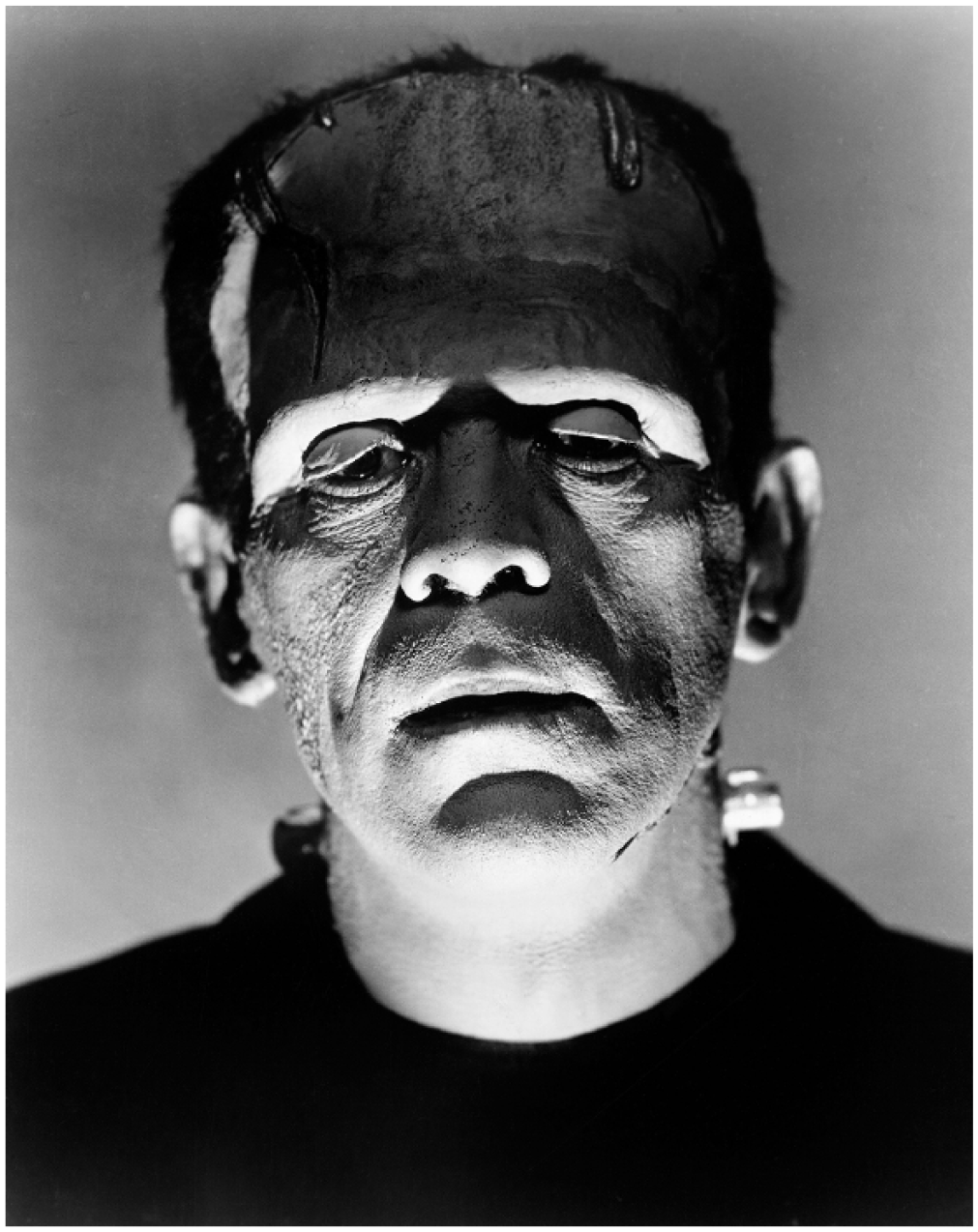
Frankenstein (1931) provided a template for creature features that followed. These scary stories often train naïve children to beware of strangers. Yet, the unchecked ego of Dr. Frankenstein is a far more malevolent force. Mary Shelley’s ground-breaking novel explored the dangers of scientists playing god, messing with nature, attempting to generate life. Technological irresponsibility can be deadly; children pay for adults’ folly. Actor Boris Karloff evokes empathy for the abandoned and mistreated creature. He grunts and groans like an inarticulate child unable to comprehend the cruelty he encounters. The best monster movies are cautionary tales that prompt us to reflect on our behavior, to consider biblical injunctions to practice humility, to care for creation, and to welcome the stranger.
This essay will bridge the perceived gap between horror, fantasy, science fiction, and biblical exegesis. So many biblical passages challenge us to combat fear and anxiety with faith. Yet, in the Gospel of Luke, the appearance of angels evokes fear in Mary and the shepherds (Luke 2:9). God’s messengers seem wholly other until they reassure listeners to “fear not.” Rudolf Otto described such awe-inducing majesty as mysterium tremendum. Such divine encounters can produce “a tranquil mood of deepest worship” or “spasms and convulsions, or lead to the strangest excitements, to intoxicated frenzy, to transport to ecstasy. It has its wild and demonic forms and can sink to an almost grisly horror and shuddering.” 1 Isn’t that the immersive, soul-shaking experience filmgoers seek in monster movies? Horror and fantasy fans want something awe-inducing, outside their experience: a holy terror. When we’re confronted by forces above and beyond ourselves, we may recognize our creaturely limits. Otto suggests such “absolute overpoweringness” can inspire dread, reverence, and humility. 2 Preachers and teachers eager to connect with their audiences may be wise to study with the Bible in one hand and a TV remote control in the other, because our fascination with monsters might just reflect an innate desire to experience the sacred.
Boris Karloff as Frankenstein’s monster in Bride of Frankenstein, 1935. Directed by James Whale. Universal Pictures/Album/Art Resource, NY.
Monsters have always gripped our collective imagination. Greek mythology is filled with fantastic beasts overcome by superhuman feats. The chimaera and the griffin are strange amalgamations of known animals merged into ferocious combinations like “a lion in front, a serpent behind, a goat in between.” 3 The Bible mentions giants like the Nephilim (Gen 6:4; Num 13:33) as well as creatures like the Behemoth (Job 40:15 ). The sea seemed so vast and threatening that it contained beasts like Leviathan (Job 41:1; Isa 27:1). We fear what we cannot contain or explain, whether beasts in the field or unseen forces in the depths of the ocean. As our anxiety grows, so do the legends surrounding that fear. Historian Scott Poole suggests, “American monsters are born out of American history. They emerge out of the central anxieties and obsessions that have been a part of the United States from colonial times to the present and from the structures and process where those obsessions found historical expression.” 4 Poole writes that vampires and werewolves may have arisen from the folkloric tradition of early modern Europe, “but when they appear in our local Cineplex, in the pages of comic books and prose fiction, and even in our folklore and urban legends, they are true American monsters. They are living representations of our darkness, simultaneously metaphors and progenitors of the American way of fear and violence….American history can best be understood through America’s monsters.” 5
This essay will consider the monstrous across film genres—adventure, science fiction, fantasy, and horror. The first section focuses upon natural beasts like King Kong (1933) who reveal our cruelty and evoke our sympathy. How we understand God’s directive to fill the earth and subdue it (Gen 1:28) and our calling to till and to keep the garden (Gen 2:15) will largely determine how we respond to the wild side of creation. The second part of this essay will look at the monstrous aspects of science fiction from Godzilla (1954) to The Matrix (1999). God has given us a remarkable ability to create, placing tools in our hand to fashion our future. Yet, there is an inherent risk in creation—when creatures rebel against their creator.
The third section discusses monsters that threaten children in fantasy and horror. Villains like the Child Catcher or Voldemort can send a chill up a kid’s spine. In horror movies, parents often succumb to the devil’s wiles, endangering their own offspring as in Sinister and The Babadook (2014). The most egregious horrors in the Bible involve child sacrifice to false gods like Moloch. How do we wrestle with monstrous evil within us? This essay will conclude with a reflection on our current fears and the Oscar winning films The Shape of Water (2017), Get Out (2017), and Jordan Peele’s latest thriller, Us (2019). These movies hold up a cracked mirror to our divisive era and redefine the monstrous. Such timely and topical horror films can expose the racism that bedevils us and challenge us to welcome strangers instead.
Fright master Wes Craven (a psychology major at Wheaton College) insisted that “Horror films don’t create fear. They release it.” 6 The monstrous springs from the Latin word monstrum, meaning “that which appears” or reveals itself. 7 Demonstration is rooted in the concept of monstrum. So, what do horrible and fantastic movies demonstrate about our fears and anxieties? It is easy to externalize our fear, to demonize and attack the Other. Efforts to dominate nature or rule over others may unleash forces that we struggle to control, from King Kong or Godzilla on a rampage, to The Terminator (1984) or “the Tethered” who come back to haunt in the film Us. We fear nature, we are anxious about what we’ve created, and we struggle with evil around and within us. The monstrous can be a humbling teacher, reminding us that we are not God. Rudolf Otto sees this “creature-feeling” as an opportunity to encounter the numinous, to see ourselves in proper relation to the Wholly Other. 8 Reverence for the Creator and creation can prompt curiosity and hospitality toward strangers. By confronting and addressing our fears, pastors, counselors, and professors are enroute to setting their people free to love (1 John 4:18).
Natural Fears and Beasts
Our earliest, primeval fears arise from nature. We have long feared the sea and the creatures therein. Who can hold waves at bay or keeps beasts in place? In Genesis 1, God brings order to a formless void. Humankind is charged to “Be fruitful and multiply, and fill the earth and subdue it; and have dominion over the fish of the sea.” (Gen 1:28). Psalm 74 celebrates the glory of the Lord who demonstrates such dominion: “You divided the sea by your might; you broke the heads of the dragons in the waters. You crushed the heads of Leviathan; you gave him as food for the creatures of the wilderness” (Psalm 74:13–14). Isaiah 27:1 celebrates the Lord who “with his cruel and great and strong sword will punish Leviathan the fleeing serpent.” These verses suggest that whoever can vanquish sea monsters is worthy of our devotion.
The crew of the Alecton attacking a giant squid, from Jules Verne’s Twenty-Thousand Leagues Under the Sea. Paris, 1870. Art Resource, NY.
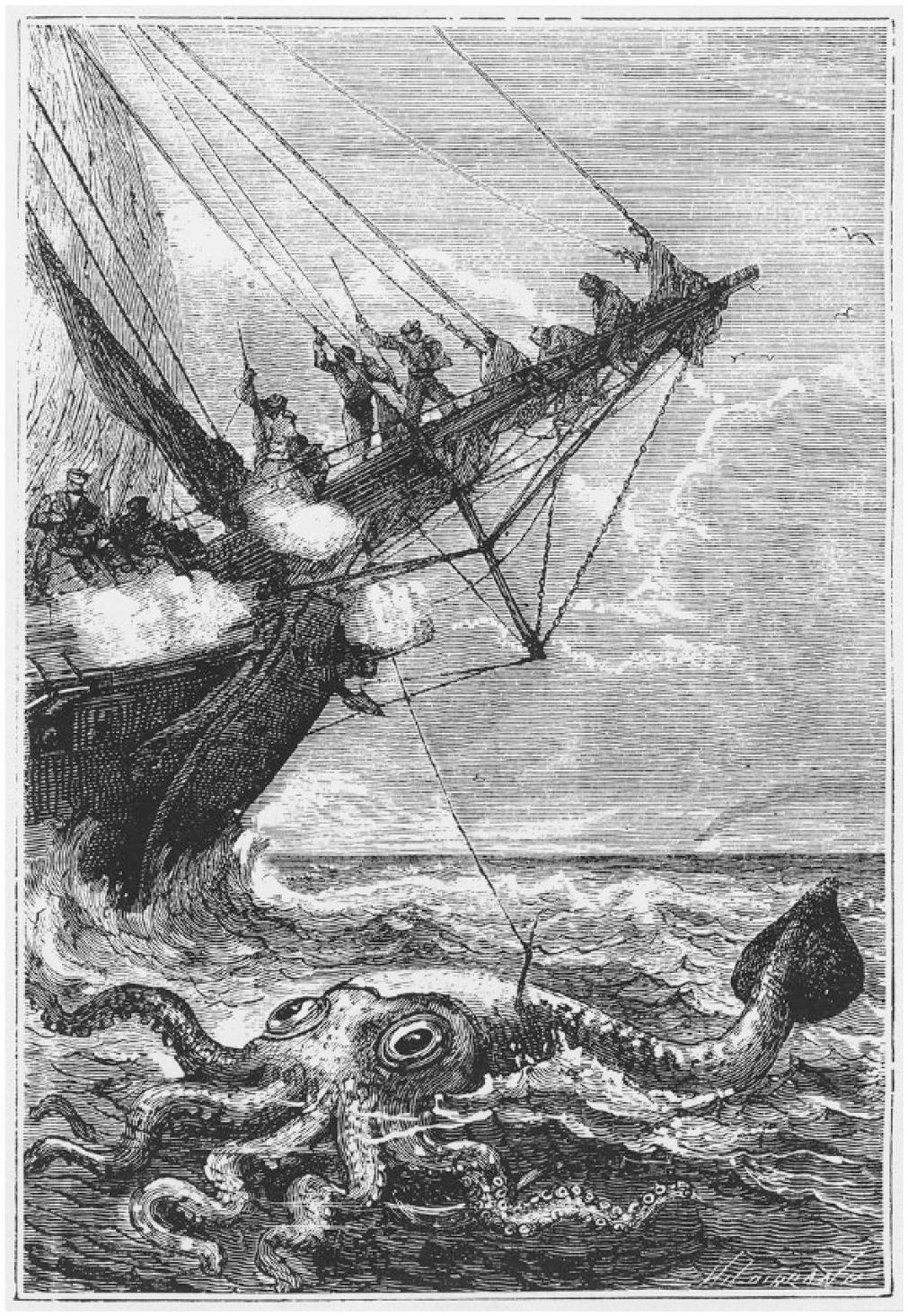
So many monster movies celebrate our ability to subdue nature and exercise dominion over animals. For example, Jules Verne took readers 20,000 Leagues Under the Sea (1954) in search of a sea monster. Disney brought Captain Nemo, his Nautilus submarine, and a giant squid to CinemaScope in 1954 (and to Disneyland shortly thereafter). Gregory Peck made a memorable Captain Ahab in Moby Dick (1956), hell-bent on vengeance even if it costs the crew of the Pequod their lives. His obsessive hunt for the great white whale proves to be Ahab’s downfall. Stephen Spielberg frightened moviegoers with the ferocious mechanical shark from Jaws (1975). As a kid growing up in Florida, my parents kept me from seeing the movie because they feared it would make me afraid of swimming at the beach. Yet, we’ve seen sea-goers like Captain Quint battling (and often losing) to sharks ever since Jaws shattered box office records. In Deep Blue Sea (1999), Open Water (2003), and The Meg (2018), we see that when we get too close to wild animals (and overly confident in our own mastery), nature can exact a punishing vengeance.
Problems arise from our understanding of “subdue” and “rule” (Gen 1:28). “Subdue” has echoes of a power move, demanding that creatures submit to our authority. It has been used to create biblical justification to kill animals, knock down forests, and siphon as much ore and oil from the earth as can be found. 9 Thankfully, theologians like Sallie McFague have challenged us to see “the planet more like an organism or community that survives and prospers through the interrelationship and interdependence of its many parts, both human and nonhuman.” 10 Creation arose from holding back chaos. Our calling is comparable to forging a footpath or keeping weeds and insects at bay. Our placement “in the garden of Eden to till it and keep it,” implies to “work” or “serve” (Genesis 2:15) How do we serve a garden? To “keep” suggests exercising great care over. Adam and Eve are charged to tend the garden like a loving caretaker. Some translations insert the agricultural term “cultivate.” A cultivated garden should yield far more than when we started. Our calling is to to create culture in all its myriad forms—from agriculture to the arts. 11
How do we care for God’s creation and superintend the seas responsibly? Documentaries like The Cove (2009) and Blackfish (2013) chronicle how cruel our hunting and capturing are to majestic dolphins and whales. Similarly, in the biblical story of Jonah, God employs a big fish to redirect an errant disciple. Nature becomes a godly force in rescuing us from foolishness and prompting repentance. In the ridiculous but colorful Aquaman (2018), the gorgeous King Arthur (Jason Mamoa) must make peace with his calling to rule Atlantis. Through a mentor, he learns to love the ocean and converse with sea creatures. Under threat from his jealous brother, Aquaman and his girlfriend Mera seek shelter in the mouth of a whale, just as God uses a big fish to restore Jonah and prepare him for a mission (Jonah 1:17). Aquaman depends upon a whale to elude his enemies and eventually live into his calling.
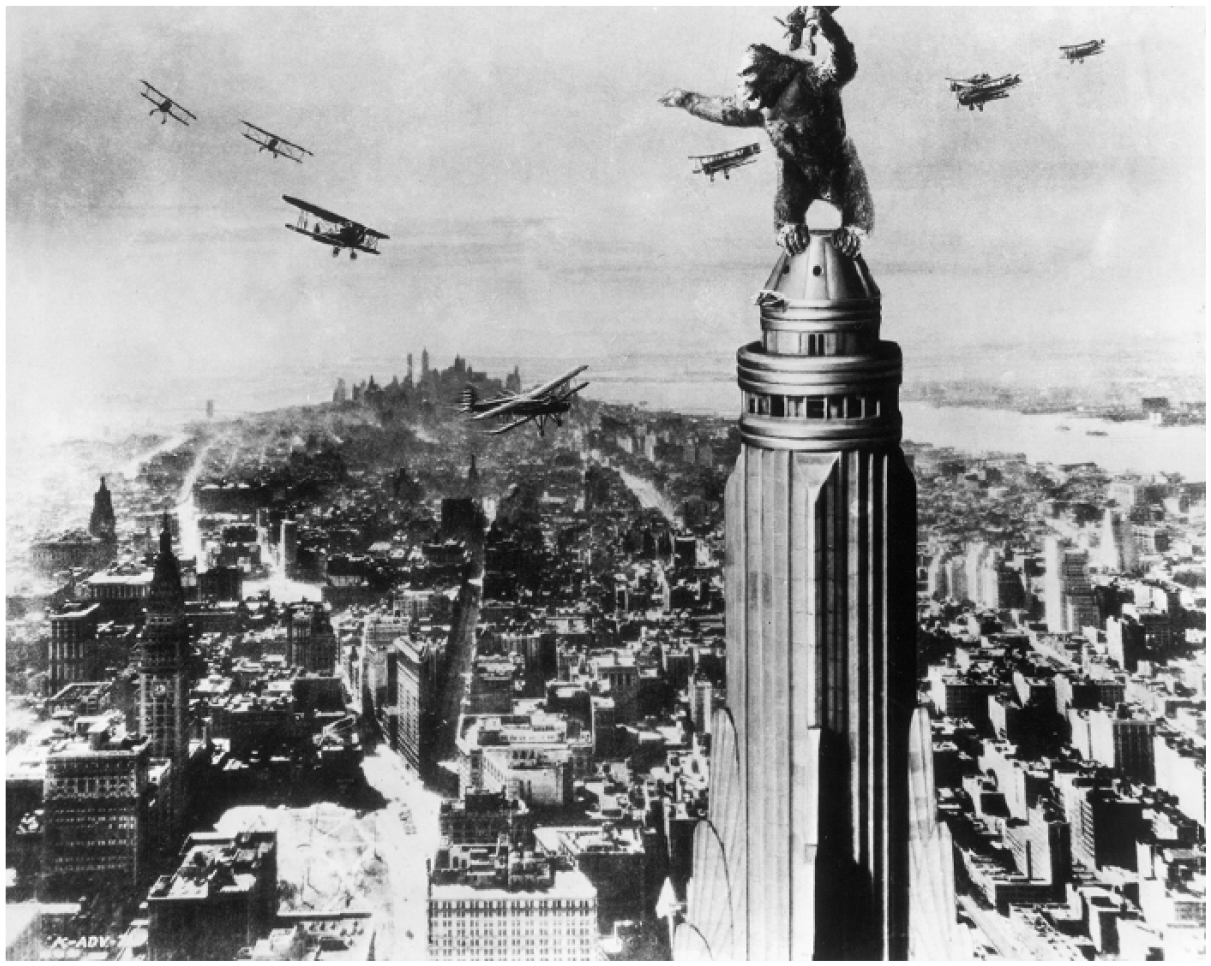
What happens when we cross nature, encroaching upon the sea or rain forests that God created? Perhaps the most tragic effort to dominate nature comes in King Kong (1933). A film crew ventures to the Indian Ocean with an actress in tow. The isolation of Skull Island allowed dinosaurs, long thought extinct, to flourish. 12 Who is the king of this brutal isle? Director Merian C. Cooper described his vision in a 1930 memo: “His hands and feet have the size and strength of steam shovels; his girth is that of a steam boiler. This is a monster with the strength of a hundred men. But more terrifying is the head—a nightmare head with bloodshot eyes and jagged teeth set under a thick mat of hair, a face half-beast, half-human.” 13 Cinematic images of a white woman kidnapped by savages to satisfy a big black beast played into all kinds of racist tropes. Yet, Cooper ensured that King Kong engendered compassion in the audience despite his fierce appearance. By the time the film crew carts Kong back to New York to be displayed as “The Eighth Wonder of the World,” notions of whose behavior is monstrous have shifted. Echoes of colonialism and the slave trade linger. Kong didn’t ask or deserve to be captured and turned into an object of fascination. Why couldn’t the explorers respect God’s creation? The fall of Kong from the Empire State Building becomes a tragedy that could and should have been avoided.
The stop-motion photography that allowed a miniature Kong to loom so large onscreen in 1933 has been eclipsed by digital effects. King Kong has returned holding Jessica Lange (1976), under the direction of Peter Jackson (2005), and recently in Kong: Skull Island (2017). What makes Kong such an enduring and endearing character? 14 Rudolf Otto’s term tremenda majestas—“aweful majesty”—aptly describes Kong. 15 We marvel at the glory of creation and tremble from a close encounter with such uncontainable power. Wild beasts can drive us to our knees in appreciative praise and desperate prayers for deliverance. Kong holds a mirror up to human nature and finds us wanting. Our efforts to tame or domesticate wild animals are foolish. Kong reveals our worst tendencies to appoint ourselves as rulers and colonizers rather than caretakers of God’s creation. We often overplay God’s directive to “fill the earth and subdue it.” 16 When we attempt to rule over every living creature that moves on the ground, we also undercut our place within a fragile ecosystem. Scary sharks and raging beasts remind us to steward creation with humility rather than bluster. Those attempting to dominate may end up mastered by the beasts they seek to capture, kill, and exploit for selfish gain. Our call is not to bend nature to our will, but to tend God’s garden in a sustainable way.
King Kong, 1933. Directed by Merian C. Cooper and Ernest B. Schoedsack. Stiftung Deutsche Kinemathek, Berlin, Germany. Photo credit: bpk Bildagentur/Art Resource, NY.
The Fallout from Our Folly
The first Frankenstein movie begins with a prologue, “a friendly word of warning: We are about to unfold the story of Frankenstein, a man of science who sought to create a man after his own image without reckoning upon God.” 17 In Mary Shelley’s novel, the monster says to his maker, “I am thy creature: I ought to be thy Adam, but I am rather the fallen angel.” 18 God’s bond to Adam and Eve within the garden was cut short by sin and rebellion. They are cast out of Eden, consigned to labor and granted tools as a consolation. In Noah’s ark, we use tools to preserve biodiversity, in Nimrod’s Tower at Babel, we seek to make a name for ourselves. Philosopher Albert Borgmann defines technology as the systematic process of trying to get everything under control. 19 From massive projects like paving a road to building a dam, through smaller acts of cleaning our house or coordinating our calendars, we are forever attempting to control our environment. In the movies, our efforts to build machines or alter nature for our own glory go badly. Presumption precedes chaos. The doctor can’t control his creation in Frankenstein (1931). The sorcerer’s apprentice, Mickey Mouse, is swamped by the mop and buckets in Fantasia (1940). Science fiction monsters from Godzilla to The Terminator chronicle the fallout from our folly.
European legends like The Golem (1920) predated Frankestein. This Jewish folk tale merges our modest clay origins in Genesis with the threats imposed upon the Hebrews during the Exodus. 20 In the sixteenth century, as Jews living in Prague were threatened by the Holy Roman Emperor’s pogroms, tales arose of a rabbi fashioning a massive defender from mud. The Golem is a created to serve his master. Its name is found in the Psalms, “My frame was not hidden from you when I was made in the secret place, when I was woven together in the depths of the earth. Your eyes saw my unformed body (golmî in Hebrew).” 21 What if the helper proves tough to control? The Golem starts out as an answer to prayer but becomes a nightmare, turning on its creator. The lumbering protector of the Jewish ghetto nearly destroys it.
The barbarism of the Holocaust raised questions regarding human progress. How could the Nazis have been so evil to target an entire people for extermination? And where was God amidst the suffering and murder of so many Jews? Victory in World War II was tempered by the stark photos that followed. Robert Oppenheimer named his atomic bomb project “Trinity”. After witnessing the first nuclear bomb blast in 1945, Oppenheimer thought of Krishna’s monstrous appearance in the Bhagavad-Gita and the scripture, “Now I am become Death, the destroyer of worlds.” 22 Horrific images from Hiroshima and Nagasaki made us question our war machine. Martin Heidegger suggested in technology, “Contemporary man’s inveterate drive to master whatever confronts him is plain for all to see. …The modern technologist is regularly expected, and expects himself, to be able to impose order on all data, to ‘process’ every sort of entity, nonhuman and human alike, and to devise solutions for every kind of problem. He is forever getting things under control.” 23 Why is tech such a masculine driven industry? Why do men desperately want to master nature and exert control? 24 When we treat the earth or each other as an object, we dehumanize ourselves and endanger our collective future.
Science fiction films from the fifties reflected our fears of war and nuclear holocaust. What kind of monsters might atomic fallout unleash? Gojira (Godzilla: King of the Monsters [1954] in America) is a prehistoric sea monster awakened by the bombings of Hiroshima and Nagasaki. Godzilla combines the Japanese words for gorilla and whale (kujira in Japanese). His dinosaur skin has been scarred by nuclear radiation like the real victims of the atom bomb. When the monster roars, it emits an atomic heat beam that destroys everything in its path. Godzilla’s overpowering presence invites us to reflect on what Otto described as “the feeling of one’s own submergence, of being but ‘dust and ashes’ and nothingness.” 25 This can be the starting point for a numinous experience of religious humility.
Godzilla’s indiscriminate destruction of Tokyo echoes the atomizing unleashed upon Japan. Does the awakening of a long-buried monster also allude to Japan’s imperial ambitions? 26 Americans dropped the bomb, but it was also Emperor Hirohito’s war time hubris which brought judgment to Japan. Godzilla arose in 1954 as a manifestation of Japanese trauma and fears of a recurrence. If the monster can be vanquished, then perhaps Japan can avoid another nuclear catastrophe. In Godzilla, one thoughtful Japanese scientist suggests that the monster should not be killed but studied for clues for surviving the effects of radiation. Godzilla presents an opportunity to learn from our mistakes. But will we? Radiation spilling from the Fukushima Nuclear Power Plant in 2011 reconfirms human folly. Nuclear fallout is costly. The urge to conquer via science and technology threatens us all.
From 2001: A Space Odyssey (1968) to I Am Mother (2019), we have been warned to beware of robots and computers created to serve us. Fear of machines and distrust of technical solutions reside behind The Terminator series launched by James Cameron in 1984. The chiseled muscles and foreign accent of Arnold Schwarzenegger made him a perfect robotic killing machine. The rise of Skynet echoed the fear expressed in The Golem. What happens if the machines we create disobey or become too sentient? Perhaps The Terminator will fight with us, or perhaps technology will destroy our world (and us). The Matrix series created by the Wachowski brothers also explored the rabbit hole that machine learning may create. The first film opened on Easter weekend 1999 with a heady mix of Christian, Buddhist, and philosophical elements. The cool moves of Neo and Trinity existed within the green glow of computer screens and virtual worlds. Morpheus questioned our grasp of reality. The Matrix anticipates a future where simulations prove far more malevolent than we suspect. How do we prevent an army of Agent Smiths from overtaking our consciousness? The conclusion of the trilogy, The Matrix Revolutions (2003), suggests that humanity and machines must learn to get along. This fragile peace failed to satisfy audiences. Perhaps that’s why Keanu Reeves agreed to take a fourth cinematic trip into The Matrix. As artificial intelligence comes to dominate our decision-making, more movies will remind us to be cautious with our coding.
Beware of the Boogeyman
Scary fairy tales can move children from innocence to experience. Monster movies put us through emotional wringers in order to teach us the world can be a scary place. Evil exists; prepare to resist it. When the BBC asked who were the scariest villains in children’s books, Voldemort from Harry Potter, 27 Cruella DeVil from 101 Dalmatians, 28 and Gollum from The Lord of the Rings 29 were recurring answers. Yet, the Child Catcher from Chitty Chitty Bang Bang (1968) was crowned most threatening (even though he didn’t appear in Ian Fleming’s original story). 30 Screenwriter Roald Dahl invented the black clothed, pasty faced Child Catcher. I vividly recall the chills that the Child Catcher sent up my young spine. His pointy nose and bony fingers reeked of menace, especially given his mission to snatch and imprison the children of Vulgaria. His black cape and hat echoed the grim reaper, come to snuff out life. I did not want to be trapped behind his bars, carted off to the Bombursts’ castle. From this frightening early experience, I learned to beware of those who target the vulnerable.
The Child Catcher fits within the tradition of witches and boogeymen who aspire to consume children. Jesus warned his followers to beware of wolves in sheep’s clothing. 31 The fairy tales collected by the Brothers Grimm alerted all Little Red Riding Hoods to watch out for Big Bad Wolves in disguise. While most horror films make women the object of malevolent wrath, 32 truly chilling films place kids in peril from their parents. When dealing with the devil, children are often placed in harm’s way, their life demanded by a voracious villain. Consider the horrors in Rosemary’s Baby (1968), The Exorcist (1973), The Conjuring (2013), The Witch (2015), and Hereditary (2018). Mothers are manipulated, coaxed into sacrificing their own offspring out of fealty to a false god. The devil attempts to drive a wedge between mothers and their children, an affront to Scriptures highlighting God’s heart for widows and orphans. These unholy terrors drive some to madness and despair; others to their knees, begging God to deliver us from evil.
The most diabolical idolatry in the biblical witness involves child sacrifice. In Leviticus, God says to Moses, “Any of the people of Israel, or of the aliens who reside in Israel, who give any of their offspring to Molech shall be put to death” (Lev 20:1). Anyone who sacrifices their children must be cut off from the community for “defiling my sanctuary and profaning my holy name” (Lev 20:3). And yet in 1 Kgs 11:7, Solomon is described as building an altar for Molech, “the abomination of the Ammonites.” This insatiable consumer of children is associated with fire. Those who mistreat children, entrapping them for personal gain, deserve a special place in hell. Such convictions drive the pro-life movement. Contemporary images of refugees held in cages along our Southern border should also trouble and disturb us. Have we hardened our hearts and sacrificed others’ children while pursuing our prosperity? Jesus’s rebuke to his disciples still resonates: “Let the little children come to me, and do not stop them; for it is to such as these that the kingdom of heaven belongs” (Matt 19:14).
Amongst the most terrifying, child-snatching boogeymen are Buhguul in Sinister (2012) and the eponymous The Babadook (2014). In both low-budget horror films, a parent endangers his or her child. In Sinister, a true crime writer in search of another best seller moves his wife and two children into a home where another family was murdered. Ellison Oswalt discovers a box of home movies that show families being murdered. Who was behind the camera? In tracing occult symbols on the films, Ellison learns about an ancient Babylonian god named Buhguul who murders parents and consumes their child’s soul. Ellison’s kids refer to Buhguul almost playfully as “Mister Boogie.” He features the same pale white skin and dark clothes as the Child Catcher (along with the allure of a death metal singer). Sinister explores how demon possession can overwhelm the innocent and inspire gruesome crimes. Director Scott Derrickson makes horror movies because of his Christian roots, saying, “I think it is the genre that is most-friendly to the subject matter of faith and belief in religion. The more frightening and sort of dark and oppressive a movie is, the more free you are to explore the supernatural and explore faith.” 33 Can Ellison solve the mystery and vanquish Buhguul before his seven-year-old-daughter is possessed? Sinister challenges adults to put their children’s well-being above their personal ambitions.
In The Babadook (2014), a husband dies in a violent car crash enroute to the hospital with his pregnant wife. Six years later, grief swamps the mother, Amelia, as she raises her son, Sam. As a devotee of magic tricks, Sam struggles to fit in at school, acting out in annoying ways. The arrival of a pop-up book about Mister Babadook frays Amelia’s nerves even further. The Babadook resembles the Child Catcher with top hat, cape, and pasty face. As creepy things occur in their home, Sam blames the Babadook, much to Amelia’s annoyance. Sleepless nights push Amelia to the brink, where she becomes a threat to Sam. Can mother and son make peace with the haunting reality that “you can’t get rid of the Babadook”? Australian director Jennifer Kent wrote this psychological meditation on the inescapable nature of grief. Will our nightmares overwhelm us, drive us toward madness, even destroy our families? We must face the scary things hiding in our basements (and our subconscious). Like Amelia and Sam, we must learn how to live with painful past traumas. 34
The Monstrous in Us
At the conclusion of Mary Shelley’s Frankenstein, the monster proclaims, “I desired love and fellowship, and I was still spurned. Was there no injustice in this? Am I to be thought the only criminal, when all humankind sinned against me?” 35 While monster movies can be warnings to guard our homes, they can also make effective appeals to empathy. They remind us not to turn into monsters.
In a post 9/11 world, fear of aliens and strangers has risen dramatically. We feel increasingly haunted by forces that threaten to overwhelm us. It is easy to externalize our fears, but what happens when we start to resemble the monster? Sadistic scenes of torture in Saw (2004) and Hostel (2005) arrived alongside photos of prisoner abuse in Abu Ghraib, Iraq. The Purge (2013) springs from our distrust of each other and the faith we place in security systems and violence to resolve our socio-economic divide. It is easy to externalize our fears, but in Matthew 15, Jesus reframed the root of our problems. Purity laws were designed to protect the Israelites from foreign influence and threats. Yet, Jesus makes it clear that our struggles are internal, “For out of the heart come evil thoughts—murder, adultery, sexual immorality, theft, false testimony, slander. These are what defile a person” (Matt 15:19–20).
The finest horror films tap into the cultural Zeitgeist and call us to greater discernment. The Shape of Water (2017), Get Out (2017), and Us (2019) remind us how cruel, greedy, and frightening humans can be. They also demonstrate the courage needed to choose compassion rather than cruelty. Amidst our civil unrest, the Academy recognized the artistry in previously maligned genres, bestowing Oscars upon Guillermo del Toro for The Shape of Water and Jordan Peele for Get Out. By shifting our understanding of the monstrous, the filmmakers called us to consider how quickly we demonize The Other. They reframe our prejudices regarding who or what we really need to guard against.
Like little Maria encountering Frankenstein’s monster at the pond, a quiet waif named Elisa meets a marvelous amphibian in a pool, under government surveillance in The Shape of Water (2017). While a colonel views the creature as a potential weapon against the Soviets, we are invited to see the monstrous through the loving eyes of the mute Elisa. Her non-verbal communication with the Amphibian Man demonstrates patience no one else musters. To summon empathy from inside the fish suit, actor Doug Jones tapped into his adolescence, “When you’re a kid going through those awkward monster years, when you feel like you are the creature in the room that nobody understands and you look different from anyone else.” 36 Jones found, “This movie is about love being possible no matter how flawed and ugly we think we are.” Mexican filmmaker Guillermo del Toro set his monster movie amidst Cold War paranoia, siding with the disabled, the mute, and the misunderstood against white male aggressors. In an interview, del Toro acknowledged how, “We’re told constantly to fear the other. I tried to say, can we embrace the other?” 37 Learning to embrace the alien is a scary, high stakes process. Elisa’s love for the water borne creature puts both of them in danger. We may be injured or even killed by those who abuse our compassion. We are called to risk kindness and hospitality, to fight our fear with loving faith. The Amphibian Man proves to be a source of healing amidst violence.
Jordan Peele directed the most resonant recent horror films. Get Out (2017) and Us (2019) reveal African Americans’ harrowing experiences in highly creative ways. Get Out begins with the anxieties that accompany any boyfriend tasked with meeting his girlfriend’s parents. As a black American, Chris’s fears are amplified because Rose and her family are white. Despite their gracious, liberal exterior, the Armitage family use hypnotherapy to engage in brutal body snatching. Under the guise of care, Chris is lulled into a sunken place of powerlessness that preys upon his childhood traumas. Peele’s slow reveal of the Armitage clan’s nefarious, brain washing process takes audiences inside an African American mind. Get Out demonstrates how racism undermines black identity and immobilizes otherwise powerful people. Peele also aspired to challenge elites who think ‘We don’t have a racist bone in our bodies.’ Peele made his goal explicit, “We have to face the racism in ourselves.” 38 His brilliant film unites audiences across the racial divide. We all end up shouting “get out” to Chris and to a system that robs, steals, and destroys.
Us (2019) is an even broader indictment of the United States (U.S.) through the arrival of deadly doppelgangers. The affluent African American Wilson family are enjoying fun in the sun until they are confronted by their vengeful doubles, “the tethered,” who struggle to survive underground. The tethered arose from a failed cloning project (shades of Frankenstein again). These monsters are inarticulate; they cannot speak. They are forced to mimic their doppelgangers’ actions, robbed of free will, until a rebel leader arises. For Peele, the tethered are “a representation of the guilt, the trauma, the fear, the hatred that might be buried underneath layers of pleasantry. All the stuff that we don’t deal with.” 39 Us is about race and class; an exposé of the brutal cost of our prosperity. When will the bill for our self-serving greed arrive? Us reaches back to 1986 and the promise of Hands Across America to implicate the decades of social Darwinism that have left us even more socially, economically, and racially divided. An equally coordinated day of judgment is now at hand, led by Mrs. Wilson’s doppelganger, Red (with the brilliant Lupita Nyong’o in dual roles). Peele underlines his prophetic intent through repeated references to Jer 11:11: “Therefore, thus says the Lord, assuredly I am going to bring disaster upon them that they cannot escape; though they cry out to me, I will not listen to them.” Get Out and Us are cinematic expressions of the pain that sparks movements like “Black Lives Matter.” Jordan Peele cries out for justice, rooted in the biblical tradition. We must confront our monstrous behavior across American history, from enslavement to modern police brutality.
Monsters morph and change with the times. They reflect the anxieties of the cultures they spring from. How we address those fears also shifts in the movies. We may have valid reasons to fear. Sometimes we must destroy monsters who threaten our children with extreme prejudice. But the temptation to vanquish nature in an effort to dominate has proven quite costly. We must be careful not to turn into monsters or unleash environmental disasters. Horror films can cause mysterious tremors which remind us to “Humble yourselves therefore under the mighty hand of God, so that he may exalt you in due time. Cast all your anxiety on him, because he cares for you” (1 Pet 5:6–7). The movies can also remind us to approach those beyond our experience with caution and care. Remember, “Thus says the Lord of hosts: Render true judgments, show kindness and mercy to one another; do not oppress the widow, the orphan, the alien, or the poor” (Zech 7:9–10). Encounters with those who seem “other” can be frightening. Yet, we reach out in faith beyond fear, for “there is no fear in love. But perfect love drives out fear” (1 John 4:18), just like our most resonant movie monsters.
Footnotes
1.
Rudolf Otto, The Idea of the Holy, trans. John W. Harvey (Oxford: Oxford University Press, 1958), 12–13.
2.
Ibid., 19.
3.
Edith Hamilton, Mythology (New York: New American Library, 1940), 137.
4.
W. Scott Poole, Monsters in America: Our Historical Obsession with the Hideous and Haunting (Waco, TX: Baylor University Press, 2011), 4.
5.
Poole, Monsters in America, 4.
6.

7.
Poole, Monsters in America, 5.
8.
Otto, The Idea of the Holy, 11.
9.
Lynn White, Jr. traced “The Historical Roots of Our Ecologic Crisis” back to our flawed understanding of Genesis 1:26–28 in Science 155 (March 10, 1967): 1203–1207.
10.
Sallie McFague, Life Abundant: Rethinking Theology and Economy for a Planet in Peril (Minneapolis: Fortress, 2001), 72.
11.
For more reflection on this, see Craig Detweiler, iGods: How Technology Shapes Our Spiritual and Social Lives (Grand Rapids: Brazos, 2013).
12.
Arthur Conan Doyle’s novel served as the basis for the groundbreaking monster movie, The Lost World (1925). Almost seventy years before Jurassic Park (1993), a team of paleontologists learn that their assumptions regarding dinosaurs may be false and hazardous to their health.
13.
James Hise, Hot Blooded Dinosaur Movies (Las Vegas, NV: Pioneer, 1993), 56.
14.
15.
Otto, The Idea of the Holy, 20.
16.
Gen 1:28.
17.
18.
Mary Shelley, Frankenstein; Or, The Modern Prometheus (Hertfordshire: Wordsworth, 1993), 77–78.
19.
Albert Borgmann, Technology and the Character of Contemporary Life: A Philosophical Inquiry, (Chicago: The University of Chicago Press, 1984), 14.
21.
Ps 139:15–16.
22.
23.
Martin Heidegger, The Question Concerning Technology and Other Essays, translated and with an introduction by William Lovitt, (New York: Harper Colophon Books, New York, 1977), xxvii.
24.
I discuss these questions in greater detail in iGods.
25.
Otto, The Idea of the Holy, 20.
26.
27.
J.K. Rowling, Harry Potter and the Sorcerer’s Stone (American version first published by Scholastic in 1997) was the first of seven books in the Harry Potter series.
28.
Dodie Smith, 101 Dalmatians (Heinnemann,1956), was later made into films (1961, 1996).
29.
J.R.R. Tolkein authored the Lord of the Rings trilogy, which was published by Allen & Unwin in 1954 and 1955 and later made into films (2001–2003).
31.
Matt 7:15.
32.
Filmmakers have been trying to top the shocks delivered by Norman Bates’s serial killer since Psycho (1960). Following the social upheaval of the sixties, horror grew increasingly violent with malevolent slashers stalking young women in Halloween (1978), Nightmare on Elm Street (1984), and Scream (1996).
34.
For a more popularized form of preying upon childhood trauma, see the cinematic adaptations of Stephen King’s novel It (2017) and It Chapter Two (2019).
35.
Shelley, Frankenstein; Or The Modern Prometheus (New York: Signet Books, 2013), 240.