







Abstract
The planet Neptune was discovered on 23 September 1846, following the calculations of Le Verrier. This study is about the way the predictive performance of the French astronomer was numerically evaluated, first by Le Verrier himself, and then reported in various papers and books. A detailed examination of this question brings to light unexpected errors still present in today’s scientific literature.
Introduction
The discovery of planet Neptune, in light of the calculations made by Urbain Jean Joseph Le Verrier, is a major event in modern astronomy. The history of this discovery is well known, at least in its broad lines, and has often been related in books either mainly dedicated to it or dealing with related subjects. 1 The British side of the story is particularly studied, i.e., the circumstances that deprived John Couch Adams of the success his French competitor had obtained, as he had carried out similar calculations without publishing them. 2 This took place before Le Verrier had started his on his own.
It should be remembered, however, that on 18 September 1846, Le Verrier wrote a letter
3
to Johann Gottfried Galle from the Berlin Observatory, in which he communicated the position of the planet disturbing Uranus according to his calculations. Galle received this letter on 23 September, and in the very same evening, with the decisive assistance of Heinrich Louis d’Arrest and the help of the celestial chart Hora XXI by Carl Bremiker, he found the planet which was to be given the name of Neptune. After taking the time to check that he had indeed discovered a planet, Galle wrote to Le Verrier on 25 September to announce the news in French with this historic sentence: “Monsieur, La planète dont vous avez signalé la position,
In the same letter, Galle established the position of Neptune observed on 23 September at 12h 0 min 14.6 s, mean time in Berlin: αN = 328° 19′ 16.0″, δN = − 13° 24′ 08.2″. 5 It should be noted that in accordance with the practices of the astronomers of the time, “23 September” fits into the calendar year between noon, September 23 and noon, September 24. So the observation mentioned by Galle takes place 14.6 seconds after midnight at the very beginning of September 24 for the Berlin time but Neptune had already been observed by Galle before midnight, 6 which puts his discovery on September 23. Considering the time difference of about 45 minutes between Paris and Berlin, the gap between the time references given by the observation of Galle (23 September 1846 at midnight) and the data of Le Verrier (1 January 1847 for the astronomers, that is to say 1 January 1847 at noon) will be counted as 99.53 days.
The results transmitted to Galle by Le Verrier, which were related to his hypothetical planet (designated here by H) are the ones he communicated to the Academy of Sciences on 31 August 1846, where “the longitudes are calculated from the equinox of January 1847 and where the distances are related to the average distance from the Earth to the Sun” 7 (which corresponds to the astronomical unit, au). It should be noted that H is supposed to move in the ecliptic plane. Le Verrier gives more precise values of some of these results in the detailed presentation of his study in the Connaissance des Temps. 8 These results concern: the semi-major axis aH, eccentricity eH and longitude of the perihelion ϖH, and (specified for 1 January 1847) the mean longitude Lm, heliocentric longitude LH and distance to the Sun rH.

Moreover, again on 1 January 1847, Le Verrier attributes the value 7° 44′ 44″ to the equation of the centre 9 C, hence the result LH = Lm + C = 326° 31′ 48″ that he rounds up to 326° 32′. But he made a mistake in the calculation of C, whose correct value is 7° 44′ 18″, so that LH = 326° 31′ 22″ ≈ 326° 31′. As for the distance rH of the planet to the Sun, it is easily obtained by the polar equation of its elliptical orbit, 10 and in both of his texts quoted here, Le Verrier gives rH = 33.06 au. However, whether the calculations are done with the values given by Le Verrier, rounded or not, or with the ones that he should have used, the results obtained are respectively 33.0809, or 33.0806, or 33.0803 au, and in any case he should have indicated rH = 33.08. These slight mistakes are almost of no consequence to the results of Le Verrier’s calculations.
The purpose of the present study is to examine what scientists, more particularly astronomers, said about the angular difference that separated, at the time of the discovery, the actual position of Neptune from the one that Le Verrier had calculated. Curiously enough, this calculation and the mention of this ‘error’ 11 for the prediction have shown defects or inaccuracies that can still be found in today’s literature. Three types of angular differences will be considered as detailed below.
The difference in heliocentric longitude ΔL, according to Le Verrier
After Neptune was discovered, a question naturally came to mind requiring an answer: by how much did Le Verrier err in his calculations? In other words, what ‘error’ had he made on the position of the new planet? It can be easily believed that the difference was rather small as the indications given by Le Verrier had enabled Galle to find the planet rapidly.
Le Verrier himself gives a first answer to this question, as early as the session at the Academy of Sciences on 5 October 1846. Here is the outline of his calculations such as he presented it and in which he referred to Galle’s observation as mentioned above:
Right ascension observed:….……………………… 328° 19′ 16.0″
Declination observed:……………………………… −13° 24′ 8.2″
Geocentric longitude concluded:…………………… 325° 53′
Reduction to the heliocentric place:…………………. 0° 59′
______________
Heliocentric longitude on 23 Sept 326° 52′
Movement in 0.275 year……………………………… 32′
______________
Heliocentric longitude concluded for 1 January 1847 327° 24′
Longitude deduced from the perturbations and mentioned
in the Comptes rendus dated 31 August 1846 ………… 326° 32′
_____________
Difference…………… 0° 52′
So the position had been predicted within one degree. 12
Thus it is from a difference in heliocentric longitude that Le Verrier chose to estimate the difference between the positions of the two planets. The details of this calculation will be examined below but its basic principles raise a major objection from the outset: the difference in heliocentric longitude could not really be calculated at the time the discovery was made. Geometrical considerations indeed prevented a derivation of the heliocentric longitude of Neptune at that time.
To simplify things, let us suppose that Neptune, designated by N, is in the ecliptic plane. At the time of the discovery the knowledge of the orbital movement of the Earth makes it possible to obtain the length ES (Earth-Sun) as well as the geocentric longitude λS of the Sun which, by comparison with the geocentric longitude λN of Neptune deduced by the observation of Galle, provides the angle SEN, τ = λN − λS (cf. Figure 1). The trouble is that this angle SEN and the side ES are the only known elements of the triangle SEN, whose other elements cannot be calculated, particularly the angle NSE, which would immediately lead to the heliocentric longitude of Neptune. It would have been necessary to know the distance EN (or SN) that Galle’s observation could not determine. Theoretically, Neptune can be situated anywhere on the half-line Ex.
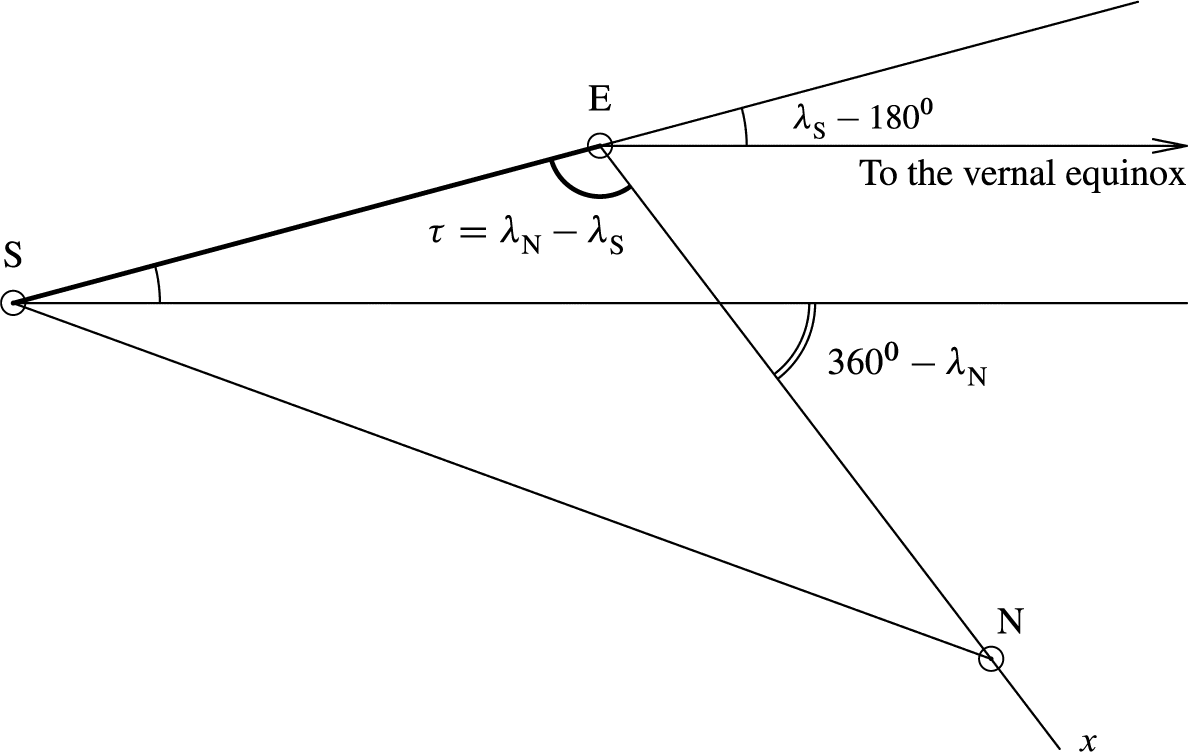
Approximate relative positions of Sun, Earth and Neptune at the time of the discovery.
Let us focus now on the detail of Le Verrier’s calculations. The geocentric longitude of Neptune is the result of the classical passage from equatorial coordinates to the ecliptic ones. The obliquity of the ecliptic provided by the Connaissance des Temps for 1846 (ε = 23° 27′ 26.8″) indeed gives: 13 λN = 325° 52′ 48″ ≈ 325° 53′. Then Le Verrier considers that Neptune is approximately situated in the ecliptic plane. Therefore, the heliocentric longitude is deduced from the geocentric longitude with a correction of parallax (“reduction to the heliocentric place”), which is angle ν (angle SNE) under which the segment Sun-Earth is seen from Neptune: LN = λN + ν ≈ 326° 52′ when it was discovered.
In the triangle SEN the angle τ in E is the difference between the geocentric longitudes of Neptune (325° 52′ 48″) and the Sun (180° 32′ 39.2″, according to the Connaissance des Temps for 1846), at the moment of Galle’s observation, that is to say τ = 145° 20′ 08.8″, and if one sets SE = d, the angle ν is such that sinν = (d / rN) sinτ. As d ≈ 1 au and Le Verrier found ν = 0° 59′ one can thus deduce that he attributes to rN a value of approximately 33 ua which corresponds to rH.
The heliocentric longitude of Neptune thus obtained for 23 September 1846, is augmented by Le Verrier with the movement A(LN) of the planet in longitude during the interval Δt separating this date from 1 January 1847, when he determined the position of H. More precisely, Δt must be counted between the moment of the discovery, that is to say almost on September 24 at 0 hour (civil time in Berlin) and the beginning of the year 1847 for the astronomers, which is for Le Verrier, 1 January 1847 noon (Paris time), so that Δt = 99.53 days, as it was mentioned above, or Δt = 0.2725 sidereal or Julian year, and not 0.275 year as Le Verrier indicates by mistake. If one overlooks the advance of the perihelion and the equinoctial precession during Δt, A(LN) merges with A(θ), advance of true anomaly, θ = LN − ϖN, during the same interval. Now, θ, time t (in sidereal years), distance rN (in au) are linked by
Most likely, when stating that rN varies little during Δt, Le Verrier contented himself with estimating A(LN) in degrees by:
So Le Verrier twice substituted rH for rN that he did not know. The second substitution could have been avoided if the calculation had been made for September 23 as, in that case, it is the advance A(LH) of H between the two dates that Le Verrier should have calculated, then subtracted from the value of LH on 1 January. But the first substitution could not be avoided to obtain LN on 23 September.
Under these circumstances, the 52′ are not what they are supposed to be. At first glance, these 52′ can give the illusion that they really represent the ‘error’ made by Le Verrier, since they are obtained from the positions of the calculated planet and of the real one. But it is impossible to recognize in the 52′ the scientific convention usually followed in expressing the difference between the theoretical and experimental values of a parameter, for the theory here enters into both terms of the difference. These 52′ actually represent the ‘error’ that would distort the heliocentric longitude predicted by Le Verrier, provided that he would not have made any in the Sun-Neptune distance. The calculation, which Le Verrier should have presented with some warning, at best enabled him to say that the ‘error’ that was made in the heliocentric longitude was probably about one degree. By the way, this is what the astronomer William Smart merely said when he refrained from mentioning the 52′ of Le Verrier. 14
As a result of this incorrect calculation, the exactness of the 52′ is of course illusory. A similar calculation of the same difference in longitude published by the Scottish astronomer Robert Grant proves it. Just like Le Verrier, Grant only gives a sketch of his method 15 but it is easy to piece it together. He takes up the movement in longitude by 32′ between the two dates mentioned and that Le Verrier obtains for H, but he subtracts it from LH = 326° 32′ as it is given by Le Verrier on 1 January, so as to obtain LH = 326° on 23 September. Besides, Grant determines LN at this date from the coordinates of Neptune provided by Galle and the Sun-Neptune distance on 23 September, such as it was known at the time. Indeed, Grant must have most probably deduced this distance from the orbits of Neptune calculated by the American astronomer Sears Cook Walker (cf. infra). The last ones 16 had a semi-major axis of about 30 au (instead of 36 au as stated by Le Verrier) and an eccentricity of only 0.0087. Incidentally, Grant mentions one of these orbits in his book. 17 For his calculation, Grant can thus consider that the orbit of Neptune is circular with a 30 au radius. Thus he set the correction of the parallax at 1° 04′ (instead of 59′ as set by Le Verrier) and concludes a difference ΔL of 57′ on 23 September, but he would have obtained the same result on 1 January.
The difference between the approaches of the two astronomers is obvious. With Grant, LH is a pure product from Le Verrier’s research whereas LN is entirely determined with the observational data and its result gains a scientific value that Le Verrier’s does not have. The accuracy of the 57′ is thus justified and contradicts the difference found by the French astronomer. It should be noted though that Grant’s parallax of 1° 04′ corresponds to rN ≈ 30.55 au, a value incompatible with the orbits of Walker for which rN ≈ 30 au, and 1° 04.5′ would still give the too large value rN ≈ 30.32 au. Walker’s orbits lead to a parallax close to 1° 05′ and ΔL ≈ 58′.
The reason why Le Verrier gave an estimation of his ‘error’ with an incorrect process is obvious: he deemed the process perfectly legitimate. Before the discovery of Neptune, the confidence Le Verrier had put in his calculations was very impressive. On 1 June 1846, he declared to the Academy of Sciences:
Is it possible that the inequalities of Uranus should be due to the action of a planet situated in the ecliptic, within a mean distance that is double of the one of Uranus? And should it be so, where is this planet now situated? What is its mass? What are the elements of the orbit it covers? The problem being formulated so, I’ll solve it rigorously.
18
This confidence that helped Le Verrier keep on with his work held a bad surprise in store for him. The observations of the new planet, to which had been added an observation made by Lalande (who, on 10 May 1795, thought he was dealing with a star), soon revealed that the orbital elements of Neptune were quite different from Le Verrier’s results, even if the uncertainties he had given them were taken into account. 19 Indeed, as early as February 1847, Walker obtained 20 aN ≈ 30.25042 au and eN ≈ 0.0088407, whereas, according to Le Verrier “the semi-major axis of the orbit (…) can only vary between the limits 35.04 and 37.90” 21 , and eH ≈ 12 eN. These discrepancies led the American mathematician Benjamin Pierce to conclude that “the planet Neptune is not the planet to which geometrical analysis had directed the telescope” and that “its discovery by Galle must be regarded as a happy accident”. 22 Le Verrier should have been more careful in the wording of his results. Thanks to his calculations, mainly founded on the residual perturbations undergone by Uranus at numerous dates starting from 1690 till 1845, it was one thing to predict the position held in the sky by the disturbing planet in 1846, but it was quite obviously another to state, rather carelessly, the elements of its orbit, since it was a way to say, more specifically, where it would stand in 50 or 100 years later.
It should be noted however, that the arguments put forward by Le Verrier or others, in order to defend his work concerning this disparity of orbits, have nothing to do with the present study, which is mainly dealing with astrometry. We are most of all concerned here with the calculations with which, at the time of the discovery, Le Verrier estimated the ‘error’ he had made in the position of Neptune. As it was, in October 1846 the immense confidence he had put in his calculations, as they had marvellously justified the discovery of Neptune around the position predicted, naturally led Le Verrier to consider that the calculated elements were very close to the ones of the real planet. In fact, that was probably a common belief at the time, as Emmanuel Liais writes:
But at the time one discovers a planet, one still does not know its distance from the Sun. The planet Neptune was found near the position as indicated. It was thus believed that it had the elements announced (…).
23
So Le Verrier did not have the feeling that he was making a mistake when he determined a heliocentric difference by identifying the real distance of Neptune with its calculated one.
The geocentric angular distance ψ
Even if the calculation of the difference in heliocentric longitude had been possible at the time of the discovery, this difference would not have been a satisfactory answer to the question about the ‘error’ made by the French astronomer on the position of Neptune. Apart from specific technical preoccupations, it is a matter of little concern to know an angular difference between the positions of Neptune observed and calculated, in the case in which the ‘observation’ would have been made from the Sun. By contrast, it is interesting to know to what extent the position where Galle found the planet at the Berlin Observatory was different from the one he had initially turned his telescope to, following the indications provided by Le Verrier. It is the geocentric angular distance that represents the natural measure of the ‘error’ made by Le Verrier. Now, if, as mentioned above, it was impossible, at the time of the discovery, to deduce the heliocentric coordinates of Neptune from its equatorial ones as indicated by Galle, Le Verrier could very well have had the opposite approach from the heliocentric coordinates he had predicted. Besides, Galle had to perform the same operation, at least approximately, to know where he had to look in the sky to find the planet.
Generally speaking, if the relative spatial positions of the Earth and the Sun are known, the passage from the heliocentric (resp. geocentric) angular coordinates of a planet P to its geocentric (resp. heliocentric) angular coordinates is only possible when the distance from P to the Sun (resp. to the Earth) is known. In the case under study, where we know the heliocentric angular coordinates of H and geocentric of Neptune, and where the distance of H to the Sun can be calculated, the geocentric angular comparison of the positions of H and Neptune can thus be done at the moment of the discovery. It is this calculation that is shown below. This calculation has nothing anachronistic as it only uses the traditional knowledge Le Verrier and his successors had at their disposal.
One can first give an accurate estimation of the advance in anomaly A(θ) of planet H between 23 September 1846 and 1 January the following year. On this latter date one uses the longitude LH = 326° 31′ 22″ (obtained above) and the longitude of the perihelion 24 ϖH = 284° 45′ 08″. By proceeding with successive approximations, one finds A(θ) = 32′ 11.56″. A(θ), however, is not the advance in heliocentric longitude between the two dates considered. One must add to it the advance of the perihelion in longitude, which, in the case of H and according to what Le Verrier said, 25 can be identified with the precession in longitude during the same interval. The latter will be 13.68″, according to the rate of the yearly precession in longitude, close to 50.21″, as Le Verrier uses it. 26 So, the advance in longitude is 32′ 25.24″ ≈ 32′ 25″ and, at the time of the discovery of Neptune, one had almost LH = 326° 31′ 22″ − 32′ 25″ = 325° 58′ 57″ whereas the successive approximations of the calculation of A(θ) also give rH = 33.05986 au.
Hence, when extracting from the Connaissance des Temps for 1846 the geocentric longitude of the Sun (180° 30′ 53.07″) and its distance d from the Earth (logd = 0.0011373) one obtains for the same time of the discovery the geocentric longitude λH = 324° 58′ 20.5″ whereas βH = ΒH = 0 as H was situated in the ecliptic plane. Now one should take into account the obliquity of the ecliptic, ε = 23° 27′ 25.65″, according to the tables of Friedrich Wilhelm Bessel 27 that Le Verrier 28 refers to (ε = 23° 27′ 26.8″ according to the Connaissance des Temps for 1846) to obtain the equatorial coordinates of H, αH = 327° 15′ 32.2″ (32.4″) and δH = − 13° 12′ 26.7″ (27.3″), which are compared with the ones observed by Galle for Neptune. The result is a geocentric angular distance ϕ = 1° 03′ 06.7″ (06.4″) 29 between the positions predicted and observed of the new planet, or ϕ ≈ 1° 03′. By the way, this result is compatible with the positions of the two planets marked on Bremiker’s map, which was used for the discovery. 30
Compared with the 52′ of Le Verrier, the ‘error’ has now gone beyond one degree. The 11′ difference between the two ‘errors’ has no direct interpretation, as the two ‘errors’ are of are of different natures, though they are of the same order of magnitude. Let us notice, however, that one is less than one degree while the other is above. This remark will be significant in the continuation of this paper.
The difference in geocentric longitude Δλ
Contrary to the difference in heliocentric longitude, the difference in geocentric longitude could easily be obtained at the time of the discovery. The previous calculations make it possible to compare λH = 324° 58′ 20.5″ to its analogue for Neptune deduced from the equatorial coordinates noted by Galle, that is to say: λN = 325° 52′ 48.0″. The difference in geocentric longitude is thus established with Δλ = 54′ 27.5″ ≈ 54.5′, a difference that Le Verrier could have calculated directly by supposing Neptune in the ecliptic plane, which was almost the case as the coordinates indicated by Galle are βN = − 0° 31′ 53.2″.
This result is to be compared with the one mentioned by the director of the Berlin Observatory, Johann Franz Encke who wrote to Le Verrier as early as 28 September 1846: “Your elements only differ, for Sept 23.5 by only 54.7′ in longitude”. 31 Here, one is indeed dealing with geocentric longitude as, for the time of the discovery, Encke indicates somewhere else 32 λN = 325° 52.75′ and λH = 324° 58′, hence the difference Δλ = 54.75′. Contrary to what Le Verrier will do on October 5, Encke does not compare heliocentric longitudes, probably because he is well aware that it was impossible to make such a comparison correctly. The Genevan astronomer, Émile Plantamour 33 in 1846 and the American one Benjamin Apthorp Gould, 34 in 1850, will do the same, without mentioning the 52′ of Le Verrier. The longitude is of course the main coordinate if the positions of the two planets are to be compared, as one is exactly in the ecliptic, whereas the other is slightly distant from it. None of the three astronomers show any concern for the geocentric angular distance. Yet, their calculations are correct, at least in principle.
What is clearly the matter here, again, is geocentric longitude when the American mathematician and meteorologist Elias Loomis wrote in 1848 (and even in 1856): “The new star was found in longitude 325° 52′; the place of the planet computed by Le Verrier was 324° 58′; so that this body was within one degree of the computed point.”
35
So it seems that like the three previous scientists, Loomis, too, understood that the longitudes that were compared couldn’t be but geocentric. But if such was the case, he changed his mind a dozen years later. Indeed, here is what he wrote in 1868:
On the 23rd of September 1846, Dr Galle (…) received a letter from Le Verrier, announcing the results of his calculations, informing him that the longitude of the unseen planet ought to be 326°, and requesting him to search for it (…) It appeared as a star of eight magnitude, having a longitude of 326° 52′ and, consequently, only 52′ from the place assigned by Le Verrier.
36
One can recognize the results found by Le Verrier transposed to 23 September 1846 and, this time, Loomis yielded to the temptation of the heliocentric comparison. We shall see that maybe he followed a wrong example.
An uncontested calculation
Initially obtained by Le Verrier, the estimated 52′ of the difference in heliocentric longitude between the observed and predicted positions of Neptune seems to have been acknowledged in the studies until today, without being put into question. Even Emmanuel Liais, who undoubtedly never tried to spare Le Verrier, never alludes to the fault in this calculation, though, as we have seen, he had noticed what caused that fault. 37 These 52′ have simply been accepted for what they were supposed to be.
Already admitted by Jean Baptiste Biot
38
and John Pringle Nichol,
39
the 52′ are implicitly mentioned by François Arago and Camille Flammarion who both merely report the heliocentric longitudes of 327° 24′ and 326° 32′ as indicated by le Verrier. But Arago exchanged their attributions,
40
and Flammarion suggests that they are related to 23 September.
41
However, the 52′ are clearly mentioned by Edmond Dubois, as well as the two terms whose difference they are in Le Verrier’s calculations, without any further comments.
42
John Herschel, who transposed the calculation done by Le Verrier to 23 September, explicitly mentions them again:
The geocentric longitude determined by Dr Galle from this observation was 325° 53′, which converted into heliocentric, gives 326° 52′, differing 0° 52′ from Mr Le Verrier’s place.
43
What is very surprising is that John Herschel does not raise any issues concerning this ‘conversion’ done by Le Verrier. It was maybe after reading this text that Loomis deemed himself authorized to present the heliocentric comparison after rejecting it first. Later, Charles André, the director of the Lyon Observatory, took up Le Verrier’s ‘conversion’ and concluded that “The total error of this long and difficult research was not even 1°, it was 0° 52′.” 44 We can also quote Fernand Baldet, director of the Société astronomique de France, when he presented the events scheduled to celebrate the centenary of the discovery of Neptune, by saying: “(Galle) found the unknown planet 52′ only from the heliocentric position calculated by Le Verrier.” 45 However, all these authors have the merit of being aware that the 52′ represent a difference in heliocentric longitude (and one can assume that such was the case for Vladimir Kourganoff who said that “The only thing that posterity remembered from the Calculations by Le Verrier were the 52′ that separated in fact his theoretical planet from the real Neptune.”). 46 We are going to see that it was not always the case.
The longevity of an error
As mentioned above, Le Verrier himself declared about his calculation of the 52′: “Thus the position had been predicted within one degree.” Likewise, on 1 October 1846, in his answer to Galle who had just told him about the discovery of “the new world”, he mentioned “the pleasure I felt when I realized that you had come across it within a degree of the position I had given.” 47 But Le Verrier knew what he was talking about and for him the position was of course located in heliocentric longitude. The problem is that the reality of the observation on the celestial vault soon replaced the abstraction of the heliocentric longitudes, which is at the origin of another error that Le Verrier is not responsible for.
Indeed, insidiously, people and even scholars started to think that Neptune had been found by Galle on the celestial sphere, within one degree of its predicted position, or more precisely 52′ away from it. At least this is what was said to the public. Indeed, the astronomers were right to focus on geocentric angular distance that measures what Le Verrier achieved in relation with the discovery of Neptune in the sky of Berlin. The problem was that this angular distance was actually greater than one degree, as we have mentioned above. Here is a chronological list of some erroneous texts written by scientists.
The author of the first of these texts is Charles Delaunay who distinguished himself with his research on the lunar theory. Here is what he wrote in 1853 in his Cours élémentaire d’astronomie:
(Galle) pointed a telescope to the point in the sky as indicated by Mr Le Verrier and indeed saw the planet which was to be given the name of Neptune: in reality where it was situated was within one degree from the position that the theory had stated.”
48
This passage is still present in the last edition published during the lifetime of the author in 1870. It was not mentioned though in the 1876 posthumous edition where the physicist Albert Lévy replaced it with a more cautious and flawless formulation as he wrote that Galle saw Neptune “almost exactly where it was indicated by the theory”. 49
What Frederic Petit, director of the Toulouse Observatory, wrote may be very telling:
Mr Galle (…) viewed a Star of 8th magnitude which was not on the map, at 0° 52′ only from the calculated position for the very same day 23 September. Precisely, it was the expected Planet.
50
The meaning is clear: the 52′ difference was in some way ‘viewed’ by Galle in the sky or on the map. However, three pages further in the same book one can read:
Mr Le Verrier, for the same day of 23 September, deduced from these figures a heliocentric longitude equal to 326° 00′. Now, as the observation provided Mr Galle with 326° 52′, the error was reduced to 0° 52′. So the position had been predicted within one degree.
51
So, Petit was fully aware that the 52′ represented a difference in heliocentric longitude, which did not prevent him from changing this difference into the angular distance between the two stars. Just like Petit, those who did this shift of meaning may have betrayed their thought inadvertently. However, we have to stick to what they wrote. Such was the case for Jules Janssen, the founder of the Meudon Observatory, as he declared in the speech he delivered at Le Verrier’s funeral service on 25 September 1877:
(…) when Mr Gall (sic) received the letter from Mr Le Verrier he was immediately able to carry out research and indeed noticed that the position of the planet in the sky was less than one degree from the one stated by the theory for the next 1 January.
52
The direct comparison of the position observed on the day of the discovery with the theoretical position on the next 1 January is somewhat strange, and Janssen does not seem to have well understood the calculations by Le Verrier on that subject. Now, there is no doubt about the meaning that should be granted to the assertion that Neptune was ‘observed’ in a position in the sky less than one degree away from the predicted position, and one cannot understand otherwise what the mathematician Joseph Bertrand, the permanent secretary of the Paris Academy of Sciences, wrote two years later in his Éloge of Le Verrier:
(…) the very day when he (Galle) received the result of the last corrections, he viewed a star only 52′ away from the stated position. It was not among the seventy five thousand stars mentioned in the celestial chart. The day after, it had moved very slightly toward the direction as announced, the distance predicted by Le Verrier: it was planet Neptune!
53
As for Delaunay or Janssen, the difference in heliocentric longitude is not the issue any more. Nothing could make one think that these authors would not evoke the angular distance separating the position in the sky where the planet was observed from the one where Le Verrier’s study had placed it.
One could think that this inaccuracy could have soon been corrected. However nothing happened and the most learned scholars perpetuated the error. Let us quote first Simon Newcomb: the values he determined for the astronomical constants were to be used as international basis for the calculations of the ephemerides. He wrote in his Popular astronomy published in 1878:
An observer was told that if he pointed his telescope towards a certain point in the heavens, he would see a new planet. He looked and there was the planet, within a degree of the calculated place.
54
Maybe he influenced Agnes Clerke when she wrote a few years later: “(Galle) directed his refractor to the heavens that same night and perceived within less than a degree of the spot indicated, an object with a measurable disc (…)”. 55
Félix Tisserand, another expert in celestial mechanics, wrote the following in his Traité de mécanique céleste, published in 1889:
On 18 September 1846, Le Verrier wrote to Mr Galle, an astronomer in Berlin, to tell him about the position of a planet, and on the very day when he received the letter, on 23 September, Mr Galle observed the planet 52′ away from the designated position.
56
He had already written almost the same (without the precision of the 52′) in 1887. 57 Again in 1889, in his speech given at the Paris Observatory for the unveiling of the statue of Le Verrier, Tisserand said: “Galle discovers Neptune within one degree from the calculated position”. 58 The error is still present in the 1929 edition of the Leçons de cosmographie. 59
One can also quote Anton Pannekoek who explicitly uses the term of “distance” when he evokes the discovery by Galle and d’Arrest:
(…) they soon found a star of the eight magnitude which was missing from the map. It was the looked-for planet at a distance of less than one degree from the predicted position.
60
Finally, let us conclude this enumeration with André Danjon, who also fell into the error when celebrating the centenary of the discovery of Neptune (by the way, he repeated the mistake in his famous Astronomie générale
61
):
On 23 September 1846, after receiving the letter from Le Verrier, Galle, assisted by d’Arrest, directed Fraunhofer’s great equatorial towards the designated position. A star that was not on the chart could be seen 52′ from there. The day after, the planet had moved: it was the very planet.
62
With the exception of the text by Petit, considering the different contexts of the assertions quoted above, nothing can lead the reader to think that the difference mentioned should be understood in heliocentric longitude, and it is difficult to think how it could be understood in any other meaning than its obvious one. There is no doubt that it is the angular difference ‘observed’ in the Berlin sky, that is to say the geocentric angular distance (the diurnal parallax is negligible here) between Neptune and the planet calculated by Le Verrier.
The burden of authority and tradition
As noted above, the incorrect calculation, with which Le Verrier assessed his ‘error’ on the position of Neptune, seems never to have been criticised. Nobody has examined in depth the way Le Verrier had obtained his 52′ difference. His recognized authority was enough. Those who could have tolerated that Le Verrier might use the distance of his hypothetical planet as a substitute for that of Neptune, could at least have objected to the illusory character of a difference announced to the nearest minute in these conditions, but such a criticism is nowhere to be seen.
However, it is very unlikely that no astronomer ever noticed that this calculation was incorrect. It seems equally surprising that nobody expressed a different view about it, but it must be recognized that the context was rather unfavourable for such an initiative. The following quotations provide an idea of the prevailing climate after the discovery:
(…) this discovery will remain one of the most magnificent triumphs of the astronomical theories, one of the glories of the Academy, one of the noblest titles of our country to the gratitude and admiration of posterity.
63
The remembrance of the enthusiasm excited by this discovery, of the amazement with which the tidings were received, not only by astronomers, but by almost all classes of the community, and the homage paid to the genius of Le Verrier, is still fresh in the memory of all. Nations vied with one another in expressions of their admiration.
64
Everywhere the discovery was termed the most brilliant in the annals of astronomy, and it was rated the crowning achievement of human intellect.
65
In short, “the enthusiasm knew no bounds”. 66 Under such conditions, it is no wonder that Le Verrier was showered with honours in France and abroad. 67 Particularly, the same year of the discovery, he was awarded the prestigious Copley Medal of the Royal Society of London. Moreover, he managed to be close to power, first Louis-Philippe and then Napoleon III whose advent in 1852 brought him strong political support. Le Verrier was raised to the dignity of senator as early as 1852, and in 1854 he was appointed director of the Paris Observatory where he behaved as a real dictator. 68 In fact, on January 1870, because of the despotic behaviour of Le Verrier, thirteen astronomers of the Paris Observatory resigned. Then, on February 5, 1870, Le Verrier was dismissed from his office as director. Delaunay replaced Le Verrier, but the former died on August 5, 1872. On February 13, 1873, Le Verrier was again appointed director of the Observatory, but the establishment of a Council of the Observatory left him less freedom. 69 Nevertheless, numerous tributes were paid to him at his funeral. 70 He remained an emblematic figure of French astronomy and more generally of astronomical science, 71 “one of the prides of French science”, 72 “one of the greatest scientists of the century”, 73 and his statue was erected in 1889 in the main courtyard of the Observatory. No doubt that any claim about such detail as the erroneous calculation of the 52′ by the “discoverer of Neptune”, would have been considered as trivial and inappropriate. It should be noted, however, that these 52′, often mentioned by French astronomers, are completely ignored by the Anglo-Saxons Gould, Grant and later on Smart. It seems that contrary to the former, the latter knew what was suitable to think about the 52′ calculated by Le Verrier. If so, they did not want to go against this result, and thus refrained from mentioning it.
Later on, the astronomers who mentioned Le Verrier’s achievement, not only never checked the validity of his 52′ but they even seem to have forgotten what this difference was supposed to represent. Could it be that they deliberately altered the truth both to simplify things and to highlight Le Verrier’s achievement? It is obvious that a difference of only 52′, anyway less than one degree, was flattering for the astronomical sciences in general, and the French ones more particularly. On the other hand, an ‘error’ slightly above one degree did not have the same psychological impact. However, it is difficult to imagine that a personality as famous as those mentioned above was likely to adopt such an unscientific attitude.
In the period following the discovery, minds must certainly have been struck by the accuracy of the prediction obtained through an enormous amount of calculations. Incidentally, let us mention that the need to perform such calculations was later challenged by some scientists. 74 As soon as Le Verrier revealed the value of the ‘error’ he made, the 52′ were considered as the indisputable measure of his exploit. So, mainly in France where national pride may have fostered the error, what was kept in mind was that the planet had been observed in Berlin at 52′, thus within one degree of the calculated position. As astronomers trusted their learned predecessors or contemporaries, thus quoting them with full confidence about this subject that seemed in no way delicate, a tradition started to set in more and more strongly as time went by. We do not mean to put into question the integrity of the authors quoted above, but as they omitted to check what the 52′ difference was really about, they fell into the trap of this faulty tradition.
It can be noted as well that most of the quotations mentioned in the previous section are from texts or speeches targeting a wide public. In such a case, it is obvious that it was best to refrain from mentioning heliocentric longitude, whereas everybody could understand a difference expressed in geocentric angular distance, even if this distance was not explicitly evoked. But it was important to pay attention to the way the value of the difference behaved as its nature was changing. At least among those who contented themselves with asserting that Neptune had been found within one degree of its predicted position, some may have been victims of some misjudgement. As Neptune was found at about only half a degree from the ecliptic (βN = − 0° 31′ 53.2″) where the calculated planet was, they could have considered that ϕ could be more or less confused with Δλ and they would have stuck to this approximation. More precisely, they would have underestimated the impact of the latitude on the angular distance, compared with the event where Neptune could have been situated on the ecliptic. This impact is weak indeed as ϕ − Δλ ≈ 8′ 40″, but it is enough to shift the angular distance above one degree.
Conclusion
As so many scientific authorities passed on the inaccurate information about the ‘error’ made by Le Verrier without ever correcting it, so it seems, it was obvious that many astronomers would use it and spread it, as they are the ones who have the best opportunities to mention the discovery of Neptune. This has been going on until today. This inaccuracy seems to stem from some sort of historical-astronomical doxa, which also stated (following an error made by Arago) that Paris had moved to mean time in 1816, whereas the event had occurred 10 years later. 75 The whole thing comes from the fact that the primary source of the 52′ never went through a critical examination and that later on nobody even cared to consult it. After all, the error seems to have gone through the years as a distant consequence of the huge shock wave produced by Le Verrier’s achievement in the astronomical community. Many inaccuracies, errors of appreciation and lapses should also be taken into account.
However, others do not make the mistake as they just use a somewhat inaccurate vague formula. They say for example that Galle found Neptune within the field of his telescope that he had positioned according to Le Verrier’s calculations; 76 or they just say that Galle discovered the planet almost at the predicted position. 77 If some authors knew that there was something wrong in the texts more precisely worded, they, possibly, may have resorted to such inaccurate formulations while they were reluctant to go against tradition. Of course, that can be only hypothetical since we found no case of any suspicion about this tradition.
With regard to astronomical sciences, it does not really matter whether the angular geocentric distance between the predicted and observed positions of Neptune at time of the discovery might be slightly greater than one degree rather than slightly less. It is obvious that Le Verrier’s achievement is by no means undermined. This minor difference, as well as the error made by the astronomers later on, is purely anecdotal. If we consider it from an epistemological viewpoint, it is a different matter. Of course, finding the same error repeated in texts written by astronomers for so long after the discovery of Neptune, is something quite surprising.
The progress of sciences in general, and more particularly of astronomy, is accompanied by a series of all types of errors of different origins. After decades of research and controversy, it had to be acknowledged that neither the satellite of Venus that Francesco Fontana thought he had discovered, 78 nor the canals observed on Mars by Giovanni Schiapparelli and Percival Lowell, 79 nor planet Vulcan that Le Verrier considered as responsible for an anomaly in the advance of Mercury’s perihelion, 80 really ever existed. Besides scientific errors there are also historical ones produced by an incorrect tradition. We have already mentioned the year on which mean time was introduced in Paris. Another example is the claim that Edwin Hubble discovered the expansion of the universe in 1929, an error often seen even nowadays, though Georges Lemaître first advanced this theory two years before. 81
However, we should emphasize that the errors taken into consideration in this study are of quite a different nature. We are dealing here with fundamental astronomy referring only to classic and rather elementary calculations that are easy to verify. Therefore, as the difference in longitude initially calculated by Le Verrier was deprived of any scientific value but never put into question, then wrongly used repeatedly as an angular distance, we have here a case of numerical scientific errors always renewed for more than one and a half century, which might be unique in the history of contemporary sciences. Moreover, on this occasion we are obliged to note the failure of a scientific community since such defects that could have been easily detected from the start, were however spread all along the years by those who were the most unlikely to participate in their survival.
Footnotes
Acknowledgements
The author wishes to thank Ms Claude Desmoulins for her invaluable assistance in improving English of this text.
Notes
Note on Contributor
Jacques Gapaillard is Honorary Professor at the University of Nantes where he taught mathematics and history of mechanics and astronomy. He is still associated researcher at the Centre François Viète (Epistemology, History of Science and Technology) of this university. His most recent book is Histoire de l’heure en France (Paris: Vuibert, 2011).