







Abstract
The recently published papyrus P. Fouad inv. 267 A, dating from around the second half of the second century
Introduction
In comparison with his treatment of the other heavenly bodies, Ptolemy’s solar theory stands out for its simplicity. A single periodicity, the tropical year, functions as both the Sun’s period of longitude and its period of anomaly; the anomaly itself is produced by uniform motion around a simple eccenter, and there is no latitudinal motion. Ptolemy explicitly links his solar theory to Hipparchus by telling us that Hipparchus endorsed the same value for the length of the tropical year and derived the same eccentricity and apsidal line from the same assumed season lengths although he also tells us that Hipparchus was not convinced that the tropical year was a constant (Almagest 3.1 and 3.4). 1 The Almagest leaves the question open whether, notwithstanding those doubts, Hipparchus ever offered a coherent solar theory intended to be valid for the long term, whether matching Ptolemy’s in all respects or not. On the related subject of precession, Ptolemy reports that Hipparchus’ final theory was essentially the same as Ptolemy’s, with the stars performing a slow revolution around the poles of the ecliptic, but whereas Ptolemy assigns a rate of 1° per century to this revolution, he quotes a phrase from Hipparchus that indicates that Hipparchus considered 1° per century to be a lower bound, with the implication that he did not settle on a definite rate (Almagest 7.1–3). 2
Thanks to a small number of Greek astronomical papyri, we know that other solar theories and tables were circulating during the first centuries of our era alongside Ptolemy’s. A table of solar mean motions (P.Oxy. astr. 4174a) tabulates three different mean motions, which can be understood from a passage from Theon of Smyrna to pertain to a theory in which precession had no place but according to which the Sun had a latitudinal motion analogous to the Moon’s, and distinct periods of longitude, latitude, and anomaly. 3 Another table (P.Oxy. astr. 4148) lists dates and times – expressed as sexagesimal fractions of a day – at constant intervals of 365;15,33,46 days, obviously constituting a sidereal year, and these dates were evidently understood to represent the moment when the Sun reached a certain longitude (probably Cancer 8°). 4 This would have been a component of a set of tables based on a theory having a sidereally fixed solar apsidal line and probably rejecting precession since the dates are pretty clearly meant to be summer solstices. Easily the most interesting of these witnesses to non-Ptolemaic solar theories, however, is the recently published P. Fouad inv. 267 A. This document yields detailed information about a set of mean motion and anomaly tables based on a solar model that differed in many important respects from Ptolemy’s, and yet, just like Ptolemy’s, the tables are said to have been founded on the observations of Hipparchus.
P.Fouad inv. 267 A was discovered, and its astronomical contents recognized, by the papyrologist Jean-Luc Fournet in 1993 among the unpublished papyri of the collection of the King Fouad I Egyptian Papyrological Society, which are in the care of the Institut Français d’Archéologie Orientale at Cairo. Several years afterwards, Fournet began a collaboration with Anne Tihon to edit and elucidate the fragment. The text proved to be exceptionally interesting, but also exceptionally difficult both because of the damaged condition of the papyrus and because the astronomy of the papyrus has many strange features that the text’s author did not explain at all clearly. Fournet and Tihon have recently published a monograph entirely devoted to the papyrus, comprising the Greek text with a French translation, extensive philological and astronomical commentary, and an appendix of further astronomical analysis by Raymond Mercier. 5 After this work (which for brevity we will refer to henceforth as FT) was completed, the authors learned of a small additional fragment of the same manuscript in Florence. Their edition of the new fragment will appear in a forthcoming volume of the Papiri della Società Italiana (PSI) series. 6
The commentaries on P. Fouad inv. 267 (henceforth, for brevity, “P. Fouad”) in FT employ an exploratory approach and their arrangement challenges the reader’s ability to keep track of several parts of the book simultaneously. Separate sections are devoted to notes on the text (Fournet), notes on the translation (Tihon), a more or less line-by-line astronomical commentary followed by a series of extended notes on specific astronomical and interpretative issues (Tihon), and Mercier’s astronomical analysis, whose scope overlaps with Tihon’s commentary while offering some divergent perspectives. Thus, one has to live with this book for an extended time to get the most out of it. In this article, I propose to offer a more linear presentation of the most important findings as well as my own observations where I think more can be said or where I have a different interpretation.
The papyrus and the nature and contents of the text
P. Fouad is a roughly square fragment (15 cm height by 13.4 cm width) of what was probably a leaf of a manuscript in codex format. It preserves practically the full width of the text on both sides, but not the full height. The new fragment, in fact, belonged to the same page and was originally situated entirely above the main fragment. Parts of the text are lost to holes or effaced by abrasion; in particular, much of the left half of the verso is barely legible. In all, we have 300 or 400 words of text, which may not seem like a great deal, but this is one of the most substantial chunks of Greek astronomical text to have been discovered in an archaeologically recovered source, and it is dense with information.
The astronomical text is written in a neat informal capital script of a kind that cannot be dated with much precision. In FT (p. 12), Fournet writes that at first glance it looks characteristic of the third century
The text is not a formal treatise but, it would seem, the notes of a student reporting a lecture or lesson on how to perform astronomical calculations for astrology. There is little overt theory; most of what we read consists of instructions and examples of computation. One gets the impression that the student had difficulty writing down, or remembering, all the details, so the result is quite elliptical and incoherent, and the grammar is also wayward. Among the numerous mistakes and omissions, some seem to be products of the author’s haste and lack of understanding, while others could be copying errors. For my part, I find it difficult to believe that the papyrus is a copy made by someone else many decades later of a text composed soon after
The text, so far as we have it, concerns how to use tables to calculate the longitude of the Sun on a given date as well as certain data dependent on the solar longitude. On the recto, the first section (lines 4–17) is a discussion of the theory behind the table of solar mean motions followed by terse instructions for using this table and a table of equations to obtain the Sun’s true longitude. Then follows the beginning of a worked example for a date equivalent to
Translation of P. Fouad inv. 267 A
Parentheses enclose words that are not part of the text but help to make its meaning clearer. Brackets enclose text lost through physical damage to the papyrus. (For a fuller restoration of recto lines 24–32, see Table 2.)
Recto. … (possibly a title?) (line left blank?) Of the Sun. Consider how(?) he laid down … the year(?) that is from a point when we compute a nativity, 365 1/4 plus(?) 1/309, and the [second(?)] … on the assumption that (the Sun) only overruns 1/4 (day) in a year, and this is uniform, and the third (the year that is) from solstices, 365 1/4 plus 1/102, which he worked out in accordance with the observations of Hipparchus and which shows us by how many degrees in the leading direction the tropical points shifted from the times of Hipparchus, plus(?) the (degrees) from the beginning of the table’s structure until the observation made by Hipparchus in the 166th year (counting) from (the death) of Alexander, Pachon 28th, hour of day, the tropical points have receded(?) in the leading direction in longitude and they have shifted, and one must subtract these (degrees) [from] the total of the tropical (longitude) of the Sun as we will demonstrate in the example. So having made the mean (motion) of the three Sun(s?), count from the [degree?] of the apogee(?) of the eccentricity(?) of the Sun … and taking the resulting quantity to its second(?) eccentricity(?), subtract up to 180. For example, let there be supposed a nativity in the 15th year of Hadrian, Hathyr 11th, according to the Egyptians Choeac 20th into the 21st, 9th hour of night, in the case of the Sun (?), up to the death of Alexander there are 37334 (years), and the [years] from the death of Alexander up to the 15th year of Hadrian (are) 454, there results 3[7788 (years)]. I set out the degrees for each time interval as follows: from a point … 30000 240 0 0 30000 xxx xx 0 30000 264 [xx xx] 7000 8 0 0 7000 xx4 2 0 7000 97 xx [xx] 775 161 36 0 775 x69 2 2x 775 171 xx [xx] 13 356 40 19 13 356 47 48 13 356 [xx xx] Choeac 88 42 14 Choeac 88 4x 22 Choeac 88 [xx xx] 20 18 43 34 20 18 43 xx 20 18 xx [xx] hour 9 0 51 45 hour 9 0 xx xx hour 9 0 xx [xx] of night of night of night result after circles result after circles result after circles [154 33 52] xx xx [xx] 278 1x [xx] Verso. … … uncorrected … at(?) Alexandria … was demonstrated(?) according to the … … found … quantity(?) of the hours(?) 14 … … of Menelaus(?) … … of the (longitude?) from solstices, [that is?] from the Sun’s 18;2[9],[44]°, the remainder is Scorpio 14;20,18°. The time-degrees(?) diametrically opposite, since it is night, I enter in the table of ascensions, Taurus 14;20,18°, according to the klima of Alexandria. Next to Taurus 14 are Taurus 1;42. The increment to the time corresponding to the next degree is 0;48. For 0;20, (there corresponds) 0;16 of time. And hence there results Taurus 1;58. And similarly (for) the diametrically opposite (degree), that is, the Sun’s (Scorpio) 14;20°, I found Scorpio 21;37. (This, multiplied) by the magnitude of the night (gives) 199;(39). 1/12 of this results in 16;38,15 for the magnitude of an hour of time. I multiply these (by the) 3 seasonal hours after midnight, and there results 49;54,45. 1/15 of these results in 3;19,39 sexagesimal, or approximately 3 1/3 equinoctial hours, and we say that these are equinoctial hours after midnight. So since, as is stated above, we found the Sun at [1]8;29,44, and the hourly course of the Sun was (0);x,30, … … the approximately 1/3 hour (0);0,11, add … the aforesaid Scorpio 18°, I found … 18;xx,18 degrees. It has been shown to be this many. For the declination, we go to the (table of?) declination, first noting that from Aries and Libra at the beginning(?) it obtains the equator(?), and that from Aries (it is) north, from Libra south. So I count from Libra 4;9° which are the tropics at that date as far as Scorpio 18;30°, (which is) 44;21, beside which is 16;25, and I say that the zodiac is these (degrees) south … of the equator. Again, I enter the x degrees in Scorpio into the table where the heading “of noon/meridian” … or(?) less. Hence by this many … time until … …
from a point tropical
The 3 years, precession, and Hipparchus
The author starts off with some rather confused, but very interesting, remarks relating to the underlying theory and historical background of the tables that are going to be used to calculate the Sun’s longitude. First, he specifies three kinds of year that an unnamed person (the teacher?) proposed: one having length 365 1/4 plus (apparently, the preposition being mostly lost) 1/309 days, which he calls “from a point” (ἀπὸ σημείου); another comprising exactly 365 1/4 days, whose name is an as yet unidentified word apparently ending in -χήμερος and which the author also characterizes as “uniform” (ὁμαλός); and a third comprising 365 1/4 plus 1/102 days, which he calls “from solstices” or “from turnings” (ἀπὸ τροπῶν). As the editors recognize, there is a confusion compounded by a second error here: the name “from solstices” ought to designate a tropical year, and this would be the first of the 3-year lengths, which we should correct to 365 1/4 minus 1/309 days, whereas “from a point” should be the name for a sidereal year, which would be the third one of the list, 365 1/4 plus 1/102 days. It is not clear whether the “uniform” 365 1/4 day year was also supposed to have an astronomical meaning, and if so, what it was. Why sidereal motion is characterized as “from a point” rather than, say, “from a star” is also not clear, but the terminology is attested in other Greek astronomical authors; a particularly intriguing example is Theon of Smyrna (ed. Hiller, 172), who, while showing no awareness of precession, defines the Sun’s longitudinal period as “from some point to the same point … and from turning to the same turning.” 8
The text says that the third of the years was established by an unnamed “he” on the basis of observations of Hipparchus, and perhaps this statement is meant to apply to the others as well. A tropical year of 365 1/4 − 1/309 days is obviously very close to Ptolemy’s tropical year, 365 1/4 − 1/300 days, which was, according to Ptolemy (Almagest 3.1), adopted by Hipparchus in at least two works. A sidereal year of 365 1/4 + 1/102 days is significantly longer than the value (which is quite accurate) implied by Ptolemy’s rate of precession, approximately 365 1/4 + 1/144 days (or sexagesimally, about 365;15,25 days), but, as Neugebauer has shown, a period relation that Ptolemy attributes to Hipparchus in Almagest 4.2 implies that Hipparchus assumed, on this occasion at least, a sidereal year of 365 1/4 days plus a fraction between say 1/110 days and 1/94 days (sexagesimally, between 365;15,32 and 365;15,39 days).
9
The year lengths in the papyrus thus appear to be influenced by parameters that had been circulating in Greek astronomy since Hipparchus’ time, but the specific values could well have been derived from comparisons of observations by Hipparchus with more recent ones. For example, the fraction 1/309 days in the tropical year could have arisen from the interval between Hipparchus’ observation of the summer solstice of 158
The following lines, although rather muddled, apparently describe a precessional correction that allows one to convert sidereal longitudes to tropical longitudes or vice versa. This correction is said to incorporate the precessional shift of the tropic points – hence the assumed frame of reference here is sidereal – “from the times of Hipparchus” to whatever date one is computing for, as well as the precessional shift from the epoch of the mean motion table (“the beginning of the table’s organization”) to “the observation made by Hipparchus.” This observation is assigned a specific date in the 166th year from the death of Alexander, an alternate name for the Era Philip familiar as the epoch of Ptolemy’s Handy Tables. In other words, the “times of Hipparchus,” which sounds rather vague, really means this observation date or at least the year in which it took place.
The phrase ἀπ᾿ ἀρχῆς συντάξεως τοῦ κανόνος that I translate “from the beginning of the table’s structure,” Tihon understands as “the beginning of the table of the Syntaxis,” taking the word σύνταξις in the sense of “systematic treatise,” as it is used in Ptolemy’s own title for the Almagest (FT p. 142). This is taken to indicate that the tables used by the teacher were part of an Almagest-like treatise by an unknown author. But for συντάξεως to be dependent on τοῦ κανόνος would be a harsh construction even for our grammatically challenged author; of the two genitive nouns, κανόνος, which undoubtedly means “table,” has the definite article and so ought to be dependent on συντάξεως, not the other way around. Construing the phrase this way causes no difficulty if σύνταξις has its basic sense of “composition,” and in fact one can cite an almost exact parallel in Almagest 3.1 (ed. Heiberg 1.208) where Ptolemy speaks of “the composition of the individual tables” (ἡ σύνταξις τῆς κατὰ μέρος κανονοποιίας). 10 Whether the tables employed by the papyrus’ author or his teacher were embedded in a treatise has to remain an open question.
The date given for the Hipparchian observation is equivalent to 158
The time of the 158
The date of the worked examples
In recto lines 18 and 19, the author expresses the birthdate (γένεσις) that he will use to illustrate the solar computations in the conventional civil form: reigning emperor and regnal year, civil Egyptian (sometimes called “Alexandrian”) calendar month and day, and seasonal hour: Hadrian 15, Hathyr 11, ninth seasonal hour of the night. He also says that the night between Choeac 20 and 21 is the equivalent date according to the old Egyptian calendar which, with its constant years of 365 days, provided a convenient chronological structure for mean motion tables. Moreover, he states in line 21 that the year in question is 454 years “from the death of Alexander,” that is, Era Philip 454.
Either there is a mistake in the civil date or the calendar conversion was not done correctly: the equivalent in the old calendar of civil Hathyr 11 in the year Hadrian 15 (=
We are not told how the chronological conversions were done. A regnal canon like the ones surviving in medieval manuscripts as part of the Handy Tables could have provided the number of years to be added to any emperor’s regnal years to obtain the year according to the Era Philip. Another table – or the same table in a more prolix format – could have given the number of days of divergence between the old and civil Egyptian calendars in effect in each single civil year; the old calendar date would always be obtained by counting this number of days forward from the given civil date.
The structure and epoch of the mean motion tables
Before looking at the mean motion calculations in the papyrus, it will be helpful to consider how such calculations would be done using Ptolemy’s Almagest and Handy Tables. We recall that Ptolemy operates with a tropical frame of reference for longitudes, and his solar model is a simple eccenter with its apogee tropically fixed at Gemini 5;30° and its eccentricity equal to 1/24 of the eccenter’s radius, and that the Sun revolves uniformly around its eccenter once in 365 1/4 − 1/300 days. Hence, only one rate of mean motion is involved in calculating a solar longitude.
In the Almagest, all the mean motion tables give the increment in motion (i.e. arc travelled) corresponding to intervals of time, expressed as integer multiples of equinoctial hours, days, bundles of 30 days (i.e. Egyptian months), bundles of 365 days (i.e. Egyptian years), and bundles of 18 Egyptian years. To use one of the tables, one has first to determine the time interval elapsed between the Almagest’s epoch date (the “Era Nabonassar,” 747
In the Handy Tables, the arguments are actual components of old Egyptian calendar dates expressed according to the Era Philip. For example, the row with argument “Choeac” gives the increment in mean motion for the time interval from noon on the first day of the year to noon on the first day of Choeac. Except for this change of convention and a reduction in precision in the sexagesimal fractions, the tables for the smaller time units (hours, days, Egyptian months, and Egyptian years) are basically the same as in the Almagest. Instead of bundles of 18 Egyptian years, however, the highest order mean motion table in the Handy Tables is indexed by actual Era Philip years (i.e. noon on the first day of the years) at intervals of 25 years. The tabulated mean motions in this 25-year table incorporate the epoch constant, so that they are not merely increments but absolute mean motions, and hence the table does not start with zero as the lower order tables do.
The 25-year table of the Handy Tables solar mean motion tables yields the Sun’s elongation
Calculations of the Sun’s tropical mean motion according to the Handy Tables and its sidereal mean motion according to P. Fouad.
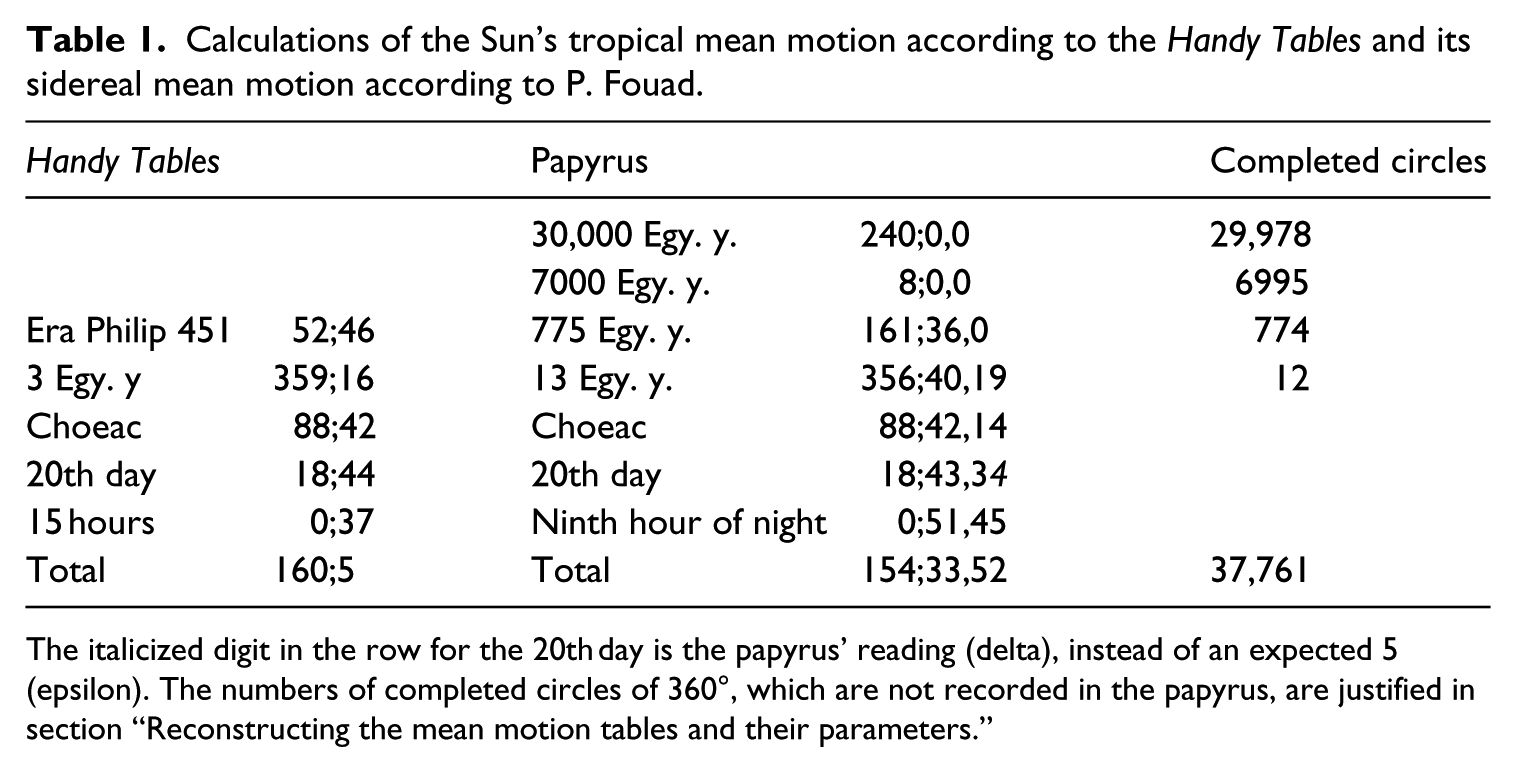
The italicized digit in the row for the 20th day is the papyrus’ reading (delta), instead of an expected 5 (epsilon). The numbers of completed circles of 360°, which are not recorded in the papyrus, are justified in section “Reconstructing the mean motion tables and their parameters.”
A glance at the tabulations on the recto of the papyrus shows two major respects in which they differ from a calculation using the Handy Tables. One is, so to speak, horizontal: three distinct mean motions are computed in parallel columns. The other is vertical: the breakdown of the given date is different. We can begin by considering the vertical aspect first, looking just at the comparatively well-preserved first column of data, which bears the heading “from a point” (Table 1, centre column).
Reading from the bottom line (30) up, the entries for the hour, day, and calendar month are done in the same way as they would have been with the Handy Tables, except that the increments are given to two fractional sexagesimal places instead of one as in the Handy Tables. Continuing upwards, we have entries for 13 single Egyptian years and 775 Egyptian years, which show that the mean motion table included tables for single years and bundles of 25 years. The latter, however, was not the highest order table, since we also have entries for 7000 Egyptian years and 30,000 Egyptian years.
These astonishingly large numbers reflect the fact that the year is counted not from the Era Philip itself but from an epoch year 37,334 Egyptian years before Era Philip 1 (as the text states in line 20). The interval 37,334 has no special significance; the motivation for this choice of epoch is that the year of the Hipparchus summer solstice, Era Philip 166 (cf. line 11), was exactly 37,500 Egyptian years after the epoch year, a numerologically appealing number with only 2s, 3s, and 5s as factors.
15
Hence, there are effectively two epochs for the tables: the overt, primary epoch which began on 2 June (=Thoth 1), 37,633
Obviously, the secondary epoch was the real starting point for constructing the tables, but why was this particular year chosen? Or in other words, why, out of all the years in which Hipparchus made solar observations, was this year considered special? The phenomenon extends beyond the particular set of tables used in our papyrus since the well-known formula of the “horoscope casters of old” for converting Ptolemy’s tropical longitudes to sidereal longitudes that Theon of Alexandria associates with the theory of trepidation in his Little Commentary on the Handy Tables uses the very same year as the epoch for which tropical 0° equals sidereal 8° 16 I will offer a tentative explanation later.
We can visualize the mean motion tables as being structured roughly like Ptolemy’s, but beginning with a table for tens of thousands of years from epoch, then a table for thousands, and so on. Of course, in practice one would never use the rows for 10,000 and 20,000 years or for the thousands up to 6000, so these rows might have been omitted with no resulting inconvenience. However, if the designer of the tables had been looking for efficiency, he would never have chosen in the first place an epoch so remote from the dates for which the tables would be used. There had to have been a didactic purpose in this, which would have been best served by providing complete tables even for the largest time bundles. 17
Reconstructing the mean motion tables and their parameters
We now turn to the problem of determining the constant rate of mean motion underlying each of the three columns of mean motion calculations in the papyrus. This would be trivial if all the quantities were written down to full precision (or at least to four or five fractional sexagesimal places) and included the numbers of completed circles. As things stand, the quantities corresponding to smaller time intervals are missing key information in the lower order places, while those corresponding to larger time intervals effectively lack their highest order places. Still worse, some numerals in the upper rows and the total row of the second column and all fractional places of the third column except the first place of the total are lost because of damage to the papyrus. Nevertheless, there is enough information to allow one to progress significantly further than the discussions in FT, where only the reconstruction of the first (left) column and its mean motion table is presented as both complete and certain.
It is very fortunate that the first column is intact except for the total row (which of course can be restored immediately). As a starting point for recovering the constant rate for this column, we have the expectation that any astronomically meaningful solar mean motion will have a rate of just under 1° per day. In principle, one could find an accurate approximation of the underlying daily rate of mean motion by taking the number recorded for the longest interval, 30,000 years, and dividing by 30,000 times 365, but this presupposes, first, that the mean motions for the highest order time intervals did not incorporate a nonzero constant for the epoch position and, second, that we know how many complete revolutions of 360° the Sun is supposed to have made since the recorded numbers are all modulo 360. A mean motion derived from a year of exactly 365 1/4 days would make about 29,979 1/2 complete revolutions in 30,000 Egyptian years, and the number of complete revolutions in 30,000 years for our mean motion table ought to be within ±1 of that number if the actual year length assumed in the table was within say 1/80 day of 365 1/4 days.
Since the year lengths set out earlier in the text were within this range, we can test whether dividing 240° plus 29,978 complete revolutions or plus 29,979 complete revolutions by 30,000 gives an annual rate of mean motion from which the other numbers in the column can be derived. The annual rate obtained from the lower number of revolutions is 359;44,38,24° while that from the higher number is 359;45,21,36°. The former turns out to be the one we want; all the numbers in the papyrus agree with it exactly, assuming rounding at the second sexagesimal place, except for the number for the 20th day which ought to have been 18;43,35, not 18;43,34. 18 This confirms that all the numbers in the mean motion table were simply multiples of the assumed rate, with no epoch constant in the highest order table. Also, since the number recorded for the ninth hour of night is 21/24 of the daily rate, the epoch time is not noon as in Ptolemy’s tables, but 6 a.m., an idealization of sunrise neglecting the seasonal variation. See Supplementary Table 1, left column, for a reconstruction of the entire table; Mercier’s reconstruction, with some differences of format, is his Table I on FT p. 156. 19
That there is something more to this parameter is obvious from the fact that the mean motion increments given for 7000 and 30,000 Egyptian years are exact whole numbers. This is a symptom of an underlying assumption that the total mean motion for 37,500 Egyptian years is 37,473 complete circles plus exactly 120°. Moreover, the annual rate 359;44,38,24° can be divided by 365 to obtain a daily rate that terminates in sexagesimals, 0;59,8,9,36°, and this is surely deliberate. The rate of mean motion can also be expressed as a year length of 365 1/4 + 1/(102 2/3) days, so we are obviously dealing with a table of the Sun’s mean motion in sidereal longitude, as the heading “from a point” implies (correctly this time). But it is not exactly the same year length as was given in the preceding text, presumably because the parameter for the table was adjusted to yield a round number for the long period as well as a terminating value for the daily motion.
We now come back to the fact, strange if we base our expectations on Ptolemy, that the papyrus shows calculations of two other solar mean motions in columns to the right of this sidereal mean motion. We have already mentioned another papyrus, P.Oxy. astr. 4174a, that preserves parts of a set of solar mean motion tables with three rates of motion corresponding (with slight roundings apparently motivated by arithmetical convenience) to years of length 365 1/4, 365 1/2, and 365 1/8 days.
20
The meaning of these years is revealed in a passage of Theon of Smyrna (first half of the second century
It is noteworthy that the set of tables in P.Oxy. astr. 4174a involved a year of 365 1/4 days without further correction – a parameter that also has appeared explicitly in P.Fouad, recto line 6 – and that in the cited passage, Theon defines the Sun’s longitudinal cycle as “from some point (ἀπὸ σημείου) to the same point and from solstice (ἀπὸ τροπῆς) to the same solstice and from equinox to the same equinox,” using a conjunction of terminology that parallels the “from a point” and “from solstices” of P.Fouad. 21 Despite these points of contact, the two solar theories seem to be as different from each other as both are from Ptolemy’s. The theory outlined by Theon does not recognize precession, and it has different mean motions because they are tracking the Sun’s elongation from different elements of its model: the solstitial and equinoctial points, the apogee, and the nodes. By contrast, the mean motions of P.Fouad apparently all relate to longitudinal motion, but according to different frames of reference.
The middle column’s heading is illegible, and several of the digits in the mean motion numbers are effaced. The number for 13 years is fully preserved, however, and from it we get an approximation of the annual rate, 359;45,12,55° ± 0;0,0,4°. Scaling up, we find that the number for 775 years must have been 774 complete circles plus 169;2,2x° (where x stands for any undetermined digit), from which we obtain a more refined value for the annual rate, 359;45,12,58 ± 0;0,0,1°. Again scaling up, we find for 7000 years 6995 complete circles plus approximately 75;12° (with uncertainty about any further sexagesimal places). This conflicts with the reading of the papyrus. There is no question about the reading of 4 (delta) standing as the lowest order digit of the whole degrees, but this has to be an error since 74° is far outside the range consistent with all the preserved numbers for shorter time intervals. 22 For the minutes, a clear 2 (beta) is preserved, and it is possible that it was preceded by an iota (10) that has been obliterated by abrasion except for a tiny speck of ink (I thank Dr Fournet for confirming by private communication that this is possible).
If we assume that the complete number for 7000 Egyptian years should have been 75;12,0°, we derive from it a refined annual motion of 359;45,12,57,36°. 23 Taking this as an exact value, we obtain for 30,000 years 29,979 complete circles plus 168° exactly. The papyrus confirms that the seconds place was indeed 0. I think it is practically certain that the table was based on this annual motion, from which it results that the total mean motion in 37,500 years is 37,474 complete circles plus exactly 120°, or precisely one revolution less than in the table for the sidereal years. Since the implied year length is almost exactly 365 1/4 days, this mean motion corresponds to the second year length in the text. Our reconstruction of the table is the middle column of Supplementary Table 1. Mercier provides two reconstructions, his Tables II and III on FT pp. 157–8, the former based on a year of exactly 365.25 days and the latter on a year length derived from assuming that 74;2,0° is correct for 7000 years, so neither table gives the exact values of the original table.
For the third column, the scribe originally wrote a heading “from a point,” but realizing this time that he had made a mistake, he wrote “tropical” superimposed on the incorrect words and again above them. Hence, we can expect an assumed year length around 365 1/4 − 1/309 days. The loss of the fractional places of the mean motion increments, except for a couple of slight traces, limits the precision to which we can determine the underlying rate of motion, but at least we have the total preserved to a precision of tens of minutes, 278;1x, which will have been the overrun beyond 37,762 complete circles corresponding to an interval of 37,788 Egyptian years, 109 days, and 21 equinoctial hours. Assuming upper bound value of 278;20, we find that the assumed year length was less than 365 1/4 − 1/(306.97) days. On the other hand, from the known increment of 264° plus an unknown fraction beyond 29,979 revolutions in 30,000 years, we find the year length has to have been greater than 365 1/4 − 1/(307.17) days. The fractional part of the increment for 30,000 years thus has to be between 0 and 4 minutes. Since the increments for this interval in the other two columns were exact integers, it seems highly probable that the increment here was exactly 264°, to which corresponds to an annual motion of 359;45,24,28,48°. Our reconstruction of the table is the right column of Supplementary Table 1. Mercier’s Table VI on FT p. 161 is also based on this parameter. He also provides reconstructions according to year lengths of 365 1/4 − 1/309 and 365 1/4 − 1/307 years as Tables IV and V on pp. 159–60.
The total tropical motion over 37,500 years is 37,474 complete revolutions plus 240°, and the year length approximately 365 1/4 − 1/(307.17) days. This should probably be interpreted as a modification of the “given” tropical year length of 365 1/4 − 1/309 days to obtain a neat symmetry in the 37,500-year period, with the Sun performing exactly one less sidereal revolution and exactly one-third more of a tropical revolution than the number of “mean” revolutions.
Thus, despite the loss of so many numerals on the papyrus, we are in a position to restore the entire calculation of the mean motions in lines 23–32 (Table 2) as well as the mean motion tables on which they were based (Supplementary Table 1). A very minor uncertainty concerns whether the tables (or the ancient user of the tables) employed rounding or truncation in the seconds place, which is as far as the values recorded in the papyrus go. Only two surviving final digits would have been affected by this decision, and in one (left column line 30) the value appears to have been rounded up, while in the other (middle column line 28) it appears to have been truncated. In Table 2, the restored final digits were obtained by truncation, and in Supplementary Table 1, all values are given to three fractional places, employing truncation at that place.
Restoration of lines 23–32 of P. Fouad inv. 267 A.
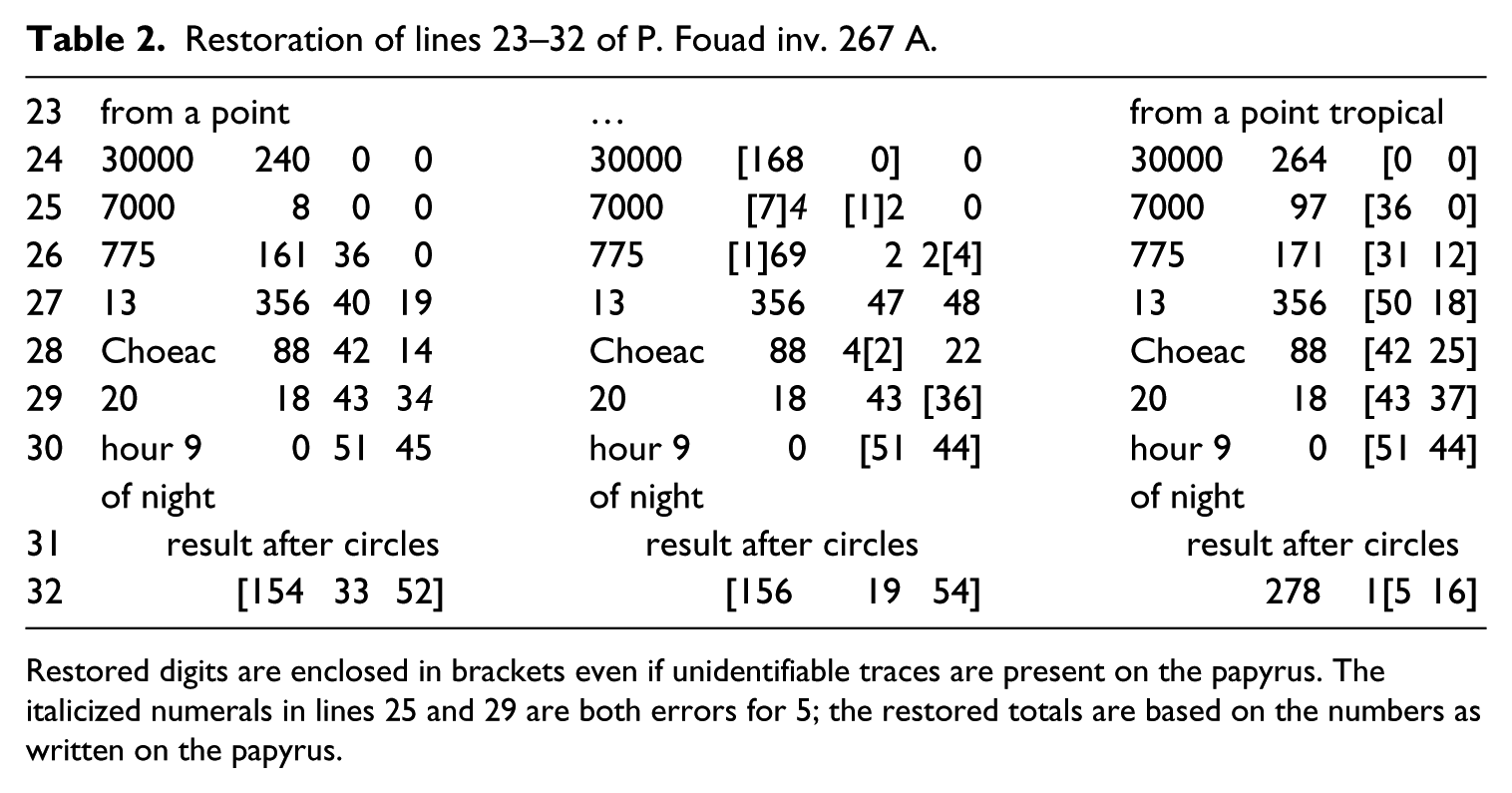
Restored digits are enclosed in brackets even if unidentifiable traces are present on the papyrus. The italicized numerals in lines 25 and 29 are both errors for 5; the restored totals are based on the numbers as written on the papyrus.
In passing, we may observe that the mean motions corresponding to one Egyptian year in the tables based on the “uniform” (365 1/4 day) and tropical years cannot be divided by 365 to obtain terminating daily motions in sexagesimal notation. Given the imposed constraints that the total sidereal and tropical motions over 37,500 Egyptian years should, respectively, differ by exactly 360° and 120° from the “uniform” motion, at most one of the annual rates could have been chosen to be exactly divisible by 365. The fact that it is the sidereal rate that has this property might suggest that this rate had some kind of primacy in the mind of the astronomer who composed the tables.
In Almagest 3.1, Ptolemy expresses the view that periodicities of the heavenly bodies such as the tropical year are not knowable as exact values, but that progressively better approximations to them can be obtained by comparing observations made over longer and longer intervals.
24
He writes that astronomers should seek the greatest accuracy possible for these periodicities on the basis of the observational record, but not try to go beyond this: But we consider claims concerning an entire aeon or even a time interval that is some great multiple of the interval covered by the observations to be foreign to love of knowledge and love of truth.
Toomer suggests in a footnote to this passage that Ptolemy is alluding to the αἰώνιος κανονοποιία, “Eternal Tables” or “Aeon Tables,” that Ptolemy disparages in Almagest 9.2, and in a note to that passage, Toomer conjectures that “Ptolemy is referring to a type of work in which the mean motions of the planets were represented by integer numbers of revolutions in some huge period, in which they all return to the beginning of the zodiac …” 25 The mean motion tables used by the author of P.Fouad come very close to fitting Toomer’s idea. 37,500 Egyptian years is not precisely a recurrence period of the type Toomer describes, since – so far as we know – only solar periodicities were involved in it and the period does not contain whole numbers of the periodicities although a tripling of it would do so. The astronomer who constructed these tables evidently had a fundamentally different conception of astronomical periodicities from Ptolemy’s, that they were interrelated by certain pleasing and recognizable relations of whole numbers so that exact values valid for indefinitely long intervals of time could be found through their nearness to the approximate values obtained from observations.
The calculation of the Sun’s true longitude
When using Ptolemy’s tables, one obtains the Sun’s true tropical longitude in three steps: (1) calculate the Sun’s mean elongation from its apogee using the mean motion table, (2) using the mean elongation as argument in the table of solar anomaly, determine the Sun’s equation and whether it is additive or subtractive, and (3) calculate the true longitude as the sum of the apogee’s tropical longitude (which is a constant), the mean elongation from apogee, and the signed equation. We can expect that something similar was done in the worked example of P.Fouad in the lost part of the text between the recto and verso. The first problem we face in trying to reconstruct the details of the procedure, and the underlying solar theory, is that it is not immediately obvious what quantity was supposed to be used as the mean elongation.
We know the three total mean motions that the author obtained as the sums of the tabulated increments: 154;33,52° for the sidereal mean motion, 157;19,54° for the “uniform” mean motion, and 278;15,16° for the tropical mean motion. We also know that the tables, unlike those of the Handy Tables, were constructed such that the mean motions corresponding to the primary epoch date were 0. The reasonable inference is that the tables were only supposed to give relative motion with respect to the situation at epoch, so that a constant had to be added to each total to obtain the mean positions for the given date. The partly surviving total for the tropical mean motion shows that if such constants were added, it was done as a separate step after the summation of increments.
As we saw, the total sidereal mean motion over 37,500 Egyptian years is exactly 120° beyond complete revolutions, so that this was the mean motion for the beginning of the “Hipparchus year,” Era Philip 166 Thoth 1 = 159
In the course of the calculations on P.Fouad’s verso, we encounter a true tropical longitude, λt = Scorpio 14;20,18° on both lines 7 and 8 – there is no doubt about any digit – and a true sidereal longitude that, according to Fournet’s reading of some poorly preserved letters, is λs = Scorpio 18;29,44° (high-order digits in line 6, and all but the initial tens-digit in line 19). On the basis of careful study of the high-resolution photographs of the papyrus kindly provided by Dr Fournet, I am confident that his reading of the sidereal longitude is correct.
Can the solar model be deduced from the information in the papyrus? There are several unknowns, beginning with the type of model. It is obvious from the use of mean motions that we are dealing with some kind of geometrical model involving uniform circular revolutions. In speaking of the solar apogee in the preceding section, we have tacitly been presuming an eccenter model, such as is familiar from the Almagest. One could also consider some other possibilities: an epicyclic model with the Sun revolving on its epicycle in the opposite sense to that of the epicycle’s motion around the Earth, such as Ptolemy offers as a less simple alternative to the eccenter; an epicyclic model with the Sun revolving on its epicycle in the same sense as the epicycle revolves around the Earth; or a concentric-with-equant model. For a “same sense” epicycle model to fit the known season lengths, its effective apogee has to be placed where the perigee is in an eccenter model and vice versa. A concentric with equant has no apogee, of course, but the direction of displacement of the equant from the Earth serves the same function. Of the four types of model we have been considering, only the eccenter and the “opposite sense” epicycle are kinematically equivalent, but since the Sun’s eccentricity is small, the longitudes generated by all the models are practically indistinguishable if suitable parameters are chosen, so there is no way to be sure about the geometry of the model on the basis of the numerical data in the papyrus.
In my translation of the passage of the recto that incoherently explains how to obtain the Sun’s equation, the word “apogee” occurs in line 16, while “eccentricity” occurs twice, on lines 16 and 17; these words would appear to be decisive in favour of an eccenter model. However, each of the words is subject to doubt, so that I have qualified them with question marks. The Greek word for apogee, ἀπογείου, is not written out on the papyrus; it is Tihon’s interpretation of a curious abbreviation or symbol at the beginning of line 16 (between a brief amount of lost text at the end of 15 and the familiar wizard’s cap symbol for the Sun,  ), resembling two lower case ts joined by a ligature, for which no parallel is known to exist:
  In the context, it has to refer to the top row of the anomaly table corresponding to the slowest true rate of longitudinal motion since line 17 tells us that, as in Ptolemy’s anomaly tables, the equations for arguments between 0° and 180° are subtractive. This would be the apogee if the underlying model was an eccenter, but nothing in the symbol is actually suggestive of the word.
As for “eccentricity,” what is written in both places is not ἐκκεντρότης but ἐγκεντρότης, a word not known to occur elsewhere in Greek literature but that would be the regularly formed abstraction meaning “concentricity” from the adjective ἔγκεντρος, “concentric.” Fournet and Tihon think that this is a miswriting of ἐκκεντρότης, “eccentricity,” explaining the spelling doubtfully as a symptom of a phonological oddity of the scribe (p. 35). As they note, however, the scribe initially wrote ἐν- and corrected to ἐγ-, which perhaps is a sign that he really had concentricity (ἐν-κέντρος = “on centre”) in mind. The author might have understood the equation table as translating a motion that was defined as uniform from with respect to an eccentric point into an apparent location on a circle concentric with the Earth; this seems to leave open the possibility of a concentric-with-equant model as an alternative to an eccenter. Given the scribe’s propensity to slips and confusions, however, I would grant that a miswriting or mishearing of ἐκκεντρότης is more likely, and so I will follow Tihon and Mercier (in his analysis of the calculation of the true Sun, FT pp. 164–74) in presenting the analysis of the papyrus’ data in terms of an eccenter.
There still remain three unknowns: the frame of reference in which the apogee is fixed, the apogee’s longitude in that frame of reference, and the size of the eccentricity. Hence having a given
Things begin to get disturbing, however, when Mercier repeats his procedure using the tropical data from the papyrus. The total of the tropical mean increments on the recto, 278;15,16°, makes no sense as
Either of these reconstructed models would seem perfectly plausible for a non-Ptolemy solar theory contemporary with Ptolemy. But for both to be assumed by the same astronomer simultaneously is bizarre, although Mercier draws less attention to this fact than he might have; it would amount to supposing that the Sun is simultaneously moving according to two nonequivalent models. At the secondary epoch, the models could be considered to coincide since
Is there a way to avoid an astronomically nonsensical two-model solar theory? One could suppose that one of the coincidences that Mercier finds between the 1/24 eccentricity and a near-integer apogee is a fluke, and that only one model, with either a sidereally fixed or a tropically fixed apogee was assumed. (The occurrence of two such flukes is definitely more than I would be willing to believe.) Then, one has to explain how the tropical longitude was obtained from the sidereal one or vice versa. This ought to involve a formula analogous to Theon’s formula for going from Ptolemy’s tropical to sidereal longitudes, but using a precession rate of 1° in 78.125 instead of 80 years. Unfortunately for this approach, the difference between the sidereal and tropical true longitudes in the papyrus’ worked example does not combine with the tables’ precession rate to obtain a convincing epoch for the conversion formula.
On balance I am persuaded that the sidereal and tropical longitudes in the papyrus were independently obtained in the theoretically inconsistent way that Mercier deduces. Nevertheless, I think it is still most likely that the astronomer who constructed the tables assumed only the sidereally fixed model, but the author of our text, or his teacher, misunderstood how the tables were to be used. A consistent procedure would be to take the sum of sidereal mean motion increments as
Interestingly, Mercier’s sidereal model agrees only moderately well with Hipparchus’ observation of the autumnal equinox exactly 5 days before the secondary epoch (159
The eccentricity of both the reconstructed sidereal and tropical models is identical to that of the Hipparchus–Ptolemy eccenter model of Almagest 3.1. In the form in which it is presented by Ptolemy, this model is derived from six specific dated observations: the Meton–Euctemon summer solstice of 432
Mercier’s sidereal model could have been an adaptation of the Hipparchus model, preserving the eccentricity, but adjusting the apogee from tropical 65;30° (equated with sidereal 73;30° in 159/158
The calculations on the verso
The first few lines of the verso are very broken although there is an intriguing likely mention of the astronomer Menelaus of Alexandria (fl. late first century
The first step (lines 6 and 7) appears to be a derivation of the tropical longitude, Scorpio 14;20,18°, by subtracting a precession correction from the sidereal longitude – an operation which admittedly seems hard to reconcile with the two-model hypothesis. The text explains how one finds the duration of nighttime in equinoctial time-degrees by subtracting the oblique ascension of the point diametrically opposite the Sun from the oblique ascension of the Sun’s longitude. These ascensions are obtained from an ascension table for the latitude of Alexandria tabulated at 1° intervals – the interpolation is described in detail for the ascension of the diametrically opposite point – and they are expressed according to a convention that each 30° sector of the equator starting from the equinoctial points is named after the corresponding zodiacal sign; thus, the ascension Scorpio 21;37° would be 231;37° according to Ptolemy’s convention of counting from the vernal equinoctial point. This convention of dividing the equator into zodiacal quasi-signs has previously been attested only for Hipparchus. 29 The ascensions given by the table diverge from those given by the Handy Tables by about 0;4°, which shows that there were differences in the details of their computation but probably not in their trigonometrical basis.
The text then divides the time-degrees of nighttime by 12 to obtain the time-degrees of one seasonal hour, multiplies this by 3 to get the time-degrees of the given time past midnight, and divides by 15 to get the time as a number of equinoctial hours past midnight, first expressed sexagesimally (line 16) and then rounded to 3 1/3 equinoctial hours (line 17). The next steps seem to have consisted of taking the 1/3 equinoctial hour by which this time exceeds the time used in the original calculation of the Sun’s longitude, multiplying this by the Sun’s (mean?) rate of motion in one equinoctial hour, and adding the product to the provisional true sidereal longitude. Unfortunately, the numerical details in lines 19–22 are obscured by damage to the papyrus, and not all the legible numerals seem to be what we would expect. The correction ought to have been about 0;0,50°, resulting in a corrected sidereal longitude Scorpio 18;30,34°.
In lines 22–28, the author uses a table of declination to calculate the Sun’s declination. The argument of the declination table should be the tropical longitude, given in the text as Scorpio 14;20,18° before the correction for seasonal hours, so that the corrected value would be Scorpio 14;21,8°. But instead of simply entering the table with this longitude, the author “counts from” what he says is the sidereal longitude of the autumnal equinoctial point, Libra 4;9°, to the Sun’s true sidereal longitude, Scorpio 18;30°. This is an oddly roundabout procedure, especially on the two-model hypothesis according to which 4;9° would have been obtained as the difference between the independently computed true sidereal and true tropical longitudes of the Sun, yet treated now as a precession adjustment for the current date.
The specific datum that we have for the declination table is that the declination corresponding to a longitude 44;21° from an equinoctial point is 16;25°. This is, to the nearest minute, the declination that one would have obtained by interpolation from the table in Almagest 1.15. Thus, we may infer that the tables of spherical astronomical functions were based on approximately the same value for the obliquity of the ecliptic as Ptolemy’s, that is, 23;51,20°.
If the two-model hypothesis is the correct one, and the author believed that the sidereal longitudes of the tropical and equinoctial points within their zodiacal signs could be found by subtracting the Sun’s true tropical longitude from its true sidereal longitude, this would have the interesting consequence that the tropical and equinoctial points would not shift at the constant rate of 1° in 78.125 Egyptian years, but at this rate plus an oscillating component with period 28,125 Egyptian years, which is the assumed precessional period and thus the period after which the apogees of the two models return to their original alignment. The amplitude of the oscillating component would be close to the maximum solar equation, 2;23°. I think it is unlikely that the author would have been aware of this slow quasi-trepidation.
The last lines 28–32 of the verso are very badly preserved, but evidently describe how some quantity dependent on the Sun’s longitude – it is not clear whether sidereal or tropical – is obtained from a table with a heading containing the word μεσημβρινός, the adjective meaning “meridian” or “pertaining to noon.” Tihon doubtfully suggests that this was something to do with the Sun’s annual northward and southward movements, but it is not clear how this would be something sufficiently different from declination to call for a separate table. I wonder whether it could have been a table of the equation of time, described in terms of a correction to the time intervals between noons since this too is a function dependent on solar longitude. On the other hand, correcting for the equation of time is a refinement beyond what one would normally expect an ancient astrologer to care about.
Despite the uncertainties, the verso shows that, so far as the functions of spherical astronomy are concerned, the tables available to the papyrus’ author and their applications differed from Ptolemy’s only in comparatively unimportant details of format.
Conclusion
If there is one particularly important conclusion to draw from P.Fouad, it is that the legacy of Hipparchus’ contributions to solar theory was less straightforward for astronomers working several centuries later, such as Ptolemy, to build upon than Ptolemy would have us believe. Hipparchus’ series of observations of solstices and equinoxes, made over an interval of more than three decades, could not all have been reconciled with any simple model, so even for his own time the parameters of the model would have been subject to uncertainty. Thus while Ptolemy and the unknown author of the solar tables used in the papyrus both assumed an eccentricity of 1/24, Ptolemy situates the apogee at tropical Gemini 5 1/2°, whereas the unknown astronomer assumed that it was at tropical Gemini 8° at the beginning of the Egyptian year 159/158
Footnotes
Acknowledgements
This article profited from discussions with Dennis Duke and comments on a previous draft by James Evans.
Notes on Contributor
Alexander Jones is a Professor of the History of the Exact Sciences in Antiquity at the Institute for the Study of the Ancient World, New York University.