






Abstract

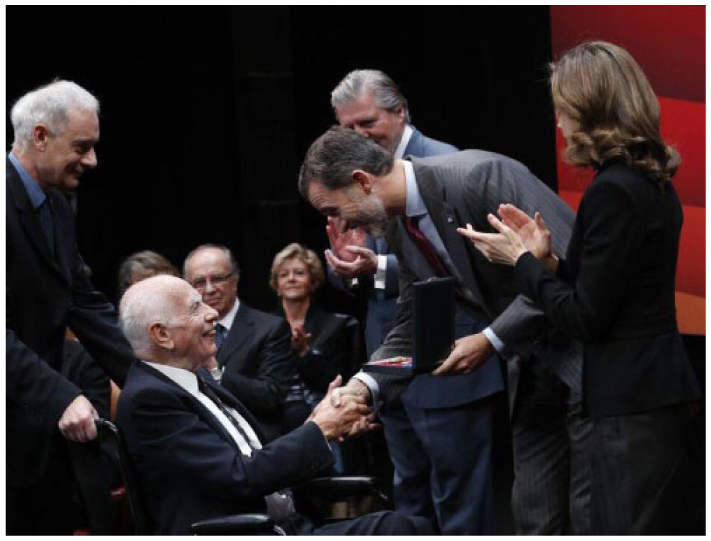
In San Sebastian in December, 2016, Michael Hoskin, the founder and for many many years the editor of this journal, was among those awarded the Gold Medal for Merit in Fine Arts by the King and Queen of Spain. The field is wide: It embraces ballet, gastronomy, bullfighting, and this year at least, archaeoastronomy.
Hoskin’s period as editor saw the controversy over the claims of Alexander Thom that in the Neolithic period there was an advanced science of astronomy that permitted the prediction of eclipses. Few now accept Thom’s claims, but there is a continuing interest in the role of the sky in the prehistoric world-picture. After early retirement from Cambridge University, Hoskin devoted himself to locating Neolithic communal tombs throughout Europe and North Africa, and measuring their orientations. All this research was published in Journal for the History of Astronomy (JHA) or its Archaeoastronomy supplement.
At Antequera in southern Spain, there is a remarkable World Heritage site, consisting of just three tombs but each of a different culture and each gigantic in size. Many archaeologists have worked on this site, but Hoskin was able to set the 3 tombs into the context of the 3000 others that he has studied. For this contribution to the understanding of Antequera, he was awarded the Gold Medal for Merit in Fine Arts.