






Abstract
Using detailed knowledge of the Earth’s variable rotation, we conclude that the eclipse of BC 188 July 17 was total at Rome, and that Livy’s historical account of the darkness that befell the city in that year was due to this eclipse. This sets tight constraints on the value of ∆T at that epoch.
Keywords
Introduction
Given the rarity at any one place of total solar eclipses of the Sun and their infrequent mention in the extant literature of antiquity, it would be remarkable if records survived from different civilisations of the same eclipse. Nonetheless, this indeed appears to be the case for the eclipse of BC 188 July 17, which may have been total in Rome in the western hemisphere soon after sunrise and 2.5 hours later recorded as nearly total in the eastern hemisphere at Chang’an in China in the mid-afternoon. The track of totality is shown in Figures 1 and 2.

Track of totality over Italy in BC 188. The inset shows the phase and altitude at maximum eclipse at Rome.
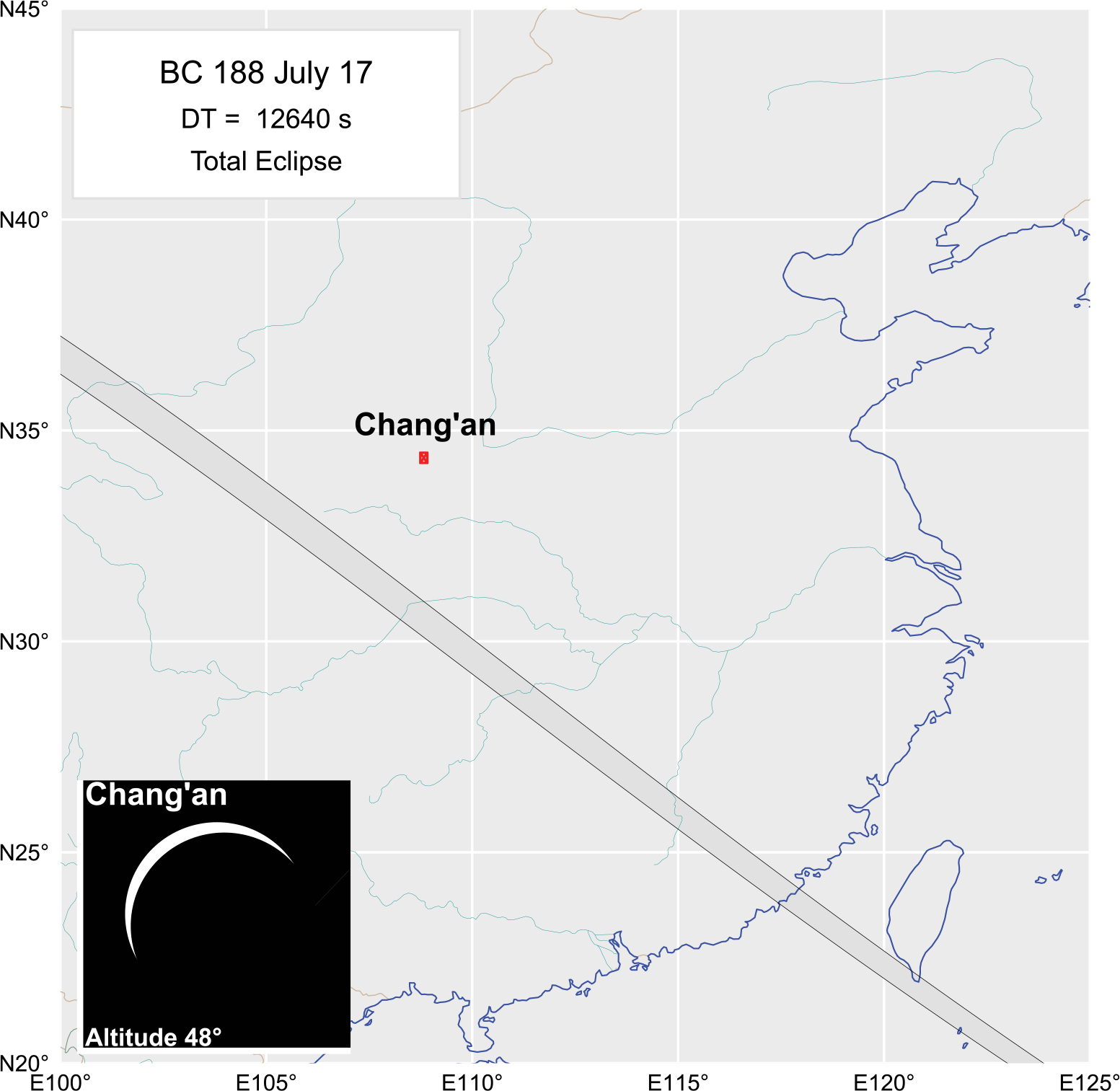
Track of totality over China in BC 188. The inset shows the phase and altitude at maximum eclipse at Chang’an.
The observation from Chang’an (Figure 2) in China is well attested, specifically noting that the Sun was almost completely eclipsed and giving the solar right ascension. However, the observation from Rome is circumstantial, mentioning the occurrence of darkness by day (and its drastic effect on the populace), but not offering any explanation as to the cause. The purpose of this paper is to use our investigations of contemporaneous observations of eclipses in the period 200–100 BC to determine the likelihood of totality in Rome in BC 188 and the implications this has for the measurement of the Earth’s variable rotation.
Measurement of Earth’s rotation, ∆T
The discrepancy in time due to fluctuations in the Earth’s rate of rotation is measured by the difference between the clock regulated by the Earth’s period of rotation and the uniform clock derived from the celestial motion of the Sun and Moon. The precise alignment of the Sun and Moon during a total solar eclipse is a very effective way of measuring this discrepancy in the past, provided there is an extant record of the eclipse at a known place. 1 This discrepancy in time is denoted by ∆T and is about 3.6 hours at the epoch of the eclipse in BC 188.
The times, associated quantities, and locations on the Earth of the umbral shadow have been calculated using our own software based on the Besselian plane method as described in The Explanatory Supplement.2,3 The basic coordinates of the Sun and Moon are from the Jet Propulsion Laboratory’s long-term ephemerides DE 431, 4 and their apparent places use the algorithm that is given in The Explanatory Supplement 5 together with routines from the Standards of Fundamental Astronomy. 6 The map outlines were downloaded from Natural Earth at naturalearthdata.com.
Contemporaneous observations of total or large solar eclipses in the period 200–100 BC are recorded in China in 198, 188, and 181 BC and in Babylon in 136 BC We have discussed the Chinese observations in detail and derived bounds on the values of ∆T. 7 The records of these eclipses are found in the treatises in the dynastic histories, and as such are very reliable, as distinct from those in the annals.
The observation of 198 BC states that at Chang’an the eclipse was total, and this sets upper and lower bounds on ∆T. The upper bound is definitive, but the lower bound is undefined because the track is almost parallel to the equator. The eclipse of BC 188 is described as being almost total at Chang’an; that is to say, it was not total, and therefore this defines a zone of avoidance for ∆T. The eclipse of 181 BC was total at Chang’an, and this defines upper and lower bounds. The Babylonian eclipse of 136 BC is recorded on two cuneiform tablets and is undoubtedly a description of a total solar eclipse at Babylon. The bounds on ∆T for 136 BC are taken from Stephenson et al., Supplement. 8
We have not previously used the eclipse of BC 188 in our derivation of ∆T because we did not regard Livy’s account as a definitive description of a total solar eclipse. However, with our knowledge of ∆T from the spline fitted to all the other historical data in Morrison et al., 9 we are able to test whether the eclipse was indeed total at Rome. Figure 1 shows Rome inside the track of totality calculated with the spline value of 12640 seconds.
The following range of ∆T renders the eclipse total at Rome (12 °.511 E; 41°.891 N):

The bounds on ∆T for all the eclipse records considered here are collected in Table 1 and plotted in Figure 3. From Figure 3, it can be seen that an upper bound of about 12800 seconds in BC 188 is derived by the projection backwards of the critical upper bound of 181 BC, using the slope of the spline fit taken from Morrison et al.
10
The calculated lower bound of BC 188 for Rome is 12590 seconds. Thus, the range
Bounds on ∆T.
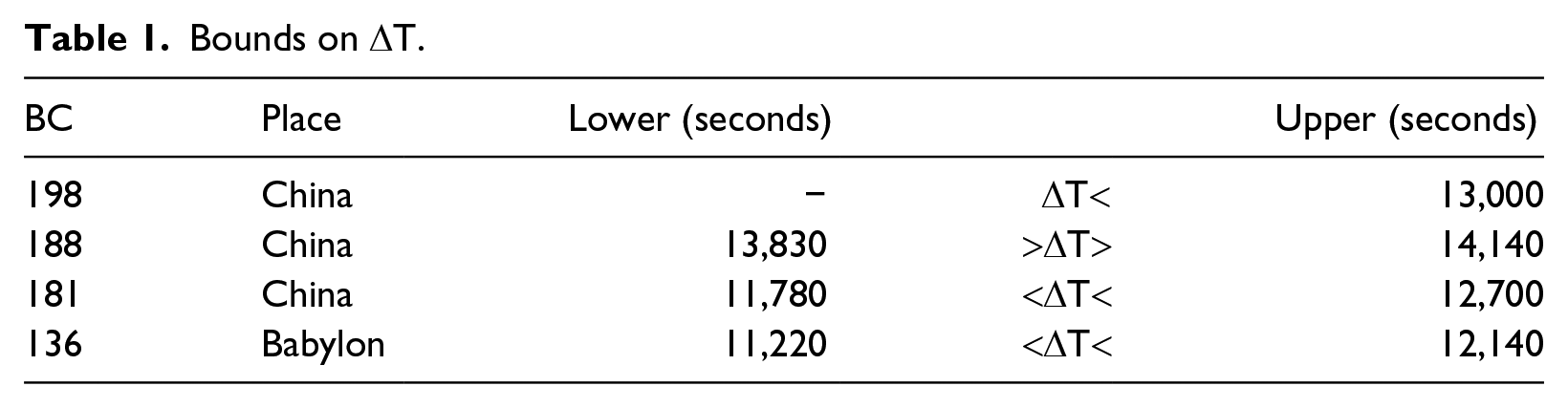

Bounds on ∆T (seconds) from observations in China (C), Babylon (B), and the total eclipse in Rome.
The overriding question is whether the event referred to by the Roman historian Livy in his work From the Founding of the City was in fact due to an eclipse, and not some other event in the year BC 188.
Discussion of Livy’s account
The Roman historian Livy records darkness in Rome after the Ides of March in his work From the Founding of the City:
Then, when Marcus Valerius Messala and Gaius Livius Salinator had been inaugurated as consuls on the Ides of March, they consulted the senate . . . Before the new magistrates (i.e. consuls) departed for their provinces, a three-day period of prayer was proclaimed in the name of the College of Decemvirs at all the street corner shrines because in the daytime, between about the third and fourth hours, darkness had covered everything (tenebrae obortae fuerant).
11
The year is not in doubt because Marcus Valerius Messala and Gaius Livius Salinator were consuls in 188/187 BC. 12 There was only one eclipse in Italy in these years, and that was on BC 188 July 17. A more accurate translation of the phrase tenebrae obortae fuerant is “darkness had arisen.” Although Livy offers no explanation of the loss of daylight, the fact that it led to the proclamation of a 3-day period of prayer “at all the street corner shrines” throughout the city implies that the darkness was awe-inspiring.
The occurrence of a total solar eclipse visible in Rome in BC 188 suggests a likely explanation. In the various accounts of total solar eclipses recorded in ancient and medieval history, it is evident that the sudden darkness, which accompanied these events, often terrified eyewitnesses.
Although the “total” darkness only lasted about 40 seconds, it would have been very impressive. The eclipse became total at about 6:10 a.m. local time, which was about 1 hour 40 minutes after sunrise, and thus between the first and second hours of the day, rather than “between about the third and fourth hours.” We do not regard this disparity in the time of day as a fatal objection to the association of Livy’s report with this eclipse. He qualifies his estimate of the time with the word “about,” and he was writing his history long after the event, which would have made it difficult to find precise times of the onset of the “darkness.”
Possibly a stronger objection to the eclipse interpretation is that the eclipse of BC 188 occurred on July 17, whereas the consuls were elected on the Ides of March (= March 15). However, it is not known how much time elapsed between the inauguration of the consuls and the date they “departed for their provinces.” Furthermore, the Republican calendar of 355 days required the insertion of an intercalary month every 2 or 3 years to bring it into line with the seasons. This was done on an ad hoc basis and was subject to abuse by the officials who wished to prolong the length of term of a magistrate. For these two reasons, it is possible to bridge the gap between March and July.
Conclusion
In summary, we can definitely assert that the eclipse of BC 188 July 17 was total in Rome. After setting aside the disparities of time of day and time of year in Livy’s account, it seems highly likely that this eclipse was the cause of the terrifying darkness recorded in Rome.
Any model of the Earth’s rotation needs to consider carefully the strong possibility that the eclipse of BC 188 July 17 was “recorded” as total in Rome, and therefore, the value of ∆T is tightly constrained to the range of 12590–12800 seconds at that epoch.
Footnotes
Acknowledgements
The authors acknowledge HM Nautical Almanac Office and the International Astronomical Union’s Standards of Fundamental Astronomy.