







Abstract
Starting in the late 19th century, the Harvard Observatory hired women to study stars via the Astronomical Photographic Glass Plate Collection. Some of these women—such as Annie Jump Cannon, Henrietta Leavitt, and Cecilia Payne-Gaposchkin—made discoveries that changed astrophysics forever. However, they were far from the only women working at the Harvard Observatory during the era of astronomical glass plate photography. Historically, most of these women have been anonymous. The names found on over 400,000 glass plate envelopes were compiled into a list of all the women who left their mark on the collection between 1875 and 1975. Through this list of names, it is revealed that Harvard’s glass plate collection acted as a haven for women who wanted to study the stars, long before they found equality in the field of astronomy.
Introduction: A field for women
In 1893, Williamina Fleming, the head of Harvard Observatory’s team of “women computers,” sent a message to the Congress of Astronomy and Astro-Physics at the Chicago World’s Fair: A great many women of to-day must have a similar aptitude and taste for Astronomy and if granted similar opportunities would undoubtedly devote themselves to the work with the same untiring zeal. . .
1
Her speech titled, “A Field for Woman’s Work in Astronomy,” makes a case for inclusion within the scientific field. 2 She details the work of twelve women at the Harvard College Observatory’s astronomical glass plate photograph collection and describes how well-suited they are to astronomy. Her colleagues identify thousands of stars on glass photographic negatives by checking them against published catalogs. They measure stellar magnitudes, classify spectra, and detect new objects of interest such as nebulae, variables, and rare star types. Fleming herself had already gained some fame for finding numerous stars, identifying Beta Lyrae as a binary system, and discovering nebulae—including the Horsehead Nebula, which she found on a glass plate photograph captured in 1888. 3 Given all of her accomplishments, in 1899 Fleming became the first woman to be awarded an official Harvard Corporation-approved title: Curator of Astronomical Photographs. 4
What Fleming does not say in her speech in 1893 is that she was making a case for women in the field of astronomy because they needed one. Throughout the turn of the 20th century, Fleming and her team of mathematicians and astronomers were cited in newspapers across the county with headlines such as “Woman Scientist at Harvard Has Amazed Astronomers By Discovery of New Star” and “Brainy Boston Women Learn Sky’s Profoundest Secrets” (Figure 1). 5 While these articles promoted the work of female astronomers like Fleming and her team at Harvard, they did not do so in a way that put them on equal footing with their male colleagues. Each headline has a necessary disclaimer—the word “Woman.” The American media of the time expressed how amazing these astronomers were because they were female, not because they were remarkable scientists in their own right.
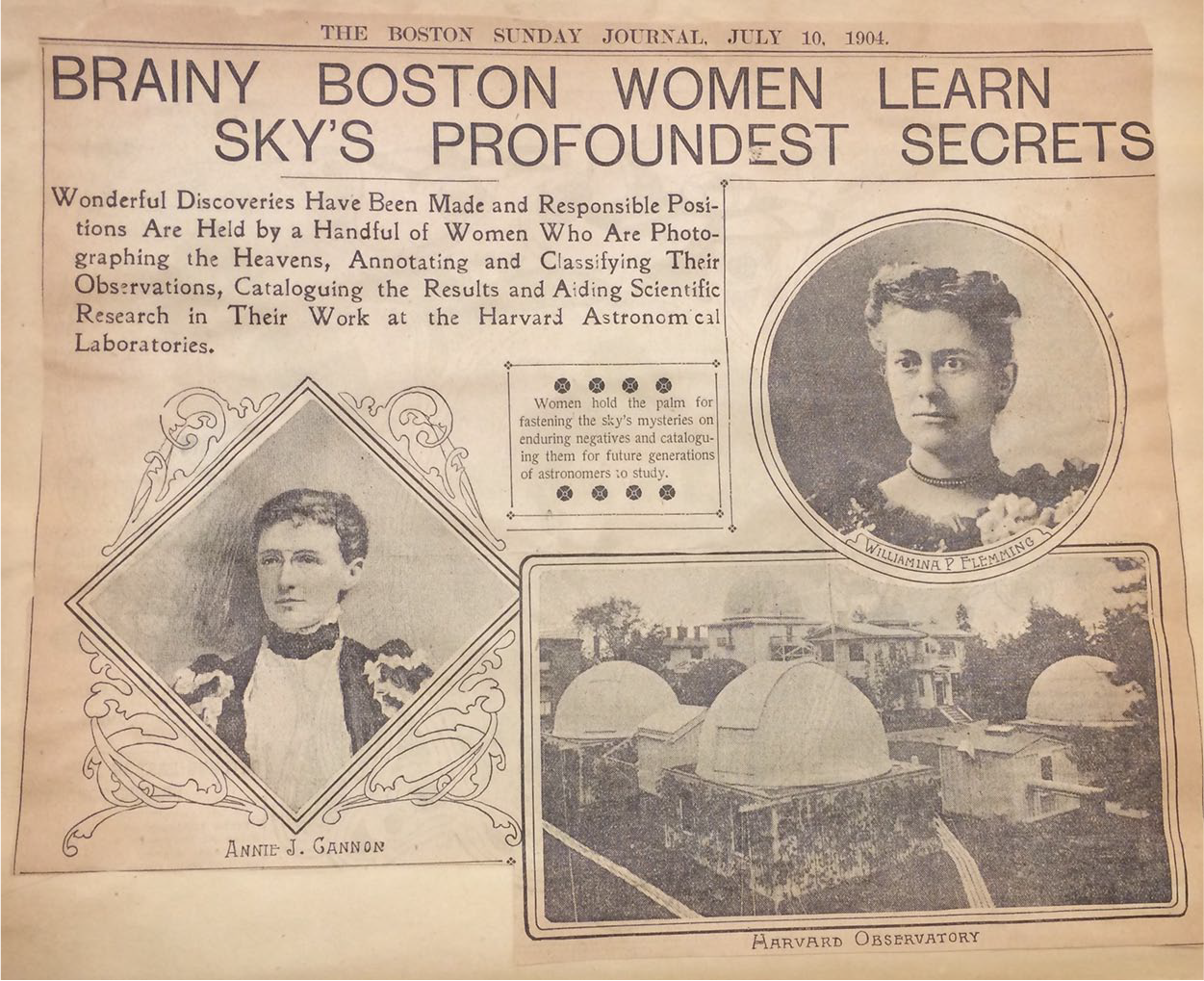
“Brainy Boston Women Learn Sky’s Profoundest Secrets,” Boston Sunday Journal, 10 July 1904. 6
When we read accounts of famous American women in the 19th century, it is easy to overlook the context of the world in which they lived. Headlines about other astronomers never included masculine identifiers because it was generally understood that astronomers were always men, unless otherwise stated. Newspapers from Massachusetts to Oregon followed the careers of female astronomers because of their ability to rise above what most people expected from women at that time in history. 7 What made the Harvard computers so fascinating to the media at the turn of the 20th century was the fact that they made great scientific discoveries—despite being women.
Throughout the late 1800s and early 1900s, the Harvard Observatory’s team of “women computers” stood upon a pedestal. They showed what women were capable of, if only they were given the opportunity to learn and work alongside men. The American media treated these female astronomers as exhibits upon the national stage. Like one might see a fragile artifact behind glass in a museum, society could observe the accomplishments of women like Fleming from a distance. With her astronomical glass plates, she was an example of what women could do with opportunity, determination, and education.
Fleming’s team members and their protégés would go on to make revolutionary discoveries in the field of astronomy and astrophysics. Annie Jump Cannon created a spectral classification system and cataloged 400,000 stellar spectra based on temperature. 8 Henrietta Leavitt discovered the Leavitt Law (formerly called the Period-Luminosity Relationship), which gave astronomers a tool to calculate distance in space with the use of Cepheid variable fluctuations. 9 Cecilia Payne-Gaposchkin famously used the Harvard glass plate collection for her PhD thesis, “Stellar Atmospheres,” in which she calculated the chemical composition of stars, revealing that they are primarily made of hydrogen. 10 But as impressive as these women were, it is important to note that famous names like Fleming, Cannon, Leavitt, and Payne-Gaposchkin were not the only female astronomers at Harvard Observatory during the era of astronomical glass plate photography (Figure 2).
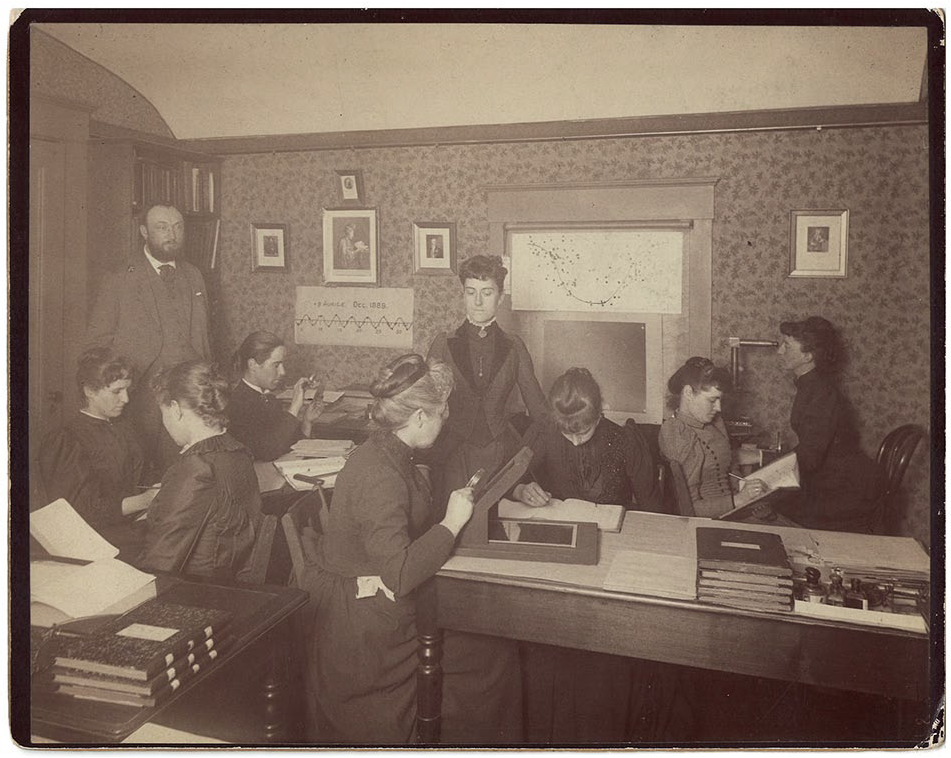
Edward Pickering and Williamina Fleming supervising Harvard College Observatory’s team of “women computers” in 1891. 11
The astronomical glass plates that these women studied still exist in a repository at the Harvard College Observatory, now a part of the Center for Astrophysics|Harvard & Smithsonian. Each glass plate photograph is housed in its own paper envelope, which includes information about the plate itself—the date, unique identification number, telescope used, region of the sky, etc. This paper envelope often includes information about its historic users. Fleming, Cannon, Payne-Gaposchkin, and many others left handwritten notations about their research upon these envelopes.
Since 2016, roughly 400,000 paper envelopes have been reviewed for such markings, in search of new names and initials left behind by glass plate users—most of whom were women. 12 Thus began a 4-year quest to identify hidden figures in America’s astronomical history. This list now consists of the names of 216 women who had a hand in Harvard Observatory’s astronomical photographic glass plate collection between 1875 and 1975. 13
The cost of women’s work
The first professional female astronomer in America was Maria Mitchell, who discovered a comet using her family’s personal telescope in 1847. This accomplishment led to a gold medal from the King of Denmark and subsequent fame. 14 Maria Mitchell was the only professional female astronomer in the United States in the 1850s, but she did not hold that unofficial title for long. According to a study made by John Lankford and Rickey Slavings, between 1860 and 1899 there were at least 56 women working in astronomy in America. That number rose to 344 between 1900 and 1940. 15 However, except for the rare few who found astronomy professorships at the new women’s colleges, the generation of American women in astronomy that followed Mitchell worked less with telescopes and more with pencils as human computers. 16 Even Mitchell worked as the sole female computer for the U.S. Coast Survey at the Nautical Almanac Office before she was recruited as the first professor at Vassar College for Women. 17
Human computers completed mathematical and scientific calculations to organize information into useful formats. Computers were known to calculate the exact position and movement of stars, predict the return of comets, and create tables for nautical almanacs aimed at helping sailors determine their longitude at sea. 18 The first women who joined the Harvard Observatory staff in 1875 were no exception. They spent their days conducting mathematical calculations for the male astronomers who worked at the telescopes overnight. The women computers took the astronomers’ observation notebooks and “reduced” the data recorded inside—averaging numbers, and correcting them for refraction, parallax, and error inherent in different instruments in order to record an object’s absolute position in the sky. 19
Officially, Harvard Observatory’s glass plate photography project began in 1885, with a significant increase in photographic production and analysis in 1886, thanks to donations from philanthropist Anna Palmer Draper. 20 However, as evidenced by the numerous collodion wet plates and daguerreotypes within the Harvard Observatory’s collection, astronomers at Harvard were experimenting with astrophotography as far back as the late 1840s. Entries discovered in historic notebooks indicate that early attempts at astronomical photography were not always successful (Figure 3). 21 It took decades for photographic technology to advance to a point where images of the sky could be captured night after night, with shorter exposure lengths and more sensitive emulsions that made working around sky conditions much easier. 22
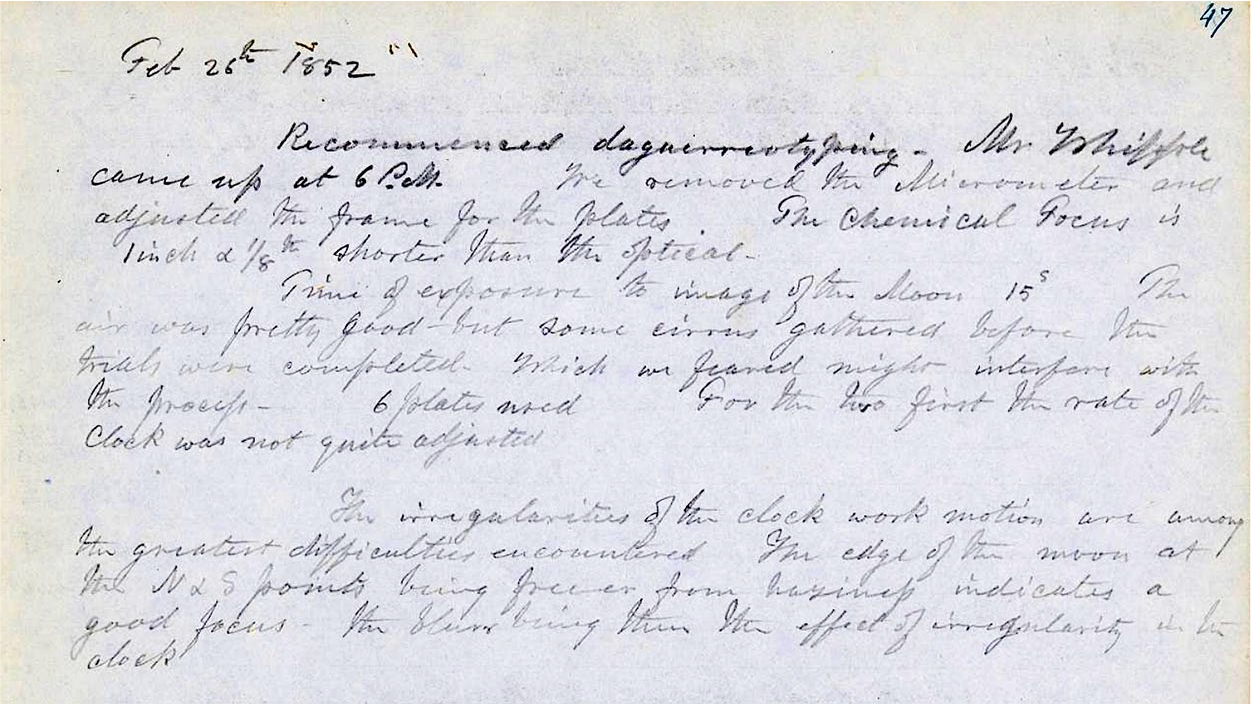
“February 26th 1852 recommenced daguerreotyping—Mr Whipple came up at 6 PM. We removed the micrometer and adjusted the frame for the plates. . .Time of exposure to image of the Moon 15 seconds. The air was pretty good—but some cirrus gathered before the trials were completed which we feared might interfere with the process—six plates used.” 23
Nightly photography of the heavens made it feasible to see changes in the sky over time in ways that were impossible before. Teams of male astronomers spent evenings taking photographs of the stars, which were then sent to the female computing team for analysis. The women at Harvard acted as the stars’ decoders, calculating minute changes in the heavens. We do not know exactly when the women at Harvard Observatory began working with the glass plates, but we do know that Nettie Farrar taught Williamina Fleming how to measure stellar spectra on photographs before Farrar left to get married in 1885. 24 What is clear is that the glass plate collection quickly became recognized as a space for women, even though men were responsible for creating the photographs at night.
Historically, computing was perceived to be easier than the work of astronomers or male assistants who operated telescopes at night, hence the lower pay and professional ranking for computers. Before women were hired as computers in the late 19th century, computing roles were often filled by young men. At the Harvard Observatory, Arthur Searle worked as a computer before he was promoted to an assistant in 1867, and then Assistant Professor in 1883. 25 Young men like Searle would temporarily accept low paying computer jobs with long hours in exchange for mentorship and professional advancement. 26
The hiring of young men as computers before the late 19th century was not only common practice in America. In the case of Greenwich Observatory in England, many of these computers were boys from the local training schools and orphanages. 27 Their employment benefitted the observatory by providing cheap labor, while the program also existed as a social welfare project by giving disadvantaged boys useful skills that they could later bring with them to other employment opportunities. 28 Once women began to fill computing rooms in the late 1800s, this sort of upward professional mobility for computers vanished until at least the mid 1900s, with few exceptions.
For over a century after Maria Mitchell discovered her comet, the division of labor in American astronomy was gender specific. Positions designated for women in observatories offered them almost no mobility, very low pay, and limited freedom in what they researched.
29
The cultural idea that women were better suited to specific roles in science was far-reaching. Many professional astronomers believed females had “special skills” for work that required a great deal of patience and attention to detail.
30
Even Maria Mitchell fell victim to this line of thought: The eye that directs the needle in the delicate meshes of embroidery will equally well bisect a star with the spiderweb of a micrometer. . .Routine observations. . .dull as they are, are less dull than the endless repetition of the same pattern in crochet-work.
31
The belief that women were gifted in specific tasks served two purposes. It was used to open the door for women in the field of astronomy, but it also kept them from advancing to other types of work at observatories.
Beloved supporters of women’s advancement in astronomy were not exempt from this limited imagination for what women could achieve. Mary Wagner, a graduate from the Vassar astronomy department, wrote a letter to the Harvard Observatory’s director, Edward Pickering, in 1893. She had learned that he hired women to work at Harvard Observatory and begged him to consider her as an applicant. 32 Pickering offered her a clerical and computing job admitting “perhaps the work required may not be of the kind that you would like.” 33 Given how few options were available for women in the field of astronomy, she accepted.
Letters between Wagner, Pickering, and Professor Arthur Searle show evidence of Wagner’s many heartfelt pleas to work with telescopes throughout her few months at Harvard Observatory. On May 22, 1893, Wagner wrote to Searle about the possibility of helping with his projects.
I am more fond of practical work and have a good eye for seeing; I have used the telescope, microscope, and spectroscope a great deal. In case you wish me to do other work than computing I may be able to do it.
34
Even given Wagner’s extensive experience using astronomical equipment at Vassar, the next day, Searle, replied that, “I fear that there will be little opportunity for you here in the way of telescopic work.” 35 Wagner did not drop the subject, however. On December 19 of that year, Wagner wrote to Searle: “If I can use the telescopes evenings and work 4 hours a day on the catalogues, I will be satisfied. I would like to have some opportunity of showing you and Prof. Pickering that I can do some good work.” 36
By late December of that year, Wagner left her job at the observatory. The departure, while officially being to take care of her ill mother, may have had something to do with her deep displeasure with the tasks she was assigned. She wrote: It seems to me that I ought to beg your pardon for complaining to you so often about the work. I hope your new assistant, if you have one, may find joy in cataloguing stars and that she may have no other ambition than to do that well.
37
Professor Pickering later wrote to Vassar professor Mary Whitney, saying that Wagner was good at her computing job, “but she found the monotony of ordinary computing too much for her.” 38 Fortunately for Annie Jump Cannon, who joined the computing team as a volunteer in 1896, Pickering seemed to change his stance on permitting women at the telescopes—at least in her case. 39
Constant computations took mental and physical tolls on the women working at Harvard Observatory—from stress injuries to illnesses. In her diary from 1900, Fleming wrote multiple entries detailing her 6-day workweek. She spent all day bending over glass plate photographs and papers in preparation for publication, then brought additional work home to do in the evenings. In her entry from March 11, 1900, Williamina Fleming wrote that she received physical therapy for her arm.
40
When she fell ill a few days later she wrote: All through the winter I have been fighting colds and overworking, and I do not wonder that at-last I had to give up. During the last half of the month when I was unable to write anything in the evening I thought it was due to laziness, which with me would be something heretofore unknown. Now I can see how hard a fight the grippe and I had before it overcame me. Even now I feel that it will be some time before I get back to my long days of steady work and strain.
41
Long hours and excessive work may have had a hand in Fleming’s illness in 1900 and her need for physical therapy, but it did not stop her from picking up the pace once she recovered.
Unfortunately, computing not only took a physical toll on the women who worked at the Harvard Observatory, it took a mental toll as well. On March 8, 1900, Fleming wrote that her colleague, Harriet Stevens, was sent home multiple times for mental fatigue, then known as “hysteria.”
42
Fleming wrote that she: …was surprised to find Miss H. Stevens suffering from a fit of hysteria in the next room. This is the second attack she has had here within eight days. Last Tuesday she was quite ill and I had to send her home in a carriage.
43
Today we might be more inclined to view such episodes as anxiety or panic attacks, possibly due to excessive stress. Stevens does not appear to have been the only team member suffering from mental exhaustion. Professor Mary Whitney at Vassar wrote to Pickering, stating that she was concerned Mary Wagner’s “nervous instability” may have hindered Pickering’s interest in hiring other Vassar students. 44 Antonia Maury is reported to have felt nervous and overtired from her work at the observatory and the immense pressure she perceived from higher management. 45 Not surprisingly, Maury quit and returned to Harvard many times throughout her career. Even Fleming lamented the workload that she was expected to carry, claiming she “feel(s) almost on the verge of breaking down.” 46
Such fatigue was no doubt amplified by the fact that most of the women who worked at the observatory barely earned a livable wage. When Rhoda Saunders was hired as a computer in 1875, she was offered a yearly salary of $600, while male assistants were paid $800 annually. 47 During the turn of the 20th century, women computers at the Harvard Observatory made 25 cents per hour, with the higher earners making as much as 30 cents. 48
When Wagner first applied to work at Harvard in 1893, she reluctantly accepted the position with a salary of $500 per year. She explained that, “It hurts my pride to work for $500, but I have a great desire to see your observatory and to work there for a year must surely be instructive to me.” 49 After she left the observatory, Wagner lamented that she was forced to live in poverty while employed at Harvard. She wrote that, “Astronomy must be left in the hands of the wealthy, while I turn my attentions to something that will give me a living.” 50 She was not the only woman at the observatory who held animosities over unfair wages. During the turn of the 20th century, Williamina Fleming was the highest earning female staff member at the Harvard Observatory. In 1900, she earned $1500 per year—roughly $1000 less than the male assistants. 51 When she requested a raise, Pickering reportedly told her that she “receive(s) an excellent salary as women’s salaries stand.” 52
Many women at Harvard Observatory got around the low wage problem by taking financial assistance from family members or by living with colleagues or professional boarders. According to her letters in 1893, Mary Wagner accepted an offer of financial assistance from a friend. 53 Williamina Fleming’s diary describes long nights working on observatory tasks with her boarder and colleague, Annie Jump Cannon. 54 Cannon later moved with her sister to a small house aptly named Star Cottage. 55 Henrietta Swan Leavitt lived near the observatory with an uncle until he died in 1916. She then boarded at a rooming house before her mother moved to Cambridge and they were able to rent an apartment together. 56
Women who did not live with friends or take family assistance had to find other ways to survive in Cambridge on minimal pay. Many of the women who worked at the glass plate collection in the early 20th century were Radcliffe graduate students. They most likely would have lived in Radcliffe dormitories down the street from the observatory, like Cecilia Payne-Gaposchkin did for her first 2 years at Harvard in the 1920s. 57 Those who were not students had to find lodging with locals who took in boarders for pay. According to the 1920–1940 census records, Lillian Hodgdon, Florence Cushman, and Ida Woods, were all long-time boarders. 58
All this is not to say that the Harvard Observatory’s director, Edward Pickering, was a poor advocate for women in astronomy during the turn of the 20th century. During his era it was the custom to pay women less than men. This tradition unfortunately continued well into Harlow Shapley’s term as director (1921–1952). According to astronomer Bart Bok’s oral history with David DeVorkin in 1978, this pay gap may have been deliberate: Shapley had a young woman who was sort of the chief of staff, Jenka Mohr, and then he had Virginia Nail and then Constance Boyd. A great many young women, and he used to pay them very low wages. And he used to say to people, ‘If you give me $500, I will get so much work out of a young woman — I'll name a galaxy after you —.’
59
This type of language regarding female colleagues was not atypical for Shapley. During his own oral history with the American Institute of Physics, Shapley admitted to coming up with the term “girl hours” as a yardstick for measuring production from the computing team. 60
Dorrit Hoffleit, who joined the Harvard Observatory staff in 1928, turned down multiple better paying jobs to continue working with the glass plates. Despite the poor salary, she felt that the collection was “the only place in the wide world” where she belonged. 61 Even when other women computers grew bored of the work and left, Hoffleit felt a deep dedication to the plates. In her 1979 interview with David DeVorkin, she said her salary was 40% of what other positions offered her, but she stayed for the love of the work. She admitted that Shapley, “. . .sized me up right away, that this was something I really wanted, so he could get away with minimal pay.” 62
It should be noted, that aside from the poor pay, Hoffliet speaks highly of Shapley, who encouraged her to get a PhD. However, the treatment she and her beloved plate collection faced during Donald Menzel’s tenure as Director of the Harvard Observatory (1932–1971) eventually weighed too heavy on her. When Menzel temporarily halted the glass plate project and proposed to discard 1/3 of the collection, she finally left to work at the Yale Observatory.
63
Of her experience under two directors at the Harvard Observatory, she says: It annoys you, when you know you’re being taken advantage of, but if you don’t allow yourself to be taken advantage of, you lose the only thing you want in life: which I lost anyway because of that skunk Menzel. . . What Menzel really was doing was trying to obliterate as much as he could of what Pickering and Shapley stood for.
64
No matter how the Harvard Observatory directors personally felt about their female staff members, a very real wage gap remained a reality for the women who worked with the glass plate collection, well into the 20th century. During the era of glass plate photography at the Harvard Observatory, work was assigned a gender and that gender was assigned a price. Women were given tasks that managers believed fit feminine temperament and abilities—measuring stars in the plate collection as opposed to operating the telescopes in the domes.
Access and opportunity
In researching the names of women who worked at the Harvard Observatory, several interesting relationships became apparent. Many women who worked with the glass plates appear to have been related to other staff members already employed at the observatory. This prevalence of family relations among the staff was also recognized by Keith LaFortune in his 2001 thesis, “Women at the Harvard College Observatory 1877–1919.” 65
There were many pairs of sisters, cousins, and nieces and aunts, among the computing team at Harvard. Some of these are confirmed, while others are assumed based on the prevalence of last names such as Hawes, Stevens, Michaelis, Gill, Searle, Rogers, Walker, Mussells, and Wells. Williamina Flemings’s maiden name was Stevens, suggesting several of the women on her team may have been related to her. Antonia Maury was the niece of the project’s beloved patron, Anna Palmer Draper (Figure 4). Male astronomers also recommended their female relatives for employment. Solon Bailey, Arthur Searle, Joseph McCormack, Limmye Vernon Robinson, Leon Campbell, Jesse Greenstein, and William Rogers were all related to women who worked with Harvard Observatory’s glass plate collection between 1875 and 1975.
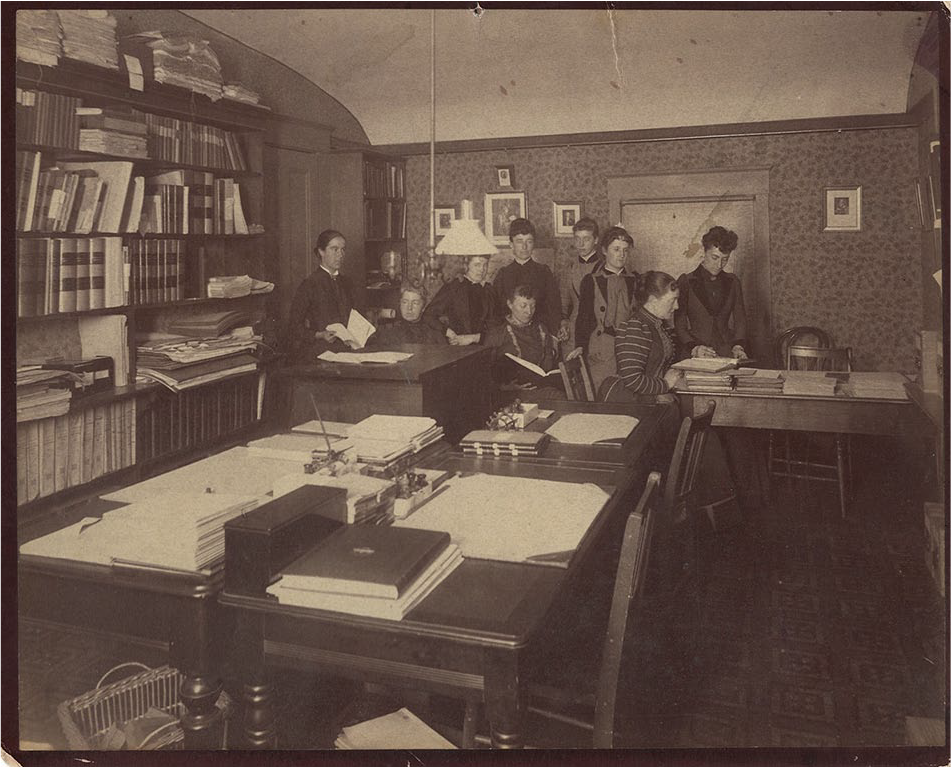
Williamina Fleming (far right) shows Anna Palmer Draper (seated) some of the Henry Draper Memorial Project notebooks while the rest of the “women computers” wait behind them. Draper’s niece, Antonia Maury, is standing at the far left. 66
Even the directors of the observatory appear to have participated in the practice of hiring family members. Selina Cranch Bond, was the daughter of the first director, William Cranch Bond, and sister to the second director, George Phillips Bond. The third director, Joseph Winlock, had two daughters on staff, Anna and Louisa. The fourth director, Edward Pickering, hired his astronomer brother William, but his sister-in-law Anne Atwood Pickering, also appears on payroll records in 1904. The fifth director, Harlow Shapley, does not seem to have officially hired his wife, Martha Betz Shapley, but she published astronomical work based on the glass plates and was known to be a gifted mathematician who might have assisted her husband in much of his mathematical work, including his Princeton PhD thesis. 67
A modern lens might persuade researchers to chalk these relationships up to historic nepotism, but there’s more happening beneath the surface. Family recommendations for employment were essential in establishing women in the early scientific workplace in Europe. In 1757, Nicole-Reine Lepaute assisted in calculations for the prediction of the return of Halley’s comet alongside Joseph- Jérôme Lalande and Alexis-Claude Clairaut. Her mathematical skills were recommended for the project by her husband, the French royal clockmaker. 68 Similarly, for 37 years, John Edwards was paid as a computer for the British Nautical Almanac. When he died in 1784, it was revealed that his wife, Mary, had done the calculations. Mary later gained permission to bring her daughter, Eliza, into the computing enterprise. 69
For centuries, it was common practice for the wives, sisters, or daughters of famous scientists to assist in their male family member’s work. What we know of these women is often passed down through word-of-mouth and cannot always be backed up with documentation, since female contributions were not always saved in archives or published in official records. For example, according to the memoir of the 19th century astronomer, Mary Somerville, there were unsung heroes behind the work of famous 19th century physicists Henry Kater and Edward Sabine—their wives, Frances Kater and Elizabeth Sabine. 70 Beyond Somerville’s account, there is little evidence to support this claim, but such familial working relationships were not so unusual. Astronomers Elisabeth Koopman-Hevelius (ca. 1647–1693), Sophie Brahe (1556–1643), Christine Kirch (ca. 1696–1782), Caroline Herschel (1750–1848), and Margaret Lindsay Huggins (1848–1915) all worked as assistants alongside their more famous male family members. 71 Their contributions were often uncredited.
Around the turn of the 20th century, a secondary pattern of hiring emerged within the Harvard Observatory. Many of the women who worked in the computing room arrived fresh out of the new women’s colleges. Throughout his tenure as the director of the Harvard Observatory (1877–1919), Edward Pickering was in close contact with female professors of astronomy. These relationships were likely due to Pickering’s reputation as a supporter of women’s astronomical education. He assisted female astronomy professors in establishing observatories, trained female students in using physics laboratories, and wrote about the potential for women to make influential discoveries in astronomy.
72
In an open invitation for volunteer observers, Pickering made a point to specifically enlist female graduates to pick up their telescopes and change minds about what women were capable of. He said: The criticism is often made by the opponents of higher education of women that, while they are capable of following others as far as men can, they originate almost nothing, so that human knowledge is not advanced by their work. This reproach would be well answered could we point to a long series of such observations . . . made by women observers.
73
Pickering was so well-regarded for his advocacy, female astronomers pooled funds together in 1916 to start a fellowship in his honor—the Pickering Astronomical Fellowship for Women. 74 Pickering’s reputation as a proponent of women’s education and an employer of female astronomers meant he was never at a loss for new recruits. Female professors wrote to him recommending their best students for his computing team, while Pickering added names to his ever-growing waitlist. 75 Fleming herself had not attended college before her employment at Harvard Observatory in 1879, but many of her colleagues had. Antonia Maury, Annie Jump Cannon, and Henrietta Swan Leavitt graduated from the newly-founded colleges Vassar (established in 1861), Wellesley (established in 1875), and Radcliffe (established in 1879). 76 Despite the establishment of new women’s colleges, there were still significant roadblocks that kept American women from gaining the education they needed to find employment in the field of astronomy. One of the biggest obstacles was social stigma.
Throughout the second half of the 19th century, there were heated debates about whether it was appropriate, or even healthy, to educate women to the college level. In 1876, just 1 year before Harvard Observatory hired its first female computer, former Harvard medical school professor Edward Clarke wrote a treatise discouraging the equal education of women—for their own protection.
77
In Sex in Education, Clarke addresses the women’s education advocates who claim that girls and boys should be schooled equally. Clarke responds: But it is not true that she can do all this, and retain uninjured health and a future secure from neuralgia, uterine disease, hysteria, and other derangements of the nervous system, if she follows the same method that boys are trained in.
78
Clarke was not the only person who held anxieties over women entering universities. Decades later, young women were still making arguments for their rights to an equal education.
Caroline Furness made a moving case for her own advanced education in the 1890s. In letters to her father, she wrote: I only want to prepare myself for the highest place – just as any young man might. . .I must make my own way in the world. I have ability and interest, and why should I not rise to as much distinction in my profession as any man? If I were your son instead of daughter, you would hopefully approve of my ambition.
79
Furness did succeed in attending graduate school. She also went on to become a professor of astronomy at Vassar and spent time conducting research in Harvard’s glass plate collection. 80
Despite the accomplishments of American astronomers like Maria Mitchell and the women at Harvard, male astronomers in the late 19th century frequently cited women’s physical and emotional shortcomings as reasons to keep them out of universities and professional training programs. Female students were characterized as nervous, emotional, and too shy to speak up. Investments in their education or on-the job training were feared lost once a woman married and inevitably left the field. 81
This bias toward women students lingered well into the 20th century. Around 1920, the director of Laws Observatory at the University of Missouri, Robert H. Baker, wrote of one of his female students: “While unfortunately she is not a man, I believe she is handicapped by her sex less than any aspirant I have known.” 82 Proving oneself to be not just capable, but unlike other women appears to have been a prerequisite for the approval of some professors who were not wholly on board with granting women equal footing in university classrooms or in giving them a job in observatories.
The anxiety over women’s education extended far beyond America’s borders. In England, Cambridge University was asking similar questions about the capabilities of the female mind.
83
In 1888, female students from Girton College, Cambridge University’s female school, marched through the streets in protest of Cambridge’s refusal to grant women degrees.
84
When Greenwich Observatory’s Astronomer Royal, George Biddell Airy, received a publication about the subject from a young woman, he responded that: I entirely approve of education of young women to a higher pitch than they do commonly reach. . . But I do not think that their nature or their employments will permit their mastering the severe steps of beginning (and indeed all through) and the complicated steps at the end. . . But I desire above all that all this be done in entire subservience to what I regard as infinitely more valuable than any amount of knowledge, namely the delicacy of woman’s character.
85
A woman’s character and her level of education were commonly seen to be at odds and thus, a reason to keep women from advanced education and professions traditionally held by men.
During a visit to the laboratory of a prominent European researcher in the 1880s, American astronomer Sarah Frances Whiting recalls being asked, “If all the ladies should know so much about spectroscopes and cathode rays, who will attend to the buttons and the breakfasts?” 86 Whiting did not share this researcher’s same fears. She went on to found Whitin Observatory at Wellesley College, alongside donor Sarah Elizabeth Whitin. 87 At Wellesley, Whiting taught future astronomers such as Annie Jump Cannon. 88
Frustrations for women who dreamed of having careers in astronomy went beyond the classroom. The workplace was often just as hostile toward women’s advancement in the field. One of Furness’s students from Vassar, Phoebe Waterman, was a computer at Mount Wilson Observatory before she took a Vassar fellowship in 1911 that enabled her to conduct doctoral research at the University of California Berkeley. She wrote to Professor Furness about her frustrations with computer work at Mount Wilson: But Oh, I do want so much a position as astronomer, part of my work with the instruments and part with the reduction of my plates, as men here [at Mount Wilson] have. . . But it is very bold and presuming of a woman to think of such positions I suppose! They think so here. . .
89
The acceptance of women in American universities and observatories would change over the next century, though slowly. However, some groups of women were able to find a place in the field of astronomy sooner than others. In reviewing the names of women who worked at Harvard Observatory during the era of glass plate photography, a clear racial divide emerges. As far as research has shown, none of the women who studied glass plates at the Harvard College Observatory between 1875 and 1975 were women of color. In fact, the only women of non-white descent who are known to have worked for Harvard Observatory in any capacity were Peruvian domestic workers at the Boyden Station in Peru: Vincenta, Josefina, and Pelionela. 90 These women were recorded in Solon Bailey’s notes from his time managing the station while it was in Chosica and, later, Arequipa. There were almost certainly many more unnamed Peruvian women who cared for Boyden Station during its 38-year tenure in Peru. 91
With the 24-inch Bruce Telescope (named after financial donor Catherine Wolfe Bruce), the astronomers at Boyden Station created some of the most prized astronomical glass plates of the southern skies. 92 While Vincenta, Josefina, and Pelionela are not known to have assisted with the glass plate project or any of the astronomical research at Boyden Station, they are certainly responsible for keeping the station operating. 93 Not all of the work done by women during the era of glass plate photography was research-based. That does not render their work less essential. The contributions of often-forgotten groups, like the indigenous women of Peru, should be acknowledged whenever possible.
Women at the Harvard observatory
Several Harvard College Observatory staff lists have been published in the past century, each providing more insight into who was there during the era of astronomical glass plate photography. Harvard astronomer Solon Bailey published the first well-known list of staff in his 1931 book titled History and Work of the Harvard Observatory. Thanks to this list, we have an official account that shows the first women hired at the Harvard Observatory all started in 1875: Rhoda G. Saunders, Anna Winlock, and Rebecca Titsworth Rogers—not Williamina Fleming, as is often reported. 94
Some names are noticeably absent from Bailey’s list. His own wife, Ruth Bailey, for instance. Solon and Ruth Bailey moved to a remote mountaintop in Peru with their young son in 1889. There, Mrs. Bailey assisted in the work of operating a small Harvard observatory station, which began in little more than a tent (Figures 5 and 6). 95 Annie Jump Cannon, who visited Peru in 1922, recorded that Mrs. Bailey was a “skillful and charming hostess” to observatory visitors. 96 But Mrs. Bailey was far more than a hostess. Solon Bailey and Edward Pickering both published articles that mention her work making stellar measurements on plates and counting stars in tightly packed globular clusters. 97
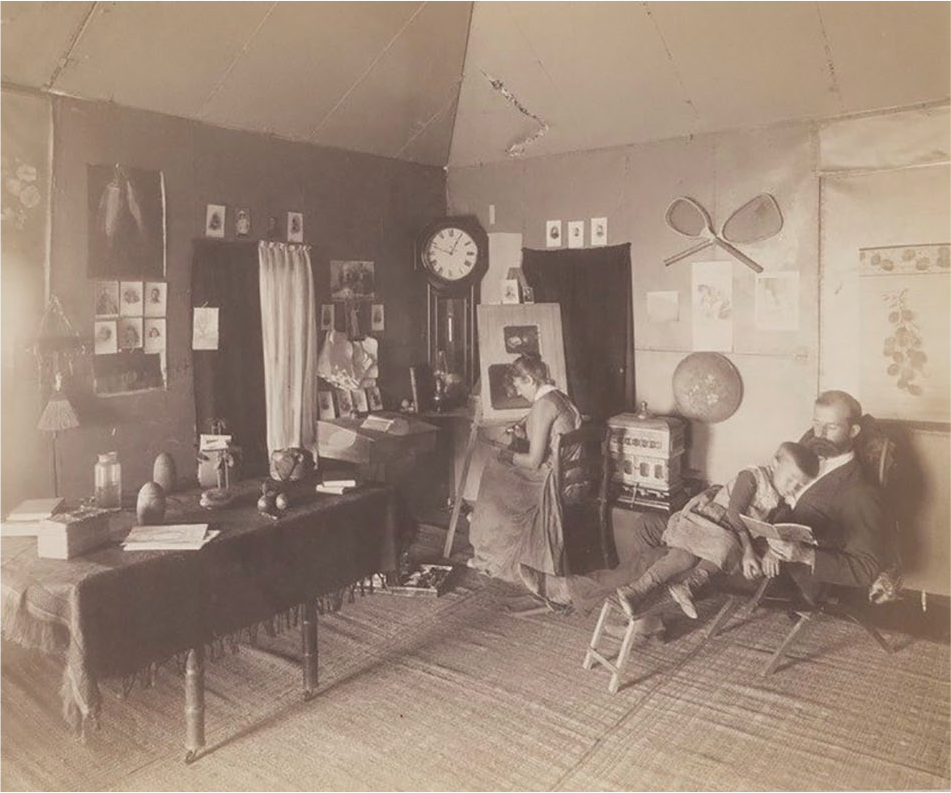
Ruth Bailey is photographed painting at an easel while Solon Bailey reads to their son, Irving. The family lived in a tent on Mt. Harvard, Peru before the station was transferred to a more permanent site in Arequipa. 98
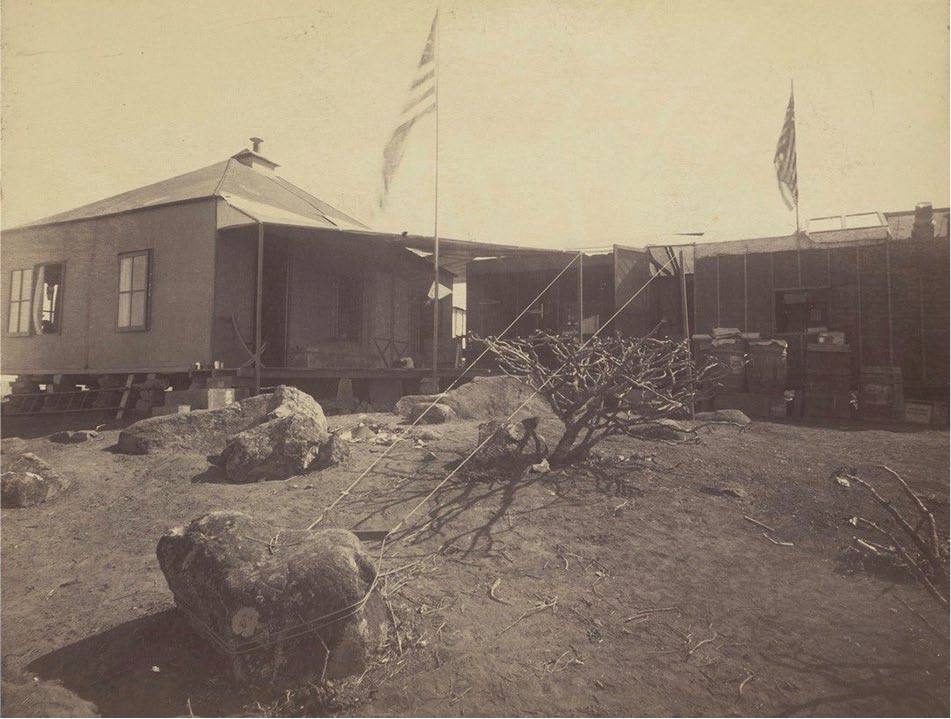
Exterior shot of the Mt. Harvard, Peru station where the Bailey family lived in 1889. 99
While Mrs. Bailey’s duties may have been written off as those of a good wife, they were essential to the success of establishing the remote observatory station and should rightly be included in any listing—whether she was paid or not.
Ruth Bailey is not the only woman whose work at the Harvard Observatory went unrecorded in History and Work of the Harvard Observatory. In some cases, Solon Bailey may have based his decisions on length of tenure. Mary Wagner, who was employed at the Harvard Observatory in 1893, and Juanita Wells, who is listed in payroll records from 1897, are both absent from his list. 100 Neither woman appears to have spent more than a few months at the observatory. In other cases, Bailey’s list skips years of women’s work. Williamina Fleming’s first year at the observatory as a housekeeper (1879) did not make the cut. 101 Henrietta Leavitt volunteered on the computing team from 1895 to 1896, but those years are also absent from Bailey’s list. 102 Bailey does include Leavitt’s official employment from 1902 to 1921, but one wonders how many other women were working at the observatory on a voluntary basis. Without archival evidence of their presence in the plate collection, their contributions may be lost to time.
The Harvard Observatory has a long history of female volunteers. These individuals have been included in this project because the worth of someone’s work should not be weighed by wages. While female staff at Harvard received comparatively little compensation for their research, there were many more who received none at all. For example, Anne Atwood Pickering and “Miss” M.A. Clarke volunteered as photographers during Harvard’s 1886 total solar eclipse expedition. 103 The famous astronomer and educator Ida Whiteside studied at Harvard from 1907 to 1909, but was a volunteer observer for the Harvard Observatory long before that. She provided Edward Pickering with data from over 2,500 observations of long-term variable stars via telescopes at Vassar and Wellesley observatories (Figure 7). 104 She and her corps of volunteers, such as Mt. Holyoke Professor of Astronomy Anne Sewall Young, are all missing from staff lists like Bailey’s. Thankfully, their names appear written on the paper envelopes of glass plate photographs, marking their use of the Harvard collection.
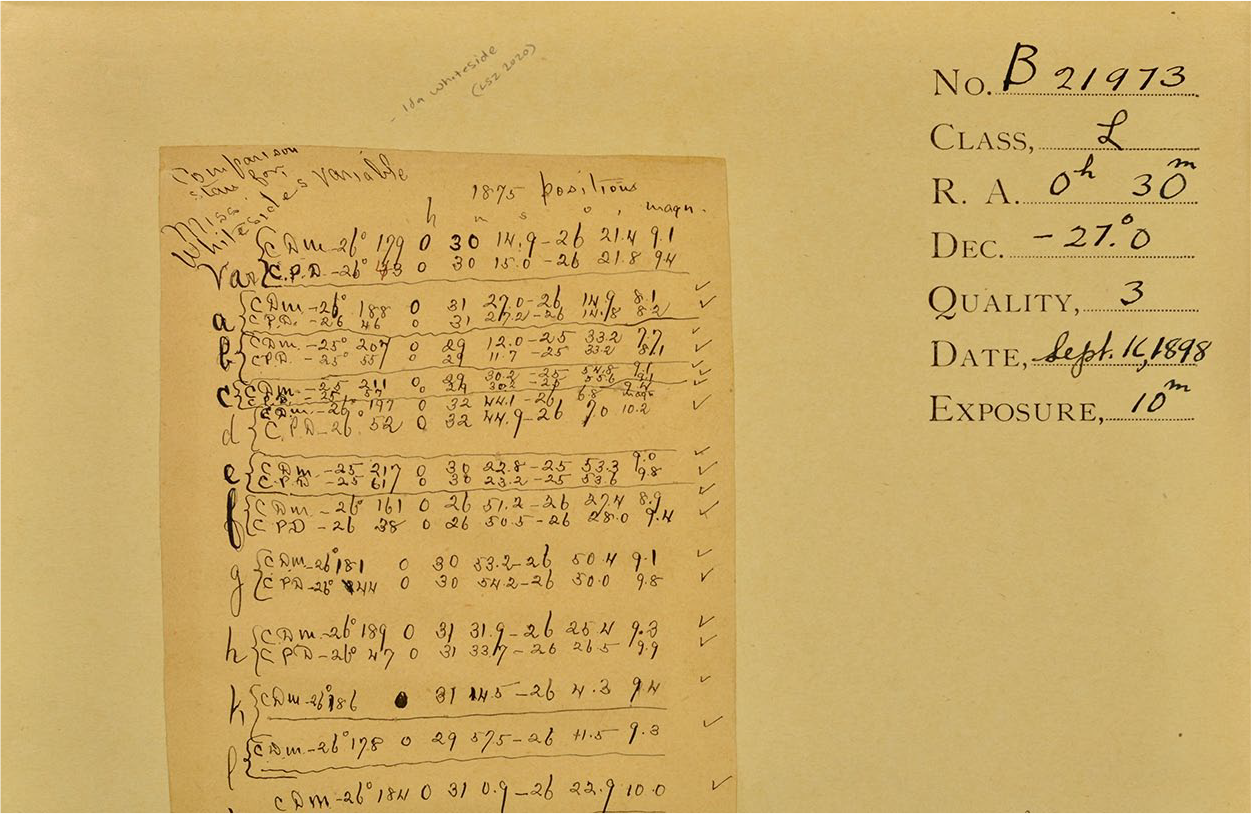
Glass plate B21973 lists magnitude comparison work for Ida Whiteside’s variable. 105
Aside from annotations on paper envelopes, there is another resource for identifying the names of women who worked with the glass plates—their own handwritten research notes. Many volunteers and staff members at the Harvard Observatory left behind their notebooks, which have now been compiled for Project PHaEDRA (Preserving Harvard’s Early Data and Research in Astronomy). This initiative, led by the John G. Wolbach Library, is preserving and transcribing handwritten notebooks from these historic women. One such woman is Mary Fowler, who does not appear on any Harvard staff lists or on glass plate envelopes. Project PHaEDRA has uncovered 99 of Fowler’s historical notebooks from the years 1911 to 1916. Fowler later went on to publish with the famous Princeton astronomer Henry Norris Russell, as did Martha C. Borton and Ernestine Fuller who each left over 40 research notebooks behind at the Harvard Observatory. 106
Volunteers and paid computers were not the only women who worked with the glass plates between 1875 and 1975. Astronomy students at Radcliffe College (Harvard’s affiliate women’s school) used the glass plates for research and publications. Some female students went on to join the observatory’s computing team in an official capacity, like Henrietta Swan Leavitt and Annie Jump Cannon did. Other Radcliffe students searched for astronomy jobs at observatories across the country, as Mabel Merriman did when she left to work at Lowe Observatory. 107 Another student, Carolyn E.O. Burns, is cited in one of Edward Pickering’s Harvard Circular entries alongside computer Annie Jump Cannon. 108 She went on to work at Mt. Wilson Observatory. 109 Neither Merriman nor Burns are listed in Bailey’s record, likely due to their student status.
Another influential woman in astronomy, Anna Palmer Draper, is also noticeably absent from Bailey’s staff list from 1927. Draper was a philanthropist who funded Harvard Observatory’s photographic glass plate project, then named after her late husband and early astrophotographer, Henry Draper. Most likely, Anna Palmer Draper was not included in Bailey’s account because she was not a paid member of the Harvard Observatory. However, to assume that this meant she was not an active member of the scientific field would be deeply incorrect. Throughout her marriage, she conducted astronomical research alongside her husband, helping to produce several photographs including the earliest known photographic spectra of a star (Vega) in 1872. 110 Draper even attempted to found her own observatory after her husband’s passing in 1882.
Far from the absent philanthropist, Draper remained personally and financially invested in Harvard Observatory’s glass plate project until her death in 1914. She donated telescopes, routinely visited to check up on the photographic project’s progress, and communicated with Director Pickering via letters throughout her life. Evidence of her involvement in astrophotography was recently discovered in Project PHaEDRA’s collection of historic notebooks (Figure 8). The observatory kept records for different photographic formulae that were provided by fellow astronomers. Anna Palmer Draper’s name is included, listing her recipe for a silvering process used with her husband’s 28-inch reflector telescope, which she donated to Harvard.

“Martin’s silvering process as used for the 28 inch Draper reflector. Receipt given by Mrs. Draper.” 111
In sum, Bailey’s staff list, though immensely helpful, cannot be viewed as a complete record of women who worked at the Harvard College Observatory. For the purposes of this project, other sources were needed to create a more complete list of women’s work during the era of astronomical glass plate photography.
Finding the names of the women who worked with Harvard’s glass plate collection was one challenge, but locating date ranges for their tenure was another. Inconsistencies in staff lists were not uncommon. For example, Bailey’s book claims Susan Raymond worked at the Harvard Observatory from 1916 to 1917, but her Project PHaEDRA notebooks clearly begin in 1914. Maude E. Harriman is listed as an employee between 1900 and 1905, but her notebooks show dates through 1908. Similarly, Alberta Hawes is included in every known staff list as being at the observatory between 1912 and 1918, but one of her research notebooks, in her handwriting, lists the date 1922. It is possible that former staff members returned to work on a voluntary and sporadic basis to conduct their own research.
In many cases, female staff members who left to work at other universities or observatories continued to use Harvard’s glass plates for publications, years after their departure. Edith Jones Woodward published articles using the glass plate collection long after she left Harvard (c. 1941) to teach astronomy and mathematics. 112 Margaret Harwood left the Harvard Observatory to be a research fellow at the Maria Mitchell Observatory in Nantucket in 1912. She later became the director of that observatory, but remained in close contact with her former colleagues at Harvard. 113 Her marks have been found on the envelopes of glass plates years after her tenure ended. The same goes for Margaret Walton Mayall, who left her official appointment within the glass plate collection to be the Recorder of the American Association of Variable Star Observers (AAVSO) in 1949, but continued to use the glass plates to aid in her variable star research. 114
One big difference between this project and past lists is that visiting researchers have been included, regardless of official Harvard affiliation. This was an intentional decision. The glass plate collection had long been a haven for female astronomers, which should be honored by including all women who worked there, regardless of their status. Many female astronomers who were employed by other institutions left annotations on glass plate envelopes between 1875 and 1975. For example, Linda L Lucignani left her mark on plates in 1970 when she was conducting a summer fellowship with the Maria Mitchell Observatory in Nantucket. A report from the AAVSO in 1970 says she used 300 of Harvard’s glass plates in her research. 115 Marjorie Williams, astronomy professor at Smith College, also spent several summers in the 1930s researching at the Maria Mitchell Observatory. 116 She left her mark on Harvard glass plates between 1930 and 1931. Ida Whiteside’s colleague at Whitin Observatory, Luisita Wemple, used glass plates in 1932. Leah B Allen worked as an assistant at Lick Observatory before becoming an astronomy professor at Hood College in the late 1920s-1950s. Her annotations have been found on glass plates from 1932 and 1954, which match publications that indicate her use of the Harvard glass plates. 117
There is also a curious annotation referring to Aphrodite Rosenberg c. 1934. Rosenberg was a computer for the Estonian Computing Bureau based at the University of Tartu. 118 She worked with Dr. Ernst Öpik, who was a visiting researcher at Harvard in 1930 and 1934. But it seems Rosenberg was not the only member of the Estonian Computing Bureau who studied the Harvard collection. Notes from Dr. Öpik’s research assistant and second wife, Alide Piiri, also turned up on glass plate envelopes. According to a published report by Harlow Shapley in 1933, Harvard used the services of the Estonian female computers for data reductions because they were one-third the cost of Harvard’s own team of computers. 119 It is possible that Dr. Öpik brought the Harvard plates to these women at their home base at the University of Tartu.
According to Harvard Observatory lore, the glass plate collection has long been a home for the unemployed wives of male Harvard astronomers, lecturers, and visiting scholars. Past Curators of Astronomical Photographs welcomed them into the stacks so these women could conduct their own research while their husbands went about official business at the observatory. Esther Agnew Robinson, the wife of PhD recipient Limmye Vernon Robinson, appears to have worked on glass plate photographs before 1933 while her husband was completing his PhD. He mentioned her assistance in his publication “Light Curves of Cepheid Variables.” 120 Jesse Greenstein’s wife, Naomi Kitay Greenstein, also left notes on the glass plates around the same time that Jesse was earning his PhD at Harvard c. 1937. Years later, she was still publishing her findings from the Harvard glass plates, with no less a co-author than the observatory’s director, Harlow Shapley. 121
Entire books have been written about the work of the most famous women at the Harvard Observatory. Henrietta Leavitt, Cecilia Payne-Gaposchkin, and Annie Jump Cannon, for example, have all been the subjects of many well-deserved tributes. 122 However, there were at least 216 women who studied these glass plates between 1875 and 1975, most without receiving any acclaim for their work. At best, they were footnotes in the history of the most famous among them. At worst, they were nothing but an initial on a glass plate envelope. Deeper examination of primary-source records can serve to give initials their full names and grant those names their full recognition. From paid employees and volunteers, to students and temporary researchers—women have long had a significant presence at the Harvard College Observatory via the astronomical glass plate photograph collection. No matter how women were able to access the glass plates, their names have now been recorded for posterity.
The list as of December 2020
The following list includes the names of women who either left annotations on the paper envelopes of glass plates or who were known to work with the glass plate collection before 1975, as evidenced in published articles, archival records, etc. Women who worked at the Observatory before 1950 are automatically included in this list, regardless of published or archival proof of activity. This decision was made due to the plate collection’s status as the women’s sphere. It is highly unlikely that a woman would have spent time at the Harvard Observatory prior to 1950 without interacting with the glass plates or the other women who worked there. Regardless of whether these individuals spent time at Harvard Observatory as volunteers, computers, astronomers, researchers, or students, the glass plate collection was recognized as a space for women—a refuge filled with numbers and stars.

Conclusion: A haven made of glass
We now know the names of 216 women who left their mark on the astronomical glass plate photograph collection at the Harvard College Observatory between 1875 and 1975. This project began in 2016 with a short list of names and initials that the Curator of Astronomical Photographs collected from the paper envelopes of glass plates. As the list grew, many resources were essential for ironing out identities and dates for the names found:
SAO/NASA Astrophysics Data System
Project PHaEDRA, Center for Astrophysics|Harvard & Smithsonian
Annals of the Astronomical Observatory at Harvard College, as well as the Observatory’s Bulletins, Circulars, and the Annual Reports of the Director
Census records on Ancestry.com
Oral History Interviews, Niels Bohr Library & Archives, American Institute of Physics
Pamela Mack, “Women in Astronomy in the United States,” Thesis: Harvard University, 1977.
Keith LaFortune, “Women at the Harvard College Observatory, 1877–1919: ‘Women’s Work’, the ‘New’ Sociality of Astronomy, and Scientific Labor,” Thesis: University of Notre Dame, 2001.
Solon Bailey, The History and Work of the Harvard Observatory: 1839–1927 (New York: McGraw-Hill Book Company, Inc., 1931).
Bessie Zaban Jones and Lyle Gifford Boyd, The Harvard College Observatory: The First Four Directorships, 1839–1919 (Cambridge: The Belknap Press of Harvard University Press, 1971).
Even with these resources, this list is admittingly lacking. One large gap in this study is the names of the countless female volunteer observers that Pickering enlisted to assist in monitoring variable stars. These women worked from their own homes, using their own telescopes. Most never set foot at the Harvard Observatory, but they delivered countless observations which Pickering published in the Annals—under their own names. 126
There is also the fact that most visiting researchers to the Harvard collection left only initials on glass plate envelopes, if they left any marks at all. There are currently over 170 initials without any further identification. Most likely, many of these belong to women who used the collection, but without a name there is nothing to investigate further. Still, 216 names is a triumph for equity and inclusion in the history of astronomy. What we can learn from this list is that many women worked in the field of astronomy between 1875 and 1975, even when their names were not credited in publications or recorded in staff logs. These women have made impacts both great and small—impacts that deserve to be recognized. We may never know all of the women who blazed a path for modern astronomers, but by digging into the archives, we have taken one giant step in the right direction.
The true impact of Harvard Observatory’s astronomical photographic glass plate collection on the advancement of women in astrophysics goes beyond 216 names. Astronomical glass plates were the catalyst for women gaining greater acceptance within the field of astronomy. They enabled female astronomers to prove that women are capable of great contributions to science if they are granted equal access to education and professional opportunities—and paid fairly for their work. The collection has shown that women were involved in the astronomical photographic glass plate project in a multitude of ways—from keeping the observatory stations operational, to studying the stars encased on glass, to funding women’s research. Harvard Observatory’s astronomical glass plate collection has served as a haven for women in astronomy and it remains, to this day, a monument to the bright scholars who studied the night sky, during the daytime, through panes of glass.
Footnotes
Acknowledgements
Thanks to Anne Callahan, Sarah Lavallee, Olivia Ambo, Meta Partenheimer, Eve Fairbanks, Helen Driscoll, and Elaine Joubert for your research locating Harvard Observatory women in archives and century-old books. My appreciation extends to Dava Sobel for her continued efforts in uncovering historic women of science and for all of her kind encouragement over the years. Many historical female astronomers would have remained anonymous without the work of Daina Bouquin, Katie Frey, Maria McEachern, Nico Carver, and Samantha Correia on the PHaEDRA and StarNotes projects. Additional appreciation goes to Sarah Lavallee, Emily Reynolds, Sarah Hogan, and Zack Zrull for their invaluable editing advice.