







Abstract
Luminous blue variables (LBVs) are extremely massive, evolved stars that can experience highly erratic instabilities and outbursts. During an eruption, they are capable of temporarily being the brightest star in their host galaxy. By careful examination of two drawings of Messier 33 (M33) made in 1850–1851 and 1857, the currently well-known LBVs Variable B and Variable 83 have been found. The drawings show that Variable 83 was visible on both while Variable B had faded below detection on the second. Comparing the limiting magnitude of the stars plotted on the earlier drawing indicates that Variable B was near the brightest it has ever been measured at while Variable 83 was experiencing a brighter eruption than has since been recorded. These are the first known recorded observations of an LBV in any galaxy beyond the Milky Way.
Keywords
Introduction
Since their discovery in M31 and M33 as irregular variable stars with dramatic photometric and spectroscopic variations, astronomers have been seeking to better understand luminous blue variables (LBVs). 1 Their general properties include high luminosities, significant mass-loss rates, variability on multiple time-scales, eruptive events, and often nebulous ejecta. 2 While it’s still unclear what the underlying physical trigger(s) of the instability is, the LBV phase is considered to represent a transitional phase from massive O-type main-sequence to Wolf-Rayet stars. 3 This phase is short – lasting only several 10 years – while the initial masses of the brightest LBVs cover the range of 50 to 120 M☉. 4 The less luminous ones are possibly post-Red Supergiant (RSG) objects that have lost almost half of their initial masses (within the range of ~25–40 M☉) during the RSG phase. 5
In the Milky Way, some of the brightest and most well-known examples of LBVs are P Cygni and Eta (η) Carinae. 6 However, it must be noted that those particular LBVs became known for giant eruptions (in the 1600s, and 1840s, respectively) in which their total luminosity increased by more than one magnitude. In a typical or normal LBV eruption (typified by S. Doradus in the Large Magellanic Cloud), the bolometric luminosity remains approximately constant. 7 These normal eruptions, commonly referred to as S Dor variability, may take years or even decades to observe. Hence, the list of bona fide LBVs is short with many objects only considered candidate LBVs.
Published drawings
In the middle of the 19th-century, the largest telescope in operation had a 72-inch f/9 speculum mirror. The owner and driving force behind its creation was William Parsons, Third Earl of Rosse (1800–1867). 8 The telescope saw provisional first light in September 1844 and was used for over four decades. However, being made of metal and in the open air, the three-ton mirror would quickly tarnish, leading to a noticeable reduction of reflectivity. G. Johnstone Stoney, Lord Rosse’s scientific assistant from July 1848 until August 1850 and again in late 1852, 9 wrote that even when “. . .the speculum was quite fresh from the polisher [the] effect was lost in a very short time.” 10 This issue, along with a poor observing site and different observers led to many objects being reobserved several times.
It was documented that the large, face-on spiral galaxy M33 was examined 32 times with it over the next two decades 11 and three drawings were published (Figure 4a–c). The first published drawing of M33 using the telescope (Figure 1) was made in September 1849 by G. Johnstone Stoney and can be found in the 1850 issue of the Philosophical Transactions of the Royal Society of London (Plate XXXVI, Figure 5). 12
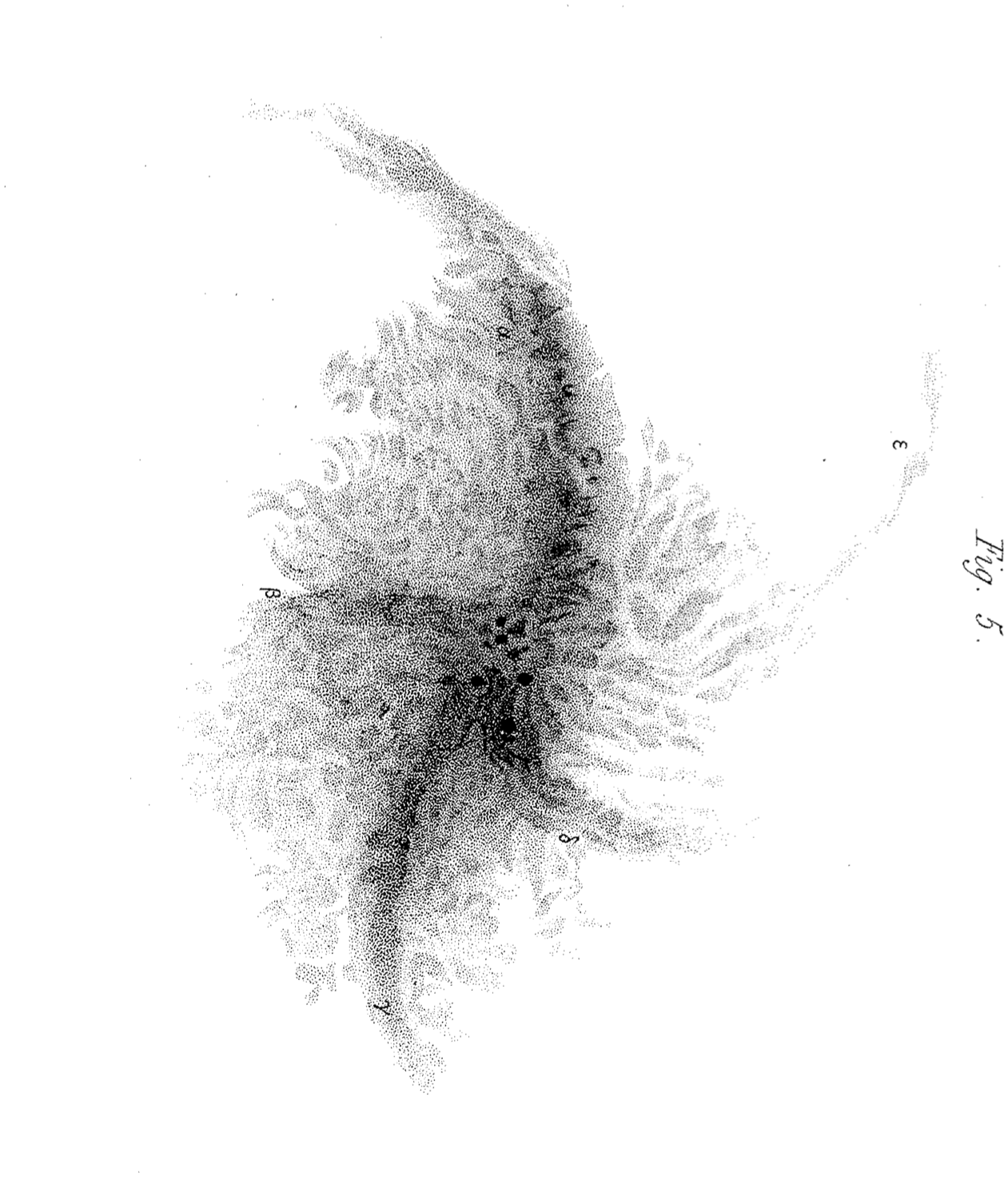
G. Johnstone Stoney’s 1849 drawing of the central region of M33. Rotated to have what the author believes to be north approximately towards the top after comparing to later drawings also done using the 72-inch.
After G. Johnstone Stoney’s departure, Lord Rosse’s next scientific assistant was Bindon Stoney, the younger brother of G. Johnstone Stoney. He assisted Lord Rosse from August 1850 until April 1852. 13 During this time, he observed M33 possibly 12 times and took detailed measurements of stars and three nonstellar objects (NGC 604, NGC 595, and IC 142) amongst the perceived arms. 14 This was done with a bar-micrometer, whose threads were thick enough to be seen in the eyepiece without illumination. His small but carefully made drawing (Figure 2) can be found on page 711 of the 1861 issue of the Philosophical Transactions of the Royal Society of London and is reproduced here (Figure 3a) next to a modern-day amateur image of M33 (Figure 3b).
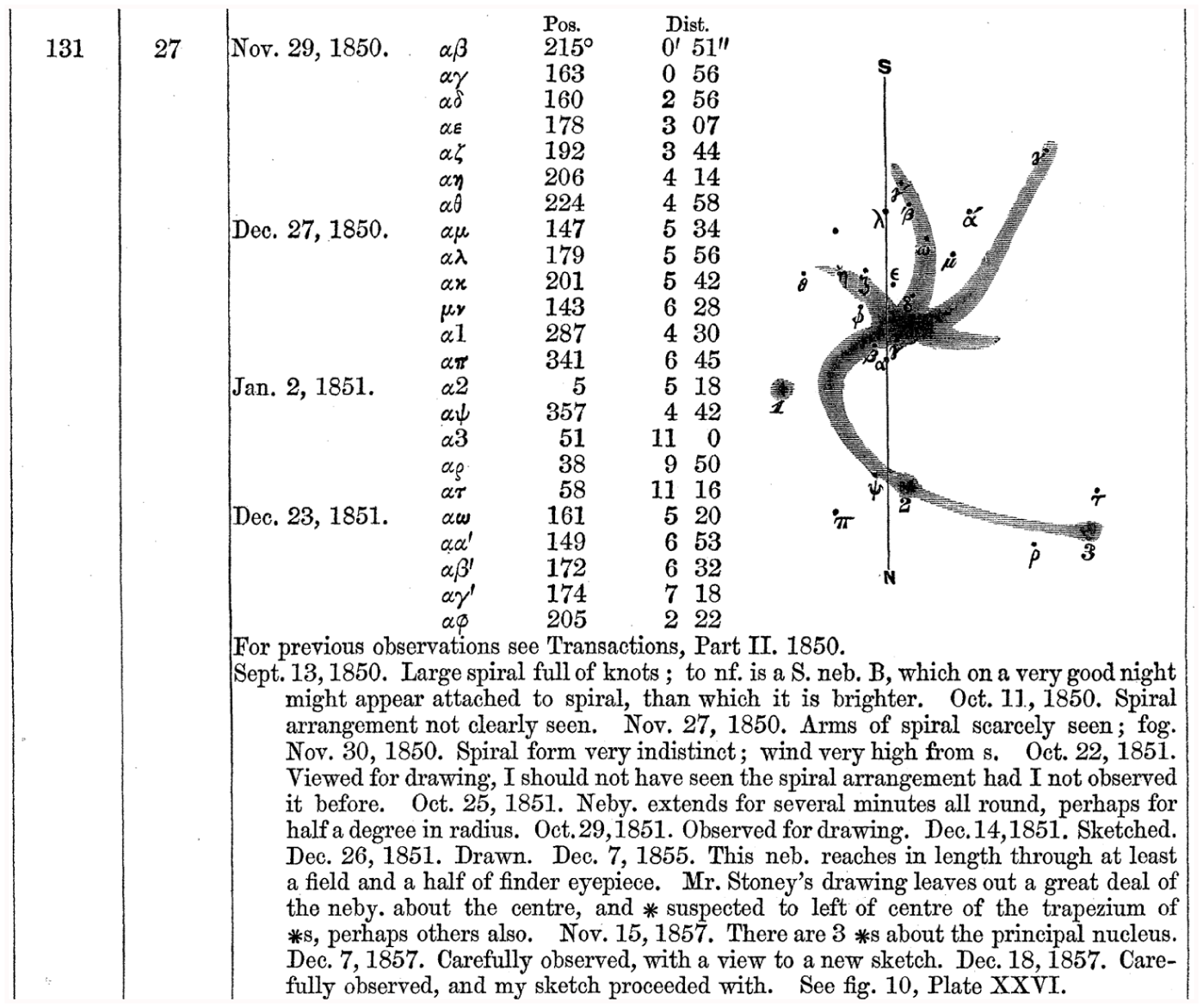
A portion of page 711 in the 1861 issue of Philosophical Transactions of the Royal Society of London showing observations of M33 and Bindon Stoney’s 1850–1851 drawing.
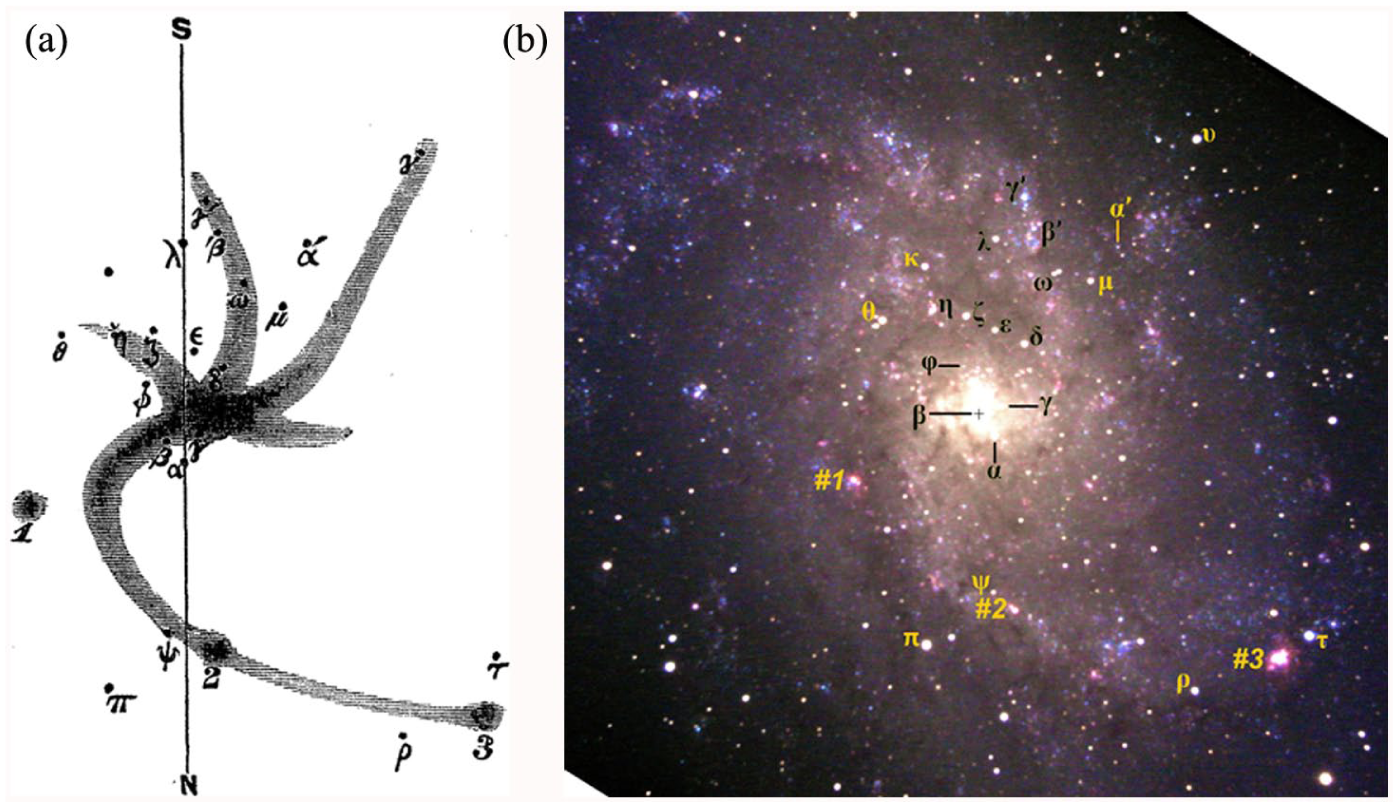
(a) Bindon Stoney’s drawing (south up) composed between 1850 and 1851. Compare to Figure 3b, which is an amateur image with the same stars labeled and rotated to match. (b) Amateur image of M33 with the same stars labeled and rotated to match figure (a) for better comparison.
Lord Rosse’s longest tenured scientific assistant was R.J. Mitchell, who aided him from December 1853 to May 1858. 15 He finished the third and last known drawing of M33 using the 72-inch in December 1857. 16 His drawing (Figure 5), which contains several dozen stars and one more nonstellar object (NGC 592) than Stoney’s 1850–1851 drawing, also appeared in the 1861 issue of the Philosophical Transactions of the Royal Society of London (Plate XXVI, Figure 10). However, it should be noted many of the digital versions of Plate XXVI available to the author are cropped enough that they leave off important details. Thus, you’ll usually find either NGC 592 missing from the right-hand side or a magnitude V = 11.93 star previously labeled as nu (ν) on Stoney’s 1850–1851 drawing missing from the left-hand side (Figure 5).
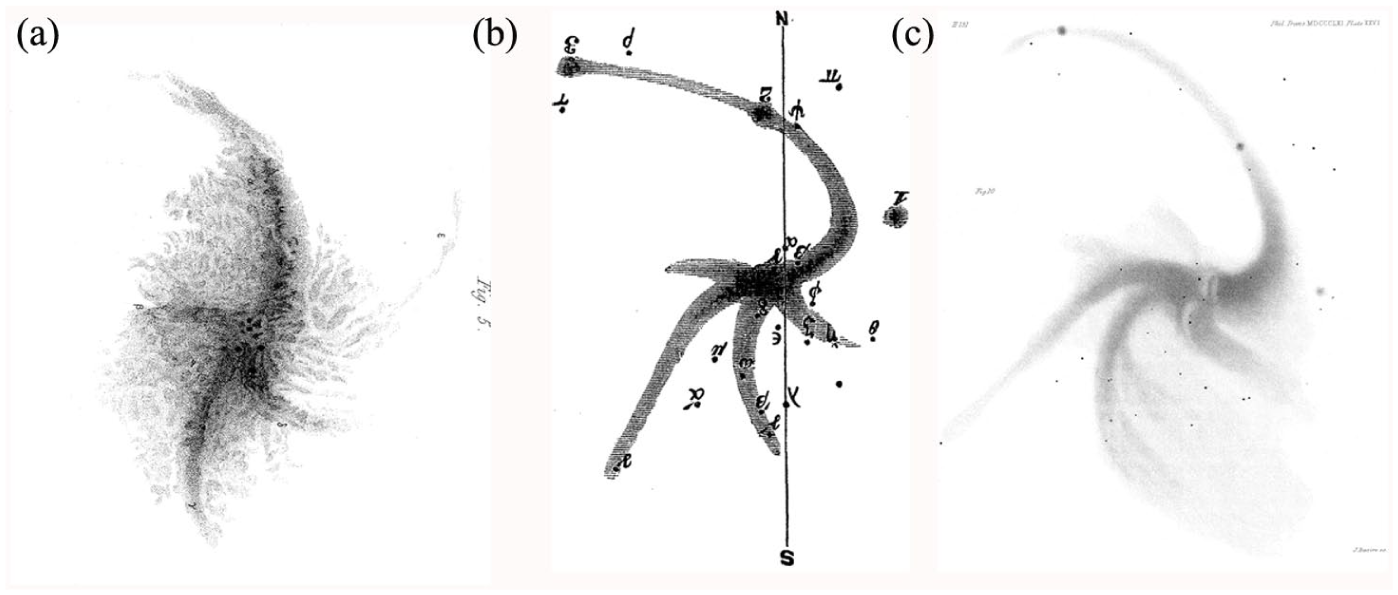
(a) On the left is G. Johnstone Stoney’s 1849 drawing, which was the first of three published drawings made with Lord Rosse’s 72-inch speculum reflector. It is seen here arranged at a similar scale and orientation (north approximately up) to figure (b) and (c). (b) The middle figure is Bindon Stoney’s 1850–1851 drawing, which was the second of three published drawings made with Lord Rosse’s 72-inch speculum reflector. It is seen here arranged at a similar scale and orientation (north approximately up) to figure (a) and (c). (c) On the right is R.J. Mitchell’s 1857 drawing, which was the third and final published drawing made with Lord Rosse’s 72-inch speculum reflector. It is seen here arranged at a similar scale and orientation (north approximately up) to figure (a) and (b).
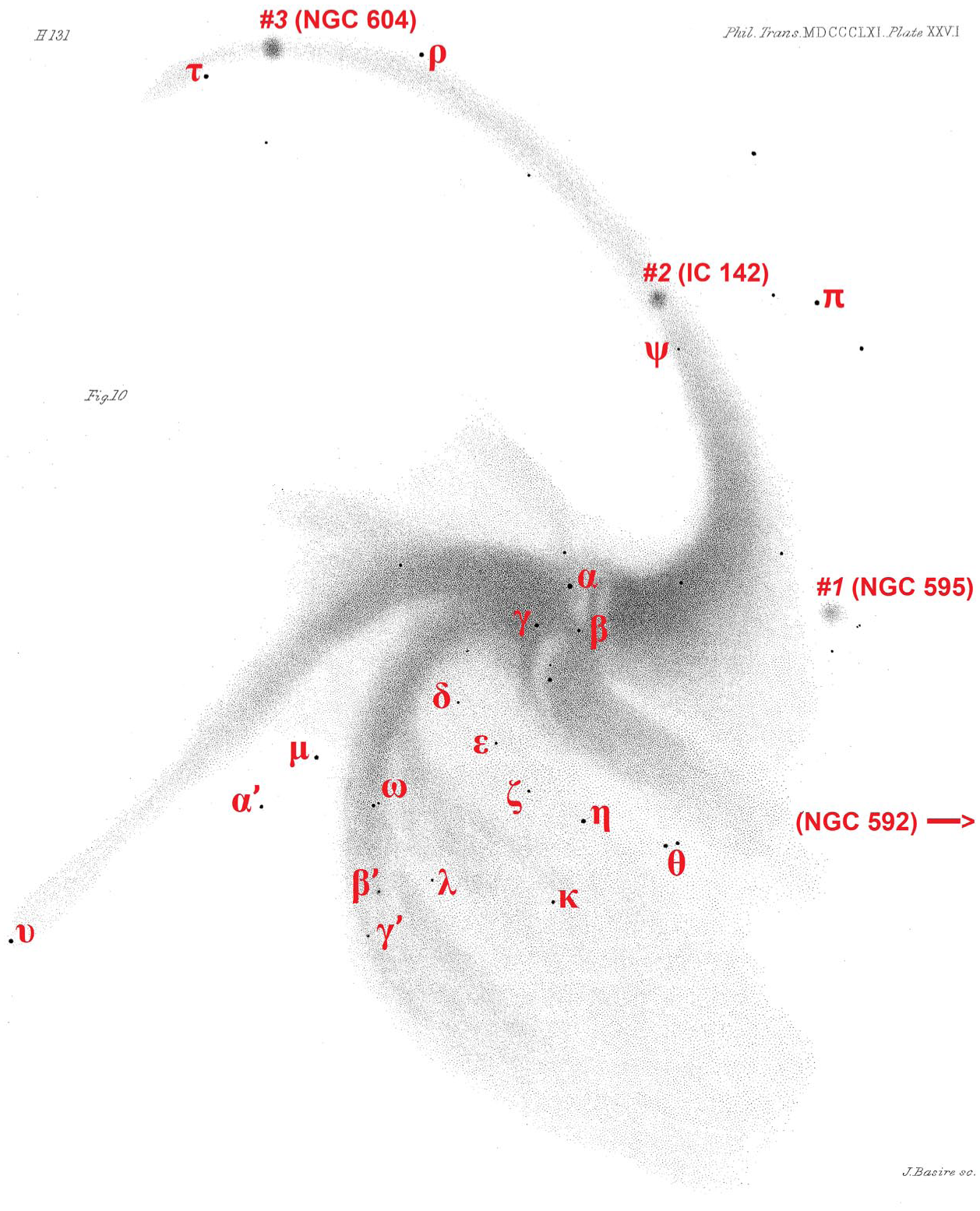
R.J. Mitchell’s 1857 drawing of M33 published in the 1861 issue of Philosophical Transactions of the Royal Society of London, with north approximately up and the stars that Bindon Stoney also saw labeled. However, this copy has the right-hand edge cropped off, which is why the round, nonstellar spot NGC 592 isn’t seen but its general location is indicated.
Initial analysis of drawings
G. Johnstone Stoney’s 1849 drawing of M33 was the first ever to highlight the galaxy’s spiral arms. 17 However, it came with the comment that “This figure represents the central portion of a very large nebula. The nebula itself has not been sufficiently examined, but as yet no other portion appears to have a spiral, or indeed any regular arrangement. The sketch is not very accurate, but represents sufficiently well the general character of the central portion.” This point is further strengthened by the fact that his drawing contains no cardinal directions, making one have to assume such.
In his 2013 book, Observing by Hand: Sketching the Nebulae in the Nineteenth Century, 18 Nasim emphasized that “[Lord] Rosse’s published figures of the nebulae or clusters therefore should be considered portraits and not descriptive maps. They are portraits because the primary emphasis in each is the pictorial qualities rather than the measured quantities.” With this being the case, the few drawings that do include micrometer measurements hold the most scientific value. Thankfully, Bindon Stoney took the precious time to do just that for his 1850–1851 drawing. In Table 1, each star in Bindon Stoney’s drawing (labeled using the Greek alphabet) is cross-matched with those in the Gaia DR3 19 and listed with their magnitudes from APASS DR9 and Gaia DR3 (via Aladin Sky Atlas). This revealed that the faintest foreground star was psi (ψ), at magnitude V = 15.42 (G = 15.28). The second faintest was beta-prime (β′) at magnitude V = 14.88 (G = 15.19) and the third faintest was gamma (γ) at magnitude V = 14.52 (G = 14.53). This indicates that any star drawn was likely brighter than magnitude V = 15.50.
Stoney’s 1850–1851 measurements listed with their magnitudes from APASS DR9 and Gaia DR3.
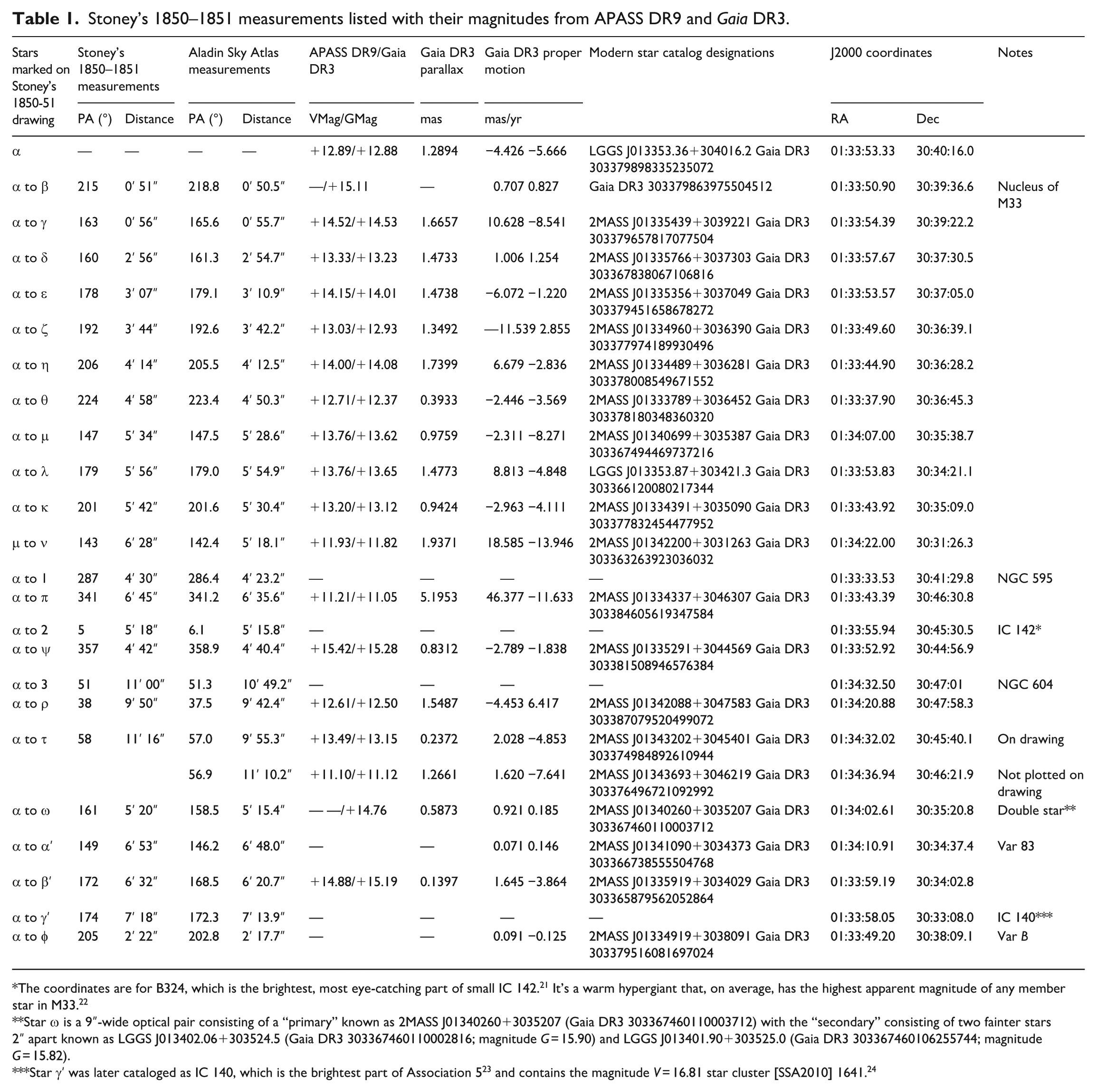
The coordinates are for B324, which is the brightest, most eye-catching part of small IC 142. 21 It’s a warm hypergiant that, on average, has the highest apparent magnitude of any member star in M33. 22
Star ω is a 9″-wide optical pair consisting of a “primary” known as 2MASS J01340260+3035207 (Gaia DR3 303367460110003712) with the “secondary” consisting of two fainter stars 2″ apart known as LGGS J013402.06+303524.5 (Gaia DR3 303367460110002816; magnitude G = 15.90) and LGGS J013401.90+303525.0 (Gaia DR3 303367460106255744; magnitude G = 15.82).
It should be noted that even though the position angles and distances accompanying Stoney’s 1850–1851 drawing are of good accuracy, the drawing itself has a few issues. These include:
(A) The kappa (κ) star is drawn but not labeled;
(B) A magnitude V = 13.49 star is drawn and labeled as tau (τ), but the micrometer measurement to it is undoubtedly for a magnitude V = 11.10 star, which lies in the same position angle and 1′ 15″ farther. Plus, the V = 11.10 star was drawn on R.J. Mitchell’s 1857 drawing along with the V = 13.49 star;
(C) Star omega (ω) is actually a close double star that was drawn as a pair later in R.J. Mitchell’s 1857 drawing;
(D) Star gamma-prime (γ′) is actually the OB association IC 140, which Guillaume Bigourdan discovered visually in 1889; 20
Before a full analysis of Bindon Stoney’s drawing can be made, one must also inspect R.J. Mitchell’s 1857 drawing, which seems to have been done without aid of a micrometer and was reproduced at a larger scale for publication (Figure 5). The author has found that R.J. Mitchell drew 35 stars and four nonstellar objects (NGC 604, NGC 595, NGC 592, and IC 142), which is 14 more stars and one more nonstellar object than can be found on Bindon Stoney’s drawing. He also drew (correctly) each of Bindon Stoney’s stars omega (ω) and eta (η) as pairs. This adds weight to the accuracy of Bindon Stoney’s drawing but also indicates that either the night(s), telescope mirror, or observer were of slightly better quality in 1857 (Figure 5).
However, Bindon Stoney’s star phi (φ) was not drawn by R.J. Mitchell while the author could not convincingly match up three very faint stars on R.J. Mitchell’s drawing to any seen in modern-day images. The disappearance of phi (φ) will be investigated further in the following section. As to the few “extra” stars seen by R.J. Mitchell, it seems they are not engraving errors as Lord Rosse wrote, “The engravings of the Nebulae are extremely faithful; there is, however, a slight inaccuracy which it is necessary to notice, and for which we are to blame, not the engraver. Many of the principal stars are too large. The error arose in this way. The stars were inserted in common, not Indian ink, and, the drawings during their transmission by post becoming slightly damp, the ink made its way into the paper, the dots in some cases becoming small blots.” 25 We are then left to assume that while trying to record as many stars as possible, R.J. Mitchell fooled himself into seeing a few where none existed – something that has been known to happen to visual observers of the night sky.
Critical analysis of drawings
Variable 83 (J2000.0 RA 01:34:10.91 Dec +30:34:37.4)
Of the 21 stars on Bindon Stoney’s 1850–1851 drawing of M33, there are two that match up well with physical member stars of the galaxy on modern-day images. The first one I noticed is alpha-prime (α′). On December 23, 1851 Stoney measured a position angle of 149° and distance of 413″ from the magnitude V = 12.9 star alpha (α), which is not the galaxy’s nucleus (labeled as beta) but instead lies 50.5″ north of it. The closest match by a large margin is the LBV Variable 83 (Var 83; Figure 6), which has a nearly identical position angle of 146.2° and distance of 408″ from alpha (via Aladin Sky Atlas).
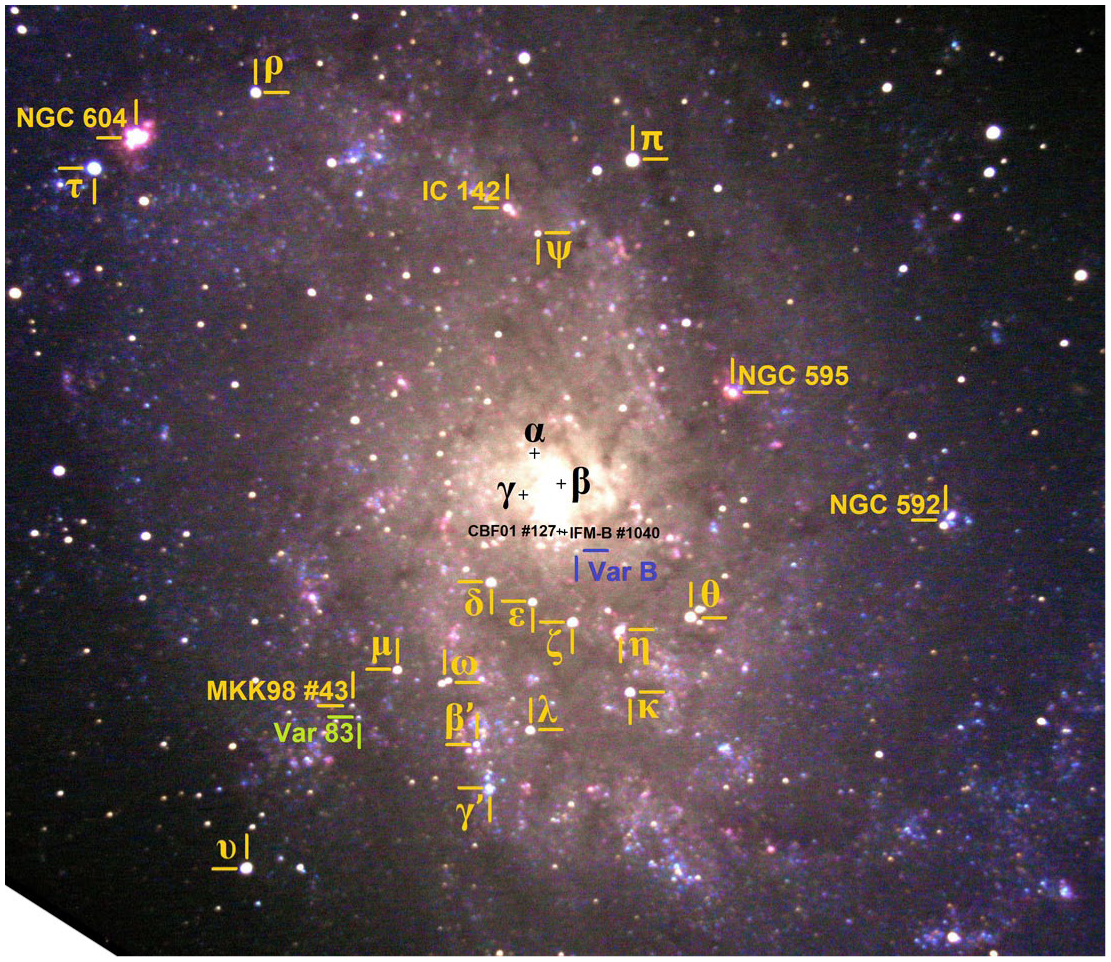
Amateur image of M33 with north at top. The LBVs Var 83 and Var B are labeled along with NGC 592, NGC 595, NGC 604, IC 142, the member star IFM-B #1040, plus member star clusters CBF01 #127 and MKK98 #43.
It was evident to me that this wasn’t an error when I realized there’s a star plotted at the same place in R.J. Mitchell’s 1857 drawing. However, there’s a stellar object 17.2″ north-northwest of Var 83 on modern-day images that is usually a similar brightness and could be a foreground variable star. That scenario was able to be ruled out as it is instead a log(M☉) 5.377 star cluster 26 first cataloged as “MKK98 #43” 27 and later found to be magnitude V = 16.61 28 and V = 16.47. 29
Variable B (J2000.0 RA 01:33:49.20 Dec +30:38:09.1)
The second star I noticed on Bindon Stoney’s 1850–1851 drawing that matched up well with a member star of M33 was phi (φ), which Stoney recorded a measurement for also on December 23, 1851. Lying near the core, he measured a position angle of 205° and distance of 142″ from magnitude V = 12.9 star alpha. The closest match by a large margin is the LBV Variable B (Var B; Figure 6), which has a nearly identical position angle of 202.8° and a distance of 137.7″ from alpha (via Aladin Sky Atlas). Turning to R.J. Mitchell’s drawing in 1857, there’s a star shown in the general vicinity, but it’s an unlikely match for Var B since it sits noticeably closer to the galaxy’s center. Instead, the star that R.J. Mitchell drew matches up exceedingly well (visually) with the location of member star 1040 in Ivanov et al.’s 30 paper “A Catalog of Blue and Red Supergiants in M33,” hereafter “IFM-B #1040.”
IFM-B #1040 (J2000.0 RA 01:33:50.43 Dec +30:38:33.8)
R.J. Mitchell’s 1957 drawing of M33 shows what he described as a “trapezium of stars” at its center (Figure 7). In fact, he states during an observation made on December 7, 1855 that “[Bindon] Stoney’s drawing leaves out a great deal of nebulosity about the center, and star suspected to left of center of the trapezium of stars, perhaps others also.” 31 If true, it’s plausible that R.J. Mitchell could have seen a fainter star than Bindon Stoney “about the center” if Var B had faded below detection.
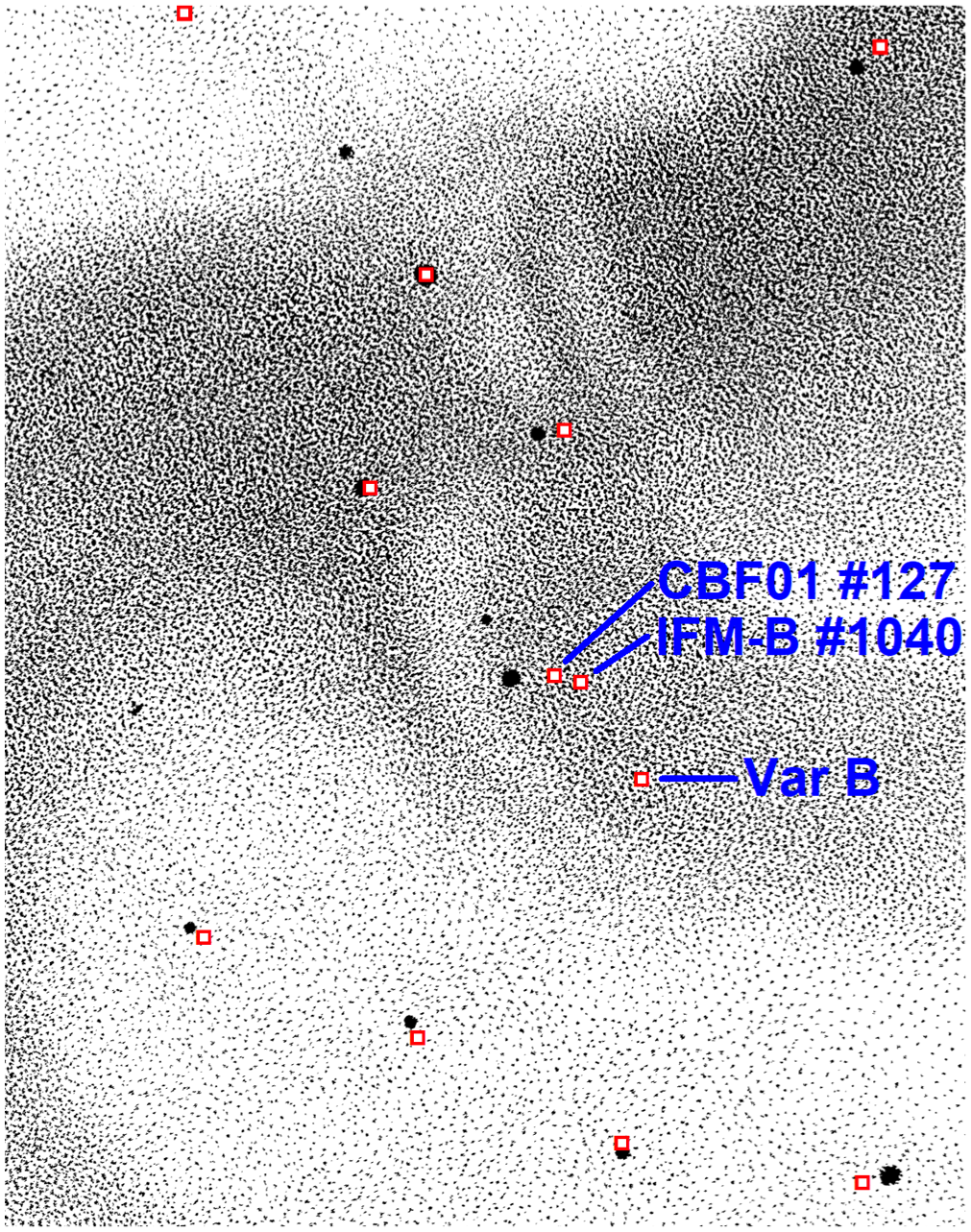
Reprint of the central region of R.J. Mitchell’s 1957 drawing, rotated with north straight up. Open squares denote the location of stars (plus the galaxy’s nucleus) on modern-day images. His plotting accuracy of the brighter stars in the galaxy’s central region is enough that it’s doubtful he saw the LBV Var B and more likely the combined light of member star IMF-B #1040 and star cluster CBF01 #127.
IFM-B #1040 was first cataloged as magnitude V = 15.90 and B = 15.90. 32 On Plate 2 of the discovery paper, 33 there is another star labeled IFM-B #1054 only 5.5″ east. It is listed at magnitude V = 16.0 and B = 16.20 with the remark that it’s a candidate Wolf-Rayet star. In Monteverde et al.’s 34 paper, “Spectroscopic Observations of AB supergiants in M 33,” the spectra of IFM-B #1040 revealed it was a composite of a B and an F spectrum while they classified IFM-B #1054 as a B2 Ib, but suspected it could be a binary or multiple system. In Massey et al.’s 35 paper, “The UV-Brightest Stars of M33 and Its Nucleus: Discovery, Photometry, and Optical Spectroscopy,” IFM-B #1040 was reclassified as a type B1 Ia + WN with a magnitude V = 15.86 and B = 15.92 and IFM-B #1054 as a type B3 Ia with a magnitude V = 16.49 and B = 16.27. In Massey et al.’s 36 paper “A Survey of Local Group Galaxies Currently Forming Stars. I. UBVRI Photometry of Stars in M31 and M33,” IFM-B #1040 was found to be magnitude V = 15.86 and B = 16.05 on October 4, 2000.
In Chandar et al.’s 37 paper, “Star Clusters in M 33. IV. A New Survey from Deep HST Images,” they used Hubble Space Telescope WFPC 2 images and found that IFM-B #1054 was actually a star cluster. Known hereafter as “CBF01 #127,” it was later found to be magnitude V = 16.39 38 and V = 16.38. 39 In Moeller and Calzetti’s 40 paper, “Ages and Masses of Star Clusters in M33: a Multiwavelength Study,” they found it to be a log(M☉) 3.16 with a log(age years) of 6.70.
Could R.J. Mitchell have seen IFM-B #1040, which lies 64″ from the nucleus of M33, while examining the area? At magnitude V = 15.90, it would have been difficult lying within the galaxy’s bright central region. But if we sum V = 15.90 for IFM-B #1040 and V = 16.40 for CBF #127, their combined light is V = 15.37, which is V = 0.5 brighter than the faintest star plotted by Bindon Stoney. Plus, I have proven that this pairing can be observed as a single stellar object under rural skies in my 254 mm Schmidt-Cassegrain telescope at 400×. Thus, it’s quite likely that R.J. Mitchell saw the star and star cluster as a single source considering he did record more stars on his M33 drawing than either of the Stoney brothers.
LBV lightcurves
Variable B (J2000.0 RA 01:33:49.20 Dec +30:38:09.1)
The brightest LBV discovered by Hubble and Sandage 41 in their paper “The Brightest Variable Stars in Extragalactic Nebulae. I. M31 and M33,” was Variable B. It lies 90″ from the galaxy’s nuclear star cluster 42 at a position angle of 194.1° (or 137.7″ at a position angle of 202.8° from Bindon Stoney’s alpha star). The lightcurve they created, using photographic magnitudes (mpg), started in 1919 and ran until 1953, with some additional mpg from various years between 1899 and 1915. The maximum they recorded for it was mpg = 15.1 in 1947.7. In Rosino and Bianchini’s 43 paper, “Observations of Hubble-Sandage Variables in M31 and M33,” they found that in 1963.5, Var B reached mpg = 14.7 or higher, attaining an absolute magnitude of −10.0 at the same time.
From 1972 to 1989, Var B was monitored by Sharov and the majority of the time it was found to be B = 16.0–17.0. 44 However, while Sharov recorded a B = 16.81 on November 12, 1982, 45 that was the date a second group started monitoring it and recorded it at B = 17.79. 46 While Sharov gathered no magnitude on it again until the next year, the other group recorded the star between B = 17.72 and B = 17.97 several more times in November. 47 Such a large discrepancy is not found again between the two groups, which leads me to consider it likely erroneous data in the latter group. 48 In Szeifert et al.’s 49 paper, “HST and Groundbased Observations of the “Hubble-Sandage” Variables in M 31 and M 33,” they noted that Var B had been slowly rising towards a major maximum since about 1981 and that it was at V = 14.81 when observed on February 2, 1992. By continuing to monitor it into January 1993, they found that it had dimmed by only V = 0.2-magnitude, indicating that it was either at or had just passed through its visual maximum in early 1992. On October 4, 2000, it was recorded it at magnitude V = 16.21 and B = 16.24. 50 Figure 8 shows the B-magnitude light curve of Var B between 1899 and 2011, reproduced from Burggraf’s 2015 PhD thesis “LBVs in M33: Variability and Evolutionary State.” 51
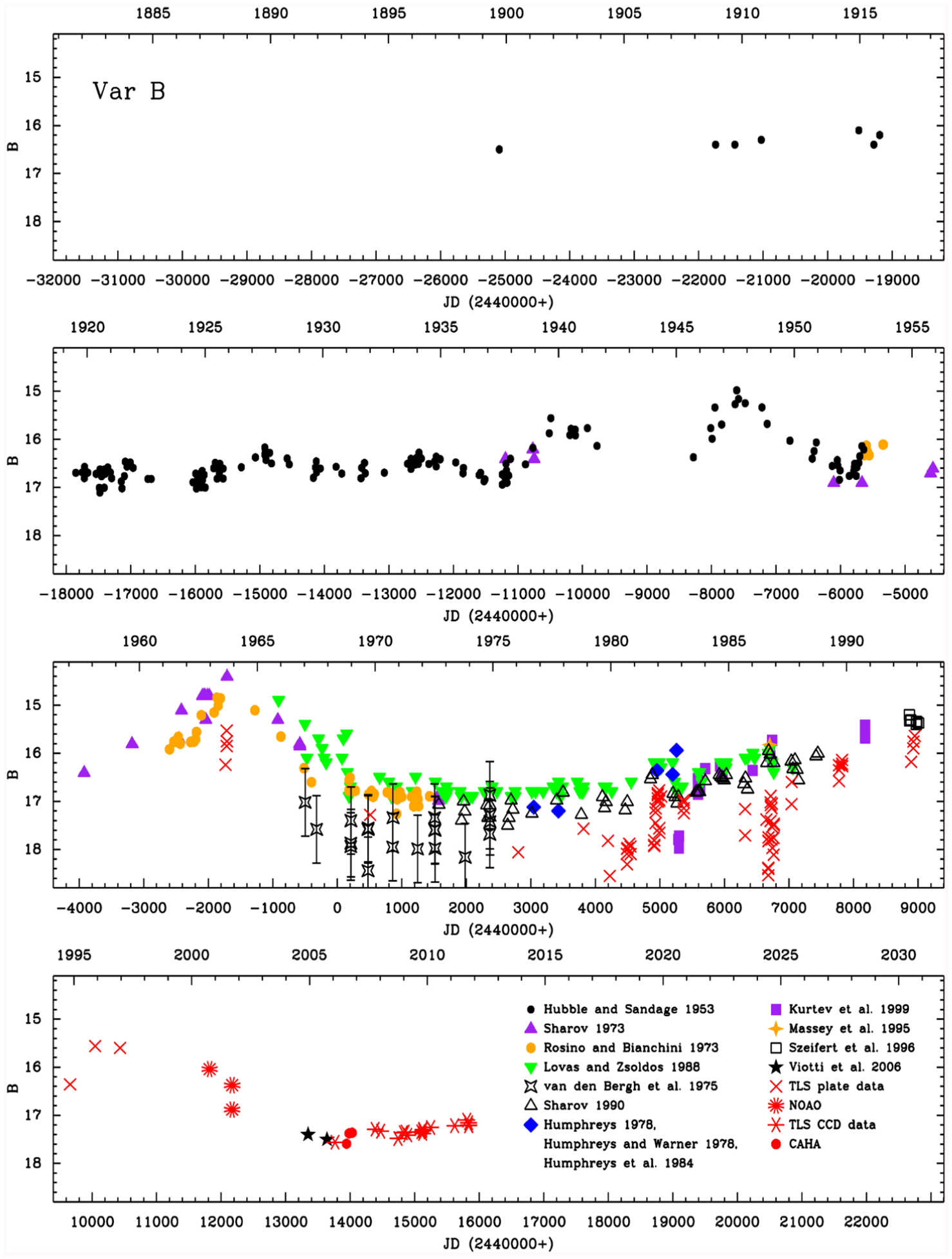
This figure, taken from Burggraf’s 2015 PhD thesis “LBVs in M33: Variability and Evolutionary State,” 58 shows the B-magnitude lightcurve of LBV Var B between 1899 and 2011.
From 2012 to the present, Var B has been one of the numerous stars monitored in the UIS Barber Observatory Luminous Stars Survey. 52 In that time, it never got brighter than V = 17.00. Figures 9 and 10 show the lightcurve of Var B from 2012 to 2024 in V- and B-magnitudes, respectively.
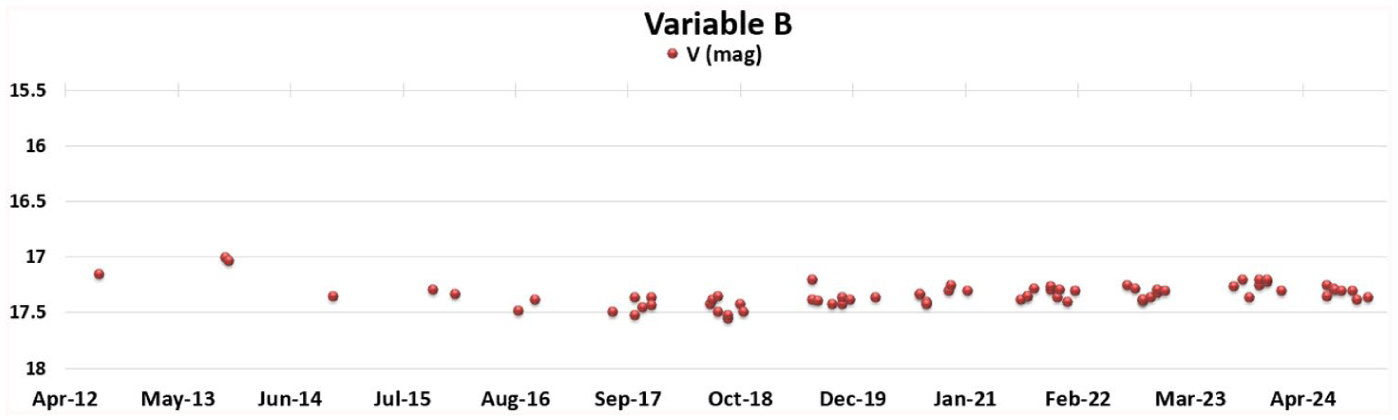
V-magnitude lightcurve of LBV Var B from 2012 to 2024 compiled from the UIS Barber Observatory Luminous Stars Survey <https://go.uis.edu/m31m33photcat>.
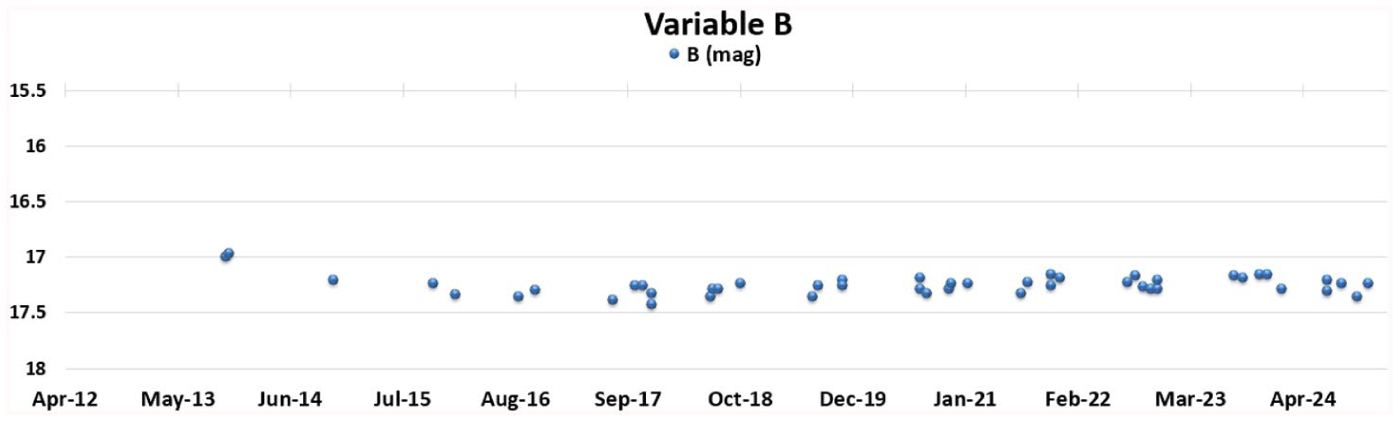
B-magnitude lightcurve of LBV Var B from 2012 to 2024 compiled from the UIS Barber Observatory Luminous Stars Survey <https://go.uis.edu/m31m33photcat>.
Variable 83 (J2000.0 RA 01:34:10.91 Dec +30:34:37.4)
Var 83 was first cataloged as a yellow variable during an investigation of 67 plates obtained with the 48-inch Schmidt telescope on Mount Palomar from January 1966 to November 1974. 53 While the authors emphasized that the magnitudes they obtained were of low accuracy and that “. . .no attempt was made to use these observations to derive periods for the newly discovered variables,” they believed Var 83 was found to have reached a maximum magnitude V = 15.8.
Var 83 was later measured at magnitude V = 16.72 on September 22, 1976 and added it to the short list of known LBVs based on its strong resemblance to Var B both spectroscopically and photometrically. 54 In Humphreys’ 55 paper, “IUE and Ground-based Observations of the Hubble-Sandage Variables in M31 and M33,” they found that between September 1976 and November 1980, it rose from magnitude V = 16.72 to V = 16.51. Then, from November 1980 to October 1982, it rose to V = 15.43. In Sharov’s 56 paper, “Variability of Hubble/Sandage Objects in M31 and M33,” it was found that between 1972 and 1989, Var 83 got brighter than magnitude B = 16.0 only twice.
In Szeifert et al.’s 57 paper, “HST and Groundbased Observations of the ‘Hubble-Sandage’ Variables in M 31 and M 33,” they observed Var 83 from September 1992 into January 1993 and found it to only fade from magnitude V = 16.33 to V = 16.40. However, they did note that even though Var 83 was at minimum light, it was about a magnitude brighter than any of the other LBVs in M33 during minimum and commented that “Except for a brief brightening [of about a magnitude] in 1982–1983, Var 83 has. . .been relatively constant for many years.” In October 1999, Var 83 was found to be magnitude B = 16.1 with an amplitude of 0.1 59 while on October 4, 2000 it was recorded it at magnitude V = 16.03 and B = 16.13. 60 Figure 11 shows the B-magnitude light curve of Var 83 between 1967 and 2011, reproduced from Burggraf’s 2015 PhD thesis “LBVs in M33: Variability and Evolutionary State.” 61
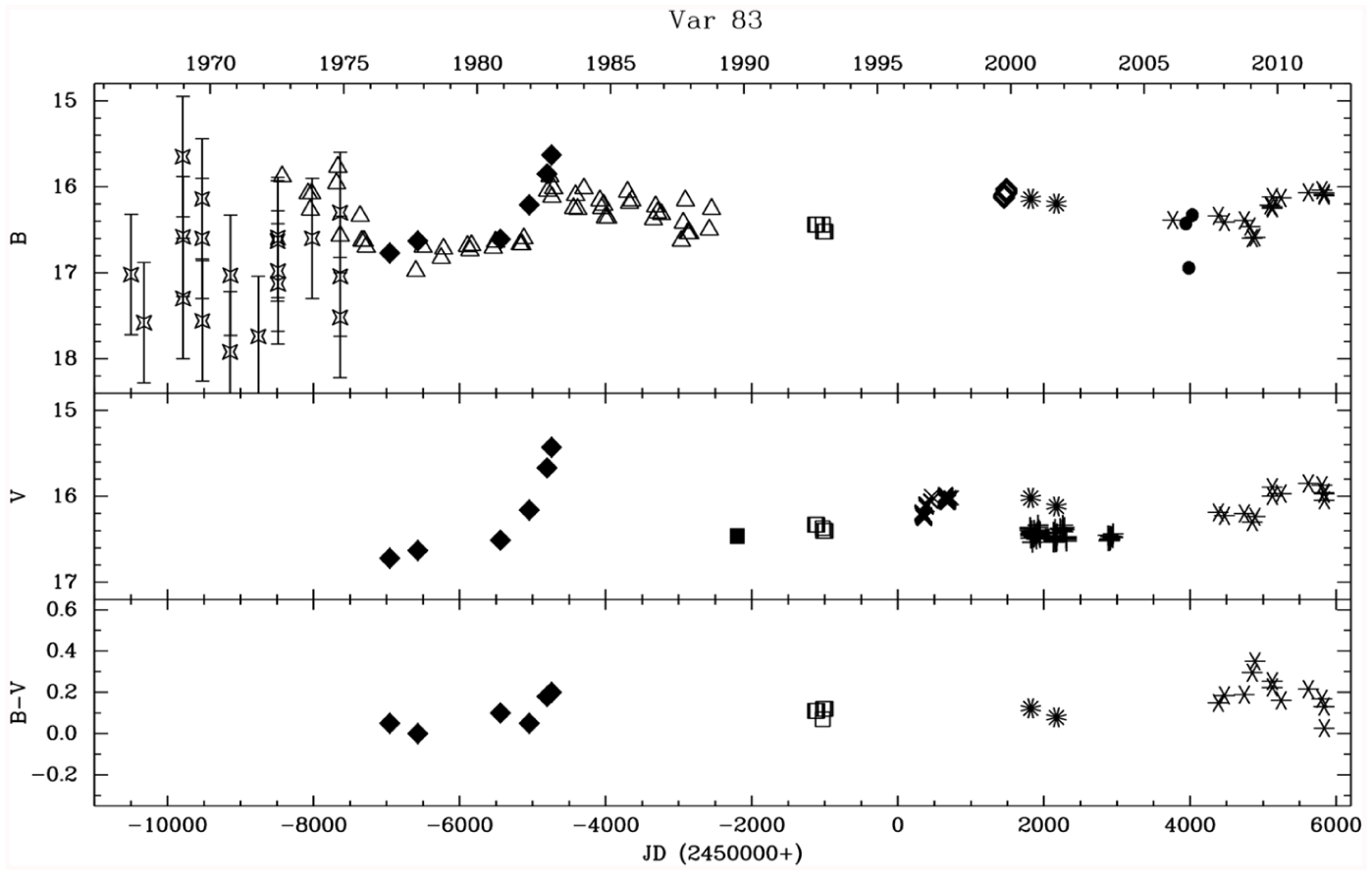
This figure, taken from Burggraf’s 2015 Ph.D. thesis “LBVs in M33: Variability and Evolutionary State,” 63 shows the B- and V-magnitude lightcurves and B-V color curve of LBV Var 83 between 1967 and 2011.
As with Var B, the UIS Barber Observatory Luminous Stars Survey has recorded the brightness of Var 83 several times a year since 2012 using a 20-inch telescope equipped with a BVRI CCD. 62 As a result, we know it got as high as V = 15.75 on October 26, 2016 before dipping as low as magnitude V = 16.80 on August 15, 2021 – an amplitude of a full magnitude. Figures 12 and 13 show the lightcurve of Var 83 from 2012 to 2024 in V- and B-magnitudes, respectively.
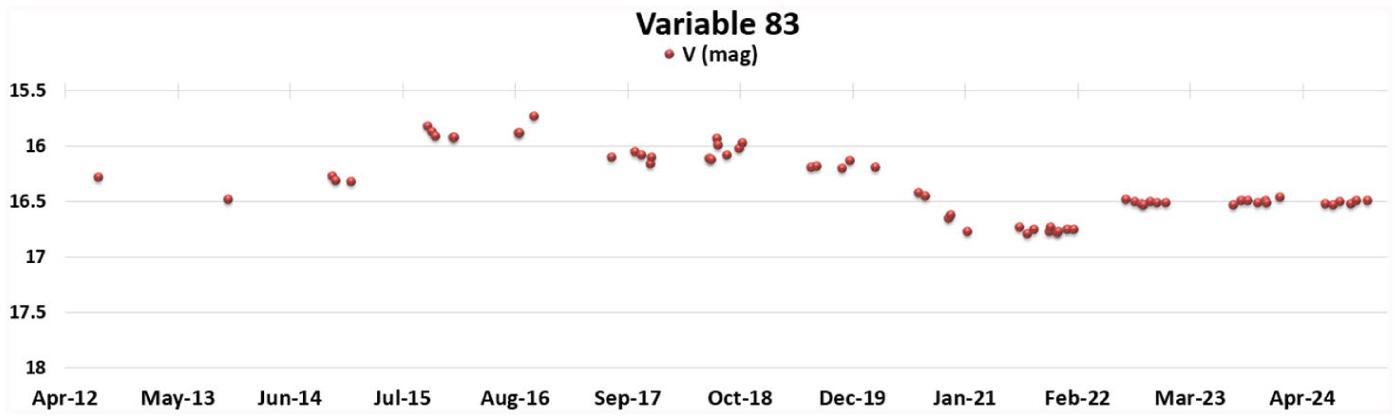
V-magnitude lightcurve of LBV Var 83 from 2012 to 2024 compiled from the UIS Barber Observatory Luminous Stars Survey <https://go.uis.edu/m31m33photcat>.
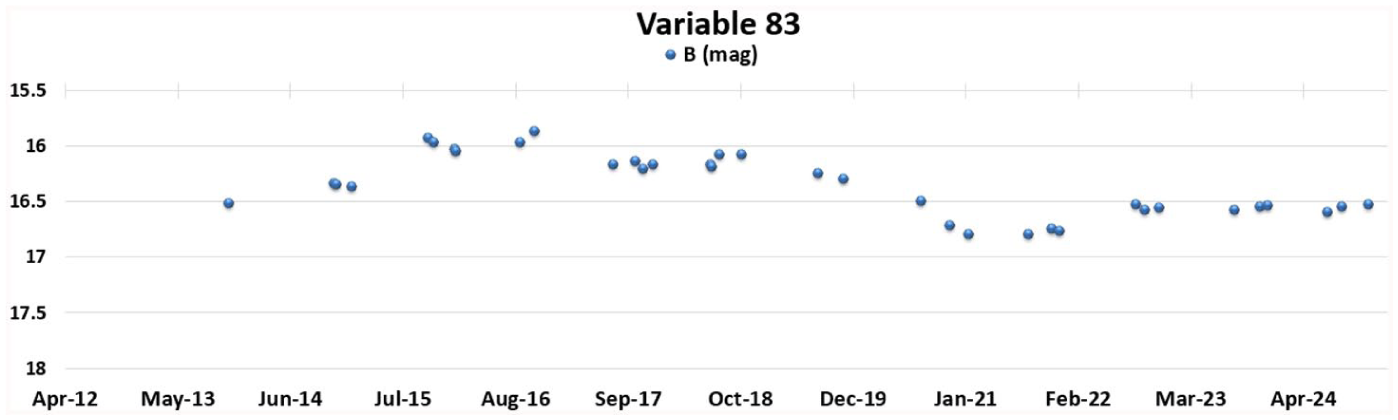
B-magnitude lightcurve of LBV Var 83 from 2012 to 2024 compiled from the UIS Barber Observatory Luminous Stars Survey <https://go.uis.edu/m31m33photcat>.
Summary
In the middle of the 1800s, several drawings of M33 were done using the largest telescope of the. Since then, the stars plotted on them were assumed to be foreground stars overlayed on the galaxy. However, one drawing included micrometer measurements for 21 stars around the galaxy, allowing for a positive identification for all 21 in current star catalogs. By careful examination, I have shown that two of those stars were in fact member stars of M33. Known as LBVs, they were only visible because they were in an eruptive state.
Using the fact that no stars were sketched or measured on Bindon Stoney’s 1850–1851 drawing that are currently fainter than V = 15.5, an LBV seen would necessarily be brighter. For Var B, twice in the 1900s an eruption was photographed that pushed it past magnitude V = 15.0 even though for the last decade it’s been fainter than V = 17.0. Hence, the 1850–1851 eruption of Var B is only unique for being its first documented.
In contrast, Var 83 has never been caught in a similar eruption even though its absolute bolometric magnitude is about one magnitude greater than Var B. 64 The brightest it has been recorded at since its discovery after 1965 was V = 15.43 (B = 15.63) in October 1982. Considering the two drawings were about 6 years apart, for Var 83 to be brighter than V = 15.5 for that long would indicate that it was in an eruptive state and reached approximately magnitude V = 14.0–15.0.
Footnotes
Acknowledgements
I thank the anonymous referees who so kindly read my manuscript and provided invaluable feedback that improved it enormously. I also thank the likes of Dr. Harold Corwin, Steve Gottlieb, and Dr. Roberta Humphreys for their many comments and suggestions to the manuscript. Thanks also goes to the Royal Society for their splendid job of keeping William and Lawrence Parsons’ publications available for the public. My gratitude goes to Scott Conner for letting me use his image of M33.
Author’s note

Funding
The author disclosed receipt of the following financial support for the research, authorship, and/or publication of this article: This work made use of Aladin Sky Atlas developed at CDS, Strasbourg Observatory, France and the Sloan Digital Sky Survey, which funding was provided by the Alfred P. Sloan Foundation, the U.S. Department of Energy Office of Science, and the Participating Institutions.