







Abstract
In 1956, Akhtar Khan began a project in rural East Pakistan that inspired new approaches to community and organization development. A quarter century later, he replicated the developmental process in impoverished neighborhoods of Karachi. The techniques of shared decision making, building cooperatives, training the master trainers, and encouraging self-sufficiency were pivotal to the approach. The effect transformed the two communities and helped inspire microfinance. Using the lens of intentional change theory in a post hoc analysis, we explain why this approach worked. The article allows us to honor a social innovator while affirming our commitment to practices like participation to create and reinforce a shared vision, creating new resonant relationships, building a multilevel intervention with distributed leadership, inclusiveness in training for empowerment, and continuous attention to cycling through the process iteratively. These are offered as insights in the design of organization and community development efforts.
The effectiveness of the Comilla Project in what was East Pakistan (now Bangladesh) and the Orangi Pilot Project in Karachi (Pakistan) were the result of the efforts of many people. The Achilles’ heel of sustainable community development has been the inability of development projects to generate widespread grass-roots momentum (Khan & Tessendorf, 2001). These projects were marvels of success in social mobilization. Uphoff, Esman, and Krishna (1998) pointed out, “Successful rural development programmes depend more on ideas, leadership and appropriate strategies than money” (p. viii). The Comilla and Orangi projects are linked by the philosophy, inspiration, and leadership of one man—Dr. Akhtar Hameed Khan.
This article is about how Dr. Khan approached the two projects. Today, they still inspire projects all over the world, such as the Shakti Project of Unilever in India or the Annapurna Project in Ghana. Few people are aware of the work of Dr. Khan, his legacy, and how he started this in the late 1950s. He and his work were one of the inspirations for the Nobel Laureate Mohammad Yunus to create microfinancing projects (M. Yunus, 2012, personal communication). In this article, we will use intentional change theory (ICT) in a post hoc analysis to explain why these two efforts were so effective. In ways that Khan might have felt instinctively, we will show how this post hoc analysis can help in the design and execution of organizational and community development projects. Although there is no magic formula for a successful community development effort (Uphoff et al., 1998), we believe that understanding how and why these worked will help others in initiating transformative change.
Intentional Change Theory
Akhtar Hameed Khan changed Comilla and Orangi through intentional efforts. He was able to bring the desired changes in a sustainable manner. The reason why the process worked can be explained by ICT (Boyatzis, 2008).
ICT describes the essential components and processes of sustained, desired change (SDC) in a person’s behaviors, thoughts, feelings, and/or perceptions (Boyatzis, 2008), as shown in Figure 1. The theory is a multilevel theory claiming that the same processes and phases occur for SDC at other levels of human endeavor, such as dyads, teams, organizations, communities, and countries. While a detailed explanation of ICT is beyond the scope of this article and has appeared in earlier publications (Boyatzis, 2008; Goleman, Boyatzis, & McKee, 2002), it is important to review briefly the major propositions in the theory.
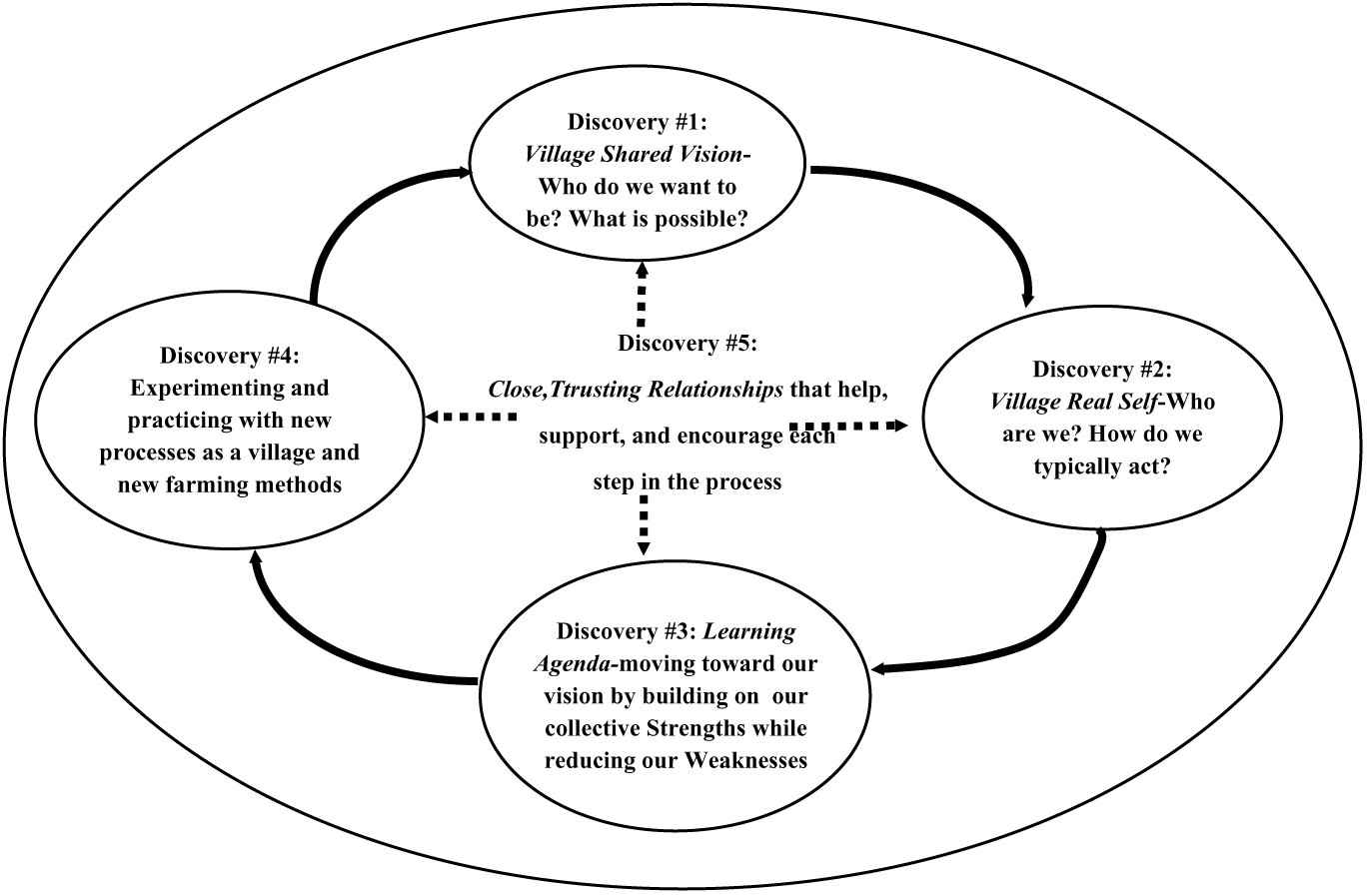
Village/community intentional change theory.
ICT explains SDC in human systems as a complex system with the following propositions (Boyatzis, 2008): (1) SDC is often discontinuous and nonlinear. (2) Progress on SDC can be seen as a series of emergent, conscious realizations. (3) These conscious realizations may be experienced as epiphanies or discoveries. (4) Observations and research in SDC suggest that five recurring discoveries are typically present: (a) the Ideal Self or shared vision in human groups; (b) the Real Self or shared culture, norms, and values; (c) the Learning Agenda or shared agenda; (d) Experimentation and practice with new thoughts, feelings, attitudes, or behavior; and (e) development of Close, Trusting Relationships. (5) The Ideal Self (or personal vision and shared vision at the collective levels of human groups and organizations) is the “intention” or purpose for SDC. (6) The Real Self (or shared culture, norms, values, and nature of the relationships within the group) is how the individual or groups behave and would appear to others. (7) The Learning Agenda is the articulation of a plan of activities to move closer to the vision or shared vision—the action plan. (8) The experimentation and practice experiences are those attempts to try to enact the new thoughts, feelings, attitudes, or behavior. (9) The development of close, trusting relationships is the fifth discovery that enables a person to proceed through the other discoveries with validation, support, confirmation, encouragement, reality-checks, or confrontation. (10) Movement from one discovery to the next occurs when a tipping point or trigger point is reached between the Negative Emotional Attractor (NEA) and Positive Emotional Attractor (PEA). (11) The NEA is a state of being aroused in the Sympathetic Nervous System with related neural networks (i.e., the Task Positive Network) activated and having negative emotions with varying degree of intensity. (12) The PEA is a state of being aroused in the Parasympathetic Nervous System with related neural networks (i.e., the Default Mode Network) activated and having positive emotions with varying degree of intensity. (13) SDC occurs as a fractal of this process at all levels of human, social organization from individual to dyads to teams to organizations to communities to countries and to global processes. (14) Two factors facilitate transmission of information and emotion across these levels: resonant relationships with leaders and social identity groups.
The starting point in the process of intentional change is the discovery of who we want to be (Boyatzis, 2008). Our Ideal Self is an image or a vision that emerges from our dreams and aspirations (Boyatzis & Akrivou, 2006). For a community, it is their shared vision. Although others have documented the power of vision in sports, music, and academic fields (Boyatzis, 2008), recent functional magnetic resonance imaging studies have shown that thinking about a personal vision activates neural circuits that involve imagining, being more cognitively, emotionally, and perceptually open (Jack, Boyatzis, Khawaja, Passarelli, & Leckie, 2013). This allows individuals to try new things, but because of the effect of emotional contagion, it spreads to others in the person’s vicinity (Boyatzis et al., 2012).
In Phase 1 of ICT, it is possible for a community to coalesce around a shared vision. Boyatzis and Soler (2012) described how two brothers, fifth generation in a family business, developed a shared vision and saved their family business. The brothers in the Boyatzis and Soler (2012) article spread their vision to others in the region and helped revitalize a community by talking with others and sharing their excitement. Neff (2011) showed that shared vision predicts long-term financial success of family businesses.
Once a sense of Ideal Self has been built, the next phase is the awareness of the Real Self. At the community level, this is how living in the community is experienced by those involved and others outside of the community (Boyatzis, 2008). Awareness of the Real Self helps us identify our strengths and weaknesses. The third discovery is the formation of a Learning Agenda, which often becomes a learning plan. The next emergent awareness comes in the form of Experimenting and Practicing with planned behaviors (Boyatzis, 2008). All these phases are made possible if there exist Close, Trusting Relationships among those involved in the process (Khawaja, 2011).
According to ICT, movement to the next phase and continuation of the iterative recycling occurs through tipping points. According to Boyatzis (2008), there are moments of emergence in moving from the NEA to the PEA. Due to the observation that negative emotions are stronger than positive (Baumeister, Bratslavsky, Finkenauer, & Vohs, 2001), the positive or PEA has to overcompensate for forward movement in the ICT discoveries. Because negative emotions are stronger than positive emotions, to help people become cognitively, perceptually, and emotionally open and consider change, a person and by extension groups of people must experience more frequent PEA moments to compensate for the reduction in cognitive, perceptual, and emotional functioning caused by negative affect and being in the SNS (Boyatzis, Smith, & Blaize, 2006). We believe that actions that invoke the PEA have to be engaged three to six times more often than those of the NEA, as suggested by Fredrickson (2009).
All too often, development efforts involve a generous and well-intentioned funding agency telling people in communities what they need to do to improve. This approach is often experienced as an imposition, implying that if you take the money or resources you are obligated to act in a certain manner. Both of these experiences engage the NEA and eventually lead to less openness to new ideas. The attempt at helping in these more traditional and more typical approaches result in the exact opposite arousal to those intended within the people experiencing it—they become closed to change and new ideas, not more open to them.
In an analogous manner, planning for the future can invoke more NEA than PEA with its detrimental effects. In ICT, it is claimed that the driver of the vision or shared vision is followed by planning and setting of goals. In traditional and typical community change efforts, planning is required before a clear vision emerges. The result is that people set goals and plan, but it feels like an obligation, invokes the NEA, and results in people being more defensive and closed.
The spread of the PEA or NEA state from person to person occurs through emotional contagion (Boyatzis et al., 2006). When these states are engaged at the community level, emotional contagion enables a new PEA open state or a return to the defensive NEA state between neighbors, villagers, families, and between various coalitions and subgroups within the community (Fowler & Christakis, 2008, 2010; Hatfield, Cacioppo, & Rapson, 1994). Research in neuroscience has shown that the role of mirror neuron networks (Iacoboni, 2009) and sympathetic hemodynamic networks (Decety & Batson, 2007) enables a person to unconsciously and quickly (within milliseconds) tune into the actions of others and their feelings. These emotions are sensed by others in a person’s environment at an unconscious level. They spread quickly, in under a second and often in milliseconds, to others in one’s environment because of the work of the von economo neurons (Allman, Watson, Tetreault, & Hakeem, 2005). Emotional and social contagion depends, of course, not only on the ability of other individuals to correctly recognize the signal of an emotional state through body positioning, facial expressions, or verbal cues but also on unconscious sympathetic hemodynamic processes in which brains affect other brains around them (Decety & Batson, 2007). This is the social process by which the PEA and NEA tipping are triggered, and moving through ICT helps a group or community become open to new ideas and change and sustain a learning process.
Since it is a multilevel theory, ICT also describes SDC at other levels (Boyatzis, 2008), such as dyads (Boyatzis, Smith, & Beveridge, 2013), teams (Boyatzis, 2010), organizations (Boyatzis, Smith, Van Oosten, & Woolford, 2013; Van Oosten, 2006), communities, and countries (Howard & Coombe, 2006). Boyatzis (2008) has described this as follows: Sustainable change within a family, team or small group occurs through the cyclical “group level definition”of the five discoveries. The ideal self becomes a shared vision of the group’s future. What does the group want to be, what can it be? Similarly, sustainable organizational change occurs through the five ICT discoveries at the organizational level, and so on at the community, country, and global level. (p. 308)
As will be explained through the lens of ICT in the next section, it appears that Akhtar Khan helped the people of Comilla and Orangi feel more hope about the future (Mustafa, 1984; Schumann, 1967). He encouraged the villagers and lane residents consider a different future by asking about what they most wanted. Early experiences of success most likely had an effect of increasing their sense of efficacy, like saving a few rupees. As they experienced more, it fed creativity through the PEA and neural activation explained previously. Hope and efficacy are crucial components of a personal or shared vision (Boyatzis & Akrivou, 2006). More than increasing participation, Khan’s process was participation in developing and reinforcing a shared vision, with the commensurate experience of hope.
This is an archival review of two projects. Interviews conducted at the time of each of the projects as well as detailed local reports and evaluations were analyzed, along with video and written documents on the web. Anthologies like Krishna, Uphoff, and Esman (1997) that included a reflective chapter on Khan and the impressive synthesis of these cases in Uphoff et al. (1998) were reviewed. In qualitative analysis, this was a manifest analysis. Not being a latent analysis, it does not require detailed coding, coder reliability, and many of other forms of qualitative analysis (Boyatzis, 1998). We are not offering this as a new qualitative analysis but as an act of synthesis and interpretation from archival sources.
The value of case study method has sometimes been the subject of criticism in social sciences. The subjectiveness of retrospective reports is criticized for their lack of controls with internal validity. Case studies are a method of scholarship that defines cases rather than establishment of casual inferences. Case studies, as in the case of this article, rely on the interpretation of archival data, diaries, letters, and so on. Although the generalizations through case studies may not be easily made, the case study is central to development of a nuanced view of reality (Flyvbjerg, 2011). For the purpose of analyzing limited number of issues and complexity of a single person or project, case study method is an extremely useful one (Runyan, 1982). This is the approach of this article, which analyzes two case studies and relates it to the vision of Dr. Akhtar Hameed Khan.
The Comilla Project
Ali Ahmed woke up one morning in the spring of 1959 on his 2.5 acre farm in South Rampur, a village of about 90 families (500 inhabitants). He is poorer than his father was. He is illiterate and it appears that his children must remain illiterate also. He owns only one bullock, whereas his grandfather owned four. He has less than half the land his grandfather held. He is head over heels in debt, on which he pays half his total farm production in interest. He is at the mercy of the wind, the flood and the drought. There is a black future ahead and little that can be done about it. This is what Ali and all his neighbors believe. (Fairchild & Huq, 1961, p. 10)
However, the world was about to change for Ali Ahmed and his neighbors in this rural part of East Pakistan, now Bangladesh. Within 4 years, their food production would almost triple through the use of fertilizer, better seeds, better planting techniques, irrigation, electricity to run pumps, and planting a third crop. Their village council would save money, even after they had bought a tractor, electrical pumps for the irrigation ditches, and more livestock. A new set of possibilities would open up for Ali, his family, and neighbors. They and their children had the possibility of a better future. All this was made possible through the Pakistan Academy for Rural Development at Comilla.
Comilla was a densely populated area in the eastern part of East Pakistan (now Bangladesh). The landholdings in Comilla were very small. The Comilla Academy for Rural Development was conceived with the intention of establishing new channels of communication between farmers and development workers and providing multidisciplinary solutions to rural problems of Comilla (Karim, 1985).
Akhtar Hameed Khan was appointed as principal of Comilla Victoria College in East Pakistan in 1950. Khan established the project for rural development in Comilla after the United States shelved the Village Aid program (V-AID). The V-AID was launched in 1953 as a community development program. It was designed and drafted in the United States to be implemented in the rural areas of East Pakistan. It was typical of most First-World-funded development programs that were mostly unable to take into account the ground realities and had little buy-in from the targeted population. The V-AID program failed. It was abandoned in 1961 after the government realized that V-AID had been totally ineffective in improving the material life of the people (Hussain, 1996). Khan, after his return from Michigan State University, launched the Comilla Project in 1959. To execute the project, he created the Pakistan Academy for Rural Development, referred to as the Academy. Advisory support for this project was provided by Harvard and Michigan State Universities, USAID (United States Agency for International Development), and the Ford Foundation.
Karim (1985) and Schumann (1967) have described in detail the conception, design, and implementation of the Comilla Project. According to them, Khan realized that if the Comilla Academy was to fulfill the mandated function of training rural development officers, then they must make close and systematic observation of village conditions. The Academy used the Kotwali Thana area (similar to a county in the United States) as a laboratory area for experimenting in economic development and local government. He encouraged experiments on a farm located at the Academy site.
Khan believed that the process of adopting small changes and finding them effective would lead to an appetite for the villagers for being receptive to accepting larger and more complicated changes. In response to the needs he and his staff observed of the local population, three principle activities for the Academy were envisaged (Karim, 1985): (1) improvement of rural governance through training of officials and new group processes, (2) conduct of research and evaluations, and (3) new type of cooperative credit system to be developed for the local farmers.
Typically, when Khan and his colleagues would enter a village, they would ask to speak with as many of the villagers, both male and female adults, as could be gathered. They talked of the possible benefits of a better yield of crops. They offered the villagers the opportunity for loans and training, to learn about growing more crops from the same land, if the villagers met the Academy’s conditions. They listed the following 10 conditions:
The adult villagers must organize into a formal group and elect officers
They must hold regular weekly meetings and keep records
They must save money as a group
They must elect an official “organizer” who would go to the Academy twice a week for special training
They must keep good accounts and have a special person appointed to the job of being the group accountant
They must exercise group planning for the use of joint credit
They must exercise group planning for the use of group property
They must be willing to try new methods and use new machines for farming
They must join a larger cooperative federation for the purpose of securing credit, purchasing, marketing services, and educational materials
They must discuss as many things as possible with the whole group (Schumann, 1967)
Although these were stated as conditions for access to the loans and training, the Deputy Director would engage them in dialogue to get their input and have a thorough discussion about them. He would try to model the group process that the Academy was expecting from them. Khan knew that it would take a strong inducement to encourage the villagers to alter their age-old practices. He was of the opinion that it was their current norms that kept them from innovating. Current loans took a great deal of time to acquire, even if the applicant was deemed eligible. It also took a great deal of paperwork and working with the bureaucracy. The Academy offered new access and a new possibility. The conditions for loans under the new system were the following: (1) the village cooperative had to prepare an individualized plan for the use of the money; (2) the group had to secure the loan approval based on the plan; (3) once they got the loan they would use the money as per the outlined plan; and (4) the group would then repay the loan from production, paying a portion each harvest (Schumann, 1967).
From its inception, Khan maintained a culture of collaboration between the Academy and the local farmers. Although they had a family planning objective as a possibility from the beginning, they decided that it was too bold to initiate in the early stages of the project for a traditional South Asian village and was not one of the elements of development that villagers had identified in earlier discussions. In less than 4 years, the private sector, in the form of new cooperatives, joined with the public sector to form the KTCCA (Kotwali Thana Central Co-operative Association).
The agricultural cooperative program was the lynchpin of the Comilla Project and central to the success of the program for a new model of microcredit. The cooperatives would operate as primary or catalytic agents to disseminate the concepts of development (Haq, 1978). The two-tier cooperative system consisted of primary village cooperatives consisting of 20 to 75 villages and a central cooperative at the sub-district level (Karim, 1985). The cooperatives at the village level may be considered as Social Units, whereas the ones at the Thana (subdistrict level) may be considered as higher level Business Units. The cooperative functioning was made simple. The villagers would operate it themselves.
Each member bought a share in the cooperative. Capital was formed with the savings of the villagers. Every member was required to deposit some savings into the cooperative on a weekly basis. Farmers could also pledge savings “in kind,” as a portion of their harvest and amass credit in the village cooperative. The shares and deposits earned interests and dividends at market rates. Such financial transactions were positive, even if they violated some tenets of Sharia principles in terms of principals and interest. Within weeks, villagers had saved several hundred rupees (about 100 dollars at the time) and realized that they could actually gain collective financial power.
The cooperative credit system replaced the local exploitative credit institution of money lenders. The helpful and more personal but reasonable aspect of investment in their futures was relief from abusive practices and was valued in the context of their communities and faith. This stimulated hope and created a new level of efficacy about their future.
The villagers jointly planned the use of purchased tractors, water pumps, and later sophisticated services such as cold-storage plants and dairy operations. The central cooperative supplied the necessary agricultural supplies, credit, and training. The village groups elected their own representatives every 2 weeks, who would receive training at the central association.
Under the leadership of Khan, the academy had created a “learning environment” and was willing to change direction whenever required. The staff and participants in the Comilla Project learned through an inductive process. He was assisted by able and inspired companions such as Dr. Majeed Khan, who lead various aspects of the program (Khan, 1963). It was a synergistic effort between the staff and the community members.
Education and training was delivered to three groups of individuals in each village. One group were the “organizers” who became de facto extension agents for the Academy, bringing their new knowledge and ideas about farming back to the village after the two classes each week at the Academy. The second group was the accountants. The third group was the helpers for the organizers who assisted in providing training and education to the farmers. The organizers would learn techniques of farming, irrigation, fertilizer, and sanitation. They would learn ways to improve the health of children and fellow villagers.
When the organizer would report a new type of problem occurring in the village to the Academy training sessions, they would discuss and explore how best to handle it. This resulted in emergent leaders and distributed leadership throughout the village. The different leaders enabled momentum on projects to continue at multiple levels at the same time (i.e., for individuals, for couples, for families, for villages, and for regional cooperatives). As an incentive, the Academy would pay the organizer for their time at the Academy and training efforts. The expectation was that the village cooperative would take over the payments for this person as soon as possible. Since the villagers elected this person, it was a personal experience with democratic processes and the experience of collective power. As the experiment evolved, members of local government agencies were brought into the experiment and given access to the same education and training. They were encouraged to explore discussion and problem-solving behavior, instead of relying on established procedures and policy, which was the typical bureaucratic response.
In 1962, a public works program in drainage and road building began. A marketing project also was started to sell the produce from the cooperatives. In 1963, the United Bank took over all credit operations. A cold-storage plant and rice mill were started. At the same time, a Women’s Program began, including the training of midwives and education in home cleanliness. A Rural Electrification Project was started, and a creamery and dairy cooperative were formed. The larger cooperatives began to sell rice, potatoes, and vegetables. Three other experiments, like Comilla, were begun in other parts of East Pakistan. By 1964, irrigation programs and communications between villages were established.
The results were dramatic. Rice production almost tripled in the early years of the project and continued to remain more than twice the national average per acre by 1980. Family farm income increased by 210% in the 1960s. This was in contrast to the 100% increase in neighboring thanas (Barkat-Khuda, Harbison, & Robinson, 1988). By July 1964, 156 village cooperatives had been established with a membership of 5,980 people. Cash savings of Rs. 375,305, shared capital of Rs. 54,125, and reserve savings of Rs. 2,113,777 were realized (Schumann, 1967). General adult education programs were begun, and a library was created and distributed literature from the Academy. Khan remained as the director of the Rural Academy at Comilla until 1971.
The Comilla approach dealt with local conditions and focused on holding the interest and cooperation of involved officials and people. The model showed that farmers with small land holdings in developing countries could be organized. It could bring dramatic changes in their living conditions. The staff of the Academy made positive use of cultural factors. For example, since many farmers gathered at the mosque for Friday prayers, the training sessions were usually made to coincide with the end of the Friday prayers. Raper (1970) observes that the Comilla model may not be considered as much a formula for development but in fact a formula for finding a formula for development to fit indigenous conditions.
In Comilla, poor controls, government interference, and reallocation of resources resulted in only 400 functioning cooperatives by 1979 (Chowdhury, 1990). Without a leader and distributed multiple levels of leadership, the social system will come apart. Deterioration in Comilla in the 1970s might have occurred because of other factors, like geopolitical changes (East Pakistan became Bangladesh), economic changes, climate changes, and shifting priorities of different governments (Uphoff et al., 1998).
But in 1990, the Comilla approach was replicated as the village-based cooperative or “Comilla model” for development, which later became known as the Comprehensive Village Development Program (Chowdhury, 1990). It was adopted as a development strategy for the whole of Bangladesh. By 2005 there were 63,000 village-based cooperative societies with 2.2 million members being managed in the 490 thanas of Bangladesh (Bhuiyan, Faraizi, & McAllister, 2005).
The Orangi Pilot Project
While the Comilla Project had become a success story, which was being replicated elsewhere, war in that part of the world resulted in the emergence of independent Bangladesh. In 1971, Khan consequently moved to (West) Pakistan. In the early 1970s, he was a research fellow at the universities of Faisalabad and Karachi. He went back to Michigan State University as a visiting professor in 1973 and remained there for the next 7 years. During this time he served in the capacity of a visiting professor at Lund, Harvard, and Oxford universities. He then returned to Karachi, Pakistan, and started another inspiring project—the Orangi Pilot Project (OPP)—in which he worked from 1980 to his death in 1999.
Orangi is perched on a hill on Karachi’s northwestern suburb. The OPP is considered one of the world’s most successful experiments in improving the lives of the urban poor (Krishna et al., 1997; Pearce, 1996).
The Orangi Pilot Project was very different from the Comilla Academy. OPP was a private body, dependent for its small fixed budget on another NGO. The vast resources and support of the government, Harvard advisors, MSU (Michigan State University), and Ford Foundation were missing. OPP possessed no authority, no sanctions. It may observe and investigate but it could only advise, not enforce. (Khan, 1996, p. 42)
Although different in outlook, Khan and his colleagues believed that the same fundamental approach to development that applied in Comilla would work in Orangi. Khan thus spent time in the community, seeking to understand their culture and ways. He found that due to disease the residents’ medical bills were six times greater than for others’ living in sanitary conditions. Khan called this the health-tax (Khan, 1997a, 1997b). These were expense of resources that the poor could otherwise spend on food and school. Khan’s team decided to help the residents of Orangi. Based on the needs and demands of the locals, Khan’s first aim in Orangi was to improve sanitary conditions (Khan, 1997a, 1997b).
OPP was initially sponsored by Agha Hassan Abedi of Bank of Credit and Commerce International (Khan, 1992). OPP considered itself a research and technical support organization. Its objective was to analyze problems of the Orangi township through action research and then provide extension education to discover solutions to those problems. OPP hoped to help the community begin self-management and provide technical support (Khan, 1996). Like in Comilla, OPP wanted to help mobilize local financial and managerial resources by encouraging the practice of cooperative action.
Orangi Township began as an unplanned settlement in the outskirts of the sprawling city of Karachi in 1962 (Inayatullah & Birley, 1996). The Orangi settlement was set up on the outskirts of Karachi by enterprising migrants from rural areas and refugees from Bangladesh (Urdu-speaking population). They had more human capital than the people of Comilla had two decades earlier. They were poor businessmen, merchants, tradesmen, and skilled workers. This was a contrast to the Pashtuns who entered later and settled in the hills of Northern Orangi. By the mid 1980s, Orangi extended over 8,000 acres and had a population of about one million (Khan, 1992). The generally unplanned and informal settlements were predominantly underserved by public utilities. The government was in fact reluctant to officially acknowledge Orangi’s existence and so refused to provide services.
In 1970, the Karachi Municipal authorities finally accepted the fact that the Orangi squatter settlement was there to stay. The residents were eventually allowed to procure title to land, and so they felt a sense of permanency and focused on improving their living conditions (Khan, 1997a, 1997b). The public sector was still almost nonexistent, and only a tenth of schools and clinics were state-run (Pearce, 1996).
In the residents’ opinion, sanitation was the most urgent need of Orangi. However, the cost of laying sewage pipes was seemingly out of the reach of the locals. In 1980, bucket latrines or soak pits were being used by the Orangi residents for disposal of solid human waste. Open sewers disposed the waste water. Khan (1992) termed such sanitation methods as “medieval.” According to Khan (1997a), when there is a medieval sanitation system, there is a medieval level of health in the communities, and no country can advance without a healthy population. The first focus of the OPP was to build a modern sewerage system.
According to Dr. Khan, there are four major barriers for communities to work together and develop the infrastructure on their own (Khan, 1996):
Psychological barriers, like the belief in urban slum communities of the developing world that they would get sanitation and water from the government as a free service. In other words, it is related to the old socialist model that everything will be done for the people by the state.
Financial barriers, like the belief that the cost of construction and maintenance is not affordable for them to be able to do it on their own.
Social barriers, like the belief that mechanisms for collective working and trust among the community members is lacking.
Technical barriers, like the belief that the requisite expertise for construction and maintenance is not available within the community.
In Khan’s opinion, the removal of the economic barrier of the high cost of latrines could be the catalyst that would lead to the removal of the other three barriers.
OPP proposed that they could buy all necessary materials if each household paid an average of $42 (Khan, 1992). This was an average month’s salary for an Orangi family. With their combined efforts, the residents invested about 2 million dollars of their own in the project. There was no loan or subsidy but just a willingness to improve their own future. The Orangi residents began to consider that they were not destitute. After all, they had built their houses as solid structures in the squatter settlement, which had cost them about $1,500 each. This often involved microcredit and finance projects. For example, one loan was to purchase a pump for a lane in the neighborhood. In other cases, the microcredit allowed craftsmen to purchase the tools they needed to practice their trade. The residents also paid for electricity and water connections.
The project was approached in a “learning process” mode instead of the traditional prescriptive manner (Khan, 1997a, 1997b; Krishna et al., 1997). The OPP experts found ingenious ways to drastically bring down the cost of modern sewage-line construction. By simplifying the design and eliminating the middle man, Khan proposed that the residents could construct the system themselves. The basic structural unit of the OPP is the lane or the street. There are four levels of a modern sanitation system that were required to be constructed: (1) inside the house—the sanitary latrine; (2) in the street/lane—underground sewerage lines with house connections; (3) secondary or collector drains; and (4) main drain and treatment plants (Khan, 1992). The residents were capable and willing to finance all the sanitary arrangements at the first three levels. The main drain and the treatment plant had to be the responsibility of the government because of the magnitude of the project.
Each small street or lane in Orangi has approximately 20 to 30 houses. Khan solicited a great deal of input from the residents. He believed that residents should decide the changes to be made. The OPP crafted a master plan only after it felt that it knew the people, their needs, and the culture of Orangi and what they wanted. It took Khan more than 3 months of listening and discussing these issues before the first lane agreed to participate in the project (Mustafa, 1984). A lane manager was chosen by the households in each lane. This person would collect contributions and allocate work. The OPP only provided technical details. As in Comilla, they asked that all the adults in the neighborhood be involved in discussions about their projects and use of resources. This increased the likelihood that they might develop a truly “shared vision” of a new possibility, as proposed by the ICT, not merely a government-imposed concept or one appealing to a small group of residents, which was imposed on others.
The area residents were organized and trained to lay the sanitation system. The sewage line was laid lane by lane. The OPP’s technical team of architect, surveyor, draughtsman, and other qualified persons supervised and assisted the construction of the lane’s latrines, primary and secondary drains.
At the same time, the United Nations Centre for Human Settlements (UNCHS), which was given a part of Orangi to provide sewerage system, failed miserably. They had used the traditional preplanned, target-oriented, systematic plan in community development. In 6 years of the project the UNCHS was able to develop only 36 lanes, whereas the OPP developed 4,000 lanes at one third the cost (Khan, 1996). Khan succeeded where the UNCHS failed because he was able to demonstrate that poor households can save and invest if they are engaged, have a voice and stake in the group decisions and project outcomes (Uphoff, 1998). Later, the UNCHS admitted that OPP’s philosophy and approach was correct and effective (Khan, 1996).
In Orangi, one million people constructed 5,610 underground lane sewers, 163,563 rft secondary drains, and 85,000 flush latrines. They did it with their own investment of US$2.5 million (Khan, 1992) and without loans. The finances were collected through neighborhood groups as they were instrumental in convincing inhabitants to sign on to the less expensive sanitation program and to keep them clean, as compared to what existing organizations were able to do (Wright, 1997). This willingness to pay was achieved because of the commitment of the individual members gained through decisions, which was representative of the group consensus. By 1997, almost every home in Orangi had a hygienic latrine connected to an underground sewer paid for by the residents themselves (Khan, 1997a, 1997b). This helped Orangi control disease and damage to their property. The infant mortality rate improved dramatically from 130 in 1984 to 37 in 1991. The expanded OPP ran other model programs in Orangi: (1) low-cost housing program, (2) health and family planning program, (3) enhancement of women’s skills in the garment sector, (4) upgrading schools, and (5) microcredit for family enterprises.
Women’s skill development became a principal program target for OPP in later years. Gender inequality has been shown to significantly hinder the community’s economic and social development (Epstein & Kim, 2007). Khan saw that with rising inflation, women would have to contribute to the household earnings, along with men. He felt that the traditional, patriarchal system had to give way. He created a special emphasis on their skill development and microcredits for women. In his reminiscences, Khan (1996) said he was touched by the emergence of women working in Orangi and by the fact that better education, health, and incomes were becoming possible for all because of them. Khan considered the development of the Orangi women as the “finest achievement of the Orangi project and the best preparation for entering the twenty-first century” (Khan, 1996, p. xli). Not surprisingly then, despite absence of state schools, the literacy rate among the youth in Orangi is 70%, considerably above the national average (Pearce, 1996).
Khan’s legacy in this regard has been carried on to this day by a courageous woman, Parween Rahman, who was the joint director of the OPP in the initial phases of the project.
The OPP model has also been replicated. OPP’s sanitation model is being replicated in other urban slums of Karachi such as Chanesar Goth, Manzoor colony, and Mauripur. It is also being replicated in other cities of the country such as Sukkur and Lodhran (Khan, 1992). UNICEF has accepted the Orangi approach to low-cost sanitation as a model for UNICEF Urban Basic services. The World Bank program for housing development is using a similar arrangement. Within Pakistan, OPP serves as technical advisor to the UNICEF, World Bank, and Swiss Development Corporation Projects, as well as a training center for their personnel.
Discussion
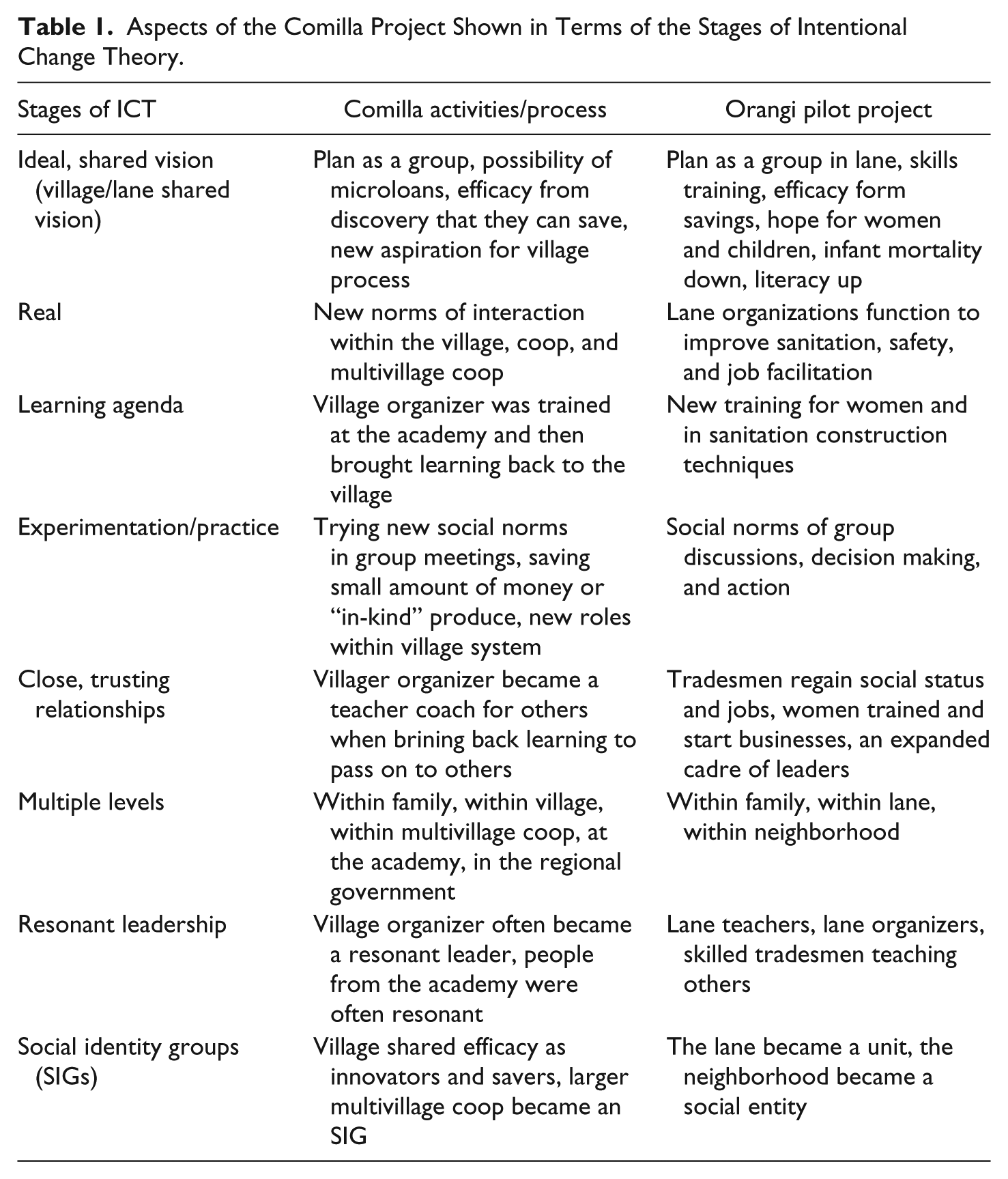
Aspects of the Comilla Project Shown in Terms of the Stages of Intentional Change Theory.
Specifics on How Intentional Change Theory Explains Why the Comilla and Orangi Projects Worked.
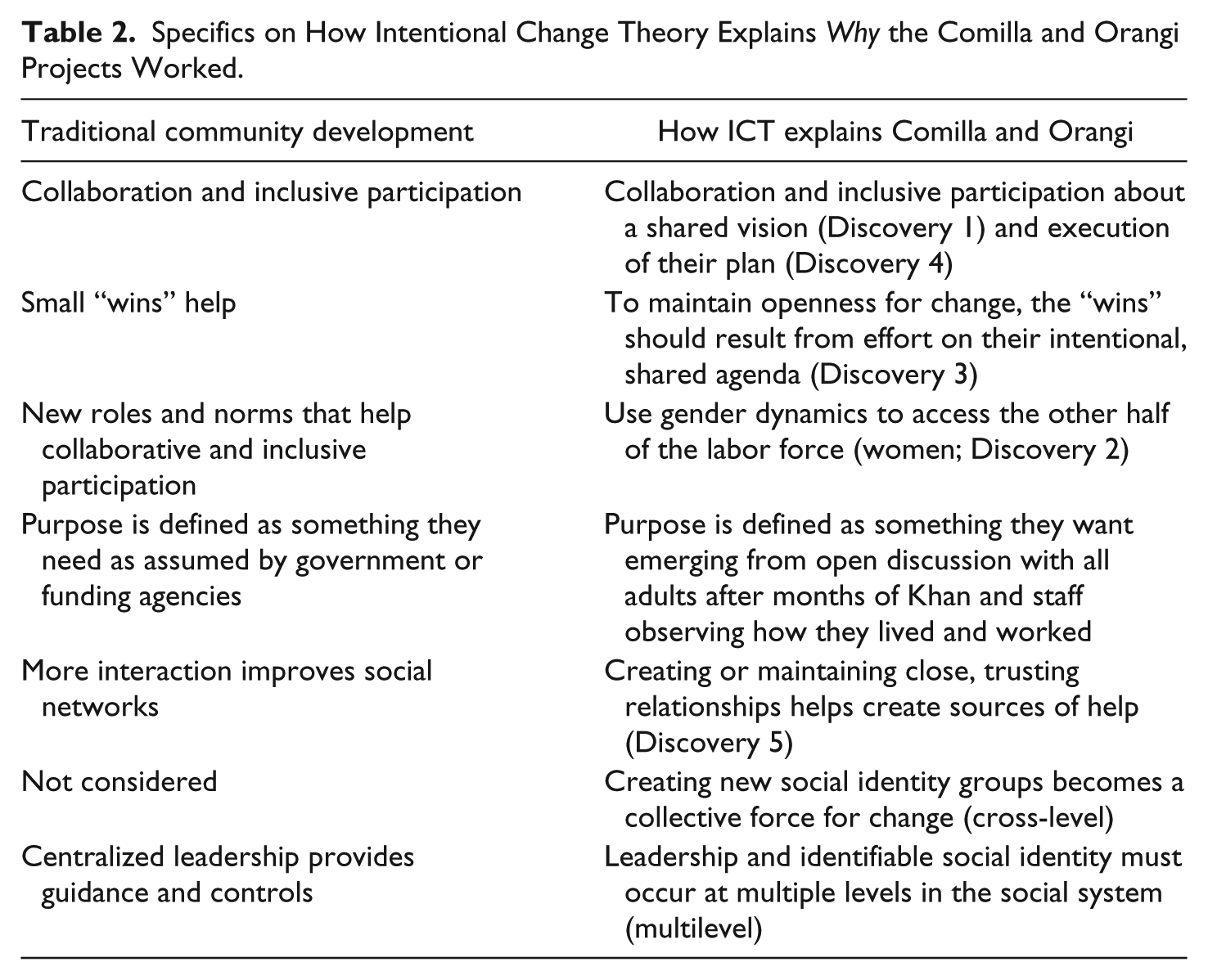
Empowerment and increased self-reliance occurred, as Uphoff et al. (1998) explained. We contend that discussion of the shared vision aroused the PEA with the neural activation that helped keep people open to change. This likely fed a sense of hope. To the extent that this triggered more PEA, the ongoing discussion of the execution, experimentation, and adaptation of their plans would also be more open than otherwise. Even if they did not mention it explicitly every time the villagers or lane residents came together, visually being together was an emotional reminder of the shared vision and purpose that had brought them together. As evidence of progress emerged, it reinforced the PEA and kept the iterations of ICT phases going.
Another observation from applying ICT to these projects was that relationships were built among the villagers or lane residents. New norms of interpersonal interaction involved in the group process requested by Khan enabled or enhanced new relationships (Discovery 5 in ICT). As the relationships grew bonds of trust and hope, people begin to use these relationships as support, reminders, sources of interpretation, reality testing, and encouragement, likely keeping them in the PEA. The relationships among the adults of the village or lane may have woven a new social fabric by the changing of interaction patterns.
A third observation from applying ICT is the creation of new social identity groups. The development of cadres (i.e., social identity groups) created new local organizations (Uphoff et al., 1998). Beyond dyadic relationships, these social groups invoke identity and, as progress occurred, pride. They fed the PEA, commitment to each other and their shared vision. It kept the energy and hope for the projects alive.
The relationships enabled the fourth observation from applying ICT to these projects. They operated at multiple levels of the social system at the same time. The village or lane was changing through formation of new cooperatives. There were village cooperatives and regional or neighborhood cooperatives. There was a new allegiance at the project level (RAD or OPP). A tenant of complex systems is that some factors move information across the multilevels of a complex system. ICT contends that resonant leaders and the emergence of a social identity group provide this linking function (Boyatzis, 2008). They not only move information across the levels but also move emotions and facilitate new networks of social relationships.
The facilitation of leaders, educators, and change agents at many levels brought a fifth observation of distributed leadership at multiple levels of the social system in which the villagers or lane residents lived. Khan and his staff trained the leaders who in turn trained the village farmers of Comilla and urban residents of Orangi. It was the chain of relationships that helped support the sustainability of change at each level. Change at one level also provoked change at the other levels. The broad participation and emphasis of collaboration helped change on several levels: the country, the community, the village or neighborhood lane, the family, and the individual levels. This multilevel system and the linking factors for the Comilla Project are shown in Figure 2.
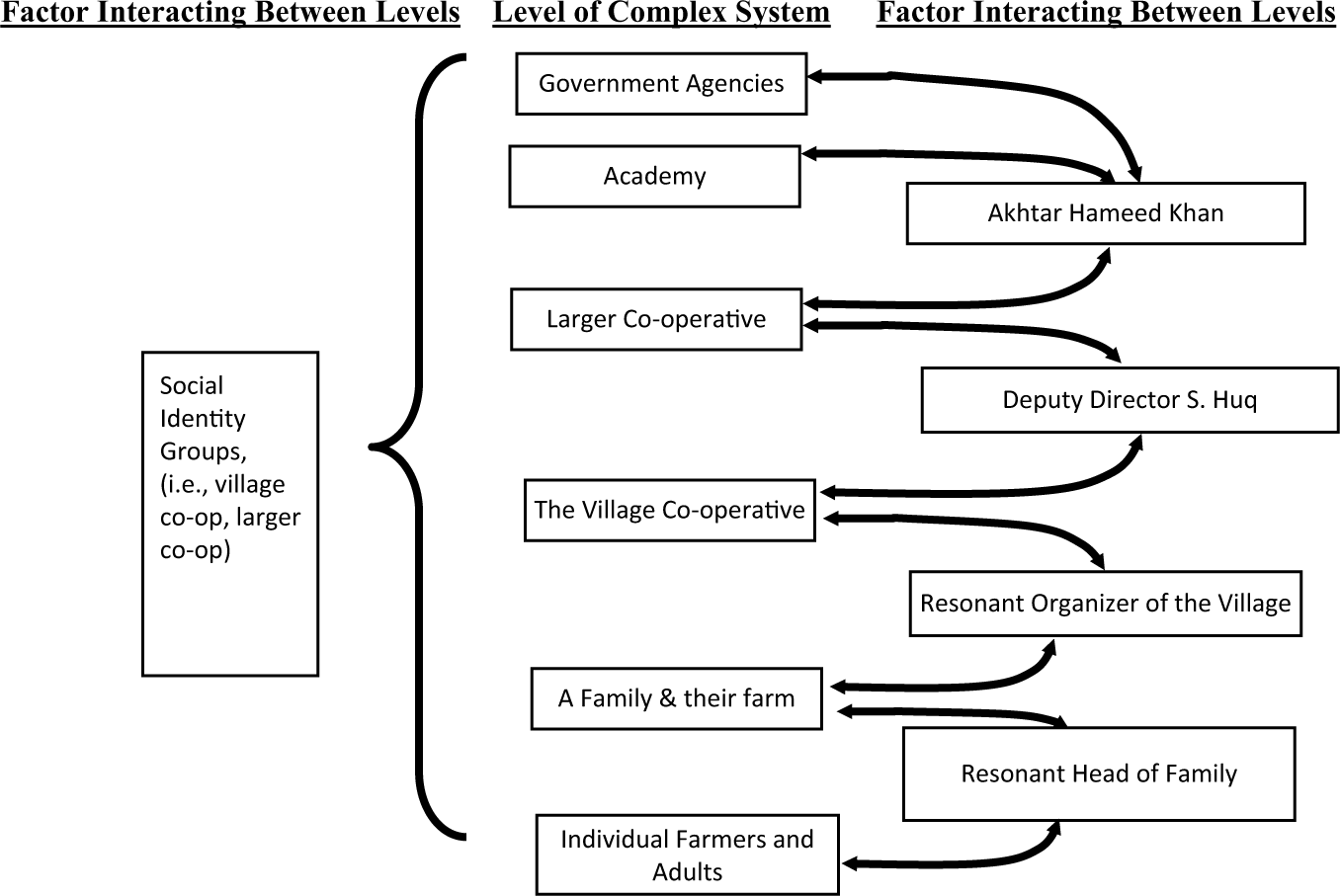
Multi-level model of community development and the role of leadership in the Comilla project.
Muhammad Yunus, who was awarded the Nobel Prize for microfinance initiatives, was a student of the Comilla Academy and was inspired by the leadership and personal relationship with Khan (Valsan, 2005; M. Yunus, 2012, personal communication). Yousaf (2003) notes, “Today micro-credit has become a buzzword in the lexicon of development practitioners for poverty alleviation throughout the world, but 35 years ago this idea was pioneered in Comilla” (p. 373).
In the case of Comilla, a loan was given to a village cooperative society only if its members had accumulated some weekly saving of its members. The savings served as collateral against loans (Karim, 1985). The rate of repayment in Comilla was an outstanding 98.5% (Raper, 1970). Peer pressure (a key strategy also used by Nobel Laureate Muhammad Yunus in the Grameen bank project in that part of the world) was one of the main reasons for the high rate of loan repayment in this case. The role of the guarantors was crucial since their honor in the community was at stake. There were many cases where the guarantor exerted moral pressure on the borrower to pay up (Inayatullah & Birley, 1996). Since the guarantors and borrowers were mostly from the same community, the guarantor acted as a vector of social pressure (Jaunaux & Venet, 2009) in the close-knit community.
The OPP took a different approach. OPP’s initial sanitation project was self-financed by the residents. Later for other projects, OPP selected individual enterprises for closely supervised credits. The credits are given by the Orangi Charitable Trust (OCT), which is an extension of the OPP. The OCT began it operations with a grant of about US$700,000 from its parent organization, the OPP (Khan, 1992). From this amount about half was pledged to a local bank for overdraft facility. At the initial stages, OCT provided loans from its revolving fund, after borrowing from commercial banks. Later, OCT started receiving donations and became less dependent on the commercial banks.
Khan argued against centralized government control of such projects. He declined to run rural development projects in Pakistan in 1971 when he arrived because it appeared politically motivated to him (Chowdhury, 1990). His concern with many emerging projects in the 1990s, including approaches to microfinance, was that they focused on only the poorest and not the near poor who still lived in destitute conditions (M. Yunus, 2012, personal communication).
It should also be said that Ahktar Hameed Khan is not the only leader of successful community change projects. Krishna et al. (1997) and Uphoff et al. (1998) chronicle many of them. However, Khan’s work was the earliest of the ones examined. From this analysis, it seems that his was also distinctive from previous efforts in important ways as explained in this article.
Implications for Practice and Sustainability
These cases go beyond supporting the efficacy of community development and reinforce organization development methods of participation, small group process, empowerment, and distributed leadership. They suggest that by overlaying the concepts of ICT, we can be more precise as to what type and how participation, group process, empowerment, and distributed leadership can be more effective in pursuit of SDC. These insights and elaborations can be used in refinement of processes in community development and possibly even organization development.
Consultants have realized the importance of building better relationships for decades in organizational development. These cases help us illustrate that the relationships must be more than utilitarian. They must be ones of interdependence, trust, and caring. In conjunction with a shared vision and good group processes, these relationships can create a new social structure. The use of social identity groups for cohesion and meaning and working within multiple levels in a social system seem much more important than previously considered. Consultants working with individual, dyadic, team, organization, and community development at the same time may feel daunting and pose challenges for the client to finance, but the work at multiple levels creates the many reverberations and reinforcements that we saw in these two cases. Finding and nurturing leaders at all of these levels is another possible method for consultants to expand their effectiveness.
Improvement of people’s lives and the hopes for their children is a basic human quest. Those without access to the vehicles of personal financial success, health, or education become depressed as they are increasingly oppressed. They succumb to the belief that their plight is inevitable, and they become enslaved. However, a few leaders are able to inspire others to greater heights and inspiration (Valsan, 2005). Khan followed Gandhian idealism in launching the community development program in Comilla. He, in turn, inspired the staff and farmers of Comilla and later, the urban poor of Orangi to bring about change. We believe the village and lane leaders created a contagion of hope as they were able to inspire thousands of their countrymen. Their shared vision and commitment to new ways of interacting and executing their plans provided an impetus for social mobilization.
Khan rightly observed that a community’s economic prosperity was embedded in a structure of social relations (Cernea, 1991).
Most programs developed for the poor in the Third World fail because they are designed by professionals who belong to the upper classes and are not fully conversant with the sociology, economics, and culture of the low-income communities or the causes of conditions in low-income settlements. (Khan, 1996, p. xxii)
The work of Dr. Ahktar Hameed Khan in Comilla and Orangi created a new life for millions of people. In the process, they also created a model of community development that has inspired many to offer help to others. They have ignited a sense of possibility and stirred the contagion of hope. Dr. Khan has indeed achieved an amazing legacy!
Footnotes
Appendix
Declaration of Conflicting Interests
The author(s) declared no potential conflicts of interest with respect to the research, authorship, and/or publication of this article.
Funding
The author(s) received no financial support for the research, authorship, and/or publication of this article.