







Abstract
Recently, at an Academy of Management meeting workshop, reflecting on the field, Warner Burke asked “where are the new models and theories of change?” This provocative question has been pondered within organization studies and specifically on organization theory for several decades. And yet it persists. Borrowing this debate, in this essay we reverse the question to consider whether theory might be the problem in change research. Specifically, we argue that theory has become a (figurative) straightjacket. Far from advancing debate as significantly as has regularly been assumed, an obsession with theory and a narrow understanding of what constitutes a contribution could be hampering the development of knowledge about change. The criteria for publishing organizational research are increasingly focused on adding to specific and already existing theory. As a challenge to the restrictions that have become convention, we decode what this theoretical straightjacket looks like, and query why change researchers have willingly gone down this path, shutting down other promising opportunities. In response, we present phenomenon-driven research as a possible solution. It is time for change researchers to reclaim our heritage and take off the theoretical straightjacket.
In its original 1965 purpose statement, the consulting editors of Journal of Applied Behavioral Science (JABS) observed that the journal “focuses upon the processes by which individuals and institutions are changed” (p. 2). The call was broad; for stimulating, creative, and influential research, with the explicit acknowledged influence of Kurt Lewin’s laboratory work and statements on the potential for extending knowledge. Like its predecessors (Human Relations, launched in 1947; Administrative Science Quarterly, 1956, and Academy of Management Journal, 1958), and as Jean Bartunek notes (this issue), its early issues did not place much emphasis on theory, and accepted research that had little or no theory. There was even less attention given to generating theory, with most articles considering the dynamics and processes of changing, in keeping with the burgeoning field and the practice orientation of organization development (OD). Reflecting this focus, the list of early recipients of the journal’s Douglas McGregor Memorial Award were almost exclusively for applied research (e.g., Friedlander, 1968; Golembiewski, Billingsley, & Yeager, 1976) with little emphasis on explicit theory building. Ten years after its inception, however, and following Bennis’s (1969) call, Warner Burke (1976) used JABS as a platform to make the case for more theory- and research-based work in the field, citing limitations in the way OD and change was being studied, the constraints of its practitioner bias, and its lack of maturity. Given the robust organizational environment at the time, and the evolution of the business school into a more research oriented entity, a succession of researchers have added to and solidified organizational change into a field of research.
In following this path, organizational and change researchers overwhelmingly have come to believe in the need to continuously emphasize, represent, and invoke theory—and the ever present “theoretical contribution”—as a necessity for “progress” and the basis of “discovery.” Doing so, the place of theory as a means of scholarship, of facilitating career progression, and for publication has been solidified (see Nord, 2012).
In this article, we suggest that the increasingly dominant focus on theory in change research has advanced the field (and, we stress, theory is useful), but it has come at a price: The increasingly narrow approach to theorizing in organizational change research has become a figurative straightjacket, hampering real progress in knowledge and encouraging work on popular topics that fall within the realm of the most well-known already existing theories. In this way, theory has become a cornerstone of communicating our ideas, and paradoxically, the implications for practice have been reduced to a tidy intellectual exercise.
This approach to theorizing leads to extension of theories, but it does not necessarily contribute to increased knowledge about organizational change. We raise this problem in recognizing the irony of how this theory-driven research (TDR) acts as a primary restriction on the essence of Burke’s near four decades old recommendation for using theory to advance OD and change as a field. The principal aim of TDR—research oriented to or driven by theory—is to refine, enhance, advance, and generally stimulate theory by focusing on theory. To the extent that there is theoretical progress, it tends to modify or qualify existent theory. For instance, in the JABS June 2014 special issue, four of the five articles are explicitly focused on advancing existent paradigms and theory by developing theoretical observations. This research is driven by the need to contribute theoretically.
In response, we promote phenomenon-driven research (PDR) as a correction. With its emphasis on identifying, capturing, documenting, and conceptualizing a phenomenon of interest in order to facilitate knowledge creation and advancement, this approach focuses on contributing to knowledge within a field rather than to specific theory. In this sense PDR is perpetual, rather than bounded by the limits of the specific theory. PDR differs from problem-oriented types of research which tend to focus on identifying a problem or construct an issue from existing theory (such as Alvesson &Sandberg’s [2011] problematization) or on researcher values (cf. Lawrence, 1992). Instead, the foundation for research is the phenomenon (from which a problem is sourced). For example, Hollnagel, Braithwaite, and Wears (2013 ) write on the “sorry state of affairs” of patient safety brought about by the organizational and medical pressures of health care. Their interest is driven by a phenomenon (resilient health care) identified as important to medical practitioners and from their prior work in the area, and it is this phenomenon that provides the basis for debate, theorizing, and practical suggestions.
Given how it uses theory for advancement, PDR is a call for a return to a variant of the applied heritage of OD and change research. More than a basic (and well-worn) “back-to-our-roots” response with its interest in highlighting the unexpected, PDR knowledge offers an alternative research path of action and strategy. Consequently, it is important to emphasize that theory intersects in TDR and PDR. There is a place for both approaches in change research but we promote PDR as an opportunity to correct the restrictions imposed by a reliance on theory.
The key to our focus on PDR is recognizing that we are not promulgating an emotive or forlorn perspective on change and organizational research, or using the analogy to critique the place and use of theory. Nor are we interested in deconstructing theory, how knowledge develops or the logic of discovery. These approaches, and the introspection they promote, are both regular and de rigueur. Instead, acknowledging the value of good theory, we argue that a self-inflicted obsession with theory is both the source of the straightjacket problem and a platform for moving forward in the future. To understand this duality, and in what follows, we briefly consider the context and positioning of the theoretical straightjacket before explaining PDR as a knowledge-based avenue for addressing these restrictions.
The Theoretical Straightjacket: Theory-Driven Research
Before starting, it is important to emphasize that TDR is not a particular study or a specific theory. Rather, it is a way of doing research by relying on or being guided by theory. Based on an assumption that theory serves as the foundation for organizational research (Ferris, Hochwarter, & Buckley, 2012) and so provides progress and advances debate, the theoretical straightjacket is perpetuated by a compulsion to identify and fill gaps in extant theory. For instance, in 1972, in the context of broader organizational research discussions, Burke queried “the demise of organizational development”; a premise that has persisted in OD debate. Far from prompting a concerted, applied focus, however, the theme encouraged further introspection and competing explanations reflected in discussions on the OD research base (King, Sherwood, & Manning, 1978), the use of historical trends (Sashkin & Burke, 1987), reflections on gaps into the future (Worley & Feyerherm, 2003), and a return to the original gap in readdressing the OD demise (Argyris, 2005) based on other gaps that its proponents may have missed (Burnes & Cooke, 2012). Rather than drive an applied research agenda, this debate has primarily resulted in researchers commenting on and finding other theoretical gaps by focusing on OD and theory. In this way, TDR presents theory as a pathway to progress.
Although valid, the debate is exclusionary. For outsiders, this theory-driven approach risks becoming abstract and too distant from the organizational context, which may seem rather curious in an applied field such as OD and change. As a parallel, imagine what the field of medicine might look like if theoretical explanations were communicated only among those doing research, and with minimal interest in speaking with those who are also practicing medicine. As Alvesson and Sandberg (2013) indicate, the tendency in organizational research has been to pay attention to the theory rather than to what it represents, and through it to seek out theoretical consensus. Paradoxically, theory becomes a straightjacket.
The Problem: When a Contribution Is Not
The theoretical straightjacket is a figurative representation of the way that theory and a devotion to theory imposes developmental limits on a field. While accepting the necessity of theory, and of its place in social science research, a rather narrow understanding of what constitutes a theoretical contribution has emerged. TDR has come to emphasize the importance of constructing and then filling existing theory gaps as a basic means of knowledge development, resulting in the perpetual advancement of established and favored theories. Consequently, theory becomes a legitimate means to an end: publishing, scholarship, status, and career. A straightjacket is artificially constrictive because by default it characterizes theory as filling existing, known knowledge gaps, add-to-the literature norms, and making “progress”—of development and advance.
The most visible evidence of this development is the persistent emphasis on theoretical contribution in organizational journals—and debate about making a contribution. For example, in their comparison of two books published decades apart Fulmer and Wren (1976) suggest that the problems facing managers are refinements of the same ideas, whereas Smith and Carroll (1978) suggest that “new” is relative and that research has advanced. Three decades later Miller, Greenwood, and Prakash (2009) complete a full circle and come back to the conclusion that there has been a decline in the extent that discussion has advanced. Far from pushing past theory, however, the net effect of this interest in contribution is to extend debate via theory and promote the basic and perpetual need for theory in order to build “new” theory. Assuming that existing theory is essential to making a contribution relies on the idea of universality—that knowledge always develops cumulatively and does so in a standardized cycle. The limits of reason (e.g., Simon, 1990) and knowledge production (e.g., Merton, 1968) raise questions about the absoluteness of assumptions.
In the context of broader debate about the field of OD and change, this type of evolution and observations on where theory fits in the field are not surprising and they are also well debated (Miller et al., 2009; Smith & Carroll, 1978). Moving forward, however, we are interested in how change researchers have willingly gone down this path. Why voluntarily use theory to shut the door on other opportunities? More specifically, how did we let the straightjacket come to define what the field looks like?
Context: An Obsession With Theory
The basis of the straightjacket is that organizational scholarship is obsessed with theory. In order to publish research in the organizational domain, it has become a basic requirement to have a clearly delineated, theory derived, and TDR question (Miller, 2007; Oswick, Fleming, & Hanlon, 2011; Suddaby, Hardy, & Quy, 2011; Whetten, Felin, & King, 2009). A cursory reading of influential and perceived “quality” journals (whether via citation patterns, rankings or other means, e.g., Li & Parker, 2013; Nkomo, 2009) that frame change research conversations indicates this essential placement of theory—to the field, the researcher, and the audience.
Furthermore, supporting this requirement, reviewers are inculcated via the editorial process to emphasize a focus on theory as a means of critique (and idea development). A cross-section of critical and summative reviews of change research over the past two decades indicates this necessity, with debate and subsequent suggestions centered on the story that theory tells (e.g., Armenakis & Bedeian, 1999; Pettigrew, Woodman, & Cameron, 2001; Woodman, 1989). As a result, and after decades of evaluating the meaning, placement, and virtue of theory, organizational research in general and change research in particular is “rich in theory” and yet “theoretically poor” in advances made, with the tendency to work on a broad set of topics within an increasingly narrow range of theories.
This accumulation of theory has become a core part of the way we research change. It is now taken-for-granted that theory is necessary in order to publish and to how we develop conversation on change. Given the nature of peer review, we have become theoretical gatekeepers in critiquing a manuscript based on its contribution. An obsession with theory overwhelms and yet theorizing is often limited to existing debate known to others in the field. Moreover, it overlooks the applied basis of change research—and that this engagement meant a far broader acceptance of other paths for making contributions.
Theory is key to knowledge and is embedded in our scholarship. But as Shapira (2011) points out, because many organizational researchers have “an erroneous understanding of what a theory is” (p. 1312), and given the basic difficulty in defining theory, there is a great deal of confusion about it (for those interested, see Ferris et al., 2012; Oswick, et al., 2011; Sandberg & Alvesson, 2011). Knowingly emphasizing theory over content (and especially existing theory) or making theoretical extensions the primary goal of research thereby may inadvertently restrict a field.
The irony of this obsession is that in the late 1950s, two reports by the Carnegie Foundation (Pierson, 1959) and Ford Foundation (Gordon & Howell, 1959) critiqued business schools for their weak research basis and poor quality of the research being undertaken by its faculty. In response, the business school community invested time, energy, and funding into reversing that trend. This commitment cultivated the ascendency of scientific-based measurement and principles of knowledge that went on to characterize the business school and business school academic. The response has been overwhelming, evident in the research dominance of the field and a narrow evaluation of faculty based on academic scholarship. It is instructive that in 1958, Isaack pointed out that theory was denigrated by managers “in the real world” (p. 29) and then goes on to call for its development. It led to the current focus on publication for the academic community, which not coincidentally favors theory (rigor) over relevance.
It is in this context that the fathers of academic-based OD (like Burke’s 1976 treatise) promoted theory development as one path for the advancement of change debate and the field away from its narrow base. Consequently, successive sets of scholars have made a perpetual call for theory—refined theory (Hassard, Cox, & Rowlinson, 2013), better theory (Augier & March, 2011), new theory (Woodman, 1989), relevant theory (Hodgkinson & Starkey, 2011), and theory testing (Halbesleben, Wheeler, & Buckley, 2004)—in order to contribute to the field and advance career. In a perverse reversal, theory subsequently has come to dominate what the field considers valuable; where the call today is precisely for more “real world,” practice-based relevance.
In this context, the history of JABS tells a story of this evolution toward TDR. A review of its content shows that in the 1970s, in keeping with its original purpose, the majority of its articles were mostly applied OD type discussions with strong practitioner input and insights into facilitating change programs. By the 1980s, following a new editorial push to broaden the journal (Zurcher, 1982), the journal witnessed a subtle shift with a new “theoretical observations” section (launched in 1980, Vol. 16, No. 1) that would “present readers with an overview of the “hottest” new behavioral science theories insofar as they are pertinent to practitioners” (Zurcher, 1980, p. 9) . This focus saw an increase in the use of issues that were topic specific or developed around commentary. In this way, while applied scholarship continued to be a core part of debate, the structure of the journal began to change subtly as it incorporated more comment, biography, book reviews, interviews, debates on theory, method, and pedagogy, and the use of stand-alone observation and reflection. With this variation, by the 1990s, JABS produced many more special- and focused-issues, which specifically made place for theory-based articles, or which specifically debated theory (e.g., Gray & Wood, 1991), or which commented on and reflected on theory (e.g., Alderfer, 1991). This move continued into the new millennium with increasing use of case application, psychology and sociology style work (e.g., Berg, 2002; Zell, 2003), and considerations of the field (e.g., Worley & Feyerherm, 2003). It is during this latter period that this movement toward TDR was recognized as having become a more common part of the journal, with the 40th anniversary special issue in 2005 (Vol. 41, No. 1) highlighting the need to reengage researchers with practice and application (e.g., Bunker & Alban, 2005; Woodman, 2005), a call made once again in a 2013 editorial (Vol. 49, No. 2).
It is worthwhile acknowledging that the straightjacket generated from TDR is self-inflicted. For example, reflecting on his tenure as the Academy of Management’s OMT (Organization and Management Theory) chair, Davis (2010) observes how although organizational theory has a rich intellectual heritage, its key paradigms tend to remain constant because its own researchers continue to refer back to and rely on the same set of theories, resulting in modest advances. It is almost as if the scholarships of discovery, integration, application, and productivity have collided because researchers have tended to neglect primary research in the search for social and professional recognition (Taylor Huber, 2002). As a group, we understand the limitations of what we are doing to ourselves and our field. And yet we implicitly support it via tenure processes, publication rankings, reviewing norms, citation patterns, doctoral training and career path, conventional journal format, and institutionalized accountability.
The problem with change researchers willingly adopting this obsession (and thereby cultivating the straightjacket) is twofold: First, in the context of the social sciences, change is still a relatively young and growing research field, which by definition encourages interesting and novel debate as it develops and not necessarily tethered to theory. Yet by following academic convention, change researchers appear to be mired in circular deliberation, drawing on a familiar set of change theories to prove legitimacy (see Burke, Lake, & Paine, 2009 as indicative).
Second, this emphasis on making impact through theory is never ending because TDR focuses on making a perpetual theoretical contribution rather than contributing to knowledge and debate. As Starbuck (2006) develops in his challenge to the way we produce knowledge, the core interest of the contemporary scholar is on publication, and publication in the right places, meaning that there is never really any closure to theory building, because the knowledge thrives on uncertainty and debate in order to continue publishing. Even so, change research and organizational journals that publish change embrace theory as a basic tenet. The net effect is a field dependent on theory and theoretical contribution yet made up of scholars who feel obligated to “pretend to be developing theory or contrive an explanation” (Miller, 2007, p. 179). Interestingly, this problem is broadly acknowledged in organizational research circles but far less so by change researchers. In this sense we paraphrase Van Maanen (1995) in noting that in a push for theory as a means of career progression, organizational researchers may overlook or forget that theory constrains as much as it liberates precisely because it is researcher generated and interpreted.
Using theory for justification, change researchers have followed the same theory acceptance path as others in the social sciences. Being part of the organizational domain, and as several authors acknowledge, wanting to produce publishable, influential work (Austin & Bartunek, 2003; Burnes & Cooke, 2012) we have mirrored this paradigm. Interestingly, it was exactly this approach that Isaack (1958) warned against as the field took shape, in observing that “theory can never be a scissors and paste technique . . .” (p. 33) for thinking about organizations. The tendency to focus on theory has affected research to the extent that the most substantial part of a published paper is in establishing, justifying, and integrating its necessity and associated contribution. The common assumption is that an article needs an appropriate theoretical base simply in order to be interesting (Pillutla & Thau, 2013), and in turn needs to be interesting in order to be legitimate.
The fascinating aspect of this perspective is that given a background in applied- and practice-oriented change research, there has been little historical debate about this deficiency among those researching change. But it doesn’t have to be this way. Acknowledging the value of theory to OD and change research, we propose a (renewed) focus on organizational change phenomena as a possible counterbalance to this self-inflicted straightjacket.
Removing the Restraint: Phenomenon-Driven Research
Research on change has reached an interesting crossroad. The domain is well established, continues to grow, and is apparently prospering (Agarwal & Hoetker, 2007; Mohrman, 2001). In its early years, as the field took shape, the objective of those journals publishing seminal change research was always to open and then extend debate by “improving the research” done (JABS, 1965) and by “encouraging and facilitating development” (Human Relations, 1947). The theoretical straightjacket suggests, however, that while change researchers are technically achieving these objectives, we have come to rely on theory in a way that moves away from the spirit of these original goals. It is in this context that we look to PDR.
Although it is the bedrock of OD and while it has a long tradition in our discipline, PDR has fallen by the wayside as it has been neglected. In this sense, we argue that PDR is a possible mitigating solution to the narrowness the theory-driven approach has come to present. What we are proposing is not groundbreaking. Phenomenon-type research typically has acted as a compliment to different types of scholarship and there is a history of different problem-oriented approaches to organizational research, as Sandberg and Alvesson (2011) review. Similarly, von Krogh, Rossi-Lamastra, and Haefliger (2012) note the increase in calls for ways to incorporate phenomenon-based research. The former focuses on the need for such research and the latter on strategies and research design. Given this interest there is already a trend supportive of the tenets of a PDR approach in OD and change scholarship. The broader field of management also indicates that there is an acknowledgement of the need to move across disciplinary fields from the more narrow TDR approach to alternative perspectives on what constitutes a contribution. Taking the place of TDR into account, our focus is on the neglect of PDR and the possibilities it may offer. By marginalizing PDR, OD and change researchers have seemingly relinquished one of the key strengths of our heritage. In Table 1 we summarize how PDR differs from TDR along six key dimensions, each incorporated in the discussion that follows.
How Theory-Driven Research Differs From Phenomenon-Driven Research.
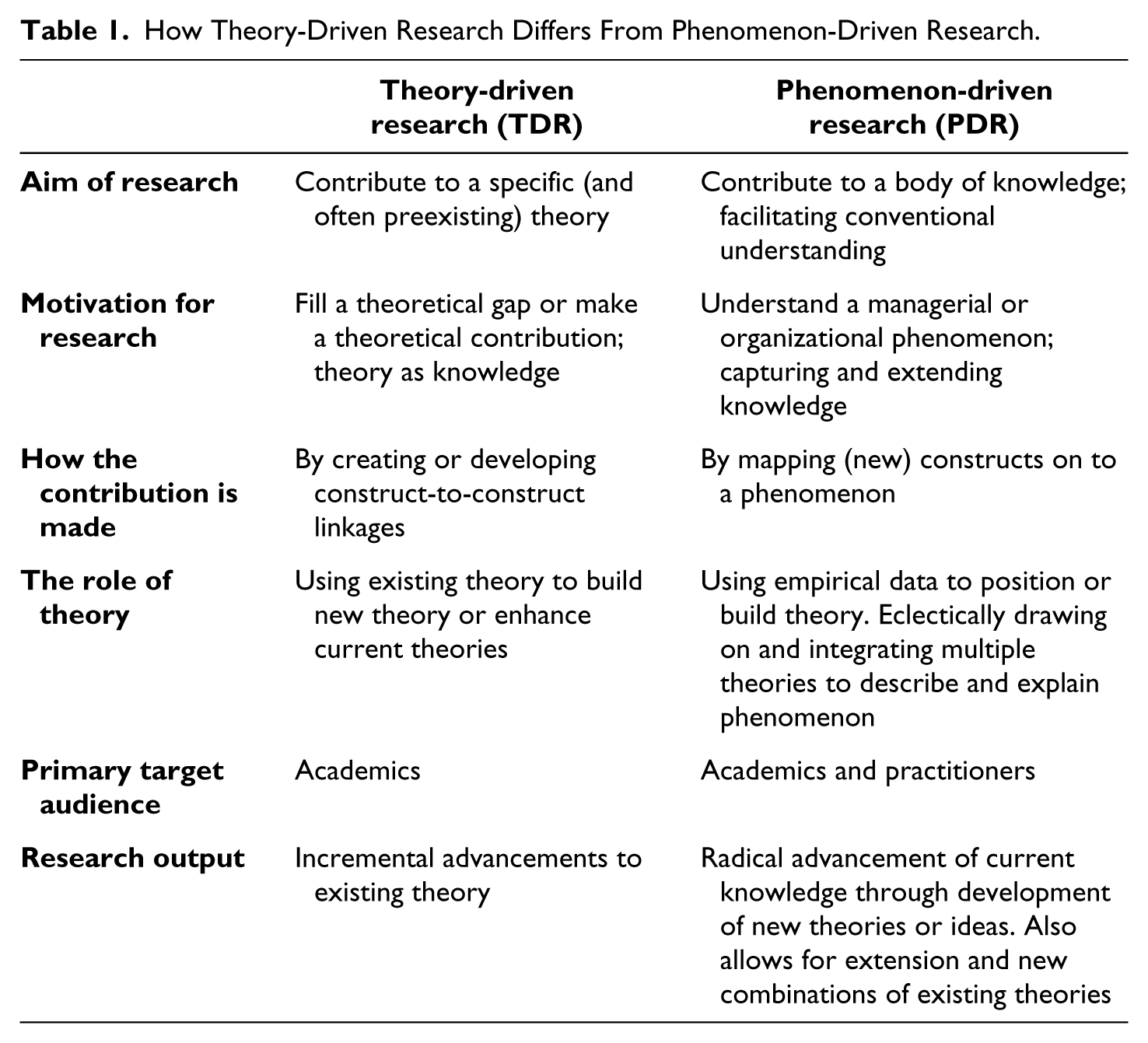
The Aim and Motivation of PDR
PDR focuses on identifying phenomena of interest for both practice and theory. It is an ideas-led, interpretive approach to researching. A phenomenon is “a fact or situation that is observed to exist or happen, especially one whose cause or explanation is in question” (Oxford University Press, 2006). As von Krogh et al. (2012) point out in their suggestions for building phenomenon-based research strategies, the emergence of a new phenomenon (a novel or alternative observation of a well-known phenomenon) is a starting point in the process of discovery and in building knowledge. In this way PDR differs from problem-based researching that starts with the choice of a significant emerging problem and the research strategy radiates outward (Lawrence, 1992).
As previously defined, the aim of PDR is to identify, capture, document, and conceptualize a phenomenon in order to facilitate knowledge creation and advancement. At its foundation is the phenomenon itself and then the emergence of new phenomena which help challenge established beliefs and develop new knowledge. The starting point is the phenomenon which becomes more apparent through the researcher and the mode of scientific inquiry adopted. For instance, earlier we highlighted Hollnagel et al.’s (2013) resilient health care as an example of PDR. Their focus was on the phenomenon—“the ability of the health care system to adjust its functioning prior to, during, or following changes and disturbances so that it can sustain required performance . . .” (p. xxv). They explored this interest by researching many of its separate parts that the medical community considered important (e.g., safety, stakeholder concerns, restructuring formal structures, systems improvements) all of which were then used to develop suggestions for “making health care resilient.” While we limit its relevance to the organizational domain, as Apel (2011) illustrates, a focus on phenomena is a widespread research technique used in the sciences, biology, and philosophy of science.
The motivation behind PDR is neither to contribute to a specific (and often preexisting) theory nor test theoretical minutiae. Instead, it emphasizes the capture and extension of knowledge within a field by focusing on or synthesizing a specific organizational phenomenon. This approach allows for a variety of research paths and outcomes, which may lead to a series of other debates and research opportunities. Frequently mentioned examples of PDR include the work by Bartlett and Ghoshal (e.g., 1992, 2002) where they revise views on manager roles in multinational enterprises by introducing and theorizing different models for the global manager and the transnational organization. Using debate on the increasing relevance of multinational firms, they focus on the need to develop three different types of managers. Other proponents include Eisenhardt (1989; Eisenhardt & Graebner, 2007), who uses PDR to assist theorizing on decision making in high-velocity environments, and Lavie (2006) who uses the approach to extend work on the competitive advantage of firms participating in alliances. Rather than constructing gaps in existing theories, such research is inductively framed with a goal to understand the phenomenon that the researchers had either observed in organizations or which bugged them enough to undertake research and which could not be explained through existing theories. The resultant phenomenon-driven approach provided new constructs and understandings of the change at hand.
Given that both are based on rigor, the most obvious difference between the aims and motivation of PDR and TDR is how researchers frame the issue they are interested in (i.e., their point of departure). While TDR begins with a theoretical puzzle and thus requires and draws on existing theory and allied research, understanding a phenomenon does not necessarily require building on an extant theory. The initial phenomenon may have no theoretical foundation and perhaps even no precedent. Accordingly, PDR can be based on phenomena grounded in observations of:
Practitioners doing something different from what we would expect from theory (e.g., seminal research by Mintzberg or by Eisenhardt, 1989)
Practitioners doing something which we have no theory or literature about at all (e.g., Bartlett and Ghoshal’s [1992; 2002] work on transnationals)
An entirely novel or unprecedented organizational occurrence (e.g., the use of social media during change or the introduction of entirely new business models)
In this sense, PDR should not be misinterpreted as atheoretical. On the contrary, a PDR approach requires extensive theoretical knowledge and an extraordinary overview of the existing knowledge. The research will have to convince its audience not only of the importance of the phenomenon, but also how it differs from other related phenomena. More significantly, the researcher will have to illustrate that there is a lack of existing theories that can adequately (or better) explain that phenomenon. As such, existing theory serves to position the research and the contribution to the field rather than merely as building blocks for new theory.
Whereas some researchers (e.g., Grant, 2012; von Krogh et al., 2012) primarily think of PDR as nascent and with a primary purpose to describe new and previously unseen phenomenon, others argue that documented explanation of the phenomenon may be a distant goal (e.g., Lynch et al., 2012). For new and unknown phenomena identification and description of a phenomenon may be viewed as a contribution in its own right. However, if we take seriously the idea that PDR caters to real managerial problems and issues, then the aim of PDR should not be restricted to description or to build problem-oriented responses and strategy. PDR should not be viewed simply as a step in research design or as another step in broader data gathering because it aims to contribute to a body of knowledge. Researchers may apply PDR where theories exist if there is a chance that the phenomenon could be better understood through the development of new and alternative theories. In this way, PDR requires that the researcher presents something innovative, counterintuitive, or even surprising relative to what we already know. It is this latter aspect that is essential to breaking out of the straightjacket. This approach to researching based on the aim of and motivation for PDR research offers us a possible platform for OD and change researchers to move forward.
The (Different) Role of Theory in PDR and How Contributions Are Made
In proposing the renewed use of PDR, it is important to emphasize that there is a clear role for theory to play in this type of research. With the phenomenon as key, however, this role is one of integrating and extending existing theories as well as developing new and alternative theories based on observed trends. Rather than start with existing theory and then construct a gap based on this theory, a PDR process typically starts off with a broad interest or question. This focus allows for various theoretical lenses to take shape progressively and without the restrictions of a specific theoretical approach to limit interpretation. For instance, in To the Desert and Back, Mirvis, Ayas, and Roth (2003) retell the story that they had witnessed and facilitated on UniLever’s turnaround, noting that “the answers lie not so much in our theories and analysis as in really seeing and feeling what this company experienced” (p. xiv). Although their focus is guided by and built around the phenomenon (transformation), they invoke a series of integrated interests and theories (on personal and organizational transformation, growth, and leadership) to explain what was experienced.
Good exemplars are challenging to find as researchers who explicitly adopt PDR have described how in the publication process they were forced to construct TDR questions in order to rhetorically set their manuscript up to provide a contribution to already existing theory. For instance, Siggelkow (2002) reported that he used a PDR approach to explore how firms evolved toward tight internal fit, but in order to get the idea published he was pushed by journal reviewers to reframe his research motivation to become more theoretical. Given the role of theory in PDR, forcing research around a theoretically framed question in this way is problematic for three reasons. First, existing theories may not lend themselves to address the key issues observed (Miller et al., 2009). Second, forcing a study into an existing theoretical frame makes it considerably more difficult to challenge current theories as well as to question the underlying assumptions of those theories (Alvesson & Kärreman, 2007). Finally, selecting one theoretical frame over others restricts the researcher from more eclectically drawing on a multitude of more appropriate theoretical insights or in developing alternative theoretical insights grounded in the empirical material.
To be clear, in advocating for a different role for theory, we are not arguing that PDR document the entire research process as it was conducted. Indeed, most academic papers are not written up in a chronological manner showing each step of the researcher. Besides, research typically includes a number of dead-ends and can be quite a messy process. Nevertheless, since PDR rarely is driven by extant theory, researchers should not be forced to retrospectively construct gaps in existing theory and tie their contribution and emerging theorizing to existing theory.
Almost two decades ago, Locke and Golden-Biddle (1997) identified three different rhetorical approaches researchers use to construct opportunities for making theoretical contributions. Although not advocating PDR, they illustrate that at that time there was a broad variance in how a contribution could be constructed. These are the following: synthesized coherence, where strands of literature that previously have not been cited together are connected; progressive coherence, which refers to a developed and focused line of inquiry within a shared theoretical perspective; and noncoherence, which refers to controversy and competing explanations within existing knowledge. Since the publication of their article, the progressive coherence approach in particular has emerged as the more popular (and legitimate) ways to frame a research article; a strategy visible in change research (see Armenakis & Harris, 2009; Schwarz, 2012). By adopting a broader understanding of what constitutes a theoretical contribution, however, PDR embraces the synthesized coherence and noncoherence approaches to researching. The combination of these approaches highlights the alternative path PDR offers to using and incorporating interesting and influential theory in the development of a body of knowledge.
Furthermore, as part of their note on how contributions are grounded, Locke and Golden-Biddle (1997) also provide a way to view phenomena in constructing a contribution. They show that how we problematize the phenomenon based on what we already know can help establish the contribution’s importance and relevance. Again, they suggest three approaches to the way an area of interest is problematized: (a) the current field is portrayed as incomplete, thus leaving room for providing a more extensive understanding, (b) current research is viewed as inadequate, which provides opportunity for offering alternative perspectives on a phenomenon that have so far been overlooked, and (c) the extant field is framed as wrong or misguided, which implies that it needs to be replaced with an alternative explanation or theory. Each approach offers different ways of viewing how a contribution can be made around problematizing a phenomenon.
This use of problematization clearly delineates the different role that theory can play in how we research. In TDR, existing theory is used to build new theory. In contrast, PDR uses existing theory to position findings as different from current knowledge. New theory is built inductively based on an understanding of the phenomena that is generated from empirical data. When researchers working from a PDR approach draw on existing theory to position theory, they typically do so in an eclectic manner, based on the extent to which it overlaps or differs in the context of the phenomenon. In this way, as von Krogh et al. (2012) show, theory from a phenomenon-driven study can be built by (a) referring to existing theories—for instance, to distinguish what the phenomenon is not, (b) eclectically drawing on multiple theories and adapting, modifying or combining these, and (c) inductively generating new concepts and theories. In this way, instead of creating gaps within existing theories or assuming that knowledge (and contribution) always develops cumulatively from theory, we present PDR as a complementary path to theory building.
Primary Target Audience and Research Output
The different target audiences of TDR and PDR are worth noting. Studies that are motivated by a gap in existing theory require that the reader knows and interested in theory. TDR is therefore primarily written principally for (and to debate) other researchers. Whereas with its focus on a noted occurrence or change, PDR aims for a broader audience appealing to both academics and practitioners. While often an overlooked aspect of the way we research, as part of a discussion on making research persuasive, Siggelkow (2007) describes the significance of a target audience, observing that a paper should allow the reader to see the world, and not just the literature, in a new way. . . . Imagine that someone who is interested and knowledgeable about the phenomenon you study, but who does not know the literature, were to read your paper. Would this reader find your paper and its results interesting? Or are the paper’s contributions only of interest to those who can appreciate the references and refinements to prior theory? (p. 23).
His final observation is telling in the context of PDR, where he suggests that “theory as a purely self-referential exercise—rather than as an attempt to better understand the world—[is] a poor allocation of time and effort.” (p. 23/24). For TDR proponents, a focus on our colleagues makes sense given that researchers report on findings to others who are familiar with an existing theoretical perspective. By contrast, PDR aims to engage researchers and practitioners by generating insights about problems that are sourced by or relevant to managers.
Identifying this target difference raises a relevant and timely question: Do theoretical insights such as those on organizational change have any substantial value if, as academics we only communicate these among ourselves? We present PDR as one option to redress this possible imbalance. Because PDR is driven by questions based on real problems in organizations, and aims to contribute to existing knowledge within a field, rather than contributing specifically to a particular theory, it could successfully produce research with clear and immediate implications for practice. As such, PDR can potentially reinvigorate the “Managerial Implications” sections of manuscripts that others have repeatedly called for (see Bartunek & Rynes, 2010; Tsui, 2013).
Increased Momentum for PDR Across Journals and Fields
The importance of phenomena to theorizing and its use in discovery is well-known and acknowledged. This realization is both galling and disappointing. Although TDR appears to have become the predominant way to make a theoretical contribution, and is presented as the primary means of advancing career and getting published, PDR is a research meme that has previously been supported in the organizational domain. As far back as 10 years ago, in a Journal of Management editorial, Feldman (2004) offered phenomena as a solution to the way we write and publish, expressing concern about how we define and determine theoretical contributions: I often see reviewers comment that the paper is “not informed by theory.” This phrase apparently means different things to different reviewers. For some, it means that an article does not fall squarely within one theoretical paradigm (e.g., the next logical study in transaction cost economics). For others, it means an article is focused on explaining a phenomenon rather than testing a specific theory’s predictions. For still others, it means that a variety of theoretical perspectives have been used in explaining a phenomenon, but the themes that cut cross theories have not been identified. There should be room in our field for both theory-driven and phenomenon-driven research; papers that push the envelope in theory but are disconnected from real world phenomena are no more valuable than papers that use a hodge–podge of theories to explain an important real world phenomenon. (p. 566)
This same theme—and interest in phenomena—was raised by several others since, including Davis (2010), Miller et al. (2009), Nord (2012), and Shapira (2011) among others. Likewise, both Baden-Fuller (2008) and Grant (2012) specifically addressed the need for PDR in their editorials within Long Range Planning: In addition to pieces that fulfil traditional criteria, we actively seek pieces that document in a careful manner important phenomena that are relevant to academics and practice. (Baden-Fuller, 2008, p. 2) A widely-lamented weakness of the traditional research-based management journals was their infatuation with papers that developed or tested theory and their disinclination to publish pre-theoretical research that aimed to identify and describe phenomena. (Grant, 2012, p. 99)
The theme and interest in the placement of phenomena is also seen as a way of moving forward, with two recent observations reiterating this refreshing. First, the mission statement of the newly launched Academy of Management Discoveries observes an interest . . . to promote the creation and dissemination of new empirical evidence that strengthens our understanding of substantively important yet poorly understood phenomena [italics added] concerning management and organizations. AMD welcomes phenomenon-driven research that employs quantitative and/or qualitative methods at any level of analysis.
A second recent indication is how in 2014, the incoming editor of the Academy of Management Journal Gerard George, committed the journal to the lofty ideals of “rethinking management scholarship” by considering the balance and relevance of what it publishes, expressing that This [editorial] team will pursue a balanced approach that promotes strong empirical work that informs practice by bringing the context center stage and moving the organizational problem to the forefront. The implication of such framing is to unveil theoretical contribution as a coherent explanation of phenomena and document how, when and why the phenomena occurs. “My editorial team will look for clearly articulated problem statements or research questions motivated by managerial challenges.” (p. 1, italics added)
In this context it is worth noting that OD and change journals are missing from this representative listing (albeit a random one). That JABS is missing is particularly remarkable given the journal’s original interest in application and phenomena and to “analyze some of the practical problems of personal and social change in a way which will stimulate productive research” (Watson, 1965, p. 2). Although it does indicate that while OD journals are focused on legitimate practice issues, we are witnessing an increasing number of journals in the broader field of management explicitly promote and target PDR. A similar trend is surfacing in a broad cross section of areas of research. For instance, a number of thought leaders have called for more PDR within consumer psychology (e.g., Park, 2012; Pham, 2013). Although sociology (e.g., Tuchman, 2009), economics (e.g., Quiggin, 2012), and the sciences (e.g., Stephan, 2012) have all variously done the same. Clearly, we are at an interesting crossroad. The broader field acknowledges the need for a balance between TDR and PDR. Yet with its strong tradition in PDR, and perhaps due to the changing business school environment (see Khurana & Spender, 2012), OD and change research have let PDR fall by the wayside, resulting in the types of soul-searching that is typical of the field (e.g., Greiner & Cummings, 2004; Rynes, Bartunek, Dutton, & Margolis, 2012) and on the relationship between researchers and practitioners (e.g., Hitt & Greer, 2012; Rynes, Bartunek, & Daft, 2001). Accordingly, we now offer specific actions for how PDR can advance knowledge within our change field.
Illustration of How We Can Adopt PDR
Knowing that the straightjacket exists is one thing. Acting on it is another. So how can we transfer what we already know about PDR into a viable and accessible research strategy? We suggest that recognizing and incorporating the foundations of our field is a good start. Adhering to real organizational and managerial challenges has historically been at the root of the OD and the change domain, and yet as we have argued, by willingly adopting a narrow TDR focus, we have relinquished this strength, cultivating the theoretical straightjacket. We advocate a renewed attention on and a return to these roots by reminding ourselves of the placement of phenomena. We illustrate the opportunities of adopting a PDR approach by discussing one specific phenomenon that has been noted by several researchers, and which potentially could generate a multitude of new perspectives on change: the idea of change as a series of multiple events (“multiple changes”). This focus merely serves as one illustrative example. Our hope is that by bringing a specific example, we can spark research on a multitude of other interesting but currently underexplored and under theorized change phenomena.
This reintroduction of the phenomenon is consequential. Seminal studies on change that generated models and theories that we continue to rely on (in particular in our teaching about change) were based on studies of real organizational problems. The researchers who have most influenced the field built their models and theories on real-life phenomena that they had observed and interpreted (e.g., Lewin, 1947; Burke, 2010; Beer & Nohria, 2000). At a recent Academy of Management Meeting, Michael Beer reflected on his academic career, explaining how he undertook research on problems that managers cared about—a theme repeatedly noted and called for by others over the past decade (Bansal, Bertels, Ewart, MacConnachie, & O’Brien, 2012; Burke, 2010; Vermeulen, 2005). Consequently, his work had immediate relevance and value for people within organizations. In his research, he looked for solutions to issues that managers grappled with. Having identified the phenomenon, he first searched the existing body of knowledge, and if he was unable to find the answer in the literature, he then set out to further research the issue and subsequently analytically develop new knowledge, thus contributing to the field. Its applied heritage and the fact that many researchers have close ties with practitioners suggest that OD and change researchers should have the best preconditions for embracing the phenomenon-driven approach to research. Yet if it were so simple, would we be celebrating JABS’s 50th anniversary with a reminder and a call to arms?
The first step in reengaging with PDR in this way is to pay closer attention to what bothers those experiencing a change. While the PDR way of framing research questions resembles the applied nature of the early OD and change research, managers today are liable to face new and different challenges compared with those that managers struggled with decades ago—when many of our most popular theories of change originated. Today’s organizations are larger, more complex, multinational, (Miller et al., 2009), often loosely coupled (Burke, this issue) and the pressure to continuously innovate and change is perceived as ever increasing. Only by carefully listening to the issues about organizational change and development that preoccupy managers today can we develop theories that are aligned with, explain and support practice. This implies viewing managers as a rich and infinite source of research ideas. At the same time, managers may not come with readily researchable topics, and so a certain effort to translate practical problems into researchable phenomenon may be necessary by the researcher.
As part of this response, we suggest that PDR is facilitated by more readily reevaluating convention about what change looks like. For instance, a number of real-time process studies of change have pointed to the many parallel and overlapping processes that often coexist in organizations (Stensaker et al., 2002; Langley & Denis, 2006), suggesting that organizational change may leave the organization in a constant mode of large-scale change rather than this being an exceptional state. This phenomenon has been labelled multiple change (Meyer & Stensaker, 2006) because it implies that organizational members are continuously exposed to a number of (apparently loosely coupled) planned change initiatives. Multiple change has been defined as: “Organizations . . . implementing a number of changes at the same time or initiating new changes before previous changes have been completed “(Meyer & Stensaker 2006, p. 2). The changes can be large scale or incremental, of an episodic or continuous nature, they can be more or less related, but they will nevertheless likely affect each other.
The notion of multiple change challenges current models of change and raises new issues and tensions that require further research. For instance, episodic or continuous perspectives on change are typically portrayed as two opposing perspectives. Within the episodic perspective of change, stability is viewed as the “normal” situation, while change is depicted as something out of the ordinary, requiring unfreezing of the organization (and established behaviors) to prepare for movement. Change, it is assumed, is something the organization needs to get through—to manage—before it returns to a more stable, controllable state, and becomes refrozen. This perspective on change accords with established, influential models such as punctuated equilibrium (Tushman & O’Reilly, 1996) and Lewin’s (1947) three-step model (unfreeze-move-refreeze). Although not intended in the early work by Lewin, much of the existing literature treats organizational change in a rather isolated manner, as one discrete event taking place after another, without much attention to the broader context and other parallel changes. The alternative perspective is that of continuous change, which tends to emphasize more incremental and emergent processes of change (see, e.g., Weick & Quinn, 1999). A multiple change perspective suggests that change is not episodic or continuous, but rather both may be occurring at the same time where large-scale changes take place more or less continuously and in parallel with more incremental changes.
With its broader focus, the idea of multiple change presents new opportunities for theorizing about change, but it also implies thinking differently about the ways in which we conduct research on change. Instead of limiting our focus to one particular change project (or one element within a planned change project), multiple change implies taking a broader view on change and incorporating the history, the outer context and the inner context in the research design (see, e.g., Pettigrew, 1997). Although using multiple change as a platform for conducting PDR may seem overwhelming for any single researcher, there are countless opportunities for developing new insights based on an observed phenomenon within this “multiple” context. Below we list a few suggestions of where to start the conversation on PDR, with the aim of inspiring new avenues for change research:
Intertwined processes of change: The notion of multiple change suggests that at any one point in time there will be multiple and related processes of change underway at different levels within the organization (Pettigrew et al. 2001). These processes are intertwined, yet they tend to have their own momentum, pace, and trajectory. Because the existing change literature has tended to examine change as more isolated events, we have limited knowledge about how parallel processes affect each other.
Change capacity: Rather than focusing on how to mobilize for a particular change project, a key question in a multiple change context has to do with how to develop a capacity for many overlapping change processes. This requires coordinating a number of loosely coupled, parallel, and sometimes conflicting processes over time. Some work has been done on this topic, but more is needed. For instance, in line with the PDR approach, Pettigrew et al. (2001) draw on several theories including complementarities theory, contingency theory, and configurational theory to explore this topic. They suggest that high-performing firms are able to combine a number of changes at the same time to make a full system of changes that are greater than the sum of its parts (some of which taken on their own might even have negative effects). Meyer and Stensaker (2006) have approached the issue of coordinating multiple change from a different angle by looking specifically at what managers do (i.e., managerial practices) to develop capacity (at both individual and organizational levels) for multiple change.
Motivating change: A multiple change situation suggests that the organization is in constant movement—a situation that is quite different to the notion that organizations tend to become rather stable entities that need to be “unfrozen.” This begs the question of how managers, in the context of multiple change, can prepare and motivate middle managers and employees for additional change. Multiple change also challenges the idea of “refreezing” new processes and changed behavior because organizations and organizational members are continuously exposed to new large-scale change projects. This might require rethinking the importance of and ways to make change stick. Furthermore, it could have important implications for how we measure change results and outcomes.
The impact of previous experience and history: Most organizations today have previous experiences of change that may facilitate or hamper new planned change initiatives, yet current change theories only to a limited degree incorporate past experience and history. We tend to presume that all organizations begin at more or less the same place. A multiple change perspective requires taking history seriously and probing previous experiences and past results of change as this is presumed to affect current change processes. It also raises questions about how potential future changes (e.g., planning to grow through mergers and acquisitions) may affect current decision making.
Engaging recipients: Although the literature on organizational change has emphasized the benefits of participatory processes, a situation of multiple change raises new (and very practical) challenges related to how to engage employees in participative processes, when there are many change projects going on at the same time and new projects overlap with previous ones.
Recognizing inertia: In addition to probing how managers handle multiple change it may also be relevant to examine how managers may produce legitimate arguments for not adopting every new management fashion that comes their way.
In this way, a focus on the phenomenon, such as multiple change, in researching change offers an opportunity to correct the restrictions imposed by the rather narrow reliance on theory we have imposed on ourselves. At its heart, and with its genesis in the social sciences, organizational scholarship and academic debate relies on identifying questions that remain unanswered. Yet instead of relying on theory to formulate the questions, we use PDR to open the field to new avenues for research and problematizing. This approach also offers a means to escape from artificially imposed uniform guidelines that have come to delineate publishing, advance career, and the associated reliance on a subset of models in change scholarship. In this way, researchers adopting a phenomenon-driven approach may find that existing theories are not an appropriate foundation for describing and explaining the change at hand. Assessing PDR thus requires a different set of criteria for determining whether a contribution has been made.
Conclusion
The perceptions and norms of what constitutes academic rigor and theoretical contributions continuously evolve. But it also has potentially put us in a theoretical straightjacket. In noting the problem with relying too much on theory-driven change research, we have argued that since we have willingly put on the straightjacket, we should also be able to take it off. We have proposed PDR as an avenue for pushing us beyond incremental advancements in theory to generate new and bold knowledge and thereby open up the field of organizational change. As we reflect on the past 50 years of research at JABS, PDR offers us an opportunity to move beyond the known theory-based challenges that the field faces. Will PDR on organizational development and change succeed in this way? The answer is still pending, especially given the force of TDR. In this sense, however, we invoke Gutierrez, Howard-Grenville, and Scully’s (2010) observations on how identification triggers a change effort. Sometimes the closest and most engaged (and yes, even the most aggrieved) are the most motivated and in the best position to fix a problem. It is this role that we envision for the JABS readership.
Footnotes
Declaration of Conflicting Interests
The author(s) declared no potential conflicts of interest with respect to the research, authorship, and/or publication of this article.
Funding
The author(s) received no financial support for the research, authorship, and/or publication of this article.