







Abstract
The relationship between coach and client is an essential factor for coaching success. Although researchers have repeatedly called for an investigation of the actual interaction between coach and client to better understand their relationship, previous research has been based primarily on questionnaire data. We analyzed the working relationship of 31 videotaped coaching dyads by means of interaction analysis and questionnaires. We coded relationship-relevant behaviors initiated by the coach or the client, focusing on indicators of the working relationship such as (a) their agreement on goals and tasks and (b) appraisal and bonding. Results showed no correlation between behavioral and questionnaire data. As expected, client-initiated agreement on goals/tasks was positively related to coaching success. Surprisingly, coach-initiated agreement on goals/tasks had the opposite effect, whereas bonding behaviors did not influence coaching success. Results underscore the importance of an active client in the coaching process, and promote interaction analyses in coaching research.
The growing relevance of coaching has been emphasized by several authors who have mentioned the revenues generated by coaching worldwide (Jowett, Kanakoglou, & Passmore, 2012; Theeboom, Beersma, & Vianen, 2013) and the percentage of organizations using coaching (de Haan, Duckworth, Birch, & Jones, 2013; Jowett et al., 2012). This growing relevance has given rise to an increasing number of empirical studies that have found the relationship between coach and client to be the most important success factor in the coaching process (Baron & Morin, 2009; de Haan et al., 2013; Gyllensten & Palmer, 2007; Kemp, 2008). The call for a broader theoretical foundation has led researchers to adapt the construct of the working alliance, established in the field of therapy and counseling research (Hersoug, Høglend, Monsen, & Havik, 2001; McKenna & Davis, 2009) as a theoretical framework to coaching relationships (Baron & Morin, 2009; Baron, Morin, & Morin, 2010; de Haan et al., 2013). A working alliance develops in the process of all helping relationships and consists of the mutual agreement about goals and tasks that need to be achieved as well as the bond between coach and client (e.g., Bordin, 1979). Although we presume that a high-quality working alliance is based on the behavior of coach and client (Ianiro & Kauffeld, 2014), past studies in coaching have measured the working alliance with the established Working Alliance Inventory (WAI; Horvath & Greenberg, 1989), and therefore focused on questionnaire data only (e.g., Baron & Morin, 2009; Baron et al., 2010; de Haan et al., 2013). Thereby, only the coaches’ or clients’ perception of the working alliance was measured: The working alliance–relevant behaviors in the course of the actual coaching process (the extent of mutual agreement about goals and tasks and bonding behavior) have not been investigated. This neglect of the coaching process conflicts with the ongoing call for an investigation of the interaction between coach and client (Greif, 2010). To date, coaches and researchers do not know (a) if the agreement about goals/tasks and bonding behaviors during the process indeed leads to a higher rating of the working alliance and (b) which of these behaviors influence coaching success.
This study pursues this research gap by exploring the working alliance with questionnaire as well as behavioral data. This approach offers several contributions: First, by using videotaped sessions of genuine coaching processes, we observe actual working alliance–relevant behavior based on the definition by Bordin (1979): coaches’ and clients’ mutual agreement about goals/tasks and bonding statements during the coaching session. Second, we use the established WAI to measure the coaches’ and clients’ perception of their working alliance. Third, we offer a valid answer to the question of to what extent the working alliance–relevant behaviors correspond with the perception of the working alliance. Fourth, we analyze which of the working alliance–relevant behaviors are most influential for coaching success (mutual agreement about goals/tasks or bonding statements), and if it makes a difference who initiates these behaviors (coach or client).
The article is structured as follows: We begin with an examination of the relevant constructs. Next, we explain our hypotheses before we summarize the objectives of our study. In the method section, we illustrate our sample, the procedure of data gathering, and statistical analyses for each of our hypotheses. In the next passage, we give an overview of the statistical results. We interpret the relevance of our results in the discussion, as well as give an overview of practical implications.
Relationship as a Success Factor in Coaching
Coaching research is still in its infancy (Ely et al., 2010), often struggling with a missing theoretical foundation and with methodological limitations (Passmore & Fillery-Travis, 2011). Thus, many studies have argued a need to improve the research methodologies used and use findings from more established research areas (de Haan et al., 2013; McKenna & Davis, 2009; Theeboom et al., 2013). With regard to the similarities between coaching and other helping relationships, researchers transferred validated success factors from areas such as therapy to the coaching field (e.g., de Haan et al. 2013; McKenna & Davis, 2009; Theeboom et al., 2013). According to these studies, client characteristics and extra therapeutic factors are the strongest predictors of a successful change process, closely followed by relationship factors, which account for 30% of the success variance (McKenna & Davis, 2009). In this line, the relationship between coach and client has received particular attention and has been investigated in various kinds of coaching: in executive coaching (Baron & Morin, 2009; Baron et al., 2010, de Haan et al., 2013), career coaching (Gyllensten & Palmer, 2007; Ianiro & Kauffeld, 2014; Ianiro, Lehmann-Willenbrock, & Kauffeld, 2014; Ianiro, Schermuly, & Kauffeld, 2013), or performance and life coaching (Gyllensten & Palmer, 2007). Not only is the relationship one of the reportedly strongest success factors (de Haan et al., 2013; McKenna & Davis, 2009), it is the most influential factor the coach can indeed influence (Ianiro & Kauffeld, 2014). Given that, researchers have engaged in the quest for determinants of the coaching relationship. Qualitative studies have been conducted in an attempt to extract coaches’ and clients’ view of the relationship by interviewing small samples of coach–client dyads (Jowett et al., 2012; O’Broin & Palmer, 2010), or just clients (Gyllensten & Palmer, 2007) after their coaching processes. Although these studies have given insight into the perception of relationship-relevant behavior, the qualitative approach has led to considerably differing results, depending on the study (e.g., Gyllensten & Palmer, 2007; Jowett et al., 2012; O’Broin & Palmer, 2010). To achieve comparable results across different populations, and to develop a common definition of the relationship, researchers have adapted an existing model to coaching: the working alliance (Baron & Morin, 2009; Baron et al., 2010; de Haan et al., 2013).
Working Alliance
The concept of working alliance is established in the field of therapy and counseling research (Hersoug et al., 2001; McKenna & Davis, 2009) and has recently gained popularity as a construct for coaching relationships (Baron & Morin, 2009; Baron et al., 2010; de Haan et al., 2013). It is based on Bordin’s (1979) assumption that the success of all helping relationships depends on the process and the relation between the person who seeks change and the person offering to help. The working alliance is extendable to all helping relationships and includes the mutual agreement on goals and tasks to be achieved in the process and the development of bonds.
The application of Bordin’s definition to therapy and counseling increased with the development of the WAI (Horvath & Greenberg, 1989). The developed items relied strongly on the initial definition of the facets of the working alliance, using behaviorally anchored items, such as “My therapist and I agree about the things I will need to do in counseling to help improve my situation” (agreement about tasks), “My therapist and I are working toward mutually agreed on goals” (agreement about goals), “I feel that my therapist appreciates me” (bonding). Horvath and Greenberg (1989) have tried to establish a three-factor structure equivalent to Bordin’s concept, differentiating between mutual agreement on (a) goals, (b) tasks, and (c) bonding. However, given that the two “agreement” subscales of the WAI especially have shown high intercorrelations, the question of the distinctiveness of these factors has been raised early on (Horvath & Greenberg, 1989). Recent studies have suggested that a two-factor structure composed of “agreement about goals and tasks” and “bonding” is more suitable (Andrusyna, Tang, DeRubeis, & Luborsky, 2001; Hatcher & Barends, 1996; Webb et al., 2011). This is underpinned by studies showing that clients have problems especially distinguishing between “agreement about goals” and “agreement about tasks” when rating their working alliance (Hatcher & Barends, 1996). Based on these studies, we will use these two facets of the working alliance: agreement about goals/tasks and bonding. Today, the WAI is one of the most frequently used questionnaires in the study of therapy (Martin, Garske, & Davis, 2000) and, due to the broadening field of helping relationships, also in coaching research (e.g., Baron & Morin, 2009; de Haan et al. 2013). In a recent study, de Haan et al. (2013) evaluated 156 coaching dyads (data acquired from 34 coaches) assessed by an online questionnaire. Using the WAI, the clients’ perception of their working alliances was found to be positively related with coaching effectiveness. Interestingly, there were no significant correlations between the client’s and coach’s perception of the working alliance. This effect was confirmed in another study, underscoring the investigation of dyads: coach and client have their own distinct view of the relationship, which is based on their own individual experience (Baron et al., 2010; de Haan et al., 2013). In a sample of 31 coach–client dyads, Baron and Morin (2009) found a mediating role of the working alliance: the more coaching sessions the clients received, the higher their rating of the working alliance, which led to higher self-efficacy (Baron & Morin, 2009). This result suggests that the working alliance develops during the coaching sessions. Unfortunately, these studies cannot provide information about what actually happened during the coaching sessions that determined a more or less positive perception of the working alliance. Although these were important studies in coaching research, having used adequate sample sizes and an established questionnaire, they did not investigate the coaching process and focused solely on correlates of the WAI (Jowett et al., 2012). Therefore, to date, neither qualitative nor quantitative studies could give coaches a valid answer to the question of which behaviors lead to a positive perception of the working alliance and affect coaching success (e.g., O’Broin & Palmer, 2010) because neither actually investigated behavior.
The Perception of the Working Alliance and Working Alliance–Relevant Behavior
Taken together, most of the studies investigating the working alliance in coaching were based on retrospective subjective ratings only. Although the items of the WAI are strongly behaviorally based (“My therapist and I agree about the things I will need to do to help improve my situation”), they only assess the perception of the interaction, not the actual behavior (e.g., the actual agreement about tasks). Nevertheless, to rely solely on hypothetical behavior measured by questionnaires can lead to misinterpretations (Baumeister, Vohs, & Funder, 2007).
Whereas therapy research has used analytical methods to investigate the process of therapy through audiotapes and videotapes (Hill, 1990), coaching research trails far behind in terms of the use of behavioral data (Greif, 2010). Only a few exceptions in coaching research have applied methods to investigate behavior (Greif, 2010; Ianiro & Kauffeld, 2014; Ianiro et al., 2013, 2014) and, to our knowledge, only one of them has considered the working alliance. Using videotapes of 16 coaching dyads, Ianiro and Kauffeld (2014) showed that coaches’ and clients’ affiliation and dominance expressions mediated the influence of coaches’ mood on clients’ working alliance ratings. Unfortunately, this study only included first session behavior rated on the two dimensions dominance and affiliation, neglecting behavior during the remaining coaching sessions (Ianiro & Kauffeld, 2014).
The repeated strong call for an investigation of the coaching process (Baron & Morin, 2009; Greif, 2010) is based on the belief that the key factor for differentiating between more or less successful coaching lies in the interaction between coach and client (Cavanagh, 2006). This applies particularly to the working alliance, which is characterized by observable behaviors: the amount of mutual agreement about goals/tasks and the amount of bonding/appraisal. This is underpinned by studies using observers to rate the working alliance (e.g., Andrusyna et al., 2001) and authors emphasizing that a working alliance is established by coach and client during the coaching process (de Haan et al., 2013; Ianiro & Kauffeld, 2014). However, to date, it remains unclear if the WAI corresponds with actual working alliance–relevant behavior. To evaluate the extent to which behavioral and questionnaire data correspond, “the ideal paper would report both direct observation of behavior and measurement of inner processes . . . ” (Baumeister et al., 2007, p. 401). Following Baumeister et al. (2007), observational data and questionnaire data are not only two different methods but assess two totally different constructs: behavior and the perception of behavior. The overlap between these constructs differs, but is usually small (Baumeister et al., 2007). This led us to the following assumption regarding the correlation between the WAI and the observed working alliance–relevant behaviors:
Effects of Working Alliance–Relevant Behaviors on Coaching Success
Bordin (1979) not only accentuated that the effectiveness of all helping relationships was completely caused by the working alliance but that the nature of the working alliance differs between different kinds of helping relationships. These differences are a result of specific processes and roles depending on the approach of the particular helping relationship (e.g., Bordin, 1979). A characterization of the roles in the coaching process can be taken as a basis for understanding which facets of the working alliance in coaching influence its success. Comparing coaching with other “helping relationships,” such as therapy, consulting, or counseling, it shows some unique, specific characteristics: in its various forms, coaching is more work centered and is shaped by personal development rather than by restoration (Kemp, 2008; McKenna & Davis, 2009). Coaching focuses solely on healthy clients (Theeboom et al., 2013) that are fully functioning (compared with therapy clients) and motivated to develop themselves (McKenna & Davis, 2009). The objectives of coaching are the achievement of personal goals and the enhancement of performance or career outcomes (Grant, Cavanagh, Parker, & Passmore, 2010; Kemp, 2008). Suggesting that a usual subject matter is less intimidating during coaching compared with therapy, the bonds of attachment and trust that are required are weaker in coaching compared with therapy (e.g., Bordin, 1979). This leads to a relatively lower level of depth regarding the “bond” in coaching compared with therapy (McKenna & Davis, 2009). By contrast, the agreement about goals and tasks as the other facet of working alliance behavior seems to be an important factor for coaching success (e.g., Grant, Curtayne, & Burton, 2009; Kemp, 2008). Regarding the specific facets of working alliance behavior (“agreement of goals/tasks” and “bonding”) and their influence on coaching success, we have made two more assumptions:
Objectives of the Study
The overriding objective of our research is partially to fill an often highlighted gap in coaching literature: examining the actual coaching process and verifying its effect on coaching outcomes (e.g., Greif, 2010). In this study, we will focus on the key success factor in coaching: the working relationship (Baron et al., 2010). We will examine both the coaches’ and clients’ perception of the working alliance and their actual working alliance–forming behavior during coaching sessions. Our first aim is to compare these two measures, expecting to show the lack of congruence between questionnaire data and actual behavior. Beyond that, we will analyze the positive effect of working alliance–forming behaviors on coaching success, investigating whether mutual agreement about goals/tasks or bonding statements are more influential for coaching success.
To achieve these goals, we will first use an established questionnaire, the WAI (Horvath & Greenberg, 1989). Second, we will carry out a detailed interaction analysis of 31 coaching processes (each consisting of three coaching sessions) to examine the coach’s and client’s working alliance–forming behavior: the agreement on goals/tasks and bonding/appraisal statements (Baron & Morin, 2009). Using lag sequential analysis as a preliminary analysis, we expect to show that the assumed behavioral sequences (“agreed on pursuit of a goal or a task”) significantly occur. After that, we will be able to test whether the frequencies of the coaches’ and clients’ working alliance–forming behaviors (their “agreed goals/tasks” and their “bonding statements”) correlate with their perception of the working alliance. We expect to find only moderate correlations between the WAI and the coaches’ and clients’ actual working alliance–forming behaviors (Hypothesis 1), showing the need for a multimethodical approach in coaching research. Finally, we want to verify the positive influence of working alliance–forming behaviors on coaching success (Hypothesis 2a). Comparing the effects of different behaviors, we expect mutual agreement on goals and tasks to be a stronger predictor of coaching success compared with bonding behavior (Hypothesis 2b).
By testing these hypotheses, we will (a) evaluate to what extent working alliance–relevant behaviors correspond with the perception of the working alliance and (b) provide detailed information for practitioners on which working alliance behavioral patterns—initiated by either the coach or the client—are most beneficial for coaching success.
Method
Participants and Procedure
Training the Coaches
The participating coaches all held a bachelor’s degree of psychology (or a comparable degree) and completed the same coaching education training at their university to ensure that the coaching approach used was comparable. As regards content, the trained coaching approach focused on career-related issues, such as planning subsequent career steps, exploring individual strengths and weaknesses, or preparing for an application process. The career coaching training took 190 hours within 4 months and comprised 50 hours of theoretical input, 50 hours of practical training (including modeling and role playing), 20 hours of self-awareness as a client, and 20 hours of self-awareness as a coach, combined with supervision. The training was conducted by a psychologist with 10 years of coaching experience. After the career-coaching training, each coach performed career coaching with a collegiate client who had applied to participate in the coaching program and had been randomly assigned to one of the coaches. These coaching processes built the database of this study.
Coaching Processes
All coaching processes consisted of five individually arranged sessions within a period of three months. Coach and client did not know each other prior to the first coaching session. The sessions took place in a room at the university that had been prepared with a video camera attached to a tripod to film the interaction between coach and client. There was no other person present besides the coach and the client during the coaching. To investigate the working alliance behavior during the process, we used videotaped coaching sessions from the beginning, the middle, and the end of the coaching process. Given that a career coaching process took five coaching sessions, we therefore examined the first, third, and fifth sessions. Each session lasted between 18 and 164 minutes (M = 81.75, SD = 22.54).
Sample
A total of 31 coaching dyads, each consisting of a coach and a client, were part of the sample. The coaches were graduate students of psychology from two large universities in Northern and Southern Germany. The age of the coaches ranged from 21 to 42 years (M = 25.32, SD = 4.74). Ninety seven percent of the coaches were female (n = 30) and 3% were male (n = 1), which corresponds to the gender distribution of psychology degrees in Germany. The clients were students from different majors who had applied for a career-coaching process. Nineteen of the clients were undergraduate students, seven of whom had completed an apprenticeship before starting their studies and had professional experience. The remaining 12 clients were postgraduate students, again 7 of whom had professional experience. The clients’ average age was 25.32 years, ranging from 21 to 32 years (SD = 2.91), and 80.6% of the clients (n = 25) were female and 19.4% were male (n = 6).
Measures
Working Alliance Inventory
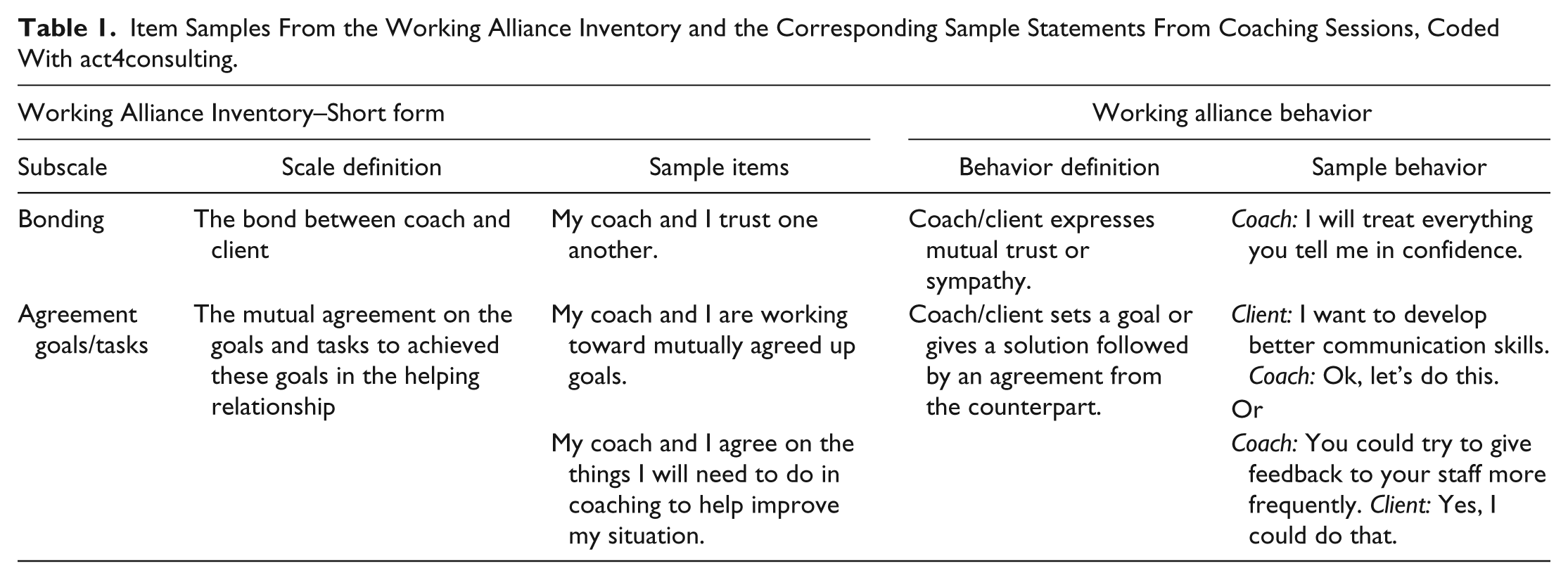
The perceptional working alliance between coach and client was measured after the last coaching session by means of the short form of the WAI (WAI-S; Tracey & Kokotovic, 1989). The WAI is established especially in the field of therapy research (Martin et al., 2000), but was originally developed for all kinds of helping relationships (Horvath & Greenberg, 1989; see e.g., Martin et al., 2000) and has already been used successfully in the field of coaching research (Baron & Morin, 2009; de Haan et al., 2013). The WAI measures the facets of working alliance: agreement about goals/tasks and bonding (see Table 1 for definitions of the subscales and sample items). Following recommendations by Tracey and Kokotovic (1989), the overall alliance score of the WAI-S is often used instead of any subscales, especially in smaller samples like ours, which limits the execution of multivariate tests (1989). The WAI-S has proven to have good reliability and validity in many different studies (e.g., Martin et al., 2000), and has been translated into different languages (e.g., Corbière, Bisson, Lauzon, & Ricard, 2006). We used the client version of the WAI-S by Baron and Morin (2009), who adapted the wording for the coaching context (for example “coach” instead of “therapist”). Additionally, we adapted the original therapist version in an identical manner. In this study, we used a 6-point Likert-type scale, ranging from 1 = I totally agree to 6 = I totally disagree. The internal reliability of both scales—the coach and the client version—was good: Cronbach’s alpha for the coach version was α = .81, and α = .72 for the client version (Kline, 1999; see Table 2). With regard to Hypothesis 1, we used the overall working alliance score from the coach and the client to test the correlation between their perception of the working alliance with the total amount of working alliance–related behaviors during the coaching process.
Item Samples From the Working Alliance Inventory and the Corresponding Sample Statements From Coaching Sessions, Coded With act4consulting.
Cronbach’s Alpha, Means, Standard Deviations, and Bivariate Correlations for Age, Sex, Goal-Attainment Progress, WAI, and WAB.
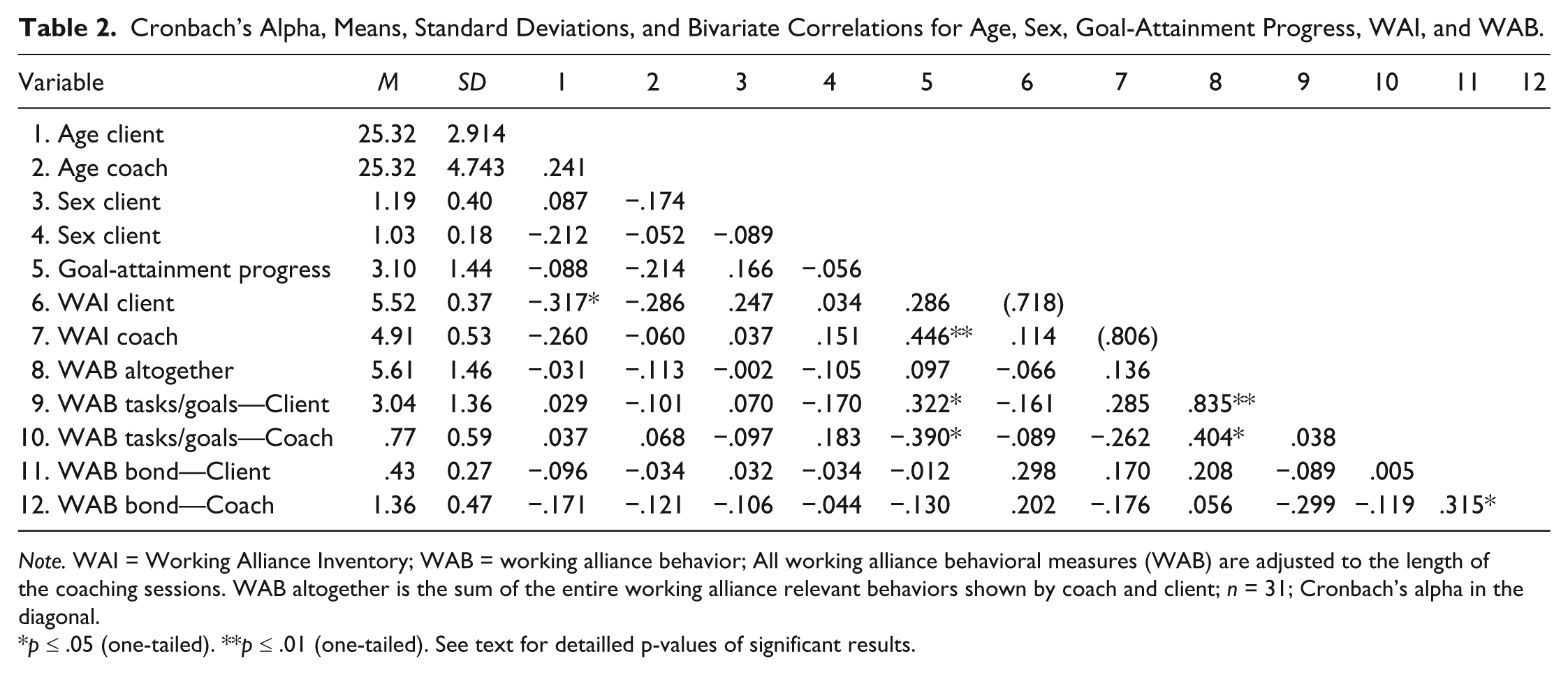
Note. WAI = Working Alliance Inventory; WAB = working alliance behavior; All working alliance behavioral measures (WAB) are adjusted to the length of the coaching sessions. WAB altogether is the sum of the entire working alliance relevant behaviors shown by coach and client; n = 31; Cronbach’s alpha in the diagonal.
p ≤ .05 (one-tailed). **p ≤ .01 (one-tailed). See text for detailled p-values of significant results.
Goal-Attainment Progress
To assess coaching success for each of the 31 dyads, we used goal-attainment scaling. As coaching is an individual intervention in which the client tries to attain professional or personal goals (Grant et al., 2010; Spence & Grant, 2007), the definition of “coaching success” can vary by processes and clients. Goal-attainment scales take this individuality into account and permit a comparison between results of different coaching processes (Grant et al., 2010; Spence & Grant, 2007). Therefore, it remains a central criterion to measure coaching success used in many different studies (for an overview, see Grant et al., 2010). In our study, clients set between one and three personal coaching goals and defined their original degree of goal attainment on a scale from 1 = goal not at all achieved to 10 = goal perfectly achieved in the first coaching session (similar to the approach of Grant, 2012). In every subsequent session, the clients rated their goal progress on the same scale. In the first session, the clients defined their original degree of goal attainment for their goals, on average, between 2.00 and 7.00 (M = 4.66, SD = 1.29). After the last coaching session, they rated their average goal achievement between 3.00 and 10.00 (M = 7.78, SD = 1.48). The overall goal-attainment progress ranged between 0.50 and 7.00 (M = 3.10, SD = 1.44) and was used in the study to measure coaching success for each of the 31 dyads.
Observed Working Alliance Behavior
The videotaped coaching sessions were subdivided into units, each representing a single communicative statement. Following Bales (1950), such a unit is characterized as the smallest meaningful statement that can be understood by another member of the interaction. This unitizing process was carried out by trained coders and realized with the software Interact (Mangold, 2010), with which the coder can cut the units directly in the digitalized video. A 1-hour coaching session consists of 800 units, on average. After the cutting process, each unit was assigned to the speaker (coach or client) and to a behavioral code. The unitizing and coding process followed the strict rules of the coding system Advanced Interaction Analysis for Consulting (act4consulting; Hoppe, 2013). This coding system is “mutually exclusive and exhaustive,” which means that each unit contains only one code (exclusive) and that for every unit, there is a suitable code without any second of the video “not coded” (exhaustive; Bakeman & Gottman, 1997). Each of the four coders received 50 hours of training with act4consulting before starting the coding process. Five randomly assigned coaching sessions were double coded to assess the interrater reliability. With a value of κ = .65 (Fleiss, 1971) across all act4consulting codes, the coders showed a substantial agreement and good interrater reliability (Fleiss, 1981; Landis & Koch, 1977). In this study, we were interested in working alliance behaviors: the correlation of all working alliance behaviors with the coach’s and client’s perception of the working alliance (Hypothesis 1) and the influence of specific working alliance behaviors on coaching success (Hypothesis 2a and Hypothesis 2b).
As mentioned above, we followed current studies and definitions, and distinguished between two facets of the working alliance: agreement about goals/tasks and bonding behavior (e.g., Andrusyna et al., 2001; Webb et al., 2011). To translate these facets into working alliance–relevant behaviors, we relied strongly on the behaviorally anchored items of the WAI and used 6 of the 47 act4consulting codes. For bonding, which is defined as the trust and liking between coach and client (Tracey & Kokotovic, 1989), we used the frequencies of the codes “bonding” and “appraisal” from the act4consulting coding scheme to measure the amount of bonding behaviors in the coaching process (see Table 1 for item samples from the WAI and the corresponding sample statements from act4consulting). The frequencies of these bonding statements form the following two variables: bonding/appraisal stated by the coach (WAB Bond—Coach) and bonding/appraisal stated by the client (WAB Bond—Client).
The facet agreement about goals/tasks consists of the mutual agreement about the goals of the coaching and the steps that need to be taken to achieve these goals (Baron & Morin, 2009; Bordin, 1979). To assess this facet in the interaction between coach and client, we used the codes “goal”; “solution”; “action plan”; and “agreement” (see Table 1 for sample statements from act4consulting). As the facet explicitly mentions the mutual agreement between coach and client about goals and tasks as the key element, we will only use the frequencies of an agreed goal or task to measure the agreement about goals/tasks. To this end, it is necessary to examine whether an agreement statement generally follows a previous goals/tasks statement (goal, solution, and action plan). The statistical analysis to test for a sequence of statements is called lag-sequential analysis (Bakeman & Quera, 2011).
Lag-Sequential Analysis
Lag-sequential analysis a statistical method to identify patterns of events following each other in sequential measured data (Bakeman & Quera, 2011). In this study, sequential analysis is used as a preliminary analysis to evaluate if a goals/tasks statement made by an interaction member indeed follows an agreement statement made by the other interaction member. The lag-sequential analysis has to verify that these sequences occur with statistical significance before the frequencies of a sequence can be used as a variable. In the following sentences, we will give a short overview about the statistical background of the analysis: For each statement pair (e.g., goal–coach followed by agreement–client), the transition frequencies (e.g., “How often does the client agree after the coach stated a goal?”) were counted. Based on these frequencies, the transition probabilities were computed (dividing the frequency of the sequence by the total frequency of the first statement alone), that is, the conditional probability that a certain sequence appears when the first statement is made. As this probability also depends on the frequency of the following statement, the application of statistics ensures that the transition probability of the sequence differs from the unconditional probability of this following second statement (Bakeman & Quera, 2011). The lag-sequential analysis and the used z values were computed with the program Interact (Mangold, 2010).
Results
Preliminary Analysis of Working Alliance–Forming Behavior: Lag-Sequential Analysis
Each of the three coaching sessions of the 31 coaching dyads (a total of 93 coded coaching sessions) consisted of 1037.76 sequences on average (SD = 43.59). The coded data from all 93 coaching sessions were combined, for a total of 96,512 sequences, to enable the interpretation of the results of the lag-sequential analysis. All of the sequences of agreement following solutions, action plans, or goals were significant, whether initiated by the coach (coaches’ solutions followed by clients’ agreement: z = 39.01; coaches’ action plans followed by clients’ agreement: z = 16.16; coaches’ goal followed by clients’ agreement: z = 8.26, p ≤ .01) or the client (clients’ solutions followed by coaches’ agreement: z = 53.11; clients’ action plans followed by coaches’ agreement: z = 16.83; clients’ goals followed by coaches’ agreement: z = 36.05, p ≤ .01). Therefore, the preliminary analysis confirmed the existence of mutual agreement on goals and tasks: Both the coach and the client start working alliance–behavioral patterns by verbalizing “goals” and “tasks,” subsequently followed by an agreement of the other interaction member. The frequencies of these sequences can be counted to form the following two variables: “tasks/goals stated by the client followed by an agreement from the coach” (WAB Tasks/Goals—Client) and “tasks/goals stated by the coach followed by an agreement from the client” (WAB Tasks/Goals—Coach).
As the length of the three coaching sessions and, hence, the total number of sequences varied across dyads, frequencies of the “agreed goals/tasks” sequences as well as frequencies of “bonding” statements had to be adjusted to the total amount of sequences of the dyad. We added the particular frequencies from all coaching sessions for each dyad (e.g., frequency of bonding behavior stated by the coach from first session + frequency from third session + frequency from last session), divided this sum by the total amount of sequences, and multiplied it by 100. These adjusted variables, as well as their means and standard deviations, are shown in Table 2. Finally, to test Hypothesis 1, we summed up all four working alliance behavior variables to form the variable “working alliance behavior altogether” (see Table 2: WAB altogether).
Descriptive Statistics of the WAI
Table 2 shows means, standard deviations, and intercorrelations of the WAI and the other measures used in this study. It should be noted that the perception of the working alliance by coach and client showed no significant correlation, r(29) = .114, p = .557 (two-tailed). Additionally, there was no significant correlation between the WAI of the client and the goal-attainment progress, r(29) = .286, p = .090 (one-tailed). Only the WAI of the coach was positively related to the goal-attainment progress, r(29) = .446, p = .008 (one-tailed).
Perceptional Working Alliance and Working Alliance–Relevant Behavior
To test our first hypothesis regarding the correlation between the coaches’ and clients’ perception of the working alliance and working alliance behaviors during the process, we did not distinguish between single facets of working alliance behavior or the initiator of the behavior. This was due to the fact that the items of the WAI make no distinction between whether “mutual agreement” or “bonding” is initiated by the coach or the client (see Table 1 for sample items of the WAI). Therefore, we used the overall alliance score of the WAI in the coach and client form and working alliance behavior altogether. As mentioned in the method section of the article, we formed this variable by adding up the adjusted frequencies of “agreed goals/tasks” and “bonding” behavior, both stated by the coach and the client. Table 2 shows means and standard deviations for this variable. Our first hypothesis suggested only moderate relationships between the WAI and working alliance–relevant behavior during the process. Contrary to our initial hypothesis, neither the coach’s (r(29) = .136, p = .237 (one-tailed)) nor the client’s perception of the working alliance (r(29) = -.066, p = .366 (one-tailed)) showed a significant, positive correlation with overall working alliance–relevant behaviors during the process (see Table 2 for an overview).
Specific Influences of Working Alliance–Relevant Behaviors on Goal–Attainment Progress
The second hypothesis regards the influence of working alliance behavior on coaching success: We suggested that all working alliance–relevant behaviors influence coaching success (Hypothesis 2a), whereas agreement about goals/tasks has a stronger effect than bonding (Hypothesis 2b). Table 2 shows that only agreement about goals/tasks initiated by the client was positively related to goal-attainment progress: r(29) = .322, p = .039, whereas agreement about goals/tasks initiated by the coach was negatively related to coaching success: r(29) = −390, p = .015. Bonding behavior showed no significant correlation with goal-attainment progress. We, therefore, conducted a hierarchical multiple regression analysis with the statistical program SPSS (Version 22) to test and compare the effects of the working alliance–relevant behaviors on goal-attainment progress. As shown in Table 3, the first step was the entry of the behavior facet agreement about goals/tasks (WAB-goals/tasks), either initiated by the client or the coach (see Method section of the article: variable WAB Tasks/Goals—Client and WAB Tasks/Goals—Coach) because it has shown to be strongly related to goal-attainment progress. As expected, the variables significantly predicted goal-attainment progress, explaining 21% of the variance, R2 = .213, F(2, 28) = 5.066, p = .013. Interestingly, WAB-goals/tasks initiated by the coach showed a significant negative effect, b = −.40, t(26) = −2.49, p = .019, whereas only WAB-goals/tasks initiated by the client showed a positive effect, b = .34, t(28) = 2.08, p = .047. In the second step, the additional entry of the behavior facet bonding (WAB-bonding) either by the client or the coach (WAB Bond—Coach and WAB Bond—Client) did not explain an additional part of the variance, ΔR2 = .009, F(4, 26) = .159, p = .854 (see Table 3 for an overview of the results). We could, therefore, not confirm Hypothesis 2a, whereas Hypothesis 2b was supported.
Hierarchical Multiple Regression Analysis Predicting Goal-Attainment Progress in the Coaching Process.
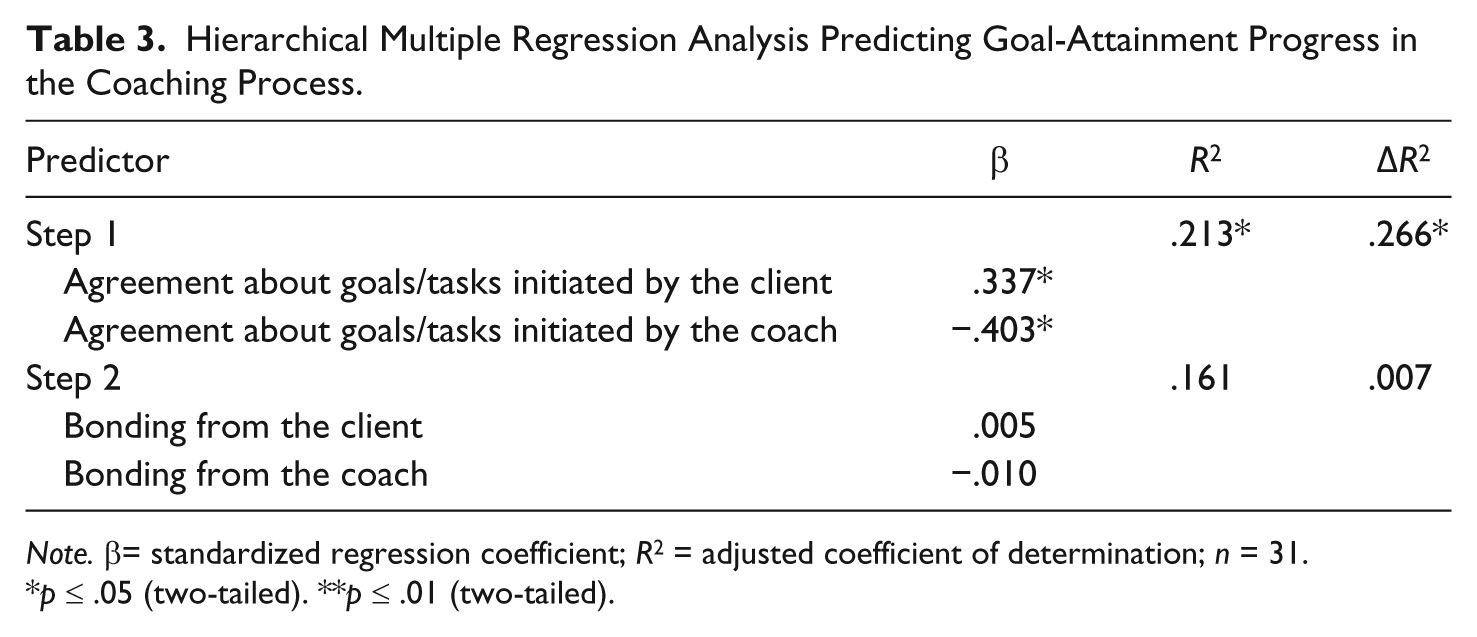
Note. β= standardized regression coefficient; R2 = adjusted coefficient of determination; n = 31.
p ≤ .05 (two-tailed). **p ≤ .01 (two-tailed).
Discussion
The first objective of our study was to fill the gap of process-analytical methods in coaching and to assess one of the central success factors—working alliance—with questionnaires as well as behavioral measures. We assessed the perception of the working alliance by coach and client with the WAI and the actual working alliance–relevant behavior by analyzing 31 coaching processes (93 coaching sessions altogether) by means of an interaction analysis. For the first hypothesis, we used the total working alliance–relevant behavior during the coaching process to see if there would be a correlation with the coaches’ or clients’ perception of the working alliance. Our hypothesis that questionnaire data and behavioral data would show only small correlations was outperformed by the results, indicating that there is no connection between the WAI (whether rated by the coach or the client) and working alliance behavior at all. Taken together, neither the client’s nor the coach’s perception of the working alliance corresponded with the objective amount of working alliance–relevant behavior during the coaching process. Interestingly, neither clients nor coaches agreed in their rating of the working alliance. The low correlation between the relationship ratings of coach and client matches results from the field of therapy (Webb et al., 2011) as well as first studies from coaching research (Baron et al., 2010; de Haan et al., 2013).
Taken together, our results underpin the difference between the “perception of the working alliance” and “working alliance–relevant behavior”: The perception of the working alliance seemed to be affected by more than just the behaviors that are specified by the WAI. It is possible that the perception of these behaviors underlies memory effects and led to an underestimation or overestimation of the actual behavior. Another explanation could lie in additional behaviors affecting the perception of the working alliance: For example, we only coded positive working alliance behavior in this study. This was due to the fact that we did not observe working alliance–opposed behavior in our sample, such as “denial,” following a task-planning statement or depreciating statements by coach or client (e.g., Hoppe, 2013).
Given the result that working alliance–relevant behavior did not lead to a higher rating of the working alliance, the question is raised as to what extent these behaviors are generally beneficial for coaching success. As the second objective of our study, we wanted to offer an initial answer to this question. As expected, we found the strongest effect on coaching success for the facet “agreement about goals/tasks” (Hypothesis 2b). Additionally, we found that the effect of this facet differed depending on the initiator of the behavior. The agreement about goals/tasks only had a positive effect on coaching success when initiated by the client (when the client stated a goal/a task and the coach agreed), as opposed to the case when the coach initiated this behavior: agreement about goals/tasks initiated by the coach showed a significant, negative effect on goal-attainment progress. On the contrary, bonding behavior had no effect at all, whether initiated by the coach or by the client. Therefore, Hypothesis 2a that all of the working alliance–relevant behaviors have a positive effect on coaching success could not be confirmed.
It seems that the effect of particular working alliance behaviors depends strongly on the person initiating them: Depending on whether the coach or the client states a goal or a task (following by an agreement of the other person), the effect has the opposite effect. A possible explanation lies in the different roles of coach and client in the interaction. The client has a very active part in the mutual process of setting goals as well as planning and coping with specific tasks to achieve them, whereas the coach has the role of supporting this process (Grant et al., 2009). Some authors have suggested that the more the client has the feeling of “owning” the goals and has developed the tasks (compared with just “accepting” them), the more he or she will pursue them (Spence & Grant, 2007). This leads to an active and self-dependent role of the client during the coaching sessions: The client’s activeness is essential for the coaching process (Spence & Grant, 2007).
It is possible that our choice of the outcome variable—goal attainment—explains the missing link between bonding behavior and coaching success: bonding represents the feeling of mutual trust, a rather affective process that probably influences affective outcomes, such as sympathy. If so, future research should use a wider range of outcome variables and explore how these measures are related to each other. Bordin (1979) provides another possible explanation of the missing influence of bonding behavior, stating that the longer a relationship is expected to last (e.g., for years, like in therapy), the more important the affective bond is going to be. In our case, the coaching relationship was designated to last only 3 months, which would—according to Bordin (1979)—lead to a lower need for an affective bond. Beyond that, he claimed that “when attention is directed toward the more protected recesses of inner experience, deeper bonds of trust and attachment are required and developed” (Bordin, 1979, p. 254). Coaching is defined as a relationship with a lower level of depth than therapy (McKenna & Davis, 2009), which results from the differing subject matters treated. Our results lead to the assumption that the more a coaching has characteristics of a shorter relationship with more work-focused content compared with therapy, the less bonding influences coaching success.
An additional result of our study regards the relationship between the WAI and coaching success: Only the coaches’ perception was positively related to coaching success. This is contrary to previous findings from the field of therapy (e.g., Hersoug et al., 2001; McKenna & Davis, 2009) or coaching (de Haan et al., 2013), where only the clients’ rating of the relationship was “pivotal” regarding its influence on success (McKenna & Davis, 2009, p. 251). According to these results, coaching research should continue to replicate findings from therapy research, with a wide range of outcome measures assessed by different sources and adequate sample size (e.g., Grant et al., 2010).
Implications for Practice
We address the following implications for practice primarily to behavioral scientists, professional working coaches, or consultants who want to advance their ability to form an effective working alliance, and clients who want to understand the roles and processes of the working alliance in coaching and its influence on successful change.
The current study is one of the first attempts to combine questionnaire and behavioral data to investigate coaching processes. The results of an interaction analysis of genuine coaching sessions offer several contributions to the current coaching research. As mentioned before, whereas therapy research has embraced the possibilities of working with behavioral data to help therapists understand the impact of their behavior on therapy success (Hill, 1990), there are only a few similar studies in the coaching field (Greif, 2010; Ianiro & Kauffeld, 2014; Ianiro et al., 2013, 2014). Due to the difficulties of observing actual behavior compared with using questionnaires, the imbalance between these two methods is understandable (Baumeister et al., 2007). Nonetheless, there are reasons for meeting the challenge and using observational data: As soon as we are interested in processes by asking which behavior of the coach or the client during the process leads to effective coaching, we cannot distribute process-analytical methods (Baumeister et al., 2007). We also want to promote a multimethod approach for behavioral scientists because “relying solely on hypothetical behavior would draw a false conclusion that would omit an important and significant contribution to actual behavior” (Baumeister et al., 2007, p. 400). By extending existing survey-based research with interaction analysis, we could gain a deeper understanding of the processes leading up to successful coaching. This insight would not only be useful for improving coaching practice in general, but the inclusion of reliable findings about process factors could refine and validate theoretical coaching models as well.
In the growing coaching market, being able to provide evidence for the coaching offered proves to be increasingly important for practitioners (McKenna & Davis, 2009). The same applies to clients: If they or their companies invest in personal coaching, the high investment needs to pay off in terms of a successful and effective process (McKenna & Davis, 2009). Although past research has addressed this issue, the coaching process remains, to date, a kind of black box (Greif, 2010). This article offers both parties—coaches and clients—useful insight into what they might do to model their working alliance as effectively as possible to achieve their mutually agreed on goals. Our results underscore the influence of the specific roles coaches and clients have during the interaction: Client activeness during the process is not only beneficial to coaching success, but coach activeness (acting as an advisor rather than as a coach) will actually have the reverse effect. The more the coach adopts the clients’ role, mentioning goals and tasks during the process, the less the goals of the coaching are achieved. A reason for this result lies in a possible “overconfidence bias” of the coach (Kemp, 2008, p. 35), that is, the tendency to overestimate the accuracy of his or her ability to understand and judge the client. Assuming that this bias exists, a client’s agreement does not necessarily mean that the goal or the tasks suggested by the coach match perfectly. Our findings suggest that the coach should beware of adopting the clients’ role, suggesting goals or tasks during the process. We, therefore, strongly recommend coaches monitor their behavior, using, for example, audio or video recordings of their sessions to prevent the negative effect of working alliance behavior initiated by the coach.
Clients should be aware that their commitment and active work during the process is essential for goal attainment. As Spence and Grant (2007) noted, not all personal goals are, in fact, freely chosen and represent the clients’ values and beliefs. Our results accentuate the need for the client to formulate his or her own goals and their associated tasks in order to identify with them. A coach can take advantage of these findings and make the coaching even more successful: By clarifying their respective roles at the beginning of the coaching process, the coach can make sure that the client’s expectations match the upcoming coaching. During their sessions, coaches can support the clients’ roles and support the process of goal and task development by encouraging feedback and self-reflection. Basal techniques, such as active listening, paraphrasing, and especially open questions, should be helpful in supporting clients in their ability to formulate goals, develop solutions, and specify tasks (Gessnitzer & Kauffeld, 2013).
Limitations and Future Research
Compared with other studies investigating behavior, this study has a respectable sample size of n = 31, observing the behavior at three points in time and analyzing 93 coaching sessions altogether. However, our sample size still pushes the limits of statistical testing. Future studies should try to build larger samples to allow multilevel analyses, for example.
The current results indicate that the objective agreement about goals and tasks, initiated by the client, is a strong facilitator of coaching success, but shows no significant relationship with the clients’ perception of the working alliance. The influences of this perception need to be examined instead because although in our study clients’ rating of the working alliance showed no significant correlation with coaching success, a positive rating of the working alliance remains an attractive objective for coaches. However, results regarding the WAI have to be interpreted restrictively: The high means and low standard deviations of the WAI score (especially of the client version) in our study could be a sign of a ceiling effect, indicating that all of the clients rated the working alliance as very good. By contrast, measures of goal-attainment progress and observed working alliance behavior featured a wide range of values (see also Table 2).
Another aspect regards the coaches in our study: Due to our study design, all coaches had the same limited amount of coaching experience, which implies a slightly limited generalizability of our findings. Conversely, our design allowed for an elimination of confounding variables that are supposed to have an effect on the coaching outcome, such as the coach’s experience (O’Broin & Palmer, 2010), received sessions (Baron & Morin, 2009), coaching approach (Gyllensten & Palmer, 2007), or setting factors (Gyllensten & Palmer, 2007). Another generalizability limitation lies in the fact that the coaches and clients were German. Future research should consider a broader sampling frame to address cultural limitations.
Despite these limitations, this study is one of the first serious attempts to analyze the working alliance during the coaching process by means of interaction analysis. Although our findings suggest no correlation between the perceptions of and behaviors related to the working alliance, we could identify behaviors important for coaching success: “Agreement about tasks and goals” as a facet of working alliance behavior seems to be a strong success factor when initiated by the client. Thus, we provide valid knowledge for coaches and clients about the importance of role-coherent behavior during their interaction.
Footnotes
Acknowledgements
Stefanie Jordan, Gina Duschek, and Nathalie Hohl helped analyze the used coaching sessions, which is gratefully acknowledged.
Declaration of Conflicting Interests
The author(s) declared no potential conflicts of interest with respect to the research, authorship, and/or publication of this article.
Funding
The author(s) received no financial support for the research, authorship, and/or publication of this article.