







Abstract
It is well documented that employees’ supportive behavior is essential for the success of change initiatives and that leaders are considerably influential on generating this support. Drawing from conservation of resources theory, this article investigates how leader–member exchange is associated with behavioral support for change through resource creation. It is proposed that high-quality leader–member relationships increase resource reserves of employees regarding their fairness and job security perceptions, which in turn enhance their support for change. A survey was conducted in organizations going through change using a sample of 269 employees and their immediate supervisors. The results showed that the relationship between leader–member exchange and behavioral support was fully mediated by the two underlying mechanisms of procedural justice and job insecurity. Findings demonstrate that managers who want to enhance support for change need to pay attention to fair procedures and nurturing a climate of security.
Keywords
Background of the Study
Change is inevitable in the agenda of the 21st century. Consequently, it has become imperative that organizations adapt to the rapidly shifting business contexts through ongoing reorganizational practices (e.g., mergers and acquisitions, introduction of new management teams, restructuring, new strategic initiatives, downsizing) to increase their effectiveness and stay competitive in the market (Hartley, Jacobson, Klandermans, & van Vuuren, 1991; Kiefer, 2005). In this context, employees’ ongoing behavioral support is crucial for the success of change initiatives since it facilitates reaching strategic change objectives (Armenakis & Harris, 2009; Herscovitch & Meyer, 2002; Oreg, Vakola, & Armenakis, 2011; Shin, Seo, Shapiro, & Taylor, 2015; Stevens, 2013). Kim, Hornung, and Rousseau (2011) define behavioral support for change as actions employees engage in to participate in, facilitate, and contribute to a planned change initiated by the organization.
Leaders unsurprisingly have an essential role in creating behavioral support for change. Central role of the leader for generating positive attitudes and behaviors toward change has been documented in previous studies (e.g., Ahn, Adamson, & Dornbusch, 2004; Herold, Fedor, Caldwell, & Liu, 2008; Nadler & Tushman, 1989). Huy (1999, 2002) has identified immediate managers’ leadership to be an important determinant of their employees’ responses to organizational change. Immediate supervisors are typically considered more effective by their proximity to employees than senior leaders, as they tend to have more direct contact with their followers. Consequently, the quality of relationship between a leader and a subordinate (i.e., leader–member exchange [LMX]) influences employees’ behavioral support during organizational change. LMX refers to the quality of dyadic relationships that are developed and negotiated over time through a series of exchanges between leader and member (Bauer & Green, 1996). LMX theory posits that leaders develop different types of exchange relationships with their followers and the quality of these relationships affects attitudes and behaviors for both parties (Gerstner & Day, 1997; Liden, Sparrowe, & Wayne, 1997). Employees with high-quality exchanges are referred to as “in-group” and those with low-quality exchanges are called “out-group.” High-quality LMX is generally associated with high level of interaction, trust, mutual support, rewards, attention, and loyalty (Dienesch & Liden, 1986; Schriesheim, Castro, & Cogliser, 1999).
The positive relationship between LMX and positive reactions to change has usually been explained via social exchange theory such that according to the norm of reciprocity, individuals who are treated favorably by others feel a sense of obligation to return the favor by positive responses, for example, support for change (Blau, 1964; Gouldner, 1960). Nystrom (1990) found that the quality of the relationship between a change agent and the organizational members was a significant factor in determining commitment to change since the immediate leader clarifies roles, provides information, and helps subordinates to form appropriate cognitive appraisals of the situation.
Going one step further and drawing from the conservation of resources (COR) theory (Hobfoll, 1989, 2001), this study attempts to explain the relationship between LMX and behavioral support for change by emphasizing the role of key resources that act as the underlying mechanism. The basic premise of the COR theory is that individuals strive to obtain, retain, protect, and nurture a set of personal valued resources. When these resources are threatened or depleted, they feel stress. Some examples of resources may be physical objects, individual characteristics, energy, status, information, support, and social relations. According to the COR theory, in the context of organizational change, such resources play two key roles. First of all, change is a stressful and draining experience for employees (Begley, 1998; Huy, 1999). Increased feelings of anxiety, negative emotions, and uncertainty are major reasons of employees’ unwillingness to support changes and thus failed change efforts (Bordia, Hobman, Jones, Gallois, & Callan, 2004; Kiefer, 2005; Sutton & Kahn, 1987). In that context, employees need more resources than stable times to cope with this stressful event, reduce strain, and increase positive reactions such as support for change (Shin, Taylor, & Seo, 2012). Moreover, during an organizational change, employees already face a threat of loss or actual loss in their resources (e.g., increased work load, change in their job positions, or losing good coworker relationships) which in turn increases their stress and may lead to change-resistant behaviors (Shin et al., 2012). Under such circumstances, receiving sufficient resources from the organization or supervisors is expected to help reduce the stress, cope with change with more resources, and hence be more positive toward the change. Also, employees who receive more valuable resources will be more willing to support change by investing their own resources for the success of change as a result of the social exchange mechanism with the organization.
LMX focuses on the quality of exchange between the employee and the manager and it is based on the degree of emotional support and exchange of valued resources (Graen & Scandura, 1987). Some examples of valuable resources during change situations can be social support, organizational support, and personal attributes (e.g., self-esteem, resilience). Accordingly, LMX could provide resources for individuals who help them build strong resource reservoirs during change that help them cope with the challenges of the situation and display change-supportive behaviors. For example, employees with high-quality relationships with their supervisors may gain information that reduces their uncertainty about their future in the current position, which consequently may positively influence their commitment to change.
Despite its crucial role, not much attention has been paid to the role of key employee resources that shape support for organizational change (Shin et al., 2012). Drawing from COR theory (Hobfoll, 1989, 2001), this study argues that two major resources, namely perceptions of procedural justice and job security, will help employees cope with the stress and uncertainty of the situation, overcome their challenges, and subsequently display supportive behaviors. Moreover, it suggests that leaders have a crucial role in building up such resources by building high-quality leader–member relationships. Several studies have also identified employment (i.e., perceived job security) and the perceived fairness of procedures as valuable resources for coping with the challenges of a job (Cheng, Huang, Lee, & Ren, 2012; Kausto, Elo, Lipponen, & Elovainio, 2005). Furthermore, in their study incorporating job demands and resources, Bakker et al. (2010) identified procedural justice and job security among major job resources. This study specifically focuses on these two potential valued resources, because especially during organizational change periods (i.e., context of uncertainty) employees become more sensitive to justice-related acts and fairness becomes particularly critical when a high level of uncertainty is experienced (Thau, Aquino, & Wittek, 2007). Moreover, given the nature of change periods, substantial concerns about job insecurity persevere among employees (Ashford, Lee, & Bobko, 1989; King, 2000). While some studies have investigated the linkage between LMX and perceived job security and justice (e.g., Alexander & Ruderman, 1987; Lee, Murrman, Murrman, & Kim, 2010; Loi, Ngo, Zhang, & Lau, 2011; Liu, Caldwell, Fedor, & Herold, 2012), little is known as to how leaders shape perceptions of justice and job security, especially in an organizational change context. Furthermore, studies have not investigated the relationship between LMX and support for change through the COR approach. Shin et al. (2012) found that organizational inducements and employee psychological resilience act as resources that increase employee commitment and support for change. They focused on the role of building up these resources before organizational change begins. However, they further address the need for more studies that investigate other resources that may affect employees’ attitudes and behavior during organizational change.
The main goal of the study is to address the aforementioned need for research by examining procedural justice and job security as two different types of resources that enhance employees’ behavioral support for change. These resources are investigated as an underlying mechanism through which leaders can affect support for change by establishing high-quality relationships with their followers. To achieve these purposes, an empirical model investigating justice and job security as mediators between LMX and behavioral support for change was tested in a field study with 269 employees and their supervisors from 30 organizations going through a significant change process. The next section focuses on hypotheses development followed by research methodology and findings sections. Finally, the results are discussed in relation to their theoretical and practical implications.
Hypotheses Development
LMX and Behavioral Support
Previous research has shown that high-quality LMX constitutes a social exchange, where a long-term partnership develops between the supervisor and the subordinate based on mutual respect and trust (Loi et al., 2011). Bakker, Demerouti, and Verbeke (2004) proposed that the availability of job resources can activate the motivational potential of the employees to perform extra-role behaviors. In high-quality exchanges, employees receive more support and in reciprocity, they display higher job performance, perform extra-role behaviors, and tend to engage in pro-organizational behaviors (Bakker et al., 2004; Gerstner & Day, 1997). In contrast, subordinates in low-quality LMX receive less supervisory support, and obtain fewer resources and hence they have little motivation to make an extra effort to perform beyond their routine work roles.
Similarly, in an organizational change context, it is expected that with high-quality LMX, employees will receive more resources from their immediate supervisors, which will subsequently lead to more change-supportive behaviors. From the perspective of COR theory, resources originating from leaders (e.g., from high-LMX relationship), can contribute to maintenance of strong resource reservoirs (Hobfoll, 1989, 2001). As explained in the previous section, when individuals receive resource reserves from their supervisors during organizational change, they will be more likely to cope with the stress of the situation and be more supportive (Cheng et al., 2012). In high-quality leader–member relationships, leaders may provide valuable resources such as support, coaching, and information to assist employees to better understand and adapt to change, feel confident and powerful, and be engaged in the process. When employees feel that they receive such resources that they can also conserve them for further use they in return display supportive behaviors, whereas those employees who anticipate losing (or lack) such resources may be more resistant to change (Shin et al., 2012). According to one basic tenet of the LMX theory, not all individuals have the same amount of access to resources originating from their supervisors such that employees who belong to the in-group (those with high-quality exchanges with the supervisor) are more likely to have access to more resources, and thus be more supportive of the change initiative, whereas the out-group employees are less likely to support since they will have less resources provided from their supervisors. Based on the aforementioned arguments, it is proposed that
Procedural Justice and Behavioral Support for Change
Organizational justice refers to employee perceptions of fairness in the workplace (Greenberg, 1990). Researchers have mainly focused on three types of organizational justice: distributive justice (Adams, 1965), procedural justice (Thibaut & Walker 1975), and interactional justice (Moorman, 1991). Distributive justice, which is based on Adams’ equity theory, is related to equitable distributions of rewards and resources; procedural justice is concerned with the perceived equity of policies and procedures determining resource allocation and other managerial decisions or in simpler terms the fairness of the process by which a decision is made; and interactive justice refers to respectful and equitable treatment of employee by immediate supervisors.
Among the three types of justice, procedural justice has been mostly examined in explaining support for change. It is found that procedural justice is more strongly related to organization-related outcomes such as feeling committed to the organization or supporting the organizational change compared with the other types of justice (Colquitt, Conlon, Wesson, Porter, & Ng, 2001; Sweeney & McFarlin, 1993). Past research found that procedural justice perceptions are effective predictors of attitudes and behavior during organizational change, leading to higher acceptance, readiness, and commitment to organizational change (Korsgaard, Sapienza, & Schweiger, 2002; Lind, 2001; Tyler & de Cremer, 2005). Based on the social exchange theory (Blau, 1964) and norm of reciprocity (Gouldner, 1960), employees who are treated in a fair manner tend to reciprocate by their favorable attitudes and behavior. When their leaders use fair procedures in allocating outcomes, followers become more supportive of their goals and act in more cooperative ways. From the COR theory perspective, procedural justice becomes even a more crucial resource under such uncertain circumstances, because employees get more sensitive to justice in the decision-making procedures and they expect more constantly applied, bias-free, and ethical decisions where all affected parties have some level of involvement (Leventhal, 1980). Consequently, employees need to know that change is conducted in a fair manner to support the change (Cobb, Wooten, & Folger, 1995). In that sense, fairness makes employees feel as valued members of the organization (Tyler & Lind, 1992) and makes future events more predictable (Colquitt, Scott, Judge, & Shaw, 2006). In other words, the more of this resource they have, the more they tend to support the change. Therefore, it is suggested that
Procedural Justice as a Mediator Between LMX and Behavioral Support for Change
Leaders and their attitudes and behaviors are an important source of justice perceptions in the workplace (Erdogan & Liden, 2006). Since managers have legitimate power over employees and use of crucial resources, they are in a unique position to enhance or weaken perceptions of justice in the organizations (Brown, Treviño, & Harrison, 2005). There is a positive linkage between LMX and perceptions of fairness (Alexander & Ruderman, 1987). More specifically, LMX and procedural justice perceptions are positively related such that individuals in high-quality leader–member relationships are more likely to receive clear justification of processes and decision-making procedures (Lee et al., 2010). Employees who belong to the leader’s “in-group” (high-quality LMX relationships) will perceive their leaders as treating them more fairly than those not part of this group. Considering that procedural justice is associated with change-supportive behaviors (Cobb et al., 1995), it is expected that employees will be more likely to support the change as leaders induce procedural justice as a resource during organizational change.
Job Insecurity and Behavioral Support for Change
Job insecurity refers to the uncertainty one feels about his or her job’s continuity (Greenhalgh & Rosenblatt, 1984; Sverke, Hellgren, & Naswall, 2002). It is a subjective appraisal of a possible threat of job loss (De Witte, 1999). Especially, in the context of organizational change, substantial feelings of job insecurity persevere among employees (Ashford et al., 1989; King, 2000). According to the social exchange theory (Blau, 1964), employees are expected to perform well in their jobs with an exchange of rewards and continuous employment. However, when an employer violates the long-term obligation of providing stable and continuous employment for its employees, leading to job insecurity, employees also consider the consequences of their actions and accordingly take positive or negative actions. Previous studies have found that major consequences of job insecurity are decreased organizational commitment, reduced trust in management, lower levels of job involvement, and increased levels of turnover intention (Sverke et al., 2006).
Especially during an organizational change, job insecurity may constitute an important variable that is negatively related to commitment to change and behavioral support for change (Noer, 1993). Based on the COR theory, employees need this resource to cope with the threat that organizational change poses to their jobs. When employees are equipped with the valuable resource of employment (i.e., job security), they will be less likely to withdraw from their work, identify more with corporate objectives without the anxiety of a possible job loss, feel more powerful, and obtain predictability over their future jobs. Consequently, they will be less likely to display change-resistant behaviors and be more supportive. On the contrary, when employees lack this resource (i.e., perceive a threat to their jobs), they will be more likely to show change-resistant behaviors as change will possibly harm them. Thus, it is proposed that
Job Insecurity as a Mediator Between LMX and Behavioral Support for Change
Job insecurity is associated by a sense of powerlessness, lack of control, and a subjectively perceived likelihood of involuntary job loss (De Witte, 1999). Leaders may be influential in this subjective appraisal such that high-quality relationships with the leader involving empowerment, support, assurance, and trust may play a role in increasing the controllability, predictability, and perceptions of security (Loi et al., 2011). In addition, individuals who have high-quality relationships with their supervisors may receive updated and transparent information about the ongoing changes as well as higher performance ratings, and may feel more certain as to whether they will keep their jobs (Schriesheim et al., 1999). Moreover, since supervisors can have the power to decide whom to retain in the organization, they may prefer to keep those employees with whom they have good relationships (Cheng et al., 2012). An employee, who feels a part of the in-group circle of the leader (i.e., having high-quality exchange), may feel less likely to be laid off than someone in the out-group. Cheng et al. (2012) further argue that high-quality relationships with the supervisor may create a supportive workplace which may make employees evaluate their job situation and feel less threatened by the uncertainty. For those reasons, LMX provides an important job resource for employees to reduce the threat to their future jobs, which in turn leads to better coping with uncertainties associated with organizational change. As a result, those “in-group” employees will be expected to show more positive reactions to change, whereas those who are in the out-group of the supervisor will lack the resource (feel insecure about their jobs) and thus avoid change-supportive behaviors. In line with these arguments, it is suggested that
Method
Research Design
A survey was conducted to test the proposed model. In line with the methodology that was successfully used in previous research (e.g., Herold et al., 2008), data were collected from employees and their immediate supervisors from 30 organizations which have been going through a significant change process. All these organizations were private companies in a variety of industries, including electronics, information technologies, food, finance, health, logistics, manufacturing, and media. The age of the organizations ranged from 2 to 45, with an average age of 12.5. Organizations had an average of 140 employees, majority of the organizations being middle-sized firms.
A significant change process was defined as a noteworthy change in input, output, or processes of the organization. Examples of types of changes that the organizations were going through included mergers and acquisitions, restructuring, downsizing, CEO change, sector change, ERP system change, new markets, and new processes. Furthermore, these changes also needed to have a significant impact on the regular work and job routines of employees. Therefore, it was ensured that the departments and employees that were directly influenced by the organizational change initiative were surveyed. To avoid problems associated with common method variance, data were collected from two sources: 269 employees and their immediate supervisors. Employees were distributed the surveys by the researcher and they returned surveys to the researcher in envelopes on which a unique code was given for each employee to ensure confidentiality. Then, each employee’s supervisor filled out another survey where they evaluated the behavioral support of their subordinate and that was matched with the employee survey. Forty-one percent of the participants (employees) were females, 56% belonged to the 26- to 35-year age-group, 13% belonged to the 18- to 25-year age group, and 31% were older than 35 years. Fifty-six percent of them had undergraduate degrees, 30% had high school degrees, and the rest had a graduate degree. Sixty-eight percent of the employees were within their first 3 years in the current organization, and 74% were working with their immediate supervisor for up to 3 years. Thirty-eight percent of the sample had up to 5 years of work experience, 39% had up to 10 years of experience, and 23% of the sample had more than 10 years of total work experience.
Measures
Independent Variable
LMX was measured using LMX7 Scale by Graen and Scandura (1987), the most frequently used LMX measure with the highest internal consistency and soundest psychometric properties. Responses were given on a 5-point Likert-type scale ranging from 1 (completely disagree) to 5 (completely agree). Cronbach’s alpha for the scale was .89. A sample item is “My supervisor would use his/her power to help me solve work-related problems.”
Mediator Variables
Procedural justice was measured using the scale developed by Niehoff and Moorman (1993). The scale consists of six items that measure the degree to which job decisions are made with unbiased and accurate information, and whether employees have an opportunity to provide input in the process. A sample item is “All change decisions are applied consistently across all affected employees.” Cronbach’s α for the scale was .88. Responses were given on a 5-point Likert-type scale ranging from 1 (completely disagree) to 5 (completely agree). Job insecurity was measured using the three-item job insecurity scale by De Witte (1999). The respondents indicated the frequency that they felt insecure about their jobs considering the organizational change period. The responses varied from 1 (never) to 5 (always). Cronbach’s alpha reported for the scale was .86. An example item is “I think that I will lose my job in the near future.”
Dependent Variable
Behavioral support for change was measured by a scale of 17 items developed by Herscovitch and Meyer (2002). Employees’ immediate supervisors rated their support rather than employees’ self-reports. The responses varied from 1 (never) to 5 (always). A sample item is “He/she tries to find ways to overcome change-related difficulties.” Reliability of the scale was .91.
Data Analysis and Results
Descriptive Statistics and Correlation Analysis
Means, standard deviations, and intercorrelations for all constructs of interest (LMX, procedural justice, job insecurity, and behavioral support) are presented in Table 1.
Means, Standard Deviations, and Correlations.
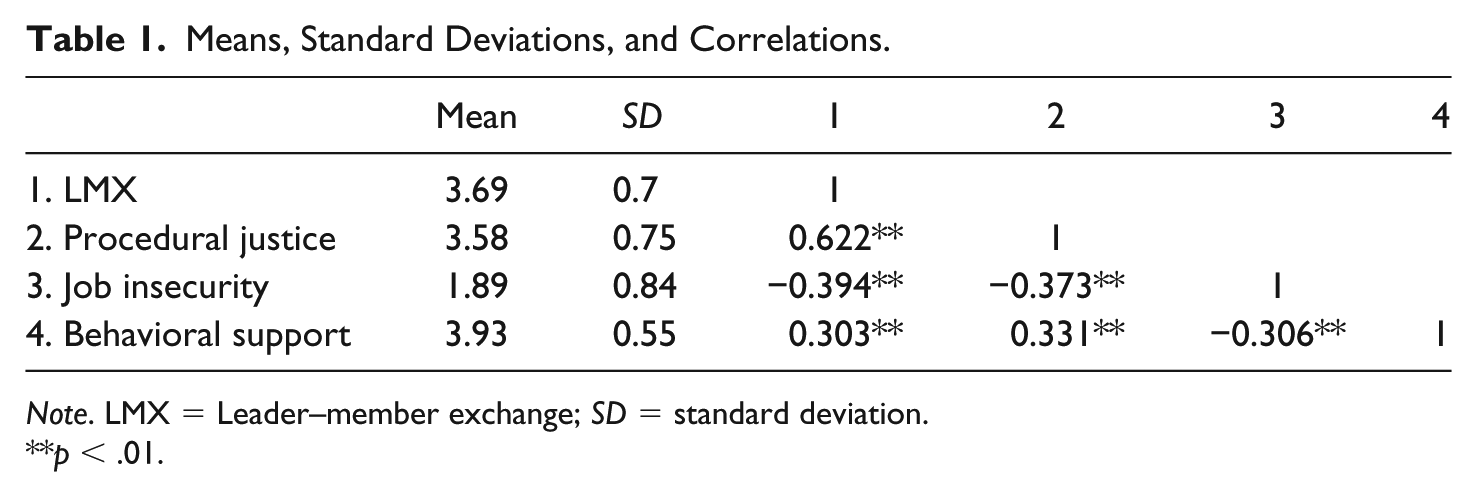
Note. LMX = Leader–member exchange; SD = standard deviation.
p < .01.
Measurement Model
To test the hypothesized relationships, a two-step procedure was applied using AMOS 21.0 software. First, a confirmatory factor analysis (CFA) was conducted to test whether the measurement model fit the data sufficiently or not. The measurement model provided satisfactory goodness of fit (i.e., there was no significant discrepancy between the proposed and observed correlations). All fit indices (goodness-of-fit index [GFI] = 0.834; comparative fit index [CFI] = 0.909; root mean square error of approximation [RMSEA] = 0.055; standardized root mean residual [SRMR] = 0.0542) fulfilled the suggested cutoff values (Hair, Black, Babin, Anderson, & Tatham, 2010; Hu & Bentler, 1999). After assessing fit, validity and reliability have been assessed. Construct reliability [CR] values greater than 0.7 (Nunnally, 1978) confirmed the internal consistency (reliability) of all scales. For convergent validity, the AVE by each construct needs to be larger than 0.50 and the CR score has to be greater than the AVE score. AVE score for support was slightly less than 0.50. However, according to Malhotra and Dash (2011), AVE is a more conservative measure than CR and convergent validity can be established using CR alone, even when AVE is less than 0.50. Finally, to ensure discriminant validity, AVE for each construct should be greater than its maximum squared correlations (maximum shared variance [MSV]). Accordingly, reliability, convergent validity, and discriminant validity for all constructs have been confirmed as shown in Table 2.
Validity and Reliability.
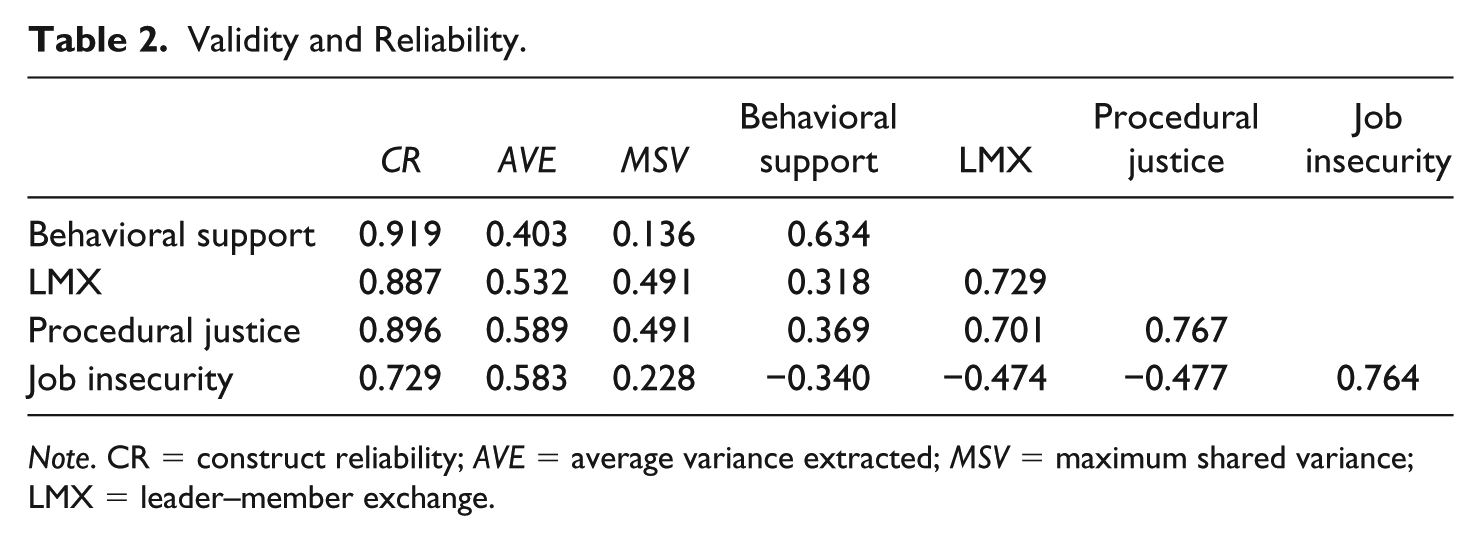
Note. CR = construct reliability; AVE = average variance extracted; MSV = maximum shared variance; LMX = leader–member exchange.
Hypothesis Testing: Structural Model Testing
After specifying and validating the measurement model by CFA, a structural model was developed with maximum-likelihood estimation to test the relationships between the constructs. The fit indices for the hypothesized model indicated good fit (GFI = 0.972; CFI = 0.964; RMSEA = 0.062; SRMR = 0.0437). In this study, independent and mediator variables have been collected by employees’ self-reports, whereas the dependent variable was assessed by supervisors. So, it is unlikely that there will be a concern of common method bias. However, in order to partial out a possible common variance between self-reported variables, common latent factor was added to the CFA model and kept in the model while creating composites for the structural model as a suggested remedy (Podsakoff, MacKenzie, & Podsakoff, 2003). Thus, regression weights in the model have been obtained by controlling for common method bias. First of all, the direct effect of LMX on behavioral support without mediators was tested and was found significant (β = 0.224, p < .001). Then, a partial mediation model was tested keeping the direct path from LMX to behavioral support. However, when the mediators entered the model, path was no longer significant, indicating full mediation. Then, the full mediation model was tested. The following direct relationships were positive and statistically significant: LMX and procedural justice (β = 0.649, p < .001), LMX and job insecurity (β = −0.401, p < .001), procedural justice and behavioral support (β = 0.191, p < .05), and job insecurity and behavioral support (β = 0.199, p < .001). Results showed that Hypotheses 1, 2a, and 2b were confirmed. Table 3 demonstrates the parameter estimates for the significant paths in the model.
Path Estimates.
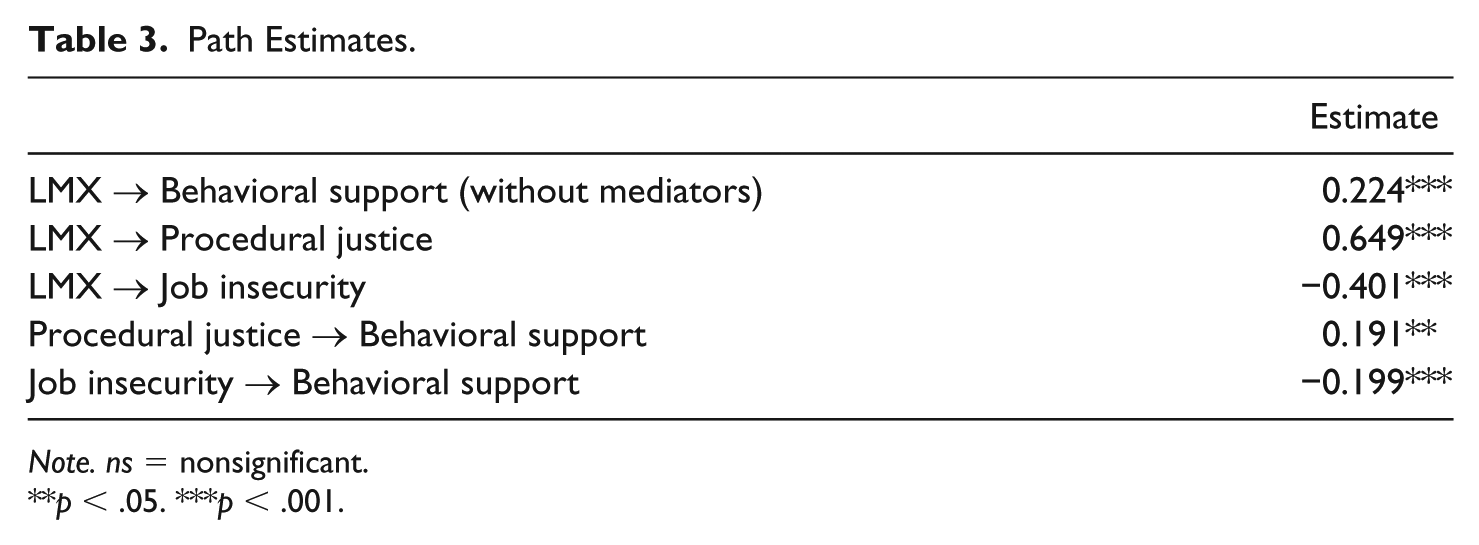
Note. ns = nonsignificant.
p < .05. ***p < .001.
Mediation Analysis
It was hypothesized that procedural justice and job insecurity mediated the relationship between LMX and behavioral support for change. Bootstrapping method was used to test the hypothesized mediation and the strength of mediation (full or partial mediation). Bootstrapping method, which is suggested due to its statistical power (Preacher & Hayes, 2004, 2008), compares the direct effects of the independent variables on the dependent variables with the indirect effects and direct effects when the mediator is included. Furthermore, mediation analysis was replicated via PROCESS macro (Hayes, 2013) using the regression analysis. Both methods confirmed that procedural justice and job insecurity fully mediate the relationship between LMX and behavioral support for change. These results show that Hypotheses 3a and 3b have been supported. Figure 1 shows the paths examined in mediation analysis and Table 4 shows the direct (with and without the mediator) and indirect effects between the variables of interest. The hypothesis testing summary is presented in Table 5.
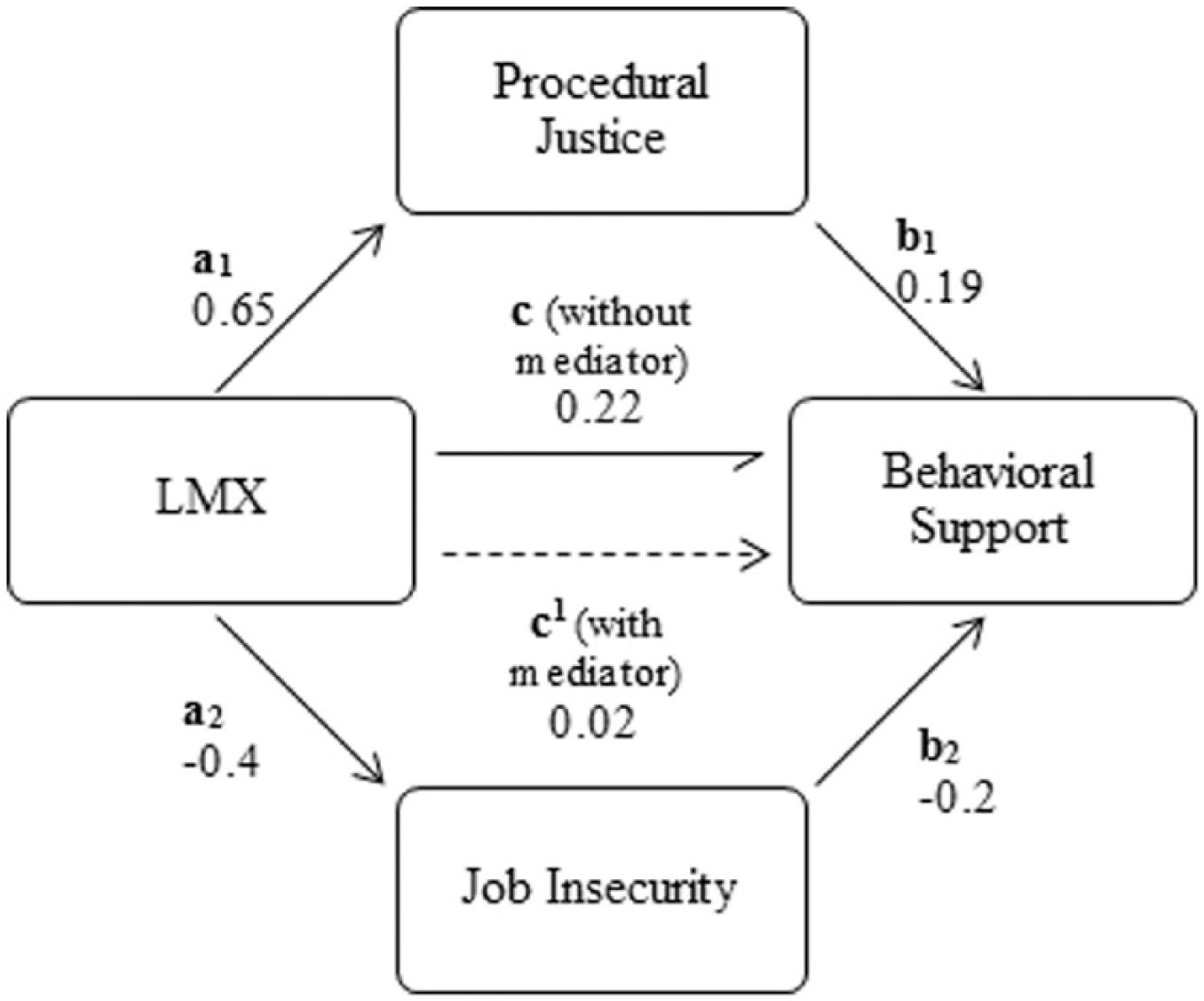
Mediation model.
Mediation Analysis.
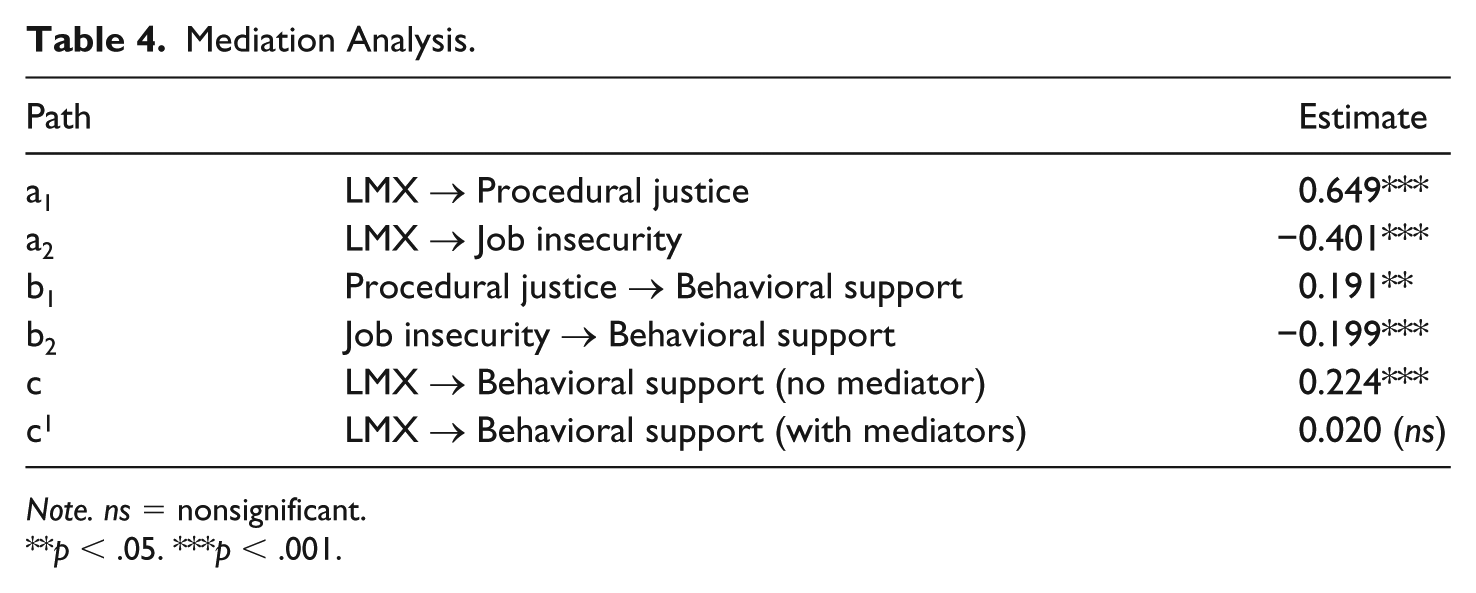
Note. ns = nonsignificant.
p < .05. ***p < .001.
Hypothesis Testing Summary.
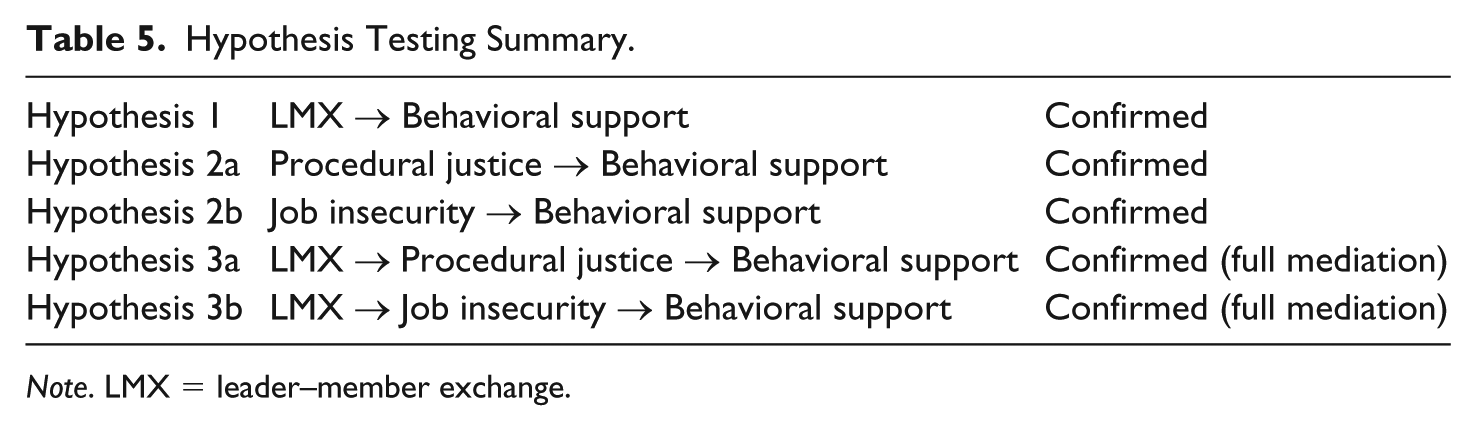
Note. LMX = leader–member exchange.
Discussion
The goal of this study was to gain an understanding of the complex relationships between LMX, procedural justice, job insecurity, and behavioral support for change through the COR approach (Hobfoll, 1989, 2001). The results of the study reinforce previous findings about the importance of the quality of LMX, procedural justice, and perceived job security on behavioral support for change, but more important, they add to the lack of research in the area of how leaders have control over change-supportive behaviors through inducing valuable resources during the context of organizational change. Previous studies have shown that leaders are influential in generating change recipients’ supports for organizational change, and specifically, high-quality leader–subordinate relationships (e.g., LMX) is related to behavioral support. Moreover, the basis of this finding has been usually linked to social exchange theory such that individuals who are treated favorably will in return display favorable attitudes and behavior (i.e., support for change in this case). However, not many studies have taken the approach of investigating the change recipients’ resources (Shin et al., 2012). This article goes one step further than social exchange theory to explain how LMX leads to behavioral support for change through induction of certain resources. Using COR theory (Hobfoll, 2001), this study demonstrates how LMX contributes to behavioral support for change through two underlying mechanisms of procedural justice and job security. The findings showed that the relationship between high-quality LMX and behavioral support for change was fully mediated by procedural justice and job insecurity. In other words, these two mechanisms serve as valuable resources that contribute to positive reactions of employees. The results confirm the assumptions of COR theory that individuals with plentiful resources are capable of coping with the stress and uncertainty of change, and thus, are more likely to generate positive reactions to change. Furthermore, it highlights the significance of establishing high-quality relationship with the employees. It is seen that change-related behaviors result significantly from ongoing exchanges with the immediate supervisors. This research suggests that perceptions of justice and security are two important resources for employees during a change period. Through fostering positive relationships with their employees and increasing perceptions of fairness and security, leaders may consequently enhance support for change.
Theoretical Contribution
This study has four important contributions to the organizational change literature. First of all, not much attention has been paid to the role of employee resources as a determinant of change-supportive behaviors (Shin et al., 2012). This study further posits that leaders are influential in generating such resources that enhance employees’ support for change. It specifically shows that LMX contributes to behavioral support via the underlying mechanisms (resources) of justice and job security. Moreover, leaders’ influence on security perceptions of employees has not been investigated in previous studies. This study contributes to the lack of studies in this area and shows that high-quality relationship with supervisors helps increase the feeling of job security. Third, organizational change literature is criticized by its tendency to give more weight to studies on attitudinal reactions rather than behavioral ones. Employees’ behavior to support change has received limited attention (Herscovitch & Meyer, 2002; Kim et al., 2011; Meyer, Srinivas, Lal, & Topolnytsky, 2007). Finally, although most studies have measured attitudes or behavioral intentions rather than actual behavior, this study focuses on the behavioral support for change rather than change-related attitudes or behavioral intentions.
Practical Implications for Leading and Managing Organization Change
Given the significance of organizational change in the 21st-century business context, it is practically vital to understand how to successfully manage change. Managers who want to increase their employees’ behavioral support for change need to consider providing them with certain resources to help them cope with change. Justice and job security are two of these critical resources. Therefore, it is suggested that managers create the perception that processes are conducted in a fair manner and that the employees feel secure about their jobs. In other words, a climate of justice and security would help employees to be more supportive, and thus, less resistant to ongoing changes.
This study has several important practical implications. First of all, this study demonstrates the positive role that leaders can play in the success of change initiatives by increasing their subordinates’ behavioral support for change through building high-quality leader–member relationships based on open communication, trust, interaction, support, and mutual understanding. Second, it is crucial that practitioners keep in mind that leaders may have direct control over gaining employee support through providing the right set of resources that employees need during the organizational change process. Organizational change periods are characterized by uncertainty, anxiety, stress (Begley, 1998). Two of these critical resources that will help employees manage their stress, reduce their uncertainty, and increase their predictability are job security and procedural justice. The quality of relationship with the immediate supervisor may foster (or obstruct) attaining these resources. On the contrary, employees who lack a high-quality relationship with their immediate supervisor may be deprived from such resources.
The results show that leaders would benefit from inducing the perception of procedural justice to increase employee support for change. Procedural justice translates into managerial actions such that managers who want to be fair need to make decisions in an unbiased manner by collecting accurate and complete information. Value of clear communication throughout change process has been confirmed to increase perception of fairness. However, in some cases managers themselves may not have enough information to convey to their employees since change may be planned at higher levels. Even in such uncertain cases, it is suggested that managers remain transparent and honest in what they know since open communication has been found to minimize negative consequences (Cameron, Freeman, & Mishra, 1991).
In addition, procedures are perceived as fair if they are made consistently, without self-interest, considering the interests of all concerned parties represented, and following moral and ethical standards (Brockner, Tyler, & Cooper-Schneider, 1992). Therefore, managers also need to make sure that employee concerns are heard before making decisions, decisions are applied consistently across all affected employees, additional information is provided about decisions when requested, and employees are allowed to challenge the decisions made by managers. To do so, team meetings can be organized to make sure employees’ concerns and questions are addressed by the management.
Furthermore, given the significant mediating role of job security, leaders, who want to gain employee support, need to care about their employees’ perceptions of security. Perceptions of security can be cultivated through just and nondiscriminatory treatment of employees or fair appraisal of their work performance. In addition, supervisors can take measures to prevent the negative effects of job insecurity by, for instance, providing accurate information, improving communication, and preparing their subordinates for employment alternatives (Hartley et al., 1991; Kets deVries & Balazs, 1997). Promoting high-quality relationships with employees may help them cope with the threat of insecurity and uncertainty which is prevalent in organizational change contexts. Participation in the process is also crucial for security perceptions. Murray Axmith (1995) found that employee meetings or focus groups were crucial to rebuild morale in organizations that were going through downsizing or restructuring. In cases, where radical changes (e.g., deployment of the entire team) may take place, it becomes even more crucial to involve all employees in the process to increase their perceived control and reduce feelings of powerlessness, which is the main aspect of job insecurity (De Witte, 1999). Human resource managers (or internal OD specialists) can also provide employees with a better understanding of top management thoughts about the change by meeting them personally or joining these group meetings and explaining the goals and reasons of the change, and the specific consequences of the change for the person, or his or her job (Agote, Aramburu, & Lines, 2016). This can contribute to increased perceptions of fair actions conducted and enhance trust.
On the other hand, some types of changes (e.g., restructuring, downsizing, mergers) by their nature involve the reality that some people will have loss in their jobs, by either being laid off or being reassigned to new positions. In such cases, where job elimination may be a reality, it may constitute a challenge to provide high levels of job security or perceptions of justice to employees. For these situations, managers can use certain levers to reduce the adverse effects of such an environment. First, organizations going through changes such as downsizing should honestly explain the external or internal forces which cause them to break their promise of job security to their employees. Studies again refer to the importance of providing open, accurate, and honest communication to enhance employee trust and employees to understand the reasons, timing, and necessity of downsizing efforts (Appelbaum, Lavigna-Schmidt, Peytchev, & Shapiro, 1999; Cascio, 2002). If managers communicate the nature and scope of the changes, employees can understand how their positions will be affected. Furthermore, managers can individually discuss personal situation of each employee and plan the steps ahead with them. Especially in the context of downsizing, advance notice of layoff may enhance the perception of procedural justice, because leavers feel that they are given adequate time to find new employment and the ones who stay also see that procedures are conducted in a fair manner (Brockner et al., 1992). Also, it is crucial that job terminations are handled fairly, using consistent and performance-based criteria, with the appropriate compensation, and respectfully (Brockner, Grover, Reed, DeWitt, & O’Malley, 1987; Leana & Feldman, 1992). Although the current environment may not promise job security, organizations may offer re-employment counselling or outplacement assistance services to dismissed employees to increase their likelihood of future employability (Burke & Nelson, 1997). Outplacement assistance can take various forms such as stress management training, résumé-writing services, trainings on job search and interviewing, and spousal counselling (Knowdell, Branstead, & Moravec, 1994). In addition, managers also need to address the needs of those who stay behind. Studies found that survivors after a downsizing experience feelings of unfairness, worries about future job security, and lack of trust and motivation (Noer, 1993). High-quality member exchange relationships can alleviate these negative consequences. When managers cannot warranty security for the overall organization, they may individually talk to key people at different levels to give them the assurance that despite the negative outlook their jobs are secure (Cameron et al., 1991). Finally, there may be times in which managers may not know what will exactly happen in the future. Even in such uncertain cases, it is crucial that managers do not lie and demolish the trust based high-quality relationships with their subordinates. Transparency is an important aspect of leader trustworthiness, and thus, crucial especially in such circumstances.
Finally, another practical implication of the study may concern the “in-group–out-group” distinction. Based on the results, one may pose the question of “So what happens to the out-group? How can leaders make sure that out-group employees also obtain such valuable resources and thus be more supportive?” This basic principle in the LMX theory concerning the differential quality of relationship between in-group and out-group members may have certain consequences as also seen in the results of this study. Given the nature of exchange relationship, one may not assume that leaders can include everyone in their in-groups. It is expected that leaders invest more resources to those with whom they have better relationship or those they expect to perform better than others. However, a possible suggestion would be that leaders may reduce the differential effect between the two groups as much as possible and maximize their high-quality relationships with their subordinates (i.e., increasing the circle of in-group) as the concept of differentiation itself violates the idea of justice. Therefore, leaders may make sure to spread perceptions of fairness to the whole group without differential treatment. In relation to that, Nishii and Mayer (2009) argue that inclusive leadership may be a possible implication where those leaders have generally high-quality relationship with their subordinates and display less differentiation. Sherony and Green (2002) also emphasize the importance of creating an inclusive environment where the leader’s behavior contributes to a group setting where majority (if not all) of the members can develop high-quality LMX relationships. Along similar lines, Wasserman, Gallegos, and Ferdman (2008) also refer to the importance of leaders in an organizational culture of inclusion. According to Mor Barak (2000), perception of inclusion–exclusion is defined as the extent to which individuals feel a part of critical organizational processes, such as having access to resources, being connected to the supervisor, or having the ability to participate in the decision-making process. Therefore, leaders may further work on creating the employee perceptions of inclusion during organizational change processes to benefit maximally from the positive linkage between high-quality LMX and employees’ supportive behaviors.
Strengths, Limitations, and Suggestions for Future Research
This research has several strengths that support the validity of findings. First of all, data were collected from multiple sources, thus, reducing the likelihood of common method bias (Podsakoff et al., 2003). While LMX, and perceptions of justice and job security constructs were measured by employees’ self-reports, behavioral support was rated by the employees’ immediate supervisors. Second, organizational change literature is criticized by its tendency to give more weight to studies on attitudinal reactions rather than behavioral ones. Change recipients’ behavior to support change has received limited attention with the exception of few studies (Herscovitch & Meyer, 2002; Meyer et al., 2007). This study considers a behavioral response to change to address this need in literature. Moreover, actual behavior was assessed rather than using self-reported behavioral measures. A third strength is that this research was conducted across 30 organizations as opposed to single organization studies, which is more common in the organizational change field. Therefore, the results can be more generalizable and reliable across different contexts and change settings. However, despite these strengths, the cross-sectional nature of the study does not allow to track the causality relationship between variables. Future studies may adapt a longitudinal approach and investigate how these resources induced by leaders may change or accumulate over time or at which stage of the change process their role reaches maximum effectiveness. This study analyzed job security and procedural justice as two major resources that can enhance employees’ behavioral support. Considering that high-quality exchanges with the leader constitute a major contributor to change-supportive behaviors through building up resources, future studies may investigate other possible resources that leaders may create. In addition, this study focused on the role of the relationship between the employee and immediate supervisor to increase these resources. Further studies may investigate the types of resources that are induced at the individual level (e.g., personality), group level (e.g., social support), or at the organizational level (e.g., perceived organizational support, organizational climate).
Footnotes
Declaration of Conflicting Interests
The author(s) declared no potential conflicts of interest with respect to the research, authorship, and/or publication of this article.
Funding
The author(s) received no financial support for the research, authorship, and/or publication of this article.