







Abstract
Qualitative research crucially contributes to knowledge generation via theory development, refinement, and refutation. A plethora of resources exist facilitating raw data engagement and immersion strategies. Yet, advanced analytic techniques for deriving theoretical insight are scantly understood and documented in the methods literature. The current paper creates a procedural framework for advancing theoretical insight via the use of qualitative analytic techniques by collating insights from the groundbreaking work of Klag and Langley, Langley, Locke et al., and Locke—which builds heavily on Peirce's work on abduction and Weick's work on disciplined imagination. We construct this framework around three core processes: challenging, seeing, and articulating. We provide three practical examples from our own research projects to demonstrate how these core processes are supported by advanced analytic techniques. We discuss the impact of different theorizing goals, different epistemological grounding, future applications, and further methodological development.
Qualitative research plays a vital role in knowledge generation by offering theoretical advancements via theory development, refinement, and refutation (Bansal et al., 2018; Gephart, 2004; Köhler et al., 2025a; Pratt, 2008; Pratt & Bonaccio, 2016). Reflecting this critical role, the number of qualitative publications in top organization studies journals has seen a strong increase in the past two decades (Bluhm et al., 2011; Pratt & Bonaccio, 2016; Smith et al., 2015; Wilhelmy & Köhler, 2022). Given that there are far fewer academics who employ qualitative methods, the relatively high number of qualitative versus quantitative and conceptual publications in top journals speaks to the theoretical novelty and quality of the work. The crucial contributions of qualitative research to theoretical advancement are further evidenced by the fact that qualitative research papers win best paper awards relatively more frequently than quantitative research papers (Bartunek et al., 2006b; Rynes & Bartunek, 2016; Smith et al., 2015).
In order to achieve these strong theoretical contributions to the knowledge generation cycle, qualitative researchers often engage in substantial data collection, including embedded fieldwork, multimodal data collection techniques, and multisource data triangulation, to obtain relevant, contextualized data involving key agents and stakeholders. Subsequently, qualitative researchers need to consider a wide range of data analytic techniques that allow them to explore, evaluate, interpret, and make sense of the data.
Above and beyond these data engagement techniques, though, qualitative researchers need to understand and utilize advanced analytic techniques that facilitate theorizing from their empirically grounded insights, contributing to a novel understanding and explanation of the theoretical meaning of their observations and interpretations (Klag & Langley, 2013; Locke, 2007; Richards, 2020). When we refer to advanced qualitative analysis, we mean activities that are aimed at seeing, understanding, interpreting, refuting, challenging, integrating, and explaining patterns in the data, that is, the activities and analyses researchers use to generate theory from data. They are the kind of qualitative analytic techniques that bring about a “conceptual leap” (Klag & Langley, 2013, p. 150), which: […] involves bridging the gap between empirical data and theory: moving from the mass of words and other data (the world of the field), through and beyond the mechanics of analysis to an abstract and explicit set of concepts, relations and explanations that have meaning and relevance beyond the specific context of their development (the world of ideas).
These analytic techniques aimed at deriving theoretical insight are the least well-understood and documented aspect of qualitative research methods (e.g., Klag & Langley, 2013; Locke et al., 2008; Richards, 2020). While a plethora of resources exist that guide researchers through different data engagement strategies targeted at getting to know one's data or to summarize core themes (such as open coding, first and second level coding, thematic analysis, content coding for categories, writing case summaries, etc.), resources for explicating the derivation of theoretical insight (the “aha” moment) are largely absent from textbooks, research methods syllabi, and methods sections in empirical papers (e.g., Köhler et al., 2025b; Langley, 1999; Locke et al., 2008; Richards, 2020; Van Maanen et al., 2007). 1 Notable exceptions of empirical research papers that provide transparency of these intermediate processes include Kaplan and Orlikowski (2013, Appendix 1), Gersick (1988, 1992), Jarzabkowski et al. (2012), Golden-Biddle (2020), and Smith (2002).
One of the reasons for this lack of description of advanced analytic techniques is that they are often relatively idiosyncratic to the research project, depending on the research question, the unique characteristics of the sample and setting, and the unfolding discovery process of the researcher (e.g., Van Maanen et al., 2007). Thus, it is difficult to write up universal advice for a textbook on how to analyze data to arrive at theoretical insights. Furthermore, sharing the authors’ specific discovery process would likely reflect its iterative nature and the serendipity of “stumbling on” the theoretical contribution or “leaping” toward theoretical insights (Van Maanen et al., 2007); these may be seen as less “scientific” and potentially less rigorous to nonqualitative scholars, and might therefore be avoided. Hence, despite the growth in qualitative publications, there continues to be a silencing around this analytic reality (Hansen et al., 2025), and thus a lack of description of the necessarily iterative nature of the discovery process (Hoon & Baluch, 2024; Köhler et al., 2025b; Ridder et al., 2014; Van Maanen et al., 2007).
A related reason for silencing this idiosyncratic discovery process is the field's push for templates for qualitative research. The use of such templates has risen, coming to dominate qualitative publications over the past 20 years (e.g., Cornelissen, 2017b; Mees-Buss et al., 2022; Pratt et al., 2022; Zilber & Zanoni, 2022). By promoting standardization of qualitative approaches and legitimizing only a handful of them, the field has actively discouraged researchers from disclosing the more unique steps in data analysis that have helped them uncover interesting theoretical insights for fear of not getting published (e.g., Köhler et al., 2022). Recently though, the lack of reflection and indiscriminate use of templates have been challenged as a major threat to the relevance and rigor of qualitative research (e.g., Harley & Cornelissen, 2022; Köhler et al., 2022; Mees-Buss et al., 2022), driving renewed interest in the innovativeness and adaptability of qualitative methods.
Moreover, advanced qualitative data analysis also serves to produce different forms of theorizing. While correlational thinking and propositional theorizing dominate in mainstream positivist research (Cornelissen, 2017a; 2017b; Delbridge & Fiss, 2013; Langley, 1999), there are many different forms of theorizing that might be central to a respective qualitative research project, including narrative theorizing, the creation of typologies or taxonomies, rich description, and many more (Abbott, 2004; Cornelissen, 2017a, 2017b; Cornelissen et al., 2021; Delbridge & Fiss, 2013; Zilber & Zanoni, 2022). Furthermore, different epistemological and ontological assumptions presume different theorizing goals (Cunliffe, 2022; Delbridge & Fiss, 2013; Willmott, 2025). Generally, different epistemological stances tend to lead to different research questions and lenses with regard to the underlying phenomenon, its context, and how it functions (e.g., Cornelissen et al., 2021; Cunliffe, 2022; Mees-Buss et al., 2022). Consequently, researchers embedded in different onto-epistemological traditions or with different theorizing goals will likely employ different advanced data analytic techniques for their theorizing, which in turn determine which theorizing might be derived from the resulting observations (e.g., Cornelissen, 2017b; Pratt et al., 2022; Van Maanen et al., 2007). Yet, this link between data analytic techniques and theorizing goals remains largely unexplored.
The purpose of the current paper is to elaborate on this link. In the following, we start our exploration by reviewing the ground-breaking work by Karl Weick (1989), Malvina Klag and Ann Langley (2013), and Karen Locke et al. (2008) that has provided crucial guidance to researchers about making the conceptual leap from qualitative data to theory. This work focuses mostly on the forms of reasoning and scholarly exploration that are necessary to arrive at theoretical insights. We integrate the core tenets of this work to arrive at a rudimentary framework, specifying different avenues toward the practices of challenging, seeing, and articulating that advanced analytic techniques need to enable and support. We then provide three practical examples from our own qualitative research projects to demonstrate specific forms of advanced analytic techniques and how they supported challenging, seeing, and articulating to derive the subsequent theoretical insights of our work. We end with a discussion of the impact of different theorizing goals as well as different epistemological grounding on the link between theorizing and advanced qualitative techniques, applications of said techniques in future research, and the need for further methodological development in this space.
Theorizing From Qualitative Data
Arguably, activities related to theorizing are the main concern of researchers in the fields of management and organization studies (e.g., Cornelissen et al., 2021). Practically no paper gets published without making a theoretical contribution or testing theory with an eye toward determining whether a given theory receives empirical support or needs to be revised. The role of qualitative research in particular is to contribute to theory generation and revision, a crucial task in ensuring that the theoretical landscape in our research fields remains vibrant and interesting, yet also scientifically sound and generative for future research (e.g., Köhler et al., 2025a).
Consequently, a healthy literature exists that engages with the definition of theorizing, its content, its processes, and its communication. Much of that literature focuses on the conceptual aspects of theorizing, that is, forms of thinking and establishing argument, often based on the body of prior conceptual and empirical work (e.g., Cloutier & Langley, 2020; Cornelissen, 2025; Cornelissen et al., 2021; Ketokivi & Mantere, 2010; Klein & Zedeck, 2004; Weick, 1989; Whetten, 1989). Mostly independent of that, another substantial literature explores methodological techniques to analyze empirical data and extract findings from it, ultimately leading to interpretations and conclusions related to a chosen theoretical lens or framework (e.g., Van Maanen et al., 2007). However, rarely are the two literatures brought together to explore specific methodological techniques that help researchers with their respective form of theorizing (Cornelissen, 2017b; Klag & Langley, 2013; Köhler et al., 2025b; Langley, 1999). As a result, the process of qualitative research, especially related to its purpose of producing theoretical insights and novel theorizing, remains an enigma for many researchers (e.g., Czarniawska, 1999; Klag & Langley, 2013; Köhler et al., 2025b; Langley, 1999; Richards, 2020).
Some of the most groundbreaking work in bringing together theorizing and analytic techniques can be found in the work of Klag and Langley (2013), Langley (1999), Locke et al. (2008), and Locke (2007), building heavily on Peirce's (1931–1958) work on abduction and Weick's (1989) work on disciplined imagination. In this part of our paper, we bring together insights from these different works to create a rudimentary procedural framework for advancing theoretical insight via the use of qualitative analytic techniques. We build this framework around three core processes for advancing theoretical insights (built on said earlier research), namely, challenging, seeing, and articulating. The proposed framework is depicted in Figure 1.
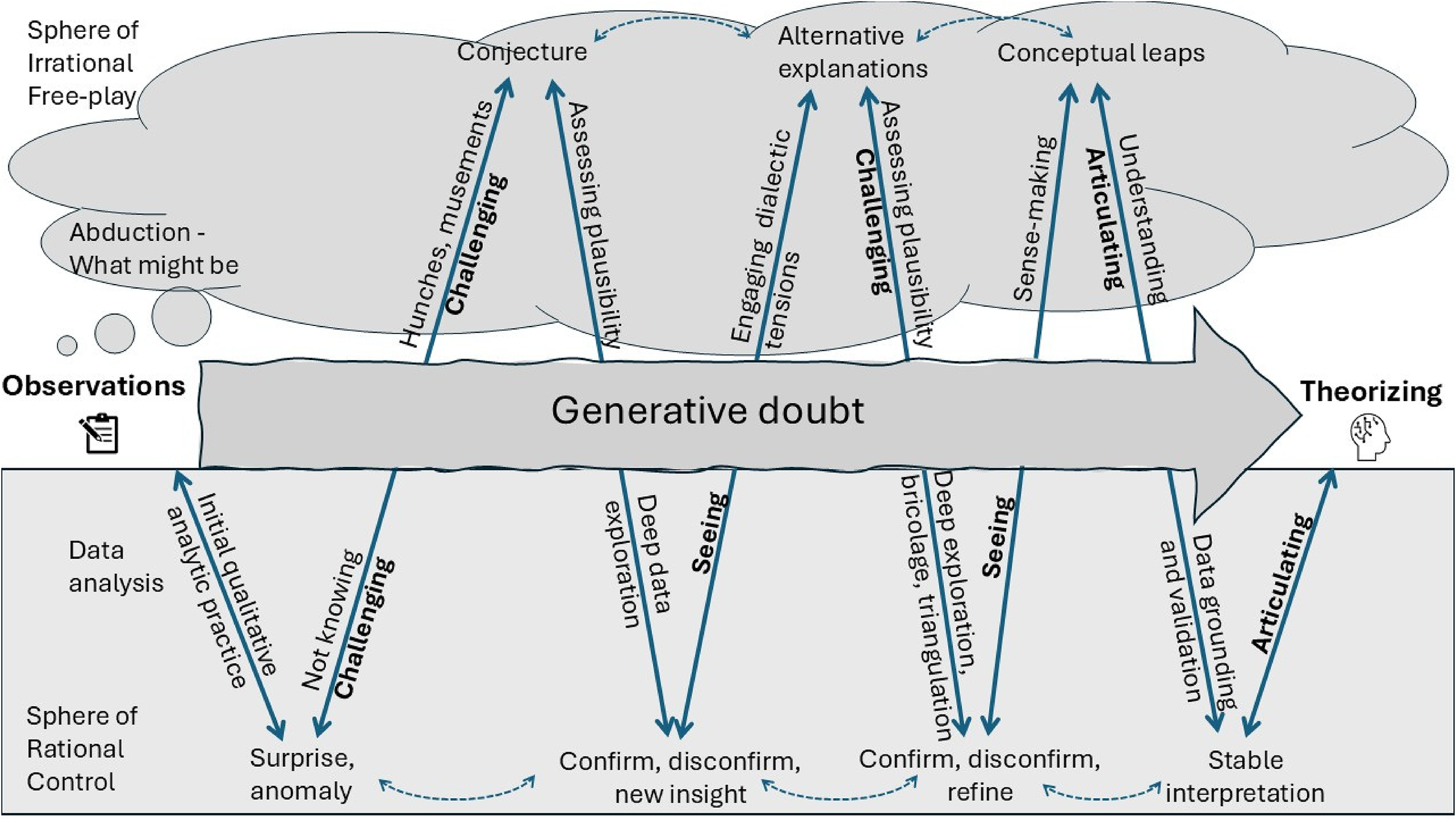
A procedural framework for theorizing through advanced qualitative analysis.
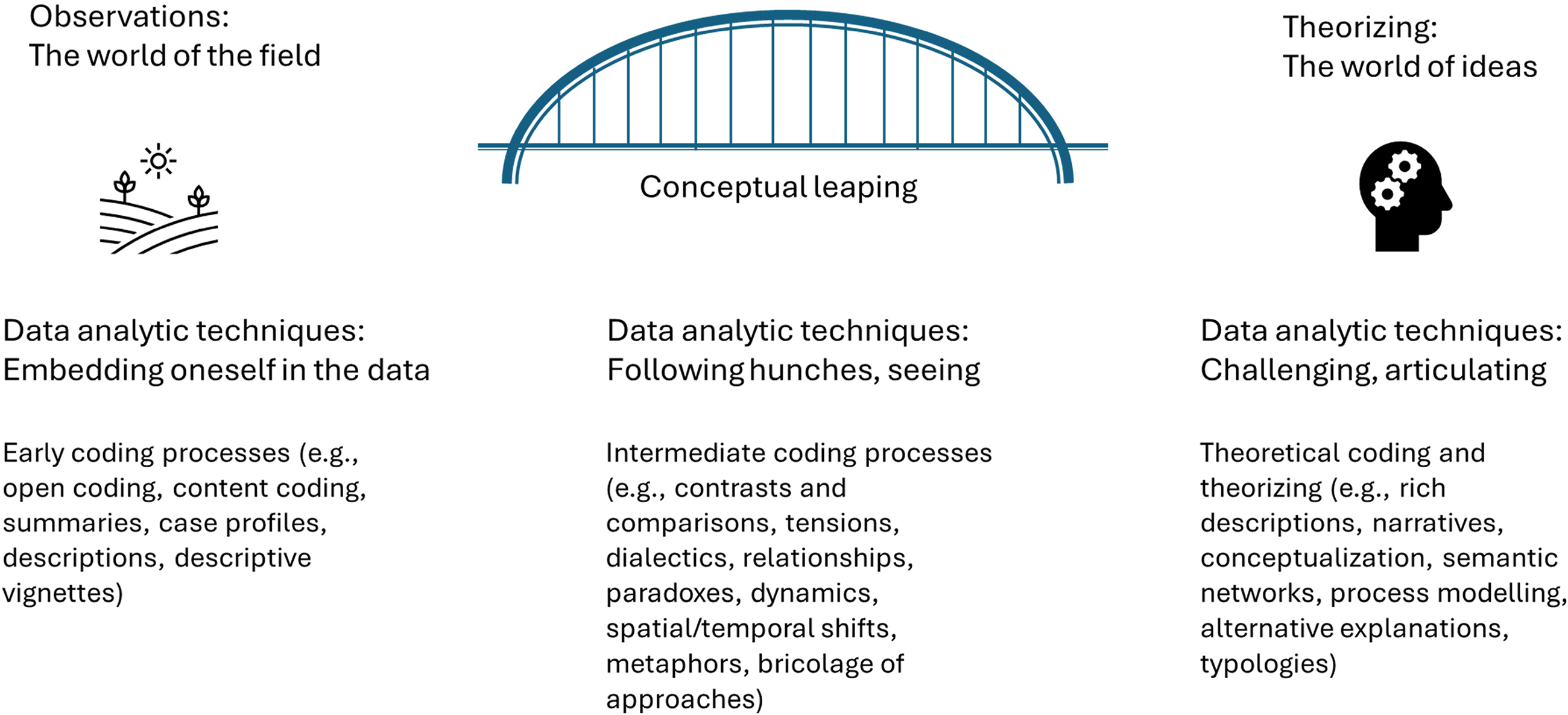
Data analytic techniques to facilitate conceptual leaping.
A Procedural Framework for Theorizing With Qualitative Analytic Techniques
Abduction has been widely identified as the major paradigm for deriving theorizing from qualitative empirical data (Klag & Langley, 2013; Locke, 2007; Locke et al., 2008; Sætre & Van De Ven, 2021; Weick, 2005). Peirce distinguishes abduction from deduction and induction insofar as: “Deduction proves that something must be; induction shows that something actually is operative; abduction merely suggests that something may be” (Peirce, 1931–1958 [CP] 5:171). Although qualitative research and data analysis are often associated in the literature with induction—that is, the establishment of “expectation based on repetition of observations” (Locke, 2007, p. 567)—when theorizing from qualitative data, abduction is much more conducive to generating a deep theoretical understanding as “through abduction we invent a way of understanding (a conceptualization) which achieves a synthesis of observations” (Locke, 2007, p. 567). Abduction allows a researcher to generate theoretical ideas and conjectures that the researcher subsequently evaluates (conceptually and empirically) and discards or develops further depending on the outcome of the evaluation.
The process of idea generation through abduction usually starts with a surprising observation in the empirical work that leads to doubt about the explanatory utility of our existing theories (Locke et al., 2008; Weick, 2005). Surprises can emerge in many ways, for example, unexpected observations, inconsistencies with the prior literature, divergent findings in different contexts, samples, or at different times, a negative case, a questioning comment during a member check, and any other observation that constitutes an anomaly. The anomaly draws into doubt what the researcher thought they knew about the phenomenon or context. This “generative doubt” in turn produces a state of “not knowing” and the subsequent motivation to search for alternative explanations that might provide a theoretical resolution for the experienced surprise (Locke et al., 2008; see also Alvesson & Kärreman, 2007; Timmermans & Tavory, 2012). This search process for alternative explanations unfolds over time and keeps the researcher iterating between possible explanations, further data engagement and analysis, potentially even further data collection, rejection of earlier ideas, and further exploration of literature and data, through a series of conceptual leaps, until a plausible explanation can be generated that advances sensemaking about the phenomenon or process of interest (Klag & Langley, 2013; Locke et al., 2008; Mithani & Kocoglu, 2024; Weick, 1989; Van Maanen et al., 2007; see Figure 1). 2
In building the connection between theorizing (“the world of ideas,” Klag & Langley, 2013, p. 150) and our empirical data (“the world of the field,” Klag & Langley, 2013, p. 150), that is, what Locke et al. (2008) term the “discovery process,” much of the previous work has highlighted core underlying tensions that fuel the iterative nature of the abductive process. One of these tensions relates to the conceptualization of novel theorizing between disciplined thought experiments that engage more structured forms of thinking and that assess the plausibility of derived alternative explanations (i.e., “disciplined imagination,” Weick, 1989), and unbridled imagination (CP 1. 46), during which the employment of generative doubt leads a researcher through phases of not knowing, conjectures, hunches, and musements toward “the potential of theorizing creatively” (Locke et al., 2008, p. 908). This tension includes the process of “
Another tension resides in the provision of methodological structure through systematic and deliberate data engagement (what Weick, 1989, calls validation or demonstrations) and the need to move beyond the data to freely explore possibilities and hunches. Locke (2007) distinguishes two modes of thinking required throughout the abduction process: “rational control” (Locke, 2007, p. 570), in which the researcher systematically observes and deliberately pursues understanding through the use of qualitative analytic practices, and “irrational free-play” (Locke, 2007, p. 569), during which the researcher imagines possibilities, follows hunches, and engages in musements to arrive at theoretical conjectures. Empirics and conjecture go hand in hand in this dual thinking mode. Irrational free-play is based on intimate knowledge of the data, at which a researcher arrives by engaging in qualitative analytic practice. Yet, irrational free-play needs to go beyond the data and the product of analytic practice into imagination and creative theorizing to overcome pure description and statements of what can be plainly observed and may thus be largely trivial on its own. Irrational free-play can produce conceptual leaps (Klag & Langley, 2013) that create bridges between empirical data and the world of theory by imagining “concepts, relations, and explanations” (Klag & Langley, 2013, p. 150) that transcend the specific context in which the data were collected. Yet, Golden-Biddle and Locke (2007) emphasize that the conjectures produced by irrational free-play should not go unchecked by rational-controlled modes of thinking, during which a researcher empirically evaluates the hunches and inspects their plausibility and usefulness more closely with the available data.
The iteration between these different forms of data engagement in conjunction with creating conjectures to arrive at possible, or alternative, explanations for the empirical observations leads to the process of “ Conceptual leaping is a ‘do-it-yourself’ process of ‘cobbling together’ that one undertakes with the tools at hand. There is, and must be, plenty of trial and error, tinkering, playing and testing, during which the scholar draws upon his or her unique toolbox (Stock, 2010). The bricoleur is able to engage in multiple, diverse tasks and does not limit each to the tools available for the project at hand. Instead, he or she accesses a broader toolbox that contains many items collected over time (e.g., ideas, theories, methods, life experiences, skills, social connections), sometimes acquired with a view to their potential usefulness, but often accumulated in a more undirected way. (p. 161)
Pratt et al. (2022) view bricolage as a metamethodological approach that helps researchers understand and communicate how to do qualitative research. They define methodological bricolage as: “the combining of analytic moves for the purpose of solving a problem or problems tailored to one's own research project” (Pratt et al., 2022, p. 219). The authors highlight the importance of creating a coherent application of method that aligns the research question with the data engaged to answer it (i.e., data collection, analysis, and interpretation) as well as with the theory created or employed to explain the obtained observations. Furthermore, a researcher needs to dynamically apply and develop analytic approaches that address emerging methodological problems throughout the unfolding of the research project, while also engaging with the data in their given project with competence, integrity, and benevolence. Competence refers to knowledge of existing analytic moves as well as the necessary skill and training to implement them. Integrity refers to the need for different analytic moves to be combined so that they fit together (e.g., ontologically and epistemologically) as well as fit the research question and specific setting. Benevolence refers to being truthful to the data and not misrepresenting the experience of informants in the subsequent theorizing process.
Conceptualizing methodological bricolage as a set of analytic moves at the discretion of the researcher underlines the agency of the researcher in making explicit choices throughout the research project that impact the researcher's conclusions (Pratt et al., 2022). Similarly, Locke et al. (2008, p. 909) emphasize the inherent human experience and embodiment in the abductive process: “[…] the elements of inquiry we have discussed—abduction, doubt, and belief—are living transactional processes involving human beings living and acting in a world. They are not purely subjective phenomena; rather, they mediate between the human organism and its environment.” In particular, Locke et al. (2008, p. 916) underscore the “important process of growing theory” through the work involved in the iterative process of observations, following hunches, creating conjectures, and inspecting them for plausibility, ultimately transforming them into theory. Thus, theoretical musings and analysis of empirical data are inextricably linked and constantly revolve around each other like twin stars.
Advanced Qualitative Techniques for Theorizing
As stated in the Introduction, in this article we pay specific attention to the advanced qualitative techniques that facilitate theorizing, more so than the well-known early-stage qualitative analytic practices directed at getting to know or breaking down empirical raw data, such as line-by-line coding in grounded theory (Glaser & Strauss, 1967), writing case summaries (Denzin & Lincoln, 2005), producing content coded categories (Miles & Huberman, 1994), and the likes. These early stages may produce the kinds of surprises and anomalies vis-à-vis existing theoretical understanding that become the impetus for embarking on the abductive journey. Yet, due to the fact that the early stages of engaging with data are usually targeted at summarizing or dissecting to facilitate data immersion, but not necessarily at moving beyond the data, we are more interested in those later, more advanced stages of qualitative analytic practice that will lead us past the discovery of the anomaly and toward developing insights and theorizing. Specifically, we want to explore those techniques that facilitate the critical processes of challenging, seeing, and articulating that lead to conceptual leaps. See Figure 2 for an illustration and distinction between different phases of the discovery process and related data analytic techniques.
Klag and Langley (2013) provide some suggestions for advanced qualitative techniques that can harness the tensions between rational control and irrational free-play to facilitate conceptual leaps and alternative explanations. For example, heuristics can be used to stimulate novel theoretical formulations, such as category checklists, metaphors, argument heuristics, and spatial/temporal shifts (see Klag & Langley, 2013; also see Glaser, 1978; Ketokivi et al., 2017; Weick, 1989). These heuristics offer different ways to conceptualize a phenomenon that facilitates deeper data engagement and generate alternative means of exploration. Additionally, both immersion in the data via recognized qualitative analytic practice to prepare for irrational free-play, as well as more playful engagement such as asking different types of questions, only looking at parts of the data—possibly even out of order or out of its context—comparing specific incidents, cases, or time periods, creating specific case narratives or using alternative theoretical templates can all foster different ways of seeing (e.g., Eisenhardt, 1989; Langley, 1999; Locke, 2007). Locke (2007), in particular, provides a very detailed example of how to move beyond early qualitative analytic practice to engage in more irrational free-play.
Klag and Langley (2013) also propose that researchers most effectively exploit the tensions by using bricolage techniques that facilitate different ways of engaging with the data. As Pratt et al. (2022) observe, engaging in methodological bricolage affords a researcher a deeper connection with the data and different ways of seeing. In addition, the analytic flexibility that methodological bricolage offers the researcher allows the move away from restrictive methodological templates toward a more tailored engagement with the data and context of the specific study, making theorizing more relevant and more benevolent toward informants. Furthermore, bricolage provides the potential for methodological innovations to address challenges in one's study, which in turn can facilitate surprises and unique discoveries.
Ultimately, this deep engagement with data, methodological and theorizing approaches that produce “seeing,” also produce the ability to communicate the obtained ideas and novel explanations, for example, through writing, visualization, or other forms of representation of findings and insights, which constitutes the third process of “
Unfortunately, our field lacks in-depth descriptions of the application of bricolage and other advanced qualitative techniques to facilitate theorizing (e.g., Köhler et al., 2025). Furthermore, many methodological techniques that reside outside of the predominant templates are still underused, despite holding strong promise for certain research areas (e.g., Lerman et al., 2022; Zilber & Zanoni, 2022). In the following, we provide three concrete examples from our own work to illuminate the interaction between the application of advanced qualitative techniques and the theorizing produced by it. We provide these examples to inspire and guide readers to advance their own methodological and theorizing practice.
Challenging–Seeing–Articulating
The Process of Theoretically Leaping With the Help of Advanced Analytic Techniques
This section uses three worked examples from our own research to illuminate our respective discovery processes and showcase how challenging, seeing, and articulating were advanced by the respective employed analytic techniques. We further illustrate some of the diverse ways and forms of theorizing that subsequently emerged from our discovery processes.
First, to show how
While we foreground particular foci and tools for illustration, it is important to note that these ways of working with and theorizing from data are not mutually exclusive. Indeed, they often overlap in practice, where researchers adapt methods to their particular question and context, through an iterative process that involves a pragmatic bricolage of techniques (e.g., vignettes, timelines, and process models), critical analytic decisions (e.g., core constructs and unit of analysis), multimodal engagement with data (e.g., hearing, reading, and touching data), and tools (e.g., sticky notes, drawings, and CAQDAS).3
Example 1: Deep Diving Into a Particular Observation: Sensitizing Concept in Practice
Background
The following worked example is based on the paper by Jarzabkowski et al. (2012). This paper is one of a series of papers written from a large, multi-year research project by the first two authors, investigating the management of contradictory organizational goals. This project generated an extensive dataset of 254 meeting observations, 130 interviews, 16 days of field observation, and 1,597 documents (see also Jarzabkowski et al., 2019). Critically, this dataset covers a multi-year organizational restructuring in a large infrastructure firm, as it underwent major regulatory change. The paper we discuss here focuses specifically on organizing and coordinating activity central to that organizational restructuring. We therefore describe how we mobilized the dataset to speak to these themes. Critically, we employed the notion of the sensitizing concept (Blumer, 1954) as a way into our data. Blumer (1954) argues that concepts in the social sciences are not definitive, but should be approached as sensitizing. As such, they offer analytic artifacts based on which researchers can derive a general sense of where to look in their data: A sensitizing concept lacks specification of attributes or benchmarks and consequently it does not enable the user to move directly to the instance and its relevant content. Instead, it gives the user a general sense of reference and guidance in approaching empirical instances. Whereas definitive concepts provide prescriptions of what to see, sensitizing concepts merely suggest directions along which to look. The hundreds of our concepts-like culture, institutions, social structure, mores, and personality-are not definitive concepts but are sensitizing in nature. (Blumer, 1954, p. 7)
In this way, sensitizing concepts offer an important analytic artifact for inquiry by encouraging open-minded, creative, and exploratory engagement with field data. They offer an “interpretive device” that may serve as starting point for research (Glaser, 1978; see also Bowen, 2006; Charmaz, 2003). They can therefore be used very early on in research, often also in the design and data collection stages (see Blumer, 1969). Critically, however, the sensitizing concept only suggests where a researcher may posit more attention. It is not prescriptive, with the data continuing to lead us, potentially displacing the sensitizing concept altogether (Padgett, 2004). At the same time, it offers one specific way to engage with and theorize from the data—in short, it offers “a way in.” We found this device particularly useful in our large, complex projects with a massive dataset. We therefore focus our illustration of the process of theorizing, zooming into the advanced analytic technique of the sensitizing concept. See Figure 3 for a visual account of this process that parallels our procedural framework for theorizing through advanced qualitative analysis.
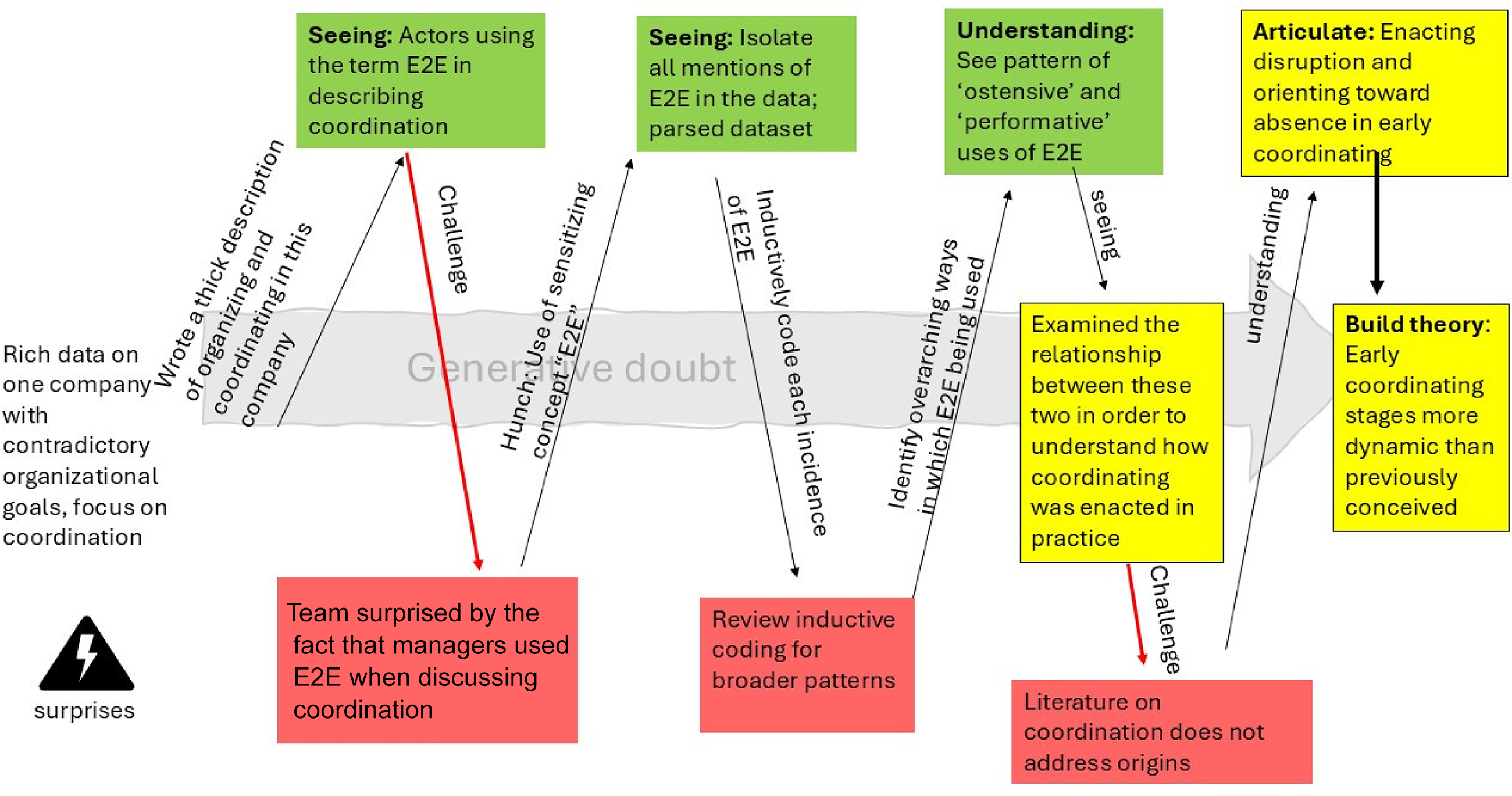
Discovery process in Jarzabkowski et al. (2012).
As we commenced this paper project—explicitly focusing on organizing and coordinating—we reoriented toward and revisited the data. Our first step was to write a thick description (Geertz, 1973) of the overarching case, outlining key actors and events. As we discussed this thick description among ourselves, we became aware that “actors used the term ‘end-to-end management’ when discussing coordinating efforts” in ways that felt unusual to us as management scholars (Jarzabkowski et al., 2012, p. 912). Specifically, we noticed that organizational actors were heavily reliant on the notion of end-to-end management in order to coordinate their activity: “E2E was conceptualized as a management process for coordinating activities to deliver tasks” (Jarzabkowski et al., 2012, p. 911). This surprising observation became a starting point for more focused analysis, using the notion of end-to-end management as a sensitizing concept to delve deeply into the data and theorize it in ways that helped us better understand and explain how organizational actors coordinated their activity in practice.
We first searched for and retrieved all mentions of E2E management (see Appendix A for an early conceptualization of E2E), essentially creating a subset of data for further in-depth analysis. We then looked at this data, preserving its context and temporal order, initially deriving empirical coding inductively (see Appendix B for some initial inductive codes of E2E). These codes were then complemented with two theoretical codes that allowed us to identify the abstract and evolving concept of E2E (“ostensive,” see Feldman & Pentland, 2003; Pentland & Feldman, 2005), as well as the specific E2E actions that performed it (“performative,” see Feldman & Pentland, 2003; Pentland & Feldman, 2005). Finally, we examined the relationship between these two in order to understand how coordinating was enacted in practice (see Appendix C for processual arrangement in table form; Appendix D for early visualization).
The Use of Advanced Analytic Techniques in the Discovery Process
Seeing
Seeing that our field participants mobilized E2E management throughout the organizational restructuring, but not understanding what they meant by E2E management, led us back to the literature, where we found some reference to E2E management in the project management literature (Cohen & Roussel, 2004; see Appendix A). However, reading about the notion of E2E management further complicated our view of the case: How could case participants possibly use such a loose notion to coordinate a critical organizational change? What did it actually look like to do E2E management in practice?
The process of iteration brought us back to the data, where working closely with data excerpts allowed us to notice that organizational actors defined E2E management in various different ways. Outlining these ways in which E2E management was mobilized, we noted critical differences in terms of what E2E was meant to coordinate and where this coordinating was taking place (see Appendix B). So, how could they possibly coordinate activity, if they didn’t even agree which activity they were coordinating?
Still in the data, we tried to understand the different ways of conceptualizing E2E management and realized that there was an important temporal component. When we arranged the data month-by-month, carefully working through the various bits of data from meetings, observations, and documents, we could see shifts in the way E2E was understood, leading us to see that E2E was an evolving concept for participants (see Appendix C)—as they engaged in more coordinating work, they better understood coordinating. Here, with the help of our coauthor, we brought in the notions of ostensive and performative (Feldman & Pentland, 2003; Pentland & Feldman, 2005), going back to the literature to try to understand how these concepts from the routines literature might apply to coordinating. We could see an ongoing interplay between the evolving “performative” coordinating and the evolving “ostensive” understanding of what coordinating meant in the organization. We therefore asked ourselves how this was relevant to organizational restructuring, putting coordinating activity (ostensive/performative) alongside restructuring outcomes by means of a process diagram (see Appendix D). We noted that the evolving performances of coordinating, alongside the evolving understanding of coordinating, were consequential for restructuring outcomes.
Using E2E as a sensitizing concept allowed us to mobilize the data in a way that was new to us and therefore also enabled us to see things that we had previously not seen. This was because zooming in on a specific part of the story—here by using the E2E references in our dataset to track its evolution as a coordinating device—enabled us to disentangle elements of the data in ways that more clearly gave access to the coordinating pattern. Examining this pattern with the conceptual and empirical frame of E2E management, identified two important mechanisms of coordinating: enacting disruption and orienting to absence. Identifying each of these constituted a critical “aha” moment. First, by looking closely at the E2E data, we were able to see that coordinating was not simply disrupted—there were no external issues that broke the process. Rather, in an effort to move to new ways of coordinating, organizational actors were purposefully enacting disruption to old ways of coordinating. Second, deep engagement with the E2E data revealed that new ways of coordinating were built, as actors oriented toward “absence” in the new coordinating mechanisms. In other words, when they faced a situation where they could not do something, because the coordinating mechanisms did not allow it (i.e., there was something missing), organizational actors oriented toward and tried to fill that absence. This was necessary before organizational actors could develop the E2E mechanisms by forming elements and patterns and later stabilizing these. Intrigued by these findings, we returned to the literature on coordinating to seek explanation.
Challenging
Our findings challenged the existing literature on coordinating, which started much later—really at the forming of coordinating patterns—therefore, missing the origins of coordinating. Re-reading the coordinating literature, alongside our empirical process findings, we realized that the literature overlooked two foundational and critical elements of coordinating (enacting disruption and orienting toward absence), both of which preceded the already documented practices of coordinating. There was an “absence” in the literature on coordinating, and we consequently oriented toward this gap. In doing so, we found that these two previously unidentified mechanisms did not only extend the process of coordinating into earlier, unobserved phases, but also challenged existing notions of coordination mechanisms more generally. Specifically, these early phases suggested that even established mechanisms—like E2E—were much more dynamic than previously conceptualized and, indeed, were actively enacted in practice. We thus looked more deeply at these two mechanisms to understand how they operated.
Articulating
Looking at these findings and seeking ways to articulate them, we moved through multiple stages of writing, visualizing, and discussing. Initially, this was done within the author team, with multiple meetings held to discuss the emerging findings and the associated understanding. Once these ideas formed up, we took them to conferences and later through to paper submission, and the review process. Here we completed a careful dance, iterating empirical (E2E) and theoretical (coordinating) understanding continuously, until we could differentiate these and clearly communicate our theorizing. We noted that our E2E case was not just a study of coordinating mechanism, but one of transitioning from an old way of coordinating to a new way of coordinating, which necessarily involved some disruptive restructuring (disruption), reorienting (absence), and rebuilding (new elements). Focusing in on the theoretical story of coordinating mechanisms, we could use our sensitizing construct (E2E), to speak to that specific phenomenon and theorize coordinating as an enacted process.
Reflection/Conclusion
Engaging with that sensitizing construct enabled us to not just see a new empirical pattern, but also project that pattern onto existing theory to see that there was an important reconceptualization that needed to take place to explain our findings. Without a focus on E2E specifically, and the coordinating mechanisms more broadly, it would have been difficult for us, if not impossible, to see and articulate the “large” story of coordinating. In our case, the contributions of the various authors—and the interplay between them in the analytic process—was critical to revelatory theorizing.
Example 2: Using Activity Logs to Theorize About the Role of Cultural Differences in Team Meetings
Background
The purpose of the Köhler et al. (2012) paper was to analyze cultural differences in meeting behaviors and expectations. We had access to three different datasets that included collaborations between German and American team members. One dataset consisted of video recordings of an intact organizational team from a large global manufacturing organization that was participating in a cultural team collaboration exercise. The German and American team members worked separately from each other through a given task, and their respective meetings were recorded. The second dataset included six student teams with German and American team members, who participated in a global virtual student collaboration over the course of nine weeks. Data were collected through participant observations, a record of the students’ email messages via the employed communication platform, the students’ individual reflective essays, as well as qualitative and quantitative surveys and organizational documents. The third dataset contained three intact organizational teams in a global software organization. The data consisted of interviews with team members and on-site observations of team meetings, teamwork, and taskwork.
The intended aim of the data analysis was to explore whether German and American team members had different expectations regarding work meetings and subsequently engaged in different meeting behaviors or interpreted meeting behaviors differently. The purpose was to determine whether cultural differences in meeting expectations and typical meeting behaviors created conflict in joint German–American teams that could be traced back to these cultural differences. In the following, I outline the unfolding of my discovery process throughout this process and the creation of the specific analytic technique of activity logs. I highlight various analytic moves via bricolage that brought the whole picture together. Furthermore, I describe my employment of triangulation across the datasets, analytic moves, and researchers to aid our seeing, interpretation, and articulation of the role that cultural differences played in creating meaningful differences in team meeting patterns. See Figure 4 for a visual account of this process that parallels our procedural framework for theorizing through advanced qualitative analysis.
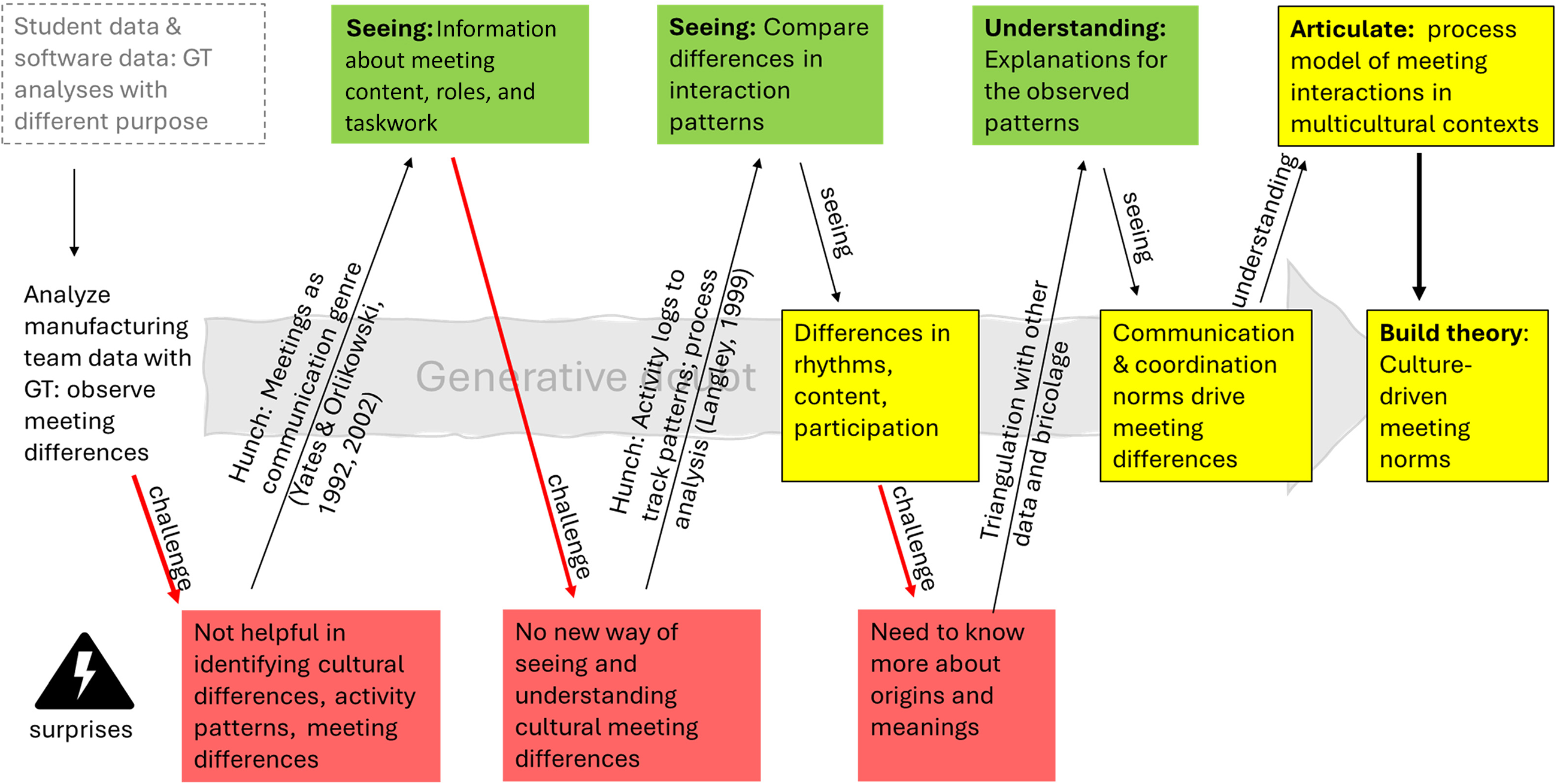
Discovery process in Köhler et al. (2012).
The Use of Advanced Analytic Techniques in the Discovery Process
Of the three datasets, two datasets—the student teams and the software teams datasets—had been collected and analyzed via a grounded theory approach with different guiding research questions for other studies prior to this one (Cramton & Hinds, 2014; Köhler, 2009). For the current project, we combined these datasets with the manufacturing teams dataset, which had not previously been coded. Naturally, we thought that grounded theory inspired coding would again be useful and started with that. In particular, we started with coding the manufacturing team dataset toward German and American meeting differences as this dataset offered us the opportunity to observe the German and American parts of the team separately during their respective video-recorded team meetings.
However, we discovered quickly that coding the video recordings of the manufacturing team with a grounded theory approach to analyze the content of the conversations between team members was not helpful in identifying cultural differences, team activity patterns, or anything meaningful related to meeting differences. Part of this had to do with the fact that the manufacturing teams were going through a team building exercise, and hence, their meeting conversations were determined by the exercise task, not by their regular work tasks. In addition, for the current study, we needed to get at meeting behaviors more than at the content of team member communications, which had been more central in the prior two studies for which the student and software team data had been collected. So, we quickly realized that we needed a different approach than what would be commonly used when analyzing transcribed texts, for example, from interviews or from student essays. This was a first
The first and second authors of the paper then started discussing different possible data analysis approaches. We were already employing a case study approach as we were interested in comparing German and American meeting behaviors within teams and then comparing meeting behaviors across teams to determine which cultural patterns might be observable in different team settings. However, case descriptions and summaries also got us no further than a superficial description of the team, its members, and the content of their communications. We needed to drill deeper. My coauthor Catherine Cramton suggested approaching meetings as a genre of communication and employing the genre approach developed by Yates and Orlikowski (1992, 2002). Yates and Orlikowski's (1992) conceptualization of genres of communication is built on Giddens' (1984) structuration theory and views communication genres, such as meetings, as socially embedded institutions that provide templates for social interaction (Yates & Orlikowski, 2002). These templates include specific elements: the purpose of the communication, the roles of participants, the structuring of the communication, the timing, location, and content. To analyze these interaction templates, researchers need to explore the “why, what, who/m, how, when, and where” of the communication activity (Yates & Orlikowski, 2002, p. 16).
So, as a next step, I applied these questions to the available data and attempted to code the team members’ activities for themes related to why, what, who/m, how, when, and where. This coding resulted in information about the content of the team discussion (“what” question; idiosyncratic to the task they were given), the roles team members took on (“who” question), and some information about the coordination and taskwork activities the team members engaged in (“how” question). While this information was useful in determining some superficial, mostly descriptive, differences between the German and American teams, it still did not result in a new way of seeing and understanding the way in which cultural differences shaped team meeting dynamics.
Based on a very tangential
The creation of activity logs led to our
Consequently, we examined the two other datasets to drill deeper into the observed patterns to develop understanding and engage in sensemaking. We employed triangulation techniques to add insights from further observations of other German–American teams (especially the record of email conversations in the student teams sample) but also insights from interviews and reflections (mostly from the software teams sample) to learn more about team members’ experiences and interpretations of their interactions with their culturally diverse team members. This data analytic step was aimed at uncovering explanations for the observed patterns and obtaining more information about potential cultural differences in the purpose of the meeting (the “why” question). We employed the grounded theory technique of constant comparison to refine and confirm observations from the coding of the manufacturing team and employed negative case analysis to look for examples in the two additional samples that would challenge our observations from the manufacturing sample (Corbin & Strauss, 2014). We also drew on our existing grounded theory coding of the student and software teams samples related to the reporting of cultural conflicts and observations and reflections about interactions with team members during meetings.
This led to our
Reflections
By employing methodological bricolage in the application of different qualitative analytic moves at different points throughout our discovery process, we were able to address methodological problems and facilitate “
Example 3: Processes and Tensions: Temporal Bracketing and Visual Maps in International Expansion Processes
Background
In 1984, the national U.S. telephone company AT&T was broken up into seven Regional Bell Operating Companies (RBOCs), creating an almost natural experiment to examine how these companies grew and changed. The focus of our study was how these firms expanded internationally during their early years as separate entities. These similar companies (in CEO profile, AT&T heritage/culture, revenue and asset size, and subscriber base) were all subject to the same strict regulatory constraints domestically but all had the ability to expand internationally. Having worked in the telecommunications industry, I was
This research project used a multiple case study approach and focused on the companies’ international expansions from 1984 to 1992. Archival data were used to construct a detailed timeline of each firm's international activities, and this timeline was distilled into a physical document shared during open-ended interviews with two to five executives at each of these companies. 4 During the interviews, executives were asked to describe the international expansion process and point out places on the physical timeline to ground their comments. From this research, there were two empirical papers—one that captured the international expansion process of the six firms (Smith & Zeithaml, 1999) and one that delved into a tension faced by two of the six firms after they had developed a critical mass of international commitments and activities (Smith & Zeithaml, 1996). In this article, I will focus on the 1999 publication that provides a process model of these firms’ international expansion. See Figure 5 for a visual account of this process that parallels our procedural framework for theorizing through advanced qualitative analysis.
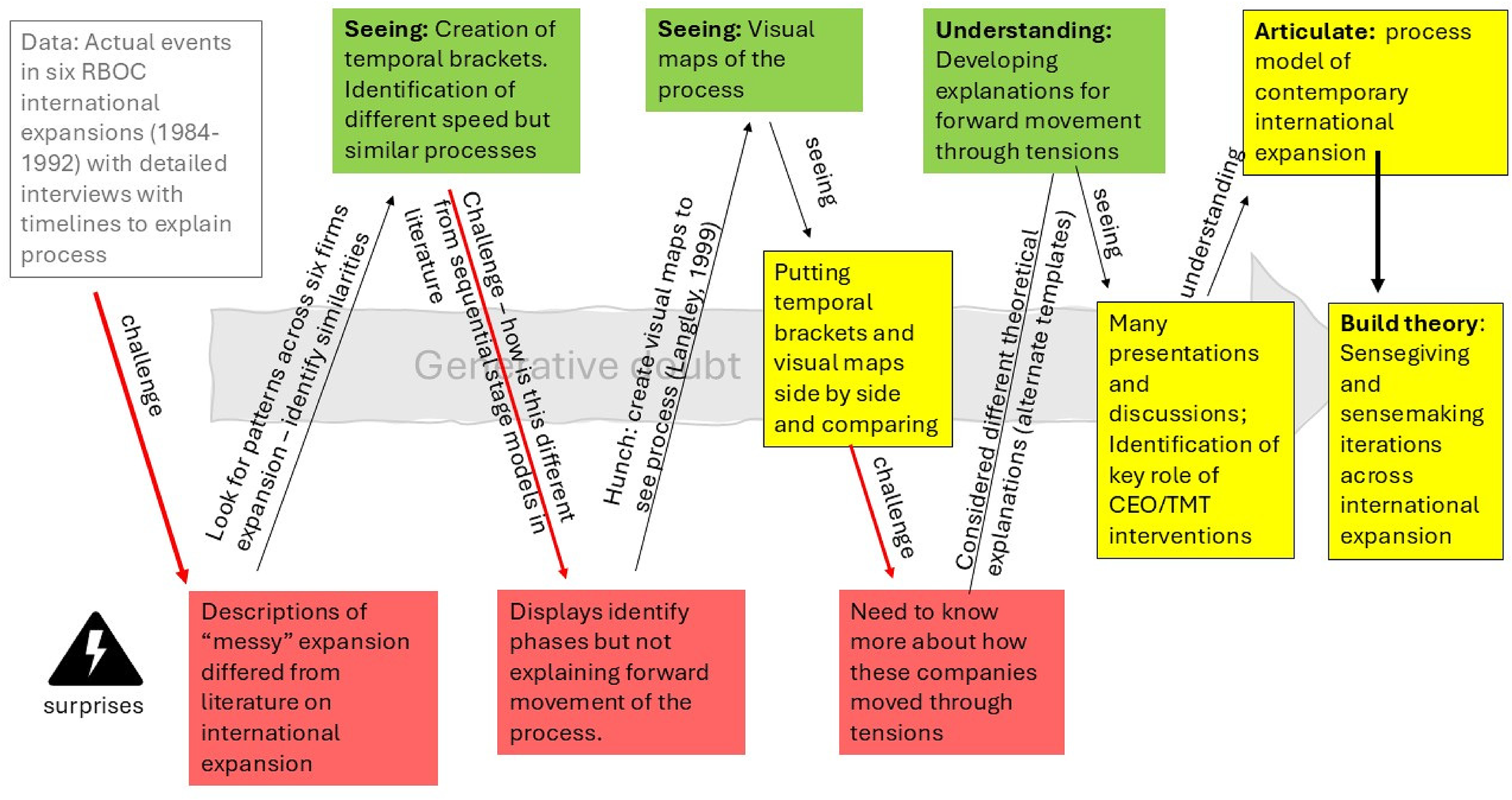
Discovery Process in Smith and Zeithaml (1999).
The Use of Advanced Analytic Techniques in the Discovery Process
The key analytic tools that allowed us to understand their internationalization process were temporal bracketing and visual mapping (Langley, 1999). 5 These two analytic approaches allowed us to see patterns within cases as well as to compare among cases. In their retrospective analysis about how Langley's techniques have been used since 1999, Lerman et al. (2022) highlighted these two approaches. Langley (1999) described visual mapping as “visual graphical representations … [that] allow the simultaneous representation of a large number of dimensions, and … can easily be used to show precedence, parallel processes, and the passage of time” (Langley, 1999, p. 700). Lerman et al. (2022) note that visual mapping allows for data reduction and visual synthesis, and these maps can be used to visually compare different processes. Langley (1999) described temporal bracketing as process when “a mass of process data is transformed into a series of more discrete but connected blocks” (p. 703). In their interview with Langley (Lerman et al., 2022), she clearly argued that temporal bracketing is not the creation of stages through which a process moves but instead is a way to bracket events based on time to compare “units of analysis for replicating the emerging theory” (Langley, 1999, p. 703).
Temporal bracketing and visual maps have been used together extensively in data analysis descriptions in published papers, but as Lerman et al. (2022) discovered, there is limited description about how these process analysis approaches were used in practice, with a few notable exceptions (e.g., Compagni et al., 2015; Tracey et al., 2018). 6 Our aim is to open up understanding related to how these two techniques helped us to see patterns in our voluminous, longitudinal dataset and to move toward theoretical insights.
Our initial analysis was to capture the movement, activities, and description of their international expansion processes over time. To see their patterns, we created grids of interviewee-described expansion periods and transition points. While these maps were unique to each firm, indicating different years and timing for their phases and transitions, the way in which their early expansion processes were described were
By the end of our study period 1992, we could see these similarities and also identify the main difference—the firms’ international expansion speed; in 1992, these firms were at different points in their expansion. To substantiate our finding that the firms’ processes were similar, we undertook coding for each phase to capture international expansion dimensions (product/service diversity; geographic diversity; types of entry modes) and identified distinctive quotes about each expansion period. 7 We also created tables (counts) of types of activities for each of these brackets (see Appendix H). We then mapped both quantitative and qualitative aspects onto a large flip chart for each firm, in essence creating temporal brackets around different international expansion activities for each firm. This was not an elegant process but consisted of hand-written details in a table on a flip chart for each firm (see Appendix I for an example).
While we identified distinct phases for each firm, my dissertation advisor and I were puzzled by what was motivating and moving each firm's process forward. So, we created visual maps for each firm to capture their movement over time and identify the clear tension points (see Appendix J for an example of a visual map). We created these maps by re-reading the interview transcripts; it became clear that during these “squiggles” or tension points, international expansion activities were halted or paused. The interviewees noted that there was distinctive difference in activities and approaches before and after these tension points. These process-oriented mappings were physically moved next to each firm's temporal bracketing flip chart. Seeing all temporal bracketing and visual maps allowed us to reflect on the firms’ overall process and what propelled the process forward (see Appendix K).
Seeing
Our temporal bracketing allowed us to see that the international expansion process across all firms was remarkable similar within each phase—with early exploration (that we later labeled as “opportunism and experimentation”); a second phase of deal-making and making significant investments (what we later labeled as “growth and commitment”); and a third phase, experienced by two of the six firms, whose international expansion became strategic to their firm. We were surprised how closely the six firms’ experiences resembled each other within each phase, but what we did not know and had not identified was why all six firms moved forward in their expansion and why some firms were more advanced in their international expansion at the end of our study period. We recognized the “squiggles” in our visual maps as key tension points, and that our “story” and theoretical contribution was in understanding the movement over time through these tensions (i.e., Rouse et al., 2025). We turned to the international business literature to understand our patterns.
Challenging
At the time of our research, the messiness and tensions found in our study were not clearly captured in existing literature. Many international models reflected sequential growth phases (e.g., Johanson & Vahlne, 1977) and international entry mode decisions were conveyed as rational calculations (e.g., Dunning, 2001), for example. Although our temporal brackets may have appeared to be similar to previous stage models, they were not, and this was because of the emergence of points of tension in their international expansion when international expansion could have been curtailed, as our interviewees noted. Instead of anchoring to the existing international expansion literature, we decided to broaden our theoretical lens and turned to the organization change literature to explain our patterns.
Articulating
Articulating the theoretical contributions from this data was a multi-year process (Smith, 2002). Our initial presentation of results relied on elements of a punctuated equilibrium model of organizational change as applied to the international expansion process. Yet, many dissertation members and initial reviewers did not see the connection and questioned what was going on within the punctuation.
We continued to present our findings at conferences and to colleagues, and to consider what explained the forward international expansion movement of these firms. We contemplated several potential theoretical explanations to understand the tensions (similar to Langley's alternate templates process data analysis approach). Was it the change in the regulatory environment during this period, more in keeping with population ecology or resource dependence explanations? Was it mimetic isomorphism among these six firms created from the same corporation? Was it financial and slack resources available to deploy toward international pursuits, more in keeping with Penrosian arguments? We investigated each of these possible explanations in our interview and archival data and across our temporal bracketing and visual mapping analyses. We knew the theoretical contribution centered on unraveling how the tensions emerged and were addressed (i.e., Rouse et al., 2025), yet our investigation of explanations provided a partial or incomplete explanation of their forward movement over time.
Eventually, and with the help of reviewers at several journals and academic friends (Smith, 2002), we began to see that tensions were explicit moments in which top managers intervened in a process more akin to a sensegiving followed by a time of international manager sensemaking, propelling this process forward over time. What preceded this intervention was the installation of a new CEO and his 8 top management team; a shift in CEO mindset toward international expansion; hiring an outside international executive; and/or use of outside consultants related to overall corporate strategy and/or international expansion. The CEO and/or top managers intervened to give sense and provide top-down general support to and resources for international pursuits, but international managers were responsible and had the discretion to move the internationalization process forward and enact the general guidance from executives. This back-and-forth of periodic sensegiving (by top management) was followed by international manager’ sensemaking related to their international growth. This overall insight about what was propelling forward their international expansion provided a new lens—sensemaking—to explain international expansion.
Reflection/Conclusion
In re-reading the two empirical papers that emerged from this research, I found that our explanation about the role of temporal bracketing and visual mapping during data analysis was seriously lacking. I am not sure if this was due to either not wanting to expose the messiness and nonlinearity of the process (i.e., seeming less “scientific”) or reflecting conventions of the time (i.e., silencing actual analysis, Hansen et al., 2025). Yet, when the two empirical papers from this research were safely in publication, I wrote about the reality of what I had experienced and learned from my journey from process data analysis, through theorization, and moving toward publication (Smith, 2002). In this reflection, I exposed the messiness, insights, and personal persistence throughout this data analysis and theorization process. I included and discussed the temporal bracketing and visual mapping flip charts (also reproduced in this paper) to show the type and depth of analysis that led to theoretical insights. In the end, these analytic approaches—temporal bracketing and visual mapping—allowed us to move to novel theorizing about international expansion as an iterative sensegiving-sensemaking process.
Discussion
With this paper, we provide more clarity about the use of advanced qualitative analytic techniques to facilitate theorizing. As we mentioned in the Introduction section, this intermediate step that forms a bridge between a researcher's embeddedness in the data and the abstract understanding and sensemaking of theory is often omitted. We hope that our synthesis of the literature on conceptual leaping, generative doubt, and abduction elucidates the discovery process and enables readers to see how they might employ advanced data analytic techniques in their own work to deepen their discovery process. We provided three practical examples from our own work to offer some concrete demonstrations of our discovery process and the role that advanced analytic techniques played in advancing the processes of challenging, seeing, and articulating our theoretical insights.
Across the three study examples, the process of moving from rich data to theoretical insights reflected an iterative process. In each case, there were early surprises that highlighted the “not knowing” (Locke et al., 2008) or a clear difference from explanations found in the literature. Gradually, analytic techniques—sensitizing concepts, activity logs, and temporal bracketing/visual maps—provided some distillation of the data to allow our respective research teams to begin to see patterns. We reflected on a research process in which we had latitude in discovering the story within our respective data, with stories connecting to theoretical insights. All examples also highlighted how “others” either on the team (Jarzabkowski et al., 2012; Köhler et al., 2012) or presenting at conferences or to other academic audiences (Jarzabkowski et al., 2012; Smith & Zeithaml, 1999) identified interesting parts of the findings and important connections back to pertinent literature. In all cases, the research activities described above were not fully articulated in the published papers.
As we mentioned earlier in the paper, it is important to keep in mind that the pursuance of different theorizing goals, as well as the general research traditions in which a research question is embedded, are bound to influence the methods chosen to engage with data, and vice versa. Chosen methods allow for different forms of seeing and understanding the data, which restricts the ability for certain kinds of theorizing (e.g., Cornelissen, 2017b; Cunliffe, 2022; Van Maanen et al., 2007). In our examples, the three papers employed different techniques and resulted in different theorizing outcomes. Interestingly, all three studies employed some form of process analysis and theorizing. This was an unintended coincidence but might allow for greater exploration of the nuances in theorizing outcomes that can come from different researcher positionality, methods applications, and engagement with the data. Overall, we made sense of a mass of rich, qualitative data by utilizing different analytical approaches; we moved abductively between hunches, surprises, and insights toward novel theoretical insights.
The Importance of Theoretical and Methodological Plurality and the Contribution of Generative Doubt
Going beyond the specific examples provided in our paper, it is important to highlight a continuing debate in our field about the lack of methodological and theoretical plurality (e.g., Cornelissen, 2017b; Cunliffe, 2022; Delbridge & Fiss, 2013). As mentioned briefly in the Introduction section, this debate highlights that our field is dominated by certain forms of theorizing, mostly correlation based, “net-effect” theorizing (Cornelissen, 2017b; Delbridge & Fiss, 2013; Harley, 2015; Ragin, 2008), which restrict the perceived legitimacy of other forms of theorizing that might provide more fruitful avenues for truly novel, insightful, meaningful, and reflexive theorizing (e.g., Alvesson & Kärreman, 2007; Cunliffe, 2022; Van Maanen et al., 2007). In addition, the dominant forms of theorizing in turn restrict the methods the field accepts as legitimate ways to explore phenomena, which limit our possibilities for seeing and understanding (Cornelissen, 2017b; Langley, 1999; Van Maanen et al., 2007).
We agree with many of the contributors to this debate. We believe that the abductive discovery processes elaborated by Weick (1989), Klag and Langley (2013), and Locke et al. (2008) likely provide the most promising avenues for creating more imaginative insights that lead to theorizing that engages, on the one hand, in a much more generative way with data through rational control, while, on the other hand, supporting and being in service of true exploration, following hunches, conjectures, and musements, through irrational free-play in order to think beyond the restrictions of existing theorizing. This abductive process that capitalizes on the generative power of doubt (Locke et al., 2008; or as Alvesson & Kärreman, 2007 would call it, “the mystery”) allows for discovery, problematization, and novel sensemaking and understanding, something the field still desperately needs as it is drowning in increasingly formulaic research (e.g., Harley & Cornelissen, 2022; Mees-Buss et al., 2022; Zilber & Zanoni, 2022).
Aligned with this debate, Weick (1989) already pointed to an important issue that limits truly imaginative theorizing, that is, the field's obsession with validation of theoretical insights. The validation obsession he describes includes the need to demonstrate close linkages between theoretical insights and the raw data (e.g., quotes from interviews or observational detail) as well as the avoidance of errors in the analysis process. This drive for validation has been promoted through calls for greater transparency and standardized processes, which have been deemed acceptable and legitimate by the larger community of researchers (e.g., Cornelissen, 2017b; Locke et al., 2008; Locke et al., 2015; Pratt et al., 2020; Weick, 1989; Van Maanen et al., 2007). Yet, this push for legitimization has created a conundrum by spurring a trend for a small number of widely accepted qualitative templates, which in turn have applied a straitjacket to diverse, nonmainstream qualitative research over the last years (Pratt, 2008). While these are now slowly but surely being challenged as unproductive and harmful by the research community (e.g., Cunliffe, 2022; Harley & Cornelissen, 2022; Köhler et al., 2022; Mees-Buss et al., 2022; Zilber & Zanoni, 2022), some damage has been done.
This obsession with validation through standardized and legitimized methods and evidentiary bases has several negative outcomes. First, methods sections in empirical papers predominantly describe procedures for raw data analysis (such as initial coding, the construction of case summaries, content coding protocols, etc.) and mostly provide evidence from the raw data (e.g., through the use of quotes or very rudimentary themes) in the Findings section. The iterative nature of an abductive discovery process is hardly ever described (e.g., Locke et al., 2008; Klag & Langley, 2013; Van Maanen et al., 2007). Furthermore, we would venture a guess that many authors may never engage in such an iterative, abductive discovery process, remaining squarely at the very basic levels of data engagement, simply because they have so few models and methodological resources to know how to go further (e.g., Köhler et al., 2022).
In addition, the field's socialization mechanisms through doctoral education, paper development workshops, editorials focused on how to publish papers in a journal, Meet-the-Editors sessions at conferences, and the like, have been shown to perpetuate the existing preferred theorizing and methodological model and entrain junior researchers into buying into them as the one best way to successfully publish and forge an academic career (e.g., Cassell, 2018; Cilesiz & Greckhamer, 2022; Cornelissen, 2017b; Cunliffe, 2022; Delbridge & Fiss, 2013; Harley, 2015; Van Maanen et al., 2007). Yet, as much of the ongoing debate on the lack of methodological and theoretical plurality argues, this focus on validation and standardization is detrimental to advancing scientific knowledge and produces largely incremental research with, at best, “trivial” theoretical insights (Weick, 1989, p. 516).
Learning deep qualitative data engagement and imaginative theorizing usually happens via a kind of master-and-apprentice system (Köhler et al., 2022), meaning that a few lucky PhD students and early career researchers get to work directly with some of the most skilled qualitative researchers in our field and learn advanced qualitative techniques through application and accompanying guidance. One could say that this is in fact the intended model of PhD supervision. Yet, this also means that picking up advanced qualitative research methods skills outside of a structured PhD training is much harder and not usually provided for. Typically, methods courses outside of university degrees (e.g., through nonprofit providers, professional academic associations, etc.) focus on early stages of qualitative analyses related to embedding oneself in the data. Methods related to later phases of qualitative data analysis that facilitate theorizing are rarely discussed. This article is intended to provide a starting point for this discussion, which will be continued in a related feature topic in the journal Organizational Research Methods (Köhler et al., 2025b).
The Importance of Researcher Reflexivity for Abductive Theorizing
Another line of argument contributing to the debate on the importance of methodological and onto-epistemological plurality for theorizing highlights the importance of reflexivity and a focus on humanness in our theorizing (e.g., Alvesson & Kärreman, 2007; Cunliffe, 2022; Delbridge & Fiss, 2013; Hibbert, 2026). The objectification and standardization trends have largely promoted an intellectual and emotional detachment of researchers from their theorizing as well as from their research settings and participants (e.g., Cunliffe, 2022; Hansen et al., 2025; Zilber & Zanoni, 2022). These trends, however, run counter to the foundations of abduction, which emphasize human-centered interpretation as part of the process of observing and following hunches and musements (Locke et al., 2008).
Increased reflexivity in the research process, as well as in our theorizing, is proposed to improve research in multiple ways. Delbridge and Fiss (2013, p. 300), for example, call for more researcher reflexivity and “a willingness to engage constructively across the range of approaches to theorizing, rather than a defensive positioning of the established dominant paradigm.” They propose that explicitly acknowledging the researcher's onto-epistemological stance “is a key step in opening up spaces for alternatives” (Delbridge & Fiss, 2013, p. 300), which in turn leads to more robust and phenomenon-appropriate theorizing.
Alvesson and Kärreman (2007) propose that self-critique and reflexivity are cornerstones of theorizing. Data, or empirical material as the authors call it, are always constructed through interactions between the researcher, their informants, and the setting. Furthermore, empirical material can never be fully sufficient to explore complex organizational ideas, which means that the researcher has to engage in knowledge work, guided by theory, to construct the social reality they are theorizing about. Reflexivity enters the picture (Alvesson & Sköldberg, 2000; Calás & Smircich, 1999; Hardy & Clegg, 1997), pointing to the struggle to acquire an awareness of how paradigms, sociopolitical contexts, frameworks, and vocabularies are involved in shaping the researcher's constructions of the world at hand and his or her moves in doing something with the world. (Alvesson & Kärreman, 2007, p. 1268)
The researcher employs reflexivity to carefully evaluate their own constructions but also to question commonly held theoretical beliefs and to challenge them (and their associated vocabulary) critically by examining alternative ways of construction and interpretation to problematize the existing theoretical framework (Alvesson & Kärreman, 2007).
Cunliffe (2022) agrees that theorizing can benefit from more reflexivity but adds that researchers also need to be more reflexive about their own ways of theorizing as they may otherwise blindly follow discipline-engrained ways of theorizing that favor and proliferate particular onto-epistemological stances. Cunliffe (2022) further calls for more humanness in theorizing: It means being open to what's happening around us by embracing surprising narratives, doubts, idiosyncrasies and emotions—features that resonate, may lead to new questions and ideas, and provoke us to rethink our ways of being, doing and relating… our ways of being human. (p. 5)
She argues that many of the ways in which researchers currently perform theorizing and data engagement are “still viewed more in terms of imposing a frame or procedure that disciplines our imagination, rather than allowing us to respond to and work with the contours of the living/lived experience of people” (Cunliffe, 2022, p. 5). Furthermore, focusing on theory as the main goal of our work, “diverts us from noticing, acknowledging and cultivating insights around what might be happening in unfolding living moments and relationships and in the in-the-moment doings, sayings and meaning-making of people” (Cunliffe, 2022, p. 14). She proposes that researchers should employ sensibility (“knowing from a human point of view,” Cunliffe, 2022, p. 14) and sensitivity (noticing experiences in “living, sensory and unique moments,” Cunliffe, 2022, p. 14). She argues that “sensual theorizing” (Cunliffe, 2022, p. 19) requires paying attention to embodied experiences during all parts of the research process, including our fieldwork, data interpretation, and reference back to the literature.
Unfortunately, though, rather than increasing our field's reflexivity, we currently see an accelerated turn away from human-centered exploration and reflexivity through the increased attraction of the use of generative AI as well as other computer-assisted mechanization and objectification tools that many researchers who are interested in conducting qualitative research seem to feel. This trend not only reinforces the idea of detached engagement with data and, by extension, with the context and participants, it also introduces new issues related to a lack of rigor (i.e., lack of alignment between ontology/epistemology, research questions, fair and benevolent treatment of participants, setting, and data, and engaged interpretation and conclusion; Harley & Cornelissen, 2022), increased error, data misrepresentation, and hallucinations, decreased researcher agency, and decreased intellectual and emotional engagement of the researcher (e.g., Nguyen & Welch, 2026; Lindebaum et al., 2025).
Proponents of the employment of generative AI tout its detached processing of data as something positive, following the validation lines of argument criticized by Weick (1989) and others. Worse, the fact that generative AI cannot and will never “analyze,” “interpret,” “summarize,” or “theorize”—all human activities that require critical reflexiveness and intellectual engagement beyond processing data vectors to produce strings of words—is frequently and conveniently ignored and downplayed in its criticality for the interpretive qualitative research process to instead focus on the benefits of (sense-free) machine processing of larger amounts of data (see Nguyen & Welch, 2026, for an in-depth discussion of this issue).
Abduction, though, does not work without human-reflexive intellectual and emotional engagement. Surprises, hunches, conjectures, musements, mysteries, conundrums, and the resulting theorizing processes of challenging, seeing, and articulating cannot be delivered by machine-coding. In fact, much of the writing on abductive processes challenges the idea that mechanistic coding, even that done by humans, would lead to, or even support, these abductive processes. Rather, it is the detachment from engrained structures and mainstream ways of thinking that promises more relevant and exciting theoretical insights (e.g., Alvesson & Kärreman, 2007; Klag & Langley, 2013; Van Maanen et al., 2007; Weick, 1989).
Writing on the abductive process also acknowledges that researchers have to go beyond the raw data for truly relevant theorizing by questioning the motives and forces that have been operative for creating the raw data (e.g., Alvesson & Kärreman, 2007; Cunliffe, 2022; Van Maanen et al., 2007). The kinds of advanced analytic techniques presented and advocated in our paper need to emerge organically as part of a human discovery process, using bricolage and methodological innovation to adapt to the researcher's need for challenging, seeing, and articulating (Klag & Langley, 2013; Locke et al., 2008, 2022; Pratt et al., 2022). Generative AI and other machine learning tools are not able to meaningfully go beyond the raw data they are being fed, let alone even meaningfully engage with the raw data they are being fed (Nguyen & Welch, 2026). Hence, these tools cannot credibly support any abductive research.
Yet, we fear, as over the past decades, that the pressures on researchers to produce conformist, objectivist research that prioritizes mainstream positivist, correlational “net-effects” theorizing outcomes are sure to continue and even increase with this new barrage of mechanization and standardization. We hope that our paper can inspire researchers to resist those trends and engage in more meaningful, relevant, and reflexive theorizing and qualitative data engagement.
Applications and Implications for Applied Behavioral Science
In the area of applied behavioral science, scholars have long worked with innovative advanced analytical techniques to theorize complex social dynamics and improve practice. Coming from a proud tradition of engaged scholarship (Van de Ven, 2007), the field's focus has always been on producing relevant, impactful research (Bartunek, 2012; Bartunek, 2020; Bartunek & Rynes, 2014; see also Schwarz & Bouckenooghe, 2024). Studying organizational development and change—phenomena that by nature are ephemeral and continuously in flux—has necessitated creative methodological approaches that alter the way we engage with and ultimately understand organizations, leading to novel (Schwarz & Stensaker, 2014), even prospective theorizing (Cooperrider, 2021).
Some of the engaged methods closely affiliated with behavioral science include appreciative inquiry, action research, and world café.
Applied behavioral science is grounded in phenomenon-driven research (Schwarz & Stensaker, 2014), which has encouraged such engaged and creative research approaches. Additionally, there has been explicit focus on identifying advanced analytic techniques that support high quality theorizing and practice, recognizing that “novel ways of collecting or analyzing qualitative data often comes in the ‘doing’: when confronted with specific challenges or encountering an unanticipated development” in the field (Cloutier, 2024, p. 361). We outline a few examples below.
For instance, Bednarek (2024) identifies three advanced analytic techniques: distributed cognition (Hutchins, 1995), doubt (Locke et al., 2008), and the hermeneutic circle (Gadamer, 1989). In her case, there was shared knowledge of a broad research context, but distributed knowledge of specific research sites. The team thus sought new analytic practices, such as memoing others’ data files, discussing thick descriptions, constructing individual and joint process frameworks, and iterating emerging theory (R. Bednarek, personal communication, November 7, 2025). Additionally, she illustrates how limitations of knowing helped the team orient toward new contexts and develop global analysis (see also, Jarzabkowski et al., 2015), iterating the focus of study from “global reinsurance trading” to “global underwriting trading practice across a range of deals generates collective risk bearing” (Jarzabkowski et al., 2015, p. 16). Therein, they used analytical practices that iterated between parts and the whole, drawing on contextual observations to outline overarching practices by continuously moving between individual sites to compare and contrast observations, and build collective theory. This produced sophisticated theorizing of the global reinsurance trading market.
In a similar vein, Cloutier (2024) positions “conceptual nimbleness” and “methodological dexterity” as two critical analytical mechanisms that underpin good theorizing. Nimbleness is the ability to creatively abstract from data, while dexterity is about methodological imagination (see also Locke, 2012, on analytic imagination) to engage creatively with a plethora of analytic approaches throughout the research process. For nimbleness, she recommends techniques such as reading extensively within and beyond the focal area and continuously re-conceptualizing empirics in relation to the phenomena it may speak to, thereby connecting it to a plethora of theories over time to establish fit and contribution. For dexterity, she recommends understanding novel methods and recombination of methods, and building an extensive repository of analytic techniques among which one can pivot, pending research context.
Likewise, Gray et al. (2012) talk about the analytic power of context, voice, and time. They argue that specific contexts may provide evidence of novel dynamics that can extend our theorizing, therein offering potential opportunities to theorize additional contexts based on similarities and differences (Gray et al., 2012). Such contextual differences may include physical space, institutional environment, power structures, and competitive dynamics, among others. Additionally, Gray et al. (2012) foreground the importance of changing voice by adapting different perspectives on empirical settings. In ODC, this has meant including those affected by change (e.g., Bartunek et al., 2006a), middle managers (e.g., Balogun & Johnson, 2004), and frontline workers (e.g., Balogun et al., 2015). Further, a shift in the temporal perspective can be an interesting analytic approach to improve theorizing: for instance, comparing organizations pre- and post-change (e.g., Corley & Gioia, 2004), or using psychological (Fried & Slowik, 2004) or social (Lawrence et al., 2001) constructions of time to give nuance to the change process.
Conclusion
With this article, we hope to positively contribute to discussion and research in the field of management and organization studies. Specifically, we wish to open up the toolbox of advanced qualitative techniques and abductive forms of theorizing, and identify how different advanced qualitative techniques can facilitate different forms of theorizing. We hope that our concrete examples are useful to other researchers to learn more about diverse approaches to qualitative analysis aimed at deeper, more engaged, and insightful theorizing.
Footnotes
Authors’ Note
At no point throughout the creation of this article (including ideation, writing, analysis, and editing) did we employ generative AI. This article represents original, independent, human-reflexive scholarship.

Funding
The authors disclosed receipt of the following financial support for the research, authorship, and/or publication of this article: This work was supported by the Faculty of Business and Economics, University of Melbourne (Sabbatical travel funding, Visiting Researcher Scheme).
Declaration of Conflicting Interests
The authors declared no potential conflicts of interest with respect to the research, authorship, and/or publication of this article.