






Abstract
As the political context in which organizations operate continues to change, organizations face growing challenges in managing politically diverse teams. Yet, empirical evidence remains limited on how politically dissimilar employees working interdependently affect team functioning. Drawing from the political affiliation model and the categorization-elaboration model, we hypothesize that political diversity is associated with higher relationship conflict, which in turn relates to lower team performance. We further propose that a team diversity climate helps buffer these negative effects. Using a time-lagged, multisource field study of 372 employees within 70 teams in South Korea, we find general support for these hypotheses. We conclude by discussing the theoretical and practical implications of these findings, particularly in terms of how organizations can adapt to and effectively manage politically diverse teams in an era of accelerating sociopolitical change.
Introduction
In countries around the world, the changing sociopolitical environment paired with rising polarization and disagreement are reshaping how people view their neighbors, family, friends, and coworkers. In the United States, political polarization and animosity continue to rise (Tyler & Iyengar, 2024), with one in five employees saying they have been mistreated at work because of their political views (Society for Human Resource Management, 2022). Similar polarization is unfolding in South Korea, where, for example, around 40% of people surveyed were uneasy about even sharing meals with those who have different political ideologies (Lim, 2023). This increased polarization comes at a time when organizational scholars are calling for more attention to political ideologies in the workplace (DeBode et al., 2024; Swigart et al., 2020), with recent research finding that the political ideologies of employees and top managers affect several important aspects of their roles at work. These include their judgments of job applicants (Roth et al., 2020), the extent to which they engage in ally work (Dang & Joshi, 2023), CEO attitudes toward corporate social responsibility, downsizing, and stakeholders (Chin et al., 2013; Gupta et al., 2019; Thams & Dau, 2023), how boards are structured (Gupta et al., 2022), and even how CEOs are paid (Chin & Semadeni, 2017; Gupta & Wowak, 2017). Thus, this increasing polarization and the relevance of political ideologies for work outcomes is an ongoing form of social change that leaders must be ready to face.
Indeed, diversity management initiatives represent major organizational change interventions that reshape HR policies, organizational culture, and social dynamics (Kossek et al., 2003; Nadiv & Kuna, 2020). Managing politically diverse teams thus represents a pressing change management challenge for organizations navigating today's polarized landscape. Despite this knowledge, little is known about how liberals and conservatives work together in team settings, and how it relates to team functioning. People of different political preferences usually do not like each other (e.g., Finkel et al., 2020; Roth et al., 2020; Wade et al., 2020). At the same time, leaders and scholars emphasize the importance of viewpoint and political diversity (Berliner, 2024; Duarte et al., 2015), arguing that a range of perspectives is essential for sustaining organizational credibility, building trust, and mitigating partisan bias. However, the existing literature on political ideologies in organizations has primarily focused on individuals and dyads (e.g., Rosen et al., 2024; Solomon, 2025), leaving limited understanding of how political diversity impacts team processes and outcomes.
We address this critical lack of understanding by investigating political diversity's impact on team performance in a field study. We view team performance as a suitable outcome of study following Mathieu et al. (2019, p. 18) as it represents the “results and byproducts of team activity that are valued by one or more constituencies” (Mathieu et al., 2000). We then draw from the political affiliation model (PAM; Roth et al., 2020, 2025) and the categorization pathway in the categorization-elaboration model (CEM; van Knippenberg et al., 2004) to theorize about political diversity's impact on teams. To better understand the changing external sociopolitical environment and how it affects organizations, the PAM broadly suggests that partisan employees view political outgroup members’ work ability and talent more negatively (Roth et al., 2020). We suggest that these negative work views—along with the fact that political differences are distinctly salient and negatively valenced individual differences (Finkel et al., 2020; Rosen et al., 2024)—make it more likely team members will categorize and be biased toward other members with differing political views. We suggest that this categorization will surface in politically diverse teams as having higher levels of relationship conflict than teams that are less politically diverse. This conflict will, in turn, be associated with negative consequences for team performance. Further, we propose that having a higher level of team diversity climate will help to buffer the negative effect of political diversity on relationship conflict, with downstream consequences for team performance. In a field study of 70 teams in South Korea, we find general support for our predictions. South Korea provides an especially relevant context for examining political diversity because its political landscape is dominated by two major parties, making ideological separation particularly salient within teams.
We offer several contributions to theory and practice. First, this paper advances understanding of political differences at work by examining their effects on team processes and performance, an area that remains largely unexplored despite increasing societal and workplace polarization (Swigart et al., 2020). Doing so is important to help organizations cope with the social and organizational changes such polarization creates. This contribution highlights the negative consequences of political diversity for relationship conflict and team performance, further clarifying how political diversity operates in teams. Second, we extend the PAM by integrating it with diversity scholarship to study team political diversity, addressing calls to expand the PAM to the team level (Roth et al., 2025). This extension demonstrates how the PAM can help to explain political dynamics among employees who know and work with one another, beyond the model's traditional focus on hiring contexts where employee evaluations are made about unknown others. Third, we contribute to diversity-climate research by proposing a rationale as to how it can act as a buffer against the negative effects of politically charged differences. We contribute to the evidence that a positive diversity climate benefits team functioning even for political diversity, offering practical implications for organizations reconsidering their DEI efforts (Francis & Cutter, 2024; Holmes et al., 2021).
Theoretical Background and Hypotheses
Political Diversity
Political ideology broadly refers to beliefs about how people think societies should be structured and organized, and encompasses a schema of related attitudes, beliefs, and values that people use to process information (Jost et al., 2009; Swigart et al., 2020). Political ideology is generally viewed as falling on a continuum from very liberal to very conservative and is commonly classified along party lines as Democratic or Republican in the USA and, in South Korea, the Democratic Party of Korea or the People Power Party (e.g., Ditto et al., 2019). There are many differences between liberalism and conservatism, but generally those higher in liberalism tend to value societal change and focus on situational and contextual factors that disrupt equality of outcomes, whereas those who value conservatism are more traditional, more accepting of status hierarchies, and put value in the belief of agency of an individual to change their status (Swigart et al., 2020).
At work, depending on the context, conservative managers appear to generally support outcome accountability whereas liberal managers prefer process accountability (Tetlock et al., 2013). These differences may be especially consequential in periods of ongoing social and organizational change, such as the rising polarization (e.g., Finkel et al., 2020; Tyler & Iyengar, 2024), when teams must make sense of shifting expectations and how work should be evaluated. To the extent that liberal and conservative employees differ in their preferences for process versus outcome accountability, politically diverse teams may have both interpersonal quarrels and disagree about what constitutes fair and legitimate coordination. Under these conditions, the management of political diversity becomes partly a change issue, such that broader shifts in the sociopolitical environment can enter team interactions through competing expectations about how the work is to be done, and norms regarding expectations of voice, procedures, and results.
Political diversity, based on Harrison and Klein's (2007) definition of diversity, refers to the distribution of differences among members of a unit regarding political attributes, such as political ideology, party affiliation, or views on political issues. It highlights the extent to which individuals within a group vary in their political perspectives or beliefs. Diversity scholarship distinguishes two main types of diversity based on whether they are surface-level and more demographic (e.g., race, gender, and age), or more attitudinal and deep-level such as differences based on characteristics like personality, values, or cultures (Harrison et al., 1998, 2002; Triana et al., 2021). Political diversity would be classified as a deep-level diversity, but importantly, political diversity is markedly different from other forms of deep-level diversity and warrants study for several reasons.
First, political ideologies are emotional and often central to one's identity (Barber & Blake, 2024; Beck & Shen, 2019; Rosen et al., 2024). This emotional centrality of one's ideology is coupled with the rising polarization mentioned above. This changing landscape is normalizing negative attitudes toward politically dissimilar people (Pew Research Center, 2022; Tyler & Iyengar, 2024), which makes political diversity a unique form of deep-level diversity. Whether this disdain for opposing party members translates to real-world effects on team functioning remains to be seen and is explored in this study. Second, despite these reported negative attitudes toward politically dissimilar people, scholars and leaders are still calling for increasing political diversity, something also not currently happening with other forms of deep-level diversity (Berliner, 2024; Duarte et al., 2015). In fact, fields such as computer science are showing political diversity's importance as a distinct construct for outcomes such as news engagement and journalistic credibility (Bhadani et al., 2022; Saveski et al., 2022), indicating a progression and development of knowledge about political diversity outside of management.
Political diversity can be viewed as one form of value diversity, which is itself a type of deep-level diversity, as both political and value diversity guide attitudes and are evaluative in nature (Triana et al., 2021). Similar to other types of value diversity, political diversity reflects fundamental differences in individuals’ guiding principles, which may influence their behaviors and attitudes within teams. While the recent meta-analysis by Triana et al. (2021) found that value diversity negatively impacts team performance, the types of values considered are markedly different from political diversity. Most of these studies on value diversity have focused on constructs such as work values (e.g., “being careful,” “being innovative,” and “sharing responsibility”; Jehn et al., 1997; Jehn & Mannix, 2001), work ethic and traditionalism (Klein et al., 2011), and broader values like benevolence, universalism, and self-direction (Woehr et al., 2013). And not all these studies exhibit increased levels of conflict either (Triana et al., 2021). For example, one form of value diversity, diversity in work preferences—the preference to work alone or with others—was negatively associated with relationship conflict (Polzer et al., 2002).
Political diversity differs from other forms of value diversity and, because of its identity-relevant and divisive nature, may be more likely to trigger intergroup bias. For example, it is increasingly the case that people dislike members of the other political party more than they like members of their own party (Finkel et al., 2020), suggesting that it may be an extremely salient characteristic above and beyond other forms of value diversity. Further, as Triana et al. (2021) note, there is a pressing need to examine how different dimensions of diversity may differently shape team performance. We acknowledge that some have framed these differences as political polarization at the team level (e.g., Javidan et al., 2023; Shi et al., 2019), but we adopt the diversity framework (Harrison & Klein, 2007) because it provides a better integration with organizational theories such as the PAM and CEM, more validated team-level measures, and a focus on within-team heterogeneity in political ideologies rather than a broader disdain for abstract members of an opposing political party.
This framing allows us to treat political diversity as a more nuanced form of value diversity that can better capture its implications for team functioning. This perspective fits within Harrison and Klein's (2007) framework as defining political diversity as separation, which posits that ingroup-outgroup potential is most pronounced when teams are evenly divided on a diversity attribute. While polarization and separation both describe dispersion along ideological lines, polarization typically implies antagonism and bimodality in which members strongly identify with opposing camps (Javidan et al., 2023; Shi et al., 2019). In contrast, following Harrison and Klein (2007), our conceptualization of political diversity as separation focuses on within-team heterogeneity in political ideology without assuming inherent hostility or that all members are at either ends of the political spectrum.
Political Affiliation Model (PAM) and Categorization Elaboration Model (CEM)
As previously stated, differing political ideologies impact the perception of others in addition to job attitudes and behaviors. For example, at the individual level, research suggests that having coworkers with differing political ideologies can increase workplace incivility, which in turn raises burnout, turnover intentions, and reduces job satisfaction (He et al., 2019). Additionally, discussing political topics at work is linked to resource depletion, withdrawal behaviors, and some employees have even reported being bullied based on their political views (Kim et al., 2022; Soylu & Sheehy-Skeffington, 2015). However, what remains unclear is how political diversity at the team level, where members work interdependently toward a shared goal, impacts team functioning and outcomes. To address this gap, we draw from and extend theories of team diversity and political affiliation to develop our arguments and hypotheses regarding this impact.
The PAM underscores the impact of individual political preferences on workplace decisions (Roth et al., 2017). Specifically, the PAM suggests that an employee's political preferences influence their judgment of work-related outcomes, often superseding more relevant information, which aligns with similarity-attraction paradigms (Roth et al., 2017, 2020). Employees who perceive others as sharing similar political values tend to form overly positive judgments about their work ability (Mönke et al., 2024), while those with differing political ideologies are more likely to be viewed as outgroup members and disliked. This may pose a threat to the value of one's political identity and could be associated with increased intergroup bias (van Knippenberg et al., 2004). Organizational research supports this at the individual level, showing increased reports of incivility toward employees with differing political affiliations (He et al., 2019). Further, PAM has been extended to political contexts where there are more than two main political parties (Mönke et al., 2024) and situations where job applicants, guided by their political group identity (e.g., liberal or conservative), evaluate organizations based on the organizations’ perceived political group identity (Roth et al., 2022). Taken together, PAM highlights how political preferences shape intergroup bias in the workplace (Solomon, 2025) at the individual level.
While PAM provides a useful framework for understanding intergroup bias, it primarily focuses on contexts at the individual level involving employees and applicants who do not know each other. What remains unclear is whether these negative partisan views affect people at the team level whose members already know one another and work interdependently toward shared goals. On one hand, for example, when politically diverse members hold different accountability preferences (e.g., Tetlock et al., 2013), they may interpret the same leader behavior differently: one member sees fairness and inclusion, another sees inefficiency or lack of standards; one sees appropriate outcome focus, another sees procedural unfairness, thus impacting team dynamics. On the other hand, other research on team dynamics suggests that working closely with politically diverse colleagues could potentially change the dynamics proposed by PAM. For example, contact theory posits that frequent interaction with outgroup members can reduce prejudice (Pettigrew & Tropp, 2006).
However, political ideologies may operate differently because they are deeply rooted constructs tied to identity, where differences can elicit stronger negative emotions (Rosen et al., 2024; Swigart et al., 2020). Thus, we expand PAM by exploring its implications at the team-level in settings where employees must interact and collaborate with known colleagues. While individual-level research shows that political dissimilarity can heighten bias, incivility, and withdrawal (He et al., 2019; Kim et al., 2022), not all these effects necessarily scale up to interdependent teams. Frequent collaboration may, in some cases, reduce bias through increased contact (Pettigrew & Tropp, 2006). Yet, because political identities are deeply tied to moral conviction and self-concept (Swigart et al., 2020), these biases tend to persist rather than dissipate. Thus, the interpersonal biases observed at the individual level are likely to manifest as relationship conflict in politically diverse teams.
Building on this reasoning, we further define the phenomenon of interest using the CEM (van Knippenberg et al., 2004; van Knippenberg & Schippers, 2007), a comprehensive framework for understanding how diverse teams face both challenges and opportunities. Over the decades, research inspired by CEM has demonstrated that team diversity can have both positive and negative effects on team performance (Homan et al., 2020; Kearney et al., 2022). Consistent with this perspective, prior work highlights both elaboration-based benefits and categorization-based risks. In the present study, we focus on the categorization pathway, which is more likely to dominate in politically diverse contexts characterized by identity threat. Importantly, we propose that team diversity climate serves as a key boundary condition shaping whether categorization processes are amplified or attenuated. Specifically, we focus on the categorization process within CEM, which describes how diversity can lead to an “us versus them” mentality (Williams & O’Reilly, 1998). This categorization, driven by intergroup bias, often undermines the potential benefits of diversity (Tajfel & Turner, 1986; Williamson et al., 2023).
Drawing from research supporting the PAM at the individual level, we propose that the disliking and negative perceptions of coworkers with opposing political views will intensify the categorization and intergroup bias processes proposed in CEM, fostering an “us versus them” mentality, which will be associated with increased relationship conflict within politically diverse teams. Given that political ideologies are core to individuals’ identities (Swigart et al., 2020), opposing views can feel existentially threatening, further amplifying negative emotions (Rosen et al., 2024), and possibly triggering an identity threat. As a result, team members with differing political ideologies are likely to be perceived negatively, and as part of the outgroup, whereby ingroup-outgroup tension is most pronounced when teams are evenly divided (which is consistent with the conceptualization of diversity as separation; Harrison & Klein, 2007). By integrating PAM with the categorization component of CEM, our framework highlights the negative impact of political diversity on team processes and outcomes, as depicted in Figure 1.
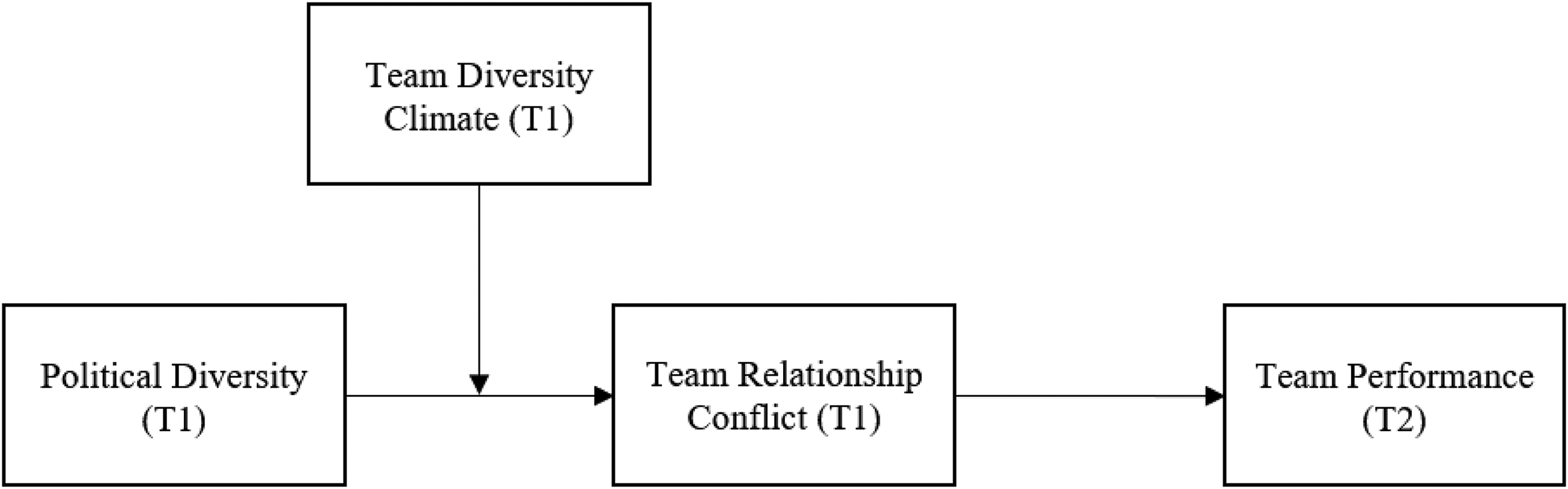
Theoretical model.
Building on the general model outlined above, we first focus on the political diversity's impact on relationship conflict. According to PAM at the individual level, employees perceive those with similar political ideologies more favorably, leading to positive judgments of their work abilities, while viewing those with opposing ideologies as outgroup members, which fosters distrust and disliking (Mönke et al., 2024; Roth et al., 2017, 2020). For instance, in right-leaning organizations, left-leaning employees have reported lower job satisfaction and reduced affective commitment relative to their right-leaning coworkers (Henderson & Jeong, 2022). Moreover, political identity dissimilarity with coworkers was associated with increased levels of experienced incivility (He et al., 2019). Drawing from this individual-level research, we believe many of these dynamics will apply at the team level, which should surface as higher levels of team relationship conflict. While Triana et al. (2021) found that value diversity generally increases team conflict, we argue that political diversity amplifies these effects by intensifying ingroup-outgroup dynamics and relational tensions. Put together, teams with higher levels of political diversity are expected to experience heightened relationship conflict. Thus, we hypothesize the following: H1: Political diversity is positively associated with relationship conflict.
Diversity Climate as a Buffer
Given that we expect political diversity to be positively associated with relationship conflict, it is important to consider potential moderating factors in this relationship. Researchers have proposed that certain team dynamics may facilitate better functioning on diverse teams (van Knippenberg et al., 2004). We draw from this work to propose that a team diversity climate would be best suited to help address our understanding of how teams may prompt a “de-categorization” process (Drach-Zahavy & Trogan, 2013) to buffer this relationship between political diversity and relationship conflict. A diversity climate is defined as “shared perceptions among employees in a unit that people are treated fairly and are integrated into work environment regardless of background” (Chung et al., 2015, p. 1496). Although diversity climate has been operationalized at different levels, we follow Holmes et al.'s (2021) suggestion that the research question should determine which level of analysis diversity climate is investigated at. We treat diversity climate at the team-level where each team has an aggregate level of a diversity climate because our theorizing focuses on how team members experience these climates and its effects on their group dynamics. These shared perceptions among team members regarding a positive diversity climate can lead to job satisfaction, inclusion, team identification, and knowledge sharing via increasing trust and openness of members (Hofhuis et al., 2016).
Leaders also play an important role in shaping a perceived positive diversity climate (Herdman & McMillan-Capehart, 2010; Shore et al., 2011). For example, organizations and their leaders can create a climate where everyone gets access to resources, feels respected, and is treated fairly, regardless of their identities (Nishii, 2013). This applies to both demographic characteristics (e.g., gender, race, and age), as well as other attributes (e.g., tenure and functional background) that people may differ on (Chung et al., 2015). However, the vast majority of the diversity climate research focuses on improving outcomes for underrepresented groups (Holmes et al., 2021). We draw from diversity climate theorizing and findings to suggest these benefits apply to political diversity too. Although political ideology differs from other forms of demographic diversity, it is an important social identity that creates in-group favoritism and out-group bias (Schwartzstein & Hwang, 2026; Solomon et al., 2026), and diversity climate functions by promoting perceptions of fairness and inclusion (e.g., Chung et al., 2015). The perceptions of a fair climate may help to reduce the likelihood of seeing a politically diverse group from the lens of in-groups and out-groups.
Indeed, creating environments where all employees feel included and welcomed has a host of positive individual and organizational outcomes (Gonzalez & DeNisi, 2009; Hicks-Clarke & Iles, 2000). For instance, Gonzalez and DeNisi (2009) found that perceptions of diversity climate moderated the impact of demographic diversity on affective commitment, organizational identification, and their intention to quit. Given the generally positive effects of a diversity climate on these team processes, it may mitigate the negative effects of political diversity on relationship conflict. In one study of workplace aggression, researchers theorized and found that perceptions of a diversity climate provoked a “de-categorization” process in teams, which helped reduce aggression caused by the tension between in-groups and out-groups, which may help them see other team members as unique team members rather than members of an out-group (Drach-Zahavy & Trogan, 2013). When political diversity is present, a de-categorization associated with a positive diversity climate could reduce any identity threat present by signaling that political views will not impact whether they are treated fairly or included. This, in turn, could be associated with lower levels of intergroup bias and lower likelihood that political diversity escalates into relationship conflict. As per CEM, a positive diversity climate thus serves to disrupt the categorization pathway (van Knippenberg et al., 2004) that we expect to dominate in politically diverse teams, reducing the “us versus them” mentality that drives intergroup bias and relationship conflict.
However, when there is not a positive diversity climate present and certain political ideologies have a privileged status, members may feel like they will be treated differently based on their views. In such a context, this is likely to surface as a threat to one's identity (van Knippenberg et al., 2004) and members with their identities threatened may be more “on guard” and defensive and have higher levels of bias toward out-group members in response to this threat. Similarly, in a poor diversity climate, the in-group favoritism and out-group bias is likely to be more pronounced because members feel they will not be treated fairly or included because of their ideology. When there are higher degrees of separation of political diversity in a team, this defensiveness and bias is likely associated with worse relationship dynamics than when there is a climate where people understand they will be treated the same, regardless of their beliefs. At the team level, a low diversity climate can therefore intensify these dynamics by signaling that certain ideological positions are valued over others, heightening perceptions of unfairness and reinforcing in-group favoritism. Thus, we propose the following: H2: Team diversity climate moderates the positive relationship between political diversity and relationship conflict, such that when there are lower (higher) levels of team diversity climate, political diversity's positive association with relationship conflict will be stronger (weakened).
Relationship Conflict as a Mediator Between Political Diversity and Team Performance
Previous research and theorizing demonstrate that relationship conflict generally harms team processes and reduces team's performance for various reasons (De Dreu & Weingart, 2003; De Wit et al., 2012), often explained through social categorizations (Jehn, 1997; Tajfel & Turner, 1986). For example, scholars theorize and find that relationship conflict and these interpersonal issues, such as arguing about things unrelated to task completion or difficulty working with other team members, hinder the team's progress toward its goals (Jehn, 1997; Jehn et al., 2008). Relationship conflict is also distinct from other forms of conflict like task conflict which mainly focuses on disagreement about how to best complete tasks (De Wit et al., 2012). As opposed to task conflict, relationship conflict is generally detrimental to a team's working environment (De Dreu & van Vianen, 2001). Relationship conflict thus usually has a negative impact on team satisfaction, commitment, engagement in citizenship behaviors, and performance (De Dreu & Weingart, 2003; De Wit et al., 2012). Indeed, there are negative correlations between relationship conflict and team cohesiveness (r = −0.35) and team viability (r = −0.42; Tekleab et al., 2009), suggesting that teams that argue about interpersonal issues struggle to stay together and remain cohesive.
Relationship conflict alone is associated with higher levels of deceptive knowledge hiding behaviors (Venz & Nesher Shoshan, 2022) and is likely further exacerbated when interacting with people of different political ideologies. Research suggests that even overhearing political conversations at work is associated with negative emotions such as anxiety, anger, frustration, or fear, especially when employees perceive the speakers as dissimilar to themselves (Rosen et al., 2024). These emotions may heighten out-group bias toward politically dissimilar teammates and create interpersonal tension that contributes to greater relationship conflict. Thus, because political disagreements likely surface in heated and emotional ways, this political diversity should be associated with increased relationship conflict and thus detract from the team's performance. We theorize that this relationship conflict is the link in the relationship between political diversity and team performance. That is, relationship conflict represents the primary manifestation of CEM's categorization pathway in politically diverse teams, linking political diversity to downstream team performance decrements. Thus, we hypothesize the following: H3: Relationship conflict mediates the negative relationship between political diversity and team performance.
We further theorize that the proposed buffering effect of a team diversity climate will have downstream consequences for the performance of the team. While somewhat different than a diversity climate, Shi et al. (2019) found that creating a climate that respects and adheres to existing norms appeared to help political diversity improve team performance in a sample of Wikipedia editors. Likewise, Chung et al. (2015) found that a diversity climate increased loyalty behavior. Relating this back to political diversity, if there are norms for respecting those differing perspectives (because of a positive diversity climate), teams may avoid the emotional and heated aspects of political disagreement and a team's diversity climate may act as a buffer to preserve team performance. Put together, and consistent with CEM's proposition that contextual factors determine which pathway dominates (van Knippenberg et al., 2004), we predict these benefits of having a diversity climate will also ameliorate some of the negative impacts of political diversity on the team's functioning. Namely, having a positive team diversity climate will weaken the association between political diversity and relationship conflict, and thus be associated with fewer problems for the team's overall performance. Similarly, a poor or weak diversity climate may amplify the differences as we hypothesized earlier and further strengthen the negative impact of political diversity on team performance. We thus formulate a moderated-mediation hypothesis: H4: Diversity climate moderates the indirect effect of political diversity on team performance through relationship conflict, such that the negative indirect effect is attenuated (strengthened) when diversity climate is high (low).
Method
Sample and Procedure
We collected data from five organizations in South Korea encompassing a variety of industries, including social welfare, entertainment, distribution, food manufacturing, and healthcare. South Korea's political landscape is predominantly shaped by two major parties: the conservative People Power Party and the Democratic Party, jointly holding over 90% of the seats in the National Assembly. Similar to the USA, South Korea is facing a growing political divide, exemplified by a study reporting that 40% of South Koreans are reluctant to dine with individuals of opposing political views (Frimer et al., 2023; Lim, 2023). This polarization extends beyond the political sphere, increasingly influencing workplace relationships and team dynamics.
This research only included teams with three or more individuals working socially and interdependently. Surveys were initially distributed to 422 team members and 78 team leaders. One team consisting of only two members was excluded from the analyses, as dyads can exhibit qualitative differences compared to larger groups (Moreland, 2010). After excluding missing and unmatched data, and the one two-person team, 70 teams were included in the final sample. This includes 372 team members and 70 team leaders, for a response rate of 89.7% for team leaders and 88.2% for team members.
We administered the survey to two different sources, team members and leaders, across two time periods (one-month time lag) to avoid or minimize any potential common method bias (Podsakoff et al., 2003). At time 1, team members were asked to assess their political ideology, team relationship conflict, and team diversity climate. At time 2 (one month after time 1), team leaders were asked to assess team performance. The paper-based survey questionnaires were distributed on-site at each organization. All participants were informed that their participation was voluntary, responses were completely confidential, and private information and rights were protected by an institutional review board. Each team averaged 5.31 members (SD = 2.45). Of 372 team members, 33% were women, the average age was 35 years (SD = 5.15), and the average organizational tenure was 5.6 years (SD = 3.71). Of 70 team leaders, 34.3% were women, the average age was 42.5 years (SD = 3.82), and the average organizational tenure was 10.6 years (SD = 3.82).
Measures
Political Diversity
In our study, we defined political ideology diversity as a state of separation, drawing on the framework proposed by Harrison and Klein (2007) and further discussed by Swigart et al. (2020). Harrison and Klein (2007) posit that diversity within a group can manifest as variety, separation, or disparity. As described earlier, our focus on political ideology led us to posit that diversity reaches its peak when there is an equal representation of conservative and liberal viewpoints within a team (i.e., ideologies that are further apart). To gauge this diversity, team members first self-assessed their political ideology using an adapted two-item scale from Rock and Janoff-Bulman (2010) which measures personal political orientation and the political orientation of their preferred political party on a scale from 1 (very liberal) to 7 (very conservative). This measure is similar to Graham et al.'s (2009) and Lawson and Kakkar's (2022) approaches in that it provides a continuous measure of political ideology that captures the strength of the association with liberalism and conservatism and not just party membership. The reliability of this political ideology scale was confirmed with a coefficient alpha of 0.97, deemed acceptable by Nunnally (1978).
Political diversity was then operationalized using the standard deviation of political ideology, adjusted to account for variations in team size, following the approach of Biemann and Kearney (2010). The unbiased standard deviation, which accounts for team size, corrects for sample size bias, enhancing the accuracy of comparisons across teams of different sizes and providing more reliable diversity measurements, particularly for smaller teams. The resulting scores indicate the extent of ideological division within teams, with higher values reflecting a more pronounced division between liberals and conservatives.
Team Relationship Conflict
Team relationship conflict was measured by team members using a four-item scale from Jehn (1995), ranging from 1, “strongly disagree,” to 5, “strongly agree.” The items were: “There is friction among members in my team,” “There are personality conflicts evident in my team,” “There is tension among members of my team,” and “There is emotional conflict among members in my team.” The coefficient alpha of team relationship conflict was 0.93, which was acceptable. To examine the effect of team relationship conflict at the team-level, we aggregated individual ratings of team relationship conflict to the mean level. To justify aggregation, we examined within-team agreement and interrater reliability. Recommended thresholds are median rwg ≥ 0.70–0.80 (James et al., 1984; LeBreton & Senter, 2008), ICC(1) typically 0.05–0.20 and acceptable when ≥ 0.10–0.12, with a significant ANOVA F-test (Bliese, 2000), and ICC(2) ≥ 0.70 (Klein & Kozlowski, 2000). In our data, team relationship conflict showed rwg = 0.89 (SD = 0.24), ICC(1) = 0.50 (F = 6.31, p < .01), and ICC(2) = 0.84, supporting aggregation to the team level.
Team Diversity Climate
Team diversity climate was measured by team members using a five-item scale adapted from Chung et al. (2015), ranging from 1, “strongly disagree,” to 5, “strongly agree,” with higher values indicating a more supportive diversity climate. We modified the referent by changing the term “coworker” to the more specific term “team member,” thereby clarifying the target of the items, and we removed items assessing overall organizational diversity climate to focus exclusively on the team-level context. The final items were: “My team members help me feel like an important part of the team,” “My team members appreciate my background and perspective,” “My manager always treats me like a valued member of my team,” “My manager ensures that I always feel included at work,” and “I have the same opportunities for career growth as my team members.” The coefficient alpha of team diversity climate was 0.93, which was acceptable. Consistent with our approach for team relationship conflicts, we also calculated rwg and interrater reliability: rwg = 0.91 (SD = 0.14), ICC(1) = 0.47 (F = 5.79, p < .01), and ICC(2) = 0.83. Thus, aggregation to the team level was justified.
Team Performance
Team performance was measured by team leaders using a 4-item scale of overall team performance adopted by Pearce and Sims (2002) and used more recently by Lvina et al. (2018) ranging from 1, “strongly disagree,” to 5, “strongly agree.” The items were: “My team is highly effective,” “My team is making very good progress on the team's charter,” “My team does very good work,” and “My team does a very good job.” The coefficient alpha of team performance was 0.94, which was acceptable.
Control Variables
Following prior diversity research, we controlled for team mean level of political ideology since team mean level of political ideology and standard deviations across teams can be confounded due to an artifactual overlap (Harrison & Klein, 2007). Second, we controlled for the effect of team member organizational tenure (the mean level of the aggregated team members’ tenure in the organization) since the mean level of individual member's organizational tenure can influence their performance (Ng & Feldman, 2013). Third, we controlled for gender diversity and age diversity, aligning with the operationalization used by Sung and Choi (2019). Although Harrison and Klein (2007) suggested that diversity can be conceptualized as variety, separation, or disparity, we followed Sung and Choi in treating gender diversity as variety and age diversity as separation due to operationalization constraints. Gender diversity was operationalized using a bias-corrected Blau's index (Blau, 1977) as a variety measure, while age diversity was operationalized using a bias-corrected standard deviation of team members’ ages as a separation measure. Lastly, we controlled for the five organizations (using dummy variables) since our data include various types of organizations, including non-profit and for-profit organizations.
Analyses and Results
Table 1 represents the means, standard deviations, and correlations of all variables in this study.
Means, Standard Deviations, and Intercorrelations.
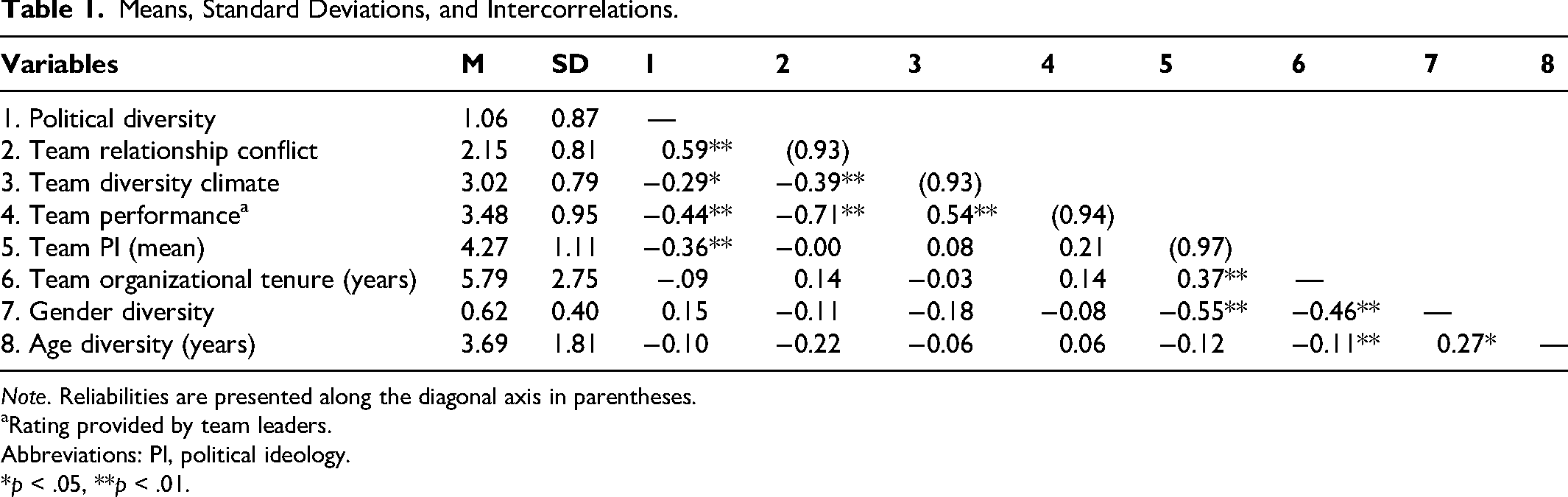
Note. Reliabilities are presented along the diagonal axis in parentheses.
Rating provided by team leaders.
Abbreviations: PI, political ideology.
*p < .05, **p < .01.
Prior to hypothesis testing, we conducted a series of confirmatory factor analyses (CFA) to test the discriminant validity of scales, using Mplus 8.7 (Muthén & Muthén, 1998–2017). Since our focal variables are measured by two different sources (team members and leaders), we conducted a two-level CFA to accurately understand how the measurement model fits our data (Kim et al., 2016). All items were loaded at the respective level at which they were measured: political ideology, team relationship conflict, and team diversity climate were measured by team members, so they were included at the individual level, but team performance was measured by team leaders, so it was included at the team level. In the full model, all items were loaded on their corresponding factors at the individual and team levels, respectively, resulting in a four-factor model. The two-level CFA revealed that the proposed four-factor model has an acceptable fit (Hu & Bentler, 1999): χ2 (43) = 137.73, p < .01, RMSEA= 0.07, CFI = 0.98, TLI = 0.97, SRMR individual-level = 0.03, SRMR team-level = 0.04. In addition, two alternative models were compared with the hypothesized full model to ensure that the hypothesized full model has the best fit. The fit indices for the full model were significantly better than those for the three-factor model (combining political ideology and team relationship conflict into a single factor): χ2 (45) = 982.41, p < .01, RMSEA= 0.23, CFI = 0.79, TLI = 0.72, SRMR individual-level = 0.11, SRMR team-level = 0.04. However, the two-factor model (combining political ideology, team relationship conflict, and team diversity climate into a single factor) showed non-convergence partially due to its model complexity (Lüdtke et al., 2021).
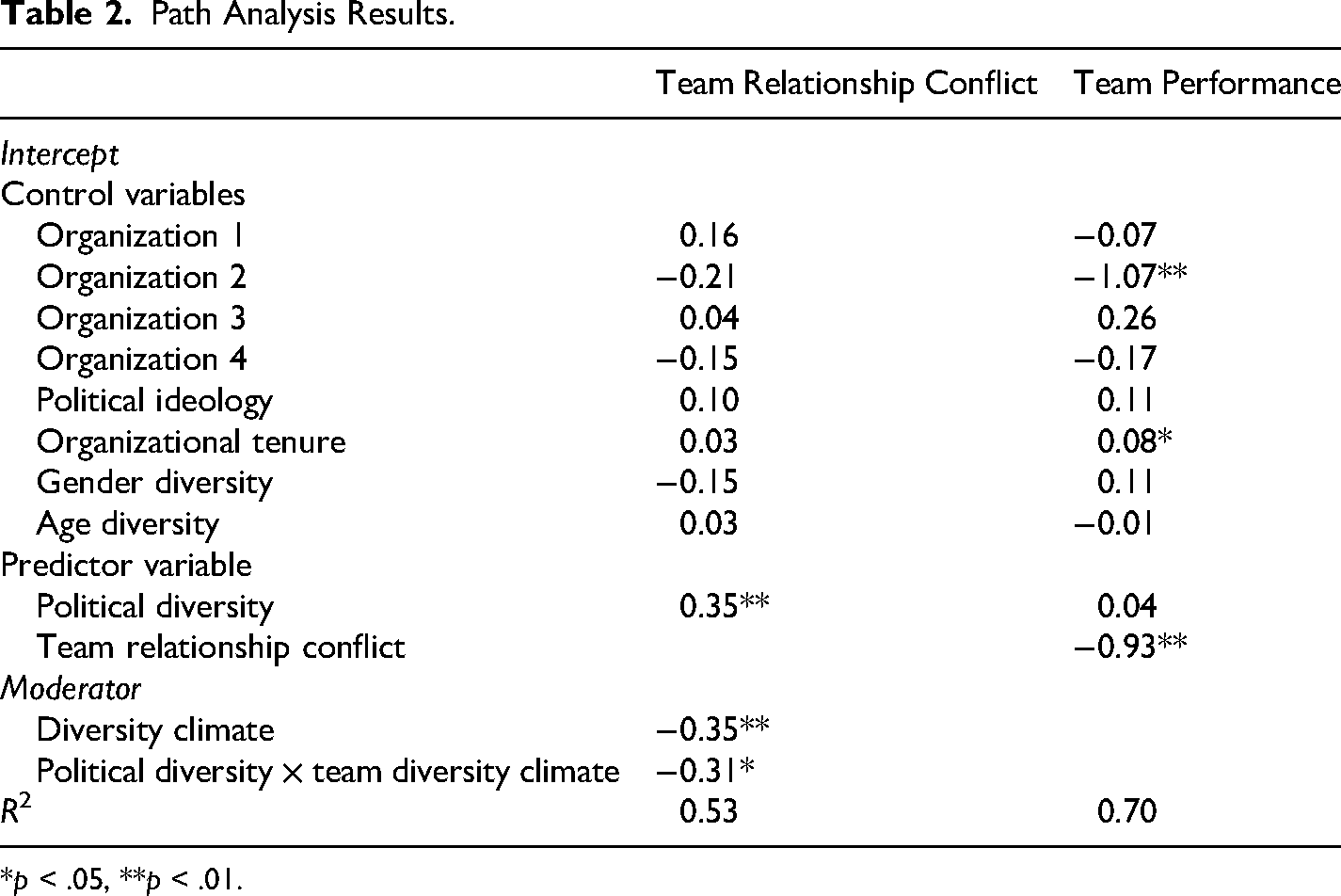
We tested our hypotheses using path analysis in MPlus software (version 8.7) with the maximum-likelihood algorithm (Muthén & Muthén, 1998–2017). Figure 2 shows the result of the path analysis. First, we investigated the path coefficient of the direct effect between political diversity and relationship conflict (Hypothesis 1). Second, political diversity and team diversity climate were grand-mean centered to help diminish the effect of multicollinearity. We next examined the interaction between political diversity and team diversity climate to see how it affects relationship conflict and then conducted a simple slope analysis (Aiken & West, 1991; Cohen et al., 2003) to test the hypothesized interaction effect (Hypothesis 2). Third, we used the product of the coefficient approach and bootstrapping with 5,000 bootstrapped samples to test the hypothesized indirect (Hypothesis 3) and conditional indirect effects (Hypothesis 4). In addition, we examined if there was a significant difference between the high (SD + 1) and low (SD ‒ 1) conditions of team diversity climate for political diversity to team performance through team relationship conflict based on the product of coefficient approach and bootstrapping method.
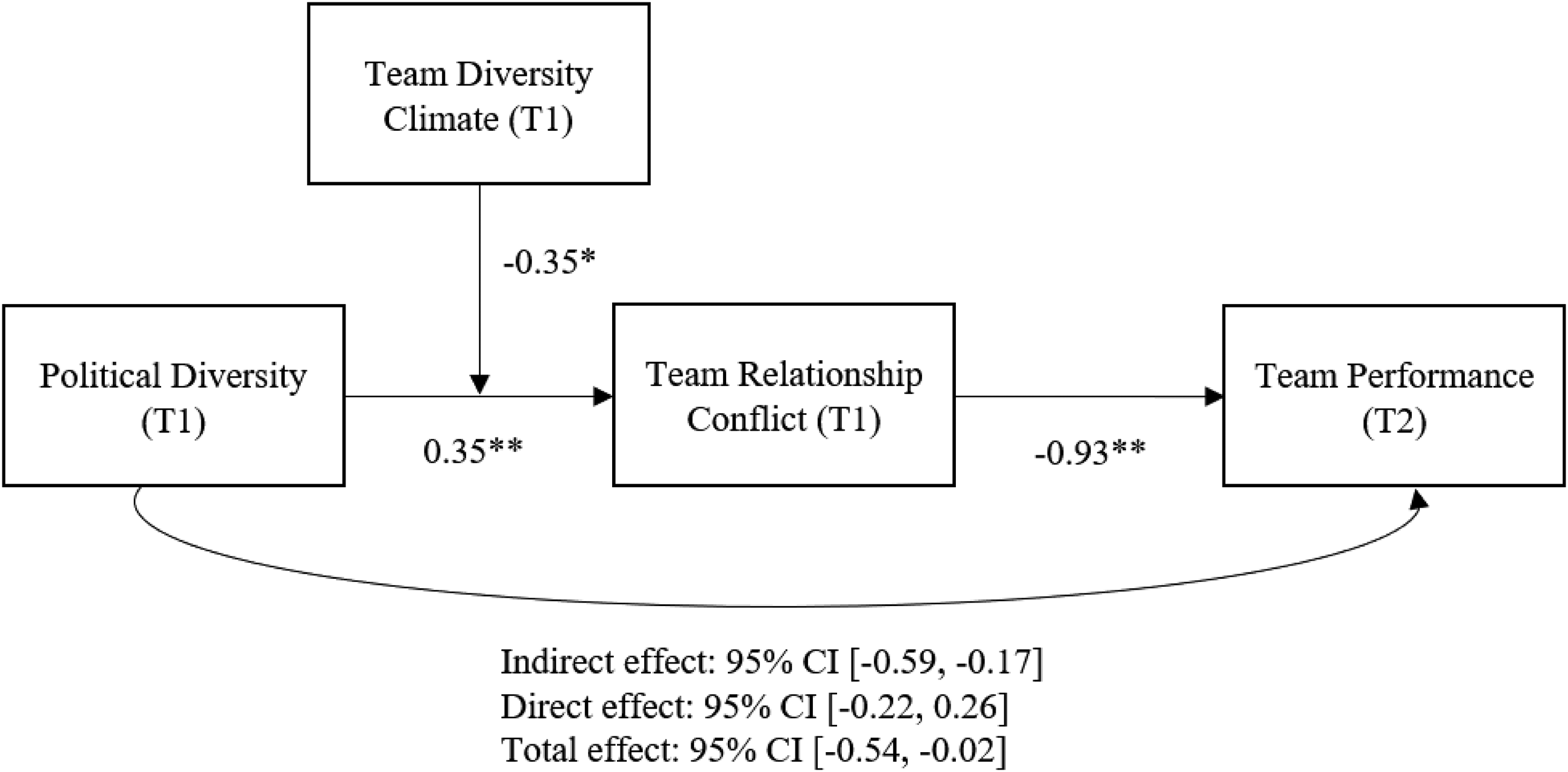
Results of path analysis.
As shown in Table 2, Hypothesis 1 was supported as political diversity was positively related to team relationship conflict (β = 0.35, SE = 0.10, p < .01). Hypothesis 2 predicted that team diversity climate would moderate the relationship between political diversity and team relationship conflict. As shown in Table 2, this prediction was supported as the effect of the cross-product term of political diversity and team diversity climate on team relationship conflict was significant (β = –0.31, SE = 0.14, p < .05). Based on Aiken and West (1991), we conducted simple slope analysis to examine the significance of the cross-level interactive effects. The results of the simple slope analysis showed that teams with a lower team diversity climate experienced relatively more team relationship conflict (for team diversity climate at 1 SD below the mean: simple slope = 0.63, p < .01) than teams with a higher team diversity climate (for team diversity climate at 1 SD over the mean: simple slope = 0.07, ns) as political diversity increased. As shown in Figure 3, the positive relationship between political diversity and team relationship conflict was stronger when team diversity climate was low (–1 SD), but weaker and non-significant when team diversity climate was high (+1 SD).
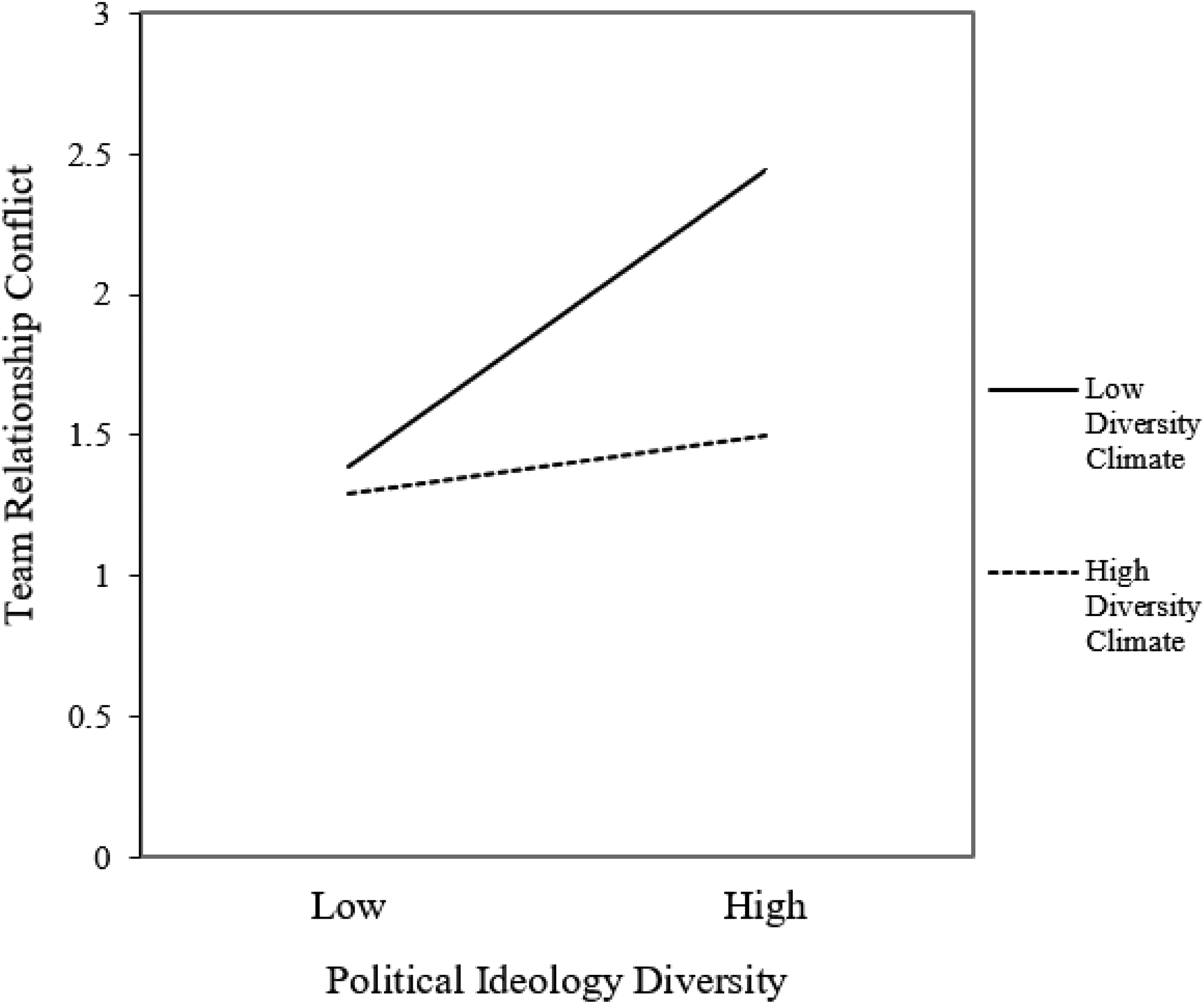
Interaction of political diversity and diversity climate on team relationship conflict.
Path Analysis Results.
*p < .05, **p < .01.
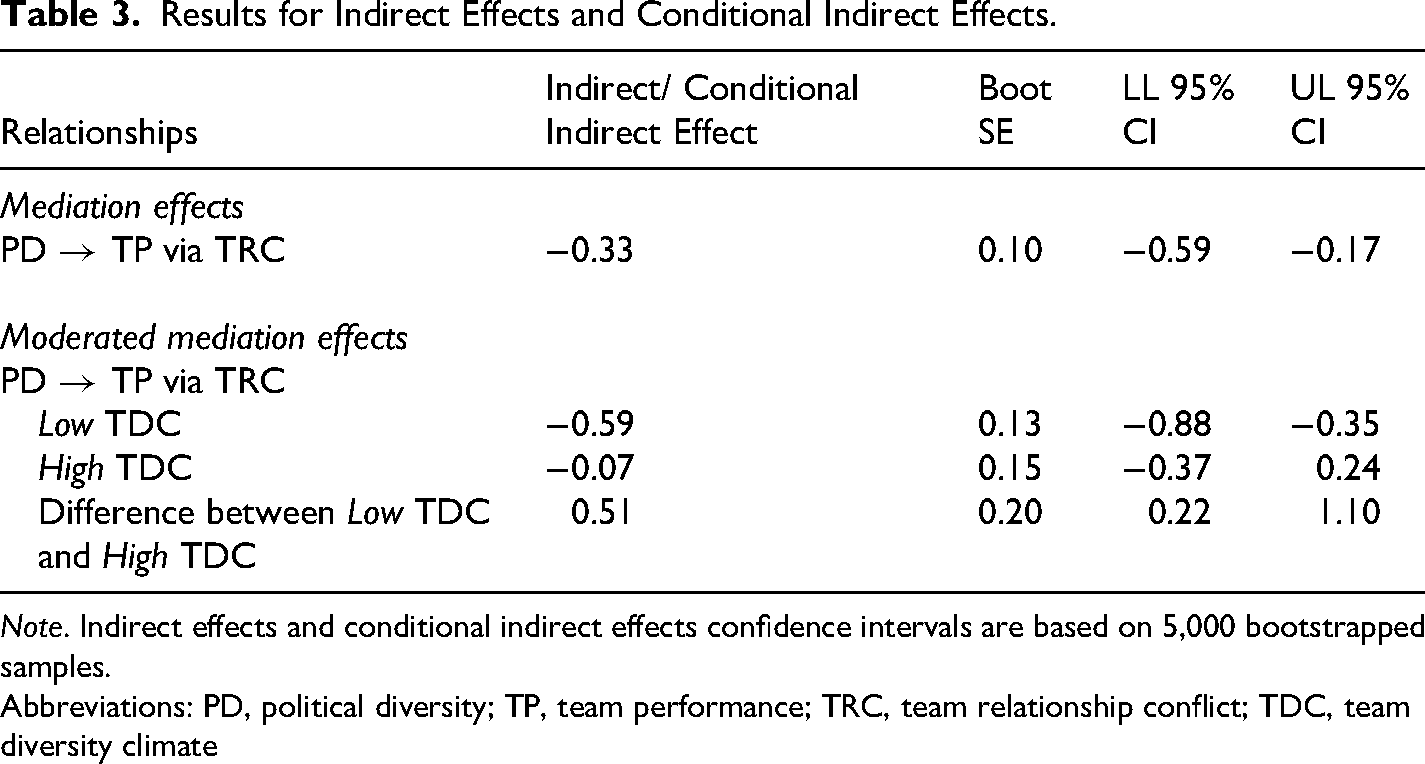
Hypothesis 3 predicted that political diversity would be negatively associated with team performance through team relationship conflict. As shown in Table 3, the indirect effect of political diversity on team performance through team relationship conflict was statistically significant in 95% confidence intervals (indirect effect = −0.33, SE = 0.10; 95% CI [–0.59, −0.17]). More specifically, the relationship between political diversity and team performance appears to be driven by team relationship conflict. The direct effect of political diversity on team performance was not significantly predictive (β = 0.04, SE = 0.12; 95% CI [–0.22, 0.26]), but still the total effect of political diversity on team performance was significant (β = −0.29, SE= 0.12; 95% CI [–0.54, −0.02]).
Results for Indirect Effects and Conditional Indirect Effects.
Note. Indirect effects and conditional indirect effects confidence intervals are based on 5,000 bootstrapped samples.
Abbreviations: PD, political diversity; TP, team performance; TRC, team relationship conflict; TDC, team diversity climate
Hypothesis 4 predicted that a negative relationship between political diversity and team performance through team relationship conflict would be moderated by team diversity climate. As shown in Table 3, we found that the indirect relationship between political diversity and team performance was stronger and significant when team diversity climate was lower (indirect effect = −0.59, SE = 0.13; 95% CI [–0.88, −0.35]), but was weaker and non-significant when team diversity climate was higher (indirect effect = −0.07, SE = 0.15; 95% CI [–0.37, 0.24]). The difference in the indirect effects at higher and lower levels of team diversity climate was also significant (Δ indirect effect = 0.51, SE = 0.20, CI [0.22, 1.10]), indicating Hypothesis 4 was supported. Our results reveal both conditional and unconditional indirect effects, highlighting the pathways through which political diversity is associated with team performance. The total effect of political diversity on team performance underscores the broader impact, contextualizing the conditional effects observed under varying levels of team diversity climate.
Additional Exploratory Analyses
First, given the potential limitations of control variables (e.g., Becker, 2005), we tested our proposed model without any control variables and our interpretation of the results remained unchanged, with only minor coefficient beta differences. These findings confirm that our hypotheses were supported regardless of the inclusion of control variables. Second, we also tested our model incorporating a single two-person team, and the results remained the same, with only minor variations in coefficient values. It also confirmed that excluding one two-person team did not impact our findings.
In line with Harrison and Klein's (2007) typology, political ideology diversity can be conceptualized in multiple ways, including as separation, variety, disparity, or even through the mean level of ideology in a team. To ensure the robustness of our theorizing and to explore alternative conceptualizations, we re-tested our model by applying these different operationalizations of political ideology diversity.
We first conceptualized political ideology diversity as variety. Following Harrison and Klein (2007) and Biemann and Kearney (2010), we transformed individual political ideology scores into seven discrete categories (e.g., 1.00 ≤ x < 1.50 = category 1 [very liberal], 1.50 ≤ x < 2.50 = category 2 [liberal], 2.50 ≤ x < 3.50 = category 3 [slightly liberal], 3.50 ≤ x < 4.50 = category 4 [moderate], 4.50 ≤ x < 5.50 = category 5 [slightly conservative], and 5.50 ≤ x < 6.50 = category 6 [conservative], 6.50 ≤ x ≤ 7 = category 7 [very conservative]) and calculated a bias-corrected Blau's index for each team. Results indicated that political ideology diversity as variety was not significantly related to our mediator (β = 0.29, p = .64), and its interaction with team diversity climate was not significant (β = –0.08, p = .91). These findings suggest that different conceptualizations of political ideology diversity may capture distinct aspects of team composition. In our data, operationalizing political diversity as separation was associated with relationship conflict, whereas conceptualizing it as variety was not, highlighting the importance of aligning theoretical arguments with specific diversity operationalizations. Moreover, transforming a fundamentally continuous construct such as political ideology into discrete categories may introduce additional measurement constraints. Accordingly, we interpret the non-significant findings for variety with caution and view them as reflecting differences in operationalization rather than as evidence that one conceptualization is inherently superior.
We next conceptualized political ideology diversity as disparity to examine whether having a smaller number of conservatives (liberals) on a team of liberals (conservatives) impacts the team's dynamics. In accordance with Harrison and Klein's (2007) and Biemann and Kearney's (2010) recommendations, we used a bias-corrected coefficient of variation (Allison, 1978), which ranges from 0 (low disparity) to 1 (high disparity) and captures the degree of variation relative to the team's mean. Results showed that when disparity was measured in its original coding, political diversity as disparity did not significantly predict the mediator (β = 0.48, p = .16), nor did its interaction with team diversity climate significantly predict the mediator (β = –.63, p = .15). However, when political ideology was reverse coded (i.e., 1 = very conservative, 7 = very liberal), disparity became significant: political ideology diversity as disparity was positively related to the mediator (β = 1.30, p < .001), and its interaction with team diversity climate was also significant (β = –1.26, p = .02). These findings indicate that disparity captures asymmetries in team composition in ways that depend on which side of the ideological spectrum is in the minority, but overall, separation remains the most robust operationalization.
Finally, we tested whether the mean level of political ideology in a team (i.e., whether a team is overall more liberal or conservative) predicted team dynamics. Results showed that the mean level of political ideology was not significantly related to the mediator (β = –0.12, p = .40), and its interaction with team diversity climate was also nonsignificant (β = 0.18, p = .36). These findings suggest that the average political leaning of a team does not meaningfully explain variation in team processes; rather, it is the spread or configuration of political ideology (particularly separation) that is more strongly associated with relationship conflict and performance outcomes.
Discussion
This study examined how political diversity impacted a team's performance. Integrating diversity and political affiliation theories (CEM and PAM), we found that simply working on a more politically diverse team is associated with higher levels of relationship conflict, but especially when those members felt like there was not a climate for diversity. However, under high levels of diversity climate, this relationship becomes non-significant, indicating that in this condition there is no significant relationship between political diversity and relationship conflict. On the other hand, compared with teams with lower levels of a diversity climate, those politically diverse teams with higher levels of a diversity climate had lower levels of relationship conflict, in turn, making the negative indirect relationship between political diversity and team performance weaker.
Theoretical Contributions
This research has several theoretical and practical implications. First, we contribute to theory and the burgeoning understanding of political differences at work during times of increasing polarization. Our results show that political diversity is positively associated with team relationship conflict. As another type of value diversity, political diversity differs from other value-based differences because of its heightened potential to trigger intergroup bias, as explained through PAM (Roth et al., 2020). Aligning with general findings in the diversity literature, our results indicate that higher levels of (political) diversity correlate with increased relationship conflict (Roberson, 2019). However, we go further by arguing and showing that political diversity's identity-relevant and emotionally charged nature may amplify these effects, making it distinct from other forms of value diversity, such as diversity in work values and preferences (Jehn & Mannix, 2001; Polzer et al., 2002; Triana et al., 2021). Theoretically, by integrating CEM's categorization pathway with PAM, we provide a conceptual framework for understanding why political diversity is particularly likely to trigger intergroup bias and relationship conflict in team settings, advancing theory on how identity-relevant, emotionally charged diversity dimensions operate differently from other forms of deep-level diversity. In doing so, our study also expands the nomological network of political diversity by linking it to relationship conflict and team performance during a changing sociopolitical environment. Thus, our findings speak directly to organizations grappling with the social and organizational changes that rising polarization creates, as diversity management efforts are themselves recognized as organizational change interventions that transform how organizations function (Kossek et al., 2003; Nadiv & Kuna, 2020).
Second, we extend the scope of the PAM by adapting its principles to team settings, thereby highlighting its usefulness for understanding broader phenomena about how political affiliations and team composition impact team functioning. In doing so, we show that insights from PAM are even more pervasive than the original theory suggested, such that the disliking and negative work attitudes toward outgroup members likely apply to employees who have established working relationships and know each other. This represents a departure from the initial focus of PAM, which analyzed the effects of political ideologies on evaluations of unfamiliar individuals, such as organizational applicants (Roth et al., 2020; Roulin et al., 2023; Wade et al., 2020) or the judgments applicants make about potential employers (Roth et al., 2022). We suggest the PAM is useful beyond the contexts where the individuals do not know each other and are making evaluations of what they will be like. In these changing societal times of rising polarization, we theorize that this disliking and negative workplace attitudes toward people with different political ideologies surfaces as relationship conflict in team settings, despite team members knowing each other.
Third, our research contributes to the body of knowledge on diversity climates by emphasizing their relevance to political diversity in the workplace, particularly amidst increasing societal polarization and pushback against DEI efforts from some governments and organizations. While diversity climates have been linked to numerous benefits, such as increased comfort, higher retention, enhanced group performance, and greater satisfaction (Holmes et al., 2021; McKay et al., 2007; Mor Barak et al., 1998), these effects have primarily been explored in the context of surface-level diversity dimensions like gender and race. By extending these findings to deep-level diversity, especially negatively valenced, value-based differences like political diversity, we provide evidence that a positive diversity climate can help reduce political diversity's negative impacts and enhance team functioning. Importantly, we argue that political diversity's impact on team performance is not merely an ideological concern tied to promoting DEI but an operational issue, as political divisions drive relationship conflict that directly hinders team performance. Thus, by highlighting the importance of addressing political diversity through a positive diversity climate, our work bridges the gap between ideological efforts to foster inclusivity and the practical necessity of managing political differences for improved workplace dynamics.
Practical Implications
Our results have practical implications for managers and organizations. Given the growing societal polarization, managers cannot ignore the potential impact of political diversity in the workplace. Our results suggest that organizations should actively invest in building a positive diversity climate to prevent political differences from escalating into relationship conflict and harming team performance. Drawing from Holmes et al. (2021), this may be accomplished through concrete DEI practices: senior leadership endorsing diversity and inclusion as a strategic organizational objective, adopting HR policies that ensure fair treatment and inclusion of all personnel regardless of their political views, and allocating resources toward maintaining inclusive work climates. In the context of political diversity specifically, managers should clearly signal that political views will not influence how employees are evaluated or treated (Chung et al., 2015), directly countering the partisan bias in work evaluations identified in PAM (Roth et al., 2020), and should model inclusive behavior themselves. Organizations may also consider establishing explicit team norms around if and how political discussions occur at work, given evidence that political conversations in the workplace can be costly for employees (Kim et al., 2022).
Limitations and Future Directions
This study is not without limitations. First, our field study was not experimentally manipulated, so causality cannot be established. However, we separated our independent and dependent variables in a time-lagged design, and also collected data from both employees and their leaders, so we believe common method bias concerns are minimized (Podsakoff et al., 2003). We note that we chose our one-month time lag because it is in line with other team-focused scholarship involving ratings from both team members and leaders (e.g., Owens & Hekman, 2016), but it may be possible our chosen time lag impacted our results and we suggest future research replicate our results using different time lags too. Future work could experimentally manipulate certain team members’ political ideologies and diversity climates to better determine causality. Likewise, we did not collect data about whether and how much the team members talked about political issues with other team members.
Relatedly, like most single-diversity studies, we assume political diversity operates independently of other diversity dimensions, and future research should examine how it intersects with other diversity dimensions to shape team processes. For instance, it is likely that certain surface-level characteristics intersect more profoundly with political ideology in the U.S. or other Western countries, but in this South Korean context, we establish the impact of political diversity while controlling for age and gender diversity.
Another fascinating future direction is to explore the deeper mechanisms of whether political diversity is associated with relationship conflict because of stereotyping (driven by knowledge a team member is of the opposing party) or driven by underlying differences between liberals and conservatives even if they are unaware of each other's political affiliations. Relatedly, the mean score of relationship conflict was not as high as expected based on the negative emotions associated with political disagreements, suggesting that familiarity and history among colleagues may also matter. Teams with longer shared tenure or stronger personal relationships may be less likely to categorize based on political identity, while newly formed teams may be more vulnerable to conflict. Future research should therefore examine team age or membership history as moderators of these dynamics. Additionally, whereas we focused on the negative consequences of political diversity, it may be interesting to explore if there are benefits to be gained via increased information elaboration as proposed in the CEM (van Knippenberg et al., 2004).
Second, our investigation explored the dynamics of political diversity within the specific milieu of South Korea. Recognizing the inherent limitations of a single-country study, we are cautious to avoid overgeneralizing our findings (Henrich et al., 2010). Thus, our theory, assumptions about disliking politically dissimilar coworkers, and our findings must be considered within the context of intense political polarization in countries like South Korea and the United States. Future work should consider this context and whether certain task-related dimensions affect this relationship (Johns, 2006). We also note that this study was based on findings from 70 teams, and future research should attempt to replicate and extend these findings with larger samples. Further, because our study involved different industries, our measure of team performance was a more subjective measure rated by the team's leader, and future research could consider more objective measures which would rely less on the view of individual leaders, such as revenue generated by the team (e.g., Kearney et al., 2022), or by studying sporting contexts where objective team performance data is readily available (e.g., Fonti et al., 2023).
Conclusion
While polarization keeps rising around the world, leaders would be wise to be aware of how political ideologies may be impacting their team's performance. Our research suggests that working on a politically diverse team is associated with higher levels of relationship conflict on the team. This team-rated interpersonal tension and conflict, in turn, was associated with lower leader-rated team performance evaluations. However, our research highlights the importance of creating a climate for diversity to help reduce relationship conflicts associated with political diversity. Importantly, when these politically diverse teams felt that there was a positive climate for diversity, the negative impact of political diversity on relationship conflict was weakened and the indirect effect of political diversity on team performance became nonsignificant. In sum, in politically polarizing climates across the world, ensuring employees experience a positive climate where they are treated fairly and with respect may help to ease some of the negative associations with team political diversity in organizations.
The authors report no conflicts of interest.
Footnotes

Funding
The authors received no financial support for the research, authorship, and/or publication of this article.
Declaration of Conflicting Interests
The authors declared no potential conflicts of interest with respect to the research, authorship, and/or publication of this article.