







Abstract
This paper examines affirmative action in Malaysia and South Africa, two regimes that favor majorities. Malaysia’s highly centralized and discretionary programme is in contrasts with South Africa’s more democratized, decentralized and statutory structure. With regard to affirmative action outcomes, both countries have made quantitative gains in increasing representation of Bumiputeras in Malaysia and blacks in South Africa, in tertiary education and high-level occupations. However, there is also evidence to suggest continuing, primarily qualitative, shortfalls, in terms of graduate capability, dependence on public sector employment, and persistent difficulty in cultivating private enterprise. The results reported here emphasize the importance of implementing affirmative action effectively in education, while exercising restraint in employment and enterprise development.
Introduction
Malaysia and post-apartheid South Africa are prominent as upper-middle income nations implementing extensive affirmative action in favor of a politically dominant and economically disadvantaged majority ethnic group (Table 1). Colonial and apartheid legacies of exclusion, discrimination and repression entrenched systemic and continuing forms of disadvantage, resulting in severe under-representation of certain groups in high-status social and economically influential positions. Specifically, the under-representation of Bumiputeras in Malaysia and blacks in South Africa in tertiary education and high-level occupations, as well as asset ownership, has compelled each state to take extensive action to redress these imbalances through preferential policies. In the wake of ethnic unrest in 1969 in Malaysia, and in the face of uncertainty in South Africa’s mid-1990s transition from apartheid to democracy, both countries expanded or introduced a wide range of ethnicity-based affirmative action programs which formed an integral part of national development agendas and policies.
Ethnic composition and national income, Malaysia and South Africa.
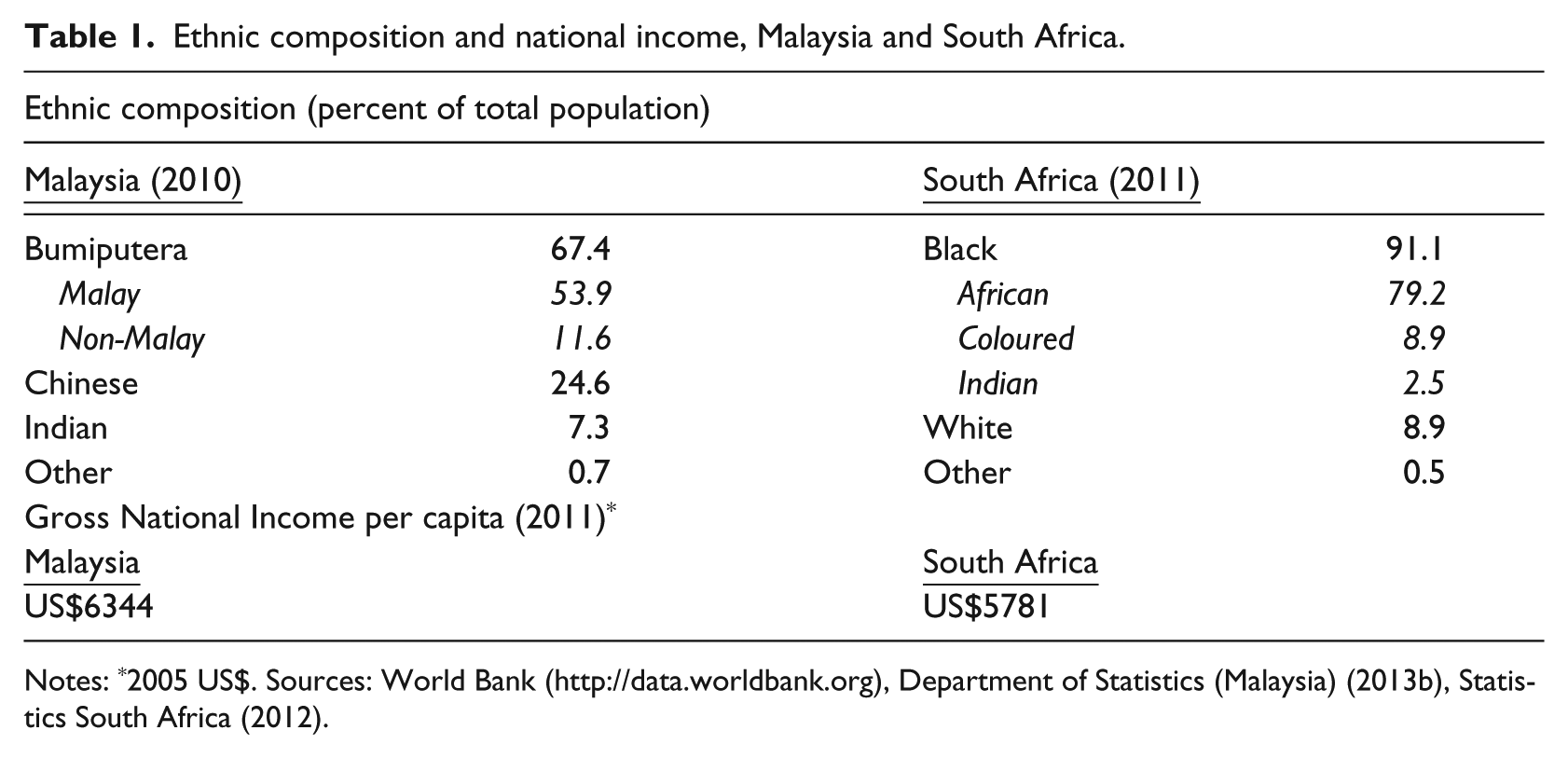
Notes: *2005 US$. Sources: World Bank (http://data.worldbank.org), Department of Statistics (Malaysia) (2013b), Statistics South Africa (2012).
This paper provides an overview of affirmative action and an analysis of policy outcomes, focusing on interventions in education and employment, in Malaysia and South Africa. Both nations have implemented preferential programs – with contrasting structures and mechanisms – to raise beneficiary group participation in tertiary education and high level occupations, primarily in professional and managerial positions. The larger part of this study covers empirical analyses, drawing on a range of national survey data and supplementary sources and focusing on the primary policy objective of increasing group representation in targeted areas. In addition, other outcomes and costs associated with affirmative action, especially those involving qualitative effects of preferential selection, are considered.
A note on group categorizations is in order. In both countries, beneficiaries of affirmative action belong to aggregated categories comprising sub-groups. Bumiputera, meaning ‘sons of the soil’, encompasses Malays and indigenous populations of Malaysia – that is, non-Malay Bumiputeras. Following South African convention, the term ‘black’ is used in this paper to refer to African, Coloured and Indian individuals. The demographic majority and political preeminence of Malays in Malaysia and Africans in South Africa lend to these categories sometimes being used, instead of Bumiputera and black. This paper will apply the terms Malay and African when such empirical definitions are warranted, or when the political primacy of these groups is relevant to our consideration.
This paper proceeds as follows. The next section discusses some background issues, covering conceptual literature and existing relevant research on Malaysia and South Africa. Affirmative action programs and legislation are then reviewed, with notable contrasts being identified. This is followed by a presentation and discussion of empirical evidence of the outcomes of affirmative action, as individual cases and in comparative perspective. In general it was found that both countries have raised beneficiary group representation in tertiary education and high level occupations, but have fallen short in terms of the quality and breadth of graduates and penetration of the private sector, especially in management. Shortcomings in educational attainment constrain the capacity for Malaysia and South Africa, respectively, to increase the upward occupational mobility of Bumiputeras and blacks. The paper concludes with consideration of policy implications, arguing for the need for affirmative action to be made more effective in education and for more tempered, restrained implementation of the policy in the spheres of employment and private enterprise.
Background
Conceptual and methodological considerations
Affirmative action can be defined as preferential policies to redress the under-representation of a disadvantaged population group in socially esteemed and economically influential positions (Fryer and Loury, 2005; ILO, 2007; Weisskopf, 2004). These policies address a specific problem: under-representation of a population group – categorized by race, ethnicity, gender, disability, region, and so on – in socio-economic positions that affect the collective esteem and stature of the group. A group that is conspicuously and persistently absent among university students, doctors, lawyers, engineers, managers, and so on, may be perceived or stereotyped negatively, discouraged from gaining upward mobility, and continually excluded over the long term. This situation is further characterized by various disadvantages that members of the group on average may face – for instance, inferior schooling, shortage of work experience, and lack of capital ownership or access to credit – and compounded by entry barriers to these positions – for instance, university entry grades, higher education qualifications for professional jobs, work experience and network connections for managerial positions.
Focusing on these specific problems and obstacles clarifies the instrumental role of preferential treatment. Affirmative action rests on a premise that conventional criteria of need or merit will not sufficiently facilitate upward educational and occupational mobility or capital ownership, because those in a disadvantaged group will generally not qualify for positions targeted by affirmative action unless they are granted some degree of preference based on their identity with that group. At the same time, because affirmative action grants preference based on identity, it is imperative that such policies are productive, effective and transitory. Affirmative actions policies are undeniably contentious and entail both benefits and costs to economy and society. This theoretical debate is inconclusive, emphasizing the importance of empirical enquiry (Fryer and Loury, 2005). The breadth of affirmative action programs, and the importance of evaluating both quantitative and qualitative outcomes, demands a multidimensional approach and a wide range of empirical observations.
The empirical analysis reported here is derived from two principal considerations. First, there is a focus on the primary objectives and target groups of affirmative action in education and employment, and the corresponding implications of preferential selection. Groups specifically targeted as affirmative action beneficiaries are then evaluated, with quantitative outcomes being examined principally with reference to participation in tertiary education and occupational representation, supplemented by qualitative evidence to shed light on the efficacy and sustainability of policies. As explained above, representation of disadvantaged groups in specific positions and strata constitutes the policy’s principal objective. Hence, this paper maps out the ethnic composition of university enrollment data, educational attainment of the labour force, and occupational categories. Data that capture more qualitative implications, especially university graduates’ capability and labour market mobility, and the public/private sectoral distribution of affirmative action-targeted occupations, are added to these empirical points of reference.
A second consideration relates to the availability of relevant data. This study sets out to compile and evaluate from a comparative perspective the empirical evidence of the outcomes of affirmative action in Malaysia and South Africa. Labour force surveys and censuses provide data for observing the principal outcomes of interest – group representation in tertiary education and high level occupations – although raw data are far more accessible for South Africa than Malaysia. In the Malaysian case, statistics reported in or derived from official publications that summarize national surveys have been compiled. In stark contrast, national survey data are freely and fully accessible for South Africa, and the findings are originally generated for this study. These quantitative sources and supplementary qualitative data largely suffice for policy evaluation. However, data limitations preclude consideration of an important ramification of affirmative action for both countries: disparities between inter-ethnic earnings within educational or occupational groups. The requisite data are not available for Malaysia, although such findings can be computed from South Africa’s Labour Force Surveys. 1
Empirical studies of affirmative action in Malaysia and South Africa
The literature examining the primary objectives of affirmative action is not as extensive as one might expect, given the breadth and intensity of the policy in Malaysia and South Africa. Most research on inequality in both countries focuses on general aspects, especially household income and differences in personal earnings, and situates analyses within the broader framework of development policy and not necessarily as a specific and systematic conceptualization of affirmative action. Although studies of inequality in these countries invariably connect income inequalities with affirmative action, the causal links are relatively distanced compared to the socioeconomic outcomes primarily targeted by affirmative action – group representation in tertiary education, high-level employment, and ownership of and control over assets.
Literature on Malaysia dealing with affirmative action often locates ethnic preferential policies in the context of national development policies, especially the New Economic Policy, which from 1971 have pursued a full range of objectives, including alleviation of poverty, economic growth, industrialization, and advancement of Bumiputeras. Affirmative action thus tends to appear in the background, or is drawn into the discourse as one of many explanatory factors of development outcomes. Several studies have outlined educational and occupational attainments of ethnic groups over time, although the research output is sparse, partly due to official data restrictions. Much of the work addresses the pre-1990s era and does not account substantively for variation in education quality or labour market competitiveness (Faaland et al., 1990; Jamaludin, 2003; Jomo, 2004; Leete, 2007). Progress since the 1990s has been studied less vigorously, even though some shortcomings in the economic participation of Bumiputeras persist, particularly with regard to difficulties among graduates in labour market engagement, continual dependence on public sector employment of professionals and administrators, and under-representation in management and private enterprise (Lee, 2005). It is also quite common for research to commend Malaysia’s achievements in promoting the educational and occupational advancement of Bumiputeras, while highlighting shortcomings raising Bumiputera equity ownership (Chakravarty and Abdul-Hakim, 2005; Yusof, 2012). However, such appraisals tend to overlook shortfalls or regression in the quality of education and labour market mobility of the beneficiaries of affirmative action: it is these two aspects which are among this study’s main findings.
South Africa has maintained freer access to information and this has fostered productive research on inequality. However, the greater majority of the relevant literature focuses on household income or personal earnings, and deduces affirmative action outcomes and implications from inequality in income or earnings, these being influenced by myriad other factors and policies, including economic structural change, labour market conditions, and general socio-economic development (Allanson et al., 2002; Burger and Jafta, 2010; Seekings and Nattrass, 2005). There is a tendency to equate affirmative action with employment equity in the labour market, while giving less attention to preferential programs in tertiary education as part of a broader framework of affirmative action. This study seeks to fill the gaps by focusing on the primary objectives and outcomes of affirmative action, encompassing both the educational and occupational spheres.
There is also a paucity of comparative empirical work on these countries. Malaysia and South Africa were the subjects of some comparative studies in the early to mid-1990s, mostly with the aim of discerning whether South Africa could draw lessons from Malaysia on development and redistribution programs, including affirmative action (Emsley, 1996; Hart, 1994; Southall, 1997). However, these studies preceded South Africa’s implementation of post-apartheid majority-favoring affirmative action, and there has been little comparative work on these two nations since South Africa’s affirmative action laws and programs began to take shape. Malaysia’s four decades of extensive affirmative action – since 1971 – provide a substantive track record of achievements and shortfalls. Affirmative action in South Africa has now been implemented for nearly fifteen years, long enough for progress to be evaluated. Its affirmative action programs, especially employment equity and black economic empowerment, are constantly embroiled in contemporary debate.
Affirmative action regimes
While affirmative action in Malaysia and South Africa is majority-favoring and extensive in scope and scale, policy objectives are pursued through significantly contrasting frameworks and programs. At this juncture, it is pertinent to note two contrasts in the countries’ political economic conditions that set certain constraints on affirmative action, and on the role of the state more generally. First, mainstream development thinking at the time when Malaysia’s New Economic Policy was introduced was more receptive to state intervention compared to South Africa during its transition to democracy. Malaysia in the early 1970s was able to take an expansionary stance and massively enlarge state-led development programs, including affirmative action, to a greater extent than South Africa in the mid-1990s, where a neoliberal regime and contractionary policies took hold. Second, in terms of the overarching policy agenda, Malaysia pursued both the extensive alleviation of poverty and widespread social spending alongside affirmative action, while in South Africa the social development agenda was not as cohesively integrated with affirmative action. Social development programs and expenditures in Malaysia facilitated Bumiputera entry into higher education and high-level occupations, leading to the subsequent formation of a Bumiputera middle class. However, upward mobility of blacks in South Africa has been circumscribed by deficits in basic social provisioning, particularly education and development of skills.
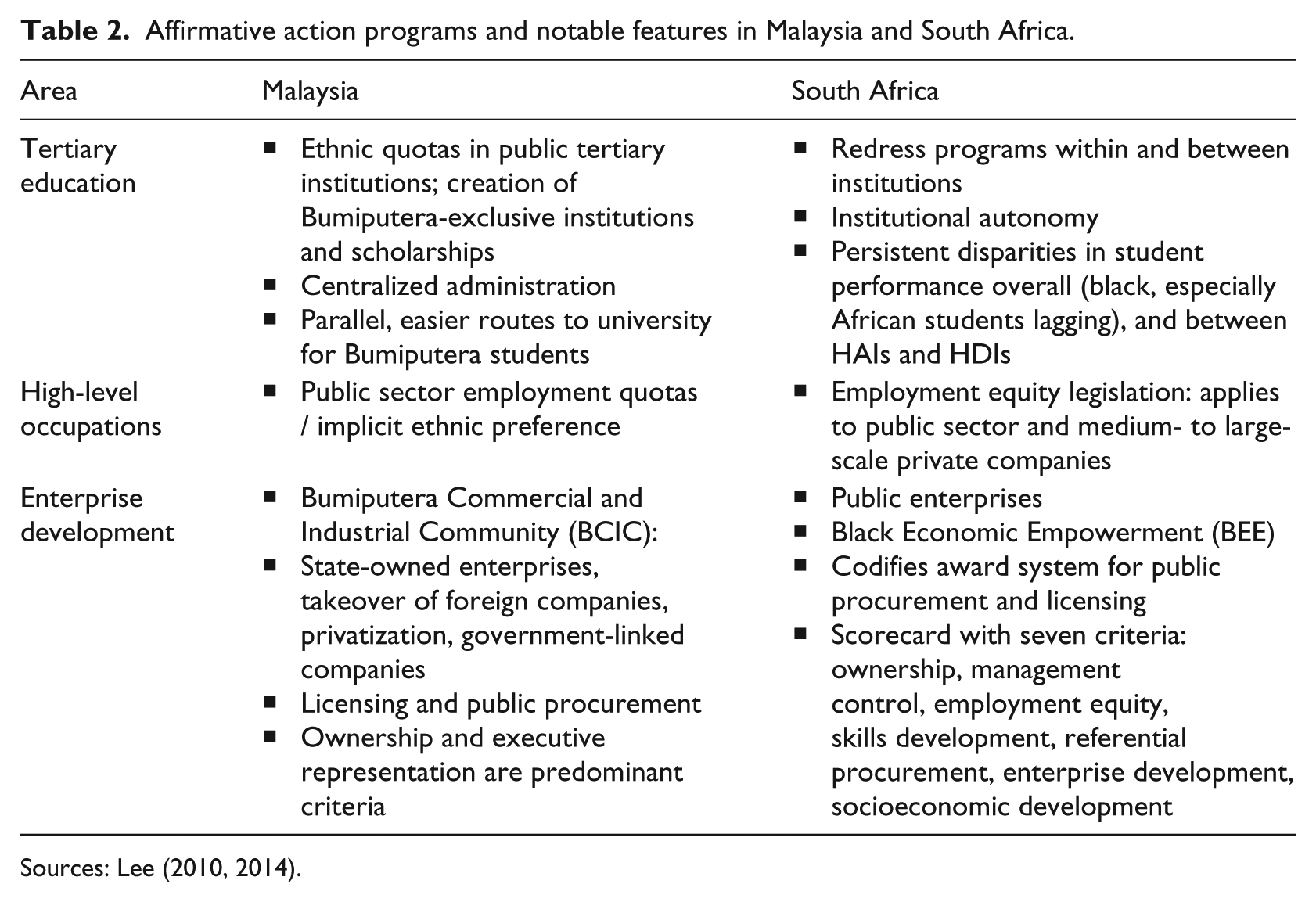
In what follows the operational aspects of affirmative action are briefly outlined, drawing out notable comparisons especially in terms of degree of centralization, scope of intervention, and the relative application of discretionary authority and statutory mandates (as summarized in Table 2).
Affirmative action programs and notable features in Malaysia and South Africa.
Tertiary education
Malaysia has maintained a centralized administration of affirmative action in tertiary education and, to a lesser extent, in secondary education. The main instruments encompass quotas in public university admissions and government scholarships, and Bumiputera-exclusive institutes and scholarships. University admissions and public service scholarships are administered centrally and have generally applied ethnic quotas. MARA (Majlis Amanah Rakyat, or ‘Council of Trust for the People’) residential colleges and matriculation colleges offer parallel, alternate – and easier – routes to degree-level education, while MARA scholarships have funded degree-level enrollment for Bumiputera students, with the top scholars being sent abroad. Places in University Teknologi MARA (UiTM), which in 2009 enrolled 140,000 out of a total 590,000 in the public university system, are reserved exclusively for Malay and Bumiputera students.
South Africa has adopted a more decentralized framework and implemented affirmative action programs only at the tertiary level. Through the democratic transition, the autonomy of universities was preserved and universities were mandated to pursue broadly defined redress or transformation agendas. Having inherited vast inequality between historically white or historically advantaged institutes (HAIs) versus historically black or historically disadvantaged institutes (HDIs), emphasis was placed on increasing black representation in HAIs and on narrowing disparities between HAIs and HDIs. Preferential selection for places in universities, especially the HAIs, operates in rather disparate ways, partly by design since each institution is entrusted to formulate its own admissions policy (Badat, 2012). 2 The application of affirmative action in universities began to be more expressly noted in the late-2000s, notably in the context of comparative studies vis-à-vis the United States (Featherman et al., 2010; Nussbaum and Hasan, 2012). Perhaps as a result of the general omission of education as a component of South Africa’s affirmative action interventions, little attention has been paid to preferential policies in education in both countries. Van der Westhuizen, a rare exception, describes Malaysia’s enrolment quotas as ‘far more discriminatory’” (van der Westhuizen, 2000: 45) than corresponding programs in post-Apartheid South Africa. Expansion of affirmative action in higher education in Malaysia also coincided with a shift from English to Malay as the medium of instruction, whereas the English language has been emphasized in South Africa. Thus, assertion of the native language has played a role in facilitating entry from schooling to university in Malaysia, while South Africa’s experience has been quite the opposite. 3
High level occupations
The measures Malaysia adopted to increase Bumiputera representation in managerial, professional and technical positions are relatively narrow in scope and were implemented through a less formalized and codified process. The NEP set the ethnic composition of the population as a guideline for group representation in employment at all levels and in all sectors. 4 The public sector has conformed by de facto hiring and promotion quotas or ethnic preference norms, and has desisted from instituting mechanisms for monitoring or inducing equitable group representation in government departments. There is no broad private sector and cross-industry program along the lines of employment equity legislation, although some sectors appear to have adopted ad hoc targets for increasing Bumiputera representation in management.
In marked contrast, South Africa passed the Employment Equity Act (EEA) in 1998, requiring medium- and large-scale firms to submit regular reports on their workforce composition and, in consultation with workers, to set targets for increasing the proportion of previously disadvantaged individuals – blacks, women and disabled persons – where they are under-represented, principally in professional and managerial positions. The legislation, backed by monitoring mechanisms and punitive consequences for non-compliance, covers all industries and encompasses private and public sectors, thus forming the bedrock of affirmative action in the labour market. South Africa adopts as a baseline that the ethnic and gender composition of organizations should reflect the economically active population. Black economic empowerment (BEE) sets out a framework for scoring the performance of firms in advancing black interests across a range of criteria, including ownership, executive representation, employment equity and skills development. Firms’ scores are factored into public procurement and licensing decisions. This program supplements employment equity by providing some inducement for firms to increase their efforts in hiring and promoting disadvantaged persons through accessing and using state funds and licenses.
Affirmative action to promote beneficiary group representation in management – with a focus on commercial organizations rather than public administration – entailed specific policies to overcome the distinctly steep barriers to entry to such positions. Malaysia’s passage towards cultivating a Bumiputera Commercial and Industrial Community (BCIC) followed a meandering, experimental and heavily state-led path, from emphasis on state-owned enterprises (SOEs) and takeover of foreign-owned companies (1970s to early 1980s), to heavy industries (early to mid-1980s) to massive privatization of SOEs (late-1980s to 1990s). The aftermath of the 1997–1998 financial crisis saw the renationalization of previously privatized entities from the late 1990s and their reconstitution as government-linked companies, or government majority-held corporations. Government procurement and licensing have also both been structured around affirmative action objectives in managerial and enterprise development, through exclusion of non-Bumiputera in the allocation of small contracts and handicaps to Bumiputera bidders in medium to large contracts, and the requirement of Bumiputera business partners in awarding licenses.
With regard to cultivating a black managerial class, South Africa’s approach has also been incremental but, in contrast to Malaysia’s Bumiputera-favoring interventions, relies more on statutory and market-based instruments. Formal programs did not take shape until the late 1990s, with the establishment of the Black Economic Commission in 1998 and passage of the BEE Act in 2003. Industry charters had formulated plans for Government procurement and licensing operated within a less codified preferential framework, but became subsumed into the black economic empowerment program with the BEE Act and the expansion of government procurement in the 2000s. The BEE Codes, promulgated in 2007, set out an incentive framework for granting preference based on performance in advancing black persons in, inter alia, ownership and control, and enterprise development. Although South Africa indicated in the mid-1990s that privatization of parastatals, initiated in the 1980s, would proceed, the policy mostly did not materialize, and public enterprises have incorporated the BEE mandate.
Affirmative action outcomes: Malaysia
Tertiary education
The evidence on the advancement of Bumiputeras in tertiary education is somewhat dispersed, unlike occupational representation and other statistics that, until the mid-2000s, have been tracked consistently in development plans. Nonetheless, a range of sources paint a picture of substantial quantitative gains. Institutions established for the educational advancement of Bumiputeras grew considerably in size. MARA junior science college enrollment increased from 6311 in 1984 to 9050 in 1995 and 20,162 in 2005. Public matriculation colleges registered student populations of 5280 in 1985 and 15,470 in 1995, then burgeoned to 55,442 in 2005 (Malaysia, 2001, 2006). These institutions play a vital role in facilitating access by Bumiputeras to universities and colleges; they were exclusively Bumiputera until a 10% non-Bumiputera quota was introduced in 2002. However, both the quality and rigor of public matriculation colleges are questionable. Available research has found that students from matriculation colleges demonstrate less academic ability than those obtaining the Malaysian Higher Education Certificate (STPM), the predominantly means of passage for entry by non-Bumiputeras into university (Othman et al., 2009).
The ethnic composition of universities demonstrates the efficacy of admissions quotas and the creation of institutions with exclusively or predominantly Bumiputera enrollment. Official disclosures are sparse, but available data show marked change, especially across the 1970s and 1980s. From 1970 to 1985, Bumiputera representation in university student populations grew from 40.2% to 63.0%, then apparently stabilized (Khoo, 2005). In 2003, the ethnic proportions were reportedly 62.6% Bumiputera, 32.2% Chinese and 5.2% Indian (Sato, 2005: 86). The effects of the expansion of and affirmative action in tertiary education in allocating access extend to the labour force (Figure 1). The share of the workforce with tertiary education increased across all groups, but most rapidly for the Malay population. Indeed, attainment of formal qualifications is highest in this group, followed by Chinese and Indian. Notably, non-Malay Bumiputeras are lagging by the widest margin. To summarize, access to and completion of tertiary education, especially at degree-level, has expanded, but the opportunities available to Indians and especially non-Malay Bumiputeras are consistently narrower.
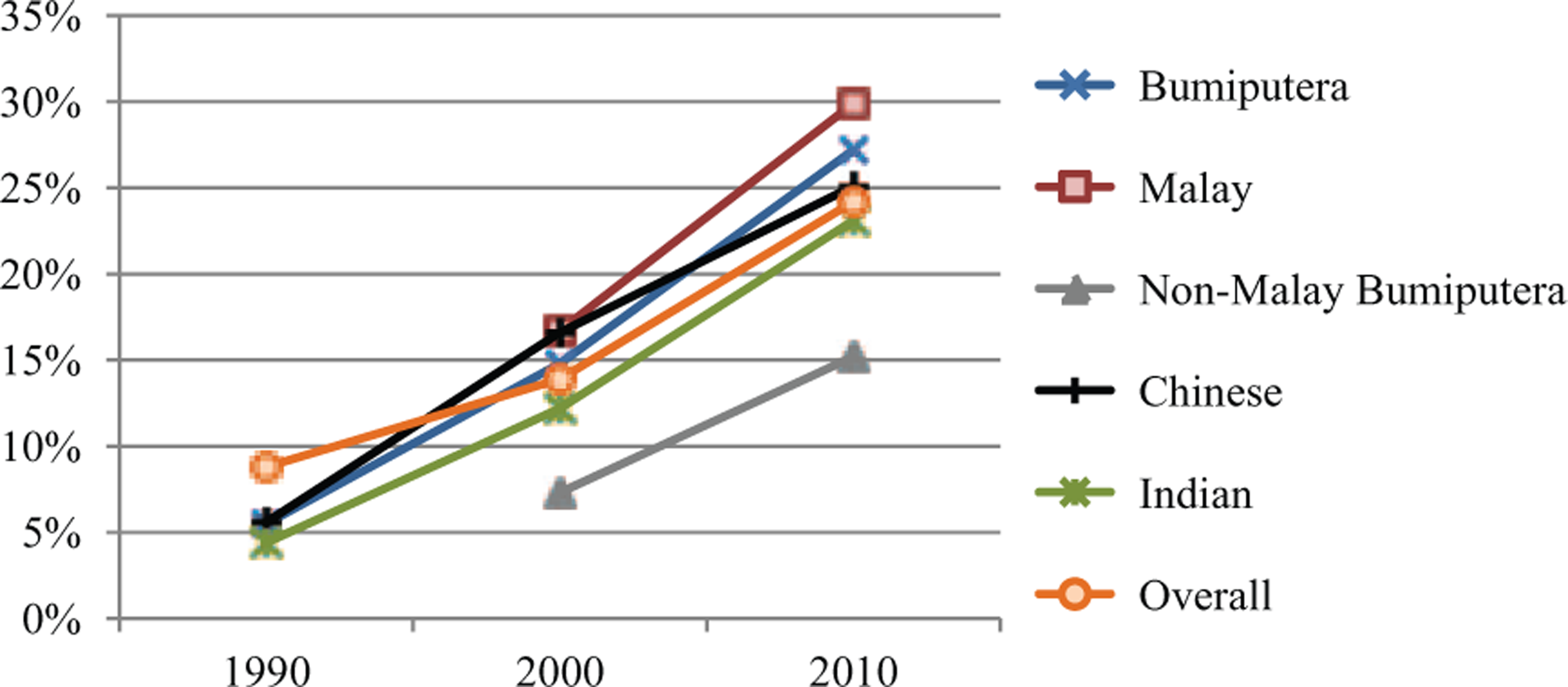
Malaysia: Share of labour force with tertiary education, by ethnic group.
Serious questions about the quality of tertiary education have also arisen in recent years, especially with regard to the increasing concern about graduate unemployment and its disproportionate incidence among Bumiputeras. Census data have shown that Bumiputera graduates, especially of domestic universities, are particularly concentrated in public sector positions, where entry requirements are generally less stringent. Surveys of employers and employees add further insight, indicating that graduates of local, public higher education institutions – from which the vast majority of Bumiputeras graduate – experience greater difficulty in securing employment in occupations commensurate with their qualification (World Bank, 2009).
High level occupations
A few patterns can be seen in Bumiputera representation in high level occupations from 1970 to 2013. Figure 2 presents occupational data derived from labour force surveys and professional association membership registers. It must be noted that the survey classification system changed in 2000, which probably accounts for discrepancies observed before and after that year. Bumiputera entry into professional and technical positions proceeded steadily in the 1970s and 1980s, but slowed down from the 1990s through the 2000s. The flatter slope captures the slowdown in progress. Professional association membership data show that the combined Bumiputera share of registered professionals – who are mostly in the private sector – increased more steeply from 1970 to 1990 and more gradually since then. The dynamics vary across occupations. These data indicate waning momentum of Bumiputera mobility into professional organizations from the 1990s, although in a few categories – in particular, architects, dentists and lawyers – Bumiputera representation has continued to grow steadily. Because tertiary level qualifications and industry standards are prerequisites for such occupations and membership in some organizations, the slowdown in Bumiputera entry may reflect either a lessening preference for professional programs of study, or a declining quality of graduates.
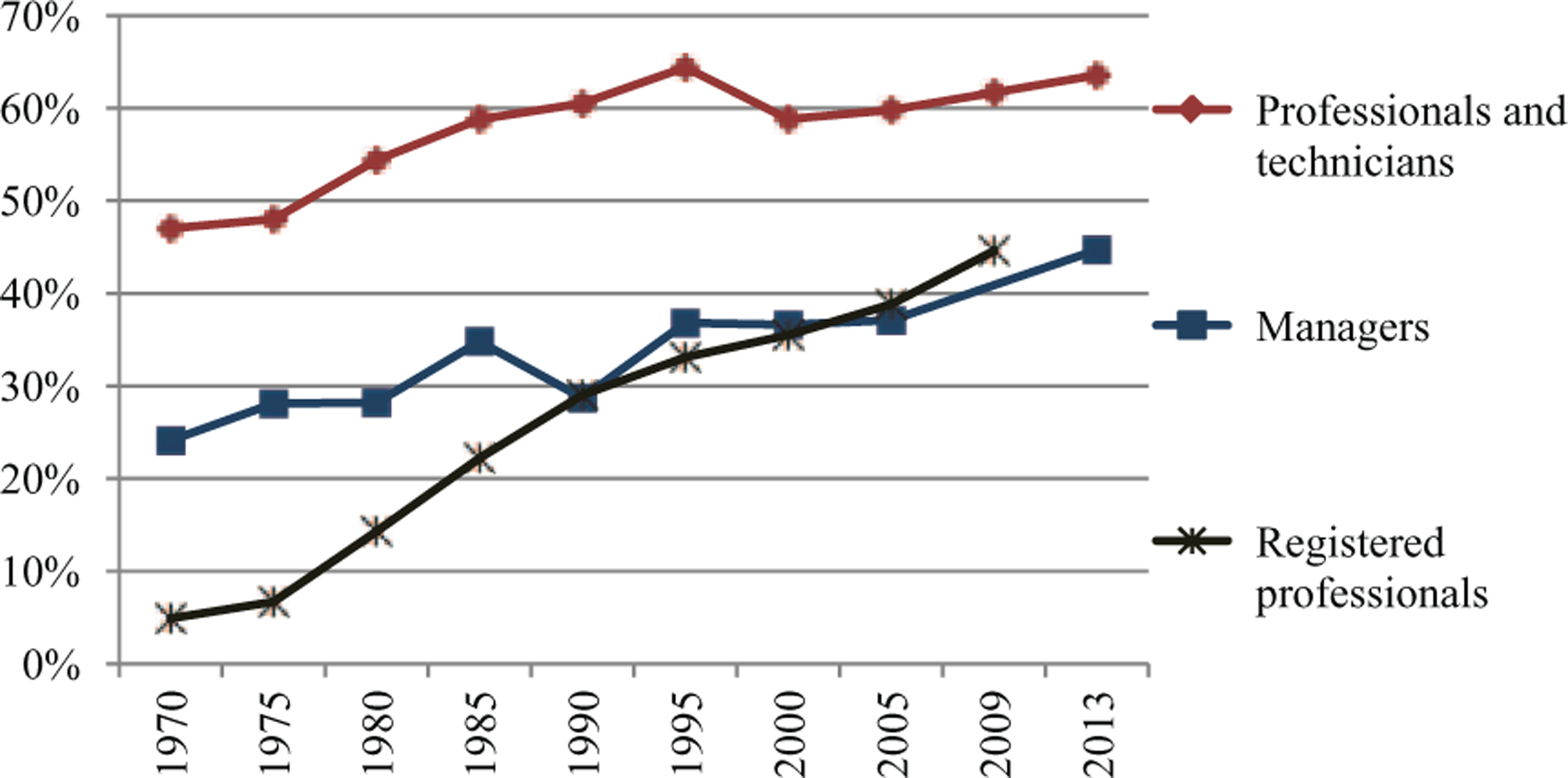
Malaysia: Share of Bumiputera in high level occupations.
Malaysia’s attainment shortfall is greatest in its program of developing an independent Bumiputera Commercial and Industrial Community (BCIC), particularly since the mid-1990s. Prior to that, Bumiputera representation in management had increased gradually, from 1970 to 1995, but remained static over 1995–2000 and 2000–2005. The public sector has played an instrumental role in fostering Malay upward mobility and raising a Malay middle class during and beyond the NEP (Embong, 1996). Recent employment trends reflect a continuing dependence of affirmative action on government employment. In 2005, 52.5% of Bumiputera professionals, compared to about 22.4% of Chinese professionals and 30.8% of Indian professionals, worked as teachers and lecturers, predominantly in government. 5
The development of Bumiputera-owned and operated small and medium scale enterprises remains an area of pronounced shortcoming, particularly in manufacturing activities, where reliance on foreign investment persists. Licensing and procurement have suffered from corruption and weak implementation, while privatization has largely failed, the evidence for which is the mass re-nationalization exercises of the late 1990s after the Asian financial crisis (Tan, 2008). These re-nationalized entities, together with companies controlled by government investment funds, were rebranded as government-linked companies (GLCs) and continue to contribute to the absorption of Bumiputeras into professional and managerial positions. However, the GLCs, accounting for only 3% of the employed population, are limited in their capacity to expand and impact on Bumiputera representation at the national level.
Affirmative action outcomes: South Africa
Tertiary education
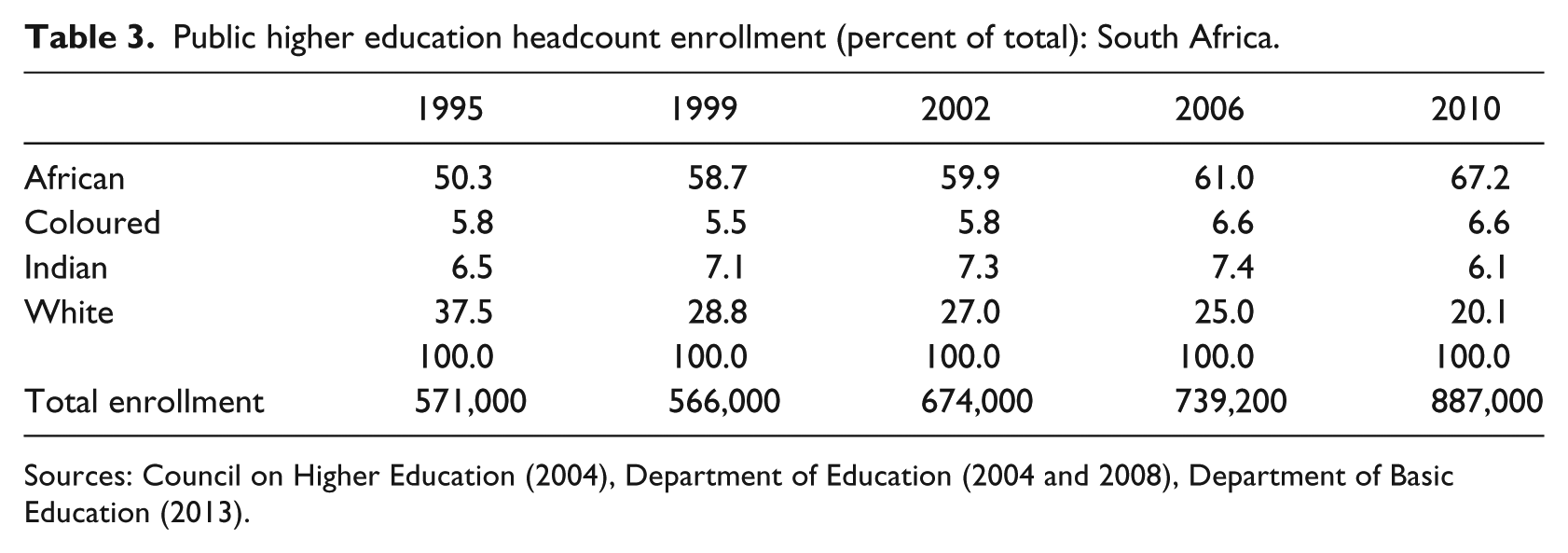
Public higher education enrollment figures reflect expansion of access to blacks (Table 3). The proportion of Africans increased most substantially, although they remain considerably under-represented. White representation declined, although absolute numbers continued to grow, because their access to higher education is sustained in public institutions, albeit with constraints under affirmative action, and is somewhat compensated by growth in private institutions. These developments in educational provision translate into increases in the proportion of blacks in the labour force at secondary school level and above (Figure 3). The findings from analyses of the Labour Force Survey, which is regarded as a reasonably reliable source for examining the demographic composition of the workforce (Bezuidenhout et al., 2008), are reported below. The black share has steadily risen among diploma holders and degree holders in the labour force.
Public higher education headcount enrollment (percent of total): South Africa.
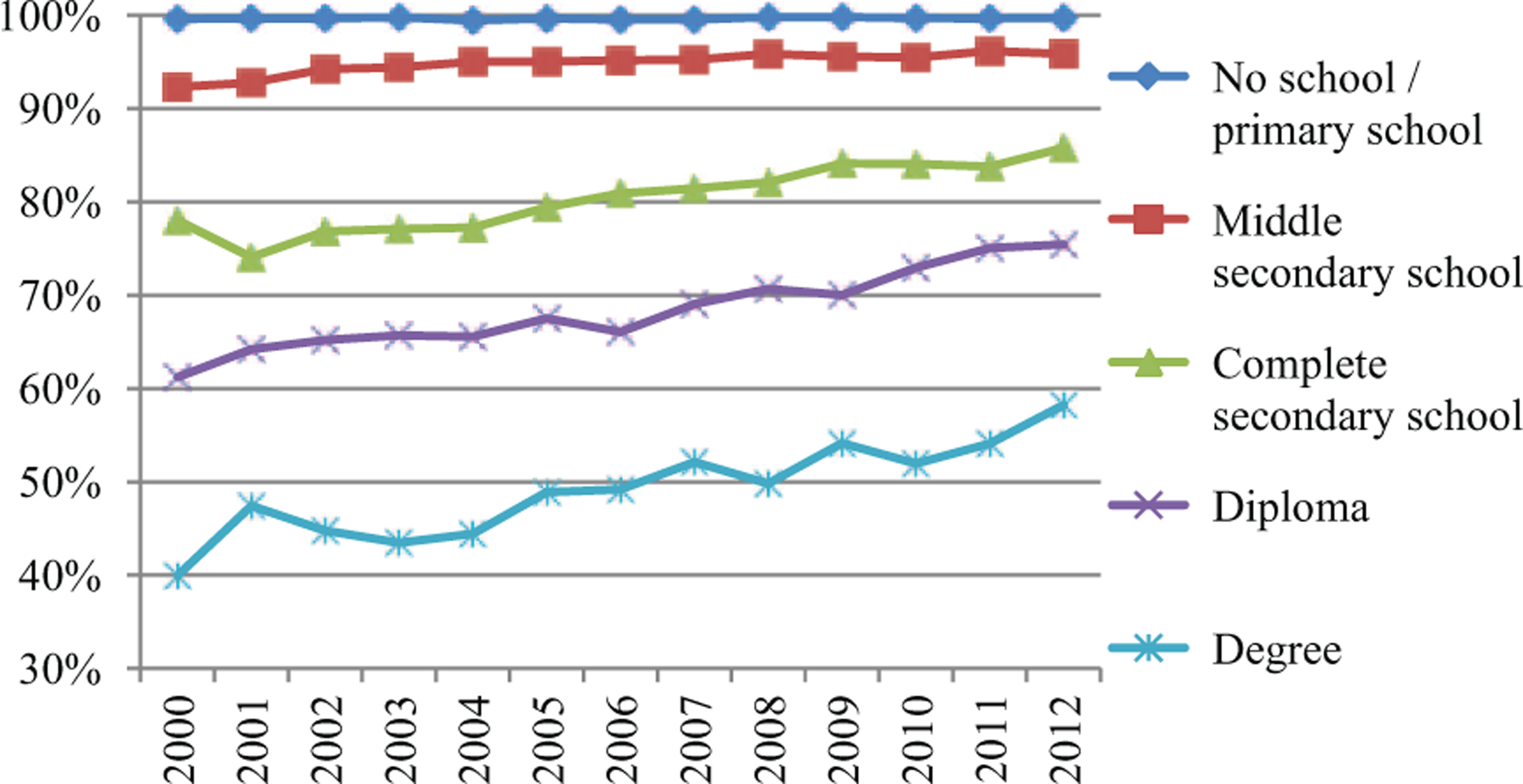
South Africa: Share of blacks in labour force, by education attained.
Unarguably, gaps persist in the quality of education. While the access of the black population to the more prestigious and better equipped HAIs has expanded, large numbers remain enrolled in HDIs. A growing proportion of black students has enrolled in HAIs, and a declining proportion in HDIs. In 1993, 49% of black students enrolled in HDIs and 13% in HAIs; in 2003, 32% were in HDIs and 42% in HAIs (Department of Education (SA), 2005; Ministry of Education (SA), 2001). While South Africa has phased out the HDI/HAI distinction and merged and reorganized various institutions since 2003, we may reasonably argue that the trends above have continued, and that stratification of the education system persists – possibly even intensifies – as ethnically diversifying urban middle and upper classes increasingly enjoy the advantages of being educated in previously white schools and HAIs (Morrow, 2008).
Various forms of ethnic disparity endure, from success rates to distribution across disciplines to completion rates. In 2000, Africans constituted 51% of all graduates, but their proportion varied across study area, from 85% in education, 74% in public administration and 58% in social science, to 39% in business and commerce and 32% in science, engineering and technology (Subotzky, 2003). More recent studies have also found startlingly poor graduation rates among university students, as well as the problems of non-completion and dropping out, particularly among Africans. Fisher and Scott (2011) point out the persistently low tertiary education participation rate in the African as well as Coloured populations, and the continuing disproportionately low numbers of African students in science and technology fields and in research universities. Black students take considerably longer to graduate and are more likely to drop out.
High level occupations
The proportion of blacks gradually increased in the occupations prioritized by affirmative action (Figure 4). The present evaluation of affirmative action in occupational representation also relies on the Labour Force Survey and only includes the formally employed, because the informal economy lies outside the policy’s reach. Subsamples of the nine occupation groups are smaller than those of education categories, entailing some clear outlier effects, notably the over-representation of African managers in 2007. In general, trends are discernible over time. In professional employment, blacks increased their proportion from the 45%–50% range in the early 2000s to 55%–60% a decade later. However, gains in black representation taper from the mid-2000s. A slightly different pattern obtains at managerial level, where the increase in black representation holds steady through the decade.
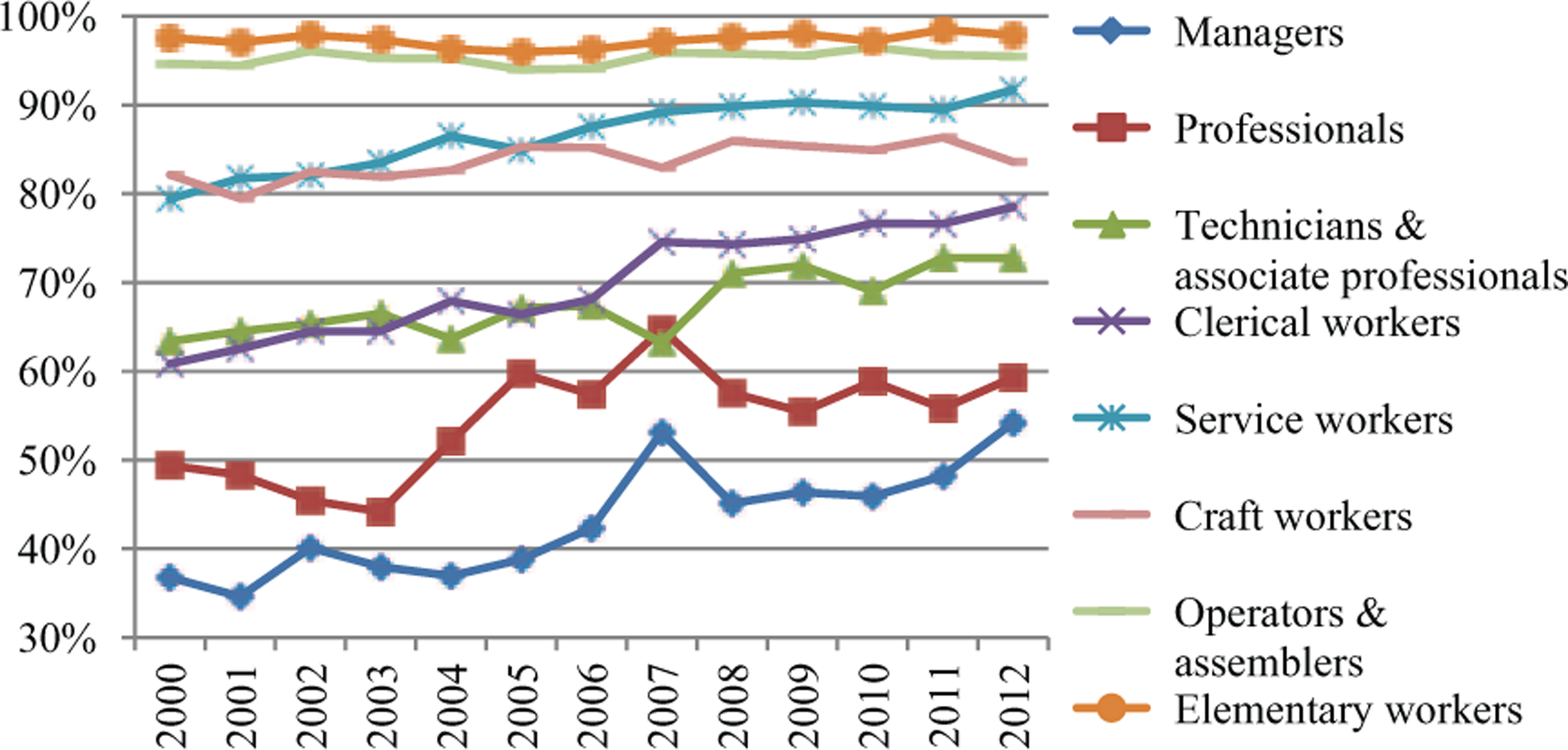
South Africa: Proportion of blacks within occupation groups.
The more sustained increase of the number of blacks among managers compared to professionals is somewhat surprising, given that entry to professional positions follows more sequentially from formal tertiary education, whereas experience, seniority, networks and other cumulative factors influence entry into management. It is plausible that scarcity of skills– lack of capable degree holders, in spite of quantitative increases – has constrained entry of blacks to professional positions. The public sector regularly features unfilled vacancies due to unavailability of qualified personnel, and has reverted in large part to the use of private contractors and consultants. 6 Slow employment growth in the public sector, specifically of teachers, may also account for the low absorption of Africans into professional-level positions. While the total number of professionals in the South African workforce expanded by 2.9% per year for the period 2000 to 2011, the number of teachers in public schools grew by just 1.0% annually over the same interval. 7 Employment equity reports filed with the Commission for Employment Equity (CEE) corroborate the above findings. These data, derived from employer submissions of employment equity reports and not random sampling, need to be received with some circumspection; nonetheless, they serve as a useful supplementary data source. The CEE’s compilations show gradual and steady gains in black representation in management, and uneven results among professionally qualified employees (Department of Labour, 2000, 2006, 2010).
The public sector has evidently facilitated black mobility and entry into managerial and professional positions. Survey reports of graduates have found a high incidence of public sector employment among African graduates. Moleke (2005) reports on a survey, sampling respondents who worked between 1990 and 1998, which found that 76.7% of African graduates secured their first job in the public sector, compared to 39.0% of white graduates. The survey also found major differences between graduates of HAIs and HDIs in the length of time taken to secure a job after graduation and in the share of unemployed (across all academic disciplines), with HDI graduates registering slower transitions into employment.
Labour Force Survey data show higher proportions of managerial and professional blacks working in the public sector – encompassing national, provincial and local government offices and public enterprises – compared to the private sector (Figure 5). 8 In the public sector, blacks constituted a high and increasing proportion of managers, and a steady share of professionals. Notably, black representation increased among private sector managers and professionals, especially the latter. The inclination of blacks, particularly Africans, toward public sector employment derives from various factors, including the concentration of tertiary-qualified blacks in services, especially education, and the greater latitude for enforcement of employment equity in government departments or government-owned entities. As noted above, however, limited expansion in government recruitment, coupled with scarcity of adequately skilled blacks, have probably both constrained the capacity for the public sector to absorb blacks into high level employment. Concurrently, private sector employment has grown in attractiveness, with premiums commanded by black managers and professionals as companies seek to enhance their employment equity profile (SAIRR, 2007).
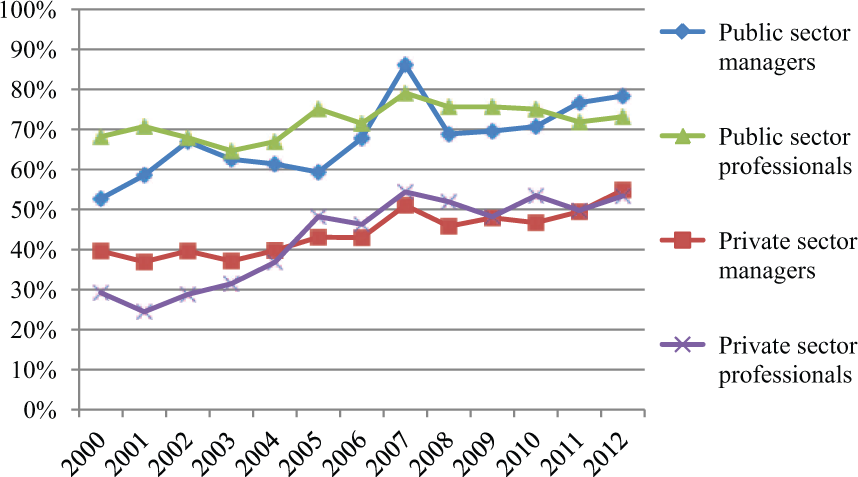
South Africa: Proportion of blacks among managers and professionals, public sector and private sector.
Employment equity mandates and BEE incentives form the backdrop to observed patterns of black representation in the private sector. However, the effects are not immediately traceable. Qualitative data and firm-level studies can add some insight here – and largely reveal limited evidence of active implementation of employment equity. Based on fieldwork interviews with officials and employers, Bezuidenhout et al. (2008) found considerable shortfalls in government capacity to monitor employment equity. Schreuder et al., (2007), surveying compliance with BEE codes and objectives, found generally low levels of engagement in BEE, particularly among small firms, and higher priority attached to equity transfers than employment equity and enterprise development. Other studies confirm the conspicuously slow progress of blacks in establishing and operating small and medium scale enterprises, and continual concentration in human resource or public relations departments, especially in engineering and technical firms (Mohamed and Roberts, 2008).
Literature on affirmative action is sparser over the late 2000s and early 2010s. Companies recurrently come under pressure regarding employment equity, although increasing compliance with filing EE reports does not translate proportionately into higher target setting or increased black representation. LFS data reported above show no marked change in black representation from the late-2000s, when the BEE Codes were promulgated. This is possibly a result of less emphasis being placed on these policies, as skills shortages have become more widely acknowledged and public backlash has surfaced against excessive accumulation of wealth by politically-connected BEE beneficiaries, shifting national development policies toward re-emphasis on employment, skills, and poverty (Economic Development Department (SA), 2010; National Planning Commission (SA), 2012).
Policy implications: comparative synthesis
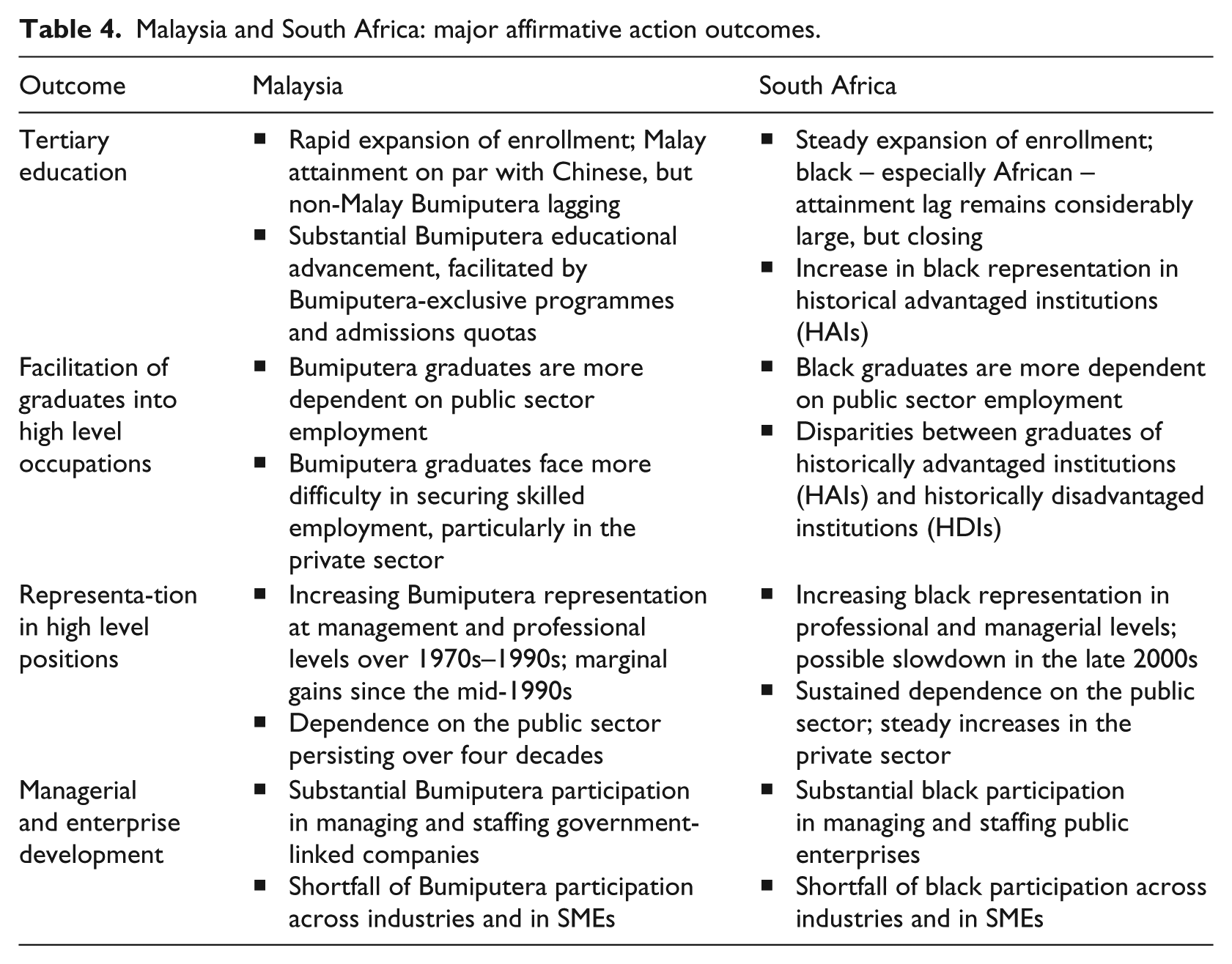
This study has documented substantial quantitative gains under affirmative action programs in Malaysia and South Africa (summarized in Table 4). It has also been observed that the qualitative aspects of tertiary education differentiate graduates’ prospects of upward mobility, and that affirmative action has some adverse side-effects on its beneficiaries. The scope for expansion of tertiary enrollment and mechanisms for redistributing opportunities are respectively broader and simpler, and hence potentially more attainable than in the employment and ownership spheres of intervention, the evidenced for which is the continuous increases in the proportion of graduates in the Bumiputera and black workforces.
Malaysia and South Africa: major affirmative action outcomes.
While affirmative action programs can increase numerical growth in the degree-qualified labour force, they can come at some cost to academic achievement. As discussed in the previous section, Malaysia and South Africa operate contrasting mechanisms for affirmative action which in turn elicit different policy implications. The autonomy safeguarded for South African education institutions and devolution of affirmative action offers constructive insights into managing the dual objective of facilitating equitable representation while maintaining academic standards at the university level, in contrast to the highly centralized and quota-based system in Malaysia. Another confluence of objectives – targeting the neediest within the designated ethnic group – finds its most potent instrument in tertiary education. The assessment of entry into university can take family background into consideration much more than might be expected in the case of hiring or of decisions about promotion. A further challenge concerns the lack of Bumiputera and black enrollment in specialized technical and professional fields, which demonstrates the need for affirmative action to target specific gaps, beyond promoting group representation in general.
The potential for increasing the proportion of blacks where they are under-represented hinges on developments in education, which effectively limits the scope for employment equity legislation or other mandates. Both countries stand to benefit from focusing on building capabilities, through educational achievement and institutional quality, and moderating the pursuit of group representation in high level occupations. Again, country-specific implications arise. Malaysia, without employment equity legislation to compel change in private sector labour markets, depends heavily on the education system to realize this objective. It is argued here that priority should be placed on remedying the deficiencies of Malaysia’s post-secondary system, especially matriculation colleges and preferential university admissions. In South Africa, it is argued that while improvement in the quality of basic schooling must remain a long term priority, currently it is beneficial to incorporate affirmative action in tertiary education into a systematic framework for affirmative action that encompasses education and employment. There has been an unhelpful tendency to view these separately, or to consider affirmative action as confined to employment equity, although employment equity and university admissions both involve ethnic preference and aim to increase representation of a disadvantaged group. This somewhat disjointed perspective has arguably precluded more integrated approaches and restraint in pursuing employment equity – such as benchmarking group representation targets based on the supply of qualified graduates or registered professionals.
Regarding affirmative action in the labour market, this study finds that the public sector plays a prominent role. In Malaysia, this follows directly from the confinement of affirmative action in employment to the public sector. In South Africa, employment equity mandates apply to both the public sector and private sector. Black representation in managerial and professional positions is sustained at higher levels in the public sector, although distinct black upward mobility in the private sector was also observed. Malaysia’s policy has engendered Bumiputera over-representation and diminished non-Bumiputera interest in government jobs. 9 The case can be made for reorienting public sector employment policy towards a more balanced ethnic composition. This could also lay the foundations for initiatives to increase Bumiputera representation outside the public sector. The feasibility and desirability of general hiring mandates are both highly questionable for Malaysia; however, variations of employment equity may be adopted in public procurement and other public-private sector transactions on an incentivized, voluntary basis.
Both the persistent dependence on the public sector for employment of Bumiputera professionals, and South Africa’s slowing rate of increase in black, especially African, representation among professionals, emphasize the importance of graduate quality. Deficiencies in Bumiputera and black graduates curtail progress in both countries in broadening participation in private establishments and across all sectors. Affirmative action is also associated with problems related to administrative competency and public service delivery in Malaysia and South Africa, although these causes are undeniably more complex than ethnic preferential policies.
The implications of affirmative action in the labour market along the lines of South Africa’s employment equity laws warrant critical evaluation. Employment equity is fraught with many difficulties, yet it is hard to envisage market processes redressing group under-representation adequately. Repealing employment equity legislation is foreseeably unviable, in view of majority support – although the subject also remains highly contested and ethnically fractious. 10 Academic and policy attention would thus be more productively directed at effective and prudent implementation, such that it proceeds apace with the availability of capable tertiary-educated workers, particularly in specialized fields. In the same way that affirmative action in tertiary education is constrained by the breadth and capacity of school-leaving cohorts, affirmative action in employment can only effectively proceed apace with the growth of the number of suitably qualified persons in the beneficiary group. In both countries, many of the technical and professional fields with severe under-representation are highly specialized.
South Africa’s employment equity program, arguably its foremost affirmative action sphere, can be fine-tuned. In line with the South African Constitution, employment equity law designates beneficiaries on the basis of socio-economic disadvantage, prohibits unfair discrimination and delegates employment equity planning and target-setting to employers in consultation with workers, laying a more democratic, balanced and adjustable edifice for constructing and modifying policies. In practice, however, various targets for black representation, notably in public sector management, have been exceedingly ambitious and often detached from objective assessment of the supply of suitably qualified black candidates. 11 Employment equity targets tend to outpace the supply of capable graduates, leading to the hiring or promotion of personnel possessing formal qualifications but under-qualified with regard to practical skills . Pressures to accelerate transformation in South Africa must therefore be tempered with the realities of lagging supply of skilled and experienced labour, and with the realization that effectual and sustainable occupational mobility are protracted processes. Legal recourse is constitutionally available for aggrieved parties, although I would argue that it is surely more desirable to avert such contentions and conflicts. Sector-specific targets, corresponding with availability of tertiary qualified candidates, or membership in professional organizations, and supplemented with qualitative, firm-level data, would serve as more suitable reference points for implementing employment equity (Bezuidenhout et al., 2008). Setting more tempered and actionable targets can also give added impetus for increasing the resources for and efficacy of employment equity monitoring and enforcement agencies, whose shortage of capacity has constrained the implementation of employment equity.
The development of a managerial and entrepreneurial class has proved to be acutely difficult among affirmative action efforts in both Malaysia and South Africa. Government-linked companies in Malaysia and public enterprises in South Africa continue to be assigned the tasks of employing and training managers and professionals, and of applying ethnic preference to procurement and contracting decisions. Allocation of government procurement, licensing and contracting are three further instruments for developing managerial capacity. The pitfalls in these schemes can be immense, especially where lucrative contracts and fast windfall profits are at stake, and are compounded by corruption, fronting, rentier behavior, and a dearth of regulatory oversight, major concerns in both countries – notwithstanding South Africa’s formalized and codified BEE framework. Affirmative action in managerial and enterprise development is also inextricably linked to the issue of ownership of capital and wealth, a factor this study has not empirically investigated. However, it is clear that affirmative action in cultivating enterprise must be pursued with caution and restraint, in particular to avert unproductive accumulation of wealth and political patronage (Jomo, 2004; Southall, 2005). Small and medium enterprises offer more sustainable and capability-enhancing pathways for economically empowering Bumiputeras in Malaysia and blacks in South Africa, with less scope for and proclivity towards accumulation of debt, rapid and unproductive transfers of wealth, and passive ownership. Malaysia and South Africa have fallen short in this regard, in terms of policy efficacy and, probably more consequentially, political will to invest in processes that will yield slower gains and probably involve more laborious efforts.
Conclusions
This study has provided an overview of affirmative action and analyzed policy outcomes in Malaysia and South Africa, focusing on the primary objective of increasing representation of a disadvantaged group in particular spheres of socio-economic participation. Policy formation is heavily driven by political imperatives and socio-economic disparities between groups; successful execution is integral to the development paths of both countries. Affirmative action interventions aim to redress difficult and messy conditions; the positive attainments and adverse consequences that arise are similarly complex and mixed. Resolution – the ultimate ideal of affirmative action becoming redundant and hence able to be dismantled – undoubtedly hinges on political, social and economic conditions and settlements, as well as broader socio-economic development, provision of basic education and social services, and uplift of poor communities. Affirmative action must be implemented with a timeline or benchmarks for it to be scaled back, perhaps to be reconstituted as programs promoting ethnic, gender and other forms of diversity (Dupper, 2005).
Institutionalized policies favoring a majority group are seemingly immutable, as demonstrated by Malaysia’s near four decades of implementation and continued ambivalence towards dismantling ethnic preference. However, the perpetuation of programs that have declined in efficacy also emphasizes the imperative of executing affirmative action effectively and of laying out plans for eventual reconstitution or removal. In both Malaysia and South Africa the onus is on affirmative action to consolidate sufficiently the economic security of the beneficiary group, paramount for future political settlements concerning fundamental reforms.
Footnotes
Acknowledgements
This paper draws on the author’s doctoral dissertation completed at the University of Massachusetts, Amherst. The author thanks his supervisors Robert Pollin, Gerald Epstein and James Heintz for their guidance and critical feedback, but implicates none of them for the contents of this paper. Previous versions have been presented at the Eastern Economic Association Conference (New York City, February 2009), the Southern Economic Association Conference (Atlanta, November 2010), the University of Malaya (November 2011), and Waseda University (July 2013).
Declaration of Conflicting Interests
The author(s) declared no potential conflicts of interest with respect to the research, authorship, and/or publication of this article.
Funding
The author(s) disclosed receipt of the following financial support for the research, authorship, and/or publication of this article: Data collection in South Africa in 2007-2008 was funded by a University of Malaya Short Term Research Grant (F0283/2007B) and a Political Economic Research Institute (PERI) Travel Grant. Substantial data updating and paper revisions were conducted while the author was a visiting research scholar at the Japan Center for Economic Research in June-September 2013, under the Nikkei Scholarship program.