






Abstract
The Constitution of Kenya 2010 introduced a framework for devolving public resources in Kenya’s forty-seven Counties. The Counties were given the responsibilities of maintaining health, roads and agriculture, among others. Using the Afrobarometer (2015) survey, we employ probit regression to examine the determinants of successful public participation in the Counties. We find that approval of the Governor’s performance has a positive and significant influence on public participation. However, difficulty among the citizenry in influencing County decision-making; lack of responsive County Assembly Members; difficulty in accessing information on County budgets, legislation and projects; and corruption in the Governor’s office have a negative significance.
Introduction
Public participation is the process of engagement in governance, in which ‘people participate together for deliberation and collective action within an array of interests, institutions and networks, developing civic identity, and involving people in governance processes’ (Cooper, 2005: 534). The importance of public participation cannot be overstated. Its contribution in anchoring democracy is significant because it ensures inclusivity and transparency in the governance process, with citizens and government agencies sharing power among themselves (Arnstein, 1969). It ensures government responsiveness to citizen needs and increases the legitimacy of the government’s decisions and institutions. Further, at the individual level, public participation increases patriotism and trust in public institutions. This in turn increases social inclusiveness and social capital (Raimond, 2001), making public participation a process and not a single stand-alone event.
Article 1(1) of the Constitution of Kenya 2010 (Government of Kenya, 2010) vests all sovereign power in the Kenyan people. This power is to be exercised either directly by the people through public participation or indirectly through their democratically elected representatives. In addition, the Constitution created a decentralized system of government with the primary goal of devolving resources, power and representation to the local level. This led to the creation of forty seven Political and Administrative Counties, where the public would get the opportunity to participate in the governance process; hence citizen participation was made a national value and a principle of public service in Articles 10(2a) and 232(1) of the Constitution.
In the devolved system of government, the County Government Act (Government of Kenya, 2012a), the Public Finance Management Act (Government of Kenya, 2012b), and the Urban Areas and Cities Act (Government of Kenya, 2011) have called for public participation in drafting new legislation, determining budget priorities, ensuring that public-sector performance and expenditures are reviewed and submitting grievances. In addition, County governments have been tasked with ensuring that the public receives information for public participation, setting in place structures and mechanisms and guidelines for public participation, and also providing an annual report on citizen participation to the County Assembly.
Public participation in Kenya’s devolved system of government has had its fair share of challenges, such as limited support from the political class and low levels of civic education (Kenya School of Government, 2015). However, there has been a success story in Makueni County, whose public participation model has been lauded by the World Bank (2016). In its model, the County has been able to have the citizens identify their development priorities at the grassroots level, with the citizens becoming involved in the prioritization, planning and setting of final expenditures for the identified projects. In addition, the County allows citizens to be engaged in the full implementation of these projects.
The main goals of public participation are to inform, engage, consult, collaborate and empower the citizenry through different ways such as, elections, or civil society activities where public input is sought at all stages of policy making. However, the culture in public bureaucracy is not supportive of public engagement, but relies on standard information exchange channels like public hearings (Kathi and Cooper, 2005), which most of the time are one-way and are not oriented towards problem-solving (Baker et al., 2005). Therefore, there is a need to transform that culture and to ensure that citizens are partners and not just clients in the governance process through meaningful public participation.
Why devolution and public participation?
The creation of a decentralized system of governance by the Constitution of Kenya 2010 was meant to ensure that citizens would be empowered through the provision of information and thus engage in the policy-making process on issues affecting their livelihoods. It sought to change the developmental imbalances that had hindered the country’s social and economic development in the past through enhanced transparency, accountability, service delivery, equity and inclusiveness. Article 232(d) has guaranteed the involvement of citizens in the policy-making process, with Article 196(1)(b) calling on the County Assemblies to facilitate public participation. Further, other legal provisions, such as the County Government Act (Government of Kenya, 2012a), the Public Finance Management Act (Government of Kenya, 2012b), and the Urban Areas and Cities Act (Government of Kenya, 2011) have been enacted to ensure that public participation takes place in the devolved units.
The spirit of the Constitution calls for public participation not only to take place but also to be meaningful, so that it can impact the policy-making process. Unfortunately, the presence of legally binding rules for public participation has not translated into meaningful practice. For instance, it has been found that 83% of Kenyans do not know the resources assigned to their County, with only 7% aware of their County’s Fiscal Strategy Paper, 16% aware of the County Integrated Development Plan, and 41% aware of the County’s budget. This dismal performance is related to the finding that only 38% are aware of County meetings and only 15% attend those meetings (Transparency International, 2016). In addition, the Policy on Devolved System of Government (Government of Kenya, 2016) acknowledges that the quality of public participation is low and has not been optimized due to low civic awareness by the citizenry, uncoordinated civic education and challenges in accessing information.
It is evident that most County public participation processes take place as a formality to meet the minimum requirements of the Constitution (Judicial Review Miscellaneous Application 61 of 2014), thereby undermining the legitimacy of the public participation process as envisioned in the Constitution. This practice may lead to a public perception of such meetings as hollow rituals (Adams, 2004). Therefore, if this lack of meaningful public participation persists, the intention of the new Constitution with regard to ensuring that citizens are involved in the governance process through public participation, and the promise it holds, will not be realized. Thus the need arises for an investigation of the determinants of meaningful public participation in Kenya’s devolved units.
Why meaningful public participation?
Ensuring public participation is in line with Article 232(1)(d) of the Kenya Constitution 2010, which provides for citizens’ participation in the decision-making process, and Article 232(1)(f), which calls for transparency through the provision of timely and accurate information to the public. In the same spirit, the Public Finance Management Act 2012, Section 207, calls on the County governments to establish structures, mechanisms and ways to ensure citizen participation. Cognizant of this, the Kenya Vision 2030 seeks an open and participatory political process through increased participation in the country’s economic, social and political decision-making processes, and civic education programmes that are conducted with the purpose of ensuring an informed and active citizenry. Further, the political pillar of Vision 2030 provides for equal citizenship rights and equality of participation in major policy decisions in a bid to create social equity and to offer opportunities to the poor and marginalized so that issues affecting them can be channelled into public policy.
In addition, the political pillar of the Medium Term Plan II seeks ‘a people-centered and politically-engaged open society’ (Government of Kenya, 2013: 107) through enhanced public participation and respect for devolution and the new Constitution. In this regard, this paper contributes to the government’s efforts to ensure that effective public participation occurs at the County level (Policy of Devolved Government, 2016) by investigating the factors that determine meaningful public participation and their level of influence. Moreover, the findings will fill a gap in the literature on public participation in Counties in Kenya.
Literature review
Citizens’ perceived level of influence in public decision-making has been used to describe their level of participation in the government’s decision-making process, with low levels of participation being attributed to a low perception by citizens of their influence in the governance process (Schlozman et al., 2012). According to McComas (2003), citizens’ desire to engage in public participation was associated with their perceptions that their ideas would have some influence on the decision-making process. These finds are consistent with those of Williamson and Scicchitano (2014), whose results showed that citizens would not attend public meetings if their input was not appreciated and was not incorporated into decision-making.
Whiteley (1995) found that individuals’ view of the degree of influence they had in decision-making at group level was associated with how the elected officials viewed their contributions. Elsewhere, Yang and Pandey (2011) observe that the degree of public engagement is associated with the likelihood that the information gathered will have an influence on public decision-making, so bringing about legitimacy in the representative process between the public and the government.
Leighley (1995) criticizes the ‘standard socioeconomic model’ of political participation which emphasizes that a citizen’s socioeconomic status and civic orientation are key predictors of participation. The model posits that an individual with higher socioeconomic status has a much higher likelihood of participation than others. Leighley (1995) critiques this view and argues that it ignores the role that mobilization plays in public participation.
Cooper and Bryer (2007) suggest that, in order to transform the administrative units of government for greater public participation, there is a need for leadership which calls for the orientation of public administrators towards engaging citizens as partners rather than clients and as important stakeholders in the governance process (Handley and Howell-Moroney, 2010).
The adoption of progressive laws has been associated with the adoption of positive policies (Orey et al., 2006): this has been measured by the democratic composition of local legislatures and parties in addition to their responsiveness to citizens’ needs (Daley, 2008). This political culture in turn affects the level of public participation, because cultures that seek to adopt progressive laws have a much higher likelihood of encouraging public engagement (Ebdon, 2000).
Beyle (1968) measured institutional determinants of public participation by examining gubernatorial performance and vested power. He contends that a good institutional indicator of public participation lies in the Governor’s performance and willingness to place certain legislative powers and also support mechanisms that would lead to more and better public participation initiatives in their jurisdictions. Herina (2011) argues that such professionalism on the part of the Governor may lead to professionalism in local institutions and hence to more open public participation.
Ebdon and Franklin (2006) study public participation in the budgetary process and highlight elements that impact the participation process. These elements are: low turnout, a focus on minimum legal requirements, insufficient representation, and participation taking place at the conclusion of the decision-making process. Irvin and Stansbury (2004) also suggest that these elements do threaten the legitimacy of the process. In addition, the study by Ho and Coates (2002) on how performance measurement can be legitimized as a decision tool shows that public input into the budget-making process does provide government officials with important insights and can increase political support for elected officials.
Berry et al. (1993) contend that political culture influences public participation. They find that a strong motivation to achieve successful participation and ensuring that the participation process is devoid of partisan politics bring about a high level of public engagement. Their findings are reinforced by Fagotto and Fung (2009) who note that public participation is successful when those who hold participatory meetings have political authority and use the input to address citizens’ needs through good performance. Further, Nabatchi and Amsler (2014) observe that political culture may be affected by the degree of professionalism of elected officials and citizens’ perception of the government.
To ensure that citizens feel they have an opportunity to contribute to the decision-making process, Gastil (2008) calls for deliberative two-way communication oriented towards problem-solving which ‘aim[s] to arrive at a decision or judgment based on not only facts and data but also values, emotions, and other less technical considerations’ (Gastil, 2005: 164). Such an approach would ensure that every participant had an equal opportunity to speak and listen to the views of other participants. Further, according to Amsler and Speers (2005), meeting conveners should have a communication strategy for assisting attendees and the entire community to understand the process, how they can be involved and the results of their input.
In reference to public meetings and hearings, Adams (2004) observes that the public is never given enough time to air its views and there is no room for dialogue; thus communication becomes a one-way process. In measuring the individual impact of public participation Kihl (1985), analyzed 36 public meetings and hearings on highway proposals, found that frequent participants showed more satisfaction and less frustration than those who did not participate. Further, McComas (2003) studied two public meetings and found that there was a high level of satisfaction among the participants and non-participants if they had high expectations of the meeting, thought that it would provide useful information and open discussions, and saw the conveners as legitimate.
In order to have successful public engagement elected officials, especially local legislators, should be responsive to public needs. McComas (2001) asserts that some government executives see public meetings as a way of ensuring that citizens actively participate in the democratic process, but only if the citizens are informed – for if they are not, they will do more harm than good. These findings are confirmed by Hagelskamp et al. (2013), who suggest that elected officials see the public as being uninformed, disengaged and distrustful, and thus see no need to engage them.
Well-structured deliberative public participation has been shown to produce high-quality engagements, especially in a diverse environment (Black, 2012), thereby reducing problems of marginalization, exclusion and inequality (Sui and Stanisevski, 2012). However, Shapiro (2002) fears that such meetings may lead to group polarization, with one or both groups taking a hardline position. While there is evidence from research on polarization, it is limited to political discussions, and there is no empirical evidence on deliberative public engagement on socioeconomic issues (Collingwood and Reedy, 2012).
Devas and Grant (2003) use a sample of municipal governments in Kenya and Uganda to assess how local decision-making relates to citizen participation and accountability. They found that local governments in Kenya had not involved citizens in decision-making, but that this was changing due to pressure from civil society and the introduction of the Local Authorities Transfer Fund. For Uganda, they found increased citizen participation due to the country’s decentralized system. However, accountability problems persisted.
Mugambi and Theuri (2014) analyse the challenges that County governments in Kenya face during budget preparation. Using Kilifi County as a case study, and employing a descriptive analysis, they found that, although budget procedures were present, public participation in the process was absent. Elsewhere, Muriu (2014) used cross-regional data to assess the impact of citizen participation on service delivery in Kenya. He found that public participation had been lacking and its influence on the decentralized system of government had been negligible.
The Institute of Economic Affairs, Kenya (Oduor et al., 2015), reviewed the status of public participation and the available participation and information frameworks in Kenya’s Counties through a qualitative study of Kisumu, Turkana, Makueni and Isiolo Counties. Using key informant interviews and secondary sources like the Kenyan Constitution to review the legal framework, the study found that Kisumu County had decentralized structures for public participation down to the grassroots level. Public meetings were held quarterly and were organized by members of the County Assembly (MCAs) and the Governor. According to the study, when the MCAs took part in the organization of meetings participants with differing views were excluded, indicating that the MCAs were not responsive to citizens’ needs. The study also found that there was neither a public participation policy nor a civic education structure or policy, the absence of which led to low attendance at the meetings.
With regard to Turkana County, the study noted that public meetings were held on a quarterly basis. The citizens were allowed to pick projects that they thought would benefit them. However, such selections were not binding to the County executive. Thus the citizens’ input did not influence the County’s decision-making process.
In Isiolo County, the public received information on predetermined projects that were to be initiated and thus there was no opportunity for citizens to engage with leaders on projects they felt were meaningful to them. Further, the County had not initiated any mechanisms for civic education.
In its Handbook on Civic Education, Makueni County had operationalized its civic education and public engagement procedures. In addition, a Public Participation Office had been established to ensure that there was coordination and that the public was well informed so that it could participate effectively. Further, the County had trained 990 trainers of trainers on public participation from members of the community, mainly drawn from the religious fraternity, non-governmental organizations (NGOs) and the education sector (especially the Teachers Association Union).
Overview of literature
The literature has highlighted the importance of meaningful public participation. We find that determinants of high-quality and meaningful public participation have been identified as citizen empowerment, political will, access to information, influencing County decision-making, responsive leaders, performance of elected leaders and the adoption of progressive laws associated with the adoption of positive policies.
However, in Kenya the available studies at County level have been descriptive of the current status of public participation, focusing on the structures and frameworks that have been put in place to facilitate citizen engagement. Therefore, this study seeks to bridge a gap in the literature by examining, through a rigorous methodology, the key determinants of public participation and their level of influence in ensuring meaningful or successful public participation at County level.
Methodology
Theoretical framework
The study’s theoretical framework is premised on the Ladder of Public Participation theory, Cognitive Engagement theory and Equity–Fairness theory. The Ladder of Public Participation theory (see Figure 1) advances the proposition that successful and meaningful public participation is determined by the redistribution of power to the public in order for citizens to have a genuine opportunity of influencing the decision-making process (Arnstein, 1969). Cognitive Engagement theory posits that availability of information on government workings and politics and satisfaction with the policy or performance of the political class are associated with meaningful public participation (Anderson, 2003). According to Equity–Fairness theory, trust and social capital associated with responsive leaders are a good indicator of a meaningful public participation (de Tocqueville, 2003 [1835]).

Arnstein’s ladder of citizen participation.
Analytical framework
Meaningful public participation – unlike normal public participation whose sole purpose is to meet minimum legal requirements – calls for citizens to have access to information that is relevant to policy-making, an ability to hold their leaders to account and an influence on the decision-making process, with enhanced transparency and accountability and an assurance that pressing social concerns will be addressed by responsive leaders. Hence when meaningful public participation takes place, the citizens are fully satisfied with it, showing that the process has been successful and has achieved its constitutional objective of impacting the policy-making process.
In this study, we model meaningful participation at the County level as a binary dependent variable whose value is one (1) if there is meaningful public participation, or zero (0) if otherwise. With a binary variable, a probit model is favoured due to the normality of the error term and the properties of normal distribution (Wooldridge, 2012: 586). Hence the study adopts a probit maximum likelihood estimation technique. The outcome that participation is meaningful takes the binary outcome defined as
The probit model assumes that the probability that

where


As the regressors

Econometric model specification
From the above derived analytical framework, we expand equation (1) to estimate our variables of interest (

where
corr_govoff = corruption in the office of the Governor;
c_dm = difficulty in influencing County decisions;
resp_mca = responsive MCA;
perf_mca = performance of the MCA;
perf_gov = performance of the governor;
inf = difficulty in accessing information on County budgets, legislation and project plans;
c_mtg = attendance at County government meetings;
Data sources and definition of variables
This study uses the Afrobarometer (2015) Quality of Democracy and Governance in Kenya survey. The survey had a sample size of 2397, made up of a sample of Kenyan citizens aged 18 or older, with a national sample design. In addition, the survey stratification was Kenya’s 47 counties with the place of residence being both urban and rural.
Dependent variable: meaningful public participation
Using Afrobarometer’s (2015) survey, the study assumes that the dependent variable, overall satisfaction with public participation in the County government, is the best measure for assessing how meaningful public participation has been in Kenya’s counties. The variable is obtained from the Afrobarometer survey question: ‘Overall, how satisfied are you with public participation in the operations of your County government?’ Possible responses were: 1 = not at all satisfied; 2 = not very satisfied; 3 = fairly satisfied; or 4 = very satisfied.
From the responses, we construct a binary dependent variable with the value one (1) representing satisfaction or meaningful participation if the respondent was ‘fairly satisfied’ or ‘very satisfied’. The value zero (0) was assigned to represent lack of satisfaction or meaningful participation if the respondent was ‘not at all satisfied’ or ‘not very satisfied’. Thus the dependent variable reflects the public’s satisfaction with the degree of participation in the County government.
Independent variables
Influencing County decisions
Low levels of public participation have been attributed to a low perception by citizens of the level of influence they can have in the governance process (Schlozman et al., 2012). Citizens have been found not to attend public meetings if they feel that their input is not appreciated or incorporated into the decision-making process (Williamson and Scicchiato, 2014). The Afrobarometer (2015) survey asked, ‘Thinking about public participation as enshrined in the Constitution, how easy or difficult would you say it is to influence County decision-making?’ Possible responses were: 1 = very easy; 2 = easy; 3 = difficult; and 4 = very difficult. Therefore, we hypothesize that
Hₒ: Difficulty in influencing the County decision-making process decreases the likelihood of meaningful public participation.
Responsive members of the County Assembly
For meaningful public engagement to take place, elected officials, notably the locally based legislators who have grassroots networks, should be highly responsive to public needs. Such responsiveness comes from deliberative communication instead of one-way communication. The Afrobarometer (2015) survey asked, ‘How often do local government Councillors listen?’. Possible responses were: 0 = never; 1 = only sometimes; 2 = often; and 3 = always. We therefore hypothesize that
Hₒ: Non-responsive members of the County Assembly decrease the likelihood of meaningful public participation.
Performance of the Governor and members of the County Assembly
In transforming the public administration for more meaningful public participation, there is a need for effective leadership (Cooper and Bryer, 2007) which will engage the citizens as partners and not as clients in the governance process (Handley and Howell-Moroney, 2010). Previous findings have shown that successful public participation takes place when meeting conveners have public authority and can influence the decision-making process. Therefore we use the performance of Governors and MCAs to measure their influence in ensuring meaningful public participation, for they are mandated by the Constitution to undertake this role. The Afrobarometer (2015) survey asked, ‘Do you approve or disapprove of the way the following people have performed their jobs in the past twelve months? Your County Governor, your local government Councillor.’ Possible responses were: 1 = strongly disapprove; 2=disapprove; 3= approve; and 4=strongly approve. Thus from the preceding literature, we hypothesize that
Hₒ: A well-performing Governor increases the likelihood of meaningful public participation.
Hₒ: A well-performing MCA increases the likelihood of meaningful public participation.
Access to information on County budgets, legislation and project plans
County governments have been tasked with ensuring that the public receives ‘information, data, documents and other information relevant or related to policy formulation, implementation and oversight’ (Government of Kenya, 2016: 2), with Article 35 of the Kenyan Constitution guaranteeing to citizens the right to access such information. Further, the County Government Act, Sections 94, 95 and 96, calls on the Counties to establish mechanisms for ensuring that citizens can access information through the use of media channels with the widest public outreach. Thus access to information is crucial in ensuring that meaningful public participation takes place. The Afrobarometer (2015) survey asked, ‘Thinking about public participation as enshrined in the new Constitution, how easy or difficult would you say it is to access information on County budgets, legislation and project plans?’ Possible responses were: 1= very easy; 2 = easy; 3 = difficult; 4 = very difficult.
Hence we hypothesize that
Hₒ: Difficulty in accessing information on County budgets, legislation and projects decreases the likelihood of meaningful public participation.
County meeting attendance
Most if not all County public participation takes place through face-to-face meetings. Thus people who attend such meetings are able to participate and provide their views with the objective of impacting the decision-making process. This variable is drawn from the Afrobarometer (2015) survey, which asked respondents whether they had attended County meetings during the past year. Possible responses were: 0 = no, would never do this; 1 = no, but would do if had the chance; 2 = yes, once or twice; 3 = yes, several times; and 4 = yes, often. We therefore hypothesize that
Hₒ: Attending County meetings increases the likelihood of meaningful public participation
Corruption in the office of the Governor
A corruption-free administration and society means that the public can trust the programmes and processes being implemented and seek to get involved in them in a bid to bring about positive social change. The Afrobarometer (2015) survey solicited respondents’ perceptions of how corrupt the Governor and officials in the Governor’s office were. Possible responses were: 0 = none; 1 = some of them; 2 = most of them; 3 = all of them. Thus we hypothesize that
Hₒ: Corruption in the office of the Governor decreases the likelihood of meaningful public participation.
Results and discussion
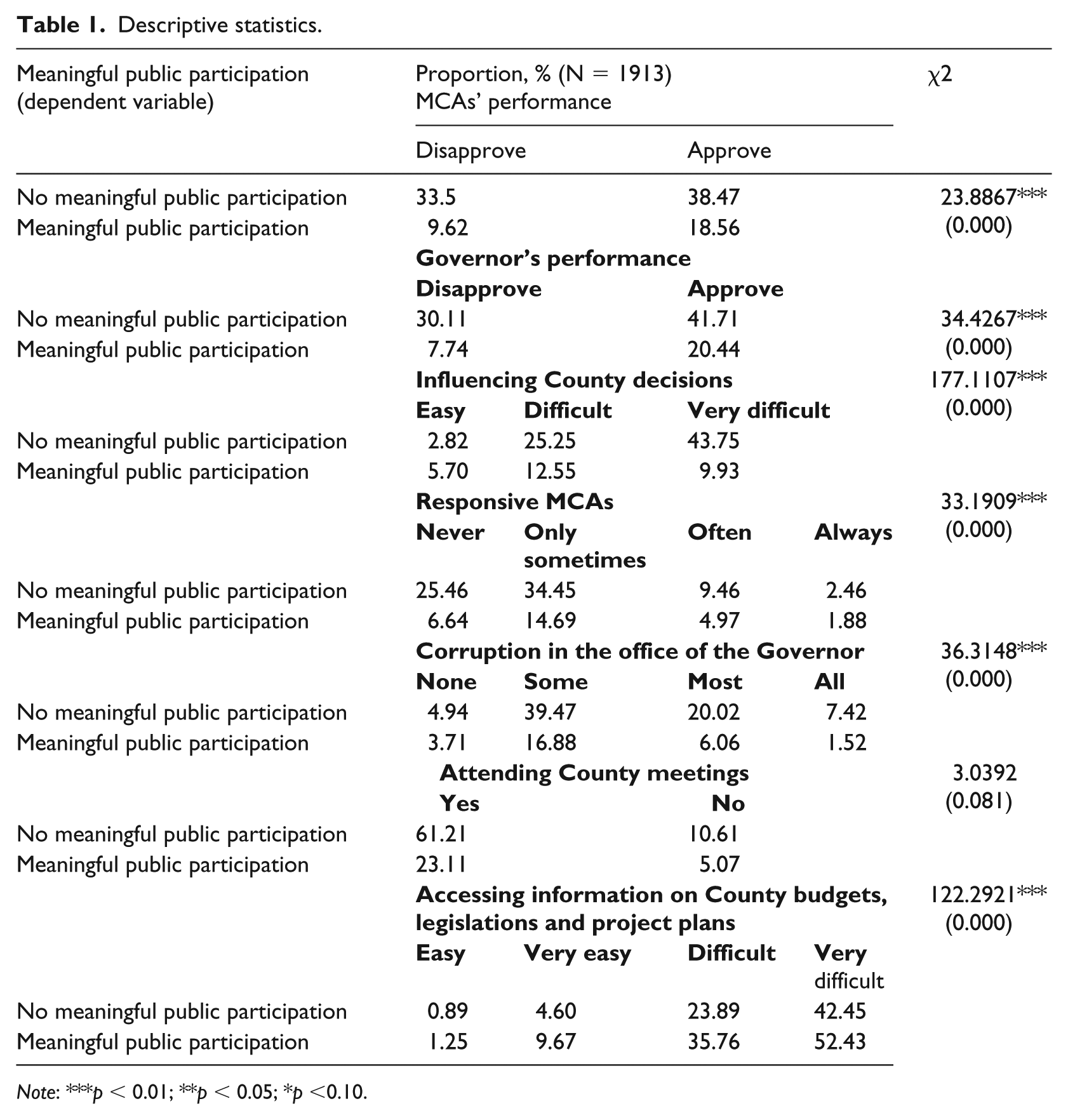
Table 1 presents descriptive statistics of the variables under study, which have 1913 observations. With regard to the performance of the MCAs, of the respondents who had not experienced meaningful public participation, 33.5% disapproved of the MCAs’ performance, while 38.47% approved. Of those who had experienced meaningful public participation, 9.62% disapproved of the MCAs’ performance while 18.56% approved. Further, with regard to the Governor’s performance, of those who had not experienced meaningful public participation, 30.11% disapproved of their performance and 41.71% approved. Of those who had experienced meaningful public participation, 7.74% disapproved, and 20.44% approved of their Governor’s performance. For the test of association, which looked for the presence or lack of a relationship between the dependent variable (meaningful public participation) and the independent variables, we find that meaningful public participation is statistically associated with the MCAs’ performance (χ2(1) = 23.8867 ⩽ 0.05). The same results hold for the Governor’s performance (χ2(1) = 34.4267⩽ 0.05).
Descriptive statistics.
Note: ***p < 0.01; **p < 0.05; *p <0.10.
The descriptive statistics show that, with regard to the respondents’ ability to influence the County decision-making process, of those who had not experienced meaningful public participation, 2.82% found it to be easy, 25.25% difficult and 43.75% very difficult. Of those who had experienced meaningful public engagement, 5.70% found it easy, 12.55% difficult and 9.93% very difficult. The test of association shows strong evidence of association between meaningful public participation and difficulty in influencing the County decision-making process (χ2(2) =177.1107⩽ 0.05).
With regard to the MCAs being responsive to citizens’ needs, of those who had not experienced meaningful public participation, 25.46% reported that the MCAs were never responsive, 34.45% that they were only sometimes responsive, 9.46% that they were often responsive and 2.46% that they were always responsive. Of those who had experienced meaningful public participation, 6.64% reported that the MCAs were never responsive, 14.69% that they were only sometimes responsive, 4.97% that they were often responsive and 1.88% that they were always responsive. The chi-square test result (χ2(3) =33.1909⩽0.05) shows that meaningful public participation and responsive MCAs are statistically associated.
Of the respondents who had not experienced meaningful public participation, 4.94% reported that no staff in the Governor’s office were corrupt, 39.47% that some were corrupt, 20.02% that most were corrupt and 7.42% that all were corrupt. Of those who had experienced meaningful public participation, 3.71% per cent indicated that no staff were corrupt, 16.88% that some were corrupt, 6.06% that most were corrupt and 1.52% that all were corrupt. The test of association (χ2(3) =36.3148⩽ 0.05) showed strong evidence of association between meaningful public participation and corruption in the office of the Governor.
The data also show that of the respondents who had not experienced meaningful public participation, 61.21% attended County meetings and 10.61% did not. Of those who had experienced meaningful public participation, 23.11% attended County meetings, and 5.07% did not. The test of association (χ2(1) =3.0392 ⩾0.05) showed a lack of relationship between meaningful public participation and the attending of County meetings.
Lastly, in relation to accessing information on County budgets, legislations and project plans, of those who had not experienced meaningful public participation, 0.89% found it easy, 4.60% very easy, 23.89% difficult, and 42.45% very difficult. Of those who had experienced meaningful public participation, 1.25% found it easy, 9.67% very easy, 35.76% difficult and 52.43% very difficult. Through the chi-square test (χ2(3) =122.2921⩽0.05) we infer that there is strong evidence of association between meaningful public participation and access to information on County budgets, legislations and project plans.
Regression results for determinants of meaningful public participation
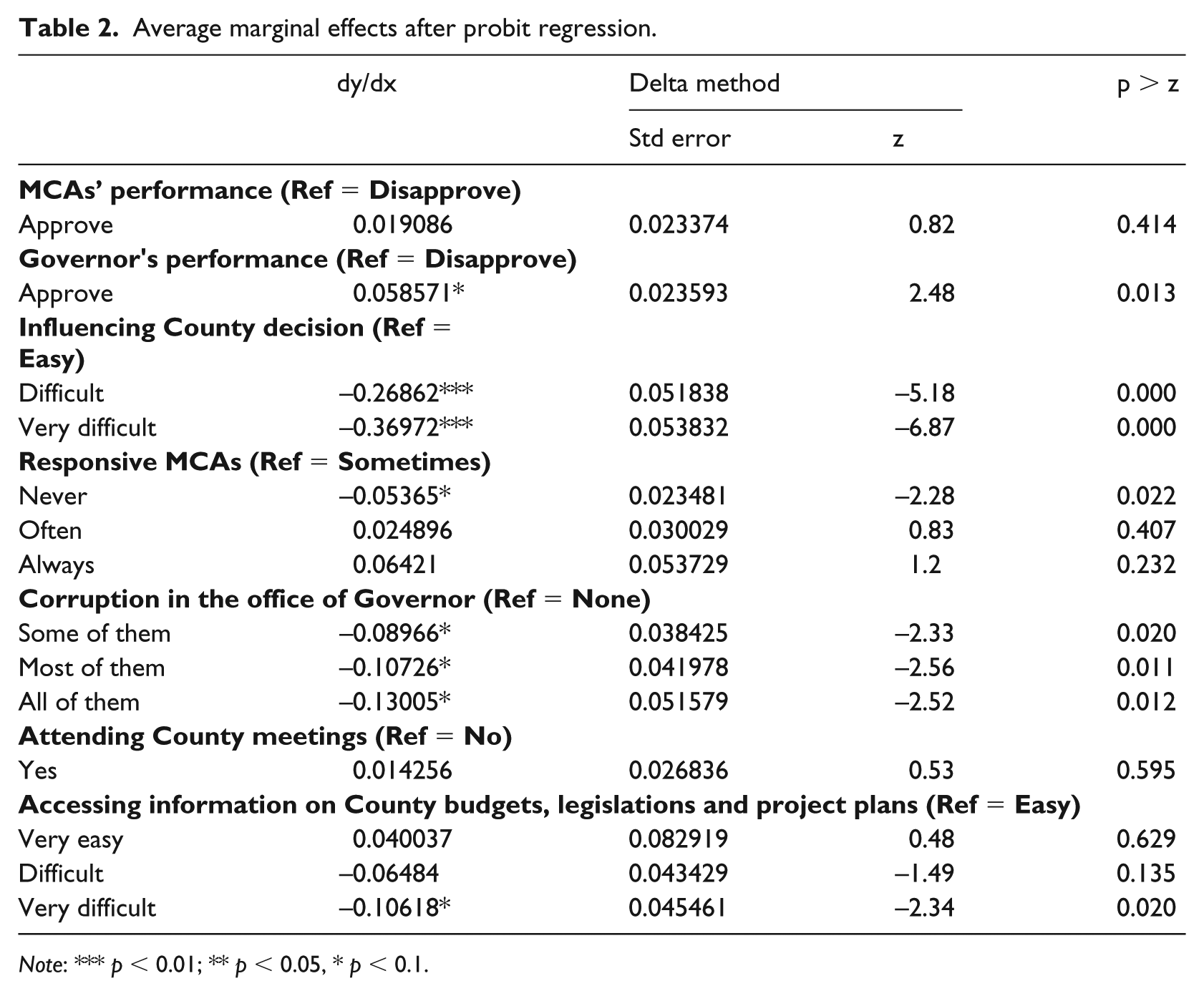
Table 2 presents the results regarding the marginal effects of the political determinants of public participation in Kenya’s Counties.
Average marginal effects after probit regression.
Note: *** p < 0.01; ** p < 0.05, * p < 0.1.
Influencing County decision-making
Compared to those who find it easy, for citizens who find it difficult or very difficult to influence the County decision-making process the probability of having meaningful public participation decreases by 26.8% and 36.9%, respectively. Thus we fail to reject the null hypothesis and assert that difficulty in influencing County decision-making does decrease the likelihood of meaningful public participation. This finding conforms to the literature (Williamson and Scicchiato, 2014) which finds that citizens do not want to participate in activities when their input is not appreciated or used to solve societal problems.
Responsive members of the County Assembly
From the regression results, when MCAs are never responsive to citizen needs, compared to when they are sometimes responsive, the probability of meaningful public participation decreases by 5.3%. We therefore fail to reject the null hypothesis and conclude that non-responsive MCAs decrease the probability of meaningful public participation. A logical explanation for this finding may relate to the extent of their grassroots connections and mobilization ability, which are important factors in public participation and there may be a detrimental effect if they are not effectively exploited through deliberative rather than one-way communication.
Governor’s performance
Hypothetically, the Governor’s performance is associated with the outcome and success of a public participation process. Considering the average marginal effects of the Governor’s performance in Table 2, when citizens approve of the Governor’s performance, compared to when they disapprove of it, the probability of meaningful public participation increases by 5.8%. Hence we fail to reject the null hypothesis and affirm that a well-performing governor increases the likelihood of meaningful public participation. This finding conforms to the literature which argues that for meaningful public participation to take place there needs to be good leadership, which in turn brings legitimacy to the process.
Transparency in the office of the Governor
From the regression results, it can be inferred that, when some of the officials in the Governor’s office are perceived to be corrupt, they reduce the probability of meaningful participation by 8.9%; when most of them are perceived as corrupt, the probability is reduced by 10.7% and when all are perceived as corrupt it falls by 13%. Therefore, we fail to find enough evidence to reject the null hypothesis and affirm that a corrupt Governor and County officials decrease the likelihood of meaningful public participation. This conforms to the literature: a corruption-free administration is trusted and public engagement is successful if citizens trust that their input will be positively used for the good of their society.
Accessing information on County budgets, legislation and project plans
For meaningful public participation to take place, citizens must have access to appropriate information and they are guaranteed the right to access such information by Article 35 of the Kenyan Constitution. From the regression results, when it is very difficult to access information on County budgets, legislation and project plans, compared to when it is easy, the likelihood of meaningful public participation decreases by 10.6%. Thus we reject the null hypothesis and assert that difficulty in accessing information on County budgets, legislation and projects decreases the likelihood of meaningful public participation.
MCAs’ performance and attendance at County meetings
From the results, the performance of MCAs and attendance at County meetings have an insignificant influence on meaningful public participation. This can be attributed to the public’s focus on the performance of the Governor, whom they perceive to wield most of the power in the County. In addition, attending County meetings may be insignificant if such meetings do not fully involve the public, and are regarded only as a formality to meet the minimum Constitutional requirements, with the citizens treated as clients rather than partners.
Conclusions
To achieve the goal of a decentralized system of government as envisioned in the Constitution of Kenya 2010, the empowering of citizens by allowing them to participate in decision-making requires a public participation process that is meaningful and not one whose sole purpose is to meet the minimal Constitutional and legal requirements. Such meaningful public engagement will redress the developmental imbalances that have hindered the country’s social and economic development and will usher in an era of transparency, accountability, enhanced service delivery, equity and inclusiveness.
This study has empirically explored the determinants of meaningful public participation in Kenya’s Counties. Employing the Afrobarometer (2015) Quality of Democracy and Governance in Kenya survey, the study found out that: difficulty in influencing the County decision-making process decreases the likelihood of meaningful public participation; difficulty in accessing information on County budgets, legislation and projects decreases the likelihood of meaningful public participation; MCAs’ non-responsiveness decreases meaningful public participation; a well-performing Governor increases the likelihood of meaningful public participation; and corruption in the office of the Governor reduces the likelihood of meaningful public participation in the Counties. MCAs’ performance and attendance at County meetings have an insignificant influence on meaningful public participation. Therefore, these findings highlight the need for policies that will address the gap between meeting the minimum legal requirements of public participation and achieving meaningful participation that reflects the spirit of the new Constitution.
Policy recommendations
The findings of the study give rise to the following policy recommendations.
County executives should organize public participation meetings in a way that allows deliberative communication that is two-way and oriented towards problem-solving, as opposed to meetings that are restricted to the answering of questions and at which the organizers give no room for dialogue. This change of tack will allow citizens to influence the decision-making process and will make them partners and not clients in the governance process.
Information on County budgets, legislation and project plans should be made easily available to the public. This can be achieved by operationalizing the Public Participation Guidelines (Government of Kenya, 2016), which call on Counties to ensure that citizens have access to information that is relevant and related to the oversight and policy-making process of the County. In addition, Counties should meet the requirements of the County Government Act, Sections 94, 95 and 96, by ensuring that media outlets with wide public outreach are used for information dissemination. Further, for those citizens who do not have sufficient knowledge to understand the complexities of such information, civic education should be conducted to ensure that their Constitutional right of access to information that affects their livelihood is not denied.
The Governor should continue to take a leading role in public participation to legitimize the process and increase citizens’ confidence in it. Further, the Governor should ensure transparency and accountability by implementing findings of the Office of Auditor General, as corruption negatively impacts meaningful public participation.
Future research
Public participation will benefit greatly from the spread of digital technologies. Further investigation and understanding of the determinants of meaningful public participation in the devolved units in Kenya through the use of digital technologies will therefore provide a valuable perspective, especially with regard to those people who do not find time to attend County meetings. This additional research will provide a clear direction for policies intended to respond to the spirit of the Constitution of Kenya 2010, and to bring about a ‘people-centered and politically-engaged open society’ (Government of Kenya, 2013: 107). Therefore, future research should employ a new dataset that captures the digital technology determinants not addressed in this study.
Footnotes
Funding
The author(s) received no financial support for the research, authorship, and/or publication of this article.