







Abstract
We draw from the meaning-making practices on the margins, the communicative repertoires of the multilingual and multicultural students at two Southern African universities: the University of Zambia in Lusaka, Zambia; and the University of Malawi in Zomba, Malawi. As our locus, we are interested in the unique linguistic/semiotic coinages which constitute the students’ linguistic repertoires as multilingual innovations amenable to placemaking. In an attempt to do this, we purposefully unearth lexical innovations which we analyse within the broader framework of translanguaging. Thus, we show the emergence of (new) lexical items through the (re-)invention and disinvention of communicative resources, and the deployment of material artefacts of place as a basis for the creativity and innovation through repurposing of lexical items for new uses. Thus, we privilege students as active manipulators of their communicative practices by showing the semiotic/linguistic creativity and innovation inherent in their repertoires.
Introduction
To argue for lexical creativity and innovation as translanguaged-induced communicative practices, we draw from the meaning-making practices on the margins, the communicative repertoires of the multilingual and multicultural students at two Southern African Universities that is, the University of Zambia (UNZA) in Lusaka, Zambia (Southern-Central Africa) and the University of Malawi (UNIMA) in Zomba, Malawi (Southeastern Africa). As our locus, we are interested in the unique linguistic/semiotic coinages which constitute the students’ linguistic repertoires. While studies on multilingualism abound both in Zambia and Malawi, we note with interest the dearth in the literature on the linguistic/semiotic coinages and innovations constituting the linguistic repertoires of students on university landscapes. This entails that students’ meaning-making practices have received less or little attention (cf. Simungala, 2020; Simungala and Jimaima, 2020). This (re)presents a research gap as the lexical innovations are unique communicative features disinvented through the on-going creative and innovative “processes of enregisterment, the process whereby speech practices become consolidated as repertoires of socially recognized register of forms” (Stroud and Mpendukana, 2009: 364), and therefore forming a linguistic cultural group within the university.
This paper is organized as follows: the upcoming section provides a context for the study by highlighting the multilingual nature of the landscapes of the two campuses under study; this is followed by an explanation of conceptual and theoretical matters; thereafter, materials and methods are presented followed by a simultaneous presentation and discussion of the data; and a summary and conclusion drawn from the study are presented in the last section.
Contextualizing the multilingual and multicultural spaces of the UNZA and the UNIMA
The UNZA is a public university located in Lusaka, Zambia – a landlocked country in Southern Africa. Established in 1965, UNZA is Zambia’s largest and oldest public learning institution. As a premier university in the country, UNZA draws, for its student populace from multiple dispersed localities of Zambia, which in turn leads to multilingual and multicultural student demographics. The students belong to well over 72 ethnic groups representing between 15 and 20 distinct (non-mutually intelligible) language groupings (Jimaima, 2016; Jimaima et al., 2019; Simungala, 2020; Spitulnik, 1998). The English language is Zambia’s national official language with seven other indigenous languages legislated as regional languages in Zambia’s 10 provinces (Banda and Jimaima, 2017; Jimaima and Banda, 2019a). Bemba is the regional language for the Copperbelt, Luapula, Northern and some parts of Muchinga and Central provinces; Nyanja is designated for Lusaka and Eastern provinces while Tonga for the Southern province and parts of Central province; and Lozi for the Western province and Lunda, Kaonde and Luvale for the North-Western province (Jimaima and Simungala, 2019; Simungala, 2020).
The UNIMA is a public university in Malawi (Southeastern Africa) established in 1965 and composed of four constituent colleges located in Zomba, Blantyre, and Lilongwe. Of the four colleges, Chaputula and Boadi (2010) report that the largest is Chancellor College in Zomba. Like UNZA, UNIMA is composed of multicultural and multiethnic students drawn from across the country, but also enrolls students of other nationalities at both undergraduate and postgraduate levels. Therefore, the campus is linguistically heterogeneous owing to the multilingual reality in Malawi, which has approximately 16 Malawian languages with numerous dialects being spoken within the country (Kayambazinthu, 1998). This makes the country multilingual and multiethnic with 10 tribal groups that use Chichewa as a lingua franca (Kamwendo, 2016; Kayambazinthu, 1995). As in most African countries, Malawi is characterized by a form of multilingualism in which there is an asymmetrical co-existence of English, the official language, and Chichewa, the national language.
As noted already, the sociolinguistic reality described in the two universities orients towards Fishman’s sociolinguistics template of diglossia in which one observes the asymmetrical co-occupancy of local languages and English in the local language for informal and formal communicative practices. What this means is that the universities are alive to and benefit from sensibilities of spatialization in which English is the centre code for all formalities – administration and medium of instruction – while local languages form part of the de-centred repertoires. However, as will become apparent in the discussion, the conflation of English and local languages on the multilingual landscapes of these two universities gives rise to “creole-like” forms which we have referred to, in this study, as semiotic disinventions. Our understanding of these creations fits the recognition that multilingualism is always implicated by “power and authority, friction and freedom of mobility, turbulence and the violence of marginalization, and to the varieties of semiotic modes of representation and practice in which these dynamics become manifest” (Stroud, 2014: 2).
As has been observed in the scholarship about multilingualism, the conflation of multiple languages may almost always result in hybridity (Mambwe, 2014), creating what Homi Bhabha calls “the third space” (cf. Milani and Jonsson, 2012: 59). And we take that “third space” to mean multilingual margins of student self-reflexivity and lexical creativity by which multilingual tokens of hybridity are constructed in a translanguaged-induced linguistic environment. Like Milani (2014: 12), we concede to the fact that “linguistic hybridity is not the debris formed from the cross-fertilisation of ‘pure’ elements”; nor is it overly inferior and marginal. Rather, outcome lexis of translanguaging and code-mixing are legitimate in their own right, usually forming what Nkolola-Wakumelo (2010) called “a hybrid sociolect of identity” in describing the language of “call-boys” and “minibus conductors” in Zambia. In their introduction to the inaugural issue of Multilingual Margins: A Journal of Multilingualism from the Periphery, the Editors, Christopher Stroud and Quentin Williams reveal that they sought to deal with populations of speakers on the margins exploring issues of self-reflexivity, language ideologies, mobility, and spatialization. The notion of margins was looked upon from the perspective in which it could be strategically employed as unsettling vantage points through which to re-read existing sociolinguistic research on “non-normative” linguistic practices (cf. Milani, 2014). This perspective gave life to thinking about how understudied groups such as students on university campuses can contribute to a paradigmatic shift of thinking about language, society, ethics, and the mind. This is seen in how for instance, as used in this undertaking, the human agency gives rise to aspects of creativity and innovations constructed on the margins of university campuses.
Towards a conceptual view of lexical innovations and translanguaging
Linguistic innovations, also known as lexical innovations are closely tied to language change (Wei, 2020) and the creation of new lexical items or patterns in a language (Arndt-Lappe et al., 2018). Often, the acquisition and development of new lexical items is through diverse processes. For instance, writing on Cameroon English, Bobda (1994) details how various kinds of loans from French, Pidgin English, and indigenous languages make up the language through processes such as semantic extension and shift, derivation by prefixation, suffixation, conversion, and back derivation among others. In the same connection, Sornig (1981) shows how lexical innovations in slangs have their origins from the activation and revitalization of existing morphological forms and manipulation of lexical material. In this undertaking, we refer to lexical innovation as semiotic disinvention arising from communicative practices built on multilingualism to account for a variety of resources from different languages that make up the coined lexical items. Makoni and Pennycook (2007) support this view when they refer to this as alternative ways of understanding language through strategies of disinvention and reconstitution. From this point of view, they argue, all languages (including the communicative repertoires of students) are social constructions, artefacts analogous to other constructions such as time. Thus, the full appreciation of the role of multilingual practices in semiotic disinvention is predicated on the understanding that mobility, mixing, political dynamics and historical embedding are now central concerns in the study of languages, language groups, and communication (Blommaert and Rampton, 2011).
Multilingual innovations are couched within the overarching framework of translanguaging. This is purely because rather than possessing two or more autonomous language systems (Makoni and Pennycook, 2007), as has been traditionally thought, bilinguals, multilinguals, and indeed, all users of language, select and deploy particular features of language from a unitary linguistic repertoire to make meaning and to negotiate particular communicative contexts (Vogel and García, 2017). Translanguaging acknowledges the fact that communication is multimodal because it relies on the convergence of multiple modes of linguistic and semiotic materialities (Kress, 2010). Translanguaging then is the deployment of a speaker’s full linguistic repertoire without regard for watchful adherence to the socially and politically defined boundaries of named (and usually national) languages (Namatama and Jimaima, 2020; Simungala and Jimaima, 2021a). This will become apparent as we shall show how the innovations draw upon a variety of resources from multiple languages, as well as from other semiotic resources through creativity for purposes of meaning-making. For García and Wei (2014: 40), “all translanguaging is multimodal” and signal a “trans-semiotic system with many meaning-making signs, primarily linguistic ones that combine to make up a person’s semiotic repertoire”. As a result of the foregoing, language should be seen as a social practice, an integrated social and spatial activity that has been disinvested into multiple discursive modalities (Heller, 2007; Makoni and Pennycook, 2007; Pennycook, 2010).
It is further acknowledged that translanguaging foregrounds repertoires as a more productive communicative resource amenable to use in spaces of the late modern age. Consequently, there is a growing recognition of the need to conceive of social actors’ communicative and representative abilities as repertoires (Banda and Bellononjengele, 2010; Pennycook, 2010) as it informs what ought to be perceived as a normative practice. In this regard, Blommaert and Backus (2013) have offered some very illuminating light, a nexus between language and communication, by fore-fronting the idea that the real “languages” we have and can deploy in social life are biographically assembled patchworks of functionally distributed communicative resources and skills known as repertoires. In this regard, Mufwene (2010) points to new forms of individual and societal multilingualism produced by globalization and the need to conceive of speakers’ repertoires dynamically. Thus, as we argue for semiotic innovations arising from multilingualism, we predicate our understanding of the notion within the broader framework of translanguaging with its attendant concepts such as repertoires.
The data
The present paper started out as an extract, a part of a big research project which aimed at exploring the linguistic landscape of UNZA from a social semiotic perspective. This study employed an ethnographic research design in order to capture the sociolinguistic situation of UNZA, as well as the multiple modalities for meaning-making (Simungala, 2020; Simungala and Jimaima, 2020). Thus, the study purposefully sampled a graduate class of 16 students (eight females and eight males) of which consent for the undertaking was granted. Of particular interest were the lexical innovations which were mostly noted during causal conversations lectures, academic group discussions over a period of six months. This was made possible by the fact that one of the researchers was a graduate student at the time. Beyond what the researcher gathered, the respondents came up with word lists of the lexical innovations which the researchers then used to compile a list presented in the sections that follow. In trying to broaden the study, the researchers partnered with another postgraduate student at UNIMA. Seeing as the motivation for the study was already explained, the postgraduate student, a co-researcher at UNIMA did not need months to observe the language practices as she simply used recall, as well as introspection and consulted six other respondents (two males and four females). She then compiled a word list as UNIMA lexical innovations.
Thus, data collection was purposefully done as the words collected were only those relating to semiotic disinventions arising from the multilingual communicative practices. In this way, in addition to diachronic dimensions, we took a synchronic approach by understanding multilingual innovations based on the communicative practices of the moment. Therefore, the study was qualitative and relied on narrative, discourse, and content investigations (Denzin and Lincoln, 1994). This approach is well supported by Chilala and Jimaima (2020) who advance that qualitative methodology avails much as it goes beyond a mere taxonomic representation of the data to an in-depth synthesis of each data set in its own right (cf. Nkhata and Jimaima, 2020). As noted above, some of the data were collected through recall and introspection by the researchers who were postgraduates at the time. However, the write-up for the paper only started after the two researchers had graduated so they had to further engage current students: a total of five students (two at UNZA and three at UNIMA). The current students of the two universities were interviewed to provide insights into the terms currently in use. The involvement of the current students was therefore done to see more new innovations and advancement by the students. This was especially because new terms are always being (re)created.
(Re-)inventing and disinventing communicative resources
In Table 1, data pertaining to semiotic re-invention and disinvention are presented.
Terms relating to year of study at the University of Zambia (UNZA) and Chanco.
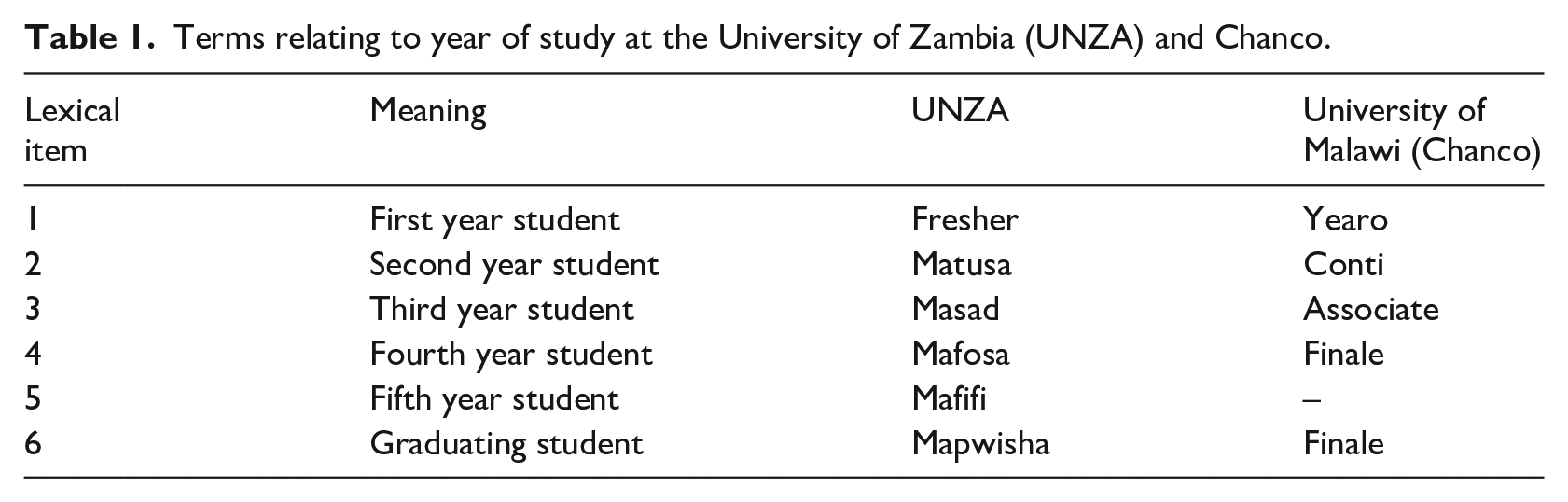
Table 1 shows the lexical innovations by students in the two universities used to name students from their first year to final year. At UNIMA-Chanco, a first-year student is called a “yearo” while at UNZA they are called “fresher” for singular or “bafresher” for plural. It is important to show the workings of student lexical creativity giving rise to both “yearo” and “fresher”, respectively. The term “fresha” can be traced back to “freshman” or indeed “fresher”, an informal term used for first-year students, especially in universities and colleges in the United States and Britain, respectively. In the disinvention of “fresha” from “freshman” (or “fresher”) – a compound word – it can be observed that one of the roots of the word “fresh” has been retained while the other – (“man”) or in the case of “fresher” the agentive marker “er” has been replaced with a vowel ending – “a”. The outcome lexis seems to orient towards the process of agentive nominalization built on a local vowel ending – “a”, which is seen to be accomplishing two morphological requirements: localization; and nominalization. With respect to localization, the vowel ending – “a” responds to the phonotactic requirements which force all Zambian local languages to end in an open syllable. In particular, this is the case when students deploy Nyanja and Bemba, the two widely spoken lingua-francas (Jimaima and Banda, 2021). Mwansa (2017) explains that in fact, it is these language-specific factors such as the phonological and morphological features that influenced the design of orthographies in Zambian languages. We will provide more insights on phonotactic requirements as we account for the syllable structure. Thus, for nominalization, we note that the vowel ending succeeds in turning the adjective “freshman” into a noun “fresha”. In some instances, the British form “fresher” is used instead. The lexical innovation only becomes apparent in the plural form of the word: “bafresher” instead of “freshers”. As discussed later, the prefix “ba” corresponds to two syntactic functions in Bantu linguistics: as a marker of plurality; and as marker of the noun class two. In this case, through innovation and creativity, “fresha” (fresh-a) or “bafresher” (ba-fresher/-a) is a disinvented choice of a noun from the adjective used to name the first-year students at UNZA within this closed student socioculture.
For Chanco, the debate on the creation of “yearo” is not conclusive as it is held that the word is derived from the English word “year” and “one” or “year” and “zero”. In the case of “yearo” as coming from “year one”, we notice the possible lexical formation process of blending and clipping applied sequentially. The phrasal configuration “year one” undergoes a major semiotic operation in which “one” of “year one” is clipped and the remaining morphological material “o” is affixed to the word “year” through the process of blending, hence creating the adjective “yearo”. With regards to “yearo” as derived from “year zero”, the name is used to typify the first-year student’s level of knowledge acquisition being zero. In this way, it can be argued that “yearo” has the stem “year” through which the students locally (re)create it and assign new meaning by affixing “o” to it. Thus, what was once an adjective is now taken as a noun. The convergence of meaning-making resources from several sources entails that the terms “yearo” and “fresha” have been (re-)invented and disinvented. This shows that creativity and innovation are highly at play as students (re)shape and (re)create their means for meaning-making.
As shown in Table 1, the UNZA term for a second-year student is “matusa” while Chanco identifies them as “conti”. In the coinage of the word “matusa”, which can be analysed as “ma-tusa”, we notice that the noun stem “-tusa” which is the noun stem and placed in the penultimate position, is constructed on the semiotics of onomatopoeia of the English digit “2” in the phrase “year two”. To understand this innovation, we draw on the fact that all translanguaging is multimodal, in which word creation and the meaning thereof draw on sounds made in the production of morphemes in a particular language system. The creativity is further evident from the accompanying morphemes “ma” and “-a”. In the case of “ma”, we notice the use of the noun class 1 prefix to denote person. The morpheme “-a” is functioning as vowel ending, creating a typical nominal Bantu template of consonant–vowel–consonant–vowel (cf. Van de Velde, 2020). Thus, owing to the sound of the penultimate syllable in the noun stem which, as pointed out above is an onomatopoeiac of the English word “two” of the phrase “year two”, we argue that these disinvented lexical items are characteristic of multilingualism as the localized English “two” “2” is built around morphemes from local languages. However, the outcome lexical item “matusa” cannot be attributed or equated to any local language as there is no such word in any of the local languages. Similarly, at Chanco, a second-year student is referred to as “conti”, which implies that one has completed the first year of study and they are “continuing” to their second year of study. In this way, the word continuation is truncated as “conti”, forming a new lexical item. As shown with the lexical innovation of “matusa”, similar internal structures exist up to the fifth year of study. Notice that for all lexical innovations to name students in each year of study at UNZA, the prefix “ma” in the word-initial position is affixed to the noun stem; “tusa” for second-year students seen in “matusa”, “sad” for third-year students seen in “masad”, “fosa” for fourth-year students seen in “mafosa”, and “fifi” for fifth-year students seen in “mafifi”. The prefix “ma” is therefore serving two binary functions – concord and plural marking – which are common features yielded in Bantu languages generally (Bryan, 2017; Taraldsen et al., 2018) and Zambian languages particularly (cf. Banda, 2020).
At Chanco, all the terms for each year of study appear to have been recreated from the English language. The terms in Table 1 are in their singular form; they refer to one student. So as noted above, a first-year student at Chanco is a “yearo”, a second-year student is a “conti”, a third-year student is an “associate” and a fourth-year student is a “finale”. When these terms are used to refer to a class of students of a certain year, the Chichewa plural morpheme “ma” is attached to the beginning of the terms. For example, first-year students are called “mayearo” in which case the lexical item is (re)created through what we call semiotic disinvention predicated on multilingualism as both Chichewa and English morphemes are present in one word. The same is true for second-year students who are called “maconti”, third-year students who are called “maassociate”, and fourth-year students who are called “mafinale”. Just like the semiotic disinventions at UNZA, the prefix “ma” in all innovations at Chanco attempts to uphold the syntactic concord for number as the prefix “ma” signals plurality in Chichewa nouns. Arguably, its attachment to the coined words is in response to the requirement for localization of near-Anglo-Saxon lexical items such as “conti” to make “maconti”, giving rise to what could be called “multilingual blends”.
What has been observed in the two universities is students’ ability to exploit the existing multilingual situation for a systematic communicative practice built on lexical innovation and creativity. Arguably, the convergence of multiple semiotic resources in one environment affords social actors in that space to curve for themselves newer tokens for communication and meaning-making practices predicated on a shared sociocultural knowledge and historical background. At this point, being mindful of Kress’ (2010) social semiotic theory in which meaning is subject to individual orientation and the shared sociocultural knowledge and history of the social actors, we wish to underscore the centrality of multiculturalism and multilingualism to the meaning-making enterprise of students. It is compelling to refer to semiotic disinventions such as “maconti”, “matusa”, “mafifi”, etc. as multilingual blends and not mere lexical innovations, given that at both Chanco and UNZA, a number of known languages are involved in the creative enterprise of these words. In the next section, we discuss some peculiarities of multilingual blends (innovations) at UNZA.
Lexical innovation through material artefacts of place
In Table 2 we discuss features of semiotic disinvention peculiar to UNZA multilingual spaces. We notice that some of the created terms bear the abbreviation of the university: UNZA. We wish to argue that the creativity and innovation behind these coinages draw on some material artefacts from within the spaces of the university for meaning-making arising from a shared sociocultural orientation (Kress and Van Leeuwen, 2006; Simungala and Jimaima, 2021a).
Terms bearing on the University of Zambia (UNZA).
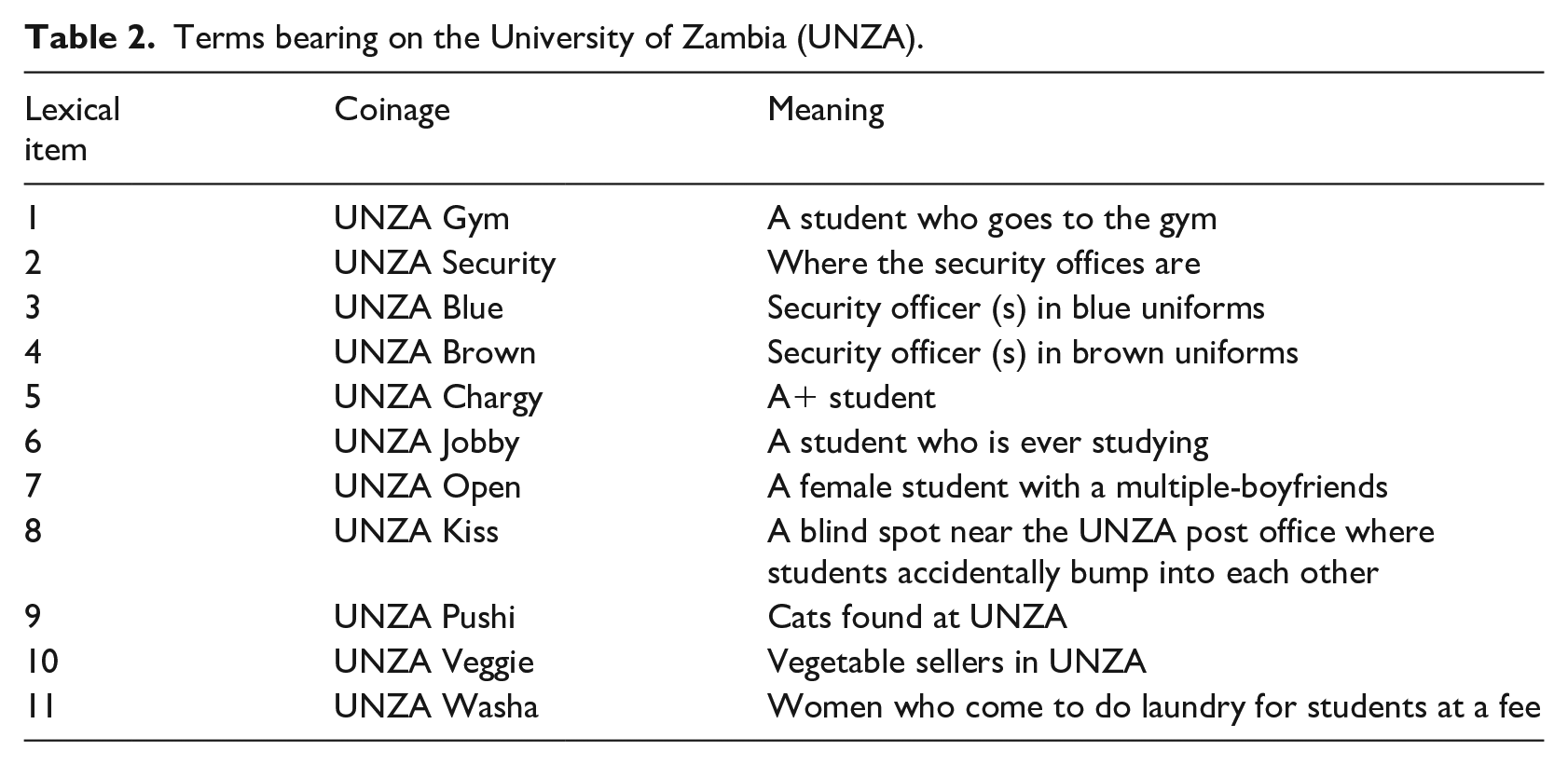
In Table 2, consider the coinages “UNZA Blue” and “UNZA Brown”, among others. “UNZA Blue” is a lexical innovation used in reference to security officers clad in blue uniforms who keep vigil around campus – the security’s attire becomes the artefact that is assembled and drawn upon in constructing their name, identity and profession within the university. “UNZA Brown” equally refers to security officers clad in brown uniforms only seen during sessional examinations while executing duties of invigilation. “UNZA Brown” like “UNZA Blue”, was innovatively coined using the colour of the attire in which the colour scheme becomes an active semiotic canvas for semiotic remediation and repurposing for dynamic uses. In this way, colour is now used to foreground and identify security officers and their functionality on UNZA campuses. Thus, from these examples in Table 1, we see that the abbreviation “UNZA” is attached to the material artefact and deployed for students’ meaning-making instances.
Further to the innovation and creativity seen above, it is interesting to note that ‘cats’ are referred to as “UNZA Pushi” by drawing on a Bemba word “pushi” for a cat. The use of resources from indigenous languages attests to their vitality and productivity beyond their legislated environs. Consider also “UNZA Washa”, in which an urbanized form of “wash”, “washa” used in Bemba, Tonga and/or Nyanja is seen. This term has been coined in reference to the women who visit halls of residences doing student laundry at a small fee. Consider also “UNZA Kiss” which refers to a material and physical space located near the UNZA Post Office which is a blind spot, an outlet leading to the new halls of student residences. The term “UNZA Kiss” emerges out of the social actions in this space where, as a result of being a blind spot, unsuspecting social actors would often bump into each other to the point of almost kissing if the social actors are of the seemingly same height. As a result of these happenings, this space has been semiotically disinvented as “UNZA Kiss” (cf. Shevwanti, 2017). The addition of “UNZA” becomes a peculiar feature as the material artefact of place and is used to refer to “belonging to”, “found at” and “originating from” the spaces of the university. It would appear that an unwritten rule, one which is socially and culturally construed in these spaces is adhered to in the constant semiotic construction or coinage of the said terms, entailing that particular words/phrases ought to have the abbreviation “UNZA” attached.
The repurposed lexical innovation
We now take to semiotic remediation as repurposing to draw attention to the diverse ways that students’ coinages are re-represented and reused across modes, media, and chains of activity (Banda and Jimaima, 2015; Bolter and Grusin, 2000; Simungala and Jimaima, 2021b) as seen from Table 3. We begin with the term “Berlin Wall”, a term used to refer to the two wardrobes normally placed by students to partition a room into two in the halls of residences. This term has been transported from global spaces and replicated in meaning and use in a local space. This is because the use of Berlin Wall ascertains the domestication of global emblems through repurposing. The Encyclopedia Britannica historicizes that the Berlin Wall was a barrier made of a series of concrete walls (up to 15 feet (5 metres] high) that were topped with barbed wire. These walls surrounded West Berlin and prevented access to it from East Berlin and adjacent areas of East Germany between 1961 and 1989. Thus, the term Berlin Wall has been semiotically mediated to resonate with the wardrobes that are in the middle of rooms dividing the two-bed spaces so that each social actor can assume ownership of their space. The term Berlin Wall has been repurposed, resemiotized, and semiotically mediated in the creation of a new meaning-making instance as it has acquired new meanings.
Repurposed terminologies.
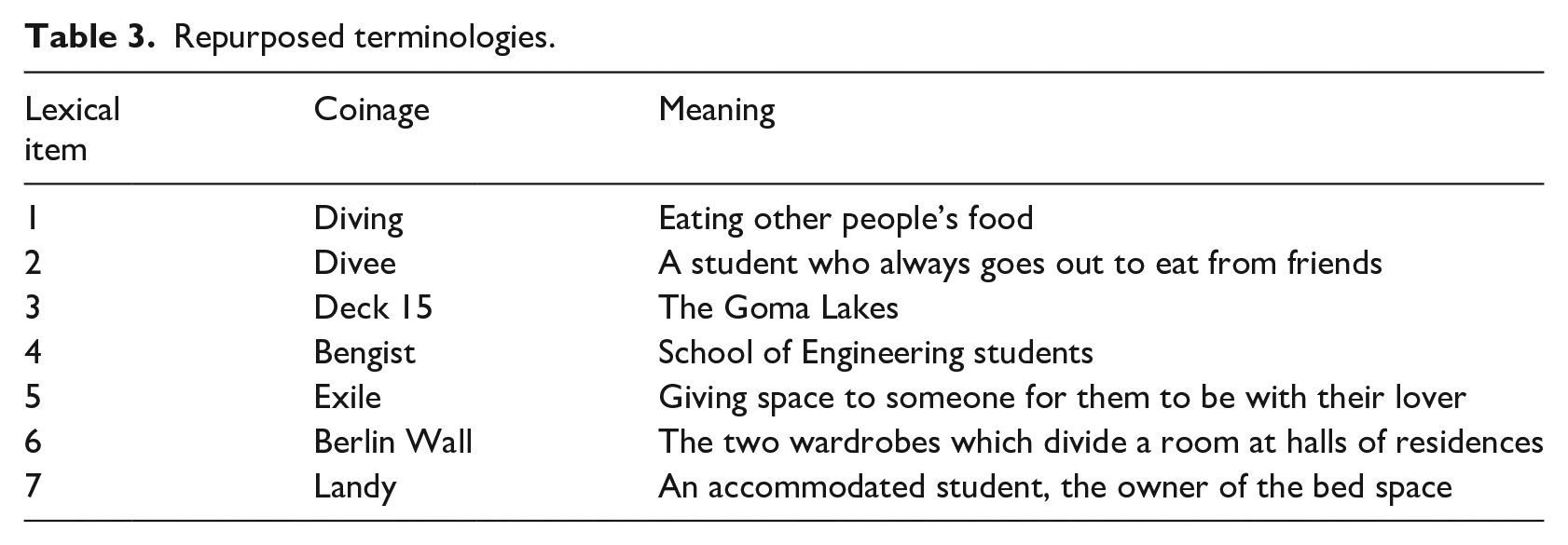
From Table 3, attention is drawn to lexical item number 5. When a student says they are in exile, the student means that for a considerable time, mostly for a night, a student should not go back to their room as the owner of the bed space, called a “landy” (landlord), is with their lover. Here we can appreciate that both UNZA and Chanco use the same term “exile” for the same meaning. The meaning of “exile” and how it has been repurposed is the same at both universities. This suggests that there are similarities in how students in institutions of higher learning create and recreate resources for meaning-making. The term “exile”, despite being an English word, is used with local languages present (Chichewa, Bemba, Nyanja, etc.) and it is understood to mean what it means. Note that the term “landy” is another multilingual innovation of the students. The basic understanding of the term can be captured under translanguaging as mainstream English language would deny this creativity, labelling it a diversion from the norm. This innovation is through truncation (-lord) and insertion (y) as word-formation processes.
As Table 4 illustrates, the term “peri” refers to anyone who is not a student of Chanco or has never studied at Chanco. The coinage is traceable from the English word “peripheral” which refers to the outer area. In this case, the word was coined after truncation and repurposed to refer to the outer area of the university. And since this is an institution of higher learning, the focus is on the students. So the word does not merely refer to the people outside this institution but rather to students who are not students of Chanco or those who have never studied at Chanco. The coinage “mafrus” is another case that undergoes the clipping process. It comes from the English word “frustrations”. In its coinage, however, “mafrus” blends with the Chichewa plural prefix “ma” and the clipped morpheme from the English word “frus”. The same is seen of the word “mayo” which is a blend of the Chichewa plural marking morphemes “ma” and “yo”. Just like UNZA, this illustrates how students blend the two languages into one innovative coinage.
English induced coinages at Chanco.
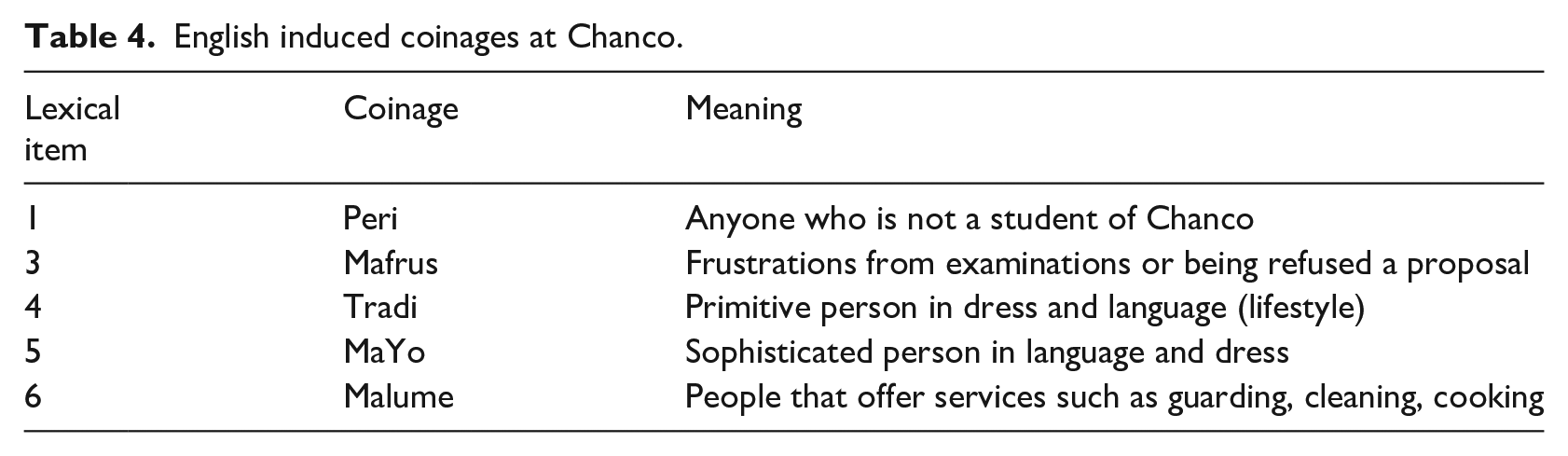
The term “malume” translated as “uncle” in English is a case of recontextualization at Chanco. In its ordinary usage in an African cultural setting, the term refers to the brother of one’s father or mother or the husband of one’s aunt. However, at Chanco, the term is decontextualized and repurposed to refer to male caretakers (these are social actors who work on campus in various places such as the cafeteria, the dormitories, as guards, and even cleaning around the university). This can be seen as a way of respect and not merely referring to an elder person since some of the people who work in these places are younger than some of the students at the university. But clearly, this is not a new phenomenon since the term “malume” is used as a sign of respect/deference to an older person in other African contexts, for example, among the Zulu and Xhosa.
Summary and conclusion
The study has presented a detailed analysis of the innovations inherent in students’ multilingual repertoires at UNZA and Chanco. It has shown how students draw on a variety of languages through truncated bits and pieces of different semiotic resources to bring into the spotlight creativity in one junction of meaning-making. While some innovations are entirely new, having been innovated as a blend, clipping and/or truncation of morphemes, others are as a result of repurposing, where a word, activity, or process from everyday usage of a language is picked and (re)-mediated and deployed anew to serve a different function. Thus, the study has shown, how multilingual innovations, can potentially be redeployed for new uses and for extended meaning potentials. Beyond mere repurposing, some lexical items are often reshaped and recreated. The (re)shaping and (re)creating of language shows that semiotic disinvention is both a local and social practice (Heller, 2007; Makoni and Pennycook, 2007; Pennycook, 2010) which does not subscribe to boundedness and immobility (Blommaert, 2010). This has happened for both terms already in local spaces or even global emblems. This shows that language is indeed fluid and that terms can acquire new meanings in various contexts (Jimaima and Banda, 2019b). Through decontextualization and recontextualization, students are able to shift meaning to a meaning that they can associate with and this is passed down orally to new students.
The study has equally highlighted the tolerance of multilingualism as multiple languages are drawn upon in the construction of lexical items. This has been evidenced through several lexical items which have shown that for UNZA, English, Bemba and Nyanja seem to have a greater influence (cf. Jimaima and Banda, 2019b; Simungala and Jimaima, 2020). However, it should be pointed out that this does not stop other languages from equally being productive. For Chanco on the other hand, the study has shown how English co-existing with Chichewa as official and national languages have been favoured over the other indigenous languages available in the country. These two languages have been adopted and used for a much longer time such that they are common and familiar – it is not a wonder to see that even the innovations and coinages that the students make centre around these two languages and not the rest of the local indigenous languages. The productive use of indigenous languages alongside English not only shows a cultural heritage of the students, but it also demonstrates a linguistic and semiotic innovation and creativity. Since it cannot be traced as to who actually came up with individual terms used in these spaces, the findings indicate that a close oral tradition is present in these institutions of higher learning.
Footnotes
Funding
The authors received no financial support for the research, authorship, and/or publication of this article.
