







Abstract
The influence of succession on organisational sustainability has been widely acknowledged globally, but studies focusing specifically on farms remain relatively limited. This article examines the factors influencing succession in the newly occupied farms under the fast track land reform programme in Zimbabwe and their implications for the sustainability of the land reform programme. The study followed a qualitative multi-case research design. Data were collected using a combination of unstructured interviews, informal discussions, lived experience narrations and direct observations. Notwithstanding other structural and institutional constraints, the absence of succession arrangements and the politics of survival have been found to be the major threats to sustainability.
Introduction
The land question has been a dominant feature of the political and economic dynamics of resource distribution and utilisation in the Zimbabwean history. In the context of the fast track land reform programme (FTLRP), this article examines the factors influencing succession in the newly resettled farms in general and their implications for a sustainable land reform programme in particular. The critical role played by leadership succession in influencing the long-term sustainability of organisations, especially small-scale enterprises, is widely acknowledged. An organisation’s long-term stability, survival and growth require founders to look beyond their tenure by developing conditions for smooth succession (Chrisman et al., 2003; Irefin and Hammand, 2012; Maunganidze, 2011). In this article, founders refer to the initial plot holders or beneficiaries of the FTLRP following the year 2000 land invasions. The article advances the argument that while there is, on the part of some resettled farmers, some form of succession planning taking place, overall the practice has often been neglected for various reasons relating to cultural and political legitimacy.
Globally, a few studies focusing on the intergenerational transfer of family-farms have been conducted in countries such as Austria (Korzensky, 2019), England, France and Canada (Errington, 1998, 2002), Pennsylvania (Pitts et al., 2009) and Italy (Corsi, 2009). These authors concur that although succession planning was vital for farm survival, many founders failed to take appropriate action. In the African context, studies have been conducted particularly in South Africa following the country’s attainment of political independence (Cousins, 2000; De Villiers, 2003). Although land reform in South Africa generally sought to reverse the apartheid-induced land ownership disparities, it also sought to prevent any possible post-settlement failure (De Villiers, 2003: 42). Another challenge was its poor implementation and lack of protection of farm workers’ and dwellers’ rights (Binswanger-Mkhize, 2014: 262) and that of the victims of land dispossessions during the apartheid era (Ramutsindela and Mogashoa, 2013: 314). The South African land reform programme was on-going and highly contentious with issues of succession and sustainability likely to be of concern for some time.
In the Zimbabwean context, although literature has long revered the significant role played by the land reform programme in fighting colonially induced land ownership inequalities, poverty and the quest to promote empowerment of local communities (Chaumba et al., 2003; Chingarande et al., 2012; Moyo, 2007, 2013; Munemo, 2016; Scoones et al., 2010), there has not been much scholarly inquiry on post-settlement issues, especially farm succession. However, recently a few attempts at considering the phenomenon have been discernible (Chipato et al., 2020; Chipenda and Tom, 2020; Scoones et al., 2019). Although these may not have looked at issues from our own perspective, they provide insights from a youth and generational perspective that is critical for the succession discourse. Given that current scholarship on Zimbabwean agrarian transformation focuses primarily on the outcomes of the FTLRP, examining the nexus between succession and the sustainability of the programme becomes a timely intervention in filling a gap in knowledge.
The rest of this article is organised as follows. Firstly, an overview of the background to the FTLRP is considered. In the second part, the theoretical framework that guided the study is provided. Thirdly, the study setting and methodological issues are outlined. Finally, the article discusses the study findings in the context of both literature and theoretical orientation.
Background and context
The first two decades of Zimbabwe’s postcolonial era witnessed two dominant narratives to the land reform programme that were set against each other: the black liberation and neoliberal narrative (Alden and Anseeuw, 2011). Both had far-reaching implications for the land reform programme. Thus, starting from 1980 and motivated by the first narrative, the Zimbabwe African National Union–Patriotic Front (ZANU-PF) government led by Robert Mugabe initiated various land reform programmes targeting historically disadvantaged Black citizens, particularly the rural people. This was not only because land redistribution was among the major reasons for engaging in the war of liberation, but also because it was considered part of a broad strategy to build a socialist state in which the means of production were socialised (Matondi, 2012). Later, a neoliberal narrative that emerged out of the transition from colonial to postcolonial era reflected the political compromises made by elites to gain independence and emphasised the market-based willing buyer and willing seller approach (Munemo, 2016). Under the influence of internationally driven neoliberal economics, the state-led interventionist land reform was removed from the development agenda and replaced by a concerted market-based land policy. This policy framework pursued the privatisation and commercialisation of land focusing on market-based land transfers (Moyo and Yeros, 2005). The willing buyer, willing seller principle that had punctuated much of the negotiations for political independence stipulated that land could only be acquired if the seller was willing to dispose it under the prevailing market price as well as in a currency determined by the seller. This arrangement failed to materialise to the extent that Zimbabwe went for more than two decades without any meaningful land redistributions except for the spasmodic ones from 1980 to 1984 and those in the 1990s and beyond that tended to favour state elites and ruling party functionaries (Moyo, 2013).
In the late 1990s, the government of Zimbabwe abandoned its neoliberal land reform in favour of a more radical approach. The justification for radicalism as argued by De Villiers (2003) was motivated by the failed or slow progress of the market-driven ‘willing-buyer and willing-seller’ model. In addition to this, the unpopular and failed economic structural adjustment programme (ESAP) had triggered high levels of unemployment and poverty across the country (Ncube, 2000; Nherera, 2005). The co-evolution of the formation of a labour-driven opposition political party, Movement for Democratic Change (MDC), in 1999 and the rejection of the proposed new constitution in the year 2000 referendum which would have allowed for compulsory land acquisition for redistribution ignited country-wide land invasions. The pioneers of the invasions who were mainly ZANU-PF supporters and war veterans christened this form of struggle for land the ‘Third Chimurenga’ (Third Revolution) or ‘hondo yeminda’ (war for the land) or ‘jambanja’, for its autogestive chaos and violence (Chaumba et al., 2003; Harrison, 2006; Magosvongwe, 2013; Matondi, 2012). While the state was initially reluctant to bless the programme in its radical form, it later appropriately backed it as a response to the political will of the people by providing both the legal and technocratic framework for land redistribution (Moyo, 2013). Consequently, the Land Acquisition Act was enacted in 2000 (amended 2002) to regularise the invasions, allowing for compulsory acquisition without compensation for the whole of the land itself but for the value of improvement on the farm. The main objective of the programme was to accelerate both compulsory land acquisition and redistribution (Zikhali, 2008). This was not just populist, but it effectively transferred massive net of wealth and power from a racial minority to the landless masses of peasants in the countryside (Moyo, 2011). Therefore, redressing the racially inspired tenure system was not just driven by political motives but also required a multi-dimensional approach to deal with pressure coming from diverse interest groups. For example, Mkodzongi (2013), Moyo (2001, 2011), Moyo et al. (2013) and Scoones (2015) show how socio-economic demands by peasants confined to communal areas and a poor underclass in urban areas shaped the initial land reform response with local authorities and war veterans being at the centre. According to Moyo (2000, cited in Moyo, 2007: 23), the occupations were in fact a ‘bottom-up’ and ‘community-led self-provisioning’ strategy. The FTLRP could be viewed as a political and strategic development initiative. Despite this, the populist narrative cannot be easily glossed over due to the direct involvement and endorsement of the invasions by the ruling party structures and the diametrical counter reaction from some Western countries and the MDC which led the process to be viewed as a ruling party appendage. The shift from the neoliberal approach to the radicalised occupations also attracted condemnation particularly in neighbouring South Africa where consequences of a similar land revolt were feared (Lahiff and Cousins, 2001).
The FTLRP followed two models, namely, the A1 and A2, which echoed the early independence land zoning or modelling systems (cf. Table 1). The farms were ostensibly classified based on a rational arrangement relating to equity and growth (Matondi, 2012; Matondi and Dekker, 2011; Zikhali, 2008). The A1 model comprised small holder settlers recruited predominantly from communal lands and resettled on either villagised or self-contained plots of about 5–6 ha. Plot holders got permits for use of the land. The A2 model was relatively an elite commercial farming land-use model attracting aristocrats in the society – top ruling party and military leadership, senior civil servants and politically connected business people (Masiiwa, 2004; Moyo, 2013). Occupants would initially get offer letters and later on expected to receive leases. This category was expected to create a new class of agricultural producers rooted in Zimbabwe. The model was based on full-cost recovery, with the beneficiaries having an option to purchase the land within the 99-year lease period (Masiiwa, 2003, 2004).
A2 model land-use types.
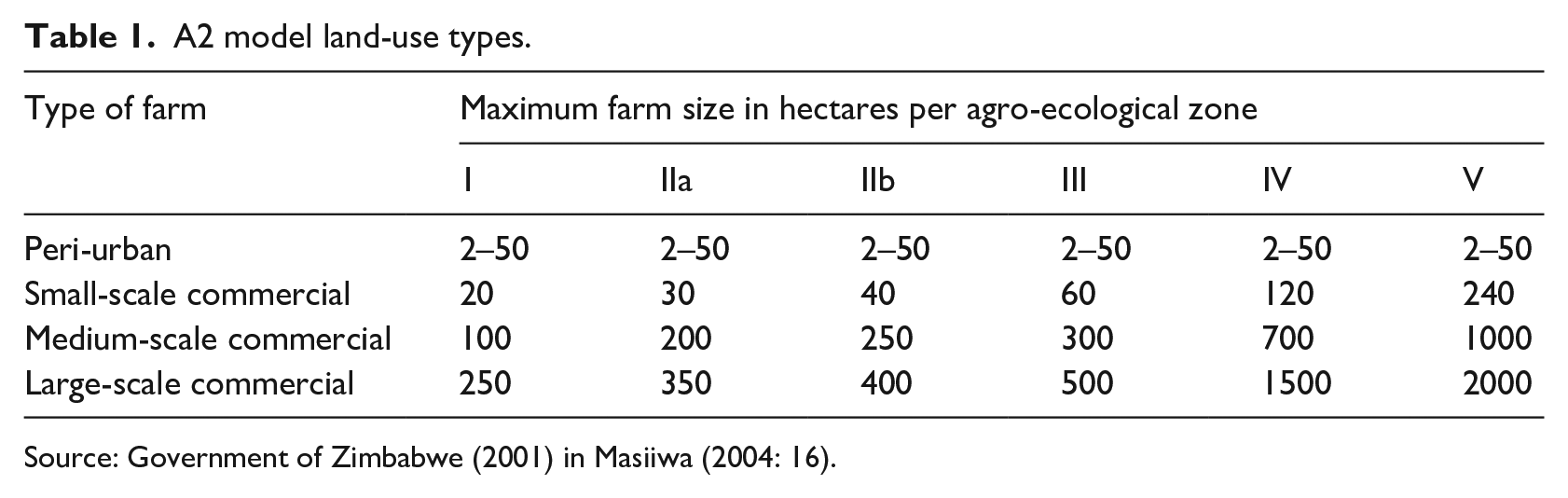
Source: Government of Zimbabwe (2001) in Masiiwa (2004: 16).
The advent of a new political dispensation in Zimbabwe in November 2017 under the leadership of Emerson Mnangagwa following the departure of Robert Mugabe marked the return to neoliberalism, emphasising farm productivity (Mkodzongi and Lawrence, 2019). This was accompanied by the threat of eviction of unproductive or absent plot holders. In addition to this, the alleged possible return of White commercial farmers heightened anxiety and uncertainty on the farms. However, the assurance of continued state control over access to land and its pronouncement of its commitment to accommodate more youths and women in the programme was a positive development that potentially promoted the sustainability of the programme. As Tekwa and Adesina (2018) observed, the redistributive outcomes of the FTLRP saw various categories of women (married, single and widowed) comprising 12%–18% of beneficiaries gaining access to land in their own right.
Theoretical orientation
Given the complexity of the issues under examination, the study was informed by a combination of ideas drawn from Flora and Flora’s (2008) Community Capitals Framework (CCF) (Figure 1) and Amartya Sen’s Capability approach (Figure 2). According to Emery et al. (2005), the CCF was developed as an expansion to the systems approach to poverty reduction, effective natural resources management and social equity. The framework contains seven capitals: human, social, cultural, political, built, financial and natural. Central to the model are social inclusion and empowerment, which are all critical aspects resonating well with the dynamics of the land reform programme. Flora and Flora (2008) and Pigg et al. (2013) put a case for understanding the systemic interdependence, interaction and synergy among capitals. It is critical to maintain a balance between the capitals to avoid decapitalisation (Emery et al., 2013). Decapitalisation is the overemphasis of one capital at the expense of others. During the implementation of the FTLRP, political interests tended to take precedence over other capitals (Masiiwa, 2004; Mkodzongi, 2013).
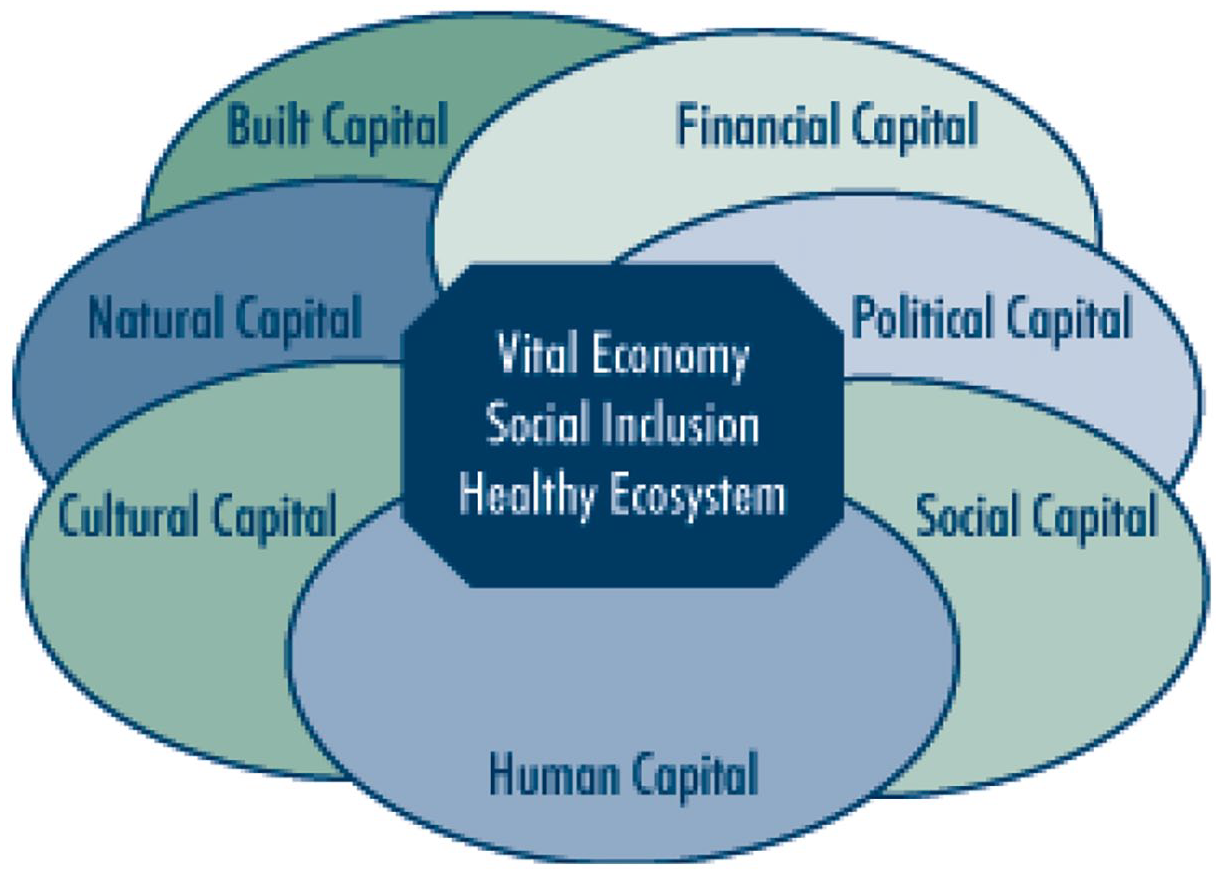
Flora and Flora’s (2008) Community Capitals Framework model (adapted from Gauvin, 2011).
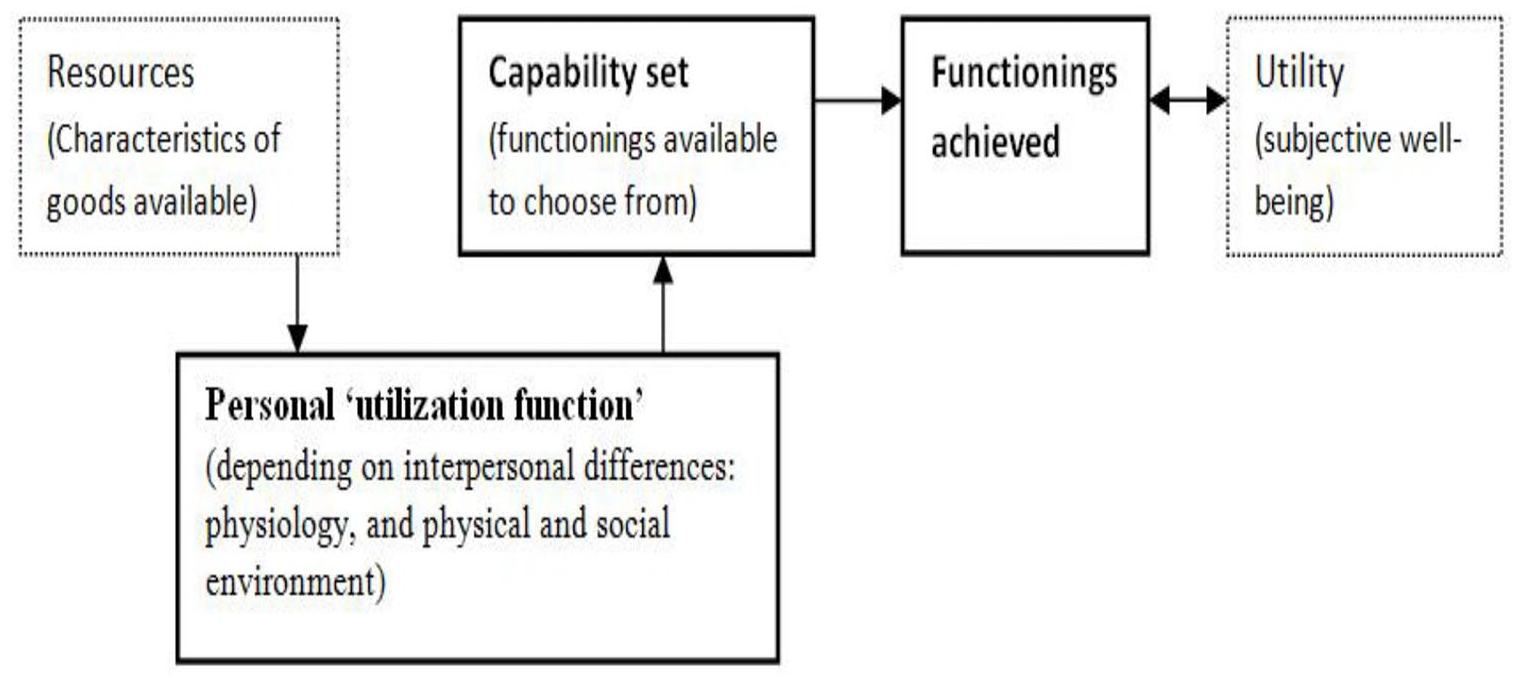
Core relationships of Sen’s Capability approach (http://www.iep.utm.edu/sen-cap).
For purposes of examining the dynamics of the FTLRP and the accompanying succession issues, the Capability approach plays a complementary role to the CCF. According to Sen (1999), development is a matter of expanding the capabilities that people have reason to choose and value. However, this depends on what institutions exist to contribute to that freedom (Stewart and Deneulin, 2002: 67). The expansion of freedom both as the primary end and as the principle means of development is central to the approach (Alkire, 2005; Sen, 1999). Human development was viewed as a process of expanding the real freedoms that people enjoy, expressed as their capabilities in doing so (Alkire, 2005: 120–121). Transforming resources or capitals into capabilities also depends on the ‘personal utilisation function’ (Figure 2). In the case of the FTLRP, it was important to identify capitals that were critical for coping and adaptation. For example, family interests as a social capital and a driver of intergenerational transitions were downplayed during the process despite the fact that the majority of A1 settlers occupied the land as families. Social capital and by extension cultural capital weave through both the community capitals and capabilities, and any neglect of this aspect threatens the sustainability of any rural system (Bowler et al., 2002). While the programme sought to speed up the process of redressing of inequalities and providing freedoms to landless majority, it neglected the aspect of balancing the various community capitals, which was essential to achieve real freedom.
Setting and methodology
The study on which this article is based followed an interpretive qualitative research approach and utilised a cross-sectional multi-case study design. Case studies have already been used in similar situations elsewhere and found to be very useful in allowing investigations to retain the holistic and meaningful characteristics of real life events (Maunganidze, 2011; Mutopo et al., 2014; Wild, 1997). The choice of the design also emanated from the desire to understand complex social phenomena as they unfolded as a whole (Yin, 2003: 2). The study focused on the experiences of purposively selected settlers on a farm located in Seke Rural District in the Mashonaland East Province of Zimbabwe. Seke rural district lies about 30–50 km south of the capital Harare (Figure 3).
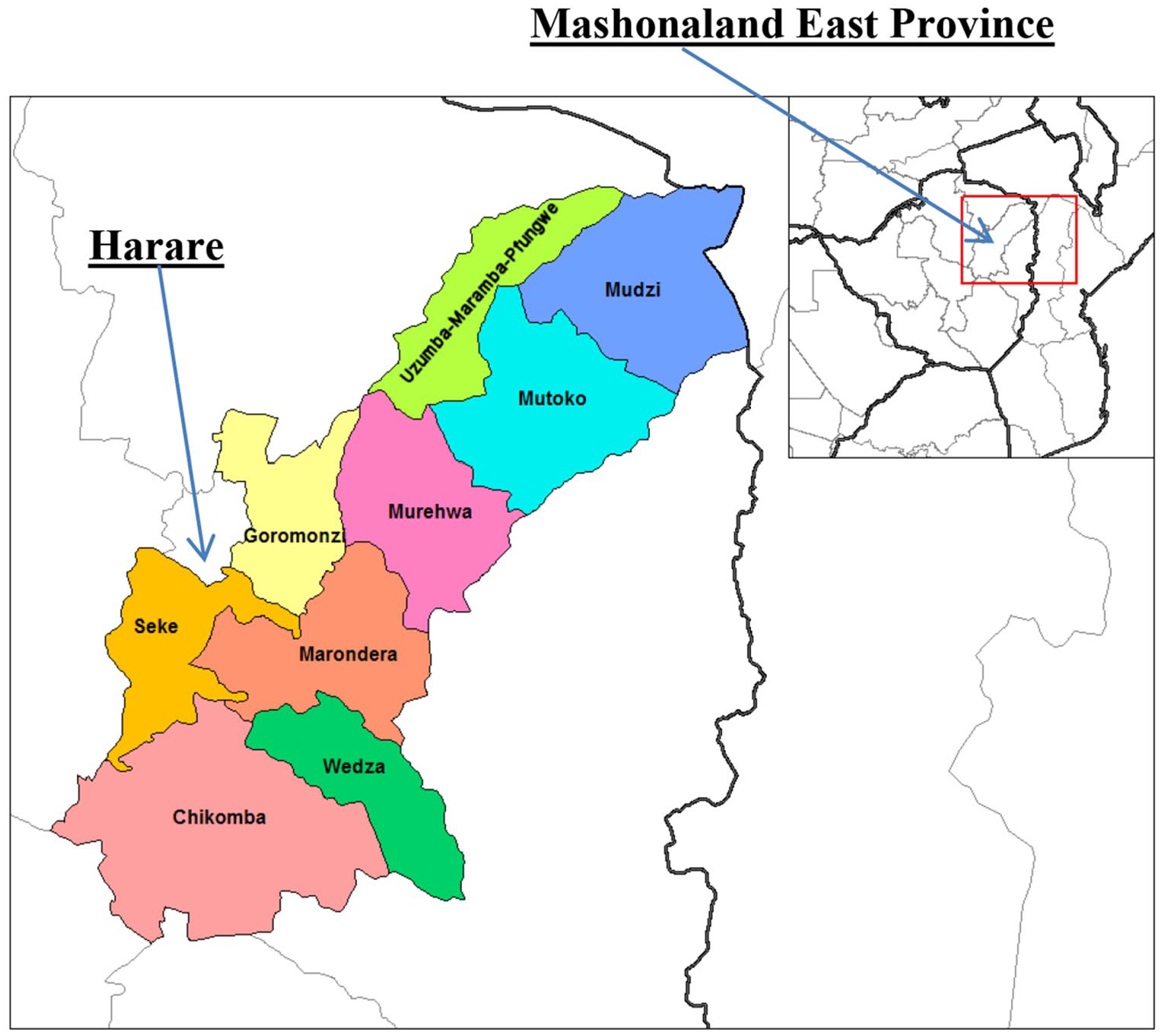
Seke District, Mashonaland East Province (http://www.zim.gov.zw/).
The study focused on the A1 and A2 models in general and the villagised and small-scale commercial plots specifically. For the purposes of conducting in-depth interviews, 10 A1 settlers comprising 8 males and 2 females and 5 A2 settlers comprising 3 males and 2 females were selected using purposive availability sampling technique. Both groups were settled on two adjacent former White-owned commercial farms, and the earliest occupants had come in the year 2000. All the occupants under the A2 model originated from urban areas, while for the A1 settlers some had come from nearby communal lands such as Marondera and Chikomba Districts (Figure 3) and were previous labourers in the former commercial farms. Five key informants comprising the two veterans of the liberation struggle, two village lands committee members and an agricultural extension official were also purposively selected. This allowed collection of credible data given their intimate knowledge of the events leading to and during the invasions and implementation of the programme. Two spouses and three children of the initial A1 occupants were conveniently selected. The total number of participants selected was 25. The study area and sampling strategy were chosen primarily for two reasons. First, the researchers’ familiarity and previous association with key informants in the study allowed easy access, negotiation of entry and management of gatekeepers. One of the researchers had been farming in the study area on a rental basis for more than 5 years. The use of acquaintances has been found useful for collecting qualitative data, particularly lived experience narrations (Etikan et al., 2016). Second, key informants were chosen on the basis of the willingness to provide information by virtue of knowledge and experience.
Data were collected using a combination of in-depth interviews, informal discussions, narratives of lived experiences and direct observations. This was complemented by documentary survey of previous studies on FTLRP in Zimbabwe. This approach recognises the value of the complementarity of various techniques in collecting information related to people’s views, observations and interpretations (Kottak, 2006). Data were thematically analysed using a combination of pattern matching and illustrative multi-case analytical techniques in line with the adopted theoretical frameworks. Data collection procedure was ethically informed. Participation was voluntary, and confidentiality and protection of information were assured.
Results and discussion
Politics of survival and decapitalisation
One of the findings of the study was that social capital in the form of social networks, trust, collaboration and linkages was critical for agricultural production at farm level and by extension farm longevity. Given the multiplication effect of social capital onto other capitals, it assumes centrality in the land reform discourse (Cliffe et al., 2011; Ncube, 2018). According to Flora and Flora (2008), social capital can be categorised into bonding and bridging social capitals. The former relates to connections that occur among homogeneous individuals and groups, while the latter enables diverse groups of individual bonded together to pursue specific ends. This was important for our study given that most of the settlers had either originated from the same area or been recruited to the farms via both the social and political networks. When the bonding and bridging of social capitals are strong, effective community action is realised together with the creation of an entrepreneurial social infrastructure (Gauvin, 2011). This supports Portes (1998) and Wolz et al. (2005), observations that institutionalised social capital provided sufficient investment to transform ordinary households into viable firms. Thus, preparation for leadership take over could be more effective when it becomes part of the whole community, support groups and associations. This is consistent with Korzensky’s (2019) finding elsewhere, that non-kin or extra familial transmissions or transfers of farms were a viable adaptive strategy to ensure food security and food sovereignty. As observed by Saidapur (2012), entrepreneurs organised groups and working networks, which then allowed them to overcome obstacles and conflicts. Kabir et al. (2012) added that leadership skills were also acquired during social networks. Networks facilitated resource mobilisation and information sharing, which were both critical for building capabilities. This reinforces Carter and Jones-Evans’ (2000) and Shaw’s (1997) assertions that personal contact networks were a business resource that assisted in the acquisition of information and advice. In this study, such cases were hardly visible as one A1 settler indicated:
Our networks are used more for current existence and survival than for future.
The challenge with the FTLRP was not only its dramatic and transformational orientation, but it was also overly political. Occupants and their dependants were expected to be more connected to the ruling party structures than other social capital dimensions. The ruling party structures were central to land invasions and have remained instrumental in the subsequent land redistribution exercise. In essence, social capital was an underappreciated factor of production, and as a consequence, the issue of transfer management (succession) did not feature on the agenda. However, the political persuasion of beneficiaries has remained unclear. Our lived experience on the farms also concurred with key informant’s narrations that the beneficiaries feigned party affiliation or loyalty as a survival strategy:
Yes, we have people who pretend to support ZANU-PF. During elections they either stay away or vote for the opposition. For example, in the first round of presidential elections in 2008, there was evidence that some had voted for the opposition, MDC.
This supports Mkodzongi’s (2013) findings elsewhere that land redistribution beneficiaries were ‘performing or playing ZANU-PF’ as a survival mechanism. This generated a form of negative social capital with consequences such as exclusion of outsiders, excess claims on group members and restrictions on individual freedoms (Portes, 1998: 15). At the time of the study, it seemed the authorities and beneficiaries were fixated on the survival of the ruling party with very little attention paid to building individual capabilities. While the programme continued to have some attraction from a political perspective, it has turned out to be problematic with incidences of some occupants having abandoned the plots and relocating to urban areas. The new social networks and the accompanying interactions were transactions more driven by parochial political interests that tended to be very fragile and often failing to build solidarity among communities.
Drawing insights from the CCF, we advance the argument that the overemphasis on the political dimension of the process or alternatively decapitalisation of social capital (Emery et al., 2013) diffused family social capital which was critical for intergenerational transition and succession. This observation is consistent with other scholarly works (Coeurderoy and Lwango, 2012; Dudek, 2016; Korzensky, 2019) which found out that the dilution of the social capital associated with the traditional family system handicapped the smooth inter- and intragenerational transmission of farms. The programme constrained social capital as it partly tore apart existing social institutions. The new settlements under the FTLRP were owned and controlled by the state with a relatively subdued involvement of both traditional leadership and families.
Our study found out the existence of a combination of both communalised and individualised households under both the A1 and A2 models. Guided by the CCF, we make a case for considering the aspect of community-level participation and empowerment to facilitate durable succession and sustainability of the programme. A negation of balanced community capitals through members’ preoccupation with political survival has led to decapitalisation, which consequently suppressed agricultural productivity. As a result, the new settlers had remained not only subsistent but also subservient and dependent on State benevolence, hence the article’s contention that land occupations under the FTRLP had become a political resource.
The two conditions that are critical for sustaining family social capital but missing from study cases are the aspect of power with respect to the family’s predominance in terms of ownership and involvement that is directly linked to farm management and control by family members. For example, in the absence of written succession plans, the sons’ active involvement in the management of the farm could not provide sufficient preparation for the possible takeover in the event of incapacitation, retirement or death of the founder. The lack or absence of succession plans can also be explained with the use of Flora and Flora (2008), concepts of social and cultural capital. Although the FTLRP did not directly reconfigure new class formations, the three dimensions of capital, economic, social and cultural capital (Siisiainen, 2000), were manifest particularly under both the A2 and A1 models.
Individualisation and women participation
The individualisation of land rights under both the A1 and A2 models has far-reaching implications for both agricultural investments and productivity. Although individualisation tended to split families (Mkodzongi, 2013; Nyawo, 2016) and disrupt social bonding and norms of reciprocity, it also empowered individual women through the provision of opportunities to access and control land. As one female informant intimated,
We might not be the owners of the land as women but at least have direct control over the produce and jointly make decisions regarding land utilization and the incomes from sales particularly tobacco.
The study findings support Matondi (2005) (cited by Chingarande et al., 2012), earlier observations in the same province that FTLRP provided individual women the opportunity to access financial capital. This resonates with Sen’s Capability approach as the embedment of such ‘individualisation’ in the programme facilitated women’s participation in independent farming and entrepreneurial activities. Rather than land endowment, access to capital was driving accumulation in rural settings (Shonhe and Mtapuri, 2020). The article argues that women participation is central to sustainability. Women participation helps to avoid land being left derelict on the departure of male founders. Although there is evidence of some women getting land in their own right, overall land was allocated unevenly to men and women. Husbands’ names appeared on offer letters and permits, although legislation, 17th Amendment to the Zimbabwe Constitution, Section 23(3) adopted in 2005, allowed for equal enjoyment of land rights. The role played by women during both the war of liberation and FTLRP, providing support particularly to the base camps during the ‘jambanja’ period, is well revered in literature (Mutopo et al., 2014; Scoones et al., 2010, 2019) and thus cannot be ignored. Although the FTLRP had effectively disrupted some deeply entrenched patriarchal practices paving way for gender equity, the initial stages of the programme privileged men as the primary beneficiaries (Goebel, 2005). As observed earlier, the chaotic and often violent nature of the invasions left some women, especially wives, relatively invisible. However, when women were asked about their readiness to take over the plots, one participant and also a wife to one of the A1 settlers stressed,
We are ready to take over. We are responsible for the bulk of both household and farming tasks here and capable of managing our own plots.
Despite this, women continued to face challenges that constrained effective succession. Although legislation provided for equality, wives could still be excluded from succession on the basis of primogeniture. Gender blindness in land policy also perpetuated women marginalisation (Maguranyanga and Moyo, 2006). As Manjengwa and Mazhawidza (2009) and Mutopo et al. (2014) argued, practical realities in the countryside effectively excluded women, especially daughters, from succession. Although appointment of successors on the basis of knowledge and experience was appreciated across cases, transfer of plots to daughters was considered problematic as they could possibly be married out of the family.
For a better understanding of women participation, this article moves the analysis beyond the conventional modernist framing of women as collectively homogeneous and powerless. Women can be socially differentiated from others with capacities for agency and acting on relational self-interest in a dynamic social world (Mackenzie and Soljar, 2000, cited in Casey, 2004: 10). With respect to access to land, the absence of women’s names on permits and offer letters did not necessarily constitute marginalisation. In some cases, married women were elected to key positions such as village lands committee chairpersons and secretaries, signalling that women had strategies that could potentially dictate the direction of the land reform programme. As Cliffe et al. (2011) and Zvokuomba and Batisai (2020) found out elsewhere in Zimbabwe, women were not necessarily victims of gendered inequalities and structures since they managed to secure use of land often indirectly and by wheedling it out of spouses, other family members and political influentials at local level.
Security of tenure and succession
Although accumulation of social and political capital tends to be beneficial in the short term, overall it has an economic cost (Chrisman et al., 2003). The nexus between land rights and security of tenure on the farms has implications for succession. The land reform programme could not exist independent of property rights and the institutions and ideologies that sustained it (Fine, 2003). The legitimacy of occupation was mediated by the political capital. Since the rights were only extended to use (usufruct), ownership was effectively symbolic and sentimental. Such an arrangement constrained the founder’s capacity to delegate or transfer responsibility and control (Zuern, 2003). Lack of clarity on tenure discouraged some settlers to invest much on the land. As concurred by Cliffe et al. (2011) and Maguranyanga and Moyo (2006), uncertainty and insecurity were some of the root problems that reduced new settlers’ confidence and investment commitment on farms. For example, despite having been on the farms for decades, none of the interviewed A2 settlers had secured the 99-year leases. As one participant bemoaned,
The delay in issuing leases creates uncertainty and anxiety. One cannot plan for tomorrow because an offer letter is not secure enough. It can be withdrawn at the discretion of the government.
However, some A1 settlers such as war veterans viewed the situation differently:
For some of us we are not concerned about permits or leases because we do not intend to trade this land. This is our legitimate inheritance. Blood was spilled to regain our land rights. So this land is not for free.
Lack of clarity around land rights and tenure security triggered ‘dual residency’ – settlers staying on newly acquired farms while at the same clinging to their communal homesteads (Matondi and Dekker, 2011; Mkodzongi and Lawrence, 2019). Consequently, temporary structures have been common on the farms (Figure 4). There have also been fears of possible eviction following suspicions of the return of former farm owners in response to the reconciliatory tone of the new government, signalling a dramatic shift from radicalism (Mkodzongi and Lawrence, 2019). Thus, over the years, plot holders have been maintaining a ‘foot’ in communal lands as ‘insurance’ in case of dispossession. Split households make succession difficult as families spread their risk through maintaining dual farming households as fallback in the event of eviction.

Photo of an A1 plot homestead.
Entrepreneurial orientation, youth perspectives and succession
Building entrepreneurial intensity is critical for the sustainability of the land reform programme. The failure of the FTLRP to engender a new culture of both individual and collective entrepreneurship remains a challenge to both development researchers and practitioners. This study found no consideration given to the aspect of capacitating individuals before resettlement. As one A2 occupant stated,
We rushed to the farms with no one taking stock of our farming capabilities.
Although factors such as age, gender, experience and education, as well as the ‘social positions, worldviews and dispositions’, have been found to predict entrepreneurial orientation (Molly et al., 2012), the chaotic and political character of the programme did not allow for the nurturing of entrepreneurship. The claims-based approach and the entitlement orientation associated with the programme did not motivate the occupants to pursue meaningful economic activities. For some settlers, land occupations were more of an opportunity to own a home than engaging in productive farming. The settlers’ failure to transform their new plots into viable entrepreneurial ventures was a threat to household livelihoods, food security and sustainability of the programme. This has implications for generational transfer of land, assets and sustaining livelihood opportunities (Chipenda, 2020; Scoones et al., 2019).
Consistent with the CCF and Capability frameworks, this article argues that while the FTLRP had created opportunities for the landless to access land, lack of requisite farming skills and experience, appropriate infrastructure and other capitals necessary to create capabilities denied them ultimate freedom. These factors limited beneficiaries’ capabilities to plan for the future (Kabonga, 2020; Mkodzongi, 2013; Moyo, 2011). Sustainability is about long-range planning to ensure the land continued to be productive for the benefit of both current and future generations.
Although some young people were instrumental during the invasions, they tended to be cautious about full-time engagement on the plots. As a consequence, some have continued to rely on the commercial A2 farms for seasonal or casual employment (Shonhe et al., 2020). This finding reinforces Chipato et al.’s (2020) and Chipenda and Tom’s (2020) observations that FTLRP had brought mixed fortunes. While the programme had been viewed as having enhanced the productive capacities of individuals and positively transformed their lives, others felt it had limited their opportunities (Chipenda, 2020). This was because apart from the small plot sizes allocated to each household at the time of invasions, no land had ever been allocated to any of the youth in their own right. The invisibility of youth albeit the seemingly advanced ages of their parents posed a threat to plot sustainability. Some youth only engaged in full-time farming when all possible avenues for either formal employment or further education had been closed. As one key informant, a former liberation war collaborator, remarked,
Our youth face a dilemma. While they may support the programme they do not seem to envisage life beyond our generation given the political dimension of the programme.
The mixed perspectives of the youth regarding the FTLRP were also observed by other scholars. For example, Chipato et al. (2020) argued that the conflation of party and state politics disenfranchised the youth by subordinating land struggles to the dictates of party politics. The manner in which land reform occurred, the agency of actors involved and their participation have formed meaning and attachment, which in different ways inform issues of succession. Although some youth, particularly those under the A1 model, were prepared to succeed their parents, they were concerned about the ‘waiting period’. One male youth lamented about the arrangement in which they had to wait to be allocated a portion of their parents’ plots:
Some of us were not yet born during the initial land occupations decades ago and were not considered for land allocation. Now we need our own pieces. Sharing land with our parents is not a good thing.
This ‘waithood’ (Chipato et al., 2020; Scoones et al., 2019) discouraged children participation. As a way of dealing with the growing need for access to land by the youth, the village lands committee resolved to allocate plots to youth on areas initially earmarked for animal grazing. However, this practice tended to create another problem; both arable and pasture land could soon be exhausted, leading to potential land disputes. As one participant remarked,
While taking over our parents’ plots was a good idea it was not sustainable because in some cases there would be many siblings and with diverse interests. Some may prefer to rent or even dispose it.
The study also found that both A1 and A2 founders had not embraced succession planning strategies, such as on the farm ‘apprenticeship’. Accumulation and possession of specific knowledge on farming play a key role in creating smooth intra-family succession (Corsi, 2009). However, this can be constrained by ‘intergenerational incongruity’ – the dissimilar or conflicting interests, values and attitudes between the founder and succeeding generations (Grote, 2003; Molly et al., 2012). As the parents get aged and children lose interest in the land, sustainability is threatened. While there was strong social capital, the human capital dimension was relatively weak. This article contends that the community capitals onto which capabilities for creating individual freedoms were anchored were not evenly distributed. Thus, as informed by Sen’s Capability approach, the ability of people to convert bundles of resources into valuable capabilities depended on their personal utilisation function (Sen, 1999). Parents tended to privilege the maintenance of social, cultural and political capitals in order to access and control both natural and financial capitals. Such decapitalisation was relatively conservative and limited opportunities for the development of entrepreneurial intensity and farm longevity. On the contrary, the children’s attachment to their parents, community and the land particularly on A1 plots facilitated continuity. This is significant for effective generational transfer and consequently sustainability of the land reform programme.
Conclusion
The article assessed the sustainability of the land reform based on plot succession possibilities in a selected resettlement area in Zimbabwe. It specifically sought to examine the factors influencing succession in the farms acquired under the FTLRP and the implications for sustainability of the programme. One of the key findings of the study was the interweaving connections between various community capitals, security of tenure, women and youth participation, and entrepreneurial intensity and their influence on succession.
Notwithstanding other antecedent structural and institutional constraints, the article concludes that the politics of survival posed a major threat to both succession and the sustainability of the land reform programme. Beyond the variants of cultural and social capital, the politics of survival that circumscribed programme created uncertainty among both founders and potential successors. Preoccupation with accumulation and consolidation of political capital at the expense of other community capitals generated decapitalisation (Emery et al., 2013; Flora and Flora, 2008) which threatened capacities for the creation of individual capabilities and freedoms (Alkire, 2005). Perspectives of women and the young generation deserved consideration as critical success factors for effective succession. Therefore, capabilities needed to be created around these actors to prevent the plots becoming derelict following the departure of the founders.
Although some settlers engaged in some form of planning, on the whole the practice has often been neglected due to both cultural and political reasons. It may be too early to conclude, but there is, overall, no evidence of deliberate succession strategies at individual, community and institutional level.
Footnotes
Funding
The author(s) received no financial support for the research, authorship and/or publication of this article.
