







Abstract
The relationship between the nuclear arms race and strategic stability has been important for scholars, politicians, and journalists who have shown keen interest in what causes a state to augment its military power and its effects on its rivalries with other states. As emerging technologies continue to change the security calculus of the states, the arms race is on for investing in the development and acquisition of offensive and defensive technologies in South Asia. The Indian strategic cooperation with the technologically advanced countries and the increase in the defense budget confirm its military modernization while upsetting the delicacies of the conventional military balance in South Asia. This study gives a substantive background to the developments and technological advancements in the post overt nuclearization era (1998) in the context of complications posed by India’s persistent animus dominandi to outpace Pakistan in an anarchic structure vis-à-vis its impact on strategic instability in South Asia by making a comprehensive analysis of an unending arms race for the maintenance of credible minimum deterrence.
Introduction
India and Pakistan are a prominent pair of competitors in South Asia who provide a classic example of a security dilemma. They are involved in an action–reaction spiral of research and development to produce nuclear weapons and ballistic missiles. They acquire arms and military technologies from developed countries to ensure their national security requirements. Empirical evidence suggests that Pakistan received nuclear weapons in response to the counterbalance of Indian conventional superiority, and it has always followed the Indian footprints in the field. As emerging technologies continue to change the security calculus of the states, the arms race is on for investing in the development and acquisition of offensive and defensive technologies in South Asia. The Indian strategic cooperation with the technologically advanced countries and the increase in the defense budget confirm its military modernization upsetting the delicacies of the conventional military balance in South Asia vis-à-vis Pakistan. According to Stockholm International Peace Research Institute, SIPRI Yearbook 2020: Armaments, Disarmament and International Security, India ranked the third-largest defense spender with $76.6 billion compared to the United States and China with $801 billion and $293 billion, respectively. India is presently ranked the second-largest importer of major conventional arms with 11% of its global share (SIPRI, 2022a). In this significance, India’s military modernization threatens Pakistan’s conventional deterrence. Some scholars have gone so far as to suggest that this conventional superiority and military modernization by India is compelling Pakistan to embrace low-yield and battlefield-use delivery systems known as tactical nuclear weapons (Ladwig, 2015). Pakistan’s National Command Authority (NCA) also expressed concerns about the Indian military modernization in its 25th meeting held on September 8, 2021 (Sadiq and Ali, 2022). The NCA “noted with concern the destabilizing massive arms build-up in the conventional and strategic domains” and “viewed these developments as detrimental to peace and security and asserted that Pakistan will take all measures to ensure the strategic stability in the region without entering into an arms race” (Khan, 2021). The primary reason for Pakistan’s outburst about Indian Revolution in Military Affairs (RMA), a hypothesis in military theory often connected with technological and organizational reforms in the military, is based on the Indian military acquisitions from the United States, France, Israel, and other most advanced countries designed to qualitative and quantitative augmentation of its C4I2R and precision strike capabilities.
Ever since the South Asian rivals have locked themselves in a deadly conflict, a relationship whereby the region’s stability depends on maintaining their military balance. Pakistan’s quest for such a balance is constrained by its limited resources compared with India, which has the world’s second-largest population; third-largest army; third-largest military spender after the United States and China (SIPRI, 2022b); and fourth-largest economy in terms of purchasing power parity (Bose et al., 2019).
This article is to reconnoiter the persistent animus dominandi by India to outpace Pakistan in an anarchic structure by analyzing the dynamics of an incessant nuclear arms race between India and Pakistan. The asymmetry between India and Pakistan regarding population, army, defense spending, and purchasing power parity makes Pakistan insecure. Structural obligations force Pakistan to struggle for parity against India with particular attention to the effectiveness of its ability to combat or as a deterrent against India in an action–reaction framework with the qualitative and quantitative augmentation of their armed forces. Therefore, this study first attempts to make a conceptual and theoretical understanding regarding the factors/variables that drive an army build-up of one country or a group of countries connected to the competitive nature of an adversarial and anarchic relationship in which states are concerned about their security. Then, it seeks to explore different postures in the context of frequent testing and development of similar types and ranges of missiles by India and Pakistan indicative of an action–reaction framework. Given the protracted conflict between India and Pakistan, it concludes that the nuclear arms race dynamics are further complicating the delicacies of strategic stability in South Asia.
Conceptual clarification
A mundane definition of an arms race relationship between two countries or groups of nations is a pattern of competitive augmentation of their military capabilities. It is a competitive, resource-based dynamic interaction between two countries or a group of countries in their arms build-up. The study of the arms race and related phenomena is an essential ingredient of strategic stability. It is further divided into the “stability of quantitative arms race, involving determining whether nations will engage in the proverbial behavior of piling arms upon arms or whether this process will stop at some stable equilibrium,” and the “stability of qualitative arms race, involving determining whether nations engage in competitive research and development to acquire a technological advantage”(Brito and Intriligator, 1995). The prenuclear era example of an arms race includes the “dreadnought” naval arms race between Great Britain and Germany that triggered World War 1 (Herwig, 1991). Cold War nuclear arms race is another example between the United States and the Soviets which cycled through different phases that include, from Atomic to Thermonuclear Bombs (1945–c.1955); from Bombs to Missiles (c.1955–c.1965); the Era of Mutual Assured Destruction (c.1965–c.1980), and the End of First Nuclear Age (c.1980–c.1990) (Watts, 2013). Both the United States and the Soviets were engaged in producing thousands of nuclear weapons and delivery systems with megatons of yield till the disintegration of the Soviet Union.
Politicians, academicians, and journalists took a particular interest in the bipolar rivalry between the United States and the Soviets throughout the Cold War, generally termed an arms race. For two groups, states, or coalitions to be in an arms race relationship, Colin S. Gray believed that there should be two or more parties “perceiving themselves to be in an adversary relationship, who are increasing or improving their armaments at a rapid rate and structuring their respective military posture with general attention to the past, current, and anticipated military and political behavior of the other parties” (Gray, 1971). He has listed four necessary conditions for a particular relationship to be in an arms race:
There must be two or more parties, conscious of their antagonism.
They must structure their armed forces with attention to the probable effectiveness of the forces in combat with, or as a deterrent to, the other arms race participants.
They must compete in quantity (men, weapons) and/or quality (men, weapons, organization, doctrine, deployment).
There must be a rapid increase in quantity and/or improvements in quality.
The parties to the relationship may have their domestic justifications to pursue such military and political behavior. Still, it can serve as a trigger for an arms race for the other parties. Schelling and Halperin (1961) have observed that each side must be prepared to spend a great deal of money; it also means a constant fear on either side that the other has developed a dominant position, or will do so, or will fear the first to do so, with the resulting danger of premeditated or pre-emptive attack.
One independent state may be more committed to racing than the other in a typical arms competition. In this sense, “arms competition” is another term that represents an arms race relationship between a pair of states or groups of states involved in force increase, research, and development of military technology, production, acquisition, and deployment of weapons by another mean. According to Franklin A. Long (1989), if nation A undertakes military moves to increase its national security, for example, by a build-up of military forces, its opponent B suffers (or believes it suffers) a loss in security. Therefore, a common response by B is to increase the size of its military forces, hoping thereby to increase its national security. A continuing competition of this sort is an arms race resulting from a search for elusive national security.
Such an anarchic pattern is called “security dilemma.” The security dilemma theory, which John Herz originates, holds a homo homini lupus situation. The parties are concerned about their security and driven to acquire more power to escape from being attacked, endangered, conquered, destroyed, or dominated by others (Herz, 1950).
The security dilemma is essential in international relations to understand the anarchic system in which states with compatible goals compete and end up at war. It explains the rationale foundations of political anxieties and stresses between the states that seek security competition. The problem lies with making an adversary less secure can also reduce the state’s security. Reducing the adversary’s security is dangerous because making him more insecure will increase his interest in acquiring more power to ensure his security. Consequently, the state is less likely to be deterred by improved capabilities, and security is seen as a zero-sum game (Glaser, 1997). This action–reaction spiral may equally increase or decrease the security of both adversaries. It most likely results in greater instability that Barry Buzan (1983) holds as a “power-security dilemma” resulting from rival states’ constant struggle for power and security. However, sometimes rational observation may lead both adversaries to establish arms restraint and cooperation, which is one of the main perceptions of the arms control and disarmament theories. Framing the problems of cooperation laid the foundation of game theories such as “Stag-Hunt,” and “Prisoners’ Dilemma.”
Prisoners’ Dilemma is the most popular game-theoretic model of the arms race between two countries, representing a conflict situation in which a player is supposed to be rational. The response options are dichotomized in a 2 × 2 game matrix (arms and disarm) with four possible outcomes. Consider A and B are two states in a situation to choose one of the two options with payoffs as indicated in Table 1. Given the two options, the player will always choose the one with higher utility and comfort (Sowden, 1983).
Payoff matrix for India and Pakistan.
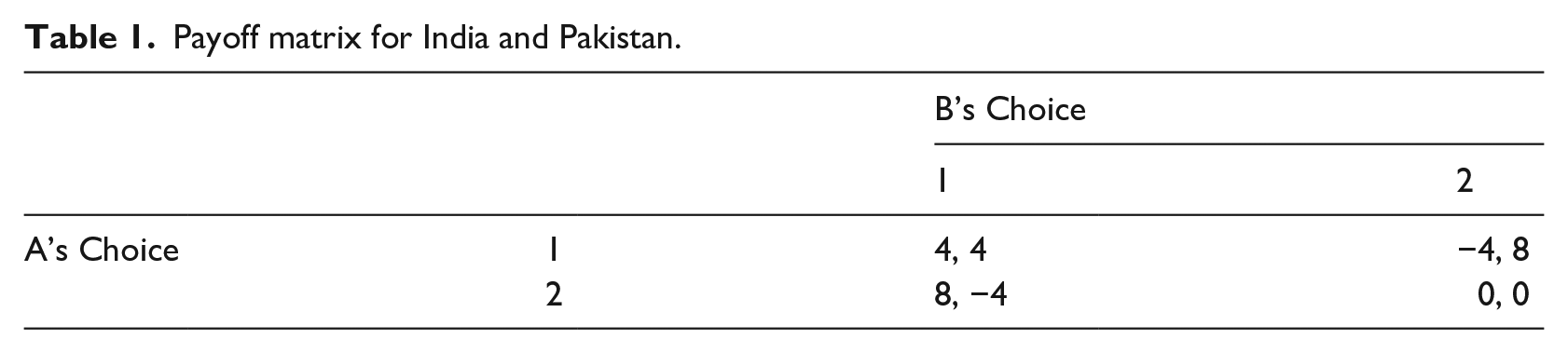
In other words, the Prisoners’ dilemma explains that “there are rewards for the cooperation and penalties for mutual noncooperation, but in which the reward for unilateral noncooperation exceeds both the benefit from cooperation and the cost of mutual conflict” (Snyder, 1971). It is better elucidated through another game-theoretic model called “Stag Hunt,” where all actors have the same preferences. “If they cooperate to trap the stag, they will all eat well. But if one person defects to chase a rabbit—which he likes less than stag—none of the others will get anything” (Jervis, 1978). Stag Hunt situations are those in which:
Cooperate and trap the stag (the international analog being cooperation and disarmament);
Chase a rabbit, while others remain at their posts (maintain a high level of arms while others are disarmed);
All chase rabbits (arms competition and increased risk of war); and
Stay at the original position while another chases a rabbit (being disarmed while others are armed).
Dynamics of the arms race between India and Pakistan
Pakistan has been continuously searching for its security against India since its partition in 1947. Pakistan perceives an existential threat from its archrival India which has a larger territory, enormous population, and richer resources. Pakistani policy-makers live under a continuous fear that India is persistently scheming against Pakistan to undo it since the turbulent patrician of British India in 1947, which created two independent states of India and Pakistan. There have been four wars between India and Pakistan, including several military skirmishes. The war of 1971 in which Pakistan was disintegrated and East Pakistan was established as Bangladesh with India’s help, further strengthened the belief that India is persistently involved in designs to undo Pakistan. The underlying philosophy of deterrence in Pakistan is based on the deep mistrust and fear of an attack from India. This mistrust is the central construct of security discourse in Pakistan and the raison d’etre of the prevailing arms race against India.
The competition between India and Pakistan over nuclear, missiles, and conventional superiority is well documented through different lenses of neorealism, such as the theory of security dilemma or security interdependence. Pakistan’s pursuit of strategic stability in the region is eventually justified for Indian arms build-up. The following section briefly examines the defense spending on the nuclear, ballistic, naval, and space programs during the last two decades of overt nuclearization that substantiated Pakistan’s threat perception and made its own qualitative and quantitative adjustments in response to India.
Nuclear arms race
Regarding the ongoing nuclear arms race, both India and Pakistan have a mixture of reasons. India’s acquisition of nuclear weapons is based on its perceived threat from China and international prestige. In contrast, Pakistan simply followed suit in its quest for ensuring its deterrence against India. As Andrew Futter (2021) puts it: “Both saw nuclear weapons as a pathway to modernization and enhanced international status, and as important for domestic politics and national identity, but both also built the bomb for traditional security reasons.” However, the South Asian nuclear arms race journey can be divided into three phases. The first phase starts from their independence in 1947 to the disintegration of Pakistan in 1971. This phase is dedicated to acquiring nuclear technologies and scientific knowledge for “peaceful application.” The second phase started with the so-called Multan Conference in 1972. Pakistan decided to start its covert nuclear program which ended with the nuclear explosions by India and Pakistan in 1998. This phase can be considered as “nuclear ambiguity.” The third phase is “overt nuclearization,” which has continued since both states declared their nuclear capabilities in 1998. Different scholars have characterized this nuclear arms race between India and Pakistan as an action–reaction spiral. Pakistan has followed the Indian footsteps as India decided to go nuclear; Pakistan followed suit to preserve its strategic balance and deterrence (Jalil, 2017).
Following the Indian nuclear tests of May 11 and 13, 1998, Pakistan faced enormous external pressures, anxious arm-twisting, and pleas for restraint by global actors, especially the United States. The UN and other European nations attempted to dissuade Pakistan from following the Indian suit. Pakistan believed that Indian nuclear tests had destroyed the strategic balance. In a direct response after a lapse of 2 weeks, Pakistan tested five atomic devices at an underground facility in the Chagai Hills on May 28 and one thermonuclear device on May 30, 1998, accelerating the nuclear arms race in South Asia. In response to India’s five, Pakistan responded with a quid pro quo plus six tests, “five to match New Delhi’s tests and one in response to India’s 1974 test” (Sagan, 2001). In a televised speech to the nation, Pakistan’s prime minister Nawaz Sharif claimed that they “have settled a score and have carried out five successful nuclear tests” (Anderson and Khan, 1998). Scholars have argued about these tit-for-tat nuclear tests initiated by India and followed by Pakistan, whether they reflect a “vigorous,” “gradual,” or “slow-motion” nuclear arms race (Chakma, 2004; Ganguly and Hagerty, 2012; Rajain, 2005; Zahra, 2012).
The most remarkable characteristic of the arms race between India and Pakistan is that both sides have developed and acquired quite identical nuclear weapons. As of April 2021, based on the calculations of weapons-grade plutonium and the number of operations nuclear-capable delivery means, the nuclear inventory is estimated at around 156 nuclear warheads for India and 165 for Pakistan (Kristensen and Korda, 2021). Indian military fissile material production is based on plutonium extraction and uranium enrichment. A 40 MW(t) CIRUS thermal heavy water reactor and a 100 MW (t) Dhruva Heavy Water Reactor produce plutonium for military purposes. Both reactors are located in Bhabha Atomic Research Center (BARC) Mumbai. CIRUS was shut down in 2010, whereas Dhruva continues to operate. Another 100 MW (t) reactor near Visakhapatnam at Andhra Pradesh is under construction, which will be used as a plutonium reprocessing facility for military purposes. India’s weapon-grade plutonium stockpile is estimated to be around 0.6 tons, in addition to 7.8 tons of reactor-grade plutonium accounted for as military material.
BARC maintains a pilot-scale enrichment plant, whereas Rare Materials Project a large centrifuge plant operating at Rattehalli is also being expanded. Moreover, the Indian stockpile of fissile material includes 5.2 tons of highly enriched uranium (HEU). The Indian HEU program is primarily designed to produce HEU for its nuclear submarine program. Under the Indo-US nuclear agreement signed on July 18, 2005, the United States amended its laws about the international controls for nonsignatories of NPT on the transfer of technology and nuclear fuel (Nautiyal, 2008). These amendments were made to allow full civilian nuclear energy cooperation and trade with India in exchange for the Indian separation of civil-military facilities. The US Congress passed Hyde Act in 2006, giving India specific exemptions and allowing for the adaptation of 123 nuclear cooperation agreements in 2007. NSG subsequently endorsed the Indian application in 2008, allowing India to trade nuclear fuel and technologies with global suppliers. India maintains three overlapping streams of nuclear power programs that include: “civilian safeguarded,” “civilian unsafeguarded,” and “military” (Robertson and Carlson, 2016). India is not a signatory of NPT, but some of its civilian facilities operate under its safeguard agreement signed with International Atomic Energy Agency (IAEA) in 2009 and Addition Protocols signed in 2014. It is anticipated that the plutonium separated or spent fuel generated in unsafeguarded facilities in Kalpakkam site, including fast breeder test reactor (FBTR) and prototype fast breeder reactor (PFBR), will be helpful to make nuclear weapons. The PFBR alone can produce 140 kg of weapons-grade plutonium per year, which would allow a nearly five-fold increase in the rate of production of weapons-grade plutonium in India (Bahree, 2009).
Moreover, Plutonium Reprocessing Plant in Trombay, Mumbai, is reprocessing the irradiated fuel from the reactors, reprocessing 50 tons of spent fuel annually. In addition, India plans to construct six more PFBRs in the next 15 years (Kumar, 2018). As per INFCIRC/754/Add.10 of 2020, India had put a total of 28 nuclear reactors under IAEA safeguards (IAEA, 2020). India has now signed strategic and nuclear cooperation agreements with Australia, Argentina, Bangladesh, Canada, the Czech Republic, France, Japan, Kazakhstan, Mongolia, Namibia, Russia, South Korea, the United Kingdom, the United States, and Vietnam. In addition, India is making nuclear trade with Australia, Canada, and Kazakhstan to supply uranium for its nuclear reactors after acceptance into Missile Technology Control Regime (MTCR) in 2016, Wassenaar Arrangement in 2017, and Australia Group in 2018 (Rajagopalan, 2018).
In response to Indo-US nuclear deal, Pakistan increased its nuclear cooperation with China. Pakistan’s pressurized water reactors (PWR) at Chashma, that is, CHASNUPP-1, CHASNUPP-2, CHUSNUPP-3, and CHASNUPP-4, have been supplied by China National Nuclear Corporation (CNNC). In May 2021, Pakistan inaugurated the 1100 MW KANUPP-2 (K-2) power plant in collaboration with China. Although it is difficult for Pakistan to keep pace with Indian fissile material production, Pakistan has established a diverse production complex. There are uranium enrichment plants in Kahuta and Gadwal near Islamabad (Kristensen and Korda, 2021). In addition, there are four heavy-water plutonium production reactors at Khoshab, which are the main element of Pakistan’s nuclear, plutonium, and tritium production facilities. It is estimated that Khushab-1, Khushab-2, Khushab-3, and Khushab-4 can now produce approximately 64 kg of plutonium annually (Patton, 2012). The International Panel on Fissile Materials estimated that Pakistan has about 3900 kg of 90% enriched weapons-grade HEU and around 410 kg of weapon-grade plutonium.
Arms race for nuclear-capable ballistic missiles
The nuclear-capable missile programs of both India and Pakistan predate their nuclear explosions of May 1998. Both rivals have been developing their short-, medium-, and long-range missile systems since the 1990s. Contrary to the Cold War rivals, India and Pakistan have not yet created any mechanism to share or publish their weapons, ballistic missile development, deployment, and storage data. The available estimates are educated assessments based on calculations of fissile material production and delivery means. The only thing these two rivals publicize transparently is the result of their missile tests which have become “mirror developments in the strategic environment that would tend to motivate arms-racing behavior, even if they are merely conducted as part of a technology development effort” (Dalton and Nandler, 2012). The missile tests are not a perfect indication of an arms race between India and Pakistan since India is perfecting its missile range and accuracy against China. Pakistan’s primary focus is to make sure that its missiles can target any city in India. As of 2020, India has conducted 200 nuclear missile tests compared to nearly 100 tests by Pakistan since 1998. Figure 1 shows the comparison of India’s and Pakistan’s missile tests since 1998. It is evident from the data that India has intensified its missile tests since 2007.
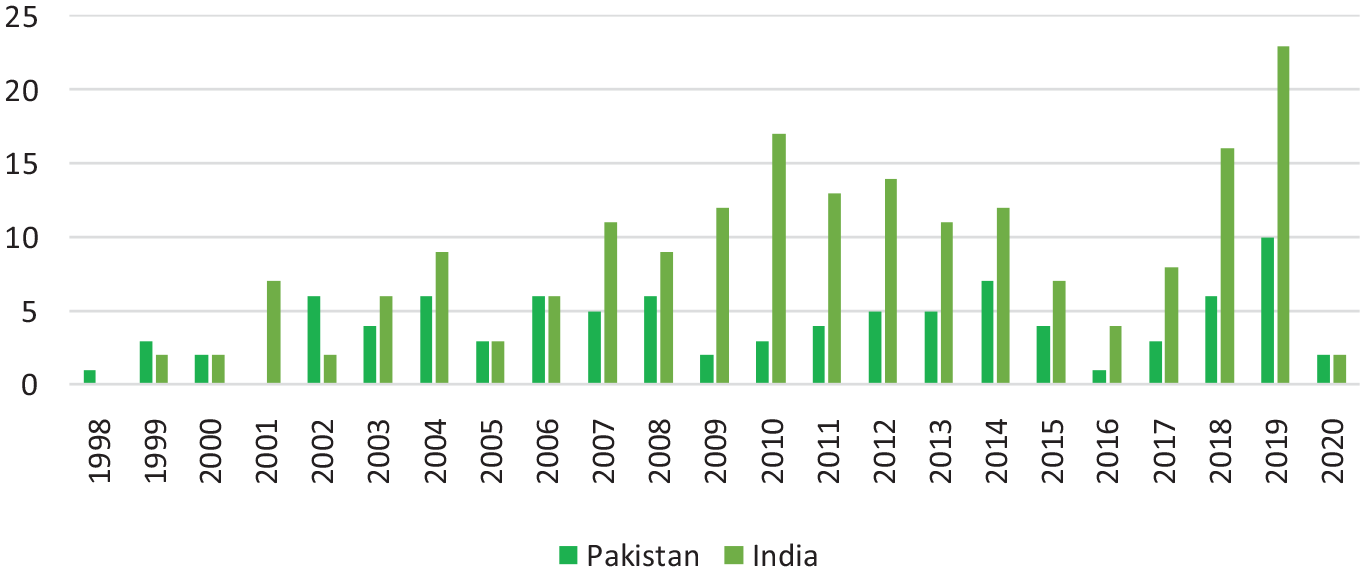
India Pakistan missile tests (1998–2020).
Initially, Pakistan’s focus was to test its ballistic missiles, but since 2005, it has shifted the focus on its cruise missiles. The frequency, time, and pattern of these tests indicate the existence of an action–reaction and signaling behavior between India and Pakistan. At the same time, the number of tests being conducted each year by the two indicates that India has been conducting a higher number of missile tests since 2007. Table 2 provides details of different missile systems India has tested since the overt nuclearization in 1998. The overall success rate of Indian missile tests is 85%.
Indian missile tests (1998–2020).
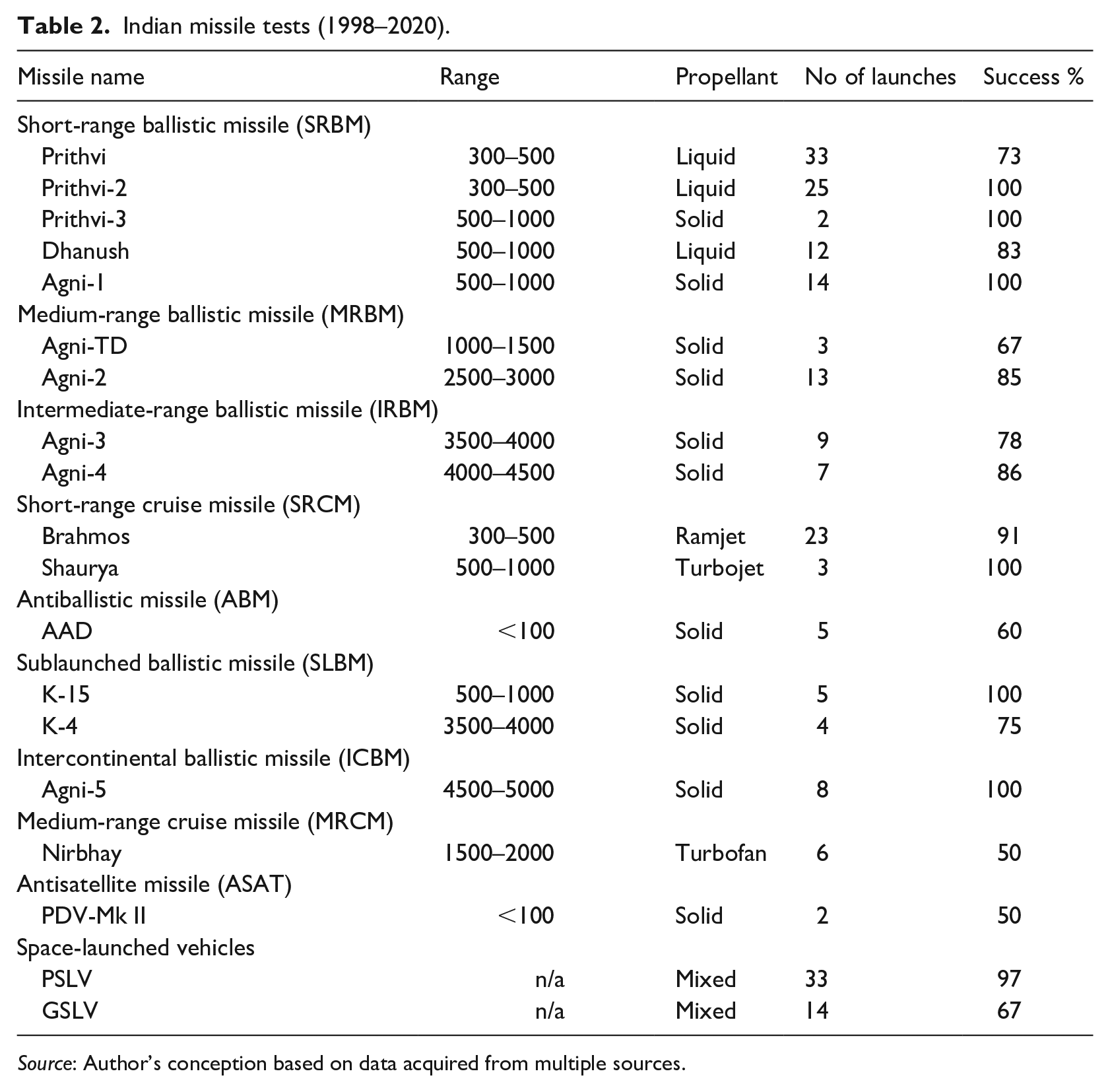
Source: Author’s conception based on data acquired from multiple sources.
India has developed almost all missiles ranging from short-range to intercontinental ballistic missiles. A closer look at the Indian missile variety shows that in addition to Pakistan, Indian targets include Chinese cities as well. Amid ongoing border tension with China, India successfully test-fired its ICBM Agni-V on October 27, 2021. Agni-V is believed to carry 50 tons of payload to over 5000 km, bringing the northernmost parts of China within its strike envelope (Pandit, 2021). Figure 2 shows that Indian primary focus is on Short-Range Ballistic Missiles, 38% of total missile testing since 1998. At the same time, other Indian tests include 24% SLVs, 11% SRCMs, 7% IRBMs, and 7% MRBMs.
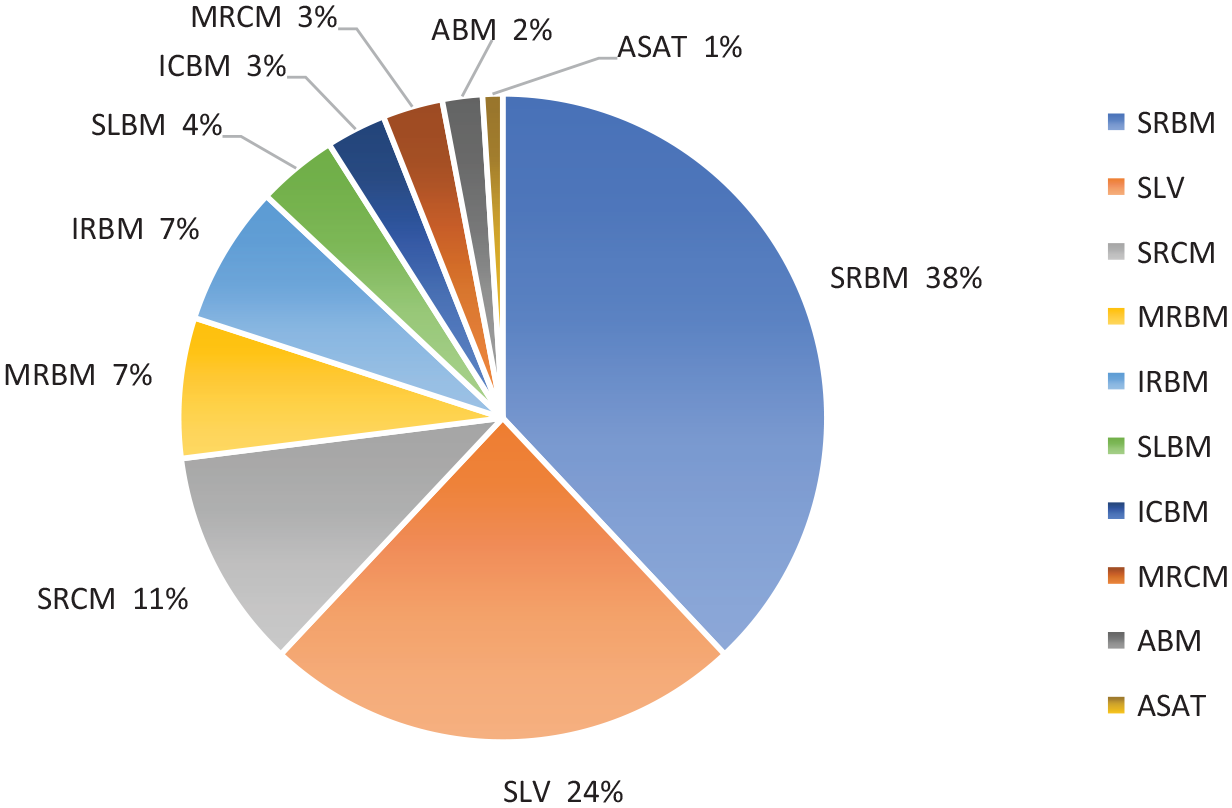
Indian missile systems.
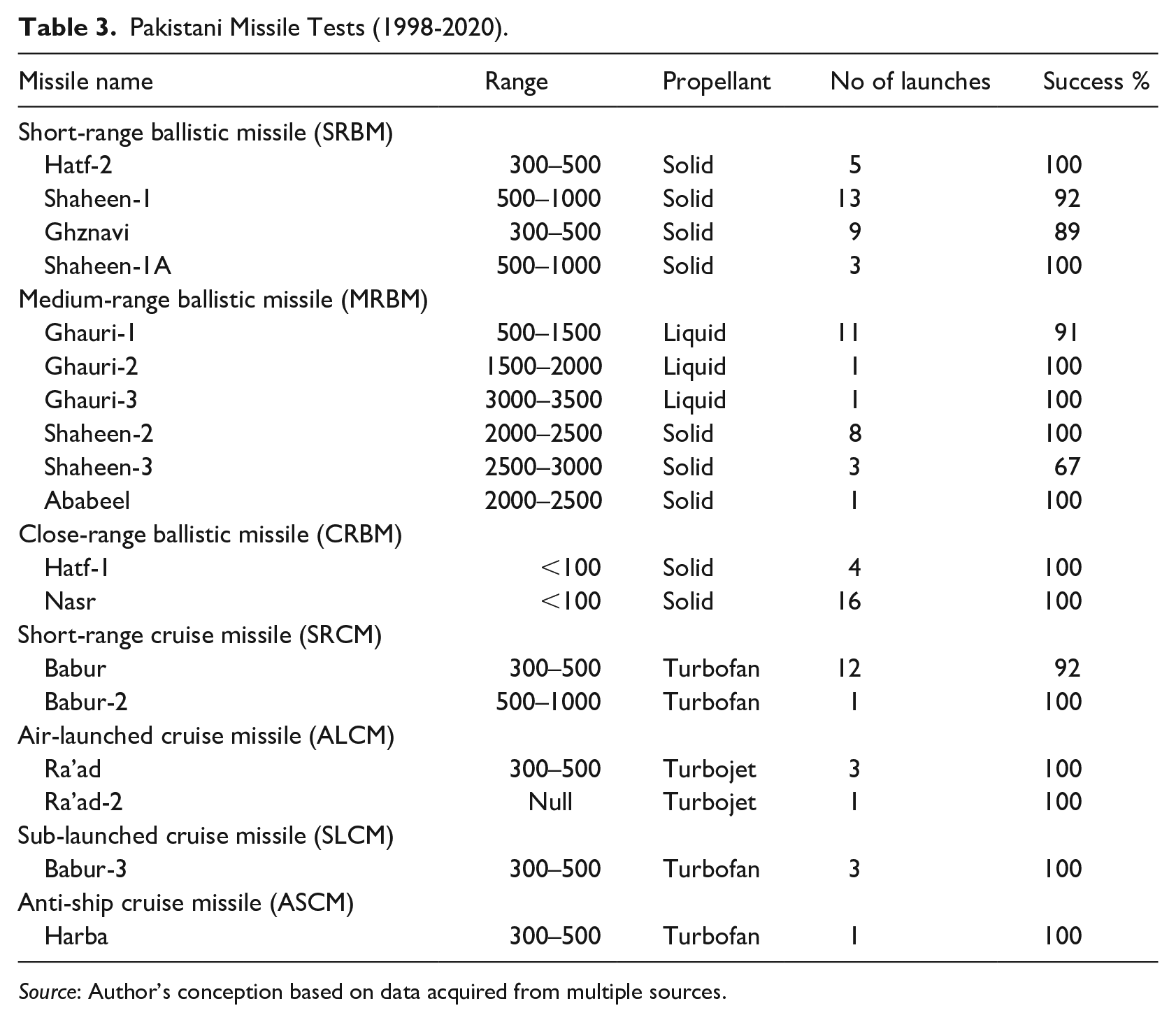
Table 3 details the missile systems Pakistan has tested since the overt nuclearization in 1998. The overall success rate of Indian missile tests is 95%.
Pakistani Missile Tests (1998-2020).
Source: Author’s conception based on data acquired from multiple sources.
A closer look into Figure 3 reveals that Pakistan’s missile systems may show that 94% of overall missiles tested so far have given successful outcomes. Whereas 31% short-range ballistic missiles (SRBM), 26% medium-range ballistic missiles (MRBM), 20% close-range ballistic missiles (CRBM), 14% short-range cruise missiles (SRCM), 4% air-launched cruise missiles (ALCM), 3% sub-launched cruise missiles (SLCM), and 2% anti-ship cruise missiles (ASCM). Among these missiles, SRBM Shaheen-1 and Ghaznavi have been tested 13 and 9 times, respectively. MRBM Ghauri-1, CRBM Nasr, and SRCM Babur have been tested multiple times in other missile systems. The percentage of tested missiles shows that Pakistan’s focus is on SRBMs, MRBMs, and CRBMs. It means that Pakistan’s target strategy is to bring entire Indian cities into its strike envelope.
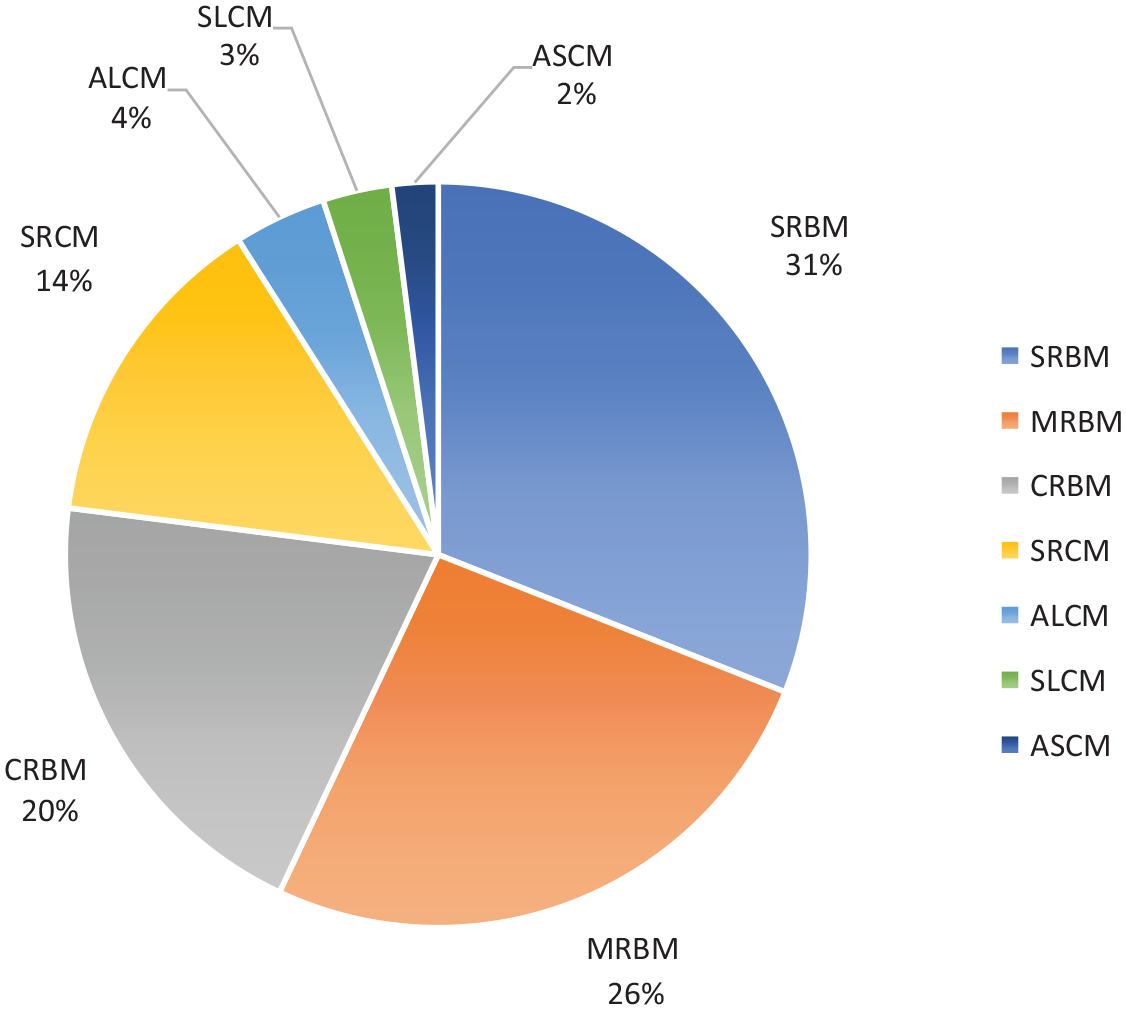
Percentage of Pakistani missile systems tested.
Even though both states had a technological requirement to develop longer-range delivery means capable of reaching targets beyond their shared borders, action–reaction dynamics were at play. Subsequently, India tested variants of Agni ballistic missiles, whereas Pakistan tested variants of Ghauri and Shaheen ballistic missiles. However, there was no evidence of action–reaction dynamics in the case of cruise missile development. India started testing its cruise missile Brahmos in 2001, whereas Pakistan started testing its cruise missile Babur in August 2005. Pakistan’s race to balance India against its advanced work on its cruise missile capabilities to ensure Pakistan’s minimum deterrence (Ahmed, Interview by author, edited by Iftikhar Ali, February 26, 2020).
The existing action–reaction dynamics started fading away by the end of 2006. With the sustained economic progress in India and the Indo-US nuclear deal, India increased its military expenditures. Missile tests were conducted twice as those tested by Pakistan. Whereas the Global War on Terror in Afghanistan and the subsequent increase in terrorism have badly affected Pakistan’s economy. However, the Indian Cold Start Doctrine influenced Pakistan to develop missiles such as Nasr are part of its full spectrum deterrence to neutralize any perceived deterrence gap below the nuclear threshold. Pakistan has conducted over 16 tests of Nasr since the declaration of the Indian CSD to demonstrate its capability of neutralizing any warfighting strategy below the nuclear thresholds.
India and Pakistan have tested and refined their missile systems in two decades. Although repeated tests indicate that both countries are sharpening their arsenal for achieving precision and accuracy, at the same time, these tests cannot be considered in isolation. There is an action-reaction dynamic between India and Pakistan regarding testing their delivery means pushes their technological advancements. There also exists a factor of security trilemma whereby India pursues the development of IRBMs and ICBMs that are more applicable to deter China than Pakistan. The security trilemma outpaces and undermines India and Pakistan's deterrence capabilities and falls prey to an enduring nuclear arms race. It may not be wrong to argue that the ongoing arms race in South Asia is a product of competing strategies, mistrust, the introduction of new technologies, and absence of conflict resolution mechanism. (Qaisar, Interview with the Author. edited by Iftikhar Ali, Islamabad, October 11, 2021).
The Sino-US strategic competition in the Indian Ocean Region (IOR) and the respective patronage of Pakistan and India have increased the risks of mistrust and the formation of an alliance system in the Cold War patterns. In the milieu of such a partisan, the United States and China would not be available for crisis management. Thus, any crisis triggered between India and Pakistan may escalate to a nuclear level. These developments make the atomic geometry of South Asia very complex as measures taken to enhance stability by one party have often been considered factors of instability by the others. “Traditionally, the United States played its role as crisis manager between India and Pakistan. However, the Sino-US rivalry in the IOR, formation of the Quad, China-Pakistan vs US-India alignments has further complicated the security matrix in South Asia” (Muhammad, Interview with author, edited by Iftikhar Ali, Islamabad, October 11, 2021).
Most importantly, the Indian procurement of the Russian S-400 will have a more destabilizing impact on the ongoing arms competition between India and Pakistan and the strategic stability in the region. India has started receiving S-400 Triumf surface-to-air missile defense systems from Russia which is Russia’s most advanced multichannel long-range surface-to-air defense missiles system (ADMS). The US$ 5.2bn deal was signed during the 17th Indo-Russia Summit in Goa in 2016 and concluded in 2018. On November 14, 2021, Russia’s Director of the Federal Service for Military-Technical Cooperation (FSMTC), Dmitry Shugaev, announced that “the supplies of the S-400 air defense system to India have started and are proceeding on schedule”(Sputnik, 2021). As per the contract, India received five regiments (each regiment carries two battalions). Out of which three regiments will be deployed against Pakistan, whereas two will be stationed at the border with China, one each on the western and eastern sectors of the Line of Actual Control (LoAC). (Abbasi and Khan, 2019)
The S-400 has also been acquired by seven countries, including China and Turkey, which can track and destroy incoming missiles, drones, and hostile aircraft within a range of up to 400 km. The system consists of a long-range target acquisition radar, a command post vehicle mounted on multi-axle, and multi-wheel transporters capable of moving on rough terrains. The delivery of S-400 systems has angered the United States. Usually, the United States imposes sanctions under the Countering America’s Adversaries Through Sanctions Act (CAATSA) against the countries in trade with Russia (Philp, 2021).
Pakistani response against the Indian acquisition of S-400 BDM capability would be developing and acquiring capabilities that may render S-400 systems ineffective. Soon after the Indo-Russian Summit of 2016 in Goa and the subsequent agreement on the S-400, Pakistan successfully conducted its first surface-to-surface ballistic missile Ababeel. According to a press release by ISPR, the ballistic missile Ababeel is capable of carrying nuclear warheads and can engage multiple targets with high precision, defeating the enemy’s hostile radars. The development of the Ababeel Weapon System aims to ensure the survivability of Pakistan’s ballistic missiles in the growing regional Ballistic Missile Defence (BMD) environment. This will further reinforce deterrence. (ISPR 2017)
It can be pointed out that in response to the Indian BMD system, Pakistan may focus on the attainment of Multiple Independently-targetable Re-entry Vehicles (MIRV) capabilities. The development of Ababeel Missile Systems has the MIRV capability and ability to address threats from the Indian acquisition of destabilizing weapons such as S-400 BMD systems. The test of Ababeel is a manifestation of the Pakistani quest for strategic stability against Indian military modernization. Together with SLBM Babur-3, Ababeel provides Pakistan with second-strike capability. Pakistan’s pursuit of a successful demonstration of MIRV technology confirms that it is on the path of a qualitative augmentation of its missile program against the emerging security threats in its neighborhood.
Aircraft assessments
India and Pakistan both are believed to have a nuclear triad of delivery means. A nuclear triad means the nuclear delivery systems are based on air, sea, and land. The arms competition between India and Pakistan is not limited to missiles only. They are competing to modernize their respective air forces. Before the Prithvi-II nuclear-capable ballistic missile fielding, the most reliable systems for India’s nuclear-capable aircraft were Mirage 2000H with a range of 1850 km, and Jaguar IS/IB with a range of 1600 km. By no means IAF is limited to these two aircraft. It has over 1000 aircraft, mostly Russian aircraft made in Russia or locally produced with a Russian license. The largest IAF fleet of these Russian aircraft consists of various Russian SU-30s explicitly made for India, including MiG-21, MiG-29, and Su-30MKI. The IAF inventory is not limited to Russian models. The IAF has also acquired some European aircraft models such as Jaguars, Mirage 2000, and Rafale fighter aircraft from French manufacturer Dassault. Although IAF is better equipped and maintains numerical superiority against Pakistan, it faces qualitative and quantitative disadvantages in tackling the challenge of Pakistan’s possible collusion with the Chinese air force (Pant and Sing, 2020). It is estimated that India will receive a total of 36 Rafale fighters which are used for nuclear missions in France. The Rafale fleet will be deployed in two equal-sized squadrons of 18 fighters and four dual-seat trainers: one squadron (17th Colden Arrows Squadron) at Ambala Air Base Station, located only 220 kilometers from the Pakistani border, and the other squadron (101st Falcons Squadron) at Hasimara Air Force Station in West Bengal. (Kristensen and Korda, 2020)
Based on its economic position, Pakistan cannot compete against IAF quantitatively; however, it maintains a qualitative competition by mustering enough airpower to tackle any challenge posed by IAF. This capability was demonstrated by Pakistan Air Force (PAF) during IAF air sorties against Pakistan during February 2019 crisis that resulted in one Indian MiG-21 Bison being shot down by PAF. Pakistan’s Mirage-III and Mirage-V fighter squadrons are the most likely nuclear-capable aircraft in PAF inventory. PAF Base Masroor and PAF Base Rafiqui near Karachi and Sialkot house the Mirage fighter bombers. The former houses the 7th, 8th, and 22nd Mirage Squadrons, and 32nd Wing, whereas the latter is home to 34th Wing and two 15th and 27th Mirage Squadrons. At the same time, the F-16A/Bs supplied by the United States during the mid-1980s is based at Mushaf Air Base at Sargodha, which houses 38th Wing along with 9th and 11th Squadrons. The newer versions of F-16 C/Ds are based at Jacobabad’s Shahbaz Air Base, which houses the 39th Wing and 5th Squadron (Mujaddid, Interview with the author, Islamabad, February 22, 2020). ALCM Ra’ad-II has been tested on Mirage-III over six times, and according to ISPR, the last test was conducted in 2020, “which significantly enhances air delivered strategic standoff capability on land and at sea. . . equipped with state-of-the-art guidance and navigation systems ensuring the engagement of the targets with high precision” (ISPR, 2020).
Since Mirage aircraft are older and modified versions, Pakistan has started replacing the new premier multirole fighter JF-17 aircraft co-produced with China. Besides, it is not confirmed whether JF-17 is tasked with nuclear capabilities; it features a variety of air-to-ground and air-to-air munitions, missiles, and cruise missiles. The integration of such capabilities could prove a formidable opponent for Indian aircraft with first-generation R-77 missiles (Gao, 2021). Further to counter the Indian acquisition of Rafale, Pakistan has recently inducted J-10C multirole fighter jets. The Chinese-built J-10C variant is equipped with Active Electronically Scanned Array (AESA) and is capable to carry missiles which has a far wider utility for PAF to address the conventional imbalance against India. The acquisition of J-10C fighter jets from China confirms that its full-spectrum deterrence posture will work in response to deny Indian air superiority (Iqbal, 2022).
Naval arms race
The development of sea-based deterrence completes the third dimension of nuclear deterrence. The submarines at sea are the most survivable second-strike nuclear force available to any state. States require an atomic submarine called SSBN (Ship, Submersible Ballistic, Nuclear) to launch a ballistic missile. In the South Asian security milieu, maritime nuclear deterrence is a recent development. While India has marked the completion of the successful establishment of its nuclear triad, Pakistan’s maritime nuclear capability remains at an embryonic stage. The rapid modernization and increased prowess of Indian blue-water capabilities in the IOR originated mainly to counter China and deter Pakistan. Still, it is also to gain regional and global power status. Chinese strategy of the “Strings of Pearls” (Ashraf, 2017), the MSR as a component of BRI, and the development of Gwadar port under China-Pakistan Economic Cooperation (CPEC) undermines and poses threats to Indian interests and influence in the IOR(Lobo, 2021). Primarily, the Indian maritime strategy is to deter China while focusing on deterring or defeating Pakistan. Rajagopalan believes that Indian desires in this regard “are part of its larger goal of achieving a big power status than a carefully considered maritime strategy” (Rajagopalan, 2016). Because of emerging challenges and India’s larger ambitions, India is also engaged with the United States and France through strategic agreements for Indian access to port facilities at respective ports on Diego Gracia (Panda, 2016) and Reunion Island (Das, 2019). The informal Quadrilateral Security Dialogues known as the Quad is also an extended Indian strategic outreach to the United States, Australia, and Japan.
As far as sea-based deterrence is concerned, it was envisioned in the Indian Draft Nuclear Doctrine (DND) in 1999 that India’s nuclear “forces will be based on a triad of aircraft, mobile land-based missiles, and sea-based assets” (Government of India (GOI), 1999). The maritime context of DND is extended in successive reiterations of Indian maritime doctrine initially published in 2004 and updated in 2007, 2009, and 2015. In 2015, India published its naval strategy document named “Ensuring Secure Seas: India’s Maritime Strategy,” which shows India’s political and military thinking. The strategy emphasizes the importance of adopting naval deterrence. Furthermore, it stresses the vitality of controlling the Sea Lines of Communications (SLOC) as a part of the Indian maritime strategy (Indian Navy, 2015). The Indian Navy has achieved tremendous progress in the last couple of decades. It is now among the top 10 world naval powers and operates 16 submarines, including two nuclear-powered submarines. It has more than 67,000 active personnel, including 10,000 naval officers and 57,240 sailors (Kumar, 2020b). In addition to producing vessels indigenously, India has also imported submarines from technologically advanced countries such as Russia, France, and Germany. On November 5, 2018, India announced that its nuclear-powered ballistic missile-carrying submarine (SSBN), INS Arihant, armed with Sub-launched Ballistic Missiles (SLBMs), has achieved the milestone of completing a month-long deterrence patrol (Patel, 2020). INS Arihant is reportedly capable of carrying four K-4 SLBMs or 12 K-15 SLBMs. K-4 and K-15 SLBMs have a range capability of around 3500 and 700 km, respectively. In addition, it can launch cruise missiles like Brahmos (Davenport, 2020). India is building another SSBN INS Arighat, which is expected to be commissioned by the end of 2021.
At the same time, the Indian Navy is expected to receive two modified Admiral Grigorovich-Class guided missile frigates by 2024 (Muraviev, 2018). INS Arighat has a more powerful nuclear reactor and can carry 24 K-15 missiles or eight K4 missiles (Kristensen and Korda, 2022). India’s Maritime Security Strategy of 2015 gives immense importance to SSBNs as a part of its nuclear deterrence. It states that the stealth characteristics of SSBNs enable “discrete and prolonged deployment and combat capabilities including weapon outfit, provides a credible, effective and survivable capability and contribute to the assurance of punitive retaliation following our nuclear doctrine” (Indian Navy, 2015). Moreover, India is working to build up its second-strike capability, which includes the construction and upgradation of Scorpion class submarines with the help of France for an estimated cost of US$ 4.6 billion (Jalil, 2018). The Indian Navy has a nuclear-powered submarine INS Chakra (SSN) armed with torpedoes and anti-ship missiles. It has a substantial fleet of frigates with several radars and stealth features, including domestically built INS Shivalik-Class frigates. INS Shivalik-Class frigates can launch the nuclear-capable SRBM Dhanush and Brahmos, thus completing the third leg of its nuclear triad (Kumar, 2020a). Other frigate classes in the Indian Navy include advanced single-arm launcher Talwar, Brahmaputra, and the Godavari. The changing contours of Indian maritime strategy and increasing ability to straddle naval force projection are inextricably linked with South Asia’s changing balance of power.
As far as Pakistan is concerned, it has established a Naval Strategic Force Command that oversees its second-strike capabilities. Pakistan has vital strategic and maritime interests, which it feels are seriously challenged by the Indian Navy’s conventional superiority. Pakistan perceives that the Indian second-strike capability is a disturbing element for the strategic balance in the region. To ensure the credibility of its deterrence, Pakistan has to acquire a matching sea-based second-strike capability at any cost. In this regard, Pakistan’s quest is to improve its navy, the long-ignored branch of its armed forces. Pakistan’s attention on its maritime role in the regional oceans has traditionally been the least prioritized. Pakistan Navy continues to operate with the most negligible share out of the total defense budget for the fiscal year 2021–2022. Pakistan Navy is allocated the smallest percentage of the pie with Rs.148.7 billion (10.85%) compared to Rs.651.5 billion (47.5%) and Rs. 291.2 billion (21.26 %) for Pakistan Army and Pakistan Air Force, respectively. Remaining Rs. 278.5 bn (20.32%) are allocated to inter-services organizations (Syed, 2021).
Pakistan Navy has French-designed two Agosta-70 and three modern Agosta-90B submarines. Of the three Agosta-90B, the first (Khalid-class PNS137) was built in France, whereas the second (Saad-class PNS138) and the third (Hamza-class PNS139) were built in Pakistan under the Transfer of Technology (ToT) agreement with France. Agosta-90B is a diesel-electric attack submarine (SSK) that is considered the backbone of the Pakistan Navy, equipped with air-independent propulsion (AIP) system with a modern design and improved battery performance. Comparatively, Agosta-90B has a 200%–400% increased submerged range and can launch torpedoes and Exocet SM39 anti-ship missiles (AShM) (Sodhi, 2016).
However, since the last decade, Pakistani policymakers have started giving serious consideration to the upgradation of its navy. In 2009, Pakistan inducted PNS Zulfiqar, the first of four F-22P class frigates, purchased from China (Chawla, 2015). The next biggest purchase was made through a ToT agreement with China Shipbuilding Industry Corporation (CSIC) and Karachi Shipyard & Engineering Works (KSEW) in 2015 for five billion USD. Under this deal agreement, China is constructing four out of eight 39 Yuan-Class attack submarines in Pakistan, slated for delivery by 2023. The remaining four vessels will be built in China and delivered by 2025–2028.
In another significant development, Pakistan signed a contract with China to deliver four Type-054A/P frigates in 2017–2018. Pakistan Navy commissioned the first of four 054A/P frigates on November 08, 2021. It is equipped with advanced combat management and electronic warfare technologies along with state-of-the-art self-defense capabilities. It is named PNS Tughril, and according to media reports, official illustrations of the Type 054A/P in 2018 showed either a two-by-three or two-by-two cell suite for anti-ship cruising missiles (ASCM). This modification could be compatible with Pakistan’s locally manufactured “Harbah” dual-ASCM/land-attack cruise missiles (LACM). If derived from the Babur LACM (which is likely), the Harbah ASCM/LACM should have a range of 450 km to 700 km-plus. (Archus, 2021)
Pakistan is working on survivability and assured second-strike capability by arming its SLCMs. Air Commodore (retd) Dr. Ghulam Mujaddid (Interview with the author, Islamabad, 2020) believes that overall we are in a competitive deterrence relationship with India. Although Pakistan Navy (PN) lacks superiority or balance against the Indian Navy (IN) in terms of numbers or technology, it maintains the resolve for maritime combat against India if the need arises. Pakistan established the Naval Strategic Force Command in 2012, which is tasked to develop Pakistan’s second-strike capability that would ensure a sea-based nuclear deterrence.
The naval constituent of Pakistan’s deterrence consists of the SLBM Babur-3 cruise missiles tested in 2017. SLBM Babur-3 cruise missiles range from 300 to 500 miles, whereas Babur-1 is a land-based cruise missile, and Babur-2 is deployed on land and sea. These missiles use Terrain Contour Matching (TERCOM) and Digital Scene Matching and Area Co-relation (DSMAC) navigation technologies due to which it is challenging to neutralize (Mizokami, 2021).
Conclusion
It can be concluded that the race between India and Pakistan is not a classic example of an arms race. It is fraught with ambiguities and inequalities. The growing Indian strategic cooperation with the developed and technologically advanced countries, especially the United States, Australia, and Japan (The Quad) vis-à-vis Pakistan’s relationship with China is creating a more complex dynamic of the strategic equation in South Asia. Both India and Pakistan have different threat perceptions and security objectives. They are running on a track that has no definite stop. It can be called a “competition” rather than an “arms race.” Pakistan is competing against India, and India is competing against China to ensure its deterrence.
The Indian superiority over Pakistan in missiles, air, and naval technologies will remain for some time. However, instead of racing in all categories and variants of the armaments, Pakistan would prefer to close the gap through qualitative improvements while maintaining its minimum credible deterrence. Thus, Pakistan’s quest for arms race stability can be understood as a subset of its large-scale perspective of strategic stability in South Asia. India races ahead in the competition for military and technological advantage over Pakistan, whereas Pakistan responds to India by arming too. This creates a dangerous cycle of actions and reactions responsible for ongoing instability in the region. Even though competition does not prevent war, it may be the best available option for Pakistan under certain conditions. Since arming in deterrence, and preparedness may not deter a potential adversary and guarantee peace; it could still be the best bet for a defending state.
Footnotes
Funding
The authors disclosed receipt of the following financial support for the research, authorship, and/or publication of this article: The research was supported by the Institute of Research Management & Services (IPPP) University of Malaya, Kuala Lumpur, Malaysia, and Karakoram International University, Gilgit, Pakistan.
