







Abstract
Both democracy and the legislature in Africa are emergent and require scholarly investigations to understand them. Therefore, this paper investigates the contextual configuration of Nigerian Senate debates (henceforth, NSD), paying particular attention to how legislators orient to the macro-context of this institutional discourse. The data comprise a 1.9 million-word corpus of NSD subjected to quantitative and qualitative discourse analysis. While the quantitative approach provides information on key semantic domains, concordance and collocational data, the qualitative analysis relies on a partial theory of the context models of parliamentary debates and the concepts of appropriateness and common ground. The components of the macro-context of NSD comprise context as social domain subcategorized into institutional setting, actors and goals, and context as social actions subcategorized into the global actions of legislation, representation and oversight function, respectively. The paper argues that legislators make explicit, through specific cognitive pragma-linguistic devices, their knowledge of aspects of the context of NSD they consider relevant for engaging in, and interpreting ongoing interaction, especially when something goes wrong.
Introduction
The emergent nature of democracy and the legislature in Africa and Nigeria has been documented in the literature (Barkan, 2009; Inya, 2021, 2022). Since the legislature in Nigeria’s Fourth Republic is emergent (1999 till date), it becomes pertinent to characterize how its (discursive) activities are undertaken by legislators. In other words, the paper examines how Nigerian legislators ‘do politics/legislation’ in the Nigerian Senate. Specifically, we investigate the contextual configuration of Nigerian Senate debates (henceforth, NSD), paying particular attention to how legislators orient to the macro-context of this institutional discourse. In their seminal work on rethinking context, Duranti and Goodwin (1992) aver that investigating context should involve examining the phenomenon from the perspective of ‘an actor actively operating on the world within which he or she finds him-or herself embedded [as well as] describing the socio-historical knowledge that a participant employs to act within the environment of the moment’ (Duranti and Goodwin, 1992: 5). Accordingly therefore, this paper analyses the context of NSD by examining the aspects of this institutional environment that legislators orient to as relevant for contextualizing ongoing interactions. We will argue that legislators make explicit, through specific cognitive pragma-linguistic devices, their knowledge of aspects of the context of NSD they consider relevant for engaging in, and interpreting ongoing interaction, especially when something goes wrong.
Furthermore, the question of the context of NSD is pertinent precisely because there is the need to clearly characterize, from a discourse-pragmatic perspective, this particular discourse domain in terms of its constitutive features. In other words, the current study examines how the socio-historical, political, cultural and discursive dimensions of the context of NSD constrain meaning construction and define its genre status. Take the socio-historical realities of the Nigerian state as an instance, particularly the repeated military interventions that abruptly truncated democratic experimentations (Ehwarieme, 2011: 494). The military interventionists privileged the executive arm of government and proscribed the legislature, and entrenched the impression that the most important, and consequently, the most powerful arm of government was the executive (Aiyede, 2005: 75). This impression, which has been carried into the Fourth Republic, remains a dominant contextual variable in legislative interactions in the Nigerian Senate, particularly with regard to the tension it creates between the two arms, and how the executive arm of the Nigerian government is constructed in NSD, relative to the legislature and the implicatures that are derived therefrom.
Likewise, the socio-political situation of Nigeria as an emerging democracy, overshadowed by previous military interventions, and the fear of a possible future destabilization of democracy, tainted by deep-rooted corruption, electoral malpractice, weak institutions, leadership crisis and a domineering executive also underpins how debates are carried out in NSD. The constituents of this home-grown (un)democratic culture are in constant tension with the established patterns of ‘doing’ legislation, deliberation or representation standardized by older, Western democracies, such that legislators in the Nigerian Senate are sometimes in a tug-of-war between yielding to their primordial political instinct that privileges self-preservation and personal aggrandizement, and their duty as the people’s representatives in the parliament (Inya, 2018). All these issues, reformulated in contextual terms, constrain the kinds of meaning constructed in NSD.
Previous studies that have examined the context of parliamentary/legislative debates include Van Dijk (2004, 2008) Carbó (2004) and Dupret and Ferrié (2008). Dupret and Ferrié (2008) argue that the context of parliamentary debates consists of constraints that surround and shape the interaction. They draw from a debate in the Syrian parliament and aver that Members of Parliament orient to three constraining contextual features as a way to contextualize ongoing debates; namely, ‘orientation to audiences, search for legislative relevance, and reference to, and use of, procedural rules’(Dupret and Ferrié, 2008: 960). This paper shares with Dupret and Ferrié (2008) in their construal of the context of parliamentary debate as constraints that legislators discursively orient to, but disagrees with their theorizing of context strictly as what is ‘publicly available and empirically observable in the course of exchanges constituting and embodying parliamentary activities’ (Dupret and Ferrié, 2008: 960). This conceptualization is rather restrictive and excludes the socio-cognitive dimensions (background knowledge, socio-cultural/political/historical common grounds, etc.) that underscore legislative debates. We maintain that these socio-cognitive aspects that background what is publicly and procedurally consequential during debates are equally important for the context of parliamentary debates (cf. Inya, 2018; Van Dijk, 2004). In fact, we demonstrate how legislators evoke this knowledge about the context of NSD when the discursive and political activities of fellow legislators run contrary to shared expectations.
Furthermore, Van Dijk (2004, 2008) analyses the contextual configuration of legislative debates through his theory of context models (Van Dijk, 1999, 2008). Van Dijk (2004) conceptualizes the context of parliamentary debate thus: ‘a debate is a parliamentary debate precisely because it is carried out as taking place in the institution of parliament, as part of legislation and as “doing politics”’ (p. 354). This definition serves as a point of departure for our examination of the context of NSD. Moreover, Van Dijk’s (2004) is a theory-driven endeavour, which draws on fragments of debates to illustrate theoretical points. However, this paper examines the Hansard of entire legislative sessions of NSD compiled into a corpus of 1.9 million words and investigated through an innovative methodology that combines a corpus linguistic approach and qualitative discourse analysis.
Most of the previous studies on legislative discourse have studied the subject matter in the Global North (cf. Bayley, 2004; Ilie, 2015). This is informed by the long history of parliamentarization of political institutions in Europe (Ihalainen et al., 2016), and the long-standing democratic culture of North America. In the Global South, however, especially in Nigeria, and Africa, both democracy and the legislature are just emerging – 1999 to date. The paucity of scholarly works on legislative discourse in emerging democracies calls for an urgent critical attention. This is because the legislature plays a significant role in the sustenance of democracy and the rule of law. Previous linguistic studies on Africa’s emerging legislatures are few and have examined gendered discourse in the Cameroonian parliament (Atanga, 2010); politeness in Kenyan parliamentary debates (Ambuyo et al., 2011); appraisal and argumentation in Zimbabwean parliamentary discourse and its recontextualization in newspapers (Jakaza, 2013); and apologies in the Ghanaian parliament (Sarfo-Kantankah, 2021). In Nigeria, there are even fewer studies that have investigated conversational and discursive strategies in two State Houses of Assemblies (Ayodele, 2010; Oyeleye & Ayodele, 2012); meaning construction and ideology, proximization strategies, metaphor scenarios for democracy in NSD (Inya, 2018, 2021, 2022). This paper continues this trend of seeking to understanding legislative discourse in Africa (cf. Barkan, 2009) by investigating the macro-contextual features of NSD of the Fourth Republic (1999 till date).
Theoretical framework
The theoretical framework of this paper is constituted by insights from Van Dijk’s theory of context models and his partial theory of parliamentary debates (Van Dijk, 2004), Fetzer’s (2004) concept of appropriateness and the concept of common ground (Clark, 1996; Clark and Marshall, 1981). Van Dijk (2004: 349, emphasis in the original) construes context ‘as a mental representation, or model, constructed by the speech participants of or about (. . . a social) situation’. Van Dijk (2004, cf. 1999) argues that properties of social situations, for example, gender, age, group membership, do not directly influence discourse, only aspects that discourse participants discursively construct or orient to as relevant contextualize ongoing interaction (cf. Drew and Heritage, 1992). The construct of the aspects of social situations relevant for contextualizing ongoing interactions is termed a context model. Van Dijk (2004), therefore, theorizes that the context models of participants of parliamentary debates should include macro-level categories such as domain, global actions and institutional actors (IAs), and micro-level elements such as the setting, local actions, participants and cognition. We will, therefore, argue that aspects of the context models of legislators in NSD feature such categories as the social domain of the discourse (comprising institutional setting (IS), IAs, etc.) and their social actions. Legislators orient to these categories as relevant for contextualizing their discursive activities.
Fetzer (2004) avers that the concept of appropriateness is a pragmatic construct that speaks to the contextual constraints of a given communicative genre that serve as the backdrop against which appropriate communicative actions are evaluated. In other words, as a communicative action is on-going its contextual framework constantly checks to ensure that that action meets the expectations set up by the components of its contextual constraints. Following this, we will argue further that the context of NSD comprises legislators’ knowledge of what constitute appropriate communicative and socio-political actions, and how this knowledge is presupposed and/or oriented to by them. The orientation to these knowledge structures takes the form of evoking them when a discourse structure conflict (henceforth, DSC) occurs, namely, discursive and political acts that undermine the relevant contextual expectations and constraints of the interaction.
Presupposed or shared knowledge is the thrust of the concept of common ground (Clark, 1996: 12). According to Clark and Marshall (1981), common ground between interlocutors is established through physical and linguistic co-presence as well as mutual knowledge warranted by common membership of cultural communities. Physical co-presence refers to the information that is shared by interlocutors by virtue of being in the same physical/perceptual environment (joint perceptual experiences and joint actions cf. Clark, 1996), while linguistic co-presence is the information that is derived from interlocutors’ previous and current conversations. The third evidence for common ground, which is the mutual knowledge warranted by common membership of a cultural community, simply refers to the shared socio-cultural/historical knowledge interlocutors have by being members of the same community. The paper will demonstrate how legislators deploy these mechanisms of common ground as they orient to the contextual features of NSD.
Methodology
The data for the article comprise a 1.9 million word corpus of NSD (cf. Inya, 2018, 2021, 2022). The details of the corpus construction are provided in Inya (2018: 59–60). Briefly, the corpus was compiled from the Hansard of the plenary sessions of the Nigerian Senate between 2009 and 2015. This period was characterized by legislative stability and productivity for the Nigerian Senate (Inya, 2018). In compiling the corpus, we converted the Hansard data (originally in PDF) into text files for processing by Wmatrix (Rayson, 2008). We adopted a mixed method for the analysis: a qualitative discourse analysis that relied on the theoretical framework explicated in the ‘Theoretical framework’ section, and a quantification analysis, which examined key semantic domains, concordance and collocational features of the data. Specifically, the data were run on Wmatrix (Rayson, 2008) and the key semantic domains or key themes that characterized the corpus were identified. It is from this stage of the analysis that postulations about context as the social domain of NSD were made. Then the keywords that signalled the social actions (e.g. legislate*, represent*, and oversight*) were searched to get the raw frequencies of their occurrence as well as the collocational patterns they exhibited. The quantification allowed generalizations across the data examined to be made, and these are featured in the qualitative discourse analysis of representative examples.
Analysis and discussion
Context as social domain of NSD
Context as social domain (CASD) of NSD is defined as the knowledge, both personal and shared, of normative conditions under which legislative interactions take place, and how the awareness of these conditions by participants constrains what they can and cannot say or do, as well as how they represent the knowledge in discourse (cf. Mey, 2001; Van Dijk, 2004: 352). Similarly, Drew and Heritage (1992: 22) argue that ‘[i]nstitutional interaction may often involve special and particular constraints on what one or both of the participants will treat as allowable contributions to the business at hand’. The components of CASD include the IS, IAs and institutionalized goals (IGs) of NSD. Legislators orient to these three categories as constraints that contextualize ongoing debates, especially when a DSC occurs. This understanding of context as constraints is corroborated by the findings of Dupret and Ferrié (2008: 967; cf. Drew and Heritage, 1992). Furthermore, Van Dijk (2004) argues that ‘[a]n empirical theory of context also needs to specify which of the categories are general and perhaps universal, and which ones are culturally variable’ (p. 352). Therefore, while this paper shares with the works of Drew and Heritage (1992), Van Dijk (2004) and Dupret and Ferrié (2008) the idea of context as constraints by the institutional framework of the discourse type, this paper indicates the specific socio-cultural variables, especially the emergent nature of democracy in Nigeria, the various components of the category of IAs that legislators foreground as contextually relevant for ongoing interactions in NSD. In addition, as a macro-level context category, CASD and its constitutive knowledge may remain implicit, until a DSC act occurs, then the implicit knowledge is made explicit through specific pragma-linguistic mechanisms, with the goal of resolving the conflict. We now turn to the sub-categories of CASD.
IS of NSD
The IS of NSD comprises the socio-political, formal and organizational institutions that frame legislative interactions in the Nigerian Senate. For instance, the Nigerian Senate is a law-making institution, and this presupposes some socio-culturally shared assumptions and pieces of knowledge: one, it implies that Nigeria is a democratic nation, which further implies that there is separation of powers among the three organs of government, namely, the legislature, executive and the judiciary (cf. Sections 4–6 of the 1999 Constitution). Furthermore, the knowledge that the Nigerian Senate is a legislative institution in a democratic setting implies that the rule of law, accountability to electorates and party leaders, adherence to the constitution and the Senate Standing Orders, and the need for deliberation before decision-making are cardinal principles that shape interactions. Frequently, this understanding of the IS of NSD as a legislative body steeped in a democratic culture is evoked during debates to perform a number of functions, but predominantly to call out inappropriate behaviour as is seen in (1).
The real issue at stake in (1) is the question of shared knowledge or common ground and its representation regarding the voting that was done the previous day. On one hand, Sen. Omoworare is accused of misrepresenting this common ground to the media, and on the other hand, (1) the President of the Senate is attempting to ascertain whether or not there was a mutual understanding about the said vote, (2) so as to properly reprimand the erring Senator. He goes about (1) in two ways, namely, evoking common ground or presupposed knowledge through co-presence heuristics, and then through community membership-based knowledge (Clark and Marshall, 1981). First, the President tries to establish common ground with other senators present through physical and linguistic co-presence, precisely prior physical and linguistic co-presence with their auxiliary assumptions of simultaneity, attention, rationality, recallability and understandability (Clark and Marshall, 1981: 39–40). This strategy of seeking common ground by evoking co-presence is realized by ‘Even though he is not around, is there anyone here whose position yesterday was not properly and correctly reflected from the Votes and Proceedings?’ ‘He’ anaphorically refers to Sen. Omoworare, who is said not to be in the immediate co-presence. The President then proceeds to find out, through the existential presupposition ‘is there’, if anyone in the immediate co-presence, marked by the spatial deixis ‘here’, did not have their position reached in the prior co-presence ‘yesterday’, ‘properly and correctly reflected from the Votes and Proceedings’.
Other Senators in the immediate co-presence give a dispreferred response to Mr President’s question ‘(No response)’; thereby, defeating his attempt to establish common ground through co-presence. Mr. President sensing the pragmatics of silence among the senators, now evokes common ground by invoking community membership-based knowledge namely ‘democracy demands that we are honest with ourselves’, and he argues that anyone who does not act in consonance with this precept of democracy cannot be said to be ‘a very distinguished Senator of the Federal Republic’. Thus, by evoking this community membership-based knowledge, which has been classified here as an aspect of the IS of NSD, Mr. President is able to reprimand Sen. Omoworare, by implicating that his is not ‘a very distinguished Senator of the Federal Republic’. That the foregoing is true is evidenced by the fact that the main thrust of Sen. Omoworare’s response is a declaration that he shares in the community membership-based common ground of the Nigerian Senate, and therefore, he is ‘a very distinguished Senator of the Federal Republic’.
What then is the strategy that underlies (1)? It is establishing common ground or presupposed knowledge through co-presence, and if that fails, through evoking community membership-based knowledge, for example, aspects of IS, which is a component of CASD. Furthermore, the strategy is realized through referring expressions, specifically definite descriptions, deictic, and anaphoric expression, which are markers of presupposition and common ground (Culpeper and Haugh, 2014). In the remainder of this subsection, we consider factive verbs, especially the epistemic factive verb ‘know’, indicating how they make explicit community membership-based knowledge, as a way of resolving DSC, with particular reference to IS. A DSC is a discursive act that undermines the normative conditions that warrant an interaction, such as the uncomplimentary remark attributed to Sen. Omoworare in (1).
Factive verbs are said to trigger presupposition to the extent that they presuppose the truth of the message conveyed in their sentential complements (Spenader, 2002). In other words, when a factive verb is used, the speaker is construed as being committed to the truth of the proposition expressed (Lyons, 1977: 599). On the whole, we argue that through the epistemic factive verb ‘know’, legislators make explicit different typologies of knowledge considered contextually relevant for an ongoing debate. Van Dijk (2003) argues that one way that the factive verb ‘to know’ triggers presupposition is to make explicit knowledge that is shared, and this is a motivated usage since shared knowledge is by default implicit. The motivation for the case of (2) is to resolve a DSC, by evoking a relevant contextual category, namely, IS. The linguistic form for achieving this function is the ‘presupposition-preserving expression “we (all) know that”’ (Van Dijk, 2003: 103), schematized as: [[NP] [Vfactive] [THATcomplement]]. This is clearly illustrated in (2):
In (2), the speaker, Senator Joseph Iorshagher Akaagerger, makes use of the factive verb ‘know’ to make explicit the presupposed, shared knowledge that the Constitution is supreme in a democracy, and it constrains the deliberation and decision-making processes of the Senate. It is on the basis of this presupposition that he advises the Senate against pursuing a course that would be overruled by the Constitution eventually. By implying that the knowledge of the supremacy of the Constitution in the conduct of legislative business is a relevant, a shared knowledge, the speaker of (2) strikes at the heart of a number of arguments, namely, that the Constitution is one of the formal institutions that imbue the Nigerian Senate with its powers and responsibility; and as such, it belongs in the IS of NSD. The presupposition of the powers and supremacy of the Constitution further presupposes that it is a democratic setting, and things are done in a certain way in a democracy, in a way that ensures that the fundamental human rights of the citizens are protected. Thus, by making explicit this presupposed knowledge, Senator Joseph Iorshagher Akaagerger cautions the Senate to act appropriately, to act in line with its contextual configuration.
Recall that it was stated above that the use of the factive verb in the schema [[NP] [Vfactive] [THATcomplement]] is usually motivated, and one such motivation is resolving a DSC by making explicit propositions that are taken for granted by interlocutors. The complement of ‘we know that the Constitution will destroy it at the end of the day and move in the right of enforcement of fundamental human rights provided under this Constitution’ is a definite description that indexes a shared epistemic context bordering on an aspect of IS, namely ‘the Constitution’, a cardinal formal institution that is expected to guide the interlocutors’ behaviour in a democracy. Thus, it can be seen how a factive verb interacts with referring expressions to evoke community membership-based knowledge, in this case, the formal aspect of IS, in the service of resolving DSC, and ensuring that interactions in NSD proceed as contextually appropriately as possible.
IAs in NSD
The IAs in NSD are the electorate, whose Senators from the 109 senatorial districts of the thirty-six states and the Federal Capital Territory, Abuja (FCT) represent (cf. Section 71 of the 1999 Constitution). IAs also include political parties whose members won seats in the Nigerian Senate such as the People’s Democratic Party (PDP), the All Progressive Congress and so on. The political party dimension of IAs is also construed as a confrontation between the ruling party/government (which was PDP during the period under consideration) and the opposition party (which were the other parties), and the agendas of the two blocs of interest both implicitly, and explicitly, when activated, control interactions in NSD. The third dimension of IAs concerns the dichotomy between the Senate as the legislative arm of government and other arms, particularly, the executive arm, and the relationship between these arms of government is a fascinating source of conflict of interests, intentions and so on in NSD (cf. Inya, 2021). The IAs inform the voices with which Senators speak in NSD, such that a Senator can speak as a representative of a given senatorial district, or as a member of a particular political party, or as a member of the ruling or opposition party, or as a legislator belonging to the legislative arm of government interacting with the other arms of government (cf. Van Dijk, 2004: 351). The dominant IA role a senator is expected to take on is that of the representative of his constituents, while others are supposed to play de facto roles, and are allowed to implicitly control deliberation and decision, as long as they align with the expected role performance, that is, of the peoples’ representatives. If it is the case that there is a conflict of interests, which might cause a DSC, it is usually called out for redress, as can be seen in (3).
[. . .]As a Parliament, we have said it here and we must repeat it, in a democratic nation like ours, the Parliament is the engine of a car. Today, we have seen that it is N2 Billion,
As indicated in (3), the real issue with IAs is the question of expectations that these institutional identity markers evoke, and when these expectations are not forthcoming, what strategies are deployed by legislators to bring them about. For instance, the expectations attached to the category ‘electorate’ or ‘the citizens’ include voting for politicians, from whom they expect the delivery the dividends of democracy. One such dividend of democracy is proper budgeting and budget implementation, as is indicated in Example 3. For the category ‘Senators’ or ‘Members of the National Assembly’, the expectations evoked are those of championing the interest of the electorate, and ensuring the dividends of democracy are delivered to them (Inya, 2022: 236–240). Technically, these expectations constitute the core common ground, namely, ‘assumed shared knowledge, a priori mental representation’ (Kecskes and Zhang, 2009: 331) which constrains interaction in a democratic set up. In the specific context of Example 3, the expectations are not forthcoming, and this constitutes a DSC, because what obtains in (3) conflicts with standard expectations. How is this conflict resolved?
Co-presence is marked, as seen in this sentence, ‘As a Parliament, we have said it here and we must repeat it, in a democratic nation like ours, the Parliament is the engine of a car’, precisely by prior, immediate, and reoccurring physical and linguistic co-presence. The physical co-presence is signposted by the spatial deictic expression ‘here’, which refers to the spatial setting of the Senate, and the linguistic co-presence is marked by the verb of verbal communication ‘said’, and its reoccurring dimension is indicated by the sentence ‘we must repeat it’, which contains a modal of strong deontic necessity ‘must’ and a verb of reiteration ‘repeat’. The goal of evoking co-presence in such a strong fashion is to emphasize the point that the IA of the parliament is as crucial to democracy as an engine is to a car. What then is the point of this emphasis? It is to remind Members of Parliament of the IA’s role of the representative of the people, the citizens and the electorate.
Furthermore, it is to remind Senators of their IA’s role of the watchdog of the executive arm of government in respect of the latter’s duty to the electorate. The expectation that the IA of Senators is to oversee the activities of the IA of executive arm of government is further made manifest through the factive verb schema, namely, [[NP] [Vfactive] [THATcomplement]]. From this excerpt, ‘it is incumbent upon the Parliament, as Parliamentarians to know that we have been given such powerful powers in the Constitution to make sure that the Executive and the President in particular do what we want him to do for a nation but there has been silence’, the NP slot is filled by the definite description ‘Parliamentarians’, which is an instance of IA, the Vfactive slot is, of course, filled by the epistemic verb ‘know’, and the THATcomplement by the information that parliamentarians are empowered by the constitution to ensure that the executive arm of government delivers the dividends of democracy to the people. The information contained in the THATcomplement is a community membership-based knowledge, which should be taken for granted or presupposed. However, because of the DSC occasioned by the ‘silence’ of the Parliamentarians against attempts to block the effective passage of the budget; the speaker of (3) evokes the community membership-based knowledge about the expectations and roles of the different IAs with the view of cautioning the Senate.
IGs of NSD
The term IGs signifies the shared or agreed upon purposes of legislative interactions in the Nigerian Senate. This is different from private, implicit intentions of individual senators, which may or may not align with the IGs of NSD. This category is very essential as it creates the benchmark for appropriate purposes to be pursued in the Nigerian Senate, as well as indicate the institutional character of NSD. In this regard, Drew and Heritage (1992) aver that ‘institutional talk is normally informed by goal orientations of a relatively restricted conventional form’ (Drew and Heritage, 1992: 22). The following five goals have been itemized: (1) legislating for democratic and good governance; (2) representing constituents or electorate or party; (3) overseeing the functioning of other arms of the government as well as the Senate’s; (4) contributing to the development goals of the nation or contributing to the growth of the Nigerian nation (as a fiscal or socio-political entity); and (5) legitimizing the legislative arm of government or the legislative institution (cf. Inya, 2021: 206–211). These goals constrain interactions in the Nigerian Senate. In (4), the Senate President makes reference to three of the five IGs in his acceptance speech:
A specific strand of shared knowledge made explicit in (4) is the presupposed knowledge about the goals of interaction in the Senate, which is linguistically realized by a definite noun phrase ‘our work’, and cataphorically used to pick ‘legislation, representation and oversights’, and by making it explicit, the Senate President intends to press home the weight of the duties of the legislature. Furthermore, by explicitly activating the implicit awareness by senators of their duties, he sets these goals up as relevant contextual categories that should constrain the linguistic and political behaviours of senators.
To sum this aspect of the analysis, we demonstrate that CASD of NSD is the personal and shared knowledge about factors that constrain discourso-political behaviour, and are oriented to by legislators to resolve DSC. This point demonstrates the centrality of knowledge as a contextual category, and therefore, challenges Dupret and Ferriés’ (2008) counter-point. Moreover, this discussion corroborates the argument of Drew and Heritage (1992: 20) that the analysis of the context of institutional talk should show ‘that the participants’ conduct and its organization embody orientations which are specifically institutional or which are, at the least, responsive to constraints which are institutional in character or origin’. We now turn to context as social actions (CASA).
CASA in NSD
CASA refers to both discursive and political actions that legislators engage in, within the constraint of their setting, as a means to realizing their IGs. Furthermore, the logic of IS, IAs and IGs requires that there equally should be social actions. Van Dijk (2008) similarly argues that ‘the Action category of context models provides the necessary information and control over what else is now being done when speaking or writing, that is, the well-known hierarchy of social action’ (Van Dijk, 2008: 79). The context category of social action also bifurcates into the global and local (Van Dijk, 2008). However, in this paper, we focus on the global dimension. The global actions, which include legislation, representation and oversight functions (OVF), are construed as the functions of NSD. Table 1 presents the distribution of the global actions in the data for the period under consideration.
Distribution of global actions in LDNS, 2009–2015.
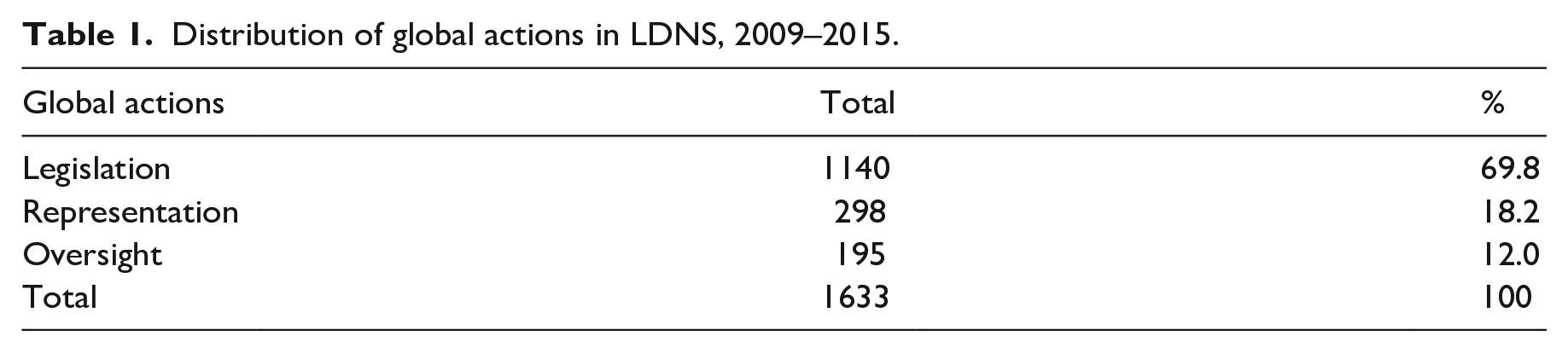
As can be seen from Table 1, legislation is the dominant function in the Nigerian Senate (69.8%), followed by representation (18.2%), and then oversight function (OVF) (12.0%). The preponderance of linguistic items that signal the global action of legislation corroborates the claim about the centrality of legislation in NSD (Inya, 2018). Representation, however, occupies a middle position, and OVF has the lowest percentage scores, and this low statistical score correlates with the fact that Nigerian senators do not take their OVF duties seriously. In what follows, I examine each of the global actions closely.
The global action of legislation in NSD
The global action of legislation is underscored by the following shared knowledge/assumptions, namely, the centrality of legislation as a core duty of legislators and this is key to democratic consolidation (cf. Section 4(1–4(a-b) of the 1999 Constitution). The second shared assumption is the centrality of legislative agenda and list to the global action of legislation. These shared assumptions constrain interactions by specifying appropriate topics for interactions, and they are considered below.
Legislation as the core duty of legislators
The global action of legislation is the core duty or responsibility of legislators in NSD. This takes the form of either amending existing laws to cater for a particular lag in governance, or making new ones to account for challenges not provided for in the Constitution, for instance. Legislators in the course of debating very often construct this shared knowledge and this is illustrated in the examples below.
In (5) and (6), the speakers underscore the importance of doing legislation. They qualify the duty as ‘this core legislative responsibility of law making’ and ‘our statutory obligation constitutionally’, which implies that the basic reason for the existence of the legislative arm of the Nigerian government is law-making, such that every speech given or question asked is targeted towards this global action (Van Dijk, 2004: 356). It is also their constitutional obligation, and refusing to legislate calls the very existence of the institution to question and casts a shadow over its legitimacy. The speaker of (5) makes this abundantly clear as he indicates that the confidence of Nigerians in the legislature is essentially predicated on the institution’s ability to fulfil its primary obligation of making laws that would better the lot of the people.
Furthermore, in (5) and (6), the global action of legislation is contextualized within the IS of the legislature, empowered by the formal institution of the Constitution, and implicitly by the socio-political framework of democracy, which stipulates a separation of power between the legislature and the executive, IAs in NSD, and specifies a check and balance mechanism to regulate the relationship of these IAs. These knowledge structures are foregrounded by the definite noun phrases with which the speakers of the excerpts above describe the global action of legislation. The foregrounding of these presupposed knowledge functions as a call to legislators to stand by their constitutional duty, in spite of confrontations from any quarters.
Legislative agenda and list as core bases for legislation
Of the lexical items that index the global action of legislation, the most fruitful is the adjective legislative as it combines with other words to paint a clearer picture of the overall act of legislation in the Nigerian Senate. The specific collocates selected for a detailed examination include legislative agenda and Exclusive (Concurrent) Legislative List. Each of these collocates reveals a unique dimension of the global action of legislation, as each indicates the items that get legislated on both statutorily and during legislative sessions. At the beginning of each Assembly, and session or legislative year, the legislature sets its agenda, which usually includes legislative initiatives and activities proposed for implementation. Usually, the agenda is presented to the Senate for debates and possible amendments.
The first thing to notice about (7) and (8) is that both examples are speeches by the President of the Senate. In (7), the President specifically itemizes the critical issues on the agenda for 2013, one of which is the further ‘Review of the 1999 Constitution’. In addition, Excerpt (8) connects the excellence in the pursuit of the Senate’s legislative agenda with the discharge of their constitutional responsibilities, the basic being legislation, which is of course indicated by the specific example of the review of the Constitution.
The other collocate of analytic interest is Legislative List, either the Exclusive List which stipulates the items that the Federal legislature has legislative powers over, or the Concurrent List that contains items for shared legislative actions between the Senate and State Legislative Houses, and then the Residual list, which is the exclusive preserve of State Legislative Houses. The legislative powers are provided for in Section 4 as well as the Part I of the Second Schedule of the 1999 Constitution of the Federal Republic of Nigeria as amended. The purpose for this division of legislative labour is to make for a clash-free system of legislation, but this is not always the case as (9) reveals.
Further to what he said, you cannot set up an airport without an enabling law.
Example (9) demonstrates how Members of the Senate discursively establish what their constitutionally stipulated powers are regarding the legislative lists. In (9), Senator Ike Ekweremadu disagrees with his learned friend regarding his interpretations of the constitution about who can or cannot operate an airport. As far as this learned friend is concerned, items on the Exclusive List are largely for legislation, and the nitty-gritty of the implementation of the legislation, as far as operating airports are concerned, should be left to the discretion of the state and other private individuals. This is what the speaker of (9) disagrees with as he asserts that aviation, both ownership and operations, is the 3rd item on the Exclusive List, and that ‘it is the National Assembly that is empowered to make laws in respect of items contained in the Exclusive List as well as Concurrent List’. Thus, any attempt by the state to legislate would constitute a contravention of the provisions of the Constitution.
A presupposition analysis of a key structure in the excerpt above would make the point of the argument even clearer. The presupposition trigger is the ‘it-cleft’ structure in the following sentence ‘
The global action of representation in NSD
The second global action performed by legislators in NSD is representation. The action is characterized by the following shared beliefs: legislators are the people’s representatives, and they pursue the interest of the people through support for effective legislations, and opposition to ill-intended legislations. Members of parliament are elected representatives of the people from various constituencies in the country. They are given the mandate to represent the interest of the electorate, and pursue legislations and policies that would benefit their constituents, among other things. Participants in the data regularly orient themselves towards this goal as a justification for their support or otherwise of one bill or the other. The lexical items that signal this global action are the different lexemes of represent, which also collocate with other linguistic items to indicate legislators’ awareness of their role as the people’s representatives. The excerpts that follow show the various dimensions of this global action.
In the examples above, it can be seen how speakers in the Nigerian Senate demonstrate an awareness of their role as the people’s representatives and its corollary. The speakers speak of their being the people’s representatives not because they are so called, but because it is their basic identity marker and one that attracts real-life consequences. In (10), the speaker describes the National Assembly as ‘the actual and true theatre of the representatives of the people’. The description has the contextual value of indicating that the global action of representation is at the heart of legislative interaction in the Nigerian Senate; and as such, it is the actual and true place where the people’s interests, worries, aspirations and so on are realized. The foregoing point is even more succinctly exemplified in (11) and (12). The speaker of (11) quite assertively declares that they are the ‘people’s representatives’, and on the basis of that, demands that certain speculations making the rounds in the public discourse domain are clarified. It is interesting to note the Hansard from which these data are got is the screening of ministerial nominees for 2011, which is the beginning of the first full term of President Goodluck Ebele Jonathan, and the issue raised in (12) is directed at Mrs. Diezani Alison-Madueke, who was to become the Minister of Petroleum. Usually, the screening exercise is a politically vested process, where the nominees by the executive arm are thoroughly, or so the public is made to believe, questioned to determine their fitness for their prospective portfolios (cf. Strauss and Sunstein, 1992: 1491–1492 for a related argument). It is also the site of a power tussle between the legislative and executive arms of government, and an opportunity for legislators to ask the nominees questions they believe their constituents would want asked. The foregoing then puts the speaker of (11) ‘We are the people’s representatives’ into perspective, and provides an effective illustration for the global act of representation, because an answer to the people’s representatives is an answer to the people.
The last example above also provides a strong support for the global act of representation as the legislators are acting in the stead of the people to ensure that their welfare is met, while stressing the centrality of representation to legislative interaction in the Nigerian Senate. The speaker of (12) states that the ‘hallmark of representation is timely response to the plight of the people you represent’, which places the burden of prompt response to the challenges of the electorate or constituents at the doors of the legislators. One implication that is consistent so far in the analysis, and as Van Dijk (2004) observes, is that the global actions of representation (legislation and oversight) are not fanciful theoretical constructs by analysts, ‘but “real” global acts in which participants consciously engage in when talking in parliament, and which guide their discourse, their understanding, their interaction, and also their mutual critique’ (Van Dijk, 2004: 357).
The global action of OVF in NSD
The third global action indicated in Table 1 is OVF, which empowers the legislature to check the activities and powers of the executive arm of government, and that way, the executive may be compelled to act in the interest of the citizens of the country. Thus, the context of OVF indicates that OVF is equally an important duty of legislators, and it can streamline the agenda of the executive to align with the yearnings of the electorate. The overall goal of legislative OVF is to ensure accountability, transparency and probity in government affairs in its various Ministries, Departments and Agencies (MDAs). Quite easily, one can see how this global action can be contextualized in the framework of the IAs of NSD and the means by which the interests and agendas of such actors as the government or the executive arm can be streamlined to fit the yearnings and desires of the electorate. In the data, one way in which legislators orient themselves towards this action is ensuring efficient budget implementation, by monitoring funds released to the various MDAs and overseeing the effective expenditure of the monies.
The issue of monitoring budget implementation is the focus of excerpts (13) and (14). In (13), the speaker particularly indicates that though legislators make laws for good governance, the only effective way to ensure the laws are to the benefit of the people is to do due diligence in their OVF. In other words, the speaker argues that doing OVF is also one duty of the legislature, and in this case, monitoring the expenditure of public funds should be done diligently to ascertain that the nation’s economy grows and the well-being of the people is guaranteed. Furthermore, in (14), Senator Patrick E. Osakwe emphasizes that OVF can be done by the Committee of the Senate responsible for specific MDAs, and in the instance of the speech, it is the Committee of Niger-Delta that is expected to perform oversight, by verifying that the estimates approved for the ministry by the Committee is indeed being put to effective use.
Conclusion
This paper has demonstrated how legislators in NSD orient to the contextual categories that constrain ongoing interaction, especially when a DSC occurs. The paper indicated that legislators orient to the social domain of NSD, namely, its IS, actors and goals as well as the social actions that legislators perform in NSD, specifically legislation, representation and OVF. The paper argues that underscoring these categories is the understanding of context as the personal and shared knowledge about factors that constrain discourso-political behaviour in NSD, and are oriented to by legislators to resolve DSC. This point demonstrates the centrality of knowledge as a contextual category, and therefore, challenges conceptualizations of context as what is only publicly and procedurally consequential for ongoing interaction.
The paper contributes to knowledge on the context of parliamentary debates in its examination of debates in an emerging legislature and democracy, an under-explored discourse domain. Therefore, the findings of the study provide an insight into the contextual iceberg that background and foreground meaning construction in NSD in terms of the shared socio-political and institutional knowledge structures that define what constitute appropriate linguistic-discursive and political actions in an emerging legislature. In addition, the study makes a methodological contribution to corpus-based investigations of context through its reliance on Wmatrix to tease out the key semantic domains of the corpus on NSD as well as the concordance and collocational patterns of the components of CASA.
Moreover, since the focus of the paper is on an emerging democracy and legislature, we recommend that the Nigerian Senate should organize, in collaboration with discourse analysts, programmes that will build the capacity of legislators for quality discourse and deliberation during plenary sessions. In addition, international donor organizations interested in strengthening accountability and transparency in Nigeria’s democracy should provide capacity building for legislators in the area of OVF, especially as this legislative duty is the least oriented to in the data.
Footnotes
Funding
The author(s) received no financial support for the research, authorship and/or publication of this article.
