







Abstract
Hong Kong witnessed unprecedented protests from June 2019 to early 2020. Drawing on frame analysis, this study explores the discourse and ideologies related to minoritized groups using multiple media sources. The findings revealed that there were multiple constructions of minoritized groups and their engagement in the protests: Niche/pro-democracy and liberal media were inclined to make “heroes” of their engagement while pro-China media seemed to revert to an older style of negative reporting portraying them as “villains.” The exploitation of minoritized groups for political purposes raises important issues about media ethics, “fake news,” and the role of ideology in news reporting.
Introduction
In summer 2019, a proposed extradition law amendment bill (The Fugitive Offenders and Mutual Legal Assistance in Criminal Matters Legislation (Amendment) Bill 2019) sparked a series of massive anti-government protests in the Hong Kong Special Administrative Region (HKSAR), starting with peaceful assemblies that later morphed into violence. A political crisis soon emerged that went well beyond the HKSAR government’s control (Lee et al., 2019; Purbrick, 2019). Local (e.g. SCMP Reporters, 2019) and international (e.g. BBC News, 2019) media provided wide coverage of the protests as they developed over summer and beyond. Considerable attention has been paid to the role of social media such as Telegram, Facebook, and LIHKG and the coordinating role they played during the protests (Lee et al., 2019). Yet less attention has been paid to more traditional media that reported on the protests constructing images, ideologies, and narratives throughout the second half of 2019.
While lack of attention to traditional media analysis is true in general, it is particularly so with respect to the city’s minoritized (Gillborn, 2005) communities who have been subject to historical marginalization and racism (Bhowmik and Kennedy, 2016; Gube and Burkholder, 2019; Gube and Gao, 2019; Kapai, 2015). This paper seeks to locate constructions of Hong Kong’s minoritized groups in the political discourses employed in multiple media sources related to the protest movement. While Hong Kong has diverse minoritized groups, our discussion in this paper largely relates to the marginalized groups from South Asian and South-East Asian heritages.
The paper first provides a brief background information about Hong Kong’s minoritized groups in the next section. The following section then explains the main analytical tool used in the research. The paper then presents the findings, discussion, implications, and conclusion of the study.
Hong Kong’s minoritized groups
Hong Kong’s minoritized populations are largely a result of its colonial history when the British encouraged South Asian immigrants to work in the colony. Currently, some 8.4% of the city’s population are categorized as “ethnic minorities” (Census and Statistics Department, 2022: 6). Yet they are by no means a homogenized group. There is diversity in cultural heritage, economic status, and work engagement. The majority are Indonesians and Filipinos, most of whom work as domestic helpers and number of South Asians living below the poverty line, while others are relatively well off including “whites” (the census terminology) working in high-end business and industry (Census and Statistics Department, 2022: 102). The experiences of minoritized groups are variable. There are inequalities in educational opportunities (Bhowmik and Kennedy, 2016) and employment outcomes (Kapai, 2015). Many encounter discriminations on a daily basis in every aspect of their lives, including accommodation, financial services, transportation services, retail and personal services, catering services and medical services (Equal Opportunities Commission, 2016). Some minoritized groups are marginalized and vulnerable, and intergenerational mobility often seems elusive.
Research on minoritized groups in Hong Kong is sizable. A significant number of studies reported the disadvantages suffered by minoritized groups and individuals. This central line of inquiry highlighted inequitable educational opportunities for minoritized students and associated factors (Arat et al., 2016; Bhowmik and Kennedy, 2016; Bhowmik et al., 2018; Burkholder, 2013; Gao, 2019; Jackson, 2017; Loper, 2004; Wang and Tsung, 2022). Disparity in employment opportunities was also reported (Kapai, 2015). The general discourse attributes the inequalities in education and employment mainly to minoritized young people’s lack of Chinese language skills and related factors. However, the issues are more complex than this simplistic narrative. For example, a number of interrelated factors at various levels including individual, family, school, community, and other contextual factors supposedly contribute to educational underachievement of minoritized students (Bhowmik and Kennedy, 2016). Some critical scholarships stressed various forms of discrimination and unfair treatments (Bhowmik and Kennedy, 2016; Bhowmik and Gube, 2022; Crabtree and Wong, 2013; Kapai, 2015). Some other research reported minoritized groups’ identities and their effects on acculturation, socio-cultural adaptation, and well-being (Bhowmik, 2021; Ng and Kennedy, 2019; Ng et al., 2019).
Literature on minoritized groups’ participation in Hong Kong’s political space is limited. A recent article reported multiple attitudes of minoritized groups about the social movement in 2019 (Bhowmik et al., 2023). A little less than half of the participants supported the movement while others had either neutral or negative attitudes toward the protests. An intergenerational difference in attitudes was found. While the younger generation tended to support the protests at least initially, the older generation was found conservative.
Historic media representation of minoritized groups in Hong Kong is problematic. Research suggests that these groups are presented in mainstream media in a biased, limited, and negative way (Baig and O’Connor, 2015; Erni and Leung, 2014; Kapai, 2015). Negative tones and deficit discourses are the key features of the news coverages about people of South and Southeast Asian heritages shown in both major English and Chinese language newspapers (Jackson, 2017). The summer protests of 2019 brought many “Hongkongers” together, but little attention has been paid to the role of minoritized residents in this process. Therefore, the following research questions (RQ) guided the research:
RQ1: How did the media represent the values and attitudes of minoritized groups in relation to the protests?
RQ2: How can these representations be theorized to better understand media ideology?
Theoretical framework and methods
Frame analysis
The paper adopted frame analysis (Winslow, 2018) as the theoretical framework to examine the way minoritized groups’ attitudes and engagement in the protests were portrayed. Framing, the way the media constructs and presents information, is a meaning-making process that seeks to establish the point of view of the journalist or the newspaper (Winslow, 2018).
Framing involves a range of issues that need to be considered. These are based on Winslow (2018: 4–6):
Frames are revealed in symbolic expressions. . . . identifying “specific vocabularies” along with “both the verbal and visual symbols that come together to constitute a specific set of vocabularies.” Patterns are created “allowing for the positioning of a set of symbolic resources within a larger rhetorical environment” (p. 4).
Identify key symbols that carry the message of the framing especially in headlines, dominant themes, and cultural and political analyses.
Identification of the journalist’s perspective.
Identification of power issues and how these are portrayed.
Identification of news outlets and articles
There are a range of written media in Hong Kong and these are shown in Table 1. Ideological orientations were identified by Feng (2017) and Yu (2014). Two “niche” publications were identified while the other could be classified as mainstream. We chose the descriptors following Budarick and King’s (2008) suggestion that “niche” was meant to suggest a “creative role as a media producer” rather than a small marginal publication.
Ideological orientations of Chinese and English language newspapers.
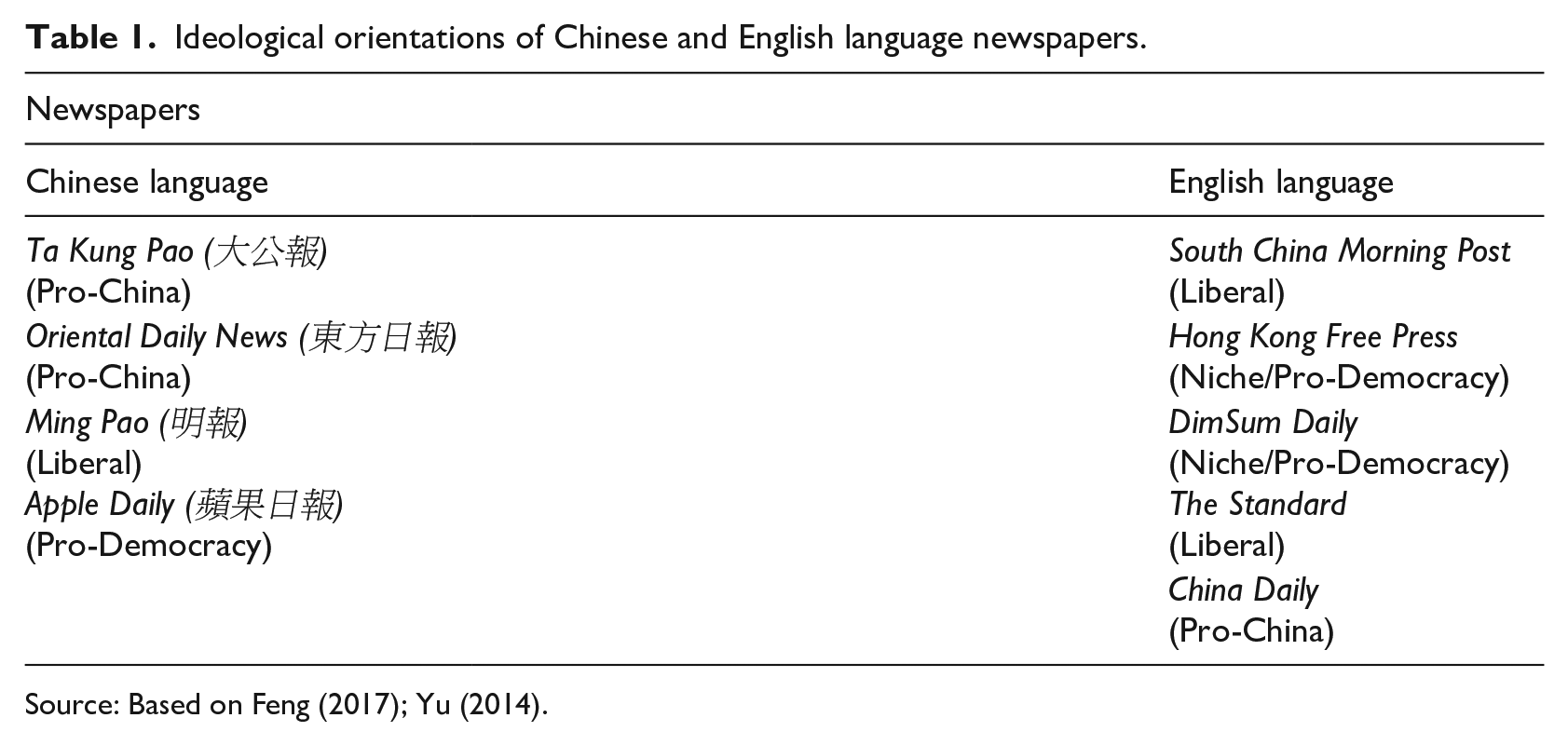
Source: Based on Feng (2017); Yu (2014).
Using Factiva and Wise News, online software for searching news articles, media stories were searched between and July 2020 across the newspapers shown in Table 1. The keywords used were “ethnic minority groups in Hong Kong protests/social movement” or “Hong Kong protests/social movement and ethnic minorities.” The search yielded 168 news articles. Of them 124 were in Chinese, 44 were in English. Many of these articles were on similar topics but appeared in different newspapers on the same day. While the topic is important, our main interest was in how topics were framed to present a view of both minoritized groups and the protest movement itself. In particular, we were interested in whether newspapers with different ideological orientations framed minoritized individuals and groups in different ways. Did these orientations influence subsequent framing?
It is obvious that the social movement could be framed in different ways. What is not known is how participation could be framed and therefore exploring this framing was the focus of our research. The exploration started from examining headlines, topics and contents from all selected sources of newspaper articles to understand the ideological construction of the newspapers or journalists and the strategies and symbols employed to frame the participation of minoritized groups in Hong Kong’s summer of protests.
Coding and data analysis
Since our focus was to identify how the newspaper articles framed the participation of minoritized communities in the protests, initially we examined whether the representation was positive, negative or neutral. To do so, all the headlines and articles were first read by the third author and coded accordingly. After that the first author re-read the headlines and articles and reviewed the initial coding. More than 90% of the initial coding was agreed between them. The rest 10% was resolved in a meeting between two authors.
Content analysis was used to identify the positioning of the headline since these are often used to identify the frame in media framing research (Bleich et al., 2015; Krippendorff, 2018; Trimble and Sampert, 2004). First, the headlines were examined to identify the stance of the article. Following that, a representative sample of text inside the article was sought to support the decision about the stance. When confusion arose, the headline and the full article were re-read few times until a decision was made.
A headline or texts inside an article showing the engagement and supportive attitude of minoritized groups toward the protests was decided as a positive stance. The negative representation of minoritized groups as well as their opposing attitude toward the protests were decided as a negative stance. A neutral stance was decided when minoritized groups’ supporting or opposing attitude toward the protests was not found.
Results
Core frames
Budarick and King (2008) used the concept of “core frame” to explain the broad contexts in which the media activities they analyzed took place. The concept of an overarching frame helps to locate the ideological parameters of the study. Table 2 shows what can be regarded as a “core frame” showing the ideological divide from “pro-China” to “pro-democracy.”
Comparison of core frames.
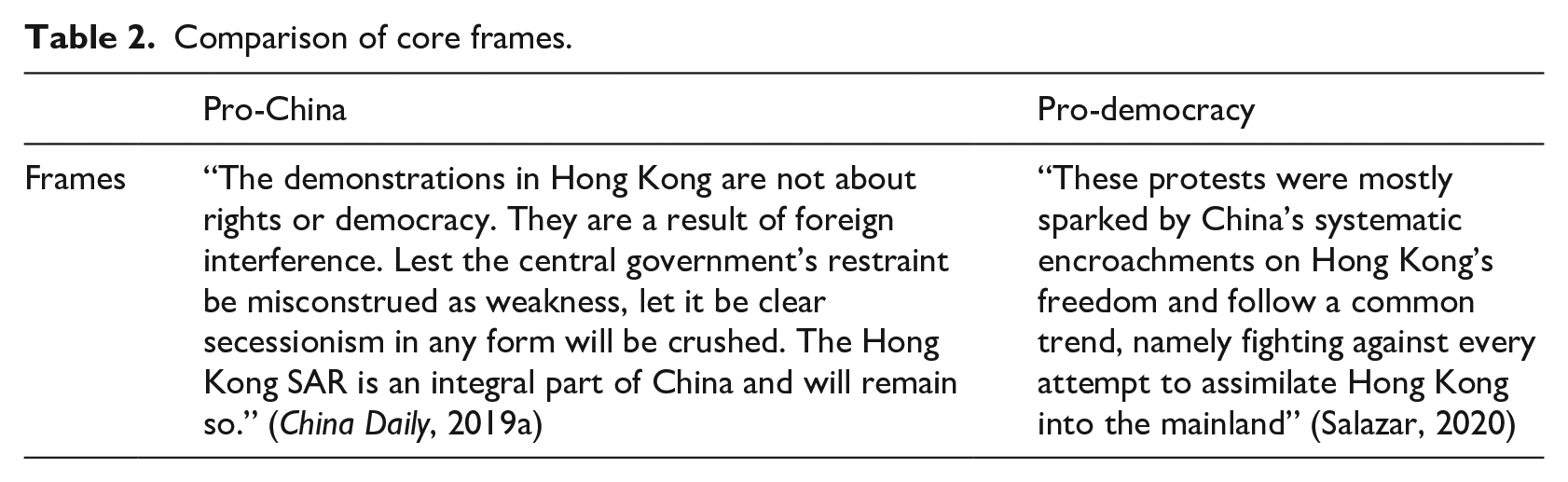
It can be argued that the issue at stake was sovereignty—who controls Hong Kong. Comments to this effect were made by Chinese government officials and reinforced on numerous occasions even by the Chief Executive of Hong Kong. In response it was asserted by protesters that democracy was “the inalienable right of the people” (Sataline, 2019). This is the tension reflected in the core frames outlined in Table 2 and representative of the discourses that characterized the Hong Kong protests throughout the second half of 2019.
Similar framings were reported in a recent work that aimed at identifying difference between the China Daily and The New York Times concerning their constructions of the protests (Wang and Ma, 2021). While The New York Times from the US portrayed the protesters as “pro-democracy protesters,” the China Daily from Mainland China, on the other hand, depicted them as “illegal rioters.” The core frames including “pro-China” and “pro-democracy” helped us understand how the selected 168 news articles from nine newspapers in Hong Kong constructed the participation of minoritized groups in the protests in the following sections.
Chinese language newspapers
Framing Chinese news articles
The Chinese newspapers did not speak with a single voice in relation to minoritized groups. Of the124 articles identified that did make such references, 65.5% (n = 80) were in the liberal/pro-democracy press (Apple Daily (蘋果日報) and Ming Pao (明報)) with the remainder in the pro-China press (Oriental Daily News (東方日報) and Ta Kung Pao (大公報)). Yet these numbers do not tell the whole story. Only 70% of references in the liberal/pro-democracy press were positive with the remainder being either neutral (25%) or negative (5%). For the pro-China Press, 58% of references were negative, 31% being neutral, and 11% positive.
This preliminary analysis highlighted the agendas being set by the different newspapers. Takeshita (2005: 280) defined such agenda setting as “how the mass media define an individual issue for us.” He also pointed out that one step further is when “the media also have an influence on how people make sense of a given theme” (p. 275). The quantitative presentation of the different constructions of minoritized groups represented this kind of agenda setting where issues related to these groups and the protests were given space and made public. Yet what is also clear from this analysis is that different newspapers framed the engagement of minoritized individuals in different ways intending to convey specific meanings. We described these frames as “heroes,” “villains,” and “bystanders” because these descriptions moved beyond the numbers to convey the essence or substance of what was being reported.
News headlines as framing tools
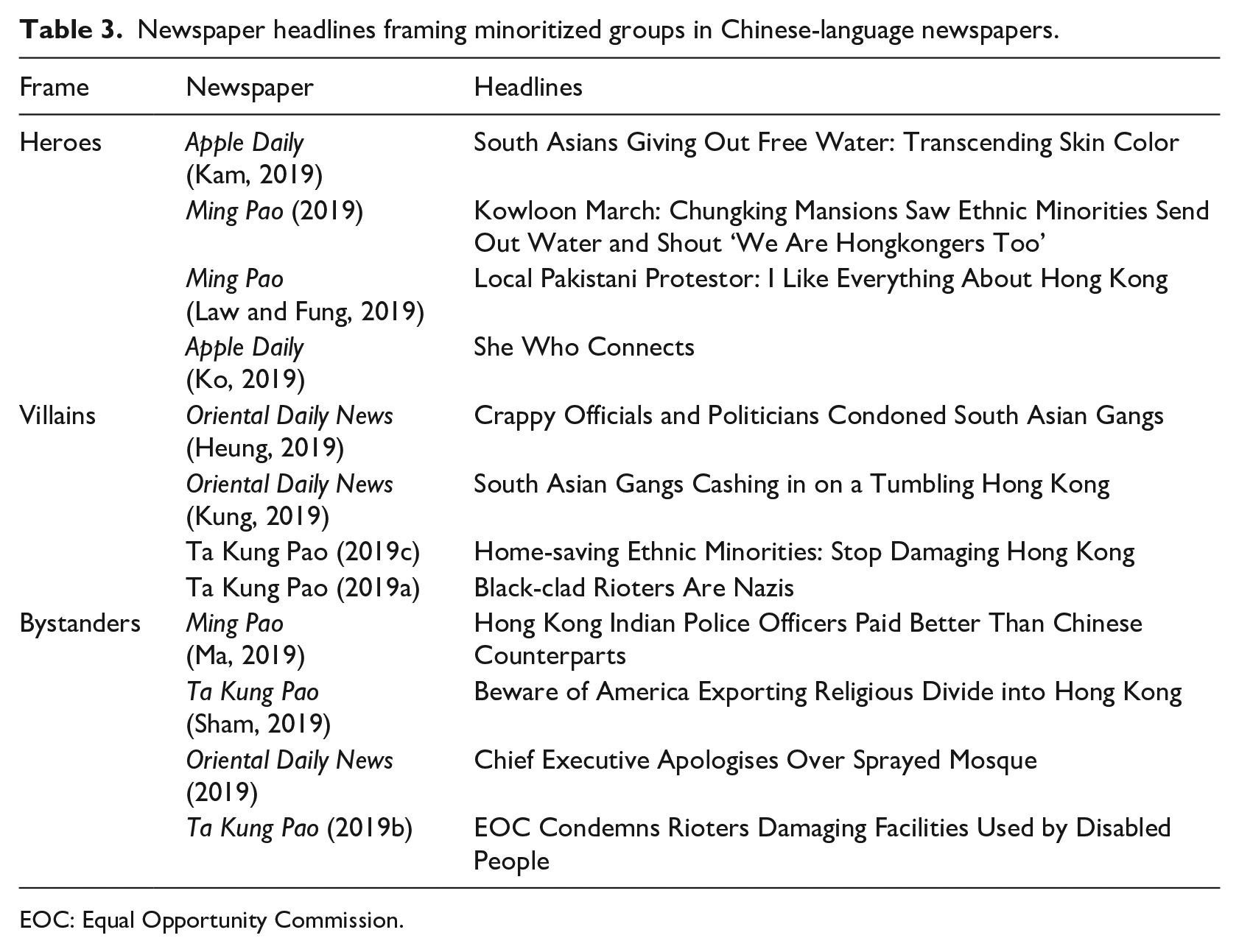
Newspaper headlines have been recognized as key framing tools (Liu et al., 2019), an indication of the qualitative nature of the framing. Selected headlines, translated into English, are shown in Table 3:
Newspaper headlines framing minoritized groups in Chinese-language newspapers.
EOC: Equal Opportunity Commission.
“Heroes” as a frame for minoritized groups
As mentioned in the previous section, the pro-democracy and liberal press (Apple Daily and Ming Pao) published the majority of news stories that framed minoritized groups as “heroes.” The selected headlines mentioned in Table 3 under this framing show the engagement and supportive attitude of minoritized groups toward the protests. They were framed as “heroes” because their attitudes and actions were consistent with the core framing for these newspapers shown in Table 2. This kind of framing is consistent with Entman’s (1993: 53) view that framing promotes “a particular problem definition, causal interpretation, moral evaluation, and/or treatment recommendation.” For the “hero” frames, some headlines were explicit while others were less so. A deeper reading of the full articles helped to identify the full effect of framing in different cases.
Two headlines including “South Asians Giving Out Free Water: Transcending Skin Colour” and “Kowloon March: Chungking Mansions Saw Ethnic Minorities Send Out Water and Shout ‘We Are Hongkongers Too’” clearly illustrated minoritized members’ engagement in the protests and therefore consistent with the core pro-democracy frame. These respective Apple Daily (Kam, 2019) and Ming Pao (2019) articles reported that in a protest day, some minoritized members gathered outside the Chungking Mansions, a place housing many businesses including hotels, restaurants and grocery shops owned by minoritized members, to demonstrate their support toward the protests. They offered free bottles of water to the protesters. They also exchanged supportive slogans with the protestors. Some members also wore T-shirts with slogan like “I love HK.” This supporting event was organized by a group of minoritized members in response to an unsubstantiated blame leveled at some of the minoritized members’ involvement in attacking a frontline protest leader. Now some minoritized members were showing their identification with the protest movement.
Another headline “Local Pakistani Protestor: I Like Everything About Hong Kong” portrayed a youth from Pakistani heritage as a protestor. This Ming Pao story (Law and Fung, 2019) illustrated that a 19-year-old Pakistani, self-identified as a Hongkonger and Muslim, showed support for the protest movement. Locally born and growing up in Hong Kong, he encouraged more interracial exchange between local Chinese and minoritized groups. Fearing his parents might one day find out about his participation in the protests, he would give excuses such as going out to study but never would he mention the word protest. Yet he was determined to come to the street for taking part in the protests because he wanted to connect with local Chinese and to show his love for Hong Kong.
The headline “She Who Connects” concerned Chief Executive of Hong Kong. This Apple Daily article (Ko, 2019) highlighted that Hong Kong was not only home to Chinese, but also to everyone in love with the place including South Asians, especially for those who were born in Hong Kong since the place is their only home. The article further mentioned that the community was becoming more outspoken and its members were seen standing by the side of other democracy-loving Hongkongers. This article also reported on South Asians shouting political slogans in support of the protests. It may be regarded as clever reporting, the article started off with reference to the Chief Executive but ended extolling ethnic minority involvement in the social movement.
“Villains” as a frame for minoritized groups
The pro-China press, Oriental Daily News and Ta Kung Pao, viewing reality as portrayed in Table 2, constructed minoritized groups as “villains.” The selected headlines referred to in Table 3 indicate the direction of the framing that can be better understood with an analysis of the full article.
Two headlines “Crappy Officials and Politicians Condoned South Asian Gangs” and “South Asian Gangs Cashing in on a Tumbling Hong Kong” clearly illustrate why “villains” is an appropriate framing. Minoritized groups are referred to as criminals with the term “South Asian gangs.” Negative representation of South Asian minoritized groups by Oriental Daily News is not a new phenomenon. It seems to have been referring to them very often as “South Asian Gangs,” even before the protests.
These two Oriental Daily News articles (Heung, 2019; Kung, 2019) reported that South Asian gangs were taking advantage of Hong Kong’s security vacuum amid the anti-Extradition Bill. They were referred to as “thieves,” “gangsters,” and “tumor by being lawless and enjoying themselves,” and seen as a significant threat to local security as they were thought to be taking advantage of police shortages during weeks of protests. Some examples were given about their lawlessness including occupying public areas (just like protestors who self-proclaim authority), a theft inside a cell phone store, and a hit and run on a female. It was also mentioned that South Asians would be happy to call Hong Kong their home when they are able to steal cash from the ATMs from vandalized by the protestors.
In addition to referring to South Asians as criminals throughout the two articles, their cultural practice was racialized too as they were described as smelling like a mix of “curry and onion” and being “repulsive.” With this perceived criminality of South Asians, they were seen as driving Hong Kong to a “dead end” together with the local rioters.
The headline “Home-saving Ethnic Minorities: Stop Damaging Hong Kong” framed a minoritized leader’s support for the extradition bill as an opposing attitude toward the protests. This Ta Kung Pao (2019c) article praised minoritized groups in Hong Kong who broke silence on the protests. The article reported a minoritized leader’s endorsement of government’s proposed extradition bill. Singh Baljinder, leader of an organization that promotes racial diversity, was referred to as commenting on the bill’s necessity to prevent terrorism within and beyond Hong Kong. His positive attitude toward the bill was framed as opposed to the protests to “stop damaging Hong Kong.”
Another headline “Black-clad Rioters Are Nazis” (Ta Kung Poa, 2019b) apparently did not indicate anything related to minoritized groups. Yet it negatively framed them suggesting that South Asian minoritized group at Chungking Mansions only survived at the hands of black-clad protestors because they had prepared their “offerings” by joining in chanting revolutionary slogans. It was also mentioned that Chungking Mansions, a well-known local business and meeting place for minoritized groups, had for ages been notoriously bad and related to triads. Similarly, minoritized members’ bowing to protestors was the evidence of the protests’ triad-like nature.
“Bystanders” as a frame for minoritized groups
Both the liberal and pro-China press published news stories that did not seem to frame minoritized groups in any particular way. These are shown in Table 3 as neutral indicating these groups were not always subject to framing although they were present, almost as though they were simply bystanders in a larger picture. The stories that followed the headlines demonstrate this point.
The three headlines including “Chief Executive Apologises Over Sprayed Mosque,” “Hong Kong Indian Police Officers Paid Better Than Chinese Counterparts,” “Beware of America Exporting Religious Divide into Hong Kong” had little in common. The three stories respectively from Oriental Daily News (2019), Ming Pao (Ma, 2019) and Ta Kung Pao (Sham, 2019) reported the incident when the Chief executive of Hong Kong visited the Muslim leaders to apologize after a police water cannon vehicle inadvertently fired blue-dyed water at the Kowloon Mosque. The Chief Executive made it clear that the government appreciated the Muslim community’s being in peace and racial harmony and expected them to work together to bring Hong Kong back to normal. If she was aware of the conflicting constructions of minoritized groups vis a vis the protests she did not show it here. Rather she was more concerned to show that the government could respond quickly to what was a public relations disaster in the police spraying of the Mosque. Muslim religious leaders accepted the Chief Executive’s apology but this was not the center of the story—the Chief Executive and the government were front and center. Minoritized groups were simply extras.
Another headline “EOC Condemns Rioters Damaging Facilities Used by Disabled People” apparently shows the Equal Opportunity Commission’s (EOC) stance against the protesters who damaged facilities for disabled people. This Ta Kung Pao (2019b) story also highlighted that EOC received strong complaints from the minoritized groups regarding vilification of Islam with reports suggesting that slogans such as “Allah is the Greatest” were painted on roads—an act disrespectful to Muslims. The EOC reminded the public to show and maintain the respect to all minoritized groups. This was more a criticism of the protestors as much as a support for minoritized groups in keeping with this newspaper’s pro-China stance. Such groups are there, but on this occasion, they are not the main story.
English language newspapers
Frames in English news articles
The ideological orientations of the English newspapers are shown in Table 1 where the balance is decidedly toward the liberal and pro-democracy stance with only one of five being pro-China (China Daily).Yet as with the Chinese language papers there was a distribution of positive (50%, n = 22), negative (11.4%, n = 5), and neutral (38.6%, n = 17) articles that was not too different from the distribution across Chinese language papers (49.2%, n = 61), 27.4%, n = 34) and 23.4% (n = 29). As was the case with the Chinese language newspapers, greater insight can be gained from an analysis of newspaper headlines in the English language newspapers.
Analysis of English news headlines
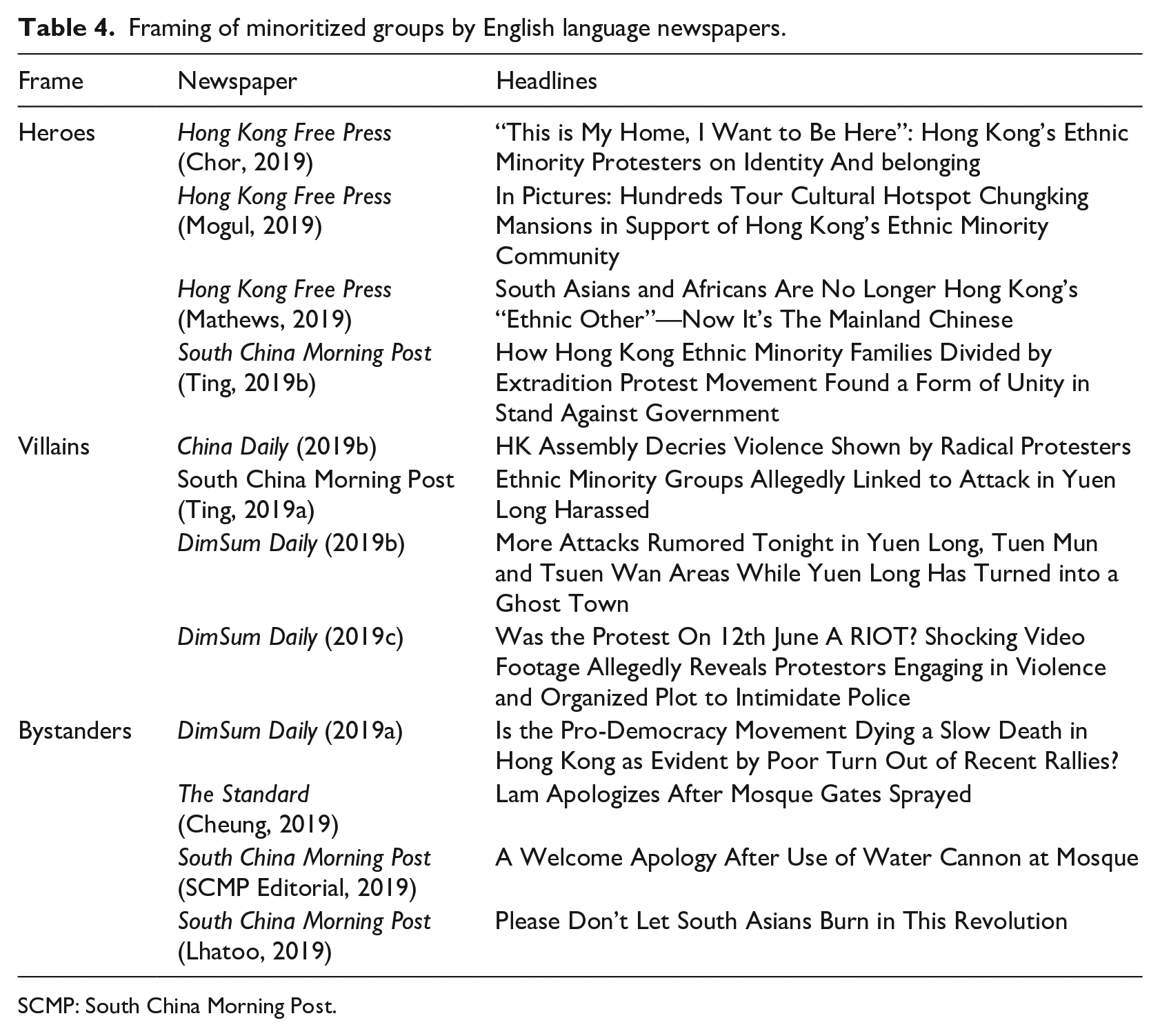
Table 4 shows selected English news headlines using the same frames as previously and acknowledging headlines as key framing (Liu et al., 2019).
Framing of minoritized groups by English language newspapers.
SCMP: South China Morning Post.
Heroes
The Hong Kong Free Press and Dim Sum Daily published the majority of the positively framed news stories with some also coming from the liberal press, South China Morning Post and The Standard. The selected headlines mentioned in Table 4 under “Hero” framing showed the engagement and supportive attitude of minoritized groups toward the protests. Some headlines clearly indicated such engagement and attitudes while others were less explicit. In the latter cases, the full articles were carefully examined to explore the nature of the framing.
The headline “‘This Is My Home, I Want to Be Here’: Hong Kong’s Ethnic Minority Protesters on Identity and Belonging” clearly mentioned some “ethnic minority protesters” indicating their direct involvement in the protest. This Hong Kong Free Press article (Chor, 2019) reported interviews with five Hong Kong protesters (mostly youths), who identified themselves from minoritized groups. The interviewees wanted people to know that they took part in the protests to help the community. They expressed that it was their right to be at the protests because the government was not treating the community correctly and the interviewees wanted to fight for the things in which they believed. The interviewees also wanted people to know that they were there to help Hong Kong grow and move forward. They hoped that the majority Chinese people would recognize that Hong Kong is their home too. Finally, they called for more minoritized people to show up and support the protests.
Two headlines including “In Pictures: Hundreds Tour Cultural Hotspot Chungking Mansions in Support of Hong Kong’s Ethnic Minority Community” and “South Asians and Africans Are No Longer Hong Kong’s ‘Ethnic Other’—Now It’s The Mainland Chinese” highlighted local Hongkongers’ visit to Chungking Mansions following some minoritized members’ demonstration of support toward the protests by distributing water bottles and chanting supportive slogans in front of Chungking Mansions. These two Hong Kong Free Press stories (Mathews, 2019; Mogul, 2019) reported that about 1000 Hongkongers, mostly ethnic Chinese, visited Chungking Mansions for a “cultural tour” organized by members of the minoritized community. It was organized to show locals that minoritized communities are peaceful, colorful, and a part of society that would help eliminate locals’ negative misconceptions about them in Hong Kong. The organizers hoped that such an experience would help resolve the high-tension situation triggered by the attacking of a frontline protest leader.
Another headline “How Hong Kong Ethnic Minority Families Divided by Extradition Protest Movement Found a Form of Unity in Stand Against Government” portrayed the intergenerational differences in attitudes toward the protests within minoritized families. This South China Morning Post (Ting, 2019b) news story reported that the protests in Hong Kong divided opinion between younger and older generations in minoritized families. Many parents asked their younger family members to stay silent and quiet. On the other hand, some younger members voiced out to show their support for the protesters. Some believed that by doing so they would be better accepted by the broader community.
Villains
Pro-China press China Daily, liberal press South China Morning Post and alternative press Dim Sum Daily published negatively framed news stories. The selected headlines mentioned in Table 4 under “villains” show minoritized groups’ opposing attitudes toward the protests. Some headlines clearly indicated the framing while others were less clear. Further reading of the full articles subsequently confirmed the framing in the latter cases.
One headline “HK Assembly Decries Violence Shown by Radical Protesters” clearly referred to the protesters as “radical” and associated them with “violence.” This was in the China Daily (2019b) reporting that a pro-government rally at Tamar criticized the protesters. The participants chanted slogans and waved signs and banners along with the national and HKSAR flags. Representatives from minoritized groups were invited onto the stage to share their thoughts and wishes for Hong Kong. By demonstrating participation of representatives from minoritized groups in this pro-government and anti-protest event, two messages were communicated. First, minoritized groups were in favor of the government and opposed the protests. Second, their support was seen to be important in signaling broad community support for the government.
Two headlines, “Ethnic Minority Groups Allegedly Linked to Attack in Yuen Long Harassed” and “More Attacks Rumoured Tonight in Yuen Long, Tuen Mun and Tsuen Wan Areas While Yuen Long Has Turned into a Ghost Town,” reported on a significant protest event where protesters were attacked. Some of the blame was attributed to South Asians. These stories respectively from South China Morning Post (Ting, 2019a) and DimSum Daily (2019b) reported that minoritized groups had become the target of harassment and discrimination, with some forced to close their businesses and stay home after online rumors suggested that members of the minoritized community were behind the Yuen Long attack. There was also an online rumor that many triad members including South Asians were paid HK$3,000 per head for the attack. The tense situation led to many minoritized groups living in fear for many days.
Another headline “Was the Protest On 12th June A RIOT? Shocking Video Footage Allegedly Reveals Protestors Engaging in Violence and Organised Plot to Intimidate Police” clearly blamed the protesters for intimidating police. This DimSum Daily (2019c) story condemned the protest and referred to it as a riot. It reported on different defining moments typical of a riot; in particular, a few masked South Asians were spotted at the scene to assist. The article questioned the timing of their appearance that made people wonder if they were paid. It clearly indicated a doubt over South Asian protesters by stating: “If the South Asians were there all along, we would have no qualms about their ethnicity and their participation in the protest.”
Bystanders
The South China Morning Post published the majority of framed articles in which minoritized are more like “bystanders.” The selected headlines referred to in Table 4 under this framing did not portray whether minoritized groups supported or opposed the protests—rather, they were mentioned in passing.
A headline “Is the Pro-Democracy Movement Dying a Slow Death in Hong Kong as Evident by Poor Turn Out of Recent Rallies?” indicated the slowing down of the protests. This DimSum Daily (2019a) article highlighted that the public were shocked by the violence and destruction caused by rioters. The protesters were said to be making up stories to keep the momentum up, including using the Mosque incident referred to earlier as a new propaganda ammunition. The Chief Executive’s apology to the Muslim community was seen as a good strategy to avoid protestors making use of the incident for their own purposes.
The two headlines “Lam Apologizes After Mosque Gates Sprayed” and “A Welcome Apology After Use of Water Cannon at Mosque” portrayed Chief Executive’s apology and its acceptance by the minoritized community. These two respective stories from The Standard (Cheung, 2019) and South China Morning Post (SCMP Editorial, 2019) reported Chief Executive’s apology to Islamic religious leaders after a police water cannon vehicle sprayed the Kowloon Mosque with blue dye. Muslim leaders accepted the apology and thanked Hongkongers for cleaning up. The apology by Chief Executive demonstrated the government’s quick action for maintaining social harmony and stability.
Another headline “Please Don’t Let South Asians Burn in This Revolution” clearly depicted a call not to make the minoritized groups further marginalized and vulnerable. This South China Morning Post article (Lhatoo, 2019) warned that vulnerable minoritized groups, easily visible South Asians in particular, were being dangerously vilified by those adding racial hatred into the mix of social unrest and protest violence. Some minoritized groups had to live in fear of reprisals, some shutting down businesses and others staying indoors until tensions cooled. There were also threats of destroying Chungking Mansions, a hub for underprivileged South Asians and Africans, and even firebombing the Kowloon Mosque.
These multiple constructions of minoritized groups during Hong Kong’s protest movement showed, on the one hand, the salience these groups experienced in a society that has not always been welcoming of them. On the other hand, the binary of “hero-villain” showed there were extremes to this exposure—extremes evident in both Chinese and English newspapers depending to a large extent on their ideological orientation. There are important lessons to be learnt from these constructions about both minoritized groups and the social movement in which they became entwined.
Discussion
The issues explored here concerned the way minoritized groups were portrayed in relation to Hong Kong’s 2019 social movement, the nature of reporting on the social movement itself, the prospects for minoritized groups in the follow up to the social movement and the ethics of reporting under times of stress and trouble. Frame analysis was used to explore the ideological orientation of four Chinese language and five English language media. Three distinct frames were identified—minoritized groups as “heroes,” ‘villains’ and “bystanders” within two core frameworks that constructed the protesters as either “pro-democracy” or “pro-China.”
Understanding the motives of minoritized groups
The focus on the framing of minoritized groups by the media suggests a passive role for minoritized groups subject to the ideological orientations of different newspapers. Yet engagement such as this is also possible to interpret in other ways. On the one hand, Durkheim’s (1984: 66) idea of “solidarity that derives from similarities” seems to have been contradicted when some minoritized groups reached across the racial boundary to support what was essentially a Chinese affair. This suggests a “oneness” with the protestors. Most of the references to minoritized groups, whether as “heroes” or “villains,” endorsed this understanding of oneness with the social movement’s purposes. Yet it is not necessarily the only possible explanation.
Allahar (1996: 18), for example, while not referring specifically to the Hong Kong context, posed a possibly different explanation for ethnic mobilization: when the liberalism of the system is put to the test, when coveted economic, political and social goods are denied to minority groups, when the realities of prejudice and discrimination become manifest, ethnic grievances develop and political mobilization is the likely result.
This is a more activist explanation suggesting the agency of minoritized groups and their willingness to engage in a battle from which they themselves could benefit in material terms. What is more, the documented failure of a range of social policies related to minoritized groups in Hong Kong (Kapai, 2015) prepared these groups for greater activism. The data in this study, however, is not sufficient to answer the question. It does suggest, however, that more needs to be known about minoritized groups as the subjects of this research and their involvement in the protests beyond the way they were characterized by different newspapers. Otherwise, they will remain “victims” of media constructions rather than active participants for social change.
Nature of reporting on the social movement
A key characteristic of the newspapers examined here was that they constructed minoritized groups, and therefore the social movement, in multiple ways. This has not always been the case in reporting the activities of social movements. Lee (2014: 2726) pointed out that “scholars have long criticized the mainstream media for marginalizing and delegitimizing protests through portraying such actions as deviant, threatening, or impotent.” This is certainly an accurate description of the pro-China press and largely accounts for the use of the “villains” frame. Yet the pro-democracy press provided a different voice that severely interrupted the pro-China narrative. What is more it seems that from the colonial period to the present, Hong Kong media has been characterized by competing agendas and commitments whether it was the debates over the Sino-British Agreement in the 1980s (Chan and Lee, 1984) or the series of protests in the first decade of the twenty first century (Lee, 2014). The 2019 protests, therefore, were yet another example of competing politics in the city. The difference this time was that they involved the city’s minoritized groups that up until that time were largely regarded as invisible by the mainstream media (Erni and Leung, 2014). Whether this exposure of minoritized groups is regarded as negative or positive depends on the perspectives of those on the outside.
Prospects for the future of minoritized groups
Over 10,000 arrests were made as a result of the protest activities in the second half of 2019 and early 2020 (Ng, 2021). There is no beak down of these according to ethnicity. This is not surprising since on basic issues such as university entrance, school attendance or even “stop and search” actions by the police there are not any requirements to indicate the ethnicity of those involved. There was, however, one prominent arrest of a minoritized individual in the aftermath of the protests. A social worker of Indian heritage, Jeffrey Andrews, was arrested for subversion under the new National Security Law. Along with many others he participated in a primary election to nominate pro-democracy candidates for District Council Elections. This primary was subsequently declared illegal by the Hong Kong SAR Government and as a participant Jeffrey Andrews was arrested (Carvalho, 2021). Unlike many, he was granted bail while he waits for his case to be heard. Apart from Andrews, little is known about how minoritized groups have fared in the aftermath of the social movement. Although there is an important issue here that needs to be understood.
The newspaper exposure of minoritized groups may suggest that such groups either identified with the protest’s objectives or at least saw ways that might advantage themselves through such identification. Yet other research (Bhowmik et al., 2023) has shown that there are multiple views about the protests within minoritized communities. In particular, the interview study showed that older groups within these communities were inclined either not to have a view about the protests or to be decidedly against them. These intergenerational differences were rarely given any media coverage, but they reflect a more nuanced understanding of the situation within minoritized communities. In this sense, the constructions by different newspapers reflected only a partial picture of the views and attitudes of minoritized communities. In turn, this raises ethical questions about reporting and whether the “heroes” and “villains” frames have portrayed an inaccurate picture of these communities.
Ethical issues and newspaper reporting
Erni and Leung (2014: 52–53) reported that minoritized groups were mostly invisible in the mainstream media in Hong Kong. When stories did appear they were usually negatively framed related to “fights among EMs [ethnic minorities], robbery, and other criminal cases involving EMs [ethnic minorities], such as murders, or news about the influx of EMs [ethnic minorities] as illegal laborers.” The pro-China press reported here continued this negative line of reporting. The issue of continuous negative representation of minoritized groups in the public domain may potentially affect public attitudes toward them as the learning in informal space is important and may be even more than in formal space (Sandlin et al., 2010). Indeed, the positive framings demonstrated in this study are certainly a step forward, but how enduring is another question. This is especially the case if such views represented individual reporters only rather than a more considered view on the part of press owners (Deuze, 2019).
Media ethics emphasizes portraying the reality as factual, authentic and neutral (Hassan, 2018). Yet it is difficult not to regard the frames used here, whether negative or positive, as being more about the promotion of causes than direct support for endorsing the sense of engagement of minoritized groups. It can be argued that the main intention of the newspapers might well be promoting their own political stance, either “pro-China” or “pro-democracy.” Minoritized groups merely become a subject enabling newspapers to pursue their political agenda. Such exploitation further marginalizes minoritized groups and highlights ethical issues on the part of media. It remains to be seen whether the inclusion of minoritized groups as part of the social movement will turn out to be an asset or otherwise for them in the long term. On the other hand, perhaps the positive turn in reporting on minoritized groups, irrespective of ethical practices, is to be preferred to the negative reporting that largely, although not exclusively, characterized some of the Chinese media.
Conclusion
Media constructions of minoritized groups during Hong Kong’s summer of discontent were varied, since they were framed as both “heroes” and “villains.” These were ideologized constructions suiting the particular media as well as individual reporters seeking to portray the protest movement in their own ways. Yet have such constructions come at a cost for the minoritized group? In stressful times, extremes in reporting can become the norm but the ethics of such reporting always needs to be taken into consideration. As Chan et al. (2022) pointed out: News values and conceptions of the social functions of news are not scientific facts; they are contingent upon cultural-historical contexts (p. 80).
Framing community actors and events to suit political agenda is by no means a new phenomenon. When it comes to an already oppressed group, however, this kind of framing has the potential to intersect with other forms of disadvantage. It becomes one more burden for minoritized groups and one more setback in a society that already seems predisposed to view diversity negatively. It may be better to remain ignored by the media than have to suffer its negative washback at a time when living in society as the “other” is already stressful and hardly likely to promote well-being.
Footnotes
Declaration of conflicting interests
The author(s) declared no potential conflicts of interest with respect to the research, authorship, and/or publication of this article.
Funding
The author(s) disclosed receipt of the following financial support for the research, authorship, and/or publication of this article: The research reported here was supported by the Public Policy Research Funding Scheme from the Policy Innovation and Co-ordination Office of the Government of the Hong Kong Special Administrative Region (Project Number: SR2020.A5.008). The views presented are those of the authors and not the funding body.
