







Abstract
The literature on Ali Shariati, “the ideologue’’ of ‘‘the Iranian revolution,” and his arguments about women presents varied views, including rejection, criticism, and confirmation. While this literature is instructive, it primarily interprets Shariati’s texts from today’s socio-political perspective, and it thus lacks an analytical dimension that examines how and why Shariati’s ideas profoundly influenced numerous Iranian women in the 1970s. By revisiting the global and local socio-historical context of the 1970s and analyzing its influence on Iranian society, particularly the youth, as well as on Shariati’s perceptions and ideas about women’s social role within that socio-political context, this paper argues that Shariati crafted a “collective revolutionary Islamic identity” for women. This concept underscores the socio-historical and political significance of Shariati’s arguments about Muslim women in the political setting leading up to the revolution of 1979.
Keywords
Introduction
During the volatile years of the late 1970s, more than four decades ago, numerous individuals from diverse backgrounds, including thousands of women, marched on the streets of Iran to express their opposition to the domestic and foreign policies of the Pahlavi dynasty (1925–1979) and ‘‘make revolution’’ (Khosrokhavar, 1995). Many of those on the streets were influenced by Ali Shariati’s lectures (Paidar, 1997) delivered at Hosseinieh Ershad, a nontraditional religious institute established in 1968 by the National Front of Iran. 1 The building was located in an upper-class neighborhood in Tehran with a capacity of 1,500 individuals (see Image 1). Hosseinieh swiftly became a hub for a new generation of youth in the 1970s, primarily university students from expanding urban areas (Karimi and Madani, 2020). These inquisitive young minds were exposed to socialist, Marxist, and anti-imperialist ideologies, as well as movements and organizations both within and beyond Iran’s national borders. Many of them could resonate with these ideologies and movements, driven by their experiences of societal and economic disparities and the Westernization of society (Moallem, 2005). However, Savak 2 (Iran’s pre-revolutionary secret police organization), to control the situation, had already started arresting some of the political organizations’ leaders—in both official and underground organizations—and executed some of them (Abrahamian, 2021; Foran, 2019). During the same years, Shariati delivered more lectures about the socio-political roles of ‘‘true Muslims’’. Seeking a combination of a modern urban lifestyle, a renewed understanding of Islam, and acceptable answers to their socio-political and existential questions, many of the youth found themselves in Hosseinieh, attending Shariati’s inspiring lectures, reading his books, and engaging in discussions either one by one or in small groups. On certain evenings, according to Savak’s reports, when Ali Shariati was scheduled to give a lecture, Hosseinieh would attract over 2000 attendees, predominantly young individuals (Hosseinieh Ershad, according to SAVAK documents (Writers’ Council), 2004).
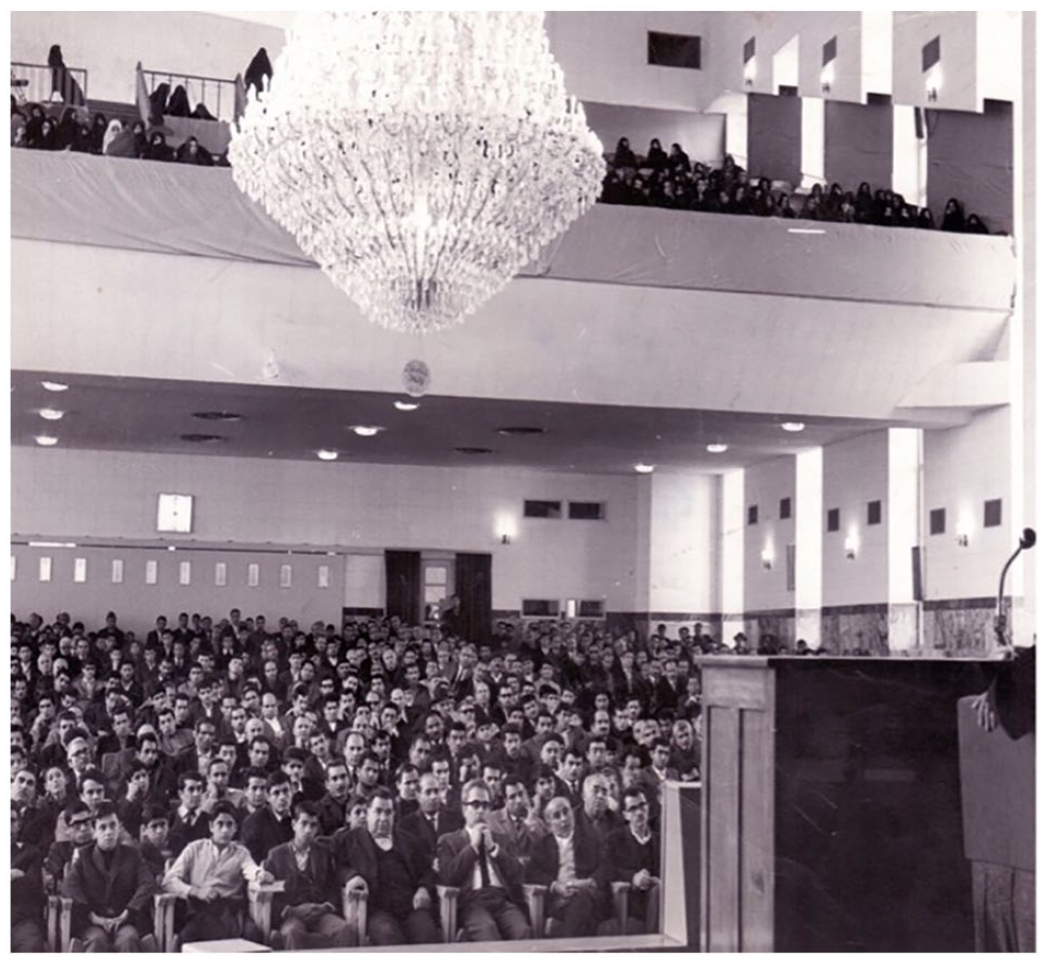
Inside Hosseinieh Ershad.
By the end of 1970, a group of religious lecturers, mostly clergy, had left Hosseinieh, criticizing and sometimes rejecting Shariati’s interpretations of Islam. They found his views in contrast with their Islamic education and closer to Marxism. Nevertheless, younger, educated people, including hundreds of women, were drawn to his inspiring lectures. Despite pressure from conservative religious groups and government officials, Shariati’s audience at Hosseinieh grew significantly. More and more young people eagerly bought his books, attended his lectures, and listened to his voice recorded on tapes and distributed among them (Bayat, 2017). In 1972, the regime closed Hosseinieh Ershad (Hosseinieh reopened after the 1979 revolution). But even after Hosseinieh was closed down and Shariati was arrested for 18 months in solitary confinement, tapes of his lectures continued to be distributed widely and inspire more and more curious minds (Paidar 1997; see Image 2).
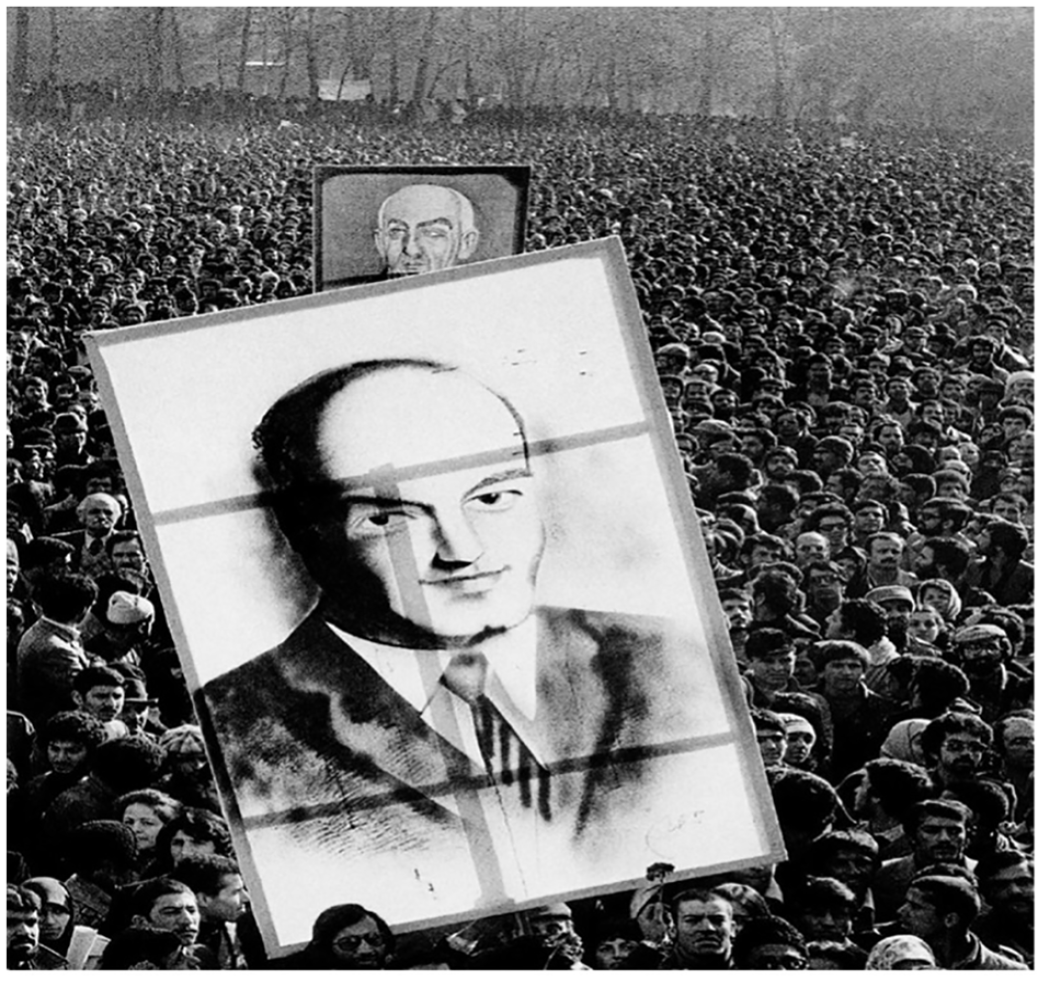
Shariati’s portrait displayed among revolutionaries in the late 1970s.
In the inflamed atmosphere of the early 1970s, Shariati delivered his famous lecture about Fatima (605/615–632 CE), the youngest daughter of the Prophet of Islam and the wife of the first Shia people’s Imam (religious and political leader). The lecture shortly turned to a book titled Fatima is Fatima (Fatemeh, Fatemeh Ast), which was read by thousands of people. In this lecture, Shariati introduced Fatima as an independent historical revolutionary figure, proclaiming at the end of his lecture that “Fatima is nobody but Fatima” (1971).
But why did Shariati choose to shed light on this Islamic figure who lived more than a millennium ago in present-day Saudi Arabia? Why did he do so while, on one hand, advocates of non-religious ideologies encouraged Iranian women to unite with anti-religious leftist groups? and on the other hand, within the legal system, several laws supporting women’s sociopolitical rights were approved, and And finally, why, during the fast modernization of the country (Moallem, 2005) and more educational and economic opportunities for women did many of them follow and accept Shariati’s ideas on women’s role in society emphasizing an Islamic figure lived and died in a pre-modern society more than a thousand years before the 1970s?
In response to these questions, I will first review the literature analyzing Shariati’s views on women. Then, I will delve into his lectures and books on women, placing them in their socio-historical context. I will employ discourse analysis as my methodology to do so. In addition, I will trace Shariati’s intellectual journey, both locally and globally, beyond Iran’s national borders to better demonstrate his perspectives on women’s potential power within the nationwide social movement that ultimately led to the Islamic Revolution of 1979. This inquiry invites us to grapple with the intricate interplay of gender, religion, politics, local and global connections, viewed through the unique lens that Shariati developed in a lifelong academic and activist praxis. Finally, connecting all these socio-historical dots, I will develop my main argument, which focuses on the construction of a collective revolutionary Islamic female identity by Ali Shariati and its significant impact within what Bayat frames as “the Iranian ideology of revolution” (2017).
Literature review
In literature discussing Shariati’s views on women in society, mostly referring to his talk and book Fatima is Fatima (1971) and The Expectations of the Present Era from a Muslim Woman (1975; Entezar-i Asr Hazer Az Zan-i Mosalman), three archetypes are commonly presented. The first archetype is the traditional woman who follows tradition without questioning it or showing interest in progress; the second is the superficial consumerist woman who is Western-oriented; and the third is the revolutionary woman (Alijani, 2017; Lahiji 2012; Sadeghi, 2011; Shakouri Rad, 2018; Shariati, 2016b). These three categories are occasionally condensed into a single binary: the ethereal woman versus the earthly woman (Khademi, 2016). Nevertheless, those who have analyzed Shariati’s ideas about women in his works, including those who consider the two or three types, have acknowledged the complexity of his views. Many have criticized the representation of Fatima’s character in Fatima is Fatima (Shakouri Rad, 2018). For instance, Shahla Lahiji (2012), an Iranian liberal feminist and publisher, criticizes the ambiguity of Shariati’s arguments about women in Shariati Did Not Believe in Women’s Freedom:
In this book [Fatima is Fatima], Dr. Shariati only deals with what is not Fatima and does not prove what she is. [And he] never defines or redefines the principles of women’s rights . . . Early women [the first Muslim women] can also be interpreted as leading women in Shariati’s interpretation, women who, of course, we do not know in what fields they are leading . . . such stereotyped divisions of human beings of society, in the culture and history of our country, have always been the beginning of dividing society into friend and foe . . . he did not believe in women’s freedom, by our definition of freedom today, that is, freedom of choice.
Some studies criticize Shariati’s portrayal of Fatima, arguing that this figure is highly patriarchal and overlooks women’s modern socio-political rights, such as women’s right to be elected or appointed to various positions (Shakouri Rad, 2018). Some feminists interpret Shariati’s thoughts on women as a tense duality that is “liberating but ideological,” carrying a profound effect in creating an oppressive order for women (Sadeghi, 2011). In response to and critique of this perspective, some other studies emphasize that Shariati’s discourse is not aimed at ideologizing the female persona but rather at presenting a just and equal view of women as human beings on par with men (Tavassoli, 2019). Some intellectuals argue that Shariati focused on Fatima’s daughter, Zainab, and Islamic revolutionary types of his time, such as Mahbubeh Mottahedin, 3 killed by Savak in 1976, because he wanted to show Islam’s potential to liberate women. For instance, Ehsan Shariati (Ali Shariati’s son and a philosopher) argues (2016a) that Ali Shariati seeks to shed light on the liberating aspects of religion for women. Others claim that his interpretation of women is influenced by the Qur’an, and his emphasis is on an Islamic identity that does not distinguish between men and women (Shariati, 2016b). According to this interpretation, Shariati attempts to shape an alternative model by relying on the constituent elements of national identity and re-narrating the history of Islam (2016b). In addition, some argue there is a lack of insight into Fatima’s personal life as a model for modern Iranian women in the 1970s. However, I question whether Shariati wanted to highlight such details and simply failed to do so: Did Shariati truly endeavor to support the individual rights presented in liberal democratic political systems and without being able to do so?
Moreover, the fact that Shariati’s view was ideological rather than scientific (Sadeghi, 2011) is consistent with Shariati’s text and his other influential essays and lectures about key Islamic Shia figures. Did Shariati seek a scientific understanding of women’s lives when he mentioned women in his lectures, including Fatima is Fatima (1971)? Should we seek a scientific explanation or a picture of how Shariati, “the ideologue of the revolution” (Bayat, 2017), prescribed women’s daily lives? Should we not put the text of Fatima is Fatima as his other arguments about Muslim women in the socio-historical context of those years, less than a decade before the “Islamic Revolution” in Iran, in 1979? Might we not consider that Ali Shariati’s intellectual trajectory led him to characterize Fatima as he did?
Certain scholars with religious-nationalist leanings posit that Shariati’s work extensively engages with the female experience, encompassing various aspects from historical perspectives transitioning from ancient to modern times to interpretations within Islam and Shiism (Alijani, 2017). Therefore, the portrayal of Fatima drawn by Shariati serves as an alternative to other commonly revered figures such as Ashraf Pahlavi 4 and Ashraf Dehghani. 5 They argue that Shariati’s crafted model, the model of Hosseinieh Ershad, was more influential in emancipating girls and women from traditional social constraints and female students from lower-class backgrounds (Alijani, 2017). This female model of Hosseinieh Ershad has socio-political subjectivity, is aware of the social problems of her society, feels responsible for working toward solutions, and actively does so. Alijani (2017) argues that Shariati believes in spreading awareness (Agahi bakhshi) and promoting liberty (Rahaii bakhshi) as a revolutionary duty of both male and female revolutionaries. Others argue that Shariati’s practical solution for women’s liberation is embedded within his theological and epistemological framework (Miri, 2016).
Although these interpretations are inspiring, they do not explain why this model of Hosseinieh Ershad introduced by Shariati achieved such social success, resonating with thousands of female teenagers and young women, many of whom had access to a modern lifestyle, whereby secular laws supported their social, familial, and official political rights, including the right to elect and be elected. Furthermore, at the time, Iran was experiencing a flourishing economy, and women, especially in the growing middle class, had the highest level of access to job opportunities, higher education, and family rights in Iran’s modern history (Esfahani and Pesaran, 2009)
In integrating these queries with my research questions concerning Shariati’s socio-political motives for delivering such a speech on Fatima in 1971 and its impact on many women, I strive to illustrate why and how his speech, and the subsequent book Fatima is Fatima, evolved into one of the most critical resources distributed and read by thousands of young women. While there are theological and philosophical dimensions in Shariati’s views about the contemporary human in general, in this paper, my contention is primarily anchored in a socio-historical understanding and interpretation of Shariati’s debates and emphasis on Fatima and her life. I contend that Fatima is Fatima was instrumental in molding a revolutionary identity among Muslim women who significantly contributed to the 1979 revolution, also referred to as “the Islamic Revolution” (Dabashi, 2017; Milani, 2018).
In addition, by applying a socio-historical lens, I try not only to understand the reasons for the text’s impact on women but also to explore the reasons underlying Ali Shariati’s emphasis on Fatima and his unique portrayal of her as a role model for young women not just in Iran but beyond national borders. I contend that Shariati’s focus on Fatima, and occasionally on her daughter Zaynab, as revolutionary Shia young women not only fostered a collective revolutionary identity inspiring women to participate in the revolutionary movement of the 1970s but also reflected his awareness of the potential and influential role that revolutionary Muslim women could fulfill in a nationwide, anti-imperialist social movement and the lack of an influential role model for women with an Islamic identity.
This article contributes to the current interpretations of Shariati’s work and his position as the leading ideologue of the Iranian ideology of revolution by suggesting a new interpretation of Fatima is Fatima as one of the most influential ideological books of its time that played a significant role in attracting young women to Islamic revolutionary organizations. The analysis of Shariati’s ideology is significant not only because his ideas gained substantial traction within a nationwide social movement—leading to a revolution and regime change in 1979, with massive participation from young people, particularly women identifying as Islamic—but also because they continue to resonate with people in Iran today. Furthermore, Shariati’s ideologies have transcended national borders and have been engaged with by many other Muslims (Bayat, 2017).
Socio-historical context
To understand why Shariati, a sociologist aware of the economic growth and the shifting socio-cultural landscape of his country, chose to deliver a speech on Fatima and why many individuals accepted his ideas, we must take a journey back to the decade that ended as “the last 20th-century revolution” shocked the world. Iran in the 1970s witnessed two contradictory social processes. On one hand, it was a period of economic prosperity for Iran, making it economically one of the most successful decades in the country’s modern history. This economic growth resulted in a surge of literate and educated middle-class urban residents who held administrative and non-administrative positions and could afford homes and personal vehicles (Esfahani and Pesaran, 2009). And Mohammad Reza Shah Pahlavi (in power from 1941 to 1979) spoke of opening the gates of the country’s great civilization and promised in his interviews that Iran would soon become one of the world’s superpowers thanks to its oil revenues and industrial growth. However, on the other hand, although Shah advocated liberal economics and the modern Western lifestyle, his regime limited political activists’ resources and available public space (Aquilina, 2011).
The state’s non-democratic acts and control facing the urban youth’s political demands and desires as the nation experienced rapid modernization of its urban landscapes led the youth political activism from the public sphere underground. Many young people began to meet in small groups and discuss different forms of political activism, including guerrilla experiences (Foran, 2019). Religious and non-religious leftist groups influenced by global and national anti-colonialism and anti-imperialism movements grew increasingly dissatisfied with the political atmosphere, unequal economic growth, and growing socioeconomic and cultural gaps in their society (Abrahamian, 2021; Foran, 2019), and they established and developed several organizations that began anti-regime underground activities (Abrahamian, 2021; Foran, 2019). The state, in response, intensified the level of repression and censorship, leading to more underground militant political activism against the regime (Abrahamian, 2021; Foran, 2019).
In such an atmosphere, the youth wanted answers to the famous leftist question of the time: What is to be done? The regime had already limited many leftist and nationalist activists’ political activism and had arrested and executed some of the key figures (Foran, 2019). In such a situation, many of those young, curious, and critical minds stoked a gradual accumulation of collective anger. To many, the state morphed into an authoritarian entity, seemingly tied entirely to US foreign policies, which inextricably influenced its economic and political decisions on both a domestic and regional scale. However, the more the state ignored its citizens’ political demands, the more the flame of revolution ignited in their hearts. Many of the curious, dissatisfied people involved in different forms of political activism found themselves in Hosseinieh during the early 1970s, listening to its influential lecturer, Dr. Ali Shariati.
Shariati, a Shia sociologist familiar with Quranic and Islamic texts and with a background of political activism in Iran and Europe, turned Islam from religion and spirituality into an ideology of revolution. He is well-known for criticizing “Marxism and Western fallacies” (Shariati, 1981) from a radical Islamic point of view. He also questioned traditional religion based on Marxist social ideas and criticized the Eurocentric approach inspired by Frantz Fanon’s arguments about fundamental socio-political changes in non-European societies (1981). Furthermore, he attempted to implant some major Marxist concepts, such as the struggle against imperialism, exploitation, and a fight for a classless monotheistic society by introducing Shia leaders (including Imam Ali, Imam Hussain, and I would add, Fatima and Zaynab) to help articulate a radical project, an “Iranian theory of revolution” (Bayat, 2017). 6 I will introduce these women and explain more in the following pages. Similarly, although Shariati delivered his lectures as a Shia scholar, his intellectual landscape transcended the confines of boundaries, including religious and ethnic ones, making him one of the most influential intellectuals in Iran’s contemporary history (Bayat, 2017).
However, it was not just the socio-political atmosphere and what Shariati had to say that explained his popularity; a part of the deep and powerful effect of his lectures came from Shariati himself. As Bayat states, “Power lies not simply in words or the ‘inner truth’ expressed in words, but primarily in those who utter them” (2007: 6). Shariati was gifted with the ability to deliver inspiring speeches and had magical power in his voice and his words to influence his listeners’ minds and inflame their hearts. In addition, his characteristics, his modern appearance (see Image 3), along with his upbringing in a religious family, his political journey, his academic background, and his connections to important figures such as Frantz Fanon and Jean-Paul Sartre, among many others, played a key role in people’s acceptance of the new collective revolutionary identity of being Shia. 7
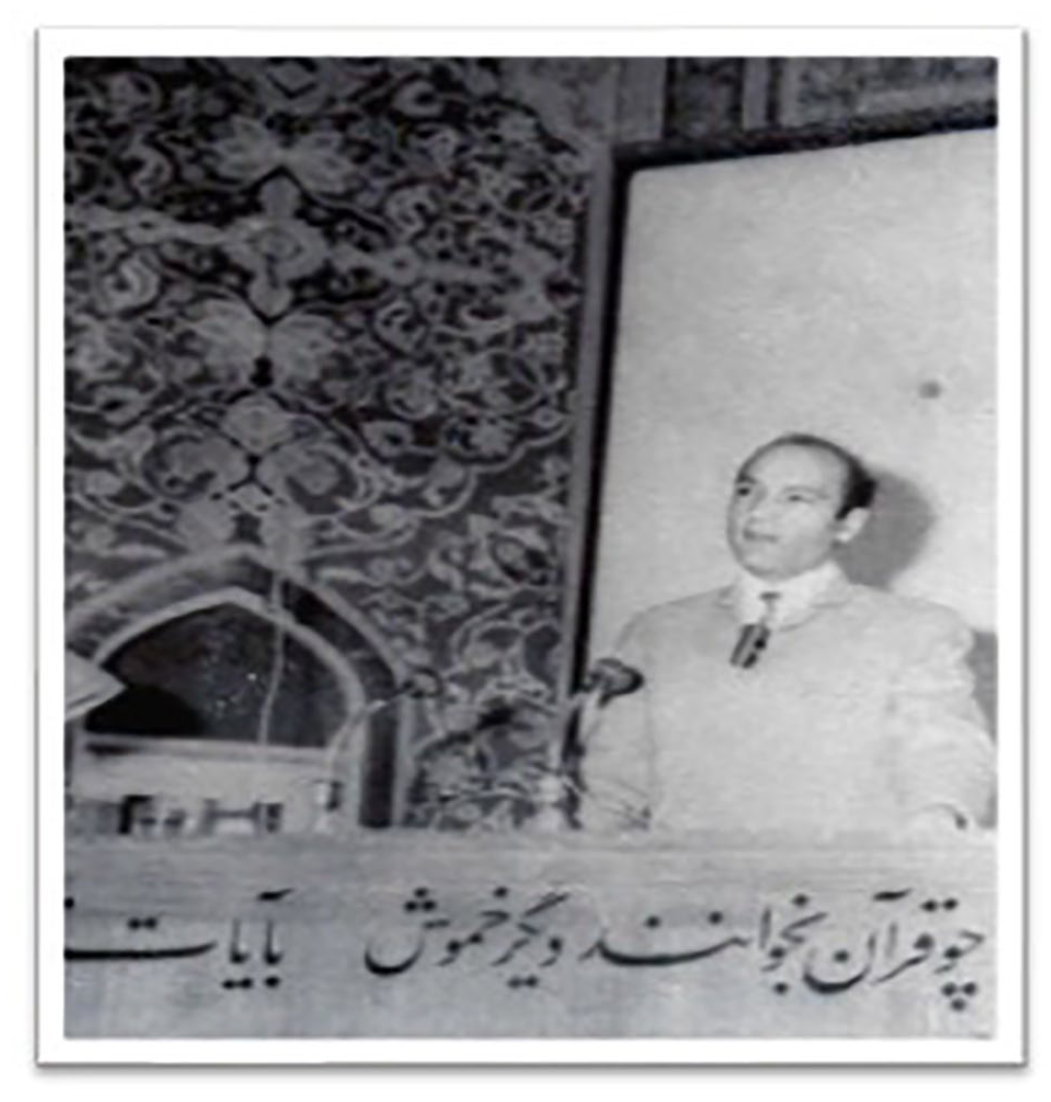
Shariati at Hosseinieh Ershad, early 1970s.
Dr. Ali Shariati became acquainted with Islamic concepts, socialism, and socialist interpretations of Islam as a teenager through his father and Qur’anic exegesis sessions and other meetings with political activists of the time. He collaborated with political groups at the beginning of his youth (Rahnema, 2000). After obtaining a scholarship, Shariati went to France to continue his graduate studies at Sorbonne University. Shariati collaborated with the Algerian National Liberation Front (FLN) in 1959 during his time in Paris. Influenced by Algerian and some Arab socialist groups battling against imperialism and colonialism, Shariati became politically active, protesting against the Shah’s regime. Deeply inspired by Fanon’s revolutionary and anti-colonial ideas (Bayat, 2017), Shariati introduced Fanon’s thoughts to Iranian revolutionary émigré circles (Saffari, 2019). He even translated Fanon’s The Wretched of the Earth into Farsi. In 1964, Shariati returned to Iran, equipped with extensive knowledge of sociology, Islamic history, political activism, and a wealth of political arguments against imperialism from key figures he had encountered. Upon his return, he was immediately arrested by Savak on charges of subversive political activities that he had conducted while in France. After a few weeks in detention, Shariati was released and began teaching at the University of Mashhad. Soon after, he moved to Tehran with his wife, Puran Shariat Razavi, who held a PhD in Persian Literature from Sorbonne University 8 . Upon their arrival in Tehran, he was invited to give lectures at Hosseinieh Ershad, lectures that quickly became the most popular ones offered by the institute. Shariati’s untimely death in London in 1977, at the age of 43, did not quench the flame of his popularity. Rather, the lingering suspicion that the Iranian government’s security forces orchestrated his demise in London only amplified the weight of his words among many revolutionary spirits. In a lecture given on a sultry August evening in 1971 in Tehran and Hosseinieh, Shariati leveraged his remarkable oratory skills and comprehensive knowledge of the history of Islam, Shia, anti-imperialist movements, and various philosophical attitudes. Within the global political landscape of the time, he portrayed an inspiring revolutionary role model for women who aspired to change their society radically: Fatima, the Prophet Mohammad’s youngest daughter.
Shariati and crafting a collective revolutionary Islamic identity
According to Dr. Ali Shariati Cultural Foundation’s (2018) reports, Shariati’s speech on Fatima and later his book Fatima is Fatima was one of the best sellers of its time, and the night Shariati delivered his speech about Fatima was recognized as the most prominent speech in 1971 at Hosseinieh Ershad. Men and women from different walks of life, particularly high school and university students, went to Hosseinieh to listen to their hero talking about Fatima. But how and why did that speech turn into Hosseinieh’s “most prominent speech” of the year?
I assert that Shariati discerned two significant socio-political phenomena: (1) the constrained power of women within social movements and the absence of a collective revolutionary Islamic identity to serve as an inspiration for numerous young women with Islamic identity willing to engage in political activism, particularly in growing urban areas, and (2) the potent role revolutionary women could play in bringing change to their society as active agents, capable of shaping society and its future through their active involvement in revolutionary struggles. He recognized that many women could not connect with the popular female figures either among the non-religious leftist groups or the regime’s representative ones. To address these necessities, Shariati, crafting Fatima’s image as a collective revolutionary Muslim figure, underscored the crucial role of women in bringing about transformative social change 9 (1979). He developed his ideas in various lectures and books, particularly in Fatima is Fatima (1971) and in the Expectations of the Present Era from Muslim Women (1975). Shariati did so by linking different social, political, historical, theological, and emotional angles to introduce a revolutionary role model beyond all times and places (1975).
Shariati, as a sociologist, had a critical stance toward the Western notion of a modern self that had failed to account for diverse socio-historical contexts in different localities (Byrd and Miri, 2017). Seeking to construct an alternative understanding of the self within his society, he drew from a range of discourses. His knowledge of Islamic history, Shia, and Islamic figures—including female figures—combined with Jalal Al-e Ahmad’s critical views on Western female figures and their popularity in Iran. AI-e Ahmad 10 , a prominent Iranian intellectual, coined the term Gharbzadegi (Westoxication/Occidentosis) in 1962. He emphasized the need for relevant conceptual frameworks that could enable young Iranian Muslims to confront the increasing Westernization of their society. He recognized the emancipatory potential of young women and underscored their crucial role in this struggle (Al-e Ahmad, 1962).
Furthermore, Shariati was significantly inspired by Frantz Fanon’s ideas concerning Muslim women’s involvement in anti-colonial and anti-imperialist movements. After translating The Wretched of the Earth into Farsi, Shariati began working on a translation of A Dying Colonialism, in which Fanon highlights the crucial role of women in Algerian society as agents of transformative change. Shariati also maintained direct correspondence with Fanon, engaging in exchanges of ideas and insights (Fanon, 2018). By actively participating in and being influenced by these national and global discourses critical of imperialism and Westernization and recognizing women’s roles within these struggles, Shariati, a sociologist and the key intellectual figure behind the Iranian theory of revolution, crafted a collective, revolutionary Islamic female identity that could resonate with countless women.
Theologically, Shariati distinguished Alavid Shia from Safavid Shia, another interpretation of Shia, to shape his discourse (Shariati 1972). He introduced Alavid Shia as the revolutionary branch of Islam, emphasizing the key role of Islamic figures in a socio-political struggle for a just society following the death of Prophet Mohammad. He highlighted significant Islamic concepts and historic characters within Alavid Shia, particularly Imam Ali, Fatima, Imam Hussain, and Zaynab. In his writings, he portrayed these figures as revolutionary warriors fighting for a classless monotheistic society (Shariati 1972, 1978). In this context, Fatima and Zaynab were two young revolutionary Shia women fighting not for individual rights but, as Shariati framed it, for advocating true Islam. His interpretations of these Shia female figures were nuanced, resonating with an image of a contemporary revolutionary Muslim woman.
Epistemologically, he united the Muslim Iranians of his time with the most revolutionary individuals of the past. With the assertion “Blessed are we that we have chosen Ali from among the successors of the Prophet,” he connected the Muslim Iranians of 1971 to the most “revolutionary of revolutionaries” (Shariati, 1971) in the history of Islam. In this context, “the past becomes evident in that heritage, and its values emerge in its identificatory appropriation” (Assmann and Czaplicka, 1995). By crafting the historic Islamic figures, including Ali and Fatima, Shariati led his audience to think and imagine a different order of things in a Muslim revolutionary society. In Shariati’s discourse, Imam Ali resonates with a revolutionary man, and he was chosen by Iranians as the greatest ideologue and political leader of Shia, a revolutionary man who respected and supported Fatima’s opinions and revolutionary actions. This portrayal not only created space for such a woman but also paved the way for men to fight alongside their ideological comrades, even in private spaces such as team houses (Khane-ye timi), to make a revolution. In this discourse, Zaynab, trained by Fatima, emerged as a brave advocate for her brother Imam Hussain’s political rights. Unlike her brothers, who had the opportunity to learn from and be trained by the Prophet, Imam Ali, and other renowned Muslim revolutionary men of the time in wars or other occasions, Zaynab mostly remained with Fatima (1979). However, at a time when many remained silent and fearful, Zaynab fearlessly delivered influential speeches, challenging the political power of the ruling class who had killed her brothers. By portraying Zaynab as a revolutionary woman, Shariati also showcased Fatima’s ability to cultivate courageous female followers of Islam (1979). In this narrative, Fatima serves as a role model for Iranian revolutionary women of the time, responsible for training younger women in their mostly underground organizations and activism.
Shariati’s narrative deeply resonated with his diverse audience, reflecting their collective emotions, such as anger against various forms of injustice and their unwavering determination to resist socio-political oppression. His discourse allowed the audience to envision a revolutionary woman collectively. Shariati vividly recounted Fatima’s courageous endeavors, elucidating her political and social activities against the ruling elite (1971, 1979). On various occasions, Fatima questioned the legitimacy and authority of the ruling class and the injustice inherent in their decisions and actions (Shariati, 1971, 1975, 1979). Fatima embodies an intersectional figure: a woman who embraces a modest life akin to those of the lower class, supporting the most revolutionary men of her time—Prophet Mohammad and his steadfast follower Imam Ali—despite the immense challenges inherent in their revolutionary Muslim existence.
Moreover, to grasp how Shariati crafted such a revolutionary female figure in Fatima, it becomes crucial to acknowledge what he did not explicitly address: Fatima’s daily lifestyle and personal desires as a young woman from an elite family. Shariati’s book and his discussions on women in other talks and publications (1972, 1975, 1976a, 1976b, 1978) do not focus on the daily life problems of women. This is because, within the revolutionary context of the 1970s, the demands of daily life were the last things revolutionary individuals should have concerned themselves with. Such demands can induce a sense of “shame,” akin to what Fatima experienced when she sought financial assistance from her father and ideological leader (1971). In other words, Shariati talks about revolutionary ethics, which involve protesting against imperialism and bourgeois values by adopting a modest lifestyle and supporting revolutionaries.
As Shariati “reformulated Marxian concepts to address the historical specificity of Iran and the Middle East” (Bayat, 2017: 41) and “stressed the role of ideas, faith, and the Shia doctrine in political and economic transformation” (Bayat, 2017: 41), he crafted a revolutionary female image capable of inspiring women across different times, economic strata, and social positions. In essence, his portrayal of Fatima, while grounded in a real Shia figure, transformed into a dynamic historical image that transcends time, spaces, and nationalities, interweaving individual experiences and visions of a revolutionary woman (Shariati, 1971).
For Shariati, the idea of “returning to self” 11 was intended to “articulate liberation from imperialism through the return to national identity, indigenous values, and cultural heritage” (Bayat, 2017: 46). No intellectual in Iran, whether contemporary to him or before and after his era, has succeeded in shaping such a female figure firmly rooted in religious beliefs, cultural traditions, and socio-historical realities. In this discourse, wherever oppression prevails, a true Muslim, even while raising children as Fatima did, upholding the institution of marriage as she did, or grappling with economic hardships as she experienced, must remain resolute in their revolutionary commitment to fulfill Allah’s will and establish a classless monotheistic society.
Shariati’s depiction of the revolutionary path resonated with many young women in the 1960s and 1970s who aspired to join revolutionary groups espousing Islamic ideologies, particularly the Mojahedin-i Khalq Organization. Founded by a small group of university students as a Muslim armed group opposing the Shah’s regime, this underground organization, “the children of Shariati’s political vision” (Bayat, 2017), was popular among young religious individuals before the 1979 revolution. Shariati’s interpretations of Shia greatly influenced the Mojahedin, who considered him their “spiritual leader” (Ghamari-Tabrizi, 2016). Many of these women joined team houses, immersing themselves in society to spread awareness and promote liberty. These women sought to actualize Shariati’s vision of a classless monotheistic society through various means, including labor and student strikes and other militant actions. Shariati’s portrayal of Fatima served not only as a role model for Shia women in Iran but was also projected as the “best role model” (Shariati, 1975) for women beyond national borders. Her revolutionary identity provided a guiding light toward genuine liberation from cultural imperialism, which dominates various societies (Shariati, 1975). This form of imperialism estranges women by emphasizing capitalist values such as consumption and a superficial understanding of life, neglecting human responsibilities in today’s world (Shariati, 1975).
In other words, although the concept of an economic class was important for Shariati, and he considered it in the economic form of the new order in Iran, he did not see it as sufficient for the formation of a revolutionary class. This analysis was especially the case for the lower-class urban women of the 1960s and 1970s. Shariati, with the creation of this capacity in the historical character of Fatima, considered religion, gender, and culture in his class analysis of societal conditions and in creating a revolutionary class. This approach drew many young women from the lower classes in urban areas, especially those seeking a revolutionary, change-driven identity. They were particularly attracted to his lectures, including the one about Fatima and her role in Islamic society.
Conclusion
Adopting a socio-historical approach and employing discourse analysis, I examined how and why Shariati, ‘‘the ideologue’’ and “architect” of “an Iranian theory of revolution” (Bayat, 2017), devoted several lectures in the 1970s to female Islamic figures, particularly Fatima. I also explored why many young people, including thousands of women, respected and accepted his thoughts, many of whom joined revolutionary groups and organizations (Paidar, 1997; Moallem, 2005). These inquiries become more significant and make the situation sociologically problematic when we recall that the 1970s was a decade of economic growth in Iran, allowing an increasing number of people to enjoy a middle-class lifestyle, and the secular Pahlavi state followed Western societies in granting women many civil rights including the right to participate in political elections, economic activities, and benefit from higher education opportunities inside and outside the country. At the same time, leftist non-religious groups were actively present in urban areas across the country.
Upon problematizing this situation, I situated both Shariati’s lectures and the youth’s attraction to them within their broader global and local socio-historical contexts in the 1970s, analyzing the dynamics at both levels. Connecting these points, I assert that Shariati’s sociopolitical discourse—influenced by his personal political journey, distinct personality traits, intense rhetorical voice, and writings—functioned like seeds cast into the ideologically fertile grounds of the time, thus cultivating a defining historical moment. His insights invigorated many, solidifying their collective anger in the revolutionary essence of Islam and the archetype of the ‘‘true Muslim.’’
Shariati, applying his sociological knowledge, recognized the rising demand for such an identity among the younger generations for whom the Western or leftist models did not resonate; he his crafted Muslim figures thus became the role models for many to join the revolutionary organizations with anti-imperialist, antiregime, and Islamic identities.
Within such sociopolitical discoursive context, and analyzing his work, particularly Fatima is Fatima (1971) and The Expectations of the Present Era from a Muslim Woman (1975), I argue that Shariati’s crafted identity rooted in history that transcended time and space. It enabled the audience to ignite their imaginations, conceptualizing the role and attributes of a revolutionary Muslim woman and comprehending the essence of a true Muslim in their society. Shariati was able to do so because, in addition to his sociological and philosophical knowledge, he possessed a profound understanding of the history of Islam, familiarity with prominent Shia Islamic figures, awareness of national and global anti-imperialist discourses, and an appreciation for the significance of women’s roles within these dialogues. Moreover, his involvement in various social movements throughout his lifetime, coupled with his insight into Marx’s perspectives on revolution, equipped him to construct such a collective identity that held broad appeal, particularly to the Iranian youth yearning for a response to the critical question of the time: “What is to be done?”
Furthermore, Shariati shaped this collective identity, understanding its potential to play a historic role in inspiring numerous women to join the nationwide social movement striving for fundamental societal change. In Fatima is Fatima, he constructed a shared past, declaring, “we, as Iranians, chose Ali while his people [in his time] did not.” (1971: 4). He connected a point in the past to a historical moment of opposing the Pahlavi regime in the present. Fatima assumed a critical role in this context; as a devoted follower of Imam Ali, she was ideologically and emotionally linked to him, much like Shariati’s audience was connected to him as their “spiritual leader” and to their political leaders as their political heroes. Consequently, Fatima emerged as the ideal role model for Iranian Muslim women who were committed to following the revolutionary path toward a unique revolutionary future. Shariati articulated this future as a classless, monotheistic society.
Furthermore, the image of Fatima, as portrayed by Shariati, could resonate with his audience because she passed several steps and examinations and difficulties to become a revolutionary woman (Shariati, 1975). She followed Prophet Muhammad as her ideologue and Imam Ali as her comrade and closest confidant to the Prophet. She learned to transcend daily trivialities, transforming from a self-centered individual to a selfless, revolutionary person. As Shariati (1971: 93) characterized it, this was a process of “moving from being to becoming.” She undertook this journey while being the daughter of the Prophet, a mother of four, and a young woman with a long life ahead of her. She sacrificed all these aspects of her life for the cause of true Islam and the vision of a classless, harmonious society. This revolutionary subjectivity and its corresponding values are entirely distinct from, if not in direct opposition to, the liberal feminist subjectivity. In fact, this liberal feminist perspective was accepted and supported by the state at the time, a fact that some individuals paradoxically attempt to find reflected in Shariati’s revolutionary lectures.
Finally, there is a global dimension to the collective identity that Shariati created. He was familiar with various anti-imperialist movements across different countries and continents. He perceived women’s oppression, not just in Iran but in the “global South,” as a direct result of cultural imperialism. He called this oppression, which also sparked socio-political problems in Western societies (Shariati, 1975), the “greatest conspiracy against humanity” (Paidar, 1997, 79). The portrayal of Fatima he presented was intended as a response to this “greatest conspiracy,” designed to resonate with women all around the world (Shariati, 1975). Fatima is Fatima was among the few Iranian works that were swiftly translated into Turkish, Arabic, and English following its publication, making Shariati’s ideas accessible to other societies (Bayat, 2017). I believe this global aspect of Shariati’s work, along with the international audience’s readiness to read his work, holds potential for future studies. In particular, examining the genealogy of South-South solidarities and “global South” anti-colonial and anti-imperialist movements, especially during the last decades of the 20th century, could be illuminating.
Footnotes
Funding
The author received no financial support for the research, authorship, and/or publication of this article.
