







Abstract
In 1926, the colonial Rhodesian state created Matobo National Park on whose shoulders Chipangali Wildlife Orphanage was established in 1974. That was followed by displacements of BaKalanga communities. By comparing livelihoods of marginalized human and animal orphans, this article provides new lens for analyzing the displacement discourse. It captures BaKalanga struggles against exclusion as orphanhood. Through ethnographically gathered narratives and animal orphan observations, it contributes to scholarship by investigating longitudinal impacts of displacement on human and animal orphan livelihoods, thereby offering a more than human displacement history. “Orphans of Matobo” captures BaKalanga characterization of their livelihoods outside ancestral land.
Introduction
Zimbabwe was occupied by the British in 1890. Europeans soon began to displace Africans from ancestral land as they shared large tracks of land which Africans claimed (Alexander, 2006). In Matobo, BaKalanga communities were displaced following the erection of Matobo National Park in 1926 (Ranger, 1999). By 1962, the hilly Matobo area which had been home to BaKalanga communities had been turned into a people-less park (Bvurire, 2023a). All land on the eastern and northern shoulders of the park was shared among Europeans. In 1974, Chipangali animal orphanage, which houses animal orphans, was created on the north-eastern armpits of the park from land claimed by BaKalanga. At the pith of this research is the impact of displacements of humans and animals for park creation and to create an orphaned animal village. Very recent world displacement figures show a gloomy picture. There were 75.9 million people living in internal displacement globally as of the end of 2023, up from 71.1 million in 2022 (internally displaced persons (IDPs)). In sub-Saharan Africa, the figures of IDPs have been increasing from 2013 to 2023 from 11.4 m to 16.5 in 2018, 27.3 in 2021, to 34.8 in 2023. Of the 75.9-m worldwide IDPs figures, sub-Saharan Africa feeds more into the sad tally. In 2023 alone, Zimbabwe had around 10,000 people internally displaced, a figure way too high for a country not at war, not usually experiencing severe climatic disasters like floods or natural disasters such as high-magnitude earthquakes, volcanoes, and landslides. This study focuses on displacement for environmental conservation as orphans are the most vulnerable class among the evicted marginalized. The fulcrum of this research is comparing livelihoods of human and animal displaced orphans. It explores orphan livelihoods after Chipangali was formed in 1974 up to 2023.
Livelihoods of animal orphans displaced to Chipangali are contrasted to human orphans of communities displaced from Chipangali. Scholars have argued that despite challenges (de Haan and Zoomers, 2005), everyday livelihoods have validity as an anthropological tool for reconstructing history (Chambers and Conway, 1992). This research therefore draws from the concept of everyday livelihoods to evaluate displacements in Matobo. The term orphan at the pith of this study has multiple, continuously shifting, and sometimes contradictory definitions. New Oxford dictionary defines an orphan as “a child whose parents are dead.” Studying the Rambi orphans in Rakai district in Uganda, James Sengondo and Janet Nambi (1997) define orphan as “a child who has lost one or both parents” (p. 106). The definitions above however deny contextually derived meanings ascribed to orphans in Matobo. In Matobo, there is a challenge which comes with the phrase “loss of parents” when discussing orphans. “Loss” in Matobo embalms deaths, rejection, and disappearance of parents. The concept of “orphan” can be viewed as carrying varied cross-culturally derived definitions. The understanding and use of the concept also differ across disciplines (Oleke et al., 2006: 268). In the case of this article, as commonly employed in Tshalimbe, an orphan is a child who has lost a parent or both, or whose parents’ whereabouts are unknown. Yet as argued by this article, the term has broader connotations as articulated by BaKalanga of Matobo. It suggests envisaged state neglect, disregard, and mistreatment of these communities from when they were displaced from ancestral land. Thus, even though the article focuses at literal Matobo human and animal orphans, it argues that these communities envisage and articulate themselves as metaphorical orphans of the state.
This article therefore uses orphan both literally and symbolically. Symbolically, the term captures Matobo articulations of how they were experiencing state control and their envisaged marginalization as a long-term impact of displacement. To them, displacement is synonymous with impoverishment (Cernea, 2000; Matanzima, 2022: 1249; Koenig, 2002). Matanzima (2022) argues that “displacements create ‘mobile-subjects’ (or ‘destitutes’) who have no permanent home” (p. 1262, also see Dowie, 2005). Beyond colonial resettlement, orphans of Matobo show that communities experienced “impoverishment, vulnerability and precariousness” (Oliver-Smith, 1991, also see Chape et al., 2005; Ghimire & Pimbert, 1997). Their plight can be summarized by “suffering for territory” (Moore, 2005) as BaKalanga viewed themselves as living outside the orbits of mainline nationalities such as the Ndebele because their language was “dominated over,” and their ethnic narrative “crowded out” (Helliker et al., 2022: 10). BaKalanga narratives of being excluded and peripherialized are summed up as orphanhood, as “they had little access to the corridors of power” (Helliker et al., 2022: 13). After independence, BaKalanga were brutalized and silenced during gukurahundi (see Dube, 2022: 32; Ndlovu et al., 2022). Looking at the Chisa who were displaced from Gonarezhou National Park, Emmanuel Ndhlovu (2022: 137) aptly embalms BaKalanga articulations thus: “The result of this has been, as Fanon (1963) would have called it, ‘individuals without an anchor, without a horizon, colourless, stateless, rootless—a race of angels’” (p. 175). BaKalanga articulations characterize themselves as “the wretched of the earth,” abandoned by the state (Fanon, 1963). Elsewhere the Sengwe of South-eastern Zimbabwe were marginalized when their land was taken during the establishment of Gonarezhou National Park (Chisi, 2022: 69). After their displacement, the Tonga of Northen Zimbabwe were also “situated at the periphery of national power so that their presence is insignificantly felt within wider Zimbabwean society and politics” as they became “forgotten orphans of the colonial empire” (Matanzima & Marowa, 2022: 108). The Tonga had to deal with “decreased food security, increased workloads, decreased physical and psychological well-being and economic hardship” (Ndhlovu, 2022: 133). Writing about the Chisa who were displaced from Gonarezhou National Park, Ndhlovu (2022) argues that they “are in a perpetual state of semi-starvation” (p. 133) as their source of livelihood was shattered. Kaerezi communities to the east of Zimbabwe, whose history Moore (2005: 1) studied, were labeled “squatters” by the state in a place they claimed to be theirs. These beleaguered communities capture BaKalanga narratives summarizing their plight as synonymous to orphanhood. At the center of the article therefore is the argument that the long-term impact of BaKalanga displacement was the perpetuation of marginalization. Physical Matobo orphans’ livelihoods were thrown to the doldrums as displacement reduced communities to Amadingindawo (nomadic land-seekers) (Bvurire, 2023a).
Scholars have therefore investigated the displacement of communities for development (see McGregor, 2009; Moore, 2005), for environmental conservation (see Amend and Amend, 1995; Ranger, 1999; Shelter, 2007; Tavuyanago, 2016), and for colonial settlement (Alexander, 2006; Marowa, 2015). More recent work has focused at the longitudinal impact of displacements (see Chisi, 2022; Helliker et al., 2022; Matanzima, 2022; Scudder, 2019). No work has centralized the longitudinal impact of displacement on orphans. There is also no study that focused on displaced wild animal orphans. Comparing displaced animals with humans has not been the focus of scholarship. This study widens the displacement discourse to these formally unattended areas. It is hoped that this study will open new debate on how (both human and animal) orphans (or children) were affected by displacements.
The study first discusses research methods before exploring the historical background of Chipangali wildlife orphanage. It then reviews displacement literature, after which it analyses the animal everyday experiences. The research then analyses the narratives of Tshalimbe orphans and their guardians and then finally, animal and human orphan everyday livelihoods will be juxtaposed before conclusions are drawn.
Research methodology
The research takes a case study approach where the focal point is Matobo District. In this study, the “Triangulation of Methods” is used in an attempt to wodge various methodological weaknesses associated with either qualitative approach or quantitative alone (Dunning et al., 2008). It is hoped that pie charts and graphs will improve the quality of data analysis. Furthermore, the sources used in this research range from primary to secondary, including archival research, interviews gathered from ethnographic research and published literature. The archival material was gathered from the National Archives of Zimbabwe, Matobo district archives, Bulawayo City Library, and Tshalimbe Primary School records. Archival research and field work were done between April 2019 and December 2023. Documents were used to trace BaKalanga history from before the establishment of the park, their lived experiences during evictions, and their livelihoods outside the park in resettled areas. Rhodesian newspapers document how the state viewed BaKalanga evictions before, during, and after displacements. African newspapers like Bantu Mirror on the other side were also used to offer African reflections on the process of evictions.
Even though documents were pivotal in providing information for this research, the main source of information was oral history. Nyachega and Sagonda (2022: 216) have argued that “oral sources have social content, hidden and multiple meanings” which “offer an obvious although not easily accessible opportunity to incorporate people’s voices into our scholarship.” So oral sources provided information on the complexities of BaKalanga livelihoods and struggles against the state from the establishment of the park up to 2023. They helped in analyzing how evicted communities re-imagined their social, economic, and political lives over a long period of time and through varied phenomena. It has been noted that although “oral sources like personal narratives vary greatly, yet they can provide unique insights into the connections between individual life trajectories and collective experiences beyond the individual when carefully read” (Maynes et al., 2008). Oral sources have therefore played a fundamental role in providing information for this research. Although oral sources can be subjective and are affected by memory loss, they gifted us with information to comprehend BaKalanga everyday struggles on the blindside of state archives and other sources.
In gathering oral evidence, the study used individual and focus group interviews among BaKalanga of Tshalimbe and from environmentalists in Chipangali. The snowball approach helped in closing memory loss and cracks during interviews and cementing particular themes. BaKalanga articulations necessitate evaluation of how they morphed livelihoods through time and various phenomena. The narratives also assist in analyzing the concept of orphan among BaKalanga and reconstructing history from how Matobo communities articulate it. The random purposive sampling method was employed in conducting the interviews.
Apart from using ethnography, this study also used the observation method when analyzing the livelihoods of animal orphans in Chipangali. Observation helped in tracing trends in animal behavior over time. Human–animal relations in the orphanage could best be assessed through watching change and continuity of animal mannerism over time. These were recorded and then analyzed to come up with nuanced discussions of animal livelihoods in the animal village. Overall, the study uses the longitudinal method in assessing the long-term impact of displacements on BaKalanga (Scudder, 2019). This method helps to uncover effects which would not have been visible closer to evictions (Matanzima, 2022). The study therefore investigates human–animal relations after evictions; in particular, human and animal orphan displacement history, by use of longitudinal approaches, archival, and ethnographic tools using qualitative and quantitative research methods, which all help in breaking new grounds in the displacement discourse.
Origins of Chipangali wildlife orphanage
Chipangali wildlife orphanage was purchased by Viv Wilson and his wife Paddy Wilson in May 1973. Viv and his wife Paddy lived in Eastern Zambia before moving to Zimbabwe. Settling in Motion by Daimon (2021) has suggested that a number of Nyasas settled in Zimbabwe during colonial rule. The Wilson family migration shows that it was not only Africans who moved to Zimbabwe during colonial era but also Europeans. According to Nicky Wilson, the name Chipangali comes from ChiNyanja language spoken in Eastern Zambia where the two lived and Chipangali means “open friendly country.” This name was viewed by the two environmentalists as curating the concept of animal orphans having “freedom to live with similar rights as animals with parents, family (and friends) in the wild.” A 2022 Chipangali pamphlet stated that Chipangali was established as “a haven for wild animals that have little hope for survival in the wild- creatures that have been orphaned, abandoned, injured, born in captivity or were former pets.” A poster at the payment office at Chipangali claims that “our orphanage is not a zoo, a menagerie or a collection of animals for financial gain.” A poster at Chipangali views it as a “private sanctuary for abandoned, confiscated or injured wild animals—animals that, once reared in captivity cannot be released back into the wild.” To Nicky, Chipangali was erected to establish a “private sanctuary for orphaned, abandoned, confiscated and injured wild animals.”
Chipangali was turned into a private animal sanctuary in 1974. The fig tree which currently sits in front of the offices was the biggest tree in the orphanage. The Wilsons put water sources, electricity, and erected all the buildings at the orphanage in the past 50 years. Initially, the Wilson family were living in a tent at the orphanage. They first built cages for animals before they built houses for themselves. At that time, Mr Wilson was working at the Museum of Natural Sciences in Bulawayo and Mrs Wilson had a job in art. The couple came over to the orphanage during weekends and holidays. They employed someone to look after animals with whatever they could get. The first house to be erected is the one at the center of the orphanage. Chipangali grew slowly around that house. The house was later turned into offices when another had been built further down behind the animal cages. Later on, a tea room for visitors was also built. Around 1982, Paddy gave up her job to fully look after animals at Chipangali.
When the Bulawayo public heard about Chipangali, they slowly began to trickle in. One weekend for instance, about 50 people visited Chipangali. They “used all toilet paper, and other basics for a donation of only 50c.” Gradually, Chipangali grew as the wildlife version of Society for Protection of Cruelty to Animals (SPCA), which caters for domestic animals. Most of the trees and vegetation at Chipangali were planted by Viv, Paddy, and Miss Barry. Chipangali is currently run by Viv’s son Kevin and his wife Nicky Wilson who have two children, Mickaya and Ryan Wilson.
Literature review
There is a large corpus of scholarly work on displacement of communities in Africa (see Jacobs, 2003; Shelter, 2007) and in Zimbabwe in particular (see Hughes, 2006; Machingaidze, 2013; Mavhunga, 2008; McGregor, 2009; Moore, 2005). These offer a solid starting point when studying the history of forced removals in Matobo. Scholars have used different terms to imply forced physical removal of people from ancestral lands (see Adams and Murphree, 2001; Isaacman and Isaacman, 2015; Kothari et al, 1989; Marowa, 2015; Ranger, 1999; Shelter, 2007). These range from removal, displacement, dislocation, eviction, exclusion to involuntary resettlement. They all characterize the forceful material deprivation of local communities. This article uses displacement to describe the forced removal of animal and people from familiar spaces. The research explores how displacement was and continue to be envisaged and experienced by marginal communities in Matobo. This section discusses displacement literature from two angles. It starts by discussing literature that engages with forced removals in general before discussing literature that focus on displacement from parks.
Alexander’s (2006) work Unsettled Land offers a valuable foundation for exploring forced removals in Matabeleland, but it does not focus on environmental conservation. Isaacman and Isaacman (2007) analyze differences in narratives of evictions by the state and the local communities after displacements for the creation of Kahora Bassa dam in Mozambique. Fontein (2015) also gathered interesting narratives from displaced communities when the Mutirikwi dam was built in Nemamwa area in Masvingo. Fontein (2015) discusses the contestations over water, land, and belonging, which characterized these displacements. However, these scholars examine displacements caused by development projects. More recently, Matanzima (2022) has used the longitudinal approach to evaluate long-term impacts of displacements from dams. Matanzima (2022) examines Tonga-Goba communities displaced from Kariba Dam and argues that “it is only through longitudinal research carried out at various time intervals that these losses as well as secondary displacements that appear long after the resettlement” (p. 1251) become apparent. Scudder (2019) has also advocated for the longitudinal approach to studying displacements in order to uncover impacts over long periods of time. Helliker et al. (2022) used the longitudinal approach to examine the livelihoods of displaced minority groups in Zimbabwe. These studies offer a solid base for this article, which also seeks to explore ethnic minorities’ livelihoods after a long period of displacement. This article seeks to broaden the longitudinal displacement discourse by exploring livelihoods of children of displaced minority groups and wildlife orphans, which inherited the land taken away from BaKalanga. It is hoped that the wildlife orphanage makes sense the narratives of communities and human orphans of the displaced. Discussing the livelihoods of animal beneficiaries of land from where humans got displaced brings a new window into the displacement discourse. This article is not a campaign against animals, nor is it a crusade to gather support for human orphans. It uses new lens of orphans to evaluate the lived struggles of communities which were removed from ancestral land.
Some displacement scholars point to the numerous threats to protected area effectiveness (see Bruner et al., 2004; Struhsaker et al., 2005), including the view that many protected areas should contribute to poverty reduction (Naughton-Treves et al., 2005). The key arguments for biodiversity conservation submit that displacement is ethically necessary and is of import value for sustainable survival (Agrawal and Redford, 2009: 6). Those who argue that environmental conservation is of ethical necessity discuss the moral responsibility of humans to preserve nature (Angermeier, 2000). They argue that the economic costs of extinction may be astronomical (Losey and Vaughan, 2006; Pearce and Moran, 1994). It is still difficult to evaluate how these arguments justify human displacement. They are based on the assumption that human presence is unhelpful to conservation, and that “there is a calculus of gains and losses through which the worst effects of involuntary displacement on humans can be balanced by gains for conservation through displacement” (Agrawal and Redford, 2009: 6–7). Juxtaposing intangibles which are grossly incomparable present a huge challenge for these submissions. Some conservationists hint on other justifications of displacement that there is a lot of injustice in the world, and conservation-related injustice is mild (Agrawal and Redford, 2009: 7). Comparing injustices in itself, however, does not offer justification for being unjust. BaKalanga of Tshalimbe characterize the injustice displacements from Chipangali as authoring kuyitiwa nhelela (being made orphans) (Interview with Philimin Nkala, Tshalimbe, 16 October 2022; Interview with Irvin Moyo, Bulawayo, 12 September 2023). Suffering for Territory by David Moore (2005) aptly captures BaKalanga struggles after displacements. Reviewing Moore’s work, Pius Nyambara (2007) notes that the Kaerezi communities under chief Tangwena “fought against” the colonial and post-colonial states whose programs they “viewed as unnecessary intrusion and interaction into their livelihoods” (pp. 513–515). Matobo communities articulate being “rejected by the colonial and post-colonial state which inverted people for animals and animals for people” (Interview with Phillimon Nkala, Tshalimbe, 16 October 2022). These sentimentalities by Matoboans open a window for exploring how the dispossessed envisage their removal from ancestral land. Those marginalization narratives open paths for studying livelihoods of animals in the orphanage which BaKalanga view as beneficiaries of their lost territory.
Advocates of environmentalism such as Carpi Estella (2021) argue that we should analyze “beyond inter-species hierarchies, which instil unproductive ways of thinking, such as that a species per se is more or less important than another” (p. 1). This suggests that humans and animals are similar and calls for similar treatment. That argument pushes for the rights of animals even if it causes displacements of communities for animal settlement. This challenges BaKalanga articulations about their displacement which they connect to their marginality. Interestingly, Wilkie et al. (2006) have agreed with Estella that “to date little empirical evidence exists to substantiate the contention that parks are bad for local people” (p. 247). This bold claim is a disjuncture from evidence in Matobo and does not seem to consider the landscape cost and the narratives of those who experienced displacement. Daniel Brockington and James Igoe (2006) argue that these claims “ignore or worse dismiss numerous cases which indicate considerable cause for concern” (p. 428). Shelter (2007) analyzes the imaginations of the Maasai after they were evicted from Serengeti, which show that displacements from parks was experienced unpleasantly by African communities.
In Zimbabwe, the establishment of Gonarezhou, Hwange, and Matobo National Parks saw the forced displacement of the Shangani (see Carruther, 2016 [2015]; Tavuyanago, 2016), Nambya (McGregor, 2009), and BaKalanga (Bvurire, 2023a; Ranger, 1999), respectively, making those parks people-less. Davy Ndlovu et al. (2022), who analyzed Tshwa livelihoods after evictions from Hwange National Park, have argued that these communities were forced to adjust their livelihoods out of the park space. Chisi (2022: 69) like Ndlovu also studied displacements from Gonarezhou on the south east of Zimbabwe and concluded that this “saw the marginalization of the Hlengwe communities.” The Chisa who were also displaced from Gonarezhou National Park’s livelihoods were described by Emmanuel Ndhlovu (2022), thus “the consequences of their evictions were dire, as households lost their livelihood means” (p. 132). These scholars agree with Tavuyanago (2016) who looked at the struggles of the Shangane after displacements from Gonarezhou National Park. All these displacement scholars engage with livelihoods of minority ethnic communities just like this study. They take a longitudinal approach to exploring the impact of displacement on communities in similar manner as this research. However, this article submits that in taking a longitudinal approach, it is pivotal to focus at the most affected subsection of the displaced; that is, orphans. It also argues that comparing animal orphans in Matobo to human orphans opens a new window to the study of displacement in that it gives the human–animal flavor to the discourse, even so, from the marginalized of the marginal humans and animals. It therefore argues that animal and human orphans of Matobo offer a case for exploring displacements from many angles not least, human–animal relations, marginalized articulations of their experienced life, and children’s livelihoods after longitudinal displacements.
In Matobo, Ranger’s (1999) Voices from the Rocks gives the right platform for studies on forced removals. But Ranger connects the history of Matobo to its nature and culture and not the impoverishment it created which give rise to the “voices from Tshalimbe.” S. Makuvaza (2016) who also studied BaKalanga displacements from Matobo National Park shows that conservation of the park was not helped by the evictions. Makuvaza’s (2016) work agrees with S. Bvurire’s (2023a) work which investigates how BaKalanga were viewed by communities into which they were displaced and argues that re-settlers lived with labels and ridicule after displacement. These studies give a sharp disjuncture from studies that view displacements as beneficial to Africans. This study draws from BaKalanga articulations of kuyitiwa nhelela (being made orphans) (Interview with Irvin Moyo, Bulawayo, 12 September 2023) when they memorialize their displacement. They narrate how they were reduced to homeless and placeless amaDingindawo (Bvurire, 2023a). Some narratives portray that these BaKalanga communities were viewed with contempt in areas they roamed through looking for settlement as they were nicknamed amaJaunda (those who eat on the way; Interview with Mpho Nyoni, Bulawayo, 10 September 2023). This study therefore captures the displaced as metaphorical “orphans.” “The Forgotten Orphans” in The Morning Line of July 2012 concluded that orphans in Hwange, nearly 400 km to the north of Tshalimbe, were facing challenges of food, accommodation, and failure to go to school (Kanjanda, 2014). That contrasts with scholarship that show that African societies had structures that cushioned against orphan struggles (Murdock, 1949). The argument that traditional African societies were immune of orphan problems is an unfortunate over-worshipping of African-ness. Elsewhere in Nkayi, Mpofu and Tshabalala (2021) discovered that orphans face many challenges despite the presence of different organizations there. In Mutasa district, Kanjanda (2018) shows that orphans also face many challenges that include failure to cope with academic pressure due to their vulnerabilities. In Mberengwa, Chitiyo et al. (2008) noted that orphans face various difficulties which agrees with Katiro’s (2010) investigation of urban orphans which revealed that they face unprecedented struggles in their livelihoods. All these studies offer some nuanced groundwork for this research as they reveal the various struggles faced by orphans throughout Zimbabwe. Notwithstanding, those orphans are not linked to displaced communities. They are not categorized according to sex, age, nature of orphanage, and fostering which determine struggle. These studies also miss articulations by Matoboans that orphanage is a description of livelihood marginality and not mere parental loss. No study has examined livelihoods of animal orphans in order to determine the long-term impacts of displacement. This study seeks to plug those openings.
Everyday livelihood of animal orphans in the animal village
In April 2022, the oldest orphan in the Chipangali village was the crocodile, known as Winny, which was 95 years old. Winny had a child in the village, also viewed as an orphan, which was 25 years old. The habitation for these reptile “orphans” was to the southern end of the Chipangali village. These “orphans” were fed with 3 kg of meat each every 2 days. There were a few other smaller crocodiles in their own cage to the north of the homage of Winny and her son. These ate a little less portion of meat than Winny and her son. These crocodiles may live up to well over 200 years.
Next to the smaller crocodiles were snake “orphans.” These were fed periodically and lived in glass cages. They usually lay as though they were lifeless in their cages but sporadically coiled around as though they wondered how to find their way out of the cages. In April 2022, one of the cages had two mambas. They lay motionless in their cages like they had successfully been domesticated and had surrendered to humanity. Like crocodiles, snakes usually appeared unconcerned that they were in cages in resettlement land, but at times seemed to be restless and wondering for their way back “home.” At times, they revealed that they could be Hollywood actors showing “tamed” characteristics far from their real wild natures, like orphans pleading innocence, so that they could be released back to their “ancestral land.”
As one faces the Bulawayo end, to the left of the animal village were lion “orphans.” There were more than 12 lions in the village in December 2023. They were all offsprings of dead lion “orphans.” Their dead “parents” were captured more than 12 years ago. Lion “orphans” had not been released back into the wild. They were fed with about 6 kg of fresh beef meat every 2 days. These lions reach a good old age of about 23 years. All of these “orphaned” lions looked unworried about visitors, maybe because they were born in cages and had never experienced jungle life.
Leopards, which were caged to the north of the animal village, also received about 6 kg of meat every 2 days. Unlike lions, however, leopards were not permanent “orphans” of the village. When they were deemed to have “recovered,” they were returned back into the wild. All lion “orphans” in the village were children of dead lion orphans. They lived in a small “bush” prepared for them to have a feel of the wild, despite the constant disruption by human visitors who seemed to constantly bother their wildity. Every Monday, Chipangali was closed for the animals to “rest from being disturbed” by a huge flow of people from all over the world who visit the orphanage.
At the center of the animal village, as if to bisect it from east to west, were different kinds of monkey and baboon orphans. In 2022, the western side of this section housed the “wisest” of the monkey species. They were “rescued” from ancestral land around Mutare. They were viewed as “clever thieves” and could grab a visitor’s phone or food instantaneously. They received food once in 2 days. They were given apples, tomatoes, cucumbers, sweet potatoes, and various types of pepper. In one of the cages, monkeys even had a teddy bear for entertainment and baby blankets for warmth, but they seemed oblivious of them.
Kudus were located closer to the main entrance as one got into the animal village. Their “neighbours” were wild pig orphans, which were fenced off next to the cashier’s office. Kudus appeared to be the least healthy and looked thin and malnourished. They were fed with hay grass and fresh animal leaves. In 2022, one of the kudus had lost one of its horns in what appeared to have been a terrible hunt before he was brought into the village. Kudus appear successfully domesticated. They gave up on being wild and seem less fit to return to the wild where they would live under many insecurities, not least humans, lions, and leopards which they seem to have befriended.
Various types of jackals were caged at the center of the animal village close to monkeys. They were fed with about 2 kg of meat every 2 days. One of these servals (ihlozi) had a broken leg which got injured while it was still in the wild. Others appear to have adapted to cages life despite sometimes revealing signs of struggling to live under restriction. Different kinds of birds, domestic animals, hyenas, and cheetahs were also orphan members of the Chipangali wild animal village.
Of importance to this study is the work of William A. Roberts (2009) who examined whether “displacement abilities of humans can be found in animals. It considers the hypothesis that animals are ‘stuck in time.’” A “stuck-in-space” view is useful when analyzing animal displacement because we need to consider the possibility of “episodic memory in animals and the anticipation of future events” as we explore the daily livelihoods of Chipangali orphans. If we take what Roberts argues as applicable, then animals in Chipangali may be viewed as having the memory to understand episodes in history and expect both danger and other events such as times for feeding and nursing. That suggests that Chipangali orphans’ livelihoods can be used to examine the history of their displacement from where they were captured. This is also useful in considering how utilitarian Chipangali has been to these orphans, which helps respond better to critics of animal orphanage. Quintessentially, Chipangali offers a case where the orthodox meaning of “orphan” is challenged. If these old animals are referred to as orphans, then orphanage is surely broader than children who lost parents. Chipangali’s existence captures the crux of Tshalimbe communities’ characterization of orphanage; that orphanage is a state of livelihood in resettlement areas and that it is linked to being “caged” by the state. In the next section, before comparing human to animal orphans, it is important to also consider animal naming as a method of understanding the livelihoods of these animals in the orphanage.
Naming animal orphans
Almost all animal orphans in Chipangali were given names. Animal names in Chipangali are never sheer happenstances but invoke memories about everydaying in the orphanage. Chipangali animal names are cues for exploring animal mannerisms in resettlement. Marowa (2017) argues that names carry people’s collective memories and that landscape becomes loaded with meaning when they are named. This agrees with Naming Colonialism by Osumaka Likaka (2009), which argues that naming in colonial Congo can be a useful source of history reflecting on how Africans characterized colonial exploitation. Thus, in Congo, names archived the voices of African societies on how they experienced colonialism. Mamvura and Marowa (2023) who studied place naming in colonial and post-colonial Zimbabwe assert that “names are not ordinary, but they stand as sources of history, carry memories of the past and are an expression of power” (p. 81). These studies offer a solid foundation for this section, which focuses on animal naming in the orphanage and argues that game naming is not a game. Animal naming reflects on the way Chipangali communities imagined this zooscape and tried to make sense of their environment. Names curate the social construction of Chipangali and how people tried to immortalize events and behaviorisms of animals (Luig and Von Oppen, 1997: 16). Animals in the orphanage have almost all been named by the owners or employees in the animal village. Their names archive memories of the human–animal interactions. Names capture how humans perceived relationships between animals and/or humans. These names offer important tools for investigating everyday animal livelihood. They offer us lens to peep into how displaced animals behaved in resettlement spaces away from the wild. They provide analytical tools for gauging whether these animals were settled or unsettled in the resettlement village.
The names of animals given here were gathered in April 2022. The naming of orphaned lion family members probably offers the most fascinating of instances. The biggest lion was called Mukuru. The origin of this name is said to be Bhuru, which is the Shona acronym for bull. Mukuru was given that name because it was one of the oldest lions in the village. It was viewed as the “mukuru” (big or old one) of the lion family. There was also Rambo. It was given that name after Rambo the movie star. Rambo was a very rebellious lion. Rambo was violent to visitors and other lions. His life was action packed. The most friendly lion to other lions was called Mafela. Mafela is used as slang in Zimbabwe for someone who is friendly to other people. Mafela was viewed as accommodating to other lions. Observation showed that Mafela did not fight with other lions. Other names of lions were Nathan and James, which are common human names in Zimbabwe. They suggest a human attempt to personify animals or to associate man with the animal world. There were also Donte and Siaga and a number of other lions with names whose origins were shrouded in mystery. All these names suggest that animals were named due to the way they associated with other animals or with humans in the village. Similar to animals, humans sometimes receive acronyms which suggest their behavior or mannerisms.
Among the baboon and monkey orphan families, naming raises particular interest. One huge baboon was named Kane because of its imposing stature. Masango (Masango means wild) was the name given to the baboon which maintained its wild behavior. It fought other baboons and human visitors in the orphanage. Among the monkey orphans, housed next to baboons, were Belinda and Sindie. These monkeys were displaced from the Eastern Highlands. Their original ancestral land was Nyanga. They were viewed as cunning. There was also Jasper and Finn. Jasper was viewed as a treasure in the orphanage. Finn was a name with origins from Fionn in Ireland. It means fair. Finn was fair looking and resembled monkey beauty. It was viewed as a polite monkey which did not offend others or harass visitors.
In December 2022, there were two duikers in the orphanage. One of them was Dina and the other was Jay Jay. Jay Jay was viewed as a shrewd duiker and Dina was viewed as a loving one. Three leopards were also in the orphanage. Their names were Theresa, who was viewed to be as humble as mother Theresa from the Catholic Church, Sabie and Roselyn, which were viewed as good adapters of harsh resettlement environments. There was also a spotted hyena known as Apolo. Four jackals were also in the animal village. Their names were Bam Bam, Domino, Purble, and Prince. Domino was claimed to be an initiator of trouble in the jackals space which usually ended up implicating other jackals and Prince was viewed as the royalty of the family as he behaved like a well-groomed jackal. There was also a bush pig called Pepper because she was viewed as having a terrible character. There was also the kudus orphan family comprising Emily and Freddy and their daughter Tammy. Freddy lost one of his horns in the wild. The three were described as very friendly to people and each other.
These names store how Chipangali characterized orphan daily livelihoods and harbored memories about living far from animal wild space. Animal names in Chipangali are not sheer marks of particularity to differentiate them. They are special signals and tags pointing at everyday human–animal interactions. Names are “key to memory and experiences” (Huldén, 1994: 33) and are an “indispensable part of human history” (Helleland, 2012: 99) canonizing the multiple processes of de-wilding, de-animalization processes at the eve of animal initiation into domestic space. In this way, Chipangali does everything against wild animals in the name of wild animals. By examining these names, it is possible to evaluate animal fate in areas they were displaced to. These names were given following close observation of animal everyday livelihoods in the village. Chipangali animal orphans were housed in an area claimed by BaKalanga who describe themselves as “rejected by the state.” Its key to note that the defenders of environmental and animal rights find themselves at loggerheads with those who advocate for human rights (Estella, 2021: 4). Thus, Chipangali means a lot of things to different people. To environmentalists, it symbolizes a massive attempt to conserve and care for animals by sheltering, nursing, feeding, and caring for their “orphans.” To BaKalanga, Chipangali is claimed to represent an unfortunate creature, bulwarking against their return to ancestral land. Naming wild animals is viewed as snobbish by BaKalanga. To the visitors, it represents a hideout from stressful urban life and a tourist resort in the wild, naturally unadulterated ecosystems.
Ranger (1999) suggests that spaces mirror long-standing histories of human interaction with their natural world. Animal naming consequently mirror histories of human–animal relations and a more than human world. As argued by Likaka (2009) in Congo, names given to these animals store significant particles of history. Chipangali animals lost their neutrality when they got closed up in the animal village and began to interact with humans. Animal naming carry a de-wilding effect and is symbolic of animal initiation into a domestic sphere. Along the way, animals lost total particles animality, gaining some grains and traits of humanity. Most of these animals were no longer completely wild animals, and yet they were not completely domestic. They have space within the human world. They have names, they eat human food at apportioned times, and they have frequent visitors and fairly comfortable homage. They lost and gained identity, they renegotiated animal-ness as domesticated wild animals, having dualism and sometimes confusion, in their mannerism. They reflect survival characteristics in resettlement areas, where they were wild when threatened and more domestic when being fed or imagining safety. The social construction of Chipangali is therefore divorcing animals from the animal kingdom through adulterating them with humanity. Naming archives these pluralisms. Unsurprisingly, Tshalimbe narratives capture BaKalanga arguing that the state views animals as Zimbabweans and them as deputy Zimbabwean.
Everyday livelihood of human orphans in Tshalimbe
The focus of this section is exploring the livelihoods of orphans in Tshalimbe. Tshalimbe is located about 20 km off the Beitbridge-Bulawayo road, shooting off that road at the 58 km peg. It is a village under headman Mabhena. Matobo district records show that the first colonial headman for Tshalimbe, Marko Mabhena was appointed on 20 August 1937. According to the National Museums and Monuments of Zimbabwe Plaque erected at the Indaba tree shrine, after Umvukela uprising of 1896–1897, the first Indaba was held in this area on 21 August 1896 between the British South Africa Company leaders such as Rhodes, Hans Sauer, Johan Colenbrander, Vere Stent, John Grootboon, and James Makunga and Ndebele chiefs such as Somabulana, Sikombo, Umlugulu, Dhliso, and Nyanda. Livelihoods of these communities hugely depend on cultivation of arid, sandy soils. Kusena (2023) has observed that in Zimbabwe, “although food security is determined by critical factors such as politicking on both access and distribution of handouts, crop cultivation has remained the biggest guarantor for food security” (p. 100). Most of the orphans in this area who were interviewed for this article had either left or were still learning at Tshalimbe Primary School which sits at the center of the community. At the beginning of 2022, Tshalimbe Primary School had 14 orphans. Three orphans with both parents dead were interviewed. A total of 17 orphans under the age of 18 years were interviewed. Most of these orphans were fostered into the family.
Some of the interviewed were Noma and Ntantoe Sithole who lost their parents due to AIDS. They stayed with their maternal grandparents in the village. Another orphan, Lewanika Simbuyu’s grandparents were evicted from land around Chipangali. Ayanda and Nonhlanhla Moyo lost their mother Loyiso Moyo who disappeared. Loyiso went to South Africa and never came back. Loyiso’s grandparents were living in the Matobo park before they got evicted in the 1962 (Interview with Themba Moyo, Tshalimbe, 16 October 2022). Sindie Ncube, 7 years old, lost her mother when she was two. Another orphan Sibusiso Ngwenya’s guardians’ grandparents moved to Tshalimbe from the north of the hills around 1900 (Interview with Dan Ngwenya, Tshalimbe, 16 October 2022.) Figure 1 shows the bar graph reflecting the distribution of interviewed orphans by sex.
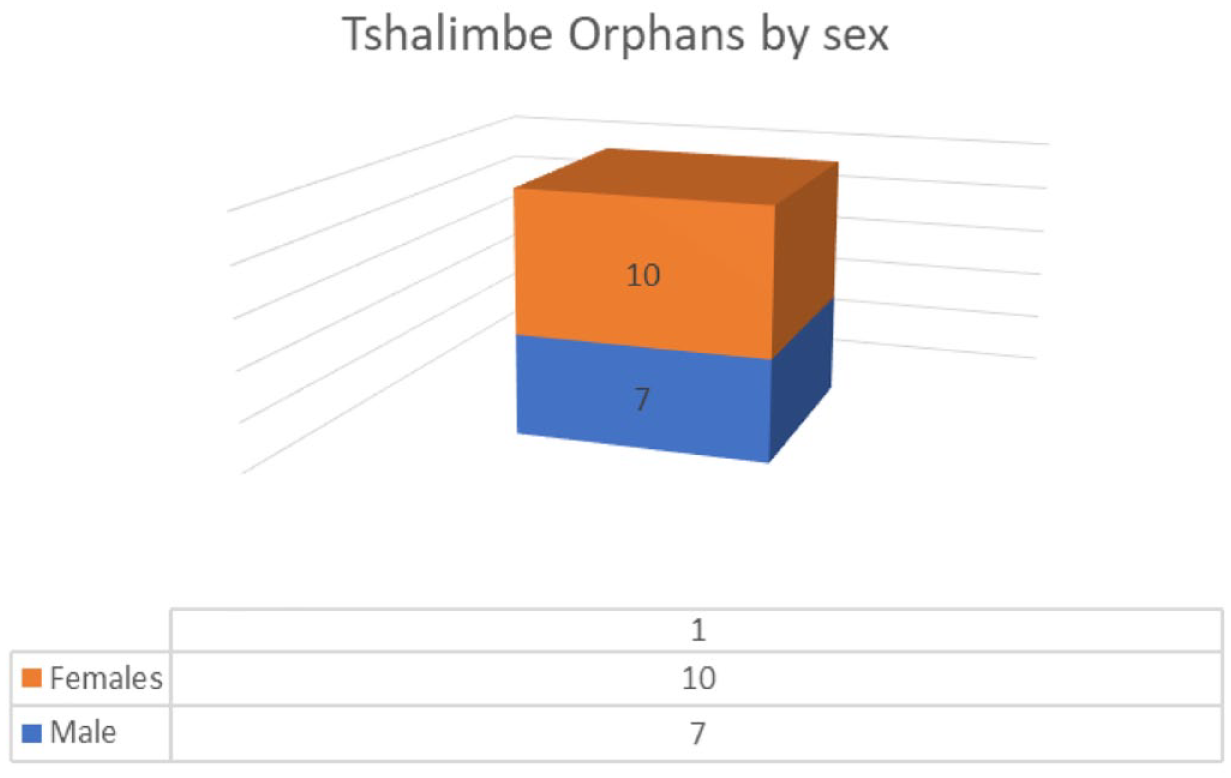
Tshalimbe Orphans by sex.
The graphs above show that in 2022, there were more female than male orphans in Tshalimbe. That has a huge significance in giving meaning to the treatment of orphans. Male and female orphans faced dissimilar treatment patterns. Males usually went out herding cattle and spent the whole day without food. Yet they narrated how they could milk cows and get wild food. They could also fish, hunt small animals such as birds, and eat while in the forests. Sometimes they had chances of getting honey and mushroom. This does not minimize the problems faced by these orphans because these advantages were not always available to all the orphans in similar trends all the time. These orphan narratives about their livelihoods offer exciting comparison with animals in Chipangali which are living like humans, yet humans in Tshalimbe hunt for food like animals. Some orphans like Dereck Moyo faced extreme poverty as his family did not have cattle. Dereck spent the day at home or assisting his uncle with chores such as molding farm bricks for people or pulling tree branches for fencing people’s gardens. He had little time for socialization with his peers or resting. Food was extremely scarce.
Female orphans generally faced tougher circumstances than males. They generally woke up earlier than males to do house chores such as cleaning and fetching water from the boreholes. Tshalimbe boreholes are generally spaced about 5 km apart. Sinini Dube, who was about 13 years old, carried a 20-L bucket of water from about 2 km away. Others carried water from up to 3 km away. Female orphans were also prone to sexual abuse and early marriages. Talent Ncube, whose mother died and was staying with his step-mother, got impregnated at 14 by a married man. Talent’s struggles simply worsened in nature. She became a mother at 15. Female orphans generally did not have money for sanitary wear and sometimes used papers, cloth, or leaves during monthly cycles. Female orphans were generally shouted at more than males due to usually working close to guardians.
Yet these generalizations of Tshalimbe orphans must also contextualize who adopted these orphans and whether the orphan lost a father, a mother, or both. The pie chart (Figure 2) shows that distribution.
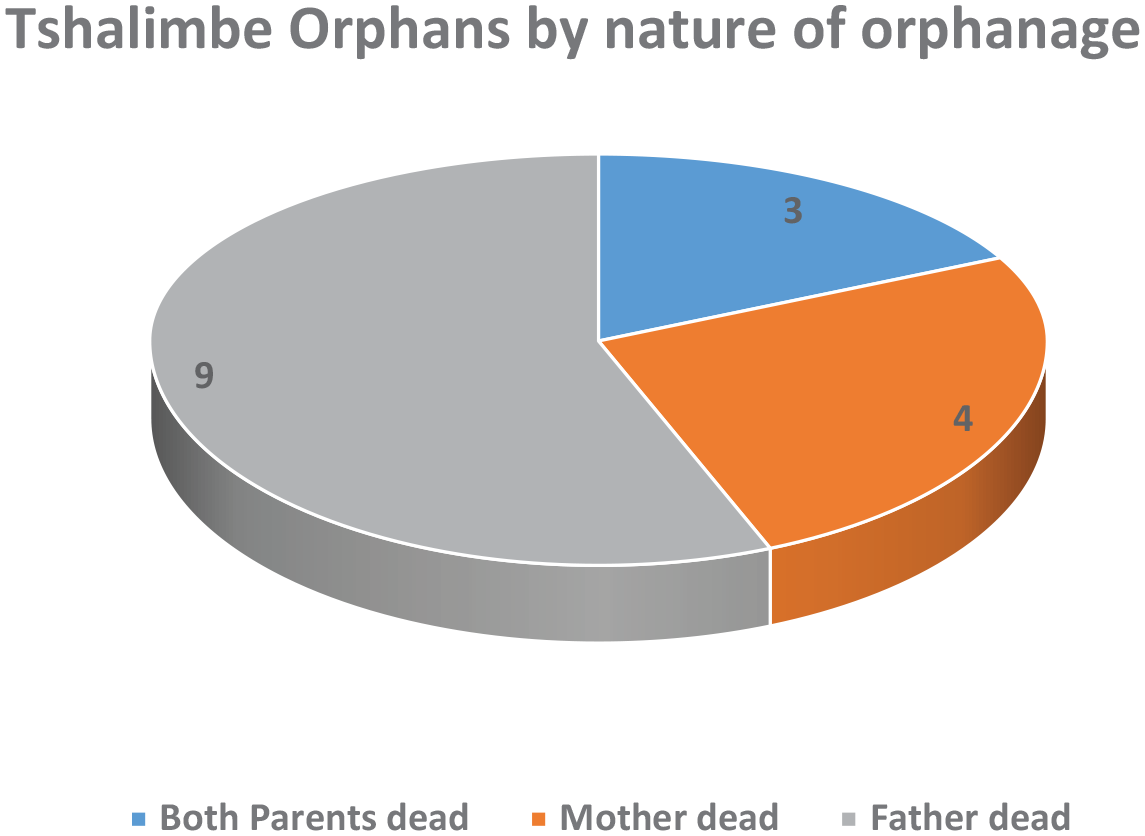
Nature of orphanage.
The three orphans without both parents generally faced more challenges than those who were staying with a single parent. The other four who lost a mother ordinarily faced worse struggles than those who lost a father only. Orphans staying with step-mothers seemed to struggle more than those who stayed with step-fathers. Yet females who stayed with step-fathers were generally at greater risk of being sexually abused by their steps than males. These circumstances were hugely dependent on the nature of fostering. The chart (Figure 3) shows the nature of fostering of Tshalimbe orphans.
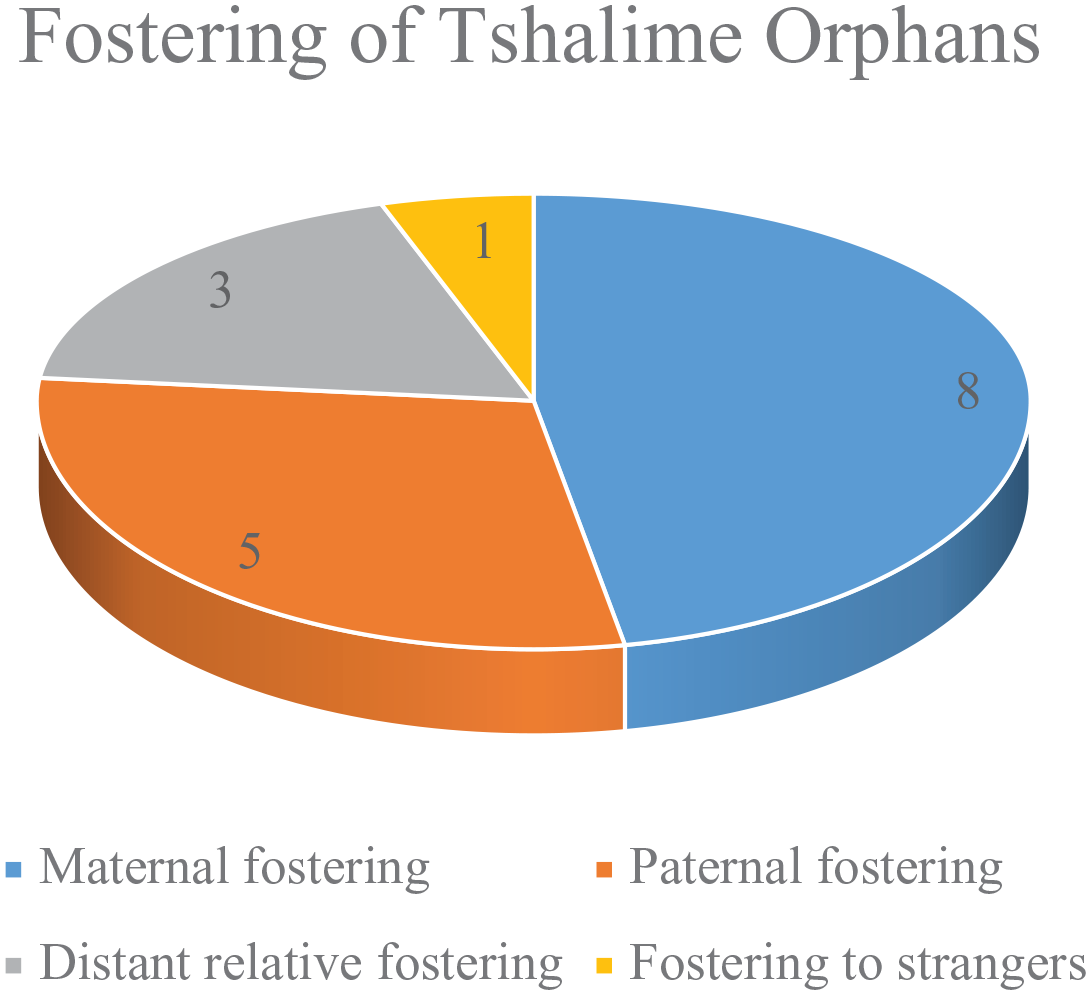
Fostering of orphans.
Where the orphans were fostered to a maternal relative, livelihood was relatively better than those fostered to paternal. One orphan, Mduduzi Ncube, who was adopted by a local church pastor, seemed to be living better than all Tshalimbe orphans as his school fees were paid on time and got at least two meals a day. He got more decent clothing than the rest of the orphans. But this was not the general trend of orphan livelihoods. Almost all the other orphans faced extreme poverty conditions and eked for a living. The other key factor determining the livelihood of orphans was age. The younger the orphan, the more the struggles. Orphans above 12 years generally dropped out of school and worked for themselves to improve their livelihoods. Njabulo Sibanda, who was 17, joined gold panning in Esigodini and was taking care of his young sister. Everydaying by younger orphans was way more hard. A 3-year-old Trymore Ndlovu was usually left at home alone by a distant paternal relative who usually left the homestead early in the morning to work in the fields. He rarely got any food until his guardians came back around midday. During some days, they only came back in the evening. This means that when assessing struggles faced by orphans, it is important to analyze these orphan differences with a difference.
The Nkala family had two orphans, Junior Nkala, born in 2012, and Prince Nkala, born in 2015. These two orphans of Thembisani Nkala, born in January 1981 but disappeared into South Africa since 2016, faced many struggles including education, food, and clothes. These orphans were different as their parents went to South Africa, but “abakhumbuli lutho” (they forgot their children). Mbuso, Ayanda’s father, was born in 1980 and also went to South Africa but never came back. Mr Nkala complained that the government also does nothing to help orphans, “bayakhuluma nje, (they simply talk). They come and count (orphans) only.” Guardians get stretched to provide for daily life needs.
Tshalimbe orphans sometimes get assistance from Petra College, Celebration Church, World Vision, and Care International, but the help is usually inadequate (Interview with Ngirazi Manyumwa, Bulawayo, 14 October 2022). It does not immunize orphans against everyday struggles. Thus, most of Tshalimbe student orphans are non-readers who usually underperform and drop out of school. Documents at Tshalimbe Primary School show that in 2022, Nqobile Mpofu, born in 2006, was still in grade seven when those of his age were normally in lower sixth form. Most orphans drop out of school “bayotsheketsha (they go for panning) or they go to South Africa” (Interview with Filimoni Nkala, Tshalimbe, 16 October 2022). Going egoli (South Africa) is popular with orphan narratives. One orphan guardian, Filimoni Nkala, described the local chief as “Amasekhelantaba” (someone who simply follows state decisions without questioning) who offered little support to orphans. In Tshalimbe, the state was viewed as popular for “making sweet promises which are never fulfilled.”
Different seasons affect orphans differently. Famines and droughts like the 2002 one are remembered as perilous to orphans who are the most peripheral of the peripheral. The 1982, 1992, and 2002 droughts ravaged BaKalanga orphan livelihoods in Tshalimbe. To Nkala, droughts were strong cues in Tshalimbe about how they “lost wetlands on the hills.” Narratives of these communities suggest that the state and environmentalists prioritized animals to humans. Bongani Dube complained that “in their (state’s) eyes, we are animals. What matters are animals which replaced us.” Matobo communities envisage themselves as sacrificed for non-Matoboan animals which replaced Tshalimbe “orphans” in Chipangali. If Matoboans characterized their poverty after displacement as orphanhood, then Tshalimbe children whose parents were not present through their everyday struggles, but were fostered to displaced “state orphans,” and experienced stinking poverty, fall into a deeper subset of “orphans of Matobo.”
BaKalanga fought for independence hoping to be resettled on ancestral land. Those hopes were aborted after independence in 1980. The post-independent state rather rewarded BaKalanga by massacring them in an operation code-named gukurahundi between 1982 and 1987 (see Alexander, 2021; Bvurire, 2023b; Dube, 2022; Reim, 2023). Filimoni Nkala narrated that the state reduced them to “orphans of the state. The state does nothing to keep us. We are suffering here. We see them (state officials) during campaigns for elections.” Nkala’s narrative gives deeper insights about what these communities view as an orphan. The term has been enlarged to mean someone “whose source of provision, home-ness and security has been grabbed” (Interview with Dingane Ncube, Tshalimbe, 16 October 2022). Dingane Ncube and Filimoni Nkala’s definition of orphan captures the way Tshalimbe communities envisage orphanhood. BaKalanga claim that the state was responsible for their peripherization. McGregor and Chatiza (2020) who studied peripheral Harare communities argue that the state seeks to make Zimbabweans its clients. Peasants in Tshalimbe deal with state crudeness in a rural setup where the materiality of land is interpreted differently but BaKalanga also view the state as presiding over their impoverishment. Tshalimbe narratives convey the state as constantly and conveniently impoverishing BaKalanga in order to make Matobo residents perpetually beholden to the state. Ncube articulated that the state had “reduced the villagers into state orphans, tenants and serfs” (Interview with Vusumuzi Ncube, Tshalimbe, 16 October 2022). This narrative takes marginalization as a method for creating state-reliant citizens. Characterizing Matoboans as orphans does not minimize their agency, but rather helps us to understand it. State capture of land as a basic means of production means these communities, like animal orphans of the Chipangali, are unable to unhook or wean themselves from the paternal state. Matoboans view the state as central in parceling out sorrow to the district and then coming back claiming to possess the cure of that which they would have allocated in the first place!
Comparing Tshalimbe and Chipangali orphans
Matobo peasants often remember the animals they sacrificed when they were displaced from the area where other animals now referred to as orphans have found homage. Remembering animals is often part of the narratives told by BaKalanga. Humans were sometimes displaced to animal jungles and animals were moved to human territory. Even though this does not reduce animals and humans to pawns of the state and environmentalists, it can be argued that the injustice which sometimes is emphasized to have happened to communities also happened to animals as they at times faced no dissimilar livelihood trends. For instance, in Rwanda, one million Rwandan Hutu refugees were, in 1994, relocated to the Virunga National Park of neighboring Congo, where 10 gorillas were killed after the territory was plundered (Hubbard and Brooks, 2021: 4). In Zimbabwe, animal displacement is still a history yet to be fully explored, and this work suggests that displacement historiography must not simply focus at humans without considering animals. Chipangali animals are a cue for human displacements, arousing memories of how communities lost their ancestral land on the shoulders of the Matobo hills. It is also key to instrumentalize how animals became both victims and agents of history during displacements. Politics of displacement in Matobo is politics of human–animal relations by other means and without exploring livelihoods of animals which suffered or benefited from similar circumstances to humans, the history of human displacement remains fractured.
Displacement historians have not focused on the eviction of communities for purposes of setting up facilities to domesticate wild animals (Ranger, 1999). This article closes that gap by giving a more than human agency to the making of Matobo history. Matobo is “constituted through, and produced by, the relationships between human and non human animal dwellers” (Hubbard and Brooks, 2021: 1490). Tshalimbe narratives view animals as undeserving Matobo land. Both humans and animals livelihoods define the creation and fabrication of this uneven production of space in Matobo. Moreover, Matobo human orphans, just like animal orphans, are not always parent-less. They both claim orphanage due to plural, multidimensional circumstances. Animals are automatically viewed as orphans the moment they are captured roaming the jungle or being chased by hunters. Interestingly, most animals in Chipangali, which are viewed as orphans, have parents in the orphanage. Taddy the kudu’s, for instance, parents Emily and Freddy were in the village. Winny, 95, together with her son in the village are both viewed as orphans. This compares well with Tshalimbe where some orphans had not necessarily lost parents. Junior and Prince Nkala’s parents were alive in South Africa. In addition, just like Winny, old Tshalimbe peasants such as Bongani Dube and Ncube viewed themselves as state orphans due to what they envisaged as state neglect. In the animal village, animal quest for freedom into the jungle is also neglected. Thus, orphanage in Matobo does not only mean losing parents. It captures broad concepts, including loneliness, being injured, envisaged state neglect, lacking basic necessities, and marginalization. Chipangali and Tshalimbe orphans reflected the malleability of the term orphan as both communities manipulate the term as capital to get provisions from donors. Orphan is sometimes a means to an end, and not an end in itself.
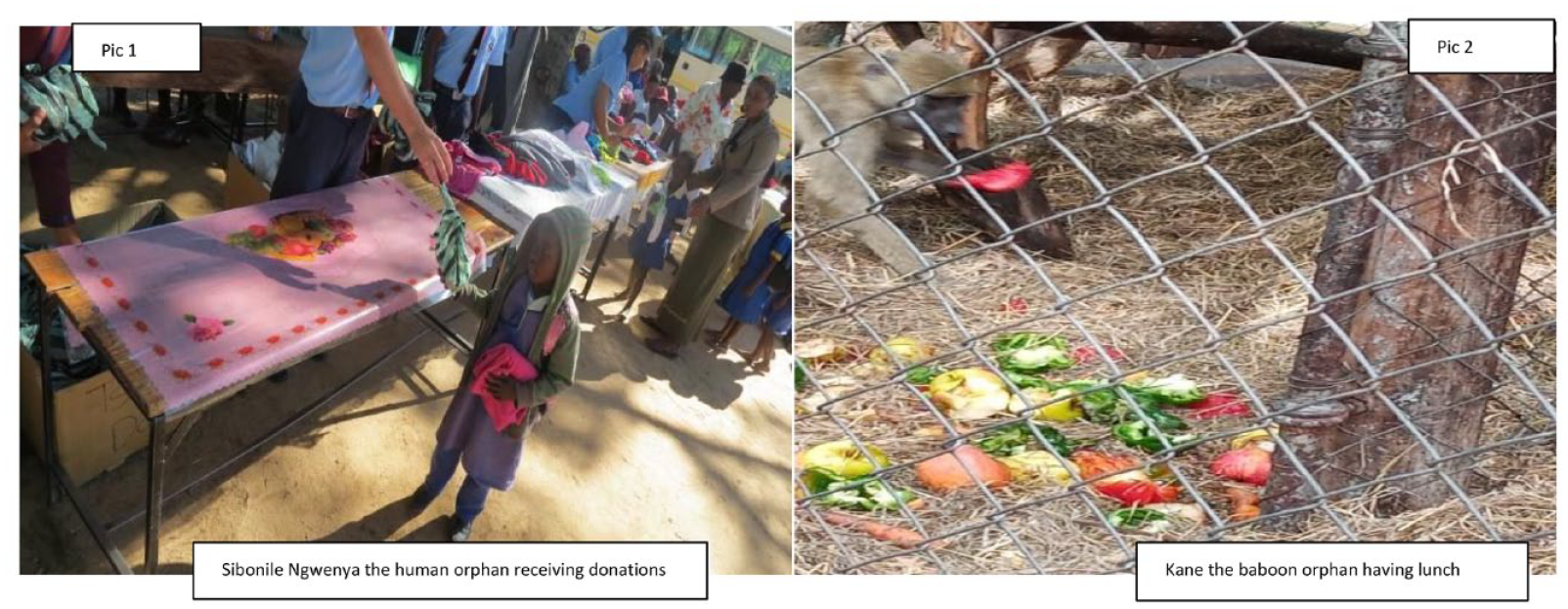
Chipangali claims to empower animal orphans and then send them back to the wild. Most of the animals sent back into the wild are baboons, monkeys, and birds. Lions have not been sent back into the wild. They have therefore multiplied over time. Whereas animal orphans were brought into Chipangali to avoid the dangers they would have faced in the wild with the hope of rehabilitating them to return them into the wild, Tshalimbe orphans were fostered to relatives with the view of raising them in order to look after their guardians. In Tshalimbe, human orphans were less prepared for adulthood life. It would be exciting to contact a study into how animal orphans returned into the wild fared. Not minimizing ability to adapt, Chipangali animals were showing signs of heavily relying on handouts inimical to wild livelihoods. In addition, most Tshalimbe orphans were uneducated, ended up panning for gold, and some female orphans plunged into early marriages. Human orphans just like animal orphans struggled for livelihood. This does not mean that they struggle in similar ways. Most animal orphans seemed to have better livelihoods than human orphans judging by material provisions. They got better food and had better accommodation and care (see Sibonile and Kane in Pictures 1 and 2). There was Sindie the monkey in Chipangali and Sindie the human orphan in Tshalimbe. The monkeys (like Jasper in Picture 4) seemed to have better food security, health, and care than the human. But like human orphans in Tshalimbe, some animal orphans appeared unsettled by being resettled from the jungle. They appeared enraged by the cages and Kane roamed all over hoping to get a way away from humanity.
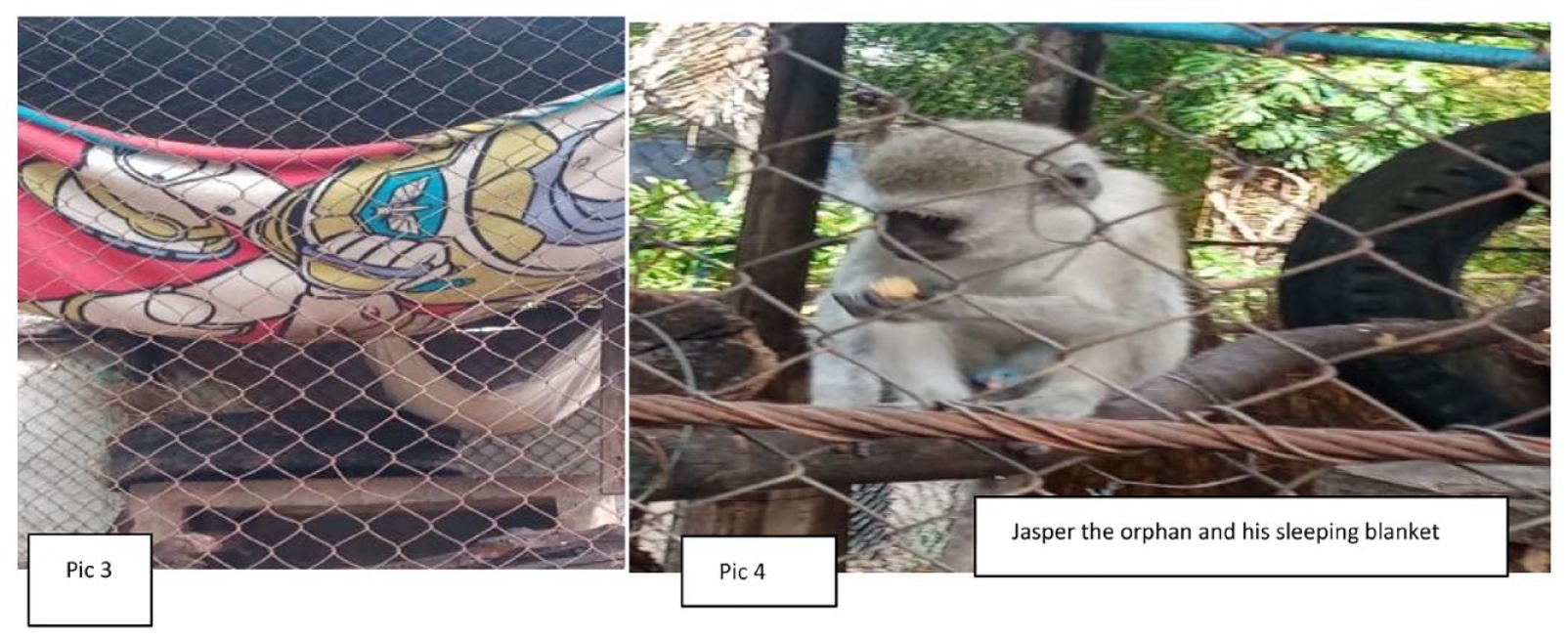
In Chipangali, monkeys were given blankets which helped to warm them during cold spells (see Picture 3). In Tshalimbe, human orphans in the Nkala homestead shared one small thin blanket which hardly warmed them during winter. In winder, they were cushioned by a fire that was candled the whole night. Baboons and monkeys ate different types of food, including apples and bananas, cucumbers, and pepper (see Pictures 2 and 4). In Tshalimbe, whereas human orphans sometimes got wild fruits and green vegetables as part of their meals, all of them said they had never eaten an apple in their life. All Tshalimbe orphans said they did not know what pepper is. Whereas lions and crocodiles got reasonable portions of meat every 3 days, Tshalimbe orphans said that meat was usually eaten at functions such as weddings, funerals, election campaigning rallies, or when a family had a visitor.
Just as people had names to identify themselves in Tshalimbe, in Chipangali, animals were also identified by specific names. Both animal and human orphan names were loaded with meaning. Matobo names were mnemonic devices. Animals and human orphans were named by people other than own parents. Some animal orphans were not from Matobo, but all human orphans in Tshalimbe claimed to be Matoboans.
In Matobo, the word orphan meant a lot of things to a lot of people. Most of the displaced people’s narratives characterized being an orphan with exclusions from means of livelihood. They viewed themselves as orphans of the state, colonial and post-colonial as they narrated that the state amplified their marginalization. The Dube family referred themselves as orphans even though they were old and their parents were alive and lived in the village. Some took orphanhood as leverage for negotiating with the corporate world to gain sympathy. In Chipangali, orphan also gained plural meanings. It was taken to refer to all animals in the village, despite their diverse circumstances. Animals referred to as orphans can never be always proved as such. Matobo did not take the dictionary meaning of orphan. There is huge elasticity to the meaning of the word. The word was broad and had charm for bringing material things. In Matobo, narratives suggest that human orphans seem to have been ignored and their place was taken by animal orphans.
Living a death by Roda Madziva (2010) captures the narratives from Matobo human orphans. They articulate that their parents left them. Yet their guardians narrate that the state rejected BaKalanga when it took their land and gave it to animals. Tshalimbe orphan articulations suggested that they struggled worse than what Kufakurinani et al. (2014) describe as “diaspora orphans” because their parents never returned from the diaspora or are dead. Matobo human orphans narrated being societal second-class citizens; secondary Zimbabweans. These narratives by orphans of communities which were displaced from Chipangali where animals were resettled add value to the discourse of displacement from ancestral land. Matoboans articulate being displaced at home (Silver, 2018). Like an Animal by Natalie Khazal and Nuria Almiron (2021) captures how human orphans in Matobo view the state as treating them. Yet this description leaves out how animals in Chipangali are treated like humans by environmentalists.
Conclusion
This article has submitted that the history of orphans of Matobo, both human or animal, offers us new lens for exploring the history of displacement from ancestral land. Human–animal relations and African epistemologies of such interactions form the pith of this research. BaKalanga narrate that the real devil was not in the creation of Chipangali Orphanage, the devil was in animating people and humanizing animals. Humanity and animality got conflated and twisted in Matobo. Mavhunga (2008) has referred to that as the thingification of humans. However, Mavhunga’s work did not discuss the humanification of animals as a contrast to human thingification. Animal orphans offered environmentalists with broader scientific weapons to articulate environmentalism in an extended way in as much as they offered Matobo communities a window to challenge environmentalism. In India, orphans provided administrators with opportunities to increasingly advance scientific constructions of race (Sen, 2007). To Matoboans, human orphans articulate being broadly neglected by the state to forge their own livelihoods in the rural Tshalimbe. They narrate that the colonial state displaced humans in order to care for animals and the post-colonial state perpetuated that disregard and peripherization. As animals were caged away from the wild and BaKalanga by the environmentalists, BaKalanga articulate their livelihoods as “caged” by the state from probable potentialities. This work has shown human disregard of human in the name of conservation. Human orphans were left to struggle as Matobo gathered animals to cushion them from livelihood struggles. Juxtaposing human and animal orphans in Matobo brings more closely the struggles of the most vulnerable of those communities. It also opens a new window for the displacement scholarship by analyzing how animals which occupied land of the dispossessed were viewed by the displaced and how animals adjusted to livelihoods in caged environments. This article therefore argues that comparing displaced communities’ livelihoods and those of displaced animals can give history an enriched window into the past. Nelson (2003) has argued that environmentalists view themselves as having the responsibility to save Africa from Africans. In Matobo, narratives suggest that Africans view the state as wanting to save Africa from Africans but claiming to save Africans from Africa. These sentimentalities help us in understanding history from the perspective of the marginalized.
Nancy Jacobs (2003), who studied the Kuruman at the edges of the Kalahari, argues that there could be biological, geological, and climatological differences in history, but the challenges of existence among the Kuruman arose more from human injustice than the deficiencies in the natural environment because powerful people drew strength from and exercised power over others through the environment. BaKalanga also tried to use the environment to resist state power. Tavuyanago (2016) argues that evictions from Gonarezhou National Park drove the Shangani to living on the fringes of the park as “conservation refugees.” In Matobo, the displaced narrate that they lived as orphans of the state. Du Plessis (2011) has revealed how “losing your home” (p. 13) is one impact of forced evictions. These narratives of the displaced and marginalized communities are key in fully understanding the long-term impact of park erection. Makuvaza (2016) argues that we need to capture the voices of the displaced communities or else “risk being irrelevant in the communities where we conduct our research” (p. 9) and Pikirayi (cited in Makuvaza, 2016) supports this by arguing that “it is the local context that should inform the global context and not vice versa.” Orphans of Matobo goes beyond simply capturing the voices of the displaced. It also captures their livelihoods and goes on to explore those of animals which replaced humans in spaces from where humans were removed. It explores not only the desire of man to save the environment, but also his desire to ignore the plight of man by using the shield of environmentalism (Bruner et al., 2001). Orphans of Matobo also shows how the term “orphan” cannot simply be used metaphorically, but also as poster of state failure both in terms of its environmental policies and methods of cushioning humans against orphanhood. Conversely, this reflects how man also ignores the open discomfort of animals in restricted areas due to his desire to drew some benefits from animals in the name of animals.
Finally, perhaps environmentalism needs to find the middle way. It needs to locate itself on the confluence of conservation and the struggles of local communities. Maybe the pragmatic answer lied at the nexus between the plight of animal and human orphans. The two should not be viewed as mutually exclusive but mutually inclusive. Environmentalists must propagate for animal rights without advocating for human orphanization and marginalization. Perhaps that will take environmental conservation to that zone of harmony where there is no winner takes all. At that region of appreciation between the use of westernized conservation ideas and the displaced’s plight, neither will survive at the detriment of another. If conservationists do not attend to the quandary of the displaced, then they strengthen the perception that conservation is a concern of the wealthy and the powerful (Agrawal and Redford, 2009). Currently, there is a vast incongruity in the position that simultaneously attempts to protect nonhuman life and ignore the livelihoods of humans. Yet in Tshalimbe, the areas where Bakalanga were resettled were taken from the local fauna; at Chipangali, the areas where animals are resettled were taken from humans. Orphans of Matobo aptly captures BaKalanga sentimentalities that the state has turned displaced marginal minority groups into destitute state orphans in the name of animal orphans which are paradoxically caged away from the wild. It embalms the dominant narrative by BaKalanga that to the state, animals are Matoboans, and BaKalanga are viewed as deputy Matoboans.
Footnotes
Funding
The author(s) disclosed receipt of the following financial support for the research, authorship, and/or publication of this article: The authors received financial funding from Harvard University which supported research for this article.
