







Abstract
Religiosity plays an important role in Asia and Africa and accounts for political-economic preferences and beliefs. I trace the influence of collective religiosity on the redistribution and democracy preferences of respondents among 35 industrialising societies in Asia and Africa in the period 2005–2022. Religious attendees support redistribution less than their non-religious counterparts and believers who do not participate in collective religiosity. Relative social position (income end education), a substitution effect and being part of a majority explain the reluctance to support redistribution. Religious attendees also more readily identify with authoritarian rather than liberal interpretations of the meaning of democracy.
Political scientists are most at home when they describe states—how states make their decisions, how they interact, and who influences them. They are far less nimble with religions, which are far older than the state, make claims far larger than the state, entail a membership far wider than most states, and indeed often accept the legitimacy of states only conditionally, according to their deepest commitments
Introduction
One of the enduring puzzles in Political Economy is why poor respondents in unequal countries are not in favour of state-led income and wealth redistribution, that is, taxing the well-off and subsidising the poor and needy. The observation of the ‘Robin Hood paradox’ (Lindert, 2004) – that redistribution is limited exactly where it is needed the most – applies especially to the industrialising (developing) countries in Africa and Asia, many of which are aspiring democracies (Cheeseman, 2015; Cheeseman and Sishuwa, 2021; Linder and Bächtiger, 2005b). Countries in the two regions have the dubious honour of recording the worst mean scores for state-led redistribution, despite having some of the highest levels of pre-tax and transfer income inequality. While the mean of redistribution (measured as the percentage decline from pre-tax and pre-transfer to after tax and transfer income distribution) in the rest of the world over the period 2005–2022 stood at around 20%, it was only 6.5% in the case of 33 developing countries in Asia and Africa for which we have relevant data from the Standardised World Income Inequality Database (Solt, 2020). Developing countries in Asia and Africa also do poorly in measures of egalitarian democracy such as the egalitarian index developed by the V-Dem project (see Figure 1). Persistent inequality is a matter of life and death, as it has been found that egalitarian democracies do a better job in protecting the health of their citizens, also in pandemics such as COVID (Vadlamannati et al., 2021). Why do Asia and Africa fare so poorly?
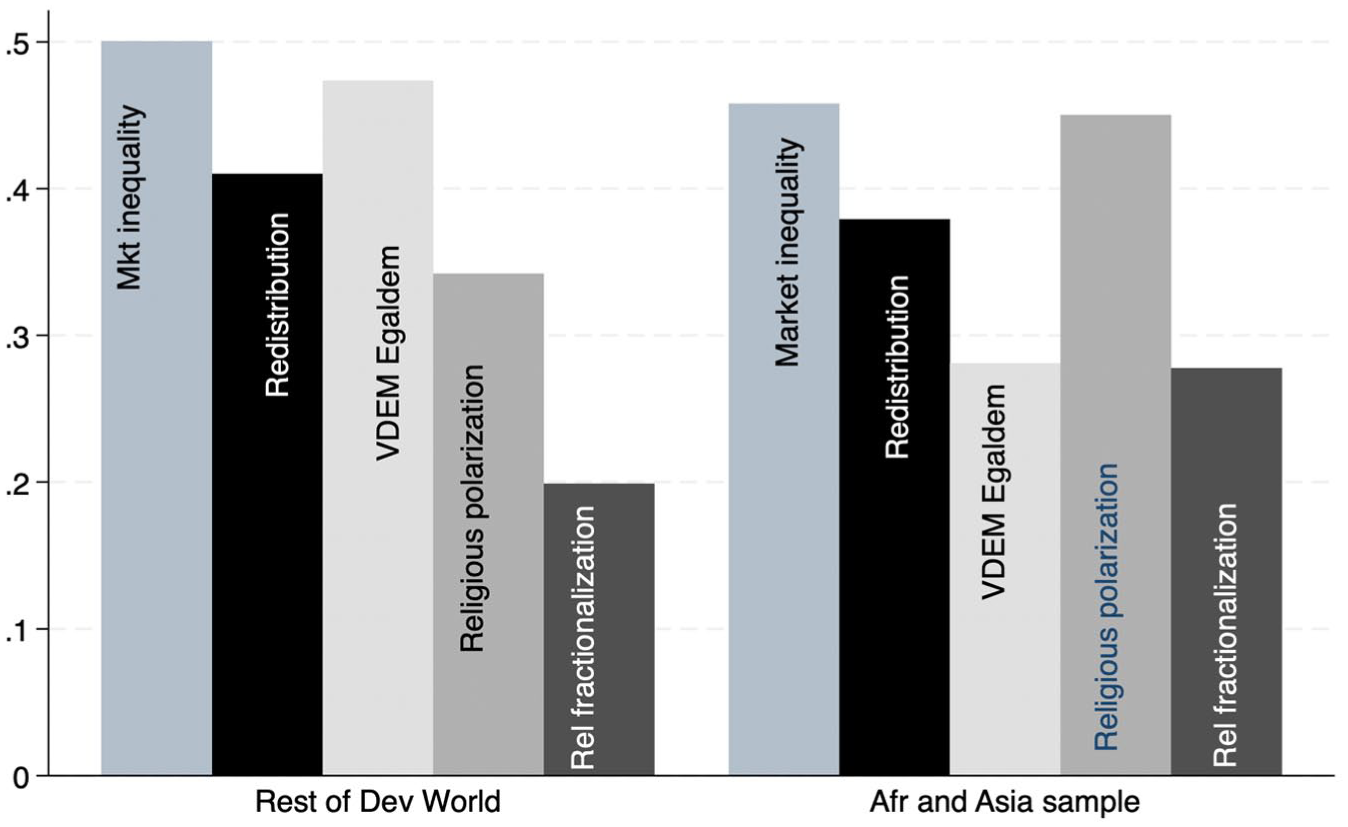
Comparing Asia and Africa with other industrialising countries.
One answer lies in the degree of inequality tolerance and contra-redistribution preferences among the self-declared religious in these regions. Africa and the Middle East have some of the highest levels of religiosity in the world, and religion’s role in Asia has also increased in recent years, largely because it provides means of political identification and mobilisation and secures club goods in the context of existential insecurities in an era of virulent globalisation (Azra, 2022; Hefner, 2010). A number of cross-sectional studies note that the religious in general – even at low income levels – is tolerant of income inequality and not enthusiastic about the use of fiscal means to redistribute income to the benefit of the needy (Arikan and Ben-Nun Bloom, 2019b; Jordan, 2014; Pepinsky and Welborne, 2011). We also know that higher inequality in developing countries is associated with higher levels of religiosity (Hekmatpour, 2020). However, we know very little about the specifics of preference formation in the industrialising countries of Asia and Africa. As Basedau et al. (2018) note in their 2018 review, explanations of redistribution preferences among the religious have been developed almost exclusively with data from high-income industrialised states. A 2019 study (Arikan and Ben-Nun Bloom, 2019b) partly extends the focus by including also data from a small number of industrialising countries, but their sample only includes democracies. Ciftci (2019) looks exclusively at Muslim-majority countries, while Pepinsky and Welborne (2011) also focuses only on Muslims. To date, there has been no attempt to focus specifically on the religious dynamics associated with redistribution preferences in a range of industrialising countries.
Correcting for this shortcoming, this study explores how collective religiosity shapes redistribution and regime preferences in 35 industrialising (developing) Asian and African states that are surveyed by the World Values Surveys over the period 2005–2022. As Figure 1 shows, Asia and Africa stand out as regions with high levels of religious diversity. They have the highest levels of religious fractionalisation and religious polarisation in the world, the most commonly cited measures of religious diversity (Lu and Yang, 2020). Interreligious conflict is more likely in a polarised context, and it is possible that a higher level of religious rivalry undermines solidarity among the likely beneficiaries of fiscal redistribution. The two regions thus form a natural experimental setting in which we can trace the relationship between religion and redistribution across a range of different religions and amid religious diversity. By focusing on industrialising states only, we can keep factors such as socio-economic modernization and associated material-existential challenges constant, partialling out the effects of religion, in its various facets and denominations. In addition, the analysis distinguishes between the main religious denominations found in Asia and Africa, namely Islam, Hinduism, Buddhism and Christianity in order to explore denomination-related factors that can explain the variety of religious views on redistribution in Asia and Africa.
I focus exclusively on ‘collective religiosity’, that is, the institutionalised collective behaviour of the pious. Religious organisations not only promote collective action among the religious. They also shape the political-economic values and beliefs of their members, including those that are pertinent to support (or lack of support) for publicly-financed transfers in order to achieve a narrowing of income differentials (De La and Rodden, 2008; Gaskins et al., 2013). Collective religiosity is commonly measured as a continuous variable in terms of how often the self-declared religious participate in organised religious activities such a prayer meetings and/or church or mosque services (Gaskins et al., 2013; Omelicheva and Ahmed, 2018). I base a categorical indicator (hereafter ‘religious’) on all the self-declared religious who attend religious events once a month or more and rely on this indicator in the analysis below. Note that the referent category ‘non-religious’ includes atheists, people who self-identify as non-religious and respondents who identify as religious, but do not participate in organised religious events. Figure 2 shows the respondent shares of the religious in the sample of 35 Asian and African countries surveyed.
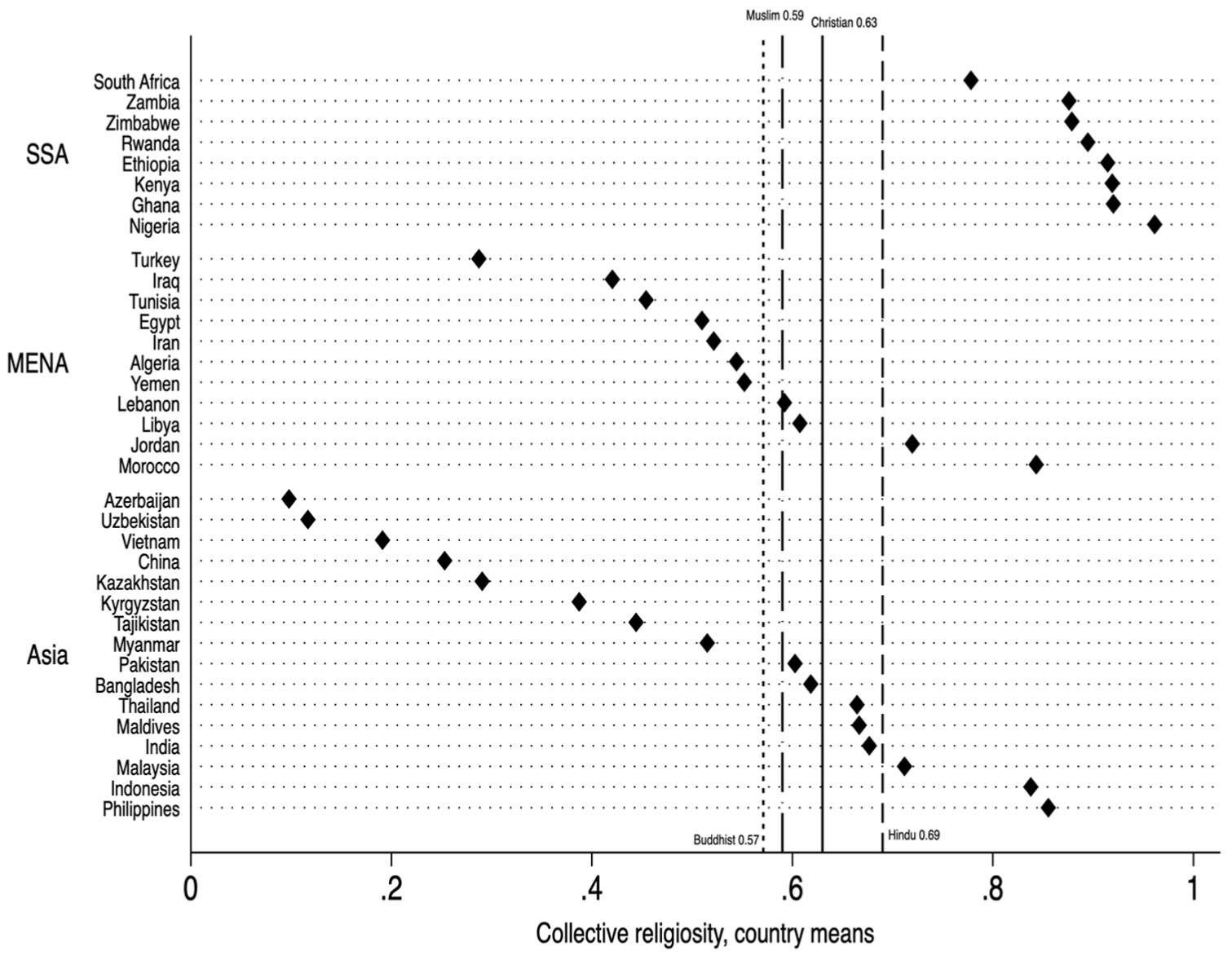
Levels of collective religiosity in 35 Asian and African societies, 2005–2022.
As will be shown below (see Figure 3), the religious in our sample are less enthusiastic about redistribution, measured in terms of the extent that respondents believe the state should take responsibility for the well-being of citizens. The literature on redistribution preferences in general suggests some explanations for this finding which is surprising given the fact that all the main denominations/movements represented there are confessionally committed to compassion towards the poor and needy (Ciftci, 2019; Kahl, 2010; Pepinsky and Welborne, 2011; Soko, 1999). A first explanation is based on the notion of social distancing and suggests that a respondent’s relative income and educational status in a society is inversely related to a preference in favour of redistribution. I show that this applies to the religious in Asia and Africa as they have relatively higher incomes and educational achievement, on average, compared to the rest of society. A second explanation suggests that organised religion acts as a substitute for state provided social assistance and/or insurance, both psychologically and materially. Hence, the more someone benefits from being a devotee, the less incentive they have to expect the state to provide. A third possibility is that redistribution reluctance on the part of the religious is related to sectarian interests and specifically to the question whether the religious respondents belongs to the majority or a minority religion in their country. The expectation is that members of the majority religion will have little incentive to share collective goods as it might benefit members of religious groups other than the majority. I find evidence to support all three explanations. Finally, I consider the question whether the religious, to the extent that they do support democracy, associate democracy with state policies aimed at taxing the rich and helping the poor, narrowing income differentials and assisting the unemployed. A second related question is also considered: To what extent do religious respondents associate social-redistributive policies with liberal democracy, as has been suggested (Ciftci, 2019). The results are less than encouraging for those who believe in socially-responsible liberal democratisation as a goal worth pursuing in Africa and Asia.
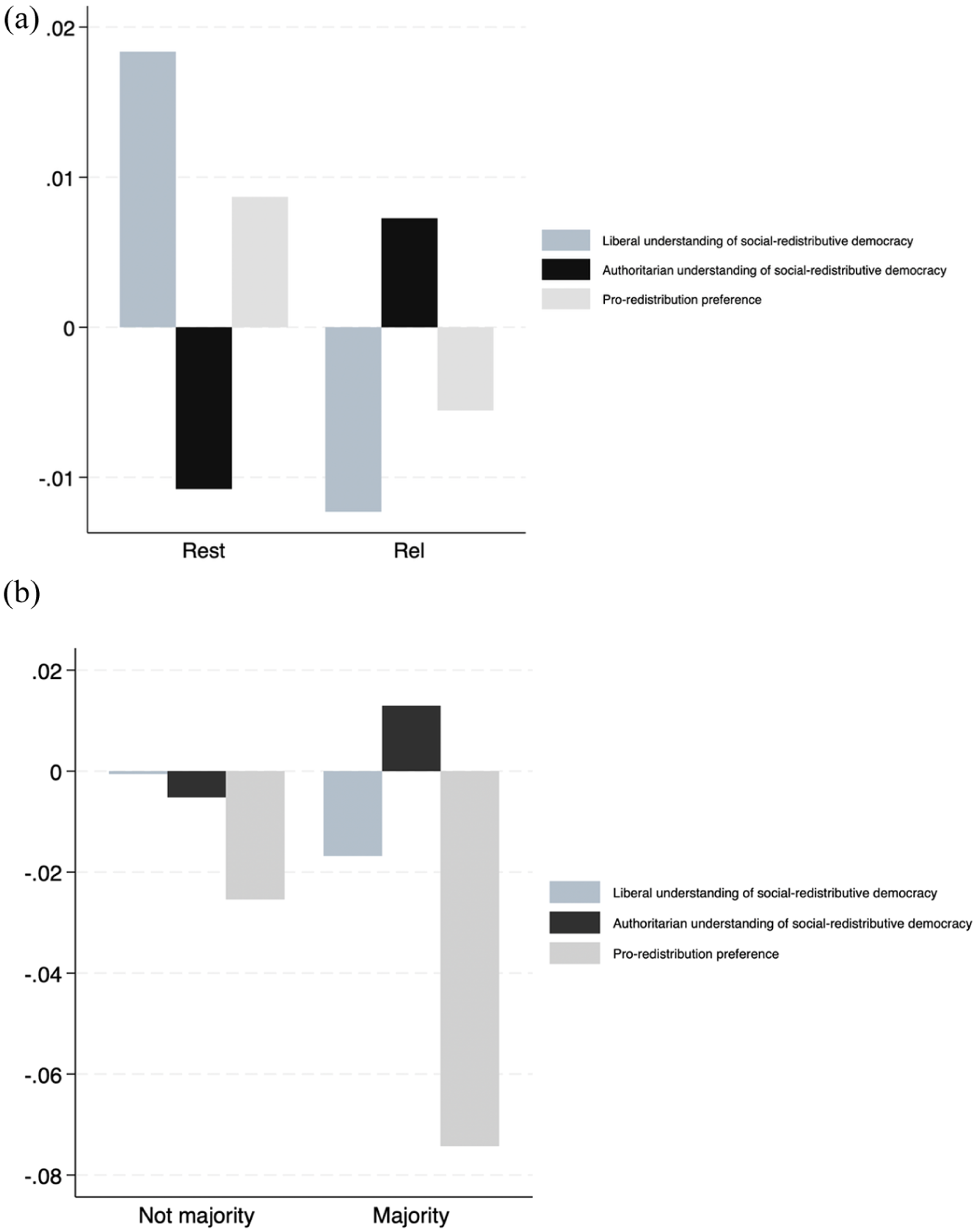
(a) Contrasting the attitudes of the religious and the rest. (b) Contrasting the attitudes of the religious who belong to a majority religion and the religious who do not.
The paper proceeds by briefly discussing the existing literature around the four expectations suggested earlier, followed by a discussion of the data on which the empirical testing is based. The Results section reports on the various tests employed as well as the results. Where possible, I report the results graphically. The associated results can be found in a series of tables in the Appendix. A final section concludes.
Theoretical expectations
Social distance
Ever since Durkheim introduced the distinction, we think of religion as comprising of at least two dimensions, namely a confessional-belief and a collective-institutional one. The two are related in the sense that they exemplify ways of observing and honouring the sacred, of being ‘religious’ we can say, and neither can be reduced to the other (Crane, 2017; Durkheim, 2001). The collective-institutional dimension is often divided into a ‘behaviour’ and a ‘belonging’ aspect. The latter refers to membership (or not) of organised religious denominations, while the former is reflected in how the pious behave in the context of institutionalised religion by regularly attending organised religious occasions and partaking in collective religious behaviour in general. Distinctions like these, based on specified individual categorical indicators, play a central role in the literature on religion and democracy (Arikan and Ben-Nun Bloom, 2019a; Ben-Nun Bloom and Arikan, 2013; Ben-Nun Bloom and Arikan, 2012), but also on religion and redistribution (Arikan and Ben-Nun Bloom, 2019b; Jordan, 2014; Stegmueller et al., 2012).
Empirical studies focusing predominantly on industrialised democracies have suggested that the religious tend to oppose state-led redistribution based on progressive taxation despite the important role that religions have played historically in establishing public care regimes for the poor and needy (van Kersbergen and Manow, 2010) and religious confessions demanding compassion and beneficence towards the needy (Ciftci, 2019; Davis and Robinson, 2006; Kahl, 2010). One possible explanation for this looks at the social positions that the religious occupies in societies, which could shape their affinity (or lack of affinity) with the likely beneficiaries of progressive fiscally-financed transfers aimed at reducing the skewed distributional effects of market forces. In terms of this explanation, what matters is not so much whether someone is religious or not, but rather what their social standing relative to the likely beneficiaries of redistribution is.
Critics of the traditional political-economic explanation of preference formation (Choi, 2021; Karadja et al., 2017 Meltzer and Richard, 1981) point out that it ignores the effects of social processes of identification and the social-psychological factor of social affinity. These critics suggest that a respondent’s attitude towards inequality and any related preference concerning redistributive measures depends on the social distance between the respondent and the likely recipients of such redistribution (Klor and Shayo, 2010; Lupu and Pontusson, 2011). Social distance can be determined by factors such as relative income (Lupu and Pontusson, 2011) and relative educational achievement, two constituents of social class position. The notion of state-led redistribution is commonly associated with progressive taxation and the provision of social assistance and insurance to needy beneficiaries both in-cash and in-kind. It is important, though, to notice that this description glosses over the fact that there are actually two different facets involved in redistribution: one involves ‘taking from’ the non-poor and another involving ‘giving to’ the non-rich. As noted by Cavaillé and Trump (2015), redistribution preferences expressed by respondents may differ depending on whether the respondent believes that they are a likely net recipient of or a net contributor to redistribution. Social position, determined by relative income and education level achieved is a potential predictor of whether respondents would favour redistribution (i.e. would expect to be a net recipient) or oppose it (that is, expect to be a net contributor) (H1).
A substitution effect?
It has been suggested that organised religion substitutes for state-assistance and provides both psychological and material compensatory support for their members (Dehejia et al., 2007; Scheve and Stasavage, 2006). A number of studies have noted the ambivalence of the religious concerning income inequality, and not only in Asia and Africa (Arikan and Ben-Nun Bloom, 2019b; Bellani and Scervini, 2020; Jordan, 2014; Mengel and Weidenholzer, 2023; Pepinsky and Welborne, 2011). In some studies, this ambivalence is traced to the bi-dimensionality of religiosity itself and in particular the distinction between the confessional (belief) and the collective-behavioural dimensions of religiosity. The most comprehensive cross-national study to date shows that the belief dimension can be linked to inequality aversion when associated with prosocial values that reflect the compassion that the major religions of the world show towards the poor and needy. In contrast, the collective-institutional dimension is associated with a greater degree of inequality tolerance as organised religion compensates for the deprivations or shocks associated with skewed income distribution (Arikan and Ben-Nun Bloom, 2019b). As I note below, one should be careful not to associate inequality aversion (tolerance) with a pro(contra)-redistribution attitude. However, the logic of this substitution argument suggests that the degree of involvement in organised religion is expected to be positively associated with general life satisfaction which in turn is negatively associated with a pro-redistribution preference (H2).
Sectarian interests?
As summarised in Figure 1, our 35 industrialising states of Asia and Africa on average record very high levels of religious fractionalisation and religious polarisation. Polarisation indicates how much a population is divided by a few similarly strong subgroups, with its extreme case being a population composed of two groups of equivalent size. In comparison, fractionalization refers to the degree to which a population is composed of a number of different small-size groups. (Lu and Yang, 2020)
Both these factors may deflate redistribution preferences if the respondent belonging to a dominant religious group will be unwilling to share fiscal resources with potential religious rivals. Aggrieved minority religious groups, specifically in the context of a functioning democracy, in contrast may demand more redistribution as a means to protect or enhance their sectarian interests. Participation in communal religious practices – the focus of this paper – increases the salience of religious identity and sectarian interests (Hoffman, 2021). We can expect, therefore, that majority religious status is negatively associated with pro-redistribution preferences under conditions of religious polarisation (H3).
Redistribution and regime preferences
The relationships between religion and democracy (Arikan and Ben-Nun Bloom, 2019a; Badaoui, 2023; Ben-Nun Bloom and Arikan, 2013; Omelicheva and Ahmed, 2018; Ben-Nun Bloom and Arikan, 2012) and religion and redistribution preferences (Arikan and Ben-Nun Bloom, 2019b; De La and Rodden, 2008; Huber and Stanig, 2011; Putterman, 1997; Scheve and Stasavage, 2006) have been studied in detail by a variety of authors. The question of whether the religious, to the extent that they do support democracy, associate liberal democracy with redistribution remains unexplored in the literature, though. By focusing on this question, the paper contributes to the comparative study of redistribution preferences in the developing world, complementing work by Haggard et al. that is now dated and does not explore the link between redistribution and democracy preferences (Haggard et al., 2013).
For the most, studies of religion and redistribution preferences simply assume popular (liberal) democracy as a ‘natural setting’ for redistribution preferences to aggregate in and to determine the chosen tax rate and level of social assitance provided by the state to the needy. This assumption derives from the dominant rational choice models of redistribution-preference formation, the median-voter model (Meltzer and Richard, 1981) and the related model of how and when citizens opt for democratisation (Acemoglu et al., 2015; Acemoglu and Robinson, 2005; Knutsen and Wegmann, 2016). The assumption is that economic inequality gives birth to demands for democratisation – ceteris paribus – and that the median income earner and her poorer allies will use democratic means to narrow the gap between median and mean incomes. Social justice in the form of redistribution and democratisation go together and mutually reinforce one another: the desires for political and social justice are cut from the same cloth. This viewpoint emerges also in the work of Ciftci (2019). Focusing only on Muslim-majority states, and relying on wave 6 of the WVS alone, Ciftci finds that religiosity increases support for (liberal) democracy through the mediating mechanism of Islamic social justice values. To the extent that Muslim majorities support redistribution, they associate it with liberal democracy, is the conclusion. I suggest that this association is less than obvious once we control for the influence of sectarian interests and extend the focus to include other religions. As discussed above, it is likely that sectarian interests may have an important role to play in shaping redistribution preferences, as well as regime preferences. In what follows, I investigate the redistribution preferences of different religious denominations and test the hypothesis that support for redistribution (as far as it is found among the religious) is indeed associated with preferences in favour of liberal democracy (H4).
Data
In testing the hypotheses discussed earlier, I rely on survey data from waves 5 to 7 of the WVS (2005–2022) focusing on 35 industrialising African and Asian states. These waves for the first time include questions that relate respondents’ views on their regime preferences and in waves 6 and 7 also to notions of state-led redistribution. The WVS is our best available source on value orientations across a large range of countries and is highly regarded in terms of the transparency of their consistent sampling methodology. The data are derived from balanced sampling procedures and questionnaires are standardised across all countries. Questions are posed in face-to-face interviews, translated into all languages that are spoken by 15% or more of the population. A total of 111,166 observations are pooled in the sample, nested in 68 country-years and 35 countries. I focus exclusively on individual (respondent)-level data, controlling for unobserved higher-level variation by employing country-year fixed effects, following the example of Choi (Choi, 2021). I rely on the sampling weight ensuring a balanced sample in terms of important identity markers, and the response rate is equalised to 1000 per country-year.
Our primary dependent variable is the degree to which a respondent endorses redistribution, defined as publicly-financed transfers aimed at proving social assistance and or insurance to the needy (Lindert, 2004). A common problem with existing studies of the socio-economic beliefs of the religious, as exemplified by the most comprehensive existing study to date (Arikan and Ben-Nun Bloom, 2019b), is reliance on a WVS measure of income-inequality aversion as a proxy for pro-redistribution preference. The WVS asks respondents to indicate on a 10-point scale whether they are in favour of less income inequality, or more (adding as a qualification to the latter option ‘as an incentive’). While responses to this question help us to gauge income-inequality tolerance/aversion, it is not a good proxy of redistribution preferences. The question does not indicate who should make incomes more equal, and answers can therefore not discriminate between preferences for state-led publicly-financed measures aimed at narrowing income differences, and processes of ‘predistribution’, that is, labour-market initiatives that would enhance lower-end wages, for instance. It also tells us nothing about who the respondent believes should take responsibility for either of these interventions. What it does reveal is the degree to which a respondent is averse to or tolerates income inequality in their society, the latter suggesting economic conservativism (Gaskins et al., 2013).
Following the example of Haggard et al. (2013), I prefer a more direct measure of respondent preferences regarding the role of the state as a proxy for redistribution preferences. Respondents are asked, again on a 10-point scale whether they think that the state should play a larger role in looking after the well-being of its residents, or whether every individual resident should take responsibility for their own well-being. A score emphasising state responsibility reflects a pro-redistribution attitude, while its reverse can be seen as a further indicator of economic conservatism (Gaskins et al., 2013). Except where specified differently, in this measure as in others I use the county-year mean-centred scores to capture the respondent’s value, relative to the mean of their country of residence in the survey year.
Innovations in the WVS battery of questions, starting with wave 5 in 2005, suggest a second useful proxy of redistribution preferences. This item is also of importance in considering the evidence pertaining to H4. Aimed at determining exactly what respondents have in mind when they declare their support for democracy (Bratton and Mattes, 2001; Chapman et al., 2023; Kim, 2008; Mattes and Bratton, 2007; Shin and Kim, 2018), a series of questions allow us to distinguish between three different notions of democracy (Ceka and Magalh~aes, 2020; Chapman et al., 2023; Kirsch and Welzel, 2019; Kruse et a., 2019). Wave 5 of the WVS (2005–2010) introduced six questions that were aimed at identifying different associations the that concept of democracy has, and these were extended in waves 6 and 7 to nine in total. Asked to indicate (on a 10-point scale) to what extent a specific feature is an essential (and not only desirable) characteristic of democracy, respondents are given the following nine statements to respond to:
(It is an essential characteristic of democracy, that . . .
People choose their leaders in free elections
Civil rights protect people from state oppression
Women have the same rights as men
Governments tax the rich and subsidise the poor
The state makes people’s incomes equal.
People receive state aid for unemployment
Religious authorities ultimately interpret the laws
The army takes over when government is incompetent
People obey their rulers
Broadly speaking, these nine questions pose three different visions of who should rule, the constraints that rulers should face and to what purpose they should rule. The first three items are associated with a liberal-polyarchic understanding of constrained rule by the many, while numbers 7–9 reflect authoritarian notions in the form of a theocracy (number 7) or rule by the military (number 8), or associating democracy with obeying the wishes of leaders (Chapman et al., 2023; Kruse et al., 2019). In what follows, I treat answer scores to items 4–6 as an index of a pro-social-redistributive instrumental understanding of democracy, as long as we control for the degree to which a respondent declares their support for democracy in the first place.
H4 suggests that there may be religious groups who do support redistribution, and that this goes along with a preference for liberal democracy. The nine options discussed above provides a unique set of data with which to test this hypothesis. As respondents (mostly) answer all nine, we can identify their relative endorsement of a combination of the three notions of democracy: liberal, authoritarian and social-redistributive. Based on this logic, I identify two intrinsic regime-cum-redistribution sets of preferences. In the first, the combined scores in favour of a liberal notion of democracy (items 1–3) are added to the combined scores for the social-redistributive notion (items 4–6), while the combined scores for the authoritarian notion (items 7–9) are subtracted from this total. This procedure imitates other additive and subtractive intrinsic measures of liberal democracy, that is, a measure that is net of authoritarian values, such as respect for strong leaders (Bratton and Mattes, 2001b ; Chapman et al., 2023; Kirsch and Welzel, 2019). Similarly, by adding the scores for a social-redistributive understanding to those of the authoritarian notion and subtracting the scores for the liberal notion, an intrinsic measure of an authoritarian-redistribution preference can be identified.
Results
To foreshadow what follows, the two panels in Figure 3 give us an idea of how the preferences of the typical participant in organised religion stack up against those of the rest of their society (Figure 3(a)), and how being a member of a majority religion affects the views of the religious compared to the religious whose religion is not the majority religion in their society (Figure 3(b)). Compared to the rest of society, the religious on average tend to be less in favour of government taking responsibility for the well-being of its residents, less inclined to combine liberal values with a social-redistributive understanding of democracy and more readily associate authoritarian values with social-redistribution. Belonging to the majority religion makes a respondent less inclined to support redistribution and more (less) inclined to support an authoritarian (liberal) understanding of democracy. A fixed-effects regression (based on the covariates reported in Tables 1 and 3 in the Appendix 1) shows that if religious polarisation is high (higher than the mean for the sample), the redistribution preference of the religious respondent who is part of a majority religion is about 10% lower than that of the religious respondent who is not part of the majority religion.
We can conclude that being in the majority has a distinct effect on the redistribution and regime preferences of the religious. Although we still have to find out why the religious in general do not favour redistribution compared to others in society, at least we can treat H3 confirmed enough to include it as a covariate (Majority) in the testing of the other hypotheses.
The role of social distance
Our first hypothesis (H1) suggested that relative social position predicts redistribution preferences as the former determines whether a respondent is likely to be a net contributor or a net recipient of redistribution. There is indeed a strong and negative association between social position and preference in favour of redistribution, as illustrated by the plot in Figure 4 which is based on a model that interacts our measure of religious and relative social position (see Table 1 in Appendix 1 for results). Relative social position is measured as a mean-centred additive index using self-reported income levels (on a 10-point scale, normalised to a score between 0 and 1) plus education status (on a three-point scale, ranging from low to high education, also normalised). The plot is based on a fixed-effect estimation with robust standard errors. Individual-level control variables are added, and they are common to the empirical study of redistribution preferences (Arikan and Ben-Nun Bloom, 2019b; Ben-Nun Bloom and Arikan, 2013; Cesari, 2016; Scheve and Stasavage, 2006; Stegmueller, 2015; Stegmueller et al., 2012), including a gender indicator (Male) with Female being the reference, Married, with being single, widowed or divorce as the reference, Employed, which takes the value of 1 if the respondent is employed, Parent, indicating whether the respondent has at least one child (none as the reference), and a three-category indicator of age, with the reference category 1 (= 18–29), category 2 = age 30–49 and category 3 = age 50-plus. As noted above, Majority is an indicator that the respondent belongs to the majority religion. Following Jordan, I also include a measure of political interest/political awareness (Jordan, 2018) based on a WVS question with a four-point response, ranging from not at all interested in politics (1) to very interested (4).
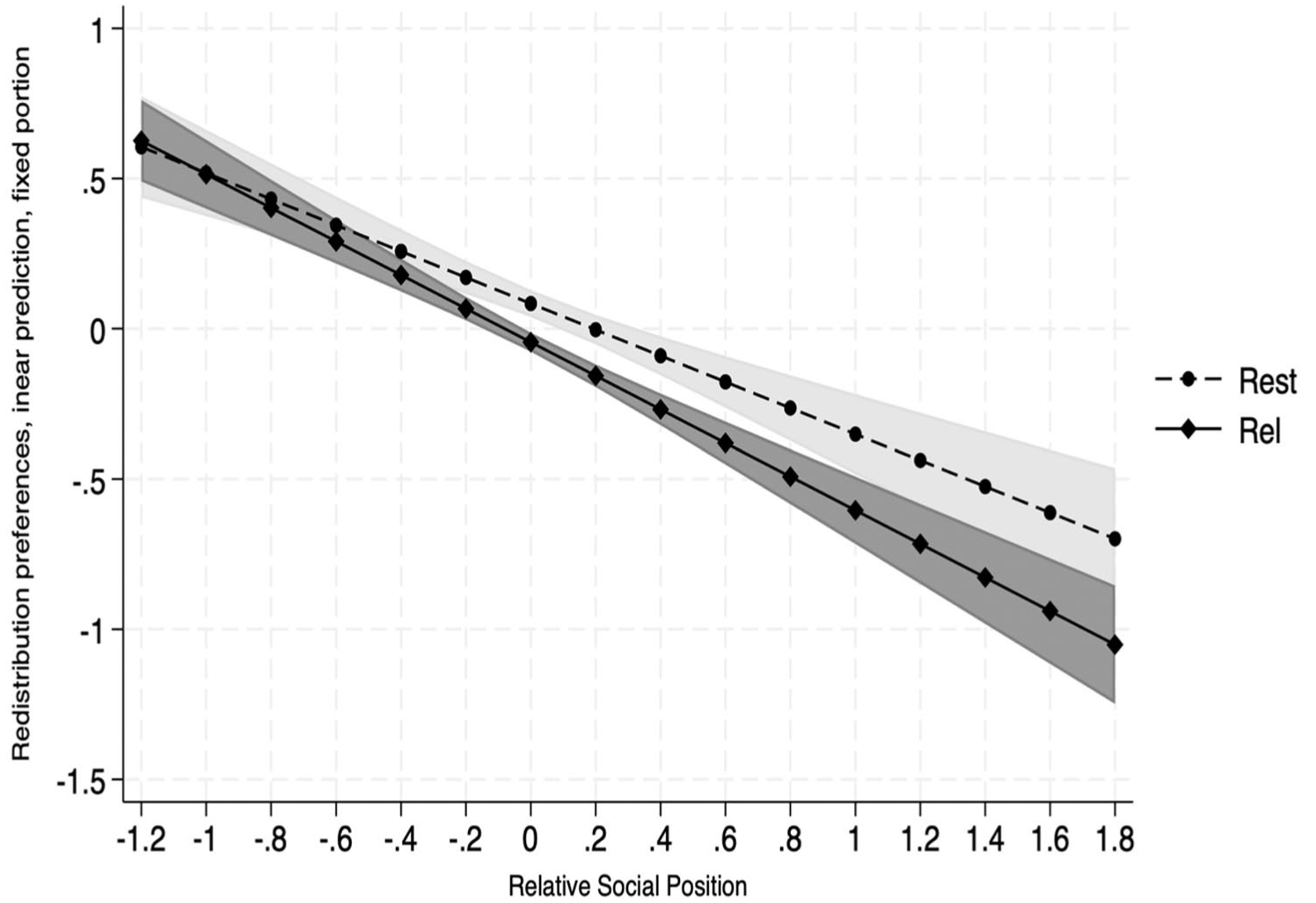
The redistribution preferences of the religious as modified by their social position, contrasted with the rest of society.
It is clear that relative social position is a powerful predictor of opposition to redistribution in general, but even more so in the case of the religious. What this figure and Table 1 in the Appendix 1 show is that the religious and the not-religious react very similar in terms of social distance, confirming H1. However, there still remains a significant difference between the religious and the rest of society, specifically at high levels of relative social position.
Turning to the individual attributes of the religious, Figure 5 reflects a country-year fixed-effect logit estimation of the individual-level attributes of participants in organised religion. I report the average for the sample as a whole (‘All’), and also the mean odds ratio’s for Christians and Muslims, who together constitute 80% of the sample. Full results (with coefficients rather than odds ratios) can be found in Table 2 in the Appendix 1. We note that the odds are significantly positive that the religious occupy a higher relative social position on average than their national counterparts, most pronounced in the case of Christians. We also note that it is much more likely that a religious respondent will be male (except in the case of Christians), 50 years or older, be married, will have at least one child, be employed (except in the case of Christians), and declare satisfaction with their life. The full results are reported in Table 2 in the Appendix 1. Again, we can have confidence in H1. Part of the explanation of why the religious are on average opposed to redistribution (recall Figure 3(a) and (b), as well as Figure 4) is the fact that they occupy relative social positions that make it likely that they think of themselves as net contributors to, rather than net beneficiaries of, fiscal redistribution. However, Figure 4 and its accompanying Table 1 in the Appendix 1 suggests that there is still a residual effect of ‘being religious’ not accounted for by social position alone. We turn to investigate H3 for a potential account.
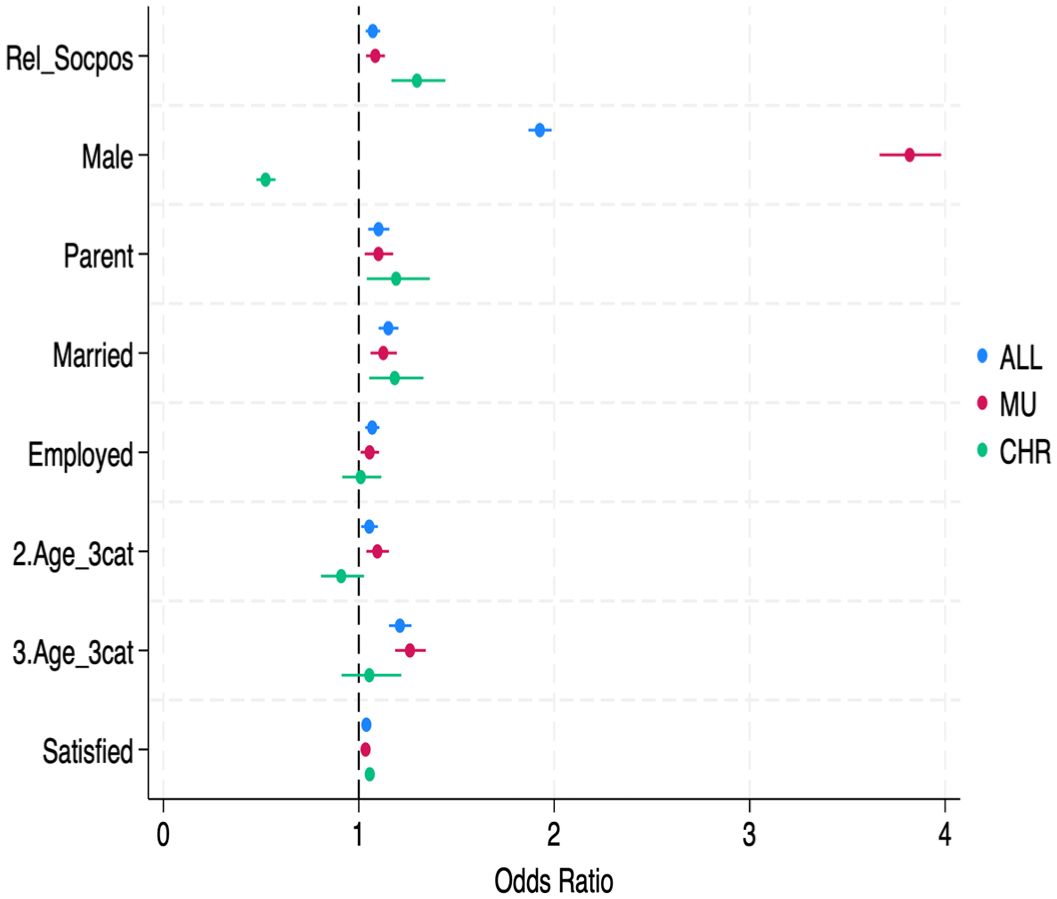
Selected attributes of the religious.
A substitution effect?
H3 suggested that the explanation for religious respondents’ lack of enthusiasm for redistribution can also be due to the fact that active membership of religious organisations compensates for the psychological and material support that state-financed social insurance and assistance would provide otherwise. The religious thus have little need for redistribution and, as we saw above, are likely to regard themselves as contributors rather than beneficiaries. This implies a pathway effect of being religious, via life satisfaction, on the demand (or lack of demand) for redistribution. To test for this effect, I focus on the finding that the religious profess being more happy, having better health and displaying higher levels of overall life satisfaction than the secular (Nezlek, 2021) as a proxy of the substitution effect (see also Arikan and Ben-Nun Bloom, 2019b). Levels of life satisfaction as measured by a 10-point scale ranging from dissatisfied (1) to satisfied (10) is inversely related to existential insecurity that ceteris paribus would lead to higher expectations regarding publicly-financed social insurance and/or assistance. I estimate the assumed pathway effect by using the structural equation reported with Table 3 in the Appendix 1.
The covariates controlled for are our measure of relative social position, an indicator of whether the respondent has at least one child, an indicator that takes on the value of one if the respondent’s religion is the majority religion and a measure of the degree to which the respondent is interested in politics, all used in other estimations of redistribution preferences (Arikan and Ben-Nun Bloom, 2019b; Jordan, 2018). Figure 6 shows the pathway model and signs and significance levels associated with the variables. Table 3 in the Appendix 1 contains the full results, which confirms the expected pathway effect. The influence of being religious on life satisfaction is positive and significant at the p < 0.05 level, while life satisfaction is negatively and significantly (at the p < 0.01 level) related to pro-redistribution preferences. Overall, the estimation shows a significant pathway effect, confirming H3.
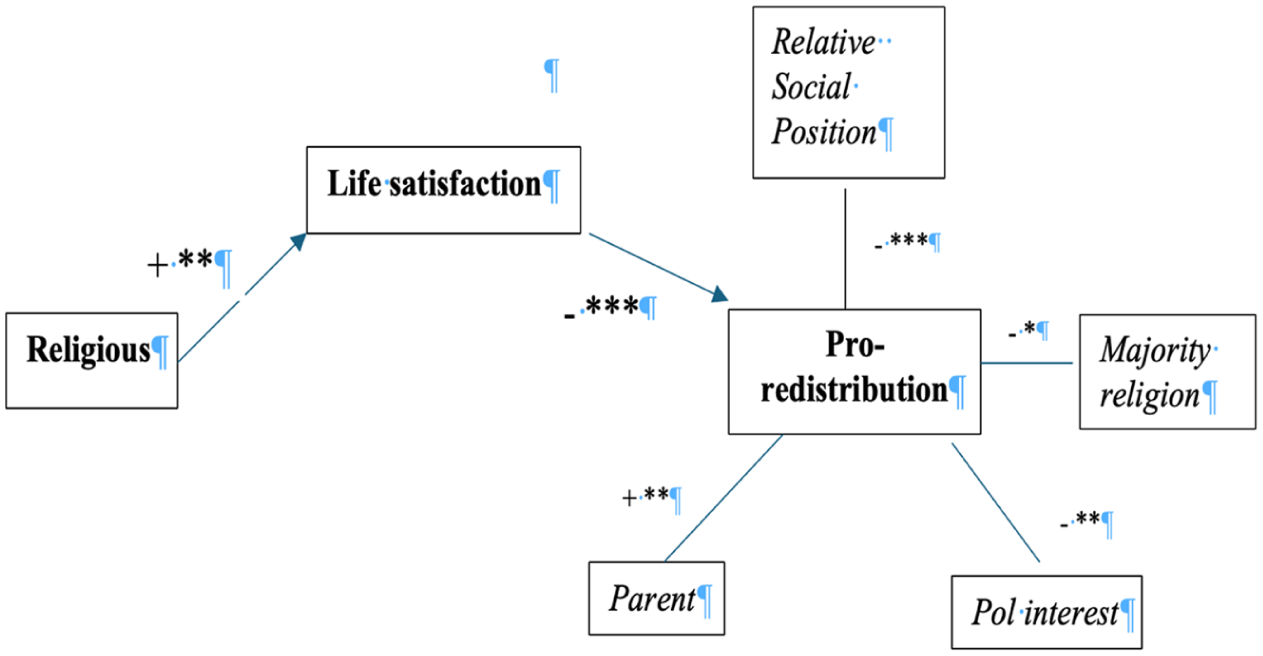
A pathway model of the effect of being religious on redistribution preferences.
Figure 7 illustrates the influence of the extent of participation in organised religion on our measure of life satisfaction, distinguishing between the four main denominations in our sample. The degree of participation is measured on an 8-point scale, ranging from no participation (value 1) to weekly participation (8). The degree of participation has a strong positive influence on life satisfaction in three of the four religions, Buddhism being the exception.
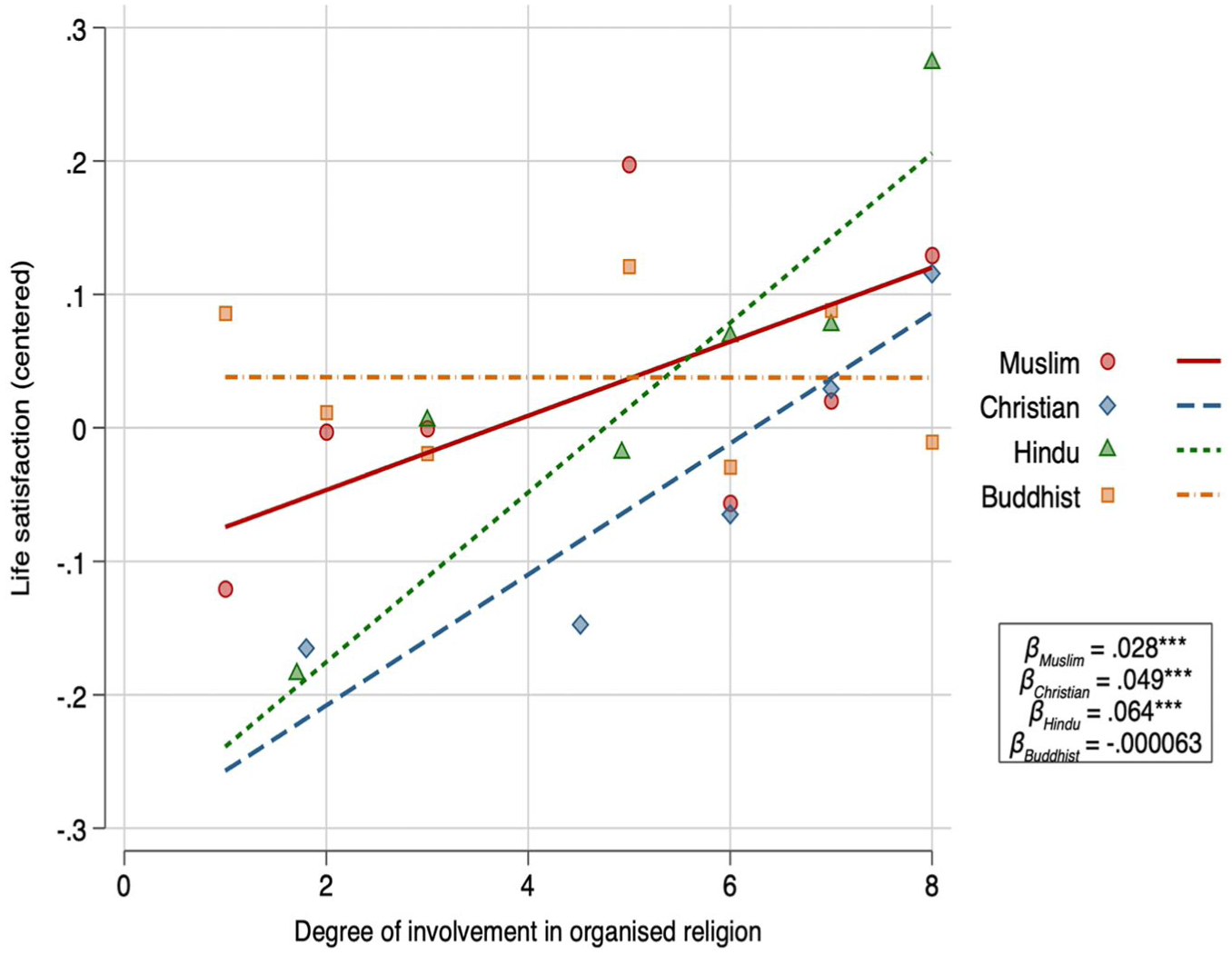
Life satisfaction and religious traditions.
Regime preferences
Finally, we consider the question whether there is a relationship between the regime preferences of respondents and their redistribution preferences. It has been claimed that Muslims (in Muslim-majority countries), to the extent that they do support redistribution, identify strongly with liberal-democratic regime values (Ciftci, 2019). In developing H4, I suggested that recent waves of the WVS allow us to test this assumption, also as far as other religious groups are concerned, by relating measures of social-redistributive value preferences with either an intrinsic notion of authoritarianism (i.e. minus respondent scores for liberal-democratic values) or an intrinsic liberal-democratic preference (i.e. minus respondent scores for authoritarian values). Table 4 in the Appendix 1 indicates that the religious are prone to identify much more strongly with an authoritarian than with a liberal-democratic version of redistribution. Keeping the values of the covariates at their means, the margins associated with our indicator measure of being religious are .007 in the model regressing an intrinsic authoritarian notion of social-redistributive democracy (model A4.2), and −.018 when the dependent variable is an intrinsic liberal-democratic notion (A4.1). In both cases, the result is significant at the p < 0.01 level.
Does endorsing redistribution change the regime preferences of respondents? That is, do redistribution preferences have a moderating effect on regime preferences? To test for such a potential moderating effect, I interact our measure of being religious with scores associated with a social-redistributive understanding of democracy and regress the scores for liberal-democratic values (Figure 8(a)) and the scores for authoritarian values (Figure 8(b)) on this interactive term and covariates. The full results can be found in Table 5 in the Appendix 1. As both Figure 8(a) and 8(b) show, there is indeed such a moderating effect. The more respondents supports a social-redistribution understanding of democracy, the less they are inclined to prefer authoritarian values, and the more attractive they find liberal democracy. But in both cases, the change takes place from a very low common base, and the difference between the religious and the rest of society remains large and significant.
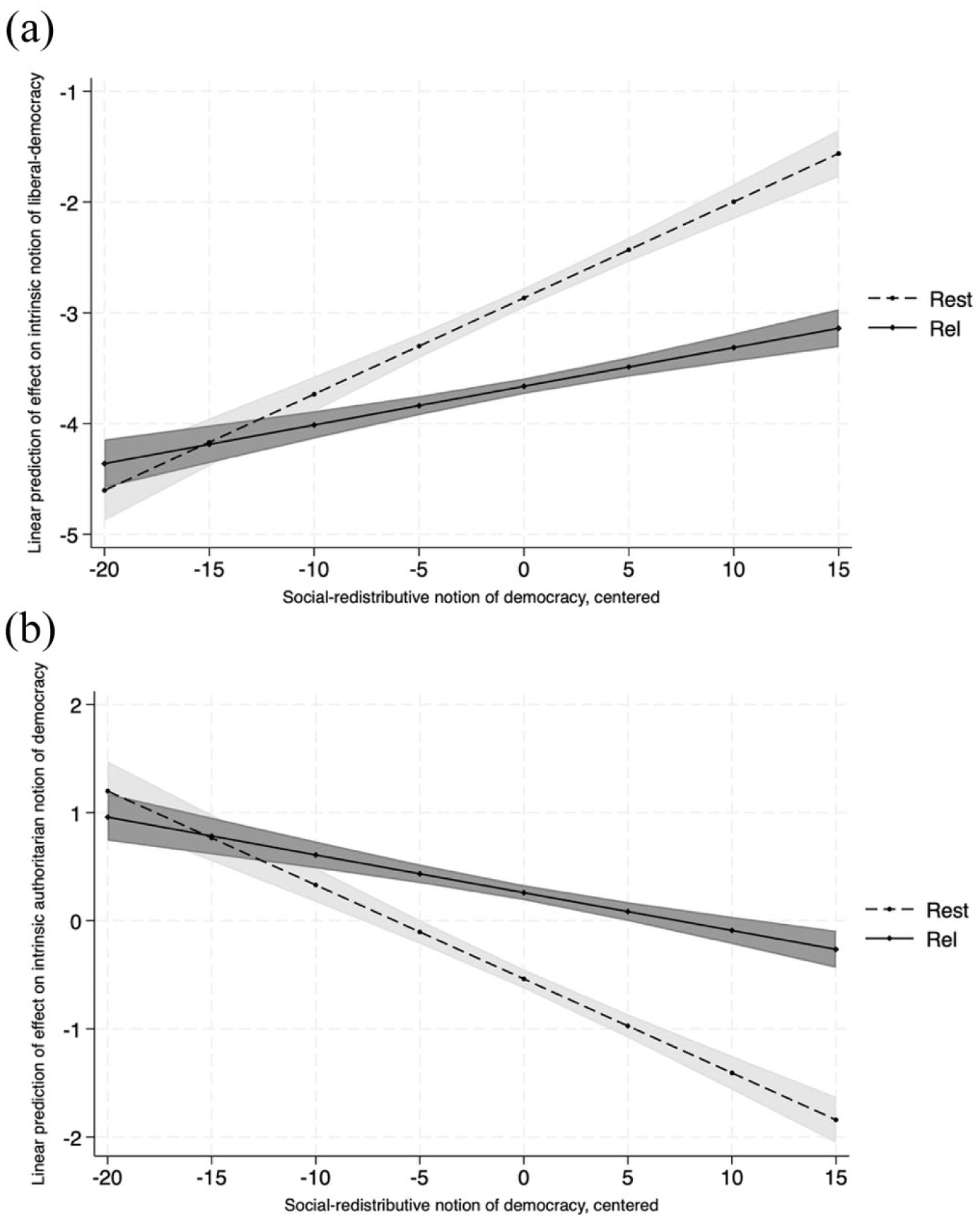
(a) Predictive margins of religious with 95% CIs. (b) Predictive margins of religious with 95% CIs.
Conclusions
Participation in organised religion plays an important role in the industrialising societies of Asia and Africa, where some 60% of respondents on average identify as such. Despite the confessional commitment to compassion with the poor and needy shared by all the major religion in these regions, the attitudes of religious individuals reveal little appetite for state-financed redistribution. The results generated here show that important explanations for this is that the religious tend to occupy a relatively higher social position in society and that their views reflect their interests as likely net contributors rather than as likely net beneficiaries of redistribution. In addition, there is credible evidence that organised religion acts as a substitute for state-sponsored social insurance and assistance, diminishing the demand for redistribution on the part of the religious. Belonging to the majority religion in a country also suppresses the demand for redistribution and the respective respondents appear hesitant to share collective goods. Taken together, these religion-related factors explain the relative lack of demand-side pressure in Africa and Asia on political leaders to establish socially-responsible and democratically responsive institutions to address the significant levels of inequality and related poverty in their societies. There is of course much more to tell about the absence of social-redistributive institutions in the developing world, including the role of transnational capital in undermining their establishment. However, organised religion is clearly more of a hindrance than a help in the creation of responsive welfare states in these regions.
The one sparkle of optimism derives from the finding that the more respondents embrace social-redistributive values, the more likely they are to also support liberal democracy. This applies to both the religious and the ‘Rest’ in our sample, although the effect is stronger in the case of the latter. Common policy thinking has often emphasised the reverse, namely that the establishment of liberal democracy act as necessary prelude to the introduction of the welfare state, but this has been challenged on various fronts (Gerring et al., 2012). These findings in this paper suggest that the two institutional reforms can be mutually reinforcing, at least as far as the attitudes of respondents are concerned.
Footnotes
Appendix 1 (containing Tables 1 – 5 )
Data used are publicly available and can be requested from the author.
Author’s Note
Philip Rudolph Nel is a Professor Extraordinaire at Stellenbosch University, South Africa.
Funding
The author received no financial support for the research, authorship, and/or publication of this article.
