






Abstract
This study examines affective positioning in Chinese and US Shangri-La Dialogue texts between 2014 and 2023 in order to explore how emotion functions in elite security communication. Drawing on a corpus of 16 country-year texts (2911 sentences) from the 2014–2019 and 2022–2023 meetings, the study combines sentence-level sentiment analysis using VADER with targeted NRC emotion classification and keyword-in-context (KWIC) validation. The results show that both Chinese and US texts are predominantly positive or neutral in overall sentiment orientation, reflecting the institutional and diplomatic constraints of the Shangri-La Dialogue as a multilateral security forum. At the same time, US texts display a significantly higher mean compound sentiment score and a lower proportion of negative sentences than Chinese texts, although the overall effect size is small. Temporal analysis further indicates that cross-national divergence is uneven rather than constant: the largest overall sentiment gap appears in 2014, whereas the strongest divergence in negative framing emerges in 2019, followed by 2022. Focused analysis of the 2019 negative subset shows that both sides rely primarily on fear- and anger-related language, but with different emotional configurations. Chinese negative sentences display relatively stronger anger and sadness and are embedded in frames of war, coercion, instability, and historical grievance, whereas US negative sentences retain relatively stronger trust and anticipation and are more closely tied to threat attribution, sovereignty, and the undermining of regional order. The study argues that China–US differences in elite security discourse are best understood not as stable national emotional styles, but as shifting patterns of affective positioning shaped by institutional context, temporal conditions, and divergent modes of negative framing.
Keywords
Introduction
In contemporary political discourse, affect and emotion have become increasingly important not because they displace rational argument, but because they help organize how political realities are perceived, interpreted, and evaluated. A growing body of research shows that emotional cues shape attention, structure judgment, and influence how audiences interpret threats, responsibilities, and political legitimacy (Pliskin and Halperin, 2021; Webster and Albertson, 2022). Rather than treating emotions as merely subjective reactions or irrational residues, recent scholarship increasingly understands them as socially and discursively constructed resources embedded in political communication (Fink et al., 2023; Pérez-Escoda and Freire, 2023). In this sense, emotion is not external to political discourse; it is one of the mechanisms through which political actors frame events as urgent or manageable, align audiences with particular interpretations, and organize relations between in-groups and out-groups (Humprecht et al., 2024; Yadlin-Segal et al., 2025). For political discourse research, then, attention to affect is not optional, but necessary if we are to understand how language works not only to describe politics but also to construct its meanings, hierarchies, and antagonisms.
This importance is particularly evident in security communication, where discourse does not simply report external realities but actively constructs threat, responsibility, and regional order. In institutional security settings, emotional language helps political actors calibrate urgency, signal resolve or restraint, and position themselves in relation to allies, rivals, and wider audiences. Yet while the affective dimensions of politics have attracted growing attention, elite security discourse in multilateral settings remains comparatively understudied. This gap matters because strategic competition between China and the United States is communicated not only through material capabilities and policy choices but also through publicly articulated affective cues that shape how regional security is imagined and contested. The Shangri-La Dialogue (SLD) therefore provides a useful site for examining how affect is strategically mobilized within a shared institutional forum: not as spontaneous feeling, but as affective positioning through which speakers frame threats, project legitimacy, and locate themselves within competing visions of Asian security order.
The SLD is especially suitable for this purpose because it provides a recurring, highly visible, and institutionally structured site of regional security communication. Importantly, the SLD is not a bilateral China–US forum; rather, it is a multilateral stage on which both states address a broader regional and international security audience under shared genre constraints. Precisely for this reason, it offers a valuable setting for comparative analysis. Speeches delivered at the SLD are public, carefully scripted, and politically consequential, yet they are shaped by common expectations of diplomatic performance, strategic signaling, and regional audience design. This makes it possible to compare how Chinese and US speakers calibrate affect within a shared communicative environment, while avoiding the problem of comparing fundamentally different genres of political speech. The period from 2014 to 2023 is particularly relevant because it captures a decade of intensifying China–US strategic rivalry, including heightened regional security tensions, the rhetorical shifts associated with the Trump years, and the post-pandemic resumption of high-level security dialogue, even though no SLD meetings were held in 2020 and 2021. Taken together, these features make the SLD an analytically productive site for examining how affective language is positioned, moderated, and intensified under changing geopolitical conditions.
Against this background, this study examines how Chinese and US speakers use affective language in SLD speeches to position themselves, competing actors, and the regional security order. More specifically, it asks three related questions: how are affective patterns distributed in Chinese and US SLD speeches across the period under study; under what temporal conditions do the two sides diverge most clearly; and what do these divergences reveal about the communicative logics of strategic competition in a shared multilateral forum? Rather than treating emotion as a spontaneous feeling or as a direct indicator of leaders’ inner states, the study approaches it as affective positioning, that is, the strategic calibration of emotional language within institutional discourse. In doing so, it argues that China–US competition in elite security communication becomes visible not only through policy content or ideological contrast but also through differentiated affective repertoires shaped by common genre constraints and changing geopolitical moments.
This study makes three contributions to research on Asian security communication and political discourse. First, it shows that strategic competition in a multilateral security forum is expressed not only through policy positions and normative claims but also through affective positioning. In doing so, it highlights how emotional language helps organize threat, responsibility, and legitimacy within regional security discourse. Second, it contributes to political discourse research by arguing that China–US competition in a shared institutional forum is manifested less through uniform emotional escalation than through widening affective divergence under common genre constraints. Third, methodologically, it demonstrates how corpus-assisted discourse analysis can be combined with sentence-level sentiment analysis, targeted emotion classification, and contextual validation to produce interpretable evidence about affective repertoires in elite security communication.
The remainder of the paper proceeds as follows. The next section reviews relevant scholarship on emotion in political and security communication and situates the present study within this literature. The following section introduces the data, case selection, and analytical methods. The results section then examines cross-national and temporal patterns of affective positioning in Chinese and US SLD speeches. The discussion considers the broader implications of these findings for Asian security communication, political discourse, and China–US strategic competition. The paper concludes by summarizing the main contributions, acknowledging limitations, and outlining directions for future research.
Literature review
Emotion as discursive and strategic resource in political communication
In recent years, emotion has increasingly been understood not as a purely internal psychological state but as a socially and discursively constructed phenomenon (Mestre-Mestre, 2021; Zemanová and Madarászová, 2024). This discursive turn highlights that emotions are shaped, regulated, and strategically communicated through language and social interaction. In political and international communication, scholars recognize that affect is embedded within power structures and ideological frameworks, functioning as a resource for constructing threat perceptions, mobilizing audiences, and reinforcing collective identities (Shah, 2024). Empirical studies demonstrate that political actors calibrate emotional expression across contexts, invoking specific emotions to heighten urgency, legitimize policy positions, and differentiate messages for domestic and international audiences (Mochťak et al., 2023; Smith et al., 2003).
While this scholarship establishes emotion as a strategic communicative resource, its implications become particularly salient in the domain of security politics, where discourse not only persuades but constitutes threats and legitimizes extraordinary measures. Recent discourse-analytic research has similarly emphasized that emotions are not simply psychological states but discursively organized resources embedded in institutional communication practices (Mestre-Mestre, 2021). This makes affect analytically important not only for political persuasion in general but also for understanding how threats, responsibilities, and alignments are publicly constructed in strategic contexts.
Security discourse and the affective turn
The study of security has traditionally been dominated by rationalist paradigms emphasizing material capabilities and strategic interests. However, the “discursive turn” in International Relations has foregrounded the performative and affective dimensions of security politics (Buzan et al., 1998; Stritzel, 2007). Within this perspective, security is understood as a socially constructed reality produced through speech acts that frame political issues as existential threats rather than as objective conditions.
Securitization theory provides the core framework for this approach, positing that political actors transform issues into security matters by articulating them as existential dangers to valued referent objects (Buzan et al., 1998). Subsequent refinements emphasize that securitization is an intersubjective process shaped by audience acceptance, institutional authority, and contextual resonance (Balzacq, 2005; Goddard and Krebs, 2015). In this sense, discourse does not merely describe threats but constitutes and legitimizes them.
Building on this foundation, recent scholarship incorporates the affective turn in security studies, recognizing emotions as integral to the success of securitizing moves (Pace and Bilgiç, 2019; Van Rythoven, 2015). Fear, anger, and anxiety function as strategic communicative resources that reduce psychological distance between audiences and perceived dangers. Emotional intensification enhances urgency, reinforces moral dichotomies, and legitimizes exceptional measures (Krebs and Jackson, 2007; Mabon, 2017).
This affective dimension aligns with what Goddard (2021) terms rhetorical grand strategy, whereby states deploy emotionally charged language not only to justify policies but to shape the broader strategic environment. Proximization theory further clarifies how such emotional alignment is discursively achieved: through spatial, temporal, and axiological strategies, actors construct threats as encroaching upon the in-group’s space, values, and future (Cap, 2013). Importantly, emotion in security discourse is socially embedded rather than individually expressive, circulating within communities as codes that define appropriate responses to perceived dangers (Loseke, 2009).
Taken together, this literature establishes emotion as constitutive of security discourse. Emotional intensification may serve mobilizational and deterrence-oriented logics, whereas emotional moderation can support risk-management and legitimacy-oriented positioning.
The SLD and Asian security communication
The SLD is best understood not as a bilateral China–US channel, but as a high-visibility Track 1.5 multilateral security forum in which defense officials and security elites address a broad regional and international audience. Since its establishment by the International Institute for Strategic Studies in 2002, the SLD has become a recurring venue for articulating positions on regional order, maritime security, defense cooperation, and strategic responsibility in the Asia-Pacific (Jin and Feng, 2023; Lynch, 2002; Pugliese, 2016). Its significance lies less in producing binding outcomes than in providing a routinized and public stage for strategic signaling, confidence management, and the clarification of interests under conditions of uncertainty and rivalry (Butcher, 2024; Liff and Ikenberry, 2014). Precisely because SLD speeches are public, carefully scripted, and delivered under shared institutional expectations, the forum offers a useful setting for examining how states communicate security positions before common audiences.
Existing scholarship on the SLD and Asian security communication has primarily focused on strategic narratives, regional order, legitimation, and geopolitical signaling. Studies have examined how different actors use the forum to project authority, defend normative preferences, and advance competing visions of Indo-Pacific order (Butcher, 2024; Ng, 2023). However, the affective dimension of this communication remains comparatively underexplored. We still know relatively little about how emotional language is calibrated in this shared multilateral setting, how common genre constraints shape such calibration, and how major actors position themselves and others through affective framing before regional audiences. For the purposes of this study, then, the value of the SLD does not lie in treating it as a site of direct bilateral emotional exchange between China and the United States. Rather, it lies in providing a comparable institutional arena in which Chinese and US security discourse can be examined as public, relational, and strategically calibrated communication. This is not to suggest that the SLD is the only or most decisive site of China–US security communication in Asia; rather, its value lies in providing a recurring and comparable public setting under shared institutional constraints.
Chinese international communication and external security discourse
This limitation is particularly consequential for scholarship on Chinese international communication. Existing research has examined how China articulates legitimacy, responsibility, and strategic identity in external communication, often emphasizing efforts to project stability, multilateralism, and normative restraint in the context of intensifying geopolitical rivalry (Liu et al., 2023). At the same time, recent work has also noted a shift toward more assertive diplomatic rhetoric, often associated with the rise of so-called “wolf warrior diplomacy,” as China seeks to defend its interests more actively and respond to perceived external hostility (Yuan, 2023). Related studies further show that China’s external communication is shaped not only by international signaling needs but also by the interaction between official discourse, digital diplomacy, and domestic nationalist sentiment (Zhang and Tang, 2024).
While these studies provide valuable insights into narrative framing, diplomatic style, and image construction, they have paid comparatively limited attention to the affective dimensions of elite security discourse. In particular, we still know relatively little about how emotional language is calibrated within China’s institutionalized external security communication, especially in relational comparison with competing actors in shared multilateral settings. Examining affective positioning therefore extends existing research by foregrounding emotion not as a byproduct of ideology or style, but as a strategically modulated dimension of public security discourse. From this perspective, Chinese external security discourse may usefully be approached as institutionally shaped and publicly calibrated communication, making it important to examine not only what is said but also how affective meanings are adjusted in relation to competing actors and wider regional audiences.
Methodological advances in corpus-based emotion analysis
Addressing this gap requires methodological approaches capable of tracing patterned affective variation across actors and over time. Recent advances in corpus linguistics and computational text analysis have made it possible to examine emotional language systematically in political discourse rather than relying exclusively on impressionistic reading (Erjavec et al., 2021; Osnabrügge et al., 2021; Rheault et al., 2016). In particular, corpus-based sentiment and emotion analysis provides a useful way of identifying recurrent affective tendencies across texts, speakers, and time periods, thereby supporting structured comparison within a shared communicative setting. For the purposes of this study, such methods are valuable not because they reveal speakers’ inner emotions directly, but because they help detect publicly articulated patterns of affective framing in elite security discourse.
At the same time, scholars caution that quantitative measures of sentiment and emotion must be interpreted carefully. Emotional meaning in political discourse is often context-dependent, rhetorically mediated, and only indirectly realized in lexical form (Erjavec et al., 2021; Osnabrügge et al., 2021). Accordingly, corpus-based emotion analysis is most persuasive when combined with contextual validation rather than treated as self-sufficient evidence. This study therefore adopts a mixed analytical strategy in which sentence-level sentiment analysis and targeted emotion classification are used to identify patterned affective variation, while keyword-in-context inspection is employed to connect these quantitative patterns to their discursive realization. Such an approach is particularly appropriate for institutional security discourse, where emotional cues are often moderated, indirect, and strategically calibrated rather than overtly expressed.
Research gap and present study
Despite growing interest in emotional politics and advances in computational text analysis, comparative studies of affective language in highly institutionalized multilateral security forums remain limited. In particular, we still know relatively little about how major powers calibrate emotional language within shared security genres, where speeches are addressed not to a single counterpart but to wider regional and international audiences under common institutional constraints. Existing research has paid more attention to strategic narratives, policy positions, and normative contestation than to how affective meanings are publicly organized and relationally positioned in such settings. As a result, the role of emotional language in structuring strategic competition within multilateral security communication remains insufficiently specified. This matters because strategic competition in such settings is not only articulated through policy content but also mediated through publicly calibrated affective cues that help organize regional interpretations of threat, responsibility, and legitimacy.
This study addresses this gap by examining Chinese and US SLD speeches as instances of public affective positioning within a shared multilateral institutional forum. Rather than treating the SLD as a site of direct bilateral emotional exchange, the study approaches it as a recurring multilateral arena in which both states articulate security positions before common audiences. This design makes it possible to compare how affective language is calibrated under shared genre constraints and across changing geopolitical moments. By integrating sentence-level sentiment analysis, targeted emotion classification, and contextual validation, the study shows how strategic competition becomes visible not simply through policy disagreement or uniform emotional escalation, but through differentiated affective repertoires and widening divergence in public security discourse.
Methodology
Methodologically, the study adopts a corpus-assisted discourse analytic approach, combining computational sentiment analysis with contextual interpretation to examine affective positioning in institutional security discourse.
Data and corpus
The corpus for this study consists of 16 country-year texts derived from Chinese and US interventions at the SLD between 2014 and 2023. Specifically, the dataset includes eight Chinese files and eight US files covering the 2014–2019 and 2022–2023 meetings. The years 2020 and 2021 are excluded because no SLD meetings were held during the pandemic period. As argued in the preceding sections, the SLD is treated not as a bilateral China–US forum, but as a recurring multilateral arena in which both sides address wider regional and international audiences under shared institutional constraints.
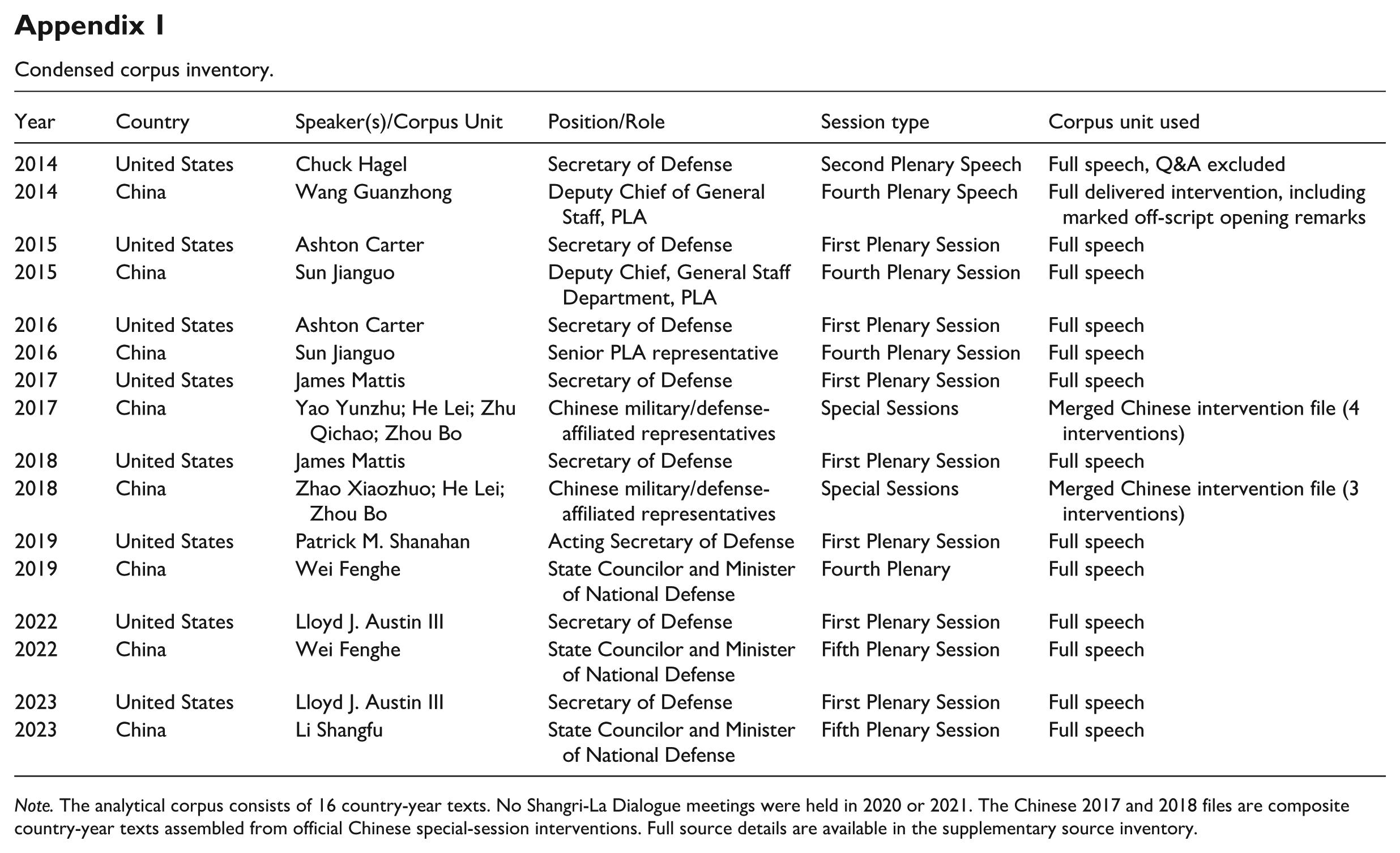
All texts were compiled from publicly available English-language materials used as the final analytical corpus. Most US texts are full plenary speeches by the Secretary of Defense or Acting Secretary of Defense, while the Chinese corpus combines plenary speeches with selected special-session interventions in years when China did not deliver an equivalent plenary address. In particular, the 2017 Chinese country-year file is a composite text assembled from four Chinese interventions delivered in official SLD special sessions, and the 2018 Chinese file is a composite text assembled from three such interventions. The 2014 Chinese text is also treated as a delivered intervention rather than as a script-only document, because the publicly circulated English version explicitly includes clearly marked opening remarks that departed from the prepared script before returning to the main speech. A condensed inventory of speakers, session types, source descriptions, and corpus units is provided in Appendix 1.
These materials were selected according to two criteria. First, only formal public interventions delivered within the official SLD program were included. Second, only English-language texts that could be used as stable public-facing discourse were retained for analysis. Question-and-answer exchanges, moderator remarks, and other panelists’ contributions were excluded from the final corpus. This procedure was especially important for the 2017 and 2018 Chinese materials, where the analytical unit is not the full multi-speaker panel transcript, but the Chinese interventions extracted and combined into country-year files. On the US side, the corpus is more consistently represented by full plenary speeches, such as Chuck Hagel’s 2014 address and subsequent first-plenary speeches by Ashton Carter and James Mattis.
Although the selected texts are not identical in session type, they are analytically comparable as instances of formal public security discourse within the same multilateral institutional setting. The aim of the study is therefore not to compare strictly identical genres or perfectly equivalent speaker roles, but to examine how official Chinese and US security representatives calibrate affective language in publicly attributable discourse under shared forum conditions. This point is particularly important in light of the asymmetry in Chinese participation across years: whereas US texts are largely plenary speeches by cabinet-level defense officials, Chinese texts include both ministerial speeches and defense-affiliated or military representative interventions in special sessions. These differences are treated as part of the communicative context rather than as grounds for excluding the texts from comparison.
For analysis, all texts were converted into plain-text files and organized by country and year. Each country-year text was then segmented into sentences, and sentence boundaries were manually checked to ensure that each unit corresponded to a coherent sentence rather than a clause fragment, heading, or list item. The resulting corpus contains 2911 sentences in total. Each sentence was annotated with three basic metadata fields: country, year, and sentence text. This structure allows flexible aggregation at multiple analytical levels, including sentence-level distributions, year-wise comparisons, and broader phase-based groupings. Following corpus-assisted discourse practice, sentence-level analysis was adopted in order to reduce the disproportionate influence of exceptionally long texts and to capture localized affective variation within individual speeches and interventions.
For subsequent temporal interpretation, the corpus was further grouped into three analytically defined phases: Phase 1 (2014–2016), Phase 2 (2017–2019), and Phase 3 (2022–2023). This phase-based design reflects shifts in the broader geopolitical and communicative environment, including the transition into the later 2010s period of intensified China–US rivalry, the interruption of the Dialogue during the pandemic, and the forum’s post-pandemic resumption. The dataset thus provides a structured, sentence-level corpus of elite security discourse that supports systematic comparison of affective positioning across countries, years, and phases within a shared institutional genre.
A condensed inventory of the 16 country-year corpus texts is provided in Appendix 1. Full source details are available in the supplementary source inventory, while primary source categories are listed separately at the end of the References section.
Sentence-level sentiment analysis
To examine affective variation in SLD speeches, this study applies sentence-level sentiment analysis using the Valence Aware Dictionary and Sentiment Reasoner (VADER). VADER is a lexicon- and rule-based sentiment analysis tool specifically designed to capture affective polarity in short texts, and has been widely used in studies of political communication and international discourse due to its sensitivity to evaluative language, intensity modifiers, and negation.
The unit of analysis is the sentence. Sentence-level sentiment analysis allows for fine-grained detection of localized emotional shifts within speeches and reduces the risk that overall sentiment scores are disproportionately driven by document length or a small number of highly evaluative passages. This approach is particularly appropriate for elite security discourse, where affective signaling often occurs in specific argumentative moments rather than being evenly distributed across an entire speech.
For each sentence in the corpus, VADER generates a compound sentiment score, which ranges from −1 (maximally negative) to +1 (maximally positive). This compound score integrates positive, negative, and neutral valence while accounting for intensifiers, modal verbs, and contrastive constructions. Higher positive scores indicate a more positive affective orientation, whereas lower (negative) scores indicate stronger negative affect.
Sentence-level sentiment scores were then aggregated in three complementary ways to support multi-level analysis. First, all sentences were pooled by country to examine overall distributional differences in affective orientation. Second, scores were averaged by year to trace temporal trajectories and identify potential divergence peak points. Third, sentences were grouped into analytically defined phases (Phase 1: 2014–2016; Phase 2: 2017–2019; Phase 3: 2022–2023) to assess whether affective differences are stable or phase-dependent.
To evaluate cross-national differences, Welch’s independent-samples t-tests were conducted where appropriate. Welch’s t-test was selected because it is robust to unequal variances and unbalanced sample sizes, conditions common in sentence-level corpora where speech length and segmentation may vary across years and countries. Statistical significance was assessed using two-tailed tests, and effect sizes were interpreted in conjunction with visual inspection of sentiment distributions.
Importantly, sentiment analysis in this study is not treated as a direct proxy for speakers’ emotional states. Rather, sentiment scores are interpreted as indicators of affective framing, that is, how emotional valence is strategically deployed within an institutional security forum. This interpretive stance aligns with prior research emphasizing that emotional expression in elite political discourse often functions as a communicative resource shaped by institutional genre constraints, audience design, and strategic signaling considerations. All analyses were conducted using Python 3.10.
Emotion classification with the NRC lexicon
To move beyond overall sentiment polarity and identify the emotional composition of cross-national divergence, this study further applies the NRC Emotion Lexicon to a targeted subset of the corpus. In the dataset, the largest cross-national difference in the proportion of negative sentences occurs in 2019, making that year the most analytically salient focal point for fine-grained emotion analysis. Rather than applying the NRC lexicon mechanically to the entire corpus, the study adopts a targeted design in order to examine the emotional textures associated with the clearest divergence in negative framing.
The NRC analysis was therefore conducted on all sentences classified as negative by VADER in the 2019 Chinese and US texts. This subset includes 45 Chinese sentences and 27 US sentences. For each sentence, lexical items were mapped onto the NRC categories of anger, fear, trust, anticipation, joy, sadness, disgust, and surprise. Emotion counts were then aggregated by country and normalized in order to compare the relative salience of emotional categories across the two subsets.
This design makes it possible to move from broad polarity differences to a more fine-grained comparison of how negative affect is structured within elite security discourse. In the corpus, the 2019 analysis shows that both sides rely primarily on fear- and anger-related language, but with different emotional emphases: Chinese negative sentences display relatively stronger anger and sadness, whereas US negative sentences retain relatively stronger trust- and anticipation-related components. Accordingly, the NRC analysis is used here not to infer speakers’ inner feelings, but to characterize the emotional repertoires through which negative security framing is publicly articulated.
Contextual validation via KWIC analysis
To strengthen interpretive validity and avoid treating dictionary-based emotion scores as decontextualized outputs, the NRC analysis was supplemented with keyword-in-context (KWIC) inspection of the 2019 negative subset. Representative keywords, including threat, risk, war, undermine, security, coercion, stability, and sovereignty, were examined in their immediate sentence contexts. This procedure makes it possible to connect emotion categories to broader rhetorical frames rather than isolated lexical triggers.
The KWIC analysis shows that Chinese and US negative sentences activate different discursive logics. In the Chinese subset, negative affect is frequently embedded in narratives of regional instability, war, coercion, division, and historical grievance, often framed through questions of who is threatening security and stability. In the US subset, negative affect is more often tied to explicit threat attribution, violations of rules and commitments, the erosion of sovereignty, and the undermining of regional order. Thus, while both sides draw on fear and anger, they do so through different rhetorical configurations: Chinese discourse emphasizes historically charged and anti-hegemonic risk framing, whereas US discourse foregrounds threat-and-rules framing.
By combining NRC-based emotion classification with KWIC-based contextual validation, the analysis establishes a transparent interpretive chain linking sentence-level emotional signals to broader communicative strategies in elite security discourse.
Methodological considerations
Several methodological considerations warrant clarification. First, overall sentiment scores in formal security speeches are shaped not only by adversarial framing but also by diplomatic protocol, acknowledgments, and institutionally conventional opening statements. For this reason, aggregate sentiment scores should not be read as direct indicators of confrontational intensity. This study therefore combines overall sentence-level sentiment analysis with year-specific distributional analysis and targeted contextual interpretation.
Second, the corpus consists of publicly available English-language texts used as the authoritative public-facing versions of the speeches and interventions under study. In some years, especially 2017 and 2018 on the Chinese side, the analytical unit is a country-year composite text assembled from multiple special-session interventions rather than a single plenary speech. The study does not treat these materials as identical genres, but as comparable instances of formal public security discourse within the same institutional forum.
Third, the targeted NRC and KWIC analyses are anchored not in a preselected year, but in the year that emerges from the quantitative analysis as the clearest point of divergence in negative framing. In the analytical corpus, that year is 2019. This design prioritizes analytical transparency and interpretive fit over mechanical symmetry.
Finally, because the Chinese and US negative subsets differ in size, raw NRC counts are supplemented with normalized emotion profiles. This step allows comparison of relative emotional composition across subsets without conflating emotional salience with differences in subset length. The aim is therefore not to claim exact equivalence between the two subsets, but to compare how negative affect is comparatively organized and articulated within the same institutional and temporal context.
Results
Overall emotional landscape (2014-2023)
Sentence-level VADER analysis of the corpus shows that both Chinese and US SLD texts are predominantly positive or neutral in overall sentiment orientation. However, US texts display a higher mean compound score and a lower proportion of negative sentences than Chinese texts. The difference in mean compound scores is statistically significant, although the effect size is small. Temporal comparison further indicates that cross-national divergence is uneven across years. The largest overall sentiment gap appears in 2014, whereas the strongest divergence in the proportion of negative sentences occurs in 2019, followed by 2022. These findings suggest that overall sentiment and negative affective framing should be distinguished analytically rather than treated as interchangeable indicators.
When the analysis shifts from aggregate sentiment to negative-sentence composition, 2019 emerges as the most analytically salient year. NRC analysis of the 2019 negative subset shows that both sides rely primarily on fear- and anger-related language. Yet the emotional composition differs: Chinese negative sentences display relatively stronger anger and sadness, while US negative sentences retain relatively stronger trust- and anticipation-related elements. KWIC inspection further demonstrates that Chinese negative framing is organized around war, risk, coercion, instability, and historical grievance, whereas U.S. negative framing centers on threat attribution, sovereignty, and the undermining of rules-based order.
Figure 1 presents the distribution of sentence-level sentiment labels in the corpus used in this study. Sentences were classified as positive, neutral, or negative using standard VADER compound thresholds. In both corpora, positive sentences constitute the largest category, confirming that SLD discourse is generally framed in a positive-to-neutral register despite the security-focused nature of the forum. At the same time, the two corpora are not identical in their distributional profiles. US texts contain a higher proportion of positive sentences and a lower proportion of negative sentences than Chinese texts, whereas Chinese texts contain a comparatively larger share of negative sentences.
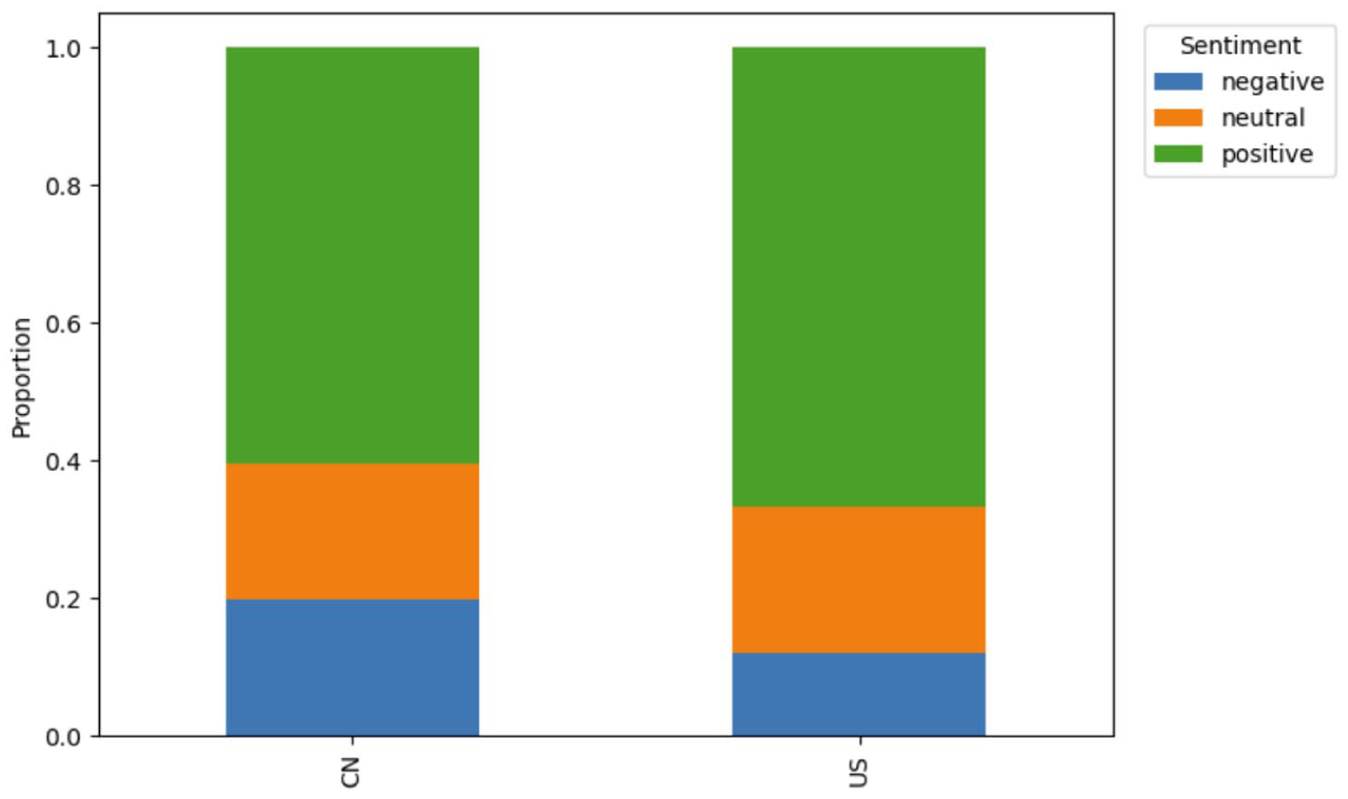
Overall sentence-level sentiment distribution by country.
More specifically, positive sentences account for 66.75% of the US corpus and 60.35% of the Chinese corpus. By contrast, negative sentences account for 11.99% of the US corpus but 19.68% of the Chinese corpus. This pattern suggests that the overall affective landscape of the Dialogue is not dominated by overt hostility. Rather, both sides operate within a formal diplomatic genre in which positively valenced and institutionally conventional language remains prevalent. However, the relatively larger negative proportion in the Chinese corpus indicates that aggregate positivity should not be equated with the absence of strategic tension.
Figure 2 displays the distribution of sentence-level VADER compound scores for the Chinese and US corpora. Both distributions are centered above zero, indicating that the overall sentiment orientation of SLD discourse is predominantly positive or neutral. Nevertheless, US texts display a higher mean compound score than Chinese texts. At the sentence level, the US mean compound score is 0.325, compared with 0.242 for the Chinese corpus. A Welch’s t-test confirms that this difference is statistically significant (t = 5.01, p < 0.001), although the effect size is small (Cohen’s d = 0.19).
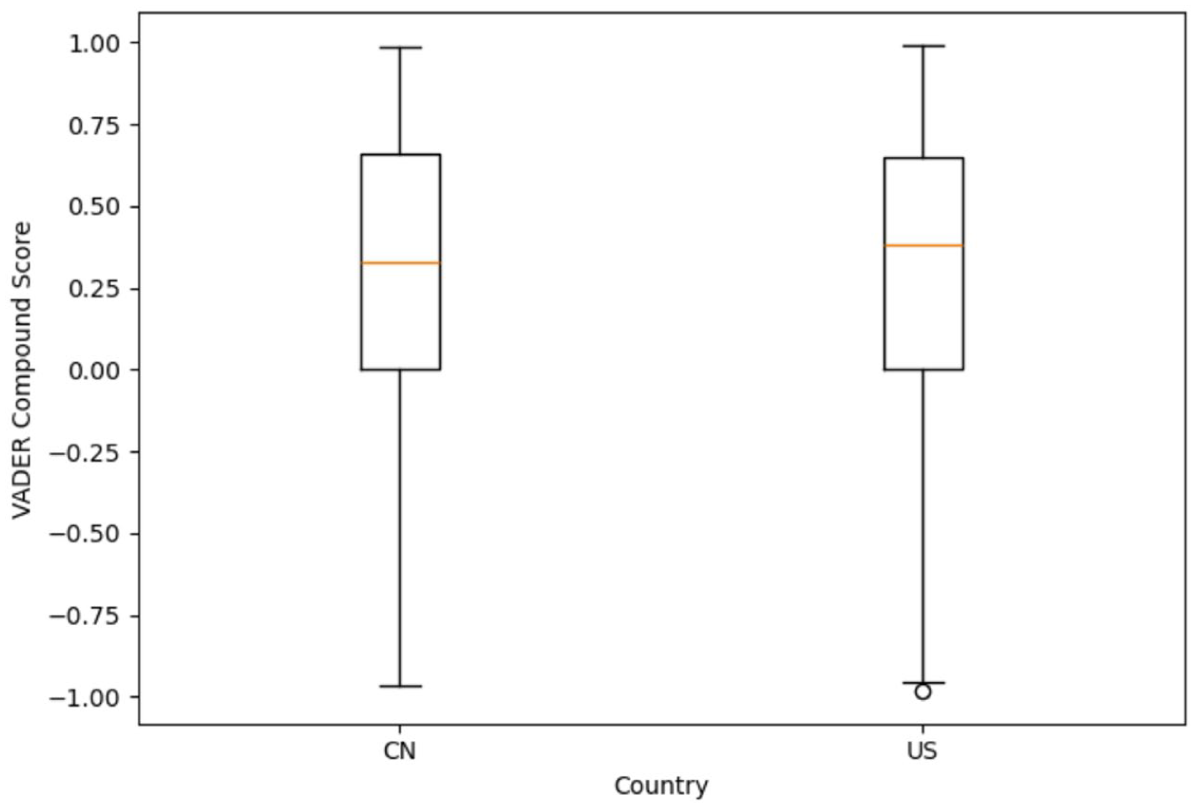
Sentence-level compound sentiment by country.
The boxplots also show substantial overlap between the two distributions. This overlap is important because it indicates that the two corpora share a common institutional affective register. The main difference lies not in a complete separation of emotional style, but in a modest shift in the relative balance between positive and negative sentence-level framing. Methodologically, these findings also suggest that overall sentiment in formal security discourse should be interpreted cautiously, since acknowledgments, diplomatic courtesies, and institutionally conventional formulations contribute substantially to aggregate positivity.
Temporal variation in sentiment and negative framing
To examine whether affective differences between Chinese (CN) and US SLD texts vary over time, this section compares the two corpora at both the yearly and phase-based levels. The analysis shows that overall sentiment and negative framing do not vary in identical ways across the time series. For this reason, temporal comparison considers both yearly mean compound sentiment and the yearly proportion of negative sentences.
Figure 3 plots the yearly mean sentence-level compound scores for Chinese and US texts. Across most years, US texts display higher mean sentiment scores than Chinese texts, although the size of the difference varies considerably. The largest overall sentiment gap appears in 2014, when the difference between the two corpora is most pronounced. Additional sizable gaps are visible in 2019 and 2017. By contrast, 2015 and 2023 show minimal difference, with Chinese texts slightly exceeding US texts in those years.
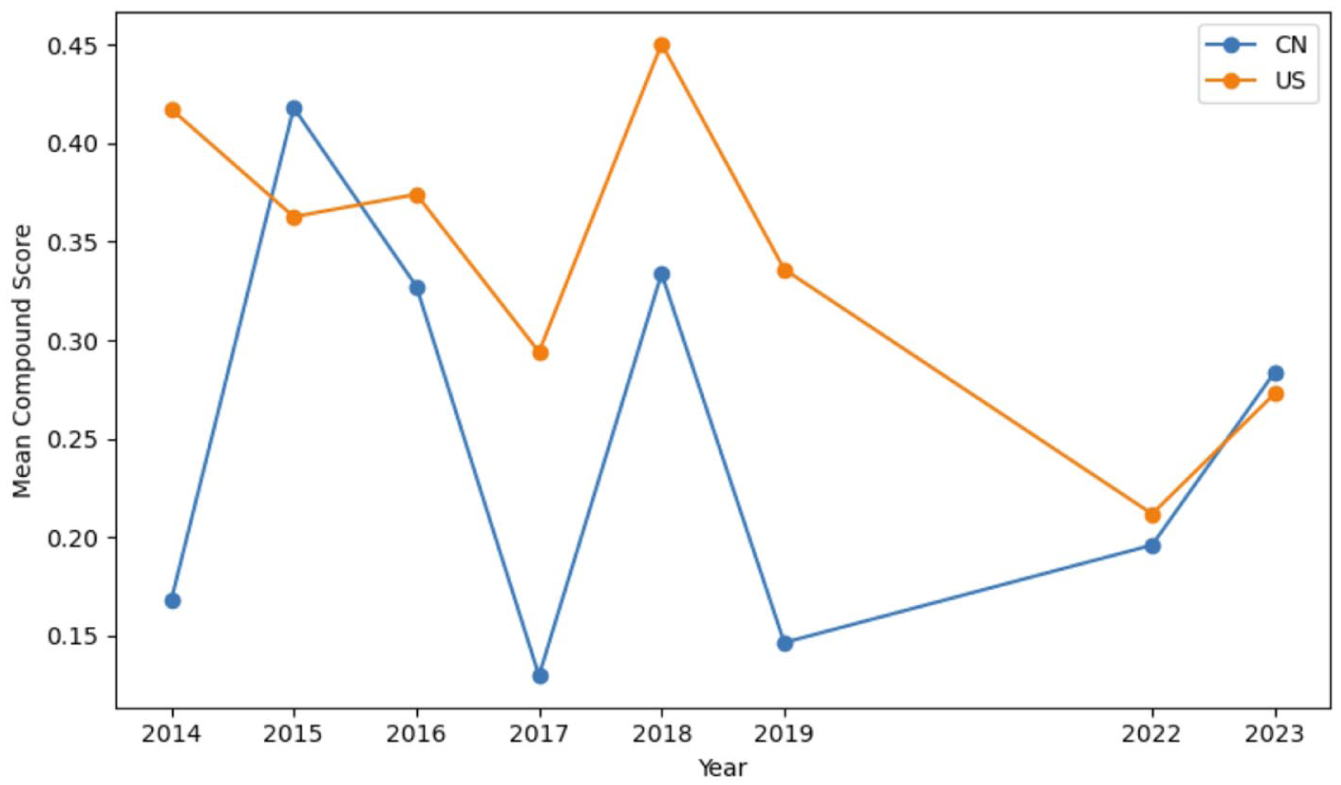
Year-wise mean sentence-level sentiment (CN vs US).
These results indicate that cross-national divergence in overall sentiment is uneven and context-dependent. Rather than revealing a stable or linear pattern of emotional escalation, the yearly means suggest a shifting relationship in which the relative position of the two sides changes across institutional and geopolitical contexts. The convergence visible in 2023 is especially notable, as it suggests that the sharpest divergences are not sustained across the entire period.
Because overall compound sentiment can be influenced by diplomatic courtesies and institutionally conventional positive language, Figure 4 examines a more specific indicator: the yearly proportion of negative sentences. This measure reveals a different temporal pattern. The strongest divergence in negative framing occurs in 2019, followed by 2022, with Chinese texts showing a markedly higher proportion of negative sentences than US texts in those years. By comparison, 2018 still displays cross-national difference, but it is not the most pronounced year in the corpus.
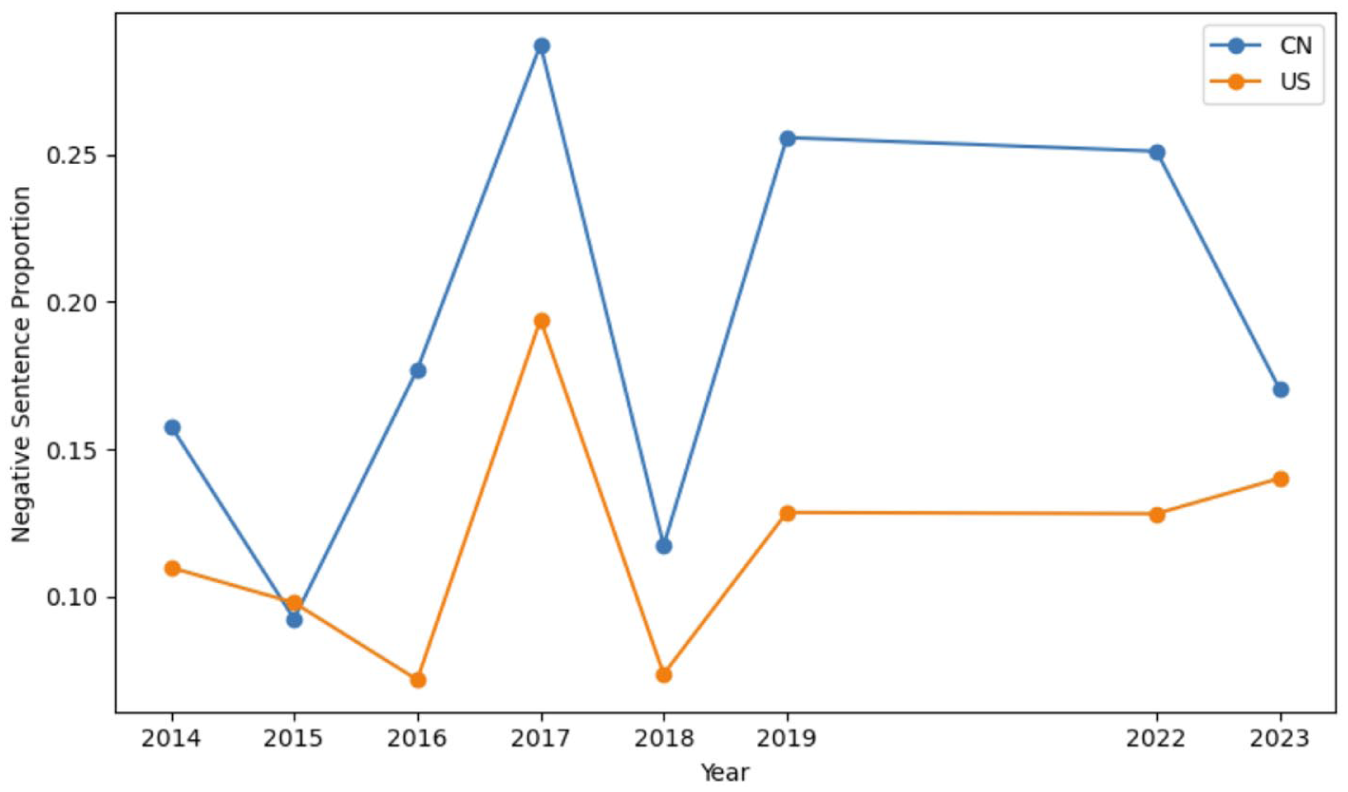
Year-wise negative sentence proportion (CN vs US).
This distinction is analytically important. It shows that the year with the largest overall sentiment gap is not necessarily the year with the strongest divergence in negative framing. In the analysis, 2014 stands out most clearly in terms of overall compound sentiment, whereas 2019 is the most salient year for concentrated negative framing. For this reason, the subsequent NRC and KWIC analyses focus on 2019 rather than 2018.
Figure 5 summarizes the mean sentence-level sentiment scores across three phases: Phase 1 (2014–2016), Phase 2 (2017–2019), and Phase 3 (2022–2023). In both Phase 1 and Phase 2, US texts remain more positive on average than Chinese texts. Chinese mean sentiment declines more clearly from Phase 1 to Phase 2, producing a wider gap in the middle period. In Phase 3, however, the two sides converge substantially, with only a very small difference between them.
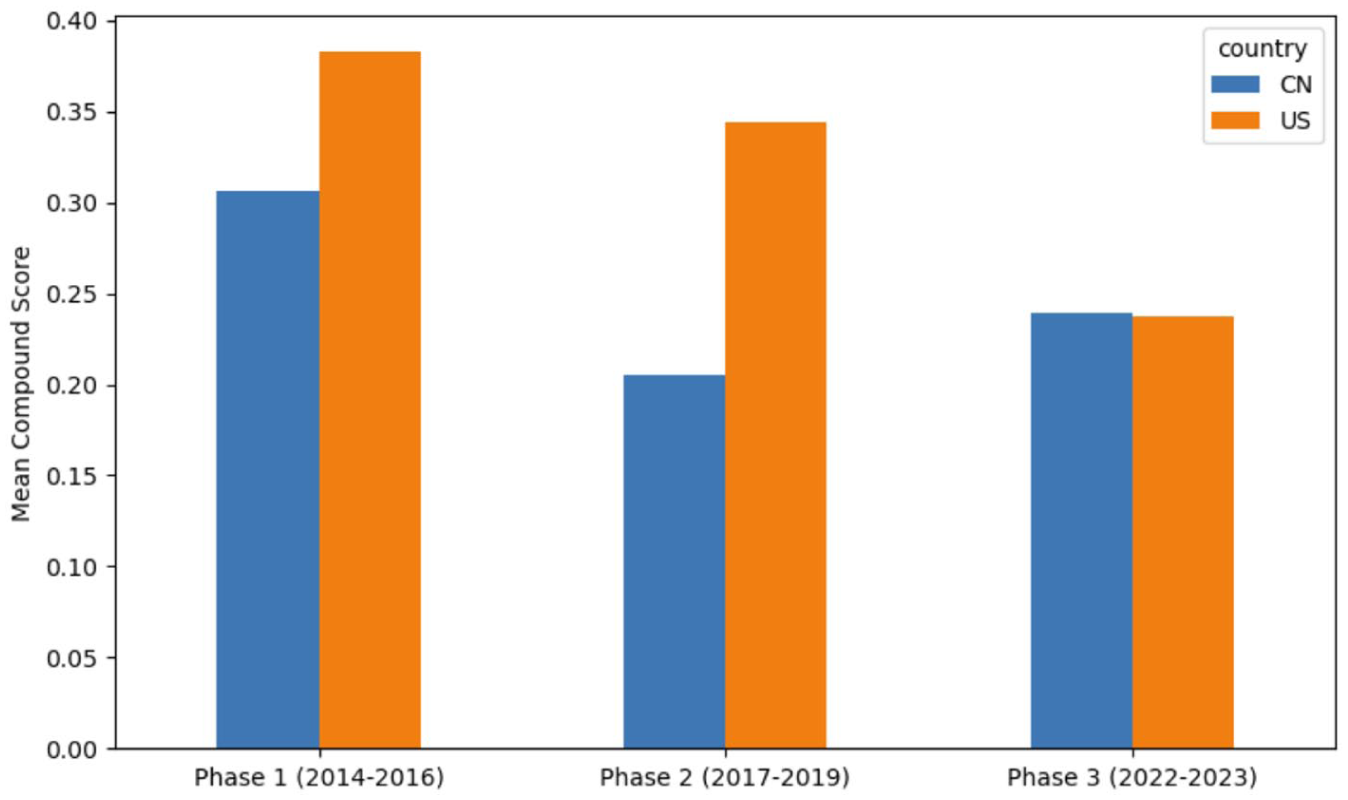
Phase-level mean sentiment.
Taken together, the phase-level results reinforce the view that affective divergence is not structurally fixed. Instead, the relationship between the two corpora changes over time, with sharper differences in the middle period and greater convergence after the Dialogue’s post-pandemic resumption. These findings also support a more differentiated interpretation of affective positioning: overall positivity remains common to both sides, but the distribution of negative framing varies more sharply across specific years and phases.
Emotion composition and discursive framing in the 2019 negative subset
To investigate the year in which negative framing diverges most clearly, this section focuses on the 2019 negative subset. In the corpus, 2019 is the year with the largest China–US difference in the proportion of negative sentences. The subset includes all sentences classified as negative by VADER in the 2019 Chinese and US texts, comprising 45 Chinese sentences and 27 US sentences.
Figure 6 presents the normalized NRC emotion profile of the 2019 negative subset. In both corpora, fear and anger emerge as the most salient emotional categories, indicating that negative security discourse on both sides is organized primarily around threat, danger, and conflict. At the same time, the two corpora differ in their relative emotional composition. Chinese negative sentences display comparatively stronger anger and sadness, whereas US negative sentences retain relatively stronger trust- and anticipation-related components. This suggests that the two sides do not differ in terms of negative versus non-negative discourse alone; rather, they differ in how negative affect is emotionally structured within the same institutional setting.
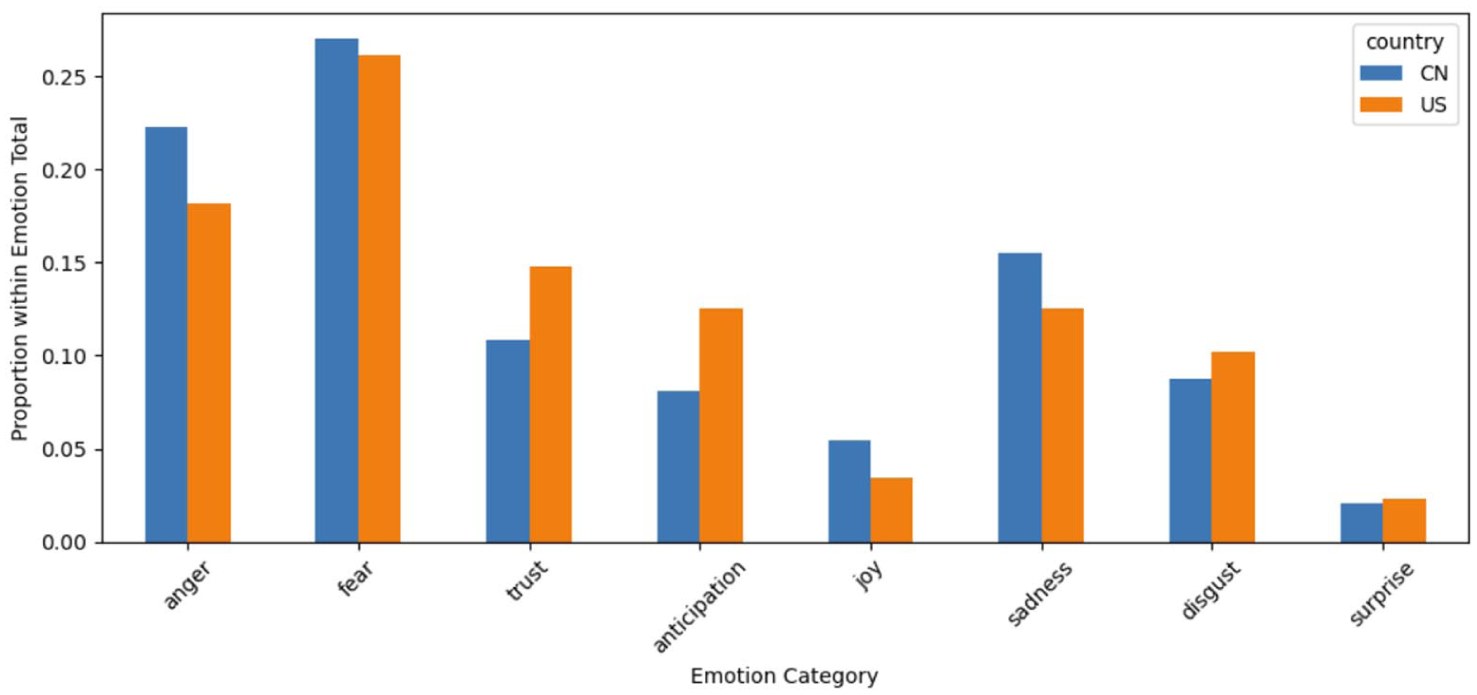
Normalized NRC emotion profile of the 2019 negative-sentence subset.
The Chinese negative subset is marked by a more historically charged and accusatory profile. In relative terms, it contains stronger anger and sadness, reflecting a discourse that not only identifies danger but also evaluates it through narratives of grievance, division, and injustice. By contrast, the US negative subset also centers on fear and anger, but includes relatively higher trust and anticipation, indicating a more forward-oriented framing in which negative assessment is linked to institutional principles, strategic response, and future action. Thus, the contrast in 2019 is not a simple opposition between one negative and one reassuring discourse. Rather, both sides mobilize negative affect, but they do so through different emotional repertoires.
Keyword-in-context analysis further clarifies these differences. In the Chinese subset, negative affect is repeatedly embedded in contexts involving war, risk, coercion, security, and stability, often accompanied by references to regional disorder, historical trauma, and criticism of hegemonic behavior. In the US subset, by contrast, negative affect is more often tied to threat, undermine, sovereignty, and risk, with emphasis on explicit threat attribution, rule violation, and the erosion of regional order. These patterns indicate that Chinese negative framing is more closely associated with historically inflected, anti-hegemonic, and grievance-oriented discourse, whereas US negative framing is more strongly organized around threat-and-rules narratives.
Taken together, the 2019 findings refine the broader results presented above. They show that the most analytically salient China–US difference in the corpus lies not in a single year of maximal overall sentiment divergence, but in a year of concentrated divergence in negative framing. In this sense, 2019 is best understood as the focal point at which the two sides most clearly diverge in how negative affect is composed and publicly articulated within SLD security discourse.
Discussion
Overall interpretation of findings
Taken together, the findings indicate that affective differences between Chinese and US SLD texts are selective, temporally uneven, and functionally differentiated rather than uniform or stylistic. Across the full corpus, both sides’ texts display a predominantly positive or neutral sentiment orientation, reflecting the institutionalized and diplomatic character of the SLD as a multilateral security forum. At the aggregate level, the two corpora overlap substantially, suggesting that affective divergence is not a constant or defining feature of China–US security communication in this setting.
At the same time, the analysis also shows that the two corpora are not affectively identical. US texts exhibit a significantly higher mean compound sentiment score and a lower proportion of negative sentences than Chinese texts, although the effect size is relatively small. This means that the difference is systematic but modest: both sides operate within a shared institutional affective register, yet they do so with somewhat different balances of positive and negative framing. Importantly, these findings suggest that overall positivity should not be conflated with the absence of strategic tension. Formal security discourse can remain globally positive in tone while still containing meaningful differences in how negative affect is selectively mobilized.
The temporal results further refine this interpretation. In the corpus, the largest gap in overall sentiment appears in 2014, whereas the strongest divergence in the proportion of negative sentences emerges in 2019, followed by 2022. This distinction is theoretically important because it shows that overall sentiment divergence and divergence in negative framing should not be treated as interchangeable indicators. The most analytically revealing difference between Chinese and US discourse lies not simply in which side sounds more positive overall, but in when and how negative language becomes concentrated, emotionally structured, and strategically deployed.
These patterns suggest that affect in elite security discourse functions as a strategic discursive resource through which actors position themselves publicly within institutional communication settings rather than as a direct reflection of leaders’ inner emotional states. Emotional language is therefore best understood in functional and strategic terms, shaped by institutional genre, audience design, and the demands of specific geopolitical moments.
Divergence in negative framing rather than overall hostility
One of the most important implications of the findings is that China–US difference at the SLD is more clearly visible in negative framing than in overall hostility. At the aggregate level, both corpora remain predominantly positive or neutral, and the sentence-level distributions overlap substantially. This pattern is consistent with the diplomatic and institutional constraints of the forum, where speakers must address not only one another but also wider regional and international audiences. Under such conditions, overtly confrontational discourse remains bounded by the communicative norms of a formal multilateral setting.
However, once the analysis shifts from overall sentiment to the proportion and composition of negative sentences, a different picture emerges. The results show that the strongest divergence occurs not in a year of maximal overall negativity, but in a year when the two sides diverge most sharply in how often and how intensely they activate negative framing. In the corpus, that year is 2019. This suggests that strategic competition in institutionalized security discourse may manifest less through generalized emotional escalation than through selective concentration of negative affect in particular periods and rhetorical contexts.
This distinction helps clarify why overall compound sentiment alone is insufficient as a proxy for confrontational intensity. Formal security speeches contain large numbers of diplomatically conventional and protocol-driven sentences, including acknowledgments, institutional affirmations, and generalized appeals to cooperation or stability. Such sentences elevate aggregate positivity even when a text also contains sharply negative security framing. As a result, a discourse may appear moderately positive overall while still deploying concentrated negative language in strategically salient segments. The results therefore support a more differentiated analytic approach in which aggregate sentiment and negative-sentence proportion are treated as related but distinct indicators.
From this perspective, the main contrast between Chinese and US affective positioning is not that one side is simply positive and the other negative. Rather, both sides operate within an overall positive institutional register, but differ in when and how they intensify negative framing. This is why the strongest China–US divergence in the corpus appears most clearly at the level of negative-sentence distribution and not at the level of overall sentiment alone.
The 2019 focal case of negative affective divergence
In the corpus, 2019 emerges as the most analytically salient focal case for examining divergence in negative framing. It is the year with the largest China–US difference in the proportion of negative sentences, and it also provides a sufficiently rich negative subset for more focused emotion analysis. The targeted NRC and KWIC analyses conducted on the 2019 negative subset therefore offer a more appropriate interpretive basis.
The NRC results show that both Chinese and US negative sentences in 2019 are organized primarily around fear and anger, indicating that both sides rely on threat- and conflict-oriented emotional language when articulating security concerns. At the same time, the emotional composition of their negative discourse differs. Chinese negative sentences display relatively stronger anger and sadness, whereas US negative sentences retain relatively stronger trust and anticipation. This suggests that the key difference is not whether negative affect is present, but how it is emotionally configured.
The KWIC results further clarify this contrast. In the Chinese subset, negative affect is frequently embedded in contexts involving war, risk, coercion, security, and stability, often accompanied by references to regional disorder, historical grievance, humiliation, division, or anti-hegemonic critique. In this sense, Chinese negative framing is not merely cautionary; it is also evaluative and historically inflected. It constructs threat through wider narratives of instability, coercive pressure, and the social or historical consequences of conflict. By contrast, the US subset is more frequently organized around threat, undermine, sovereignty, and risk, with stronger emphasis on explicit threat attribution, rule violation, and the erosion of regional order. US negative affect is therefore more tightly tied to named security challenges, institutional principles, and the integrity of a rules-based system.
This contrast is consistent with prior research suggesting that emotional language in security discourse functions as a strategic signaling mechanism rather than an expression of affective volatility (Krebs and Jackson, 2007; Van Rythoven, 2015). In this sense, the US pattern can be read as a form of threat-and-rules framing in which negative affect helps foreground urgency, identify pressure points, and signal commitment to regional order. The Chinese pattern, by contrast, is more strongly associated with historically inflected, anti-hegemonic, and grievance-oriented risk framing. Both are strategic, but they structure negative affect through different rhetorical logics.
Theoretically, the 2019 case therefore suggests that China–US divergence in elite security discourse is best understood as a difference in negative affective repertoires. Chinese discourse mobilizes anger and sadness in ways that are more grievance-oriented and historically resonant, whereas US discourse combines fear and anger with trust- and anticipation-related elements that frame negative assessment in terms of institutional commitment, strategic response, and future-oriented action. The divergence lies not in a binary contrast between emotional intensity and emotional restraint, but in the different ways negative affect is organized and publicly articulated within the same multilateral forum.
Institutional genre constraints and selective divergence
An important implication of the findings is that affective divergence between Chinese and US texts is selective rather than pervasive because it operates within strong institutional genre constraints. The SLD is a highly structured public forum in which defense representatives address multiple audiences simultaneously: counterpart states, regional partners, alliance networks, the policy community, the media, and domestic observers. This multi-audience setting imposes strong expectations of diplomatic composure, strategic ambiguity, and institutional legitimacy. Emotional expression is therefore not unconstrained; rather, it is filtered through the communicative norms of the forum.
These constraints help explain why overall sentiment remains broadly positive or neutral across the corpus, and why divergence appears more clearly in specific years and subsets rather than uniformly across the entire period. Institutional genre does not eliminate affect; instead, it channels affect into socially acceptable forms. Under such conditions, emotional difference becomes visible less through unrestrained hostility than through contrastive calibration within a shared communicative frame. In this sense, the findings refine securitization-oriented arguments by showing that emotional signaling in institutional settings is not simply a matter of unconstrained escalation, but of bounded calibration within publicly legitimate forms of discourse (Balzacq, 2011).
This point is especially important in relation to the concern that the SLD is not a bilateral China–US channel. The present findings do not require treating the forum as a venue of direct dyadic emotional exchange. Rather, the analysis suggests that affective positioning occurs through public performances before wider audiences under shared institutional constraints. The value of the SLD therefore lies not in revealing private emotion between the two states, but in providing a comparable arena in which each side publicly positions itself, its preferred order, and its interpretation of regional security.
The findings thus support a genre-sensitive and audience-oriented view of affective security communication. Emotional meaning in this context is socially embedded, institutionally mediated, and relationally performed. The two sides do not simply “express emotion”; they position themselves affectively in ways that project leadership, responsibility, threat sensitivity, legitimacy, or grievance before a wider regional public. This is why affective positioning is especially useful as an analytic concept for understanding elite security discourse in multilateral settings.
Methodological implications and limitations
Methodologically, this study demonstrates the value of combining sentence-level sentiment analysis with temporally structured and context-sensitive interpretation in the analysis of elite security discourse. By operating at the sentence level rather than the document level, the analysis avoids overweighting individual long texts and makes it possible to identify shifts that would otherwise be obscured by document-level averages. This is especially important in institutional forums, where affective signals may be concentrated in specific passages rather than distributed evenly across an entire speech.
The study also illustrates the importance of distinguishing between overall sentiment and negative framing. The results show that these are not interchangeable. Overall compound sentiment captures the broad emotional orientation of a text, but it may be strongly influenced by diplomatic protocol and institutionally conventional positive language. Year-specific negative-sentence proportion, by contrast, can reveal a different temporal pattern and may be more informative for identifying moments of affective divergence in adversarial framing. This distinction reflects the methodological importance of separating overall sentiment from negative framing.
A further contribution lies in the use of methodological triangulation. VADER provides a useful first-level account of sentence-level polarity; NRC enables more differentiated analysis of emotional composition; and KWIC inspection links lexicon-based scores to actual rhetorical contexts. Together, these methods support a more transparent interpretive chain from lexical signal to discursive function. In this respect, the study aligns with broader arguments that emotional language in security discourse becomes analytically meaningful only when related back to the strategic and communicative purposes it serves (Krebs and Jackson, 2007; Van Rythoven, 2015).
At the same time, several limitations should be acknowledged. First, dictionary-based sentiment and emotion analysis inevitably simplifies affective meaning by relying on lexical cues, and cannot fully capture irony, implicit evaluation, discourse-level framing, or pragmatic nuance. Although KWIC validation was used to improve interpretive fit, future work could integrate embedding-based or supervised models to provide more context-sensitive accounts of affective language. Second, the corpus is based on publicly available English-language texts, which are authoritative public-facing versions but may also reflect drafting, editing, or translation conventions. Third, the SLD is only one institutional arena of China–US security communication; caution is therefore needed in generalizing these findings to bilateral dialogues, domestic speeches, or less formal settings.
Finally, the Chinese corpus includes composite country-year files in 2017 and 2018 assembled from multiple special-session interventions. This design was necessary to preserve cross-year comparability within the SLD setting, but it also means that not all country-year files are genre-identical. The analysis therefore does not claim strict genre equivalence. Instead, it compares publicly attributable acts of formal security communication within the same multilateral institutional forum. Future research could extend this framework by comparing additional forums, incorporating more actors, or examining how different audiences receive and interpret contrasting affective repertoires.
Conclusion
This study examined affective positioning in Chinese (CN) and US SLD texts from 2014 to 2023 by combining sentence-level sentiment analysis with targeted emotion classification and contextual validation. Drawing on a corpus of 16 country-year texts and 2911 sentences, the study used VADER-based sentiment scoring, NRC emotion analysis, and keyword-in-context (KWIC) inspection to investigate how emotion functions in elite security communication. Rather than treating sentiment as a proxy for leaders’ psychological states, the study approached affect as a publicly articulated and strategically calibrated dimension of discourse within a multilateral institutional forum.
Across the full corpus, both Chinese and US texts display a predominantly positive or neutral affective orientation, reflecting the diplomatic and institutional norms of the SLD. At the same time, the two corpora are not affectively identical. US texts show a significantly higher mean compound sentiment score and a lower proportion of negative sentences than Chinese texts, although the overall effect size is small. These findings indicate that both sides operate within a shared institutional affective register, but differ in the balance they strike between positive and negative framing.
Temporal analysis further shows that cross-national divergence is uneven rather than constant. The largest overall sentiment gap appears in 2014, whereas the strongest divergence in the proportion of negative sentences occurs in 2019, followed by 2022. Phase-based comparison also shows that the two sides diverge more clearly in the middle period and converge substantially in Phase 3 (2022–2023). These patterns suggest that affective difference in elite security discourse is temporally contingent and context-sensitive rather than a stable national characteristic.
The focused analysis of the 2019 negative subset provides more specific insight into how this divergence is structured. NRC results show that both Chinese and US negative sentences rely primarily on fear- and anger-related language, but with different emotional configurations. Chinese negative sentences display relatively stronger anger and sadness, whereas US negative sentences retain relatively stronger trust- and anticipation-related elements. KWIC analysis further demonstrates that Chinese negative framing is more closely associated with war, risk, coercion, instability, and historical grievance, while US negative framing is more strongly organized around threat attribution, sovereignty, and the undermining of regional order. The key difference, therefore, is not simply that one side is more negative and the other more restrained, but that the two sides mobilize negative affect through different rhetorical and emotional repertoires.
Theoretically, the study contributes to research on security discourse, international communication, and affective positioning by showing that strategic competition in multilateral security forums is communicated less through generalized emotional escalation than through selective and context-dependent differences in negative framing. The findings also refine genre-sensitive approaches to elite political discourse by demonstrating that institutional settings do not eliminate affect, but channel it into publicly legitimate forms. In the SLD, affective positioning is shaped by institutional constraints, audience design, and the strategic demands of particular geopolitical moments.
Methodologically, the study demonstrates the value of combining sentence-level sentiment analysis with discrete emotion classification and contextual validation. Sentence-level analysis makes it possible to detect short-term affective variation without allowing exceptionally long texts to dominate the results, while targeted NRC analysis and KWIC inspection improve interpretive transparency and theoretical fit. At the same time, several limitations should be acknowledged. Dictionary-based methods rely on lexical cues and cannot fully capture implicit, pragmatic, or multimodal affective meaning. The corpus is based on publicly available English-language texts, which may reflect drafting, editing, or translation conventions. In addition, the SLD is only one institutional arena of China–US security communication, and the Chinese corpus includes composite country-year files in 2017 and 2018 assembled from multiple special-session interventions.
Overall, the study shows that affective divergence in the SLD is selective, episodic, and strategically meaningful. China–US difference in this forum is most clearly visible not in overall sentiment alone, but in how negative affect is distributed, composed, and contextualized across specific years. By situating sentiment and emotion within institutional, temporal, and relational contexts, the study underscores the importance of treating affect not merely as tone, but as a constitutive resource in elite security discourse and the public communication of regional order in Asia.
Supplemental Material
sj-xls-1-jas-10.1177_00219096261454847 – Supplemental material for Affective positioning in China–US security communication in Asia: Evidence from Shangri-La Dialogue speeches (2014–2023)
Supplemental material, sj-xls-1-jas-10.1177_00219096261454847 for Affective positioning in China–US security communication in Asia: Evidence from Shangri-La Dialogue speeches (2014–2023) by Qiuxi Zhuo in Journal of Asian and African Studies
Footnotes
Appendix
Condensed corpus inventory.
| Year | Country | Speaker(s)/Corpus Unit | Position/Role | Session type | Corpus unit used |
|---|---|---|---|---|---|
| 2014 | United States | Chuck Hagel | Secretary of Defense | Second Plenary Speech | Full speech, Q&A excluded |
| 2014 | China | Wang Guanzhong | Deputy Chief of General Staff, PLA | Fourth Plenary Speech | Full delivered intervention, including marked off-script opening remarks |
| 2015 | United States | Ashton Carter | Secretary of Defense | First Plenary Session | Full speech |
| 2015 | China | Sun Jianguo | Deputy Chief, General Staff Department, PLA | Fourth Plenary Session | Full speech |
| 2016 | United States | Ashton Carter | Secretary of Defense | First Plenary Session | Full speech |
| 2016 | China | Sun Jianguo | Senior PLA representative | Fourth Plenary Session | Full speech |
| 2017 | United States | James Mattis | Secretary of Defense | First Plenary Session | Full speech |
| 2017 | China | Yao Yunzhu; He Lei; Zhu Qichao; Zhou Bo | Chinese military/defense-affiliated representatives | Special Sessions | Merged Chinese intervention file (4 interventions) |
| 2018 | United States | James Mattis | Secretary of Defense | First Plenary Session | Full speech |
| 2018 | China | Zhao Xiaozhuo; He Lei; Zhou Bo | Chinese military/defense-affiliated representatives | Special Sessions | Merged Chinese intervention file (3 interventions) |
| 2019 | United States | Patrick M. Shanahan | Acting Secretary of Defense | First Plenary Session | Full speech |
| 2019 | China | Wei Fenghe | State Councilor and Minister of National Defense | Fourth Plenary | Full speech |
| 2022 | United States | Lloyd J. Austin III | Secretary of Defense | First Plenary Session | Full speech |
| 2022 | China | Wei Fenghe | State Councilor and Minister of National Defense | Fifth Plenary Session | Full speech |
| 2023 | United States | Lloyd J. Austin III | Secretary of Defense | First Plenary Session | Full speech |
| 2023 | China | Li Shangfu | State Councilor and Minister of National Defense | Fifth Plenary Session | Full speech |
Note. The analytical corpus consists of 16 country-year texts. No Shangri-La Dialogue meetings were held in 2020 or 2021. The Chinese 2017 and 2018 files are composite country-year texts assembled from official Chinese special-session interventions. Full source details are available in the supplementary source inventory.

Author contributions
Q.Z. conceptualized the study, collected and analyzed the data, and wrote the manuscript.
Funding
The authors disclosed receipt of the following financial support for the research, authorship, and/or publication of this article: This research was supported by the Humanities and Social Science Fund of the Ministry of Education of China under the project “A Comparative Study of Sino–US Metapragmatic Stances in National Discourses (2013–2023)” (grant no. 23YJC740099).
Declaration of conflicting interests
The authors declared no potential conflicts of interest with respect to the research, authorship, and/or publication of this article.
Data availability statement
The corpus used in this study consists of publicly available Shangri-La Dialogue speech transcripts. Processed data and coding scripts are available from the author upon reasonable request.
Supplemental material
Supplemental material for this article is available online.
Author biography
References
Supplementary Material
Please find the following supplemental material available below.
For Open Access articles published under a Creative Commons License, all supplemental material carries the same license as the article it is associated with.
For non-Open Access articles published, all supplemental material carries a non-exclusive license, and permission requests for re-use of supplemental material or any part of supplemental material shall be sent directly to the copyright owner as specified in the copyright notice associated with the article.
