






Abstract
This study explores the struggles of urban women vendors in Bulawayo, Zimbabwe’s second largest city, during the post-2017 Second Republic. It employs “Lizards of 5th Avenue”; a conceptual metaphor originating from how vendors characterise themselves, to investigate vendor methods of surviving spatial marginality. To the interviewed, a lizard, Umpankwa, captures how vendors navigate daily livelihoods, always negotiating for space along the street. By employing ethnographic methodologies rooted in vendor articulations and observation, and documentary research, the article concludes that through partnering with ZANU PF, vendors successfully thwarted council spatial dominance, paradoxically turning the council and ZANU into lizards of 5th Avenue.
Introduction
Street vending is a constitutive feature of urban political economy across the Global South. Notwithstanding, it remains persistently misrecognised within dominant urban imaginaries that privilege order, circulation, and formal property regimes. Streets are not only conduits of movement but also vital livelihood infrastructures, and therefore, analytical attention must attend to “what happens on the street” as a critical dimension of public space (Kiaka et al., 2021: 1263). In Zimbabwe, since ED Mnangagwa became the president in 2017, vending began to skyrocket to unprecedented levels, responding to soaring inflation and the local currency plummeting (Dube and Gumbo, 2025). The longer arc of economic decline produced what Mlambo (2017) terms the transition from industrial powerhouse to “a nation of vendors.” The Assessment of the Contribution of Street Vending to the Zimbabwe Economy in 2018 noted that 86.6% of street vendors depend entirely on street vending as their source of income. The 2022 census suggested that women had a higher chunk of unemployed persons than men, which justifies both their numbers on 5th Avenue and their study here. The 2023 ZimStats 4th Quarter Report indicates that informally employed persons were 86.8% of all employed persons in the non-agricultural sectors. Ruth Chomola’s (2024: 3) survey shows that in Bulawayo, “there is a high dependence on street vending for livelihoods, more than 50% of the respondents have an average of five dependents.” This predominance of vendors means that research must shift towards this important, fast-increasing, poverty-created social group (Chiumia, 2014). Traditionally, studies have looked at streets as livelihood frontiers where the state and vendors often clash (Mpofu, 2011, Masawi et al., 2023). This study extends scholarship on resistance and resilience among informal traders (Dube and Gumbo, 2025) by analysing vendor survival tactics.
The study focuses on 5th Avenue in Bulawayo, which was gradually morphed from being a vehicular driveway to vendor trading space. From the early 1990s, more and more vendors poured into the Bulawayo Central Business District (CBD) (Toriro and Chirisa, 2021), such that by the early 2000s scores of vendors were operating along 5th Avenue. As conditions worsened, more vendors viewed 5th Avenue as geographies of survival against unemployment (Hove et al., 2020). By the end of 2019, as the economy deteriorated, 5th Avenue became packed with vendors. In 2020, the council, which had started to offer vendor licenses for operating along 5th Avenue, renewed vendor leases by 5 years and began to mark bays for them. 1 When COVID-19 hit, in June 2020, a raft of measures aimed at curbing the spread of the pandemic was introduced (Dube and Gumbo, 2025). Those included the order to shutdown the open-air market along 5th Avenue. 2 Despite the shutdown, vendor presence along 5th Avenue multiplied, reaching unprecedented levels in 2022 as COVID-19 eased. 3 Vendors seemingly ignored the local authority’s repeated calls for them to leave 5th Avenue and instead up-scaled their operations even though they were viewed to be out of place (Bhila and Chiwenga, 2023; Kamete, 2007). They gradually closed off the entire road, barring vehicles from easily driving through or even finding any parking bay. 4 At the end of 2022, 5th Avenue had turned into a mega-market where one could get anything from vegetables to cooked food, groceries, secondhand clothes, beer, drugs, cigarettes, airtime, love potions, potions for the treatment of sexually transmitted diseases, condoms, vaginal tightening creams, penis enlargement potions, and sexual enhancement pills and concoctions. The authorities always viewed the growth of vendors as perpetuating disorder (Fontein, 2009; Potts, 2006). Urban councils usually responded to vendor presence through coercion and displacement. Planning scholarship by Kamete (2007) shows how Zimbabwean urban governance has repeatedly sought to contain or warehouse informality through designated markets and spatial exclusion, often under the idiom of modernity and order. If, as Lefebre (2001, 2003) insists, urban space is socially produced and therefore politically contested, then street vending becomes an acute site through which to examine the politics of space, regulation, and survival under conditions of economic contraction and state–local government antagonism.
This article develops the conceptual metaphor of lizards of 5th Avenue, as a means of taking forward debates on everyday vendor struggles and adaptation in urban spaces. This emanates from the complexities of the interactions between nature and society, where the Ndebele, which is the dominant ethnic group in Bulawayo, views poor people who usually bask in the sun as lizards, umpankwa. The Shona ethnic group, who also form a majority of 5th Avenue vendors, employ uri gwavava, or uri gwereveshe, or uri mupurw (you are a lizard), to mean “you are very poor.” The expression, uri gundyu risina muswe (you are tailless lizards) is deployed to mean you are extremely poor; you do not have anything of your own. The argument is that 5th Avenue has been repeatedly weaponised by authorities to marginalise vendors, yet the latter have developed resilient survival competencies that enable them to endure—and at times to reconfigure—municipal power. A central contribution of this article is to develop and work with a conceptual metaphor, Lizards of 5th Avenue, generated from vendors themselves. To vendors, umpankwa (lizard) signifies impoverishment. The isikwalakwala (scaled lizard) provides a culturally resonant idiom for describing the adaptive “scales” that vendors develop through repeated confrontations with policing, confiscations, and displacement. The article, therefore, places vendor articulation into productive dialogue with debates on contested urban space, informality, and everyday survival, and does so through a concept that emerges from the street rather than those imported wholesale from pre-existing theory.
This article posits that Bulawayo vendors exist as Lizards of 5th Avenue. The ruling party, the Zimbabwe African National Union Patriotic Front (ZANU), masquerades as vendor protectorates, and vending security guarantors. Paradoxically, ZANU is politically stifled in urban spaces and demands vendor participation and membership to the party in a city run by the opposition party. It is therefore argued that ZANU is politically lizarding (hustling for support) in 5th Avenue because they are politically impoverished (lizards). It is argued that in 5th Avenue, both ZANU and vendors are metaphorical lizards, and both are aware that they need each other. They work in conviviality to strangle council control of urban spaces. The council, therefore, has also been ablated to metaphorical lizards of 5th Avenue as its authority has been usurped. Vendors are aware that unless they become partisan citizens, they are unable to survive outside the orbits of ZANU in the face of a hostile council. ZANU is also unable to muffle council 5th Avenue claims without vendors, and vendors are not unaware of their power in spatial contestation.
Therefore, 5th Avenue is a convergence zone, a zone of contestation and negotiation for vendors, the council, and the ruling party. In this space, all of them are in unique contradictions as metaphorical lizards. Vendors have morphed methods of challenging council urban spatial claims. They have devised tactics of countering council power using the same street that authorities intended to use to punish vendors. By use of lizard survival characteristics, vendors have turned powerful institutions such as ZANU and Bulawayo City Council (BCC) into metaphorical lizards, coming to 5th Avenue in relative forms of marginality. Along 5th Avenue, power is traded, and victimhood is exchanged. The street is a source of power for the ruling party and council, as it is also for the marginalised vending lizards. It is intrumentalised and weaponised by all as they constantly negotiate their own different kinds of marginality.
The study employs vendor socially conceived umpankwa articulations to situate the article in the normative world of Zimbabwe. This does not venture into reptile studies, but biologists and geographers such as Williams et al. (2019: 160) agree with this conceptual metaphor as they argue that “their (lizards) presence is not at all welcomed. As such, there is concern about the likelihood of there being more . . . lizard populations.” Biologists have also posited that “despite environmental fluctuations, lizards have developed behavioral mechanism to maintain relative constancy” (Vicenzi et al., 2019: 337). The conceptual metaphor captures Bulawayo vendor marginality, their intolerance, and their adoption of survivalist characteristics. Other biological investigations of lizard features have shown that they are “distinct and restricted”; they develop particularly peculiar morphological traits such as scales, as they adapt to conditions of specific environmental areas (Wagner et al., 2013: 364). This can be applied to vendors along 5th Avenue, who have acquired distinctive spatial survival skills. By employing the conceptual metaphor of a lizard, the article seeks to provoke new debate around everyday vendor marginalisation, negotiation for space, and struggles for livelihood. Lizards of 5th Avenue puts vendors and urban space into productive dialogue with each other.
Literature review
A wide body of scholarship on street vending exists across the Global North and South (Devlin and Piazzoni, 2023; Kamete, 2018; Tucker and Devlin, 2021). Yet recent work still underscores persistent empirical and conceptual gaps in the study of street vending, particularly in rapidly changing African urban contexts (Engidaw et al., 2024). Recent studies by Engidaw et al. (2024: 2) note that “there is room for research in the informal sector, but little has been done.” Engidaw et al. (2024: 2) acknowledge “the absence of empirical data and research in this field” as they note that “research in the informal sector is warranted, though it has not been done much.” For Zimbabwe, the gap is sharpened by the relative scarcity of historically grounded work on everyday vendor strategies under contemporary conditions of economic informalisation and political contestation. This article addresses that gap by centring street-level tactics and the relational politics between vendors, an opposition-led local authority, and an illiberal ruling party seeking urban relevance.
The “right to the city” literature offers one route for conceptualising vendor claims to urban space (Harvey, 2003; Lefebre, 2003; Mlambo, 2021; Young, 2017, 2018). “Right to the city” is useful for foregrounding space as a site of competing entitlements. In Maseru, Lesotho, Matamanda et al. (2023) studied vendors along Main North 1 Road just as this study analyses vendors along a Bulawayo CBD street. However, they focus on right to city which is not the main focus of this study. They state that they “did not interrogate issues of vendor associations . . . and street vending space and power dynamics,” the gap that this article seeks to manipulate (Matamanda, et al., 2023: 4490). Moreover, in illiberal contexts where claims of rights are routinely disregarded, vendors may find rights-talk strategically thin as a practical resource for survival (Bandauko and Mandisvika, 2015; Hammar, 2017). Vendors know that playing the rights card in the CBD, using it as capital to gain the attention of the state, will be futile (See Lata et al., 2019). Here, vendor survival against existential threats frequently operates through pragmatic, often non-heroic tactics that work in the fissures of power rather than through formal rights regimes. This article therefore, argues that the vendor-generated metaphor of lizards better captures the texture of survival, the ambivalent mixture of exposure, endurance, and tactical adaptation through which vendors remain present.
Comparative work on uncertainty further illuminates these dynamics. Tucker and Devlin (2021: 460) show how in Ciudad del Este, Paraguay and New York, USA, cities of Latin and North America, negotiability and unpredictability shape street vending governance and frontline enforcement. Vendors use uncertainty in their operation, yet paradoxically, the local police also exploited the same uncertainty to marginalise those vendors. According to Zeiderman et al. (2015: 283), ambiguities, confession, and rule-breaking create a state of uncertainty where vendors operate within a context of flexibility created by “biopolitical risk.” In 5th Avenue, uncertainty and certainty survive in constant flux; they are both mutually inclusive and exclusive. Uncertainty and certainty coexist in a durable tension: raids and threats continue, yet decades of recurring enforcement cycles allow vendors to anticipate patterns and develop practical certainty about how power is enacted and how it can be evaded or negotiated.
Likewise, debates on “grey spaces” and “permanent temporariness” (Yiftachel, 2009) resonate strongly as vendors occupy spaces that are officially precarious yet socially durable. In Abuja, Nigeria, Adama (2020) has explored the incrimination of street vendors which creates unending curiosities leading to “permanent temporariness.” In the same context, when the temporality stays long enough, vendors begin to assume some permanence in the temporary status quo. In Bulawayo, vendors even leave their stock on the street overnight, suggesting that they have found relative permanence in the unpredictable spatial ambiguities. This suggests that over time, the “temporary” becomes a lived permanence.
Roy’s (2009) study in India, conceptualises “order” in urban spaces in which vendors negate planning. To Takabvirwa (2024: 398), planning spans from coloniality, as a legacy of Western “order” which marginalised poor urbaners. In the politics of space in 5th Avenue environments, vendors disagree with Western epistemologies of “order” in their hustling. To Bulawayo vendors, “order” is weaponised by the rich to deny the poor space. Matamanda et al. (2025) and Dube and Gumbo (2025) provide important critiques of Zimbabwe’s urban governance, showing how modernist planning criminalises informal trade. However, their analysis often emphasises structural violence, portraying traders as reactive rather than proactive actors. While they record state-led exclusion, they under-theorise the specific daily spatial negotiations that give vendors dominance. By viewing urban informality mainly as a policy failure, these works overlook the complex, ethnically rooted forms of resistance, captured in contemporary survival strategies.
Despite minimum historical accounts on street vending in Zimbabwe, geographical studies, such as the recent work by Bandauko, have actively engaged with the spatial dynamics and economic contributions of these informal economies (Bandauko and Arku, 2025; Dube and Gumbo, 2025; Maphosa, 2025). Bandauko and Arku (2025) demonstrate that street traders in Harare are active agents in negotiating city space. In Bulawayo, 5th Avenue vendors employed broader methods to win geospatial politics. Lefebre (2001) has argued that cities constitute contested spaces, a concept particularly pertinent to understanding the dynamics between street vendors and urban authorities in Zimbabwean cities (Bandauko and Arku, 2025). This study thus employs the Lizards of 5th Avenue metaphor to offer a broadened analytical lens through which one can understand the complex daily survival strategies of vendors and their interactions within challenging urban environments. This conceptual framework emerged directly from vendor articulations on the ground rather than existing theoretical constructs. It is a metaphor articulated by the vendors themselves to describe their resilience and persistent presence in urban landscapes. This conceptualisation underscores vendor-perceived marginality within contested urban spaces of Bulawayo, echoing broader struggles for spatial recognition and economic inclusion prevalent in many Global South cities (Bandauko and Arku, 2025; Maphosa, 2025).
Against this literature, this article makes two interlinked interventions. First, it contributes a street-generated conceptual frame, Lizards of 5th Avenue, that allows us to historicise everyday vendor survival without reducing vendors to either rights-bearing liberal subjects or passive victims. Second, it demonstrates that vendor survival on 5th Avenue cannot be understood outside the politics of urban governance, where vendors’ spatial endurance is shaped by a three-cornered struggle among vendors, council, and the ruling party. Specifically, it shows how vendors’ tactical alignment with ZANU-PF operates as a spatial survival strategy in an opposition-run city, reworking the council’s capacity to govern street space. In this way, the article argues that 5th Avenue is a zone of convergence in which multiple actors lizard, for survival: vendors struggle for livelihood space; ZANU-PF struggles for urban political relevance; and the council struggles to recover regulatory authority and revenue within an increasingly informalised city centre.
Methodology
The study is based on ethnographic fieldwork done along 5th Avenue from 2018 to 2025. Nyachega and Sagonda (2022: 216) contend that “oral sources have social content, hidden and multiple meanings” which “offer an obvious although not easily accessible opportunity to incorporate people’s voices into our scholarship.” It is noted that although “oral sources like personal narratives vary greatly, yet they can provide unique insights into the connections between individual life trajectories and collective experiences beyond the individual when carefully read” (Maynes et al., 2008, Wang and Geale, 2015). Although oral sources can be subjective and are affected by memory loss, they gifted this research with information to comprehend how vendors were everydaying on the blindside of newspaper records and cameras. Ethnographic methods were complemented by archival evidence where newspaper articles on vendors were used. Participatory observation also helped in tracing vendor everyday struggles.
Recent work by Maphosa (2025) has used geographic information systems (GIS) to analyse the relationship between market proximity, residential density, and spatial competitiveness, exploring how these factors influence vendor locational preferences. This study extends methodologies by employing ethnographic observation, interviews, and documentary triangulation which are well matched to the political sensitivity and spatial volatility of 5th Avenue street vending. Snowball sampling was employed because many vendors are not readily accessible through formal lists. Second, vendor density, mobile vending, repeated raids, and cat-and-rat enforcement make the population mobile and difficult to enumerate. Third, trust was an ethical and practical precondition for eliciting narratives about bribery, party alignment, policing, and everyday survival tactics. Snowballing, therefore, operated as a relational recruitment method in which initial seed participants introduced the researcher to others in their vending networks, enabling access to otherwise guarded social worlds while reducing the risks of researcher intrusion and participant exposure.
Figure 1 shows the various types of businesses done by the selected interviewees. As shown, most of the interviewed women sell fruits and vegetables, followed by clothes and then airtime. The interviews followed the proportion of vendor activities in the street. However, other trades, such as selling wine, beer, cigarettes, and drugs, are also becoming common even though fewer women take those trades.
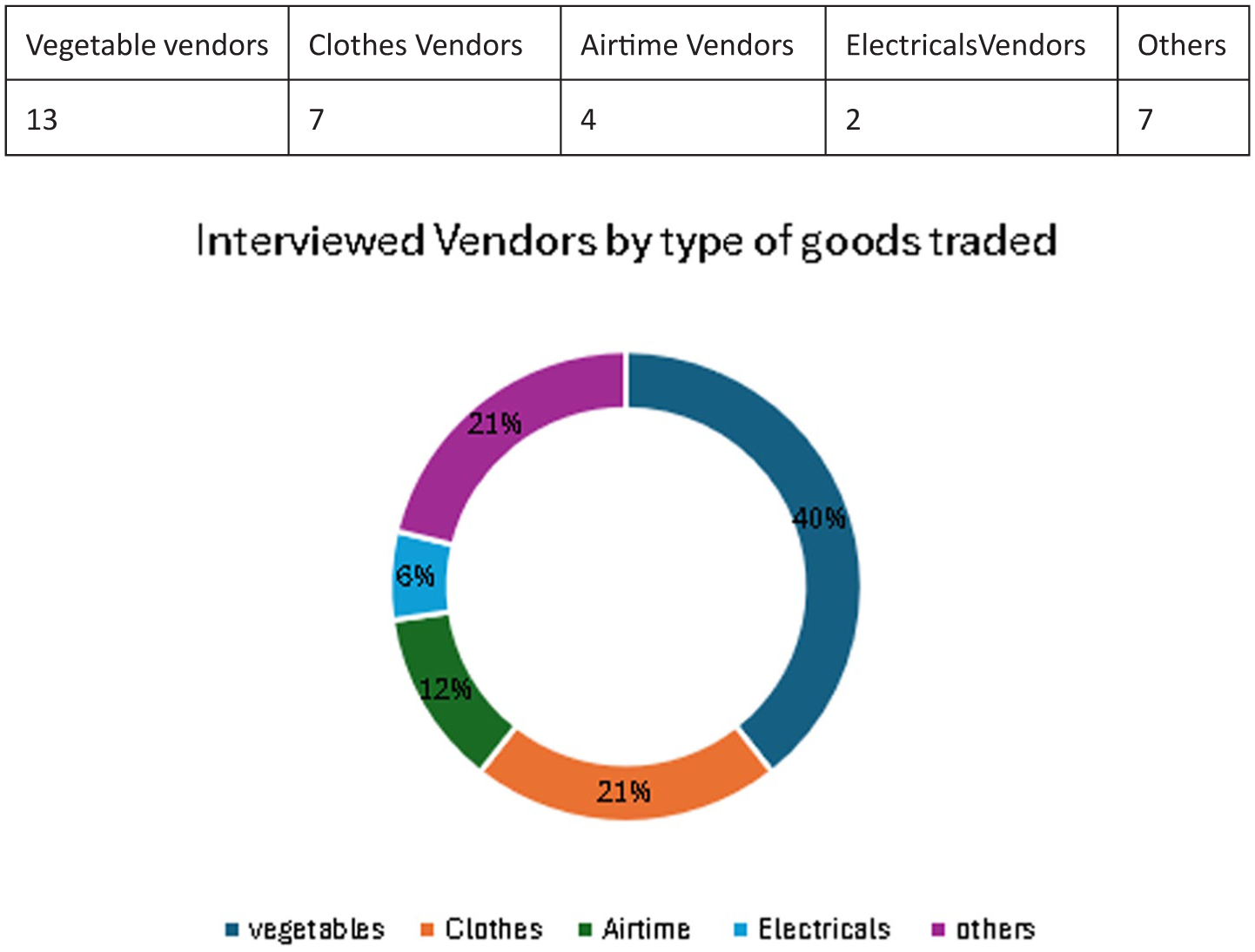
Vendors by products sold.
The article’s prioritisation of women vendors is also methodologically apt, as women constitute a substantial proportion of street vendors in Bulawayo’s CBD. Centring on women’s narratives contributes to historical recovery of marginalised agency, consistent with gender-attentive qualitative inquiry (Manamere, 2025; Skinner, 2009). The relatively small sample size (33) is justified for narrative inquiry because the analytic aim is depth, not statistical representativeness (Bell, 2002; Creswell, 2013; Morse, 2000). Morse (2000) supports a small number of qualitative designs where the goal is saturated interpretation rather than frequency estimation. Morse (2000) recommends at least six interviewees for narrative inquiry studies. A small sample size facilitated sinking teeth deeper into the narratives collected.
To mitigate the weakness of snowball sampling, such as network homophily, selection bias, and the possibility that highly connected vendors are over-represented, the research recruited multiple seeds across different commodity types (vegetables, clothing, airtime, etc.) and across different segments of 5th Avenue. Triangulating narratives with sustained observation and contemporaneous newspaper records, and using longitudinal return visits to check consistency in accounts, helped to address weaknesses. These strategies did not solve non-probability bias, but they produced a historically rich, analytically robust account of survival tactics in contested spaces, which was precisely the article’s objective.
The case study research focuses on 5th Avenue, in Bulawayo only, even though a few references are taken from vendors’ experiences elsewhere in Bulawayo. The research area is the CBD, whose streets are named from 1st Avenue, to the extreme northern side of the CBD to 15th Avenue on the other shore of the city centre. Importantly, 5th Avenue lies at the heart of the CBD, which is bisected by 7th Avenue, also known as Leopold Takawira. The accompanying Map 1 delineates the precise geographical scope of this investigation, highlighting the critical nexus where informal economic activities intersect with urban planning and regulatory frameworks.
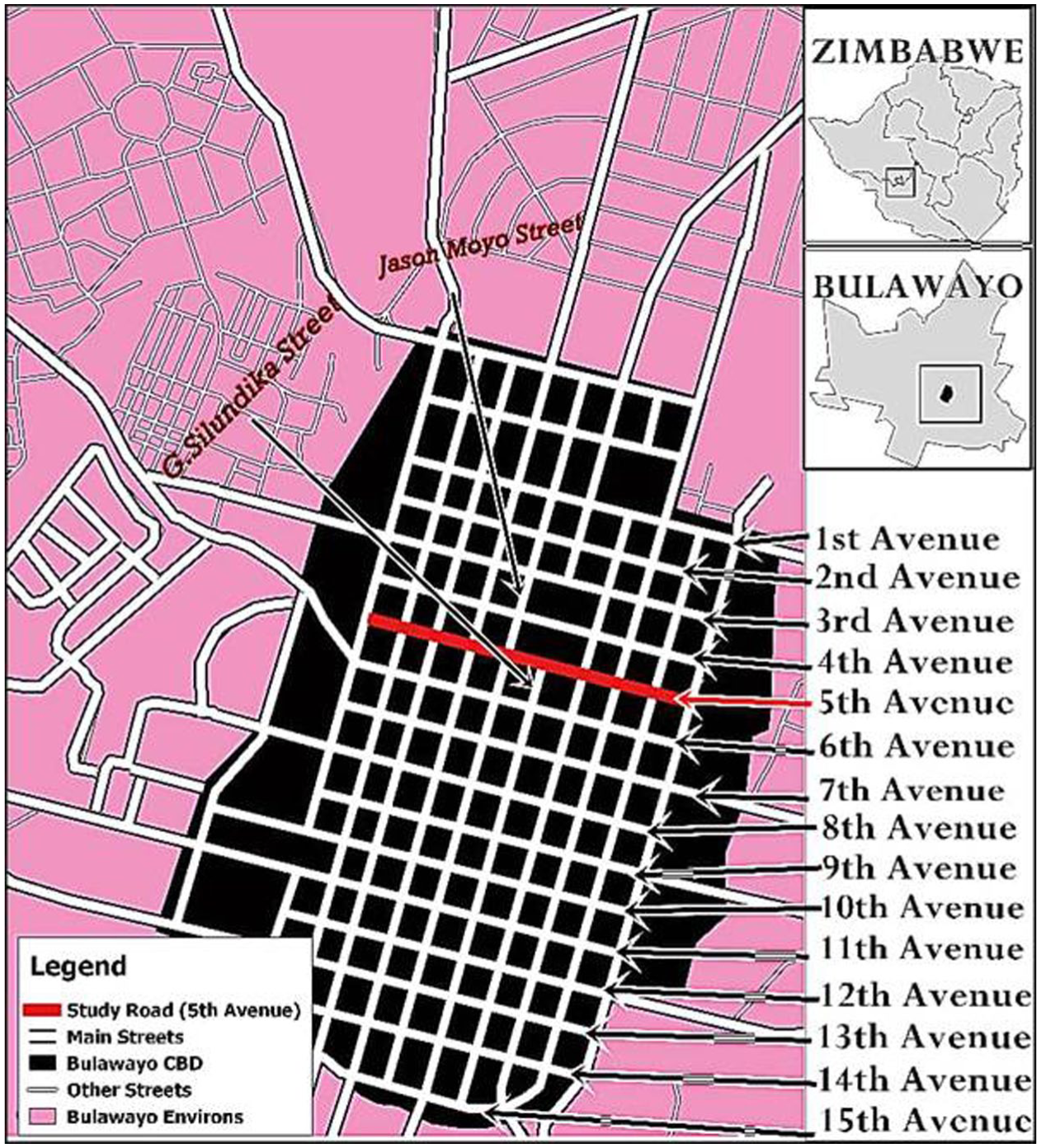
Location of 5th Avenue in Bulawayo CBD.
Vendors are highly concentrated between Robert Mugabe and Herbert Chitepo streets. Joshua Nkomo street bisects the main vendor activities along 5th Avenue; to the south are mainly fruits and vegetables and to the north, clothes. Vendors spread their stock on the ground, in the middle of the road, covering approximately one lane and all parking space on both sides of the road. This leaves just a small way at the centre of 5th Avenue.
Map 2 shows the distribution of vendors along 5th Avenue. It depicts the numerical density of vendors along the street.
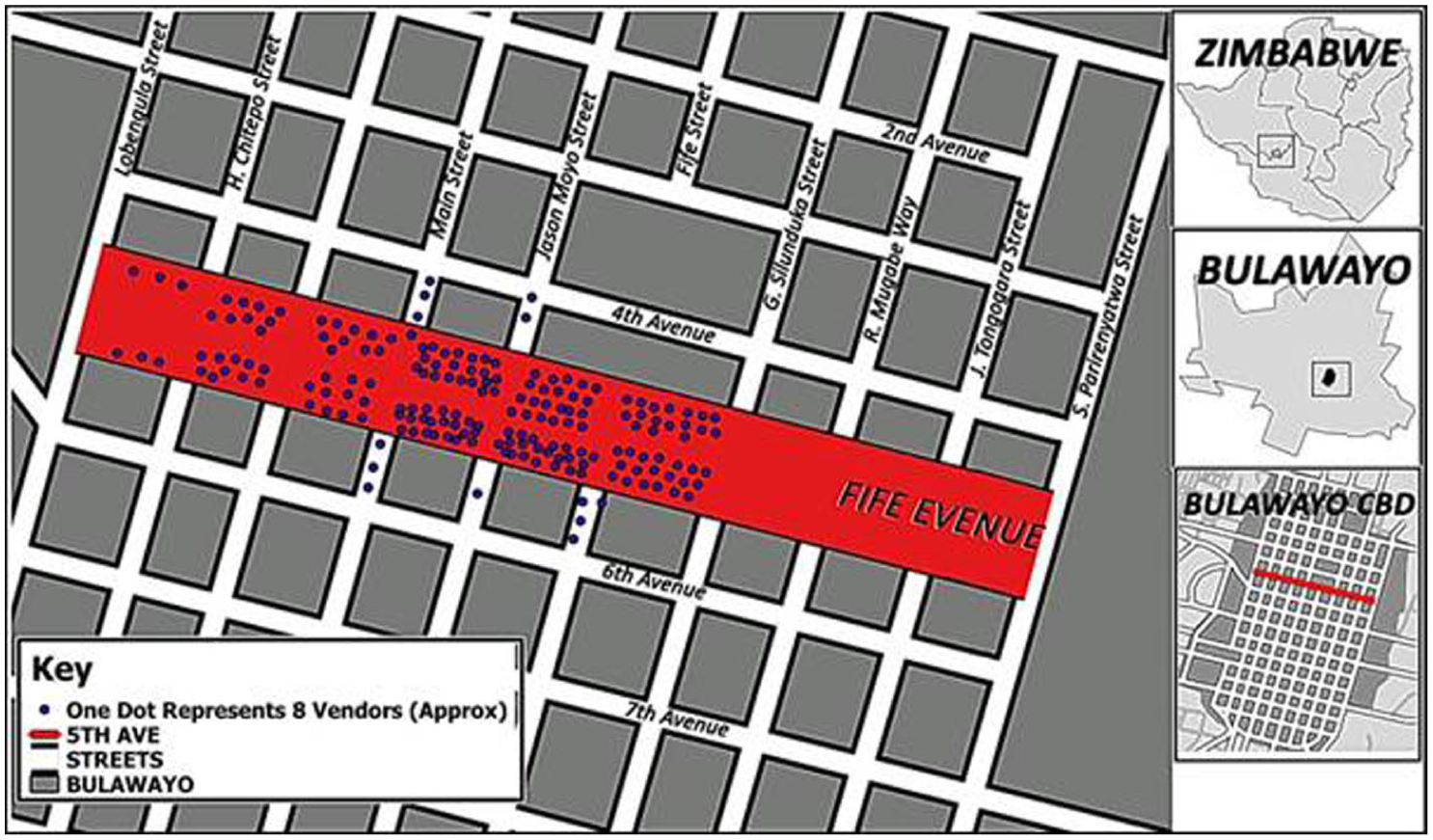
Map 2 showing vendor distribution along 5th Avenue.
As shown in Map 2, 5th Avenue is crowded by vendors operating from bays. It is also congested by crowds of buyers, mobile vendors, pushcart vendors, and other individuals roaming these spaces for a living. In these spaces, fertile for exploration, ordinarily the busiest in Bulawayo, this article is centralised.
Figure 2 shows the various age categories of women who were interviewed. The graph shows that most of the vendors are aged between 26 and 40 years. This group, as shown in Figure 3, is mainly comprising single mothers and divorced women who run their own families. However, prevalent also are married women whose husbands either fail to find employment or are paid very little.
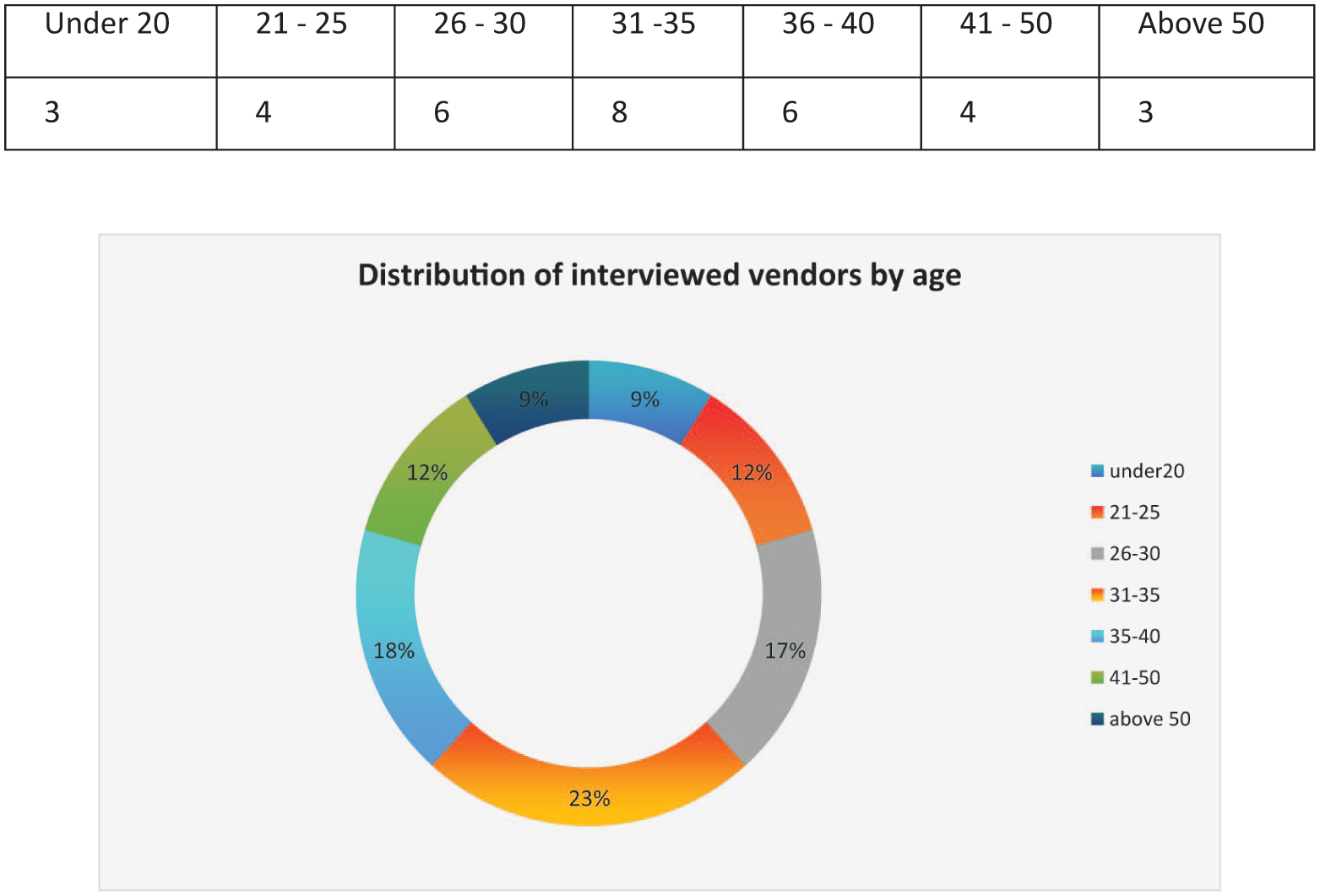
Distribution of interviewed vendors by age.
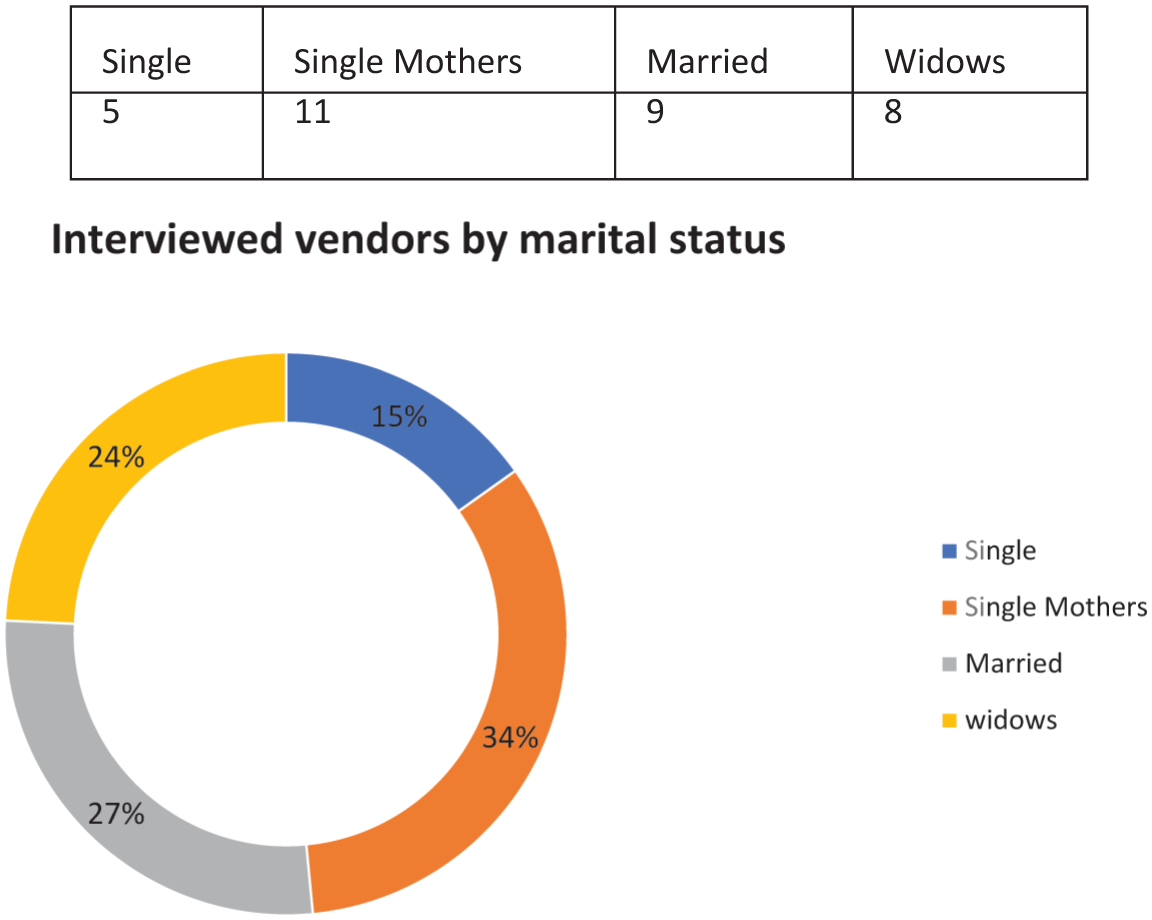
Interviewed vendors by marital status.
Where pictures were taken, consent was sought from people who were captured, as the author clearly stated that the pictures were used for academic purposes only. Interviewed people also gave consent for the use of their actual names, but some preferred the use of “Na,” a Ndebele prefix for “mother of . . . .”
Vendors for ED as a weapon for spatial claim
Vendor main strategy of survival after 2017 was aligning themselves with the ruling party, ZANU, which was also eager to get a partner to frustrate an opposition-led council in Bulawayo. Vendors were aware that they were recognised if they tightly attached themselves to ruling party structures. 5th Avenue vendors confirm Fox and Bell’s (2016) view that informal settlements tend to support incumbent regimes. From 2022, BCC intensified operations to remove vendors from 5th Avenue. On the other hand, ZANU started to intensify campaigning for the 2023 harmonised elections. Coincidentally, both ZANU and vendors needed each other at the same time; ZANU in an effort to increase its support base, and vendors as a tactic to survive spatial conflict with the council. Between 2022 and August 2023, 87% of the interviewed 5th Avenue vendors joined ZANU. By March 2025, Awande Nkomo claimed that “every vendor along 5th Avenue is a ZANU card holder.” 5 Some began to filter into ZANU structures and exercise relative power in deciding spatial claims.
In the period towards the August 2023 election, Zimbabwe saw the eruption of many informal groups pledging support to President Emerson Dambudzo Mnangagwa, colloquially referred to as ED, guising it for Economic Development. Whereas ED was obscured to mean Economic Development, it was commonly clear that it was covering up for Emerson Dambudzo. The era witnessed the emergence of groups such as Youths for ED, Teachers for ED, Doctors for ED, Lecturers for ED, Young Women for ED, Mahwindi (touts) for ED, and even Mahure (prostitutes) for ED. 6 Most of these groups used support for Mnangagwa as capital for engaging in many informalities, knowing well that the police would not challenge their actions. In Bulawayo, this saw the inauguration of Vendors for ED on 5 December 2022. Vendors for ED, launched as the Bulawayo Chapter, was ritualised through protesting against the council, which they accused for confiscating vendor stock and victimising them in the CBD. Multitudes of vendors gathered at the Large City Hall, chanting ZANU slogans (see Picture 1).
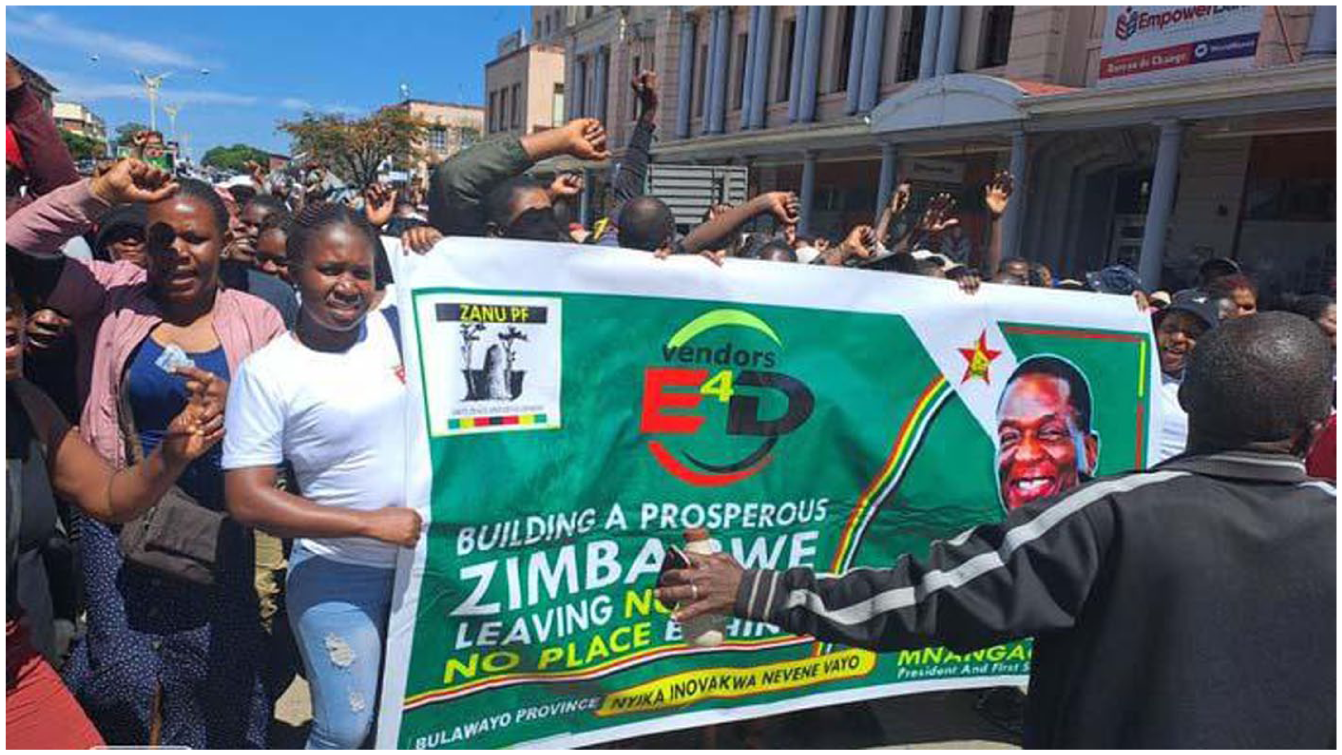
Picture taken from CITE, 29 September 2023.
Whereas before 2022, the council executed raids with ZRP; after December 2022, the ZRP withdrew from the scene. They neither arrested vendors nor condemned their activities. Vendors targeted the opposition run council arguing that it targeted vendors for supporting ZANU. Council was schemed as sabotaging the ZANU 2023 election campaigns. Vendors for ED became the banner for 5th Avenue vendors, who resisted working in council allocated bays. Through Vendors for ED, they even claimed vending space at any corner of town they wished to demarcate. The Patron for Vendors for ED in Bulawayo was Tendai Charuka, a member of ZANU who contested for a parliamentary seat in Bulawayo Central (which includes the CBD).
7
At its launch, Vendors for ED National Chair, Samora Chisvo complained that The main issue here is claims of victimisation by council officials. This is not a new thing across the nation, and we seek to have it addressed. This has to stop. Vendors are economic drivers in this nation. Once their goods are confiscated, the council often auctions the goods, or in some instances share among themselves. This is a bad practice, and it has to stop . . . The chapter will not allow vendors to be moved from their places of vending. We will never allow anyone to discriminate and disrupt your business.
8
Claiming that council raids had to stop and that vendors should not be moved from their spaces was a challenge of council power over space. According to Devlin and Piazzoni (2023: 112–113), “othering vendors was based on ability to pay for owning space, or politically legislate to own it. Oppression of vendors goes hand in hand with attempts to normalise ideas of who the ‘worthy’ residence of a city are.” In Bulawayo, vendors were othered by the council as undeserving of CBD spatial claims. Bulawayo vendors resisted city spatialisation which perpetuated vendor marginality. They resisted council spatial claims based on ability to legislate urban space ownership.
The council, however, continued to raid vendors, confiscating their stuff. On 16 December 2022, the Bulawayo Chapter of Vendors for ED, demonstrated against the council with riot police standing at a distance. 9 They presented a petition to BCC Corporate Communication manager, Nosisa Mpofu, denouncing council police violence. The Chair of Vendors for ED, Bulawayo Chapter, Sawu Jere, claimed that “municipal police confiscate our wares everyday without accounting for those goods. We have given council an ultimatum to stop seizing our goods until they respond to our concerns.” 10 Vendors, however, did not specify what the source of their power was and what the consequences would be if the council continued with raids. Yet it was clear that battle lines were being drawn between the two over urban spaces. Tucker and Devlin (2021: 460) have argued that by claiming streets as sites of work, vendors come into direct contestation with urbanists as “vendors challenge dominant notions of global mechanisms which conceive of sidewalks (and roads such as 5th Avenue) as sites of circulation rather than livelihood.” Vendors of 5th Avenue claimed the street based on Economic Development (ED) and not legal compliance. Essential also is the fact that vendor marginality (inability to pay for space or legislate it), was viewed by vendors as weak basis for denying them claims over 5th Avenue. Contrariwise, vendors used marginality to claim their desperate need for space. They claimed that the council “does not have power over us because it is culpable for our poverty.” 11
Surviving the council, falling into ZANU: Vendor spatial struggles in 5th Avenue
Vendor support of president ED towards the 2023 elections ascertained their indispensability as an urban support weaving machine. Space was also guaranteed in 5th Avenue through support. Vendors participated at various political functions in the region. Vendors featured during independence day, heroes day, youth day, and when top ZANU leadership visited Bulawayo. During the run-up to the elections, vendors were bused to various events such as the Binga rally in March 2022. Three buses parked along 5th Avenue, at the 5th Avenue, and J Silundika junction. The buses were loaded with vendors and left for the Binga rally. 5th Avenue vendors were also bused to the airport when the president came to Bulawayo rallies and business. They proved to be a readily available support base exploitable to present the optics of presidential popularity. Towards the 2023 elections, 5th Avenue was always “shut down” when the president visited Bulawayo or when there was a ZANU rally in the city. ZANU had a rally on 4 March 2022 in Old Pumula, a high-density suburb to the west of Bulawayo, addressed by Vice-President Constantino Chiwenga. On 3 March, vendors were assembled at the 5th Avenue and George Silindika junction. Vendors were instructed to close “shops” to attend the rally. 12 They were provided with party regalia, including bandannas and flags. The next day, vendors were bused to the rally. Another rally was held on 2 August 2023 in Cowdray Park. It was dubbed star rally and was addressed by President Mnangagwa. On this day, vending along 5th Avenue was shut down for vendors to attend the rally. 13 NaThandie claimed that “our main duty was to whistle and ululate in support of ED.” Like during Mussolini’s reign a century earlier, vendors acted as an “applause squad,” whipping enthusiastic support for ED’s speeches (Todd, 2002: 132). Some vendors were even strategically planted to prompt applause.
The same trend continued after the 2023 elections. In February 2025, during the 21st Movement, a youth holiday set aside on 21 February (commemorated on former President Robert Mugabe’s birthday), ZANU held a conference at the Bulawayo Trade Fair grounds. 14 Delegates from all over Zimbabwe attended. On 20 February, vendors were invited to a meeting at the junction of 5th Avenue and George Silundika. They were instructed to “close” during the presidential visit in order to go to the airport to “receive” ED. On the 21st, buses parked along 5th Avenue, loading vendors to the airport and back to the Trade Fair for his address. Vendors ululated and clapped in support of everything ED said, which presented a veneer of popular support to ED at a time he was believed to be facing a faction in ZANU which wanted him to step down. ZANU reciprocated this support by challenging the Bulawayo city council’s efforts to despatialise vendors along 5th Avenue, a task it did not detest, since ZANU sought to present opposition unpopularity in the city. This suggests that vendors and ZANU were in conviviality along 5th Avenue, using each other for survival.
These vendor-ZANU linkages were essential to ZANU because they portrayed it as a popular party, thus dispelling opposition sentiments that its support base was mainly rural and that it rigged elections. ZANU therefore drew on vendor support in order to gain a facade of likability. However, the same connections assisted vendors in gaining spatial claims along 5th Avenue. Whenever council intended to raid vendors, they presented themselves as bedfellows with ZANU, coming to work in ZANU regalia, with ZANU flags. That instilled fear on council officials. The council knew that ZANU was following events along 5th Avenue with keen interest in order to manipulate any fault for political gain to control the city. Council was also aware that when vendors dressed in ZANU regalia, the big hand of the illiberal state would be behind, and it left vendors alone. As ZANU used vendors of 5th Avenue to preclude the power of the opposition in Bulawayo, vendors knew that spatial claims and vending had an explicit connectedness to the ZANU umbilical code, which ensured their indispensability. Membership with ZANU was therefore instrumentalised to cement spatial claims.
Of the 33 interviewed vendor women, only 2 stated that they secretly belonged to opposition politics. All vendors who claimed ZANU membership agreed that they attended most of ZANU rallies in Bulawayo; 14 stated that they attended rallies outside Matabeleland. According to Sindisiwe, “attending is important because once these “big boys” (ZANU senior officials) know you, then your spatial claims will be sealed.” Sinikiwe, who sells indigenous fruits such as nyii, masau, and matamba close to Jason Moyo street along 5th Avenue, admitted that having spatial claim actually depended on luck but that vendor luck rapidly increased when one was in ZANU. To lubricate this luck, Sinikiwe claimed that most young women slept with ZANU leaders.
To fulfil its side, ZANU also gave vendors extra enchanting goodies. On 7 November 2022, hundreds of ZANU-linked vendors were allocated maize seed and fertilisers at the Hartsfield Rugby Stadium. These inputs were meant to be given to farmers in Matabeleland, but were redirected to urban vendors, most of whom went on to sell the inputs to farmers. On 9 December 2022, 76 vendors were allocated between 20 and 100 chicks by ZANU at Belleview Spar. These were ZANU tactics of drawing vendor support essential for urban ZANU optics. With these extra offers, ZANU solicited vendors’ support for the 2023 elections. When 5th Avenue became a spatial war-zone between vendors and council, vendors benefitted from the chaos as they continued to work unchecked and unregulated because the council feared vendor marriage with ZANU. See Picture 2, which shows the nature of the street on a less busy rainy day.
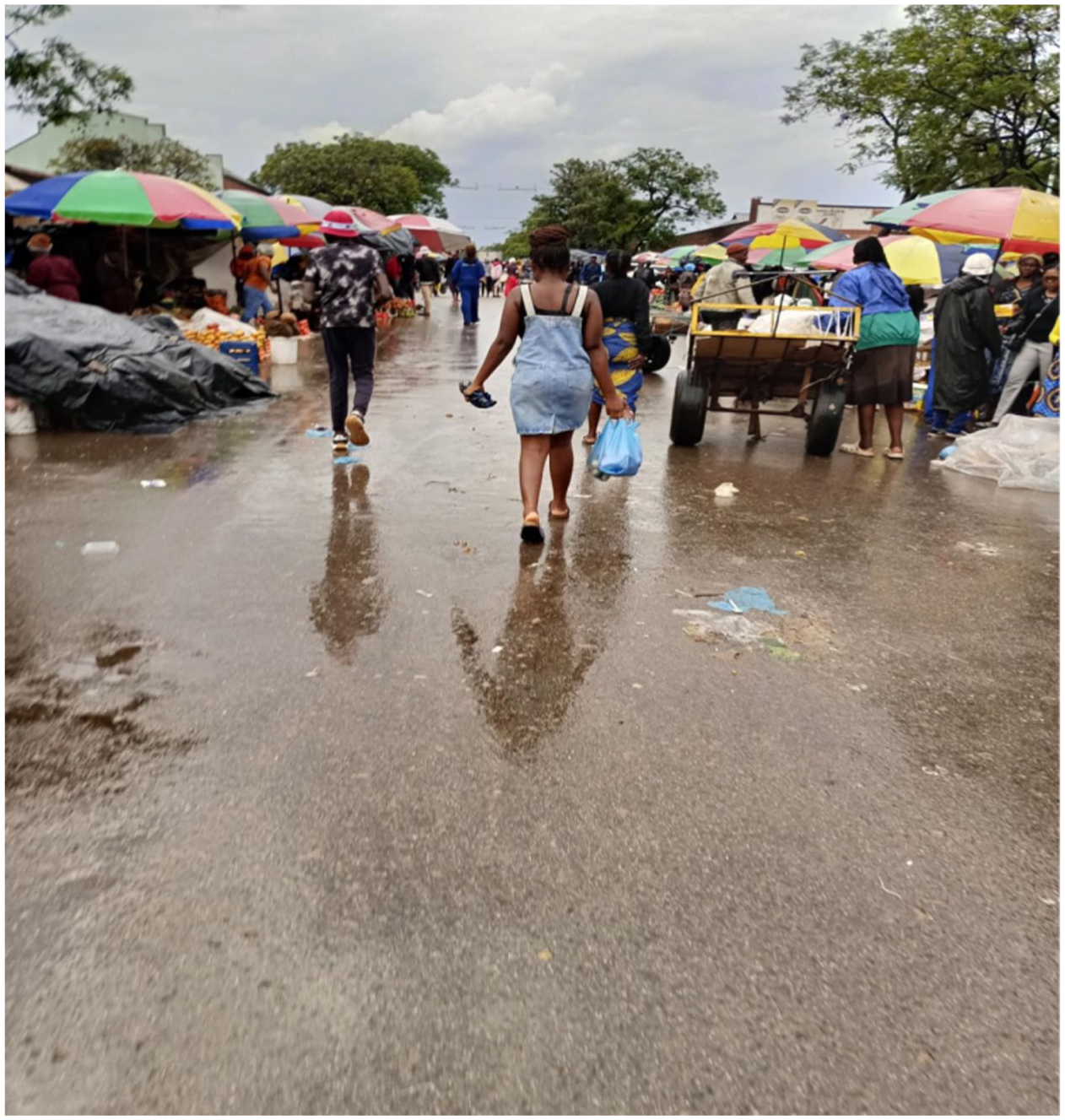
Business along 5th Avenue on a rainy day, 11 November 2025. Photograph by the author.
But surviving the council paradoxically exposed vendors to their ZANU purported protectors. Vendors narrate that ZANU leadership demanded unreasonable bribes, sometimes as much as US$600, in order to allocate them working bays. Magrette Ndlovu claimed that ZANU Chair for Nehanda, Josiah Mutangi, and other ZANU officials “used disorder to sell bays to vendors.” Soon after the August 2023 elections, Vendors for ED, Bulawayo Chapter Chair, Sawu Jere, in a letter addressed to Bulawayo ZANU Chairman, Jabulani Sibanda, accused Mutangi of “shady dealings with vendors which might have angered them not to vote for ZANU.” He claimed that Mutangi “lied to vendors that they pay him US$15 to US$30 for loans (ZANU was issuing small to medium business loans) but the vendors” never got the loans. Vendors also claimed that “Mutangi lied about the Chimoio trip, (as) vendors were charged US$3” to go on a trip that never occurred. Chimoio was a ZANU liberation war training camp in Mozambique. It was bombarded by the Rhodesians on 23 November 1977 under Operation Dingo (Miles-Tendi, 2020; Wood, 2011). A trip to Chimoio was embraced by vendors who viewed it as embalming their deep connectedness to ZANU, which was vital capital for spatial indispensability. The Cross Border Association had organised a similar trip, which assisted them in gaining traction with ZANU. Mutangi, however, got fingered for soliciting money from vendors using a “fake trip” he had not organised. Mutangi was also accused of asking for US$2/3 fabricating that ZANU leaders were going to visit 5th Avenue. NaBlessing claimed that “whenever Mutangi got broke or wanted money for a braai, he would walk along 5th Avenue with a story in order to get money.” Vendors accused him of collecting US$1 per vendor, as funeral money for a deceased vendor, NaGugu, which he never gave to gogo (grandmother) kaGugu, the deceased’s mother. In an interview with NaThandie, she accused Mutangi of “coming to us and lying that he will give us bays if we paid US$200–300 per vendor. Many people were conned by that man.” Thus, whereas vendors survived the council using ZANU, they got themselves exposed to unscrupulous ZANU leaders, who were hustling for survival along the street.
These 5th Avenue accusations between the vendors and ZANU suggest a number of multifaceted issues. First, vendors had access to provincial ZANU offices. This means that they had proximity to decision-making ruling party officials, which they used to resist marginalisation. Second, they show how much ZANU was now active on 5th Avenue by 2023, making the street pregnant with inter- and intra-party spatial conflicts. Vendors used the street to attract ZANU support against council but ironically fell prey to ZANU. Accusations also show that vendors operated in spaces of extreme marginality, always having to negotiate with powerful forces for spatial survival. That was captured by gogo kaGugu’s articulation that “we are sitting here like lizard, we must survive.” Lizard, in this articulation, denotes a state of being extremely poor, struggling for survival. Contrariwise, lizarding to the Ndebele also connotes the ability to adapt to tough contours of vendor circumstances while negotiating everyday livelihoods. These 5th Avenue lizard, articulate adjustment and resilience. By the end of 2023, 5th Avenue lizards had reconstructed their worth in Bulawayo, managing to punch way above their weight through sneaking themselves into ZANU structures. They were also able to use ZANU to fight ZANU.
Vendor articulations suggest that most members dislike ZANU, but that does not mean they do not vote for it. They vote for it because, as they narrated, they share with ZANU leadership, the fears of what would happen should the opposition win national election. Thandiswa Moyo claimed that the opposition would perpetuate vendor misfortune by resorting to “order” in the city. One ZANU leader also claimed that he feared losing easily gotten wealth should opposition come to power. That negative cohesion makes ZANU and vendors partners against opposition. Vendors are not always uncritical of ZANU but they view it as the best weapon in negotiating for urban space. Thus, vendor alignment with ZANU is anchored on conditional engagement, mirroring circumstantial loyalty, pivoting on their spatial existential threats and politics of street survival. This turns 5th Avenue into geographies of careful pragmatic manoeuvring, which underscores the complexities of vendor support for ZANU, which vendors clearly show to be far from affective but contingent. The conditionality of support does not mean that they do not vote for ZANU, but rather explains why they vote for it. Above all, this affords vendors a layer for spatial claims based on conviviality with ZANU, regardless of the expense of partisanship.
This is more than the hand of vendors: Council–vendor struggles over space
During the 3368th full BCC meeting held on 2 March 2023, the council decided to descend on vendors after recommendations brought forward by the local authority’s environmental committee. 15 Council police began ambushing 5th Avenue vendors, collecting truckloads of their stock. Barely a week later, on 8 March, as the council police were trying to confiscate their stock along 5th Avenue, vendors pelted them with stones. The riot police did nothing but watch. 16 On 23 February 2023, council police had run battles with Vendors for ED in the CBD, which left some vendors and police bruised. Some council vehicles were damaged. Vendors converged at the Large City Hall where they were addressed by ZANU’s Nehanda District chairperson Josiah Mutangi, who encouraged vendors to “defy orders by the police and council officers and go back to their illegal operating spaces.” 17 Mayor Solomon Mguni, who was from the opposition party, was left powerless as ZANU-backed vendors sought partisan support against despatialisation. Ward 9 councillor, Donaldson Mabutho, claimed that the situation prevailing along 5th Avenue had become political and therefore also needed a political settlement. He advised that council should engage ZANU’s Bulawayo Chairperson Jabulani Sibanda, who was former national chairperson of the Zimbabwe Liberation War Veterans’ Association. 18 The council viewed vendors as “out of place urban elements,” having no spatial claims (see Skinner, 2008, Takabvirwa, 2023, Yatmo, 2008). In New York, zero tolerance of street vending has been described by Devlin (2018) as “regulation fiction” which led to friction. In Bulawayo, vendors stuck to ED and the council gradually found itself disempowered to remove them from 5th Avenue.
There was another layer muddying 5th Avenue spatial contestations. Corrupt council individuals also found a gap in 5th Avenue for vulturing on vendors. NaThandie narrated that In the council, Bango deceived many, asking for money to allocate them bays along 5th Avenue. He now owns more than 6 bays which he leases to vendors at a monthly rental. We are caught up in between these people (ZANU and council) who make money using us.
19
Gogo KaGugu noted that some vendors with access to council police collected US$1 a day from vendors, which was “protection fees” to avoid being raided. “We do not even know where this money goes. We are seating here like lizards, yet others are making money out of us,” she remarked. 20 Vendors viewed themselves as lizards, besieged survivors, with ZANU and corrupt council individuals claiming power, all using 5th Avenue for enriching themselves. Contrariwise, in all this, vendors have shown resilience and ability to survive, employing orthodox and unorthodox means.
From January 2024, there were more council threats against vendors than actual raids. The council had also been reduced to lizards of 5th Avenue. They were lizards first because their presence in 5th Avenue was motivated by a deep financial need to sell parking space, which vendors refused to surrender. Second, council craved power to control, demarcate, and sell space along 5th Avenue. That further reduced the council to space hustlers. However, vendors curtailed council power. Finally, some council officials, like those from ZANU, were implicated in soliciting bribes from vendors. These came into 5th Avenue, lizarding for survival, through deceiving poor vendors into believing that, without bribes, their spatial claims were at stake. Thus, by 2024, three groups of metaphoric lizards converged in 5th Avenue. Their lizarding methods and status were not homogeneous. They cannot be viewed to have been struggling at the same level. But that does not reduce them to being lizards anyway. Because vendors realised that those who threatened them were also lizards, by 2024 they were leaving their produce on the road overnight, heaped right at the middle of the road. They were confident that no one would take their stock.
The council had to employ other methods to displace 5th Avenue vendors. From Tuesday, 20 February 2024, vendors were persuaded to leave 5th Avenue as council embarked on tree-cutting, which they viewed as dangerous to the public.
21
On 22 February 2024, using advert No.12497, BCC closed 5th Avenue from Lobengula to Parirenyatwa, for “reconstruction, resurfacing, reinstating of carriageway markings and other general maintenance cyclical works.”
22
One vendor, Mary, recalled that “these were tough time like during COVID-19. We were not working but we woke up and came to check on resurfacing work progress. We spend the whole day sitting on the sides of the roads like lizards, watching graders.”
23
Some spend the whole day sleeping hoping that reconstruction work would get finished and they would start vending again. Mary’s articulation that they spent the whole day seating and sleeping on road sides like lizards narrates sentimentalities of vendor marginality. Vendors viewed road resurfacing as disillusionment of development. Vendors were evicted, the trees along the street were cut, and the road was resurfaced, with that process taking months to complete. The vendors claimed that the council lied that tree-cutting machines broke down delaying completion. One of the vendors on 5th Avenue, NaThandie bewailed that They (council) cut down all the big trees so slowly that they showed that it was a strategy to chase us away from our bays. And how do you cut down trees that were giving us shade during the hot season? These people view us as lizards of 5th Avenue, who must be exposed to all kinds of weather. No one cares about us. They do not bother. But we are not going anywhere.
24
BCC did not cut down all the big trees even though most along this road were cut. To vendors, most of the trees were cut along 5th Avenue than along any other road. To vendors, cutting down trees and resurfacing the road was a method to marginalise them, using development as a front. They articulated that this was motivated by the authorities viewing them as lizards of 5th Avenue, who did not need shade from trees and protection from the sun and rain. Lizarding, to vendors, is an articulation of peripherisation along 5th Avenue. In Kitwe city, Zambia, authorities intended to give a piece of land to some Chinese to build a shopping mall, thus affecting the trading spot for some street vendors in the area (Jongh, 2021). In Maseru, authorities protected the Post Office Bank space ahead of vendors who traded outside it (Matamanda et al., 2023). In Bulawayo, vendors claimed that authorities, who saw that they had aligned themselves with ZANU, as a defence tactic against marginality, used tree cutting and road construction as a method to marginalise them. Vendors were lizarded by being left to bask in the sun, as they waited for the council to finish its work. But they were also proverbial lizards because they were survivors of situations seeking to despatialise them from their “shops.”
Council only reopened 5th Avenue at the end of March 2024, after more than a month of vendor impoverishment. 25 The road, which had been viewed for years as an area of informality, was officialised as a vendor street; 500 bays were demarcated on the right side of the street as one faces the northern end of the city. 26 The other road space was marked for vehicular driveway and car parking. Many vendors were left without working spaces. The council hoped to allocate them on the northern downtown end of 5th Avenue, known as Bhaktas, which vendors resented. 27 Despatialised vendors held several meetings at the ZANU Bulawayo office and several other venues to discuss the way forward. Finally, they demarcated space for themselves on the other side of 5th Avenue where the council had marked vehicular parking bays. After running skirmishes with council police for a few months, including on 2 May 2024, the council saw that it would hardly win against vendors, whose source of power was ZANU. The council finally marked more bays on the left side for vending, erasing parking bays. But many vendors still failed to get bays after the second allocations. They demarcated bays anywhere they so wished along the Avenue. This left only a small strip at the centre of the road, for people and vehicular passage (see Picture 3 of the road now fully controlled by vendors).
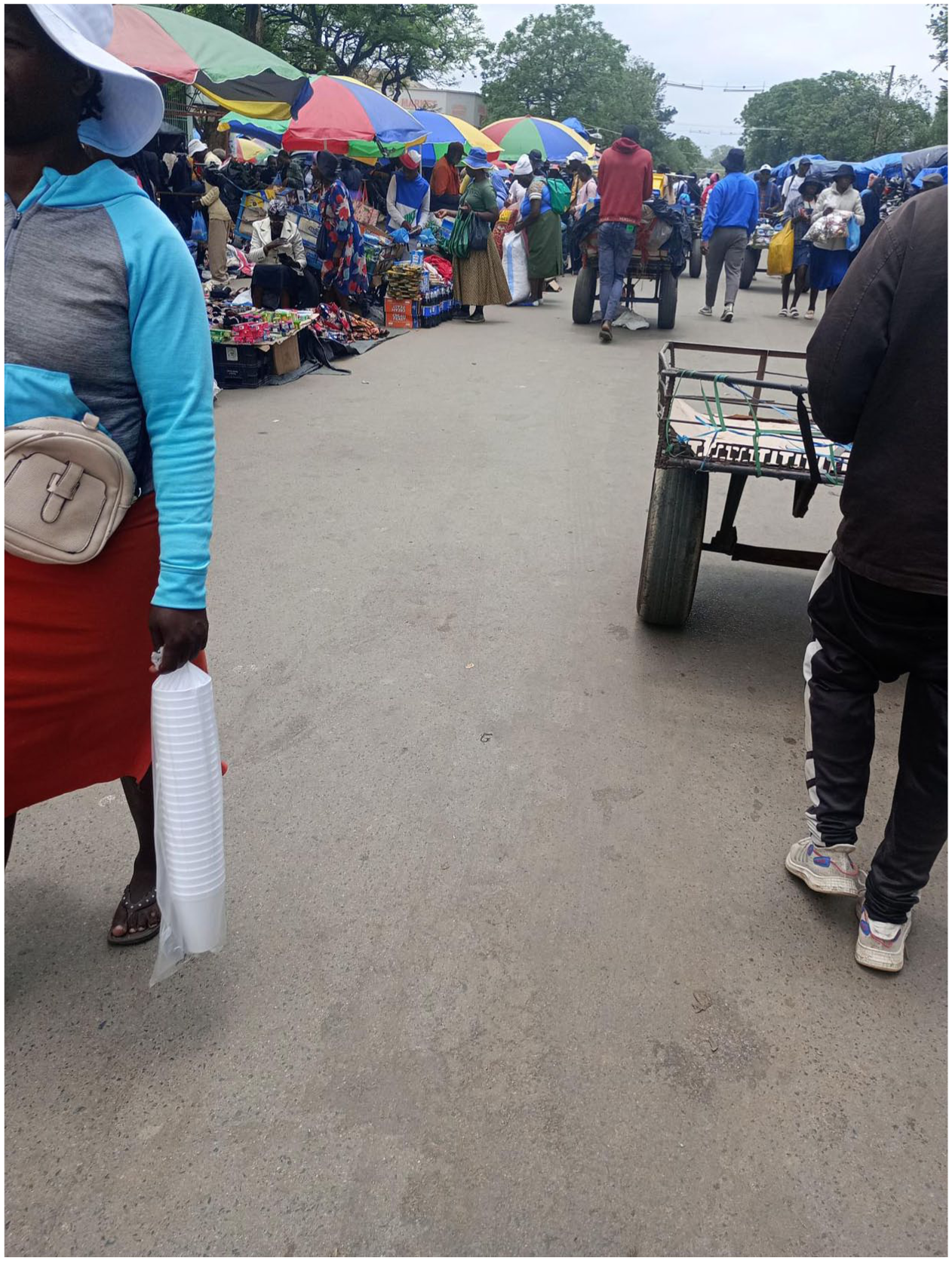
5th Avenue showing an afternoon business day; 14 November 2025. Picture taken by Author.
The council decided that vendors along 5th Avenue needed to be taught a lesson. On 27 June 2024, using council trucks, the BCC police raided vendors and loaded sacks of fruits, veggies, clothes, and pushcarts. 28 Vendors accused the police of “taking our produce for own use” but council said that they handed the produce over to the police at Drill Hall, a ZRP traffic section in Bulawayo. Nesisa Mpofu, Council Communication Manager noted that “3 officers suffered injuries and council vehicles were damaged. One council vehicle had its door window smashed.” Some vendors also sustained injuries. 29 On 16 December 2024, female vendors in Bulawayo engaged Women’s Coalition in Zimbabwe, a women pressure group, at a round table meeting discussing what vendors alleged to be harassment of women vendors in town. 30 Although vendors were still harassed in town beyond 2024, it was virtually impossible for the council to despatialise them from 5th Avenue. When council police tried to confiscate goods from 5th Avenue on 5 February 2025, they were faced by violent vendors chanting ZANU slogans. One vendor shouted in Shona, varovei, vanonetsa vanhu ivava vemablue, hameno kuti kuita blue kuita mupirisa here, varovei vanhu ivava (beat them, beat these people in blue. I do not know if they think wearing blue is being a real policeman (ZRP). Beat these people). In Zimbabwe, the ZRP, wear grey uniforms but the Bulawayo police wear blue. Mocking the council police by demeaning their uniforms portrays how vendors had gained power to face the council. These were not empty threats of the weak. Vendors had backing from ZANU, which they used to challenge council police and mock them shouting varovei (beat them). This was an antidote to what was done during Murambatsvina when vendors were referred to as “dirt of the city” (Musoni, 2010). With the support of an illiberal state, against council neoliberal spatial claims, vendors could in 2025 successfully challenge council powers, thereby lizarding the council.
On 8 February 2025, The Sunday News reported that BCC “have again resolved to close the entire Fifth Avenue vegetable trading market site and have the road reserved only for vehicular traffic in an effort to enhance urban planning, bolster safety and foster sustainable business growth.” 31 On 19 March 2025, The Sunday Mail reported that the council gave another warning that they were going to close 5th Avenue. 32 All vendors along the street were expected to be moved to Bhaktas, which they did not agree to. In an interview with Mary, she swore that “I will rather die fighting than go to Bhaktas. I will better be a ZANU supporter than be abused by this opposition infested council.” Vendors were therefore ready to use ZANU to remain on 5th Avenue. The 2025 council threats were not executed. Vendors along 5th Avenue continued to use ZANU as a shield against eviction. The council also operated with caution against vendors knowing how these vendors used politics to backlash council power along 5th Avenue. To vendors, the council which failed to collect garbage, clean roads, spearhead development, and create employment, would insulate against vending. To them, the council was the one creating chaos in the city yet claiming to want to stop chaos by removing vendors. NaSbu articulated that the council was faking to be protagonistic prophets of smartness and neo-liberalism while it failed to collect garbage. To vendors, the council attempted to cast vending as corrosive to economic life (Takabvirwa, 2024: 394), yet vending reflected on how the economy had been corroded. Vending provided a type of trestle on which life could stand and continue, constantly being disassembled and reassembled, unmade but remaking itself in disallowing circumstances. Vendors claimed that they were unwanted by those who used colonial imaginaries around utility of urban space to hugely satisfy their optics of spatial beauty, thereby marginalising communities eking out a livelihood.
In 2025, council tried to intensify raids away from 5th Avenue. BCC recruited 173 new security forces to daily patrol vending hotspots and enforce “order.” On 27 February, they raided NaPee, plying close to Edgar’s shop near TM Hyper. When her stock was taken, she collapsed and died in hospital. 33 ZANU made no small noise about her death. The incident dislodged the council from the high ground of enforcing order in town. Vendors and ZANU accused council of causing NaPee’s death. At her funeral, the BCC was blasted by several speakers who accused the council for her death. 34 This helped in insulating 5th Avenue vendors from raids. Belonging to ZANU was a social resource for negotiating space and status as vendors were aware that ZANU had broad discretion to evict or leave them along 5th Avenue. Vendors aligned themselves with ZANU, which successfully gave them a lifeline in the post-2018 era.
Conclusion
The study’s contribution to urban discourse is thus threefold. First, it advances it by offering a grounded account of how post-2017 economic decline reshaped politics of space in Bulawayo. In doing that, the article shifts from arguments that ascribe agency to the powerful, to giving agency to women vendors whose power is drawn from careful conviviality with the ruling party. Second, it contributes to debates in African urban studies by demonstrating how informality is governed not only through by-laws and policing but also through partisan strategy and inter-institutional rivalry. Third, it contributes methodologically by showing how narrative inquiry and longitudinal ethnography can recover the everyday practices through which marginal actors remain spatially present in the face of recurrent erasure. The persistence of 5th Avenue vending is therefore not anomalous; it is a durable urban formation that will repeatedly reappear as long as the structural conditions driving informal survival remain unresolved. By working with the vendor-articulated metaphor of Lizards of 5th Avenue, the article contributes a street-generated conceptual vocabulary for interpreting everyday survival under conditions of spatial marginality, rather than treating vendors only through externally imposed theoretical frames. The metaphor captures not only exposure and vulnerability but also endurance, tactical patience, and the incremental accumulation of practices and competencies (“scales”) formed through repeated encounters with confiscation, raid cycles, and municipal despatialisation.
Empirically, the article extends scholarship on informality and contested urban governance by demonstrating that vendor survival in Bulawayo is structured by a three-cornered politics: vendors seek livelihood space, the opposition-led council seeks to govern and monetise city space through order and regulation, and the ruling party seeks urban political relevance. The analysis therefore reframes vendor politics away from simplistic binaries of resistance versus compliance. On 5th Avenue, survival is political, but it is not reducible to dissident opposition to the council. Rather, it is a pragmatic politics of endurance that exploits fractures between institutions. In that process, the article shows how vendors may convert marginality into leverage by aligning with powerful actors, even while that alignment remains conditional, ambivalent, and sometimes exploitative. It shows that Bulawayo’s 5th Avenue is not merely a site of livelihood but a condensed theatre of urban power in which space is continuously produced through conflict, negotiation, and tactical adaptation.
The article argues that between 2018 and 2025, ZANU was politically poor in Bulawayo. Stifled for relevance, ZANU came to 5th Avenue to hustle for political survival, and to struggle against marginality. Starved of urban political support, ZANU came into contingent conviviality with vendors who were socially and economically poor, as they both resisted council spatial authority. The council was reduced to metaphorical lizards of 5th Avenue, unable to regulate the street. 5th Avenue was therefore a zone of convergence for Bulawayo lizards, all finding methods of surviving the other. ZANU acts like it is empathising with vendors, but paradoxically, it is also lizarding. This does not equate ZANU’s political struggles in Bulawayo to those of vendors, but that the fact that their struggles were dissimilar does not also minimise ZANU’s lizarding in 5th Avenue. Although vendors are conceptualised as metaphorical lizards, ZANU is also viewed as a political lizard. Quintessentially, vendors are living on the periphery of city livelihoods. They are the “primary” lizards of 5th Avenue. Fanon (1963: 175) would have called them “individuals without an anchor, without a horizon, colourless, stateless, rootless—a race of angels.” Vendor articulations characterise themselves as in-succumbing lizards of 5th Avenue, “the wretched of the earth,” abandoned by the state (Fanon, 1963). They embalm their plight as ambivalent lizards, exposed to devious types of existential struggles in disallowed open spaces. The article argues that lizards of 5th Avenue broaden lens for understanding vendor everyday struggles against marginality and why and how they have survived spatial threats. Future studies could focus on male vendors who are increasingly prevalent in 5th Avenue, migrant vending, which is also getting common in Bulawayo, and the lived experiences of children of vendors along 5th Avenue.
Footnotes

Funding
The author received no financial support for the research, authorship, and/or publication of this article.
Declaration of conflicting interests
The author declared no potential conflicts of interest with respect to the research, authorship, and/or publication of this article.