






Abstract
Since the emergence of Islamic State of Iraq and Al-Sham (ISIS), the Women’s Protection Units (YPJ), a female unit of the People’s Protection Units (YPG), were accepted as an ally mainly for the United States, and to some extent, for Russia in fighting ISIS. This article analyses competition over representing YPJ within the framework of the “Self” and “Other” by Voice of America and Sputnik International as public diplomacy tools for the American and Russian governments. It examines news contents by coding statements that reflect these categories at the paragraph level. The article argues that political proximity is a key determinant in explaining international framing competition over YPJ in the context of “Self” and “Other” by those media outlets since it is associated with national interests and foreign policy priorities of the United States and Russia in Syria, particularly against ISIS. It further contends that Sputnik exhibits a perceived ideological proximity to the YPJ, shaping its framing and intensifying its competition with Voice of America due to ideological affinities between Russia and the YPJ-YPG.
Introduction
The Syrian civil war remains one of the most complex and unresolved conflicts in the world despite the collapse of the Baath regime on 8 December 2024 because of the multiplicity of competing actors. On the one hand, the regime and the opposition competed. On the other, states such as the United States and Russia have engaged in intense geopolitical competition (İpek, 2022: 343), shaped in part by Cold War-era policy priorities and practices (Saull, 2012: 60–61). In this regard, the United States, at least discursively, aligned itself with the official Syrian opposition (Philips, 2018: 75, 144) particularly by the emergence of Islamic State of Iraq and Al-Sham (ISIS), while Russia perceived the Assad regime as a main ally for the strategic importance of Syria in maintaining its strategic interests which started during the times of the Soviet Union (Kreutz, 2007). For instance, the Obama administration was reluctant to engage in the Syrian civil war in spite of the utilization of chemical weapons by the Assad regime against the civilians in 2013, which was defined as a redline for the United States for intervention by President Obama (Demir, 2025: 2). However, following the emergence of ISIS as a serious menace, the Obama administration abandoned the ambiguous policy of regime change in Syria and prioritized degrading and defeating ISIS (Yacoubian, 2017: 5). This shift signalled a more selective engagement in the conflict and a departure from its primarily discursive alignment with the official Syrian opposition and its military wing, the Free Syrian Army (FSA) (Demir, 2023a). Meanwhile, Russia began providing extensive air and ground support to the Assad regime from September 2015 onward, officially justified as counterterrorism against ISIS but effectively aimed at consolidating the regime’s position against the opposition (Freire and Heller, 2018: 1202). This intervention proved decisive in altering the dynamics of the war and strengthening the regime’s control over the country (Tabak, 2015).
Ultimately, both the United States and Russia sought to justify their either willing or unwilling intervention in the Syrian civil war for defeating ISIS by interacting with forces having the same purposes (Knights and Wilgenburg, 2021: 78; Freire and Heller, 2018: 1202). Despite their geopolitical rivalry and divergent policy priorities, both powers supported the military wings of the Democratic Union Party (PYD) – namely the YPG and YPJ – in their fight against ISIS, particularly following the siege of Kobane. These groups are affiliated with the Kurdistan Workers’ Party (PKK) in Türkiye and found opportunities to implement aspects of the PKK’s model of governance with the civil war (Demir, 2022: 161–162). Moreover, the YPJ emerged as a significant factor in shaping US cooperation with the YPG, serving as a discursive tool for legitimizing US foreign policy against ISIS (Demir, 2023b).
In addition, the YPJ became a prominent subject in international media coverage following their resistance to ISIS. This visibility aligns with a broader media tendency to portray women, mothers, children, and minorities as “ideal victims” (Gerbner, 1980; Hoijer, 2004; Moeller, 1999), a category into which the YPJ arguably fits, given their identity as women and members of a Syrian Kurdish minority group. At the same time, representations are shaped by cultural perceptions: in some contexts, violence against women is normalized and not necessarily framed through victimization. From a broader perspective, Syria’s location in the Middle East – a region historically constructed as the “Other” (Said, 1978) – further informs such representations. Within Western media narratives, ISIS is a brutal actor in thinking of having every right to assault women, and YPJ have been fighting this brutal organization. This contrast makes it analytically important to position both the YPJ and ISIS at the centre of inquiry. Recent studies suggest that Western media tend to construct two dominant images of women during the Syrian civil war as victims and heroes, depending on their relationship to ISIS. Women associated with ISIS’s brutality – such as Arab or Christian women, Yazidi women, and ISIS brides – are typically depicted as victims, whereas YPJ fighters are portrayed as heroic figures (Demir, 2023b: 152).
Finally, previous research highlights two key points. First, the positions of Voice of America (VOA) and Sputnik towards the YPJ and ISIS are largely shaped by the foreign policy orientations of the United States and Russia (Demir and Doğan, 2025). Second, both outlets portray YPJ women as culturally, ideologically, politically, and practically distinct from ISIS, positioning them closer to the West (Demir and Doğan, 2025: 4158). In this regard, approaching the representation of the YPJ through the framework of “Self” and “Other” within the context of international framing competition provides a useful lens for examining the political, cultural, and ideological rivalry between the United States and Russia, as well as the relative proximities and distances constructed by these state-sponsored media outlets vis-à-vis the YPJ and ISIS. Accordingly, this study investigates the competition between these media outlets over the representation of the YPJ through the lens of the “Self” and “Other” framework by addressing the following research questions:
The article proceeds as follows: The first section reviews debates on “Self” and “Other” in media studies. The next section outlines the theoretical framework of international framing competition through the lens of “Self” and “Other,” elaborating on the key concepts of political and cultural proximity and distance, as well as introducing the notions of ideological proximity and distance. The subsequent section details the methodology, followed by the presentation of the empirical findings. The article argues that political proximity is a key determinant in explaining the international framing competition over the YPJ in American and Russian media, as it is closely linked to the national interests and foreign policy priorities of the United States and Russia in Syria. However, it also contends that Sputnik demonstrates a degree of ideological proximity and sympathy towards the YPJ in its framing, thereby intensifying its competition with VOA.
Self and Other in media studies
The existing literature on the “Self” and “Other” dichotomy in media studies highlights how media representations construct collective identities, reinforce power hierarchies and reproduce ideological boundaries. Edward Said (1978) pioneered this critique by revealing how Western media framed the East as the exotic “Other,” legitimizing colonial hierarchies and narratives. Teun van Dijk (2008) further demonstrates how political elites and mass media construct “us versus them” dichotomy that legitimizes exclusionary policies. Markina (2020) expands on this by distinguishing between pathological forms of othering – such as depersonification, fragmentation, fetishization, exotization, pathologization, homogenization – and non-pathological alternatives, including the creation of positive or ambivalent stereotypes. Her work illustrates how the media can either extend or challenge entrenched narratives of difference. Likewise, Fürsich (2010) examines cultural implications of “Self” and “Other” dichotomy and argues that media outlets shape both the representation of marginalized groups and the broader cultural narratives constructed through these portrayals. Dvir-Gvirsman (2019) extends this analysis by focusing on ideological implications of media consumption, revealing how audiences’ political identities influence their preferences by media. This process not only solidifies the binary distinction between “Self” and “Other,” but also emphasizes the role of media in fostering ideological boundaries within a polarized society. Collectively, those frameworks highlight how representation practices reflect and reinforce socio-political boundaries.
Feminist media scholarship further contextualizes this binary within gendered power relations and traditional gender roles where media plays a crucial role in reinforcing gendered norms and stereotypes. Studies consistently emphasize that media often constructs masculinity (the idealized Self) as active, rational and dominant while femininity (the marginalized Other) is portrayed as passive, emotional and subordinate (Gill, 2007; Lloyd and Kay, 2021). Lloyd and Kay (2021), for instance, discuss how transnational media practices intersect with political contexts, arguing that media representations often transcend national boundaries yet continue to propagate gendered narratives that position women as “Other.” Similarly, Höijer (2004) highlights the infantilization of women in media narratives, where women are portrayed as innocent victims rather than agents. Zayer et al. (2012) examine popular media’s role in constructing gender identities through discourses of domesticity, authenticity and sexuality, revealing that media often portrays women in traditional gender roles, while men are depicted as autonomous and rational.
This binary has also shaped international media’s presentation of YPJ in fighting ISIS. Studies examine how YPJ are positioned within Western media narratives as “Self” in contrast to the demonized “Other,” represented by ISIS (Gunaydin, 2023; Şimşek and Jongerden, 2018). Toivanen and Baser (2016) show that while ISIS women are portrayed as brainwashed victims, YPJ women are celebrated as emancipated brave-heart heroines. In this context, the dominant narrative constructs YPJ’s bravery and heroism as markers of alliance with the West. Del Re (2015) argues that the heightened media attention on YPJ stemmed from the global fear of ISIS emphasizing that YPJ emerged as a central actor in the broader struggle against both ISIS and the Assad regime. Building on this, Demir and Doğan (2025) demonstrate how American and Russian media instrumentalized images of YPJ to legitimize their counter-ISIS strategies in Syria. By framing their involvement as a support for a progressive and feminist cause, both states sought to generate public approval and moral justification for their intervention. However, Toivanen and Baser (2016) note that in British and French media, such portrayals often shifted focus from ideological agency to physical appearance and personal background, thereby reproducing orientalist and gendered images within otherwise celebratory narratives.
Studies also frame YPJ as a symbol of female empowerment, emphasizing their role in contesting patriarchal structures and gender norms. Tank (2017), for instance, argues that the YPJ not only struggles with ISIS, but also challenges traditional norms and patriarchal structures. Similarly, Drummond et al. (2021) argue that YPJ plays a significant role in the insurgency, and its presence is noted for confronting normative gender expectations and reshaping the dynamics of the regional conflict. Şimşek and Jongerden (2018) expand this perspective by suggesting that militarization of Kurdish women serves as a means of challenging hegemonic gender roles and allowing for new conceptions of gender roles in the Middle East. Central to this ideological repositioning is the concept of Jineology – a feminist epistemology promoted by PKK that places women at the centre of social liberation. Dean (2019) and Düzgün (2016) emphasize that Jineology not only redefines gender roles, but also constructs YPJ as subjects of political agency and repositions them as empowered “Self” within regional and global narratives. This paper develops a new perspective with regard to the tendency of framing YPJ and conceptualizes the international framing competition between VOA and Sputnik International over YPJ through the lenses of “Self” and “Other” framework.
International framing competition through the self and other framework
While framing conflicts or civil wars, media tend to present events as a struggle between opposite sides, competing interests or a battle between “good” and “evil” (Paukovic and Rosko, 2023: 173). In this study, we conceptualize competition over the representation of YPJ women by the American and Russian media outlets through the “Self” and “Other” dichotomy by comparing framing patterns and competition between the United States and Russia. The concept of international framing competition was introduced by Knüpfer and Entman (2018) to capture the divergent and often conflicting approaches of states and their media systems in framing events such as conflicts, civil wars, and insurgencies. In this process, state institutions and affiliated media prioritize national political interests when presenting information (Knüpfer and Entman, 2018: 483). Therefore, media outlets of competing nation-states may represent the same events from different perspectives, assigning meaning in line with their respective national interests and foreign policy priorities. The existing literature tends to approach international framing competition through the framing functions identified by Robert Entman (1993). For instance, Hammond (2018) analyses the competition over framing the Bosnian conflict mainly through one of the four framing functions of Entman (1993), the definition of problem, “ethnic war” versus “genocide” while one side perceives and defines the conflict as an ethnic war but the other as genocide. Similarly, Demir and Doğan (2025) conceptualize Entman’s four framing functions, defining problem, identifying main responsible actors, providing solutions and making moral judgements over the solution in the context of international framing competition to address the framing patterns of the state-sponsored media outlet of the United States and Russia over YPJ. This article, however, develops a new perspective over international framing competition by conceptualizing the framing patterns and competition of VOA and Sputnik over YPJ through the lenses of “Self” and “Other” theoretical framework.
The “Self” and “Other” dichotomy constitutes one of the most fundamental mechanisms of identity construction, as the existence of the “Other” enables the recognition of the “Self.” The relationship between “Self” and “Other” thus unfolds within a dialectic of identification and alienation (Doğan, 2022). Those excluded from “Self” – strangers, monsters or outsiders – destabilize its perceived integrity and boundaries, generating existential insecurity (Kearney, 2005). In this sense, the “Other” is not merely a reflection of difference but a challenge to the stability of the “Self,” which is defined through the alienation or perceived threat posed by the “Other” (Neumann, 1996). The elimination of this inherent insecurity becomes possible only when the “Other” is brought under the control of the “Self.” Otherization, therefore, does not aim for inclusion or resemblance but rather for radical exclusion, relegating the “Other” beyond symbolic borders of the “Self” (Kristeva, 1982). In this sense, otherization can be understood as an act of expulsion, whereby boundaries between the “Self” and the “Other” are sharply delineated that the “Other” is often positioned outside the accepted norms and boundaries (Staines, 2023). This process constructs identities by defining the “Self” as good, rational, superior, and the “Other” as deviant or undesirable. Accordingly, the “Other” signifies difference from the “Self” and is constituted in relation to it. The “Other” emerges where the boundaries of the “Self” end, forming the outer boundary of the “Self” (Doğan, 2022; Keller, 1996; Lloyd, 1993).
Philosophically, this dichotomy is rooted in Enlightenment rationality and Cartesian dualism, which established binaries such as male/female, native/foreign, colonizer/colonized and civilized/barbaric (Bhambra, 2007). Within this framework, the modern, rational “Self” is positioned as the agent of progress and reason, while the “Other” was cast as irrational, backward and primitive (Kearney, 2005; Keller, 1996). This epistemological hierarchy, grounded in surveillance and control, enables the “Self” to sustain its ontological integrity through the exclusion of what lies beyond its boundaries (Taylor, 1989). Thus, the ontological integrity of the “Self” depends on the existence of the “Other,” while the epistemological understanding of the “Self” is shaped by the perceived potential of the “Other” to disrupt its established order. Hegel’s master–slave dialectic further illustrates this interdependence binary relations. According to Hegel (1977), self-consciousness emerges through recognition by “Other.” The master’s identity, though seemingly dominant, remains dependent on the slave’s acknowledgement, revealing that domination and dependency are mutually constitutive (Lloyd, 1993). Thus, the “Other” is established as the object of an epistemic praxis aimed at recognizing the “Self” (Tabak and Doğan, 2024). Within the epistemological construction of the “Self,” the “Other” plays a pivotal role in determining its identity and establishing its boundaries. The function of the “Other” is not to comprehend what the “Self” is, but rather to signify what it is not. This dialectic demonstrates that Self’s authority and meaning exist only in relation to the “Other.”
Later feminist and postcolonial critiques reveal the hierarchical nature of this relationship. Haraway (1987) identifies persistent Western dualisms – those legitimizing the domination of women, people of colour, nature, workers and animals – as structural mechanisms that sustain domination over all constructed “Others.” While the “Self” continues its existence with those it dominates, those on the other side of the opposition are marked as “inappropriate/d Others” in Haraway’s words (1992). In this sense, being an inappropriate/d other means not conforming to the masks of the “Self” and the “Other” presented by modern Western narratives regarding multicultural, ethnic, racial, national and sexual identities. Being inappropriate/d is not only being marked as the “Other,” but also not conforming to categorical classifications, dislocating from the existing maps that determine the types of actors and narratives, and not being fixed by difference. Consequently, the process of otherization reinforces Self’s integrity by defining what the “Self” is not, legitimizing cultural and political hierarchies. In political terms, this relation manifests through the formation of boundaries between an in-group and an out-group. The perceived backwardness of the “Other” renders it excluded from the in-group and justifies differential treatment, including oppression (Staines, 2023). The concept of otherization, thus, provides a framework that imbues the processes of othering practices of the nation-states with meaning and legitimacy. Nation-states reproduce this logic by pathologizing and marginalizing external actors as threats to their communal integrity.
Within this framework, the representation of YPJ in the American and Russian media can be interpreted as an extension of this logic. There is a tendency of representing YPJ women as a progressive, rational and emancipated “Self,” while portraying ISIS as the barbaric “Other” in the state-sponsored media outlets of the United States and Russia. As addressed above, this paper aims to develop a new perspective over international framing competition by conceptualizing the framing patterns of VOA and Sputnik over YPJ through the lenses of “Self” and “Other” theoretical framework. In doing so, we identify praising and blaming patterns of VOA and Sputnik International for representing the actors as the “Self” and the “Other” through specific thematic constructions. Therefore, blame becomes one of the significant concepts with praise. The study of blame in particular media framing has acquired significance within the last decade (Friedman and Herfroy-Mischler, 2020; Hameleers et al., 2017; Herfroy-Mischler and Friedman, 2020). While framing conflicts and civil wars, there have been studies concentrating on the nationality of media outlets such as Israeli, Palestinian and American, and their blame attribution to actors (Friedman and Herfroy-Mischler, 2020). We may see studies questioning the ethical basis of blame in framing through blame (Herfroy-Mischler and Friedman, 2020). Building on this literature, this study offers a new perspective by assessing the sympathy/praise afforded to actor(s) perceived as “Self” and blame attributed to actor(s) presented as “Other” in the coverage of VOA and Sputnik.
A widely accepted definition of blame is an act of wrongdoing or an act of attributing responsibility for a wrongdoing actor (Hood, 2011; Sulitzeanu-Kenan and Hood, 2005). Studies framing conflicts and civil wars, mainly attributed blame to actions of an actor, and it was mainly based on virtue, particularly the lack of virtue that allows us to assess actions of blamed actor(s) (Herfroy-Mischler & Friedman, 2020: 1194). The “good” and “evil” in media framing, therefore, can be assessed through actions of actors and actors’ association with some virtues. Accordingly, the “evil” can be represented in the context of “Other” because of negative actions of actors when they are perceived lacking some virtues. Particularly, in a conflict or a civil war, an actor can be blamed by looking at its repeated negative actions, which lacks some human virtues like ISIS. The media framing represents negative actions and the negative character of an actor to portray the “evil” (Herfroy-Mischler & Friedman, 2020: 1194).
Following this logic, analysing the framing of the YPJ by American and Russian media requires identifying which actors are praised or blamed, particularly those portrayed as primarily responsible for events, as well as those depicted as opposing or resisting this perceived “evil.” This approach aligns with Entman’s (1993) framing functions, particularly the ones defining problems, identifying responsible actors, making moral judgements regarding actions of responsible actors. In this logic, ISIS is the main responsible actor for happenings and blamed as “evil” and represented as the “Other.” Those media outlets mainly focused on the actions of ISIS, and judged its overall character, which lacks some human virtues and mainly Western virtues. In addition, the media framing tends to blame and praise actors by positioning them in accordance with proximity and distance to some values (Herfroy-Mischler & Friedman, 2020: 1193). Therefore, the blamed and praised actors are represented by different media systems of different nations in assessing how those actors are associated with some specific values (Friedman and Hefroy-Mischler, 2020: 1875). The existing literature also indicates media systems of different nations are more likely to attribute blame to actors that are culturally distant from values of their countries (Friedman and Hefroy-Mischler, 2020: 1882). With the same logic, those media systems mainly tend to praise actors that are culturally proximate to values of their countries. Ultimately, the concept of political, cultural and ideological proximities and distances play a significant role for assessing praised and blamed actors as “Self” or “Other” and conceptualizing the international framing competition between different national media systems through Self and Other theoretical framework.
Political proximity explains shared political interests or policy priorities between groups (Sheafer et al., 2014: 150). We apply political proximity to explain the international framing competition between the media outlets of competing powers – United States and Russia – over framing of actors through blaming or praising. In this regard, political proximity addresses the shared political interests and policy priorities between praising agencies (VOA and Sputnik International) and praised actors by those agencies. As one of the significant conceptual contributions of this research, the concept of political distance addresses two important points. The first one is the competing political interests or foreign policy priorities between framing agencies of the US and Russian governments. The second one refers to different political interests or policy priorities between framing agencies and the blamed actors such as ISIS. Similarly, the concepts of cultural proximity and cultural distance also gain significance. Cultural proximity explains cultural, political, economic, linguistic connections, worldviews and values between media systems of different nations and their framing approaches towards the framed actors. Cultural distance, therefore, refers to cultural, political, economic and linguistic disconnections, worldviews, values or distances between framing agencies and the framed actors (Hanush, 2008: 341). As will be addressed below in analysing the collated data, cultural proximity addresses the perceived and praised cultural, political and economic similarities, worldviews and values between framing agencies and the framed actors. Cultural distance, on the other hand, explains perceived and blamed cultural, political and economic distances, worldviews and values between framing agencies and the framed actors.
By introducing a new perspective on international framing competition through the analysis of VOA and Sputnik International’s representations of the YPJ within the “Self” and “Other” framework, this article also offers an additional conceptual contribution. They are notions of ideological proximity and ideological distance. Ideological proximity refers to ideological alignment between framing agencies and framed actors, whereas ideological distance denotes ideological divergence between them. The concept of ideological proximity is developed to capture both the ideological similarities between framing agencies and framed actors and the corresponding framing tendencies towards ideologically aligned actors. This is particularly evident in Sputnik International’s portrayal of the YPJ-YPG and the PYD. First, the PYD is the Syrian affiliate of the PKK. During its formation, PKK leader Abdullah Öcalan characterized the movement as a leftist “national liberation movement,” grounded in Marxist-Leninist, state-oriented socialism and articulated through anti-capitalist rhetoric (Demir, 2023a: 31). These ideological foundations parallel Soviet-era conceptions of national self-determination and nationality (Akkaya, 2020: 733). As the PYD draws on Öcalan’s ideological framework, the relative sympathy shown by Soviet and later Russian actors towards the PYD and its military wings, the YPG and YPJ, can be understood in terms of this ideological affinity. Consistent with this position, the Russian government has not designated the PKK as a terrorist organization (Demir and Doğan, 2025) and has engaged with the PYD during the Syrian civil war, both to bolster the Assad regime and to counter Türkiye’s support for the Syrian opposition (Akbal, 2025: 415–416). Second, Islamist groups, particularly in the context of the Chechnya issue, have long been perceived by Russian officials as ideologically distant and as security threats. This perception has been extended to organizations such as ISIS (Jorge and Trujillo, 2025: 6). This dynamic helps explain the notion of ideological distance between Russia and negatively framed actors such as ISIS. Accordingly, ideological distance captures both the ideological divergence between framing agencies and framed actors and the corresponding framing tendencies towards ideologically distant actors. In practice, this is reflected in the ways VOA and Sputnik International frame and attribute blame to ISIS, often emphasizing its perceived deviance and extremity.
Methodology
This article develops a new perspective on international framing competition by conceptualizing the framing patterns and rivalry between VOA and Sputnik over the YPJ through the “Self” and “Other” framework. Its primary contribution lies in reconceptualizing international framing competition within this dichotomy. To achieve this aim, the study adopts a constructivist approach, employing inductive thematic content analysis to identify and construct themes in the coverage of VOA and Sputnik International. This analytical process is supported by statistical calculations as part of the researchers’ interpretive framework, reflecting the reflexive nature of thematic analysis (Braun and Clarke, 2023: 3), as well as by the visual presentation of the identified themes on the websites of the two outlets. Accordingly, this section outlines the processes of data collection and data analysis.
The data for this study are collected through the websites of VOA and Sputnik International, of the United States and Russia. VOA was established by the US government as an international news organization producing television, radio and digital content in approximately 40 languages (Grieco et al., 2019: 120), including Kurdish (Omar, 2015), with the aim of contributing to the Kurdish media landscape and disseminating the US perspectives to Kurdish audiences (Seldin, 2019). Sputnik was established as a multimedia platform providing news, digital content in approximately 30 languages across the world (Rawnsley, 2015: 278). Although Sputnik operated a Kurdish-language website until June 2018, it was subsequently closed (Khalidi, 2018). The platform was designed to promote Russian strategic narratives to international audiences (Nae, 2022: 367) and to counter what is perceived as an “anti-Russian bias” in global media (Rawnsley, 2015: 278). The dataset covers news content published between the outbreak of the Syrian conflict in March 2011 and the collapse of the Assad regime in December 2024. This 13-year timeframe was selected to capture the dynamic nature of framing processes, as shifts in events over time may influence both the content and scope of media framing (Demir, 2023a). Data collection was conducted using the keywords “YPJ,” “YPG,” “Kurdish female fighters,” “female fighters,” “women fighters,” “Kurdish women,” and “female recruits.” The term “YPG” was included because the YPJ operates as its female unit, and international media frequently refer to the YPJ within broader coverage of the YPG (Demir and Doğan, 2025). After removing duplicate entries, a total of 2887 news items were identified referring to the YPJ, YPG, Syrian Democratic Forces (SDF), Syrian Kurds and Kurdish female fighters, including 824 from VOA and 2135 from Sputnik International. Ultimately, there were 66 news content on VOA and 42 news content on Sputnik International which specifically focus on the YPJ and provide detailed information over this group. In addition to the specific analysis of those 108 news contents over the YPJ, other 2887 items including and referring to the YPJ, YPG, SDF, Syrian Kurds and Kurdish female fighters have been analysed to find out statements/sentences regarding the framework of “Self” and “Other.” In here, the main criteria for identifying statements for “Self and Other” were the inclusion of YPJ either as a specific coverage or as a general one in the context of assessing the YPG, the Syrian Democratic Forces (SDF), Syrian Kurds and the Kurdish female fighters during the analysed time period.
The data analysis process proceeds as follows. First, to identify recurring and salient themes in the news content of VOA and Sputnik International, we employed an inductive thematic content analysis informed by Entman’s framing approach, which involves selecting certain elements of perceived reality and making them more visible and salient in a communicative text (Entman, 1993: 51–52). Thematic content analysis, in this context, refers to the process of identifying patterns and constructing themes from the data (Maguire and Delahunt, 2017: 3352). An inductive approach was preferred in order to derive themes directly from the data, rather than imposing predefined categories. This data-driven method facilitates the identification of recurring patterns (Braun and Clarke, 2006: 83) and supports the coherent construction of themes (Braun and Clarke, 2023: 3). In doing so, the analysis moves beyond merely summarizing topics and instead seeks to capture underlying meanings, producing themes that reflect interpretive, meaning-based narratives (Braun and Clarke, 2023: 3). This approach enhances analytical rigour by minimizing the imposition of predetermined interpretations and strengthening the reliability of the findings. It also allows for flexibility, enabling the incorporation of multiple dimensions related to central ideas during the process of theme construction. Accordingly, the analysis follows the steps outlined below.
First, the news content was organized chronologically, covering the period from March 2011 to 8 December 2024. Our unit of analysis was mainly the paragraph, especially the ones referring to “YPJ,” “YPG,” “Kurdish Female Fighters,” “Female Fighters” and “Woman Fighters,” “Kurdish Women,” “Female Recruits,” “Kurdish Warriors” and “Female Soldiers.” Coding through paragraphs allowed us to understand the frequency of references (Clubb & O’Connor, 2019: 354) and mainly statements regarding YPJ. Specifically, we searched for statements reflecting meanings regarding the perceptions over “Self” and “Other” in those news contents. Therefore, statements are sometimes defined and/or represented the entire paragraph, sometimes they were only one sentence or a few sentences in a paragraph. In this way, we had a chance to classify positive and supportive statements for the praised actor in the context of “Self” and negative statements for the blamed actor in the context of “Other” in accordance with the theoretical premises of the “Self” and “Other” dichotomy presented below. With an initial look, the coding categories might be seen predetermined or biased as a limitation of the paper. However, there is no pre-determination of themes from the data as explained above. Instead, the theoretical explanations over the nature of the “Self” and “Other” dichotomy directed us to reach out statements regarding the perception of “Self” and “Other” in the news contents of VOA and Sputnik International. Our analysis also indicates that news contents on those media outlets underpins such theoretical biases.
Second, to construct repeated themes for “Self” and “Other” debate in texts, we checked statements in accordance with the premises of “Self” and “Other” like below.
The representation of “Self” was checked through statements in the news contents if statements
Describe an actor as good, correct, positive, normal and rational.
Locates an actor as an antithesis of bad, evil and terrorist.
Praise an actor due to its fight against blamed actor.
Associate an actor with notions of progress, modernity and superiority.
Afford sympathy for an actor because of cultural and ideological proximity towards actions/virtues of this actor such as multiculturalism and gender equality.
Recount achievements of an actor against blamed actor.
Characterize an actor positively.
Present: the deaths of an actor as an achievement/sacrifice in fighting blamed actor. the deaths of blamed actor(s) caused by efforts of praised actor as an achievement. the capture and detain of members of blamed actor by praised actor as an achievement through either direct or interpretive explanations or supportive quotes.
The representation of “Other” was checked through statements in the news contents if statements
Blame an actor or attribute blame to it because of cultural/ideological distance to actions and stereotypical virtues.
Describe an actor as an external, evil, bad, barbaric, inappropriate, negative, deviant and irrational.
Attribute alienation to an actor as a stranger who blurs boundaries, disrupts the widely accepted rules, and destabilizes the widely accepted norms of “Self.”
Associate an actor with notions of pre-modernity, backwardness, primitiveness or traditionalism.
Assess an actor and its ideology as an external, evil, bad, barbaric, inappropriate, incorrect and terrorist.
Blame people joining the ranks of actor and perceive such participations as an act of sin or terrorism.
Accuse an actor being responsible for bringing about a negative situation because of a negative action/outcome or character traits.
Recount sins of actor through either direct or interpretive explanations or through supportive quotes.
Demean the behaviour/act of an actor when it commits terrorism, violence, killing and torturing people.
Represent an actor as an enemy and characterize it negatively.
Sample statements representing “Self” in the news contents
The YPG has also embraced Bookchin’s ideology of promoting equality between men and women. The YPJ, an all-female unit of the YPG, has fought fiercely against the terror group [ISIS] (VOA/Kajjo, 2017) Jin TV – which means Women TV in the Kurdish language – is the first television station in Syria run entirely by women. The station began officially broadcasting late last month and aims to provide a platform for women to raise their voices. [. . .] At the peak of its rule, approximately 10 million people lived under IS control in Iraq and Syria. The terror group committed large-scale atrocities against civilians and sought to indoctrinate them with its ideology. Jin TV aims to counter that and increase awareness among women to prevent future attempts by extremists to recruit women by luring them through propaganda. (VOA/Ahmado, 14 July 2018a) “Our task is not only to fight Daesh. Our defense battalion was created before Daesh attacks, since we live in a feudal society, where every day women’s rights are attacked, by suppression and rape <. . .> So we had to organize ourselves properly in order to deal with the feudal thinking,” Nesrin Abdullah [a unit commander of the YPJ] told Sputnik. (Sputnik, 4 February 2016g)
Sample statements representing “Other” in the news contents
Vian, 26, and Zhyan, 18, are sisters from al-Shaddadi in al-Hasakah governorate, Syria. Both were forced to marry Islamic State militants after the terrorist group took control of the region in 2015. When their town was liberated from IS, they joined the Women’s Protection Units (YPJ) in the fight against the terror group. (VOA/Omar, 2018) Under the control of Daesh, Syrian women would have a totally domestic role, encouraged to lead a life inside their houses as wives and mothers. The rise of the female battalion is a complete negation to Daesh’s stone-age notions. The female fighters seek to oppose such ideas, and to fight the possibility of being forced to lead such a life. (Sputnik, 14 December 2015a) “We first heard them on the walkie-talkies. We heard them talking about the fact that if they are killed by a woman, they will not go to heaven. Then, because there were really a lot of melee fights between the YPJ and Daesh, and because they had more and more losses, they began to think differently, saying that those who have been killed by a woman should be burned because they cannot bury the bodies as the land is sacred. So they quickly took a fatwa to settle the matter,” Abdullah told Sputnik. (Sputnik, 4 February 2016g).
As the third and final step of the analysis, the themes related to the “Self” and the “Other” in VOA and Sputnik International were constructed and supported by statistical calculations. The initial coding identified 203 statements on VOA and 166 on Sputnik referring to the “Self,” and 106 statements on VOA and 131 on Sputnik referring to the “Other.” Since some statements were relevant to multiple themes, they were coded accordingly across categories. This overlap reflects the interpretive and active role of the researchers, as well as the inductive nature of thematic analysis, which allows for the incorporation of multiple dimensions linked to central meanings (Braun and Clarke, 2023: 3). The overlapping statements have not affected the meaning and mainly the construction of themes; however, they help strengthen the statistical number of calculation for the themes. To ensure consistency in the statistical calculation for the representation of themes, the total number of coded instances was recalculated. Accordingly, 274 statements on VOA and 187 on Sputnik were identified as referring to the “Self,” while 124 statements on VOA and 134 on Sputnik referred to the “Other.” Subsequently, pie charts were prepared to visualize the distribution and categorization of these themes, following recommendations to enhance the transparency and reliability of thematic analysis through visual representation (Braun and Clarke, 2023: 5). This approach enabled the grouping of themes around value judgements and characterizations associated with the “Self” and the “Other” in VOA and Sputnik International. It also constitutes a key methodological contribution of the study by offering an alternative way to conceptualize international framing competition. In the analysis section, similar themes related to the “Self” and the “Other” are discussed under shared headings, while distinct themes are examined separately. This structure facilitates a comparative assessment of framing competition between VOA and Sputnik International, highlighting both convergences and divergences in their representations of YPJ women. The analysis thus demonstrates framing competition either through differing treatments of similar themes or through entirely distinct thematic constructions.
Themes for self on VOA and Sputnik
Pie chart 1 demonstrates themes constructed regarding “Self” on VOA. Totally, there are 274 statements referring to the perception of “Self.” Thirty out of 274 (11%) are about braveness of YPJ, 110 out of 274 (40%) underline trustfulness and effectiveness of YPJ alongside YPG, 49 out of 274 (18%) are about YPJ fighting traditional Middle Eastern gender norms, 62 out of 274 (23%) differentiate YPJ from ISIS, and 23 out of 274 (8%) are about foreigners in YPJ as the core and meaning-based interpretive themes.
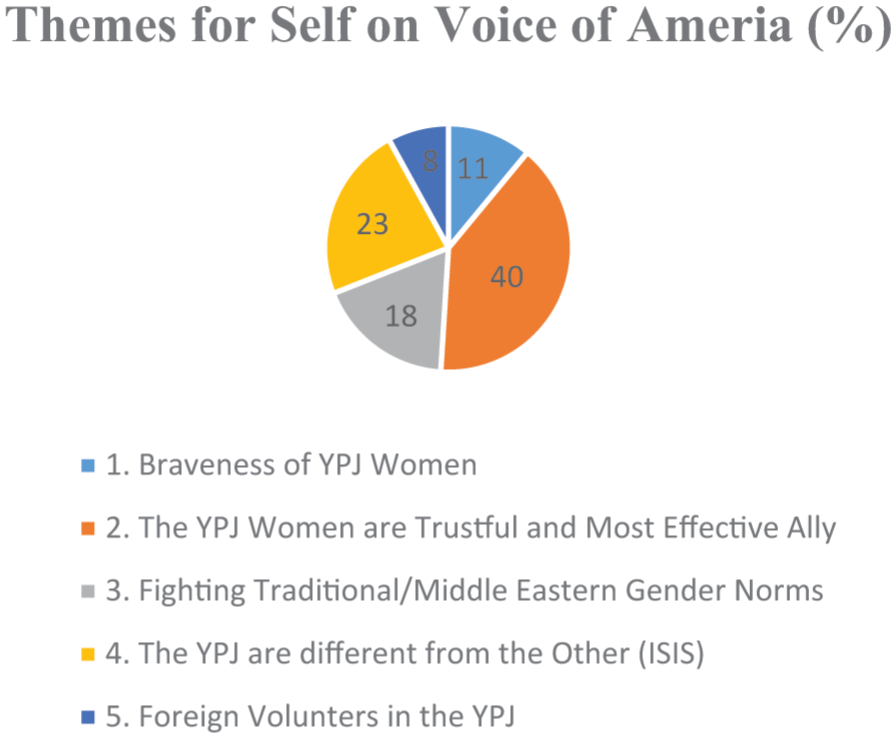
Themes for “Self” on VOA.
Pie chart 2 shows themes constructed regarding “Self” on Sputnik International. Totally, there are 187 statements referring to the perception of “Self.” Seventy-five out of 187 (% 41) are about braveness of Kurdish women, 46 out of 187 (% 25) underline purposes of Kurdish women, 52 out of 187 (28%) differentiate YPJ from Daesh and 1 out of 187 (0.5%) is about foreigners in YPJ, and 7 out of 187 (% 5.5) are about the Syrian regime as “Self,” which is normally out of this analysis but it is provided to strengthen statistics as the core and meaning-based interpretive themes.
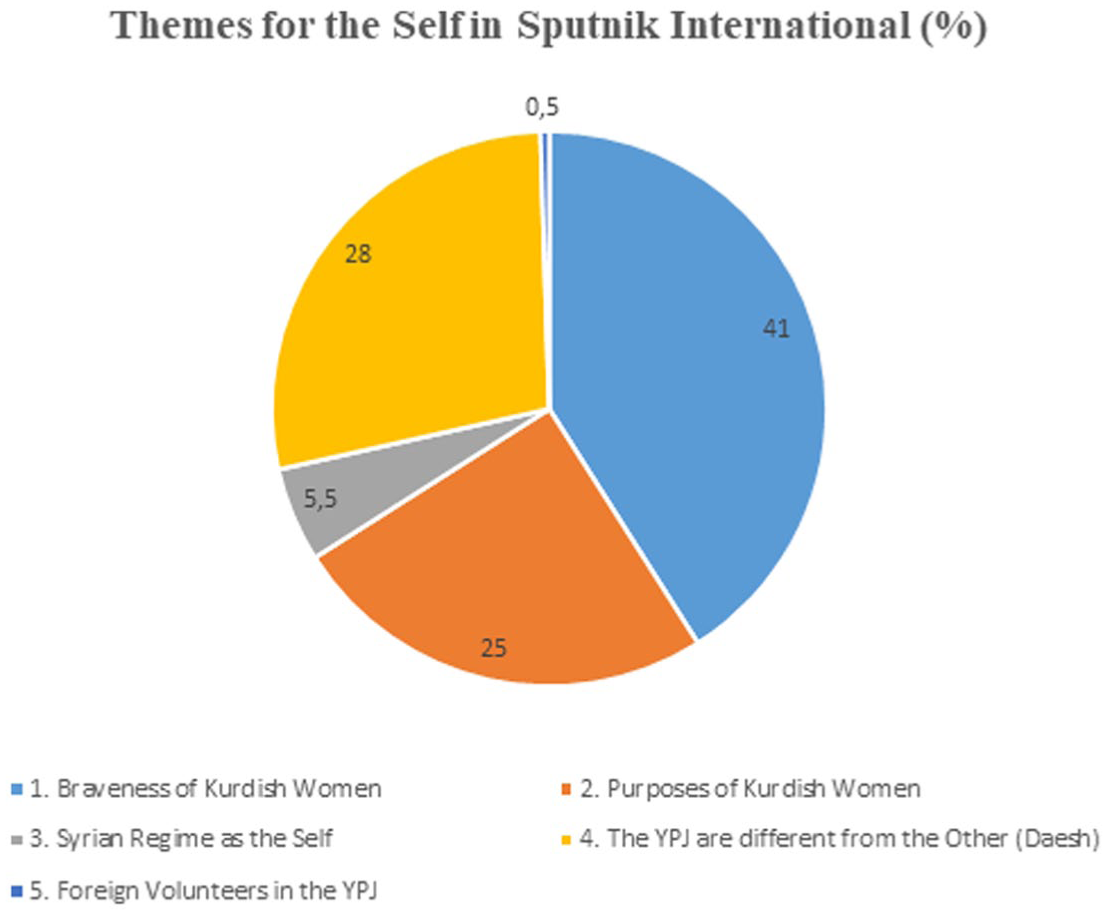
Themes for “Self” on Sputnik International.
Similar themes for framing “self”
Braveness of YPJ/Kurdish women
This theme demonstrates the international framing competition between VOA and Sputnik by highlighting on different perspectives. While VOA mainly prioritizes YPJ, Sputnik emphasizes braveness of other Kurdish women including YPJ in fighting ISIS. Before the rise of ISIS, VOA describes YPJ as an antithesis of jihadists groups in Syria, portrays them as brave people fearlessly fighting jihadists and presents their deaths as an achievement and sacrifice and draws attention to the responsibilities those women having in fighting jihadists. Following the rise of ISIS, VOA applies some other strategies. For instance, it underscores the roles of YPJ women alongside YPG against ISIS through reports, statements and quotes of their families or pictures particularly during the siege of Kobane. VOA also praises new recruits and their tasks in YPJ and SDF 1 for preparing operations to retake Raqqa, their contributions to capture Tabqa and liberate Yazidi families from ISIS. In addition, VOA presents the deaths of British and German female volunteers of YPJ in fighting ISIS as a symbol of braveness and attitudes of Kurdish sisters who forced to marry ISIS militants and joined YPJ following the liberation of their town from ISIS.
Sputnik’s framing of the YPJ as part of the “Self” also reflects the dynamics of framing competition. First, Sputnik does not only refers to YPJ, but also refers to other Kurdish women fighting Daesh and other jihadists groups. For instance, the Female Protection Forces of the Land Between Two Rivers (for Christians) was formed by taking YPJ as a role model to defend the Christian towns against Daesh (Sputnik, 14 December 2015a). Sputnik emphasizes arguments of those women believing that Daesh fears of them. Second, Sputnik avoids the term “ISIS” and consistently employs “Daesh” in its reporting. Sputnik also praises some achievements of YPJ like capturing Al-Hol, a strategic town for Daesh, and presents YPJ’s secular ideology as the main incentive for their braveness and a victory against jihadists (Sputnik, 16 December 2015c). It provides quotes of YPJ women claiming that the world had recognized their effectiveness and braveness in fighting Daesh, and praises YPJ killings of Daesh militias as an achievement (Sputnik, 21 June 2016k). Sputnik also presents the death of an YPJ member, Asia Ramazan Antar, a Kurdish Angelia Jolie killed by Daesh, as a sacrifice of the praised actor (Sputnik, 10 September 2016e). According to Sputnik, YPJ is the “worst nightmare” for Daesh terrorists in Syria (Sputnik, 21 April 2016b). Interestingly, Sputnik provides details over the book named “Daughters of Kobani” and quotes from the “Penguin Random House” which shares information over preparations of creating a movie over braveness of YPJ women fighting Daesh (Dergacheva, 2021). According to Sputnik, the US- and Russia-supported SDF including YPJ-YPG particularly in fighting Daesh (Sputnik, 11 January 2016f).
As underlined above, this theme presents achievements of Kurdish women fighting Daesh as part of a framing competition between VOA and Sputnik. Accordingly, Sputnik presents Yazidi women fighting Daesh militias as a braveness and achievement (Sputnik, 12 July 2016c), the participation of some Kurdish women in the female unit of Iraqi Kurdish Peshmerga to retake Mosul from Daesh (Sputnik, 30 March 2016l) and their deaths as a sacrifice of the praised actor (Sputnik, 24 October 2016d). According to Sputnik, the escape of two Yazidi women from Daesh by putting sleeping pills in their tea (Sputnik, 23 April 2016m) also reflects their braveness and achievement.
Perceived self (YPJ) against perceived other (ISIS/Daesh)
This theme emphasizes YPJ and Syrian Kurds’ differences from ISIS. However, the primary framing competition emerges through the concepts of political proximity and cultural proximity. VOA differentiates the YPJ from ISIS primarily due to the political proximity between the United States and the YPJ-YPG. In contrast, Sputnik distinguishes the YPJ from Daesh based not only on political proximity, but also on ideological proximity between Russia and the YPJ. To illustrate these differences, VOA highlights the Syrian Kurds’ initiatives to address the abuse of Syrian women by preventing sexual assault, rape and honour killings. VOA also features accounts from American volunteers in the YPJ-YPG, portraying them as heroes who protect civilians and refugees while promoting egalitarianism and ethno-religious diversity. Furthermore, VOA draws attention to the ideological influence of American leftist Murray Bookchin on the YPJ-YPG’s pursuit of gender equality (Kajjo, 2017).
While differentiating the YPJ-YPG from ISIS, VOA highlights US trust in the YPJ-YPG within the fight against ISIS. To illustrate this, VOA first contrasts ISIS’s atrocities against Yazidis with the YPJ’s rescue efforts, such as those in Sinjar in August 2014 (VOA, 31 August 2014). Second, it identifies radio stations, specifically Arta and Amude FM, as propaganda tools funded by the US State Department to support Syrian Kurds. These stations promote ethnic and religious diversity by hosting Muslim, Yazidi, and Christian scholars to broadcast against ISIS (Kajjo, 2015). Third, VOA features the establishment of Jin TV (Women TV), the first television channel run by Kurdish women in northern Syria. This channel amplifies women’s voices and counters ISIS recruitment ideology (Ahmado, 14 July 2018a). Fourth, VOA emphasizes the tolerance of the YPJ, noting its acceptance of newly recruited “sisters” previously forced into marriage by ISIS. These women adopted the names Vian and Zhyan to honour fallen YPJ members (Ahmado, 18 July 2018b). Ultimately, VOA frames these as rational and desirable attitudes, positioning these women as the antithesis of ISIS.
Sputnik International criticizes UK authorities for arresting a Kurdish woman who supported the YPJ, charging her with aiding militias fighting Daesh (Sputnik, 3 June 2015b). According to Sputnik, the YPJ is distinct due to its brave and fearless fighters standing against brutal organizations like Daesh. It further differentiates the YPJ from Daesh-like groups by highlighting its role as a model for new female units, such as the Female Protection Forces of the Land Between Two Rivers (Sputnik, 14 December 2015a). Crucially, Sputnik describes the ideology of Kurdish women as a progressive counterpoint to the radical ideology of Daesh, emphasizing that understanding the ideology of the YPJ-YPG-PYD is essential to comprehending their resistance (Sputnik, 16 December 2015c). Moreover, Sputnik International praises PYD’s ideological policy implementations such as freedom of expression, self-governance, direct democracy, gender equality, multi-ethnic, multi-religious and multi-lingual in accordance with suggestion procedures of international reports. Distinct from VOA, Sputnik criticizes international media for ignoring the ideological stances of the YPJ-YPG-PYD, arguing that this perspective enabled their stand against Daesh in Kobane even without initial international support. Consequently, Sputnik underscores the significance of these ideological aspects (Sputnik, 16 December 2015c) and describes the SDF as a “secular military anti-jihadist alliance . . . backed both by Russia and the US” (Sputnik, 11 January 2016f). As a significant conceptual contribution of this paper, these findings indicate an ideological proximity between Russia and the YPJ. This proximity stems from the Russian government’s ideological sympathy towards the PKK and its Syrian affiliates, as well as its opposition to the ideological premises of ISIS, largely influenced by the domestic impact of Islamist groups in the context of the Chechnya issue and their perception as terrorist entities.
To differentiate YPJ from ISIS, Sputnik International also draws attention to YPJ’s inclusiveness having Arab and Assyrian women as well as women from countries like Germany. According to Sputnik, SDF helps foreign governments like the United Kingdom, United States, France and Germany by capturing foreign fighters of Daesh (Sputnik, 21 September 2018b). In addition, Sputnik emphasizes lobbying efforts of YPJ in Sweden through Nesrin Abdullah emphasizing Daesh as a common enemy for Syrian Kurds and Sweden (Sputnik, 21 April 2016b). By covering explanations/quotes of female fighters, Sputnik International underlines that those women contribute to political, social, cultural and military areas of life in Syria (Sputnik, 29 November 2016j).
Foreign volunteers in YPJ
For instance, Brian Wilson, a retired US Air Force veteran, shared his positive impressions of the YPJ’s egalitarianism (Omar, 16 October 2014). In addition, former American military personnel such as Jordan Matson and Keith Broomfield, along with American citizen William Savage and British citizens Macer Gifford and Michael Enright are noted as foreign volunteers. VOA portrays those who lost their lives in combat as heroes defending their respective national interests against ISIS. Other significant figures highlighted in the ranks of the YPJ include Gill Rosenberg (Canadian-Israeli), Anna Campbell (British), and Ivana Hoffmann (German). Notably, Campbell and Hoffmann were killed while fighting ISIS. VOA frames their deaths as a noble sacrifice, contrasting the “praised actor” (YPJ) against the “blamed actor” (ISIS).
Findings indicate that VOA’s interest in these women stems from the political proximity between the United States and the YPJ, as US policy prioritized the degradation and defeat of ISIS in Syria through local ground forces (Demir, 2023b). Some foreign volunteers underscore that they joined the YPJ-YPG to support the multi-ethnic model of coexistence in Kurdish-held areas. Some Americans also fought alongside the YPJ-YPG against Turkish-backed Syrian opposition forces during the 2018 Afrin Operation (Dettmer, 2018). In terms of political proximity, this theme reflects US government policies aimed at securing national interests. As addressed below, VOA labels individuals from Europe and America who travel to Iraq and Syria to join ISIS as terrorists, noting that they face legal sanctions upon returning to their home countries. However, VOA treats individuals like Brian Wilson as exceptions, echoing the US State Department’s assessment that joining the YPJ-YPG is permissible as long as volunteers do not affiliate with designated terrorist groups like ISIS (Omar, 16 October 2014). Consequently, while regulations exist to prevent citizens from joining ISIS, no such restrictions apply to the YPJ-YPG, as VOA portrays the group as the antithesis of ISIS. In contrast, Sputnik International offers only a single statement regarding foreign fighters in the YPJ, highlighting the presence of Assyrian, Arab and German women (Sputnik, 12 January 2016h). This discrepancy further illustrates the framing competition between VOA and Sputnik International.
Fighting for purposes
While VOA presents YPJ fighting for traditional gender norms, Sputnik emphasizes not only purposes of YPJ, but also other Kurdish and Yazidi women through this theme. The construction of this theme also demonstrates methodological aspect of this paper, which is based on the meaning-based interpretive stories reflecting the interpretive roles of researchers, the inductive approach and inclusion of the divergent points in relation to the core ideas while constructing themes. Accordingly, VOA portrays Syria as a pre-modern and traditional area in which women would not have positions at administrative and military units. However, Syrian Kurds, particularly YPJ, are pictured quite special since they formed the “first official female municipal police unit” (Dettmer, 26 November 2013a). Therefore, women joining this unit had wishes to challenge traditional stereotypical ideas about women as a weak gender (Dettmer, 26 November 2013a). According to VOA, marrying teenage/underage girls with rapists for preventing honour killings and selling teenage girls to older men as pre-modern implementations (Dettmer, 27 November 2013b). However, ISIS keeps such a pre-modernity and traditional viewpoints regarding women.
In addition, VOA emphasizes the status of women mainly in YPJ, and their fight against sexual violence since the outbreak of the Syrian conflict for challenging traditional gender norms. Particularly, local Kurdish women activists such as Elehma Omar tried to help the abused women and change such an attitude. This could be explained through the cultural proximity between the United States, symbolizing freedom, human and women rights, and Syrian Kurdish women standing against sexual violence. VOA underlines the abuse of women as an increasing attitude during the Syrian civil war (Dettmer, 27 November 2013b). Moreover, domestic violence, forced marriage of teenage girls with older men for money, rape, honour killings are other practices of sexual violence and abusing women (Dettmer, 27 November 2013b). This point also indicates the cultural proximity between the United States and YPJ, since VOA differentiates YPJ from ISIS. As remembered, cultural proximity explains cultural connections, worldviews and values between the praised actor and the framing agencies in the context of the media systems of nations praising actors.
VOA also draws attention to the Jin (Women) TV by underscoring roles of women in operating this channel as a chief of Arabic division, a founding member and a video editor. They have been trying to change the perception in the region over the roles and abilities of women by running this TV channel. Those women also want to communicate and connect women from different parts of the world. VOA praises this channel as “a platform for women to raise their voices,” a platform for women victims of terrorist groups in revealing true natures of those organizations (Ahmado, 14 July 2018a).
Sputnik draws attention to purposes of YPJ, Female Protection Forces of the Land Between the Two Rivers, Women in Iraqi Kurdish Peshmerga, Iraqi female Yazidi battalion (Yekîneyên Jinên Sengalê), The Bein Nakhrein female military unit, the Women’s Self-Defence group, women in the Kurdish security forces, As-Saish, women in the Assyrian group an-Natora. While presenting purposes of Kurdish women, Sputnik provides details over those different groups. According to Sputnik, YPJ fights Daesh because of ideological and secular premises of PYD (Sputnik, 16 December 2015c). Sputnik makes their ideological premises visible for the audience to demonstrate Sputnik’s sympathy towards their ideology. This is also another indicator of an ideological proximity between Russia and YPJ-YPG-PYD.
Accordingly, YPJ fights Daesh for winning victory over intolerance, bigotry and radicalism (Sputnik, 16 December 2015c), protecting their population (Sputnik, 12 January 2016h), organizing people against feudal thinking and changing way of life, society and perspectives towards women (Sputnik, 4 February 2016g). Those women also fight Daesh-like groups for ousting terrorists from their territory and freeing women from patriarchal domination (Sputnik, 10 September 2016e), promoting political goals/visions, bringing justice and gender equality, and revenging men exploiting women as a trade material (Dergacheva, 2021). For Sputnik, women in the PKK having an ideological relation with YPJ fight Türkiye to avenge Turkish government and have independent territories and freedom for their people (Sputnik, 21 June 2016k). Coverage of those statements also indicates Sputnik’s sympathy towards PKK and its ideology as an indicator of ideological proximity between Russia and PKK.
According to Sputnik, Syrian women as part of the Female Protection Forces of the Land Between Two Rivers also fight Daesh for protecting their families and future of their children, challenging the traditional idea of being housekeepers (Sputnik, 14 December 2015a). It also draws attention to purposes of women joining the Iraqi Peshmerga to protect people against atrocities of Daesh (Sputnik, 21 June 2016k), prevent ethnic cleansing, crucifixion, institutional rape and slavery, clean up Kurdish territories from Daesh (Sputnik, 30 March 2016l). Those women want to liberate Mosul, live a free and democratic life with their brothers and sisters (Sputnik, 24 October 2016d; Sputnik, 15 August 2017b), liberate Yazidi women (Sputnik, 24 October 2016d), defend a Kurdish dream (Sputnik, 15 August 2017b), avenge their sisters and protect their homelands (Sputnik, 6 October 2017a). Accordingly, Sputnik describes Kurdish women fighting Daesh as good and correct ones. It situates those women as “Self” because of the ideological and cultural proximity regarding implementations such as multiculturalism and gender equality. Those are associated with notions of progress, modernity, superiority as anti-theses of Daesh.
Separate themes for framing “self”
Trustful and effective ally (VOA)
This theme serves as a primary indicator of the framing competition between VOA and Sputnik International, while providing a core empirical demonstration of the political proximity between the United States and the YPJ, reflecting the broader US military strategy against ISIS. Although the theme primarily focuses on the YPG, VOA makes consistent references to the YPJ as the female unit of the YPG and a vital component of the SDF. Accordingly, VOA presents the YPJ, alongside the YPG-SDF, as a reliable and effective ally in the fight against ISIS. To underscore this reliability and effectiveness, VOA employs a range of descriptive adjectives and phrases, characterizing the group as: “Resilient,” “outnumbered,” “underequipped,” “trusted by the U.S.-led coalition,” “opposed by Turkey but backed by the United States,” “dominant Kurdish forces,” “most effective ground force,” “one of the most effective forces,” “the most effective and reliable Syrian group,” “key US ally,” “effective partner with the U.S,” “America’s only partners,” “the most effective fighting force,” “the United States’ strongest ally.”
As previously established, political proximity addresses the shared political interests and priorities between the framing and mainly praising agencies and the praised actors by those agencies. This theme as one of the core empirical demonstrations explains the political proximity between the United States and YPJ-YPG-SDF against the common enemy, ISIS, since both sides aim to degrade and defeat ISIS as a policy objective/priority in Syria. The United States aimed to defeat ISIS in a cheap way (Knight and Wilgenburg, 2021: 11) and began working with YPJ-YPG since the siege of Kobane in September 2014. Such an interest-based relationship is underlined by the US President Donald Trump stressing that “Kurds are no angels” (VOA, 20 October 2019), but they are important groups playing a role as a ground force for the US policy of degrading and defeating ISIS in Syria.
Themes for “other” on VOA and Sputnik
Pie Chart 3 illustrates the distribution of themes related to the construction of the “Other” in VOA’s coverage. In total, 124 statements were identified as reflecting the perception of the “Other.” Of these, 15 statements (12%) focus on the atrocities/crimes committed by ISIS, while 33 (26%) frame ISIS as a common enemy of civilization. A further 23 statements (18%) depict women as victims of ISIS, and 14 (11%) highlight ISIS’s mistreatment of women. The largest proportion, 39 statements (31%), emphasizes ISIS’s violation of international norms, constituting the core, meaning-based interpretive theme within this category.
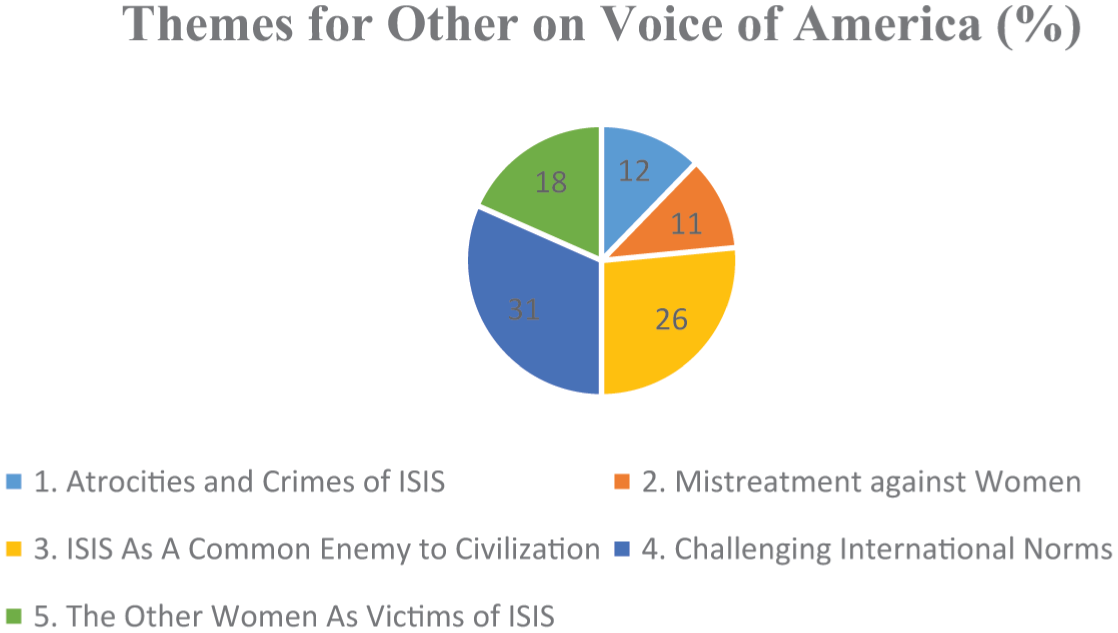
Themes for “Other” on VOA.
Pie Chart 4 presents the distribution of themes related to the construction of the “Other” in Sputnik International’s coverage. In total, 134 statements were identified as reflecting the perception of the “Other.” Of these, 31 statements (23%) focus on the atrocities/crimes of Daesh, while 61 (46%) emphasize its pre-modernity, peculiarity and incompatibility as an enemy of civilization. In addition, 20 statements (15%) depict women as victims of Daesh, and 22 (16%) highlight foreign jihadists within Daesh as the core, meaning-based interpretive theme.
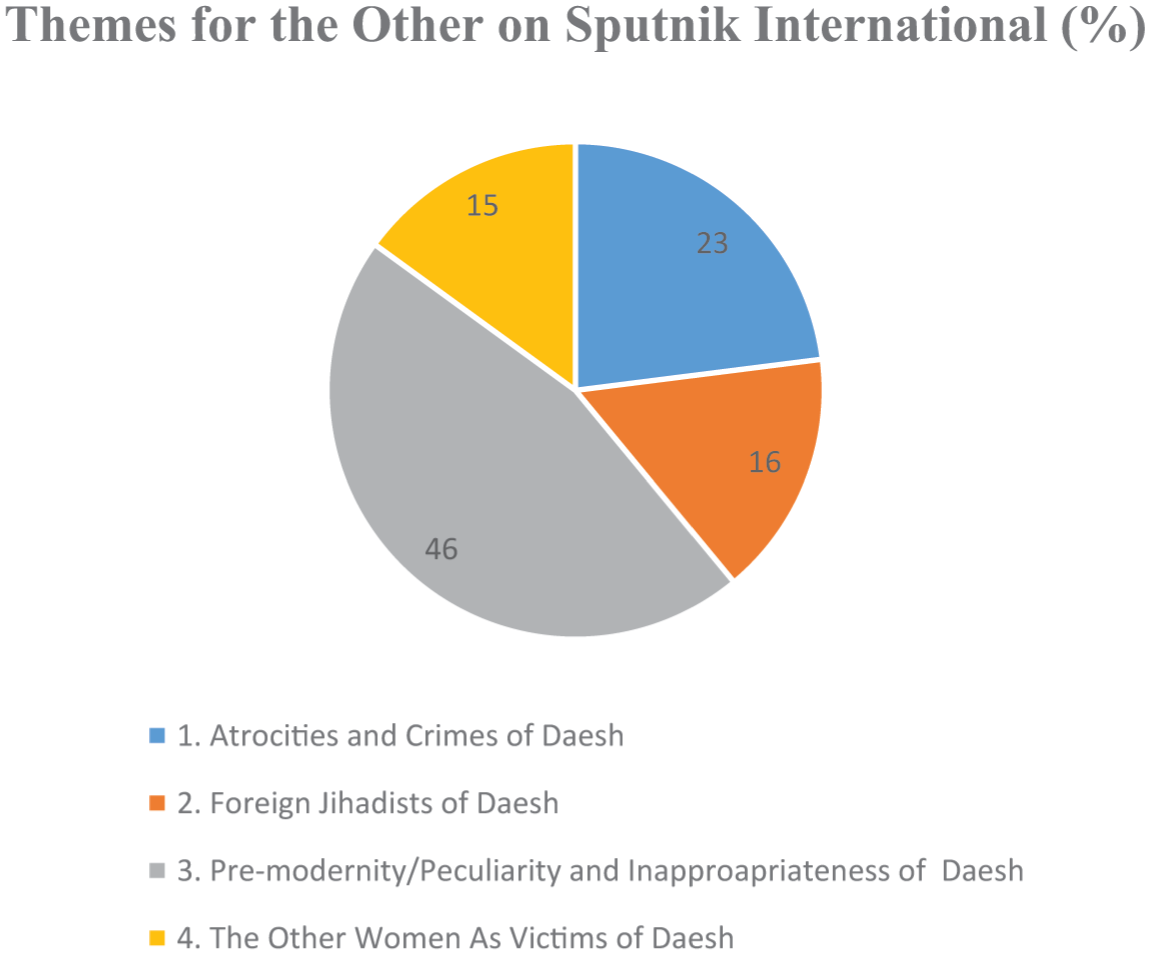
Themes for “Other” on Sputnik International.
Similar themes for framing “other”
Atrocities/crimes of ISIS
This theme focuses on the atrocities/crimes of jihadist groups. VOA emphasizes crimes committed by ISIS against humanity, particularly targeting women. To justify this framing, VOA follows several patterns. First, it highlights the motivations of American and other foreign volunteers joining YPJ-YPG, many of whom describe their involvement as a response to ISIS’s genocidal violence in Syria. For instance, an Israeli YPJ volunteer compares ISIS’s crimes against vulnerable women and children to the Holocaust (VOA, 13 July 2015). Second, VOA frames ISIS as a global threat by referencing acts such as bombings in Europe, kidnappings, attacks on major cities and ideological indoctrination. Third, it details specific atrocities, including the enslavement of Yazidi women and girls, abductions, massacres, torture, imprisonment and widespread sexual violence.
Sputnik International similarly addresses these atrocities but structures them in three categories. First, it outlines crimes committed by Daesh, including the seizure of towns, forced religious conversion, executions, ethnic cleansing, crucifixion, institutionalized rape and slavery, attacks on Yazidis in Sinjar and human rights violations in Mosul. These accounts are often reinforced by references to UN reports describing “genocide” and “war crimes” in Iraq and Syria. Second, Sputnik frames Daesh as a broader threat to humanity, emphasizing crimes such as massacres, suicide attacks, beheadings and violence carried out by foreign jihadists, particularly in Europe. It also reiterates systematic killings, enslavement, and imprisonment of Yazidis, alongside ongoing human rights violations. Third, Sputnik focuses specifically on violence against women, including institutional rape, enslavement of Yazidi women and girls, executions for resisting sexual jihad, punishment of families, systematic gender-based separation, sexual mutilation and torture (Sputnik, 21 April 2016b). Overall, this theme addresses an international framing competition between VOA and Sputnik International through a similar theme in blaming ISIS as “Other” by counting its sins through interpretive explanations or supportive quotes to demonize the behaviour of committing acts of terrorism and violence.
Fighting common enemy of civilization
This theme depicts divergent perspectives, as an international framing competition over the same theme, of VOA and Sputnik International regarding the status and ideology of ISIS as a common enemy of civilization. For instance, VOA shares quotes of YPJ fighters assessing the participation of foreigners in YPJ as an implication of standing against the common enemy. Some foreigners like the Canadian Hanna Bohman describes ISIS as an enemy to the world and VOA quotes those explanations to portray the characteristics of ISIS (Bali, 2015). VOA provides statements regarding ISIS ideology to indicate its incorrectness, inappropriateness, and pre-modernity. According to VOA, some Muslim women refer to the implementations of ISIS as un-Islamic, which demonstrate that even Muslim community perceives ISIS as an enemy (Kajjo, 2015).
Moreover, VOA labels people joining ISIS as terrorists and describes this participation as an act of terrorism and “terrorist propaganda” (Ahmado, 14 July 2018a). VOA presents implementations like the forced marriage of teenage girls with ISIS militias, treating women as objects, demands for unconditional obligation to illogical instructions of ISIS, tormenting people and women, buying and selling women in the name of Islam, kidnapping and using Yazidi women like sex slaves as peculiar implementations coming from ISIS’ outdated and primitive ideology.
Sputnik International similarly emphasizes the pre-modernity, peculiarity, and inappropriateness of Daesh, but does so through more detailed and culturally framed narratives. It often draws on testimonies of Kurdish female fighters to highlight what it presents as irrational beliefs among Daesh militants. For instance, the idea that being killed by a Kurdish woman prevents entry into heaven (Sputnik, 14 December 2015a). Additional accounts include claims that militants should be burned rather than buried if killed by women, as well as symbolic practices such as carrying keys (to open the gates of heaven) and spoons (to eat with the Prophet) during combat (Sputnik, 4 February 2016g).
Another strangeness/peculiarity about Daesh is being the army of dead men having only goals of dying to go to heaven. According to explanations of YPJ members, this comes through their ideology (Sputnik, 4 February 2016g). Sputnik repeatedly underlines that Daesh militias had a dream of being martyr and going to paradise. However, when they killed by YPJ fighter or a Kurdish girl meant that they would not go to heaven. Therefore, they are afraid of YPJ. According to Sputnik International, Daesh leader Abu Bakr al-Baghdadi felt necessary to release a special fatwa allowing Daesh militias being killed by women. Otherwise, they believe that being killed by a weaker sex (women) means would not go to heaven or would go to hell (Sputnik, 21 April 2016b). Sputnik International attempts to demonstrate the ideological peculiarity through explanations of YPJ fighters underlining that Daesh perceives women as second-class citizens (Sputnik, 21 April 2016b).
Sputnik International also presents foreign jihadists of Daesh as “professional terrorists” carrying out suicide attacks in Europe through explanations of Nesrin Abdullah (Sputnik, 21 April 2016b). It uses the following phrases either directly or through quotes of YPJ fighters, women in Iraqi Kurdish Peshmerga forces and some experts to describe Daesh. They are enemy for humanity, the world’s evil, militants, professional terrorists, terrorist group/organization, jihadist militants, Islamic fundamentalist tyranny, terrorist threat, extremists, terrorist movement, homegrown terrorists/jihadists and jihadi exporters. In this way, Sputnik International describes Daesh as evil, bad, barbaric, inappropriate, incorrect and deviant, the one disrupting rules and destabilizing norms, and associates Daesh ideology with notions of pre-modernity and primitiveness because of the perceived cultural and ideological distance of Russia to actions and stereotypical virtues of Daesh.
Women victims of ISIS/Jihadism
Through this theme, VOA and Sputnik International focus on two categories of women associated with ISIS/Daesh, reflecting framing competition within a shared narrative. The first category consists of female volunteers. VOA portrays these women as active agents of jihadist ideology, labelling them as members of extremist organizations and terrorists, often with references to the UN and the US State Department. It emphasizes their roles in travelling to Syria, marrying militants, providing financial and logistical support, facilitating operations, engaging in propaganda and recruiting others. In some cases, VOA also presents them as “female victims,” drawing on interpretations by Kurdish women (Ahmado, 14 July 2018a), though this remains secondary to their negative characterization. The second category includes women captured by ISIS and forced into marriage. VOA consistently frames these women as victims, highlighting coercion, lack of agency and systematic violence such as abuse, torture, imprisonment and sexual exploitation. Practices like forced marriage and the commodification of women are presented as central features of ISIS rule (Ahmado, 18 July 2018b), reinforcing a clear political, cultural and ideological distance between the United States and ISIS.
Sputnik International similarly condemns women who join Daesh but frames them as ideological victims who align themselves with the wrong side in a broader struggle between civilization and barbarism. It portrays life under Daesh as confined and pre-modern, with women restricted to domestic roles. These representations are often supported by accounts from YPJ fighters describing the consequences of joining Daesh, including loss of social ties and forced sexual servitude (Sputnik, 4 February 2016g). Like VOA, Sputnik emphasizes women captured by Daesh as victims, particularly Yazidi women, highlighting killings, enslavement, rape, forced marriage and other forms of systematic violence. It also stresses gender-based control and restrictions, presenting Daesh as treating women as second-class citizens (Sputnik, 16 August 2016a). Overall, both outlets construct women associated with ISIS/Daesh within a dual framework of perpetrators and victims, while differing in emphasis: VOA adopts a more security-oriented framing, whereas Sputnik foregrounds cultural and ideological dimensions.
Separate themes for framing “other”
Mistreatment against women (VOA)
This theme demonstrates the framing competition between VOA and Sputnik International as a different theme of VOA from Sputnik by drawing attention to general mistreatment against women in the Middle East and ISIS mistreatment against women. It indicates political, cultural and ideological distances between the United States and ISIS. Using this theme, VOA presents the Middle East and the environment during the Syrian civil war as a trigger for abusing women through a report issued by the Euro-Mediterranean Human Rights Network (Dettmer, 27 November 2013b). Such a mistreatment supported through inferred implementations like sexual violence of women, rape during detentions, being used as human shields during military operations, kidnapped for ransom as some tactics applied by competing sides. According to VOA, sexual assault is quite famous in the Syrian culture the same as in the Middle East with rape as a shaming occurrence brings dishonour. Another unusual practice is the persuasion of rapist and raped women to marry, “an awful, torturous prospect for an abused woman” to accept for preventing the honour killings (Dettmer, 27 November 2013b). VOA also underlines implementations of ISIS like placing hands on the heads of women, intoning three times Allahu Akbar and claiming those women as their wives (Dettmer, 27 November 2013b).
This theme highlights framing competition by showing VOA’s distinct emphasis on broader patterns of mistreatment against women in the Middle East alongside ISIS-specific abuses, revealing political, cultural and ideological distance between the United States and ISIS. VOA portrays the Syrian civil war environment as a context that facilitates violence against women, drawing on reports such as those by the Euro-Mediterranean Human Rights Network (Dettmer, 27 November 2013b). Within this framework, it references practices including sexual violence, rape during detention, the use of women as human shields, and kidnapping for ransom by various actors. VOA also points to cultural dynamics, noting how rape is framed as a source of dishonour, which can further victimize women. It highlights practices such as pressuring victims to marry their assailants to avoid so-called “honor killings,” presenting this as an additional layer of coercion and suffering (Dettmer, 27 November 2013b). In relation to ISIS, VOA underscores specific abuses, including forced marriages enacted through ritualized practices, thereby reinforcing its broader portrayal of systemic mistreatment and gender-based violence.
Challenging international norms (VOA)
Through this theme, as another indicator of framing competition between VOA and Sputnik International via different emphases, VOA presents two points regarding the construction of the “Other.” The first concerns the recruitment and use of child soldiers by YPJ-YPG-SDF, typically categorized as “Self.” VOA notes that although YPJ-YPG pledged to demobilize 149 individuals under the age of 18, the use of minors continued, as documented by the New York-based Human Rights Watch (Dettmer, 2015a). It also reports that some families, particularly those of teenage girls, were denied access to their children, presenting this practice as comparable to ISIS. VOA highlights that, despite a July 2015 directive prohibiting the recruitment of individuals under 18, YPG created a “non-combatant” category for those aged 16–17, thereby continuing recruitment in violation of international norms (Dettmer, 2015a). In this context, VOA references a Russia Today documentary featuring female fighters, including at least one 16 year old, and notes that US authorities pressured SDF to comply with basic human rights standards, including prohibitions on child soldier recruitment (Dettmer, 2015b; Kajjo, 2021).
The second point addresses allegations of mistreatment of minorities by YPJ-YPG-SDF. VOA reports Amnesty International’s claims of forced displacement of Arab and Turkmen populations and the demolition of villages in northern Syria (Dettmer, 2015b). It also notes Amnesty’s dismissal of YPG’s justification that such actions were militarily necessary. This period coincides with increasing claims that YPG had committed war crimes, particularly by Türkiye and some international organizations. Despite these allegations, VOA indicates that US authorities were reluctant to distance themselves from YPJ-YPG-SDF, describing such a move as “irresponsible” and “morally very difficult” (Dettmer, 2015b). This reflects political proximity between the United States and YPG, and helps explain the limited response to practices that, in some respects, resemble those attributed to ISIS.
Foreign Jihadists of Daesh (Sputnik)
As part of the framing competition between VOA and Sputnik across various themes, Sputnik International draws attention to foreign jihadists from European countries captured by Syrian Kurdish forces. Sputnik labels these individuals as “terrorists” or “homegrown terrorists,” with a particular emphasis on the stance of Swedish authorities. According to Sputnik, Sweden is unwilling to prosecute Swedish-born jihadists holding Swedish passports, instead allowing the Kurdish administration to shoulder this responsibility (Sputnik, 27 March 2018a). These jihadists reportedly held serious roles within Daesh, such as providing propaganda support and committing murders. Sputnik also highlights that jihadists from Germany and other European nations are in similar positions, noting that these countries follow Sweden’s lead by refusing to prosecute citizens who committed crimes in the Middle East. Furthermore, Sputnik underscores that the prosecution of these citizens by SDF is legally problematic, as the entity lacks international recognition, thereby casting doubt on the legality of their judicial sentences (Sputnik, 1 June 2016n).
Sputnik International further emphasizes the detention of notorious jihadists, such as Alexanda Amon Kotey and El Shafee Elsheikh, who were involved in the beheading of American, British, and Japanese journalists, aid workers and Syrian soldiers (Sputnik, 21 September 2018b). Within this thematic context, the outlet highlights the case of Shamima Begum, a “Daesh bride” whose British citizenship was revoked following her affiliation with the group (Ekimenko, 2021). Ultimately, this theme characterizes foreign Daesh jihadists as inherently malevolent, barbaric, and deviant. Their decision to join Daesh is framed as a criminal act of terrorism, for which they are held entirely accountable. Sputnik International systematically details their “sins” through both direct quotes and interpretive narratives, demeaning their actions when they involve terrorism, violence, extrajudicial killings, or torture.
Conclusion
This article conceptualizes the international framing competition between VOA and Sputnik International regarding the YPJ through the lens of the “Self” and “Other” framework, specifically accounting for the foreign policy priorities of the US and Russian governments in Syria. Accordingly, the study explains how VOA and Sputnik’s narratives competed in their presentation of the YPJ and identifies the specific themes these outlets utilized to influence their target audiences. A key finding of this research is that these media outlets compete either through divergent approaches to similar themes or through the introduction of entirely different thematic focuses. Our findings indicate both overlaps and discrepancies in the construction of “Self” and “Other.” Specifically, themes such as the bravery of the YPJ and Kurdish women, the perceived “Self” versus “Other” dichotomy, the presence of foreign volunteers, and the notion of fighting for a cause are shared themes used by both VOA and Sputnik to praise the “Self.” In contrast, the theme of the “trustful and effective ally” remains unique to VOA in representing the “Self,” serving as a core empirical demonstration of the political proximity between US administrations and the YPJ-YPG-SDF within the context of US military strategy against ISIS. Regarding the representation of the “Other,” both outlets employ common themes such as the atrocities of ISIS, the fight against a common enemy of civilization, and the depiction of women as victims of jihadists. However, VOA distinguishes its portrayal of the “Other” through themes of mistreatment of women and challenges to international norms, while Sputnik International focuses on the presence of foreign jihadists as a distinct thematic element in its blame-oriented framing.
This paper provides significant theoretical, methodological and conceptual contributions to the literature on international framing competition between diverse media systems. As a primary theoretical contribution, it develops a novel perspective by conceptualizing international framing competition through the lens of the “Self” and “Other” framework. This analysis builds upon the work of Knüpfer and Entman (2018), which explains how media outlets from different nation-states present information by prioritizing their respective political interests. While existing scholarship frequently employs Robert Entman’s (1993) four framing functions – defining problems, identifying responsible actors, suggesting solutions, and justifying those solutions – this study seeks to complement this tradition by introducing an alternative conceptual layer. Whereas previous research has often focused on specific functions, such as problem definition (Hammond, 2018), or the collective application of these functions (Demir and Doğan, 2025), this paper proposes that integrating the “Self” and “Other” framework can provide further nuance to our understanding of international framing patterns.
The methodological contribution of this study lies in the construction of thematic representations by VOA and Sputnik International concerning the YPJ, within the “Self” and “Other” framework. Specifically, the paper develops a refined approach for identifying, coding, and classifying statements associated with these two conceptual categories. This methodological framework is inspired by Robert Entman’s (1993) definition of framing and is operationalized through Braun and Clarke’s (2006) inductive thematic content analysis, further supported by statistical calculations for thematic construction. As a data-driven approach (Braun and Clarke, 2006: 83), inductive thematic analysis facilitates the coherent construction of themes by accounting for the foreign policy priorities of the US and Russian governments. This process captures core meanings to develop interpretive narratives rather than mere summaries of topics (Braun and Clarke, 2023: 3). Consequently, this paper offers a rigorous methodological framework that can be utilized in future research on international framing competition.
Finally, this paper offers significant conceptual contributions. By examining the attitudes of US and Russian public diplomacy tools in assessing the actions and characters of praised and blamed actors as “Self” and “Other,” this study develops several novel concepts such as political distance, ideological proximity, and ideological distance. While existing literature utilizes concepts such as political proximity (Sheafer et al., 2014: 150), as well as cultural proximity and cultural distance (Hanusch, 2008: 341), our findings expand this lexicon by developing the concept of political distance through two primary dimensions. First, it addresses the competing political interests and divergent foreign policy priorities of the US and Russian governments, as evidenced in the framing of the YPJ by VOA and Sputnik International. Second, it highlights the conflicting political interests between the framing agencies and the blamed actor, ISIS, while representing YPJ.
Furthermore, this paper introduces the concepts of ideological proximity and ideological distance. Ideological proximity refers to the ideological alignments between framing agencies and the actors they portray. In this case, while presenting the YPJ as the “Self” and competing with VOA, Sputnik International consistently highlights the YPJ’s ideological foundations, expressing sympathy towards the YPJ-YPG-PYD and the PKK. This affinity stems from the ideological links between these groups and the PKK’s historical embrace of Marxist-Leninist principles since the 1970s. In addition, the Russian government’s perception of Islamist groups, shaped by the Chechnya conflict, explains both Sputnik’s sympathy towards the YPJ-YPG-PYD and its ideological distance from Islamist entities. This leads to another crucial conceptual contribution: ideological distance, which accounts for the ideological disparities between VOA and Sputnik International when framing the “blamed actor,” ISIS. These new concepts provide a robust alternative framework for the conceptualization of international framing competition.
Footnotes

Funding
The authors received no financial support for the research, authorship and/or publication of this article.
Declaration of conflicting interests
The authors declared no potential conflicts of interest with respect to the research, authorship and/or publication of this article.