






Abstract
This paper argues that decolonizing political science in Bangladesh is best understood as an institutional and epistemic governance challenge rather than a critique of Western theory. It introduces a diagnostic framework to identify curricular deference and methodological extraction through a close reading of the University of Dhaka political science curriculum and an analysis of the knowledge-policy environment shaping research agendas. The paper operationalizes decolonization using systematic indicators of sequencing, citation geography, methodological hierarchy, and language governance, and proposes a feasible reform pathway that links curriculum design, methods, language, and institutional incentives.
Keywords
Introduction
Political science curricula in Bangladesh typically begin with Western political thought, while local political experience appears later and more often as context rather than as a source of ideas. This ordering invites a basic question: why do Plato, Aristotle, and Hobbes come before the language of local streets, movements, and struggles?
Scholars such as Connell (2007) and De Sousa Santos (2016 [2014]) have long critiqued patterns of epistemic dependence, yet much of that conversation remains at a broad theoretical level. This paper advances a more grounded institutional diagnosis by examining how epistemic governance operates through curricular sequencing and citation geography. The concern is not about the inclusion of Western texts in the curriculum. Instead, it is how disciplinary conventions demarcate what constitutes foundational knowledge and what is regarded as derivative.
This raises a further question: what would a decolonized political science look like in Bangladesh? What forms of knowledge, what kind of curriculum, and what kind of method would emerge if we took Bangladeshi experience, language, and struggle as points of departure instead of as sites of application? My inquiry began with a close reading of the undergraduate syllabus, where the hierarchy became readily apparent. The program opens with Ancient and Medieval Western Political Thought and Modern Western Political Thought, while Oriental Political Thought appears later in the form of a single course amid an predominantly Western canon. Comparative politics begins with the United Kingdom, the United States, and France; Bangladesh is introduced later, framed as Political and Constitutional Development in Bangladesh. Research methods are anchored in mid- to late-20th-century behavioral and institutional approaches rooted in American and European traditions. The structure of this curriculum reflects a pattern of deference.
Curricular ordering, however, does not operate in isolation. The Bangladeshi knowledge-policy complex – shaped by aid regimes and NGO governance since independence – has reinforced what counts as “useful” knowledge (Hossain, 2017; Sobhan, 1982). These incentive structures are also visible in donor-supported higher education governance, including the Higher Education Quality Enhancement Project (HEQEP), which institutionalized quality assurance architecture and internal evaluation routines that shape what outputs are rewarded and what styles of research become legible (World Bank, 2019). Donor-driven priorities have privileged short-term outputs over long-horizon theory building, which marginalized vernacular archives and community-based inquiry. Decolonizing political science, therefore, requires a rebalancing of incentives, supporting theoretical innovation, bilingual publication, and collaborative scholarship rooted in local epistemologies.
At the same time, Bangladeshi political experience has generated scholarship that engages directly with questions of power, institutions, and political order. Yet this work is rarely treated as foundational within political science and is more often approached as contextual or illustrative. Decolonizing political science, therefore, is not about disengaging from global debates. It is about rethinking what counts as core knowledge and who is authorized to theorize so that concepts grounded in local political realities can circulate and be debated as theory.
This article makes three contributions to debates on decolonizing political science. Starting with syllabi as infrastructures that determine basic and supplementary knowledge, it creates a portable way to diagnose curricular deference. Second, it connects patterns in the curriculum to the larger knowledge policy environment by showing how funding arrangements, professional assessment standards, and publication gatekeeping affect the incentives that drive education and research. Third, it sees a Bangladeshi canon not as a list of items to be celebrated but as a coherent body of ideas that can be taught, cited, and improved to be used as comparative theory.
The argument also speaks to debates in International Relations (IR) about how world politics has been narrated through racialized and metropolitan epistemic hierarchies that appear methodologically neutral but remain historically structured. Global IR calls attention to how theory production has been concentrated in a small set of institutional sites, while decolonial IR scholarship highlights how race and empire shape what becomes legible as knowledge. By connecting curriculum design and incentive structures to these debates, the Bangladesh case shows how epistemic hierarchies are reproduced through routine academic ordering (Acharya and Buzan, 2019; Henderson, 2013; Sondarjee and Andrews, 2023).
This article is organized into three steps. Using a systematic diagnostic framework, it first identifies curriculum deference in the Dhaka University syllabus. Next, it charts the funding and policy landscape that maintains those curricular incentives. Finally, it provides an indigenous canon and a language and methods agenda that make reform practical rather than rhetorical.
Data and the analytical approach
The paper integrates curriculum analysis with institutional analysis. The University of Dhaka Department of Political Science (PSDU) syllabus serves as a primary case in the curriculum analysis, as it has historically trained faculty, civil servants, and researchers nationwide, and it significantly shapes the perception of standard political science in Bangladesh. The empirical objective is not to claim that this single department represents all political science departments. Instead, the aim is to treat a highly influential program as a visible platform where knowledge hierarchies can be systematically observed and analyzed.
The evidence from the syllabus is examined in two ways. First, I closely read the courses to analyze how they discuss their subjects, which authors are presented as important, and which bodies of knowledge are shown as examples or case studies. Second, I applied a structured coding scheme to ensure that all courses were evaluated using consistent indicators. The coding scheme includes four key indicators.
The first indicator is sequencing. I code whether European and North American theory is taught in the first few semesters, while local and regional scholarships appear later or as an elective. The second indicator is citation geography, which codes the regional origin of assigned authors and key texts, separating scholarship from Europe and the Atlantic, South Asia, Bangladesh, and other regions. The third indicator is methodological hierarchy. I code if quantitative methods are presented as the primary approach to research, while qualitative, interpretive, and archival methods are treated as secondary or optional. Language governance is the fourth indicator. I code whether the curriculum treats English as the default language of scholarly legitimacy and whether Bangla or other languages are recognized as valid sources of theoretical knowledge rather than merely as data.
The institutional analysis draws on published policy and organizational elements that govern research production in Bangladesh, which include higher education policy papers, funding program justifications, and the publicly accessible outputs of significant research and policy groups. The analytical objective is to demonstrate how incentive structures reinforce curricular patterns.
Two limitations should be noted. First, this paper focuses on a single curriculum. The assertions on widespread tendencies in Bangladesh are consequently articulated as hypotheses that invite extensive comparative analysis between public and private universities. Second, syllabi do not fully capture what goes on in classrooms. Syllabi only record formal rules and signals, not the full range of instructional practices. As a result, the debate centers on institutionalized sequencing and incentive systems rather than on personal goals or classroom conduct.
Diagnosing the canon: What we currently teach
In what follows, I use the University of Dhaka undergraduate political science curriculum as a flagship case to illustrate how curricular hierarchies become institutionally embedded.
Syllabi script the order in which ideas are encountered and the voices that are considered as “foundational.” In Bangladesh, this hierarchy is unusually legible in the flagship BSS curriculum at PSDU. First-year students begin with Western Political Thought (Ancient and Medieval) and Modern Political Thought; Oriental Political Thought appears only in the third semester as a single course alongside Western-centered sequences in comparative government. The comparative stream itself opens with the United Kingdom, United States, and France (Comparative Government and Politics: UK, USA and France), while Bangladesh is introduced as Political and Constitutional Development in Bangladesh later in the degree (Dhaka University Syllabus, n.d.; University of Dhaka, Department of Political Science, 2024). The methods sequence likewise shows a hierarchy: Quantitative Research Methods in Political Science arrives in the fourth semester, with Qualitative Research Methods deferred to the seventh (PS 401 and PS 702, respectively). Such an order communicates that “theory” is Western, South Asian/Bangladeshi texts are supplementary, and numbers precede narratives.
This sequencing pattern is not unique to a single flagship political science department in Bangladesh. At another major public university, the University of Rajshahi Department of Political Science also places Western political thought as early compulsory training, including courses titled Ancient and Medieval Political Thought and Early Modern Political Thought. In contrast, locally grounded political theory and Bangladesh-centered material appear later and more often as specialized topics. This pattern is consistent with a broader disciplinary logic in which canonical texts gain authority through early placement in the curriculum and repeated reinforcement across institutions (University of Rajshahi, Department of Political Science, 2015, 2025).
A discipline with center and periphery
To understand why such ordering persists, it helps to recall how political science narrates itself. The American Political Science Association rapidly positioned US universities as the epicenter of the discipline. These histories, canonized in State of the Discipline volumes and cognate syntheses, were overwhelmingly written from North Atlantic vantage points and treated Euro-American experiences as the default terrain of concept formation (Almond, 1988; Katznelson and Milner, 2002). The Global South entered this story late, largely as an empirical testing ground for theories of modernization, political development, or democratic transition (Huntington, 1965; Rustow, 1970). This pattern is not unique to political science; scholars have identified parallel dynamics across other social sciences in Bangladesh, where local scholarship similarly struggles for theoretical recognition (Hossen, 2023). The behavioral revolution normalized survey research and cross-national attitudinal studies (Almond and Verba, 1963). Modernization and political development theorists abstracted lessons from the US and selected non-Western cases into general models; later, neo-institutionalism and state-centric critique recentered formal organizations and rules (Almond, 1988; Huntington, 1965, 1968; Pye, 1966).
The curriculum at DU mirrors that disciplinary narrative that “political thought” begins in Athens and early modern Europe; “comparative politics” opens in Euro-Atlantic polities; methods are inherited from the post-war behavioral and institutional mainstream. Students then meet Bangladesh as a domain of application (political and Constitutional Development in Bangladesh; Political Economy of Bangladesh – in the current PSDU syllabus), not as a site of theoretical origination. The structure implicitly reproduces what Connell (2007) calls the “metropolitan canon,” in which concepts travel from North to South, while Southern texts count as local knowledge.
Whose knowledge travels?
The imbalance in reading lists is not merely local; it reflects global circuits of prestige and publication. Reviews of IR and comparative politics show that theory and decision-making about what counts as important knowledge are largely anchored in US/European institutions. Tickner and Wæver’s International Relations Scholarship Around the World documents how IR curricula and journal ecologies center a Northern canon while marginalizing Southern production. Acharya and Buzan’s (2019) The Making of Global International Relations calls for restructuring the field so that theory is generated in, and circulates from, multiple geo-cultural sites. More recent bibliometric analyses reveal that authorship in top political science journals remains heavily concentrated in the United States and Western Europe, with less than 10 percent of publications authored by scholars based in the Global South (Lohaus and Wemheuer-Vogelaar, 2021; Zhu and Cheng, 2025). Editorial boards show similar asymmetries, reproducing what Waever has called the “core-periphery” structure of disciplinary authority.
Theories of democracy, governance, or state-building are tremendously exported from North to South. For example, Huntington’s (1968) Political Order in Changing Societies and Dahl’s (1971) Polyarchy became global reference points, while Southern contributions (e.g. Latin American dependency theory, African postcolonial critiques, or South Asian political society) remained siloed in “area studies.” Even when concepts originate in the South, their reception is filtered through Northern validation. Partha Chatterjee’s (2004) political society has been widely cited but often framed as an “Indian variant” of Euro-American civil society debates rather than a portable concept in its own right.
Top journals and review norms disproportionately privilege Northern debates, methods, and styles (Acharya, 2014). The cumulative effect is what De Sousa Santos (2016 [2014]) describes as “abyssal thinking” or an invisible line dividing those who produce universal theory from those who supply particular illustrations.
These global imbalances directly influence how courses are designed and citation practices in the periphery. When journals, publishers, and graduate programs prioritize Northern debates, departments like PSDU are pressured to focus on those perspectives by assigning “universal” texts for credibility and relegating Bangladeshi/South Asian work to context or case studies. As De Sousa Santos (2016 [2014]) argues, this dynamic is a form of “epistemicide,” which means non-Western knowledges survive as data or illustration, not as concept-generating theory. Decolonizing is therefore not a call to abandon global theory; it is a demand to pluralize the origins and authority of theory.
What gets counted as a method?
The methods sequence at DU (PS 401 Quantitative Research Methods; PS 702 Qualitative Research Methods) displays the historical elevation of survey/statistical approaches during the behavioral era and their consolidation in the late 20th century. The classic markers of this consolidation are the Civic Culture (Almond and Verba, 1963), Huntington’s programmatic essays and monograph on political order, and Pye’s Aspects of Political Development, which continue to anchor the mainstream. None of these approaches is invalid; all are valuable. However, when they overshadow methods that are rooted in Bangladeshi archives, languages, and collaborative fieldwork, they reinforce a one-way flow of epistemic authority. A rebalanced curriculum would sequence quantitative and qualitative inquiry earlier and together and frame both as complementary tools for Bangladesh-anchored theory building.
Table 1 shows a consistent pattern in which Euro-Atlantic theory is positioned as foundational earlier than Bangladesh-based and South Asian scholarship, while quantitative methods are treated as gateways before interpretive and archival approaches. It also shows that English functions as the default language of theoretical legitimacy, whereas Bangla is more often treated as an empirical input. Analytically, these processes institutionalize a division of labor in which concept formation is externalized and Bangladeshi political life is contextualized or applied (Connell, 2007; De Sousa Santos, 2016 [2014]).
Coding scheme for diagnosing curricular deference and methodological hierarchy. a .
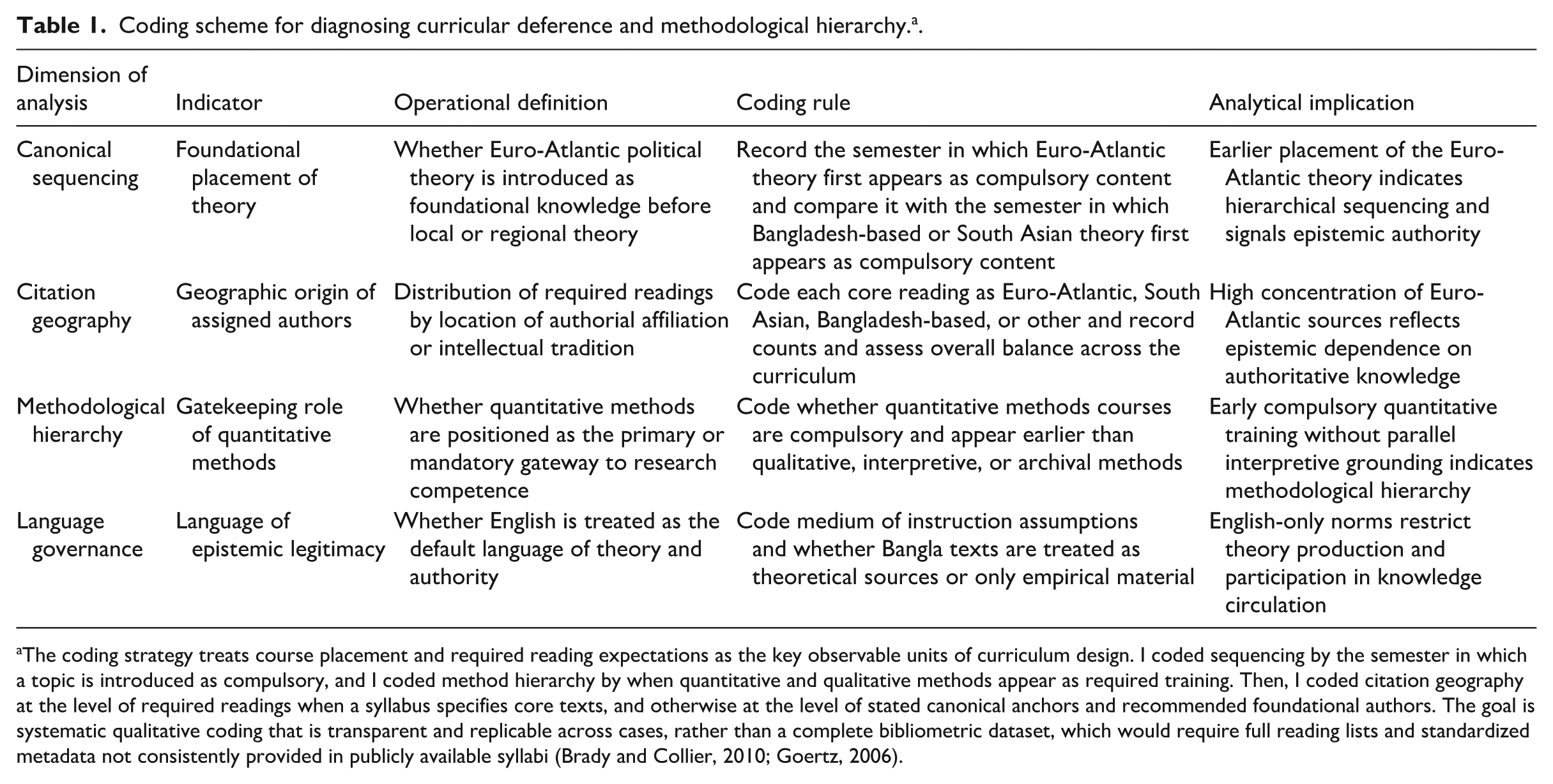
The coding strategy treats course placement and required reading expectations as the key observable units of curriculum design. I coded sequencing by the semester in which a topic is introduced as compulsory, and I coded method hierarchy by when quantitative and qualitative methods appear as required training. Then, I coded citation geography at the level of required readings when a syllabus specifies core texts, and otherwise at the level of stated canonical anchors and recommended foundational authors. The goal is systematic qualitative coding that is transparent and replicable across cases, rather than a complete bibliometric dataset, which would require full reading lists and standardized metadata not consistently provided in publicly available syllabi (Brady and Collier, 2010; Goertz, 2006).
Why the diagnosis matters
For Bangladesh, this means repositioning local experiences, not as raw material for external theory but as sources of theoretical innovation. Concepts such as Mushtaq Khan’s political settlements, Naila Kabeer’s feminist political economy, or Riaz’s analyses of authoritarian resilience offer insights not just for Bangladesh but for comparative politics broadly. Decolonizing political science, then, is less about rejecting global theory than about building circuits in which Bangladeshi and South Asian theory can travel outward on equal terms.
Mapping the knowledge–Policy complex in Bangladesh
If syllabi reflect a form of deference in the curriculum, the organization of research in Bangladesh reveals another layer of colonial influence, which is the knowledge-policy complex that connects universities, think tanks, and NGOs to donor-driven priorities.
Aid as agenda-setter
From independence onward, Bangladesh has been cast as a “test case” for development, with bilateral and multilateral donors shaping what questions are asked and how success is measured (Sobhan, 1982). Naomi Hossain (2017), in The Aid Lab, shows how this architecture institutionalized pilots, experiments, and managerial indicators as arbiters of progress. Rehman Sobhan’s (1982) early political-economy critique similarly highlighted how aid regimes discipline agendas, timelines, and organizational incentives, and set dependency into the structure of knowledge production.
One manifestation is higher education reform. The World Bank financed the Higher Education Quality Enhancement Project (HEQEP, 2009–2018), which introduced competitive grants and Institutional Quality Assurance Cells (IQACs) to standardize “quality,” research outputs, and management routines across universities. IQAC rollouts at public and private institutions explicitly reference HEQEP funding and templates, which illustrate how external financing reshapes internal academic governance.
This section analyzes donor influence and research governance using publicly available policy and administrative documents that organize higher education and research finance in Bangladesh. These include Higher Education Quality Enhancement Project manuals and operational guidelines, University Grants Commission research grant calls and evaluation criteria, Institutional Quality Assurance Cell templates and self-assessment reports, and donor-funded Bangladeshi research initiative program descriptions. The documents were analyzed to determine the characterization of research priorities, the operationalization of quality, and the outputs that receive institutional recognition. This documentary analysis aims for traceability rather than exhaustive coverage, showing how incentive structures within formal policy instruments correspond with previously identified curricular and methodological patterns.
The NGO-university-think tank triangle
Bangladesh’s globally prominent civil society sector further shapes research agendas. For instance, BRAC’s Research and Evaluation Division (RED), created in the 1970s, and the BRAC Institute of Governance and Development (BIGD) at BRAC University remain central hubs for policy-oriented studies. The Bangladesh Institute of Development Studies (BIDS) and the Center for Policy Dialogue (CPD) similarly anchor policy analysis. While these institutions produce high-quality outputs, their missions are closely tied to policy influence and donor relevance and as a result, they tend to generate a gravitational pull toward projects legible to ministries and funders.
Experimentalism and the rise of the RCT style
Since the 2000s, randomized controlled trials (RCTs) have consolidated a technocratic style of “what works” research. Bangladesh features centrally in this turn: the multi-country study on the ultra-poor “graduation” model, drawing heavily on BRAC’s programs, helped cement RCTs as a global gold standard (Banerjee et al., 2015). The Abdul Latif Jameel Poverty Action Lab (J-PAL) and Innovations for Poverty Action (IPA) have since built extensive portfolios in Bangladesh, spanning livelihoods, governance, and health. These contributions are often rigorous and policy-relevant. Yet, as Hossain (2017) notes, their dominance privileges project logics, outcome indicators, and scalability over slower, theory-building inquiries rooted in Bangladesh’s political histories.
Metrics, indexing, and the English gate
Inside universities, incentive schemes amplify these trends. Faculty reward policies frequently tie cash bonuses or promotion points to publications in Scopus or Web of Science–indexed outlets. The research grant manuals from the University Grants Commission similarly emphasize internationally legible outputs, while Bangla-medium monographs, local archives, or community-authored briefs remain undervalued. The incentive ecology thus strengthens the hegemony of English-language journals and narrows what counts as “academic productivity.”
These incentive structures are recorded in policies and project frameworks that link quality assurance to performance visibility. The World Bank’s project documents on Bangladesh’s Higher Education Quality Enhancement Project talk about an agenda for accountability and innovation that made institutions better able to ensure quality and improve the research environment. At the same time, IQAC operations manuals made in the quality assurance ecosystem frame institutional evaluation as a process of ongoing compliance and performance (World Bank, 2019). Within this environment, publication works as a shortcut for quality and global reach, and some Bangladeshi universities explicitly link research rewards to publication in journals indexed by Scopus or Web of Science (Daffodil International University, Institutional Quality Assurance Cell, 2015; University of Liberal Arts Bangladesh, 2021).
Consequences for political science
For political science, the net effect is a patterned narrowing of inquiry. First, research topics skew toward donor-funded priorities (e.g. service delivery, social protection design) rather than core questions of Bangladeshi politics, such as party-bureaucracy relations, language movements, or CHT autonomy. Second, audiences are imagined “upward” toward international journals and funders rather than “across” to Bangla-reading institutions or “downward” to affected communities. Third, theory tends to be imported: RCT-friendly causal questions or North Atlantic theories of governance are easier to publish in indexed outlets than Bangladesh-born frameworks like political settlements or political society.
Recognizing the indigenous canon (and what it theorizes)
To identify an indigenous canon, I employ specific inclusion criteria rather than intuitive selection. I include research that meets at least two of the following standards. First, it puts forward ideas or types that can be employed in more than one scenario. Second, other scholars have cited, critiqued, or built on it. Third, it pertains to a fundamental subfield of political science, including political institutions, political economy, political behavior, contentious politics, governance, public administration, or political theory. Fourth, it is written with an analytical goal in mind, treating Bangladesh as a place to make theories instead of just a place to show an instance. The aim is to develop a set of conceptual tools that students can utilize to formulate and challenge comparative assertions.
Decolonizing political science in Bangladesh does not start from absence; it starts from recovery and re-ranking. Across subfields like state formation and civil–military relations, parties and parliaments, political economy and development, feminist political economy, local governance, and indigeneity/nationalism, Bangladeshi scholarship has generated portable concepts and mid-range theories that travel beyond the delta. The problem is curricular status, not intellectual substance. These works appear as “case materials,” while Northern texts hold the status of “theory.” The task is to reverse that sociology of knowledge by treating Bangladeshi authors as theorists and by teaching their arguments as part of the core.
State formation, regime change, and civil-military relations
A long line of scholarship has theorized Bangladesh’s oscillation between authoritarian and electoral periods through the lens of civil–military relations and postcolonial state formation. Talukder Maniruzzaman’s (1987) classic Military Withdrawal from Politics offers a comparative theory of how armies exit politics and the conditions under which civilian supremacy is durable or merely cosmetic. His framework, focused on sequencing, elite bargains, and organizational interests, anticipates later “hybrid regime” and “delegative democracy” literatures and remains essential for understanding the 1975–1990 and post-1990 trajectories.
Building on this, Ali Riaz synthesizes five decades of regime change, party polarization, and military tutelage in Bangladesh: A Political History since Independence (Riaz, 2016) and extends the analysis to competitive authoritarianism and election manipulation in later work (Riaz, 2019, 2021). Read together, Maniruzzaman and Riaz yield a Bangladesh-originating account of how constitutional forms coexist with informal coercive power. This could be an account that travels to other “hybrid” settings (Riaz, 2021).
Parties, parliaments, and the party-bureaucracy nexus
Nizam Ahmed’s body of work theorizes the partyarchy of Bangladesh’s parliamentary institutions. Broadly, it asks how strong party discipline, executive dominance, and patronage subvert Westminster-style accountability (Ahmed, 2013, 2018 [2002], 2020). The argument is not merely descriptive; it contributes to comparative institutionalism by explaining why committees remain weak, why backbenchers rarely legislate, and how constituency service is reconfigured in hegemonic-party contexts. Ahmed’s analyses sit alongside Rounaq Jahan’s (2015) work on party organization and democratization, which details factionalism, dynastic control, and money politics as organizational equilibria rather than as moral failings. Together, they generate a conceptual vocabulary: partyarchy, hollow parliament, executive-dominant Westminsterism, that compares usefully across South Asia and beyond (Ahmed, 2013; Jahan, 2015).
Political settlements and development as elite bargains
Mushtaq H. Khan’s political settlements framework is arguably Bangladesh’s most exported theoretical contribution. By theorizing development outcomes as functions of elite bargains over rents and enforcement, Khan (2010, 2018) predicts when formal rules will be subverted and where reform coalitions can be assembled. This has reshaped governance debates in Africa and South Asia by providing a tractable political-economy model that travels well while being rooted in Bangladesh’s histories of party–business relations and bureaucratic control (Behuria et al., 2017).
Rehman Sobhan complements this with a normative-institutional account of structural injustice in South Asia. He argues that poverty persists because social orders systematically exclude resource-poor groups from equitable participation (Sobhan, 2013 [2010]). This reframes anti-poverty policy as institutional redesign, not mere safety nets, and helps explain why “good governance” recipes fail under unreformed settlements.
Feminist political economy and labor regimes
Bangladesh-based feminist scholarship has generated categories that have transformed global theory. Naila Kabeer’s Reversed Realities (1994) and The Power to Choose (2000) offer portable analytic tools, such as purdah as a bargaining constraint, agency under constraint, and intra-household negotiation, which are built from garment-worker ethnographies in Dhaka and diaspora sites (Kabeer, 1994, 2000). Dina M. Siddiqi (2009, 2015) extends this with critiques of “savior” narratives in global supply chains and an analysis of moral economy and stigma in post-Rana Plaza labor regimes. Simeen Mahmud et al. (2012) measurement work links paid work to empowerment and citizenship, grounding quantitative indicators in local patriarchal structures. These are not simply “gender” add-ons; they are theories of labor markets, welfare, and representation that should sit in core political-economy sequences.
Local government, accountability, and citizenship from below
Work on decentralization and local governance by Nizam Ahmed, Pranab Kumar Panday, and colleagues offers a granulated theory of how partisan control, administrative capacity, and social accountability interact in Union Parishads and municipalities (Ahmed, 2013; Panday and Abdullah-Al-Maruf, 2025; Panday and Chowdhury, 2022). Instead of treating “participation” as a universal good, these studies identify the conditions under which citizen charters, right-to-information provisions, and gender-responsive budgeting actually redistribute power. They thus generate comparative hypotheses about when decentralization empowers and when it reproduces elite brokerage.
Nationalism, indigeneity, and the CHT peace process
Amena Mohsin’s work on nationalism and the Chittagong Hill Tracts (CHT) unsettles state-centric models of nationhood. By foregrounding indigenous claims, The Politics of Nationalism (Mohsin, 1997) and her analysis of the 1997 CHT Accord reconceptualize autonomy, multiculturalism, and peacebuilding beyond textbook paradigms (Mohsin, 1997, 2003). Shapan Adnan and Ranajit Dastidar’s landmark study on land alienation in the CHT provides a political-economy anatomy of dispossession, which is useful for comparative land-rights work across South and Southeast Asia (Adnan and Dastidar, 2011). These studies anchor a theory of contentious citizenship under post-accord governance and show how “peace” without land justice becomes a modality of control rather than reconciliation.
Elections, competitive authoritarianism, and integrity systems
Finally, electoral governance research rooted in Bangladesh has produced exportable insights into how incumbents engineer hegemony under legalist cover. Ali Riaz (2019, 2021) theorizes the pathway of democratic backsliding and the mechanics of election manipulation in hybrid regimes. On the administrative side, M. Sakhawat Hussain’s (2012) practitioner-scholar work documents institutional design and reform of the Election Commission, while Transparency International Bangladesh’s (TIB, 2014) National Integrity System assessments offer a system-level view of accountability gaps. Taken together, these texts generate hypotheses about when “referees” (courts, commissions) can resist partyarchy and when they are colonized by it.
Decentering the canon?
A decolonized political science in Bangladesh does not eliminate the existing canon; instead, it repositions it. To decenter is to shift the discipline’s conceptual center of gravity from theories imported as default frames to concepts generated from Bangladeshi experience that travel outward. This move redefines what counts as generalizable knowledge. Instead of beginning with good governance or civil society as universal templates, students would begin with categories forged through local research: political settlements (Khan, 2010), partyarchy (Ahmed, 2013), contentious citizenship (Mohsin, 1997), and agency under constraint (Kabeer, 1994). These are not derivative concepts; they are analytical frameworks that emerged from empirical engagement with Bangladesh’s political, gendered, and institutional realities. Teaching them as foundational signals a reordering of epistemic authority and a subsequent recognition that theory can travel south to north (Connell, 2007; De Sousa Santos, 2016 [2014]).
Methodological pluralism is central to this re-centering. Ethnography (Kabeer, 1994; Siddiqi, 2009), archival and legal analysis (Adnan and Dastidar, 2011), institutional study (Ahmed, 2013), and macro-political economy (Khan, 2010; Sobhan, 1982) would be treated not as “soft” adjuncts to statistical modeling but as complementary modes of theorizing political life. A plural canon normalizes the coexistence of interpretive, institutional, and structural analyses, aligning with calls in the decolonial methods literature for co-production rather than extraction (Smith, 2012).
The indigenous canon presented here is cohesively linked by a series of overarching theoretical issues that extend beyond the context of Bangladesh. First, political settlements and elite bargaining frameworks theorize how distributional coalitions and informal power shape institutional trajectories under conditions of limited rule-bound governance. This could travel across developing countries as a “tool.” Second, feminist political economy accounts link labor regimes, social reproduction, and development to political authority and distribution, which can be applied to comparative questions about welfare, work, and gendered governance beyond Bangladesh. Third, contentious citizenship approaches theorize how rights claims and political membership are enacted through struggle, making them relevant to comparative work on participation under repression. These are exemplars of a theoretically generative body of scholarship that can inform comparative political analysis in other postcolonial and semi-peripheral settings (Isin, 2008; Kabeer, 2012; Khan, 2010; Riaz, 2016).
Methods: From extraction to co-production
If curriculum and language mark the what of decolonization, methodology is the how. Research methods are never neutral; they encode relations of power between researcher and researched, between “knowledge producers” and “informants.” For political science in Bangladesh, the prevailing orientation has too often been extractive. A decolonizing agenda requires shifting from extraction to co-production, where communities, archives, and scholars collaborate to define questions, categories, and interpretations.
The problem of extractive methods
The dominance of mid- to late-20th-century US behavioral and institutional approaches in Bangladeshi syllabi (e.g. Almond and Powell, 1978; Huntington, 1968) still orients training toward measurement before meaning. Students learn “regression syntax” but rarely learn how categories like shomaj (society), shongothon (organization), or andolon (movement) operate as indigenous political vocabularies. The risk is a double erasure. First, local actors’ categories are reduced to proxy variables. Second, those categories never re-enter comparative theory as portable concepts (Connell, 2007; Smith, 2012).
The rise of randomized controlled trials (RCTs) in Bangladesh reinforced this extractive tilt. J-PAL and IPA projects have generated valuable evidence on ultra-poverty, education, and health (Banerjee et al., 2015), yet the institutional dominance of the RCT style privileges externally funded designs, “scalable” interventions, and short-cycle outputs over community-defined questions and long-horizon archives (Hossain, 2017).
Indigenous models of co-production
Bangladeshi feminist research offers an alternative methodological input. Naila Kabeer’s (1994, 2000) ethnographies of garment workers begin not with exogenous categories but with purdah, mobility, and household bargaining, which are emic concepts co-interpreted with participants. Dina Siddiqi (2009, 2015) builds collaborative field relations that return analysis to workers themselves, foregrounding how they narrate agency and constraint. Simeen Mahmud et al. (2012) combines participatory surveys with qualitative interpretation and created indicators of empowerment grounded in Bangladeshi lifeworlds. These are not “case studies”; they are methodological examples of how co-produced categories can reshape global debates on labor, empowerment, and political economy.
In indigenous contexts, the principle of Free, Prior, and Informed Consent (FPIC) codified in UNDRIP (United Nations General Assembly (UNGA), 2007) offers a further model. Applied to fieldwork in the Chittagong Hill Tracts, FPIC requires that research agendas, instruments, and outputs be co-designed in Chakma, Marma, or Tripura, where communities prefer, with iterative consent and community feedback (Office of the United Nations High Commissioner for Human Rights (OHCHR), 2013; UN-REDD Programme, 2013).
From critique to design: A three-stage logic for decolonial inference
Decolonizing methodologies must transcend mere rejection of extraction. It needs to explain how to make reasonable inferences while limiting the transfer of local categories to outside academic property. I thus propose a triadic research design logic that incorporates archival grounding, co-production, and transparent modeling. The triad is a sequence that governs the formation of concepts, the interpretation of evidence, and the dissemination of assertions.
First, archival grounding puts concepts in political language that make sense in the area. For Bangladesh, this encompasses Bangla language materials, including legislative debates, party manifestos, judicial documents, newspapers, movement pamphlets, and administrative records. It is not enough to only use Bangla sources as data. The requirement is to see them as sites where political categories are set and argued. Because of this, researchers should write down how they handled translation in a short memo that discusses important terms, different meanings, and alternative ways to say things.
Second, co-production helps people who live under the institutions under research develop their perspective, which helps avoid category capture. Here, co-production means organized occasions for feedback, not just symbolic consultation. At the very least, it needs two occasions of engagement. The first happens early on, when the researcher asks the research question and explains the main ideas and listens for category mismatches. The second happens after the first findings are in, when the interpretations are sent back to the participants or community members for correction, disagreement, and putting them in context. The goal is not to give up analytical responsibility. The goal is to make the process of interpreting more open, accountable, and less extractive.
Third, clear modeling makes patterns into claims that can move about while still being honest about how uncertain they are. Quantitative analysis is beneficial when incorporated after conceptual grounding rather than before it. Here, transparency of the specifications is the bare minimum. This design requires articulating the modeling selections, providing justifications for measures, and disclosing robustness assessments that illustrate the sensitivity of conclusions to reasonable alternatives. This is the point where we can look at locally based ideas on a large scale without losing their meaning.
The triad, then, puts conceptual formation, interpretation, governance, and inferential transparency in order. Its significance is that it renders power dynamics transparent and contestable, narrowing the divide between local political discourse and comparative political science assertions.
This proposal is intended as a reformist intervention within political science standards of inference, not a rejection of them. The emphasis on archival grounding connects to debates about concept formation and measurement validity, where careful specification of what a concept includes is part of methodological rigor. The emphasis on co-production connects to mixed-method debates about how qualitative engagement can strengthen inference by improving case knowledge, reducing misclassification, and clarifying mechanisms. The emphasis on transparent modeling connects to the shared standards view that credibility depends on explicit research design choices and validation strategies. In short, the decolonial critique of extraction is compatible with, and can strengthen, mainstream concerns about validity, concept quality, and inference transparency (Brady and Collier, 2010; Goertz, 2006; Seawright and Collier, 2014).
Language and epistemic justice
Language is not just an addition to knowledge; it forms its foundation. Language policy is not just a pedagogical preference but also a component of the discipline’s inferential architecture if archival grounding and interpretive inquiry are intended to use Bangla materials as sites of concept formation instead of mere facts (Brady and Collier, 2010; De Sousa Santos, 2016 [2014]). When English is the only accepted language for academic credibility, it limits the audiences that political science can engage with. The result is what Fricker (2007) calls epistemic injustice: testimonial and hermeneutical harms that discount lay and subaltern knowers. A decolonizing political science must treat Bangla-first, English-enabled practice and, where relevant, indigenous languages as a matter of disciplinary justice, not just pedagogy.
A practical objection is that English-centered scholarship is necessary for global visibility, student mobility, and career competitiveness, and that faculty capacity constraints make deep bilingual publication unrealistic in the short term. These concerns are real. Nevertheless, they do not require accepting English as the only legitimate language of theory. A staged bilingual strategy can combine international visibility with epistemic justice by supporting translation as a recognized scholarly output, building departmental language capacity through targeted incentives, and developing parallel publication pathways that reward rigorous work in Bangla while maintaining an avenue for international circulation. UNESCO guidance on multilingual education and language policy supports the view that learning and knowledge production are strengthened when local languages are institutionally valued, while UNDRIP provides a rights-grounded framework for language and cultural integrity (Rutazibwa, 2019; UNESCO, 2022; United Nations, 2007).
Policy foundations
Bangladesh’s National Education Policy 2010 (NEP, 2010) explicitly affirms Bangla as the principal medium of education and recognizes the need to develop indigenous languages within schooling. This provides a legal and policy basis for a bilingual political science, where Bangla serves as the main language for theory, while English is used for broader dissemination. In other words, the state has already articulated the language mandate; universities have under-implemented it (Ministry of Education, Government of Bangladesh, 2010).
UNESCO’s (2012) normative guidance points in the same direction as it says mother-tongue and multilingual education increase access, retention, and learning quality because knowledge builds on what learners already know. A political science that defaults to English-only teaching and assessment contradicts a decade of policy and international evidence.
From extraction to consentful knowledge
Where research engages indigenous communities (e.g. CHT), language justice links to consent. The United Nations Declaration on the Rights of Indigenous Peoples (UNDRIP) codifies FPIC for measures that affect indigenous peoples (UNGA, 2007: arts. 19, 32). The OHCHR and UN-REDD handbooks operationalize FPIC as a process standard, not a one-off form, which means information must be provided in languages and formats communities themselves use, with iterative consultation and a right to withhold consent (OHCHR, 2013; UN-REDD Programme, 2013).
A staged reform plan: Curricula, methods, language, and incentives
A reform plan is only convincing if it includes ways to put it into action. In Bangladesh, departmental committees, university academic councils, the University Grants Commission, faculty hiring and promotion policies, and the larger research funding environment, which favors some outputs over others, all influence curriculum and methodological changes. The sections that follow explain what needs to change, where those changes can happen, and the usual obstacles to reform, like faculty language skills, publication incentives linked to international indexing, and research goals determined by donors. The goal of staging is to arrange reforms so that the first steps make room for the next ones, rather than presuming that all changes can happen at once (see Table 2).
Staged reform pathway.
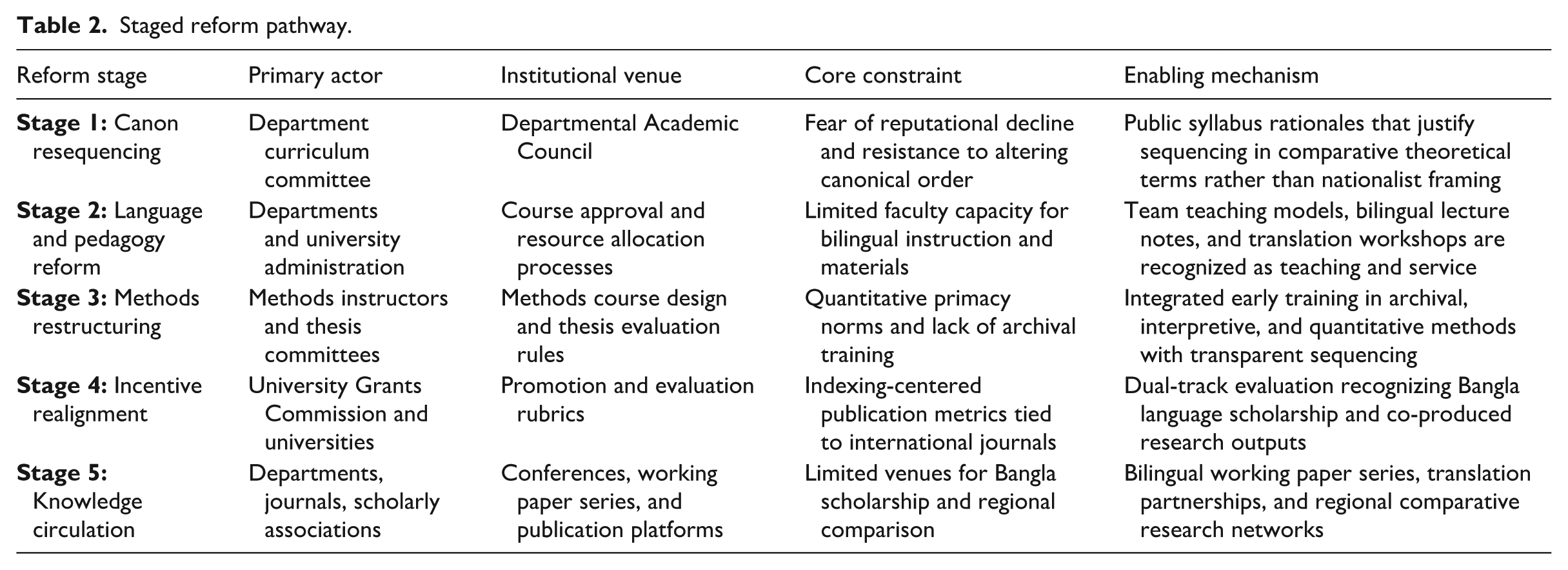
Stage 1 (years 1–2): Curricular resequencing and transparency
The first step in this process is to reorder the curriculum by placing Bangladeshi and South Asian political thought alongside Western canonical thinkers in introductory courses. Figures like K.C. Bhattacharyya, Chatterjee, and Subaltern Studies should be taught alongside Hobbes, Locke, and Rousseau in foundational courses. In addition, reading lists should be structured to include at least 40–50 percent of Bangladeshi and South Asian authors, such as Riaz, Ahmed, Khan, Mohsin, and Kabeer. To ensure transparency and foster open debate, all syllabi should be published online, allowing progress to be tracked and discussed publicly.
Stage 2 (years 1–3): Language and pedagogy
In parallel with curriculum changes, the next phase focuses on integrating language and pedagogy. This includes offering Bangla-medium sections for core theory and methods courses, with English readings serving as Supplementary Material. Students should have the freedom to write theses in Bangla, accompanied by English abstracts. Recognizing translation as a valid scholarly act is crucial, so we should encourage annotated translations of parliamentary debates, manifestos, and key monographs as academic outputs. In addition, field schools in local languages should be piloted in areas like the Chittagong Hill Tracts, haor regions, and industrial belts, where research is conducted in the preferred local languages, like Chakma, Marma, or Bangla, following FPIC protocols.
Stage 3 (years 1–3): Methods and data
The third stage emphasizes the integration of diverse research methods and the creation of a comprehensive political archive. All final-year theses should integrate archival/textual, participatory/ethnographic, and quantitative methods to ensure a holistic approach to political science research. The establishment of a Bangla Political Archive is also critical, which would require digitizing parliamentary debates, party manifestos, circulars, and judgments, and assigning DOIs to make these materials globally citable. These resources should be made publicly accessible through open-source platforms.
Stage 4 (years 2–4): Research funding and incentives
Funding and incentives play a key role in sustaining decolonization efforts. Small grants should be allocated for community-authored projects, with special calls for bilingual publications. Promotion committees should adopt a dual evaluation track by giving equal weight to outputs in indexed journals as well as Bangla monographs, datasets, and community reports. In addition, a dedicated fund should be established to support the translation of Bangladeshi works into English and vice versa to broaden the reach and impact of local scholarship.
Stage 5 (years 2–5): Outreach and uptake
The final stage focuses on bridging the gap between academic research and public practice. Policy briefs in Bangla should be published to offer accessible analyses for local governments, unions, and community organizations, using relevant political science concepts such as political settlements or partyarchy to frame practical reforms.
Conclusion
When students ask why Plato must come before the politics of their own streets, they articulate the problem more clearly than many of us dare. Syllabi are not neutral; they represent hierarchies of knowledge by reinforcing the system where theory emanates from the Global North, while Bangladesh is framed as a site for applying these theories. This was not a narrow concern but a demand for recognition that the histories, languages, and struggles of this place deserve to be taught as foundations.
The paper contributes to decolonial scholarship by showing that epistemic inequality is reproduced through institutional ordering mechanisms rather than only symbolic exclusion. It also offers a diagnostic framework that makes those mechanisms observable. It contributes to comparative political science by treating curriculum, incentives, and language regimes as governance structures that shape theory formation and method choice and are therefore legitimate objects of comparative inquiry rather than background conditions. It contributes to higher education governance debates in the Global South by linking quality assurance, donor-funded research architectures, and index-based evaluation to the everyday politics of knowledge within universities. Future research can apply this diagnostic framework to other national settings and disciplines to compare sequencing, citation geography, methodological hierarchies, and language rules across contexts and to identify which reforms produce meaningful change (Acharya, 2014; Connell, 2007).
Most importantly, the paper has shown how Bangladeshi concepts can inform global scholarship: the political settlement as an equilibrium theory of governance, political society as an account of the political repertoires under uneven citizenship, and feminist political economy as a framework that puts gendered bargaining at the center of the political. These are not mere supplements to Northern theories; they have their own mechanisms, scope conditions, and testable implications.
To decolonize political science in Bangladesh is to engage in global debates without replacing one orthodoxy with another. It is about grounding disciplinary practice in the languages, archives, and struggles of this place and, in doing so, offering concepts that others might use to understand their own. Decolonization becomes meaningful when it is embedded in institutions. The reform program outlined here sets concrete milestones for curriculum, language, method, archives, and incentives. If departments meet those milestones, Bangladesh will move from a site of application to a site of theory. That is the standard by which this agenda should be judged.
Footnotes

Ethics approval
This article is a conceptual and documentary analysis that draws on publicly available syllabi, policy documents, and published scholarship. It does not involve human participants, personal data, or experimental animals. Institutional ethics review were therefore not required for this study.
Consent to participate
This article does not involve human participants or personal data. Informed consent was therefore not applicable to this study.
Funding
The author received no financial support for the research, authorship, and/or publication of this article.
Declaration of conflicting interests
The author declared no potential conflicts of interest with respect to the research, authorship, and/or publication of this article.
Data availability statement
No new datasets were generated or analyzed for this article. All sources are publicly available and cited in the reference list. Copies of cited syllabi or policy documents can be provided upon reasonable request.