






Abstract
Why do some countries sustain neoliberal adjustment more coherently under comparable external pressures? Focusing on execution, this article argues that neoliberal adjustment entails a reconfiguration of state capacity rather than its retreat and shows that reform durability depends on effective execution rooted in institutional complementarities among bureaucratic autonomy, stable executive delegation, and institutionalized state–business coordination. Process tracing of South Korea (1980–1987), contrasted with Turkey during the same period, demonstrates that institutional alignment enabled sequenced stabilization and liberalization through credible enforcement and policy continuity, whereas misalignment produced fragmented execution, policy instability, and weak reform consolidation.
Keywords
Introduction
In the early 1980s, South Korea (hereafter Korea) navigated a period of acute external vulnerability by embarking on a far-reaching program of macroeconomic adjustment. The global recession following the Second Oil Shock and mounting external debt exposed the limits of the state-led growth model, compelling a shift toward disinflation and structural transformation. Implemented under authoritarian rule, these reforms were temporarily insulated from electoral pressures while labor and social contestation remained constrained. What distinguishes the Korean experience, however, is the coherence and durability of reform execution.
By the mid-1980s, Korea returned to a trajectory of macroeconomic stability and sustained growth. The inclusion of 1979 captures the onset of the crisis that precipitated adjustment, providing a baseline for evaluating subsequent stabilization and reform trajectories. This contrast is clearly illustrated in Figure 1, which juxtaposes Korea’s rapid disinflation and current account rebalancing with Turkey’s protracted inflation and persistent external imbalances over the 1979–1987 period. Table 1 further highlights a divergence in industrial performance: while Korea’s export share and manufacturing value added expanded steadily, Turkey’s industrial base remained comparatively stagnant. Taken together, these indicators point to a clear divergence in adjustment trajectories. Korea combined stabilization with sustained growth and export expansion, whereas Turkey experienced uneven performance and persistent instability, reflecting difficulties in sustaining coherent reform execution.
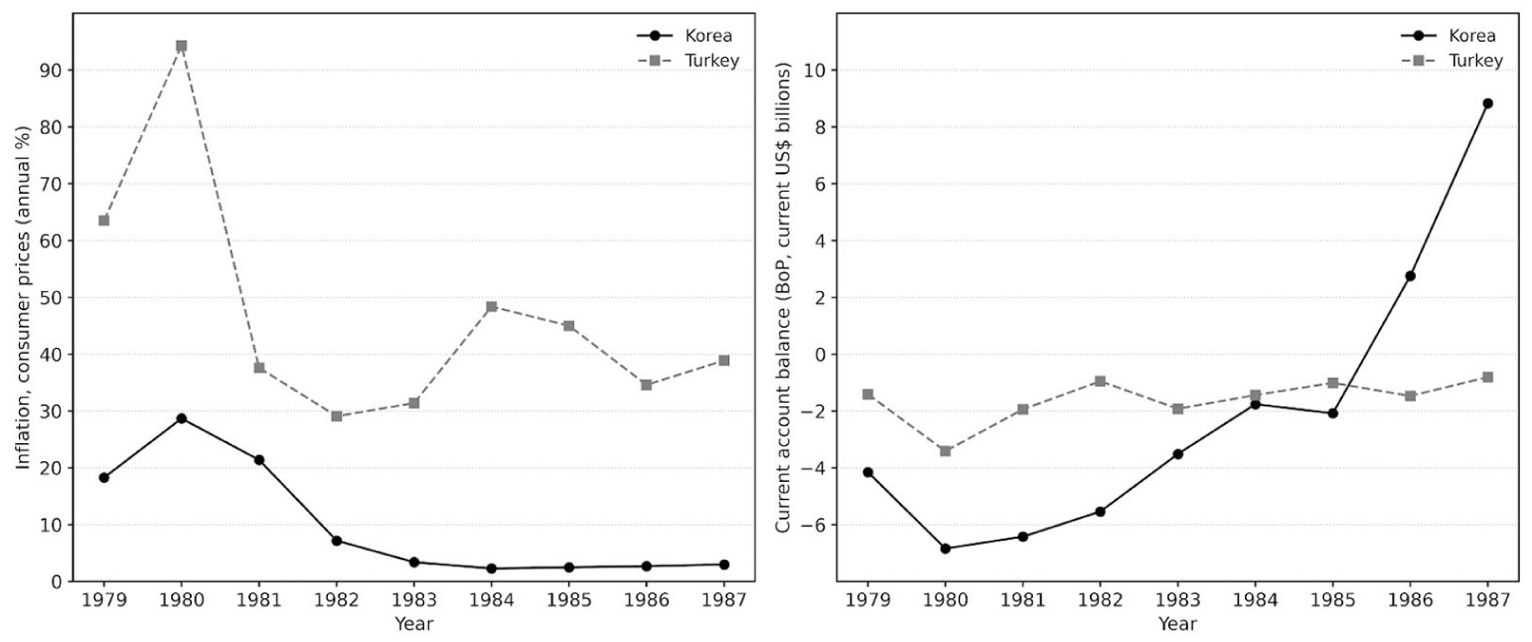
Macroeconomic adjustment indicators: (left) inflation, consumer prices (annual %); (right) current account balance (BoP, current US$ billions).
Macroeconomic Indicators of Korea and Turkey (1979–1987).
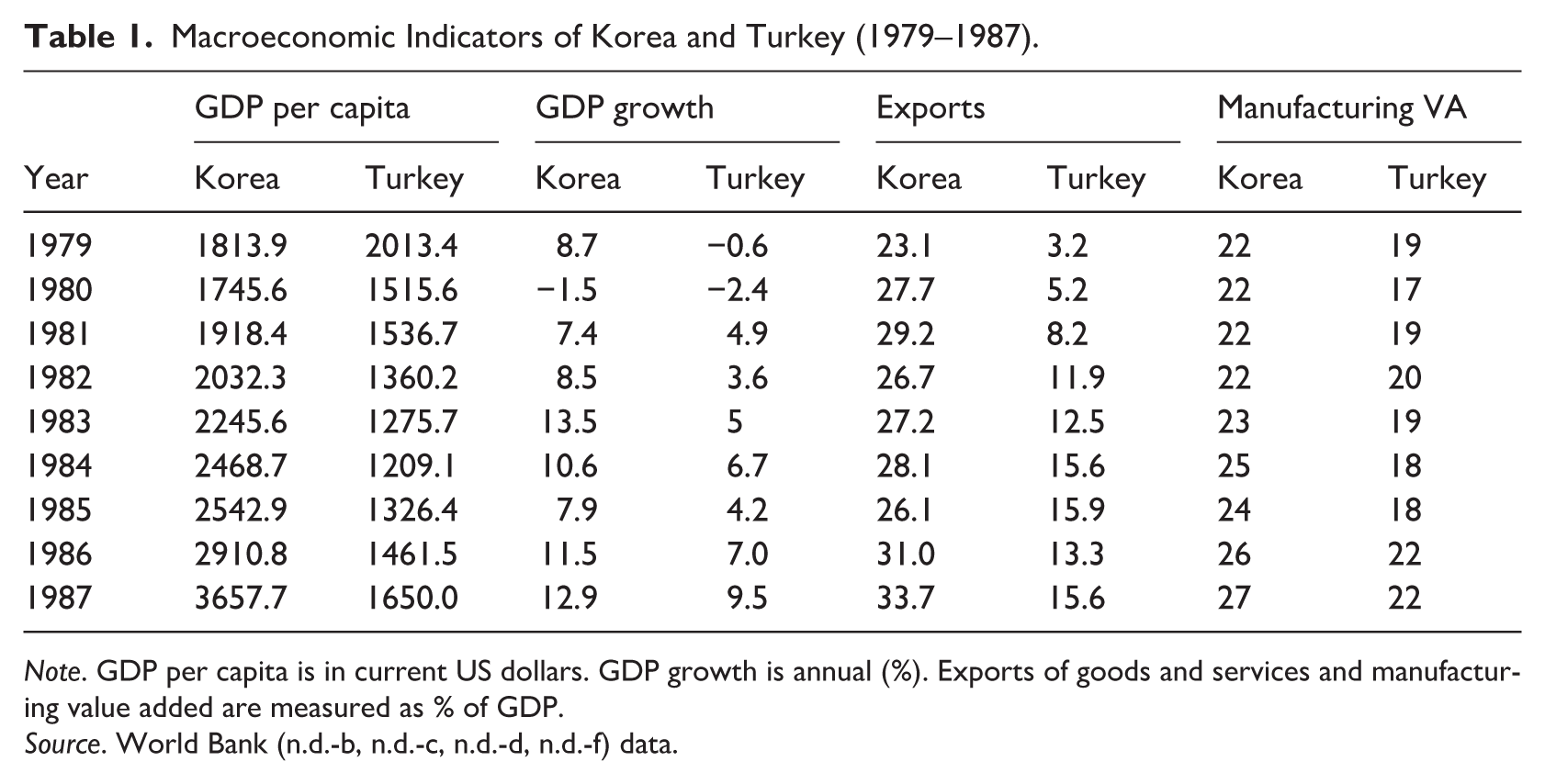
Note. GDP per capita is in current US dollars. GDP growth is annual (%). Exports of goods and services and manufacturing value added are measured as % of GDP.
Source. World Bank (n.d.-b, n.d.-c, n.d.-d, n.d.-f) data.
Why do some countries sustain neoliberal adjustment more coherently than others under comparable external pressures? This article does not seek to explain the origins of neoliberal adjustment in Korea; rather, it focuses on the institutional conditions under which such adjustment was executed and sustained during 1980–1987. Taking International Monetary Fund (IMF)-supported reform as a given starting point, the analysis examines how externally induced adjustment was implemented domestically. It argues that Korea’s reform trajectory cannot be explained by policy design alone, but by the institutional conditions that enabled coordinated execution.
The central claim of this article is that neoliberal adjustment entails not a retreat of the state, but a reconfiguration of state capacity for coordinated execution. While the reform agenda broadly aligned with policy templates promoted by the IMF and the World Bank, its effectiveness depended on how state institutions were reorganized to implement policy under conditions of external constraint. In this study, state capacity is conceptualized in terms of three interrelated dimensions: bureaucratic autonomy, stable executive delegation, and institutionalized state–business coordination. The alignment of these dimensions enabled coherent sequencing, credible enforcement, and sustained reform momentum in Korea, whereas their misalignment in Turkey produced fragmented execution and policy volatility.
To examine these mechanisms, the article employs a structured historical comparison with Turkey. The 1980–1987 period is treated as an analytically bounded phase in which reform execution can be observed under acute external constraint, prior to broader political transformation. During the same period, Turkey pursued a broadly similar adjustment agenda under comparable external shocks, yet experienced persistent inflation and repeated policy reversals. Rather than serving as a symmetrical comparator, Turkey functions as an analytical contrast that highlights how differences in institutional configuration shape the durability of externally promoted reforms.
By focusing on execution, this study shows that reform durability depends on how domestic institutions translate external conditionality into coordinated execution.
Analytical framework
State capacity: Conceptual scope and dimensions
Pre-crisis conditions are important, as “post-crisis reform often begins where pre-crisis reform stalled” (Lee et al., 2005: 4). One interpretation of Korea’s comparatively strong adjustment performance is that its earlier export-oriented industrialization (EOI) provided a structural advantage. This view, however, underestimates the extent of Korea’s external vulnerability. By the early 1980s, export expansion had been sustained through extensive foreign borrowing, placing Korea among the world’s largest external debtors (Aghevli and Márquez-Ruarte, 1985: 21). Following the Second Oil Shock, Korea faced severe balance-of-payments pressures and output contraction (Haggard and Collins, 1994: 16; Hasan, 1991: 180). Although adjustment programs were adopted under pressure from international financial institutions (IFIs), external support alone did not ensure effective stabilization or consolidation (Lee et al., 2005: 2). Outcomes depended critically on domestic institutional capacity (Weiss, 1998: x).
In this article, neoliberal adjustment is conceptualized as a linked process combining: (1) macroeconomic stabilization through disinflation and external rebalancing; (2) market-oriented restructuring, including liberalization and industrial reorganization; and (3) implementation under acute external financing constraints, typically reinforced by IMF and World Bank conditionality.
The analysis treats state capacity during neoliberal adjustment not as a fixed attribute but as a process of institutional reconfiguration. Contrary to interpretations that associate neoliberalism with state retreat, the argument here emphasizes how state institutions were reorganized to enable coordinated policy execution under conditions of external constraint. In this sense, state capacity refers to the ability to formulate and implement policy under socioeconomic pressure (Skocpol, 1985: 9) and to respond decisively in crisis contexts (Choi, 1989: 29). Neoliberal adjustment thus entailed not the erosion but the reconfiguration of state capacity to sustain reform execution.
Building on this perspective, the article disaggregates state capacity into three interrelated dimensions: bureaucratic autonomy, stable executive delegation, and institutionalized state–business coordination. These dimensions capture how authority is organized and exercised during reform implementation.
Bureaucratic autonomy is central to effective policy execution. Professionalized and cohesive economic agencies enable rule-bound decision-making while buffering against short-term political pressures (Evans, 1992: 140–141; Vartiainen, 1999: 201; Waldner, 1999: 216). In this study, autonomy refers specifically to the protected authority of core policy teams—centered on key economic agencies—to exercise jurisdiction over reform implementation.
Stable executive delegation sustains state capacity by providing consistent political backing for reform. Effective delegation entails predictable mandates and protection from partisan shocks, allowing technocratic actors to sequence reforms and maintain inter-agency coordination. By contrast, contingent or personalized delegation renders authority reversible, heightens uncertainty, and weakens implementation capacity.
Institutionalized state–business coordination enhances reform durability by linking bureaucratic decision-making with structured private-sector feedback. Drawing on the concept of embedded autonomy (Evans, 1995; Weiss, 1998), routinized consultation, monitoring, and joint problem-solving reduce information asymmetries and support coordinated adjustment under liberalization (Weiss, 1998). 1
These dimensions function as institutional complementarities: their alignment enables coherent execution and sustained reform, whereas their misalignment produces fragmented implementation and policy volatility (Evans, 1995; Thurbon and Weiss, 2021). State capacity is thus understood as an executional alignment among these dimensions, lowering coordination costs and enhancing policy credibility. This framework extends the developmental state tradition toward adaptive coordination under conditions of market-oriented reform (Thurbon and Weiss, 2021) (see Figure 2).
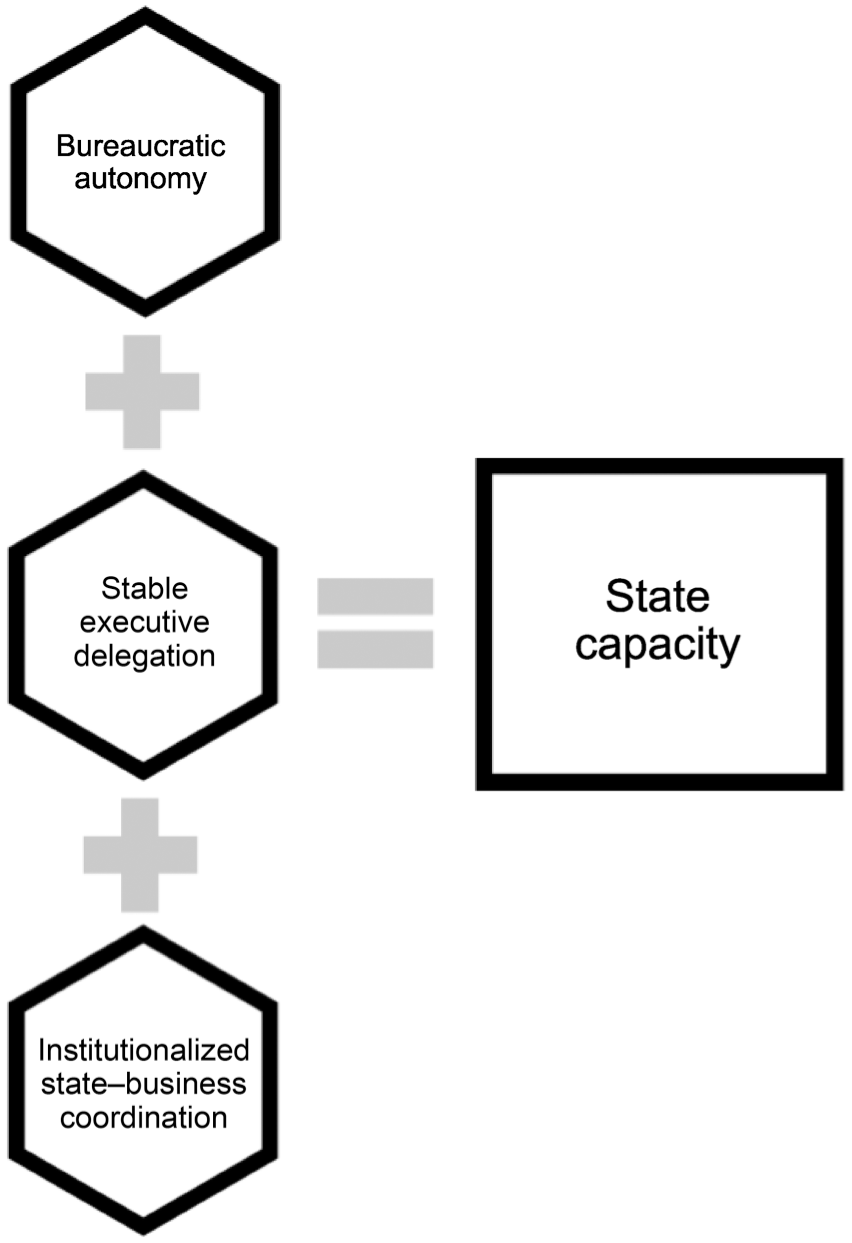
Core dimensions of state capacity.
Literature positioning and analytical expectation
Scholarship on East Asian political economy has long emphasized state capacity in shaping development outcomes (Amsden, 1989; Evans, 1992, 1995; Johnson, 1982; Wade, 1990), with subsequent work extending this insight to market design, innovation, and crisis management (Dent, 2020; Jones and Hameiri, 2022; Mazzucato, 2013; Weiss and Thurbon, 2022). Yet explanations of neoliberal adjustment often privilege policy content or sequencing while overlooking the mechanisms of reform execution under external constraint.
This study adopts a disaggregated and relational conception of state capacity to examine reform execution during the 1980–1987 adjustment period. The focus here is not reform adoption per se, but the institutional conditions of execution and durability. Korea serves as the primary mechanism-tracing case, while Turkey is introduced as a contrastive reference, illustrating how variation in bureaucratic autonomy, executive delegation, and state–business coordination conditions the durability of externally induced reforms under broadly comparable external pressures. This expectation is evaluated through process tracing of reform execution in Korea, with Turkey serving as a comparative benchmark.
This framework yields a clear analytical expectation. Where these dimensions align, reform execution is more likely to be coherent and durable during periods of neoliberal adjustment. Conversely, misalignment across them is expected to produce fragmented implementation and fragile consolidation under comparable external pressures.
Research design and methodology
This study employs a structured historical comparison of Korea and Turkey during 1980–1987, controlling for the shared context of externally induced adjustment and acute external vulnerability while tracing how domestic institutional configurations shaped execution trajectories. Turkey is selected as a contrast case because it faced comparable external financing constraints and adopted IFI-supported adjustment under an authoritarian interlude, but lacked the institutional complementarities identified above. By holding these macro-level variables constant, the analysis identifies how divergent domestic institutional configurations shaped distinct execution trajectories in each case.
The research focuses primarily on Korea as the primary case for mechanism-tracing, identifying observable markers of executive delegation and state–business coordination within key agencies such as the Economic Planning Board (EPB) and the Presidential Secretariat. These markers include the clarity of technocratic mandates, the stability of jurisdictional authority, and the routinization of public–private consultation. The analysis proceeds by first reconstructing pre-1980 institutional legacies, followed by an examination of reform execution and coordination during the 1980–1987 period, and concludes by assessing the causal impact of state capacity through a contrastive assessment of the Turkish experience. Evidence for this qualitative tracing is triangulated through government documents, elite memoirs, IMF and World Bank reports, and business association records, and is cross-checked against macroeconomic indicators to ensure empirical robustness across both cases.
Institutional legacies shaping neoliberal adjustment
Korea
By the late 1970s, Korea had developed institutional features that would critically shape the execution of neoliberal adjustment in the following decade. During the 1960s, the military-led government under Park Chung-hee insulated economic policymaking from partisan interference by delegating authority to the EPB, thereby establishing a centralized and technocratically coherent economic bureaucracy (Choi, 1991: 24). This EOI model was accompanied by formal channels of state–business coordination, including regular consultation with organized business groups such as the Federation of Korean Industries (FKI). These arrangements underpinned the emergence of a high-capacity developmental state.
From the early 1970s, however, the consolidation of authority within the Presidential Secretariat weakened EPB autonomy, while the push toward heavy and chemical industries increased external indebtedness and macroeconomic vulnerability (Chung, 1994; Haggard, 1994; Kang, 2002). Reform-oriented technocrats within the EPB increasingly criticized the developmental excesses of the heavy and chemical industrialization drive and pressed for stabilization and market-oriented reforms (Choi, 1991: 249–252; Park, 2004). The EPB-led stabilization package announced in April 1979 marked a partial shift toward macroeconomic discipline, although its impact was curtailed by the Second Oil Shock and political instability following Park’s assassination (Choi, 1991: 257; Kang, 2010: 408).
Despite these disruptions, Korea entered the 1980s with a legacy of centralized and cohesive economic bureaucracy, technocratic expertise, and routinized state–business coordination. These attributes provided the institutional foundations for bureaucratic autonomy, facilitated stable executive delegation, and ensured the continuity of state–business coordination during subsequent reform execution.
Turkey
Turkey’s pre-1980 institutional trajectory differed markedly. Although the State Planning Organization (SPO) was established in 1961 following the military coup, it lacked sustained political backing and institutional autonomy. Frequent government turnover, politicized appointments, and external interference limited technocratic authority and policy coherence (Batur, 1998; Milor, 1989). Consequently, the SPO was structurally inhibited from formulating long-term development strategies or addressing the inherent flaws of the import-substitution industrialization (ISI) model (Aydın, 2005: 38–39; Barkey, 1990: 104). Business representation remained fragmented and weakly embedded, with the Union of Chambers subordinated to the state and internally divided (Waldner, 1999). As a result, state–business coordination remained shallow through the 1960s and 1970s.
By the late 1970s, Turkey faced acute macroeconomic crisis driven by foreign-exchange mismanagement and the exhaustion of ISI during the Second Oil Shock (Celâsun and Rodrik, 1989b). The structural inability of the state to manage these imbalances was most evident in the domestic price level; the rate of inflation skyrocketed from 25% in 1977 to 52.6% in 1978 and reached 63.9% by 1979 (Aydın, 2005: 40). The appointment of Turgut Özal to senior economic posts in 1979 signaled a turn toward liberalization, culminating in the stabilization measures of 24 January 1980 that initiated export-oriented liberalization (Aricanli and Rodrik, 1990; Barkey, 1990). However, escalating political unrest and persistent institutional fragility constrained the efficacy of these measures. The September 1980 military coup temporarily restored order and expanded Özal’s authority over economic policy, but failed to resolve weaknesses in bureaucratic autonomy and state–business coordination, thereby undermining stable executive delegation and limiting coherent reform execution throughout the 1980s.
Neoliberal adjustment and reform execution, 1980–1987
Korea
Following the December 1979 military intervention, Korea’s interim administration preserved the EPB’s stabilization blueprint, which incorporated fiscal austerity, currency devaluation, a flexible exchange rate regime, and energy price restructuring in line with IMF and World Bank recommendations. Korea’s first one-year stand-by arrangement with the IMF, signed in March 1980, provided crucial external financing and reinforced policy credibility during the initial stabilization phase (Aghevli and Márquez-Ruarte, 1985: 5).
After assuming the presidency in September 1980, Chun Doo-hwan delegated economic authority to a tightly coordinated executive–technocratic core. Kim Jae-ik, a Stanford-trained neoclassical economist and principal architect of the 1979 stabilization program, was granted a clearly defined and protected mandate as chief economic advisor. Under Chun’s political backing, the Presidential Secretariat and the EPB operated in close alignment, institutionalizing stabilization objectives within the Fifth Five-Year Plan (1982–1986).
As a result, inflation had fallen to single digits by 1982 for the first time since 1965 (Sakong, 1993: 70). To sustain this disinflationary trend, the administration further imposed a comprehensive budget freeze for the 1984 fiscal year—facilitated by the introduction of zero-based budgeting—despite intense opposition from the ruling party ahead of the 1985 general elections (Cho and Kang, 2013). Furthermore, this technocratic mandate was protected even when it necessitated politically sensitive cuts in the defense budget (Yuksŏngŭro tŭnnŭn kyŏngjegijŏk p’yŏnch’anwiwŏnhoe, 2013).
Importantly, stabilization was not pursued as an isolated shock therapy. Once macroeconomic stability was secured, the administration advanced a sequenced liberalization strategy encompassing financial reform, trade liberalization, and gradual privatization. Financial liberalization proceeded through bank privatization, expanded competition, and increased foreign participation in financial services, including the establishment of joint-venture banks and the opening of insurance and securities markets (Aghevli and Márquez-Ruarte, 1985: 17–18; Choi, 1991: 303–304).
Despite Kim’s death in the 1983 Rangoon bombing, the core reform blueprint endured, reflecting sustained delegation beyond individual leadership. In 1984, the Chun administration signaled its commitment to long-term structural reform by announcing a comprehensive five-year roadmap for import liberalization. This plan aimed to progressively raise the import liberalization ratio from 85% in 1984 to 95% by 1988, while simultaneously reducing average tariff rates from 22% to 18% over the same period (Aghevli and Márquez-Ruarte, 1985: 17). By providing a clear and predictable schedule for opening domestic markets, the state allowed local industries to adapt while ensuring the credibility of its neoliberal adjustment program.
By the mid-1980s, reform implementation increasingly pivoted toward more systematic state–business coordination. This evolution from macro-stabilization to sectoral restructuring demonstrates that sustaining reform credibility depended on institutionalized consultation rather than mere bureaucratic insulation. A landmark development was the Industrial Development Act (IDA) of 1985, which established the Industrial Development Civil Council to incorporate civilian expertise into industrial governance. However, this consolidation of public–private partnership did not signify a retreat of the state. Rather, the IDA reinforced executive authority, as the Presidential Decree continued to play a central role in designating industries and approving rationalization plans (Yoon, 2012). Thus, the state reorganized its industrial policy by incorporating private-sector participation, while effectively retaining the power to discipline and steer the market through these newly established administrative channels (Kim, 1999).
In sectors such as electronics, policy coordination extended beyond consultation to joint problem-solving. A notable example was the 1986 initiative to develop a 4-megabit DRAM chip, in which the government coordinated chaebol investment and public research capacity through the Electronics and Telecommunications Research Institute to avoid duplication and foster technological upgrading (Kim, 2017: 233–234).
Between 1980 and 1987, Korea thus reconfigured its growth model toward greater reliance on private-sector activity while maintaining coordinated state oversight. Favorable external conditions in the mid-1980s reinforced this trajectory, but they did not substitute for the institutional arrangements that enabled coordinated sequencing and policy continuity. These arrangements allowed reforms to persist beyond individual leadership changes and sustained economic continuity after democratization.
Turkey
Turkey also entered the 1980s under military rule, following the September 1980 coup that consolidated the authority of the National Security Council under the 1982 constitution. As deputy prime minister for economic affairs, Özal exercised substantial autonomy in designing and implementing adjustment policies, drawing on his World Bank experience and close ties with IFIs. IMF stand-by arrangements and World Bank structural adjustment loans supported monetary tightening, devaluation, and trade liberalization during the early stabilization phase (Celâsun and Rodrik, 1989a: 671; Foroutan, 1991: 444–446). Inflation declined sharply from triple-digit levels in 1980 to an average of 31.3% between 1981 and 1983 (Öniş and Şenses, 2022: 208).
After the return to civilian rule in 1983, when Özal assumed office as prime minister, executive authority in Turkey was highly personalized. Although Özal leveraged centralized powers inherited from the military interlude to accelerate liberalization by dismantling import controls and cutting tariffs (Aricanli and Rodrik, 1990: 1345–1346), initial export gains proved difficult to sustain (Kopits, 1987: 4). This reflected the absence of stable executive delegation and institutionalized state–business coordination.
Unlike Korea, executive delegation in Turkey remained contingent and idiosyncratic, with reform authority concentrated in a narrow circle of loyal technocrats rather than embedded in institutionalized, rule-bound mandates. This arrangement weakened bureaucratic autonomy and fragmented policy authority, undermining coordination in complex reform areas such as privatization and regulatory restructuring (Biddle and Milor, 1997; Özbudun, 1994).
State–business relations further reflected weak institutionalization. Although the Turkish Industry and Business Association (TÜSİAD) initially supported Özal, these relations remained largely informal and dependent on personal ties, lacking routinized consultation mechanisms (Arat, 1991: 144; Süzer, 2001: 85). Critically, the execution of adjustment policies was compromised by a shift toward particularistic rent distribution. As Aydın (2005: 48–49) observes, the political leadership increasingly bypassed formal bureaucratic regulations in favor of patron–client relationships, effectively subordinating the traditional bureaucracy to political interests. This systemic reliance on clientelistic networks, rather than transparent institutional rules, eroded the state’s capacity to enforce structural discipline during the reform process.
Internal divisions within TÜSİAD limited its capacity to function as a coherent interlocutor, while macroeconomic volatility and policy reversals severely deterred long-term private investment (Bekmen, 2024: 507). Export performance was further distorted by incentive manipulation and policy reversals, reinforcing economic instability and undermining investor confidence (Öniş and Şenses, 2022).
Despite early stabilization gains, fiscal discipline eroded in the mid-to-late 1980s as growth and distributional objectives increasingly shaped the policy mix, contributing to widening deficits and renewed macroeconomic instability (Kopits and Robinson, 1990). Whereas in Korea delegation and coordination were institutionalized through formal councils and rule-bound mandates (Kim, 1999), Turkey’s adjustment relied on contingent executive control and fragmented implementation, limiting reform durability.
Comparative analysis
This section explains the divergence in Korea’s and Turkey’s adjustment trajectories during 1980–1987 through the interaction of bureaucratic autonomy, executive delegation, and state–business coordination. The distinct institutional trajectories and reform outcomes of the two cases are summarized in Table 2. Rather than treating adjustment outcomes as a function of policy design or external conditions alone, the comparison highlights how the alignment of these institutional features shaped the coherence, sequencing, and durability of reform execution. Korea serves as the primary mechanism-tracing case, while Turkey functions as a contrastive reference illustrating how systemic misalignment disrupted comparable reform agendas under shared external pressures.
Institutional trajectories and adjustment outcomes: Korea and Turkey.
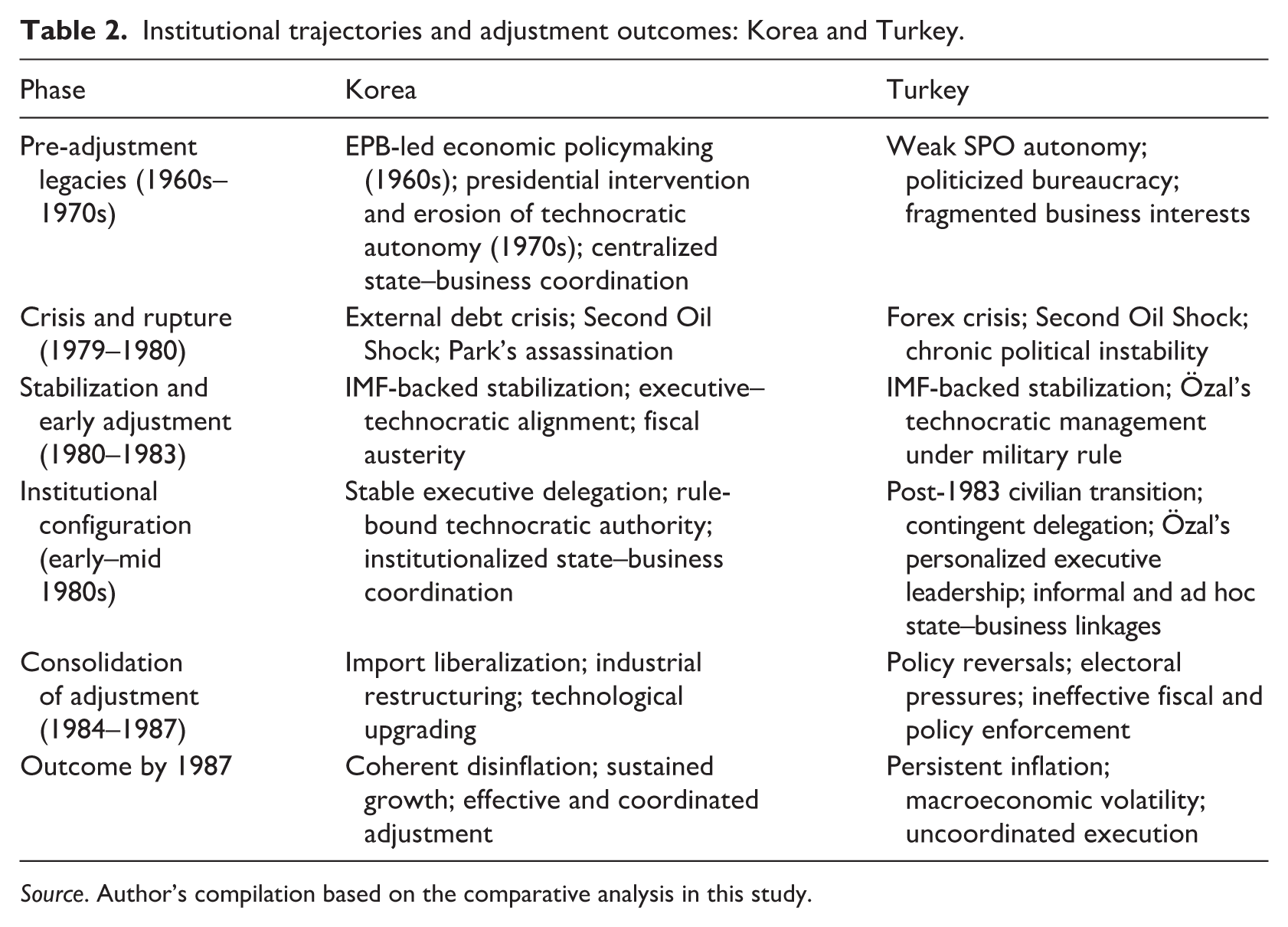
Source. Author’s compilation based on the comparative analysis in this study.
Bureaucratic autonomy differed sharply across the two cases in recruitment patterns, career cohesion, and the stability of jurisdictional authority within core economic agencies. In Korea, adjustment was implemented by career technocrats embedded in a merit-based bureaucracy, with standardized recruitment and promotion practices that reinforced intra-state cohesion and policy continuity (Öniş, 1991: 124). Although the Presidential Secretariat wielded significant political authority, it remained closely aligned with the EPB on stabilization and liberalization objectives. Inter-ministerial bargaining over initiatives such as industrial restructuring functioned as rule-bound coordination within a shared policy trajectory rather than as ad hoc interference. The Turkish case, by comparison, relied heavily on politically appointed technocrats closely associated with Prime Minister Özal. Selected primarily through personal loyalty rather than transparent meritocratic pathways, these appointees lacked a unified professional identity and frequently clashed with career civil servants. Overlapping mandates and fragmented agency authority generated jurisdictional disputes, diluting institutional responsibility and undermining continuity in complex reform areas such as ownership reform and regulatory restructuring.
The second dimension, stable executive delegation, further differentiated the two cases. In Korea, executive authority under Chun was exercised through stable delegation to a technocratic core, supported by consistent political backing for stabilization and subsequent liberalization. This arrangement reduced uncertainty and created a predictable implementation corridor in which policy teams could sequence reforms—first disinflation and fiscal restraint, then gradual liberalization—without recurrent redefinition of mandates. In Turkey, executive leadership under Özal was marked by discretionary control, frequent intervention, and reliance on informal channels. Delegation remained contingent and reversible, with policy authority flowing through personal proximity to the executive rather than through institutionalized roles. As electoral considerations gained prominence, expansionary moves aggravated fiscal and inflationary pressures, contributing to policy reversals and coordination failures even under a reform-oriented leadership.
The third dimension, institutionalized state–business coordination, constituted a key axis of divergence. In Korea, state–business relations were embedded and consultative, facilitating information exchange, monitoring, and joint problem-solving during liberalization. Structured mechanisms associated with organized business groups and the inclusion of private-sector expertise in industrial policymaking enabled governed interdependence, reinforcing reform credibility and supporting upgrading alongside stabilization. State–business relations in Turkey, however, remained largely informal and episodic. Although major business groups initially supported liberalization, consultation lacked stable institutional channels and depended heavily on personal ties. Internal divisions within business associations further limited collective representation, weakening feedback loops and compliance monitoring. As macroeconomic volatility persisted and policy credibility declined, these weaknesses constrained the capacity to sustain coordinated adjustment beyond the initial stabilization phase.
Overall, the comparison supports the article’s central claim: Korea’s comparatively stronger adjustment outcomes by 1987 reflected institutional alignment, whereas Turkey’s weaker consolidation stemmed from misalignment, producing fragmented implementation and policy volatility despite similar reform agendas. Favorable external conditions could ease adjustment pressures, but did not substitute for domestic execution capacity. Ultimately, this divergence demonstrates how institutional alignment shapes policy sequencing and, in turn, the durability of neoliberal adjustment.
Conclusion
This article has shown that variation in state capacity—expressed through institutionalized modes of execution—was decisive in shaping the durability of neoliberal adjustment. Moving beyond explanations centered on policy design or inherited development strategies, the Korea–Turkey comparison demonstrates that reform outcomes depended on how effectively states organized and sustained policy execution under conditions of external constraint.
The Korean case illustrates how institutional complementarities among bureaucratic autonomy, stable executive delegation, and institutionalized state–business coordination enabled a coherent reform trajectory. These features supported the sequencing of disinflation with market-oriented restructuring, ensured policy continuity, and allowed reforms to persist beyond individual leadership. By contrast, Turkey’s experience highlights how the absence of such alignment—manifested in politicized appointments, contingent delegation, and weakly institutionalized coordination—produced fragmented implementation and policy volatility, limiting the consolidation of adjustment despite initial stabilization gains.
The comparison further suggests that while authoritarian rule provided a permissive context for reform, it did not determine outcomes. Rather, reform performance hinged on the quality of delegation and the institutionalization of coordination that sustained credible and predictable policy implementation.
More broadly, these findings underscore that neoliberal adjustment entailed not a retreat of the state, but a reconfiguration of state capacity for coordinated execution. The durability of reform depended not on formal adoption alone, but on the institutional alignment that enabled states to translate external conditionality into sustained and coherent policy action.
While this study has focused on the 1980–1987 period as an analytically bounded phase of adjustment, the findings also point to important temporal limits. Korea’s relative success during this period does not preclude the possibility that the same institutional mechanisms generated longer-term tensions that became more visible under democratic conditions. Future research may therefore examine how these executional arrangements evolved beyond authoritarian contexts and interacted with emerging political and distributional pressures.
Footnotes
Author note
This article is based on the author’s doctoral dissertation titled “Encounters with Neoliberal Globalization: South Korea and Turkey in Comparative Perspective,” completed at Boğaziçi University.

Funding
The author received no financial support for the research, authorship, and/or publication of this article.
Declaration of conflicting interests
The author declared no potential conflicts of interest with respect to the research, authorship, and/or publication of this article.