






Abstract
This paper examines the role of religious discourse in shaping the foreign policy of the Islamic Republic of Iran, with a particular focus on the speeches of Ayatollah Ruhollah Khomeini and Ayatollah Ali Khamenei. It argues that Iran’s foreign policy is neither purely ideological nor strictly pragmatic; rather, it emerges from the interplay between Shiite (Shia) religious concepts and geopolitical imperatives. Central concepts—such as the Islamic Revolution, the oppressed (mostazafin), the Islamic Ummah, jihad, resistance, and martyrdom—form a coherent semantic system that legitimizes strategic policies, anti-hegemonic positions, and support for allied non-state actors across the Middle East. By linking theological narratives to strategic objectives, Iran frames its foreign policy within a moral–religious universe, positioning itself as a defender of oppressed communities, a promoter of South–South solidarity, and a challenger to Western-dominated international structures. The study demonstrates that while religious ideology provides normative and motivational resources, practical foreign policy decisions are shaped by structural, geopolitical, and domestic constraints, reflecting a hybrid strategy that combines moral discourse with strategic pragmatism.
Introduction
The foreign policy of the Islamic Republic of Iran has been characterized by a dichotomy since its establishment in 1979. The 8-year Iran–Iraq War (1980–1988) quickly revealed the tension between ideological slogans such as “exporting the revolution” and “the brotherhood of all Muslims” and more pragmatic objectives, including nationalism and strategic interests. While Iran has consistently challenged the regional and international order, portraying it as unjust and a legacy of colonialism shaped by major powers, particularly the United States, it has nevertheless been compelled to draw closer to Russia and China in pursuit of its regional goals. Even after US military interventions in Afghanistan and Iraq in the post-2000 period, Iran at times engaged in cooperation with the United States.
In recent years, global and regional geopolitical shifts have significantly transformed Iran’s foreign policy. Following the Abraham Accords, the events of October 7, and the subsequent wartime conditions in the region, the realignment of Middle Eastern alliances together with normalization agreements between Israel and several Arab states has placed Iran in a highly challenging position. These developments have produced new strategic dilemmas for the Iranian leadership. Although authoeities have consistently sought to align foreign policy with ideological interpretations of Islamic texts, regional realities have compelled pragmatic adaptation to emerging geopolitical (Kızılyurt, 2025).
The profound transformation of the Middle Eastern regional order after September 11 enabled the United States to consolidate its presence in close proximity to Iran. Following US military interventions in Afghanistan and Iraq, Iran’s foreign policy came increasingly “under the command of realist considerations.” After 2003, Iran sought to instrumentalize religious identity as a means of building security alliances with Shiite factions across the region. Vali Nasr (2007), in The Shia Revival, argues that Shiite communities have managed to establish “new cultural, economic, and political relations” throughout the Middle East. Slavin (2007) reinforces this claim, maintaining that Iran’s plans for Iraq included the creation of a “zone of influence and buffer” against potential US attacks.
Moreover, Tehran’s strategy of turning Iraq into a friendly state has facilitated the emergence of a political bloc that could undermine the region’s traditional security system, which has been largely centered on the interests of foreign powers rather than Iran. Yet Hunter (2010) argues that Iran’s foreign policy is unrealistic and naïve, stemming from a “failure to comprehend the dimensions of systemic change” in the post-Soviet environment. The combination of an unrealistic foreign policy and Tehran’s inability to effectively project its “ideological burden,” she suggests, has undermined its own security “by encouraging key actors to destabilize it.”
Bahgat and Ehteshami (2021) concur with Hunter that Iran remains in the process of assimilating the structural transformations of the post-Soviet order. However, they contend that the Islamic Republic ultimately functions as a rational and pragmatic actor, whose conduct is closely calibrated to Tehran’s assessments of its relative position as it seeks to assume “the more assertive role expected of a regional middle power in the Middle East.” Consequently, scholarly interpretations of Iranian foreign policy diverge considerably. Some characterize it as a synthesis of idealism and insecurity (Perthes, 2010); others attribute it to the predominance of ideological conservative factions within key state institutions (Terhalle, 2009); and still others interpret it as an ongoing attempt to reconcile universalist revolutionary aspirations with strategic imperatives (van den Bos, 2017).
Despite these varying emphases on realism in Iran’s foreign policy, religious discourse provides the normative framework for action. This paper argues that Iran’s approach is grounded in both ideological interpretations of religious narratives and geopolitical imperatives. Iran draws on religious principles to articulate its positions in neighboring countries and its stances toward the United States and its other rivals. At the same time, to pursue these policies effectively, it engages in regional and transregional disputes. Through this combination of an ideological belief system and a geopolitical outlook, Iran has expanded its influence across the Middle East, often building partnerships with non-state actors that share similar religious and ideological objectives, such as Hezbollah in Lebanon and Shiite militias in Iraq and Yemen, while presenting itself as a defender of oppressed Muslim populations.
In pursuit of its objectives aimed at promoting multipolarity, Iran also engages in a broader effort to challenge the Western-led liberal order, which it perceives as unjust. In its calls for a more equitable international system, Tehran envisions a world in which Islamic principles constitute the foundation of governance and justice (Mearsheimer, 2024). More broadly, the emphasis on religious beliefs has deepened geopolitical fault lines in Iran’s foreign policy and regional relations, encouraged other actors to adopt similar strategies.
The aim of this study is to examine how Iran employs religious narratives as a tool of foreign policy, particularly in challenging Western hegemony. By analyzing key speeches of Ayatollah Khomeini and Ayatollah Khamenei, we demonstrate that Iran’s foreign policy is not merely a reaction to external pressures but is instead rooted in a distinct vision of world order that seeks to reconcile religious ideals with strategic objectives. In doing so, this article contributes to a deeper understanding of how religious beliefs function not only as a cornerstone of Iran’s domestic identity but also as a crucial element in shaping its international position.
Methodology
This study adopts a qualitative discourse-analytical approach to examine how religious and ideological narratives are constructed and mobilized within Iran’s foreign policy discourse. The theoretical framework is situated within the tradition of poststructuralist discourse analysis as developed by Ernesto Laclau and Chantal Mouffe (2001), complemented by appraoches from critical constructivism in international relations. This framework conceptualizes discourse as a structuring practice that fixes meaning temporarily through hegemonic articulation. Therefore, the analysis traces how religious signifiers acquire strategic functions within foreign policy statements.
The primary source corpus consists of 62 public speeches, written statements, and official addresses delivered by Ayatollah Khomeini (1979–1989) and Ayatollah Khamenei (1989–present). Selection criteria were: (1) relevance to foreign policy or international relations; (2) institutional significance (UN addresses, Quds Day statements, Friday sermons, meetings with foreign dignitaries); and (3) temporal distribution across five periods: the Iran–Iraq War (1980–1988), reconstruction (1989–1997), reform (1997–2005), Ahmadinejad presidency (2005–2013), and post-Joint Comprehensive Plan of Action (JCPOA) era (2015–present). Purely ceremonial or repetitive speeches were excluded.
An initial coding scheme was developed inductively through close reading of a pilot sample of 12 speeches. The final framework comprises six analytical categories: religious authority, resistance and anti-hegemony, justice and oppression (mostazafin), civilizational identity, sovereignty and non-alignment, and strategic pragmatism. Each speech was coded manually using thematic analysis. A second coder independently coded a 20% sample, achieving 87% intercoder agreement.
Four strategies were employed to address the state-aligned nature of primary sources: (1) critical triangulation with independent academic studies and international reports; (2) performative analysis focusing on legitimizing functions rather than genuine intentions; (3) contradiction tracking to identify shifts and inconsistencies between discourse and policy outcomes; and (4) historical comparison tracing discourse across different periods and domestic contexts.
This study has several limitations. First, the analysis is confined to publicly available discourse and does not include access to internal policy deliberations. Second, the focus on leadership speeches may overrepresent official ideology relative to bureaucratic or factional variations within Iran’s foreign policy apparatus. Third, while the study examines how discourse justifies policy, it does not systematically measure the causal effect of discourse on policy outcomes. These limitations are addressed through the triangulation strategies described above and are acknowledged as boundaries to the study’s claims.
The ideological foundations of Iran’s religious narrative
From a discursive perspective, shifts in the forms and rules of discourse can transform the object itself, since foreign policy is not constructed on the basis of fixed ideas. Different language games play a significant role in organizing state foreign policy. Most importantly, no inherent or essential relationship exists between political subjects and the vocabulary of foreign policy. This is precisely why foreign policy realists emphasize the fluid and changeable nature of state behavior. Rather than attributing primacy to the subject or to discursive frameworks, they focus their efforts on understanding, influencing, and engaging with the object; within this framework, they consistently underline the adaptability of foreign policy. They view change as the result of the continuous transformation of political, social, and international objects (Chehabi, 1991; Frost and Lechner, 2016).
Accordingly, following the 1979 Revolution and the rise of Iranian Islamists, the role of religion in Iran’s foreign policy increased significantly. As religion gained prominence in politics, prioritizing Islam and the interests of Muslims became an integral component of foreign policy. This orientation was codified in the Constitution as the supreme legal document guiding foreign policy. The Constitution explicitly refers to the “formulation of the country’s foreign policy on the basis of Islamic criteria” (Article 3), the “fraternal commitment to all Muslims” (Article 3), the “alliance and unity of Islamic nations and the unity of the Islamic world” (Article 11), the “defense of the rights of all Muslims worldwide” (Article 152), “non-alignment with hegemonic powers” (Article 152), and the “complete rejection of colonialism” (Article 3) (Iran’s Constitution, 1979).
However, because religious texts offered limited engagement with concepts such as imperialism, great powers, and justice, Iranian policymakers drew on intellectual resources from leftist thinkers. Following the Islamic Revolution, these concepts became deeply embedded in Iran’s foreign policy, particularly in its opposition to the international order and US hegemony. That said, religious concepts continue to play a central role. In challenging US hegemony and sustaining its position toward regional rivals, Iran frequently invokes the concept of jihad. Similarly, in fostering a unified Islamic community against major powers, it emphasizes justice. To operationalize these goals, Iran has increasingly relied on subnational actors, though this approach has also contributed to regional tensions. Geopolitical constraints and economic imperatives have pushed Iran to incorporate pragmatism alongside religious ideology in its foreign policy.
Iran’s foreign policy is best understood as a hybrid outcome of ideology and pragmatism. Its Islamic revolutionary ideology is grounded in opposition to global arrogance, particularly the United States, support for the oppressed (mostazafin) and the Axis of Resistance, export of revolutionary values, rejection of regional rivals, and the doctrine of velayat-e faqih as the ultimate source of political legitimacy. On the other hand, when regime survival, national security, and economic interests are at stake, decisions follow cost–benefit calculations even when these appear to contradict ideological ideals.
At the same time, it remains inherently pragmatic. In practice, when regime survival, national security, strategic interests, and economic considerations come to the fore, decisions follow cost–benefit calculations even when these appear to contradict ideological discourse. This duality enables Iran to balance its commitment to Islamic values with the pursuit of strategic objectives. Therefore, while realist and pragmatic explanations emphasize material factors or regime security, a discourse-analytical approach reveals how religious narratives legitimize these strategic choices for domestic and regional audiences.
Thematic discourse analysis.
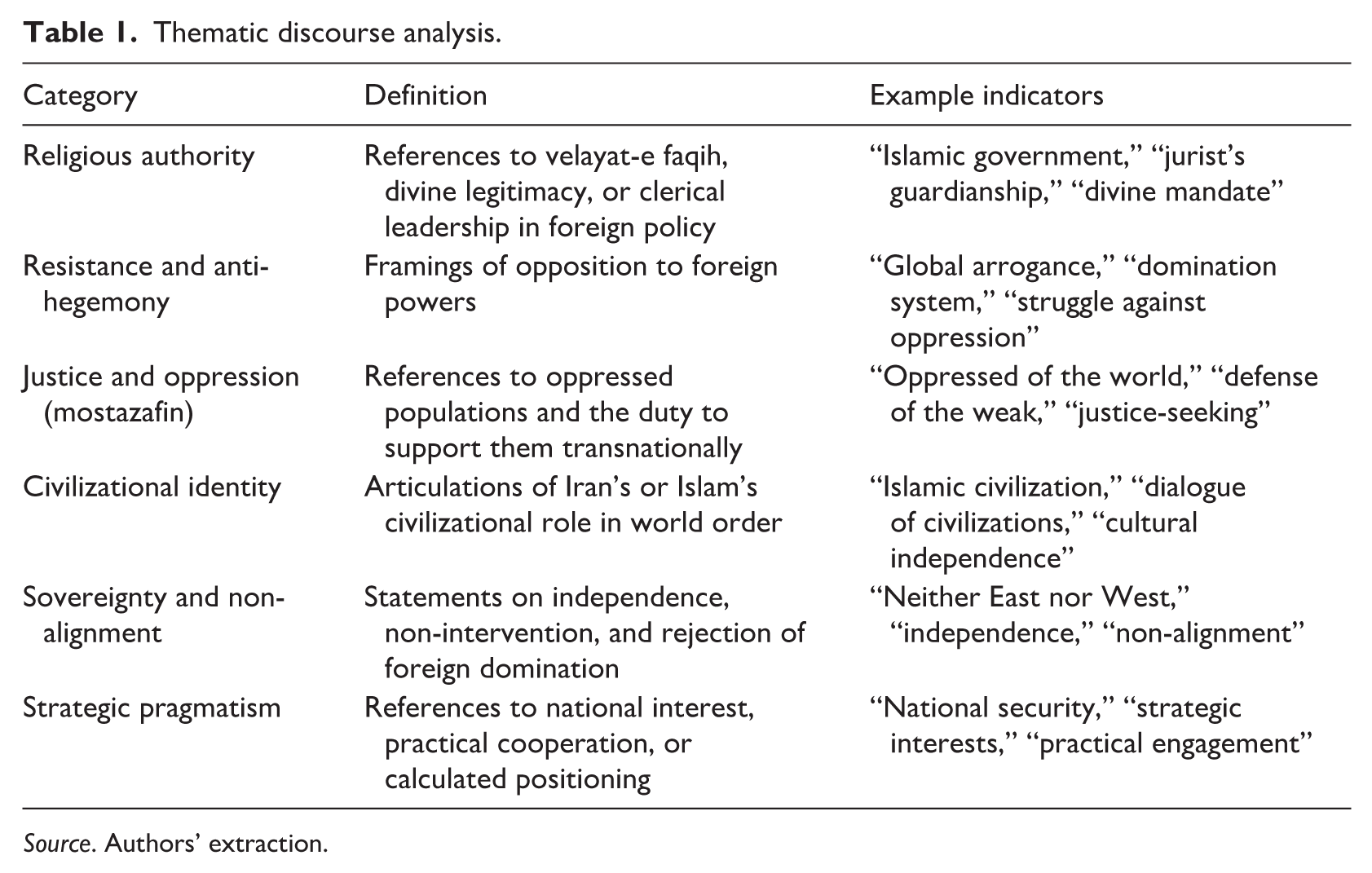
Source. Authors’ extraction.
Bridging Shia school and geopolitics
Iran’s foreign policy apparatus is shaped by a religious political ontology in which Shiism functions not merely as a belief-based identity but as a lens for interpreting global and regional politics. This identity legitimizes Iran’s regional actions. Through engagement with Hezbollah in Lebanon and non-state actors in Iraq and Yemen, the Islamic Republic underscores its ethical duty to support co-religionists. However, the alliances formed with these paramilitary groups are influenced not only by religious doctrine but also by strategic calculations of deterrence and balance of power, indicating that ethical discourse often overlaps with pragmatic security considerations (van den Bos, 2017).
Leveraging the position of Shiite minorities within the broader Muslim world and emphasizing “justice-oriented” discourse, Iran encourages dissent and resistance against established Islamic governments that maintain favorable relations with the West. Through this approach, it seeks to shape the behavior of these states in alignment with its strategic objectives. Consequently, by cultivating a hybrid political identity in which Shiite doctrine serves as a tool for advancing geopolitical goals, Iran is able not only to function as a nation-state but also to conceptualize its role as a proponent of an alternative and justice-centered international order.
To achieve its vision of justice within the international system, Iran draws on one of the more contested concepts in Shiite Islamic jurisprudence, namely jihad. Iran interprets jihad in its foreign policy as both defensive and offensive. The defensive aspect focuses on protecting Iran against external threats, while the offensive dimension seeks to export the ideals of the Islamic Revolution to Islamic countries aligned with the West. This dual interpretation allows Iran to frame its participation in regional conflicts as either a defense of fellow Muslims or a struggle against Western imperialism (Lob, 2016).
Empirical studies of Iran’s proxy network reveal operational limitations that complicate the religious discourse of resistance. As recent studies (Entessar, 2025; Şimşek, 2025) demonstrate, Iran’s proxies in Syria and Iraq have shown inefficacy in large-scale conventional operations, while control issues have generated strategic costs that challenge the sustainability of this approach. These findings suggest that while religious narratives legitimize engagement, actual policy outcomes are continually constrained by material and operational realities.
South–South solidarity and the anti-hegemonic agenda
Although the roots of Iran’s foreign policy lie deeply within Shiite ontology, it simultaneously acquires meaning within the broader discourse of postcolonial theory and Global South agency. Within this framework, Iran’s emphasis on justice, support for the oppressed, and opposition to Western domination is not merely a religious project but also part of a strategic effort to challenge the liberal hegemonic order and reinforce South–South solidarity (Thomas, 2024).
From the wider perspective of postcolonial international relations theory and Global South agency, Iran’s religiously rooted foreign policy should be understood not only as a regional phenomenon but also as a strategic expression of South–South solidarity and anti-hegemonic resistance. Central to this discourse is Iran’s alignment with other postcolonial states that seek to challenge the normative assumptions and material hierarchies embedded within the Western-led international order (Shadunts, 2023). These dimensions reflect broader frameworks across Global South countries that offer alternatives to neoliberal hegemony and Western dominance in global politics (Zaccara, 2018).
Within this context, Iran has sought to align itself with the principles outlined in the Tehran Consensus on South–South Cooperation, which emphasize strengthening South–South platforms, establishing global Southern institutions, forming strategic partnerships, and mobilizing international support for South–South cooperation. However, the gap between stated principles and actual outcomes remains significant. While Iran presents these commitments as evidence of its dedication to a multipolar international system, its ability to translate such declarations into sustained institutional cooperation has been limited by geopolitical rivalries, economic constraints, and divergent interests among Global South members (G77, 2001). These principles therefore reflect aspirational discourse as much as substantive policy.
Through diplomatic, cultural, and economic engagement, Iran seeks to foster partnerships that transcend short-term geopolitical calculations, instead projecting a discourse grounded in civilizational identity, postcolonial experiences, and skepticism toward Western intervention. While this orientation advances Iran’s ideological goals, it is simultaneously constrained by pragmatic considerations (Mokhtar, 2024: 73–75).
As scholars of Global South international relations have emphasized, such relationships are not merely tactical; they represent an emerging pattern in which soft power, religious ideology, and ethical leadership converge as instruments of coordinated diplomatic agency (Zaccara, 2018). In this context, Iran’s reliance on concepts such as the Ummah and the oppressed (mostazafin) aligns with broader discourses of the Global South. At the same time, however, it has intensified regional divergences due to its confrontation with rival ideologies promoted by countries such as Turkey and Saudi Arabia.
Moreover, Iran’s invocation of Islamic values in its foreign policy resonates with post-Western international relations discourses that advocate epistemological pluralism and dialogue among civilizations. Iran seeks to base its diplomacy on religious-spiritual principles that are compatible with the modern world, offering an indigenous alternative to Western secular internationalism. While the cohesion and durability of such a policy remain under scholarly examination, its very existence validates critical international relations literature that calls for the recognition of non-Western states as producers, rather than passive consumers, of international norms and institutions. Accordingly, Iran’s religious narrative contributes to a growing body of work within the broader Global South discourse that critiques the universalist claims of liberal internationalism and highlights alternative strategies for global engagement (Mokhtar, 2024).
This approach provides Iran with the opportunity to act as a normative entrepreneur within Global South countries, mobilizing Islamic values and postcolonial identity to articulate an alternative vision of the international order that challenges both structural dependence and ideological homogenization as consequences of globalization. Following the collapse of the Soviet Union, Iran’s foreign policy under Ayatollah Khamenei shifted focus toward countering US influence and supporting Global South countries. To achieve these goals, Iran gradually moved closer to Russia and other US adversaries. This realignment reflects Ayatollah Khamenei’s long-standing view that US intervention constitutes a primary source of global unrest.
With transformations in the international system, the export of the Islamic Revolution gradually lost its centrality in Ayatollah Khamenei’s strategic priorities. In his address to the United Nations General Assembly in 1987, he articulated a parallel vision, emphasizing the necessity of solidarity among Global South countries in the face of global arrogance and the moral decay he attributed to the policies of great powers. As he stated, Our message to the Third World countries is that as long as the current system of domination and the status quo persists, they must strive for unity among themselves. This is the best way to become strong. The global dominators understand nothing but power and firmness, and in response to the language of power they use, we must speak in the same language. The unity we propose to Third World countries is not a unity to confront the great powers; rather, it is a unity to defend themselves and prevent the violation of their legitimate rights. Oppressive powers are the primary agents for justifying and spreading moral corruption, sexual corruption, and ideological corruption. (Khamenei, 1987).
In pursuit of its ideological objectives, Iran employs both soft and hard power tools in its foreign policy. In terms of soft power, Iran relies on cultural diplomacy, pan-Islamic messaging, and media platforms such as state-run outlets like Al Alam and Press TV to promote a narrative of resistance against Western hegemony and to engage marginalized populations across the Global South. Institutions including the Islamic Culture and Relations Organization (ICRO) and Al-Mustafa International University have played a central role in disseminating Iran’s religious and ideological discourse, particularly throughout the Middle East, Africa, Central Asia, and Latin America. Moreover, in postcolonial countries where anti-imperialist sentiment is present, Iran provides scholarships and religious education and participates in humanitarian assistance (Farah and Tavarez, 2021; Paunic, 2016: 75–76).
On the hard power front, Iran has developed a transnational network of non-state actors and proxy groups. These actors serve both deterrent and offensive functions, enabling Iran to exert asymmetric influence in conflict zones without direct state-to-state confrontation (Mandaville and Hamid, 2018). The Iran–Israel war in 2025 demonstrated that, for years, these groups had been partially successful in keeping the conflict away from Iranian territory. However, their weakening created a strategic opening, allowing Israel and the United States to directly target Iran.
The perception of Iran’s religious leaders
As noted, Iran’s foreign policy after the 1979 Revolution was not defined solely by classical power considerations; rather, a set of religious and revolutionary concepts shaped its semantic framework. The leaders of the Islamic Republic, particularly Ayatollah Khomeini and later Ayatollah Khamenei, used Shiite and religious concepts to construct a discourse in which foreign policy was framed as the global continuation of the Islamic Revolution. Within this discourse, a coherent semantic order emerged in which religious vocabulary was systematically deployed as structural elements of political communication.
In Ayatollah Khomeini’s speeches, the concept of the Islamic Revolution occupies a central position in the discourse. The revolution is presented not merely as a political transformation in Iran but as the beginning of a global movement in support of the oppressed. Ayatollah Khomeini viewed the revolution as having a transnational mission and repeatedly emphasized that it should extend beyond Iran’s borders and inspire other nations.
In Ayatollah Khamenei’s discourse, the Islamic Revolution is similarly presented as a civilizational model that must stand against the global system of domination. In his view, the Islamic Revolution is not simply a limited political change in Iran but a global movement aimed at realizing Islamic justice. In his statements regarding the goals of the revolution, he underscores that the Iranian nation rose to achieve Islamic justice and independence from global powers, asserting that a nation that rises to establish Islamic justice and implement the message of the Qur’an is ready to give martyrs for this cause.
In Ayatollah Khamenei’s discourse, the Islamic Revolution is similarly portrayed as a model of resistance against global hegemony. A key element of this discourse is the concept of the Ummah. Within this framework, the global Muslim community is defined as a unified body standing against global oppression. Addressing the Palestinian people, he stated, “The Palestinian issue is the foremost international Islamic cause against arrogance” (Khamenei, 2018).
This statement demonstrates that, in the official discourse of the Islamic Republic, the struggle of Muslim nations is considered part of the collective struggle of the Islamic Ummah. In Ayatollah Khomeini’s speeches, martyrdom is presented as the highest value in the struggle against oppression. This perspective traces its roots to a historical event in which the third Imam of the Shiites, Husayn ibn Ali (680 CE), rose against the ruling authority of his time and, as a result of this uprising, was killed along with his family and a small number of followers. This event enabled Shiites to express their commitment to their beliefs through annual commemorations, linking the act of dying for one’s convictions to a religious tradition.
Drawing on this historical religious background, Ayatollah Khomeini sought to reinterpret the event of Ashura to imbue it with a political significance aligned with the needs of contemporary society, connecting martyrdom, the act of dying for one’s beliefs, to the political culture and behavior of the community. He famously stated, “A nation that possesses the culture of martyrdom is invincible” (Khomeini, 1978).
In his discourse, martyrdom becomes a cultural and political resource that renders its believers resilient, much as the name of Husayn ibn Ali endured in history despite his death. Ayatollah Khomeini frequently invoked the concept of martyrdom to mobilize the population during the revolution and the Iran–Iraq War (1980–1989). During this period, martyrdom was framed in three key ways: (1) as sacred self-sacrifice, (2) as defense of Islam, and (3) as defense of the Islamic homeland. Employing these concepts as mechanisms to generate collective motivation proved highly effective.
While Ayatollah Khomeini’s use of these concepts was largely shaped by the Iran–Iraq War and remained confined to domestic boundaries, Ayatollah Khamenei’s speeches present martyrdom as transcending national borders and extending to the regional level. He frames martyrdom as a marker of legitimate struggle and repeatedly emphasizes that the blood of martyrs sustains resistance. In 1997, during a commemoration of Karbala focused on preserving Ashura rituals, he stated that keeping the memory of the martyrs alive is no less than martyrdom itself.
Similarly, in a meeting with the families of those killed in the Syrian war on 13 March 2019, he remarked, the blood of these young men has been shed in defense of the Ahl al-Bayt. By Ahl al-Bayt, Ayatollah Khamenei refers to the nephew of the Islamic prophet, Husayn ibn Ali, who was killed at Karbala. In another speech emphasizing the culture of martyrdom, he asserted that no nation reaches its full potential without spiritual capital.
Like Ayatollah Khomeini, Ayatollah Khamenei regards martyrdom as a spiritual resource that, through historical continuity, serves as both a source of moral and political legitimacy and an instrument for sustaining struggle. This theological discourse thus opens a pathway for political legitimacy and provides a framework for mobilizing collective action. When extended to foreign policy, the martyrdom narrative legitimizes Iran’s support for regional allies and frames foreign engagement as sacred duties rather than strategic calculations.
Different levels of concepts.
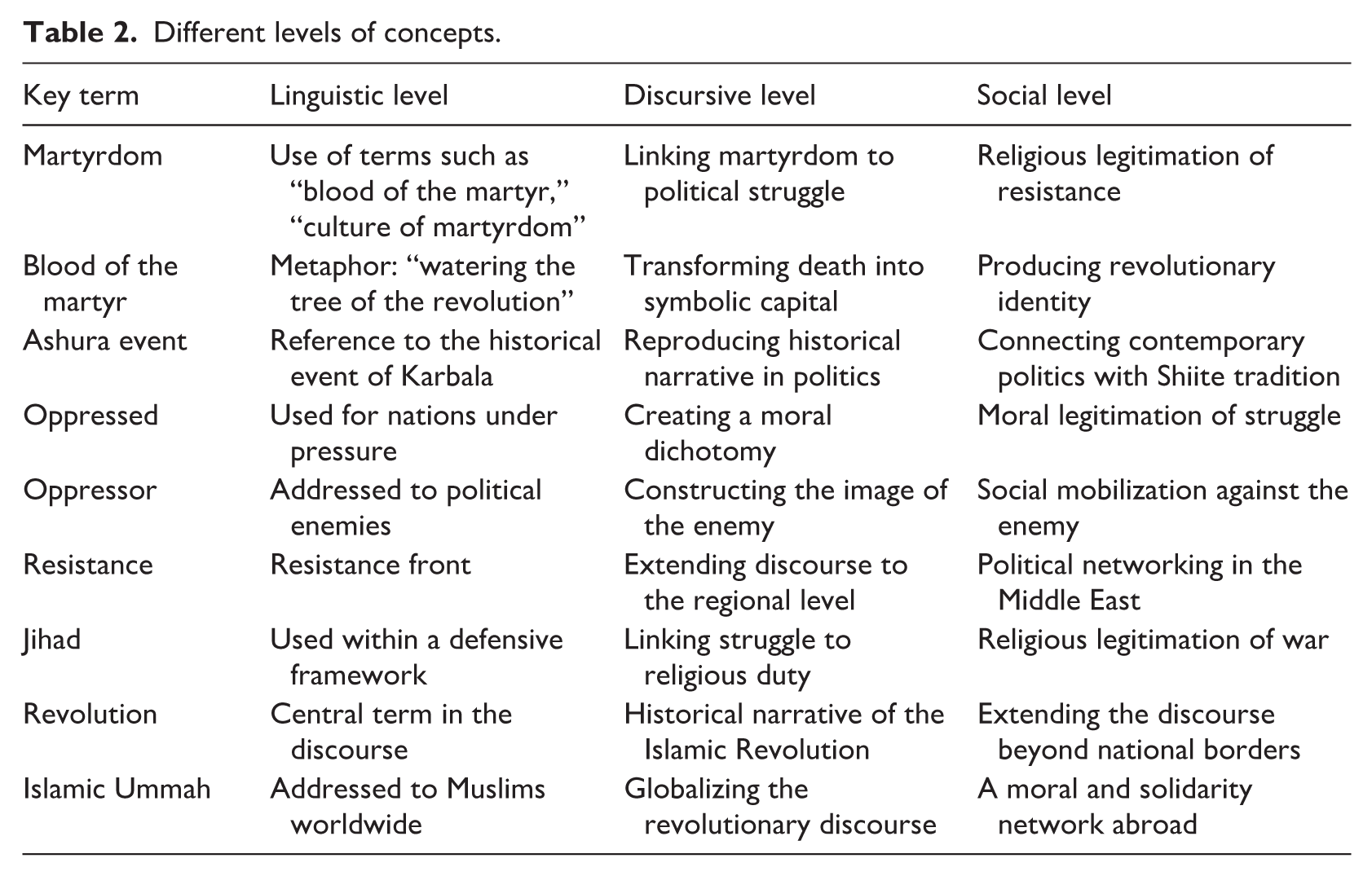
In the political discourse of the Islamic Republic, religious concepts do not function in isolation; rather, they operate as part of a coherent and interconnected semantic system. Through their internal relationships, these concepts provide a specific interpretive framework of the world, in which politics, ethics, and religion are deeply intertwined. Within this framework, the concept of the Islamic Revolution serves as both the point of departure and one of the central signifiers of the discourse.
In Ayatollah Khomeini’s expression, the revolution is not merely a political transformation but an “explosion of light,” a metaphor indicating that the revolution is represented as a sacred event carrying divine truth, transcending conventional political boundaries. This representation transforms the revolution from a historical event into a continuous source of legitimacy and meaning. In Ayatollah Khamenei’s discourse, this significance continues, with the added dimension that the revolution is presented as a civilizational model, capable of being exported to other societies.
Extending from this central signifier, the concept of the oppressed emerges as a primary subject within the discourse. In Ayatollah Khomeini’s thought, the oppressed are not merely a social class but a historical and global position encompassing all nations under domination. His emphasis on “supporting the oppressed everywhere in the world” demonstrates that this concept transcends national boundaries, becoming a transnational category. From a discourse-analytical perspective, the oppressed function as an identity-shaping signifier, enabling the discourse to position itself as aligned with “justice” and moral legitimacy.
In contrast, the concept of “the arrogant” or “global arrogance” functions discourse-wise as an “Other.” In the speeches of Ayatollah Khomeini and later Ayatollah Khamenei, this concept is applied to forces that use their power to dominate others. From a discursive perspective, the arrogant are not merely political actors but a negative semantic structure through which the positive identity of the oppressed is reinforced. This aligns with what Laclau and Mouffe (2001) describe as the “constitutive other.”
The oppressor–oppressed conflict is, at a deeper level, represented as the tyrant–victim opposition. This opposition transforms the political world into a moral structure, where actions are evaluated not based on interests but on justice or injustice. Such a representation moves foreign policy beyond mere calculation and into the realm of moral–religious judgment. Within this framework, the concept of the Islamic Ummah serves as a unifying element. In Ayatollah Khamenei’s speeches, the Islamic Ummah is presented as a single, integrated entity that transcends geographical boundaries. From a discursive standpoint, this concept functions to create a transnational collective subject capable of carrying and implementing the discourse. In other words, the Islamic Ummah is a container in which the oppressed acquire meaning and gain the capacity for collective action.
Following this semantic chain, the concepts of jihad and resistance emerge as practical mechanisms of the discourse. In Ayatollah Khamenei’s discourse, jihad extends beyond its limited military meaning to encompass cultural, economic, and scientific spheres as well. This semantic expansion transforms jihad into a permanent model of action. Concurrently, resistance is defined as a strategy to confront the system of domination. Discursively, resistance serves as a mechanism through which the chain of concepts moves from the level of meaning to the level of practice.
At the top of this chain lies the concept of martyrdom, which plays a particularly special role. In Ayatollah Khomeini’s thought, martyrdom is not a sign of defeat but the highest form of victory. This conceptualization is one of the most significant discursive innovations, as it allows the discourse to remain resilient even under material defeat. In other words, martyrdom is a semantic mechanism that prevents the collapse of the discourse.
The concept of the blood of the martyr complements this function. When Ayatollah Khomeini speaks of the revolution being “insured by the blood of the martyrs,” he establishes a direct link between individual sacrifice and the survival of the discourse. Similarly, in Ayatollah Khamenei’s discourse, the emphasis on “keeping the memory of the martyrs alive” demonstrates that this concept plays a crucial role in the continuous reproduction of the discourse. Overall, these concepts form a semantic equivalence chain that begins with the revolution and culminates in martyrdom:
Revolution → the oppressed → the Islamic Ummah → resistance → jihad → martyrdom
This chain stands in opposition to a chain of negative concepts:
Arrogance → oppression → the system of domination
From a discourse analysis perspective, this structure reflects a bipolar and antagonistic semantic system in which political identity is constituted through opposition to the “Other.” Ultimately, the discourses of Ayatollah Khomeini and Ayatollah Khamenei demonstrate how religious concepts can offer a coherent framework for meaning production, identity formation, and political action. This discourse not only shapes the way the world is understood but also directly influences foreign policy, putting international relations within a moral narrative of the struggle between right and wrong.
Discussion
A discussion of Iran’s religious narrative requires a closer examination of how Islamic principles, particularly those rooted in Shi’a Islam, shape both ideological and practical dimensions of foreign policy. At the core of Iran’s approach lies a complex interaction between religious teachings, political pragmatism, and strategic interests. This religious foundation functions as a fundamental framework guiding Iran’s positioning within the international system. Iran has integrated religion as a source of legitimacy and as a means to advance its geopolitical objectives. Religious principles inform support for specific movements and contribute to alliances with non-state actors across the region under the banner of Islamic solidarity and opposition to foreign domination. This combination of religious legitimacy with pragmatic foreign policy goals allows Iran to extend its influence beyond its borders while maintaining a moral narrative that appeals to both domestic and international audiences, particularly in the Global South (van den Bos, 2017).
Iran often presents itself as a defender of marginalized groups in the Middle East, and its support for proxy forces and political movements reflects both ideological commitment and geopolitical considerations. Iran’s foreign policy takes a pragmatic form as it balances revolutionary ideals with diplomatic necessities (Ramazani, 2004s: 557–559). This dichotomy is evident in Tehran’s support for Hezbollah and its engagement in Syria, which are framed domestically as defense of oppressed Muslim populations and resistance to Western dominance, while also serving to consolidate Iran’s regional influence in the Levant (Osiewicz, 2021: 185).
Official discourse frames Iran’s regional engagements in Syria, Iraq, and Yemen as efforts to protect vulnerable communities and counter external threats, though these engagements have also prompted opposing stances from other regional actors and brought broader regional consequences. Such policies have contributed to competition with neighboring countries, presented Iran with political and economic considerations amid prolonged regional instability, and intersected with hard situations that international observers often discuss in the context of military competition among multiple actors.
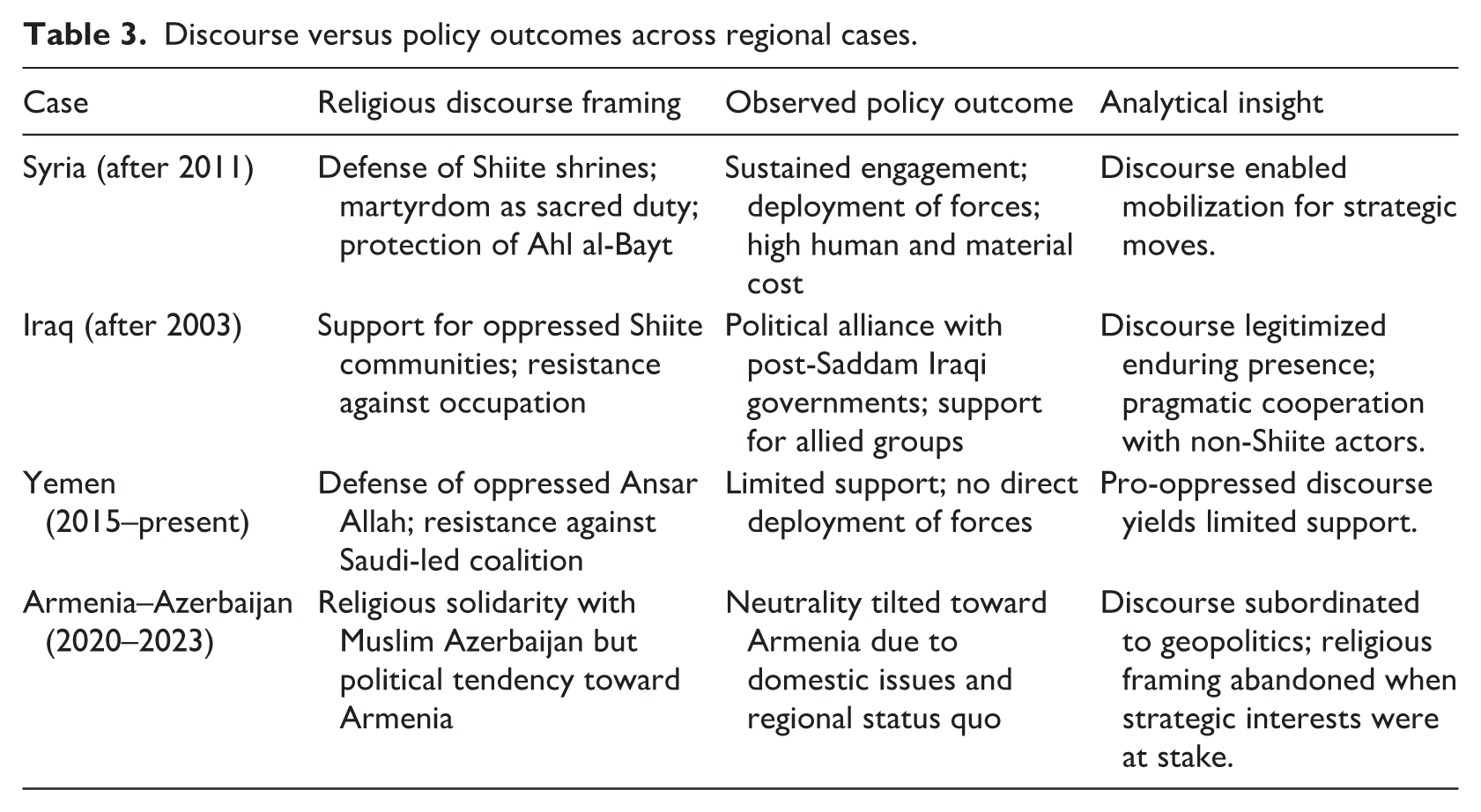
A closer examination of Iran’s stance in the Armenia–Azerbaijan conflict reveals how regional power shifts and material considerations interact with ideological commitments. Although Iran invokes a religious narrative centered on support for Muslim communities and solidarity with the Ummah, its alignment with predominantly Christian Armenia during the heightened tensions of 2020 and 2023 illustrates how geopolitical factors can complement or qualify ideological positions. This combination of domestic and geopolitical factors means that, in the Armenia–Azerbaijan case, Iran’s religious framework operates alongside other strategic considerations. Tehran’s emphasis on defending Muslims is applied contextually and can shift to protect its territorial, economic, or security interests.
The divergence between ideological discourse and political behavior in this case illustrates a broader pattern in which religious narratives used to justify foreign policy can be adjusted according to circumstances. By highlighting this case, the analysis underscores that Iran’s foreign policy cannot be understood as a linear reflection of religious doctrine; rather, it operates in a field of competing pressures where ideology is continually subordinate to strategic requirements.
In this regard, four alternative explanations of Iran’s foreign policy appear in the literature. Realist power projection emphasizes balancing against the United States through alliances with Russia and China. Survival strategies prioritize domestic security above all other goals. Identity-based explanations emphasize the role of shared religious affiliation in shaping regional alignments. Coercive regional influence focuses on proxy networks as instruments of asymmetric power projection (Cingöz et al., 2024).
These explanations remain partial. Each treats material interest or identity as fixed while overlooking how foreign policy requires continuous legitimation. Discourse analysis complements these approaches by demonstrating how religious narratives transform strategic choices into moral obligations. Balancing becomes “anti-hegemony.” Political survival becomes “defense of the revolution.” Foreign policy objectives interest becomes “support for the oppressed.” Coercion becomes “resistance.” The discursive framework does not replace realism or regime survival theory. It adds the legitimizing and mobilizing dimension that purely materialist explanations cannot capture (Wastnidge and Mabon, 2024).
Regarding multipolarity, although Iranian officials present it as a desirable alternative to US-led hegemony, pursuing such an order also introduces strategic uncertainties that complicate Tehran’s long-term foreign policy outlook. Alignment with emerging powers such as Russia and China may alleviate immediate pressures, but it simultaneously carries three specific risks. First, dependency risks in energy markets, defense cooperation, and regional connectivity could create new forms of dependency that constrain Iran’s strategic autonomy. Second, the fragmentation of global governance associated with multipolar competition may weaken international norms and institutions, which middle powers and sanctioned states often rely upon as diplomatic leverage. Third, structural vulnerabilities embedded in asymmetric partnerships with larger powers may limit Iran’s maneuvering space within a competitive international system. From this perspective, Iran’s engagement with multipolarity presents not only opportunities to counter Western hegemony but also potential costs that could constrain its foreign policy flexibility over time. The limitations of this approach became tangible during Iran’s war with the United States and Israel in 2025 and 2026, when alignment with Russia and China did not translate into direct operational support, revealing the gap between multipolar demands and actual great power behavior. For Iran, this experience underscored that multipolar arrangements carry asymmetric costs without guaranteeing reciprocal commitment from larger partners. A balanced assessment therefore requires acknowledging both the attractions of multipolarity and its inherent uncertainties for a middle power like Iran (Akbarzadeh, 2025; Asisian, 2022; Thomas, 2024).
The tension between ideological purity and geopolitical reality remains a central issue in analyzing Iran’s foreign policy. While the religious narrative provides a framework for legitimizing Iran’s policy, the strategic imperatives of managing a competitive regional order often compel Tehran to adopt policies that diverge from its ideological foundations. This dynamic has been particularly evident in the post-2003 environment, where Saudi Arabia pursued a comprehensive anti-Iran strategy, ranging from securitizing the expansion of Shi’a Islam to supporting regimes vulnerable to Iranian influence, such as Bahrain, and constraining Iran-aligned actors, including the diplomatic isolation of Qatar after 2017. Concurrently, Turkey’s support for Syrian opposition forces from 2011 onward ultimately contributed to the fall of Bashar al-Assad, a longtime Iranian ally, in 2024, thereby creating active regional competitors that limit Tehran’s ideological and geopolitical objectives.
Overall, these rival strategies contribute to a complex set of geopolitical dynamics within which Iran’s policies interact with competing regional projects. Consequently, Iran’s foreign policy trajectory reflects not only revolutionary discourse but also an adaptive process shaped by the diverse objectives of regional actors. These international consequences and regional dynamics are further shaped by three domestic pathways that translate internal pressures into foreign policy adaptations.
The first pathway is sanctions-induced resource scarcity. International sanctions reduce foreign exchange earnings and limit access to global financial systems, creating shrinking fiscal space for external operations. The Iranian government faces trade-offs between funding regional allies and addressing domestic needs such as subsidies, employment, and import requirements. This forces budgetary prioritization. When resource allocation shifts toward economically essential programs, selective reduction or modification of external commitments follows. The JCPOA pursuit between 2010 and 2015 exemplifies this pathway. Sustained sanctions pressure created domestic incentives for diplomatic engagement not because Iran abandoned resistance principles but because economic necessity generated domestic political demand for relief (Holliday, 2023). The discourse remained anti-hegemonic while policy shifted toward pragmatic engagement.
The second pathway is public expectations and electoral cycles. Domestic public opinion in any country prioritizes economic welfare, employment, and reduced inflation. When these priorities become salient, the political cost of foreign policy hawkishness increases. Consequently, foreign policy discourse temporarily moderates to align with public priorities. During the Rouhani administration from 2013 to 2021, foreign policy discourse shifted toward constructive engagement and win-win cooperation. Core resistance vocabulary was preserved but de-emphasized, reflecting an electoral mandate for sanctions relief. This demonstrates how public expectations actively shape the tone and emphasis of foreign policy language (Thomas, 2024).
The third pathway is factional competition and institutional oscillation. Multiple centers of power exist within Iran’s political system, including the Presidency, the Supreme National Security Council, the Islamic Revolutionary Guard Corps, and the Expediency Council. No single faction controls foreign policy exclusively. Different factions hold divergent views on the ideal balance between ideology and pragmatism, meaning policy preferences vary across institutions. As control over the foreign policy apparatus shifts with different coalitions gaining or losing influence, oscillation between hardline and pragmatic postures occurs over time. The contrast between Ahmadinejad’s confrontational discourse from 2005 to 2013 and Rouhani’s engagement-oriented language from 2013 to 2021 reflects this factional competition. Both administrations preserved core ideological commitments while emphasizing different aspects of the pragmatism ideology spectrum (Kamrava, 2023).
Discourse versus policy outcomes across regional cases.
Conclusion
This study has examined how religious narratives function within Iran’s foreign policy discourse, focusing on the speeches of Ayatollah Khomeini and Ayatollah Khamenei. The analysis demonstrates that religious concepts are not merely expressions of faith but operate as structured discursive tools that legitimize policy, mobilize collective action, and construct political identity.
The primary contribution of this study is the identification and systematic mapping of what we term the semantic chain of Iran’s foreign policy discourse: revolution → the oppressed → the Islamic Ummah → resistance → jihad → martyrdom. This chain reveals how seemingly distinct religious concepts form a coherent, interdependent system that links theological vocabulary to strategic behavior. While existing scholarship has acknowledged the role of ideology in Iran’s foreign policy, few studies have traced the internal structural logic of this discourse with explicit methodological transparency. By reconstructing this semantic chain and demonstrating its operation across different periods and policy contexts, the study offers a replicable analytical framework for examining religiously framed foreign policies beyond the Iranian case.
This study has three main limitations. First, the analysis is confined to publicly available speeches and does not include access to internal policy deliberations. Second, the focus on leadership discourse may overrepresent official ideology relative to bureaucratic or factional variations within Iran’s foreign policy apparatus. Third, while the study examines how discourse justifies policy, it does not measure the causal effect of discourse on policy outcomes.
This study contributes to debates on religion and international relations by demonstrating that religious discourse is neither empty political language nor autonomous belief. Instead, it operates as an intermediary variable that translates strategic interests into morally intelligible action while simultaneously constraining the range of acceptable policy options. This challenges purely materialist approaches without falling into cultural determinism.
For policymakers, understanding Iran’s semantic chain provides practical insight. Recognizing that concepts such as resistance and martyrdom are embedded in a structured system helps external actors distinguish between discursive red lines and genuinely non-negotiable commitments. The gap between discourse and behavior observed in cases such as Armenia–Azerbaijan and the JCPOA suggests that while Iran’s religious narrative is stable, its policy applications remain responsive to geopolitical and domestic pressures.
Future research should extend this discursive framework comparatively to other religiously framed foreign policies, including Saudi Arabia, India under Modi, or Turkey under Erdoğan. In addition, archival or interview-based research could explore how semantic chains are produced and contested within Iran’s foreign policy bureaucracy. Finally, systematic comparison between discourse and policy outcomes across multiple cases would help specify the conditions under which religious narratives most strongly constrain or enable state behavior.
Footnotes
Funding
The authors received no financial support for the research, authorship, and/or publication of this article.
Declaration of conflicting interests
The authors declared no potential conflicts of interest with respect to the research, authorship, and/or publication of this article.
